


Highlights
What are the main findings?
- •
- We have identified key factors that can foster or diminish hope in children with life-threatening illnesses and their families.
- •
- We show that hope is not just an individual trait, but is associated with external factors—many of which are modifiable.
What are the implications of the main findings?
- •
- Healthcare providers should be trained and encouraged to communicate honestly but empathetically, actively support family hope.
- •
- Another implication is the need for comprehensive family-centered care: supporting siblings, providing respite to caregivers, addressing financial questions via social work, and integrating spiritual care.
Abstract
Context: Previous studies and reviews in adult patients have shown that hope is an important coping mechanism in patients with serious health problems. Although there are individual studies in pediatric patients, there is a lack of a systematic review of how hope manifests and how it can be supported in children with life-threatening illnesses and their families. Objectives: This systematic review aims to identify the key factors that are associated with the experience of hope in pediatric palliative care. It examines how hope is fostered or diminished in children with life-limiting illnesses, their parents, and other family members. Methods: A systematic search was conducted across major medical databases for studies published between 1990 and 2024. Thematic analysis was used to identify factors associated with hope. The quality of the included studies was critically appraised. Results: Out of 1373 identified records, 105 studies met the inclusion criteria. Most studies were qualitative in design and met a high proportion of the applicable criteria in their respective design-specific appraisal tools. Factors associated with increased hope included open and empathetic communication, trusting relationships with healthcare providers, strong social and family support, spiritual and religious faith, effective symptom management, involvement in care decisions, and access to practical resources. Conversely, reduced hope was associated with poor communication, social isolation, uncontrolled symptoms, uncertainty, caregiver distress, financial strain, and negative healthcare experiences. These factors were consistent across cultural and diagnostic contexts, with some variation in emphasis. Conclusions: Hope in pediatric palliative care is associated with relational, psychological, spiritual, and systemic factors. Many of these are modifiable. A family-centered and multidisciplinary approach is essential to sustaining hope in pediatric palliative contexts.
1. Introduction
A serious illness in a child is a significant crisis situation that places many demands on the entire family system and has far-reaching consequences for the mental health of the child patients themselves, their parents, siblings, as well as the extended family [1,2]. Hope represents an important coping mechanism for all involved in these situations, even in the face of dire prognoses and terminal stages of illness [3,4,5,6]. Since most parents wish to be fully informed about the health status of their sick child, it seems reasonable to inform parents about the prognosis truthfully while leaving space for hope [7,8,9,10,11]. Parents and child patients draw hope from various sources [12], and when providing healthcare and psychosocial care, it is necessary to inquire about the family and identify individual sources of hope [13].
Targeted work with hope is exemplified in the recommended practices of the American Academy of Pediatrics for providing pediatric palliative care [9]. Healthcare staff may worry that activating the palliative care team will take hope away from families [14]. Recent work with adult patients shows that involving the palliative care team does not diminish hope; on the contrary, it can help ‘recalibrate’ it [14,15] The study by Sisk [16] demonstrates that for most parents, hope for recovery is an important source of overall hope, remaining important even in stages of illness with poor prognosis. In its overall conclusions, the study identifies other sources and forms of hope, including the importance of maintaining quality of life, availability of quality care, and accessibility of doctors and nurses, which corresponds with the results of other studies as well [5,12]. Still, clinicians may be concerned that some factors (e.g., open communication or prognostic disclosure) will reduce hope in patients and their families [17].
The aim of this review is to summarize and connect our current knowledge about the factors associated with the experience of hope. Our review question is: What factors are associated with the experience of hope in pediatric patients in palliative care, their parents or other relatives?
2. Materials and Methods
2.1. Review Design
This systematic review is reported following the Preferred Reporting Items for Systematic Review and Meta-analysis Protocol (http://www.prisma-statement.org/, accessed on 10 June 2025), in compliance with the PRISMA guidelines. The PRISMA checklist is in Supplementary Table S1. This systematic review was not prospectively registered. The heterogeneity of study designs and their results precluded the possibility of meta-analysis.
2.2. Inclusion and Exclusion Criteria
2.2.1. Population
We included studies on pediatric patients (children and adolescents, 0–19 years) and their family members who received palliative care during their illness. Although our eligibility criteria focused on pediatric participants, studies that also enrolled young adults were retained if they included children or adolescents within the predefined age range. Because all such studies contained data from the target pediatric population, they were considered eligible and were not excluded solely on the basis of including older participants. Similarly, studies with mixed participant samples that included healthcare professionals were eligible, but only if patients and/or caregivers were also represented and the reported findings were relevant to the experiences of these groups. Studies involving healthcare professionals as the sole participant group were excluded. We did not have geographical restrictions on the study population.
2.2.2. Concept
We included original works of all types—qualitative and quantitative studies, and case reports.
2.2.3. Settings
We searched for studies addressing hope and identifying variables that are associated with hope and its experiencing by the study population. Studies in which palliative care was not explicitly identified as the primary context were eligible only when the study population included children with life-threatening or life-limiting conditions and the reported findings addressed palliative-care-related aspects directly relevant to the review question.
Table 1 presents the inclusion and exclusion criteria for assessing the relevance of studies in relation to the topic of our research.
Table 1.
Inclusion and exclusion criteria.
2.3. Searches
The search for this systematic review was conducted separately in PubMed, and in Academic Search Ultimate, APA PsycArticles, APA PsycInfo, MEDLINE Complete, and SocINDEX via EBSCO databases. We searched in all languages, within the data range from January 1990 to December 2024. At the same time, we were conducting follow-up searches on citations found in included studies. The search formula using relevant keywords and MeSH terms for all included databases is in Supplementary Table S2.
All search results were combined in the Rayyan platform (www.rayyan.ai) and duplicates were eliminated automatically. In the next phase, two researchers independently evaluated abstracts, determining whether to include them for further analysis. This process was completely manual. Discrepancies were then resolved by the two reviewers through discussion, with the assistance of a third researcher.
In preparing this review study, we also decided to include Large Language Models (LLMs). We used LLM ChatGPT-4o to analyze the full texts of studies (with the aim to help to decide whether to include certain studies, according to the criteria listed in Table 1), and to extract studied variables associated with hope. All results of the automated analysis were subsequently evaluated against full text of studies and rigorously manually edited by the main author of this publication. Therefore, the LLM served only as a “copilot” accelerating the work and preventing possible errors of oversight, as recommended by guidelines for the use of LLM in literature reviews [18,19,20].
2.4. Quality Appraisal
The methodological quality of the included studies was appraised using the design-specific critical appraisal tools developed by the Joanna Briggs Institute (retrieved from: https://jbi-global-wiki.refined.site/space/MANUAL, accessed on 10 June 2025). The appraisal was conducted by one reviewer (HB) and was not independently verified by a second reviewer. Each item was rated as “yes”, “no”, “unclear”, or “not applicable”. Items rated as “unclear” were treated as criteria not met, whereas “not applicable” items were excluded from the denominator.
For descriptive purposes, the number of criteria met was expressed as a percentage of all applicable items within the relevant checklist. The appraisal did not determine study inclusion and was not used to formally weight individual studies in the synthesis. All eligible studies contributed to the thematic synthesis, while study design and identified methodological limitations were considered when interpreting the findings.
2.5. Data Analysis
For consistent data extraction, we were inspired by the process described by Braun and Clarke [21] using semantic coding. The main author closely reviewed the results and findings sections of each included study and generated semantic codes capturing explicitly reported factors that were associated with increased or decreased hope among patients and their family members. The codes were kept as close as possible to the terminology and intended meaning of the original studies.
Findings from qualitative, quantitative, and mixed-methods studies were coded within the same thematic framework.
Factors were recorded in a structured coding matrix. Data extraction and initial semantic coding were performed by the main author (HB). A second reviewer (MJ) subsequently reviewed the coding matrix, category definitions, and emerging thematic structure. Uncertainties and differences in interpretation were discussed within the research team until consensus was reached. The thematic structure was developed iteratively, with codes and categories repeatedly reviewed for internal coherence, conceptual distinctiveness, and consistency with the underlying study findings.
Study design was considered during interpretation. Qualitative findings were mostly used to describe the meaning and context of each factor, whereas quantitative findings helped to indicate the direction and statistical support of the association, without directly comparing their relative strength.
When a finding did not fit the emerging framework, it was retained and discussed, and the framework was revised as necessary by modifying category definitions, reassigning codes, or creating a new category.
Due to the heterogeneity of source studies and the data reported, statistical analysis of data was not possible.
3. Results
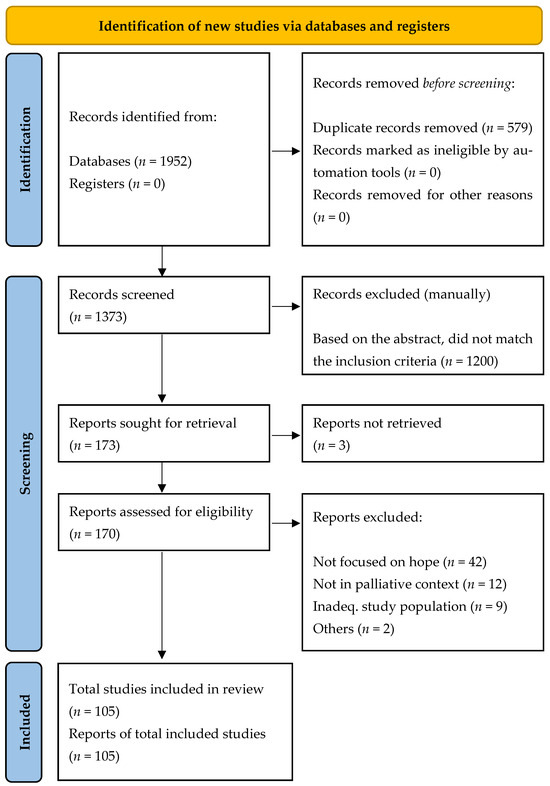
Out of 1373 articles identified by the search strategy, 173 underwent an abstract evaluation phase and after full-text evaluation, 105 articles [7,12,16,22,23,24,25,26,27,28,29,30,31,32,33,34,35,36,37,38,39,40,41,42,43,44,45,46,47,48,49,50,51,52,53,54,55,56,57,58,59,60,61,62,63,64,65,66,67,68,69,70,71,72,73,74,75,76,77,78,79,80,81,82,83,84,85,86,87,88,89,90,91,92,93,94,95,96,97,98,99,100,101,102,103,104,105,106,107,108,109,110,111,112,113,114,115,116,117,118,119,120,121,122,123] met the inclusion criteria (see Figure 1 for the PRISMA 2020 flow diagram).
Figure 1.
PRISMA 2020 flow diagram.
A description of these studies is summarized in Table 2. Most were qualitative studies or interviews, and a minority were prospective or randomized trials. The number of participants varied from one (case studies) to 546; the median was 27 and the mean was 60.3. Most studies focused exclusively on family members or other caregivers (86/105, 81.9%), whereas only 9 studies (8.5%) included patients alone, and 10 studies (9.5%) enrolled both patients and family members. Siblings were rarely represented as study participants and only one study focused exclusively on bereaved siblings.
In the patient-only group, five studies were restricted to participants aged ≤19 years, while four also included young adults (upper age limits ranging from 24 to 30 years). Among studies enrolling both patients and family members, seven included only pediatric patients, while one extended recruitment up to 25 years of age.
Six studies included healthcare professionals alongside children and/or caregivers, whereas all remaining studies enrolled only pediatric participants, caregivers, or both.
In 15 articles (14.3%), it was not possible to consistently evaluate the JBI score; the remaining studies had a score above 70%, with the majority reaching above 85%.
3.1. Hope Measurement
In the case of quantitative studies, the main tools used for evaluation of hope were the Herth hope index (six studies) and the Trait hope scale (three studies). A detailed overview is given in Table 2.
Table 2.
The characteristics of included studies (N = 105).
3.2. Factors Associated with Hope
In the reviewed studies, we identified 346 individual codes associated with increased experience of hope and 305 individual codes associated with decreased experience of hope in children in palliative care and their families. Based on the codes, 28 unique factors associated with increased experience of hope and 30 unique factors associated with decreased experience of hope were formulated. Factors were grouped into 9 and 8 thematic groups, respectively, presented in the following paragraphs. All unique codes, factors and group of factors are also listed in Supplementary Table S3.
3.3. Factors Associated with Increased Hope
3.3.1. Open Communication and Information Sharing
Clear and honest communication with healthcare providers has been shown to be a cornerstone of hope [47,69,70,80]. Parents and family members gain hope from early information, from prognostic discussions that balance realism with optimism, and from feeling that their questions are being answered openly [82,87].
3.3.2. Trusting Relationships with Healthcare Providers
In addition to the content of communication, the quality of relationships with healthcare professionals is also crucial [51,69]. Families feel hopeful when they perceive the healthcare team as caring, present, and supportive [37,41,62]. A trusting and empathetic relationship reassures parents that they are not alone, thereby reinforcing hope [49,59,82].
3.3.3. Family and Social Support & Togetherness
The majority of studies highlighted the importance of social support from family, friends and community as a crucial source of hope [27,85,94,107,113]. Strong family cohesion has been repeatedly identified as a factor that promotes hope. Parents gain hope from the presence of other family members who can share caregiving responsibilities and provide emotional comfort [31]. The possibility of staying at home with the child has also been highlighted in a number of studies as a factor that increases hope [49,59].
3.3.4. Spiritual and Religious Faith
Spirituality and faith-based practices are powerful sources of hope for many families and appear in a variety of cultural contexts. Parents often cited religious faith (belief in God or a higher plan) as helping them cope and find hope even in difficult situations [60,70,90]. Praying, participating in religious ceremonies, or receiving support from faith communities were mentioned as specific ways families strengthened their hope [31,35,92].
3.3.5. Effective Symptom Management and Comfort
Families experience greater hope when a child’s physical suffering is reduced and their comfort is maximized. Many studies have noted that effective symptom control (good pain management, relief from distressing symptoms) increases hope [35,55,87,96]. Similarly, any signs of clinical improvement in a child can generate hope [59,74,96].
3.3.6. Involvement, Control and Empowerment
Active participation in the child’s care and decision-making process is another recurring theme that is associated with reinforced hope. Families feel more hopeful when they feel they can do something meaningful for their child [42,47,117]. Being treated as a valued member of the care team and having their voice heard in decisions (such as treatment choices and end-of-life plans) empowers parents and inspires hope [36,80,104].
3.3.7. Positive Outlook and Coping Strategies
Many of the studies have highlighted that families that maintain an optimistic mindset or use active coping tend to have greater hope [7,71,75,77,103]. Examples of these factors include positive thinking, finding benefits, resilience, and determination. Cognitive reframing techniques (seeing situations in a more optimistic light) and belief in the child’s inner strength or vitality have been reported to be helpful [25,62]. Consciously building self-efficacy and self-confidence is also associated with increased hope [58].
3.3.8. Meaning-Making and Legacy Activities
Finding meaning and purpose in the terrain of illness may be another way to strengthen hope. Many parents find hope in engaging in meaningful activities with their child. This can create positive memories, which then serve as useful factors in strengthening hope. This can include celebrating milestones (birthdays, holidays, even small achievements), taking family photos, or participating in meaningful rituals [25,110,117]. These activities give families a sense of legacy and continuity and strengthen the hope that their child’s life, however short, has meaning and will be remembered [37,117]. Opportunities to say goodbye properly or fulfill a child’s wishes were also cited as hope-enhancing factors [33].
3.3.9. Financial and Practical Stability
Although financial and practical stability are less frequently discussed than psychosocial factors, several studies have identified these as important factors enabling hope [40,75,112]. When families have financial security or assistance, they can focus on caring for their child with less anxiety, thereby maintaining room for hope and for other hope fostering factors [40,107].
3.4. Factors Associated with Decreased Hope
3.4.1. Information Gaps and Conflicting Messages
Communication breakdowns have been shown to be a major obstacle to maintaining hope. Families reported that lack of information, unclear explanations, or conflicting messages from healthcare providers left them frustrated, anxious, and less hopeful [46,56,78,100,104]. Conflicting information was particularly damaging because it created confusion and distrust. Unclear or technical language can also reduce hope. When families do not fully understand their child’s condition or what to expect, they may develop inadequate fears of the future [66,75,103].
3.4.2. Social Isolation
Several studies have noted that social isolation has been linked to feelings of overwhelm and hopelessness in parents [22,27,85,88,120]. This includes situations where extended family or friends withdraw, leaving primary caregivers without a support network. Parents who have no time for themselves, are unable to work, and have little interaction outside of caregiving often report a diminishing sense of hope as their world shrinks [110,111]. For siblings, being excluded from family conversations or hospital visits has led to feelings of isolation that have diminished hope [82].
3.4.3. Child’s Deteriorating Condition and Suffering
Factors such as “the child’s deteriorating condition,” “visible suffering,” “worsening symptoms,” and frequent health crises were commonly cited as factors that reduce hope [12,25,37,53,65,95]. This is why maintaining hope is often most challenging in the final stages of illness, unless balanced by acceptance or reframed goals (e.g., hoping for comfort rather than cure) [65,113].
3.4.4. Uncertainty and Loss of Control
Not knowing what will happen or when is a psychologically draining condition. High uncertainty related to the disease has been linked to anxiety and a reduced sense of hope, as families cannot envision the future or set clear goals [25,50,55,63,64]. This goes hand in hand with a perceived loss of control, as the parents feel that nothing they do can change the outcome [26,51,59]. Bureaucratic or systemic uncertainty (such as long waits for test results or transplant availability) also contributes to this category [91,97,114,121].
3.4.5. Emotional Distress and Mental Exhaustion
Emotions such as fear, anxiety, depression, guilt, and grief can be overwhelming. Many studies have noted that parents who experienced high levels of anxiety about their child’s future or fear of their child’s death often had difficulty maintaining hope [22,40,79,103]. This can become a vicious cycle: as hope diminishes, people often feel more despair, which further diminishes hope. Interventions to break this cycle (through counseling, support groups, respite measures, etc.) are key to preventing families from spiraling into hopelessness [22,82,111].
3.4.6. Caregiver Overload
The practical burden of caring for a terminally ill child is definitely a challenging situation. In many countries, treatment for serious illnesses is often expensive [91,95,107,112], and several studies have found that financial problems are an additional source of stress, making it difficult for parents to focus on the hopeful aspects of life [31,112]. Along with financial problems, the logistical burden of caregiving can also be exhausting (frequent hospital visits, caring for other children, work, and constant caregiving). All of this can lead to caregiver burnout, which has often been cited as a factor that reduces hope [22,57,74].
3.4.7. Negative Encounters with Healthcare System
Past and current negative experiences within the healthcare system or with healthcare providers can undermine hope. For example, a qualitative report on parents of infants with chromosomal trisomy described many families encountering dehumanizing language and judgmental attitudes from healthcare staff [113]. It is not only lack of empathy, but also system-related factors in healthcare, such as fragmentation or lack of continuity of care, bureaucracy, and delays of care support, that may be linked with diminished hope [23,91,113,114,121].
3.4.8. Cultural and Spiritual Distress
Certain cultural or spiritual factors can negatively impact hope, particularly when families experience a crisis of faith or cultural conflicts in care. Perceived abandonment by God, spiritual doubts or a sense of punishment (feeling cursed or spiritually judged) can replace hope with despair [31,92]. Families also may face cultural barriers that diminish hope: stigma from their community, or cultural resistance to concepts like palliative care (e.g., when cultural backgrounds judge palliative care as “giving up”) [31,32,40,43,87].
4. Discussion
Our analysis provides a comprehensive overview of factors associated with the experience of hope in pediatric palliative care. We identified distinct factors associated with higher and lower levels of hope, highlighting the complexity of hope as a phenomenon that represents an important source of support for families in pediatric palliative care.
The preceding paragraphs have listed the dominant factors associated with the experience of hope. They show a high degree of convergence across studies. On closer inspection, some differences and nuances do emerge when considering subgroups and contexts.
Certain factors were more emphasized in specific cultural or regional contexts. For instance, religious faith and prayer were particularly salient in studies from countries with strong religious traditions (e.g., Ghana, Brazil, Malaysia, parts of the USA) [31,60,75,77,97,98]. Stigma and societal attitudes also varied by region: in some developing regions, families faced blame or gossip that hurt hope, whereas in most Western contexts, stigma was less about curses and more about isolation or lack of understanding from others [31,40,91,119].
Studies further differ in the populations studied. The majority of included studies are focused on parents, but a few show other perspectives, such as from bereaved siblings. The siblings’ perspective is aligned with many parental themes (they too wanted honest communication, involvement, and support), but siblings placed even greater emphasis on inclusion [75,82].
Further differences stem from the stage of the disease. In early or uncertain stages, many parents try to hope for a cure or long-term survival. As illness progresses and prognosis becomes poor, parents tend to redefine hope—hoping for quality of life, pain relief, or meaningful time rather than a cure [59,64,65,72].
Comparing pediatric and adult palliative populations, some notable differences can be found. Parents often feel a duty to “keep hope alive” for their child’s sake, even if personally they are exhausted [88]. In adult palliative patients, the individual’s own hope is paramount and may involve personal existential goals, for example to die at home. Adult palliative patients often emphasize peer support (e.g., support from friends or other patients) and not wanting to be a burden on family as factors in hope [124]. Regarding spirituality, our findings show that faith was a major comfort for parents, and spiritual crises could devalue hope [91]. Serious illness of their child can be an acute challenge to their previously held beliefs (“Why would God allow an innocent child to suffer?”). Adult patients, facing their own mortality, also grapple with existential questions, but some find solace in having lived a life or in afterlife beliefs [124,125,126].
Another comparison may be between parents (families) in palliative care programs and parents of children with non-palliative chronic illnesses. For parents of children with chronic but not immediately life-threatening illnesses (e.g., severe disabilities), hope factors often include advocating for the child, witnessing the child’s progress (even small milestones) [127], and receiving community inclusion [128]—partly overlapping with the themes identified in our review on palliative patients. In fact, hope might be one bridging concept across many caregiving situations: whether a child is terminally ill or has lifelong disabilities, parents need hope to cope, and they draw it from support, faith, information, and small victories.
The alignment between our findings and the other literature mentioned above underlines the importance of a few key practices. Healthcare providers should be trained and encouraged to communicate honestly but empathetically, actively supporting family hope (for example, by highlighting achievable goals or positives even while delivering tough news). Thus, the goal is a balance: a “hoping for the best, preparing for the worst” approach. Another implication is the need for comprehensive family-centered care: supporting siblings, providing respite to caregivers, addressing financial questions via social work, and integrating spiritual care. The multidisciplinary care team (including physicians of various specializations, nurses, social workers, chaplains, psychologists) is ideally positioned to target each domain of hope—physical, emotional, social, spiritual.
Despite a robust understanding of many hope factors, there remain areas for further inquiry. One recommended direction is to explore interventions that systematically enhance hope in pediatric palliative care. While the adult literature has tested hope-fostering interventions (such as dignity therapy, hope therapy, construct of “reasonable hope”, etc.) [129,130,131], in pediatrics, this is still yet emerging. Our findings suggest that multidisciplinary collaboration is the key. It seems reasonable to prospectively evaluate the contribution and effectiveness of such specifically built and trained multidisciplinary teams on fostering hope. Another research area is longitudinal studies of hope trajectories. As noted, hope is dynamic; understanding how families’ hopes evolve from diagnosis through end of life (and even into bereavement) could inform at which points certain supports are most needed. For instance, do families experience a “hope gap” when transitioning from curative to palliative intent? If so, targeted interventions at that transition (like a hope-focused consultation or a narrative intervention to help reframe hope) could be developed. Additionally, research could delve deeper into the child’s perspective on hope. We mostly extrapolate from parents, but direct voices would be valuable to tailor interventions.
It is important to acknowledge that our synthesis is only as robust as the studies underlying it. Many studies had small sample sizes or specific cultural settings, which may limit generalizability. Included studies have, perhaps even surprisingly, a relatively homogeneous direction in their conclusions. There is a possibility of publication bias: studies that identified clear “factors” might be more likely to be published, whereas those that found ambiguous results might be underrepresented. Our thematic categorization, although derived from the data, also inevitably involves subjective judgment. Most involved studies show parental reports of hope, with relatively fewer direct reports from children, and due to the small number of studies with pediatric patients as respondents, a separate sub-analysis was not performed. Most studies were from high-income countries in North America, Europe, and parts of Asia, with fewer from Africa or South America. Additionally, the concept of “hope” itself can be interpreted differently by participants. Some may think of hope in a more spiritual sense, others in a practical sense. In family therapy, the construct of “reasonable hope” exists, which may be a viable and reliable resource for clinicians with their work with clients [131]. The included studies did not typically aim to verify whether the hopes were reasonable/realistic, so we could not have explored this criterion of hope in our review. Due to different categorizations of patients into age groups across the methodologies of the included studies, our analysis did not deeply differentiate based on the child’s age. Studies that also enrolled young adults were retained if they included children or adolescents within the predefined age range. Similarly, studies including healthcare professionals alongside children and/or caregivers were retained, because all such studies contained data from the target population, although this may be a potential source of bias. Also, we included studies from both specialized and general palliative care settings based on the authors’ consensus during review process. However, we acknowledge that especially in general palliative care, where the definition is very wide, some additional, non-included studies could be seen relevant by other authors, and vice versa.
Despite these limitations, the convergence of findings across many studies lends credibility to our conclusions.
5. Conclusions
Hope is a multifaceted and vital component of the pediatric palliative care experience. Through our analysis of more than a hundred studies worldwide, we identified key factors that can nurture hope for children with life-limiting illnesses and their families, as well as factors that can diminish hope. Our findings show that hope is not merely an individual trait but strongly associated with external factors—many of which are modifiable. Supporting hope in pediatric palliative care requires a holistic approach. Medical teams must not only attend to the child’s physical symptoms but also foster open, compassionate communication and provide psychosocial and spiritual supports for the family. Interventions that strengthen family coping skills, connect families with peer support, and alleviate practical burdens are likely to pay dividends in maintaining hope.
Supplementary Materials
The following supporting information can be downloaded at https://www.mdpi.com/article/10.3390/children13081117/s1, Table S1: Prisma 2020 Checklist; Table S2: MeSH terms and EBSCO formula; Table S3: Codes, factors and group of factors associated with experience of hope. Reference [132] are cited in the supplementary materials.
Author Contributions
Conceptualization, H.B. and M.L.; methodology, M.L.; software, M.L.; validation, M.J. and M.L.; formal analysis, H.B.; investigation, H.B.; resources, M.L.; data curation, H.B.; writing—original draft preparation, H.B.; writing—review and editing, M.J. and M.L.; visualization, H.B.; supervision, M.L.; project administration, M.L.; funding acquisition, M.L. All authors have read and agreed to the published version of the manuscript.
Funding
This work was conducted as part of the authors’ regular work duties at their workplaces.
Institutional Review Board Statement
Not applicable.
Informed Consent Statement
Not applicable.
Data Availability Statement
The study protocol is available from the corresponding authors on reasonable request due to laws and regulations.
Acknowledgments
During the preparation of this work the authors used Generative AI tool LLM ChatGPT 4o (OpenAI, San Francisco, CA, USA). After using this tool, the authors reviewed and edited the content as needed and take full responsibility for the content of the publication.
Conflicts of Interest
The authors declare that there is no conflict of interest.
Abbreviations
The following abbreviations are used in this manuscript:
| ALL | Acute Lymphoblastic Leukemia |
| AYAs | Adolescents and Young Adults |
| CCHD | Complex Congenital Heart Disease |
| CHD | Congenital Heart Disease |
| ESKD | End-Stage Kidney Disease |
| HHI | Herth Hope Index |
| ICU | Intensive Care Unit |
| JBI | Joanna Briggs Institute |
| LLM | Large Language Model |
| MQLI | Multicultural Quality of Life Index |
| NICU | Neonatal Intensive Care Unit |
| PICU | Pediatric Intensive Care Unit |
| PHS | Parent Hope Scale |
| PRISMA | Preferred Reporting Items for Systematic Reviews and Meta-Analysis |
| QoL | Quality of Life |
| VAS | Visual Analog Scale |
References
- Aldridge, J.; Sourkes, B.M. The Psychological Impact of Life-Limiting Conditions on the Child. In Oxford Textbook of Palliative Care for Children; Oxford University Press: Oxford, UK, 2012; pp. 78–89. [Google Scholar]
- Siden, H.; Steele, R. Charting the Territory: Children and Families Living with Progressive Life-Threatening Conditions. Paediatr. Child Health 2015, 20, 139–144. [Google Scholar] [CrossRef] [Scilit] [PubMed][Green Version]
- Hill, D.L.; Boyden, J.Y.; Feudtner, C. Hope in the Context of Life-Threatening Illness and the End of Life. Curr. Opin. Psychol. 2023, 49, 101513. [Google Scholar] [CrossRef] [Scilit] [PubMed]
- Silveira, A.O.; Wernet, M.; Franco, L.F.; Dias, P.L.M.; Charepe, Z. Parents’ Hope in Perinatal and Neonatal Palliative Care: A Scoping Review. BMC Palliat. Care 2023, 22, 202. [Google Scholar] [CrossRef] [Scilit] [PubMed]
- Kylmä, J.; Duggleby, W.; Cooper, D.; Molander, G. Hope in Palliative Care: An Integrative Review. Palliat. Support. Care 2009, 7, 365–377. [Google Scholar] [CrossRef] [Scilit] [PubMed]
- Reder, E.A.K.; Serwint, J.R. Until the Last Breath. Arch. Pediatr. Adolesc. Med. 2009, 163, 653. [Google Scholar] [CrossRef] [Scilit] [PubMed]
- Jalmsell, L.; Lövgren, M.; Kreicbergs, U.; Henter, J.; Frost, B. Children with Cancer Share Their Views: Tell the Truth but Leave Room for Hope. Acta Paediatr. 2016, 105, 1094–1099. [Google Scholar] [CrossRef] [Scilit] [PubMed]
- Benini, F.; Papadatou, D.; Bernadá, M.; Craig, F.; De Zen, L.; Downing, J.; Drake, R.; Friedrichsdorf, S.; Garros, D.; Giacomelli, L.; et al. International Standards for Pediatric Palliative Care: From IMPaCCT to GO-PPaCS. J. Pain Symptom Manag. 2022, 63, e529–e543. [Google Scholar] [CrossRef] [Scilit] [PubMed]
- Linebarger, J.S.; Johnson, V.; Boss, R.D. Guidance for Pediatric End-of-Life Care. Pediatrics 2022, 149, e2022057011. [Google Scholar] [CrossRef] [Scilit] [PubMed]
- Mack, J.W.; Wolfe, J.; Grier, H.E.; Cleary, P.D.; Weeks, J.C. Communication About Prognosis Between Parents and Physicians of Children with Cancer: Parent Preferences and the Impact of Prognostic Information. J. Clin. Oncol. 2006, 24, 5265–5270. [Google Scholar] [CrossRef] [Scilit] [PubMed]
- Brouwer, M.A.; Maeckelberghe, E.L.M.; van der Heide, A.; Hein, I.M.; Verhagen, E.A.A.E. Breaking Bad News: What Parents Would like You to Know. Arch. Dis. Child. 2021, 106, 276–281. [Google Scholar] [CrossRef] [Scilit] [PubMed]
- Granek, L.; Barrera, M.; Shaheed, J.; Nicholas, D.; Beaune, L.; D’Agostino, N.; Bouffet, E.; Antle, B. Trajectory of Parental Hope When a Child Has Difficult-to-treat Cancer: A Prospective Qualitative Study. Psychooncology 2013, 22, 2436–2444. [Google Scholar] [CrossRef] [Scilit] [PubMed]
- Rosenberg, A.R.; Feudtner, C. What Else Are You Hoping for? Fostering Hope in Paediatric Serious Illness. Acta Paediatr. 2016, 105, 1004–1005. [Google Scholar] [CrossRef] [Scilit] [PubMed]
- Bigi, S.; Ganfi, V.; Borelli, E.; Potenza, L.; Artioli, F.; Eliardo, S.; Mucciarini, C.; Cottafavi, L.; Ferrari, U.; Lombardo, L.; et al. Perceptions of Death Among Patients with Advanced Cancer Receiving Early Palliative Care and Their Caregivers: Results from a Mixed-Method Analysis. Oncologist 2023, 28, e54–e62. [Google Scholar] [CrossRef] [Scilit] [PubMed]
- Kirby, E.; Broom, A.; MacArtney, J.; Lewis, S.; Good, P. Hopeful Dying? The Meanings and Practice of Hope in Palliative Care Family Meetings. Soc. Sci. Med. 2021, 291, 114471. [Google Scholar] [CrossRef] [Scilit] [PubMed]
- Sisk, B.A.; Kang, T.I.; Mack, J.W. Sources of Parental Hope in Pediatric Oncology. Pediatr. Blood Cancer 2018, 65, e26981. [Google Scholar] [CrossRef] [Scilit] [PubMed]
- Almack, K.; Cox, K.; Moghaddam, N.; Pollock, K.; Seymour, J. After You: Conversations between Patients and Healthcare Professionals in Planning for End of Life Care. BMC Palliat. Care 2012, 11, 15. [Google Scholar] [CrossRef] [Scilit] [PubMed]
- Cacciamani, G.E.; Collins, G.S.; Gill, I.S. ChatGPT: Standard Reporting Guidelines for Responsible Use. Nature 2023, 618, 238. [Google Scholar] [CrossRef] [Scilit] [PubMed]
- Galli, C.; Gavrilova, A.V.; Calciolari, E. Large Language Models in Systematic Review Screening: Opportunities, Challenges, and Methodological Considerations. Information 2025, 16, 378. [Google Scholar] [CrossRef] [Scilit]
- Teperikidis, L.; Boulmpou, A.; Papadopulos, C.; Biondi-Zoccai, G. Using ChatGPT to Perform a Systematic Review: A Tutorial. Minerva Cardiol. Angiol. 2024, 72, 547–567. [Google Scholar] [CrossRef] [Scilit] [PubMed]
- Braun, V.; Clarke, V. Using Thematic Analysis in Psychology. Qual. Res. Psychol. 2006, 3, 77–101. [Google Scholar] [CrossRef] [Scilit]
- Ahn, J.-A.; Lee, S. The Adaptation Process of Mothers Raising a Child with Complex Congenital Heart Disease. J. Child Health Care 2018, 22, 520–531. [Google Scholar] [CrossRef] [Scilit] [PubMed]
- Albuquerque, Y.L.; Lamy, Z.C.; Gomes, C.M.R.d.P.; Lima, S.F. Expectativas de Famílias de Crianças Elegíveis Para Cuidados Paliativos. Physis Rev. Saúde Coletiva 2024, 34, e34021. [Google Scholar] [CrossRef] [Scilit]
- Atout, M.; Hemingway, P.; Seymour, J. The Practice of Mutual Protection in the Care of Children with Palliative Care Needs: A Multiple Qualitative Case Study Approach from Jordan. J. Pediatr. Nurs. 2019, 45, e9–e18. [Google Scholar] [CrossRef] [Scilit] [PubMed]
- Bally, J.M.G.; Duggleby, W.; Holtslander, L.; Mpofu, C.; Spurr, S.; Thomas, R.; Wright, K. Keeping Hope Possible: A Grounded Theory Study of the Hope Experience of Parental Caregivers Who Have Children in Treatment for Cancer. Cancer Nurs. 2014, 37, 363–372. [Google Scholar] [CrossRef] [Scilit] [PubMed]
- Bally, J.M.G.; Burles, M.; Spurr, S.; Holtslander, L.; Hodgson-Viden, H.; Sinha, R.; Zimmer, M. Keeping Hope Possible Toolkit: The Development and Evaluation of a Psychosocial Intervention for Parents of Infants, Children and Adolescents with Life Limiting and Life Threatening Illnesses. Children 2021, 8, 218. [Google Scholar] [CrossRef] [Scilit] [PubMed]
- Barrera, M.; D’Agostino, N.; Gammon, J.; Spencer, L.; Baruchel, S. Health-Related Quality of Life and Enrollment in Phase 1 Trials in Children with Incurable Cancer. Palliat. Support. Care 2005, 3, 191–196. [Google Scholar] [CrossRef] [Scilit] [PubMed]
- Barrera, M.; Granek, L.; Shaheed, J.; Nicholas, D.; Beaune, L.; D’Agostino, N.M.; Bouffet, E.; Antle, B. The Tenacity and Tenuousness of Hope: Parental Experiences of Hope When Their Child Has a Poor Cancer Prognosis. Cancer Nurs. 2013, 36, 408–416. [Google Scholar] [CrossRef] [Scilit] [PubMed]
- Bell, M.; Biesecker, B.B.; Bodurtha, J.; Peay, H.L. Uncertainty, Hope, and Coping Efficacy among Mothers of Children with Duchenne/Becker Muscular Dystrophy. Clin. Genet. 2019, 95, 677–683. [Google Scholar] [CrossRef] [Scilit] [PubMed]
- Bennett, H.E.; Duke, S.; Richardson, A. Parent Experience of Advance Care Planning: Reconstructing Meaning—Grounded Theory. BMJ Support. Palliat. Care 2024, 14, e2726–e2736. [Google Scholar] [CrossRef] [Scilit] [PubMed]
- Boateng, E.A.; Bisiw, M.B.; Agyapomah, R.; Enyemadze, I.; Kyei-Dompim, J.; Kumi, S.P.; Boakye, D.S. A Qualitative Study on the Experiences of Family Caregivers of Children with End Stage Kidney Disease (ESKD). Biopsychosoc. Med. 2024, 18, 17. [Google Scholar] [CrossRef] [Scilit] [PubMed]
- Boursange, S.; Araneda, M.; Stalens, C.; Desguerre, I.; Barnerias, C.; Nougues, M.-C.; Isapof, A.; Quijano-Roy, S.; Blu Genestine, N.; Ouillade, L.; et al. Parents’ Dilemma: A Therapeutic Decision for Children with Spinal Muscular Atrophy (SMA) Type 1. Front. Pediatr. 2022, 10, 1062390. [Google Scholar] [CrossRef] [Scilit] [PubMed]
- Bronsema, A.; Theißen, T.; Oechsle, K.; Wikert, J.; Escherich, G.; Rutkowski, S.; Bokemeyer, C.; Ullrich, A. Looking Back: Identifying Supportive Care and Unmet Needs of Parents of Children Receiving Specialist Paediatric Palliative Care from the Bereavement Perspective. BMC Palliat. Care 2022, 21, 87. [Google Scholar] [CrossRef] [Scilit] [PubMed]
- Callaghan, E.E. Achieving Balance: A Case Study Examination of an Adolescent Coping with Life-Limiting Cancer. J. Pediatr. Oncol. Nurs. 2007, 24, 334–339. [Google Scholar] [CrossRef] [Scilit] [PubMed]
- Carnevale, F.A. The Story of Margaret and Her Family: Forced Choices, Obligations, and Hope. Pediatr. Nurs. 2004, 30, 238–241. [Google Scholar] [PubMed]
- Carr, K.; Hasson, F.; McIlfatrick, S.; Downing, J. Parents’ Experiences of Initiation of Paediatric Advance Care Planning Discussions: A Qualitative Study. Eur. J. Pediatr. 2022, 181, 1185–1196. [Google Scholar] [CrossRef] [Scilit] [PubMed]
- Carroll, K.W.; Mollen, C.J.; Aldridge, S.; Hexem, K.R.; Feudtner, C. Influences on Decision Making Identified by Parents of Children Receiving Pediatric Palliative Care. AJOB Prim. Res. 2012, 3, 1–7. [Google Scholar] [CrossRef] [Scilit] [PubMed]
- Drouin, K.; Hayes, A.; Archer, E.; Miller, E.G.; Hildenbrand, A.K. Virtual Support for Bereaved Parents: Acceptability, Feasibility, and Preliminary Efficacy of HOPE Group. J. Palliat. Med. 2024, 28, 508–512. [Google Scholar] [CrossRef] [Scilit] [PubMed]
- Dutta, O.; Tan-Ho, G.; Low, X.C.; Tan, T.H.B.; Ganapathy, S.; Car, J.; Ho, R.M.-H.; Miao, C.Y.; Ho, A.H.Y. Acceptability and Feasibility of a Pilot Randomized Controlled Trial of Narrative E-Writing Intervention (NeW-I) for Parent-Caregivers of Children with Chronic Life-Threatening Illnesses in Singapore. BMC Palliat. Care 2022, 21, 59. [Google Scholar] [CrossRef] [Scilit] [PubMed]
- Effendy, C.; Uligraff, D.K.; Sari, S.H.; Angraini, F.; Chandra, L. Experiences of Family Caregivers of Children with Cancer While Receiving Home-Based Pediatric Palliative Care in Indonesia: A Qualitative Study. BMC Palliat. Care 2022, 21, 104. [Google Scholar] [CrossRef] [Scilit] [PubMed]
- Einarsdóttir, J. Emotional Experts: Parents’ Views on End-of-Life Decisions for Preterm Infants in Iceland. Med. Anthropol. Q. 2009, 23, 34–50. [Google Scholar] [CrossRef] [Scilit] [PubMed]
- Erby, L.H.; Rushton, C.; Geller, G. “My Son Is Still Walking”: Stages of Receptivity to Discussions of Advance Care Planning Among Parents of Sons with Duchenne Muscular Dystrophy. Semin. Pediatr. Neurol. 2006, 13, 132–140. [Google Scholar] [CrossRef] [Scilit] [PubMed]
- Falkenburg, J.L.; van Dijk, M.; Tibboel, D.; Ganzevoort, R.R. The Fragile Spirituality of Parents Whose Children Died in the Pediatric Intensive Care Unit. J. Health Care Chaplain. 2020, 26, 117–130. [Google Scholar] [CrossRef] [Scilit] [PubMed]
- Feudtner, C.; Carroll, K.W.; Hexem, K.R.; Silberman, J.; Kang, T.I.; Kazak, A.E. Parental Hopeful Patterns of Thinking, Emotions, and Pediatric Palliative Care Decision Making. Arch. Pediatr. Adolesc. Med. 2010, 164, 831–839. [Google Scholar] [CrossRef] [Scilit] [PubMed]
- Fonseca, R.; Carvalho, M.; Querido, A.; Figueiredo, M.H.; Bally, J.; Charepe, Z. Therapeutic Letters: A Qualitative Study Exploring Their Influence on the Hope of Parents of Children Receiving Pediatric Palliative Care in Portugal. J. Spec. Pediatr. Nurs. 2021, 26, e12325. [Google Scholar] [CrossRef] [Scilit] [PubMed]
- Gengler, A.M. “He’s Doing Fine”: Hope Work and Emotional Threat Management Among Families of Seriously Ill Children. Symb. Interact. 2015, 38, 611–630. [Google Scholar] [CrossRef] [Scilit]
- Ghoshal, A.; Muckaden, M.A.; Garg, C.; Iyengar, J.; Ganpathy, K.V.; Damani, A.; Deodhar, J.; Vora, T.; Chinnaswamy, G. Parents’ Experiences with Prognosis Communication in Advanced Pediatric Cancers. Prog. Palliat. Care 2023, 31, 154–160. [Google Scholar] [CrossRef] [Scilit]
- Graetz, D.; Rivas, S.; Fuentes, L.; Cáceres-Serrano, A.; Ferrara, G.; Antillon-Klussmann, F.; Metzger, M.; Rodriguez-Galindo, C.; Mack, J.W. The Evolution of Parents’ Beliefs about Childhood Cancer during Diagnostic Communication: A Qualitative Study in Guatemala. BMJ Glob. Health 2021, 6, e004653. [Google Scholar] [CrossRef] [Scilit] [PubMed]
- Guon, J.; Wilfond, B.S.; Farlow, B.; Brazg, T.; Janvier, A. Our Children Are Not a Diagnosis: The Experience of Parents Who Continue Their Pregnancy after a Prenatal Diagnosis of Trisomy 13 or 18. Am. J. Med. Genet. A 2014, 164, 308–318. [Google Scholar] [CrossRef] [Scilit] [PubMed]
- Haase, J.E.; Kintner, E.K.; Robb, S.L.; Stump, T.E.; Monahan, P.O.; Phillips, C.; Stegenga, K.A.; Burns, D.S. The Resilience in Illness Model Part 2: Confirmatory Evaluation in Adolescents and Young Adults with Cancer. Cancer Nurs. 2017, 40, 454–463. [Google Scholar] [CrossRef] [Scilit] [PubMed]
- Harris, K.W.; Hammack-Aviran, C.M.; Brelsford, K.M.; Kavanaugh-McHugh, A.; Clayton, E.W. Mapping Parents’ Journey Following Prenatal Diagnosis of CHD: A Qualitative Study. Cardiol. Young 2023, 33, 1387–1395. [Google Scholar] [CrossRef] [Scilit] [PubMed]
- Hendricks-Ferguson, V.L.; Pradhan, K.; Shih, C.-S.; Gauvain, K.M.; Kane, J.R.; Liu, J.; Haase, J.E. Pilot Evaluation of a Palliative and End-of-Life Communication Intervention for Parents of Children with a Brain Tumor. J. Pediatr. Oncol. Nurs. 2017, 34, 203–213. [Google Scholar] [CrossRef] [Scilit] [PubMed]
- Hill, D.L.; Nathanson, P.G.; Carroll, K.W.; Schall, T.E.; Miller, V.A.; Feudtner, C. Changes in Parental Hopes for Seriously Ill Children. Pediatrics 2018, 141, e20173549. [Google Scholar] [CrossRef] [Scilit] [PubMed]
- Hill, D.L.; Nathanson, P.G.; Fenderson, R.M.; Carroll, K.W.; Feudtner, C. Parental Concordance Regarding Problems and Hopes for Seriously Ill Children: A Two-Year Cohort Study. J. Pain Symptom Manag. 2017, 53, 911–918. [Google Scholar] [CrossRef] [Scilit] [PubMed]
- Hill, D.L.; Miller, V.A.; Hexem, K.R.; Carroll, K.W.; Faerber, J.A.; Kang, T.; Feudtner, C. Problems and Hopes Perceived by Mothers, Fathers and Physicians of Children Receiving Palliative Care. Health Expect. 2015, 18, 1052–1065. [Google Scholar] [CrossRef] [Scilit] [PubMed]
- Hinton, D.; Kirk, S. Living with Uncertainty and Hope: A Qualitative Study Exploring Parents’ Experiences of Living with Childhood Multiple Sclerosis. Chronic Illn. 2017, 13, 88–99. [Google Scholar] [CrossRef] [Scilit] [PubMed]
- Hjorth, E.; Lövgren, M.; Kreicbergs, U.; Sejersen, T.; Asaba, E. “Suddenly We Have Hope That There Is a Future”: Two Families’ Narratives When a Child with Spinal Muscular Atrophy Receives a New Drug. Int. J. Qual. Stud. Health Well-Being 2021, 16, 1904722. [Google Scholar] [CrossRef] [Scilit] [PubMed]
- Hullmann, S.E.; Fedele, D.A.; Molzon, E.S.; Mayes, S.; Mullins, L.L. Posttraumatic Growth and Hope in Parents of Children with Cancer. J. Psychosoc. Oncol. 2014, 32, 696–707. [Google Scholar] [CrossRef] [Scilit] [PubMed]
- Chong, P.H.; Walshe, C.; Hughes, S. A Good Death in the Child with Life Shortening Illness: A Qualitative Multiple-Case Study. Palliat. Med. 2021, 35, 1878–1888. [Google Scholar] [CrossRef] [Scilit] [PubMed]
- Chong, A.S.S.; Bin Ahmad, M.; Alias, H.; Iqbal Hussain, R.B.; Bin Lateh, A.; Chan, C.M.H. Spiritual Coping Among Families of Children with Cancer: A Qualitative Study. Asia Pac. J. Public Health 2023, 35, 408–412. [Google Scholar] [CrossRef] [Scilit] [PubMed]
- Janvier, A.; Farlow, B.; Barrington, K.J.; Bourque, C.J.; Brazg, T.; Wilfond, B. Building Trust and Improving Communication with Parents of Children with Trisomy 13 and 18: A Mixed-Methods Study. Palliat. Med. 2020, 34, 262–271. [Google Scholar] [CrossRef] [Scilit] [PubMed]
- Janvier, A.; Farlow, B.; Barrington, K.J. Parental Hopes, Interventions, and Survival of Neonates with Trisomy 13 and Trisomy 18. Am. J. Med. Genet. C Semin. Med. Genet. 2016, 172, 279–287. [Google Scholar] [CrossRef] [Scilit] [PubMed]
- Kaemingk, B.D.; Carroll, K.; Thorvilson, M.J.; Schaepe, K.S.; Collura, C.A. Uncertainty at the Limits of Viability: A Qualitative Study of Antenatal Consultations. Pediatrics 2021, 147, e20201865. [Google Scholar] [CrossRef] [Scilit] [PubMed]
- Kamihara, J.; Nyborn, J.A.; Olcese, M.E.; Nickerson, T.; Mack, J.W. Parental Hope for Children with Advanced Cancer. Pediatrics 2015, 135, 868–874. [Google Scholar] [CrossRef] [Scilit] [PubMed]
- Kars, M.C.; Grypdonck, M.H.F.; Beishuizen, A.; Meijer-van den Bergh, E.M.M.; van Delden, J.J.M. Factors Influencing Parental Readiness to Let Their Child with Cancer Die. Pediatr. Blood Cancer 2010, 54, 1000–1008. [Google Scholar] [CrossRef] [Scilit] [PubMed]
- Kiefer, P.; Kirschner, J.; Pechmann, A.; Langer, T. Experiences of Caregivers of Children with Spinal Muscular Atrophy Participating in the Expanded Access Program for Nusinersen: A Longitudinal Qualitative Study. Orphanet J. Rare Dis. 2020, 15, 194. [Google Scholar] [CrossRef] [Scilit] [PubMed]
- Kim, M.; Kim, K.; Kim, J. Impact of Resilience on the Health-related Quality of Life of Adolescents with a Chronic Health Problem: A Structural Equation Approach. J. Adv. Nurs. 2019, 75, 801–811. [Google Scholar] [CrossRef] [Scilit] [PubMed]
- Kim, J.Y.; Park, B.K. The Most Important Aspects for a Good Death: Perspectives from Parents of Children with Cancer. Inq. J. Health Care Organ. Provis. Financ. 2021, 58, 1–12. [Google Scholar] [CrossRef] [Scilit] [PubMed]
- Koch, A.; Albrecht, T.; Kozhumam, A.S.; Son, H.; Brandon, D.; Docherty, S.L. Crossroads of Parental Decision Making: Intersections of Hope, Communication, Relationships, and Emotions. J. Child Health Care 2023, 27, 300–315. [Google Scholar] [CrossRef] [Scilit] [PubMed]
- Kolmar, A.; Kamal, A.H.; Steinhauser, K.E. “Between Wings of Hope and Fear”: Muslim Parents’ Experiences with the American Health Care System. J. Palliat. Med. 2023, 26, 73–78. [Google Scholar] [CrossRef] [Scilit] [PubMed]
- Larson, E. Reframing the Meaning of Disability to Families: The Embrace of Paradox. Soc. Sci. Med. 1998, 47, 865–875. [Google Scholar] [CrossRef] [Scilit] [PubMed]
- Lau, N.; Bradford, M.C.; Steineck, A.; Junkins, C.C.; Yi-Frazier, J.P.; McCauley, E.; Rosenberg, A.R. Exploratory Analysis of Treatment Response Trajectories in the PRISM Trial: Models of Psychosocial Care. Psycho-Oncology 2019, 28, 1470–1476. [Google Scholar] [CrossRef] [Scilit] [PubMed]
- Layshock, M.N.; Porter, A.S.; Bogetz, J.F.; McLachlan, L.; Weill, S.; Rosenberg, A.; Winger, J.G.; Houtrow, A.; Noll, R.B.; Schenker, Y.; et al. Experiences in Coping with Stress—A Qualitative Study of Family Caregivers of Children with Medical Complexity. Children 2024, 11, 1151. [Google Scholar] [CrossRef] [Scilit] [PubMed]
- Lee, S.; Ahn, J.-A. Experiences of Mothers Facing the Prognosis of Their Children with Complex Congenital Heart Disease. Int. J. Environ. Res. Public Health 2020, 17, 7134. [Google Scholar] [CrossRef] [Scilit] [PubMed]
- Leite, A.C.A.B.; García-Vivar, C.; DeMontigny, F.; Nascimento, L.C. Waves of Family Hope: Narratives of Families in the Context of Pediatric Chronic Illness. Rev. Lat.-Am. Enferm. 2021, 29, e3504. [Google Scholar] [CrossRef] [Scilit] [PubMed]
- Levine, D.R.; Cuviello, A.; Nelson, C.; Lu, Z.; Mandrell, B.N.; Baker, J.N. Hope-Colored Glasses: Perceptions of Prognosis Among Pediatric Oncology Patients and Their Parents. JCO Oncol. Pract. 2021, 17, e730–e739. [Google Scholar] [CrossRef] [Scilit] [PubMed]
- Levine, D.R.; Van Noy, K.; Talleur, A.C.; Snyder, A.; Kaye, E.C.; Baker, J.N. Thoughts from the Threshold: Patient and Family Hopes, Fears, Values, and Goals at the Onset of Pediatric Hematopoietic Cell Transplantation. Bone Marrow Transplant. 2020, 55, 1103–1113. [Google Scholar] [CrossRef] [Scilit] [PubMed]
- Lin, S.-C.; Huang, M.-C. Consulting with a Folk Deity before Making Decisions: Spiritual Practices in Parents Facing End-of-Life Decisions for Their Child on Life Support with Brain Stem Dysfunction. Int. J. Qual. Stud. Health Well-Being 2020, 15, 1756686. [Google Scholar] [CrossRef] [Scilit] [PubMed]
- Liu, S.-M.; Lin, H.-R.; Lu, F.L.; Lee, T.-Y. Taiwanese Parents’ Experience of Making a “Do Not Resuscitate” Decision for Their Child in Pediatric Intensive Care Unit. Asian Nurs. Res. (Korean Soc. Nurs. Sci.) 2014, 8, 29–35. [Google Scholar] [CrossRef] [Scilit] [PubMed]
- Lotz, J.D.; Daxer, M.; Jox, R.J.; Borasio, G.D.; Führer, M. “Hope for the Best, Prepare for the Worst”: A Qualitative Interview Study on Parents’ Needs and Fears in Pediatric Advance Care Planning. Palliat. Med. 2017, 31, 764–771. [Google Scholar] [CrossRef] [Scilit] [PubMed]
- Lou, H.-L.; Mu, P.-F.; Wong, T.-T.; Mao, H.-C. A Retrospective Study of Mothers’ Perspectives of the Lived Experience of Anticipatory Loss of a Child from a Terminal Brain Tumor. Cancer Nurs. 2015, 38, 298–304. [Google Scholar] [CrossRef] [Scilit] [PubMed]
- Lövgren, M.; Bylund-Grenklo, T.; Jalmsell, L.; Wallin, A.E.; Kreicbergs, U. Bereaved Siblings’ Advice to Health Care Professionals Working with Children with Cancer and Their Families. J. Pediatr. Oncol. Nurs. 2016, 33, 297–305. [Google Scholar] [CrossRef] [Scilit] [PubMed]
- Mahoney, A.F.; Handberg, C. New Medicine for Neuromuscular Diseases: An Evolving Paradox for Patient and Family Hopes and Expectations. Nurs. Inq. 2023, 30, e12527. [Google Scholar] [CrossRef] [Scilit] [PubMed]
- Maikranz, J.M.; Steele, R.G.; Dreyer, M.L.; Stratman, A.C.; Bovaird, J.A. The Relationship of Hope and Illness-Related Uncertainty to Emotional Adjustment and Adherence Among Pediatric Renal and Liver Transplant Recipients. J. Pediatr. Psychol. 2006, 32, 571–581. [Google Scholar] [CrossRef] [Scilit] [PubMed]
- Manor-Binyamini, I.; Schreiber-Divon, M. Listening to Parents of Children with Cancer—Between Life and Its End. J. Patient Exp. 2022, 9, 23743735221106589. [Google Scholar] [CrossRef] [Scilit] [PubMed]
- Marron, J.M.; Cronin, A.M.; Kang, T.I.; Mack, J.W. Intended and Unintended Consequences: Ethics, Communication, and Prognostic Disclosure in Pediatric Oncology. Cancer 2018, 124, 1232–1241. [Google Scholar] [CrossRef] [Scilit] [PubMed]
- Martinez, I.; Currie, E.; Davis, E.S.; Kumar, R.; Lawhon, V.; Snaman, J.M.; Tefera, R.B.; Bhatia, S.; Rosenberg, A.R.; Johnston, E.E. Bereaved Parent Preferences on Quality End-of-life Care for Children with Cancer in the South. Cancer 2024, 130, 4315–4333. [Google Scholar] [CrossRef] [Scilit] [PubMed]
- Misko, M.D.; dos Santos, M.R.; Ichikawa, C.R.d.F.; de Lima, R.A.G.; Bousso, R.S. The Family’s Experience of the Child and/or Teenager in Palliative Care: Fluctuating between Hope and Hopelessness in a World Changed by Losses. Rev. Lat.-Am. Enferm. 2015, 23, 560–567. [Google Scholar] [CrossRef] [Scilit] [PubMed]
- Moody, K.M.; Hendricks-Ferguson, V.L.; Baker, R.; Perkins, S.; Haase, J.E. A Pilot Study of the Effects of COMPLETE: A Communication Plan Early Through End of Life, on End-of-Life Outcomes in Children with Cancer. J. Pain Symptom Manag. 2020, 60, 417–421. [Google Scholar] [CrossRef] [Scilit] [PubMed]
- Nafratilova, M.; Allenidekania, A.; Wanda, D. Still Hoping for a Miracle: Parents’ Experiences in Caring for Their Child with Cancer under Palliative Care. Indian J. Palliat. Care 2018, 24, 127. [Google Scholar] [CrossRef] [Scilit] [PubMed]
- Nahalla, C.K.; FitzGerald, M. The Impact of Regular Hospitalization of Children Living with Thalassaemia on Their Parents in Sri Lanka: A Phenomenological Study. Int. J. Nurs. Pract. 2003, 9, 131–139. [Google Scholar] [CrossRef] [Scilit] [PubMed]
- Nicholas, D.B.; Barrera, M.; Granek, L.; D’Agostino, N.M.; Shaheed, J.; Beaune, L.; Bouffet, E.; Antle, B. Parental Spirituality in Life-Threatening Pediatric Cancer. J. Psychosoc. Oncol. 2017, 35, 323–334. [Google Scholar] [CrossRef] [Scilit] [PubMed]
- Barros Polita, N.; de Montigny, F.; Verdon, C.; Nascimento, L.C. Les Expériences des Pères d’enfants Atteints de Récidive de Cancer. Enfances Fam. Génér. 2023, 42. [Google Scholar] [CrossRef] [Scilit]
- Popp, J.M.; Conway, M.; Pantaleao, A. Parents’ Experience with Their Child’s Cancer Diagnosis: Do Hopefulness, Family Functioning, and Perceptions of Care Matter? J. Pediatr. Oncol. Nurs. 2015, 32, 253–260. [Google Scholar] [CrossRef] [Scilit] [PubMed]
- Pourghaznein, T.; Heydari, A.; Manzari, Z.; ValizadehZare, N. “Immersion in an Ocean of Psychological Tension”: The Voices of Mothers with Children Undergoing Hemodialysis. Iran. J. Nurs. Midwifery Res. 2018, 23, 253. [Google Scholar] [CrossRef] [Scilit] [PubMed]
- Prins, S.; Linn, A.J.; van Kaam, A.H.L.C.; van de Loo, M.; van Woensel, J.B.M.; van Heerde, M.; Dijk, P.H.; Kneyber, M.C.J.; de Hoog, M.; Simons, S.H.P.; et al. Diversity of Parent Emotions and Physician Responses During End-of-Life Conversations. Pediatrics 2023, 152, e2022061050. [Google Scholar] [CrossRef] [Scilit] [PubMed]
- Rafferty, K.A. “Everything Remains Uncertain”: Theorizing Parents’ Communication About Uncertainty, Hope, and Hopelessness While Managing Complex Pediatric Chronic Conditions. Ph.D. Thesis, The University of Wisconsin-Milwaukee, Milwaukee, WI, USA, 2015. [Google Scholar]
- Rafferty, K.A.; Beck, G.; McGuire, M. When Facing Hopeful and Hopeless Experiences: Using Snyder’s Hope Theory to Understand Parents’ Caregiving Experiences for Their Medically Complex Child. J. Pediatr. Health Care 2020, 34, 542–549. [Google Scholar] [CrossRef] [Scilit] [PubMed]
- Reggio, C.; Mowbray, C.; Waldron, M.K.; Rood, A.L.; Sibilia, G.; Mooney-Doyle, K.; Hinds, P.S. “It Can Be Hard but It’s Not Bad”: Three Questions to Solicit Caregiver Perceptions of Benefits and Burdens to Participating in Pediatric Palliative Care Research. J. Palliat. Med. 2021, 24, 1641–1649. [Google Scholar] [CrossRef] [Scilit] [PubMed]
- Robert, R.; Razvi, S.; Triche, L.L.; Bruera, E.; Moody, K.M. Bereaved Parent Perspectives on End-of-Life Conversations in Pediatric Oncology. Children 2022, 9, 274. [Google Scholar] [CrossRef] [Scilit] [PubMed]
- Rosenberg, A.R.; Bradford, M.C.; Bona, K.; Shaffer, M.L.; Wolfe, J.; Baker, K.S.; Lau, N.; Yi-Frazier, J. Hope, Distress, and Later Quality of Life among Adolescent and Young Adults with Cancer. J. Psychosoc. Oncol. 2018, 36, 137–144. [Google Scholar] [CrossRef] [Scilit] [PubMed]
- Rujimora, J.; Swygert, A.; Walker, A.; McNiece, Z.; Yoon, E.; Machado, M.; Myers, K.; Richardson, E.; Lenes, E.; Hebert, L.; et al. “It Becomes a Family I’m a Part of…We Get to Carry Each Other”: Themes from Qualitative Interview of Patients Enrolled in an Inpatient Palliative Care Support Program for Adolescents and Young Adults. J. Palliat. Med. 2023, 26, 1207–1216. [Google Scholar] [CrossRef] [Scilit] [PubMed]
- Salins, N.; Muckaden, M.A.; Ghoshal, A.; Jadhav, S. Experiences of Adolescents with Cancer Attending a Tertiary Care Cancer Centre: A Thematic Analysis. Indian J. Palliat. Care 2022, 28, 428. [Google Scholar] [CrossRef] [Scilit] [PubMed]
- Samsel, C.; Reichman, J.R.; Barreto, J.A.; Brown, D.W.; Hummel, K.; Sleeper, L.A.; Blume, E.D. The Experience of Fathers of Children Hospitalised with Advanced Heart Disease. Cardiol. Young 2024, 34, 1274–1278. [Google Scholar] [CrossRef] [Scilit] [PubMed]
- Samson, A.; Tomiak, E.; Dimillo, J.; Lavigne, R.; Miles, S.; Choquette, M.; Chakraborty, P.; Jacob, P. The Lived Experience of Hope among Parents of a Child with Duchenne Muscular Dystrophy: Perceiving the Human Being beyond the Illness. Chronic Illn. 2009, 5, 103–114. [Google Scholar] [CrossRef] [Scilit] [PubMed]
- Shi, L.; Tang, W.; Zhang, H.; Zhang, Y.; Yang, H.; Wu, D.; Li, X.; Liu, L.; Liu, L.; Chen, X.; et al. The Relationship between Socioeconomic Status, Medical Accessibility, Hope and Psychological Resilience of Caregivers of Children with Chronic Kidney Disease in China: Structural Equation Model. BMC Psychol. 2024, 12, 457. [Google Scholar] [CrossRef] [Scilit] [PubMed]
- Schwartz-Attias, I.; Ash, S.; Ofir, R.; Ben Gal, Y.; Broitman, M.; Saeb, M.; Hornik-Lurie, T. Gaps in Pediatric Oncologic End of Life Care as Recounted by the Bereaved Parents in Isarel. J. Pediatr. Nurs. 2024, 75, 187–195. [Google Scholar] [CrossRef] [Scilit] [PubMed]
- Sisk, B.A.; Friedrich, A.; Blazin, L.J.; Baker, J.N.; Mack, J.W.; DuBois, J. Communication in Pediatric Oncology: A Qualitative Study. Pediatrics 2020, 146, e20201193. [Google Scholar] [CrossRef] [Scilit] [PubMed]
- Sisk, B.A.; Keenan, M.; Schulz, G.L.; Kaye, E.; Baker, J.N.; Mack, J.W.; DuBois, J.M. Interdependent Functions of Communication with Adolescents and Young Adults in Oncology. Pediatr. Blood Cancer 2022, 69, e29588. [Google Scholar] [CrossRef] [Scilit] [PubMed]
- Smith, N.R.; Bally, J.M.G.; Holtslander, L.; Peacock, S.; Spurr, S.; Hodgson-Viden, H.; Mpofu, C.; Zimmer, M. Supporting Parental Caregivers of Children Living with Life-threatening or Life-limiting Illnesses: A Delphi Study. J. Spec. Pediatr. Nurs. 2018, 23, e12226. [Google Scholar] [CrossRef] [Scilit] [PubMed]
- Soto Jansson, J.; Bjurulf, B.; Dellenmark Blom, M.; Hallböök, T.; Reilly, C. Caregiver Perceptions of the Impact of Dravet Syndrome on the Family, Current Supports and Hopes and Fears for the Future: A Qualitative Study. Epilepsy Behav. 2024, 156, 109790. [Google Scholar] [CrossRef] [Scilit] [PubMed]
- Spurr, S.; Bally, J.; Burles, M.; Mcharo, K. A Investigation into Hope, Self-Efficacy, Distress and Uncertainty in Parents Who Have a Child with a Life-Threatening or Life-Limiting Illness. J. Pediatr. Nurs. 2022, 66, e9–e15. [Google Scholar] [CrossRef] [Scilit] [PubMed]
- Szabat, M. Parental Experience of Hope in Pediatric Palliative Care: Critical Reflections on an Exemplar of Parents of a Child with Trisomy 18. Nurs. Inq. 2020, 27, e12341. [Google Scholar] [CrossRef] [Scilit] [PubMed]
- Tewani, K.; Singh, R.; Wendy, C.P.Y.; Jia Huan, H.; Jayagobi, P.; Teo, I. Understanding the Experiences of Mothers Receiving Perinatal Palliative Care: A Qualitative Study. Palliat. Med. 2023, 37, 1379–1388. [Google Scholar] [CrossRef] [Scilit] [PubMed]
- Tomlinson, D.; Hendershot, E.; Bartels, U.; Maloney, A.-M.; Armstrong, C.; Wrathall, G.; Sung, L. Concordance Between Couples Reporting Their Child’s Quality of Life and Their Decision Making in Pediatric Oncology Palliative Care. J. Pediatr. Oncol. Nurs. 2011, 28, 319–325. [Google Scholar] [CrossRef] [Scilit] [PubMed]
- Truitt, M.; Biesecker, B.; Capone, G.; Bailey, T.; Erby, L. The Role of Hope in Adaptation to Uncertainty: The Experience of Caregivers of Children with Down Syndrome. Patient Educ. Couns. 2012, 87, 233–238. [Google Scholar] [CrossRef] [Scilit] [PubMed]
- van der Geest, I.M.M.; van den Heuvel-Eibrink, M.M.; Falkenburg, N.; Michiels, E.M.C.; van Vliet, L.; Pieters, R.; Darlington, A.-S.E. Parents’ Faith and Hope during the Pediatric Palliative Phase and the Association with Long-Term Parental Adjustment. J. Palliat. Med. 2015, 18, 402–407. [Google Scholar] [CrossRef] [Scilit] [PubMed]
- Vindrola-Padros, C.; Brage, E. What Is Not, but Might Be: The Disnarrated in Parents’ Stories of Their Child’s Cancer Treatment. Soc. Sci. Med. 2017, 193, 16–22. [Google Scholar] [CrossRef] [Scilit] [PubMed]
- von Scheven, E.; Nahal, B.K.; Kelekian, R.; Frenzel, C.; Vanderpoel, V.; Franck, L.S. Getting to Hope: Perspectives from Patients and Caregivers Living with Chronic Childhood Illness. Children 2021, 8, 525. [Google Scholar] [CrossRef] [Scilit] [PubMed]
- von Scheven, E.; Braun, M.; Nahal, B.; Perito, E.R.; Brakeman, P.; Soulsby, W.D.; Quill, L.; Cuneo, A.; Franck, L.S. Voices of Hope: Leveraging Think-Aloud Cognitive Interviews to Develop a Hope Assessment Tool for Young People Living with Chronic Health Conditions. Children 2024, 11, 1396. [Google Scholar] [CrossRef] [Scilit] [PubMed]
- Wakefield, C.E.; Hetherington, K.; Robertson, E.G.; Donoghoe, M.W.; Hunter, J.D.; Vetsch, J.; Marron, J.M.; Tucker, K.M.; Marshall, G.M.; Broom, A.; et al. Hopes, Concerns, Satisfaction and Regret in a Precision Medicine Trial for Childhood Cancer: A Mixed-Methods Study of Parent and Patient Perspectives. Br. J. Cancer 2023, 129, 1634–1644. [Google Scholar] [CrossRef] [Scilit] [PubMed]
- Wong, M.G.; Heriot, S.A. Parents of Children with Cystic Fibrosis: How They Hope, Cope and Despair. Child Care Health Dev. 2008, 34, 344–354. [Google Scholar] [CrossRef] [Scilit] [PubMed]
- Zelcer, S.; Cataudella, D.; Cairney, A.E.L.; Bannister, S.L. Palliative Care of Children with Brain Tumors. Arch. Pediatr. Adolesc. Med. 2010, 164, 225. [Google Scholar] [CrossRef] [Scilit] [PubMed]
- Davis, M.P.; Lagman, R.; Parala, A.; Patel, C.; Sanford, T.; Fielding, F.; Brumbaugh, A.; Gross, J.; Rao, A.; Majeed, S.; et al. Hope, Symptoms, and Palliative Care. Am. J. Hosp. Palliat. Med. 2017, 34, 223–232. [Google Scholar] [CrossRef] [Scilit] [PubMed]
- Cotter, V.T.; Foxwell, A.M. The Meaning of Hope in the Dying. In Spiritual, Religious, and Cultural Aspects of Care; Oxford University Press: Oxford, UK, 2015; pp. 91–114. [Google Scholar]
- Hirata, M.; Kobayashi, K. Experiences with the End-of-Life Decision-Making Process in Children with Cancer, Their Parents, and Healthcare Professionals: A Systematic Review and Meta-Ethnography. J. Pediatr. Nurs. 2023, 69, e45–e64. [Google Scholar] [CrossRef] [Scilit] [PubMed]
- Kaushar, S.; Jevne, R.F.; Sobsey, D. Hope in Families of Children with Developmental Disabilities. J. Dev. Disabil. 2003, 10, 35–45. [Google Scholar]
- Novak-Pavlic, M.; Rosenbaum, P.; Di Rezze, B. Changing Directions and Expanding Horizons: Moving towards More Inclusive Healthcare for Parents of Children with Developmental Disabilities. Int. J. Environ. Res. Public Health 2023, 20, 6983. [Google Scholar] [CrossRef] [Scilit] [PubMed]
- Cheavens, J.S.; Whitted, W.M. Hope Therapy. Curr. Opin. Psychol. 2023, 49, 101509. [Google Scholar] [CrossRef] [Scilit] [PubMed]
- Zhang, Y.; Li, J.; Hu, X. The Effectiveness of Dignity Therapy on Hope, Quality of Life, Anxiety, and Depression in Cancer Patients: A Meta-Analysis of Randomized Controlled Trials. Int. J. Nurs. Stud. 2022, 132, 104273. [Google Scholar] [CrossRef] [Scilit] [PubMed]
- Weingarten, K. Reasonable hope: Construct, clinical applications, and supports. Fam. Process 2010, 49, 5–25. [Google Scholar] [CrossRef] [Scilit] [PubMed]
- Page, M.J.; McKenzie, J.E.; Bossuyt, P.M.; Boutron, I.; Hoffmann, T.C.; Mulrow, C.D.; Shamseer, L.; Tetzlaff, J.M.; Akl, E.A.; Brennan, S.E.; et al. The PRISMA 2020 statement: An updated guideline for reporting systematic reviews. BMJ 2021, 372, n71. [Google Scholar] [CrossRef] [Scilit] [PubMed]

Disclaimer/Publisher’s Note: The statements, opinions and data contained in all publications are solely those of the individual author(s) and contributor(s) and not of MDPI and/or the editor(s). MDPI and/or the editor(s) disclaim responsibility for any injury to people or property resulting from any ideas, methods, instructions or products referred to in the content. |
© 2026 by the authors. Licensee MDPI, Basel, Switzerland. This article is an open access article distributed under the terms and conditions of the Creative Commons Attribution (CC BY) license.