You are currently viewing a new version of our website. To view the old version click .

Biomedicines, Volume 13, Issue 9

September 2025 - 275 articles

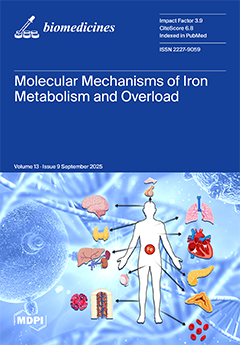
Cover Story: Iron is indispensable for life yet toxic in excess. Iron utilization is essential to normal physiologic processes across cell types. This paper explores the molecular mechanisms that maintain systemic iron balance and how their disruption leads to multi-organ disease. We outline iron's "lifecycle", key regulatory pathways, and the consequences of their failure, along with iron’s impact on systems including bone marrow, CNS, liver, kidneys, gonads, and endocrine tissues. In each of these, the dangers of overload are described, linking molecular missteps to diverse and potentially chronic syndromes. Finally, emerging therapies such as gene editing and mimetics aimed at restoring iron equilibrium are also discussed. View this paper
  • Issues are regarded as officially published after their release is announced to the table of contents alert mailing list .
  • You may sign up for email alerts to receive table of contents of newly released issues.
  • PDF is the official format for papers published in both, html and pdf forms. To view the papers in pdf format, click on the "PDF Full-text" link, and use the free Adobe Reader to open them.

Articles (275)

  • Review
  • Open Access
837 Views
15 Pages

Evolutionary Trajectory of Plasmodium falciparum: From Autonomous Phototroph to Dedicated Parasite

  • Damian Pikor,
  • Mikołaj Hurla,
  • Alicja Drelichowska and
  • Małgorzata Paul

17 September 2025

Malaria persists as a paradigmatic model of co-evolutionary complexity, emerging from the dynamic interplay among a human host, Anopheles vectors, and Plasmodium falciparum parasites. In human populations, centuries of selective pressures have sculpt...

  • Review
  • Open Access
1 Citations
2,668 Views
34 Pages

Necrotizing Enterocolitis: A Comprehensive Review on Toll-like Receptor 4-Mediated Pathophysiology, Clinical, and Therapeutic Insights

  • Asuka Ishiyama,
  • Hee-Seong Jang,
  • Jay M. Dintaman,
  • Johannes W. Duess,
  • Cody Tragesser and
  • Chhinder P. Sodhi

17 September 2025

This review integrates clinical, immunological, microbial, pathophysiological, and therapeutic perspectives on necrotizing enterocolitis (NEC)—a leading cause of morbidity and mortality in premature infants. We summarize the clinical burden and...

  • Article
  • Open Access
743 Views
13 Pages

Clopidogrel Influences Fracture Healing Under Ischemic Conditions

  • Sebastian Schreiber,
  • Janine Stutz,
  • Lukas Keller,
  • Wolfgang Metzger,
  • Tobias Fritz,
  • Christian Schönbeck,
  • David Osche,
  • Marcus Örgel,
  • Michael D. Menger and
  • Tim Pohlemann
  • + 3 authors

17 September 2025

Background/Objectives: Patients suffering from fractures are often treated with clopidogrel during the phase of bone healing due to multiple comorbidities. Studies indicate that clopidogrel suppresses osteoblast proliferation and the formation of tra...

  • Review
  • Open Access
1,122 Views
22 Pages

Reimagining Oncologic Drugs in Atherosclerosis: Emerging Mechanisms and Therapeutic Potential

  • George Liu,
  • Guillaume De Vlaminck,
  • Osayamen Atekha,
  • Eric P. Grewal,
  • Rishab Ramapriyan and
  • Gautam Agarwal

17 September 2025

Atherosclerosis is a chronic vascular disease that underlies the pathogenesis of both peripheral arterial disease and coronary artery disease, two of the leading causes of morbidity and mortality worldwide. Characterized by the accumulation of lipids...

  • Review
  • Open Access
2 Citations
1,764 Views
30 Pages

Artificial Intelligence in the Diagnosis and Treatment of Brain Gliomas

  • Kyriacos Evangelou,
  • Ioannis Kotsantis,
  • Aristotelis Kalyvas,
  • Anastasios Kyriazoglou,
  • Panagiota Economopoulou,
  • Georgios Velonakis,
  • Maria Gavra,
  • Amanda Psyrri,
  • Efstathios J. Boviatsis and
  • Lampis C. Stavrinou

17 September 2025

Brain gliomas are highly infiltrative and heterogenous tumors, whose early and accurate detection as well as therapeutic management are challenging. Artificial intelligence (AI) has the potential to redefine the landscape in neuro-oncology and can en...

  • Article
  • Open Access
727 Views
20 Pages

The Association of Elevated Factor VIII and von Willebrand Factor (vWF) Levels with SYNTAX Score in Patients with Chronic Coronary Syndrome

  • Predrag Djuric,
  • Zorica Mladenovic,
  • Zoran Jovic,
  • Snjezana Vukotic,
  • Marijan Spasic,
  • Mirjana Mijuskovic,
  • Brankica Terzic,
  • Zoran Radojicic,
  • Nina Radisavljevic and
  • Marko Djuric
  • + 1 author

17 September 2025

Background and Objectives: Factor VIII (FVIII) and the von Willebrand factor (vWF) are key components of hemostatic balance. Disruption of the vWF-ADAMTS13 axis, characterized by elevated vWF and reduced ADAMTS13 activity has been implicated in throm...

  • Brief Report
  • Open Access
492 Views
8 Pages

The Incidence of IgG4-Related Disease in Slovenia—Single-Centre Experience

  • Alojzija Hočevar,
  • Aleš Grošelj,
  • Gregor Hawlina,
  • Matic Koželj,
  • Andrej Škoberne,
  • Jože Pižem and
  • Vesna Jurčić

17 September 2025

Background: Data on the incidence of IgG4-related disease (IgG4-RD) are scarce. Our aim was to determine the incidence of IgG4-RD in a well-defined region. Methods: This retrospective study covered the Ljubljana region over the period from January 20...

  • Article
  • Open Access
1,818 Views
16 Pages

The Prevalence of Diamine Oxidase Polymorphisms and Their Association with Histamine Intolerance Symptomatology in the Mexican Population

  • Pamela Aguilar-Rodea,
  • Viviana Mejía-Ramírez,
  • Raúl Hernández-Munguía,
  • Saúl Ramírez-Vargas,
  • Diana Tovar-Vivar,
  • Jaquelin Leyva-Hernández,
  • Juan Carlos Nacar-Gutiérrez,
  • Miriam Morales-Martínez and
  • Aracely Palafox-Zaldivar

17 September 2025

Exogenous histamine obtained from the intake of histamine-rich food is mainly metabolized by the diamine oxidase enzyme (DAO). Histamine intolerance (HIT) is an alteration mainly caused by DAO deficiency, which is commonly associated with gastrointes...

  • Article
  • Open Access
749 Views
15 Pages

Valemetostat–SAHA-Driven Acetylation of p53 via SET/TAF-Iβ Displacement and p300 Activation Modulates Cell Cycle Regulators in Pancreatic Cancer Cells

  • Michele Di Crosta,
  • Francesca Chiara Ragone,
  • Rossella Benedetti,
  • Gabriella D’Orazi,
  • Roberta Santarelli,
  • Maria Saveria Gilardini Montani and
  • Mara Cirone

17 September 2025

Background/Objective: Aberrant acetylation and methylation of histone and non-histone proteins contribute to carcinogenesis. Among non-histone proteins, wild-type (wt) p53 is particularly notable for the critical role that acetylation and methylation...

of 28

Get Alerted

Add your email address to receive forthcoming issues of this journal.

XFacebookLinkedIn
Biomedicines - ISSN 2227-9059