


You are currently viewing a new version of our website. To view the old version click .

Biomedicines, Volume 11, Issue 5

May 2023 - 266 articles

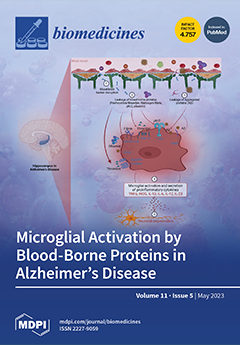
Cover Story: The blood–brain barrier restricts the entry of neurotoxic plasma components, blood cells, and pathogens into the brain, leading to proper neuronal functioning. Its impairment leads to infiltration of blood-borne proteins such as prothrombin, thrombin, prothrombin kringle-2, fibrinogen, fibrin, and other harmful substances resulting in microglial activation and release of proinflammatory mediators, consequently leading to neuronal death and impaired cognition. These mechanisms further work in concert and reinforce each other, contributing to the typical pathological changes observed in Alzheimer’s disease brains. Therefore, the identification of blood-borne proteins and the mechanisms involved in microglial activation and neuroinflammatory damage can be a promising therapeutic strategy for Alzheimer’s disease prevention. View this paper
  • Issues are regarded as officially published after their release is announced to the table of contents alert mailing list .
  • You may sign up for email alerts to receive table of contents of newly released issues.
  • PDF is the official format for papers published in both, html and pdf forms. To view the papers in pdf format, click on the "PDF Full-text" link, and use the free Adobe Reader to open them.

Articles (266)

  • Systematic Review
  • Open Access
10 Citations
3,098 Views
19 Pages

Evaluating the Adipose Tissue Depth as a Predictor Factor for Gestational Diabetes in Later Pregnancy—A Systematic Review

  • Bianca-Margareta Salmen,
  • Valeria-Anca Pietrosel,
  • Cristiana-Elena Durdu,
  • Teodor Salmen,
  • Cosmina Theodora Diaconu,
  • Ioana-Cristina Bica,
  • Claudia Gabriela Potcovaru,
  • Florentina Gherghiceanu,
  • Roxana-Adriana Stoica and
  • Anca Pantea Stoian

The increasing prevalence of gestational diabetes mellitus (GDM) requires non-invasive and precise techniques for evaluating the predisposing risk factors such as visceral adipose tissue (VAT) and subcutaneous adipose tissue (SAT). According to PRISM...

  • Article
  • Open Access
9 Citations
2,874 Views
14 Pages

Objective: Epidermal growth factor receptor–tyrosine kinase inhibitor (EGFR-TKI) is a first-line treatment for lung adenocarcinoma with EGFR-sensitive mutations, but acquired resistance to EGFR-TKIs remains a problem in clinical practice. The d...

  • Article
  • Open Access
9 Citations
2,967 Views
13 Pages

The present work is focused on the preparation of an optimal model of poly-ε-caprolactone nanoparticles as potential carriers for nasal administration of idebenone. A solvent/evaporation technique was used for nanoparticle preparation. Poly-&...

  • Article
  • Open Access
3 Citations
2,495 Views
13 Pages

Cathpesin B is a multi-functional protease that plays numerous roles in physiology and pathophysiology. We hypothesized that actin cytoskeleton proteins that are substrates of cathepsin B, various lipids, and kinases that are regulated by lipids woul...

  • Article
  • Open Access
7 Citations
4,130 Views
17 Pages

Although the predominant symptom in fibromyalgia (FM) is muscle pain, and fatigue in chronic fatigue syndrome (CFS), differential diagnosis is very difficult. This research investigates the psychoneuroimmunoendocrine disorders of FM patients and asce...

  • Review
  • Open Access
18 Citations
4,875 Views
17 Pages

Exosomes are extracellular nanovesicles commonly produced by mammalian cells that in recent years have risen as a novel strategy for drug delivery systems and cancer therapy because of their innate specificity and high bioavailability. However, there...

  • Article
  • Open Access
6 Citations
4,137 Views
14 Pages

Comparative Evaluation of the Cytotoxicity of Doxorubicin in BT-20 Triple-Negative Breast Carcinoma Monolayer and Spheroid Cultures

  • Keith N. Ncube,
  • Tamarin Jurgens,
  • Vanessa Steenkamp,
  • Allan D. Cromarty,
  • Iman van den Bout and
  • Werner Cordier

Three-dimensional cell culture models are increasingly adopted as preferred pre-clinical drug testing platforms, as they circumvent limitations associated with traditional monolayer cell cultures. However, many of these models are not fully character...

  • Article
  • Open Access
2 Citations
2,510 Views
10 Pages

As a biased agonist, peptide angiotensin II (Ang II) type 1 (AT1) receptor ligand antagonizes Ang II-stimulated G protein signaling but stimulates several kinase pathways. Here, we developed a non-peptide AT1 receptor compound as a biased ligand. We...

  • Article
  • Open Access
4 Citations
2,845 Views
10 Pages

Histologic Analysis of Idiopathic Pulmonary Fibrosis by Morphometric and Fractal Analysis

  • Massimiliano Mancini,
  • Lavinia Bargiacchi,
  • Claudia De Vitis,
  • Michela D’Ascanio,
  • Chiara De Dominicis,
  • Mohsen Ibrahim,
  • Erino Angelo Rendina,
  • Alberto Ricci,
  • Arianna Di Napoli and
  • Rita Mancini
  • + 1 author

Idiopathic pulmonary fibrosis (IPF) is a chronic, progressive fibrotic lung disorder, ultimately leading to respiratory failure and death. Despite great research advances in understanding the mechanisms underlying the disease, its diagnosis, and its...

  • Article
  • Open Access
8 Citations
3,320 Views
19 Pages

The United States Food and Drug Administration Adverse Event Reporting System (FAERS) logged 27,140 rhabdomyolysis cases from 2004 to 31 March 2020. We used FAERS to identify 14 drugs frequently reported in 6583 rhabdomyolysis cases and to investigat...

of 27

Get Alerted

Add your email address to receive forthcoming issues of this journal.

XFacebookLinkedIn
Biomedicines - ISSN 2227-9059