You are currently viewing a new version of our website. To view the old version click .

Chemosensors, Volume 9, Issue 8

August 2021 - 49 articles

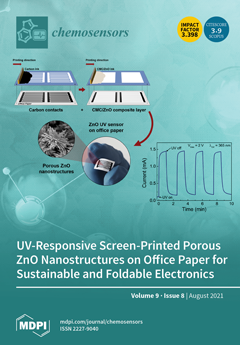
Cover Story: In this work, porous ZnO nanostructures were incorporated as a UV-sensing material into the composition of a sustainable water-based screen-printable ink composed of carboxymethyl cellulose, which was used to fabricate foldable UV sensors on office paper. The screen-printed ZnO UV sensors operate under low voltage (≤ 2 V) and reveal a stable response over several on/off cycles of UV light exposure. The devices reach a response current in the mA range and display impressive mechanical endurance under folding, showing only a small decrease in responsivity after being folded 1000 times. Their low-voltage operation and folding stability indicate a bright future for low-cost and sustainable flexible electronics, showing potential for low-power wearable applications and smart packaging. View this paper.
  • Issues are regarded as officially published after their release is announced to the table of contents alert mailing list .
  • You may sign up for email alerts to receive table of contents of newly released issues.
  • PDF is the official format for papers published in both, html and pdf forms. To view the papers in pdf format, click on the "PDF Full-text" link, and use the free Adobe Reader to open them.

Articles (49)

  • Article
  • Open Access
19 Citations
5,058 Views
17 Pages

We discovered a novel fluorophore by incorporating a dimethylamino group (–NMe2) into the conformationally locked green fluorescent protein (GFP) scaffold. It exhibited a marked solvent-polarity-dependent fluorogenic behavior and can potentially find...

  • Article
  • Open Access
6 Citations
2,791 Views
13 Pages

Titanium dioxide (TiO2) photocatalysis is a popular and promising technology in water treatment, but the performance evaluation usually depends on expensive equipment. In this study, using a smartphone for colorimetric detection, a self-invented meth...

  • Article
  • Open Access
5 Citations
3,987 Views
13 Pages

Real-time measurements of carbonate ion concentrations in the ocean are critical to advancing marine environmental monitoring and research into deep-sea hydrothermal activity. Herein, we report the first example of deep-sea hydrothermal field explora...

  • Article
  • Open Access
3 Citations
3,545 Views
12 Pages

Photography-based photometry is a technique developed to perform high throughput UV photometric analysis without instrumental detectors in resource-limited settings. Its principle relies on the illumination of a sample with UV irradiation and then ca...

  • Article
  • Open Access
15 Citations
3,625 Views
16 Pages

Phenolic Compounds from Irradiated Olive Wastes: Optimization of the Heat-Assisted Extraction Using Response Surface Methodology

  • Joana Madureira,
  • Bruno Melgar,
  • Celestino Santos-Buelga,
  • Fernanda M. A. Margaça,
  • Isabel C. F. R. Ferreira,
  • Lillian Barros and
  • Sandra Cabo Verde

Olive pomace, an environmentally detrimental residue generated during olive oil extraction, contains bioactive compounds in demand by the food industry. To valorize this waste product a suitable yield for the extraction process is required. Heat-assi...

  • Review
  • Open Access
47 Citations
10,208 Views
27 Pages

Advances in Antimicrobial Resistance Monitoring Using Sensors and Biosensors: A Review

  • Eduardo C. Reynoso,
  • Serena Laschi,
  • Ilaria Palchetti and
  • Eduardo Torres

The indiscriminate use and mismanagement of antibiotics over the last eight decades have led to one of the main challenges humanity will have to face in the next twenty years in terms of public health and economy, i.e., antimicrobial resistance. One...

  • Article
  • Open Access
2,757 Views
16 Pages

We describe a highly sensitive quartz sensor for measuring changes in the relative permittivity of liquids flowing in microchannels. The proposed method uses a highly stable oscillator and capacitance-dependent quartz crystal together with a capacita...

  • Article
  • Open Access
6 Citations
2,898 Views
11 Pages

Botulinum Neurotoxin-C Detection Using Nanostructured Porous Silicon Interferometer

  • Dashananda Nanda Kumar,
  • Zina Baider,
  • Daniel Elad,
  • Shlomo E. Blum and
  • Giorgi Shtenberg

Botulinum neurotoxins (BoNT) are the most potent toxins, which are produced by Clostridium bacteria and cause the life-threatening disease of botulism in all vertebrates. Specifically, animal botulism represents a serious environmental and economic c...

  • Article
  • Open Access
13 Citations
4,271 Views
20 Pages

Herein, the effects of nanostructured modifications of a gold electrode surface in the development of electrochemical sensors for L-ascorbic acid detection have been investigated. In particular, a bare gold electrode has been modified by electrodepos...

  • Review
  • Open Access
129 Citations
15,994 Views
42 Pages

Since MXene (a two-dimensional material) was discovered in 2011, it has been favored in all aspects due to its rich surface functional groups, large specific surface area, high conductivity, large porosity, rich organic bonds, and high hydrophilicity...

of 5

Get Alerted

Add your email address to receive forthcoming issues of this journal.

XFacebookLinkedIn
Chemosensors - ISSN 2227-9040