


Abstract
Detection of formaldehyde is of great significance for environmental monitoring and public health. Although amino-modified MOF nanomaterials have been widely adopted to improve the gas-sensing properties for hazardous gases, the fundamental enhancement mechanism is still insufficiently clarified, especially for formaldehyde-sensing material. In this work, the adsorption enthalpies of formaldehyde on UiO-66 and UiO-66-NH2 were quantitatively extracted via MEMS variable-temperature adsorption experiments, yielding values of −21.8 and −45.9 kJ/mol, respectively. The results demonstrate that amino-modified UiO-66-NH2 enables reversible adsorption between physisorption and chemisorption, which is more favorable for gas-sensing applications. Furthermore, a formaldehyde sensor was fabricated based on a MEMS resonant microcantilever. Gas-sensing performance tests indicate that the UiO-66-NH2-based sensor displays a remarkable response to 0.5–10 ppm formaldehyde with a detection limit of 17 ppb and high selectivity. The significantly improved sensing performance experimentally validates the reasonability of the proposed mechanism. This work provides a reliable strategy for revealing the sensitivity enhancement mechanism and developing high-performance MOF-based formaldehyde sensors.
1. Introduction
Formaldehyde is one of the typical volatile organic compounds (VOCs) and a colorless gas widely present in the human daily living environment. It has a diverse range of emission sources, primarily including industrial exhaust, fuel combustion, and the release of various chemical materials [1,2,3]. Classified as a Group 1 carcinogen by IARC in 2004 [4], it exerts severe irritation and damage to human organs. The Occupational Safety and Health Administration (OSHA) has set its permissible exposure limit (PEL) at 750 ppb, with 20 ppm being the concentration immediately dangerous to life or health [5]. Thus, the sensitive detection of formaldehyde is of great significance for environmental protection and public health security.
Currently, widely employed formaldehyde sensors are primarily based on electrochemical, semiconductor, spectroscopy, field-effect transistor, and mass-sensitive sensing detection mechanisms [6,7,8,9,10,11,12]. All these sensors rely on sensitive materials to capture formaldehyde molecules for generating sensing signals. Despite extensive efforts in developing high-performance sensing materials, in-depth investigations into the adsorption mechanism between formaldehyde molecules and sensitive materials remain insufficient. Among the various sensing materials, metal–organic framework (MOF) materials have garnered extensive attention and in-depth research in formaldehyde gas detection, benefiting from their ultrahigh specific surface area, designable pore structure, and abundant active adsorption sites [13,14,15]. Among all kinds of MOF candidates, UiO-66 has been widely applied in the sensing of gases, owing to its excellent chemical and thermal stability, structural rigidity, and tunable surface functionalization properties [16,17,18]. Further exploration of UiO-66 modified with different functional groups confirms that functionalization enhances its sensing performance [19,20,21,22,23]. For example, Li et al. loaded UiO-66-NH2 on the surface of polyacrylonitrile (PAN) nanofibers by in situ growth to increase the specific surface area, improving the sensor’s rapid adsorption and response toward SO2 molecules [24]. Fan et al. studied the performances of UiO-66 and functional UiO-66 series samples (UiO-66-(OH)2, UiO-66-(COOH)2), and evaluated the sensing properties toward ammonia [25]. In short, amino-modified UiO-66-NH2 shows improved performance in detecting toxic gases via strong amino-gas molecule interactions. However, the intrinsic mechanism of amino modification-enhanced gas sensing is unclearly elaborated, and no systematic study has focused on MOF performance improvement for formaldehyde detection.
Fundamentally, the capture of formaldehyde molecules by sensitive materials constitutes a typical adsorption process, which can be investigated using adsorption thermodynamics [26,27,28,29]. Enthalpy (–ΔH°) is a key quantitative thermodynamic parameter that indicates the heat released when gas molecules adsorb onto the surface of a material. It acts as an essential tool for investigating how gaseous adsorbates interact with sensing materials [30,31]. Our previous studies have shown that a resonant microcantilever is an effective method for accurately measuring enthalpy values, which helps in identifying functional materials across diverse applications [32,33]. The resonant microcantilever with mass resolution at the picogram (pg) to femtogram (fg) level can realize real-time characterization of the behavior of target molecules during the adsorption process, providing an effective approach for the investigation of sensing mechanisms [34,35]. In addition, this sensor can detect gas concentrations by converting the mass changes caused by the adsorption into measurable frequency signals [32,36,37].
In this work, the mechanism by which amino modification improves the formaldehyde gas-sensing performance was investigated by quantitatively extracting the adsorption enthalpy of sensitive materials, and the enhanced sensing properties were verified by gas-sensing experiments. Specifically, amino-modified UiO-66 nanomaterials were first synthesized, and the adsorption enthalpy toward formaldehyde was obtained via MEMS variable-temperature adsorption experiments to reveal the enhancement mechanism induced by amino modification. Furthermore, the validity of the above enhancement mechanism was verified by gas-sensing tests, including sensitivity and selectivity measurements.
2. Materials and Methods
2.1. Chemicals
ZrCl4, terephthalic acid, 2-aminoterephthalic acid, hydrochloric acid (HCl), acetone, and N, N-dimethylformamide (DMF) were purchased from Sigma-Aldrich (Shanghai) Trading Co., Ltd., Shanghai, China. Formaldehyde gas was supplied by Shanghai Weichuang Standard Gas Analysis Technology Co., Ltd., Shanghai, China. HPLC-grade ethanol was obtained from Thermo Fisher Scientific (Waltham, MA, USA), and deionized water was prepared in the lab.
2.2. Synthesis of UiO-66 and UiO-66-NH2 Nanomaterials
UiO-66 and UiO-66-NH2 were synthesized by a solvothermal method, with the difference lying in the organic ligand used. Specifically, UiO-66 was prepared as follows: ZrCl4 (125 mg, 0.54 mmol) and 1,4-benzenedicarboxylic acid (123 mg, 0.75 mmol) were dissolved in 15 mL DMF in a glass container and sonicated until a clear solution was formed. Then 1 mL concentrated HCl was added, and the pH value of the reaction system was controlled at around 1–2. Sonication was continued for 5 min, and the mixture was heated at 80 °C in a preheated oven for 18 h. After cooling to ambient temperature, the solid product was centrifuged, washed three times with 15 mL DMF and three times with 15 mL acetone, soaked in 15 mL acetone for 18 h, and finally activated under vacuum at 120 °C. For UiO-66-NH2, the synthesis process was the same as that of UiO-66 except that 2-aminoterephthalic acid (134 mg, 0.75 mmol) was used instead of 1,4-benzenedicarboxylic acid as the organic ligand, and all other experimental parameters and operation steps remained unchanged.
2.3. Material and Sensor Chip Characterization
The microscopic morphology and crystal structure of different MOF samples were characterized using a field-emission scanning electron microscope (FE-SEM, JEOL 7800 F) and a TEM (FEI Tecnai G2 F20, USA). Additionally, an energy-dispersive X-ray spectrometer (EDS, Oxford X-MaxN 80, UK) was employed to analyze the elemental composition, content, and distribution within these nanomaterials.
An XRD (Rigaku Ultima IV, Japan) equipped with a copper target was used to generate X-rays at 40 kV and 40 mA. To investigate the crystal structure of the MOF samples, continuous scanning was performed over a 2θ range of 5° to 70° with a step size of 0.02°.
Fourier Transform Infrared (FT-IR) Spectroscopy: UiO-66 and UiO-66-NH2 were characterized using a Thermo Fisher Scientific Nicolet iS20 FTIR spectrometer (USA), FT-IR spectra were recorded with a resolution of 2 cm−1 and an accumulation of 64 scans.
XPS measurements were conducted using a Thermo Scientific K-Alpha XPS spectrometer (USA) with an Al Kα X-ray source. The binding energy scale was calibrated using the C1s peak at 284.6 eV as a reference. After background subtraction, peak fitting was carried out using XPSPEAK41 and the Avantage software (USA) packages.
2.4. Loading of Sample onto Resonant Microcantilever Chip
The synthesized samples were dispersed in ethanol via 10 min sonication to form a homogeneous suspension. A micro-pipetting system controlled by a micromanipulator (Eppendorf PatchMan NP2, Germany) was used to precisely dispense the suspension onto the sensing area (near the cantilever free end) of a MEMS resonant microcantilever, with real-time monitoring under an upright optical microscope to ensure accurate positioning and quantitative loading.
2.5. Extraction of Adsorption Enthalpy
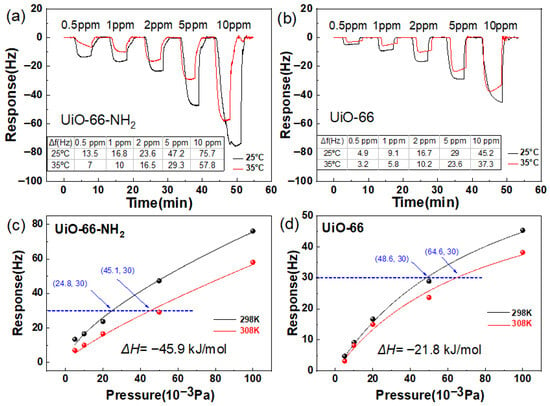
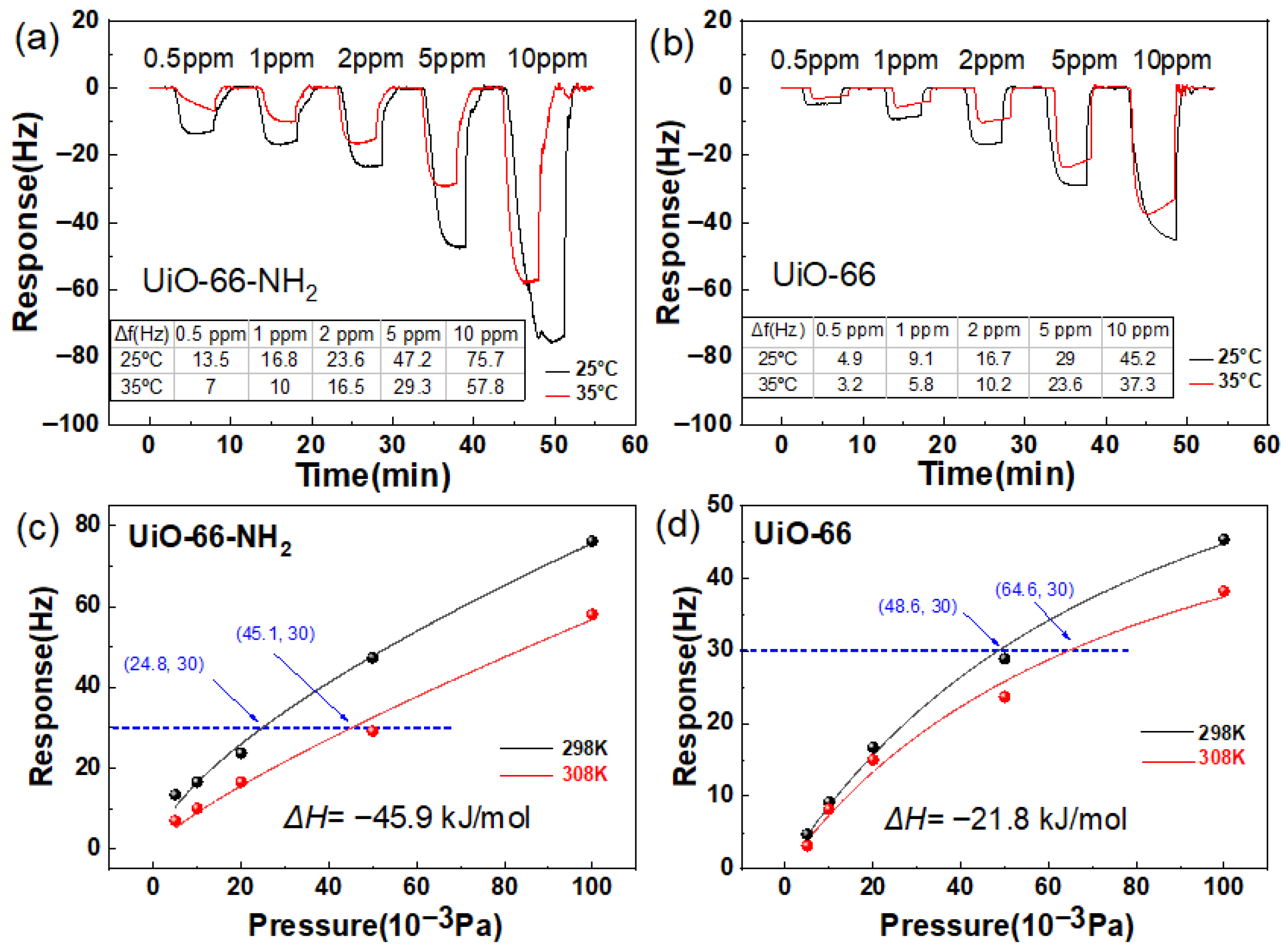
In this experiment, a lab-made MEMS microcantilever was used to convert the obtained frequency shift data into adsorption isotherms, and then the adsorption enthalpy (−ΔH°) was calculated. By real-time measuring the resonant frequency shift Δf, this resonant microcantilever sensor can real-time obtain the mass change caused by adsorbed molecules according to the relationship Δf/f0 ∝ Δm/m [34], thereby real-time acquiring the number of gas molecules adsorbed on the surface of the microcantilever. At two temperatures close to room temperature (298 K and 308 K), formaldehyde vapor with different concentrations of 0.5 ppm, 1 ppm, 2 ppm, 5 ppm, and 10 ppm was sequentially introduced into the UiO-66-NH2 and UiO-66 samples loaded on the resonant microcantilever, and a series of adsorption characteristic curves was obtained through frequency shifts. Then, based on these characteristic curves, adsorption isotherms of the samples at different partial pressures under the two temperatures were plotted. Finally, the enthalpy change value of formaldehyde gas molecule adsorption on UiO-66 crystals was calculated according to the following Clausius-Clapeyron equation:
where R is the ideal molar gas constant, and P1 and P2 represent the gas partial pressures at two corresponding points with the same coverage on the isotherm, respectively.
2.6. MEMS Gas Sensor Preparation and Sensing Experiments
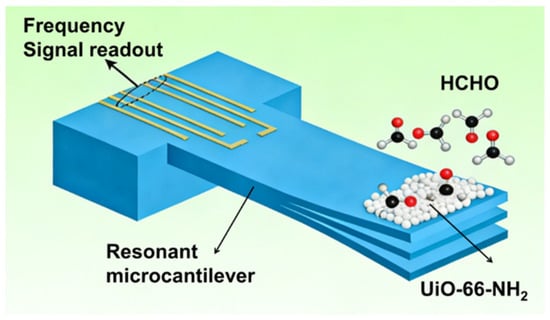
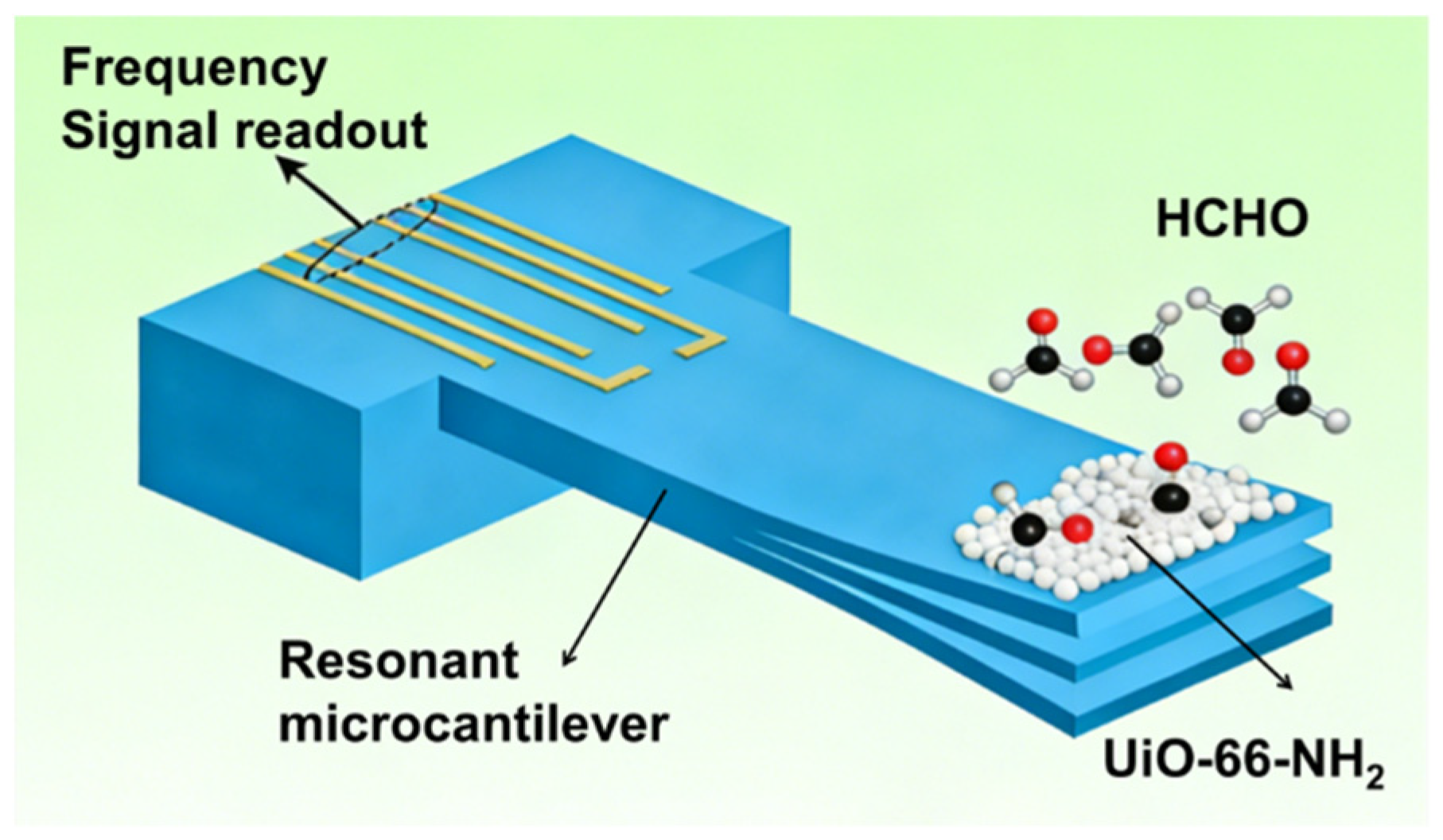
All gas sensing experiments were performed using a pre-calibrated, lab-built testing system (the flow deviation was controlled to be less than 2 sccm). A MEMS resonant microcantilever with a mass sensitivity of 1.5 Hz/pg was employed as the gas-sensitive chip; its structure is illustrated in Figure 1, and its resonant performance is detailed in Refs. [33,35,38]. The cantilever sensor’s response to a certain concentration of target gas is calculated by the relative change of the frequency (Δf) between the initial state (f0) and the state after adsorbing state (fg). The sensitivity is the slope of the linear fitting curve between the sensor’s response and the gas concentration. The gas sensor was placed in a test chamber inside a temperature-controllable oven, which provided a temperature range of 233 K to 423 K with a temperature fluctuation of less than ±0.5 K. The temperature was stabilized at room temperature (approximately 293 K) for the reported experiments, which guarantees good reproducibility in our results. An external gas supply system (LoC-GDS 4000, Xiamen High-end MEMS Technology Co., Ltd., China) was used to introduce formaldehyde gas at a set concentration (diluted with N2) into the chamber. All pipelines, connectors, and valves in the device were made of high-grade polytetrafluoroethylene (PTFE) to avoid the adsorption of gas molecules. A digital phase-locked loop circuit was utilized to record in real time the frequency shift signal caused by the adsorption of formaldehyde on the surface of MOF materials.
Figure 1.
Schematic illustration of a formaldehyde gas sensor based on a resonant cantilever loaded with MOF sensing materials.
3. Results
3.1. Characterization of the MOF Samples
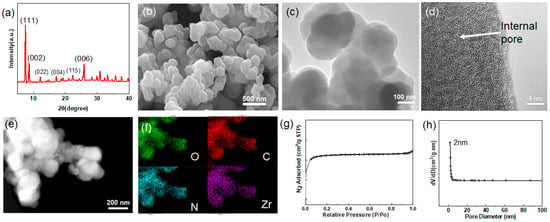
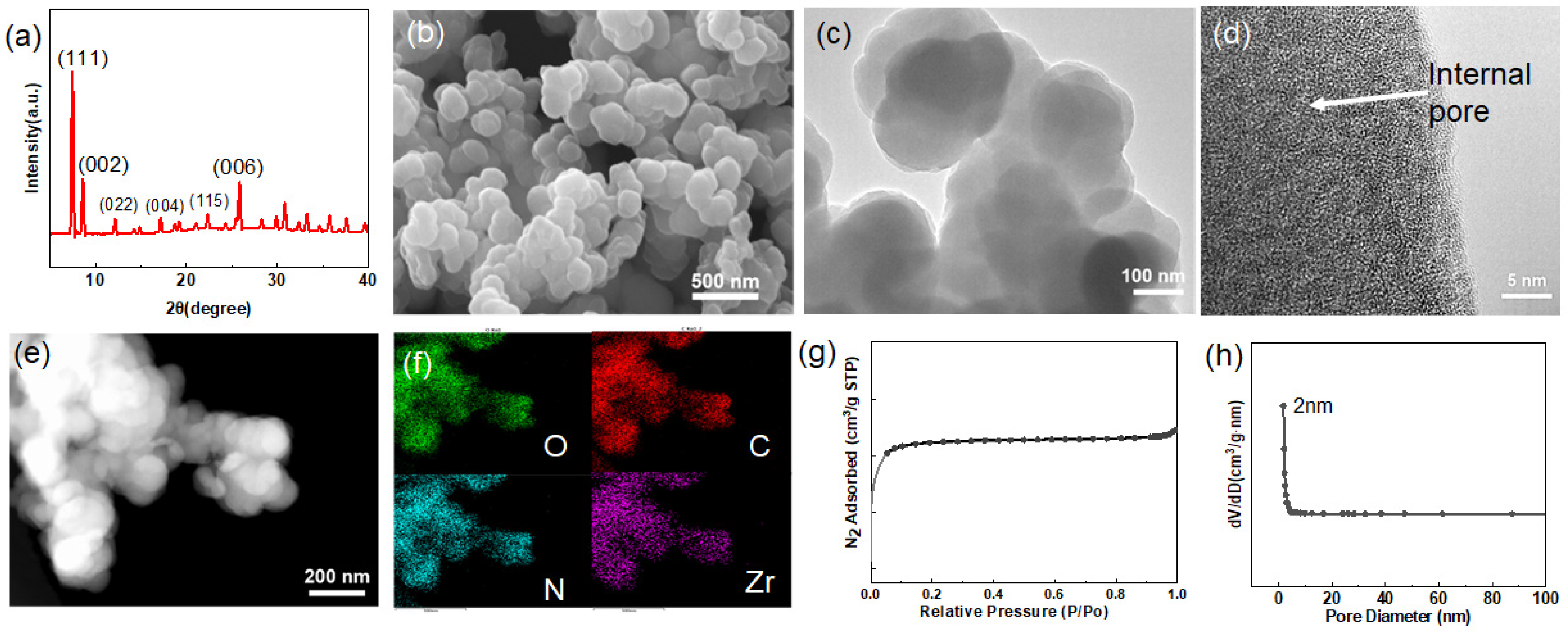
XRD was employed to analyze the crystal structure of the as-synthesized UiO-66-NH2 powder. Figure 2a shows the XRD pattern of the UiO-66-NH2 sample, in which three sharp peaks appear at 2θ = 7.5°, 8.5°, and 25.8°, corresponding to the (111), (002), and (006) crystal planes, respectively. The XRD pattern matches well with the standard pattern of UiO-66 reported in the literature [39]. Compared with the XRD pattern of UiO-66 (Figure S1), the amino-modified UiO-66-NH2 sample shows a highly similar profile, indicating that amino modification has no significant effect on the crystal structure. The XRD results confirm the successful synthesis of UiO-66 and UiO-66-NH2 MOF nanoparticles in this work. The SEM morphology of the UiO-66-NH2 sample is shown in Figure 2b, from which it can be seen that the UiO-66-NH2 crystals have an approximately spherical structure with an average particle size of approximately 220 nm, and the material exhibits an aggregated morphology. As shown in Figure 2c,d, the high-resolution TEM images of the UiO-66-NH2 particles show that they have a typical spherical morphology with internal pores. Figure 2e,f show the EDS element distribution maps of the UiO-66-NH2 material, clearly demonstrating that the four main elements (C, O, N, and Zr) are uniformly distributed in the sample. The nitrogen adsorption–desorption isotherm of UiO-66-NH2, presented in Figure 2g,h displays a type-I isotherm [40], indicating the presence of micropores smaller than 2 nm. The specific surface area of the sample was measured to be 909 m2/g.
Figure 2.
Characterization of the UiO-66-NH2 MOF samples: (a) XRD image of the UiO-66-NH2 sample. (b) SEM image of the UiO-66-NH2 sample. (c,d) TEM images of the UiO-66-NH2 sample. The average diameter of the nanoparticles is about 220 nm. (e,f) EDS mapping of the UiO-66-NH2 sample. (g) N2 adsorption isotherms of the UiO-66-NH2 sample. (h) Pore size distribution of the UiO-66-NH2 sample.
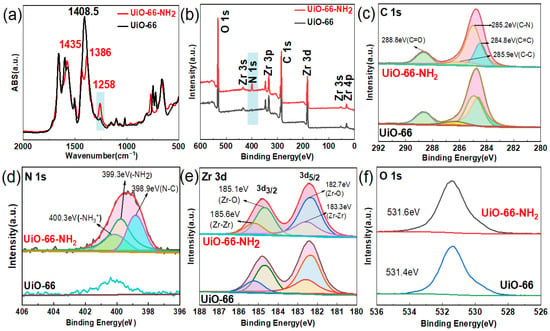
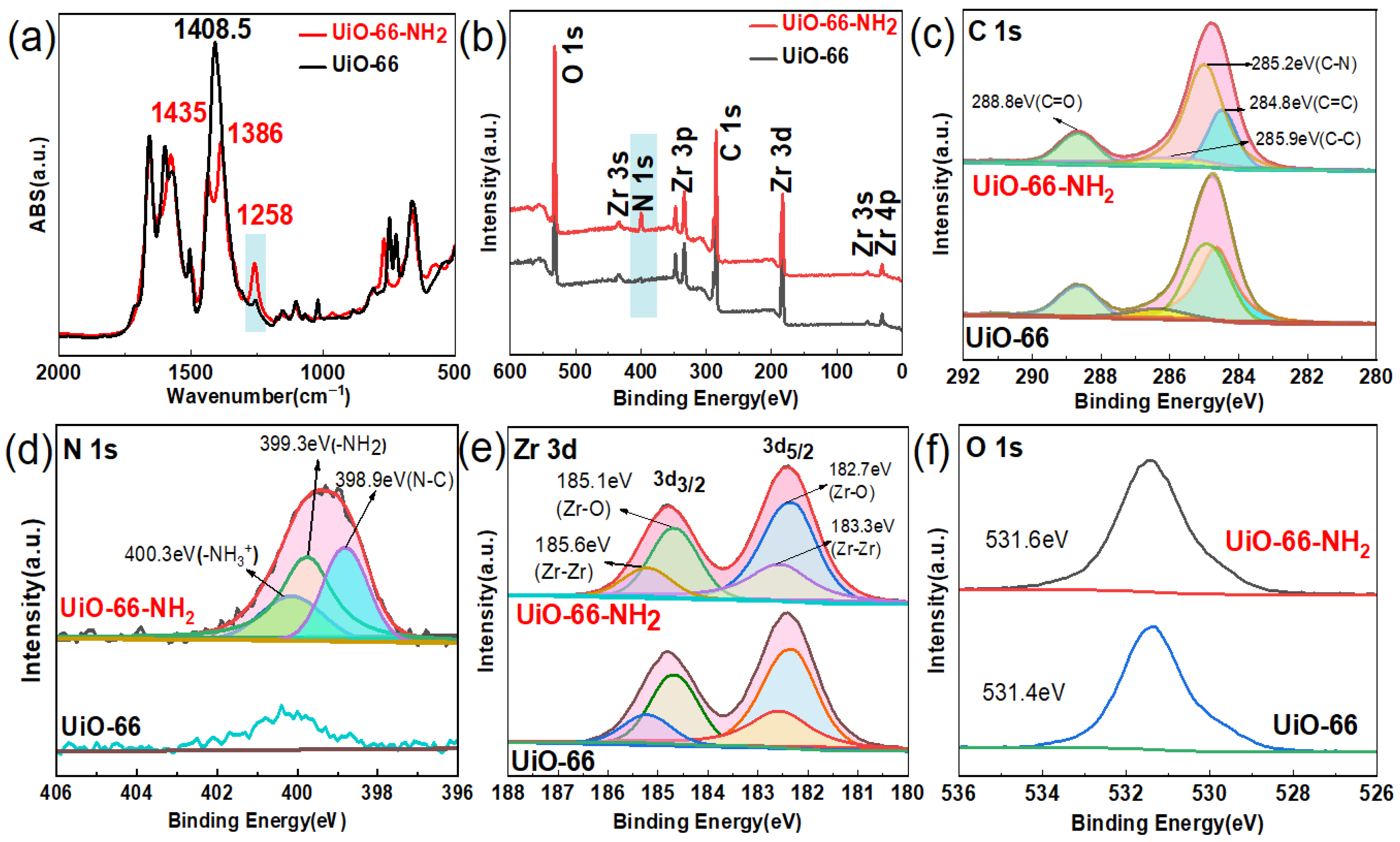
Figure 3a depicts the FT-IR spectra of UiO-66 and UiO-66-NH2 samples. The characteristic peak observed at 1258 cm−1 is assigned to the stretching vibration of C–N bonds in UiO-66-NH2, confirming the successful introduction of amino functional groups. The band at 1408.5 cm−1 arises from the stretching vibration of the COO− carboxylate group of the UiO-66. Upon amino modification, this vibrational band gradually shifts to lower wavenumbers, accompanied by the splitting of the symmetric COO− stretching mode; specifically, the intensity of the absorption band at 1386 cm−1 decreases significantly, whereas a new absorption band emerges at 1435 cm−1. Based on these results, it can be verified that UiO-66-NH2 has been successfully synthesized. XPS was employed to characterize the surface chemical state of UiO-66-NH2, as shown in Figure 3b. Figure 3c–f display the fitting analysis results of the four elements, respectively. The C 1s spectrum can be deconvoluted into four peaks, corresponding to C=C bonds (284.8 eV), C-N bonds (285.2 eV), C-C bonds (285.9 eV), and C=O bonds (288.8 eV). The N 1s spectrum can be deconvoluted into three characteristic peaks at 398.9 eV, 399.3 eV, and 400.3 eV, which are assigned to N-C bonds, -NH2 groups, and the interaction between protons and amino groups (-NH3+), respectively. This peak is a characteristic peak of UiO-66-NH2, confirming the existence of UiO-66-NH2. The Zr 3d spectrum can be deconvoluted into four peaks: the peaks at 182.7 eV and 185.1 eV are attributed to Zr-O bonds, while the peaks at 183.3 eV and 185.6 eV correspond to Zr-Zr bonds.
Figure 3.
(a) FT-IR spectrum of UiO-66 and UiO-66-NH2 samples. (b–f) The XPS elemental surveys of UiO-66 and UiO-66-NH2 samples.
3.2. Resonant Cantilever Formaldehyde Sensor
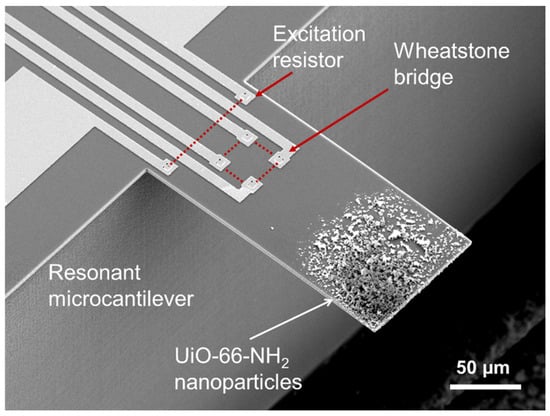
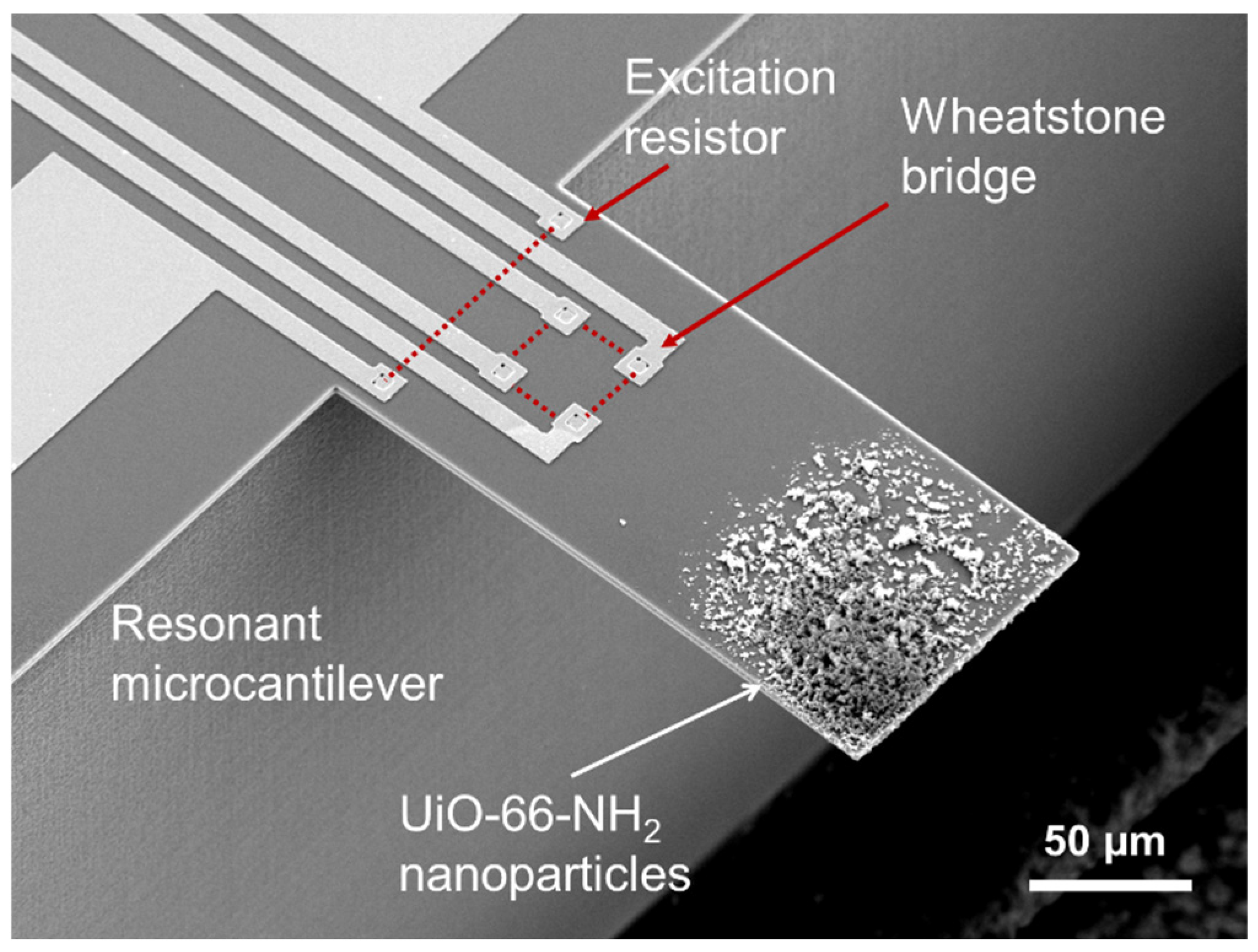
As shown in the SEM image of Figure 4, the as-synthesized sample of UiO-66-NH2 was precisely loaded onto the free end of the microcantilever for gas-sensing experiments. The sensor employs a heating excitation resistor located at the cantilever base to thermoelectrically excite the microcantilever into resonance, and an integrated piezoresistive Wheatstone bridge is integrated to record the frequency shift induced by mass changes in real time.
Figure 4.
SEM image of the resonant microcantilever, where the UiO-66-NH2 sample is loaded onto the free end of the cantilever.
3.3. Extraction of the Adsorption Enthalpy
Figure 5 presents the results of the quantitative extraction of formaldehyde adsorption enthalpy for UiO-66 and UiO-66-NH2. According to Figure 5a,b, the frequency signal at each concentration (corresponding partial pressure) is plotted in the adsorption isotherms shown in Figure 5c,d. To calculate the isosteric enthalpy of adsorption, paired data points at equal surface coverage were selected from the adsorption isotherms at 298 K and 308 K. For each temperature, adsorption isotherms were obtained by plotting the frequency shift (Δf, representing the adsorbed amount) against the partial pressure (p) of formaldehyde. At different temperatures, identical Δf values from the same sensor indicate equivalent quantities of the adsorbed molecules on the sensing materials (i.e., identical fractional coverage θ). Specifically, two points with a frequency shift of 30 Hz were selected as representative equal-coverage points. In Figure 5c, the intersections of the blue dashed line (Δf = 30 Hz) with the two isotherms yield coordinates of (24.8 × 10⁻³ Pa, 30 Hz) at 298 K and (45.1 × 10⁻³ Pa, 30 Hz) at 308 K for UiO-66. These partial pressure values were substituted into the Clausius-Clapeyron equation to calculate the enthalpy change. Similarly, for UiO-66-NH2 in Figure 5d, the corresponding coordinates are labeled. According to Equation (1), the adsorption enthalpies of formaldehyde on the as-prepared UiO-66-NH2 and UiO-66 samples were determined to be −45.9 kJ/mol and −21.8 kJ/mol, respectively. The negative adsorption enthalpy values indicate an exothermic process. The higher absolute adsorption enthalpy value of the UiO-66-NH2 sample indicates that amino-functionalized UiO-66-NH2 exhibits significantly enhanced formaldehyde adsorption activity compared with UiO-66. Based on physicochemical principles, surface interactions with absolute adsorption enthalpy changes higher than approximately 80 kJ/mol correspond to irreversible adsorption or even chemical reactions. In contrast, interactions with adsorption enthalpy changes < 40 kJ/mol can be classified as nonspecific weak physical adsorption. Interactions with adsorption enthalpy changes ranging from 40 to 80 kJ/mol are characteristic of reversible specific adsorption [41]. Accordingly, the adsorption of formaldehyde molecules on UiO-66-NH2 lies between physical and chemical adsorption, indicating it could show a reversible response as a promising gas-sensing material. In summary, the adsorption enthalpy results quantitatively indicate that amino-modified UiO-66-NH2 exhibits stronger adsorption capacity and favorable desorption behavior compared with pristine UiO-66. The enhanced interaction between formaldehyde molecules and amino-modified sites contributes to higher sensitivity and better selectivity. Meanwhile, the appropriate adsorption enthalpy endows the sensor with good repeatability and reversibility during the sensing process.
Figure 5.
Results of the resonant-gravimetric experiment for thermodynamic evaluation of the UiO-66-NH2 and UiO-66 to formamide molecules. (a,b) Micro-gravimetric frequency-shift responses of the resonant microcantilever at the temperatures of 298 K and 308 K of UiO-66-NH2/UiO-66, respectively. (c,d) Two isotherm curves of the UiO-66-NH2/UiO-66 are plotted for calculating the adsorption enthalpy value. The intersection of the blue dashed lines and the adsorption isotherm gives the partial pressure of formaldehyde at the same coverage.
3.4. Gas Sensing Performance
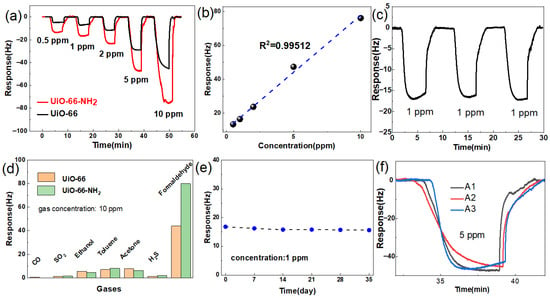
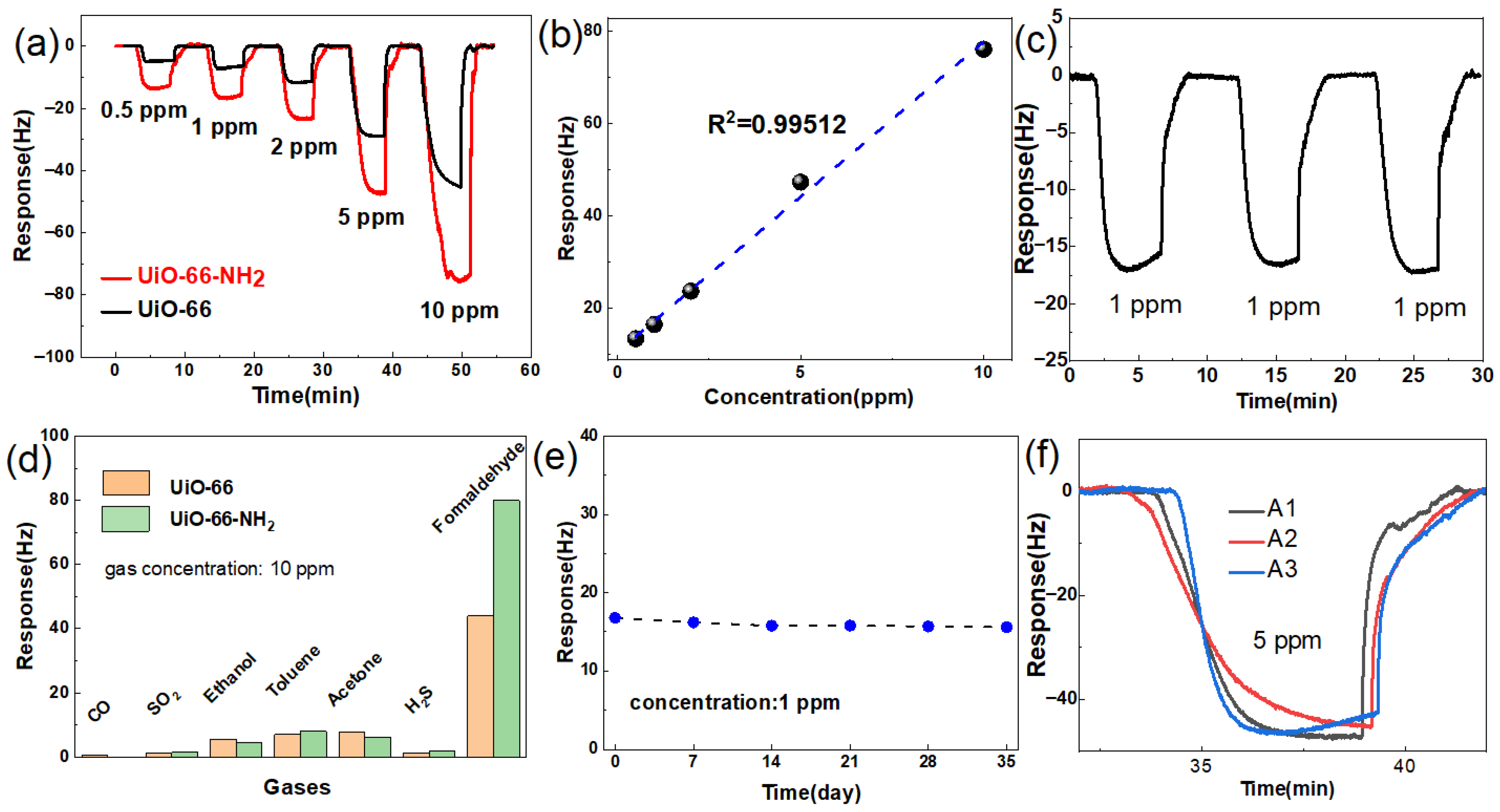
To verify the enhancement effect of amino modification on UiO-66 based on adsorption enthalpy, we employed a mass-sensitive resonant cantilever sensor to evaluate the formaldehyde-sensing properties of sensors loaded with UiO-66 and UiO-66-NH2, respectively. Figure 6 summarizes the sensing properties of the sensors based on UiO-66 and UiO-66-NH2, where Figure 6a displays the real-time response curves toward formaldehyde at concentrations of 0.5, 1, 2, 5, and 10 ppm. The sensor response rises with increasing formaldehyde concentration, and the UiO-66-NH2-based sensor displays a significantly higher response than the UiO-66 sensor. This result verifies that the enthalpy change of UiO-66-NH2 is greater than that of UiO-66 (Figure 5). For 500 ppb formaldehyde, the response of the UiO-66-NH2 sensor is 13.9 Hz, nearly 2.9-fold higher than that of UiO-66 (4.8 Hz). At 10 ppm, the response reaches 75.7 Hz for UiO-66-NH2 compared with 45.3 Hz for UiO-66, corresponding to a 1.7-fold enhancement. The response increment slows at higher concentrations, which can be attributed to the gradual saturation of surface amino sites and increased diffusion resistance of formaldehyde within the pore structure. These results confirm that the UiO-66-NH2 sensor possesses superior sensitivity for low-concentration formaldehyde. Figure 6b presents the response-concentration relationship of the UiO-66-NH2 sensor. A good linear correlation (R2 = 0.99512) is achieved in the range of 0.5–10 ppm. The sensor noise is estimated to be about 0.15 Hz (See Figure S3) and the response to 50 ppb formaldehyde is about 1.4 Hz (See Figure S4). The limit of detection (LOD) was calculated to be about 17 ppb based on the signal-to-noise (S/N) ratio criterion of 3, using the sensor noise level and the linear response in 0.5–10 ppm. The repeatability and recovery characteristics of the sensor are investigated. As illustrated in Figure 6c, the sensor exhibits good reversible response behavior over three successive cycles toward 1 ppm formaldehyde, with each cycle comprising a complete sequence of exposure (2.5 min) and recovery (2.5 min) cycles. The sensor exhibits consistent responses over three successive cycles toward 1 ppm formaldehyde, with a relative standard deviation (RSD) of 1.56%, indicating satisfactory repeatability. For selectivity evaluation, six interfering gases (CO, SO2, ethanol, toluene, acetone, and H2S) were tested. These gases frequently coexist with formaldehyde in scenarios such as newly renovated residences, kitchens, and offices, posing practical challenges to the selectivity of sensors. As shown in Figure 6d, the responses to 10 ppm interferents under dry conditions are all below 10 Hz, while the response to 10 ppm formaldehyde exceeds 70 Hz, verifying the excellent specific recognition capability of UiO-66-NH2 toward formaldehyde. Long-term stability tests in Figure 6e show that the response decreases by 5.1% after 35 days. The degradation over 35 days is possibly due to the surface morphology evolution of the UiO-66 sample and the partial adsorption saturation of active sites during prolonged exposure to formaldehyde. Figure 6f further confirms that microfabricated sensors from the same batch exhibit high response uniformity toward 5 ppm formaldehyde. The limit of detection (LOD), sensitivity, and selectivity of the sensor in this work are compared with recent representative studies. As summarized in Table 1, the proposed sensor exhibits a competitive LOD, high sensitivity, and satisfactory selectivity, demonstrating its potential for practical indoor formaldehyde detection.
Figure 6.
(a) Real-time sensing curves of the UiO-66 and UiO-66-NH2 sensors toward formaldehyde with concentrations ranging from 0.5 to 10 ppm. (b) Linear relationship between formaldehyde concentration and sensing response for the UiO-66-NH2 sensor. (c) Three successive cyclic detection results of the UiO-66-NH2 sensor toward formaldehyde at a constant concentration. (d) Selectivity of the two types of sensors to seven interfering gases at a concentration of 10 ppm under dry conditions. (e) Long-term stability of the UiO-66-NH2 sensor toward formaldehyde. (f) Sensing responses of three different UiO-66-NH2 sensor samples to 5 ppm formaldehyde.
Table 1.
Comparison of Formaldehyde Sensing Performance Among Different Sensors.
3.5. Discussions
The significantly improved formaldehyde adsorption activity of UiO-66-NH2 relative to UiO-66 can be mainly ascribed to two factors. First, the introduction of amino groups (-NH2) is the dominant reason, which shifts the dominant interaction from physical adsorption to chemisorption, thereby greatly strengthening the specific binding affinity toward formaldehyde molecules. Formaldehyde is a small polar molecule containing a carbonyl group (C=O), and the amino groups in UiO-66-NH2 provide two efficient chemical interactions: the amino groups can react with the carbonyl group of formaldehyde via reversible covalent bonding to form an imine structure (-N=CH2), which represents a highly selective chemisorption [43]. Meanwhile, as hydrogen-bond donors, the amino groups can form strong hydrogen bonds with the oxygen atom in formaldehyde, which are much stronger than van der Waals forces. Both effects contribute to the enhanced adsorption of formaldehyde on UiO-66-NH2. Second, amino modification modulates the physical properties of the material.
BET analysis reveals a specific surface area of 1140 m2/g for UiO-66 (shown in Figure S2), which exhibits a higher specific surface area than that of UiO-66-NH2 (909 m2/g). The reduced specific surface area of UiO-66-NH2 can be attributed to the larger volume of amino (-NH2) groups relative to the corresponding H atoms in UiO-66, which slightly occupies the internal pore space and thus leads to a slight decrease in the specific surface area. Although amino modification has a slight effect on the pore size of the material, the above results indicate that it has no obvious influence on the overall sensing performance but is favorable to the improvement of selectivity. On one hand, amino modification reduces the pore size, which effectively hinders the diffusion of larger interfering molecules such as bulky VOCs. On the other hand, the introduced amino groups increase the surface polarity and basicity, thus strengthening the affinity toward polar formaldehyde molecules. Furthermore, van der Waals interactions occur between the open Zr clusters, benzene rings of the ligands, and formaldehyde molecules. Overall, the enhanced adsorption activity of UiO-66-NH2 toward formaldehyde arises from a process dominated by chemical interactions and cooperatively assisted by physical effects, rendering it an excellent candidate for high-performance formaldehyde sensors.
4. Conclusions
To address the demand for trace formaldehyde detection at room temperature, the mechanism underlying the gas-sensing performance enhancement of UiO-66 MOF nanomaterials through amino modification was systematically investigated and experimentally verified. UiO-66-NH2 nanocrystals were synthesized via a solvothermal route and characterized. The adsorption enthalpies of UiO-66 and UiO-66-NH2 were quantitatively extracted via MEMS variable-temperature adsorption experiments, yielding values of −21.8 and −45.9 kJ/mol, respectively. The adsorption enthalpies indicate that amino-modified UiO-66-NH2 exhibits stronger adsorption capacity and more favorable desorption behavior in comparison with pristine UiO-66, providing solid thermodynamic support for the enhanced gas-sensing performance. Gas-sensing tests demonstrate that amino functionalization significantly improves the performance: the sensitivity of the UiO-66-NH2-based sensor is 2.9-fold higher than that of the pure UiO-66-based sensor. The sensor displays a favorable linear response toward 0.5–10 ppm formaldehyde, with a low detection limit of 17 ppb and excellent selectivity. This amino-modification strategy overcomes the insufficient sensitivity of conventional UiO-66-based sensors, offering fundamental theoretical support and technical guidance for the rational design and practical application of high-performance MOF-based gas sensors.
Supplementary Materials
The following supporting information can be downloaded at: https://www.mdpi.com/article/10.3390/chemosensors14040089/s1. Figure S1: XRD pattern of UiO-66 sample. Figure S2: (a) N2 adsorption isotherms of the UiO-66 sample. (b) Pore size distribution of the UiO-66 sample. Figure S3: The noise level of the baseline is about 0.15 Hz. Figure S4: The response of the UiO-66-NH2 sensor to 50 ppb formaldehyde is about 1.4 Hz.
Author Contributions
Conceptualization, P.X. and X.L.; methodology, P.X., M.L. and Y.C.; investigation, Z.W. and Y.C.; Writing, Z.W. and Y.C.; Validation, P.X.; funding acquisition, P.X. and X.L. All authors have read and agreed to the published version of the manuscript.
Funding
This work is supported by the National Natural Science Foundation of China (62227815).
Institutional Review Board Statement
Not applicable.
Informed Consent Statement
Not applicable.
Data Availability Statement
The raw data supporting the conclusions of this article will be made available by the authors on request.
Conflicts of Interest
The authors declare no conflicts of interest.
References
- Flueckiger, J.; Ko, F.K.; Cheung, K.C. Microfabricated Formaldehyde Gas Sensors. Sensors 2009, 9, 9196–9215. [Google Scholar] [CrossRef] [Scilit]
- Srinives, S.; Sarkar, T.; Mulchandani, A. Primary amine-functionalized polyaniline nanothin film sensor for detecting formaldehyde. Sens. Actuators B-Chem. 2014, 194, 255–259. [Google Scholar] [CrossRef] [Scilit]
- Zheng, Y.G.; Wang, J.; Yao, P.J. Formaldehyde sensing properties of electrospun NiO-doped SnO2 nanofibers. Sens. Actuators B-Chem. 2011, 156, 723–730. [Google Scholar] [CrossRef] [Scilit]
- Protano, C.; Buomprisco, G.; Cammalleri, V.; Pocino, R.N.; Marotta, D.; Simonazzi, S.; Cardoni, F.; Petyx, M.; Iavicoli, S.; Vitali, M. The Carcinogenic Effects of Formaldehyde Occupational Exposure: A Systematic Review. Cancers 2022, 14, 165. [Google Scholar] [CrossRef] [Scilit] [PubMed]
- Feng, L.; Musto, C.J.; Suslick, K.S. A Simple and Highly Sensitive Colorimetric Detection Method for Gaseous Formaldehyde. J. Am. Chem. Soc. 2010, 132, 4046. [Google Scholar] [CrossRef] [Scilit] [PubMed]
- Pei, Z.Y.; Kelly, K.E. Laboratory Cross-Sensitivity Evaluation of Low-Cost Electrochemical Formaldehyde Sensors. Sensors 2025, 25, 3096. [Google Scholar] [CrossRef] [Scilit]
- Korpan, Y.I.; Dzyadevich, S.V.; Arkhipova, V.N.; El’skaya, A.V.; Gonchar, M.V.; Gibson, T.D.; Jaffrezic-Renault, N.; Martelet, C.; Soldatkin, A.P. Enzyme-based electrochemical sensors for formaldehyde detection. Sens. Mater. 2000, 12, 79–87. [Google Scholar]
- Ghorbani, G.; Huzaifa, M.; Taghipour, F. Enhanced formaldehyde sensing with UV-LED activated Nafion-coated In2O3 gas sensor. Mater. Sci. Eng. B-Adv. 2026, 324, 118994. [Google Scholar] [CrossRef] [Scilit]
- Chen, D.Z.; Yuan, Y.J. Thin-Film Sensors for Detection of Formaldehyde: A Review. IEEE Sens. J. 2015, 15, 6749–6760. [Google Scholar] [CrossRef] [Scilit]
- Liao, C.L.; Zhang, M.; Tian, Q.Y.; Yang, X.M.; Shi, J.F.; Chen, S.; Che, Y.K.; Wang, C.Y.; Zang, L. Selective turn-on fluorescence detection of formaldehyde in the gas phase. Sens. Actuators B-Chem. 2023, 375, 132861. [Google Scholar] [CrossRef] [Scilit]
- Descamps, M.N.; Bordy, T.; Hue, J.; Mariano, S.; Nonglaton, G.; Schultz, E.; Tran-Thi, T.H.; Vignoud-Despond, S. Real-time detection of formaldehyde by a sensor. Sens. Actuators B-Chem. 2012, 170, 104–108. [Google Scholar] [CrossRef] [Scilit]
- Ayad, M.M.; Abdelghafar, M.E.; Torad, N.L.; Yamauchi, Y.; Amer, W.A. Green synthesis of carbon quantum dots toward highly sensitive detection of formaldehyde vapors using QCM sensor. Chemosphere 2023, 312, 137031. [Google Scholar] [CrossRef] [Scilit]
- Sadovnik, N.; Lyu, P.; Nouar, F.; Muschi, M.; Qin, M.H.; Maurin, G.; Serre, C.; Daturi, M. Metal-organic frameworks based on pyrazolates for the selective and efficient capture of formaldehyde. Nat. Commun. 2024, 15, 9456. [Google Scholar] [CrossRef] [Scilit]
- Deng, Z.M.; Zhang, Y.M.; Xu, D.; Zi, B.Y.; Zeng, J.Y.; Lu, Q.; Xiong, K.; Zhang, J.; Zhao, J.H.; Liu, Q.J. Ultrasensitive Formaldehyde Sensor Based on SnO2 with Rich Adsorbed Oxygen Derived from a Metal Organic Framework. ACS Sens. 2022, 7, 2577–2588. [Google Scholar] [CrossRef] [Scilit]
- Tran, A.T.T.; Hassan, K.; Jalil, M.A.; Tung, T.T.; Kida, T.; Losic, D. Growth of conductive bimetallic catecholate MOFs on porous graphene for high-performance formaldehyde gas sensing. Nanoscale 2025, 17, 26378–26392. [Google Scholar] [CrossRef] [Scilit]
- Vellingiri, K.; Deep, A.; Kim, K.H.; Boukhvalov, D.W.; Kumar, P.; Yao, Q. The sensitive detection of formaldehyde in aqueous media using zirconium-based metal organic frameworks. Sens. Actuators B-Chem. 2017, 241, 938–948. [Google Scholar] [CrossRef] [Scilit]
- Chen, S.H.; Duan, X.Y.; Li, P.; Su, D.B.; Sun, X.; Guo, Y.M.; Chen, W.; Wang, Z.H. UiO-66/Multiwalled Carbon Nanotube Nanocomposite-Coated Quartz Crystal Microbalance Gas Sensor for Discriminating Amine and Formaldehyde. ACS Appl. Nano Mater. 2024, 7, 4120–4129. [Google Scholar] [CrossRef] [Scilit]
- Bai, W.Q.; Li, C.Y.; Zhao, Z.J.; Chai, H.M.; Gao, L.J. Eu3+doped ethylenediamine functionalized UiO-66 probe for fluorescence sensing of formaldehyde. Spectrochim. Acta A 2024, 310, 123937. [Google Scholar] [CrossRef] [Scilit] [PubMed]
- Hong, M.; Jo, W.; Jo, S.A.; Jin, H.; Kim, M.; Lee, C.Y.; Park, Y.D. Enhanced Gas Sensing Characteristics of a Polythiophene Gas Sensor Blended with UiO-66 via Ligand Functionalization. Adv. Electron. Mater. 2024, 10, 2300901. [Google Scholar] [CrossRef] [Scilit]
- Queirós, C.; Moscoso, F.G.; Almeida, J.; Silva, A.M.G.; Sousaraei, A.; Cabanillas-González, J.; Carrott, M.R.; Lopes-Costa, T.; Pedrosa, J.M.; Cunha-Silva, L. MOF-Based Materials with Sensing Potential: Pyrrolidine-Fused Chlorin at UiO-66(Hf) for Enhanced NO2 Detection. Chemosensors 2022, 10, 511. [Google Scholar] [CrossRef] [Scilit]
- Ahmad, K.; Oh, T.H. Recent Progress in MOFs and MOF-Derived Materials for Gas Sensing Applications. Chemosensors 2025, 13, 100. [Google Scholar] [CrossRef] [Scilit]
- Amani, V.; Norouzi, F. An iodo-functionalized UiO-67 metal-organic framework for sensing disinfection byproducts. Chem. Pap. 2024, 78, 1699–1707. [Google Scholar] [CrossRef] [Scilit]
- Sonowal, K.; Saikia, L. Functional groups assisted-photoinduced electron transfer-mediated highly fluorescent metal-organic framework quantum dot composite for selective detection of mercury(II) in water. J. Environ. Sci. 2023, 126, 531–544. [Google Scholar] [CrossRef] [Scilit] [PubMed]
- Zhai, Z.Y.; Zhang, X.L.; Wang, J.N.; Li, H.Y.; Sun, Y.X.; Hao, X.K.; Qin, Y.; Niu, B.; Li, C.J. Washable and flexible gas sensor based on UiO-66-NH2 nanofibers membrane for highly detecting SO2. Chem. Eng. J. 2022, 428, 131720. [Google Scholar] [CrossRef] [Scilit]
- Yue, Y.Y.; Liu, H.; Yan, X.S.; Zhang, S.X.; Li, X.P.; Han, H.; Li, H.G.; Zhao, Y.; Fan, Z.Q. Fabrication and surface modification of MOF/rGO nanocomposite for enhancing the gas sensing characteristic in NH3 sensor. Sens. Actuators B-Chem. 2025, 444, 138405. [Google Scholar] [CrossRef] [Scilit]
- Prades, J.D.; Cirera, A.; Morante, J.R. First-principles study of NO2 and SO2 adsorption onto SnO2 (110). J. Electrochem. Soc. 2007, 154, H675–H680. [Google Scholar] [CrossRef] [Scilit]
- Yuan, C.Y.; Ma, J.H.; Zou, Y.D.; Li, G.S.; Xu, H.L.; Sysoev, V.V.; Cheng, X.W.; Deng, Y.H. Modeling Interfacial Interaction between Gas Molecules and Semiconductor Metal Oxides: A New View Angle on Gas Sensing. Adv. Sci. 2022, 9, 2203594. [Google Scholar] [CrossRef] [Scilit]
- Liu, H.H.; Huang, T.E.; Yen, T.Y.; Chang, Y.C.; Hung, K.M.; Lo, K.Y. Gas sensor mechanism based on Boltzmann statistics and transport theory: Assessing the impact of gas dynamics. Sens. Actuators B-Chem. 2024, 418, 136255. [Google Scholar] [CrossRef] [Scilit]
- Tanvir, N.B.; Yurchenko, O.; Laubender, E.; Urban, G. Investigation of low temperature effects on work function based CO gas sensing of nanoparticulate CuO films. Sens. Actuators B-Chem. 2017, 247, 968–974. [Google Scholar] [CrossRef] [Scilit]
- Schneider, H.J. Binding Mechanisms in Supramolecular Complexes. Angew. Chem. Int. Ed. 2009, 48, 3924–3977. [Google Scholar] [CrossRef] [Scilit]
- Stadie, N.P.; Murialdo, M.; Ahn, C.C.; Fultz, B. Anomalous Isosteric Enthalpy of Adsorption of Methane on Zeolite-Templated Carbon. J. Am. Chem. Soc. 2013, 135, 990–993. [Google Scholar] [CrossRef] [Scilit] [PubMed]
- Xu, P.C.; Yu, H.T.; Guo, S.B.; Li, X.X. Microgravimetric Thermodynamic Modeling for Optimization of Chemical Sensing Nanomaterials. Anal. Chem. 2014, 86, 4178–4187. [Google Scholar] [CrossRef] [Scilit] [PubMed]
- Yang, J.L.; Wang, D.; Li, M.; Yu, H.T.; Xu, P.C.; Li, X.X. Anatase porous titania nanosheets for resonant-gravimetric detection of ppb-level NO2 at room-temperature. Analyst 2021, 146, 4042–4048. [Google Scholar] [CrossRef] [Scilit]
- Yao, F.L.; Xu, P.C.; Jia, H.; Li, X.Y.; Yu, H.T.; Li, X.X. Thermogravimetric Analysis on a Resonant Microcantilever. Anal. Chem. 2022, 94, 9380–9388. [Google Scholar] [CrossRef] [Scilit]
- Xu, P.C.; Yu, H.T.; Li, X.X. Optimized Detection to Organophosphorous Pesticide by Selecting the Most Appropriate Nano-Size of Sensing Nano-Material. In Proceedings of the 2019 IEEE 32nd International Conference on Micro Electro Mechanical Systems (MEMS), Seoul, Republic of Korea, 27–31 January 2019; pp. 492–495. [Google Scholar] [CrossRef] [Scilit]
- Feng, L.H.; Feng, L.Y.; Li, Q.; Cui, J.M.; Guo, J.Q. Sensitive Formaldehyde Detection with QCM Sensor Based on PAAm/MWCNTs and PVAm/MWCNTs. ACS Omega 2021, 6, 14004–14014. [Google Scholar] [CrossRef] [Scilit]
- Wang, J.L.; Guo, Y.J.; Long, G.D.; Tang, Y.L.; Tang, Q.B.; Zu, X.T.; Ma, J.Y.; Du, B.; Torun, H.; Fu, Y.Q. Integrated sensing layer of bacterial cellulose and polyethyleneimine to achieve high sensitivity of ST-cut quartz surface acoustic wave formaldehyde gas sensor. J. Hazard. Mater. 2020, 388, 121743. [Google Scholar] [CrossRef] [Scilit]
- Wang, D.; Guo, J.; Wang, Z.H.; Bao, L.P.; Xu, J.C.; Li, H.J.; Li, G.S. Two-Dimensional MoS2 for Resonant-Gravimetric Detection of Ppb-Level Formaldehyde. Anal. Chem. 2022, 94, 18050–18058. [Google Scholar] [CrossRef] [Scilit]
- Luu, C.L.; Nguyen, T.T.V.; Nguyen, T.; Hoang, T.C. Synthesis, characterization and adsorption ability of UiO-66-NH2. Adv. Nat. Sci.-Nanosci. 2015, 6, 025004. [Google Scholar] [CrossRef] [Scilit]
- Keshtkar, M.N.; Mousavi, S.A.; Molavi, H. Effective Removal of Tetracycline from Water Using Stable MOF-808: A Comprehensive Investigation on Activation, Stability, and Influencing Parameters. Langmuir 2025, 41, 13395–13406. [Google Scholar] [CrossRef] [Scilit]
- Atkins, P.W.; De Paula, J. Atkins’ Physical Chemistry, 7th ed.; Oxford University Press: Oxford, UK, 2007; pp. 988–989. [Google Scholar]
- Wang, D.Y.; Xu, M.J.; Zhang, D.Z.; Mi, Q.; Gong, D.W.; Zhou, Y.P.; Wang, H.T.; Zhang, X.Z.; Gong, K.R.; Zhang, R.Z.; et al. Multifunctional QCM sensor based on UiO-66-NH2/V2CTx MXene films for detection of formaldehyde gas and respiratory behavior. Sens. Actuators B-Chem. 2026, 447, 138804. [Google Scholar] [CrossRef] [Scilit]
- Ruan, W.; Liu, H.Y.; Qi, Y.; Zhou, M.C.; Wu, H.; Yang, H.M. Post-modification of UiO-66-NH2 based on Schiff-base reaction for removal of Hg from aqueous solution: Synthesis, adsorption performance and mechanism. Fuel 2022, 319, 123816. [Google Scholar] [CrossRef] [Scilit]

Disclaimer/Publisher’s Note: The statements, opinions and data contained in all publications are solely those of the individual author(s) and contributor(s) and not of MDPI and/or the editor(s). MDPI and/or the editor(s) disclaim responsibility for any injury to people or property resulting from any ideas, methods, instructions or products referred to in the content. |
© 2026 by the authors. Licensee MDPI, Basel, Switzerland. This article is an open access article distributed under the terms and conditions of the Creative Commons Attribution (CC BY) license.