


Abstract
To prevent transmission of the coronavirus, we established the campus protection measures for coronavirus disease 2019 (COVID-19) (CPMCV-19) and analyzed the effectiveness and cost in practice. This project was set in Taiwan. We organized an anti-epidemic task force team from multidisciplinary co-workers to establish the CPMCV-19. The essential components were as follows: no close contact communication, sterilization, temperature control, social distancing, activity restrictions, personal hygiene control, and situational awareness. During 100 days of operation, the mean time spent for frontal temperature measuring was 2.7 ± 0.3 s per person. The mean on-duty time for individual personnel to control the gate and measure temperature was 3.5 h per day. In total, 31 persons with loss of taste/smell or fever were detected on campus and sent to hospital for screening within 1 h. A total of 6 persons were instructed to observe self-health management due to possible contact or travel history, and none were diagnosed with COVID-19 infection. A total budget of USD 27,100 was used for CMPCV-19 in this period. The established campus protection measures for COVID-19 were practical and might be effective. They can be used as reference for schools in a pandemic, such as COVID-19.
1. Introduction
The coronavirus disease 2019 (COVID-19) is a respiratory disease caused by the novel coronavirus, also known as severe acute respiratory syndrome coronavirus 2 (SARS-CoV-2), which was first detected during an investigation of an outbreak in Wuhan, China [1,2,3,4,5]. This infectious disease has been spreading worldwide, and the World Health Organization declared a pandemic on 11 March 2020 [6]. As of June 2020, a total of 921 million confirmed cases and 476 thousand confirmed deaths in 216 countries/areas were noted and continue to increase.
The COVID-19 pandemic has affected entire societies, including educational systems, in countries all around the world [7,8,9]. Since the first confirmed case of COVID-19 in Taiwan was officially announced on 21 January 2020 [10,11], the educational system has been challenged to decide the critical cut-off for closure of face-to-face courses in schools. Given that schools share the same responsibilities as the rest of society and need to take precautions during the outbreak of diseases, efforts to prevent transmission of this coronavirus are critically important. Towards this end, we established and began execution of campus protection measures for COVID-19 (CPMCV-19) on 26 January 2020, 5 days after the announcement of the first confirmed case in Taiwan.
This study was conducted in MacKay Junior College of Medicine, Nursing and Management, Taiwan. This school comprises about 4200 students aged between 16 and 20 years old. In the present study, we analyzed the effectiveness and cost in practicing the CPMCV-19 to provide informative statistics, as well as practical information, for other schools facing the challenges during the COVID-19 pandemic.
2. Materials and Methods
2.1. Organization for Multidisciplinary Task Force Team Managing COVID-19 Related Issues
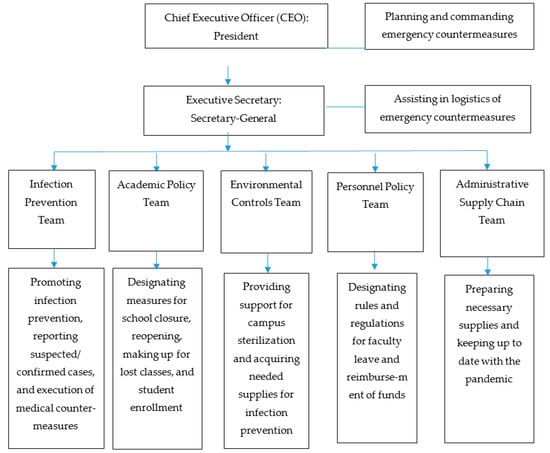
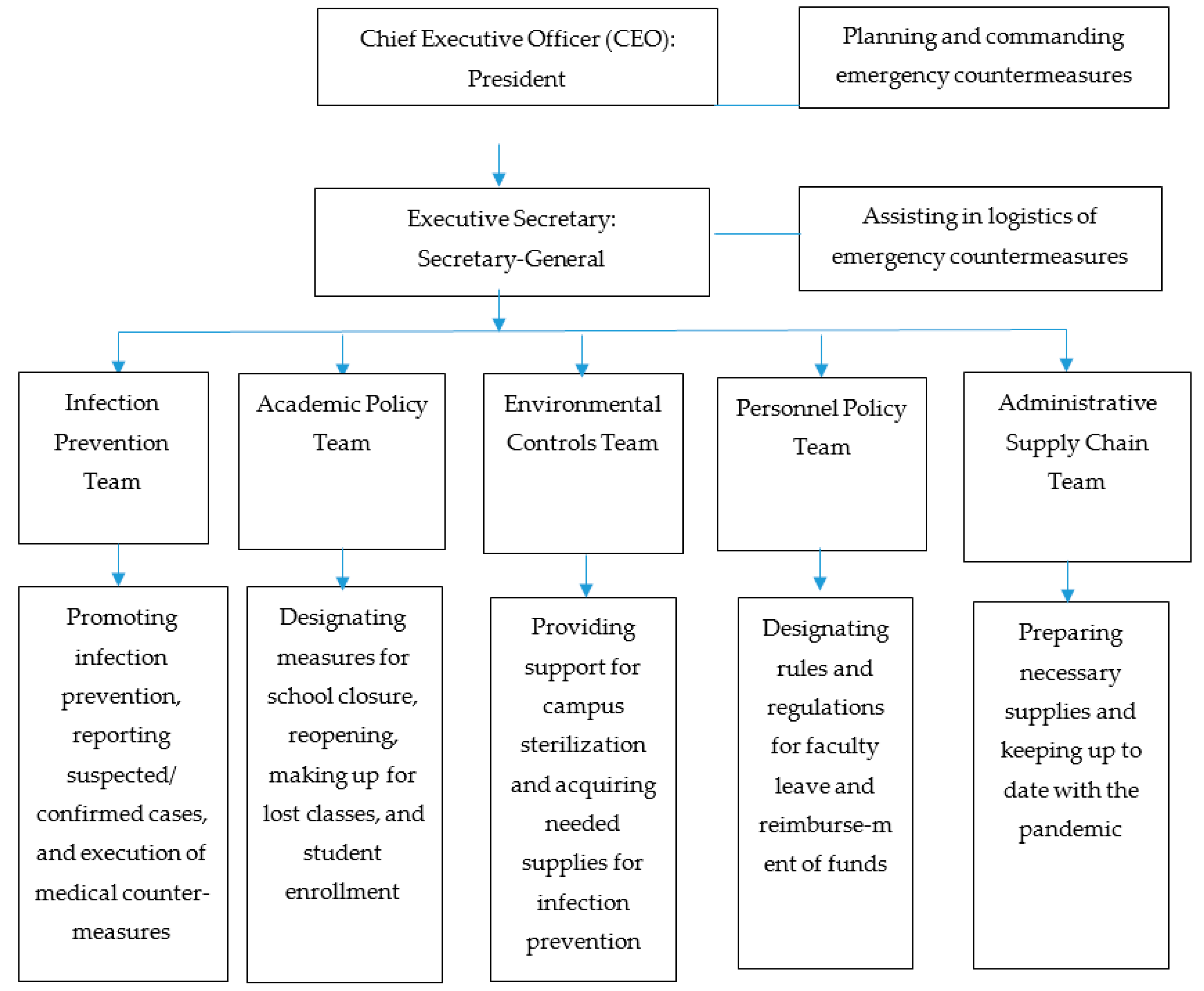
The selection of team members was mostly accomplished using existing personnel and operation designations within the original school structure. All department principal supervisors and selected secondary supervisors, 30 persons in total, were recruited and assigned to various task groups. The organization chart of this multidisciplinary task team is illustrated in Figure 1.
Figure 1.
Organization of interdepartmental task force team in a college.
The investigation was carried out following the rules of the Declaration of Helsinki of 1975. All the 30 persons involved had been informed of this study and manuscript, and their signed consent was obtained.
2.2. Establishment of Campus Protection Measures for COVID-19 (CPMCV-19)
The task team members established the campus protection measures according to the guidelines from Taiwan Centers for Disease Control (CDC) with timely updates. The details were further customized by team members from each unit. All protection measures were adjusted through a rolling correction mechanism. Team discussions were conducted through mobile application LINETM (LINE Corporation, Tokyo, Japan), institutional e-mail system, teleconferences, or face-to-face meetings.
2.3. Decision-Making Algorithm in Managing Suspected Infection on Campus
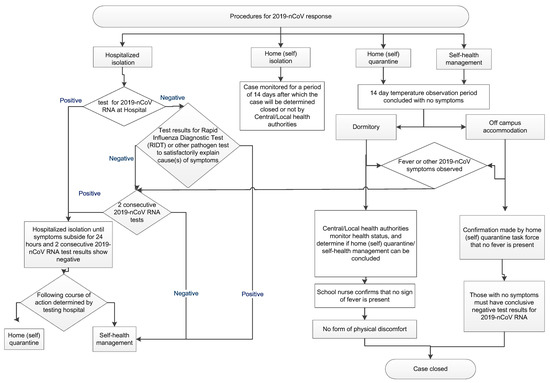
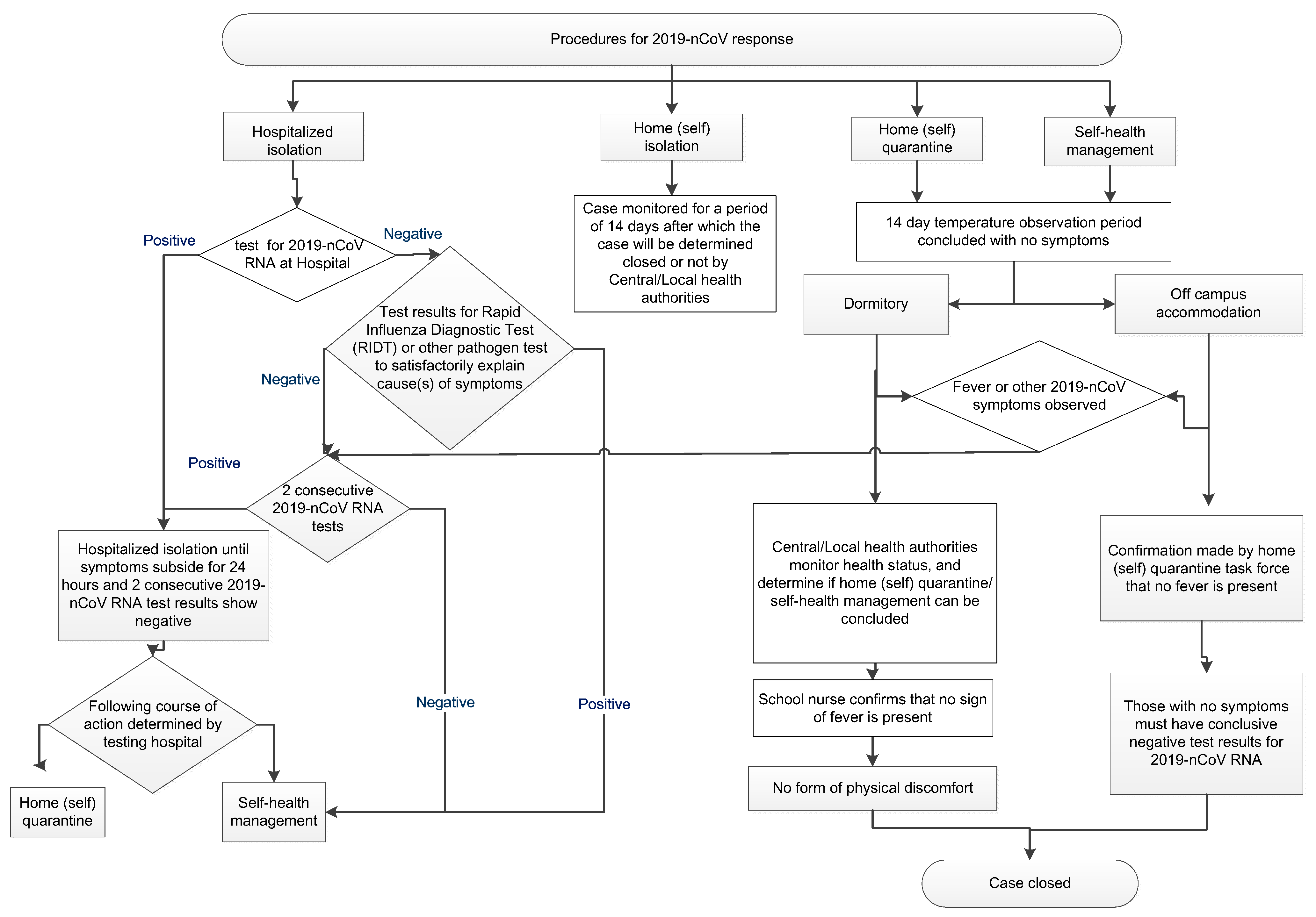
Event simulation was conducted for the development of countermeasures including detected fever, reported symptoms related to COVID-19, confirmed case on campus, and others. In order to efficiently and appropriately cope with the situation, we set up a decision-making algorithm including criteria for a 14-day school closure when 2 confirmed cases are reported within a 14-day period, as shown in Figure 2. When students are unwell or have abnormal body temperature measurement, they must first seek medical attention, and then choose hospital isolation, home isolation, home quarantine, or self-health management according to the doctor’s instructions and government regulations. The task team members established the campus protection measures according to the guidelines from Taiwan CDC with timely updates. The details were further customized by team members from each unit. All protection measures were adjusted through a rolling correction mechanism. Although a zero COVID-19 case record noted in campus cannot be entirely attributed to the performance of measures, we proposed that the established protection measures on campus might be useful and practical.
Figure 2.
Decision-making algorithm flowchart for the coronavirus disease 2019 (COVID-19) pandemic in a college.
2.4. Practical Measures in Executing CPMCV-19
As shown in Table 1, the essential components in established measures were as follows: no close contact communication (team telecommunication by using mobile application LINETM, administrative teleconference using Microsoft Teams (Microsoft Co., Redmond, WA, USA), teleteaching simulation by TronClass platform (Wisdom Garden Co., New Taipei City, Taiwan)), daily campus sterilization on workdays via 0.05% (500 ppm) sodium hypochlorite (cleaning and disinfection of environmental surfaces in the context of COVID-19: Interim guidance, 15 May 2020, World Health Organization), school gate control with daily temperature measuring (cut-off 37.5 °C by frontal temperature), social distancing (1.5-m indoors and 1-m outdoors), activity restrictions (100 persons indoors and 500 persons outdoors), personal hygiene control (facemasks, handwashing education, desktop sneeze guards in classrooms and restaurants), and situational awareness (regulations and standard operating procedures, as well as execution analysis). Official announcements to students and parents were promptly posted on the school website. An example is listed in Appendix A.
Table 1.
Essential components in established measures.
3. Results
3.1. Establishment of Regulations, Standard Operating Procedures, and Decision-Making Algorithms
As shown in Table 2, when our school faced the outbreak of COVID-19, the epidemic prevention measures and actions taken, with a total of 21 regulations, standard operating procedures, and decision-making algorithms were established. After rolling corrections, the finalized decision-making algorithms are shown in Figure 2.
Table 2.
Regulations, precautions, and standard operating procedures (SOPs).
3.2. Effectiveness of CMPCV-19
During the 100 days of operation (from 26 January to 5 June 2020), the mean time spent for frontal temperature measuring was 2.7 ± 0.3 s per person. The mean on-duty time for individual personnel to control the gate and measure temperature was 3.5 h per day. In total, 31 persons with loss of taste/smell or fever were detected on campus and sent to the hospital for screening within 1 hour. A total of 6 persons were instructed to observe self-health management due to possible contact or travel history, and none were diagnosed with COVID-19 infection. Cancellation of 32 school activities with teleconferences held as alternatives successfully avoided physical contact for 14,400 person-times.
3.3. Cost and Time for CMPCV-19 Performance
A total budget of USD 27,100 was used for CMPCV-19 in this 100-day period. This budget was mainly used to purchase items needed for epidemic prevention including forehead temperature detectors, masks, alcohol, detergents, disinfectants, and the like. The administrative teleconferences using Microsoft Teams were held 3 times, for an accumulated time of 7 h in total. The teleteaching simulations by TronClass platform were performed twice, with a combined time of 6 h.
4. Discussion
The timely established campus protection measures for COVID-19 in an approximate 5000-person college were effective and practical. They can be used as reference for schools in a pandemic, such as COVID-19.
Since the 2003 outbreak of severe acute respiratory syndrome (SARS) in Taiwan, the medical and educational institutions have established various strategies for preventing outbreaks of infectious diseases and proposed response mechanisms for distributing resources efficiently during management operations [12,13]. The experience in responding to SARS with a 17-year interval aided the rapid response to cope with the COVID-19 pandemic in educational institutions. However, the viral characters of COVID-19 are distinct to SARS. For instance, the longer latency made campus protection from case clustering a vigorous challenge. Notably, a longer incubation time for SARS-CoV-2 infection with mean time 5.2 days (95% confidence interval (CI), 4.1 to 7.0) and the 95th percentile of the distribution at 12.5 days [14], indicated a need to adjust screening and control policies. It was suggested that potentially exposed subjects are required to be isolated for 14 days to avoid the risk of further transmission. As for symptoms/signs other than fever, loss of taste or loss of smell with severity greater than moderate were reported in 37.2% of patients positive for COVID-19 [15]. Taken together, we established the campus protection measures for COVID-19 by combining the experience from SARS and updating the information for COVID-19.
The major value of this work is to provide a timely reference for schools with similar scale to establish their own campus protection measures for the COVID-19 pandemic. The limitations of this work are that no actual positive COVID-19 cases were detected in the campus and no long-term follow-up data could be provided. The uniqueness of this work is the combination of global COVID-19 situation, government infectious disease control policy, and college campus environment to establish protection measures that are timely and practical for execution. To the best of our knowledge, no such timely and well-organized measures have yet been published about the COVID-19 pandemic. To assess the execution efficiency of the campus protection measures, the following must be considered: efficacy, time consumption, costs, and labor. The performance of CPMCV-19 resulted in avoidance of physical contact in a significant quantity and rapid processing for fever or symptom-detected individuals by spending reasonable costs of budget, time and labor, indicative of effective and practical measures for campus protection. These execution results not only provide physical protection but also psychological disburden for campus crisis and human stress [16,17,18].
5. Conclusions
The established campus protection measures for COVID-19 was practical and might be effective. However, it may need adjustments according to local culture and social characteristics. It may serve as a useful template for other colleges and small institutions that have limited resources.
Author Contributions
Conception and design: Y.-J.C. and C.-L.L.; analysis and interpretation of the data: T.-C.C. and Y.-J.C.; drafting of the article: Y.-J.C. and T.-C.C.; final approval of the article: Y.-J.C., T.-C.C. and M.-Y.L.; critical revision of the article for important intellectual: J.-C.H., C.-T.Y., C.-H.L., W.-C.J. and H.-Y.H. All authors have read and agreed to the published version of the manuscript.
Funding
This research received no external funding.
Conflicts of Interest
The authors declare no conflict of interest.
References
- Gorbalenya, A.E.; Baker, S.C.; Baric, R.S.; de Groot, R.J.; Drosten, C.; Gulyaeva, A.A.; Haagmans, B.L.; Lauber, C.; Leontovich, A.M.; Neuman, B.W.; et al. Severe acute respiratory syndrome-related coronavirus: The species and its viruses—A statement of the Coronavirus Study Group. BioRxiv 2020. [Google Scholar] [CrossRef] [Scilit]
- Zhu, N.; Zhang, D.; Wang, W.; Li, X.; Yang, B.; Song, J.; Zhao, X.; Huang, B.; Shi, W.; Lu, R.; et al. A Novel Coronavirus from Patients with Pneumonia in China, 2019. N. Engl. J. Med. 2020, 382, 727–733. [Google Scholar] [CrossRef] [Scilit] [PubMed]
- Liu, L.; Hong, X.; Su, X.; Chen, H.; Zhang, D.; Tang, S.; Chen, L.; Zhu, B.; Li, X.; Shi, Y. Optimizing screening strategies for coronavirus disease 2019: A study from Middle China. J. Infect. Public Health 2020, 13, 868–872. [Google Scholar] [CrossRef] [Scilit] [PubMed]
- Tahiri, J.H.R.; Bennis, A. Hydroxychloroquine as antiviral prophylaxis for exposed caregivers to Covid-19: An urgent appraisal is needed. J. Infect. Public Health 2020, 13, 865–867. [Google Scholar] [CrossRef] [Scilit] [PubMed]
- Xiao, J.; Fang, M.; Chen, Q.; He, B. SARS, MERS and COVID-19 among healthcare workers: A narrative review. J. Infect. Public Health 2020, 13, 843–848. [Google Scholar] [CrossRef] [Scilit] [PubMed]
- WHO Director-General’s Opening Remarks at the Media Briefing on COVID-19—11 March 2020. Available online: https://www.who.int/dg/speeches/detail/who-director-general-s-opening-remarks-at-the-media-briefing-on-covid-19---11-march-2020 (accessed on 11 March 2020).
- Viner, R.M.; Russell, S.J.; Croker, H.; Packer, J.; Ward, J.; Stansfield, C.; Mytton, O.; Bonell, C.; Booy, R. School closure and management practices during coronavirus outbreaks including COVID-19: A rapid systematic review. Lancet Child Adolesc. Health 2020, 4, 397–404. [Google Scholar] [CrossRef] [Scilit]
- Brooks, S.K.; Smith, L.E.; Webster, R.K.; Weston, D.; Woodland, L.; Hall, I.; Rubin, G.J. The impact of unplanned school closure on children’s social contact: Rapid evidence review. Eurosurveillance 2020, 25, 2000188. [Google Scholar] [CrossRef] [Scilit] [PubMed]
- Bayham, J.; Fenichel, E.P. Impact of school closures for COVID-19 on the US health-care workforce and net mortality: A modelling study. Lancet Public Health 2020, 5, e271–e278. [Google Scholar] [CrossRef] [Scilit]
- Taiwan Timely Identifies First Imported Case of 2019 Novel Coronavirus Infection Returning from Wuhan, China through Onboard Quarantine; Central Epidemic Command Center (CECC) Raises Travel Notice Level for Wuhan, China to Level 3: Warning. Available online: https://www.cdc.gov.tw/En/Bulletin/Detail/pVg_jRVvtHhp94C6GShRkQ?typeid=158 (accessed on 21 January 2020).
- Wang, C.J.; Ng, C.Y.; Brook, R.H. Response to COVID-19 in Taiwan: Big Data Analytics, New Technology, and Proactive Testing. JAMA 2020. [Google Scholar] [CrossRef] [Scilit] [PubMed]
- Chen, K.T.; Twu, S.J.; Chang, H.L.; Wu, Y.C.; Chen, C.T.; Lin, T.H.; Olsen, S.J.; Dowell, S.F.; Su, I.J. Taiwan SARS Response Team. SARS in Taiwan: An overview and lessons learned. Int. J. Infect. Dis. 2005, 9, 77–85. [Google Scholar] [CrossRef] [Scilit] [PubMed]
- Centers for Disease Control and Prevention. Severe acute respiratory syndrome—Taiwan, 2003. JAMA 2003, 289, 2930–2932. [Google Scholar] [CrossRef] [Scilit] [PubMed]
- Li, Q.; Guan, X.; Wu, P.; Wang, X.; Zhou, L.; Tong, Y.; Ren, R.; Leung, K.S.M.; Lau, E.H.Y.; Wong, J.Y.; et al. Early Transmission Dynamics in Wuhan, China, of Novel Coronavirus-Infected Pneumonia. N. Engl. J. Med. 2020, 382, 1199–1207. [Google Scholar] [CrossRef] [Scilit] [PubMed]
- Spinato, G.; Fabbris, C.; Polesel, J.; Cazzador, D.; Borsetto, D.; Hopkins, C.; Boscolo-Rizzo, P. Alterations in Smell or Taste in Mildly Symptomatic Outpatients With SARS-CoV-2 Infection. JAMA 2020. [Google Scholar] [CrossRef] [Scilit] [PubMed]
- Li, H.Y.; Cao, H.; Leung, D.Y.P.; Mak, Y.W. The Psychological Impacts of a COVID-19 Outbreak on College Students in China: A Longitudinal Study. Int. J. Environ. Res. Public Health 2020, 17, 3933. [Google Scholar] [CrossRef] [Scilit] [PubMed]
- Kaslow, N.J.; Friis-Healy, E.A.; Cattie, J.E.; Cook, S.C.; Crowell, A.L.; Cullum, K.A.; Del Rio, C.; Marshall-Lee, E.D.; LoPilato, A.M.; VanderBroek-Stice, L.; et al. Flattening the emotional distress curve: A behavioral health pandemic response strategy for COVID-19. Am. Psychol. 2020. [Google Scholar] [CrossRef] [Scilit] [PubMed]
- Brooks, S.K.; Webster, R.K.; Smith, L.E.; Woodland, L.; Wessely, S.; Greenberg, N.; Rubin, G.J. The psychological impact of quarantine and how to reduce it: Rapid review of the evidence. Lancet 2020, 395, 912–920. [Google Scholar] [CrossRef] [Scilit]

© 2020 by the authors. Licensee MDPI, Basel, Switzerland. This article is an open access article distributed under the terms and conditions of the Creative Commons Attribution (CC BY) license (http://creativecommons.org/licenses/by/4.0/).