

You are currently viewing a new version of our website. To view the old version click .

Healthcare, Volume 8, Issue 3

September 2020 - 167 articles

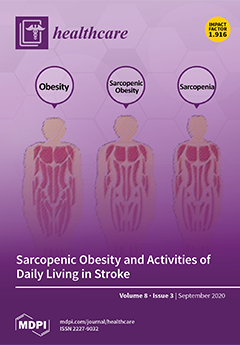
Cover Story: Sarcopenic obesity is strongly associated with decreased activities of daily living in community-dwelling older adults. We hypothesized that sarcopenic obesity also has a negative impact on activities of daily living in patients after stroke. A cross-sectional study was conducted to clarify the relationship between sarcopenic obesity, simple obesity and sarcopenia without obesity and activities of daily living capability in patients with stroke in convalescent rehabilitation wards. We found that approximately 30% of patients were classified to have sarcopenic obesity, and it was independently associated with lower ability to perform activities of daily living. Based on the findings, we ascertain that body composition of the patients after stroke should be assessed routinely as a part of daily rehabilitation assessment in rehabilitation settings. View this paper.
  • Issues are regarded as officially published after their release is announced to the table of contents alert mailing list .
  • You may sign up for email alerts to receive table of contents of newly released issues.
  • PDF is the official format for papers published in both, html and pdf forms. To view the papers in pdf format, click on the "PDF Full-text" link, and use the free Adobe Reader to open them.

Articles (167)

  • Article
  • Open Access
25 Citations
6,444 Views
16 Pages

22 September 2020

The current study aimed to investigate knowledge, attitudes, and implementation of evidence-based practice among physiotherapists working in Saudi Arabia. A sample of physiotherapists working in various outpatient settings in Saudi Arabia participate...

  • Article
  • Open Access
15 Citations
4,838 Views
12 Pages

What Happens at Work Comes Home

  • Anna Stowe Alrutz,
  • Stephen Buetow,
  • Linda D. Cameron and
  • Peter Kenneth Huggard

21 September 2020

Emergency responders (police, fire, ambulance and defence force personnel) risk exposure to dangerous and traumatic events, and the possible subsequent development of post-traumatic stress disorder. Consequently, partners of these emergency responder...

  • Article
  • Open Access
17 Citations
8,933 Views
10 Pages

Sleep Deprivation from the Perspective of a Patient Hospitalized in the Intensive Care Unit—Qualitative Study

  • Katarzyna Lewandowska,
  • Wioletta Mędrzycka-Dąbrowska,
  • Dorota Pilch,
  • Krystyna Wach,
  • Antonietta Fortunato,
  • Sabina Krupa and
  • Dorota Ozga

21 September 2020

(1) Introduction: Sleep architecture of Intensive Care Unit (ICU) patients is altered, with over 60% of them reporting sleep disorders or even sleep deprivation during their stay. The aim of the study was to describe the experiences related to sleep...

  • Article
  • Open Access
8 Citations
3,349 Views
13 Pages

Web Search Trends of Implementing the Patient Autonomy Act in Taiwan

  • Po-Chin Yang,
  • Mei-Ju Shih,
  • Ya-An Liu,
  • Ya-Chuan Hsu,
  • Hsiao-Ting Chang,
  • Ming-Hwai Lin,
  • Tzeng-Ji Chen,
  • Li-Fang Chou and
  • Shinn-Jang Hwang

21 September 2020

Background: The Patient Autonomy Act was implemented in Taiwan on 6 January 2019. It is the first patient-oriented act in Taiwan, and also the first special act to completely protect patient autonomy in Asia. Our study aimed to investigate the web re...

  • Article
  • Open Access
23 Citations
5,119 Views
12 Pages

Risk Factors Associated with Recurrent Clostridioides difficile Infection

  • Nicoleta Negrut,
  • Simona Bungau,
  • Tapan Behl,
  • Shamim Ahmad Khan,
  • Cosmin Mihai Vesa,
  • Cristiana Bustea,
  • Delia Carmen Nistor-Cseppento,
  • Marius Rus,
  • Flavia-Maria Pavel and
  • Delia Mirela Tit

21 September 2020

Clostridioides difficile (CD) is responsible for nosocomial diarrhea syndrome with possible severe progression. Recurrence of the disease induces higher health system costs, as well as exposes patients to additional health risks. Patients with recurr...

  • Article
  • Open Access
64 Citations
10,260 Views
16 Pages

A Smart Architecture for Diabetic Patient Monitoring Using Machine Learning Algorithms

  • Amine Rghioui,
  • Jaime Lloret,
  • Sandra Sendra and
  • Abdelmajid Oumnad

19 September 2020

Continuous monitoring of diabetic patients improves their quality of life. The use of multiple technologies such as the Internet of Things (IoT), embedded systems, communication technologies, artificial intelligence, and smart devices can reduce the...

  • Article
  • Open Access
8 Citations
5,063 Views
13 Pages

19 September 2020

Hospital accreditation, as a quality signal, is gaining its popularity among low- and middle-income countries, such as Romania, despite its costly nature. Nevertheless, its effectiveness as a quality signal in driving patients’ choice of hospit...

  • Article
  • Open Access
3 Citations
3,850 Views
13 Pages

18 September 2020

The ability to live independently plays a crucial role in the mental and psychological wellbeing of the disabled. To achieve this goal, most governments spend a substantial budget on home adaptation projects. It has been observed that schemes with di...

  • Article
  • Open Access
6 Citations
3,080 Views
12 Pages

Sedentary Behavior in Older Patients before and after Total Hip Arthroplasty: A Prospective Cohort Study

  • Burkhard Moellenbeck,
  • Frank Horst,
  • Georg Gosheger,
  • Christoph Theil,
  • Leonie Seeber and
  • Tobias Kalisch

18 September 2020

Objective: To compare the habitual sedentary behavior (SB) and physical activity (PA) of older hip osteoarthritis patients before and after elective arthroplasty. Methods: SB, PA and joint-specific disability of 16 patients (68.9 ± 6.8 years)...

  • Article
  • Open Access
9 Citations
4,074 Views
12 Pages

Subjective and Objective Mental and Physical Functions Affect Subjective Cognitive Decline in Community-Dwelling Elderly Japanese People

  • Akio Goda,
  • Shin Murata,
  • Hideki Nakano,
  • Kayoko Shiraiwa,
  • Teppei Abiko,
  • Koji Nonaka,
  • Hiroaki Iwase,
  • Kunihiko Anami and
  • Jun Horie

18 September 2020

Subjective cognitive decline (SCD) is complex and not well understood, especially among Japanese people. In the present study, we aimed to elucidate the relationships of subjective and objective mental and physical function with SCD among older commu...

of 17

Get Alerted

Add your email address to receive forthcoming issues of this journal.

XFacebookLinkedIn
Healthcare - ISSN 2227-9032