


Abstract
Quantum error-correcting codes are essential for achieving fault-tolerant quantum computing. Heavy hexagonal code is a type of topological code that leverages the arrangement of qubits to find and correct errors. The heavy hexagonal code is suitable for superconducting architectures, specifically graph layouts with a limited number of connections. The topological error correction methods work well, but they need more qubits, cannot be used for different sizes of quantum systems, are less reliable, and do not work well with changing quantum distributions. Thus, the research proposes an Ardea-guided exploit optimized sparse-dual attention enabled meta-learning-based convolutional neural network with bi-directional long short-term memory model (AGuESD-MCBiTM). The method exhibits effective correction over dynamic environments with the utilization of meta-learning and the extraction of statistical information, which provides a detailed representation of the qubit patterns. The Ardea-guided exploit optimized (AGuEO) algorithm tunes the weights of MCBiTM and acquires optimal solutions with higher convergence. Moreover, the sparse-dual attention module and meta-learning-based MCBiTM model, which together provide scalable, real-time identification of non-linear qubit noise fluctuations with lower computational cost. Comparatively, the proposed AGuESD-MCBiTM exhibits superior error correction with a higher correlation of 0.97, accuracy of 98.93%, and R-squared value of 0.93, as well as a lower Root mean square error of 1.87, Mean absolute error of 1.20, Bit error rate of 1.85, Logical error rate of 3.82, and mean square error of 3.49 in circuit 2, respectively.
Keywords:
quantum error correction; meta-learning; convolutional neural network; heavy hexagonal code; sparse-dual attention MSC:
81P45; 81P68; 81P73; 68Q12; 94A15
1. Introduction
With the increasing potential of future technologies, the field of quantum computing has evolved as a popular research area of evolving dynamic networks [1]. Quantum mechanics are highly effective for performing several operations that cannot be implemented with classical systems [2,3]. Similar to standard computers, qubits are considered an essential component of quantum computers [4,5]. The special features of quantum mechanics, like superposition and entanglement, help quantum computers tackle difficult problems that classical computers cannot solve. The mentioned quantum properties are considered a major difference between the classical bits and quantum qubits that are highly effective in dealing with the complexities [6]. However, the quantum states are vulnerable to external noise factors due to environmental conditions and are very fragile, resulting in avoidable, unavoidable correlations between the qubits [1,4]. The occurrence of these noise attributes leads to errors and decoherence in qubits, which can be subdued with the introduction of quantum error correction (QEC) codes [7]. The aggregation of the codes is a key influence towards the effective quantum information transmission [8]. The error correction in quantum circuits is similar to the standard bit error reduction and focuses on utilising repeated quantum bits for encoding one qubit’s data into multiple interlinked qubits [9,10]. Compared to the single qubits, the entangled qubits gave superior properties that are also known as logic qubits.
The QEC has proved to be efficient in protecting the quantum data by encoding the logical qubit state into multiple physical qubits [11]. In recent years, the progression of error correction has increased with the experimentation on diverse platforms, namely supercomputing qubit architectures, neutral atoms, quantum dots, and ion traps [12,13]. The prevention of these errors improves the lifetime of qubits; however, higher differences are encountered in native gate sets [6,14]. The schemes also need to be focused on improving the network connectivity and the relevance with noise models, which increases the demand for adaptable encoding circuits [15]. Of the various error-correcting codes, surface codes have a crucial research scope that observes the variations in the intensities of nearby communications between physical qubits that are arranged planarly [16,17]. The analysis of the shared communications assists in strategizing ways to correct the errors; however, the individual qubits are connected to the other four qubits on the dense structure of surface codes [5]. The interconnection between the multiple qubits leads to unusual frequency collisions hence, the implementations are focused on robust error-correcting codes, namely heavy hexagonal codes (HHC) [18]. Asymmetric quantum error correction methods have been developed to address the imbalance between bit-flip and phase-flip errors [19]. The hexagonal codes are mainly dependent on the aggregation of degree-three and degree-two vertices that connect the multiple interlinks of physical qubits. Therefore, the heavy hexagonal codes are seen as the aggregation of Bacon–Shor codes with surface codes.
The HHC is proven to be highly significant due to the reduction in the wider range of frequency requirements for implementation [20]. The codes introduce flagged qubits or auxiliary qubits in the syndromic measurement that reduces the effects of qubit crosstalks [21]. The coding structure perfectly fits into the hexagonal network of quantum computers and achieves stable and rapid decoding. For evaluating the performance of decoding, the threshold is considered a key metric, as well as the reductions in interlinked correlations. For achieving better error correction, the HHC implies the closer communications of physical qubits [22]; however, it causes significant impacts on decoding potential [8,23]. The introduction of robust tools in artificial intelligence (AI) transforms the scientific techniques to achieve faster strategies—mainly, the deep learning (DL) models. The DL methods autonomously implement the action-reward schemes to the complex issues of decision-making and serve as promising discoveries for quantum error correction approaches [1]. Hybrid quantum–classical convolutional neural networks have demonstrated promising results in medical image classification by integrating parameterized quantum circuits with classical deep learning architectures, achieving improved performance over conventional CNN models [24].
The encoding of reward problems is complicated, and the DL mechanisms maximize the reward over the time interval [25]. The strategization is critical in certain circumstances where the optimization plays a crucial role in high-dimensional search space. DL is an efficient tool to tackle the issues with quantum error code construction, while the hardware resource constraints, adaptability, and redundancies, as well as memory restrictions, need to be considered for better efficiencies over evolving network conditions [2,10].
The limitations in the conventional quantum error correction are complex noise, ineffectiveness with smaller low-density parity check codes, and lower reliability. The research proposes AGuESD-MCBiTM to address the limitations of the conventional approaches and to exhibit effective error correction. The AGuEO algorithm tuned the weights to improve the learning rate over complex error patterns, and the meta-learning improved the adaptability. In addition, the sparse dual attention assisted in identifying the long-range dependencies. The major highlights of this research are provided as follows,
- Ardea guided exploit optimized algorithm: Inspired by the diverse hunting strategies of hummingbirds, red kites, secretary birds, and Egret swarms, the Ardea-guided exploit optimized (AGuEO) algorithm prevents premature convergence to local optima. It effectively tunes model weights to improve learning rates and accuracy when dealing with complex, non-linear error patterns.
- Sparse-Dual Attention Module: To overcome the inefficiencies of analyzing large qubit arrangements, this module provides a low-cost, fine-grained analysis of qubit entanglement through the hybridization of sparse and dual attention, which enables the identification of the long-range contextual information of error codes and enhances scalability and adaptability across diverse, complex quantum circuits.
- Ardea guided exploit optimized sparse dual attention enabled meta-learning-based convolutional neural network with bi-directional long short-term memory model: By combining meta-learning with a convolution-bi-directional long short-term memory (MCBiTM) network, the model excels at adapting to dynamic, time-varying qubit relationships. Furthermore, the AGuEO algorithm effectively tunes the hyperparameter of MCBiTM, which aids better identification of noise profiles and non-linear error relationships, overcoming the limitations of conventional approaches on smaller, low-density parity-check (LDPC) codes.
The manuscript is presented as follows: Section 2 represents the literature review, Section 3 represents the system model, Section 4 explains the workings of AGuESD-MCBiTM, and Section 5 interprets the results and discussion of AGuESD-MCBiTM with a comprehensive overview of its objective performance. Section 6 presents the conclusion of this research, with the key findings underscoring the significance of the proposed work, as well as future directions.
2. Literature Review
The section provides an overview of the prevailing QEC approaches with their advantages and their limitations.
Aoqing Li et al. [1] presented the ML-based hexagonal decoder that utilized CNN for acquiring the decoding threshold value. The method was effective with other topological codes and implemented on complex codes respective to the distance of three up to seven initially. The ML approach acquired better accuracy even under the influence of depolarizing noises; however, it faced higher backdrops in real quantum environments. Moreover, the training with complex noise models was highly challenging. Jan Olle et al. [8] introduced a reinforcement learning-based model that automated the identification of error correction codes with the encoding circuits. The qubit connectivity between the circuits was managed for the given gate state, and encoding strategies were created by the noise-aware agents. The influence of the noise-aware factors simultaneously minimized the various ranges of the noise models; however, the scalability was not considered with wide-ranged GPU machines.
Travis Lecompte et al. [2] modeled an ML-based qubit allocation approach that reduced error by analyzing the initial layouts. The mapping decisions were created with the graph neural network (GNN)-based Q network that observed the error values as well as connections of the graph-like back end. The decision-making was improved with the setting of target backend properties as input. However, the lack of a routing approach impacted the performance among various backend configurations. Liangyu Chen et al. [12] modeled a readout scheme that reduced the contribution of decay error with the combination of microwave techniques. The method distinguished the qubit populations in the higher energy levels using two-tone excitations. The demonstration of a three-state readout was faster without the utilization of a quantum-limited amplifier. Nevertheless, lower fidelity was observed for multiplexed readout with the superconducting qubits.
Umesh Uttamrao Shinde and Ravikumar Bandaru [9] presented a self-adaptive deep convolutional neural network (SADCNN) framework for error correction in quantum circuits. The optimized DL model incorporated artificial noise for mitigating the errors in superconducting qubits, and the efficiency of the decoder was evaluated across diverse code distances. However, the adaptability was lower with the evolving quantum error patterns in real-time scenarios. Vandana Rani Verma et al. [6] modeled a quantum ML framework that regulated the computational offloading in edge-computed circuits. The stability of data queues was observed under unpredictable network conditions, as well as the leveraged offloading policies to maximize the network efficiency. The network throughput was higher with bounding queues, whereas the efficiency of network controlling algorithms was lower in highly complicated systems.
Yexiong Zeng et al. [10] created an automated quantum error correction model that utilized bosonic codes for error correction. The set of codewords was identified through reinforcement learning (RL). The optimal nature of RL assisted in suppressing the losses and exhibited effective dephasing. The approximate nature was reduced with a break-even threshold that served as the essential block toward error correction. However, the approach exhibited lower fault tolerance with maximum qubit distance. Umesh Uttamrao Shinde and Ravikumar Bandaru [7] modeled an attention-enabled decoder for the accurate correction of heavy hexagonal codes. The feature learning was improved with the utilized attention that assisted in performing complex tasks. In addition, the optimization exhibited better convergence even with changing quantum conditions; however, the method necessitated advanced modules such as reinforcement learning for maintaining scalability.
Ref. [26] introduced a Spanning Tree Matching (STM) Decoder for Quantum Surface Codes, which provides a substantial advantage in decoding time compared to the minimum weight perfect matching (MWPM) decoder. The STM decoder was implemented in three major phases, involving the minimum spanning tree (MST) evaluation, tree matching procedure, and error correction. Despite its superior decoding speed, there is a slight degradation in error correction performance compared to the optimal MWPM decoder. Ref. [12] presented an FPGA-based distributed union-Find decoder for surface codes that showcased a promising outcome with an average time complexity. Here, the Helios structures controllers as trees of control nodes, overcomes scalability bottlenecks, and enables distributed, parallel management. However, the parallel nature of the Helios architecture consumes a large percentage of available hardware resources even for moderate code distance.
2.1. Challenges
The major challenges observed in the reviewed approaches are listed below.
- The training and testing of ML-based decoding algorithms were highly challenging with the complex noise models. In addition, the accuracy of decoder error correction was not evaluated in real quantum environments [1].
- The scalability of the reinforcement learning-based method was lower in implementation with multiple GPUs, and the lack of ansatz limits the effectiveness of smaller low-density parity check codes [8].
- The efficiency of GNN-assisted compilation (GNAQC) was lower due to the lack of recurrent routing methods, and the implementation was not performed among diverse feature dimensions. Moreover, the relative fidelity across the backend configurations was reduced with different circuits [2].
- The SADCNN method exhibited lower adaptability with the evolving quantum error patterns in real-time circumstances as well as the resilience of quantum error corrections during decoding necessitated further improvements [9].
2.2. Problem Statement
The quantum error correction schemes are employed to minimize the influence of noise or errors in the qubit information. The error corrections work based on the conversion of physical quantum data to logical qubits. Various error correction schemes are deployed for the quantum networks that primarily work on the utilization of surface codes for observing the interplanar interactions. However, the methods are highly vulnerable to various challenges that include the requirement of a larger physical qubit to encode a single qubit [8], preparation of qubit states [10], as well as error leakages [9]. In addition, the complexities in identifying the errors associated with the interlinks and sensitivity to environmental factors affect the QEC performance [12]. The heavy hexagonal codes are implemented to eliminate the limitations associated with QEC; however, these codes are susceptible to limitations, including the requirement to manage the large number of errors within the hexagonal lattice structure and higher connectivity between the qubits that induce complexity. Therefore, to address these limitations, the AGuESD-MCBiTM framework is proposed in this research. Generally, the K qubits in the quantum state are represented in Hilbert space that can be signified as,
Here, denotes the Hilbert space containing K qubits, is the pure state of qubits represented in a two-dimensional Hilbert space, the tensor product is indicated by ⊗, and indicates the renormalization vector. The quantum state factor represents the collection of qubit strings of K qubits that includes the integer set of modulo two represented as ,
Here, the normalization condition ensures that the sum of the squares of the magnitudes of these amplitudes equals 1, where C is the complex number, hence the value of . The AGuESD-MCBiTM model achieves better error correction by identifying the subset state of complex numbers and the quantum operation by inducing an error factor . The AGuESD-MCBiTM method exhibits higher adaptability to various error models, and the sparse-dual attention manages the complexity of error correction.
3. System Model of Quantum Error Correction System
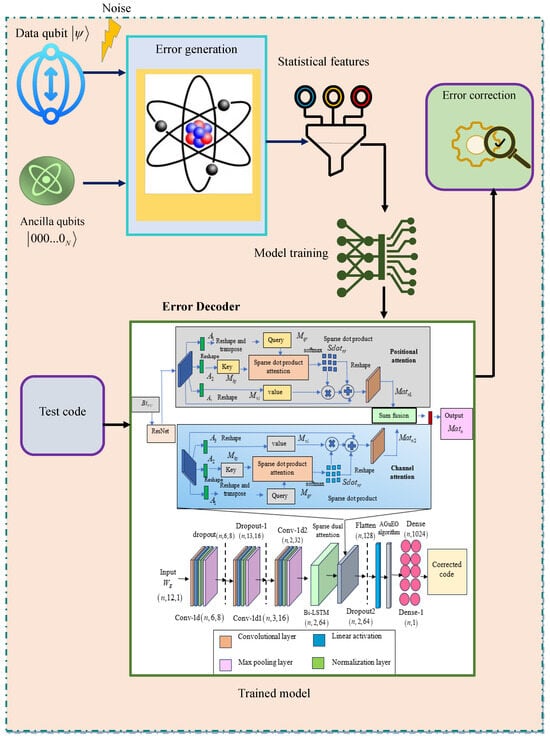
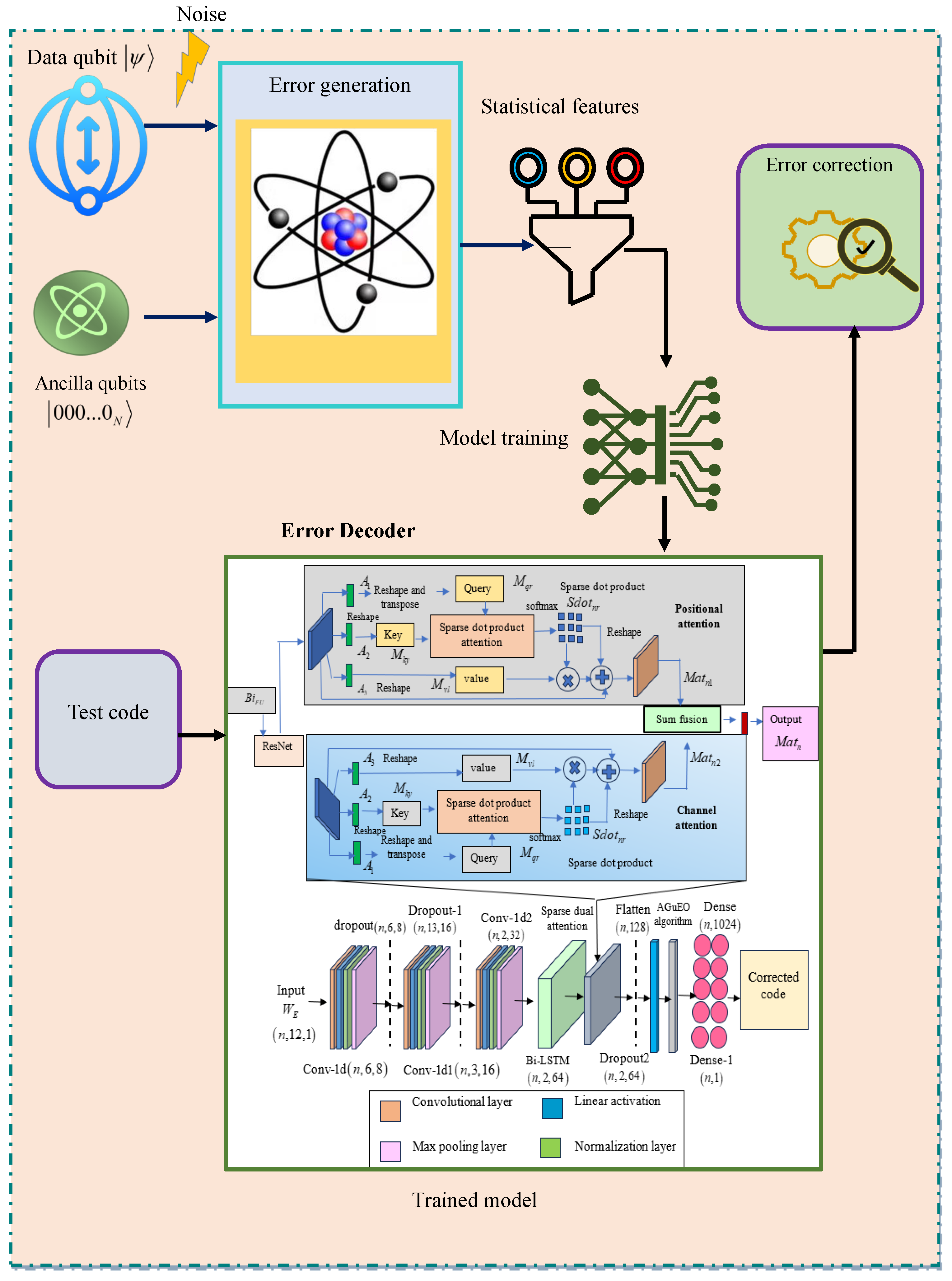
The information in the quantum networks is susceptible to errors in which quantum error correction proves to be significant in rectifying the qubit errors. The system model for detecting quantum errors is shown in Figure 1. The major components of this framework include qubits, a syndrome generator, an error decoder, an error correction unit, and a syndrome measurement. The noises are added to the data qubits where the information related to the error factors is evaluated with the syndrome generation block. The level of variations in the qubit code between the current and actual states are observed by the measurement unit. The decoding unit processes the learnt information to identify the presence of errors, and prevention strategies are applied to the qubit code in case of errors detected. The application of error correction strategies relies on the nature of the errors. The correction systems are effective in achieving fault tolerance and have a higher potential for complex quantum applications.
Figure 1.
System model of the quantum error correction framework.
4. Proposed Ardea Guided Exploit Optimized Sparse-Dual Attention Enabled Deep Learning Model for Quantum Error Correction
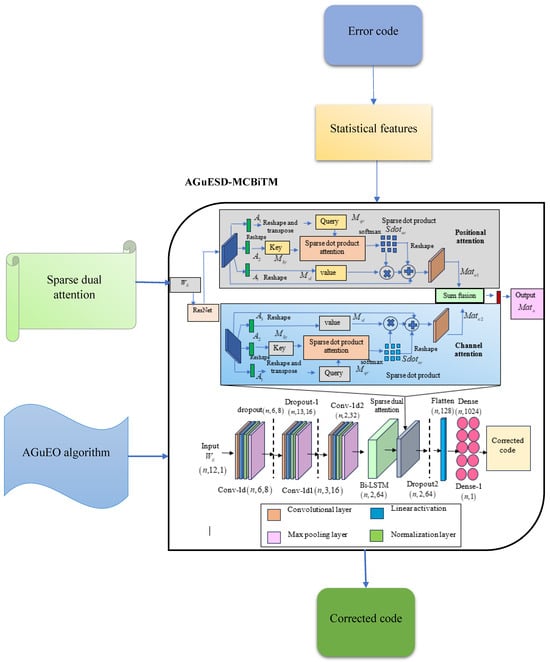
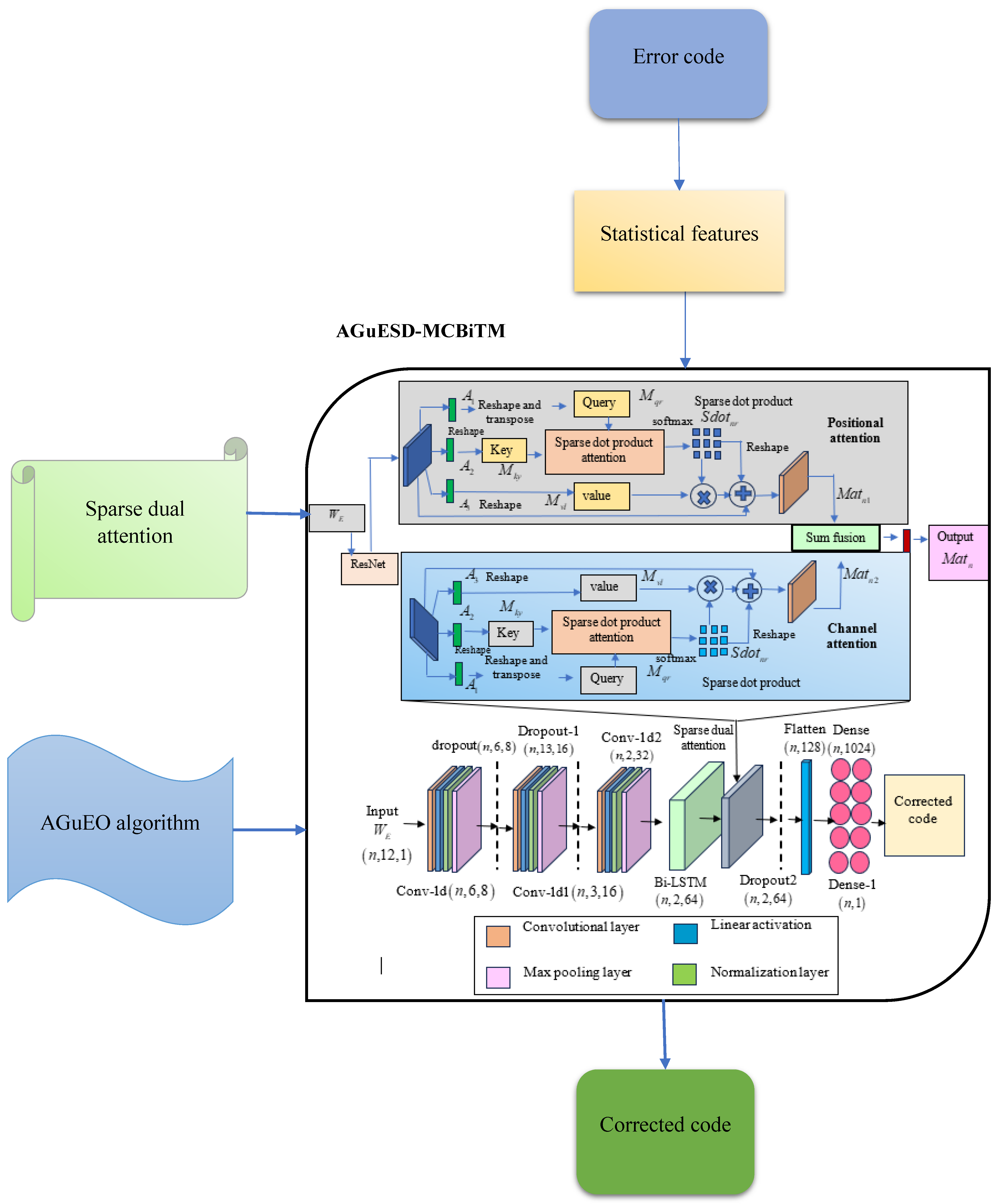
The AGuESD-MCBiTM framework addresses QEC by combining simulation-based data generation with a self-adaptive deep learning decoder to mitigate noise in superconducting qubit architectures. The model employs sparse dual attention and the AGuEO algorithm to improve decoding of complex errors, validated using Qiskit for data generation under simulated noise. This was to achieve active error detection and correction during a calculation without causing potential changes in the encoded logical information. These errors are introduced primarily through environmental noise, qubit decoherence, imperfect gate operations, and faulty measurements during the error detection process. The error detection, redundant encoding, and rectification, along with processing the encoded data, entail a significant overhead of procedures, including hardware limitations as well as security concerns. The research proposes AGuESD-MCBiTM to address the issues concerning quantum error correction. Initially, the simulation of the error code is performed, and the statistical features are acquired that facilitate understanding of the error codes and qubit distributions. The extracted features are then given to the AGuESD-MCBiTM decoder model. The long-range dependencies of the error codes are captured using sparse dual attention, and the parameters are tuned with the AGuEO that improves the correction of complex quantum errors. Moreover, meta-learning improves the adaptability of the framework to diverse errors and training with additional noise with varying code distances. Eventually, the AGuESD-MCBiTM method mitigates errors that occur during the final measurement phase by correcting non-linear noise. Figure 2 signifies the flow diagram of the AGuESD-MCBiTM framework.
Figure 2.
Block diagram of the AGuESD-MCBiTM framework.
4.1. Overview of Heavy Hexagonal Code
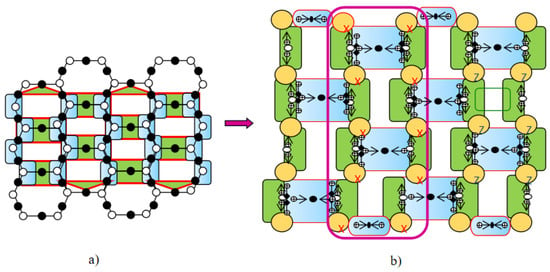
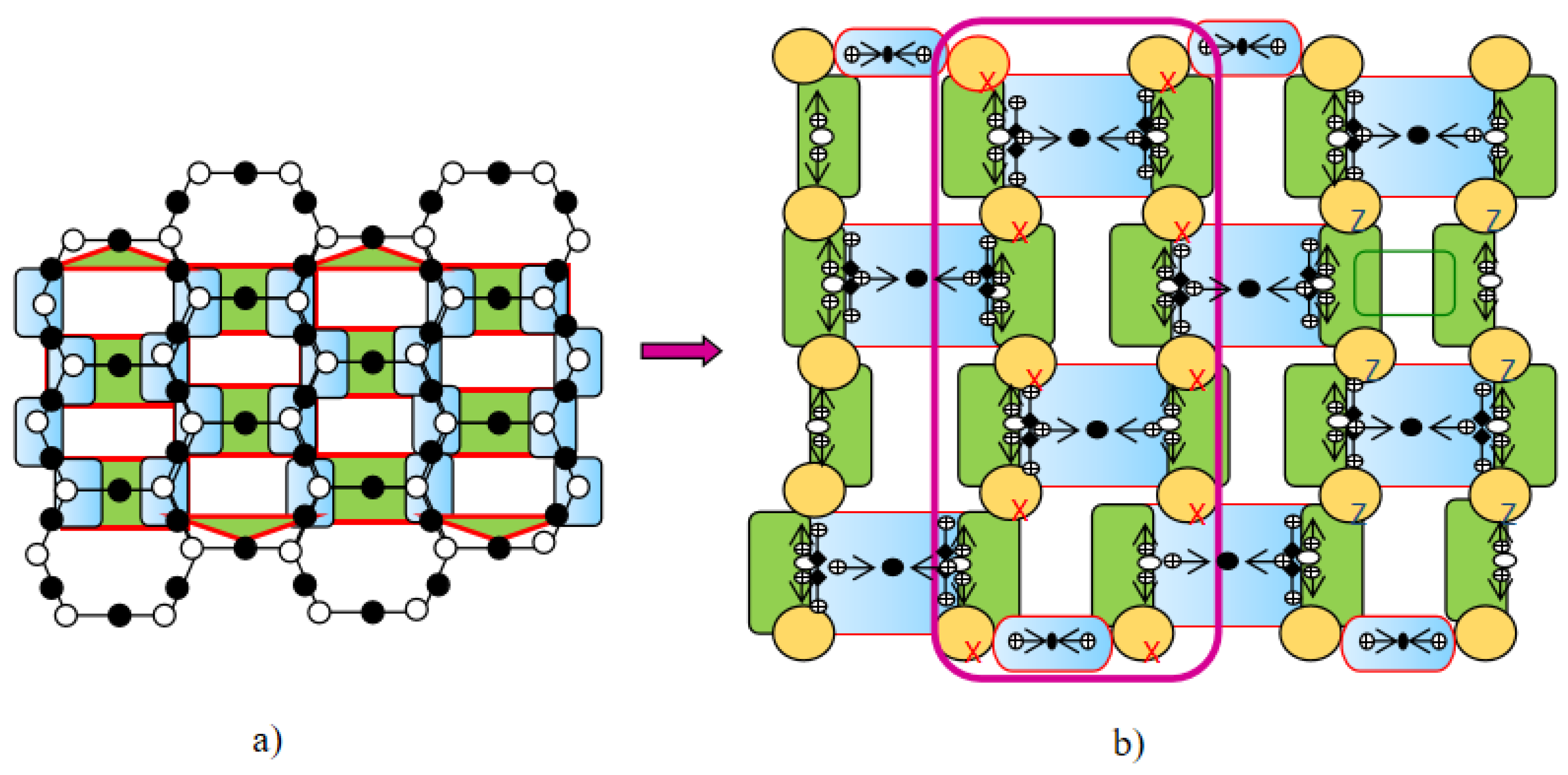
Topological error correction serves as an efficient approach to quantum error correction by harnessing the principles of qubit topologies by encoding in a highly resilient way of error correction. The Heavy hexagonal codes (HHC) are a type of quantum error correcting code that is designed as a combination of Surface codes and Bacon–Shor codes. The specific lattice structure protects against errors caused by imperfections or local disturbances in the qubit arrangements. The HHC provides various advantages by minimizing crosstalks as well as reducing frequencies that allow the convenient embedding of surface codes. However, HHC has less connectivity, which makes it impossible for any of the qubits in a heavy hexagonal structure to get directly entangled with four qubits. The auxiliary qubits are employed to address this issue, which allows a certain range for indirect communication with four distinct qubits. The qubit states, error qubits, and flag qubits are required to implement surface code in heavy hexagons with a stabilizer group of codes and gauge operators. Figure 3 represents the lattice structure of heavy hexagonal codes. Reprinted with permission from Ref. [27]. Copyright 2024 Springer Nature.
Figure 3.
(a) Lattice representation of heavy hexagonal code and (b) square lattice structure of heavy hexagonal code.
4.2. Error Code Simulation for Quantum Error Correction
Quantum circuits refer to the collection of interlinked quantum gates that perform unity transformations on qubit cells. Qubits are the major elements of quantum computing, which is similar to the binary bits utilized in computer operations. The values of qubits can be represented in either 0 or 1 as well as the proportion of both at times with K qubit strings . The distribution of qubits can exist simultaneously in multiple states where entangling is considered a critical issue that affects the states of other qubits even when separated at a large distance. In this research, the error codes are simulated to train the model for better error correction in varying operations . The dynamics of quantum circuits are simulated with the Qiskit simulator, which is an open-source library that simulates the actual interaction of qubit networks. The generated circuits are of Qiskit, in which further modifications can be performed using Qiskit tools that offer high-level representations but can be converted into low-level descriptions for execution. The Qiskit-based generator supports high variability with quantum algorithms and a variety of generation parameters. The classical elements of the quantum library include aqua, terra, ignis, and aer with the individual self-built tools where customization instructions as well as parameterization are observed, providing higher diversity. The quantum system is executed, and the expectation values of specific qubit codes are tested under idealized conditions. The simulation of real quantum noise in entangled environments provides better insights for enhancing the robustness of error correction. The quantum states are prepared, and the dynamics are analyzed for the detailed interpretation of quantum states. The quantum circuit created with the Qiskit simulator containing h quantum gates can be signified as:
The circuit operates with h quantum gates at each interval of gates with a subset , and the data is generated in an array form. From the simulated quantum circuit, quantum codes are generated in a binary format , which can be represented as:
In the generated code, each binary code has a length of 8 bits and denotes the total number of generated codes. The generated binary code is transformed into a decimal value to interpret the information and to observe the actual numerical values, which is achieved by calculating the sum of each digit multiplied by the base raised to the power of its position. In this context, the decimal transformation is done to reduce dimensionality, map complex, correlated quantum errors into a single, manageable classification label, and improve training efficiency. This transformation translates sparse, high-dimensional binary syndrome bits into a single integer representation, allowing neural networks to learn correlations rather than treating each bit independently. The decimal values of the respective binary codes can be denoted by
The binary code is converted to its corresponding decimal value as , which provides an easier interpretation of the outcomes from quantum states. For training the AGuESD-MCBiTM model, additional errors are added to the decimal code that can be mathematically formulated as:
where represents the decimal code with additional errors up to , the dimension is from which the statistical features are obtained as given in the successive section.
4.3. Statistical Feature Extraction
The statistical measures provide quantification of the probabilistic nature of quantum errors which are utilized to enhance the decoding process. The features provide the distributions of error patterns within the quantum circuits. The mean measures the average errors of a qubit, and skewness provides information on states regarding the conserved observations, and measures the asymmetry of probability distributions [28]. The probability distribution is acquired using kurtosis , which identifies non-Gaussian noise and transient “impulses” in syndrome data. The sum of maximum values is acquired using , the sum of minimum values , and the uncertainty of qubits is measured with entropy , allowing the decoder to distinguish between coherent logical information and localized noise patterns. The quantum volume of qubit counts is acquired using the maximum and the smallest possible existence of qubits obtained with minimum values. The sum measure provides the average of transition strengths . The acquired features are concatenated to form a feature vector that can be signified as:
The acquired features are fed as input to the decoding model for error correction. The features provide better insights and adaptation while dealing with complex noise properties.
4.4. Proposed AGuESD-MCBiTM Framework for Error Correction in Quantum Networks
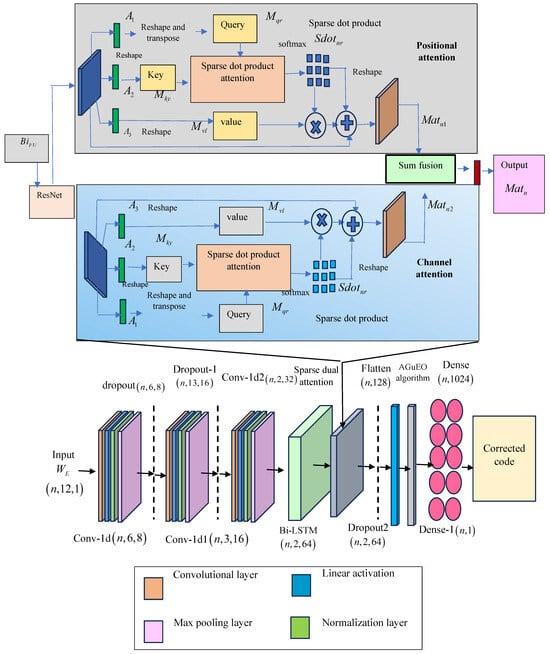
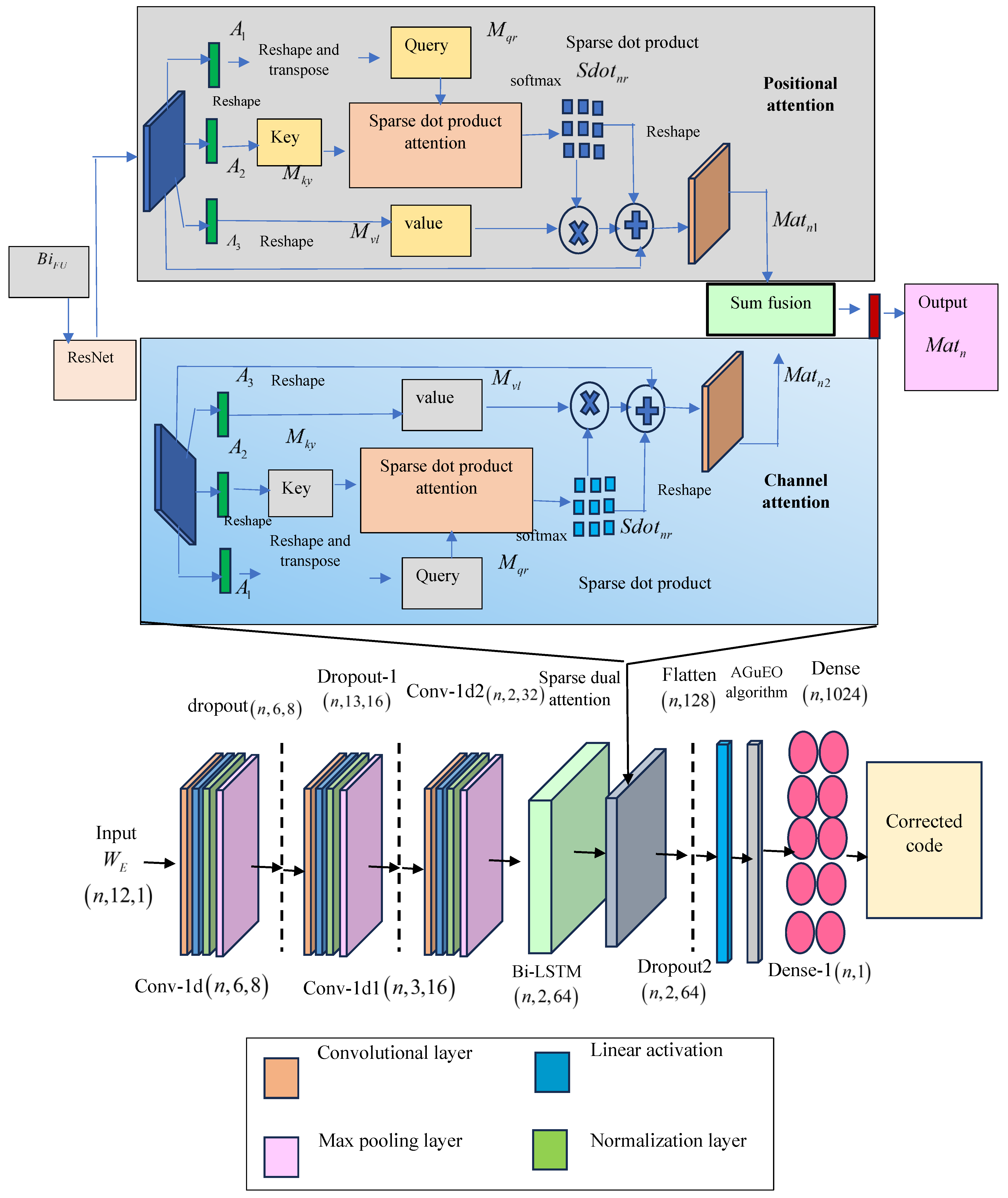
Quantum error correction models are utilized in quantum computing to conserve the information that is affected due to quantum noise as well as coherence. The models deployed for error correction faced higher vulnerabilities regarding the higher qubit fidelity [2], faulty measurements [8], and ineffective quantum state preparation [9], as well as higher complexity depth circuits [10]. In order to address the limitations, the research proposes an AGuESD-MCBiTM framework that assists with effective error correction in quantum circuits. The model harnesses meta-learning that utilizes metadata to identify errors through learning new tasks. In addition, AGuESD-MCBiTM inherits the benefits of sparse dual attention using deep CNN and Bi-LSTM that enable the capture of long-term dependencies of error codes, which is crucial to understanding the evolution of errors over time. Moreover, the aggregation of the models benefits in capturing the spatial features along with processing sequential information, resulting in better interpretation of quantum arrangements. Furthermore, the dual attention offers better adaptability to unknown error patterns as well as suppresses residual dephasing, resulting in robust error correction thresholds. Figure 4 represents the architecture of the AGuESD-MCBiTM decoder.
Figure 4.
Architecture of the AGuESD-MCBiTM framework.
The AGuESD-MCBiTM encompasses deep convolutional layers, an attention layer, and a Bi-LSTM. Meta-learning trains the AGuESD-MCBiTM to adapt to the new quantum error patterns on its own. The learning improves the skill to learn the changes in qubit relationships over time, and the predictions are generated automatically for adjusting to error fluctuations [29]. The noise profiles across various qubit locations are identified by distinguishing the non-linear relationships between actual and measured errors. The input feature vector passes through a conv-1d block that includes max pooling and batch normalization with a linear activation function. The convolutional block comprises numerous kernels, which are responsible for extracting the error patterns through qubits. The entanglement among lattice space as well as the local and global relationships is acquired to generate a feature map that can be signified as
where is the feature map of the convolutional layer, signifies the weights and bias of the convolutional layer. In this context, convolution to a linear transformation converts local neighbourhood relationships into a global dense matrix. While this transformation ignores the specific kernel structure, treating filter weights as a large weight matrix, which aims to accelerate processing of QEC via sacrificing strict spatial and translational invariance for computational efficiency, particularly when mapping high-dimensional data into a lower-dimensional space. The linear activation maintains stability, and the constant behavior outputs the numerical values of the qubit space without transformation. Followed by activation, batch normalization provides improved learning rates for variations of error codes in quantum environments. The internal covariate shift in the qubit space is eliminated, where changes in activation distributions are observed. The feature maps are downsampled to reduce the dimensions for maintaining lower complexity, and the function can be denoted as
The acquired features pass through conv-1d1 and conv-1d2 to acquire output that traverses through the Bi-LSTM model. Bi-LSTM is a recurrent network that interprets the relationship of quantum dynamics between the past and future. The information passes through three layers, such as the input gate , output gate , and forget gate , which are essential for passing the learned details in backward and forward directions [30]. The input gate manages the information added to the cell state, the forget gate eliminates the unwanted information from the past iteration, and the output gate returns the current state outcome.
where , and represent the weights and biases of the , and respectively. The sigmoid activation function is represented as . For each time step, the output from both directions is concatenated to form the final output representation that can be denoted by,
Here, denotes the hidden state output from forward and backward directions where the resultant from Bi-LSTM undergoes sparse dual attention. The internal hybridization of sparse and dual attention enables the identification of the long-range contextual information of error codes. The attention module focuses on acquiring the global representations with the pre-trained residual network as a major element that works on the dilated strategy [31]. The down-sampling operations are removed, and dilated convolutions are included in the final layer of ResNet that maximizes the final feature size without additional parameters. The features are converted into various vector values of query , key , and values , where convolution is applied to reduce the dimension and form a new feature map , , and . Then sparse dot product attention is performed between the transpose of and to generate an attention map through the softmax layer as:
Here, computes the impact of the qubit position on the region. Meanwhile, the feature is reshaped through convolution and performs matrix multiplication between and to obtain the final feature vector that can be mathematically formulated as:
where is initialized as 0 which is increased moderately to assign more weight. The resultant is the weighted sum of features across all qubit positions and the initial features hence, the global contextual information is obtained that improves the intra-class consistency. The process is similar in both attention layers, while in channel attention, the matrix is evaluated in the same dimension of channels to form . Then the outputs from both layers are fused to form output that passes through a dropout layer that prevents overfitting and is flattened to reduce the dimension to . The flattened output passes through the dense and dense-1 layers to generate the final error-corrected code. Furthermore, the parameters of AGuESD-MCBiTM are tuned using the AGuEO algorithm in the 20th layer that assists in detecting the quantum errors and finding the optimal solutions corresponding to the error codes. The position of optimal targets or errors in quantum distributions is identified with faster convergence, and the simulation of the behavioural characteristics results in accurate correction with lower energy consumption. Here, the model’s loss can be calculated using MSE metric. The work of the AGuEO is explained briefly in the following section.
4.5. Ardea Guided Exploit Optimization Algorithm
4.5.1. Motivation
The AGuEO algorithm is designed for weight tuning in the AGuESD-MCBiTM framework as well as to enhance the learning rates. The method utilizes the behaviours of hummingbirds that improve the search capability [32] and the adaptive hunting strategies employed by red kite and secretary birds. In addition, group hunting strategies of the egret flock reduce the single objective problems. The AGuEO algorithm assists the AGuESD-MCBiTM model in the effective detection of errors in qubit codes.
4.5.2. Inspiration
The AGuEO inspires the search and hunt attributes of hummingbirds, red kites, secretary birds, as well as egret swarms. The distinct hunting strategies of the secretary bird are a significant factor for the AGuEO algorithm. Moreover, the exploration ability improves the convergence of the AGuEO without being trapped in the local optima, and in addition, the unique attributes, namely camouflage and fleeing, assist in avoiding dangers [33]. The guided search and self-search adopted by hummingbirds depend on the self-learned intellectuals or guidance of leaders for finding optimal targets. The position of solutions and updates and the sound of unity acquired from the red kite enhance the search diversity [34]. Moreover, the egret swarm exhibits an interesting approach of sit and waiting as well as aggressive behaviours that balance the energy expenditure through flight. The weighting strategy denotes the observation of target behaviour over the time interval to predict the next move with low energy consumption [35]. While aggressive behaviour exhibits exploitation of better solutions. The simulation of these behaviours results in lower energy consumption and leads to finding potentially better solutions.
- Initialization: The initial positioning of the solutions in the search regions ascertains the decision vectors, and the solutions in AGuEO are randomly initialized and serve as the initial points for exploration defined as:where represents the arbitrary value between 0 and 1, and are the lower and upper boundaries, and denotes the solution with the decision variable in the range of 1 to q. The total solutions are indicated as p, and the total decision variables are denoted as q. The candidate solution matrix can be signified as:
- Fitness Function: Each searcher represents the candidate solution to optimize the problems with the decision variables. Hence, the objective function is computed depending on the values assigned by the solutions for the problematic variables. The solutions with the highest fitness exhibit a minimum logical error rate (LER) that can be signified as:The effective solutions for solving the quantum error correction problems are acquired by comparing the acquired fitness value with the respective solutions. The LER evaluates the probability of encoded information being correctly decoded after error correction, where a lower error rate represents better quality. The unitary factor symbolizes the properties or constraints that maintain the unified movement of solutions in the search space. The danger factor indicates the potential challenges or issues in the search space encountered by the algorithm, such as the possibility of slower convergence or the confinement in the local optimal region. For the higher danger factor, the solutions involve escaping from the corresponding region, and for the higher unitary factor, the solutions tend to exploit the optimal solution in the region. The solutions are updated by employing strategies, namely forage and hunt as well as relocative phases, depending on the values of unitary and danger factors as given in the successive sections.
- Case-1: Relocative movement phase: if The solution follows relative movement when the danger factor is higher or equal to the unitary factor value . Hence, to ensure safety from the danger factor, the solutions tend to escape from the region by performing camouflage or fleeing. The proximity of the region is verified, and the quantum errors are effectively detected in the appropriate concealment environments. If the proximity can be ensured, then the solutions escape from the region to maintain integrity, particularly while dealing with complex quantum errors. The flight strategy is highly energy-consuming, which results in the trapping of the AGuEO algorithm in the local regions; therefore, energy consideration is essential. The movement depends on the energy factor, which is essential to escape from danger for obtaining optimal codes.
- Subcase-1: : The solutions hide within the safer region of the problem space when the conditional probability factor is higher than 0.5. Then the updates in position can be signified as:where is the normalized distribution of an arbitrarily generated array, the hybridization factor is represented as and acquires a value between 0 and 1, denotes an arbitrary number, is the current location of the search solution, the random candidate solution is denoted as , and the random selection integer is denoted as x with the value chosen between 0 and 1.
- Subcase-2: Else: When the solutions encounter certain dangers, then the adaptive behaviour of the stay and pause strategy is employed, where the leading solution pauses the computations for moving to the optimal region. The optimal solutions are acquired with the balance between stay or pause and the current strategy that improves the weight parameters. The quality of solutions is enhanced respectively, and the updated position is denoted as:where denotes the best solution, is the step size factor of the leading solution that belongs to (0,1), e indicates the exponential factor, are the current and maximum iterations, is the integrated gradient factor, and denotes the difference between lower and upper bounds of solution space. The Brownian motion of the solution is represented as Q, which generates the array in dimensions of with a normal distribution. The updates of solutions depend on the fitness, where the fitness of the present solution is higher than the updated position selected as the optimal one. In other circumstances, the present solution remains the best solution.The updates show that during the relocative movement phase, the solutions focus on finding mistakes in the entire quantum code to ensure accurate error detection.
- Case-2: Forage and Hunt phase: if : The solutions adopt foraging and hunting when the danger element is less than the fixed value of the unity factor, then the solution forages through search space to find the optimal solution. The phase is divided into a territorial attack phase and a guided search phase, as well as leader-based consumption.
- Subcase-1: Guided search phase: : The solutions follow guided search and are involved in finding the regions with optimal targets. The regions within the search space are explored individually, preventing premature convergence in finding the effective error codes and updating the position as:Here, signifies the guided factor, represents the flight pattern of solutions, and are the random solutions in the range of 0 to 1. The randomly generated array is denoted as having a dimension of in the interval (0,1), and is the target solution. The dimension of solution space is indicated as
- Leader-based consumption phase: : The movement of the solutions depends on the leading solution in this phase, and the AGuEO considers the distance factor. The deviations from the upper and lower bounds can be analyzed by utilizing the distance consideration factor, and the position updation is represented as:The solutions tend to randomly search in the search regions and move to the newly found optimal position. The search solutions exhibit aggressive behaviour towards the target, and the positions are upgraded depending on the leading solution. The updated region with the best positions of search agents results in finding optimal error codes for correction. The mathematical representation of positional update is denoted as:Here, denotes the step size of the trailing solution in the range between 0 and 1, , which is the random number of the expected position of the solution.
- Territorial Attack phase: While : In this phase, the solution utilizes the gained experiences for finding the solutions with opportune strategy and exploiting the optimal solution corresponding to error detection. The movement of the solutions is based on three different flight factors, namely omnidirectional, axial, and diagonal flights. The solutions also observe the other targets with the existing solutions for moving to other positions in the presence of hindrances. The mathematical representation of positional update is denoted as:where represents the flexible factors and the summation of these factors equals 1, and E is the territorial factor. The adoption of relocation and foraging improves the exploration of the AGuEO algorithm throughout the search space, leading to the exploitation of optimal solutions.
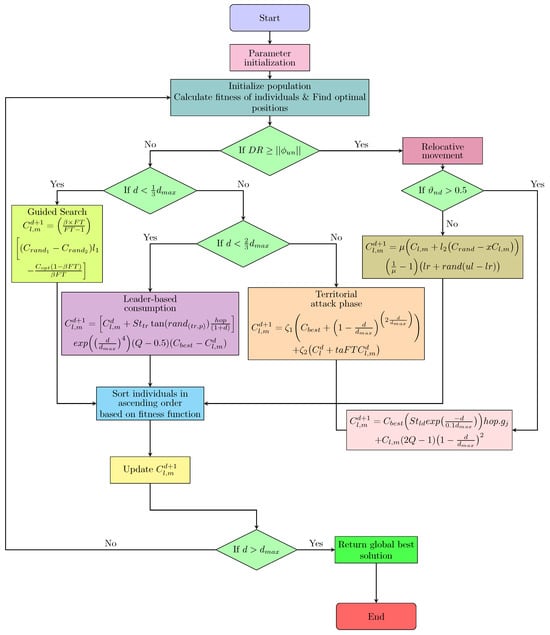
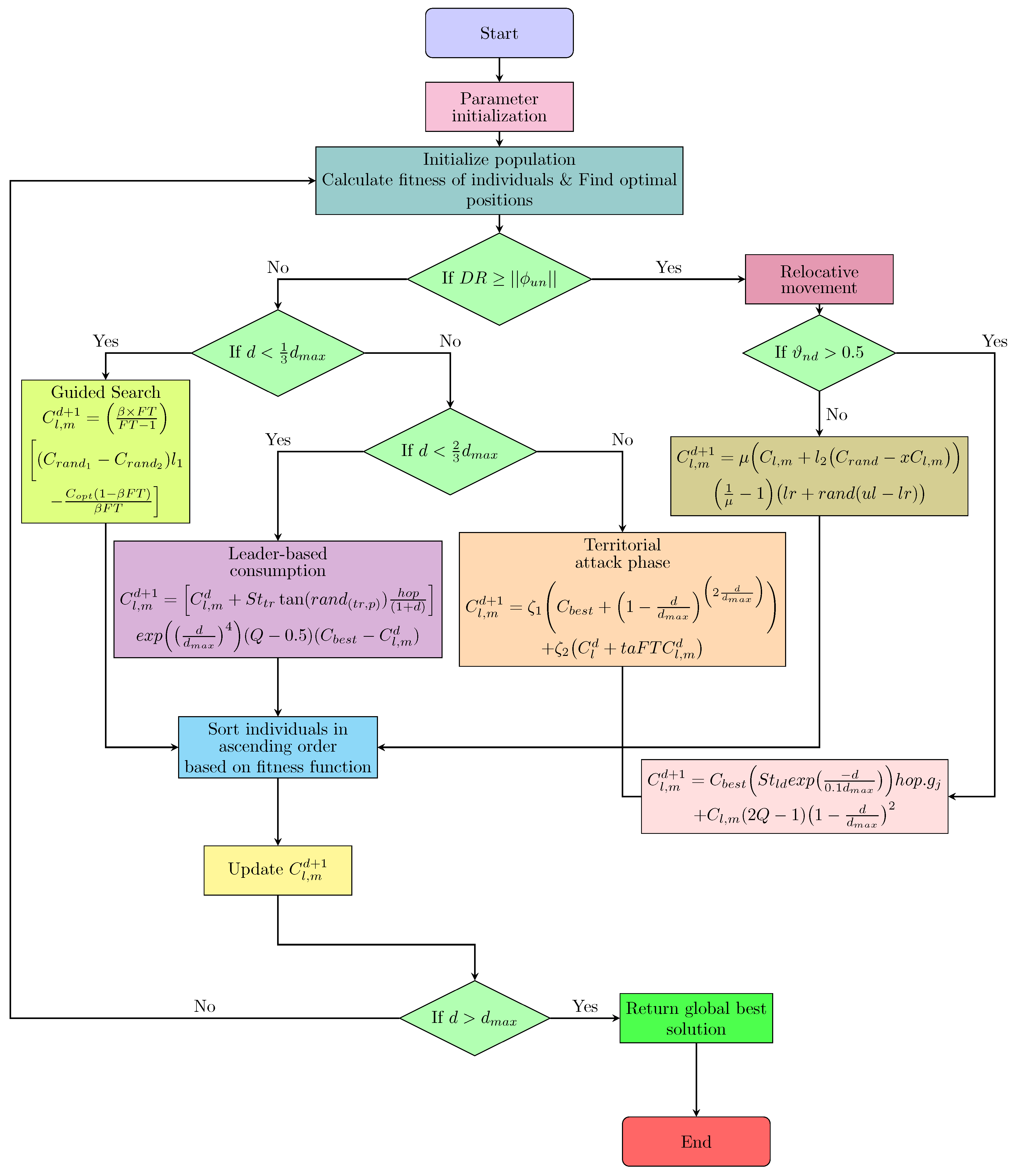
- Termination of AGuEO: The algorithm ends its iteration when is satisfied, and then the global best solution is returned. The flow diagram of the AGuEO is represented in Figure 5.
Figure 5.
Workings of the AGuEO algorithm.
5. Results and Discussion
The experimental outcomes of the AGuESD-MCBiTM quantum error correction framework are interpreted in this section, which includes experimental setup, performance analysis, comparative analysis as well as comparative discussion.
5.1. Experimental Setup
The experimental setup of AGuESD-MCBiTM is discussed in this section, where Table 1 displays the implementation and parameter details. The Qiskit simulator is utilized to generate the quantum codes, and the AGuESD-MCBiTM is administered in Python (version 3.7.6) software using the Python programming language. The codes generated using Qiskit are acquired in binary format, which is transformed into decimal values, and error values are added in the range between 0.1 and 0.6. The error code is in time-series format, and the operating system has a ROM of 120 GB, which is harnessed to train the AGuESD-MCBiTM framework. In addition, to eliminate experimental bias, a uniform training and testing split is applied across all conventional and AGuESD-MCBiTM models, maintaining identical datasets, preprocessing, and environmental conditions.
Table 1.
Experimental and hyperparameter details of AGuESD-MCBiTM.
5.2. Simulated Quantum Circuits
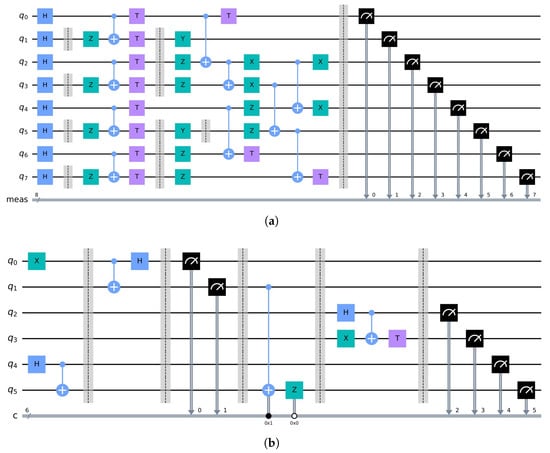
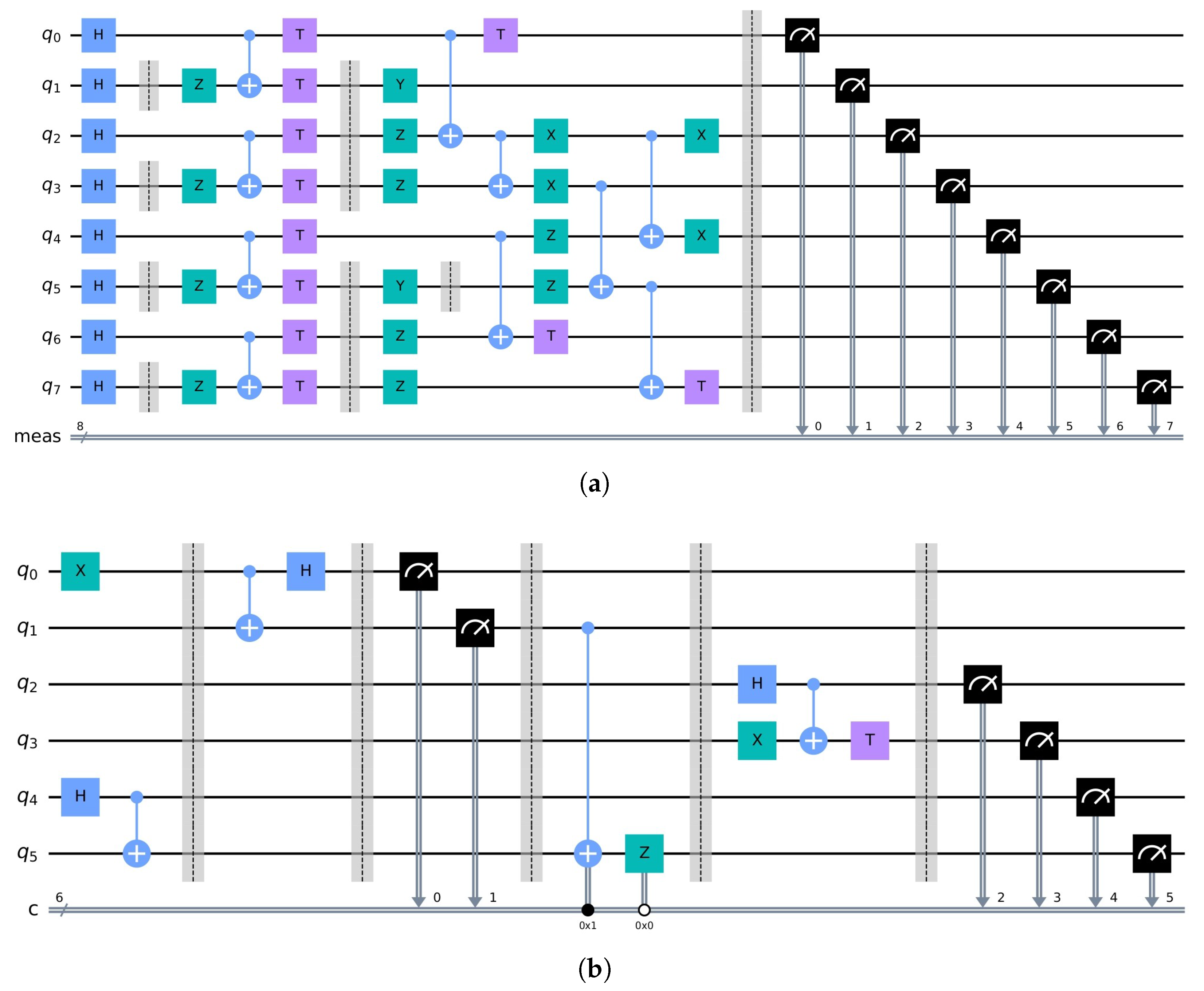
The quantum circuits simulated for the error correction are represented in Figure 6. The figure includes circuits Figure 6a,b, where circuit-1 contains eight quantum gates with Pauli operators X, Y, and Z, Hadamard gates (H), CNOT gates, and T gates, along with measurement units. Circuit-2 encompasses six qubit states with Pauli operators X, Z, CNOT gates, H, T gates and measurement units.
Figure 6.
(a) Simulated Quantum circuit 1, (b) Simulated Quantum circuit 2.
5.3. Performance Metrics
In this research, the QEC performance of the proposed model AGuESD-MCBiTM is evaluated using performance metrics such as correlation, mean absolute error (MAE), mean square error (MSE), R-squared , bit error rate (BER), root mean square error (RMSE), logical error rate (LER), and accuracy. Correlation measures the degree to which the errors occurring in one qubit influence the other. MAE computes the mean magnitude of errors between the corrected and actual codes. The average quantum distance between the real and ideal quantum states is evaluated using MSE, and RMSE provides the error measurement to be the same as the target variable. Moreover, measures the ability of AGuESD-MCBiTM to predict future outcomes and the range to fit the actual error code. Furthermore, the probability of errors in a single qubit is measured by BER, where LER estimates the incorrect state of the logical qubit and accuracy measures the correctness of the model in successfully correcting the errors to its intended state. Here, the choice of regression metrics such as MAE, MSE, RMSE, and is directly tied to the model’s role as a continuous noise estimator rather than a discrete error classifier. Since qubit noise fluctuations are continuous statistical distributions, the model’s primary goal is to map these dynamic environments with high precision in real-time. Minimizing regression errors such as MAE and MSE reduces the statistical bias in noise predictions. Accuracy is an essential metric, as it allows for more precise weight optimization during the recovery phase. Specifically, lowering RMSE helps eliminate extreme outliers in noise estimation, which prevents significant fidelity drops during decoding. Subsequently, these granular metrics ensure high-fidelity data, which is necessary to improve logical error rates and threshold behaviour.
5.4. Performance Analysis
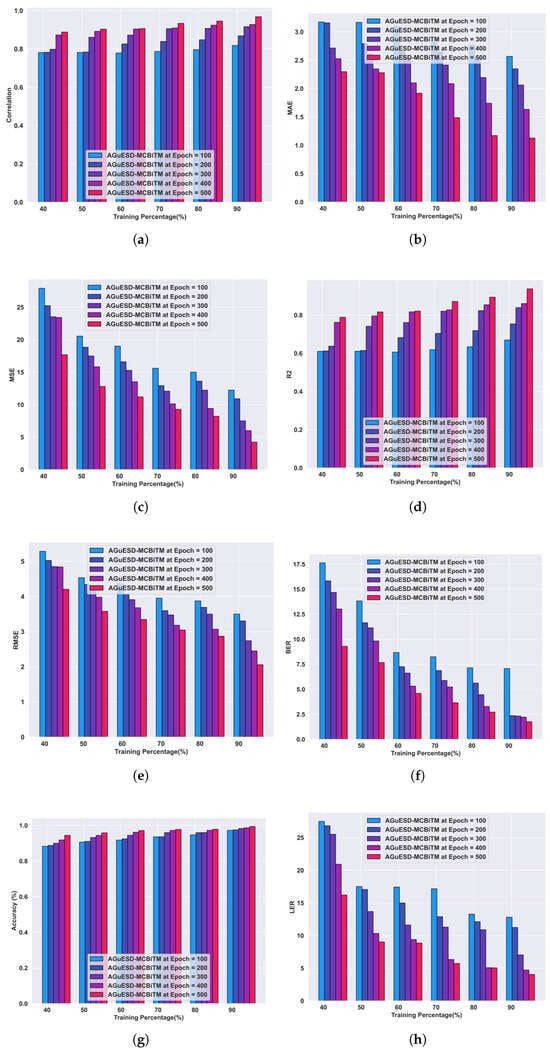
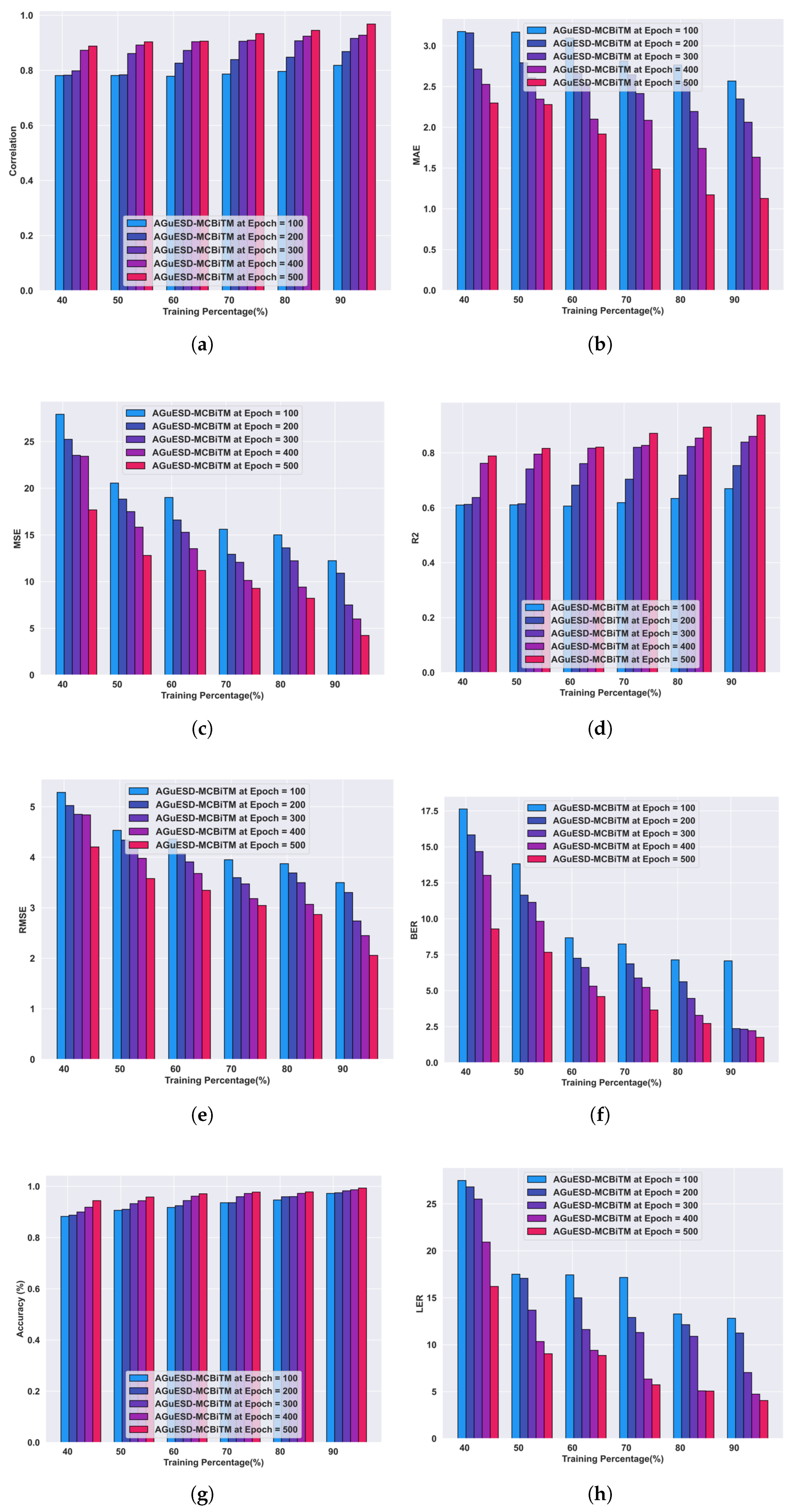
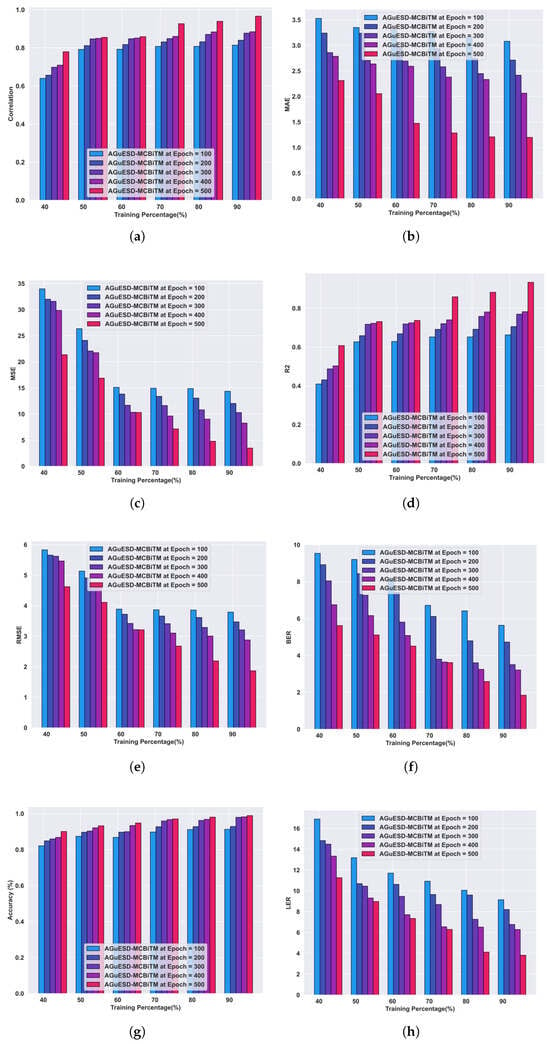
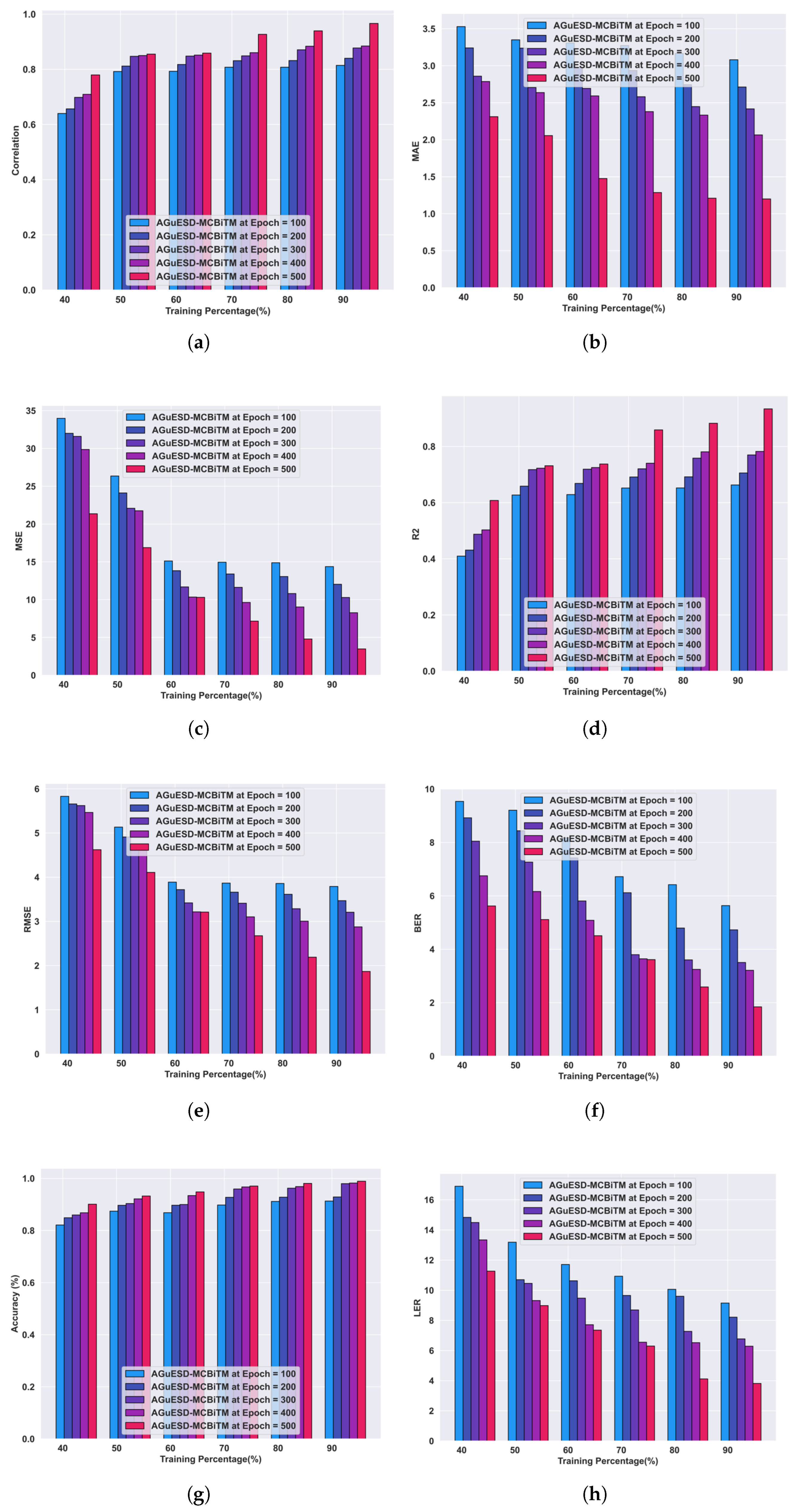
The performance of quantum error correction using the AGuESD-MCBiTM model is evaluated in the simulated circuits Figure 6a,b using various metrics with training values between 40 and 90% as shown in Figure 7 and Figure 8. The evaluations are observed for epoch values of 100 to 500.
Figure 7.
Performance analysis for Circuit 1: (a) Correlation, (b) MAE, (c) MSE, (d) , (e) RMSE, (f) BER, (g) Accuracy, (h) LER.
Figure 8.
Performance analysis for Circuit 2: (a) Correlation, (b) MAE, (c) MSE, (d) , (e) RMSE, (f) BER, (g) Accuracy, (h) LER.
5.4.1. Performance Analysis of AGuESD-MCBiTM for Circuit 1
The evaluation outcomes of the AGuESD-MCBiTM model for QEC using circuit-2 are illustrated in Figure 8, in which a correlation of 0.78 is observed in 40%, and for the increased training of 90%, the correlation further improves to 0.97, which is shown in Figure 8a. In Figure 8e, the RMSE value of 3.21 is noticed during 60%, reducing lower to 1.87 in 90% of training. The MAE value is 2.31 in 40% of training with 500 epochs, which reduces lower to 1.20 in 90% of training, as indicated in Figure 8b. The value with epoch 300 is 0.77 reached a value of 0.93 at epoch 500 using 90% training, which is indicated in Figure 8d. In Figure 8c, the AGuESD-MCBiTM shows an MSE of 16.88 in 50% of training, which reduces to 3.49% in 90% of training. As given in Figure 8f, the lower BER of 3.51 is obtained for 90% training using 300 epochs, and when the epoch reaches 500, the AGuESD-MCBiTM acquires 1.85 BER. The AGuESD-MCBiTM acquires an accuracy of 0.93 at 500 epochs and 50% training that increases to 0.99, reaching 90% training that is provided in Figure 8g. In Figure 8h, using 90% training and 200 epochs, the LER of 8.22 is acquired, which lowers to 3.82 using 500 epochs. The utilization of meta-learning improves adaptability over complex scenarios, and the sparse-dual attention results in fine-grained analysis of the qubit patterns. Additionally, the weight tuning using the AGuEO algorithm improved the efficiency with higher convergence to optimal solutions.
5.4.2. Performance Analysis of AGuESD-MCBiTM for Circuit 2
The efficiency of AGuESD-MCBiTM in circuit 2 is provided in Figure 8, in which a correlation of 0.78 is observed in 40%, and for the increased training of 90%, the correlation further improves to 0.97 which is shown in Figure 8a. In Figure 8e, the RMSE value of 3.21 is noticed during 60% reduces lower to 1.87 in 90% of training. The MAE value is 2.31 in 40% of training with 500 epoch that reduces lower as 1.20 in 90% of training as indicated in Figure 8b. The value with epoch 300 is 0.77 reached a value of 0.93 at epoch 500 using 90% training that is indicated in Figure 8d. In Figure 8c, the AGuESD-MCBiTM shows an MSE of 16.88 in 50% of training which reduces to 3.49% in 90% of training. As given in Figure 8f, the lower BER of 3.51 is obtained for 90% training using 300 epochs and when the epoch reaches 500, the AGuESD-MCBiTM acquires 1.85 BER.
The AGuESD-MCBiTM acquires an accuracy of 0.93 at 500 epochs and 50% training that increases to 0.99 reaching 90% training that is provided in Figure 8g. In Figure 8h using 90% training and 200 epochs, the LER of 8.22 is acquired which lowers to 3.82 using 500 epochs. The utilization of meta-learning improves the adaptability over complex scenarios and the sparse-dual attention results in fine-grained analysis of the qubit patterns. Additionally, the weight tuning using the AGuEO algorithm improved the efficiency with higher convergence to optimal solutions.
5.5. Comparative Analysis of AGuESD-MCBiTM
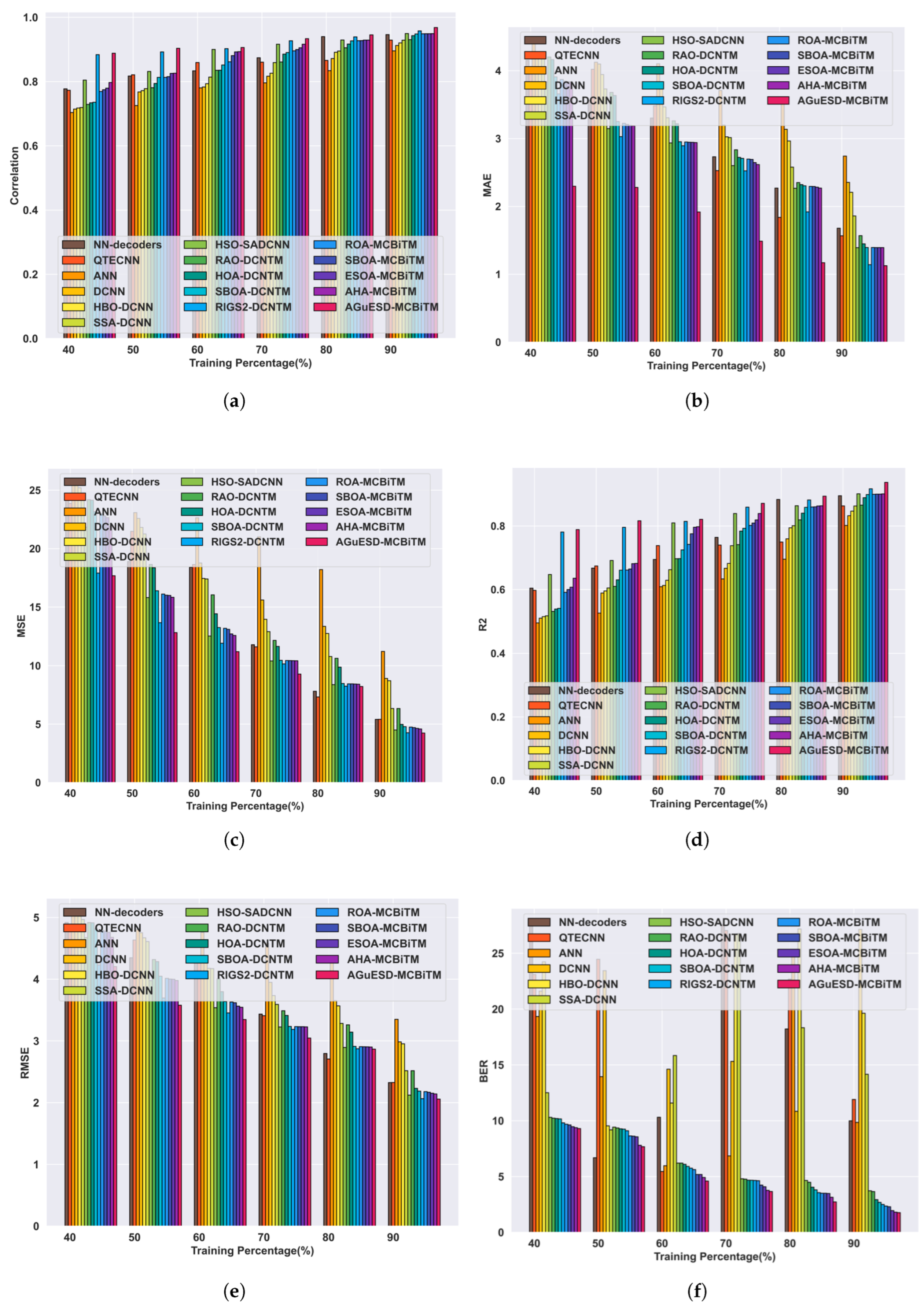
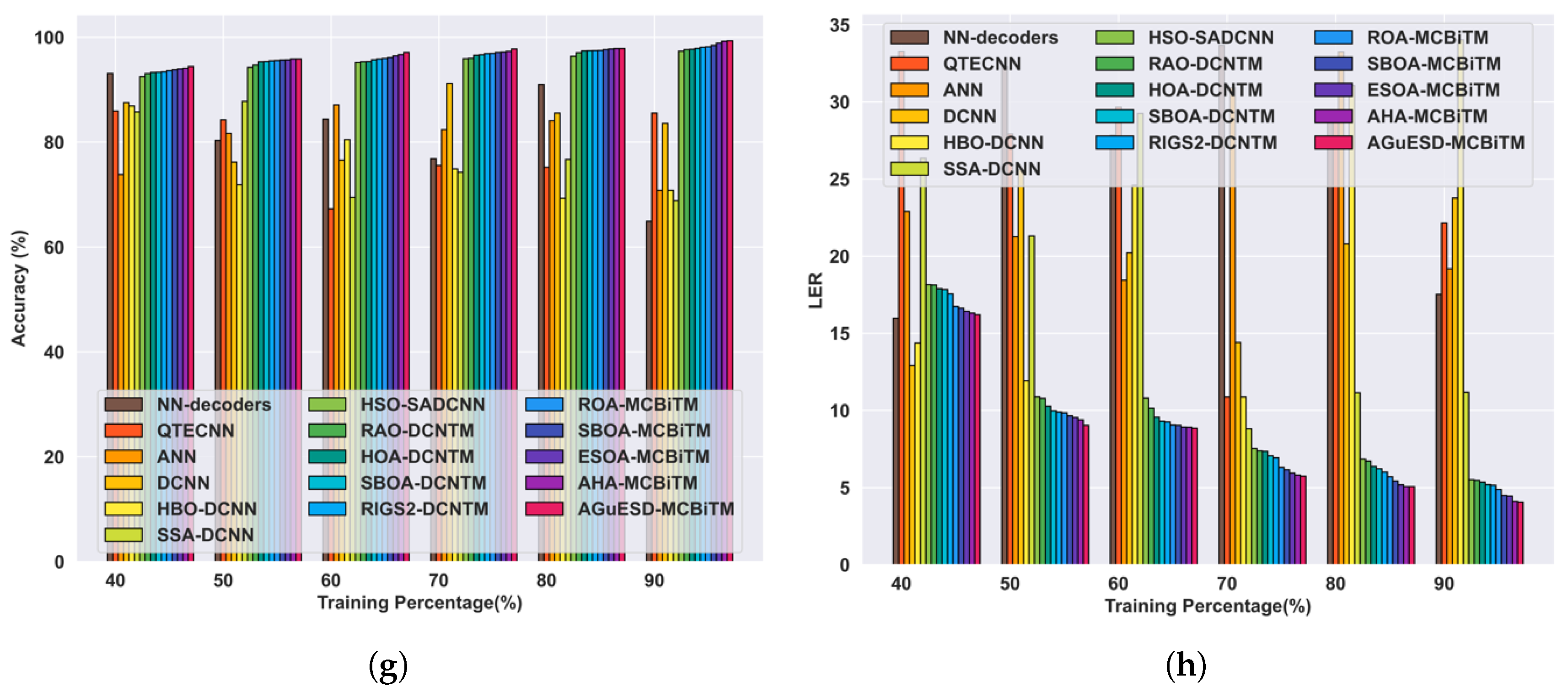
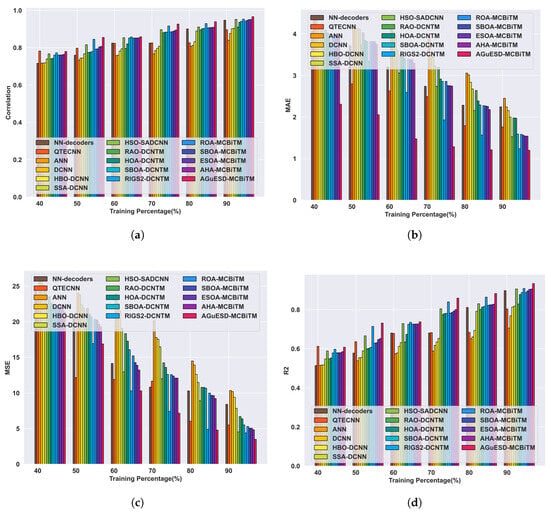
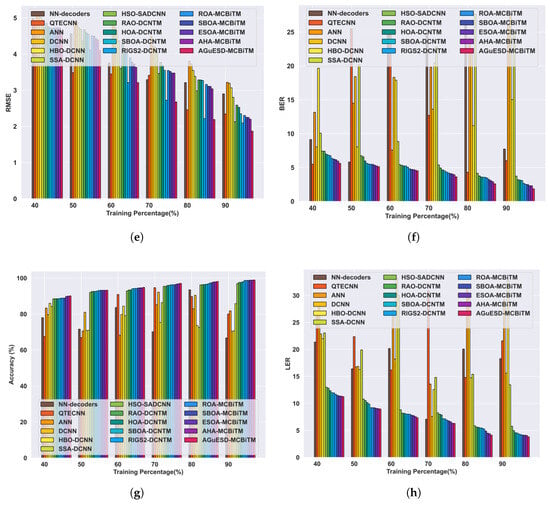
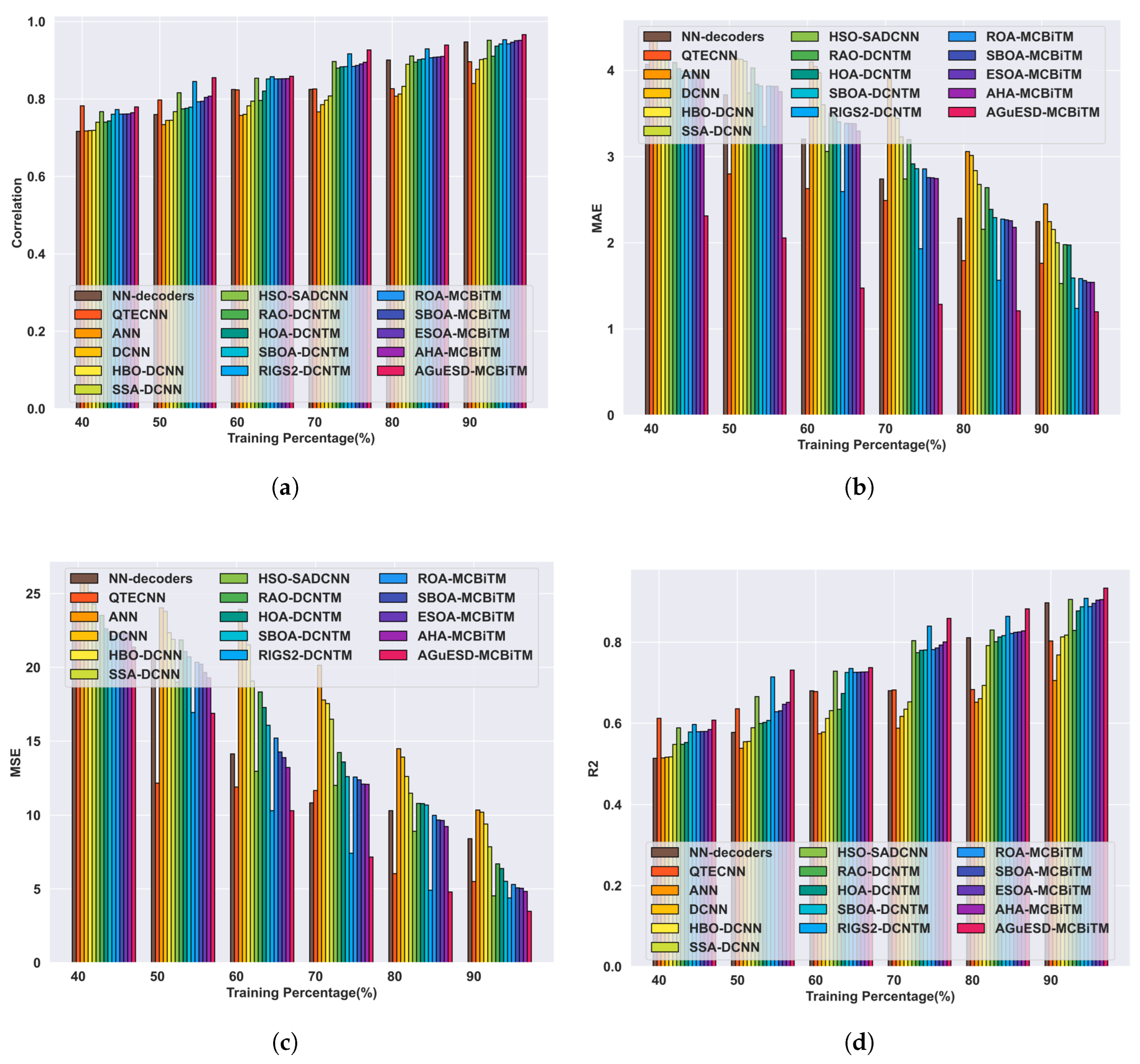
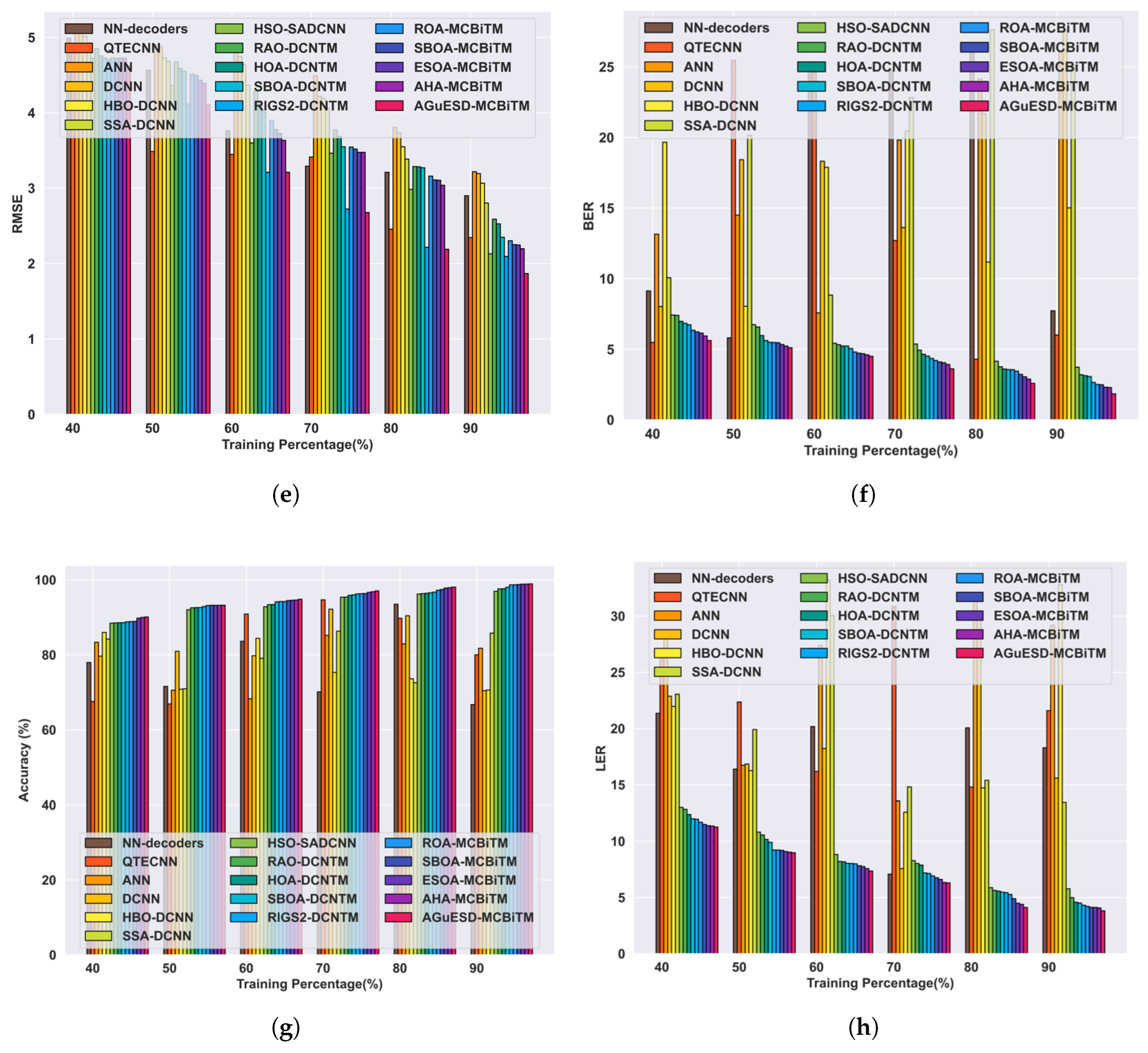
The performance of the proposed AGuESD-MCBiTM model is compared with the traditional error correction techniques such as network (NN)-decoders [36], Deep CNN (DCNN) [1], Quantum teleportation algorithm-based CNN (QTECNN) [37], Re-locative Guided Search optimized self-sparse attention-enabled CNN with Long Short-Term Memory (RIGS2-DCNTM) [7], Sparrow search algorithm-based DCNN (SSA-DCNN) [38], Artificial neural network (ANN) [39], Humming sparrow Optimization-based self-adaptive DCNN (HSO-SADCNN) [9], Artificial hummingbird algorithm-based MCBiTM (AHA-MCBiTM) [32], Egret swarm optimization algorithm-based MCBiTM (ESOA-MCBiTM) [35], Humming Bird optimization algorithm-based DCNTM (HOA-DCNTM) [40], Red kite optimization enabled DCNTM (RAO-DCNTM) [34], Secretary bird optimization algorithm-based DCNTM (SBOA-DCNTM) [41], SBOA-MCBiTM [33], Hummingbird optimization algorithm-based DCNN (HBO-DCNN), and Red kite optimization algorithm-based MCBiTM (ROA-MCBiTM). The efficiency is observed for training values from 40% to 90% using circuit Figure 6a and circuit Figure 6b, as shown in Figure 9 and Figure 10. This comparative analysis aims to illustrate the effectiveness of the proposed AGuESD-MCBiTM model.
Figure 9.
Comparative analysis for Circuit 1: (a) Correlation, (b) MAE, (c) MSE, (d) , (e) RMSE, (f) BER, (g) Accuracy, (h) LER.
Figure 10.
Comparative analysis for Circuit 2: (a) Correlation, (b) MAE, (c) MSE, (d) , (e) RMSE, (f) BER, (g) Accuracy, (h) LER.
5.5.1. Comparative Analysis for Circuit-1
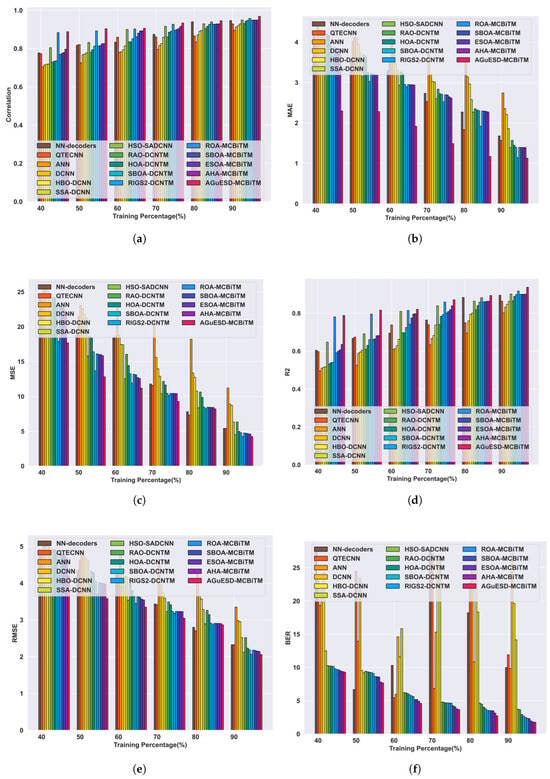
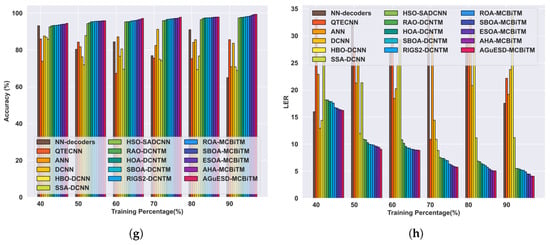
The comparative results of the AGuESD-MCBiTM model for Circuit 1 are illustrated in Figure 9. In the simulated circuit-1, as shown in Figure 9a, the AGuESD-MCBiTM acquires a correlation of 0.97, whereas SSA-DCNN, HBO-DCNN, and HOA-DCNTM exhibit 0.93, 0.94, and 0.94, respectively. As shown in Figure 9d, attained by AGuESD-MCBiTM is 0.94, which is higher than RIGS2-DCNTM and HSO-SADCNN by 2.16% and 3.83%. In Figure 9e, the AGuESD-MCBiTM shows a lower RMSE of 2.06, while ANN and ESOA-MCBiTM exhibit higher RMSE of 3.35 and 2.15, which affects the performance. The lower MSE of 4.24 is achieved by AGuESD-MCBiTM meanwhile, AHA-MCBiTM and NN-decoders are subjected to higher MSE values of 4.59 and 5.41, which is represented in Figure 9c. In Figure 9f, using 90% training, AGuESD-MCBiTM acquires a lower BER of 1.76, while RAO-DCNTM and SBOA-DCNTM acquire 3.65 and 2.68, respectively. In Figure 9b, the AGuESD-MCBiTM shows a lower MAE of 1.13, while QTECNN and ROA-MCBiTM exhibit 1.57 and 1.39, respectively, which reveals the efficiency of AGuESD-MCBiTM over other approaches. In Figure 9g, the AGuESD-MCBiTM exhibits an accuracy of 99.34%, which is higher than HOA-DCNTM and RIGS2-DCNTM by 1.65% and 1.26%. The AGuESD-MCBiTM shows a lower error rate of 4.06, while DCNN and NN exhibit 23.76 and 17.53, which is given in Figure 9h. By incorporating meta-learning for rapid adaptation to dynamic, complex quantum environments, the model avoids the heavy computational costs typically associated with modeling large qubit arrangements. Furthermore, the AGuEO algorithm enables high-convergence, optimal weight tuning, making it highly adaptable for complex, deep quantum circuits.
This combined approach tackles the critical limitations of conventional error correction by providing scalable, real-time noise identification.
5.5.2. Comparative Analysis for Circuit-2
The comparative results of the AGuESD-MCBiTM model for Circuit 2 are illustrated in Figure 10. In the simulated circuit-2, in Figure 10b, the MAE observed in AGuESD-MCBiTM is 1.20, while ANN and HBO-DCNN show 2.45 and 2.15. In Figure 10c the MSE of AGuESD-MCBiTM acquires a lower error of 3.49, whereas RIGS2-DCNTM, RAO-DCNTM, and QTECNN exhibit higher errors of 4.39, 6.70, and 5.50, respectively. In Figure 10d, the value of 0.93 is attained by AGuESD-MCBiTM, which is higher than RAO-DCNTM, ESOA-MCBiTM, and DCNN by 11.19%, 3.19%, and 17.67%, respectively. Using the RMSE measure, AGuESD-MCBiTM attains a lower error of 1.87, while the SSA-DCNN, HOA-DCNTM, and QTECNN show 2.80, 2.53, and 2.35, which is represented in Figure 10e. Figure 10a shows AGuESD-MCBiTM exhibits a higher correlation value of 0.97 that improves HSO-SADCNN, ROA-MCBiTM, and ANN approaches by 1.51%, 2.47%, and 13.08% respectively. In Figure 10f, the AGuESD-MCBiTM shows a lower BER value of 1.85, while DCNN and HSO-SADCNN exhibit 27.55 and 3.73 in 90% of training. The AGuESD-MCBiTM exhibits an accuracy of 98.93%, which is higher than HOA-DCNTM and RIGS2-DCNTM by 1.31% and 0.27%, as shown in Figure 10g. The AGuESD-MCBiTM shows a lower error rate of 3.82, while DCNN and NN exhibit 15.59 and 18.29, as represented in Figure 10h. The results exhibit the supremacy of AGuESD-MCBiTM in quantum error correction. The incorporation of meta-learning improves the adaptability to evolving noise circumstances as well as the capability to learn complex error patterns. Moreover, the inclusion of the AGuEO tuned the parameters of AGuESD-MCBiTM and reduced the complex optimization issues leading to effective error correction.
5.6. Simulation of Density Matrix
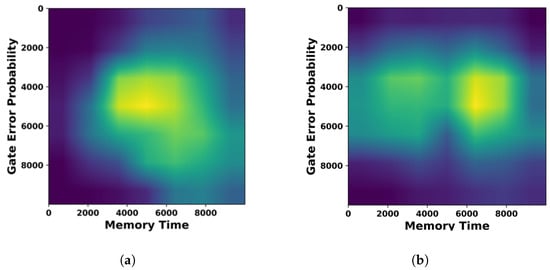
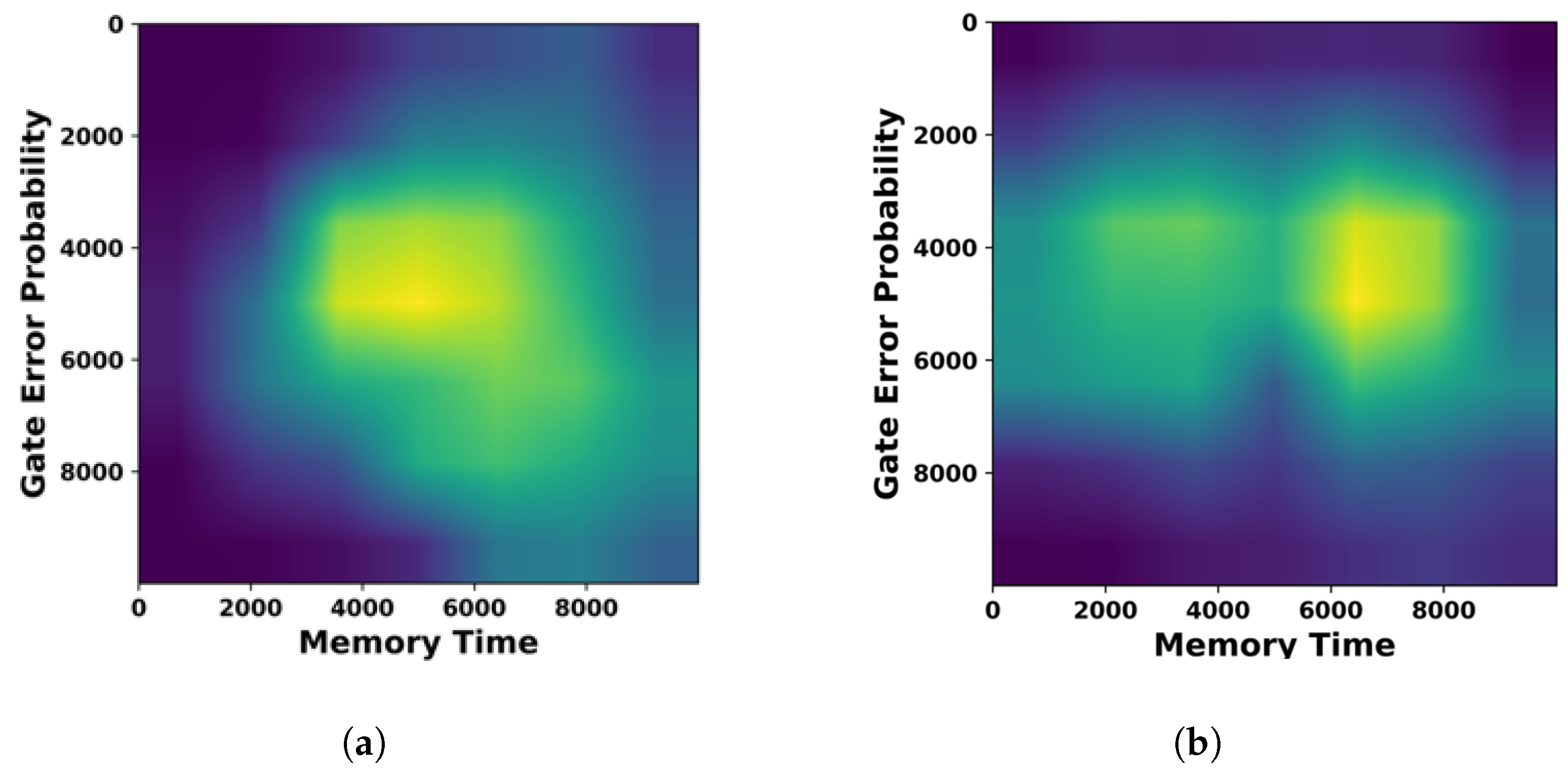
The density matrix of the quantum error code is provided in Figure 11, which includes the gate error probabilities for different coherence times. The density matrix describes the statistical behaviour of quantum circuits that are affected by decoherences, supporting a more realistic simulation of quantum error correction codes. The matrix represents the behaviour of qubits, and the errors X and Z are considered during the simulation. Additionally, the gates CNOT and T distinguish the operation and control type errors which are not denoted in scalar value. The density matrix simulation is based on independent qubit errors and faulty gate operations. The perfect operation occurs with the probability , and the imperfect operation occurs with the probability , which is defined as:
where J belongs to , and B is the operation selected by the gate operation that becomes an identity matrix for set J [42]. Moreover, the linear approximation provides a direct relation between the logical qubits and error possibilities, hence, the range of memory time can be evaluated. The error measurement is omitted in the end stage due to a limited number of qubits, as well as the measurement time being shorter. Hence, the basis of measurement is fixed to the X-axis, and the measurement time is considered finite instead of instant operation. Figure 11a,b represent the density matrix for quantum circuits-1 and circuit-2. The memory time is assumed from 0 to 8000 for preserving the simulation generality. In Figure 11a, for circuit-1, the error densities are higher in the range of 2000 to 6000 for a qubit coherence time of 4000. For circuit-2, as shown in Figure 11b, the error densities are higher between 3000 to 6000 for a qubit memory time of 6000. The density matrix estimation provides the initial states and error probabilities, as well as QEC operations leading to feasible simulation outcomes.
Figure 11.
(a) Simulation of density matrix for circuit-1, (b) Simulation of density matrix for circuit-2.
5.7. Computational Time Analysis
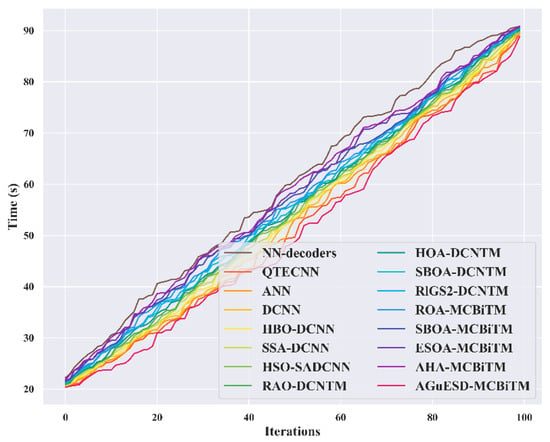
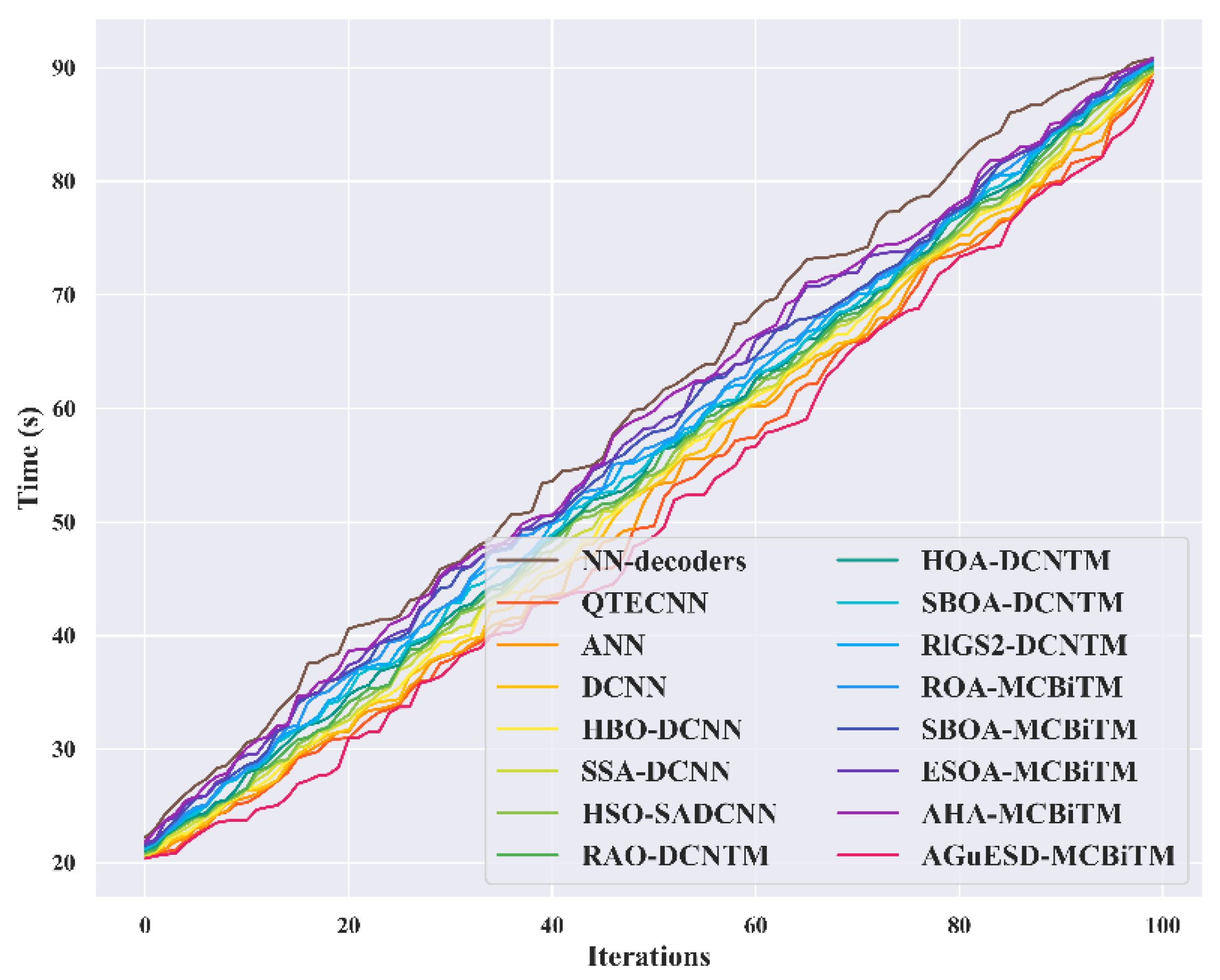
As shown in Figure 12, the AGuESD-MCBiTM method demonstrates superior computational efficiency compared to the baseline models. At maximum iterations, the proposed model significantly reduces computation time to 88.85 s, outperforming the existing methods such as RlGS2-DCNTM and HOA-DCNTM, which require 90.50 s and 90.13 s, respectively, thereby minimizing the need for extensive computations. Here, the sparse-dual attention module reduces computation by avoiding dense, full-field attention calculations. Highlights only significant statistical qubit patterns and suppresses non-significant regions.
Figure 12.
Computational complexity analysis.
5.8. Sensitivity Analysis
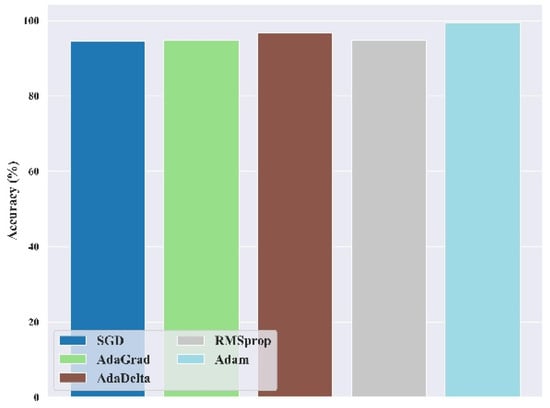
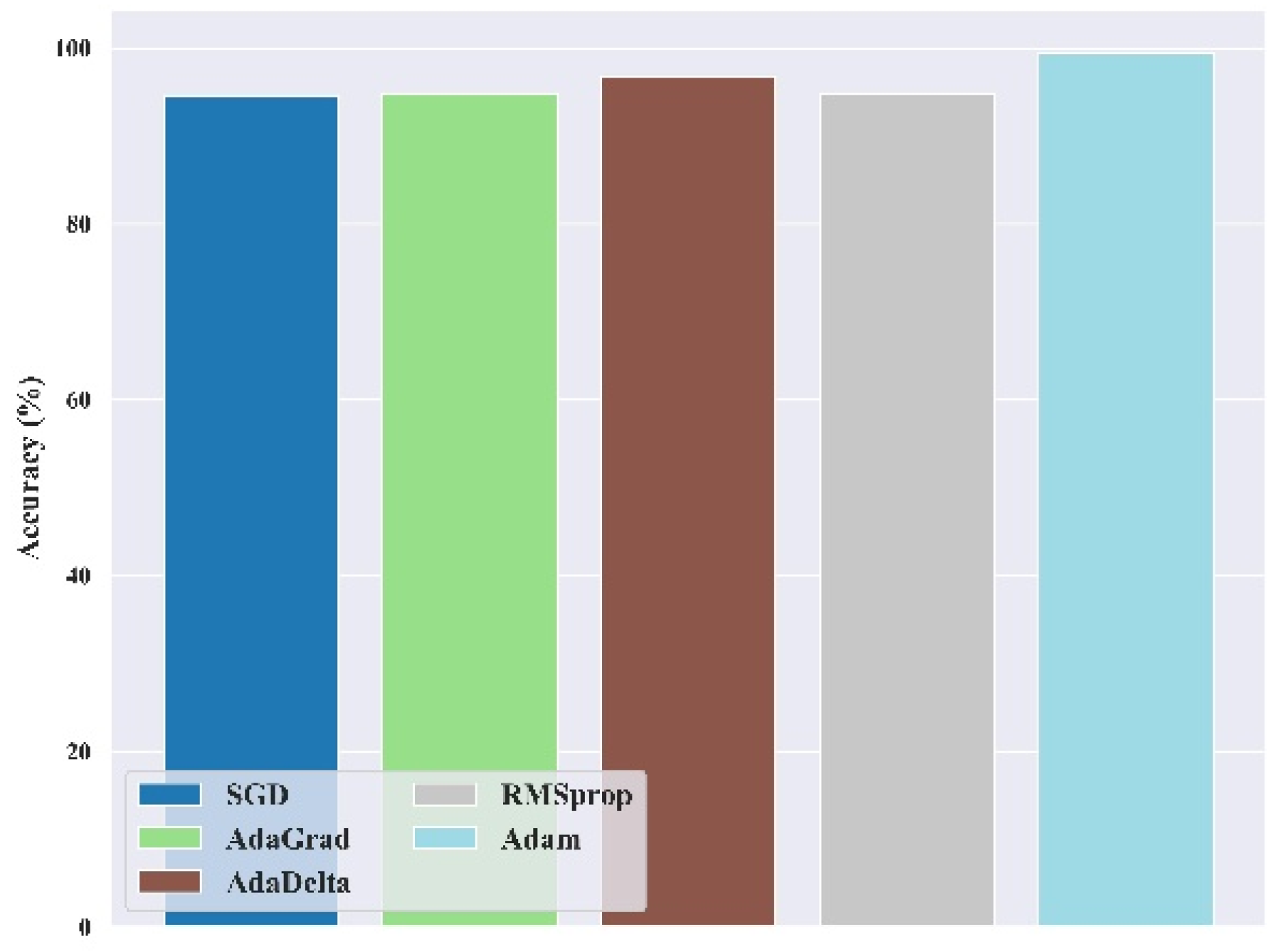
Sensitivity analysis reveals that the effective QEC model’s performance is heavily influenced by hyperparameter selection, specifically the optimizer and attention architecture, pointing to a non-convex, rugged error surface. As shown in Figure 13, the model is highly sensitive to the optimization algorithm, with Adam achieving a superior accuracy of 99.34% compared to 94.54% with SGD. Furthermore, adaptive methods such as RMSprop and AdaDelta achieved 94.68% and 96.78% of accuracies, which underperformed the Adam optimizer, highlighting the model’s reliance on adaptive learning rate mechanisms to avoid poor local minima during complex QEC tasks. Here, the effective QEC model mitigates the risk of overfitting through a highly sensitive hyperparameter tuning process that identifies the optimal architecture and optimizer.
Figure 13.
Sensitivity Analysis: Effect of optimizer selection on QEC model performance.
5.9. Attack Analysis
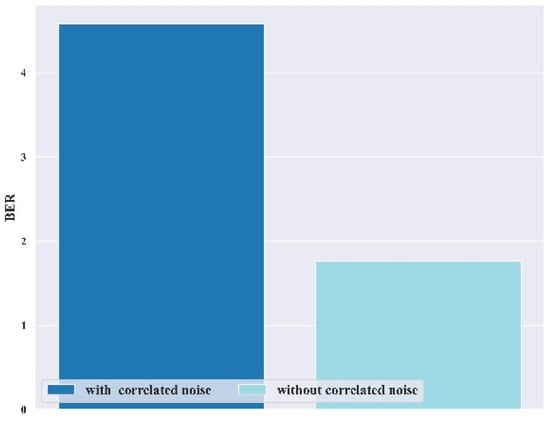
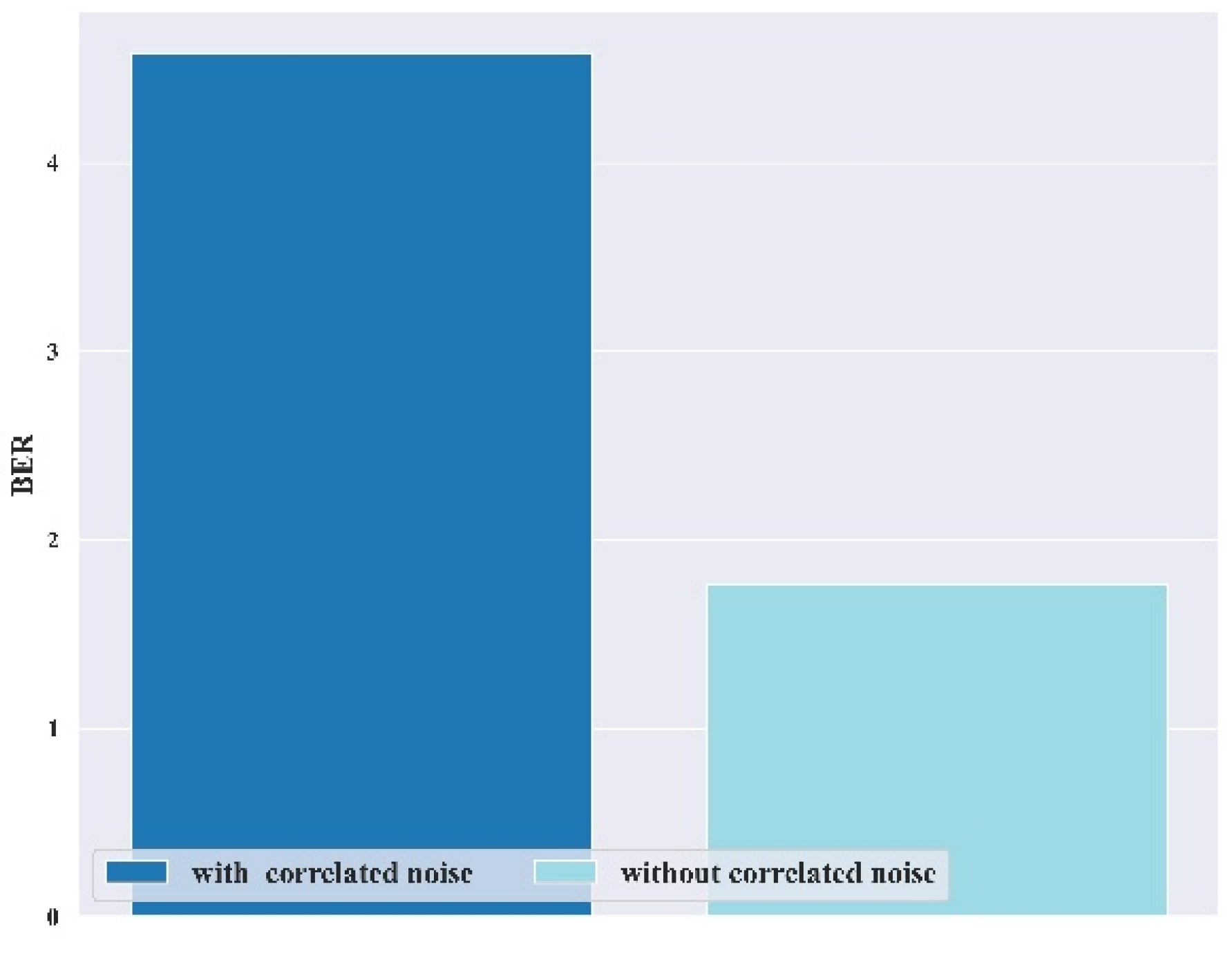
Correlated noise significantly degrades the performance of QEC tasks, increasing logical error rates far beyond the performance seen under uncorrelated noise scenarios. As illustrated in Figure 14, the logical error rate increases from 1.76% in the absence of correlated noise to 4.57% in its presence, highlighting that spatial or temporal correlations break the independence assumption required for standard decoders such as MWPM in optimal function. Such realistic noise, often stemming from hardware-specific crosstalk or coherent control errors, generates multi-qubit errors that are difficult to correct, effectively lowering the code distance.
Figure 14.
Attack Analysis: Effect of correlated noise on logical error rate compared to uncorrelated conditions.
5.10. Comparative Discussion of AGuESD-MCBiTM
The comparative discussion of the proposed AGuESD-MCBiTM model in comparison with the other traditional approaches which are provided in Table 2 and Table 3. The prevailing error correction models exhibit effective performance; however, they are subjected to various complexities in diverse scenarios. The RlGS2-DCNTM method exhibited lower scalability [7], and NN-decoders necessitated high-quality training codes in cryogenic environments [36]. In invisible quantum states, the QTECNN was not effective in maintaining the quantum information [37], and the ANN method was implemented with lower frequency time-dependent noises [39]. In addition, the multi-objective complexities impacted the SSA-DCNN model [38], and HSO-SADCNN showed lower resilience to the dynamic quantum error patterns [9]. Furthermore, the training of DCNN was highly challenging in real-time quantum noises [1] and RAO-DCNTM [34], ANN [39] was limited to smaller quantum systems. This research overcomes the limitations of traditional approaches using the proposed AGuESD-MCBiTM framework. The proposed framework uses meta-learning, which improves adaptive knowledge over real-time errors and facilitates sparse dual attention to focus on important qubit relationships. Furthermore, the AGuEO algorithm optimizes the weights and biases of the AGuESD-MCBiTM model, resulting in more effective error correction than other methods. Moreover, the AGuESD-MCBiTM model generalizes to real quantum hardware primarily with the utilization of noisy simulation environments such as Qiskit’s fake providers that mimic the non-linear qubit noise fluctuations, and gate error rates of physical devices. While trained in a simulated environment, the model employs meta-learning and sparse-dual attention, which allows the AGuESD-MCBiTM model to rapidly adapt to dynamic environments. The proposed AGuESD-MCBiTM overcomes all the limitations and exhibits better outcomes than the prevailing methods with 0.97 correlation, 0.94 , and 99.34% accuracy with a lower MAE of 1.13, MSE of 4.24, RMSE of 2.06, BER of 1.76 and LER of 4.06 in circuit-1. Moreover, in circuit-2, the AGuESD-MCBiTM shows a higher correlation of 0.97, of 0.93, and accuracy of 98.93% with lower losses of 1.20 MAE, 3.49 MSE, 1.87 RMSE, and 1.85 BER, as well as 3.82 LER for circuit-2.
Table 2.
Comparative discussion of AGuESD-MCBiTM for Circuit 1.
Table 3.
Comparative discussion of AGuESD-MCBiTM for Circuit 2.
6. Conclusions
The research concludes by presenting a dedicated deep learning-based decoder specifically designed for heavy hexagonal codes in quantum error correction. The proposed decoder AGuESD-MCBiTM framework evolves as a significant approach for effective error correction in complex quantum environments. The utilization of heavy hexagonal code offers various advantages, such as reducing the frequency requirements, minimizing the qubit crosstalks, and making it well-suitable for the hexagonal structure of quantum computers. The decoder model analyzed the error codes and qubit relationships to identify the errors in diverse distributions. The developed AGuEO algorithm tuned the hyperparameters of AGuESD-MCBiTM, which improved the learning rate during computation. The AGuEO exhibited higher convergence that led to the finding of global optimal solutions. Moreover, the inclusion of meta-learning supported the model for learning the real-time quantum mechanism to deal with unpredictable noise patterns. The statistical features enhanced the decoder by providing detailed representations of the qubit arrangements, and the sparse-dual attention facilitated the AGuESD-MCBiTM to focus on the relevant error code. The AGuESD-MCBiTM shows effective performance over the conventional methods with a higher correlation of 0.97, an accuracy of 98.93%, and an value of 0.93, as well as lower RMSE of 1.87, MAE of 1.20, BER of 1.85, LER of 3.82, and MSE of 3.49 in circuit 2, respectively. The future works can be extended by exploring more advanced learning models for adaptive quantum error corrections in practical applications.
Future Work and Limitations
The AGuESD-MCBiTM framework presents a robust approach for heavy hexagonal codes, yet its primary limitation lies in the computational complexity of the sparse-dual attention mechanism and the meta-learning component, which may struggle with real-time decoding on limited hardware resources. While simulated results indicate high accuracy, the framework’s performance may drop under highly non-Markovian noise, limiting its immediate generalizability to NISQ-era quantum hardware. Future work will focus on implementing the model on actual superconducting processors, optimizing the decoder for faster inference, minimize complexity and extending meta-learning to handle highly biased, time-varying noise models.
Author Contributions
R.K.B. and A.S.A.: conceptualized; approval, through evaluation, resources and editing process, supervision and management project. U.U.S.: conceptualized; the methodology, writing, proofreading and original draft preparation. A.S.A.: Funding acquisition. The final version of the paper has been reviewed and approved by all authors. All authors have read and agreed to the published version of the manuscript.
Funding
This research is funded by Princess Nourah bint Abdulrahman University, Riyadh, Saudi Arabia under Researchers Supporting Project Number (PNURSP2026R231).
Data Availability Statement
The original contributions presented in this study are included in the article. Further inquiries can be directed to the corresponding author.
Acknowledgments
The authors extend their sincere gratitude to the anonymous reviewers for their insightful suggestions and constructive feedback, which have greatly enhanced the quality and clarity of this article. The authors extend their appreciation to Princess Nourah bint Abdulrahman University (PNU), Riyadh, Saudi Arabia, for funding this research under the Researchers Supporting Project, No. PNURSP2026R231.
Conflicts of Interest
The authors declare no conflicts of interest.
References
- Li, A.; Li, F.; Gan, Q.; Ma, H. Convolutional-neural-network-based hexagonal quantum error correction decoder. Appl. Sci. 2023, 13, 9689. [Google Scholar] [CrossRef] [Scilit]
- LeCompte, T.; Qi, F.; Yuan, X.; Tzeng, N.F.; Najafi, M.H.; Peng, L. Machine-learning-based qubit allocation for error reduction in quantum circuits. IEEE Trans. Quantum Eng. 2023, 4, 3101414. [Google Scholar] [CrossRef] [Scilit]
- Henao, I.; Santos, J.P.; Uzdin, R. Adaptive quantum error mitigation using pulse-based inverse evolutions. npj Quantum Inf. 2023, 9, 120. [Google Scholar] [CrossRef] [Scilit]
- Duffy, K.R.; An, W.; Médard, M. Ordered reliability bits guessing random additive noise decoding. IEEE Trans. Signal Process. 2022, 70, 4528–4542. [Google Scholar] [CrossRef] [Scilit]
- Google Quantum AI. Suppressing quantum errors by scaling a surface code logical qubit. Nature 2023, 614, 676. [Google Scholar] [CrossRef] [Scilit] [PubMed]
- Verma, V.R.; Nishad, D.K.; Sharma, V.; Singh, V.K.; Verma, A.; Shah, D.R. Quantum machine learning for Lyapunov-stabilized computation offloading in next-generation MEC networks. Sci. Rep. 2025, 15, 405. [Google Scholar] [CrossRef] [Scilit]
- Shinde, U.U.; Bandaru, R. Re-locative guided search optimized self-sparse attention enabled deep learning decoder for quantum error correction. Sci. Rep. 2025, 15, 3615. [Google Scholar] [CrossRef] [Scilit]
- Olle, J.; Zen, R.; Puviani, M.; Marquardt, F. Simultaneous discovery of quantum error correction codes and encoders with a noise-aware reinforcement learning agent. npj Quantum Inf. 2024, 10, 126. [Google Scholar] [CrossRef] [Scilit]
- Shinde, U.U.; Bandaru, R. Quantum error-correction using humming sparrow optimization based self-adaptive deep CNN noise correction module. Sci. Rep. 2024, 14, 14289. [Google Scholar] [CrossRef] [Scilit]
- Zeng, Y.; Zhou, Z.Y.; Rinaldi, E.; Gneiting, C.; Nori, F. Approximate autonomous quantum error correction with reinforcement learning. Phys. Rev. Lett. 2023, 131, 050601. [Google Scholar] [CrossRef] [Scilit]
- Ryan-Anderson, C.; Bohnet, J.G.; Lee, K.; Gresh, D.; Hankin, A.; Gaebler, J.P.; Francois, D.; Chernoguzov, A.; Lucchetti, D.; Brown, N.C.; et al. Realization of real-time fault-tolerant quantum error correction. Phys. Rev. X 2021, 11, 041058. [Google Scholar] [CrossRef] [Scilit]
- Liyanage, N.; Wu, Y.; Tagare, S.; Zhong, L. FPGA-based distributed union-find decoder for surface codes. IEEE Trans. Quantum Eng. 2024, 5, 3103318. [Google Scholar] [CrossRef] [Scilit]
- Reinhold, P.; Rosenblum, S.; Ma, W.L.; Frunzio, L.; Jiang, L.; Schoelkopf, R.J. Error-corrected gates on an encoded qubit. Nat. Phys. 2020, 16, 822–826. [Google Scholar] [CrossRef] [Scilit]
- Krinner, S.; Lacroix, N.; Remm, A.; Di Paolo, A.; Genois, E.; Leroux, C.; Hellings, C.; Lazar, S.; Swiadek, F.; Herrmann, J.; et al. Realizing repeated quantum error correction in a distance-three surface code. Nature 2022, 605, 669–674. [Google Scholar] [CrossRef] [Scilit] [PubMed]
- Xue, Y.J.; Wang, H.W.; Tian, Y.B.; Wang, Y.N.; Wang, Y.X.; Wang, S.M. Quantum information protection scheme based on reinforcement learning for periodic surface codes. Quantum Eng. 2022, 2022, 7643871. [Google Scholar] [CrossRef] [Scilit]
- Chamberl, C.; Zhu, G.; Yoder, T.J.; Hertzberg, J.B.; Cross, A.W. Topological and subsystem codes on low-degree graphs with flag qubits. Phys. Rev. X 2020, 10, 011022. [Google Scholar] [CrossRef] [Scilit]
- Bhoumik, D.; Majumdar, R.; Madan, D.; Vinayagamurthy, D.; Raghunathan, S.; Sur-Kolay, S. Efficient syndrome decoder for heavy hexagonal QECC via machine learning. ACM Trans. Quantum Comput. 2024, 5, 5. [Google Scholar] [CrossRef] [Scilit]
- Varsamopoulos, S.; Bertels, K.; Almudever, C.G. Decoding surface code with a distributed neural network-based decoder. Quantum Mach. Intell. 2020, 2, 3. [Google Scholar] [CrossRef] [Scilit]
- Swathi, M.; Rudra, B. A novel approach for asymmetric quantum error correction with syndrome measurement. IEEE Access 2022, 10, 44669–44676. [Google Scholar] [CrossRef] [Scilit]
- Ding, Y.; Gokhale, P.; Lin, S.F.; Rines, R.; Propson, T.; Chong, F.T. Systematic crosstalk mitigation for superconducting qubits via frequency-aware compilation. In Proceedings of the 53rd Annual IEEE/ACM International Symposium on Microarchitecture (MICRO), Athens, Greece, 17–21 October 2020; IEEE: New York, NY, USA, 2020. [Google Scholar]
- Lienhard, B.; Vepsäläinen, A.; Govia, L.C.; Hoffer, C.R.; Qiu, J.Y.; Riste, D.; Ware, M.; Kim, D.; Winik, R.; Melville, A.; et al. Deep-neural-network discrimination of multiplexed superconducting-qubit states. Phys. Rev. Appl. 2022, 17, 014024. [Google Scholar] [CrossRef] [Scilit]
- Miao, K.C.; McEwen, M.; Atalaya, J.; Kafri, D.; Pryadko, L.P.; Bengtsson, A.; Opremcak, A.; Satzinger, K.J.; Chen, Z.; Klimov, P.V.; et al. Overcoming leakage in quantum error correction. Nat. Phys. 2023, 19, 1780–1786. [Google Scholar] [CrossRef] [Scilit]
- Foxen, B.; Neill, C.; Dunsworth, A.; Roushan, P.; Chiaro, B.; Megrant, A.; Kelly, J.; Chen, Z.; Satzinger, K.; Barends, R.; et al. Demonstrating a continuous set of two-qubit gates for near-term quantum algorithms. Phys. Rev. Lett. 2020, 125, 120504. [Google Scholar] [CrossRef] [Scilit] [PubMed]
- Ajlouni, N.; Özyavaş, A.; Takaoğlu, M.; Takaoğlu, F.; Ajlouni, F. Medical image diagnosis based on adaptive hybrid quantum CNN. BMC Med. Imaging 2023, 23, 126. [Google Scholar] [CrossRef] [Scilit] [PubMed]
- Cheng, L.; Chen, Y.Q.; Zhang, S.X.; Zhang, S. Quantum approximate optimization via learning-based adaptive optimization. Commun. Phys. 2024, 7, 83. [Google Scholar] [CrossRef] [Scilit]
- Forlivesi, D.; Valentini, L.; Chiani, M. Spanning tree matching decoder for quantum surface codes. IEEE Commun. Lett. 2024, 28, 1509–1513. [Google Scholar] [CrossRef] [Scilit]
- Ji, Y.; Chen, Q.; Wang, R.; Ji, N.; Ma, H. Quantum error correction for heavy hexagonal code using deep reinforcement learning with policy reuse. Quantum Inf. Process. 2024, 23, 255. [Google Scholar] [CrossRef] [Scilit]
- Brown, B.J. Conservation laws and quantum error correction: Toward a generalized matching decoder. IEEE BITS Inf. Theory Mag. 2022, 2, 5–19. [Google Scholar] [CrossRef] [Scilit]
- Yang, X.; Zhang, Z. A CNN-LSTM model based on a meta-learning algorithm to predict groundwater level in the middle and lower reaches of the Heihe River, China. Water 2022, 14, 2377. [Google Scholar] [CrossRef] [Scilit]
- Hasanat, S.M.; Younis, R.; Alahmari, S.; Ejaz, M.T.; Haris, M.; Yousaf, H.; Watara, S.; Ullah, K.; Ullah, Z. Enhancing load forecasting accuracy in smart grids: A novel parallel multichannel network approach using 1D CNN and Bi-LSTM models. Int. J. Energy Res. 2024, 2024, 2403847. [Google Scholar] [CrossRef] [Scilit]
- Fu, J.; Liu, J.; Tian, H.; Li, Y.; Bao, Y.; Fang, Z.; Lu, H. Dual attention network for scene segmentation. In Proceedings of the IEEE/CVF Conference on Computer Vision and Pattern Recognition, Long Beach, CA, USA, 15–20 June 2019. [Google Scholar]
- Ebeed, M.; Abdelmotaleb, M.A.; Khan, N.H.; Jamal, R.; Kamel, S.; Hussien, A.G.; Zawbaa, H.M.; Jurado, F.; Sayed, K. A modified artificial hummingbird algorithm for solving optimal power flow problem in power systems. Energy Rep. 2024, 11, 982–1005. [Google Scholar] [CrossRef] [Scilit]
- Qin, S.; Liu, J.; Bai, X.; Hu, G. A multi-strategy improvement secretary bird optimization algorithm for engineering optimization problems. Biomimetics 2024, 9, 478. [Google Scholar] [CrossRef] [Scilit] [PubMed]
- Alruwaili, F.F.; Asiri, M.M.; Alrayes, F.S.; Aljameel, S.S.; Salama, A.S.; Hilal, A.M. Red kite optimization algorithm with average ensemble model for intrusion detection for secure IoT. IEEE Access 2023, 11, 131749–131758. [Google Scholar] [CrossRef] [Scilit]
- Huang, Z.; Zhang, Z.; Hua, C.; Liao, B.; Li, S. Leveraging enhanced egret swarm optimization algorithm and artificial intelligence-driven prompt strategies for portfolio selection. Sci. Rep. 2024, 14, 26681. [Google Scholar] [CrossRef] [Scilit] [PubMed]
- Overwater, R.W.J.; Babaie, M.; Sebastiano, F. Neural-network decoders for quantum error correction using surface codes: A space exploration of the hardware cost-performance tradeoffs. IEEE Trans. Quantum Eng. 2022, 3, 3101719. [Google Scholar] [CrossRef] [Scilit]
- Cao, Q.; Wang, H.W.; Qu, Y.J.; Xue, Y.J.; Wang, S.M. Quantum teleportation error suppression algorithm based on convolutional neural networks and quantum topological semion codes. Quantum Eng. 2022, 2022, 6245336. [Google Scholar] [CrossRef] [Scilit]
- Xue, J.; Shen, B. A novel swarm intelligence optimization approach: Sparrow search algorithm. Syst. Sci. Control Eng. 2020, 8, 22–34. [Google Scholar] [CrossRef] [Scilit]
- Kim, C.; Park, K.D.; Rhee, J.-K. Quantum error mitigation with artificial neural network. IEEE Access 2020, 8, 188853–188860. [Google Scholar] [CrossRef] [Scilit]
- Zhuoran, Z.; Changqiang, H.; Hanqiao, H.; Shangqin, T.; Kangsheng, D. An optimization method: Hummingbirds optimization algorithm. J. Syst. Eng. Electron. 2018, 29, 386–404. [Google Scholar] [CrossRef] [Scilit]
- Fu, Y.; Liu, D.; Chen, J.; He, L. Secretary bird optimization algorithm: A new metaheuristic for solving global optimization problems. Artif. Intell. Rev. 2024, 57, 123. [Google Scholar] [CrossRef] [Scilit]
- Baek, C.; Ostuka, T.; Tarucha, S.; Choi, B.S. Density matrix simulation of quantum error correction codes for near-term quantum devices. Quantum Sci. Technol. 2019, 5, 015002. [Google Scholar] [CrossRef] [Scilit]

Disclaimer/Publisher’s Note: The statements, opinions and data contained in all publications are solely those of the individual author(s) and contributor(s) and not of MDPI and/or the editor(s). MDPI and/or the editor(s) disclaim responsibility for any injury to people or property resulting from any ideas, methods, instructions or products referred to in the content. |
© 2026 by the authors. Licensee MDPI, Basel, Switzerland. This article is an open access article distributed under the terms and conditions of the Creative Commons Attribution (CC BY) license.