


Abstract
Parametric regression methods are efficient when correctly specified but are sensitive to model misspecification and outliers. Nonparametric regression offers greater flexibility at the cost of reduced interpretability and susceptibility to the curse of dimensionality. Semiparametric models provide a compromise between these approaches by combining structural interpretability with functional flexibility. A key limitation of many classical semiparametric and nonparametric methods, however, is their lack of robustness to heavy-tailed errors and contaminated data. In this paper, we develop robust kernel, spline, and single-index regression estimators based on robust loss functions. To facilitate inference, we propose bootstrap-based procedures that remain valid in settings where classical assumptions may be violated. Through extensive simulation studies under normal, heavy-tailed, and contaminated error distributions, we demonstrate that the proposed robust methods achieve comparable performance to classical approaches in clean settings while providing substantial gains in stability and inferential reliability under contamination. Unlike existing works that study these robust estimators in isolation, the proposed approach provides a unified framework that integrates robust kernel regression, robust spline regression, and robust single-index modeling with a coherent bootstrap-based inference procedure. Application to Boston housing data further illustrates the practical usefulness of the proposed methodology.
Keywords:
Boston housing data; nonparametric regression; robust estimation; robust inference; semiparametric regression; single index models MSC:
62G05; 62G35; 62P20
1. Introduction
Regression modeling is a fundamental tool in statistical analysis for characterizing the relationship between a response variable and a set of explanatory variables. Classical parametric regression models are widely used due to their interpretability and statistical efficiency when the assumed model is correctly specified. However, even mild model misspecification can lead to biased estimation and invalid inference, a phenomenon that has been well documented in the literature [1,2]. In many applications, the true functional form is unknown or too complex to be adequately captured by a parametric specification, motivating the use of more flexible modeling strategies.
Fully nonparametric regression methods provide substantial flexibility by avoiding restrictive structural assumptions on the regression function. Kernel smoothing, local polynomial regression, and spline-based approaches are among the most widely used techniques in this setting [3,4]. While these methods are robust to functional-form misspecification, their performance deteriorates rapidly as the dimensionality of the explanatory variable space increases, a limitation commonly referred to as the curse of dimensionality. This challenge limits the practical applicability of fully nonparametric methods to moderate- and high-dimensional problems.
Semiparametric regression models offer a compromise between parametric efficiency and nonparametric flexibility by combining structured and unstructured components. Among these models, the single-index model (SIM) has attracted considerable attention due to its ability to achieve dimension reduction while retaining nonlinear modeling capability. In its general form, the SIM assumes that the response depends on the predictors only through a one-dimensional projection, thereby alleviating the curse of dimensionality [5,6]. Comprehensive treatments of SIMs and related dimension reduction methods can be found in [4,7], with further methodological developments that address the efficiency and identifiability of the estimation [8].
Despite their attractive theoretical and practical properties, classical semiparametric and single index estimators are highly sensitive to outliers, heavy-tailed errors, and influential observations. In many real-world applications, such as economic, environmental, and biomedical studies, such forms of contamination are unavoidable and can severely distort both estimation and inference. Robust statistical methods address this issue by limiting the influence of extreme observations, typically through bounded loss functions or adaptive weighting schemes. The foundational contributions to robust estimation include [9], with modern comprehensive treatments provided in [10]. More recent work has extended robustness concepts to nonparametric and semiparametric regression settings, including kernel- and spline-based methods [11,12].
In the context of single-index and dimension reduction models, robustness presents additional challenges because it must be achieved simultaneously in estimating both the index direction and the unknown link function. Several recent studies have investigated robust dimension-reduction and semiparametric procedures, highlighting the inherent robustness efficiency trade-off and the complexity of inference in such models [13]. Nevertheless, practical inference procedures for robust single-index models that incorporate nonparametric smoothing and nonsmooth loss functions remain relatively underdeveloped.
Robust regression methodologies are increasingly important in modern data-driven applications. In engineering systems and intelligent transportation applications, observational data are often affected by sensor noise, measurement errors, heavy-tailed disturbances, and limited sample sizes. These characteristics motivate the development of estimation and inference procedures that remain stable under contamination and deviations from classical distributional assumptions. Recent applied studies in control engineering and transportation analytics further highlight the importance of robust modeling strategies in such contexts [14,15,16].
Motivated by these considerations, this paper develops a unified framework for robust estimation and inference in semiparametric and nonparametric regression models, with particular emphasis on the single-index model. We propose robust kernel- and spline-based estimators that combine dimension reduction with bounded loss functions to mitigate the effects of outliers and heavy-tailed errors. Because the resulting estimators possess complex sampling distributions and are not adjustable to closed-form asymptotic inference, we adopt bootstrap-based procedures that are well-suited to robust and non-smooth estimation problems [17,18]. Through extensive simulation studies and a real data application, we demonstrate that the proposed methods retain high efficiency under clean data conditions while providing substantial gains in stability and inferential reliability under contamination.
Compared to existing literature, which typically develops robust kernel regression, robust spline regression, or robust single-index models separately, this paper makes the following contributions. First, it formulates a unified framework that encompasses robust nonparametric and semiparametric regression under a common estimation principle. Second, it integrates bootstrap-based inference within this framework, enabling consistent confidence interval construction across model classes. Third, it provides a systematic comparative evaluation under contamination, heavy-tailed errors, and skewed distributions. The novelty, therefore, lies in the methodological unification and coherent inferential treatment rather than in proposing isolated robust estimators.
The remainder of the paper is organized as follows. Section 2 introduces the general regression framework and reviews parametric, nonparametric, and semiparametric models. Section 3 presents the proposed robust estimation procedures. Section 4 describes bootstrap-based inference methods. Simulation studies are reported in Section 5, and a real data application is presented in Section 6. Section 7 concludes with a discussion of practical implications and directions for future research.
2. General Regression Models
Let denote a response variable and a vector of predictors. We consider the general regression model
where is an unknown regression function and is a random error term that satisfies . Different modeling assumptions on the structure of lead to parametric, nonparametric, and semiparametric regression models, each with distinct advantages and limitations.
2.1. Parametric Regression Models
In parametric regression, the regression function is assumed to be a known family, typically of the form
where is an unknown parameter vector. Parametric models are statistically efficient and easy to interpret when correctly specified. However, when the assumed functional form is misspecified, parameter estimates may be biased and the resulting inference invalid. This sensitivity to model misspecification has been studied extensively; see, for example, [1,2]. In practice, the validity of parametric assumptions is often difficult to verify, motivating more flexible alternatives.
2.2. Nonparametric Regression Models
Nonparametric regression retains the general model formulation in (1) but assumes that the regression function is an arbitrary smooth function estimated using kernel smoothing, spline, or related techniques.
For clarity of exposition in the development of kernel and spline estimators, we restrict attention in this subsection to the case , so that . Multivariate extensions to can be obtained using product kernels or related smoothing techniques. However, such extensions are not pursued here, as the focus is on the robustness aspects of the methodology.
Although nonparametric models offer great flexibility and are robust to functional-form misspecification, their performance deteriorates rapidly as the dimension p increases. This phenomenon, known as the curse of dimensionality, limits the applicability of fully nonparametric methods in moderate- and high-dimensional settings; see [3,4].
2.3. Semiparametric Regression Models and Dimension Reduction
Semiparametric regression models aim to balance flexibility and efficiency by combining parametric and nonparametric components. Among these models, the single index model (SIM) assumes that the regression function depends on the explanatory variables only through a one-dimensional projection:
where is an unknown index parameter and is an unknown smooth function. The SIM achieves dimension reduction by replacing the p-dimensional predictor vector with a scalar index, thus alleviating the curse of dimensionality while maintaining modeling flexibility.
The model (3) is identifiable only in scale and sign. Throughout this paper, we impose normalization , which fixes the scale but leaves the sign undetermined. This sign of indeterminacy plays an important role in estimation and inference and is addressed explicitly in later sections.
Single index models were originally studied in [5] and developed in more detail by [6]. Comprehensive treatments can be found in [7,19,20]. These works demonstrate that SIMs provide an effective framework for semiparametric regression, particularly when the relationship between Y and X is nonlinear but driven primarily by a low-dimensional structure.
2.4. Robust Regression Models
Classical estimation methods for model (3) typically rely on least squares or likelihood-based criteria and are sensitive to outliers and heavy-tailed errors. To address this sensitivity, robust regression replaces squared loss functions with bounded losses or introduces observation-specific weights that reduce the influence of extreme residuals. Foundational contributions to robust estimation include [9,10], with modern extensions to semiparametric and nonparametric models reviewed in [12,21].
In the context of single index models, robustness affects both the estimation of the index direction and the nonparametric estimation of the link function . The resulting estimators exhibit increased stability under contamination at the cost of some efficiency when the data are approximately clean. This robustness efficiency trade-off is a central theme of the present work and motivates the methodology developed in the next section.
3. Methodology
This section displays the proposed robust semiparametric and nonparametric regression procedures. We first describe a robust estimation for nonparametric regression using kernel and spline smoothing. We then introduce the robust single-index model estimator, which combines robust loss functions with dimension reduction through an estimated index direction.
3.1. Robust Kernel Regression Models
We now consider robust estimation under the general regression model in (1). Classical kernel regression estimators for the unknown smooth function are typically obtained by minimizing a locally weighted sum of squared residuals.
To improve robustness, we replace the squared loss with a bounded loss function and define the robust local estimator as
where is a kernel function with bandwidth h. Common choices of include the Huber and Tukey bisquare loss functions. This formulation downweights observations with large residuals, thereby reducing the influence of outliers while preserving local smoothing properties.
The optimization problem in (4) is solved using an iteratively reweighted least squares (IRLS) procedure. At each iteration, the weights are updated on the basis of the current residuals, and a weighted local regression is performed. This approach is computationally efficient and stable in practice.
The proposed robustification primarily addresses vertical outliers in the response variable through the bounded score function within the M-estimation framework. Observations with large residuals receive reduced weights during the IRLS iterations. Robustness with respect to covariate outliers is partially achieved through the localization property of the kernel weights, as observations far from the target point obtain small weights. Thus, the effective IRLS weight combines kernel-based localization and residual-based robustness.
The robust kernel regression estimator is constructed using the Huber loss function defined in Section 3.5. The corresponding score function is bounded, implying a bounded influence function and protection against extreme observations. The tuning constant is selected to achieve approximately 95% asymptotic efficiency under Gaussian errors, following standard robust estimation principles [9,10]. This choice provides a balance between robustness and efficiency.
3.2. Robust Spline Regression
As an alternative to kernel smoothing, spline-based methods offer a flexible and computationally attractive approach for nonparametric regression. Let denote a set of spline basis functions. The regression function is approximated by
where are unknown coefficients. Robust estimation is achieved by minimizing
where is a smoothing parameter controlling the bias–variance trade-off. The penalty term, , ensures smoothness of the fitted function, while the robust loss reduces sensitivity to extreme observations.
Spline-based robust estimators are particularly appealing when the covariate dimension is low or moderate and when global smoothness is desired. In this paper, spline estimators serve as an alternative to kernel-based methods, providing complementary insights into the behavior of robust nonparametric regression.
3.3. Robust Single-Index Model Estimation
We now consider robust estimation of the single-index model introduced in Equation (3). Estimation proceeds by jointly estimating the index direction and the unknown link function using a profile-type approach.
For a given candidate , the index values are computed, and the function is estimated using robust nonparametric regression of Y on T. Let denote the resulting robust estimator. The index direction is then obtained by minimizing the profiled objective function
The optimization problem in (7) is solved numerically using gradient-based methods on the unit sphere. Because the objective function is generally nonconvex, initialization plays an important role in practice. In our work, the robust optimization is initialized using the classical single-index estimator, which provides a stable and computationally efficient starting value. Estimation of the index parameter is performed via an iterative procedure that alternates between updating the link function and updating the index vector. After each update, the index parameter is normalized to satisfy the unit-norm constraint, which corresponds to a projected optimization step onto the unit sphere. The overall algorithm is implemented within an IRLS framework to incorporate robustness.
It is important to note that model (3) is identifiable only up to sign. Accordingly, and define equivalent models. This identifiability issue is addressed explicitly in the inference procedures described in Section 4.
The iterative procedure requires an initial value for the index parameter. The classical estimator is used as the starting point. Across simulations and data applications, the algorithm showed stable convergence and limited sensitivity to moderate perturbations of the initial value. The following is a summary of the Algorithm 1 for robust single index estimation.
| Algorithm 1 Robust single index estimation |
|
3.4. Remarks on Theoretical Properties
The robust single-index estimator defined in (7) combines nonparametric smoothing, robust loss functions, and dimension reduction. While classical single-index estimators have been shown to possess desirable asymptotic properties under regularity conditions, extending such results to the robust setting is technically challenging due to the nonsmooth nature of the loss function and the presence of a nonparametric component.
Rather than pursuing full asymptotic derivations, this paper focuses on practical estimation and inference using resampling-based methods. The finite-sample behavior of the proposed estimator is examined through extensive simulation studies in Section 5, and uncertainty quantification is carried out via bootstrap procedures described in Section 4.
3.5. Implementation Details
For the kernel-based estimators, we employ the Gaussian kernel
Bandwidths are selected using least-squares cross-validation in the classical setting and a robust cross-validation criterion in the robust setting, where squared residuals are replaced by the chosen robust loss function.
For robust estimation, we primarily use the Huber loss function
with tuning constant , which achieves approximately 95% asymptotic efficiency under normal errors. When using the Tukey bisquare loss, we adopt the conventional choice .
For spline-based estimators, smoothing parameters are selected using generalized cross-validation (GCV). All optimization procedures are implemented using iteratively reweighted least squares (IRLS).
4. Semiparametric and Nonparametric Statistical Inference
This section describes the inferential procedures adopted for the proposed robust semiparametric and nonparametric regression estimators. Due to the combination of robust loss functions, nonparametric smoothing, and dimension reduction, classical closed-form asymptotic inference is generally difficult to derive and may rely on restrictive assumptions. As a result, inference is conducted using bootstrap-based procedures that are well-suited to complex profile-type estimators.
4.1. Inference for the Single Index
Let denote the estimated single index obtained from minimizing the profiled robust objective function in (7). Because the single-index model depends on only through the scalar projection , the parameter is identifiable only up to sign. That is, and produce identical models. To obtain meaningful inference, a sign convention must therefore be imposed.
Bootstrap inference is performed by repeatedly resampling the observed data with replacement and recomputing the index estimator. For each bootstrap replica , we enforce the alignment of the sign with the full-sample estimate according to
where denotes the Euclidean inner product. This alignment prevents artificial inflation of uncertainty due to sign switching and yields an identifiable bootstrap distribution.
The pointwise confidence intervals for the components of are then constructed using the percentile bootstrap. It is important to emphasize that, in the single-index framework, the individual components of do not admit a marginal interpretation. As a result, these intervals should be interpreted as reflecting uncertainty in the estimated index direction rather than variable-specific effects.
4.2. Inference for the Single Index Coefficients
Inference for the unknown link function is conducted conditional on the estimated single index coefficients. Given , the index values are computed, and the link function is estimated using robust nonparametric regression of Y on T. To quantify uncertainty in the estimated function, bootstrap samples are used to obtain resampled estimates of over a grid of index values.
Pointwise confidence bands for are constructed from the empirical quantiles of the bootstrap distribution. These bands provide a flexible, distribution-free assessment of uncertainty and are particularly useful for visualizing nonlinear features of the index function and assessing model adequacy.
The bootstrap procedures described above are supported by extensive simulation evidence presented in Section 5. While formal asymptotic theory for robust single-index estimators with nonparametric components remains challenging, the bootstrap offers a practical and reliable inferential tool in finite samples. The resulting inference captures both estimation variability and the effects of robustification, making it well-suited for applications involving outliers, leverage points, or heavy-tailed error distributions.
5. Simulation Studies
This section evaluates the finite-sample performance of the proposed robust semiparametric and nonparametric regression methods using Monte Carlo simulation experiments. The simulations are designed to assess estimator behavior under both ideal model assumptions and common deviations from these assumptions, including heavy-tailed and contaminated error distributions. Classical and robust estimators are compared in terms of estimation accuracy and inferential reliability using criteria that correspond directly to the reported simulation tables.
5.1. Simulation Settings and Models
Three classes of regression models are considered: nonparametric regression, partially linear model, and single-index model.
- 1.
- Nonparametric regression.
Data are generated from the model
where the scalar covariate X is generated independently from a distribution. The true regression function is specified as
which is a commonly used smooth nonlinear function in nonparametric regression experiments. Kernel and spline estimators are employed to estimate using both classical and robust loss functions.
- 2.
- Partially linear model.
For the partially linear setting, data are generated according to
where is a two-dimensional vector of explanatory variables generated independently from a standard normal distribution, . The true parameter vector is set to
The scalar covariate W is generated independently from , and the nonparametric component is specified as
Spline-based estimators are used to estimate under classical and robust procedures.
- 3.
- Single index model.
For the semiparametric single-index model, data are generated from
where with is generated independently from a multivariate normal distribution,
The true index parameter satisfies and is specified as
and the link function is defined as
5.2. Error Distributions
The error term is generated under three scenarios:
- Normal errors: .
- Heavy-tailed errors: , with , scaled to have variance .
- Contaminated errors:with contamination proportion .
These scenarios are designed to evaluate estimator robustness to deviations from Gaussian error assumptions.
All simulation experiments are conducted with a sample size . Each reported result is based on 1000 independent Monte Carlo replications. Within each replication, bootstrap inference is carried out using resamples. The reported mean squared errors, angular errors, and empirical coverage probabilities are computed by averaging across the Monte Carlo replications.
5.3. Evaluation Criteria
For the nonparametric and partially linear models, estimation accuracy is measured using the mean squared error (MSE),
where denotes the estimated regression function (or the estimated nonparametric component in the partially linear model).
For the single-index model, index estimation accuracy is evaluated using the angular error between the estimated index and the true index ,
reported in degrees.
Inferential performance is assessed using empirical coverage probabilities of nominal bootstrap confidence intervals. Bootstrap resampling is performed with resamples within each Monte Carlo replication.
5.4. Simulation Results
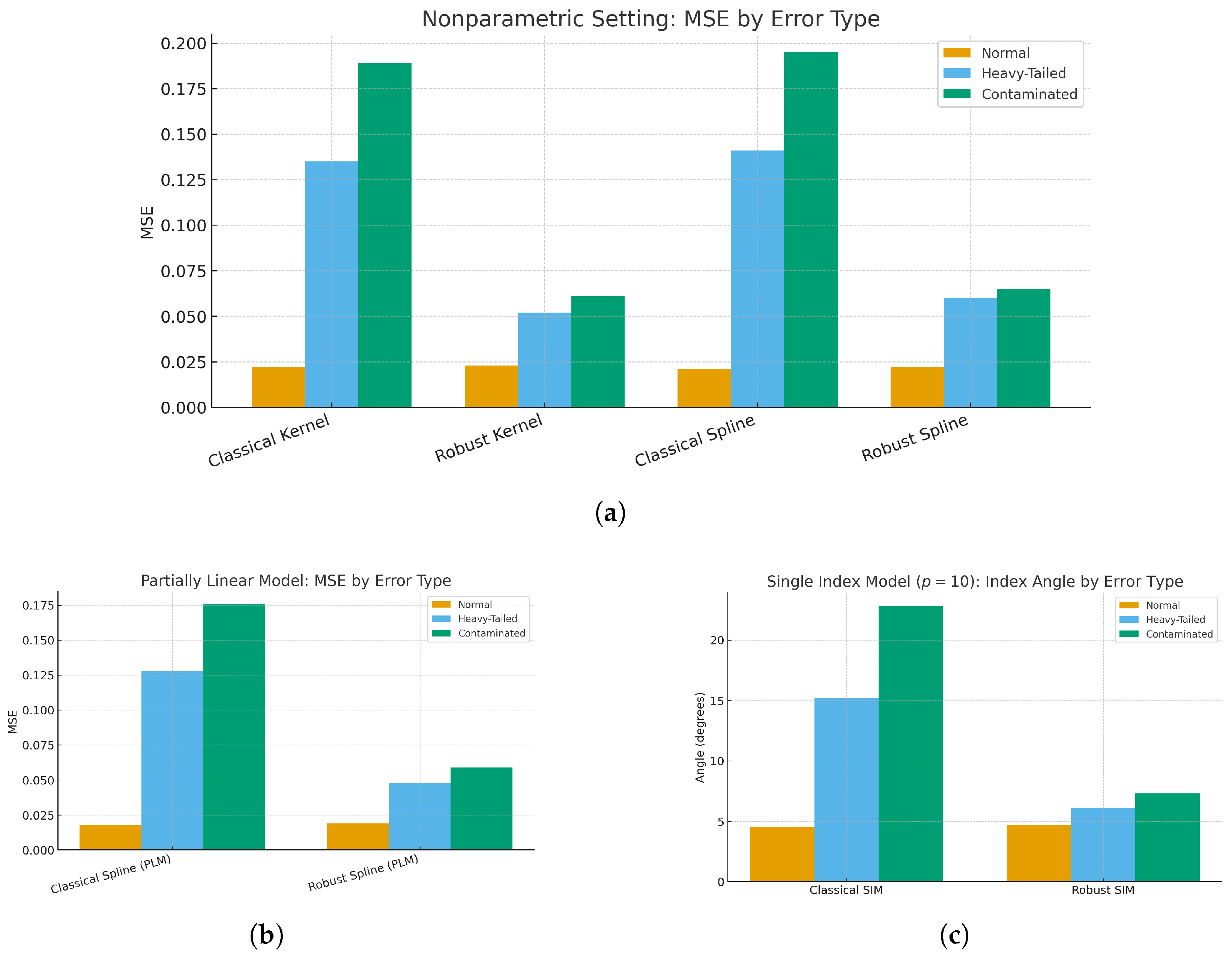
Table 1 and Table 2 summarize results for the nonparametric and partially linear models. Under normal errors, classical and robust estimators yield nearly identical MSE, indicating minimal efficiency loss due to robustification. Under heavy-tailed and contaminated errors, robust estimators achieve substantially lower MSE and maintain coverage probabilities close to the nominal level, 95%, whereas classical estimators exhibit inflated error and systematic undercoverage.
Table 1.
Simulation results for the nonparametric setting (Kernel and Spline estimators).
Table 2.
Simulation results for the partially linear model (PLM).
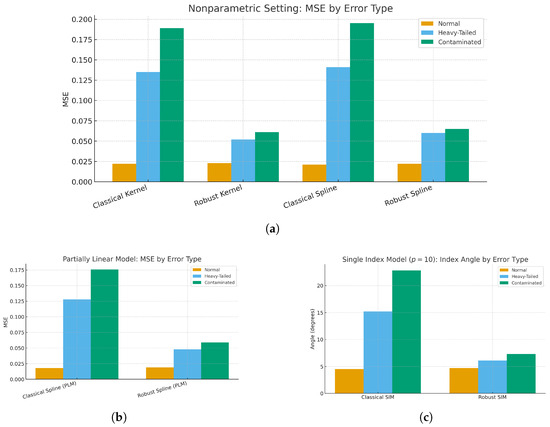
Table 3 reports results for the semiparametric single-index model. Under normal errors, both classical and robust estimators recover the index direction with small angular error. In contrast, under heavy-tailed and contaminated errors, the classical estimator deteriorates markedly, while the robust estimator remains stable, achieving substantially smaller angular error and improved coverage. Figure 1 visualizes the results under different scenarios for different models.
Table 3.
Simulation results for the semiparametric single index model with . Angles are between and (degrees).
Figure 1.
Simulation results under different modeling frameworks and error distributions. (a) Nonparametric setting: mean squared error (MSE) by error type for kernel and spline estimators. (b) Partially linear model: MSE by error type for classical and robust spline estimators. (c) Single-index model (): angle between the estimated index and the true index under different error distributions.
Overall, the simulation studies demonstrate that robust procedures show little loss of efficiency under ideal conditions while providing substantial gains in stability and inferential reliability under heavy-tailed or contaminated error distributions. These results confirm the robustness efficiency trade-off and support the use of robust semiparametric and nonparametric methods in applications where deviations from classical assumptions are plausible.
While a continuous sensitivity analysis varying the contamination proportion or tail heaviness could further illustrate the transition behavior, the present discrete design captures the key robustness regimes relevant in practice.
Robust alternatives such as quantile-based single-index estimators and data-adaptive procedures have been proposed in the literature. Unlike quantile methods, the proposed approach preserves a mean-regression interpretation while controlling influence through bounded score functions. Adaptive-robust methods select tuning parameters data-dependently, whereas our procedure uses efficiency-calibrated tuning constants for stability. A detailed empirical comparison with these alternatives is left for future work.
6. Boston Housing Data
We illustrate the proposed methodology using the Boston Housing data set, which contains neighborhood-level information on housing prices and related socioeconomic, environmental, and structural characteristics in the Boston metropolitan area, originally introduced by Harrison and Rubinfeld [22]. The data are publicly available through the MASS package in R 4.4.2 [23,24].
The data are publicly available through the MASS package in R. The data consist of 506 observations and 14 variables, derived from the 1970 U.S. Census, and describe housing characteristics in Boston suburbs. The explanatory variables include the per capita crime rate (crim), the proportion of residential land zoned for large lots (zn), the proportion of non-retail business acreage (indus), an indicator for proximity to the Charles River (chas), nitrogen oxides concentration (nox), the average number of rooms per dwelling (rm), the proportion of owner-occupied units built before 1940 (age), weighted distances to employment centers (dis), accessibility to radial highways (rad), property tax rate (tax), pupil–teacher ratio (ptratio), a measure associated with the proportion of Black residents (black), the percentage of lower-status population (lstat), and the response variable is the median value of owner-occupied homes measured in thousands of dollars (medv). Table 4 summarizes the variables on their raw scales. This data set has been extensively examined in the literature to exhibit several challenging features for regression analysis, including skewed covariates, heteroskedasticity, multicollinearity, and influential observations [25]. Subsequent studies have also highlighted data quality issues and the sensitivity of inference to modeling assumptions [26,27,28]. These characteristics make the dataset well-suited for illustrating the robustness efficiency trade-off inherent in the proposed methodology.
Table 4.
Boston Housing summary statistics on the raw scale.
All predictor variables are standardized before model fitting to ensure comparability and numerical stability. We fit both a classical single-index model (SIM) and the proposed robust SIM, using bounded loss functions and nonparametric smoothing for estimation of the unknown link function. Inference for the index coefficients is conducted using a bootstrap procedure with sign alignment to address the inherent identifiability issue of the SIM parameter. In addition to the coefficient estimation, we assess predictive performance using a 10% hold-out test set.
6.1. SIM Sign Identifiability and Bootstrap Alignment
A single-index model is identifiable only up to the sign of the index coefficient vector. Specifically, if
If the pair with and is a valid representation of the model, then the pair yields identical fitted values. Consequently, bootstrap replicates of the index coefficient may arbitrarily flip sign across resamples, which can inflate uncertainty and yield misleading confidence intervals if not addressed. To ensure coherent inference, we enforce a sign convention by aligning each bootstrap replicate to the full-sample estimate: if , then is multiplied by before constructing percentile-based confidence intervals.
6.2. Estimated Function and Single-Index Coefficients
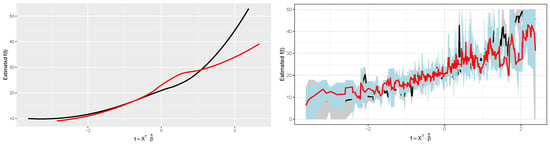
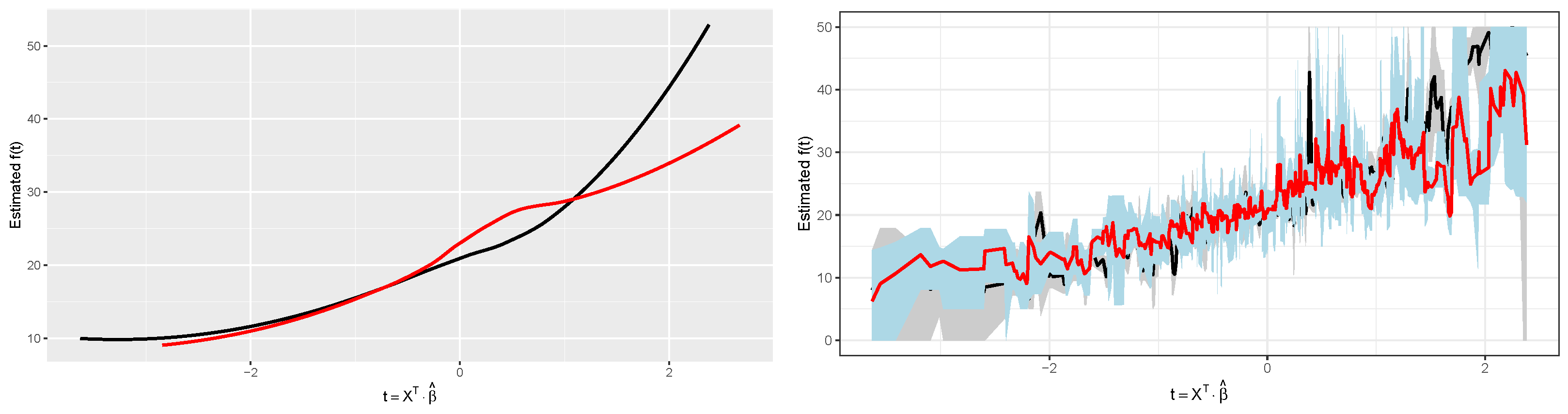
Figure 2 displays the estimated index function as a function of the scalar index for the classical and robust SIMs (black and red curves, respectively). The fitted relationships are generally increasing over most of the observed index range, indicating that neighborhoods with higher index values tend to have higher predicted median home values. Differences between the two curves are most pronounced near the tails of the index distribution, where fewer observations are available and influential points are more likely to affect the fit. In these regions, the robust estimate exhibits a more conservative trajectory, consistent with downweighting outliers and high-leverage observations. The widening uncertainty at the extremes (as reflected by the broader bands) further emphasizes that inference about is less precise in sparsely supported regions of t.
Figure 2.
Boston Housing: estimated index function versus the single-index for the classical (black) and robust (red) SIMs (left). Estimated functions along with the pointwise 95% confidence bands (right), for the classical (gray) and robust (blue) SIMs.
Table 5 reports the estimated single-index coefficients for both the classical and robust single-index models, together with bootstrap confidence intervals. To address the inherent sign indeterminacy of single-index models, all bootstrap replicates were aligned to the corresponding full-sample estimate, ensuring identifiable and interpretable inference.
Table 5.
Single-index coefficient estimates () for classical and robust SIMs fitted to the Boston Housing data. Bootstrap confidence intervals are computed using sign-aligned replicates.
For the classical estimator, several coefficients exhibit relatively narrow confidence intervals that exclude zero, most notably those associated with crim, nox, rm, dis, rad, ptratio, black, and lstat. This behavior is consistent with existing analyses of the Boston Housing data and reflects the high statistical efficiency of the classical estimator under approximately clean data conditions.
In contrast, the robust estimator produces noticeably wider confidence intervals, many of which include zero. Importantly, this phenomenon should not be interpreted as evidence that the corresponding predictors are unrelated to housing values. Compared with the classical estimator, the robust SIM yields wider bootstrap confidence intervals for some index coefficients. This reflects the robust weighting scheme, which downweights extreme observations and reduces the effective information used for estimating the index direction, resulting in more conservative but stable inference.
In a single-index framework, individual coefficients do not represent marginal effects, and the statistical significance of individual components is not equivalent to variable selection. Rather, the wider robust intervals reflect increased uncertainty in the estimated index coefficients once potentially influential observations are downweighted.
This behavior is a direct manifestation of the robustness efficiency trade-off. By attenuating the influence of observations with large residuals or high leverage, the robust estimator sacrifices efficiency in exchange for stability. As a result, multiple index coefficients may explain the data nearly equally well, leading to increased variability in the coefficient estimates while preserving the overall structure of the index.
6.3. Predictive Performance and Practical Implications
Predictive accuracy is evaluated using a 10% hold-out test set. Table 6 summarizes the resulting root mean squared error (RMSE) and mean absolute error (MAE).
Table 6.
Predictive accuracy for the Boston Housing data using a 10% test set.
The classical SIM achieves lower prediction error, indicating superior out-of-sample predictive performance under standard modeling assumptions. The robust SIM exhibits higher RMSE and MAE values, reflecting reduced predictive efficiency. This trade-off is expected, as robust methods intentionally prioritize resistance to extreme observations over predictive sharpness.
The Boston Housing application provides an informative illustration of the behavior of classical and robust single-index estimators in a setting where the data are relatively well curated and only mildly contaminated. The data set has been extensively analyzed in the literature, starting with the Harrison and Rubinfeld hedonic pricing study [22], and later diagnostic and spatial investigations [25,27]. These studies document influential observations, multicollinearity, and sensitivity to modeling assumptions, which motivate the consideration of robust procedures in this context.
In this near-ideal case, the classical single-index model achieves higher statistical efficiency, along with narrower confidence intervals and improved predictive accuracy relative to its robust counterpart.
The robust estimator, on the other hand, exhibits more conservative inference, characterized by wider confidence intervals and increased uncertainty in the estimated index coefficients. This behavior is not a deficiency in the method but rather a deliberate consequence of downweighting influential observations. When contamination is limited, this robustness mechanism offers little benefit and instead incurs an efficiency cost, as predicted by the robust estimation approach.
These results underscore that robust single-index methods should not be evaluated by dominance in clean real-data applications. Instead, their primary advantage lies in providing stable inference and reliable prediction in the presence of outliers, heavy-tailed errors, or leverage points. The Boston Housing analysis thus complements the simulation studies in Section 5, which demonstrate that the proposed robust estimator delivers substantial gains when contamination is present, while remaining competitive under clean data conditions. This behavior is consistent with robust estimation theory and highlights the conservativeness of the proposed method in the absence of strong contamination.
7. Discussion and Future Research
The simulation studies highlight the robustness efficiency trade-off inherent in semiparametric estimation. When the data-generating mechanism is approximately clean, the classical estimator achieves higher efficiency, yielding smaller estimation error and narrower confidence intervals. However, in the presence of contamination, heavy-tailed errors, or influential observations, the classical estimator becomes unstable, whereas the proposed robust estimator maintains reliable performance. These findings are consistent with established robust estimation theory and confirm that robustness should be evaluated in terms of stability rather than dominance under ideal conditions. It is important to emphasize that the proposed robust procedures are not intended to outperform classical estimators under ideal Gaussian assumptions. Rather, their primary contribution lies in providing stable estimation and reliable inference when data exhibit skewness, heavy tails, leverage points, or contamination, as demonstrated in the simulation studies.
Developing formal asymptotic theory for robust single-index estimators remains an important direction for future research.
Several directions for future research are worth noting. Extensions to generalized single-index models, high-dimensional settings with regularization, and dependence structures such as spatial or temporal correlation are natural next steps. In addition, developing formal asymptotic inference procedures for robust single-index estimators remains an open and challenging problem. In general, the proposed framework provides a flexible and theoretically grounded foundation for robust semiparametric modeling and offers a useful tool for practitioners working with complex and potentially contaminated data. Future work may include systematic comparisons with quantile-based single-index estimators and data-adaptive robust procedures to further examine relative performance under different contamination structures.
Recent developments in robust and semiparametric inference continue to emphasize the importance of stability under heavy-tailed errors and model deviations. For example, ref. [12] provides a modern overview of robust nonparametric regression methods. At the same time, recent work on semiparametric inference and resampling techniques highlights the challenges of uncertainty quantification for complex profile-type estimators. These developments reinforce the relevance of bootstrap-based inference in robust single-index settings and suggest further theoretical investigation into asymptotic properties under weak moment conditions.
The proposed robust procedures provide improved stability under contamination and non-normal errors but involve the usual robustness–efficiency trade-off; under ideal Gaussian conditions, classical estimators may be more efficient. Performance depends on bandwidth and tuning parameter selection, and bootstrap inference increases computational cost. In practice, the robust methods are recommended when outliers or heavy-tailed errors are suspected, whereas classical methods remain appropriate for clean data.
Author Contributions
Conceptualization, H.F.F.M. and W.M.A.M.; methodology, H.F.F.M., A.A.A.A. and W.M.A.M.; software, H.F.F.M.; validation, H.F.F.M., A.A.A.A. and W.M.A.M.; formal analysis, H.F.F.M., A.A.A.A. and W.M.A.M.; data curation, H.F.F.M., A.A.A.A. and W.M.A.M.; writing—original draft, H.F.F.M., A.A.A.A. and W.M.A.M.; writing—review & editing, H.F.F.M., A.A.A.A. and W.M.A.M.; visualization, H.F.F.M., A.A.A.A. and W.M.A.M.; supervision, H.F.F.M.; project administration, H.F.F.M. All authors have read and agreed to the published version of the manuscript.
Funding
This research received no external funding.
Data Availability Statement
The data presented in this study are openly available in the R package MASS, which is available from the Comprehensive R Archive Network (CRAN) at https://cran.r-project.org/web/packages/MASS/index.html (accessed on 1 June 2025).
Conflicts of Interest
The authors declare no conflicts of interest.
Abbreviations
The following abbreviations are used in this manuscript:
| SIM | Single index model |
| IRLS | Iteratively reweighted least squares |
| MSE | Mean squared error |
| MAE | Mean absolute error |
| CI | Confidence interval |
| PLM | Partially linear model |
References
- White, H. Maximum likelihood estimation of misspecified models. Econometrica 1982, 50, 1–25. [Google Scholar] [CrossRef] [Scilit]
- Wooldridge, J.M. Introductory Econometrics: A Modern Approach; South-Western: Mason, OH, USA, 2003. [Google Scholar]
- Fan, J.; Gijbels, I. Local Polynomial Modelling and Its Applications; Chapman & Hall/CRC: Boca Raton, FL, USA, 1996. [Google Scholar]
- Härdle, W.; Müller, M.; Sperlich, S.; Werwatz, A. Nonparametric and Semiparametric Models; Springer: Berlin, Germany, 2004. [Google Scholar]
- Li, K.-C.; Duan, N. Regression analysis under link violation. Ann. Stat. 1989, 17, 1009–1052. [Google Scholar] [CrossRef] [Scilit]
- Ichimura, H. Semiparametric least squares and weighted least squares estimation of single-index models. J. Econom. 1993, 58, 71–120. [Google Scholar] [CrossRef] [Scilit]
- Li, Q.; Racine, J. Nonparametric Econometrics: Theory and Practice; Princeton University Press: Princeton, NJ, USA, 2007. [Google Scholar]
- Xia, Y.; Tong, H.; Li, W.K.; Zhu, L. An Adaptive Estimation of Dimension Reduction Space. J. R. Stat. Soc. Ser. B-Stat. Methodol. 2002, 64, 363–410. [Google Scholar] [CrossRef] [Scilit]
- Huber, P.J. Robust estimation of a location parameter. Ann. Math. Stat. 1964, 35, 73–101. [Google Scholar] [CrossRef] [Scilit]
- Maronna, R.A.; Martin, R.D.; Yohai, V.J.; Salibián-Barrera, M. Robust Statistics: Theory and Methods, 2nd ed.; John Wiley & Sons: Hoboken, NJ, USA, 2019. [Google Scholar]
- Zhao, G.; Ma, Y. Robust nonparametric kernel regression estimator. Stat. Probab. Lett. 2016, 116, 72–79. [Google Scholar] [CrossRef] [Scilit]
- Salibian-Barrera, M. Robust nonparametric regression: A review and practical considerations. Econom. Stat. 2023, 26, 1–28. [Google Scholar] [CrossRef] [Scilit]
- Chen, J.; Linton, O.; Van Keilegom, I. Estimation of semiparametric models when the criterion function is nonsmooth. Econometrica 2003, 71, 1591–1608. [Google Scholar] [CrossRef] [Scilit]
- Chen, J.; Yu, C.; Wang, Y.; Zhou, Z.; Liu, Z. Hybrid modeling for vehicle lateral dynamics via AGRU with a dual-attention mechanism under limited data. Control Eng. Pract. 2024, 151, 106015. [Google Scholar] [CrossRef] [Scilit]
- Zhou, Z.; Wang, Y.; Liu, X.; Li, Z.; Wu, M.; Zhou, G. Hybrid of neural network and physics-based estimator for vehicle longitudinal dynamics modeling using limited driving data. IEEE Trans. Intell. Transp. Syst. 2025, 26, 16735–16746. [Google Scholar] [CrossRef] [Scilit]
- Wang, C.; Li, G.; Han, P.; Osen, O.; Zhang, H. Impacts of COVID-19 on ship behaviours in port area: An AIS data-based pattern recognition approach. IEEE Trans. Intell. Transp. Syst. 2022, 23, 25127–25138. [Google Scholar] [CrossRef]
- Davison, A.C.; Hinkley, D.V. Bootstrap Methods and Their Application; Cambridge University Press: Cambridge, UK, 2013. [Google Scholar]
- Salibián-Barrera, M.; Van Aelst, S.; Willems, G. Fast and robust bootstrap. J. Ital. Stat. Soc. 2008, 17, 41–71. [Google Scholar] [CrossRef] [Scilit]
- Härdle, W.; Mammen, E. Comparing nonparametric versus parametric regression fits. Ann. Stat. 1993, 21, 1926–1947. [Google Scholar] [CrossRef] [Scilit]
- Mahmoud, H.F.F. Parametric Versus Semi and Nonparametric Regression Models. Int. J. Stat. Probab. 2021, 10, 90. [Google Scholar] [CrossRef] [Scilit]
- Mahmoud, H.F.F.; Kim, B.-J.; Kim, I. Robust nonparametric derivative estimator. Commun. Stat.-Simul. Comput. 2020, 51, 3809–3829. [Google Scholar] [CrossRef] [Scilit]
- Harrison, D.; Rubinfeld, D.L. Hedonic housing prices and the demand for clean air. J. Environ. Econ. Manag. 1978, 5, 81–102. [Google Scholar] [CrossRef] [Scilit]
- R Core Team. R: A Language and Environment for Statistical Computing; R Foundation for Statistical Computing: Vienna, Austria, 2024; Available online: https://www.R-project.org/ (accessed on 1 June 2025).
- Venables, W.N.; Ripley, B.D. Modern Applied Statistics with S, 4th ed.; Springer: New York, NY, USA, 2002. [Google Scholar]
- Belsley, D.A.; Kuh, E.; Welsch, R.E. Regression Diagnostics: Identifying Influential Data and Sources of Collinearity; Wiley: New York, NY, USA, 1980. [Google Scholar]
- Gilley, O.W.; Pace, R.K. On the Harrison and Rubinfeld data. J. Environ. Econ. Manag. 1996, 31, 403–405. [Google Scholar] [CrossRef] [Scilit]
- Pace, R.K.; Gilley, O.W. Using the spatial configuration of the data to improve estimation. J. Real Estate Financ. Econ. 1997, 14, 333–340. [Google Scholar] [CrossRef] [Scilit]
- Bivand, R. Revisiting the Boston data set, changing the units of observation affects estimated willingness to pay for clean air. Region 2017, 4, 109–127. [Google Scholar] [CrossRef] [Scilit]

Disclaimer/Publisher’s Note: The statements, opinions and data contained in all publications are solely those of the individual author(s) and contributor(s) and not of MDPI and/or the editor(s). MDPI and/or the editor(s) disclaim responsibility for any injury to people or property resulting from any ideas, methods, instructions or products referred to in the content. |
© 2026 by the authors. Licensee MDPI, Basel, Switzerland. This article is an open access article distributed under the terms and conditions of the Creative Commons Attribution (CC BY) license.