


Abstract
Sound source localization in dynamic environments with multiple moving speakers presents significant challenges due to reverberation, noise, and unknown source counts. To address these issues, this paper proposes an integrated deep-learning framework combining spatial spectrum estimation with blind source detection. The method employs a causal convolution–recurrent network (SRP-DPCRN) to extract robust spatial features from multichannel audio signals under adverse acoustic conditions. Subsequently, an iterative attention-based detection network (IASDNet) automatically identifies active sources from the estimated spatial spectrum without requiring prior knowledge of source quantity. Evaluated on both simulated datasets and the real-recorded LOCATA benchmark, the proposed system demonstrates superior performance in multi-source tracking scenarios, achieving an average detection accuracy of 96% with mean angular error below 3.5 degrees. The results confirm that joint optimization of feature learning and source counting provides an effective solution for blind localization in practical applications, significantly outperforming conventional and deep-learning baselines.
Keywords:
blind source localization; spatial spectrum; casual convolution neural network; dual path recurrent neural network; iterative sound source detection; trajectory tracking MSC:
68T07
1. Introduction
Sound source localization (SSL), which aims to determine the spatial positions of acoustic sources using microphone arrays, is a fundamental task in acoustic signal processing with broad applications in human–computer interaction, teleconferencing, robot audition, and intelligent surveillance systems. Over the decades, traditional SSL methodologies have been systematically developed and can be broadly categorized into three families: time-difference-of-arrival (TDOA)-based techniques such as the generalized cross-correlation (GCC) and its phase-transform weighted variant (GCC-PHAT) [1]; steered response power (SRP) approaches including SRP-PHAT [2,3]; and subspace-based high-resolution algorithms such as multiple signal classification (MUSIC) [4,5] and estimation of signal parameters via rotational invariance techniques (ESPRIT) [6]. While these model-based methods provide theoretically grounded solutions under controlled an-echoic and high signal-to-noise ratio (SNR) conditions, their performance substantially degrades in real-world acoustic environments characterized by strong reverberation, background noise, and source dynamics, particularly in scenarios involving multiple moving speakers [3,7].
In recent years, the advent of deep learning (DL) has catalyzed a paradigm shift in SSL research, offering data-driven solutions capable of learning robust acoustic representations directly from raw or preprocessing signals. Early DL-based approaches framed SSL as a classification problem by discretization of the spatial domain into predefined grids. For instance, Chakrabarty and Habets [8] trained convolution neural networks (CNNs) on noise signals to estimate the direction of arrival (DOA) of multiple speakers. Regression-based formulations have also gained traction, where neural networks directly predict continuous spatial coordinates or spatial spectral features. Adavanne et al. [9] introduced a convolution recurrent neural network (CRNN) for joint sound event detection and localization, leveraging both spectral and temporal dependencies. More recently, Díaz-Guerra et al. [10] proposed Cross3D, a fully causal 3D CNN architecture that processes sequences of low-resolution SRP-PHAT maps for robust single-source tracking in highly reverberant rooms, demonstrating the advantage of integrating traditional signal processing principles with deep feature learning. Similarly, Yang et al. [3] developed SRP-DNN, which employs a causal CRNN to estimate direct-path inter-channel phase differences (IPDs) from microphone pairs, effectively denoising spatial cues for multiple moving source localization. These works underscore the capability of DL models, especially those with convolution and recurrent components, to capture spatial–temporal patterns and generalize to adverse acoustic conditions.
Despite these promising advancements, several critical challenges persist in the deep-learning-based SSL landscape. First, most existing models are designed for a fixed number of sources, struggling with variable source counts and unknown number of sources in real-world applications [11]. Second, the issue of permutation ambiguity where the mapping between predicted outputs and target sources is undefined complicates the training and inference for multi-source localization [12]. Third, while temporal context is recognized as crucial for tracking moving sources, many architectures rely on non-causal operations (e.g., bidirectional RNNs) or lack explicit mechanisms to model source dynamics and interactions overtime [11,13]. Furthermore, the dependency on large-scale labeled datasets and the limited explainable of learned representations remain practical barriers to deployment in resource-constrained or safety-critical applications [14,15].
To address these gaps, this paper proposed a novel deep-learning framework for multiple moving sound source localization that integrates attention-based feature disentanglement with iterative spatial spectrum optimization. The main contributions of this work are summarized as follows:
Robust Spatial Spectrum Estimation: We proposed SRP-DPCRN, a causal CNN-RNN hybrid network that learns direct-path phase differences from noisy-reverberation signals, enabling accurate spatial spectrum prediction even in adverse acoustic conditions.
Blind Source Detection without Prior Counts: We developed IASDNet, an iterative detector that identifies active sources through spatial peak classification, eliminating dependency on predefined source numbers.
Integrated Real-time Localization System: By combining SRP-DPCRN and IASDNet, we create an end-to-end framework that jointly estimates source counts and DOAs. Evaluations on LOCATA demonstrate effective multi-source localization without prior source information.
The remainder of this paper is organized as follows: Section 2 reviews related work, including the problem formulation of sound source localization and classical methods. Section 3 details the proposed methodology, introducing the SRP-DPCRN spatial spectrum prediction network (Section 3.1), the IASDNet blind source detection mechanism (Section 3.2), and the integrated SRP-DPCRN-IASDNet framework for real-time localization and tracking (Section 3.3). Section 4 presents the experimental setup, datasets, and a comprehensive analysis of the results, including evaluations on spatial spectrum prediction, active source detection, and overall localization performance. Section 5 concludes the paper by summarizing the key findings, contributions, and potential directions for future research.
2. Related Work
2.1. Definition of the SSL
Sound source localization is the determination of the specific location in space of one or more sound sources in different states (static, moving) based on received sound wave signals. Assuming a complex acoustic environment with noise and reverberation, and multiple moving sound sources of unknown number, when using a microphone array to capture sound signals, the signal captured by the m-th microphone in the array can be modeled as:
where represents the sound wave signal generated by the k-th sound source in the positioning space; represents the m-th microphone in the array; represents the k-th sound source; represents the position of the sound source; Specifically, represents the two-dimensional DOA of the k-th sound source, which includes the elevation angle and the azimuth angle ; Note: represents the transpose of the matrix/vector; where, and are defined as the positive directions along the z-axis and x-axis in three-dimensional space, respectively. can be expressed as , where, denotes the time-varying acoustic transfer function (impulse response) from the source to the sensor at time , and represents the reverberation component received at the sensor in the microphone array. Specifically characterizes the impulse response of the acoustic wave generated by a source located at arriving at the sensor positioned at via both the direct propagation path and reflected paths. is the noise received by the m-th microphone at time t. This noise is typically Gaussian white noise that is uncorrelated with the noise received by the signal source and other microphones in the array. The frequency domain expression corresponding to Equation (1) is shown in Equation (2):
where are the corresponding short-time Fourier transforms in Formula (1).
2.2. Classical Method
2.2.1. Sound Source Localization Algorithm Based on Time Delay Estimation
The sound source localization method based on time delay estimation (TDE) locates the sound source by analyzing the time difference of arrival (TDOA) between two spatially separated sensors in the microphone array [16,17]. The localization process of this algorithm is divided into two steps: (1) First, estimate the time difference between the sound signal arriving at each microphone in the microphone array, and calculate the distance from the sound source to each microphone through this time difference; (2) Combine the geometric localization algorithm to estimate the position of the sound source. The core of this method is to use the TDOA between the sound signal arriving at each microphone in the microphone array, and combine it with the spatial geometric model of the array to achieve accurate determination of the sound source position. The mainstream time delay estimation algorithms include the generalized cross correlation (GCC) algorithm [1,18] and the adaptive time delay estimation algorithm based on least mean square (LMS) [19,20].
2.2.2. Sound Source Localization Algorithm Based on Beamforming
Microphone arrays have the ability to capture focused signals at specific locations and directions of sound sources, a capability known as beamforming. In beamforming technology, steered beamforming calculates the steered response power (SRP) at different spatial locations by adjusting the beam direction, and uses the location with the maximum SRP as the sound source direction [21,22]. This method is widely used in fields such as airborne radar early warning and sonar. Controllable beamforming mainly includes delayed accumulation beamforming and adaptive beamforming Among them, delayed accumulation beamforming is a traditional beamforming technique with low computational cost and low signal distortion, but it is susceptible to noise interference. In contrast, adaptive beamformers utilize adaptive filtering technology, have higher computational cost, and can reduce noise impact, making them suitable for systems with a small number of array elements.
In 1975, Hahn et al. [23] proposed a sound source localization method based on controllable beamforming, utilizing the beamforming characteristics of microphone arrays. Subsequently, M.U. Liaquat et al. [24] successfully applied this method in an indoor environment in 2021, achieving the sound source localization task. However, this method relies on prior knowledge of the sound source and environmental noise, which is often difficult to obtain in practical applications. To solve this problem, Dibias et al. [25] proposed the Steered Response Power-Phase Transform (SRP-PHAT) method in 2017, combining controllable beamforming technology and phase weighting factors. Studies have shown that the SRP-PHAT-based sound source localization method has stronger robustness than the two-step localization technique based on time delay estimation in environments with high reverberation and strong noise interference. In addition, in 2016, Guo and Wang et al. compared the performance of GCC-PHAT and SRP-PHAT in sound source localization in their research [1]. The results show that in complex acoustic environments with multiple sound sources, SRP-PHAT outperforms GCC-PHAT in multi-source localization. Compared to time delay estimation (TDOA) and energy detection methods, beamforming technology can directly utilize the spatial coherence of the signal and improve the signal-to-noise ratio (SNR) through weight optimization, thus making it more suitable for dense arrays and high-resolution scenarios.
2.3. Research Gap and Our Approach
While traditional sound source localization methods have made significant progress in locating clean speech, they still have several shortcomings when dealing with blind sound source localization in real-world acoustic scenarios:
- (1)
- Localization accuracy often falls short of practical requirements in complex acoustic environments with high reverberation and strong noise.
- (2)
- Traditional localization algorithms struggle to distinguish sound sources at different locations in space based on the physical properties of sound signals, especially when these sources have similar acoustic characteristics. This leads to assignment ambiguity when locating such sources.
- (3)
- Traditional sound source localization algorithms lack an effective mechanism for dynamically updating localization information, thus exhibiting significant limitations when handling moving sound source trajectory tracking.
To address these limitations, we propose an SRP-DPCRN-IASDNet network framework. Based on controllable sound source power in the spatial spectrum, a deep neural network is constructed to estimate the number of blind sound sources and a dynamic sound source trajectory tracking localization algorithm in complex acoustic environments, enabling single-source and multi-source localization and moving sound source trajectory tracking.
3. Methodology
3.1. Spatial Spectrum Prediction with Deep Neural Networks
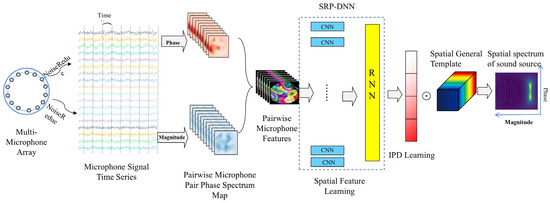
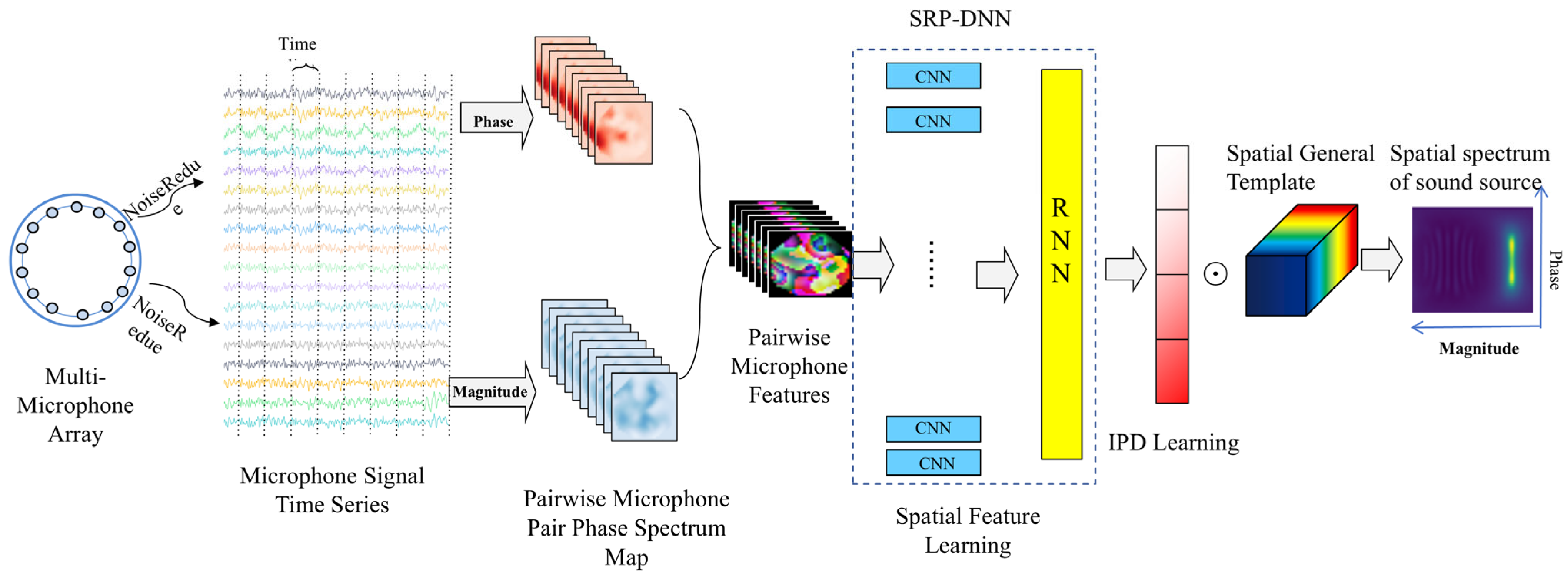
Traditional SRP (Steered Response Power) methods locate potential sound sources by scanning the sound power response in various directions across space. However, this method suffers a significant drop in accuracy in environments with strong reverberation or complex background noise. To improve robustness and accuracy, SRP-DNN (Deep Neural Network) retains the advantages of SRP spatial modeling while introducing a deep neural network to model and learn features from the SRP spatial response map. First, a spatial response map (i.e., a sound power distribution map) is calculated based on multi-channel audio collected by a microphone array. Then, this map is used as input features to train and predict the deep neural network, thereby achieving higher-precision sound source direction estimation. The block diagram is as shown in Figure 1:
Figure 1.
Block diagram of the proposed SRP-DNN.
3.1.1. Constructing the IPD Direct Path
- (1)
- Construction of the Time Difference Matrix (ITD)
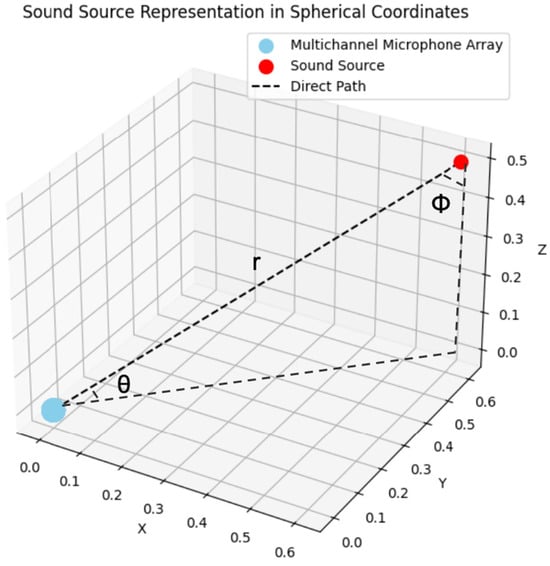
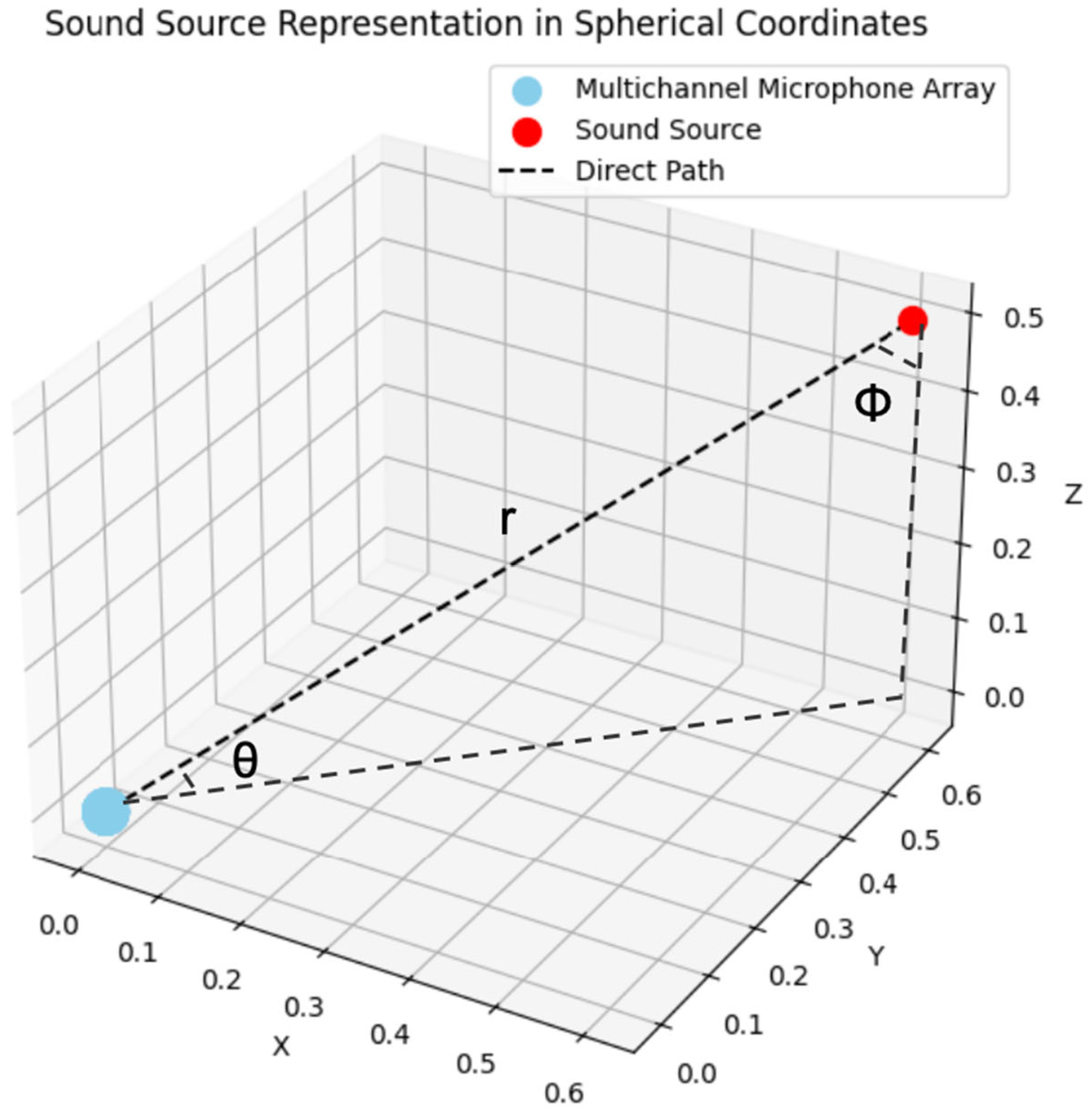
As shown in Figure 2, when a sound wave propagates from the sound source to microphones at different locations in a microphone array, the time delay of arrival (TDOA) varies due to the different propagation path lengths. By measuring these time differences and combining them with the known geometry of the microphone array and the speed of sound, the direction or specific location of the sound source can be estimated.
Figure 2.
Schematic Diagram of the Relative Position Between the Sound Source and the Microphone Array.
In a three-dimensional polar coordinate system (spherical coordinate system), as shown in Figure 2, the vector from any point (x, y, z) to the center point of the sphere can be represented parametrically in polar coordinates as follows:
where is the polar coordinate elevation angle of the microphone array relative to the sound source, is the polar coordinate azimuth angle of the microphone array relative to the sound source, r represents the shortest straight-line distance of the microphone array relative to the sound source, and x, y, z represent the projection components of the vector on the x, y, z axes.
The time difference between a sound source and any two microphones can be defined as:
where v is the speed of sound, is the time delay to different microphones, and and are the propagation path lengths of the sound wave from the sound source to microphone 1 and microphone 2.
The wave can be approximated as a plane wave propagation. Combining Equations (3) and (4), the interaural time difference (ITD) between two microphones can be described by the following Equation (5), where is the unit direction vector from the sound source to the microphone array, and are the spatial position vectors of the two microphones, and v is the speed of sound in the medium (343 m/s).
For an array containing N microphones, the ITD can be extended into a matrix form to describe the time delay difference of all microphone pairs in the direction of the sound source. The specific formula and construction process are shown as:
where represents the spatial distance difference between the two microphones, represents the time delay difference of the array of N microphones in a specific direction , is the speed of sound propagation, and represents a microphone pair composed of two microphones.
- (2)
- Construction of direct path (IPD)
The direct path from the sound source to multiple microphones can be described by the following Equation (8), where f is the frequency and is the time delay difference matrix from the sound source to the i-th and j-th microphone pairs.
3.1.2. The Model Learns the Direct Path Through Spectral and Phase Spectrum Information
- (1)
- Feature Construction
Short-time Fourier transform is performed on the waveform signals received from each pair of microphones. The spectral and phase spectrum features can be expressed as Equation (6). The spectral and phase spectrum features are extracted separately and then concatenated. The concatenated features can be described as:
where STFT represents Short Time Fourier Transform, x represents the input microphone signal, represents the amplitude spectrum, represents the phase spectrum, and represents the set of amplitude and phase spectrum features of each pair of microphones.
- (2)
- Direct Path Learning and Training
The SRP-DNN model is used to learn the differences in the spectral and phase spectra of each pair of microphones to estimate the phase difference (IPD) of the direct path. During model training, the gradient is calculated using the MSE loss function, and forward propagation directly optimizes the learning of the direct path IPD.
The sound source localization loss is MSE, where is the predicted sound source phase relative to the binaural delay phase difference of the array microphone, and is the actual sound source phase relative to the array microphone. The goal of the loss function is to minimize the difference between the predicted and actual values, learning the mapping relationship between the input phase spectrum, spectral features, and binaural delay phase difference to estimate the sound source location.
3.1.3. Estimating the Azimuth and Elevation Angles of the Sound Source Using the Direct Path
- (1)
- Constructing an IPD template
To estimate the azimuth angle and elevation angle of the sound source, based on the direct-path IPD estimated in Section 3.1.1 and Section 3.1.2 under the plane-wave approximation, an IPD template can be constructed over a discrete DOA grid using the known array geometry. This template provides a reference for mapping frame-wise IPD observations to a spatial response across candidate azimuth–elevation directions. The specific construction process is as follows:
where represents the discrete value of the elevation angle, divided into sampling points at equal intervals from 0 to , to cover the possible elevation angle range. represents the discrete value of the azimuth angle, divided into ‘nazi’ sampling points at equal intervals from to , to cover the possible azimuth angle range. represents the discrete value of the frequency, divided into sampling points from 0 to , to cover the signal frequency range. is the complex form of IPD, representing the phase difference template of the microphone pair (m1, m2) at direction () and frequency f.
- (2)
- Constructing the spatial spectrum
represents the correlation measure of microphone pairs m and at direction (including azimuth angle and elevation angle ) and time frame n. represents the real part of the complex number, F is the total number of frequency points used for normalization, and represents the phase difference between the signals of each pair of microphone pairs m and at frequency f and time frame n.
The resulting spatial spectrum emphasizes candidate DOA directions, where salient peaks correspond to active sources. This spectrum is then used as the input to the iterative detector (IASDNet) to enable blind estimation of the number of active sources and sequential peak removal.
3.1.4. SRP-DPCRN Spatial Spectral Prediction Model
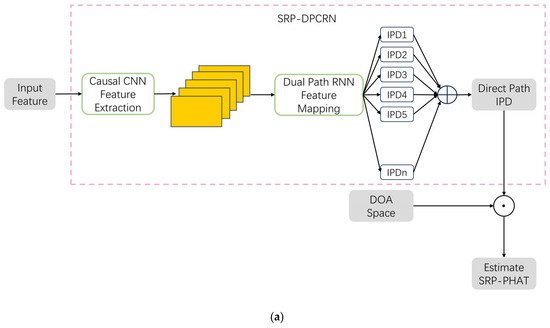
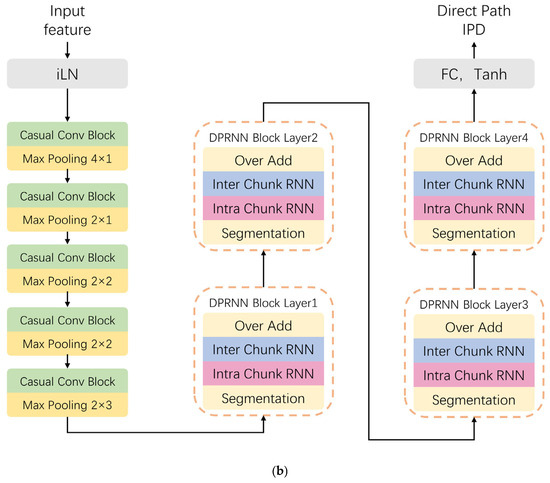
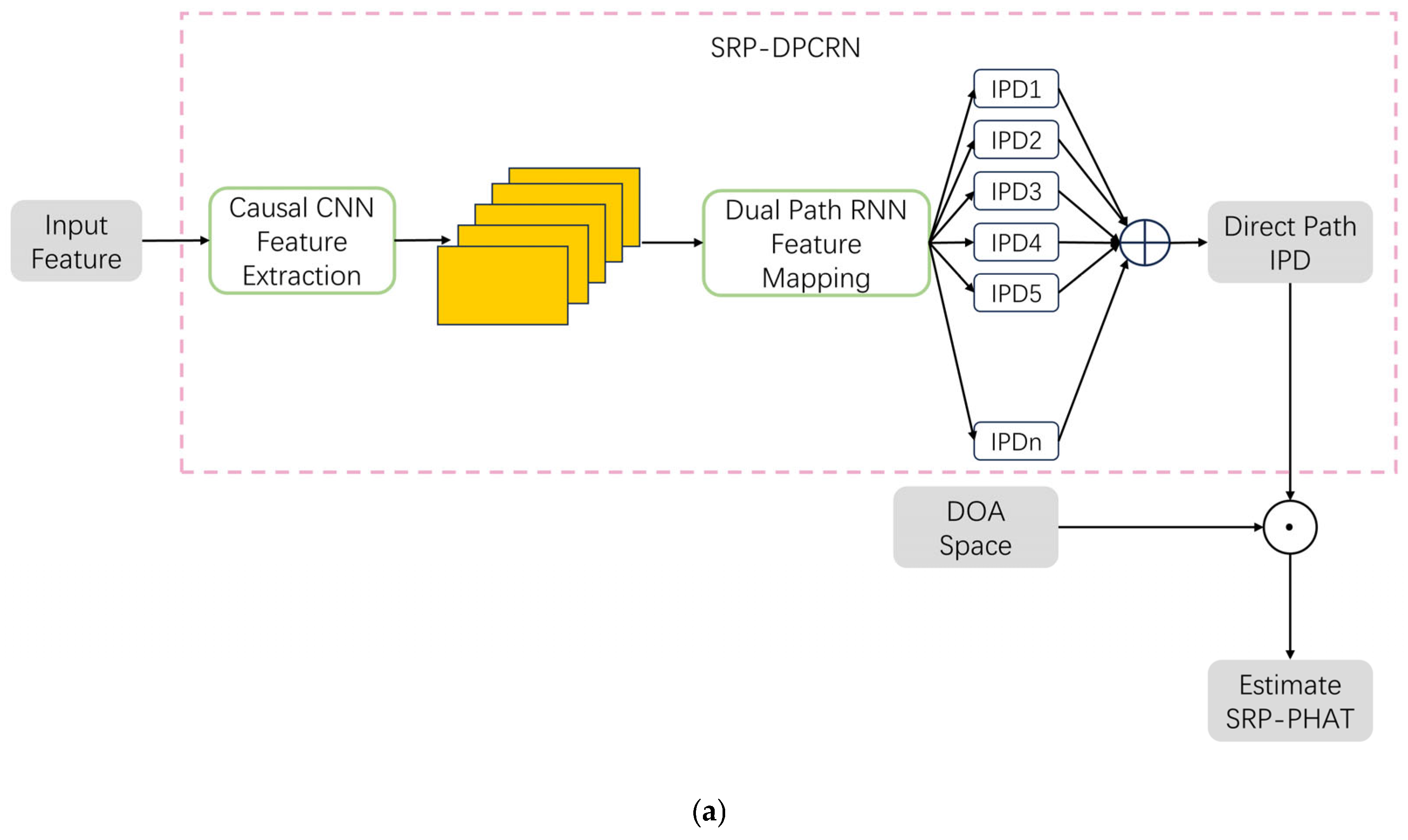
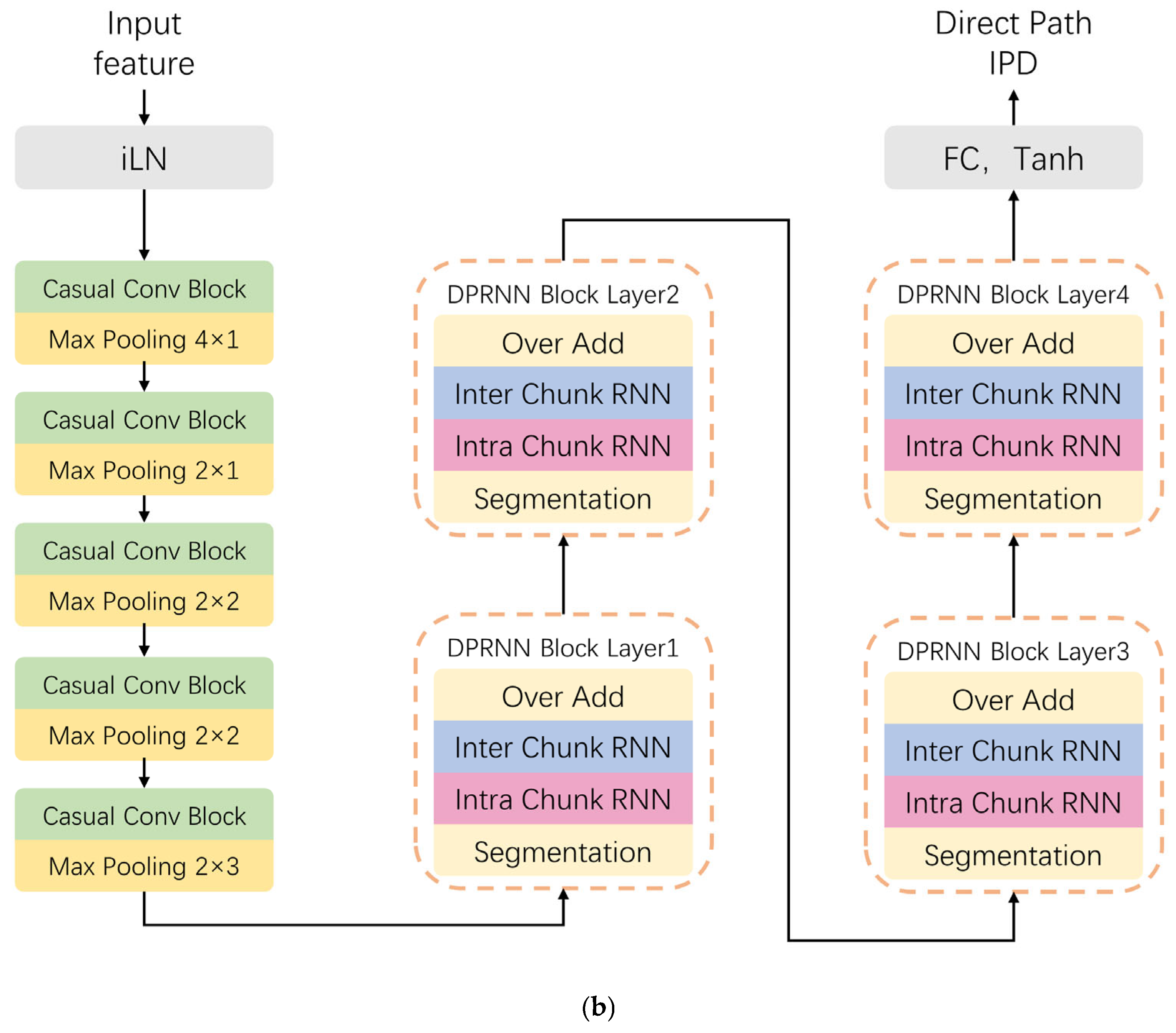
This paper proposes the use of the SRP-DPCRN network to overcome the limitations of the CRN network model in blind source localization tasks, which suffers from poor processing and modeling capabilities for extremely long time-series data due to gradient vanishing and exploding issues in traditional RNN units. In the SRP-DPCRN network, the RNN units in the CRN are replaced by the DPRNN structure, enabling the network to effectively analyze and model extremely long time-series audio signals. Introducing DPRNN not only enhances the network’s ability to capture instantaneous features of time-series signals but also improves the modeling accuracy for the positional changes of multiple unknown sound sources (blind sources). During blind source localization, SRP-DPCRN models the independent dual-channel logarithmic amplitude and phase spectra of signals captured by different sensors on the microphone array. This enables effective prediction of the controllable beam response power spectrum (SRP-PHAT) of an unknown number of sound sources in the localization space within complex acoustic environments, thereby improving the network’s localization accuracy for unknown sound sources. The network flowchart and structure diagram are shown in Figure 3.
Figure 3.
(a) Network flowchart. The input audio features are used to extract key time–frequency local features of the audio through a causal convolutional neural network. The extracted features are used as input to the DPCRN, and finally the estimated SRP spatial spectrum is obtained. (b) SRP-DPCRN network structure diagram.
The network first employs a causal convolutional neural network (Causal CNN) to extract local features from the input dual-channel audio time–frequency features. This part consists of five concatenated convolutional modules with the same structure. Each module contains two causal convolutional layers with the same kernels. Each layer is followed by batch normalization (BN) and ReLU activation, and downsampling is performed through max pooling. This design effectively captures the time–frequency and phase-frequency local features of the signal while maintaining temporal causality, providing a foundation for subsequent deep modeling. The extracted features are then fed into the DPRNN module for temporal modeling. The DPRNN expands and divides the features along the frequency dimension, captures short-term local dependencies through intra-block RNNs, and integrates the global temporal context through inter-block RNNs to complete the joint modeling of the logarithmic amplitude spectrum and phase spectrum. Finally, the features are nonlinearly mapped and reconstructed through fully connected layers and the Tanh activation function, outputting the inter-channel phase difference (IPD) sequence between all microphone pairs, which is then used to construct SRP-PHAT for sound source localization. The model is trained and evaluated using the LibriSpeech [26] and LOCATA [27] datasets. To match the frame rate required for the localization task, the network compresses the input frames by 12 times at the output, meaning that each localization frame corresponds to the modeling results of 12 input frames.
Compared to traditional CNN methods, DPCRN effectively integrates the local feature extraction capability of causal convolution with the long-term sequence modeling advantage of DPRNN. It can make full use of the spatiotemporal context information of the signal to achieve accurate prediction of SRP-PHAT in complex acoustic environments, thereby improving the accuracy and robustness of blind sound source localization.
In the SRP-DPCRN network, this paper uses the mean squared error (MSE) of the neural network’s predicted output and the learning target as the loss function for the network training process, that is:
where is the predicted output of SRP-DPCRN at the localization frame; represents the learning target of the neural network in the current localization frame; is the L2 norm of the vector, which is calculated by summing the squares of all elements in the vector, and will reflect the difference between the predicted value of DPIPD and its true value.
3.2. Blind Source DOA Estimation with Deep Neural Networks
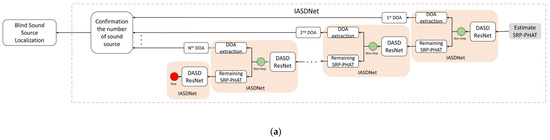
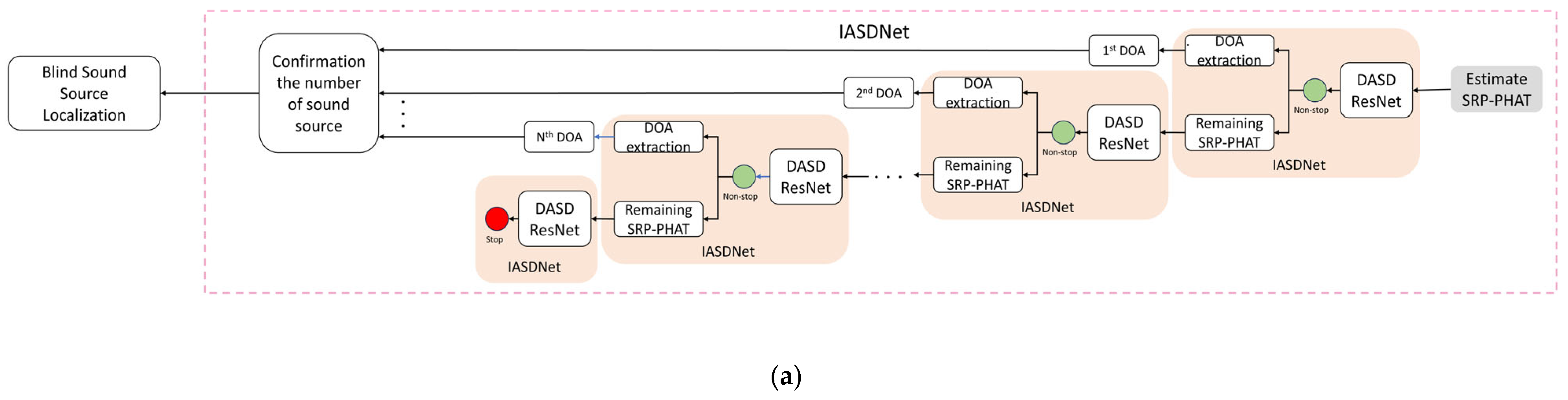
While significant progress has been made in speech separation and source localization research where the number of sound sources is known prior, the number of sound sources is often unknown in practical problems. Therefore, source localization with unknown sound sources (blind source localization) remains a challenge in the field of acoustic signal processing. This paper proposes IASDNet (Iteration Activate Source Detector Network) for iteratively detecting the number of sound sources in the spatial spectrum. This network uses the spatial spectrum predicted by the aforementioned SRP-DPCRN network as input and iteratively detects the presence of peaks contributing to sound sources in the spatial spectrum through binary classification. Each time the binary classification result is true (i.e., the spatial spectrum contains a peak contributing to sound sources), the DOA of the corresponding sound source is analyzed. Then, the contribution of that sound source is subtracted from the spatial spectrum, and the remaining spatial spectrum is fed back as the input for the next iteration. The energy of the detected peak reflects the activity level of the sound source, and the number of detected peaks directly reflects the number of sound sources in the spatial spectrum. Furthermore, this method effectively solves the problem of multi-peak aliasing in the spatial spectrum caused by mutual interference between multiple sound sources. The algorithm1 pseudo-code for the proposed method using IASDNet to iteratively detect each dominant sound source in the localization space and simultaneously estimate its DOA information is as follows:
This algorithm employs an iterative strategy, using the ASDNet network to determine the presence of sound sources in the spatial spectrum and successively extracting the location of the most energetic sound source. After estimating a sound source each time, the algorithm removes its contribution from the input features and then recalculates the spatial spectrum and performs network detection until all active sound sources have been detected and estimated in sequence, thereby achieving the estimation of the number of multiple sound sources.
| Algorithm 1: IASDNet |
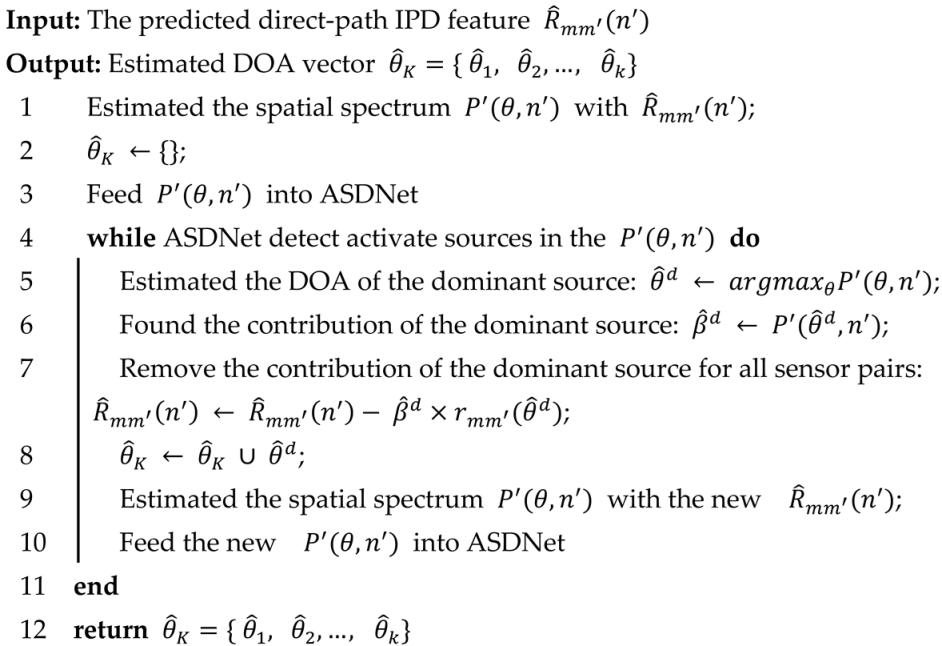 |
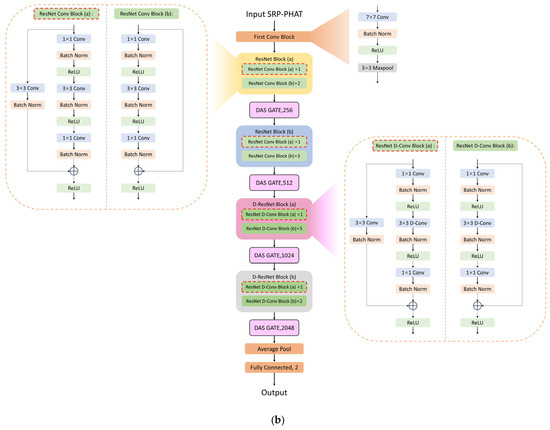
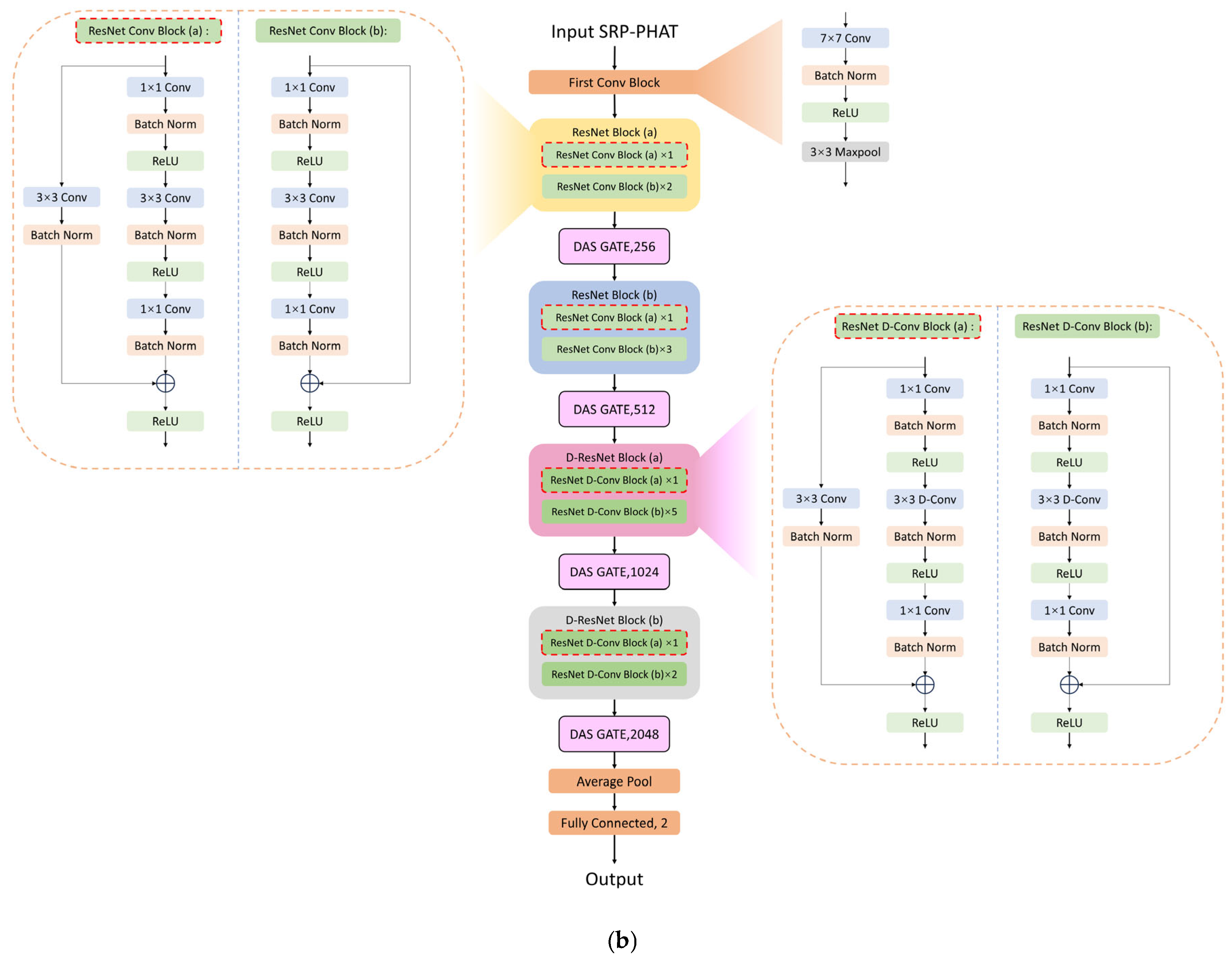
IASDNet inherits the iterative sound source detection idea of traditional sound source localization algorithms. It iteratively detects multiple sound sources by analyzing and determining whether there are dominant contributing sound sources in the spatial spectrum obtained by the SRP-DPCRN network. IASDNet can accurately detect every active sound source in the localization space even in environments with completely unknown numbers of sound sources and complex acoustic conditions, demonstrating higher accuracy and adaptability compared to traditional algorithms. However, the size of the convolutional kernel and the network depth in CNNs limit the receptive field of view, and CNNs are sensitive to features of non-target objects in the samples. Therefore, this paper proposes to optimize ResNet as the binary classification model in IASDNet. The network flowchart and network structure diagram are as follows Figure 4:
Figure 4.
The IASDNet network flowchart and network structure diagram. (a) is a network flowchart, and (b) is a network structure diagram.
In the inference part of the IASDNet network, the neural network marks the spatial spectrum where residual sound source contributions exist as 1, and conversely, marks it as 0 if the neural network determines that there are no residual sound source contributions in the spatial spectrum. In the IASDNet algorithm, if the inference decision result of IASDNet is 1, it searches for the global maximum value in the current spatial spectrum, and uses the elevation angle and azimuth angle information corresponding to this value as the predicted DOA of the sound source, and continues to iterate the algorithm until the network’s inference decision result is 0, at which point the algorithm terminates.
Therefore, the learning objective of the IASDNet network is set as the label of the spatial spectrum predicted by the network. When training the proposed IASDNet network, this paper uses the minimum cross-entropy between the true label value of the spatial spectrum and the network’s learning objective as the loss function, as shown below:
where N is the total number of training samples, is the index of the training samples; is the true label value of the nth training sample; is the learning objective of the network, which is the label value of the nth sample predicted by the network.
3.3. Blind Sound Source Location and Tracking Based on Deep Neural Networks
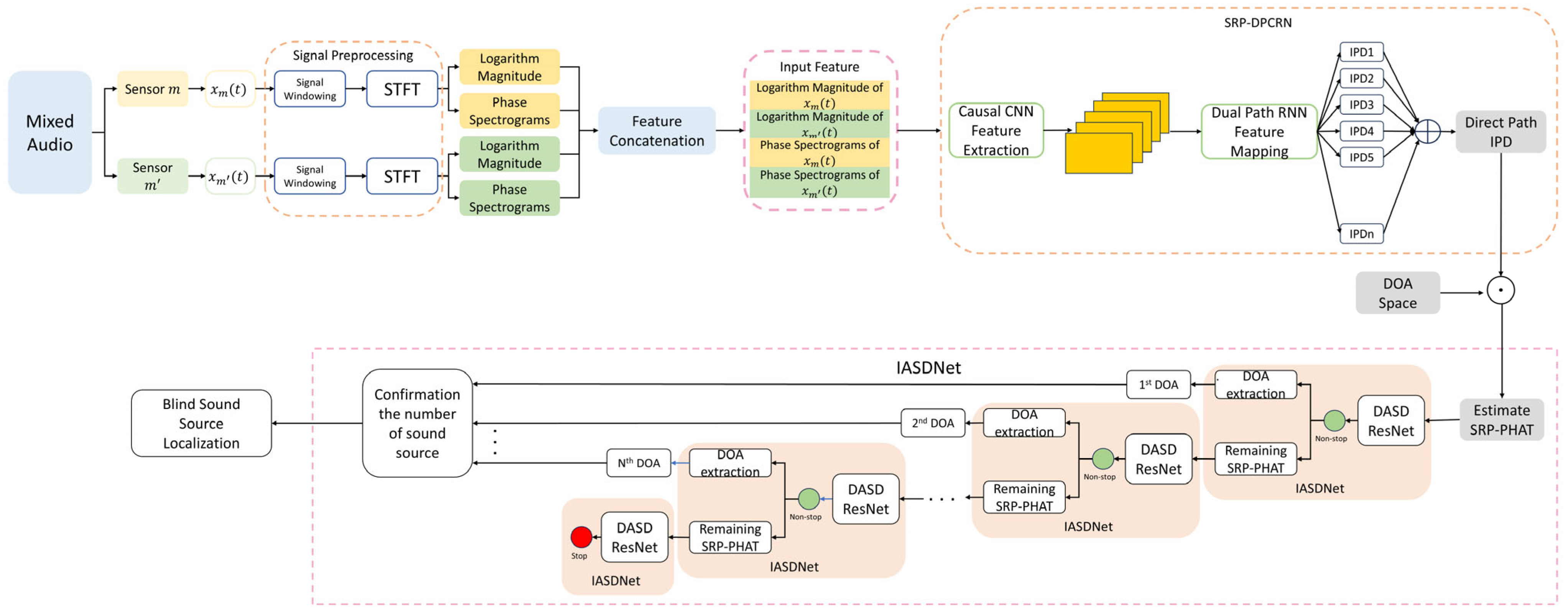
In the field of acoustic localization, the real-time and accurate localization of moving sound sources is a challenge. Traditional methods based on TDOA or beamforming typically rely on segmented processing of the entire signal, leading to computational lag, difficulty in adapting to continuous dynamic changes in sound source location, and a general lack of real-time update mechanisms for the localization model. In contrast, deep neural networks can achieve high-precision real-time localization of moving sound sources through continuous learning and dynamic adaptation. This study proposes an integrated real-time localization method for dynamic sound sources, mainly composed of a Spatial Spectrum Prediction Network (SRP-DPCRN) and an Iterative Active Sound Source Detection Network (IASDNet). SRP-DPCRN employs a causal convolutional and dual-path recurrent neural network (DPRNN) structure to achieve real-time, incremental processing of audio signals and effectively model the short-term and long-term temporal dependencies of sound source signals, thereby accurately predicting the spatial spectrum of dynamic sound sources. IASDNet, based on this, rapidly detects the number of active sound sources and estimates their direction of arrival (DOA). The SRP-DPCRN-IASDNet system, which integrates the two technologies, enables real-time tracking and rapid response to moving sound sources in complex acoustic environments, significantly improving the performance of blind source dynamic sound source localization. The method for integrating the SRP-DPCRN and IASDNet networks is shown in the Figure 5.
Figure 5.
The Flowchart of the SRP-DPCRN-IASDNet.
In this context, ‘real-time’ refers to online, causal processing along the signal timeline. Specifically, the system generates frame-synchronous localization outputs incrementally as the audio stream advances, without relying on future information or offline batch processing. This concept of algorithmic causality must be distinguished from wall-clock real-time execution (i.e., processing latency ≤ frame duration). The latter is contingent upon hardware specifications and implementation efficiency, particularly regarding the iterative detection overhead which scales with the number of simultaneously active sources.
4. Experiments and Results
This paper employs a dynamic simulation-based data generation strategy for training data, aiming to address the scarcity of labeled real-world mobile sound source data. The LibriSpeech speech library is used as the source signal, and WebRTC VAD technology is used to filter out silent segments to avoid introducing directional noise. During training, instead of relying on pre-generated static datasets, the gpuRIR tool is used to simulate multi-channel microphone array signals in real time, where environmental parameters such as sound source trajectory, reverberation time, and signal-to-noise ratio are randomized according to a preset probability distribution. This method achieves unlimited expansion and high diversity of training data, effectively suppresses model over-fitting, and enhances the model’s generalization ability to unknown acoustic environments through a controllable parameter space.
4.1. Dataset and Experiment Setup
4.1.1. Datasets of On-the-Fly Simulation
Due to the high cost and scalability challenges of acquiring real-world data involving “mobile sound sources + array recording + precise annotation,” this paper employs simulation-generated multi-channel array signals to provide controllable, salable training samples for spatial spectrum prediction and subsequent detection/tracking experiments. Specifically, this simulation method employs gpuRIR to map speech data onto array microphone responses along predefined random motion trajectories, sampling under diverse random acoustic conditions to cover complex acoustic scenarios. Speech signals for simulation originate from LibriSpeech (16 kHz, 960 h). Considering that segments with “silence but strong background noise” may introduce directional pseudo-noise, this paper employs WebRTC-VAD to identify silent intervals prior to simulation. Frames identified as silent are subsequently removed to prevent model over-fitting to specific directional noise patterns.
The settings for the simulated acoustic scene mainly include room size, SNR, RT60, array position and boundary distance constraints, and continuous movement trajectory of the sound source (trajectory points are generated by rules and smooth perturbations are added). The specific parameter settings are shown in Table 1.
Table 1.
Simulated acoustic scene parameter settings.
The microphone array geometry referred to in Table 1 is set to be identical to the array geometry mounted on the head of the NAO robot in the LOCATA acoustic source localization and tracking challenge. To avoid direct reflections between the walls and the microphone array, the randomly sampled array position is constrained to keep a minimum clearance from the room boundaries of at least 10% of the corresponding room dimension. In addition, the array is placed in the lower half of the localization space along the vertical direction.
It should be specifically noted that this online simulation data generation mechanism does not involve offline generation of a traditional dataset (no audio files are generated). Instead, it generates input data for the neural network, meaning the generated data is directly used as training samples for the spatial spectral prediction neural network SRP-DPCRN. While this approach incurs training speed overhead, its advantages include enabling the network to continuously adjust random parameters during training, reducing overfitting risks, and—more importantly—flexibly modifying the distribution of simulation parameters. This enhances the model’s generalization capability under new acoustic conditions. Furthermore, after obtaining the optimal SRP-DPCRN model, the next step in this work involves reusing the same simulation mechanism to generate inputs, yielding frame-by-frame spatial spectra that serve as training samples for a binary classification network.
4.1.2. Datasets of LOCATA
The LOCATA datasets is a widely adopted open-source benchmark for sound source localization and tracking. It comprises real-world recordings captured in a variety of acoustic environments using microphone arrays, including linear, planar, and spherical configurations. The datasets feature six distinct tasks: Tasks 1–3 involve localizing static sources with increasing complexity in array setups and source-array movements, while Tasks 4–6 address dynamic source tracking under similar varying conditions. These tasks collectively provide a comprehensive evaluation framework for algorithms under scenarios such as multiple sources, noise, and reverberation. As a result, LOCATA serves as an essential resource for validating data-driven approaches, particularly deep-learning-based methods, in acoustic localization research.
4.1.3. Experimental Setup
During training, the microphone signals are sampled at 16 kHz. Time–frequency features are extracted using STFT with a window length of 16 ms and a hop size of 4 ms, resulting in time frames per training segment. To match the localization frame rate, these frames are aggregated into 416 localization frames. The model is trained using the Adam optimizer with a learning rate of 0.001 for 50 epochs. The mini-batch size is set to 66, which equals the number of unique microphone pairs in the 12-channel array.
4.2. Experimental Results
4.2.1. Spatial Spectrum Prediction
- Spatial Spectrum Prediction Quality Comparison
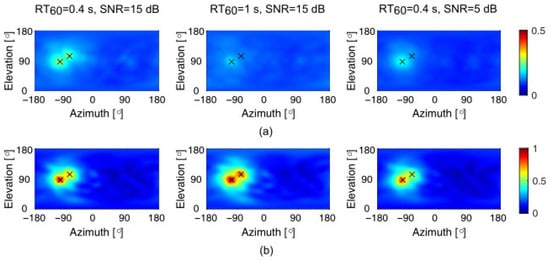
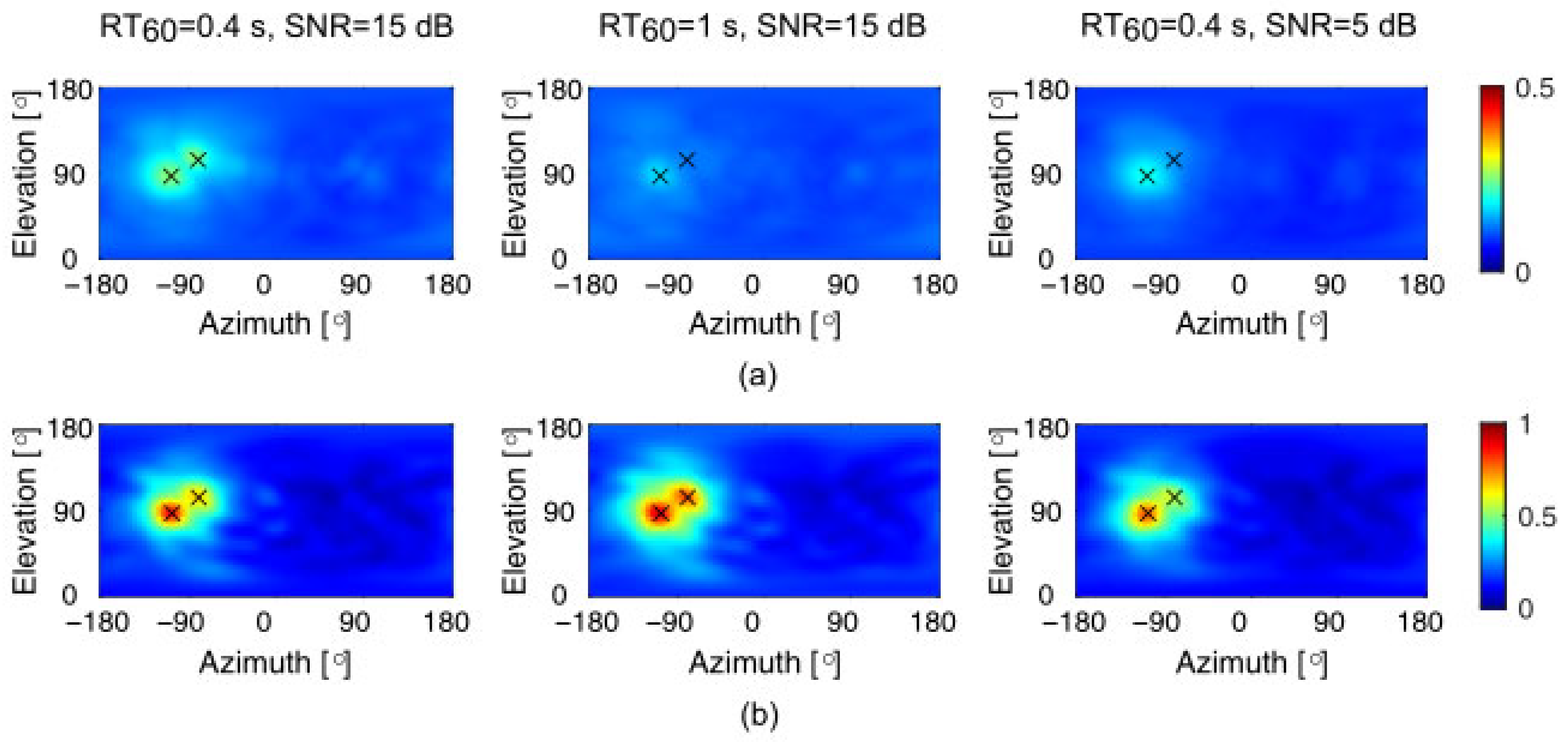
Spatial spectrum is a crucial basis for sound source localization, and its quality significantly impacts the performance of sound source localization algorithms. Therefore, after training the SRP-DPCRN network, this paper analyzes the quality of its predicted spatial spectrum. Figure 6 shows the spatial spectrum performance of traditional SRP-PHAT and SRP-DPCRN under different acoustic conditions. The spatial spectrum predicted by SRP-PHAT is shown in row (a), and the spatial spectrum predicted by the proposed SRP-DPCRN network is shown in row (b). The actual location of the sound source in each sub-figure is indicated by a black cross.
Figure 6.
Result of Spatial Spectrum Prediction Quality Comparison. The spatial spectrum predicted by SRP-PHAT is shown in row (a), and the spatial spectrum predicted by the proposed SRP-DPCRN network is shown in row (b). The actual location of the sound source in each sub-figure is indicated by a black cross.
Figure 6 demonstrates that under adverse acoustic conditions (low SNR, severe reverberation), the spatial spectrum peaks of SRP-PHAT are prone to phenomena such as “peak blunting/side lobe enhancement/peak position drift.” This causes the main peaks of the spatial spectrum to no longer stably correspond to the true DOA. In contrast, the spatial spectrum predicted by SRP-DPCRN maintains clearer high-response regions and more stable peak structures near the true DOA, providing a more reliable foundation for subsequent multi-source iterative detection.
- Spatial Spectral Resolution Analysis
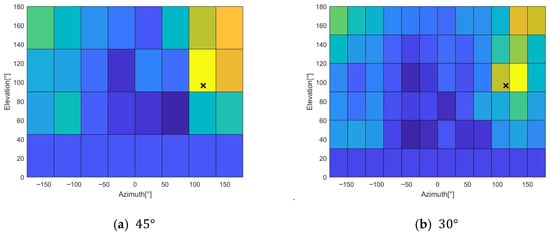
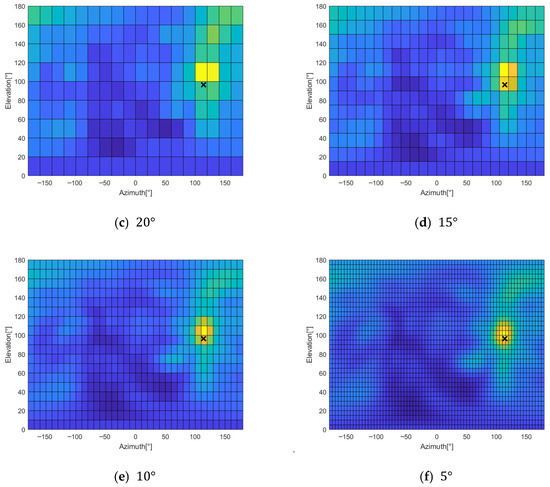
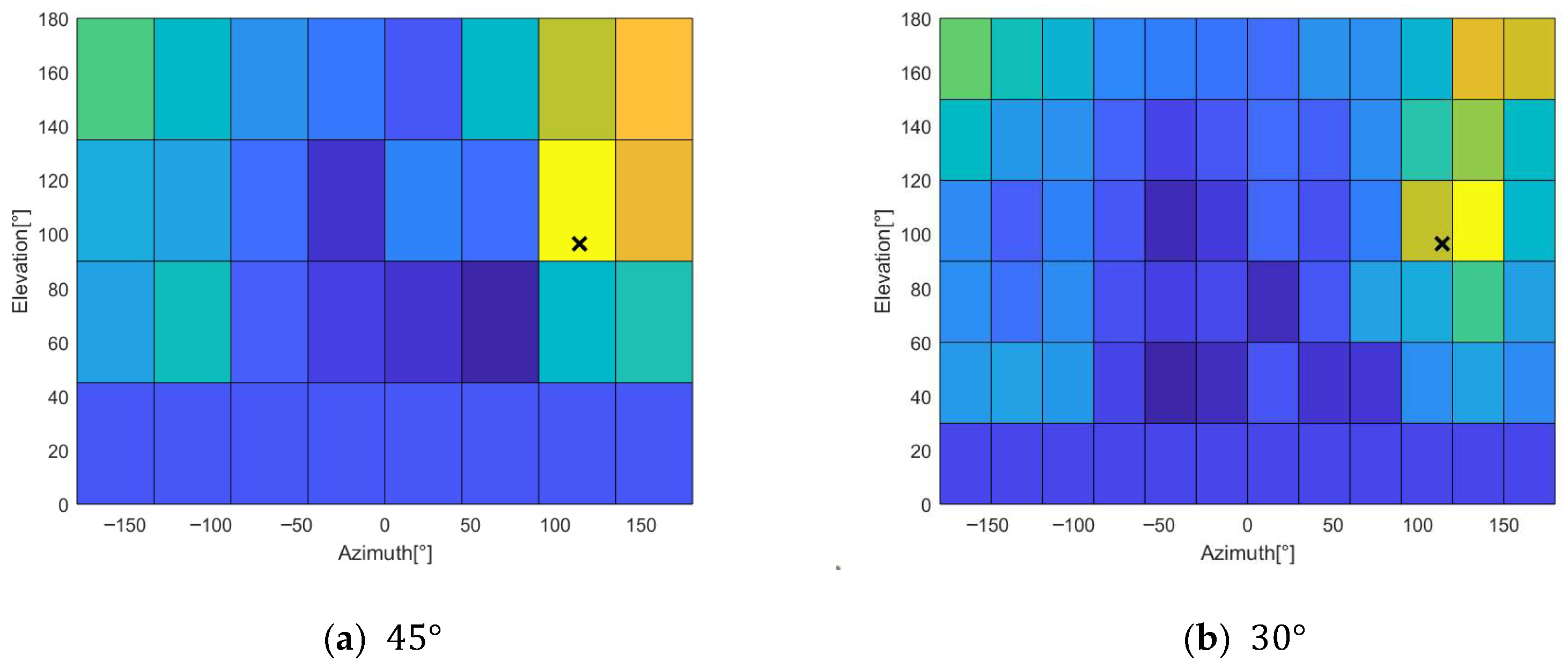
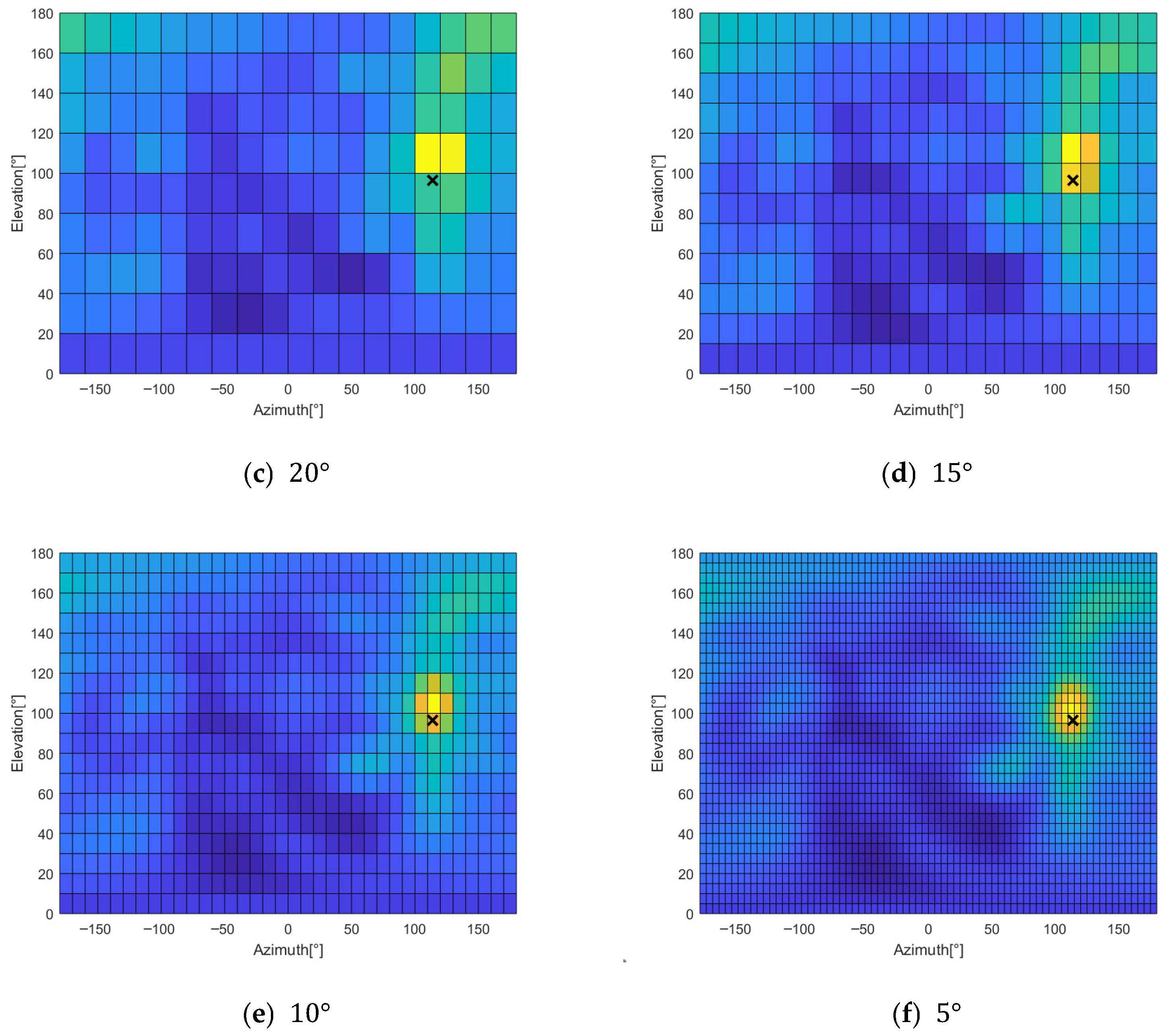
In real-world sound source localization challenges, the spatial spectral resolution is another factor affecting the performance of sound source localization algorithms. To verify the performance of the proposed SRP-DPCRN in spatial spectral prediction at different spatial frequencies, this paper designed experiments to predict the spatial spectrum at multiple different resolutions. The comparison results are shown in the figure below:
Figure 7 clearly shows that, at six different resolutions, the proposed SRP-DPCRN can accurately predict a significant peak in the spatial spectrum near the actual DOA (Direction of Arrival) of the sound source. Experimental results indicate that higher spatial spectrum resolution leads to higher prediction accuracy and smaller prediction distance error. This result demonstrates that the spatial spectrum predicted by SRP-DPCRN is not dependent on a fixed resolution and exhibits excellent expressive power for fine-grained directional differences.
Figure 7.
Spatial spectra at different resolutions. The actual location of the sound source in each sub-figure is indicated by a black cross.
4.2.2. Active Sound Source Detection
- DASDResNet Ablation Experiment
To effectively evaluate the performance of the proposed DASDResNet network, during the training of the DASDResNet network, we also conducted ablation experiments using three classic ResNet networks (ResNet18, ResNet34, and ResNet50) and DResNet (which removes DAS attention from DASDResNet and retains only dilated convolutions), with the same parameter settings and the same dataset.
The training parameter settings used for the five different networks in the ablation experiments are shown in Table 2:
Table 2.
Neural Network Training Parameter Settings.
Table 3 shows the results of the ablation experiments conducted in this paper under the same parameters and dataset.
Table 3.
Ablation test results.
Table 3 shows that the proposed improved residual neural network, Deformation Attention Residual Neural Network (DASDResNet), combines the DAS attention system and dilated convolution, enhancing the network’s attention to effective features in the spatial spectrum and widening its receptive field. This results in a higher accuracy of 96% on the test set compared to traditional residual neural networks. Experimental results demonstrate that introducing a more suitable feature extraction and attention focusing mechanism can improve the reliability of the “effective peak existence” judgment when discriminating spatial spectrum images, thus providing a more stable stopping signal for iterative detection.
- Iterative detection of sound sources visualization
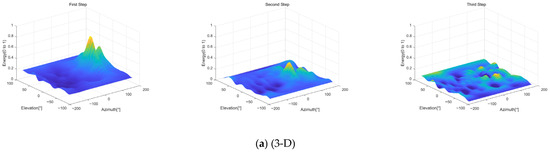
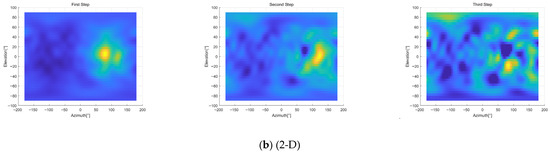
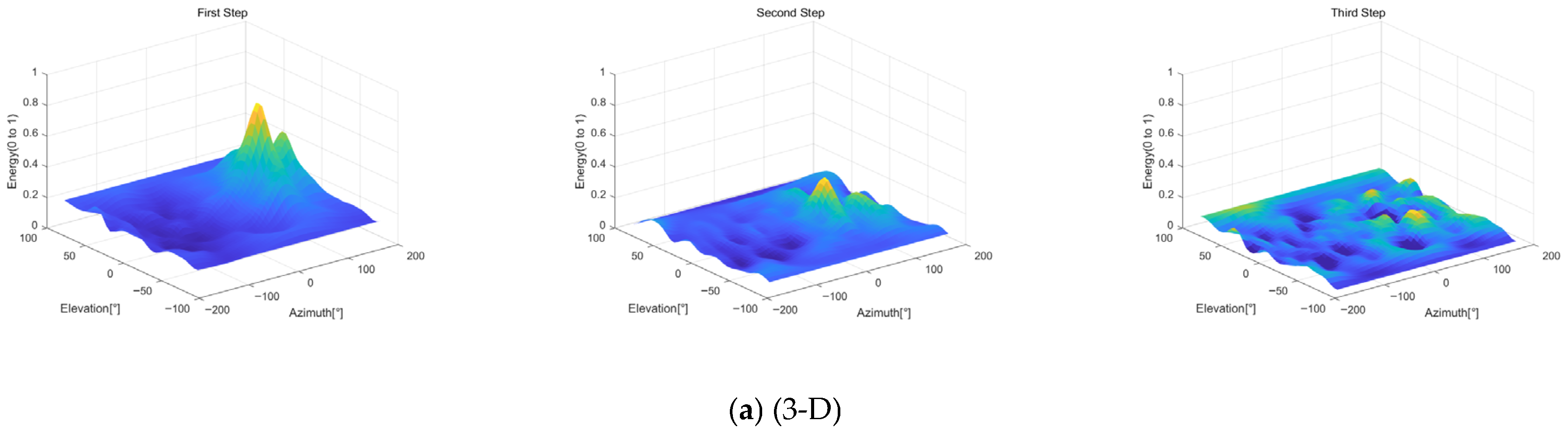
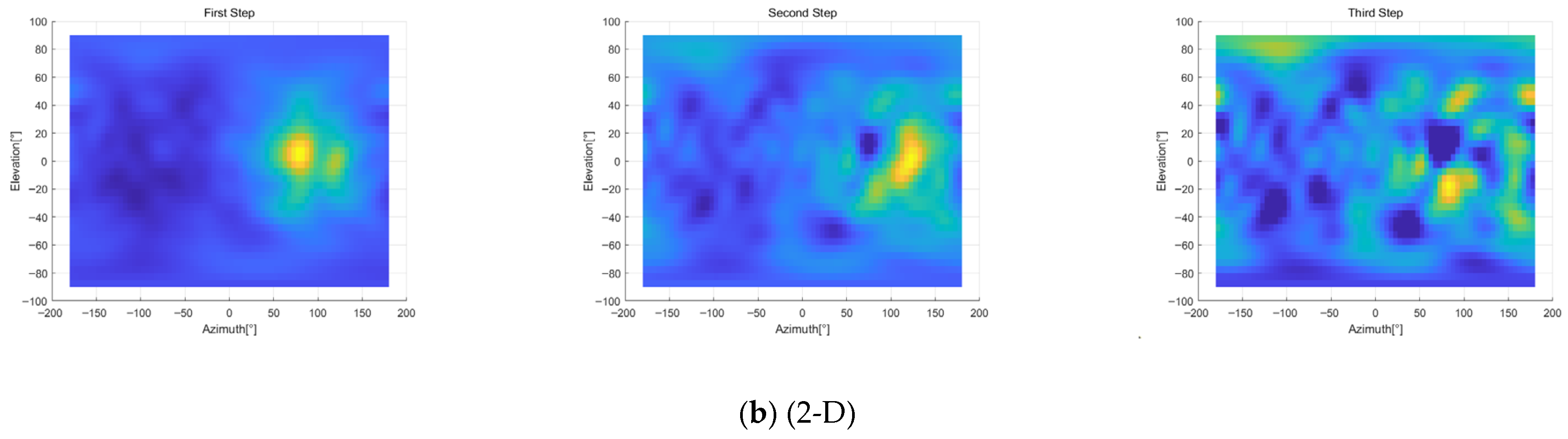
The iterative active sound source detection (IASDNet) process was visualized. In the visualization task, a real microphone array with two sound sources was randomly selected from the LOCATA dataset, and the spatial spectrum obtained by the SRP-DPCRN network was predicted. The results are shown in the figure.
As shown in Figure 8, all active sound sources in the spatial spectrum were successfully detected through three iterations. The “First Step,” “Second Step,” and “Third Step” clearly illustrate the detection process of active sound sources and the feedback of the remaining spatial spectrum by IASDNet during the three iterations. The visualization in Figure 8 reflects that, without any prior information about the number of active sound sources, the proposed IASDNet can accurately analyze the number of dominant contributing sound sources in the spatial spectrum, and the entire process does not involve any threshold control during iteration. This result verifies the effectiveness of the proposed method; the network’s stopping point is consistent with the intuitive law of “effective peak depletion” in multi-source spectra. The iteration termination is achieved without the aid of manual thresholding, thus realizing blind source detection with an unknown number of sound sources.
Figure 8.
Visualization of Active Sound Source Detection with IASDNet.
4.2.3. Blind Source Sound Source Localization Results
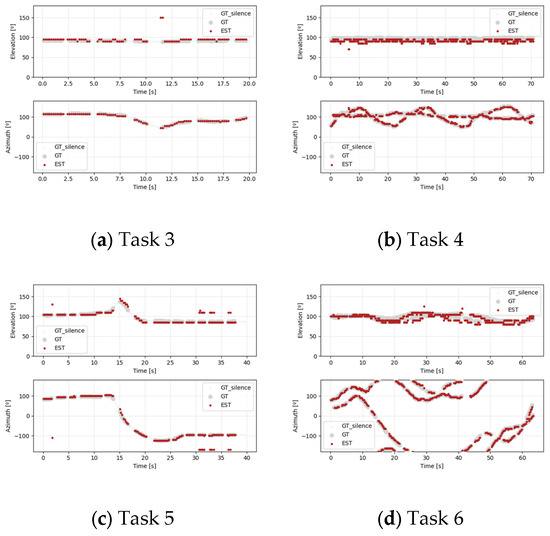
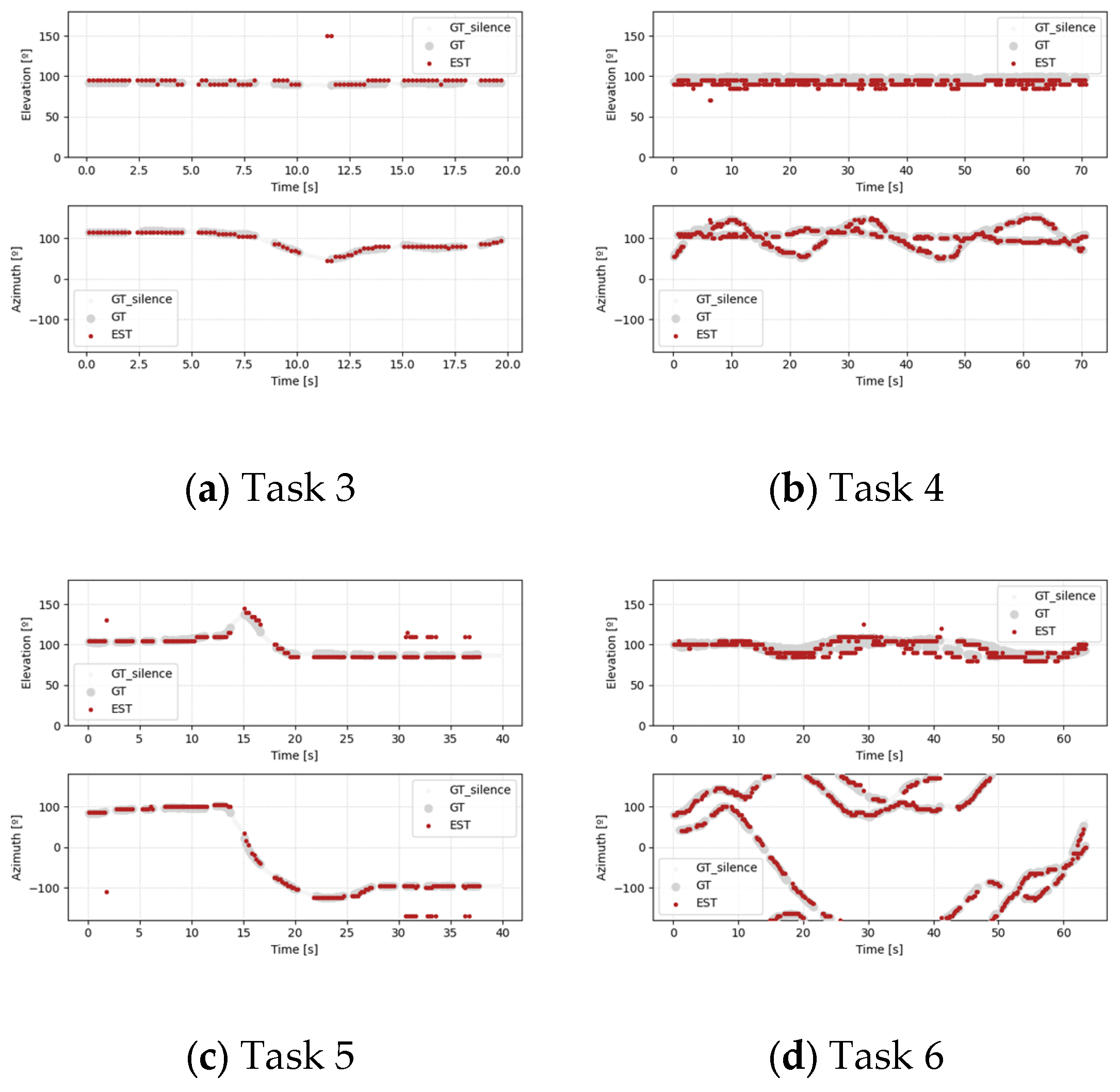
To achieve mobile blind source localization in real acoustic scenarios, this paper uses the LOCATA dataset and conducts blind source localization experiments according to different localization tasks in the dataset, without relying on the prior setting of “the number of sound sources in space”. The results are shown in Figure 9.
Figure 9.
Results of Blind Sound Source Localization.
The results shown in Figure 9 indicate that in single-source tasks (Task 3 and Task 5), the predicted trajectory is generally continuous and highly consistent with the actual trajectory. In multi-source tasks (Task 4 and Task 6), despite stronger peak aliasing and mutual interference, the system can still output trajectory results with usable continuity, demonstrating the applicability of the proposed SRP-DPCRN-IASDNet for blind source localization tasks in real-world scenarios.
4.3. Result and Analysis
In the tasks on the LOCATA dataset, tasks 3–6 involve either a moving sound source or a moving microphone, or both moving, which is particularly challenging in blind source localization tasks with an unknown number of sound sources. We evaluated the proposed SRP-DPCRN-IASDNet as follows, and the results are shown in Table 4. From the table, it can be seen that 5° is the boundary of resolution. Beyond 5°, the improvement in accuracy shows almost no change, but the computing power will increase.
Table 4.
Statistical Indicators of Network Trajectory Tracking Results.
- Accuracy of Network Localization
The accuracy of network localization results is set as the percentage of successfully detected sound source activity in space out of the total number of localization frames. The formula is:
where represents the number of frames in which the sound source is active and correctly detected; represents the total number of frames within the positioning time.
- b.
- False Detection Rate of Localization Results
The false detection rate of network localization results is set as the percentage of frames in which the sound source is inactive but is still detected by the network, out of the total number of localization frames. The formula is:
where represents the number of frames in which the sound source is inactive but is detected by the network.
- c.
- False Negativity Rate of Localization Results
The false negligence rate of network localization results is set as the percentage of frames in which the sound source is active, but the network misses the detection, out of all localization frames. The formula is:
where MDs is the number of frames in which the sound source is active but is missed by the network.
- d.
- Mean Absolute Error of Localization Results
The mean absolute error of localization for the network is set as the average error between the predicted DOA and the actual DOA of a successfully localized sound source across all localization frames. The formula is:
where and are the mean absolute error of the sound source direction angle and the mean absolute error of the pitch angle, respectively; K is the number of sound sources successfully located by the network; and are the network’s predicted DOA and the actual DOA of the sound source, respectively.
To strengthen the empirical claims, Table 5 provides a systematic quantitative comparison against representative baselines, including Cross3D, CTF-DPRTF, SRP-PATH, and SRP-DNN, on LOCATA single-source (Tasks 3 and 5) and multi-source (Tasks 4 and 6) settings. The reported metrics follow Equations (16)–(20), including MDR/FAR and the angular mean absolute errors (MAE_{azi}, MAE_{ele}) computed over successfully localized frames. It is worth noting that Cross3D is designed for single-source tracking and therefore does not apply to multi-source tasks, and CTF-DPRTF does not provide elevation estimation; these cases are marked as “–” in Table 5. In addition, for several compared methods, the evaluation typically assumes the task-specific maximum source number during localization, whereas the proposed SRP-DPCRN-IASDNet does not rely on a priori source-count information and terminates the iterative detection when IASDNet predicts no residual active sources in the spatial spectrum.
Table 5.
Statistical Comparison of Positioning Results Indicators.
Overall, Table 5 shows that the proposed method yields competitive performance in single-source localization and achieves clearly improved multi-source reliability (in terms of MDR) while retaining the blind (unknown source-count) capability.
In challenging localization tasks (moving blind sources), several key factors contribute to maintaining a stable localization trajectory: (1) the stability of the predicted spatial spectrum peak structure; (2) whether the iterative sound source detection conditions can suppress over-detection/missed detection; and (3) the impact of error accumulation on trajectory continuity. Experimental results in this paper show that SRP-DPCRN can output a more stable and separable spatial spectrum under complex conditions such as high noise/long reverberation; DASDResNet maintains high accuracy in active sound source discrimination tasks and effectively suppresses over-detection/missed detection. These two networks enable SRP-DPCRN-IASDNet to output continuous tracking results with high consistency with the real trajectory, demonstrating that the proposed method has good generalization ability in real recording scenarios. In particular, compared to traditional iterative strategies that rely on fixed thresholds or a preset number of sound sources, the proposed method effectively alleviates the uncertainty caused by multi-source interference and array motion through stable spatial spectrum representation and learning activity discrimination, enabling the system to maintain high localization reliability and trajectory continuity even under complex tasks. In summary, the SRP-DPCRN-IASDNet proposed in this paper provides an effective and engineering-feasible solution for the localization of mobile blind source acoustic sources for real-world applications, laying an experimental foundation for further research on robust localization and higher-precision trajectory estimation under more complex acoustic conditions.
5. Conclusions
This study addresses the challenge of blind sound source localization under complex acoustic conditions, a critical task in modern audio signal processing with applications ranging from intelligent robotics to passive bioacoustics monitoring. While significant progress has been made in single- and multi-source localization in controlled environments, real-world scenarios often involve unknown numbers of sources under noise, reverberation, and dynamic conditions. To tackle these issues, we propose a novel deep-learning-based framework consisting of two main components: the SRP-DPCRN network for spatial spectrum prediction and the ASDNet for active source detection. First, the SRP-DPCRN network integrates causal convolutional neural networks (Casual-CNN) and dual-path recurrent neural networks (DPRNN) to model time–frequency relationships and extract direct-path features of sound sources. This enables accurate prediction of spatial spectra even under strong noise and high reverberation, with distinct peaks near the true directions of arrival (DOAs). The model demonstrates strong generalization across varied acoustic scenes. Second, the IASDNet employs an optimized deformable attention-based residual network (DASDResNet) to iteratively detect the number of active sources from the predicted spatial spectra. Using a binary classification strategy, it effectively identifies spectral peaks corresponding to active sources without prior knowledge of source count, enhancing robustness in multi-source scenarios. Finally, by integrating SRP-DPCRN and IASDNet into a unified system named SRP-DPCRN-IASDNet, we achieve real-time tracking of moving blind sources across diverse acoustic environments. Experimental results confirm that the proposed system performs reliably in localizing and tracking an unknown number of sources without prior source count information.
Specifically, the IASDNet employs an iterative strategy that theoretically supports an arbitrary number of sources by sequentially removing spectral peaks. However, empirical validation in this study focuses on scenarios with up to two simultaneous sources, consistent with the LOCATA benchmark complexity. Furthermore, the system’s applicability is bound by the grid resolution (currently 5°). When the angular separation between simultaneous sources falls below this threshold, spectral peak merging may occur, leading to reduced localization accuracy or source counting errors. Future work will address the ‘soft’ limit imposed by spectral resolution in highly crowded acoustic scenes. While the experimental results demonstrate that the proposed system can reliably localize and track an unknown number of sources without requiring prior source-count information, the current evaluation is largely confined to indoor reverberant conditions under the LOCATA benchmark configuration. Therefore, its performance in outdoor environments—where acoustic propagation, background-noise statistics, and interference conditions can differ markedly from indoor settings—has not been systematically characterized and may require dedicated evaluation and adaptation. Moreover, the present study is calibrated to the 12-channel LOCATA robot-head array; scaling to substantially larger arrays is expected to increase the computational and memory demands of feature construction as well as template/network processing, introducing non-trivial efficiency–performance trade-offs that merit further investigation.
Looking ahead, several directions merit further investigation: (1) model compression and optimization to further reduce computational complexity while maintaining localization accuracy; moreover, a systematic complexity assessment (e.g., parameter count, FLOPs, and end-to-end runtime on representative hardware) will be conducted to more rigorously substantiate real-time feasibility in practical deployments; (2) extension to non-human vocalizations by constructing dedicated datasets for diverse biological sounds, thereby broadening the applicability of the proposed framework; (3) exploration of super-resolution localization beyond the current 5° angular resolution to better meet the growing demand for high-precision source localization; and (4) extending the current AWGN-based simulation setting to more general non-Gaussian heavy-tailed (e.g., impulsive) noise models, and studying their impact on performance together with appropriate model- and training-level refinements. As blind source localization remains a vibrant research area within signal processing, continued advances in AI and deep learning are expected to further strengthen its robustness and practicality in real-world acoustic environments.
Author Contributions
Conceptualization, Y.Y. and B.K.N.; Methodology, Y.Y.; Software, M.G.; Validation, Y.Y., B.K.N. and C.-T.L.; Formal analysis, Y.Y.; Investigation, Y.Y.; Resources, B.K.N. and C.-T.L.; Data curation, Y.Y.; Writing—original draft, Y.Y.; Writing—review & editing, B.K.N. and C.-T.L.; Visualization, M.G.; Supervision, B.K.N. and C.-T.L.; Project administration, B.K.N. and C.-T.L.; Funding acquisition, B.K.N. and C.-T.L. All authors have read and agreed to the published version of the manuscript.
Funding
202501BD070001-101, Research on Avian Acoustic Habitat Diversity Based on Deep Integration of Vocal Print Features and Call Indices, Agricultural Joint Fund Project of Yunnan Provincial Department of Science and Technology.
Data Availability Statement
The original contributions presented in this study are included in the article. Further inquiries can be directed at the corresponding author.
Conflicts of Interest
The funders had no role in the design of the study; in the collection, analyses, or interpretation of data; in the writing of the manuscript; or in the decision to publish the results.
References
- Lee, R.; Kang, M.-S.; Kim, B.-H.; Park, K.-H.; Lee, S.Q.; Park, H.-M. Sound Source Localization Based on GCC-PHAT with Diffuseness Mask in Noisy and Reverberant Environments. IEEE Access 2020, 8, 7373–7382. [Google Scholar] [CrossRef] [Scilit]
- Yin, J.; Verhelst, M. CNN-based Robust Sound Source Localization with SRP-PHAT for the Extreme Edge. ACM Trans. Embed. Comput. Syst. 2023, 22, 1–27. [Google Scholar] [CrossRef] [Scilit]
- Yang, B.; Liu, H.; Li, X. SRP-DNN: Learning Direct-Path Phase Difference for Multiple Moving Sound Source Localization. In Proceedings of the ICASSP 2022–2022 IEEE International Conference on Acoustics, Speech and Signal Processing (ICASSP), Singapore, 23–27 May 2022; IEEE: New York, NY, USA, 2022; pp. 721–725. [Google Scholar] [CrossRef] [Scilit]
- Chen, X.; Feng, Z.; Wei, Z.; Yuan, X.; Zhang, P.; Zhang, J.A.; Yang, H. Multiple Signal Classification Based Joint Communication and Sensing System. arXiv 2022, arXiv:2211.04064. [Google Scholar] [CrossRef] [Scilit]
- Dmochowski, J.P.; Benesty, J.; Affes, S. Broadband Music: Opportunities and Challenges for Multiple Source Localization. In Proceedings of the 2007 IEEE Workshop on Applications of Signal Processing to Audio and Acoustics, New Paltz, NY, USA, 21–24 October 2007; IEEE: New York, NY, USA, 2007; pp. 18–21. [Google Scholar] [CrossRef] [Scilit]
- Samal, S.K.; Khadanga, R.K. A Novel Subspace Decomposition with Rotational Invariance Technique to Estimate Low-Frequency Oscillatory Modes of the Power Grid. J. Electr. Comput. Eng. 2023, 2023, 9482825. [Google Scholar] [CrossRef]
- Chen, L.; Chen, G.; Huang, L.; Choy, Y.-S.; Sun, W. Multiple Sound Source Localization, Separation, and Reconstruction by Microphone Array: A DNN-Based Approach. Appl. Sci. 2022, 12, 3428. [Google Scholar] [CrossRef] [Scilit]
- Elminshawi, M.; Mack, W.; Chetupalli, S.R.; Chakrabarty, S.; Habets, E.A.P. New Insights on Target Speaker Extraction. arXiv 2023, arXiv:2202.00733. [Google Scholar] [CrossRef] [Scilit]
- Adavanne, S.; Politis, A.; Nikunen, J.; Virtanen, T. Sound Event Localization and Detection of Overlapping Sources Using Convolutional Recurrent Neural Networks. IEEE J. Sel. Top. Signal Process. 2019, 13, 34–48. [Google Scholar] [CrossRef] [Scilit]
- Diaz-Guerra, D.; Miguel, A.; Beltran, J.R. Robust Sound Source Tracking Using SRP-PHAT and 3D Convolutional Neural Networks. IEEE/ACM Trans. Audio Speech Lang. Process. 2021, 29, 300–311. [Google Scholar] [CrossRef] [Scilit]
- Grumiaux, P.-A.; Kitić, S.; Girin, L.; Guérin, A. A survey of sound source localization with deep learning methods. J. Acoust. Soc. Am. 2022, 152, 107–151. [Google Scholar] [CrossRef] [Scilit]
- Shimada, K.; Koyama, Y.; Takahashi, S.; Takahashi, N.; Tsunoo, E.; Mitsufuji, Y. Multi-ACCDOA: Localizing and Detecting Overlapping Sounds from the Same Class with Auxiliary Duplicating Permutation Invariant Training. arXiv 2022, arXiv:2110.07124. [Google Scholar] [CrossRef] [Scilit]
- Wang, Q.; Du, J.; Wu, H.-X.; Pan, J.; Ma, F.; Lee, C.-H. A Four-Stage Data Augmentation Approach to ResNet-Conformer Based Acoustic Modeling for Sound Event Localization and Detection. IEEE/ACM Trans. Audio Speech Lang. Process. 2023, 31, 1251–1264. [Google Scholar] [CrossRef] [Scilit]
- Desai, D.; Mehendale, N. A review on sound source localization systems. SSRN Electron. J. 2021, 29, 4631–4642. [Google Scholar] [CrossRef] [Scilit]
- Fraixedas, S.; Lindén, A.; Piha, M.; Cabeza, M.; Gregory, R.; Lehikoinen, A. A state-of-the-art review on birds as indicators of biodiversity: Advances, challenges, and future directions. Ecol. Indic. 2020, 118, 106728. [Google Scholar] [CrossRef] [Scilit]
- Kaune, R.; Fkie, F. Accuracy analysis for TDOA localization in sensor networks. Arch. Comput. Methods Eng. 2022, 29, 4631–4642. [Google Scholar]
- Sun, Y.; Ho, K.C.; Wan, Q. Solution and Analysis of TDOA Localization of a Near or Distant Source in Closed Form. IEEE Trans. Signal Process. 2019, 67, 320–335. [Google Scholar] [CrossRef] [Scilit]
- Wang, J.; Qian, X.; Pan, Z.; Zhang, M.; Li, H. GCC-PHAT with Speech-Oriented Attention for Robotic Sound Source Localization. In Proceedings of the 2021 IEEE International Conference on Robotics and Automation (ICRA), Xi’an, China, 30 May–5 June 2021; IEEE: New York, NY, USA, 2021; pp. 5876–5883. [Google Scholar] [CrossRef] [Scilit]
- Huang, Y.; Benesty, J.; Elko, G.W.; Mersereati, R.M. Real-time passive source localization: A practical linear-correction least-squares approach. IEEE Trans. Speech Audio Process. 2001, 9, 943–956. [Google Scholar] [CrossRef] [Scilit]
- Abdolee, R.; Saur, S.; Champagne, B.; Sayed, A.H. Diffusion LMS localization and tracking algorithm for wireless cellular networks. In Proceedings of the 2013 IEEE International Conference on Acoustics, Speech and Signal Processing, Vancouver, BC, Canada, 26–31 May 2013; IEEE: New York, NY, USA, 2013; pp. 4598–4602. [Google Scholar] [CrossRef] [Scilit]
- Chen, J.C.; Yao, K.; Hudson, R.E. Source localization and beamforming. IEEE Signal Process. Mag. 2002, 19, 30–39. [Google Scholar] [CrossRef] [Scilit]
- Chen, J.C.; Yao, K.; Hudson, R.E. Acoustic Source Localization and Beamforming: Theory and Practice. EURASIP J. Adv. Signal Process. 2003, 2003, 926837. [Google Scholar] [CrossRef] [Scilit]
- Liaquat, M.U.; Munawar, H.S.; Rahman, A.; Qadir, Z.; Kouzani, A.Z.; Mahmud, M.A.P. Localization of Sound Sources: A Systematic Review. Energies 2021, 14, 3910. [Google Scholar] [CrossRef] [Scilit]
- Liaquat, M.U.; Munawar, H.S.; Rahman, A.; Qadir, Z.; Kouzani, A.Z.; Mahmud, M.A.P. Sound Localization for Ad-Hoc Microphone Arrays. Energies 2021, 14, 3446. [Google Scholar] [CrossRef] [Scilit]
- Cobos, M.; Garcia-Pineda, M.; Arevalillo-Herraez, M. Steered Response Power Localization of Acoustic Passband Signals. IEEE Signal Process. Lett. 2017, 24, 717–721. [Google Scholar] [CrossRef] [Scilit]
- Panayotov, V.; Chen, G.; Povey, D.; Khudanpur, S. Librispeech: An ASR corpus based on public domain audio books. In Proceedings of the 2015 IEEE International Conference on Acoustics, Speech and Signal Processing (ICASSP), South Brisbane, Australia, 19–24 April 2015; IEEE: New York, NY, USA, 2015; pp. 5206–5210. [Google Scholar] [CrossRef] [Scilit]
- Evers, C.; Loellmann, H.; Mellmann, H.; Schmidt, A.; Barfuss, H.; Naylor, P.A.; Kellermann, W. Data Corpus for the IEEE-AASP Challenge on Acoustic Source Localization and Tracking (LOCATA); Zenodo: Geneva, Switzerland, 2020. [Google Scholar] [CrossRef]
- Li, X.; Ban, Y.; Girin, L.; Alameda-Pineda, X.; Horaud, R. Online Localization and Tracking of Multiple Moving Speakers in Reverberant Environments. IEEE J. Sel. Top. Signal Process. 2019, 13, 88–103. [Google Scholar] [CrossRef] [Scilit]
- Lebarbenchon, R.; Camberlein, E.; di Carlo, D.; Gaultier, C.; Deleforge, A.; Bertin, N. Evaluation of an open-source implementation of the SRP-PHAT algorithm within the 2018 LOCATA challenge. arXiv 2018, arXiv:1812.05901. [Google Scholar] [CrossRef] [Scilit]

Disclaimer/Publisher’s Note: The statements, opinions and data contained in all publications are solely those of the individual author(s) and contributor(s) and not of MDPI and/or the editor(s). MDPI and/or the editor(s) disclaim responsibility for any injury to people or property resulting from any ideas, methods, instructions or products referred to in the content. |
© 2026 by the authors. Licensee MDPI, Basel, Switzerland. This article is an open access article distributed under the terms and conditions of the Creative Commons Attribution (CC BY) license.