


Abstract
In this study, we statistically analyze the performance of a threshold-based multiple optical signal selection scheme (TMOS) for wavelength division multiplexing (WDM) and adaptive coded modulation (ACM); this is achieved using free space optical (FSO) communication between mobile platforms in maritime environments with fog and 3D pointing errors. Specifically, we derive a new closed-form expression for a composite probability density function (PDF) that is more appropriate for applying various algorithms to FSO systems under the combined effects of fog and pointing errors. We then analyze the outage probability, average spectral efficiency (ASE), and bit error rate (BER) performance of the conventional detection techniques (i.e., heterodyne and intensity modulation/direct detection). The derived analytical results were cross-verified using Monte Carlo simulations. The results show that we can obtain a higher ASE performance by applying TMOS-based WDM and ACM and that the probability of the beam being detected in the photodetector increased at a low signal-to-noise ratio, contrary to conventional performance. Furthermore, it has been confirmed that applying WDM and ACM is suitable, particularly in maritime environments where channel conditions frequently change.
Keywords:
free-space optical communication; maritime environments; mobile platform; wavelength division multiplexing; foggy channel; path-loss; pointing error MSC:
82-10
1. Introduction
In the case of communication link between mobile platforms (e.g., ship-to-ship) in maritime environments, free-space optical (FSO) communication has emerged as a viable candidate to support high-throughput data exchange [1]. However, maritime environments, in their nature, impose distinct physical constraints on FSO links owing to fog and pointing errors. In maritime environments, atmospheric fog composed of suspended water droplets and aerosols introduces severe optical attenuation of the laser beam and reduce visibility by several meters in a worst-case scenario (e.g., 480 dB/km) [2]. As a consequence, the achievable link reliability and throughput are substantially degraded [3]. In addition to atmospheric attenuation, due to the characteristics of maritime environments, the continuous movement of the platform makes it difficult for the laser beam to be orthogonal to the photodetector (PD) plane, resulting in pointing errors that require non-orthogonality to be considered in the FSO communication system [4]. These pointing errors can cause additional attenuation and signal distortion, further degrading performance. Overall, FSO communication systems have the potential to revolutionize mobile platform communications in maritime environments; however, the combined effects of fog and pointing errors in maritime environments can significantly degrade the reliability and performance of FSO communications. It is necessary to analyze the complex effects of fog and pointing errors statistically to solve these problems; then, based on this, we must develop an algorithm that can mitigate performance degradation that may occur due to these effects and provide reliable communication in maritime environments.
In addition to atmospheric attenuation, continuous platform motion introduces non-negligible misalignment effects.
In terrestrial environments, performance enhancement in FSO system through various channel models and modulation techniques, improving the FSO performance by applying wavelength division multiplexing (WDM) or adaptive coded modulation (ACM), has already been extensively studied [5,6,7,8,9,10,11,12,13,14,15,16,17,18,19,20,21]. Note that WDM multiplexes multiple optical carrier signals onto a single wireless optical link by using different wavelengths (i.e., colors) of laser light. By allowing multiple WDM channels to coexist on the same free-space optical path, the simultaneous transmission of multiple high-speed signals becomes possible, thereby expanding the overall system capacity. These technologies have proven to be effective in mitigating the effects of Log–normal turbulence and pointing errors in terrestrial environments [22]. Maritime FSO systems, however, must operate under uniquely unstable conditions influenced by atmospheric moisture (or water vapor) and sea level fluctuations. To cope with the rapidly changing channel conditions in such an environment, applying WDM and ACM is more important than applying land-based FSO systems. When WDM is applied, multiple optical signals can be multiplexed and transmitted on a single medium, and data can be transmitted with minimum attenuation by selecting the optimal wavelength according to the channel conditions, even in unstable channel environments with severe changes, thereby enabling stable communication. ACM selects an appropriate channel code and modulation scheme based on the channel state that can increase the average spectral efficiency (ASE) while satisfying the required bit error rate (BER). By applying this technology, optimal communication based on channel status can be achieved, even in an unstable channel environment. Accordingly, it is necessary to respond to an unstable channel environment by applying WDM and ACM to maritime FSO systems. The application of this technology enables stable communication, thereby contributing to the performance improvement in maritime FSO systems.
In this paper, we investigate a ship-to-ship maritime FSO communication link impaired by the compound effects of maritime fog attenuation and three-dimensional pointing errors induced by platform motion. We further study the benefit of applying threshold-based multiple optical signal selection (TMOS) for WDM together with ACM in rapidly time-varying maritime environments. Although prior studies have addressed fog or pointing errors individually, a unified closed-form composite irradiance/SNR distribution that directly enables tractable performance evaluation for both heterodyne detection (HD) and intensity modulation/direct detection (IM/DD) under the joint fog-pointing impairment has not been clearly established. Building on the validated modeling assumptions in the existing literature (e.g., [20]), we derive a new closed-form composite probability density function (PDF) (and the corresponding cumulative distribution function (CDF)) for the received irradiance and the associated electrical SNR, which serves as an analytical foundation for evaluating TMOS-based WDM/ACM-enabled maritime FSO systems. The main novelties and contributions of this paper are summarized as follows: (i) Unified closed-form channel statistics: We derive a new closed-form composite irradiance/SNR distribution under the combined fog and 3D pointing error effects, providing a unified analytical framework applicable to both HD and IM/DD receivers. (ii) Performance analysis enabled by the composite PDF: Using the derived statistics, we obtain tractable analytical expressions for key performance metrics, including outage probability, average spectral efficiency (ASE), and BER, for maritime FSO links employing TMOS-based WDM and ACM. (iii) Validation and design insights: We validate all analytical results via Monte Carlo simulations and provide quantitative insights into the relative behavior of HD versus IM/DD and the effectiveness of TMOS-based WDM/ACM under weak-to-severe maritime impairment conditions.
The remainder of this paper is organized as follows: Section 2 introduces the system and channel models. Section 3 presents the unified composite irradiance/SNR statistics. Section 4 derives the outage probability. Section 5 analyzes ASE and BER with ACM. Section 6 provides numerical results and discussions. Finally, Section 7 concludes the paper.
2. System and Channel Models
Selection combining (SC) is commonly used as a baseline scheme that selects a single branch (e.g., the wavelength/beam with the highest instantaneous SNR) for detection. In contrast, the considered TMOS framework is tailored to WDM–FSO systems where multiple wavelengths are simultaneously available but may experience heterogeneous degradation due to atmospheric attenuation and pointing errors. Instead of restricting reception to only the best beam, TMOS adopts a threshold-based activation strategy in which all beams whose instantaneous SNR exceeds a predefined threshold are deemed valid and jointly activated, while severely degraded beams are excluded. This enables the system to protect a target BER constraint while increasing the aggregate throughput by exploiting multiple reliable wavelengths whenever channel conditions permit. As the average SNR increases, the number of activated beams grows and approaches the total number of available wavelengths, thereby improving the average spectral efficiency. Under the TMOS operation, full channel state information (CSI) feedback is not required. The receiver feeds back only compact control information, namely, the indices of the beams that satisfy the SNR threshold and the corresponding ACM region information. This significantly reduces the feedback overhead compared to full-CSI-based schemes and allows the feedback to be delivered through a low-rate optical control channel or a hybrid RF-based feedback link, consistent with practical WDM–FSO system implementations. A detailed description of the threshold-based TMOS algorithm and its analytical characterization can be found in [22].
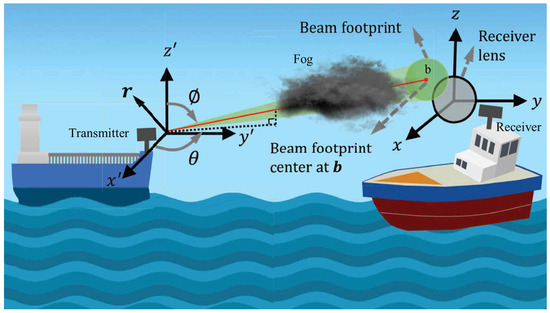
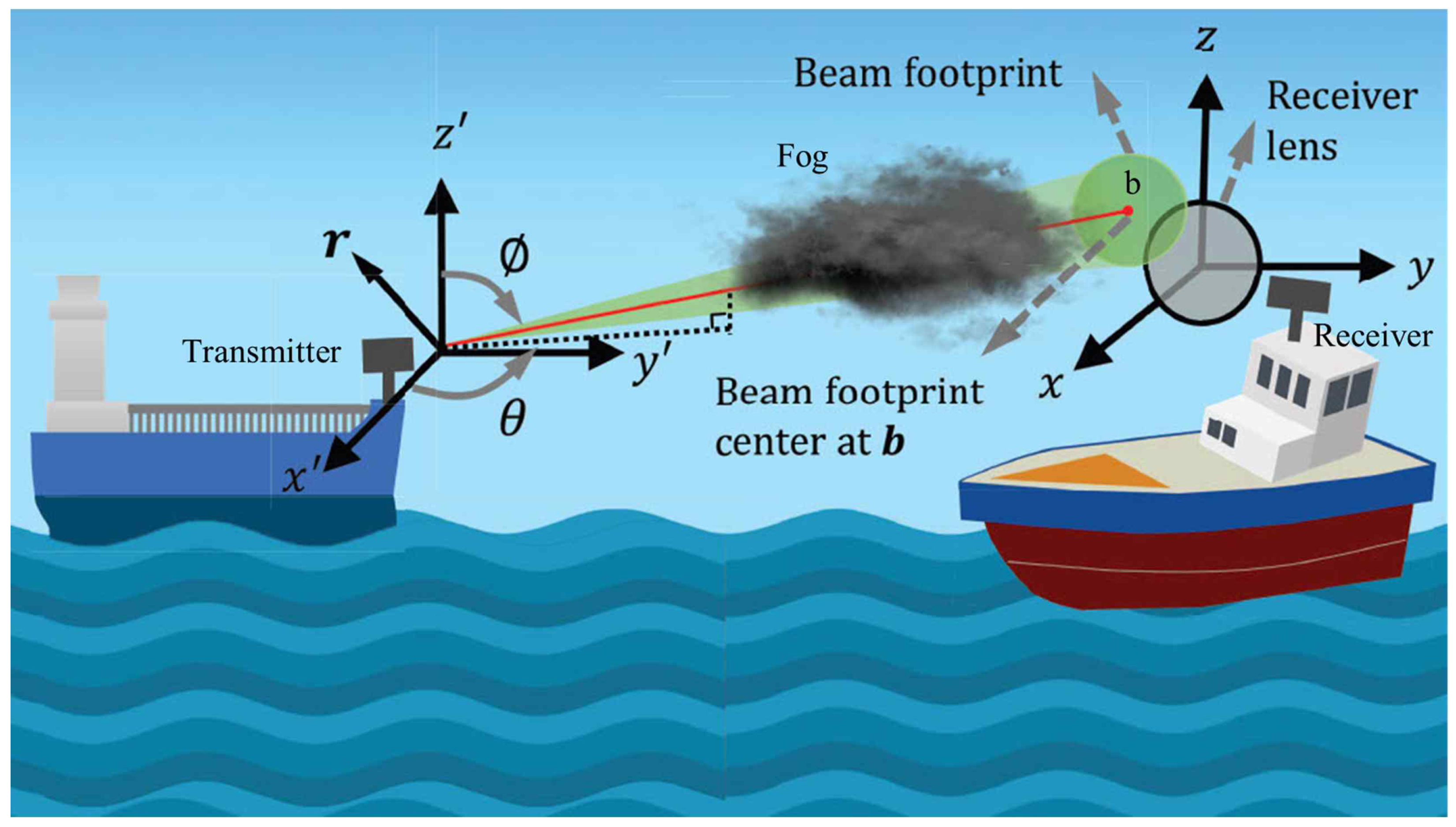
We consider FSO communication between mobile platforms in maritime environments, as shown in Figure 1. Here, because fog and pointing errors are major factors in performance degradation, the irradiance can be modeled as , where and are fog and pointing errors, respectively. To reduce the effects of these two factors and increase the FSO performance, we considered a threshold-based rate-adaptive N multidimensional trellis coded M-QAM for WDM to FSO communication as [22]. Further, because fog and pointing errors are both random variables, it is assumed that multiple wavelengths experience the same channel condition when applying a block-fading channel that models slowly varying fading. Specifically, our analysis follows the standard block-fading assumption that the channel remains sufficiently stable over one decision-and-transmission interval. For slowly varying fading (symbol period ≪ channel’s coherence), during the guard time, at the receiver, the link quality of each beam was estimated and compared with the predefined threshold and then fed back to the transmitter. Based on this information, during transmission, the transmitter transmits only beams above . With these selected beams, we considered a rate-adaptive N multidimensional trellis, coded as M-QAM. Using the largest possible modulation order while maintaining a predefined target BER, the number of transmitted bits per symbol interval can be maximized such that the obtainable ASE approximates the maximum ASE. With these assumptions, we statistically analyzed the characteristics of FSO communication between mobile platforms in maritime environments using both HD and IM/DD techniques based on our system and channel models. In the following section, the statistical model of the foggy channel and pointing error are described.
Figure 1.
System and channel models of FSO communication between mobile platforms in maritime environments.
2.1. Foggy Channel
In terrestrial environments, conventional mobile-platform-based FSO communication considers the vertical channel between the fixed–mobile platform or the horizontal channel between the mobile platform; therefore, it is difficult to directly apply the statistical model of fog, as given in [23]. However, because FSO communication between mobile platforms in maritime environments consider the form of a horizontal channel, the conventional statistical model of fog suggests that [23] can be used directly. Based on [23], using the Beer–Lambert law, which explains the relationship between the propagation path and signal attenuation, the foggy channel state is expressed as follows:
where l is the propagation link length in km and is the signal attenuation random variable in dB/km. The probability distribution function (PDF) of defined in [23] is expressed as follows:
where and denotes the Gamma function [24], Equation (8.310.1). Parameters k and are the shape and scale parameters, respectively, and their related values for different fog densities are listed in Table 1.
Table 1.
Values of parameters for different types of fog.
2.2. Mobile-Platform-Based Pointing Error
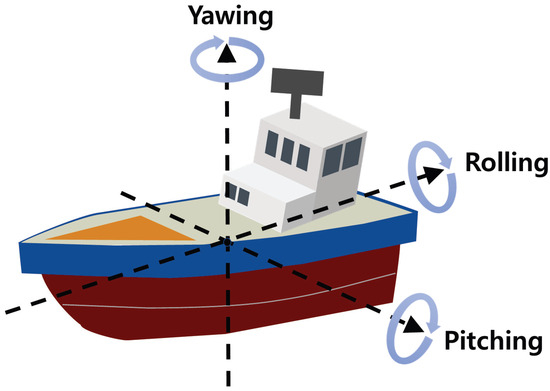
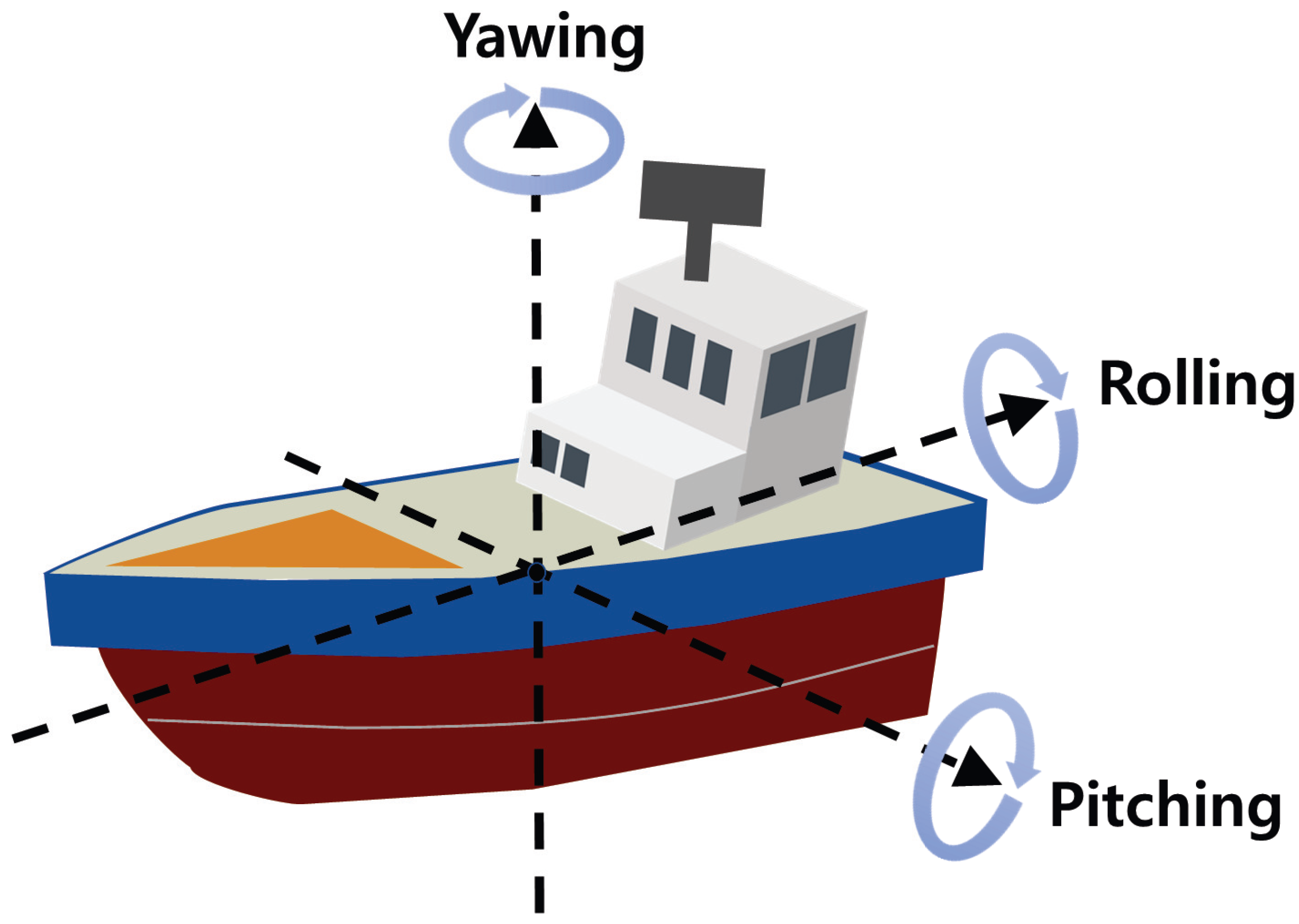
In maritime environments, instances of beam misalignment are mainly caused by ship motions such as yawing, pitching, and rolling [25], as shown in Figure 2, which jointly perturb the transmitter’s orientation and position and make it difficult to maintain orthogonal beam incidence to the receiver plane. Unlike conventional statistical model of pointing error in terrestrial environments, in which only the position changes due to building sway, both the position and orientation of the mobile platforms change in our system model. Accordingly, we applied the new statistical model of the pointing error derived in [4] that considers the position, orientation, and non-orthogonality of the FSO beam.
Figure 2.
Movements of mobile platforms in maritime environment.
Specifically, according to changes in the position and orientation of the mobile platforms, both are random vectors denoted by and . Here, represents the angle between the projection of the beam vector onto the plane and axis. In addition, denotes the angle between the beam vector and axis. We assume that all position and orientation variables are independent and follow Gaussian distribution (IG); therefore, and can be expressed as and , respectively. Here, and are means of and , respectively, and and are fluctuations of and modeled by zero-mean normal random variables with variance , , respectively.
Based on [4,26], we can approximate the fraction of power collected by the receiver lens as follows:
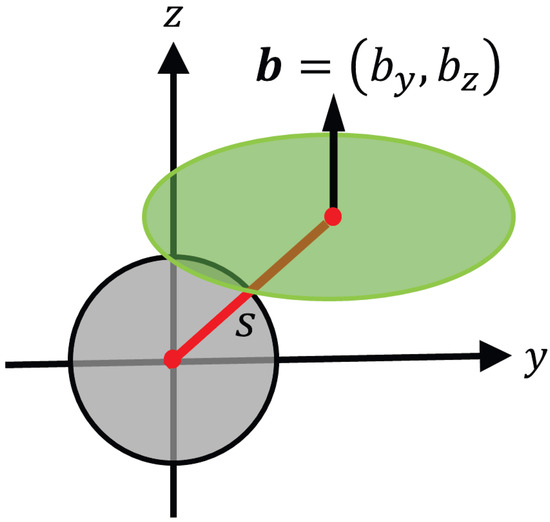
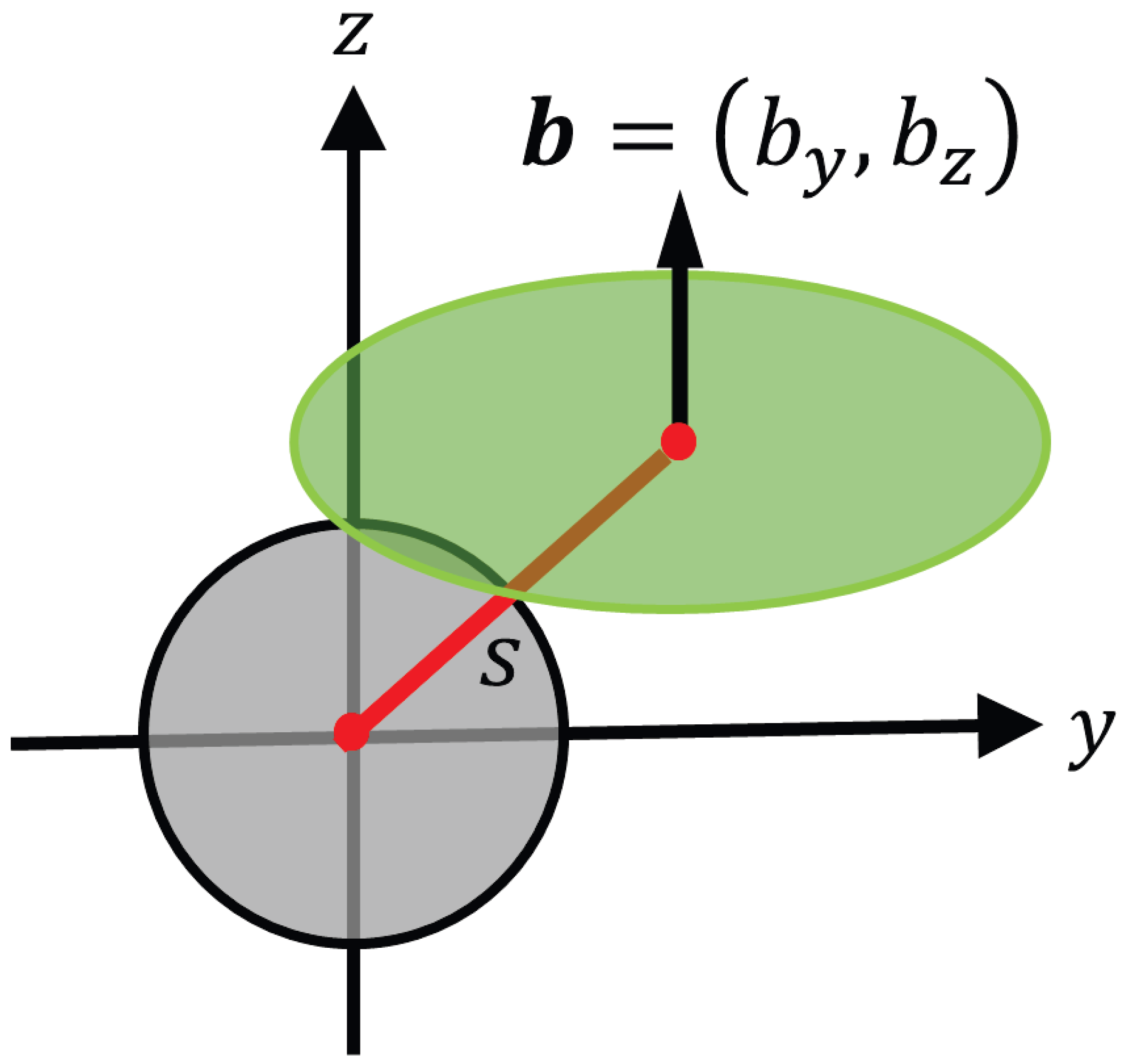
Here, the center of the footprint, , that changes due to these fluctuations can be obtained from the intersection of the laser beam and the x-plane of PD, which can be written as , as shown in Figure 3. In addition, is the distance between the center of the beam footprint and the center of the receiver lens, and is the beam width at distance L (m). Moreover, , , , , and where is the error function and is the radius of receiver lens and is the maximum fraction of optical power captured by the receiver lens at . Our pointing error model follows a Hoyt distribution with and . Note that the 2D beam footprint offset (misalignment) on the receiver plane can be modeled by a Hoyt (Nakagami-q) distribution. Here, and denote the eigenvalues (principal axis variances) of the covariance matrix of the pointing offset; thus, represents the overall jitter power/spread, while captures the anisotropy (ellipticity) of the pointing jitter. Here, and are the eigenvalues of the matrix, where is given by
where IG (independent Gaussian) and , , , , and . Then, based on the distribution of s, the PDF of is given by [26]
where is the jitter of the pointing error and denotes the zero-order modified Bessel function of the first kind [24] (Equation (8.431.1)). Note that in heavy seas, non-Gaussian motion could affect PDF accuracy.
Figure 3.
Beam footprint on the receiver lens plane.
3. Composite PDF
Based on our channel model assumptions, the composite PDF of irradiance I is expressed as:
Using (6), with the help of [27] (Appendix A), we can obtain the closed-form expression as given on (7).
Note that, in (7), using Stirling’s approximation, the value of (7) decays exponentially as the indices m and n increase [28]. Thus, the approximation by the truncation of index n is close to the exact value, and an infinite summation in terms of index m can be achieved with a finite number M. Such truncation-based numerical evaluation of infinite-series fading expressions is well aligned with established practices in recent studies on computationally efficient statistical channel modeling [29], where convergence behavior and runtime considerations are explicitly addressed. Additionally, for the numerical results presented in this manuscript (i.e., the figures), we used (approximately 15 terms in each dimension), which was found to provide stable and accurate evaluations.
In the following subsections, using (7), we analyze the statistical characteristics according to the applied detection technique (i.e., HD or IM/DD techniques). According to the applied detection technique, the instantaneous SNR can be defined as where r denotes the detection techniques (i.e., for HD and for IM/DD) and the related average SNR is expressed as follows:
where , , and is the effective photoelectric conversion ratio. Subsequently, depending on the applied detection technique, the PDF expression of the instantaneous SNR, , can be obtained as . Detailed analysis results according to the detection techniques are described in the following subsections.
3.1. Closed-Form Expression of Composite PDF Based on HD Technique
For the HD technique, with the relationship between the irradiance, I, and the SNR, , I can be defined as follows:
and
where, is the average SNR. From (9), the SNR is expressed as follows:
Then, by replacing I in (7) with (9) and applying the transformation of random variables (RVs), we can written the PDF of the SNR using the HD technique as given on (12).
3.2. Closed-Form Expression of Composite PDF Based on IM/DD Technique
For the IM/DD technique, using the relationship between I and , I can be defined as follows:
and
where, is the average SNR. Then, similar to the HD case, is expressed as follows:
Then, by replacing I in (7) with (14) and applying the transformation of the RVs, PDF of the SNR with IM/DD technique as given on (17) can be written.
3.3. Closed-Form Expression of Unified Composite PDF
In this subsection, the PDF results of SNR derived from HD and IM/DD techniques given in (12) and (17), respectively, in the previous subsections are rewritten in a unified form expression as given on (19).
where with HD and with IM/DD techniques.
Using Stirling’s approximation (as m and n increase, infinite summations decrease exponentially), infinite summations can be achieved using a finite number of terms.
For , it can be assumed that the pointing error is negligible. Therefore, the irradiance can be simplified to . Therefore, the PDF of I can be expressed as follows:
Then, by replacing I with the unified SNR representation given in (11) and (16) and applying the transformation of RVs, the PDF of SNR in a unified form expression is expressed as follows:
3.4. Closed-Form Expression of Unified Composite PDF Based on TMOS
Based on the system and channel models, the range of the optical beam (i.e., irradiance) affected by the foggy channel and pointing error is . Then, according to the relationship between I and , the range of can be obtained as . In addition, based on the TMOS scheme, the SNR of the selected beam is above the pre-selected threshold . Therefore, based on [22], the statistical representations of the output SNR of the selected beam can finally be obtained as follows:
where and are the PDF and the outage probability of the SNR, respectively.
4. Performance Analysis of the Outage Probability
Based on the operation mode, the outage probability, , (i.e., equal to the probability of no transmission) is defined as the probability that the output (electrical) SNR of the selected beam with TMOS falls below a preset threshold. Therefore, can be formulated as
According to the TMOS scheme, the selected beam follows the conditional PDF of a truncated RV. Subsequently, by substituting (22) into (23), a closed-form expression for can be obtained as follows:
Subsequently, in (24), the final closed-form results can be obtained by simply replacing with (13) for HD technique and (18) for IM/DD technique.
5. Performance Analysis with Adaptive Modulation
5.1. Average Spectral Efficiency
Based on the system models described in Sec. II, the ASE of the selected beam can be estimated as the sum of all spectral efficiencies, , weighted by the probability, , that the SNR of a selected beam is assigned to the u-th region as follows:
where and can be considered the following two cases depending on the corresponding integral region according to . Let be , then, by substituting with (22), we can obtain the closed-form expression of equation required for estimating the ASE as follows:
Case 1. ,
Case 2. ,
We can then obtain the closed-form results of by replacing in (26) and (27) with (13) for HD technique and (18) for IM/DD technique, respectively. Finally, by substituting and in (25) with the closed-form results above, we obtain the closed-form results of the ASE for each detection technique.
5.2. Average Bit Error Rate
In the case of ACM, we can express the average BER, , of all the codes for the SNRs of the selected beam as the average number of bits in the error divided by the ASE in (25) as follows:
Similar to the ASE analysis case, evaluating can be considered in the following two cases, depending on the corresponding integral region based on . In (28), to obtain the closed-form results for , we only need to derive the closed-form results for . Thus, in the following, we focus on the derivation of the closed-form results of unified for HD and IM/DD methods.
Case 1.
Case 2.
where is the BER for code u according to [30]. Furthermore, the corresponding values of , , and are listed in Table 2 and is the constellation size. Here, by applying Maclaurin series of exponential function to (i.e., ), (29) and (30) can be rewritten as follows:
where,
and
By replacing in (34) with , we can express Case 2. Using (32)–(34), by substituting (12) and (13) for HD technique and (17) and (18) for IM/DD technique into and , we can derive the closed-form expressions of (32)–(34) for both HD and IM/DD techniques, respectively.
Table 2.
Parameters based on the given , for Target .
In addition, in (32)–(34), using Stirling’s approximation (as l increases, the infinite summation decreases exponentially), the required accuracy can be achieved by a truncated summation with a finite number of terms. The detailed closed-form result derivation process of (32)–(34) with both HD and IM/DD techniques are presented in [27] (Appendix D) and [27] (Appendix E), respectively. With these closed-form results for both HD and IM/DD techniques, the unified closed-form result expression of as given on (35) can be expressed at the top of the next page.
From (37), utilizing [24] Equation (3.381.1), the closed-form of the unified in (37) can be obtained as follows:
However, to obtain the closed form results of in both general cases and the case where pointing error is negligible, we still need to derive the closed-form results of and corresponding to the relevant cases. In the case of and , we can perform the same derivation process as in both cases. Consequently, we can obtain the closed-form of unified and by replacing in (35) and (38) with and for Case 1 and for Case 2, respectively. Subsequently, we can finally obtain the closed form results of by subtracting the closed form of and and adding the closed form of .
6. Numerical Results
In this section, we present performance outcomes to illustrate how applying TMOS-based WDM with ACM enhances the performance of FSO communication among mobile platforms in maritime settings amidst random fog and pointing inaccuracies. Our methodology involves selecting beams that surpass a predetermined SNR threshold (i.e., above ). Based on this selection, we employed a rate-adaptive scheme utilizing an N-dimensional trellis coded M-QAM for our performance evaluation framework. More specifically, we define regions as the SNR threshold (i.e., ) and each region is assigned different modulation size , for different codes based on QAM signal. Note that has an upper limit (i.e., ), unlike in the conventional [22].
The means of random vector , , mentioned in Section 2.2, is expressed in spherical coordinates as , i.e., , , and to quantify the effect of non-orthogonality of the beam, i.e., [31]. Also, we assume standard deviations for the position and orientation variables as and , respectively, where is the standard deviation of the position or orientation [31]. Moreover, the analytical expressions presented in the previous sections are cross-verified using computer-based Monte Carlo simulations under varying foggy condition parameters (i.e., k and ) and pointing error parameters (i.e., ). In all figures, the lines and markers represent the analytical and simulation results, respectively, and the analytical results perfectly match the simulation results. The default parameter settings for all figures are listed in Table 3 unless otherwise noted. In all figures, we consider light fog with a low pointing error that slightly degrades the performance (i.e., , , and with ) and dense fog with a high pointing error that severely degrades the performance (i.e., , , and with ) and call them weak impact cases and severe impact cases, respectively. Note that the higher value, the lower the pointing error effect.
Table 3.
Parameter settings in results.
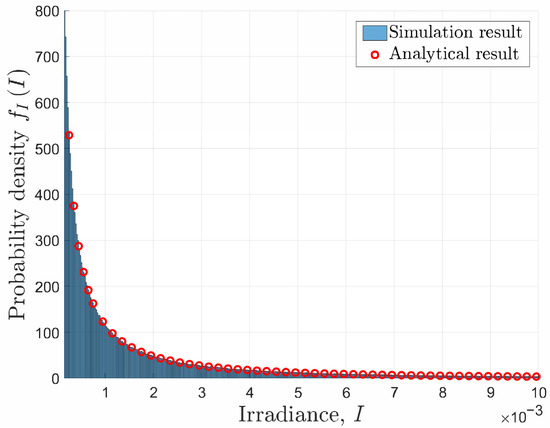
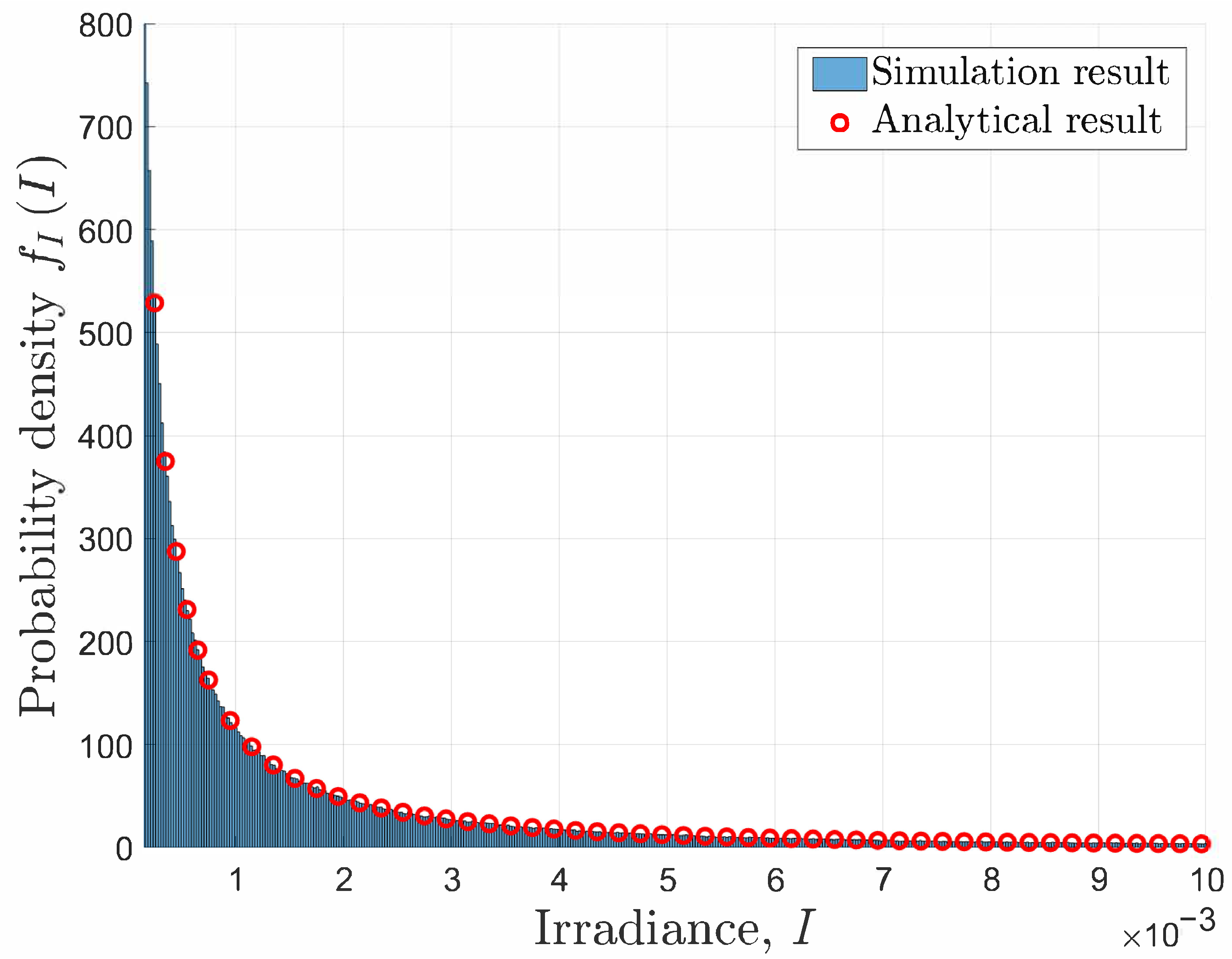
In Figure 4, we present the composite PDF results, based on the system model detailed in Section 2. Specifically, this figure shows a comparative analysis between the simulation results and newly derived analytical outcomes, considering an environment characterized by moderate fog and pointing errors. In conclusion, this analysis confirmed that these two results matched perfectly.
Figure 4.
PDF comparisons for moderate fog with pointing error (i.e., ).
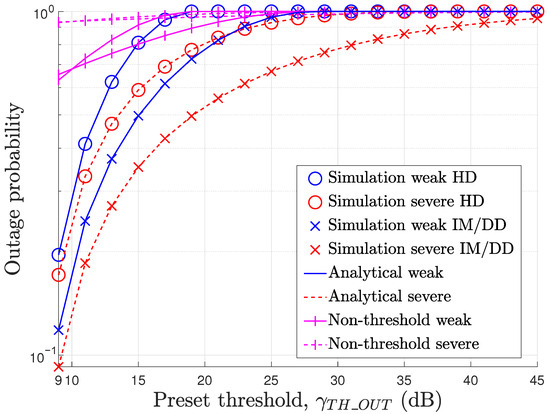
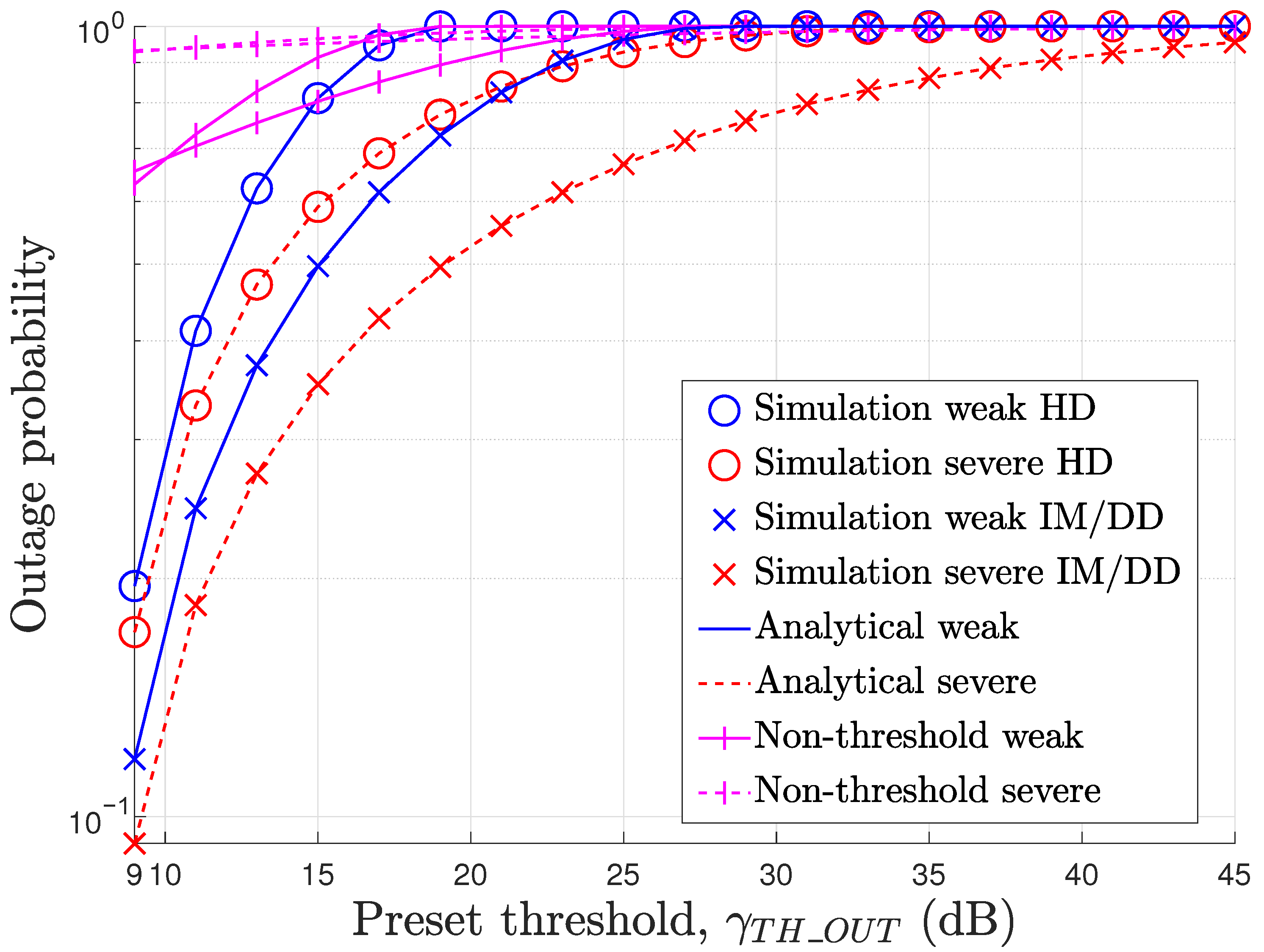
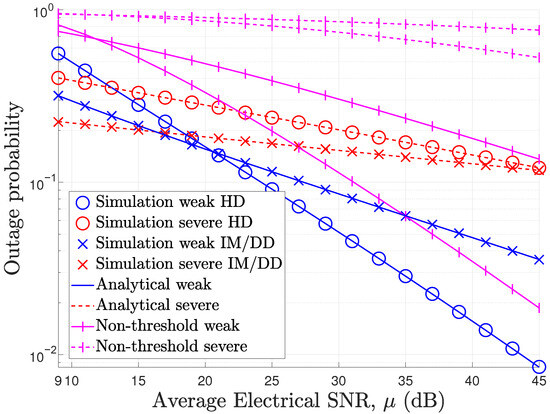
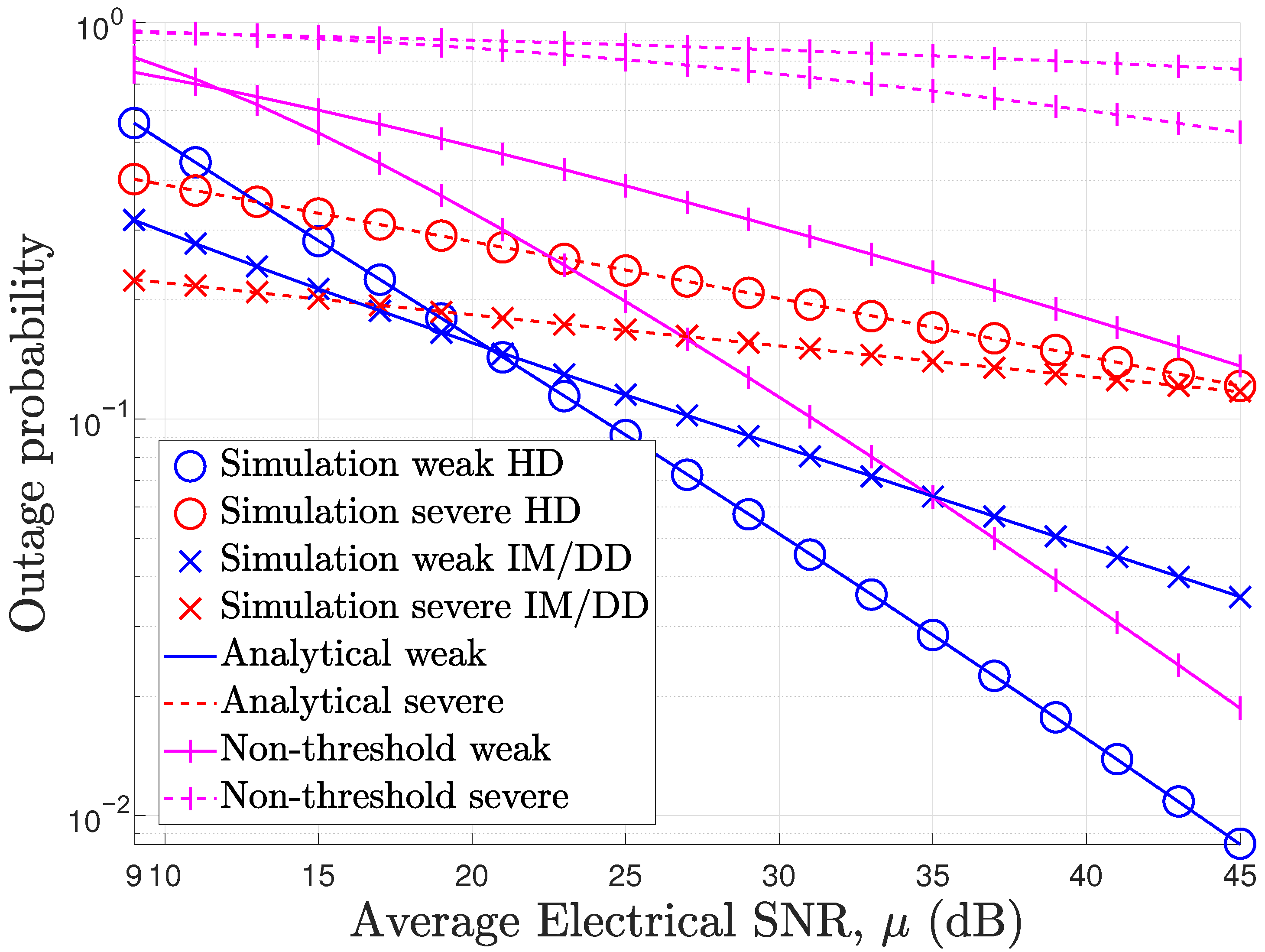
Figure 5 and Figure 6 display the outage probabilities of FSO systems using (i) TMOS-based WDM and (ii) non-threshold-based WDM, under both HD and IM/DD techniques with dB over an average electrical SNR range from 9 dB to 45 dB. These figures illustrate the performances of these systems under varying levels of influencing factors, from weak to severe conditions. Specifically, Figure 5 shows the impact of an adjustable threshold on the outage probability, with (i.e., dB) being held constant, as described in Equation (23). In this context, an "outage" refers to situations where the quality of the link for each selected beam falls below the threshold specified in Equation (23). As is evident from the outcomes, it is expected that when is fixed at 10 dB, increasing the threshold leads to a reduction in the number of beams with SNR above the threshold. This reduction, in turn, results in the deterioration of FSO communication. Figure 6 shows the impact of varying on the probability of successful data transmission at a fixed dB. In this scenario, with increasing values of , there is a corresponding increase in the number of beams with SNR higher than the threshold, resulting in improved system performance. Furthermore, the results confirm that the performance of TMOS-based WDM surpasses that of non-threshold-based WDM, particularly in challenging maritime environments. Essentially, by employing the threshold, beams with SNR compared to the threshold that fail to meet the system requirements are filtered out, leaving only those beams that satisfy the system requirements, thus enhancing beam reliability. Note that the crossover between the HD and IM/DD outage curves is mainly attributed to the different receiver operating principles and the resulting SNR mapping/noise statistics. In particular, IM/DD can be more outage-robust in the low average-SNR regime, whereas HD becomes advantageous as the average SNR increases; hence, the curves intersect. This crossover tendency is observed under both weak and severe combined-effect conditions.
Figure 5.
Impact of an adjustable threshold on the outage probability in TMOS-based WDM and non-threshold-based WDM for combined effects of foggy channel with pointing error under both HD and IM/DD techniques with dB.
Figure 6.
Impact of varying on the outage probability in TMOS-based WDM and non-threshold-based WDM for combined effects of the foggy channel with pointing error under both HD and IM/DD techniques with dB and dB.
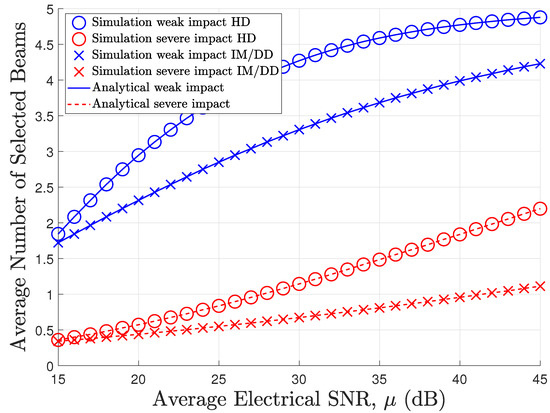
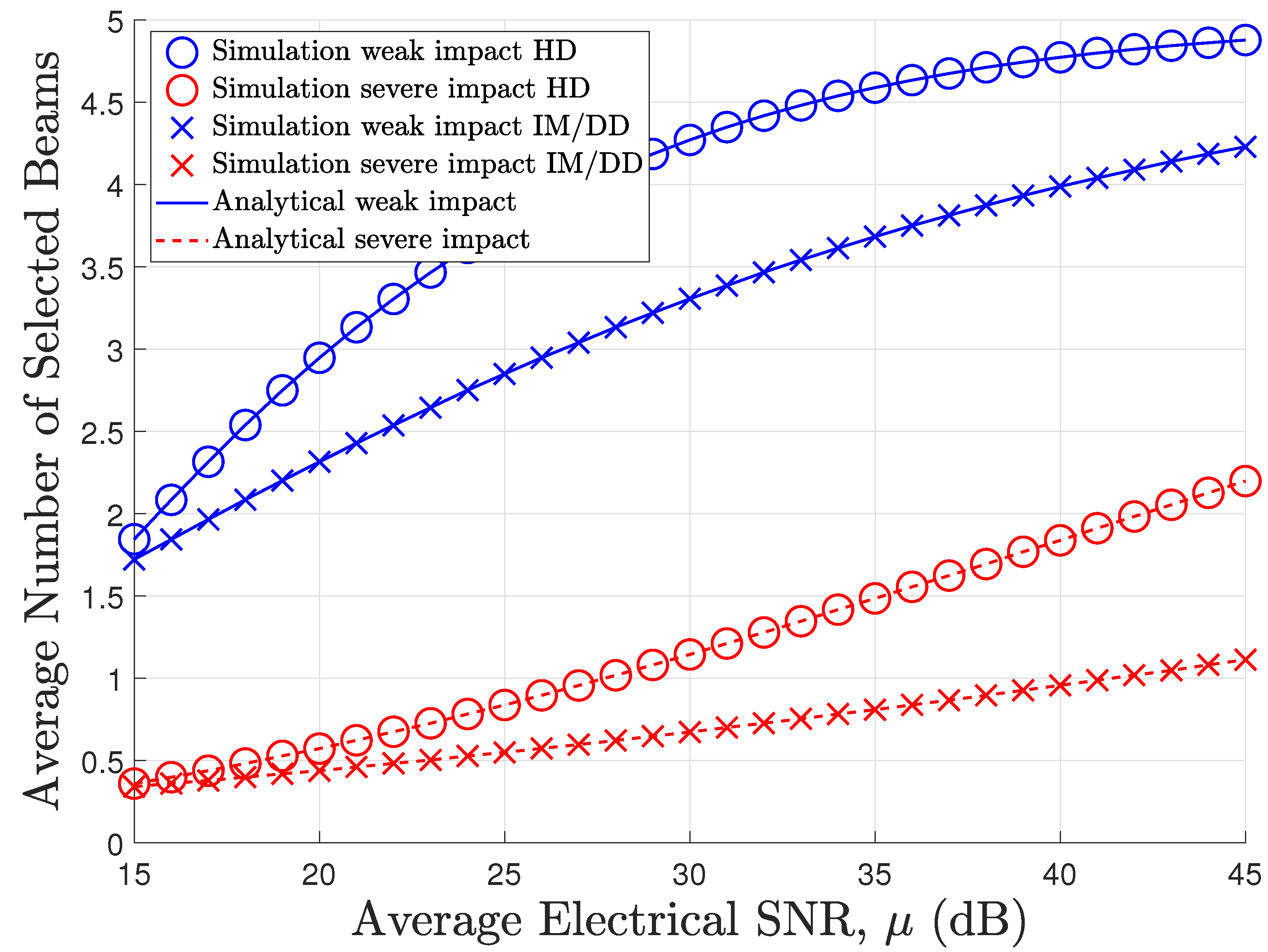
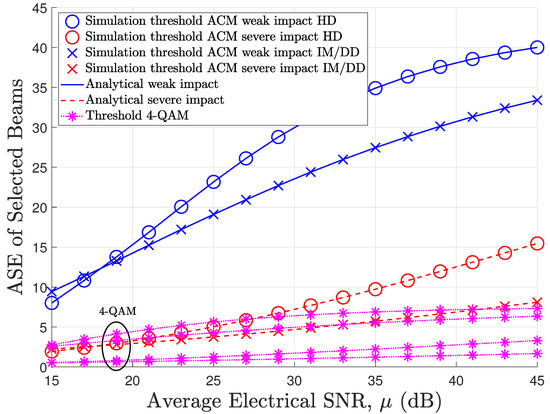
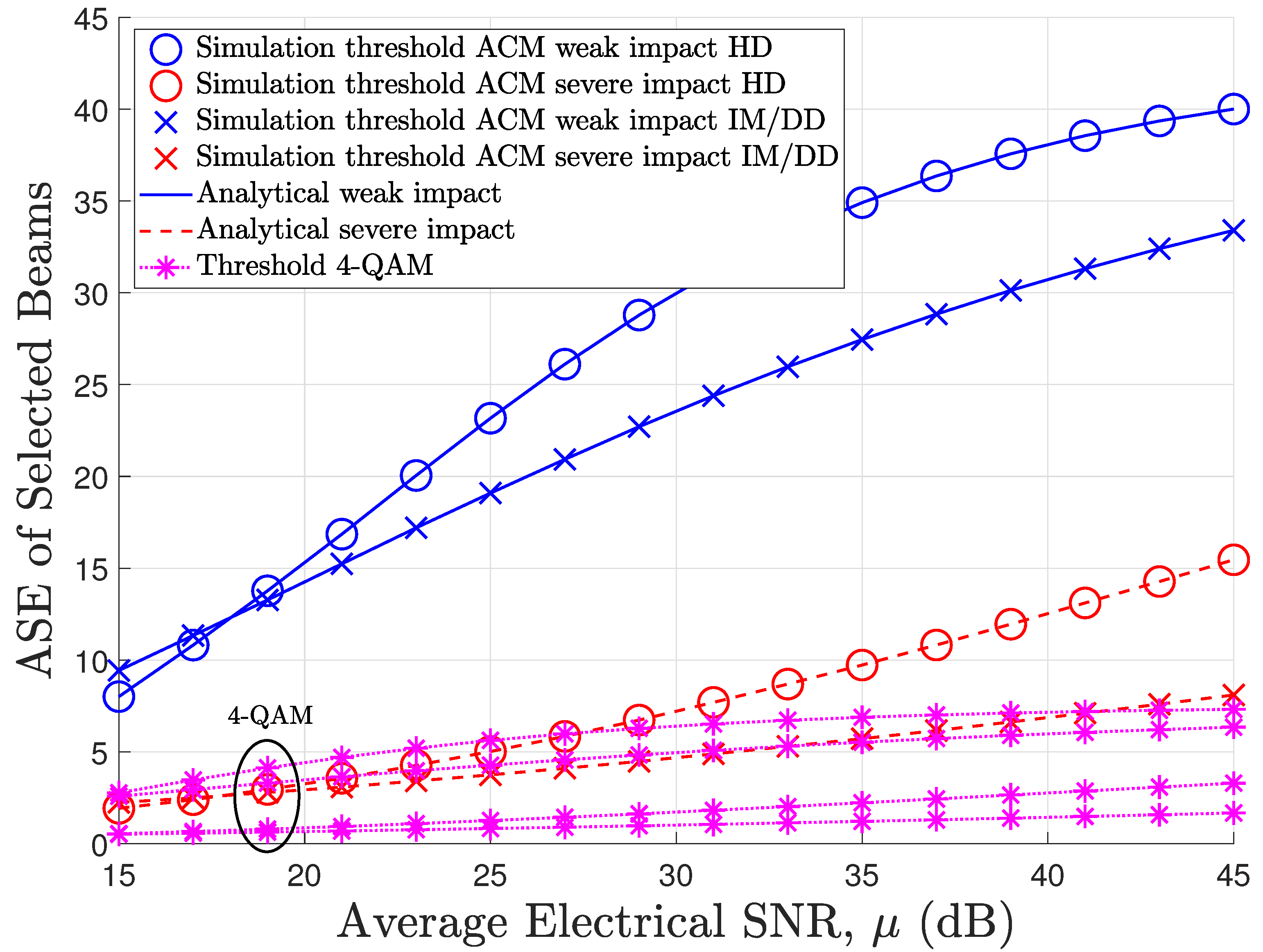
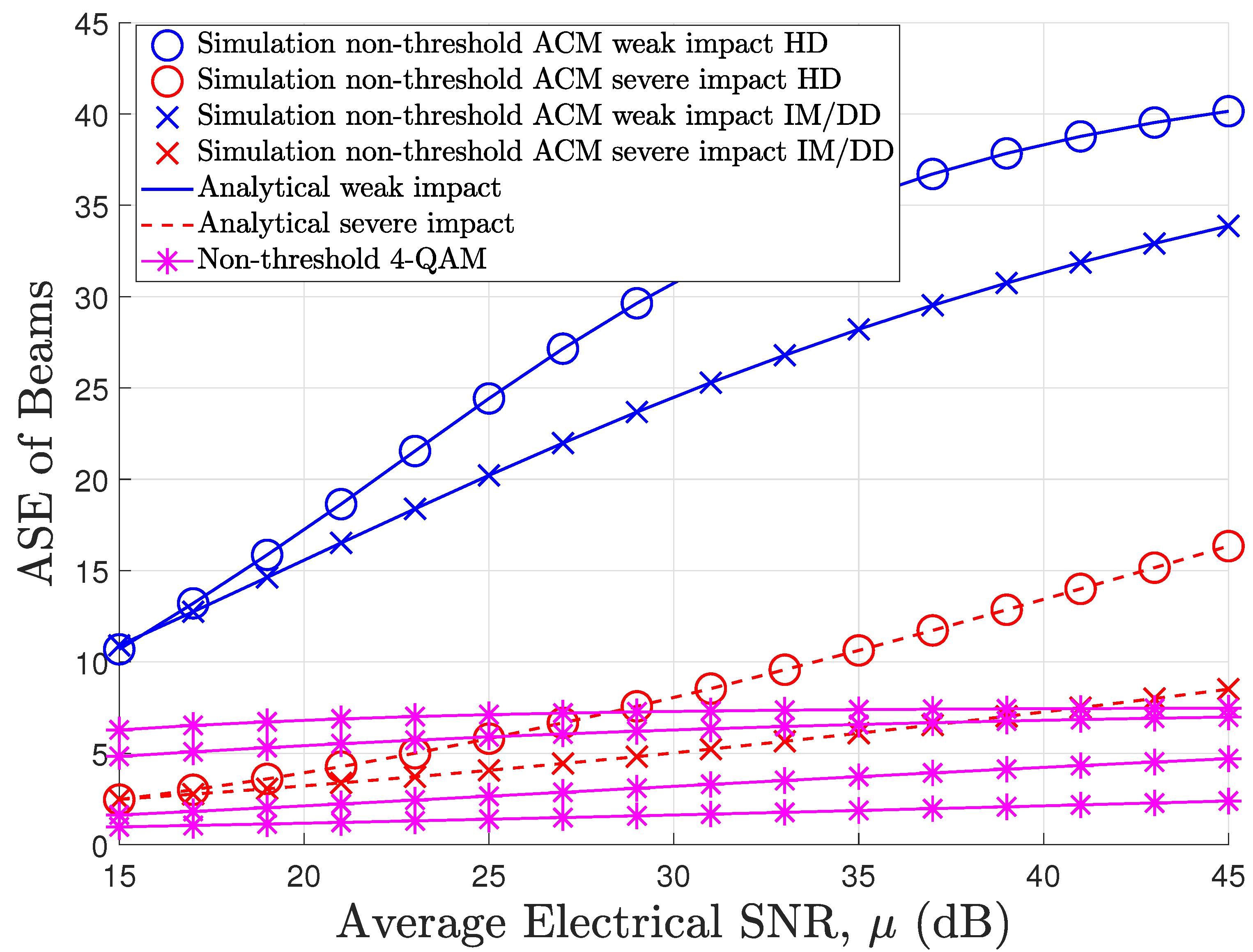
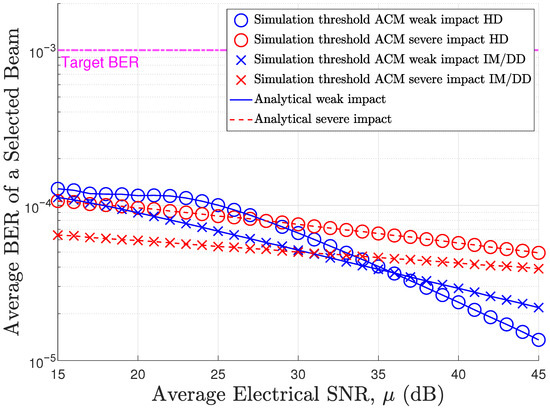
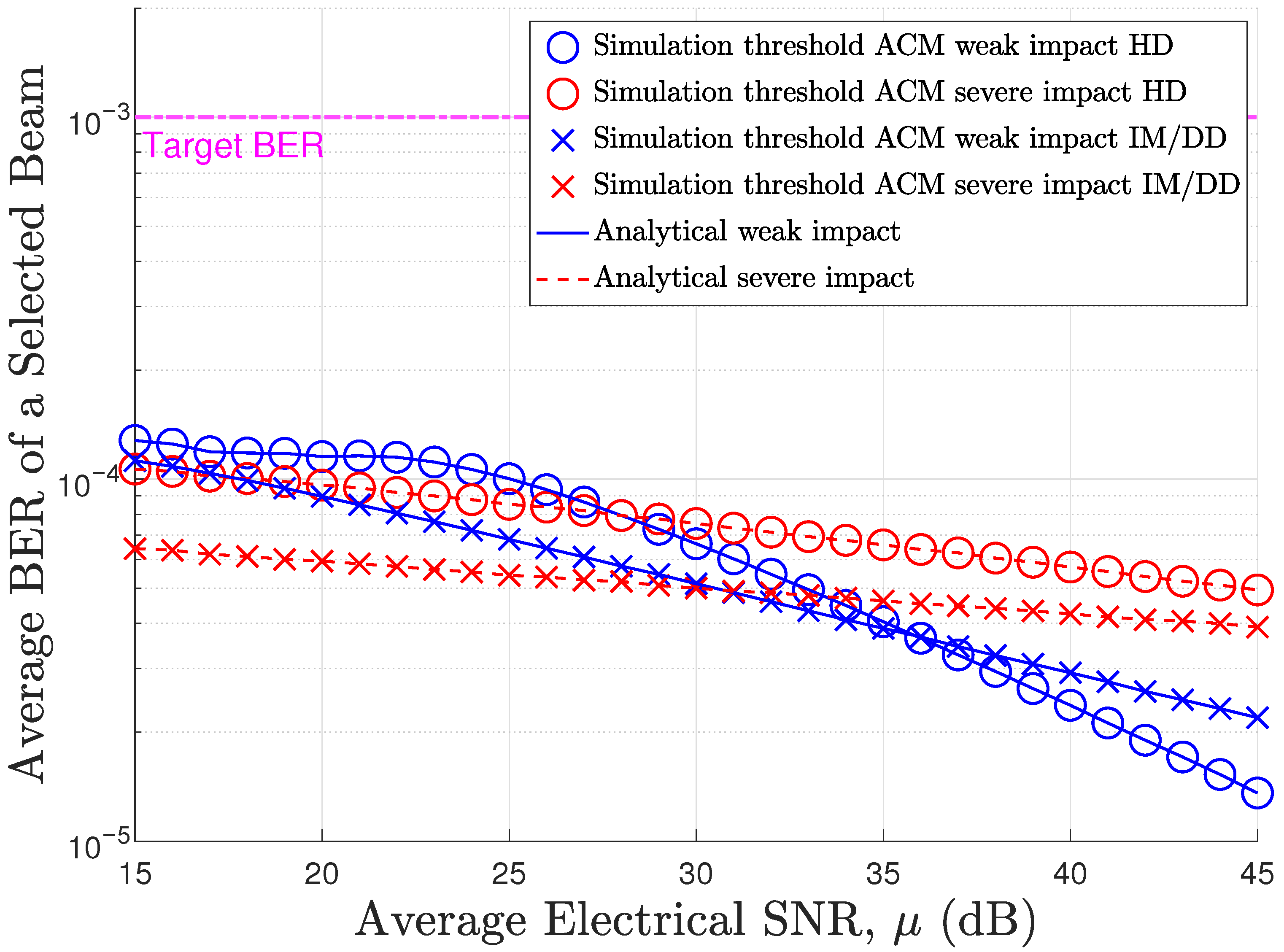
Figure 7 shows the average number of selected beams (ANSB) with TMOS-based WDM in both the weak and severe impact case under HD and IM/DD techniques with dB. As expected, as increases, the number of beams above the predefined threshold increases; thus, ANSB is enhanced and eventually converges to the total beam number (i.e., ). In addition, for both detection techniques, the weak impact case performed better than the severe impact case and converged much faster. Based on these results, Figure 8 depicts the ASE of the selected beams in TMOS-based WDM, both with and without ACM, in scenarios with weak or severe impacts on the communication channel with dB. We assume that, in the context of fixed modulation, which consistently transmits data at the same rate, it is typically designed to operate at the minimum SNR, typically using the 4-QAM scheme (i.e., in 4-QAM). When adaptive modulation is adopted, the data rate is dynamically adjusted based on the channel conditions, allowing for the transmission of more data compared with fixed modulation. Consequently, as the SNR increases, the spectral efficiency also increases, leading to an upward trend in ASE, ultimately approaching the maximum achievable ASE (i.e., ). In systems employing ACM, the primary goal is to optimize the data transmission rates while maintaining a stable BER as required by the system in response to the current channel conditions. The results presented in Figure 9 confirm that the average BER across a range of scenarios was consistently maintained below the predefined threshold BER. (), this criterion is maintained even in the face of significant channel degradation. Consequently, the utilization of ACM in dynamically changing channels not only meets the desired system quality but also boosts the ASE. This demonstrates that data transmission is considerably more efficient than when using fixed modulation schemes.
Figure 7.
Average number of selected beams for combined effects of foggy channel with pointing error under both HD and IM/DD techniques with dB.
Figure 8.
Average spectral efficiency of selected beams in TMOS-based WDM, both with and without ACM, for combined effects of foggy channel with pointing error under both HD and IM/DD techniques with dB.
Figure 9.
Average spectral efficiency of beams in non-threshold-based WDM, both with and without ACM, for combined effects of foggy channel with pointing error under both HD and IM/DD techniques.
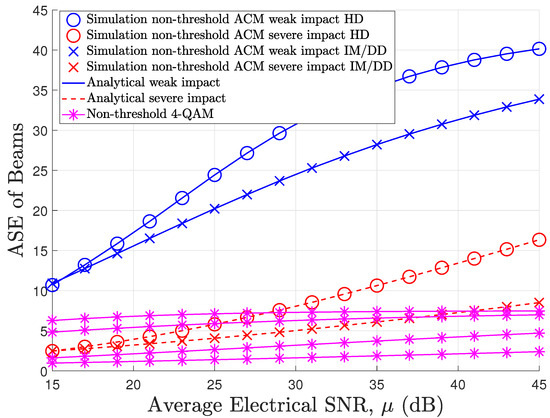
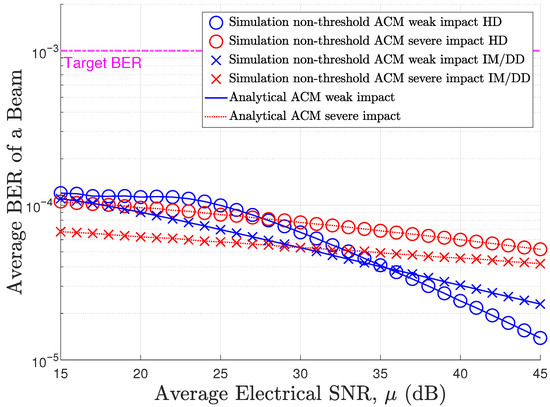
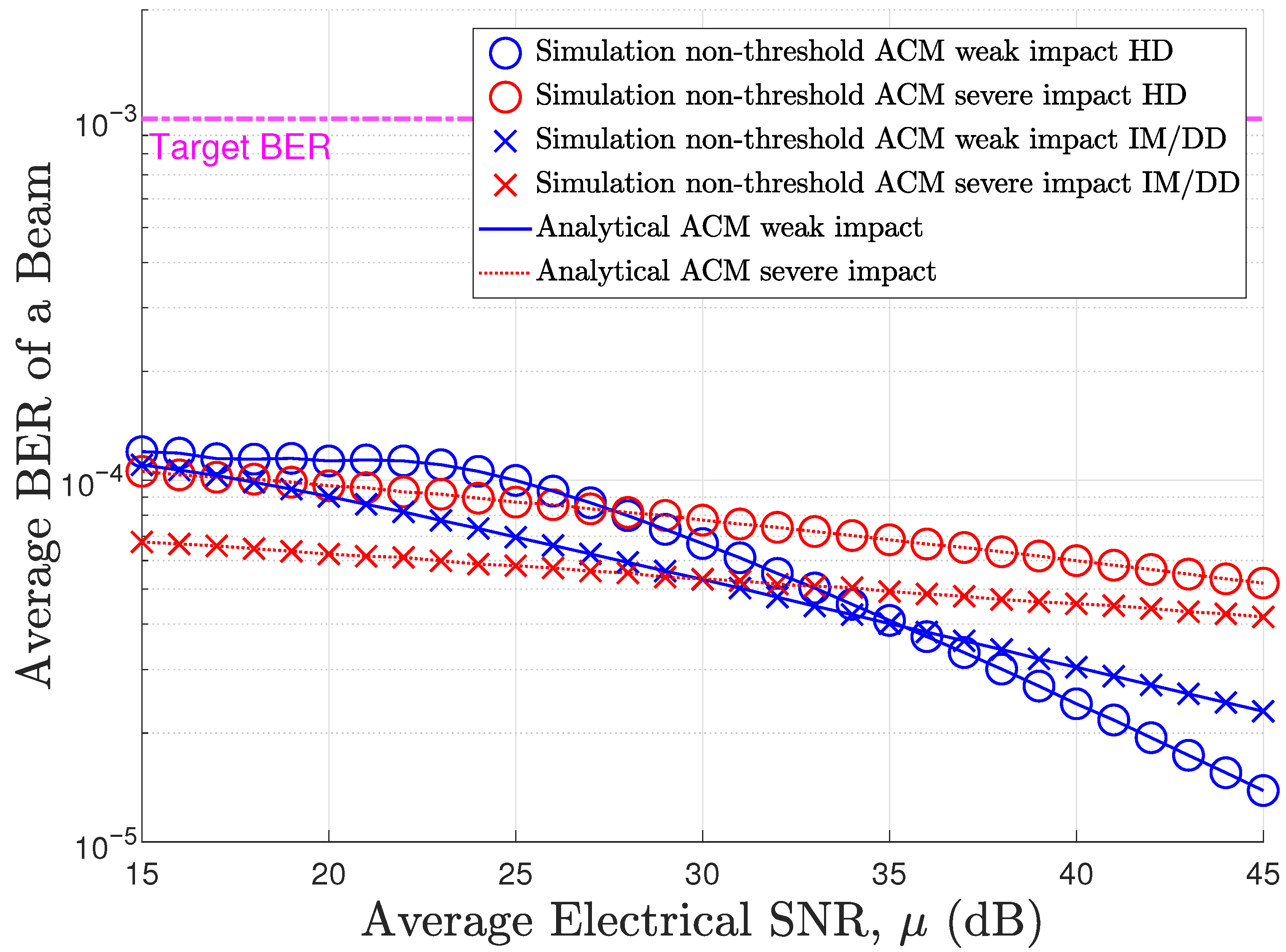
To assess the impact of applying the threshold-based WDM, Figure 9 and Figure 10 depict the ASE and average BER when using conventional (i.e., non-threshold-based) WDM with ACM in scenarios of both weak and severe signal degradation, considering both HD and IM/DD techniques. Without considering the threshold, the number of beams remains constant for the total number of beams (i.e., 5), which leads to variations in the performance of ANSB, as illustrated in Figure 9. However, the disparity between the ASE shown in Figure 8 and that in Figure 9 is very small. This indicates that beams with SNRs falling below the threshold are ill-suited for communication and have an insignificant impact on system performance. Furthermore, Figure 11 confirms that, in scenarios where the threshold is not considered, all outcomes result in BER lower than the specified target. Consequently, by considering the threshold-based selection scheme with ACM, with fewer beams used for transmission, a performance similar to that achieved when threshold-based WDM is not considered is still attainable.
Figure 10.
Average BER of a beam in non-threshold-based WDM with ACM for combined effects of foggy channel with pointing error under both HD and IM/DD techniques.
Figure 11.
Average BER of a selected beam in TMOS-based WDM with ACM for combined effects of foggy channel with pointing error under both HD and IM/DD techniques with dB.
Figure 6, Figure 10 and Figure 11 demonstrate the improved performance in scenarios where the communication channel is severely impacted at a low SNR, which differs from typical outcomes. This can be attributed to the combined effect of the presence of fog and jitter. The beam experiences dispersion as it traverses the foggy channel, as discussed in [32]. Furthermore, the jitter makes the beam footprint more spread out [31]. Owing to these factors, a dispersed beam has an elevated likelihood of being detected using a photodetector (PD). Notably, in the scenario with a severe impact on the communication channel, where the extent of beam widening is more pronounced than in the weak impact case, the probability of detection increases, resulting in enhanced system performance.
However, as the SNR increases, the beam spread relatively diminishes, resulting in a reduction in the positive impact on the performance caused by the combined effects of beam spread and jitter. Generally, FSO operates across a broader range of SNR than RF, and notably functions at high SNRs [22]. In this context, when focusing on a higher SNR range, the HD technique more effectively mitigates the adverse impact of fog and pointing errors compared to the IM/DD technique, leading to improved performance. This disparity in effectiveness stems from the fundamental operational differences between the two techniques: HD technique implements a two-dimensional modulation involving phase and amplitude, whereas the IM/DD technique operates within one dimension, focusing solely on intensity [33]. Therefore, IM/DD technique necessitates a higher SNR than its HD counterpart to achieve equivalent performance rates.
Note that when is 45 dB, the average SNR affected by the weak and severe impact cases are dB in HD and dB in IM/DD, and dB in HD and dB in IM/DD, respectively. Here, it is possible to apply the conventional values of the coefficients (i.e., and ) used in [30]. Even if ACM is applied to a wider and higher range of SNR, the analytical framework and closed-form expression results, along with the appropriate coefficient values provided in [30], remain valid. However, suitable values of and should be determined using curve-fitting techniques based on , , , and using the least squares method, as shown in [30]. Furthermore, according to [22], considering the pathloss to be deterministic, we assume that it maintains a constant value of 1. However, if the impact of the pathloss needs to be considered, we can substitute with in the derived results. Note that one may replace in the derived expressions by , where the path-loss term can be modeled as , with denoting the attenuation coefficient and d the link distance. While is environment-dependent and should be obtained via measurements (or adopted from validated experimental data) for a given underwater scenario, our analytical results remain valid and directly applicable once the appropriate (and hence ) is used.
Note that, when is 45 dB, the average SNR affected by the weak and severe impact cases are dB in HD and dB in IM/DD, and dB in HD and dB in IM/DD, respectively. Although FSO links can operate at relatively high SNR in benign conditions, the considered maritime scenario includes fog attenuation and platform-motion-induced pointing errors; hence, the range of considered in Figures X–Y (i.e., 15–45 dB) sufficiently captures the meaningful transition region of the outage/ASE/BER performance. Moreover, for dB, the TMOS-based WDM selection tends to activate (select) all available beams/wavelengths and the ACM operation reaches the maximum modulation/coding mode; therefore, further increases in yield only marginal statistical/performance changes (i.e., performance saturates), and thus results beyond 45 dB are omitted for brevity. Here, it is possible to apply the conventional values of the coefficients (i.e., and ) used in [30]. Even if ACM is applied to a wider and higher range of SNR, the proposed analytical framework and the derived closed-form expressions remain valid; however, in the high-SNR regime (e.g., beyond 45 dB) the performance improvement becomes marginal due to the above saturation behavior. Nevertheless, suitable values of and should be determined using curve-fitting techniques based on , , , and using the least squares method, as shown in [30]. Furthermore, according to [22], considering the pathloss to be deterministic, we assume that it maintains a constant value of 1. However, if the impact of the pathloss needs to be considered, we can substitute with in the derived results.
7. Conclusions
In this study, we investigated FSO communication between mobile platforms in maritime environments, where fog attenuation and three-dimensional pointing errors constitute the dominant performance impairments. To address these challenges, TMOS-based WDM combined with ACM was applied to enhance link reliability and spectral efficiency. A new closed-form composite irradiance/SNR probability density function was derived to accurately capture the joint effects of fog and pointing errors, enabling tractable performance evaluation for both conventional detection techniques (i.e., HD and IM/DD). Based on this unified analytical framework, the outage probability, ASE, and BER were systematically analyzed. Numerical results demonstrated that the proposed TMOS-based WDM with ACM significantly improves performance, particularly in dynamically varying and harsh maritime conditions, by selectively activating reliable beams while maintaining target BER constraints. All analytical results were rigorously validated through Monte Carlo simulations, confirming the accuracy of the derived expressions and the effectiveness of the proposed scheme.
Based on the selected results, we can confirm that a higher ASE performance can be achieved by adjusting the data rate according to the channel environment by applying TMOS-based WDM and ACM. Therefore, it was confirmed that the application of TMOS-based WDM and ACM is suitable for maritime environments with frequent changes in channel conditions. In addition, the performance difference between HD and IM/DD techniques can be identified, which can help determine an appropriate detection technique. However, in some results, the performance was reversed at a low SNR unlike the conventional performance, which confirmed that the performance improved by increasing the probability that the diffused beam was detected in the PD owing to the combined effects of fog and jitter. Note that this contribution is pivotal in advancing the domain by improving statistical analysis and performance evaluation capabilities in the context of maritime communications under challenging environmental conditions. Note also that the power saving obtained by transmitting fewer beams originates from selectively activating only the WDM channels that meet the target SNR, rather than from reducing the number of supported wavelengths in the hardware. The proposed framework therefore addresses link-level adaptation, while practical real-time implementation issues, including high-rate adaptive switching and feedback latency, are left for future investigation.
Author Contributions
Conceptualization, S.S.N.; Validation, D.D.H.; Investigation, S.S.N.; Writing—review and editing, D.D.H. and M.-S.A.; Supervision, M.-S.A. All authors have read and agreed to the published version of the manuscript.
Funding
This work was supported by the Gachon University research fund of 2024 (GCU-202404160001).
Data Availability Statement
The original contributions presented in this study are included in the article. Further inquiries can be directed to the corresponding authors.
Conflicts of Interest
The authors declare no conflicts of interest.
References
- Cui, X.; Yin, X.; Chang, H.; Sun, Z.; Wang, Y.; Tian, Q.; Wu, G.; Xin, X. Analysis of the orbital angular momentum spectrum for Laguerre–Gaussian beams under moderate-to-strong marine-atmospheric turbulent channels. Opt. Commun. 2018, 426, 3720–3736. [Google Scholar] [CrossRef] [Scilit]
- Korotkova, O.; Avramov-Zamurovic, S.; Malek-Madani, R.; Nelson, C. Probability density function of the intensity of a laser beam propagating in the maritime environment. Opt. Express 2011, 19, 20322–20331. [Google Scholar] [CrossRef] [Scilit] [PubMed]
- Esmail, M.A.; Fathallah, H.; Alouini, M.S. Analysis of fog effects on terrestrial Free Space optical communication links. In Proceedings of the 2016 IEEE International Conference on Communications Workshops (ICC), Kuala Lumpur, Malaysia, 23–28 May 2016; pp. 151–156. [Google Scholar]
- Najafi, M.; Ajam, H.; Jamali, V.; Diamantoulakis, P.D.; Karagiannidis, G.K.; Schober, R. Statistical Modeling of FSO Fronthaul Channel for Drone-Based Networks. In Proceedings of the 2018 IEEE International Conference on Communications (ICC), Kansas City, MO, USA, 20–24 May 2018; pp. 1–7. [Google Scholar]
- Junior, A.F.G.; Azzolin, C.P.; Castillo, C.A.R.; Carneiro, V.G.A. Availability analysis of a ship-to-ground FSO link. J. Opt. Commun. Netw. 2022, 14, 339–350. [Google Scholar] [CrossRef] [Scilit]
- Anandkumar, D.; Sangeetha, R.G. A survey on performance enhancement in free space optical communication system through channel models and modulation techniques. Opt. Quantum Electron. 2021, 53, 5. [Google Scholar] [CrossRef] [Scilit]
- Ali, M.A.; Adnan, S.A.; Al-Saeedi, S.A. Transporting 8 × 10 gbps wdm ro-fso under various weather conditions. J. Opt. Commun. 2020, 41, 99–105. [Google Scholar] [CrossRef] [Scilit]
- Badar, N.; Jha, R.K.; Towfeeq, I. Performance analysis of an 80 (8× 10) Gbps RZ-DPSK based WDM-FSO system under combined effects of various weather conditions and atmospheric turbulence induced fading employing Gamma–Gamma fading model. Opt. Quantum Electron. 2018, 50, 44. [Google Scholar] [CrossRef] [Scilit]
- Anuranjana; Sanmukh, K.; Rakesh, G.; Sushank, C. 1000 Gbps MDM-WDM FSO link employing DP-QPSK modulation scheme under the effect of fog. Optik 2022, 257, 168809. [Google Scholar] [CrossRef] [Scilit]
- Mohammad, A.B. Optimization of FSO system in tropical weather using multiple beams. In Proceedings of the 2014 IEEE 5th International Conference on Photonics (ICP), Kuala Lumpur, Malaysia, 2–4 September 2014; pp. 109–112. [Google Scholar]
- Aladeloba, A.O.; Woolfson, M.S.; Phillips, A.J. BER WDM FSO network with turbulence-accentuated interchannel crosstalk. J. Opt. Commun. Netw. 2013, 5, 641–651. [Google Scholar] [CrossRef] [Scilit]
- Biswas, S.; Biswas, P.; Akhtar, J.; Reja, M. Estimation of link range and bit rate for 16 channel WDM-FSO considering atmospheric turbulence and pointing error under various weather conditions. In Proceedings of the 2017 International Conference on Electrical, Computer and Communication Engineering (ECCE), Cox’s Bazar, Bangladesh, 16–18 February 2012; pp. 838–843. [Google Scholar]
- Mahal, A.; Vaish, A. Analysis of Wavelength Division Multiplexing (WDM) Links bases Radio over free space Optics. In Proceedings of the 2019 3rd International Conference on Inventive Systems and Control (ICISC), Coimbatore, India, 10–11 January 2019; pp. 679–681. [Google Scholar]
- Lin, C.-Y.; Lin, Y.-P.; Lu, H.-H.; Chen, C.-Y.; Jhang, T.-W.; Chen, M.-C. Optical free-space wavelength-division-multiplexing transport system. Opt. Lett. 2014, 39, 315–318. [Google Scholar] [CrossRef] [Scilit] [PubMed]
- Ciaramella, E.; Arimoto, Y.; Contestabile, G.; Presi, M.; D’Errico, A.; Guarino, V.; Matsumoto, M.; Chen, M.-C. 1.28 terabit/s (32 × 40 Gbit/s) WDM transmission system for free space optical communications. IEEE J. Sel. Areas Commun. 2009, 27, 1639–1645. [Google Scholar] [CrossRef] [Scilit]
- Hariq, S.H.; Odabasioglu, N.; Uysal, M. An adaptive modulation scheme for coded free-space optical systems. In Proceedings of the 2014 19th European Conference on Networks and Optical Communications—(NOC), Milan, Italy, 4–6 June 2014; pp. 132–135. [Google Scholar]
- Jaiswal, A.; Jain, V.K.; Kar, S. Adaptive coding and modulation (ACM) technique for performance enhancement of FSO Link. In Proceedings of the 2016 First International Conference on Control, Measurement and Instrumentation (CMI), Kolkata, India, 8–10 January 2016; pp. 53–57. [Google Scholar]
- Tang, Y.; Brandt-Pearce, M.; Wilson, S.G. Adaptive coding and modulation for hybrid FSO/RF systems. In Proceedings of the 2009 Conference Record of the Forty-Third Asilomar Conference on Signals, Systems and Computers, Pacific Grove, CA, USA, 1–4 November 2009; pp. 1644–1649. [Google Scholar]
- Karimi, M.; Uysal, M.; Diamantoulakis, P.D. Novel Adaptive Transmission Algorithms for Free-Space Optical Links. IEEE Trans. Commun. 2012, 60, 3808–3815. [Google Scholar] [CrossRef] [Scilit]
- Fatima, K.; Muhammad, S.S.; Leitgeb, E. Adaptive coded modulation for FSO links. In Proceedings of the 2012 8th International Symposium on Communication Systems, Networks & Digital Signal Processing (CSNDSP), Poznan, Poland, 18–20 July 2012; pp. 1–4. [Google Scholar]
- El-Nahal, F.; Xu, T.; AlQahtani, D.; Leeson, M. A bidirectional wavelength division multiplexed (WDM) free space optical communication (FSO) system for deployment in data center networks (DCNs). Sensors 2022, 22, 9703. [Google Scholar] [CrossRef] [Scilit] [PubMed]
- Nam, S.S.; Alouini, M.S.; Zhang, L.; Ko, Y.C. Threshold-Based Multiple Optical Signal Selection Scheme for Free-Space Optical Wavelength Division Multiplexing Systems. J. Opt. Commun. Netw. 2017, 9, 1085–1096. [Google Scholar] [CrossRef] [Scilit]
- Esmail, M.A.; Fathallah, H.; Alouini, M.S. Channel modeling and performance evaluation of FSO communication systems in fog. In Proceedings of the 2016 23rd International Conference on Telecommunications (ICT), Thessaloniki, Greece, 16–18 May 2016; pp. 1–5. [Google Scholar]
- Gradshteyn, I.S.; Ryzhik, I.M. Table of Integrals, Series, and Products, 7th ed.; Academic: New York, NY, USA, 2007. [Google Scholar]
- Jung, K.J.; Nam, S.S.; Alouini, M.S.; Ko, Y.C. Unified Statistical Channel Model of Ship (or Shore)-to-Ship FSO Communications with Pointing Errors. In Proceedings of the 2019 IEEE Conference on Standards for Communications and Networking (CSCN), Granada, Spain, 28–30 October 2019; pp. 1–4. [Google Scholar]
- Jung, K.J.; Nam, S.S.; Alouini, M.S.; Ko, Y.C. Ergodic Capacity Analysis of UAV-Based FSO Links Over Foggy Channels. IEEE Wirel. Commun. Lett. 2022, 11, 1483–1487. [Google Scholar] [CrossRef] [Scilit]
- Han, J.E.; Nam, S.S.; Hwang, D.; Alouini, M.S. Performance of a Threshold-based WDM and ACM for FSO Communication between Mobile Platforms in Maritime Environments. arXiv 2024, arXiv:2410.10335. [Google Scholar] [CrossRef] [Scilit]
- Abramowitz, M.; Stegun, I.A. Handbook of Mathematical Functions; Dover Publications: New York, NY, USA, 1972. [Google Scholar]
- López-Benítez, M.; Alhulayil, M. On the Computational Efficiency of Fading Models: The Fluctuating Two-Ray Model for mmWave Bands. IEEE Open J. Commun. Soc. 2025, 18, 8175–8189. [Google Scholar] [CrossRef] [Scilit]
- Hole, K.J.; Holm, H.; Oien, G.E. Adaptive multidimensional coded modulation over flat fading channels. IEEE J. Sel. Areas Commun. 2000, 18, 1153–1158. [Google Scholar] [CrossRef] [Scilit]
- Najafi, M.; Ajam, H.; Jamali, V.; Diamantoulakis, P.D.; Karagiannidis, G.K.; Schober, R. Statistical modeling of the FSO fronthaul channel for UAV-based communications. IEEE Trans. Commun. 2020, 68, 3720–3736. [Google Scholar] [CrossRef] [Scilit]
- Anbarasi, K.; Hemanth, C.; Sangeetha, R.G. A review on channel models in free space optical communication systems. Opt. Laser Technol. 2017, 97, 161–171. [Google Scholar] [CrossRef] [Scilit]
- Chaaban, A.; Alouini, M.S. Optical intensity modulation direct detection versus heterodyne detection: A high-SNR capacity comparison. In Proceedings of the 2015 5th International Conference on Communications and Networking (COMNET), Tunis, Tunisia, 4–7 September 2015; pp. 1–5. [Google Scholar]

Disclaimer/Publisher’s Note: The statements, opinions and data contained in all publications are solely those of the individual author(s) and contributor(s) and not of MDPI and/or the editor(s). MDPI and/or the editor(s) disclaim responsibility for any injury to people or property resulting from any ideas, methods, instructions or products referred to in the content. |
© 2026 by the authors. Licensee MDPI, Basel, Switzerland. This article is an open access article distributed under the terms and conditions of the Creative Commons Attribution (CC BY) license.