
Abstract
This paper presents a set of survey-style notes linking core themes of pure algebra with central topics in algebraic and analytic number theory. We begin with finite extensions of and describe algebraic number fields through their realization as finite-dimensional -algebras (via multiplication operators and matrix representations), leading naturally to the arithmetic invariants—trace, norm, and discriminant—and to the ring of integers, ideals, Dedekind domains, and the ideal class group. We then develop the classical theory of cyclotomic fields, emphasizing their Galois structure and their role in abelian extensions of . Next, we discuss ramification in general extensions, including decomposition and inertia groups, the Frobenius element, and the Chebotarev density theorem. The exposition continues with a concise algebraic introduction to elliptic curves and their L-functions, and it places key conjectural links (including Birch and Swinnerton-Dyer) in context. Finally, a collection of examples highlights a common operational language between fractional calculus and number theory: Laplace and Mellin transforms turn convolution-type operators into multiplication, clarifying the appearance of -factors, Dirichlet series, and zeta- and L-function structures in both settings.
Keywords:
algebraic number fields; matrix representation of number fields; cyclotomic fields; Galois groups; Dedekind domains; ideal class group; ramification; Frobenius element; Chebotarev density theorem; elliptic curves; L-functions; Laplace and Mellin transforms MSC:
11R04; 11R18; 11R37; 11G05; 11M06
1. Introduction
Modern number theory is shaped by two complementary viewpoints: the algebraic study of field extensions and their arithmetic invariants, and the analytic study of zeta and L-functions encoding prime-distribution densities. Cyclotomic fields remain the most explicit and historically influential class of number fields, yet many of the mechanisms they reveal—integral bases, ideal factorization, local ramification, and Frobenius elements—reappear throughout contemporary arithmetic, notably in the theory of elliptic curves and automorphic L-functions.
In this paper, we develop a unified account of these themes. We begin with finite extensions and emphasize a concrete linear-algebraic realization: choosing a -basis identifies K with a commutative subalgebra of , from which trace, norm, and discriminant arise naturally and can be reinterpreted through embeddings into [1,2]. This viewpoint leads to the ring of integers , Dedekind’s ideal factorization, and the class group as a quantitative measure of the deviation from unique factorization [2,3].
Cyclotomic fields then provide a guiding family where these constructions can be made explicit. They connect classical problems—constructible polygons and reciprocity laws—to the description of abelian extensions of via the Kronecker–Weber theorem and its p-adic refinements [4,5]. Beyond their intrinsic interest, cyclotomic examples serve as a canonical setting for understanding how global arithmetic data are controlled by local behavior at primes.
To make the local–global principle transparent, we review Hilbert’s ramification theory and the decomposition of prime ideals in extensions. Decomposition and inertia groups, discriminants, and Frobenius elements characterize the splitting of primes and prescribe the Euler factors that appear in zeta and L-functions [2,6]. This sets the stage for the arithmetic-geometric side of the paper: elliptic curves over number fields, their group law, reduction at primes, and the associated Hasse–Weil L-function [7,8]. In this context, local factors, conductors, and Frobenius traces link algebraic structure to analytic behavior and motivate the Birch and Swinnerton-Dyer conjecture.
Finally, we include a collection of examples illustrating how integral transforms provide a common operational language across seemingly distant areas. In particular, the Laplace and Mellin transforms simultaneously linearize fractional operators and encode Dirichlet series; this perspective clarifies parallels between convolution algebras in fractional calculus and multiplicative structures in analytic number theory [6,9]. These examples suggest further directions where transform methods govern the analytic description of arithmetic questions.
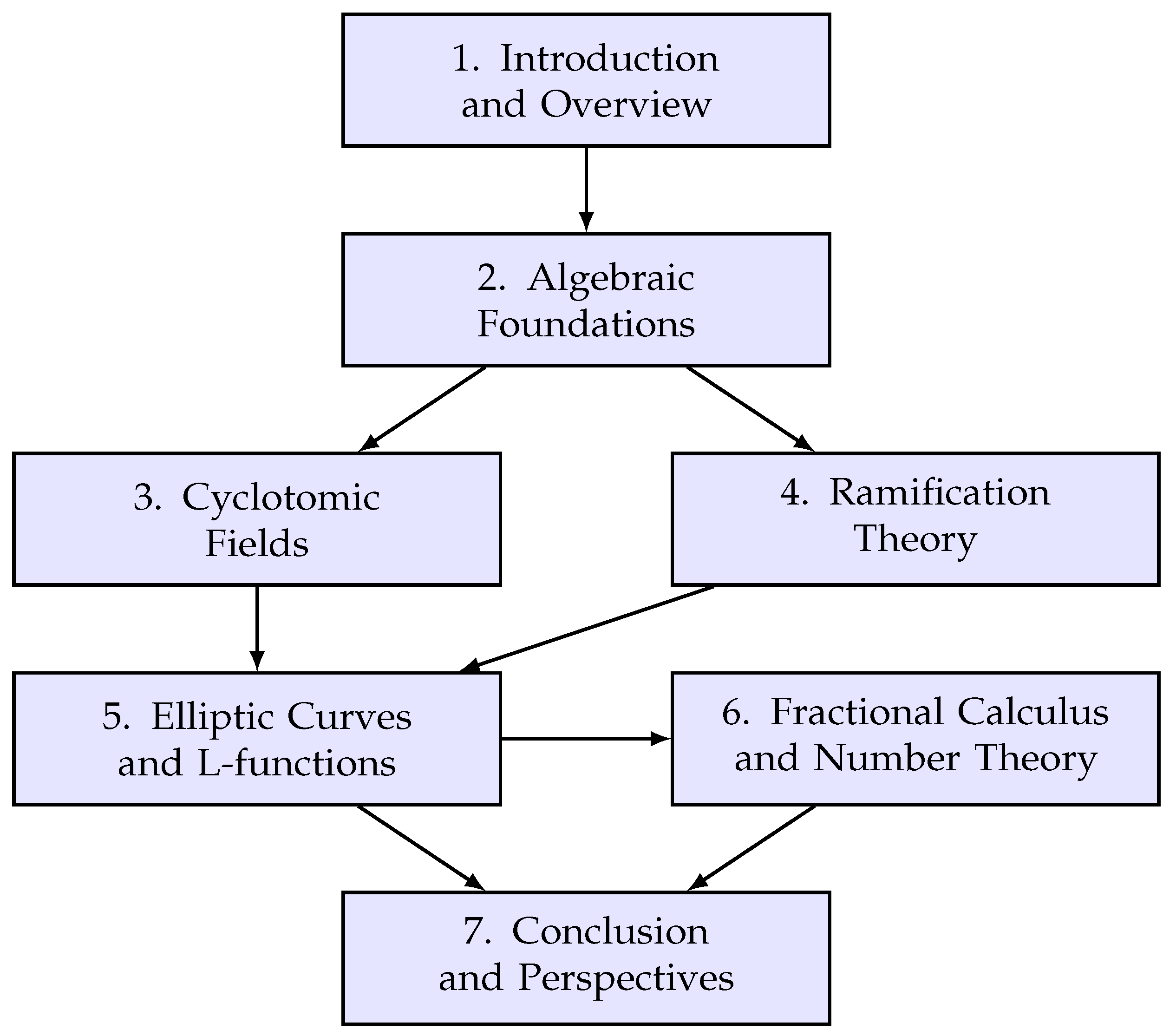
The overall logical structure of the paper is presented in Figure 1.
Figure 1.
Dependency graph of the article sections.
It continues as follows. Section 2 develops the algebraic and arithmetic foundations of number fields, including matrix realizations, rings of integers, embeddings, ideals, and class groups. Section 3 focuses on cyclotomic fields and their basic Galois and arithmetic properties. Section 4 presents ramification theory from the ideal-theoretic and Galois-theoretic viewpoints. Section 5 turns to elliptic curves and L-functions, emphasizing the interaction between reduction data and global invariants. Section 6 collects examples and cross-connections (including the transform-based viewpoint linking fractional calculus and number theory). Section 7 concludes with a brief summary and perspectives for further work.
2. Algebraic Extensions of Fields
We examine finite extensions of the field of rational numbers, which are algebraic number fields. The cyclotomic fields are discussed due to the important role they play in the development of number theory. Gauss used cyclotomic fields to solve the problem of constructing a regular n-gon with compass and straightedge. In the mid-19th century, Kummer, working on Fermat’s Last Theorem and the Laws of Reciprocity, discovered a connection between the arithmetic of cyclotomic fields and the values of the Riemann function at odd negative values of the argument. At the same time, in the mid-19th century, Kronecker formulated and partially proved a theorem classifying the abelian extensions of . Thus, all extensions of with a commutative Galois group turn out to be cyclotomic fields and their subfields. The theorem of Kronecker, today known as the Kronecker–Weber theorem, was fully proved by Hilbert at the end of the 19th century. At the beginning of the 20th century, Kurt Hensel introduced p-adic numbers, leading to the emergence of the ring of p-adic integers and the field of p-adic rational numbers. This enabled the generalization of the theory of cyclotomic fields to reach p-adic cyclotomic extensions of . In the 1960s, Iwasawa developed the theory of p-adic cyclotomic fields, which was used by Wiles in the proof of Fermat’s Last Theorem. Our goal will be to provide an overview of the classical theory of cyclotomic extensions.
2.1. Algebraic Number Fields as Matrix Algebras
Let be a finite extension; hence, it is algebraic and separable (). The primitive element theorem holds for finite separable extensions, hence . The map is a surjective ring homomorphism, with kernel , where pθ is the minimal polynomial of over . Since pθ is irreducible over , the ideal is prime. The map is a Euclidean function; therefore, in the division algorithm holds, and every ideal in is principal. In particular, every nonzero prime ideal in is principal and, therefore, maximal. Thus, is maximal, from which the factor ring is a field. The homomorphism theorem gives a ring isomorphism , which is an isomorphism of fields and . This isomorphism at shows that K is an n-dimensional vector space over . Since does not satisfy a polynomial equation over of degree less than n, the elements are linearly independent over and, therefore, form the basis for , from which .
We have that K is a finite commutative -algebra and, thus, is realized as a matrix subalgebra of . The realization is as follows: let us fix a basis for and define , where for . We transition to matrix language: let , associating with the operator its matrix in the fixed basis. If and , then . The realization of K as a matrix algebra allows us to define two invariants of the extension , trace and norm: , defined by and . The matrix is of the following form:
2.2. Ring of Algebraic Integers of a Number Field
An element is called integral (an integral algebraic number) if its minimal polynomial over has integer coefficients. Equivalently, is integral if its characteristic polynomial has integer coefficients. The set of integral elements of K is denoted by and is a ring with respect to the operations in K, according to the properties of integral extensions of rings. Schematically, the notation is as follows:
The properties of the ring of integers of K are as follows: the field of fractions of coincides with K. The ring is integrally closed in K and is a free module of rank , i.e., . Every element can be represented in the form , therefore K has an basis over , i.e., . In particular, the primitive element of the extension can be chosen from ; from now on, we will assume that we have chosen it in this way. We move on to defining the third invariant for the extension . The mapping is a non-degenerate symmetric bilinear form. We fix a basis for , and we set . The number does not depend on the specific choice of basis and, therefore, is an invariant of the field K, which is denoted by , and the equality holds. The importance of this invariant is expressed in the control of the decomposition of the prime numbers into a product of prime ideals in , i.e., if the ideal has a decomposition of prime ideals , then if . If , then . The control of the decomposition of prime numbers into a product of prime ideals in the ring of integers of an algebraic number field motivated Hilbert at the end of the 19th century to create ”ramification theory,” which we will describe next.
2.3. Description of the Invariants of a Number Field Through Embeddings
Let be the algebraic closure of and let . Any injective homomorphism is called an embedding of K over . The number of all such embeddings is , because each embedding is uniquely determined by its action on . Indeed, considering , we conclude that is among the distinct roots of , exactly n in number. Let S denote the set of these n embeddings. The invariants of are described through embeddings—for any , it holds:
The relationship between and is mediated by , because and the restrictions satisfy and .
The elements of are called units of K. An element is called irreducible if is not a unit and from for , it follows that or is a unit. Irreducible elements of are called primes. Two elements of are called associated, i.e., considered indistinguishable in terms of decomposition into a product, if they are representatives of the same class in . In , every element can be represented in a product of prime elements, but this decomposition is not always unique. The ambiguity of the decomposition in some rings of integers of number fields will be illustrated with an example:
Example 1.
Let . For the ring of integers of K, we find . The primitive element of the extension has the minimal polynomial , therefore the group S of embeddings of K is of the form , where . For the norm we find . The decomposition in is ambiguous, for example, . The numbers are primes in . For instance, if , then , from which or , i.e., α is a unit or β is a unit.
2.4. Kummer’s Theory, Kronecker’s Discrete Valuations, Ideal Class Group
Definition 1.
An integral domain or domain is called any commutative ring with 1, in which there are no nontrivial divisors of zero.
Studying the properties of the rings of integers of number fields is conveniently carried out in a more general structure–Dedekind domains.
Definition 2.
A domain is called Dedekind if
- (1)
- is a Noetherian ring, meaning every ideal of is finitely generated;
- (2)
- is integrally closed in its field of fractions;
- (3)
- Every nonzero prime ideal in is maximal.
Theorem 1.
The ring of integers of every algebraic number field is a Dedekind domain.
Proof.
Let K be an algebraic number field of degree n over , and let be its ring of integers.
- Noetherian: is a free -module of rank n. Every ideal is a -submodule; hence, it is finitely generated as a -module and, thus, also as an -module. Therefore, is Noetherian.
- Integrally closed: is by definition the integral closure of in K. Since integral closures of integrally closed domains remain integrally closed (transitivity), is integrally closed in K.
- Krull dimension 1: Let be a prime ideal. Then for some prime p. The quotient is a finite -algebra and an integral domain (since is prime). A finite integral domain is a field; hence, is maximal.
Thus, is an integrally closed Noetherian domain of Krull dimension 1, i.e., a Dedekind domain. □
The rings of integers of number fields are a generalization of the ring of integers of . From Theorem 1, it follows that Dedekind domains are a generalization of rings of integers. Example 1 shows that not every ring of integers is factorial (a factorial ring is a ring with a unique decomposition into a product of prime elements), which inspired Kummer to introduce a new structure in , the elements of which admit a unique decomposition. Kummer introduces the concept of an ideal and proves that every non-trivial ideal in decomposes uniquely into a product of prime ideals.
Theorem 2.
In a Dedekind domain, every non-trivial ideal decomposes uniquely into a product of prime ideals.
Proof.
See Example 4. □
Dedekind domains provide the appropriate structure for studying the integral extensions arising from a finite extension (and for this purpose have been considered). However, they are inapplicable in other common situations: the polynomial ring is factorial, but has no decomposition into a product of prime ideals. For example, the ideal is not prime, because , while and are prime and not contained in I. Moreover, I does not admit a decomposition into a product of prime ideals. This inspired Kronecker to create another theory of divisibility—the theory of discrete valuation.
Definition 3.
A valuation ν of the field K is a surjective mapping with the following properties:
- (1)
- if and only if, ;
- (2)
- ;
- (3)
- .
The image is a nonzero subgroup of ; by normalization, we assume it equals . The set is the valuation ring of , a local ring with maximal ideal .
Example: p-adic valuation. For a rational prime p, define by and for nonzero write with coprime to p; then . This is a discrete valuation with valuation ring .
Two discrete valuations and on K are equivalent if there exists a positive rational constant such that for all . For normalized discrete valuations with value group , this forces ; hence, equivalence coincides with equality.
- Valuations from prime ideals. Let K be a number field with ring of integers . Each nonzero prime ideal defines a normalized discrete valuation by , the exponent of in the prime-ideal factorization of . Two such valuations and are equivalent if and only if . Thus, the equivalence classes of non-Archimedean places of K are in bijection with the prime ideals of (Theorem 3).
- Localization at a prime ideal. Let . The localization of at isThis is a local ring with unique maximal ideal . Because is Dedekind, is a discrete valuation ring; it coincides with the valuation ring . The residue field is finite.
Example: Rational integers. For and , the localization at a rational prime p is . This discrete valuation ring (DVR) has maximal ideal and residue field . The associated valuation is .
The main theorem of the theory of discrete valuations of number fields is as follows:
Theorem 3.
There exists a bijective correspondence between the set of prime ideals in the ring of integers and the set of discrete valuations of the field K.
Proof.
See Example 5. □
We now proceed to define the ideal class group of a number field K. It serves as an indicator of whether is a principal ideal domain, and in particular whether is factorial. The next definition generalizes the concept of an ideal in .
Definition 4.
A fractional ideal of is an -submodule of K of the following form: , where is a non-zero ideal. A principal fractional ideal of is an ideal of the form , where . The set of fractional ideals of is denoted by , and the set of principal fractional ideals of is denoted by .
Every ideal in , in the sense of the standard definition of an ideal in a ring, is simultaneously a fractional ideal. In , multiplication is introduced: if , then the product consists of finite sums of the form . The multiplication is correctly defined, because is an -submodule of K of the form , where .
Definition 5.
A fractional ideal is called invertible if there exists a fractional ideal such that . The ideal is denoted as and is called the inverse of . The neutral element with respect to the defined multiplication in is the fractional ideal .
The following theorem shows that the set is a group with respect to the defined multiplication.
Theorem 4.
Every fractional ideal is invertible. If is a fractional ideal, then the inverse of ideal is .
Therefore, is a group, and the set with respect to the defined multiplication is a normal subgroup of . The factor group is called the ideal class group for the field K and is denoted as . The general algebraic construction of a factor group will be discussed in this particular case: two ideals are representatives of the same class if they differ multiplicatively by a principal ideal, i.e., there exists , and the corresponding class of equivalence will be denoted as . The relationship between the multiplication in the group and the factor is . The neutral element in is the class , which is denoted as 1.
At the end of the 19th century, Minkowski developed a geometric approach to algebraic integers, interpreting the elements of as vertices of an n-dimensional Euclidean lattice, where . Based on this theory, he proved that the class number is finite for every number field K. If , then is a domain of principal ideals and, therefore, is a factorial ring, meaning that every element uniquely decomposes into a product of prime elements. If , then is not a principal ideal domain and, therefore, there is no unique decomposition in .
Example 2.
Invertibility of fractional ideals in Dedekind domains.
Proof.
Let be a Dedekind domain with fraction field K. We first show that for every maximal ideal , the set strictly contains .
Step 1: . Let . Since is Noetherian, the ideal contains a product of nonzero prime ideals. Choose such a product with a minimal number of factors: . Since is prime, it contains some , say . In a Dedekind domain, every nonzero prime ideal is maximal, thus .
If , then , so . Then is not in (otherwise a would be a unit and ), but ; hence, .
If , by minimality . Choose . Then . Set . Then x is not in but , so . Thus, in all cases .
Step 2: . Clearly . Since is maximal, is either or . If , then for every we have . (Here we use the determinant trick: multiplication by x gives an -linear endomorphism of the finitely generated module ; its characteristic polynomial is monic with coefficients in ; hence, x is integral over .) Since is integrally closed, it follows that , contradicting Step 1. Therefore, ; i.e., is invertible.
Step 3: All nonzero integral ideals are invertible. Assume, for contradiction, that there exists a nonzero integral ideal that is not invertible. Since is Noetherian, pick an ideal I maximal among such ideals. Clearly , so for some maximal ideal . Define . Because , we have , so J is integral. Moreover, : if , then , and as in Step 2, for every we get . Again, applying the determinant trick (since I is finitely generated), x is integral over ; hence, , contradicting Step 1.
By maximality of I (as a non-invertible ideal), J is invertible. Since is invertible by Step 2, the product is also invertible—a contradiction. Hence, every nonzero integral ideal is invertible.
Step 4: All fractional ideals are invertible. Let M be any nonzero fractional ideal. By definition, there exists with . Then is a nonzero integral ideal; hence, invertible by Step 3. The principal ideal is clearly invertible. Therefore, is a product of invertible fractional ideals; and hence invertible. □
Example 3.
Invertibility of fractional ideals in Dedekind domains via localization.
Proof.
Let be a Dedekind domain with fraction field K, and let I be a nonzero fractional ideal of . For each maximal ideal of , the localization is a discrete valuation ring; hence, a principal ideal domain. Therefore, the localized ideal is principal; write for some . Notice that for almost all we have (since I is a fractional ideal: there exists a nonzero with , and for all such that we have )), so we may choose for those .
Define the set:
We claim that J is the inverse of I.
- First, J is a fractional ideal. Since I is nonzero, pick any nonzero element . For any , we have (because and )); hence, . Thus, . Clearly J is an -submodule of K (if and , then and ). The set is a finitely generated -module: the map sending r to is an -linear isomorphism, and is generated by 1 as an -module. Since is Noetherian, every submodule of a finitely generated -module is finitely generated; consequently, J is a finitely generated -module. Moreover, : because I is a fractional ideal, there exists a nonzero such that , and this d belongs to J. Thus, J is a nonzero finitely generated -submodule of K, i.e., a fractional ideal.
- Now we show that using localization. For each maximal ideal we compare with the set .
- Claim: .
If , then with and . For any , write with , . Then . Since and , we have . Hence, .
Conversely, assume satisfies . Because I is finitely generated, write . Then for each i, so there exists such that . Let . Then for all i; hence, , i.e., . Therefore, , proving the claim.
Now, since , the condition is equivalent to , i.e., . Thus,
Consequently,
Since for every maximal ideal , and two fractional ideals are equal if and only if they are equal locally at every maximal ideal (this follows from the fact that a fractional ideal A can be recovered as the intersection inside K)), we obtain . Hence, I is invertible with inverse J. □
Example 4.
Unique factorization in Dedekind domains.
In a Dedekind domain, every non-trivial ideal decomposes uniquely into a product of prime ideals.
Proof.
Let denote the group of fractional ideals of a Dedekind domain .
Existence. Suppose the contrary and let be maximal among ideals without a prime factorization. Since is not prime, choose a maximal ideal . Define . Because and by definition , we have . Moreover, and . If , then multiplying by in yields , a contradiction. Hence, . By maximality of , factors: . Thus, , contradiction.
Uniqueness. Assume with prime ideals . Since contains the product, it contains some ; after reordering, . Maximality of non-zero primes in gives . Canceling (multiplying by in ) yields . Induction completes the proof. □
Example 5.
Bijective correspondence between prime ideals and discrete valuations of a number field.
- Given a nonzero prime ideal , define the -adic valuation. For any , consider the principal fractional ideal . Since is a Dedekind domain, it has a unique factorization into prime ideals:where runs over all nonzero prime ideals of , , and only finitely many are nonzero. Definei.e., the exponent of in this factorization. This is a discrete valuation with valuation ring (the localization at ).
- Conversely, given a discrete valuation with valuation ring and maximal ideal , construct a prime ideal. Since is a Dedekind domain, the intersection is a nonzero prime ideal of , and one can show that is precisely the localization .
- The two constructions are inverse to each other:Hence, there is a natural bijection between the set of nonzero prime ideals of and the set of discrete valuations of K.
3. Cyclotomic Fields
The n-th cyclotomic field is by definition the splitting field of the polynomial over ; hence, it is a normal (and separable) extension of and, therefore, a Galois extension. Let be a primitive n-th root of unity, i.e., , with . Then n-th cyclotomic field is given by , and denote by G the Galois group of extension . Every element permutes the primitive n-th roots of 1, which means , for some . Thus, we obtain a canonical map , which is injective. Moreover, it is bijective and hence an isomorphism, due to irreducibility over of the n-th cyclotomic polynomial (the proof of irreducibility is given as follows)
Every d-th root of 1, for , is also an n-th root, and conversely, every n-th root is a primitive d-th root for exactly one positive integer . Consequently, the following decomposition holds
Applying the Mobius inversion formula, we obtain that has integer coefficients for all n:
The irreducibility is obtained via reduction modulo a prime p: and an application of the Frobenius endomorphism . If we assume that is reducible,
then , and the reduced components are pairwise coprime, since
Let , then there is l coprime to n, such that . Assume that and let us define by Dirichlet’s theorem on primes in arithmetic progressions. Thus, ; hence, has a common factor with . Moreover, is irreducible, then must divide . Consequently, divides , which is a contradiction to and thus completes the proof of irreducibility.
Theorem 5.
The Galois group of is canonically isomorphic to :
Proof.
Automorphisms are determined by their action on , and must send to another primitive n-th root with . The map mod n gives the isomorphism. □
For coprime positive integers the Galois group decomposes into direct product of subgroups:
Moreover, is the compositum of cyclotomic subfields (and a similar decomposition holds for the ring of integers of the cyclotomic field):
Theorem 6.
Let n be a positive integer and ζ be a primitive n-th root of unity. Then for the ring of integers of is valid
Proof.
Based on the considerations above, it suffices to prove the theorem in the case , for a prime p [2,5]. □
Let . A Dirichlet character is a homomorphism , which is extended to a function by setting and whenever . Let be the restriction map on the absolute Galois group, and let denote the isomorphism . The following diagram is commutative and shows that every Dirichlet character modulo n induces a continuous group homomorphism .

The above statement is reversible, since every continuous homomorphism has a finite image and, therefore, factors through the Galois group of some abelian extension . The Kronecker–Weber theorem (stated just below) asserts that may always be taken to be the n-th cyclotomic field for some n. By taking the minimal such n, we obtain a primitive Dirichlet character. Thus, any one-dimensional continuous complex representation of the absolute Galois group has a finite image and arises from a Dirichlet character [10].
Theorem 7.
For any continuous homomorphism , there exists a Dirichlet character χ, such that
Proof. 
We will prove that the following two statements are equivalent:
- (Field-theoretic) Every finite abelian extension of is contained in a cyclotomic field for some integer n.
- (Representation-theoretic) Every continuous one-dimensional complex representation of the absolute Galois group is induced by a Dirichlet character.
- Notation
We denote:
- –the absolute Galois group of , equipped with the Krull topology. For the basic properties of this topology, see [2] or [11]. Since is realized as a projective limit of finite groups, it is endowed with the profinite topology. It is a fundamental fact that this topology coincides with the Krull topology—the topology of pointwise convergence on the algebraic closure .
- For each integer , let be a primitive n-th root of unity.
- is the natural restriction map. It is continuous and surjective.
- We identify with via the map sending to the unique such that (see [5]).
- A Dirichlet character modulo n is a group homomorphism . By composing with , we obtain a continuous homomorphism .
The key topological fact we need is as follows:
Lemma 1.
Let G be a profinite group and a continuous homomorphism. Then is finite.
Proof.
We give a proof using the “no small subgroups” property of ((Part II, [12]) for this property and its consequences). The group has an open neighborhood U of 1 such that the only subgroup of contained in U is (for example, ).
Since is continuous, is an open neighborhood of 1 in G. Because G is profinite, it has a basis of open neighborhoods of 1 consisting of open normal subgroups of finite index (see [13] or [2]). Thus, there exists an open normal subgroup of finite index. Then is a subgroup of contained in U; hence, . Consequently, , so is open (as it contains an open subgroup). Since G is compact, an open subgroup has a finite index; therefore, is finite, and is finite. □
Remark 1.
The same result can be obtained by noting that is a Lie group and any compact subgroup of a Lie group is a Lie subgroup; a compact Lie subgroup of is either finite or a copy of the circle . The circle is connected, while G is totally disconnected. Since the continuous image of a totally disconnected space is totally disconnected, the image cannot contain ; hence, it must be finite (this argument is standard in the theory of profinite groups).
We now proceed to prove the equivalence.
- Proof that (1) implies (2).
Assume that every finite abelian extension of is contained in a cyclotomic field. Let be a continuous one-dimensional representation. By Lemma 1, the image of is finite. Therefore, is an open normal subgroup of of finite index. By Galois theory, there exists a finite Galois extension such that (this is the Galois correspondence for infinite extensions, see (Chapter IV, [2])). Then factors through an injective homomorphism
Thus, is isomorphic to a finite subgroup of ; hence is abelian (since every subgroup of is abelian). Therefore, is a finite abelian extension.
By assumption (1), there exists an integer such that . This inclusion induces a surjective homomorphism
defined by restriction: . Moreover, the natural projection satisfies
Now define . Then is a homomorphism. Identifying with , becomes a Dirichlet character modulo n (see [5]) for the standard correspondence). For any , we compute:
where the last equality holds because factors through via . Thus, , i.e., is induced by the Dirichlet character . This proves (2).
Commutative diagram:
Factoring through the Galois group of the finite abelian extension . Here, is the restriction map with kernel , and is the induced injective homomorphism.

- Proof that (2) implies (1).
Assume that every continuous one-dimensional representation of is induced by a Dirichlet character. Let be a finite abelian extension. Then is a finite abelian group. Consider the regular representation of over ; it decomposes as a direct sum of one-dimensional characters:
where denotes the set of all irreducible characters (group homomorphisms ). This is a standard fact from the representation theory of finite abelian groups (see ([14])).
For each such , define a continuous homomorphism
where is the natural projection (with kernel ). Since is continuous (it is the quotient map), is continuous.
By assumption (2), for each there exists an integer and a Dirichlet character modulo such that , where is the canonical projection.
Let . Then for each , we have and, consequently, . Indeed, if , then acts trivially on ; hence, on , so .
Now, for each ,
Therefore,
But
because the characters separate points of (the regular representation is faithful). Thus, .
Recall that and . The inclusion is equivalent, by Galois correspondence, to
Hence, K is contained in the cyclotomic field . This proves (1).
- Conclusion. We have shown the equivalence of the two formulations of the Kronecker–Weber theorem. The key ingredients were as follows:
- Continuous homomorphisms from a profinite group to have finite image (Lemma 1), which relies on the “no small subgroups” property of .
- The Galois correspondence between subfields of and closed subgroups of .
- The fact that every finite abelian group is a direct sum of cyclic groups, and its representation theory (characters separate points).
This equivalence demonstrates the deep connection between the structure of abelian extensions of and the theory of Dirichlet characters, which is the starting point of class field theory ([11] for a comprehensive treatment). □
We now prove the field-theoretic form of the Kronecker–Weber theorem. The proof proceeds in several reduction steps, ultimately relying on the analysis of ramification in cyclic extensions of prime degree. We follow the classical approach as presented in [5,15].
3.1. Step 1: Reduction to Cyclic Extensions of Prime-Power Degree
Let be a finite abelian extension. By the structure theorem for finite abelian groups, the Galois group of any finite abelian extension can be uniquely decomposed (up to the ordering of factors) as a direct product of cyclic groups of prime-power order:
where each is a cyclic group of order ( prime, ). For each i, let be the subgroup of corresponding to , and let be the fixed field. Then , so is cyclic of degree . Moreover, K is the compositum of the fields .
If each is contained in a cyclotomic field , then with . Hence, it suffices to prove the theorem for a cyclic extension of prime-power degree .
3.2. Step 2: Further Reduction to Cyclic Extensions of Prime Degree
We now prove by induction on e that every cyclic extension of of degree is cyclotomic. The base case is a cyclic extension of prime degree p; this case will be treated separately in Step 3. Assume the statement holds for and let K be cyclic of degree . Let L be the unique subfield of K of degree over (such a subfield exists because is cyclic). By the induction hypothesis, for some m.
Consider the compositum . Then is an abelian extension. By Galois theory,
Since , the field is an intermediate field between L and K. Because is cyclic of prime degree p, there are only two possibilities: either or . In the latter case, , and we are done. In the former case,
which is cyclic of order p. Thus, is a cyclic extension of degree p. The following lemma is crucial.
Lemma 2.
Let and let be a cyclic extension of prime degree p. Then M is contained in a cyclotomic field for some N.
Proof sketch (detailed).
We consider two cases.
Case 1: . Then Kummer theory applies: for some . The group of units of L is, by Dirichlet’s unit theorem, finitely generated of the form , where is the group of roots of unity in L. By adjusting by a p-th power (which does not change the extension), we may assume that is a product of a root of unity and an element whose ideal is a p-th power. Using the fact that in L every fractional ideal becomes principal in the Hilbert class field (which is contained in a cyclotomic extension by class field theory), and that taking p-th roots of roots of unity yields cyclotomic fields, one can show that can be chosen to be a root of unity. Hence, for some k.
Case 2: . Then the extension has degree d, where d divides (since the minimal polynomial of over factors into irreducibles of degree dividing ). In particular, . Because and are coprime, the extensions M and are linearly disjoint over L. Hence, and is cyclic of degree p. Now , so we are in Case 1 applied to . Thus, for some N and, consequently, .
(For the same arguments work, noting that , so Case 2 does not occur when , but otherwise the reasoning remains valid.) □
Applying Lemma 2 with and (in the nontrivial case when ), we obtain for some N. Hence, , completing the induction step.
Thus, by Step 1 and Step 2, the theorem reduces to the case of a cyclic extension of prime degree p.
3.3. Step 3: Cyclic Extensions of Prime Degree p
Let be a cyclic extension of prime degree p. We treat separately the cases and p odd.
3.3.1. Case (Quadratic Extensions)
Every quadratic extension of has the form with d a square-free integer. It is a classical fact (proved, for example, by evaluating Gauss sums) that is contained in the cyclotomic field . A detailed proof can be found in (Chapter 1, [5]) (see also the discussion of quadratic Gauss sums). For instance:
- .
- because .
- For an odd prime q, the unique quadratic subfield of is with .
Taking composites, one obtains the inclusion for arbitrary square-free d. Hence, every quadratic extension is cyclotomic.
3.3.2. Case p Odd
Now let p be an odd prime and cyclic of degree p. By Minkowski’s theorem, K ramifies at least one prime. We distinguish two subcases.
- (a)
- Only the prime p ramifies. Then the discriminant is a power of p. Consider the cyclotomic field . Its Galois group is , which is cyclic of order . Hence, it contains a unique subgroup of index p; let H be the fixed field of this subgroup. Then is cyclic of degree p and is totally ramified at p (and unramified elsewhere).The field is the ray class field of of modulus ; therefore, it is the maximal abelian extension of with conductor dividing . Consequently, any cyclic extension of degree p unramified outside must be contained in . Since H is the unique subfield of of degree p, it follows that K is isomorphic to H and, therefore, . (An elementary argument avoiding class field theory is given in (Chapter 14, [5]).)
- (b)
- Some prime ramifies. Because the extension is cyclic of prime degree, the ramification at q is tame (since ), and the inertia group at q has order p. Hence, p divides the order of the inertia group, but in the tame case, the inertia group injects into the Galois group of the residue field extension, whose order divides . Thus, , i.e., .Now consider the cyclotomic field . Its Galois group is cyclic of order , and since , it contains a unique subgroup of index p. Let be the fixed field of this subgroup; then is cyclic of degree p and ramified only at q (and at infinity).Let S be the set of primes different from p that ramify in K. For each we have the field as above. If p also ramifies in K, let be the unique degree-p subfield of (as in Subcase (a)).The fields are linearly disjoint over . Indeed, any nontrivial intersection (with ) would be a cyclic extension of degree p unramified outside . Because is totally ramified at and is unramified at , their intersection must be unramified at ; the same argument at forces it to be unramified also at ; hence, unramified everywhere. By Minkowski’s theorem, the only everywhere unramified extension of is itself, so . Hence, the compositumhas a Galois group isomorphic to (or if p ramifies). Since is an elementary abelian p-group, its subextensions of degree p over correspond bijectively to one-dimensional -subspaces of its Galois group (via Kummer theory or, equivalently, via class-field theory). Because K is a cyclic extension of degree p ramified exactly at the primes in S (and possibly p), it corresponds to such a subspace and, therefore, embeds into M.Finally, each is contained in , and . Consequently, M is contained in the cyclotomic field with , whence .
Thus, in all cases, a cyclic extension of prime degree p is contained in a cyclotomic field.
3.4. Step 4: Summary
Combining Steps 1–3, every finite abelian extension of is contained in a cyclotomic field. This completes the proof of the Kronecker–Weber theorem.
3.5. Remarks
- The proof heavily uses ramification theory and properties of cyclotomic fields. The reduction to a prime degree is standard, and the treatment of the odd prime case can be carried out either via class field theory or, as sketched here, by a direct construction using linearly disjoint cyclic extensions.
- Lemma 2 is the most subtle point; its full proof requires Kummer theory and an analysis of units in cyclotomic fields. See [5] (Chapter 14) for a complete exposition.
- The theorem has numerous generalizations, most notably to local fields (local Kronecker–Weber theorem) and to the theory of complex multiplication (where abelian extensions of imaginary quadratic fields are described using values of modular functions).
4. Ramification Theory in General
4.1. Foundations of Hilbert’s Ramification Theory
The theory of ramification, developed by David Hilbert in his monumental 1897 report “Zahlbericht,” represents one of the most important syntheses in algebraic number theory. It establishes a correspondence between the decomposition of prime ideals in extensions of number fields and the structure of their Galois groups. This principle unifies the arithmetic properties of prime numbers with the algebraic symmetries of field extensions, thereby revealing a structural connection between two domains: the discrete arithmetic of prime ideals and the algebraic structure of Galois groups.
4.1.1. The Fundamental Setting
Let K be a number field—a finite extension of —and let denote its ring of integers, consisting of all algebraic integers in K. Consider a finite extension L of K, with ring of integers . Both and are Dedekind domains, meaning that every nonzero ideal factors uniquely into prime ideals. This unique factorization is the arithmetic analogue of the fundamental theorem of arithmetic and forms the foundation upon which the theory is built.
Given a nonzero prime ideal in , the central question of ramification theory is as follows: How does decompose when extended to ? In other words, what is the factorization of the ideal in the larger ring? The answer, provided by Dedekind’s theorem, takes the form
where are distinct prime ideals of , and are positive integers. From this factorization, we obtain three fundamental invariants that encode the arithmetic behavior of in the extension .
4.1.2. The Three Arithmetic Invariants
The ramification index of over is the exponent with which appears in the factorization. It measures the multiplicity of the prime above . When , we say that is unramified in L; if , it is ramified. Ramification is a genuinely arithmetic phenomenon—a kind of “branching” that has no direct analogue in the theory of field extensions alone.
The residue field degree is defined as the degree of the extension of residue fields:
Since and are finite fields (the residue fields at and ), measures how much the residue field “expands” when we pass from K to L at the prime in question. A simple but instructive way to view is as the dimension of as a vector space over .
The third invariant, g, is simply the number of distinct prime ideals appearing in the factorization. It tells us how many primes in L lie above . When , we say that is inert (it remains prime in L); when , it splits completely.
These three numbers—, , and g—are not independent. They are bound together by a fundamental relation that reflects the deep interplay between the arithmetic of the extension and its algebraic structure.
4.1.3. The Fundamental Identity
Let denote the degree of the field extension. Then the invariants satisfy the equation
In the special case where is a Galois extension, the Galois group acts transitively on the set . Consequently, all ramification indices are equal (denote them by e), and all residue field degrees are equal (denote them by f). The fundamental identity then takes the beautifully symmetric form:
This identity is the first important law of ramification theory. It tells us that the degree n, which measures the algebraic complexity of the extension, is partitioned into a product of three arithmetic invariants. In essence, it is a conservation law: the total “amount” of extension (measured by n) is distributed among the three kinds of arithmetic behavior—ramification, residue field extension, and splitting.
To appreciate the identity concretely, consider a quadratic extension of , with d a square-free integer. For an odd prime p not dividing d, the law of quadratic reciprocity determines the decomposition of p:
- If d is a quadratic residue modulo p, then p splits: , , .
- If d is a non-residue, then p is inert: , , .
If p divides d (and ), then p ramifies: , , . In every case, .
4.1.4. Two Perspectives on the Proof
The fundamental identity can be proved in several ways, each illuminating a different aspect of the theory. We sketch two particularly instructive approaches.
- The Arithmetic Approach via Norms
The norm map sends ideals of to ideals of . For a prime ideal of lying above , we have
where f is the residue field degree of over . The norm is multiplicative, so applying it to the factorization gives
On the other hand, for any ideal of , one can show that . Taking yields . Comparing the two expressions gives , whence .
This proof highlights the role of the norm as a bridge between the arithmetic of L and that of K.
- The Algebraic Approach via Module Lengths
A more structural proof proceeds by localizing at . Let be the localization of at ; it is a discrete valuation ring. Similarly, set where . The ring B is a finitely generated free A-module of rank . The key object is the quotient , which is an A-module of finite length.
Since as A-modules, we have as vector spaces over the residue field . Hence, the length of as an A-module equals n.
On the other hand, by the Chinese remainder theorem,
where now denote the extensions of the original primes to B. The length of each summand can be computed by considering the filtration
The successive quotients are , each of which is a one-dimensional vector space over and hence has dimension over . Since there are such quotients, the length of is .
The important step is now the additivity of length: if is an exact sequence of A-modules of finite length, then
More generally, length is additive over direct sums. Applying this to the direct sum decomposition above, we obtain
Substituting the computed lengths, we have
This proof reveals the local nature of ramification: the global identity reduces to a statement about modules over a discrete valuation ring. It also introduces the powerful technique of using module length (a kind of “dimension” for modules over local rings) to measure arithmetic invariants.
The behavior of prime ideals under finite extensions of number fields lies at the core of algebraic number theory, encoding the fundamental interplay between global arithmetic and local structure. Dedekind’s factorization theorem provides a complete description of this decomposition, revealing how a prime ideal in the base field factors into a product of primes in the extension, each endowed with three intrinsic invariants: the ramification index, the residue degree, and the number of distinct primes above.
Theorem 8
(Factorization Theorem). Let be a finite extension of number fields with rings of integers and , respectively. Let be a nonzero prime ideal of , and let be such that . Denote by the minimal polynomial of α over K, and let
be the conductor of the order in .
Assume that is coprime to the conductor, i.e.,
Then:
- 1.
- The reduction factors in aswhere are distinct monic irreducible polynomials.
- 2.
- The prime ideals of lying above are exactlywhere is any monic polynomial whose reduction modulo is .
- 3.
- For each i, the ramification index is as in the factorization of , and the residue class degree equals
- 4.
- We have the factorization
Proof.
The proof proceeds in several steps.
- Step 1.
- The isomorphism .Set and localise:The hypothesis localises to . The ideal lies in the Jacobson radical of B (every maximal ideal of B contracts to , hence contains ). The quotient is cyclic as a B-module, thus finitely generated as a B-module. Nakayama’s lemma (in the form: if and for a finitely generated R-module M, then ) applied with , and gives: from we have , therefore , i.e., .Because , we have ; consequently .Localisation is exact and (if , then , contradiction). Henceand similarly . From we obtainNow is a field, therefore every acts invertibly on any -module M (multiplication by the class of s is an automorphism). Thus the canonical map is an isomorphism for and . Combining the isomorphisms yields
- Step 2.
- Reduction to the polynomial ring.Since , we havewhere is the residue field. (Recall that residue fields of number fields are finite; hence is a finite field and is a principal ideal domain.)
- Step 3.
- Factorization of and the Chinese Remainder Theorem.Factor in as with monic, irreducible, and pairwise distinct. Since the polynomials are pairwise coprime, the Chinese Remainder Theorem for rings gives
- Step 4.
- Description of the prime ideals .The maximal ideals of are precisely the ideals generated by the . Under the isomorphisms from Steps 1 and 2, these correspond to maximal ideals of . By the correspondence theorem for rings (the standard bijection between ideals of a quotient and ideals of R containing I), these maximal ideals correspond bijectively to prime ideals of containing .Choose monic polynomials such that . The image of in corresponds to in . Hence the ideal generated by modulo is exactly the maximal ideal corresponding to . Therefore,is a prime ideal of lying above .
- Step 5.
- Residue class degrees.The residue field is isomorphic toConsequently, .
- Step 6.
- Ramification indices and the factorization of .Since is a Dedekind domain, the ideal admits a unique factorization into powers of distinct prime ideals. We already know from Step 4 that the only prime ideals of containing are . Hence we can write uniquelywith integers .Because the ideals are pairwise coprime (they are powers of distinct maximal ideals), the Chinese Remainder Theorem for Dedekind domains gives an isomorphism of -algebrasOn the other hand, from Steps 2 and 3 together with Step 1 we haveBoth decompositions express the Artinian ring as a product of local Artinian -algebras. The decomposition of an Artinian ring into a direct product of local rings is unique up to permutation. Hence, after renumbering, the factors correspond; in particular for each i we haveas -algebras.Now compare the lengths of these modules over . For a local Artinian -algebra A with residue field , the length is equal to (the dimension over ). For the two sides we obtainSince the lengths are equal, we deduce .Substituting into the factorisation yieldsThus the exponents appearing in the factorization of are precisely the ramification indices of the primes over .
This completes the proof of the theorem. □
Remark 2.
The critical hypothesis is the coprimality , which is strictly stronger than the often misstated condition “ does not divide ” (i.e., ). The classical example , , shows that yet , so the theorem would fail without the stronger assumption.
We illustrate Dedekind’s factorization theorem with two examples: for a cubic field and a biquadratic field.
4.2. Example 1: The Cubic Field
The ring of integers is , because the discriminant of the minimal polynomial is and is maximal. Let . Since , the conductor is trivial; hence, Dedekind’s theorem applies to every prime. The primes 2 and 3 are ramified.
- (a)
- The prime .Reducing modulo 2 gives . By Dedekind’s theorem,because . Thus, , .
- (b)
- The prime .Modulo 3 we have , since in characteristic 3, . Dedekind’s theorem yieldsThe ideal has norm 3, so , .
- (c)
- The prime .The prime 5 is unramified. Modulo 5, has a root , hencebecause . The quadratic factor is irreducible because its discriminant is not a square in (the squares are ). Thereforewith and . We have , , , and .
4.3. Example 2: The Biquadratic Field
The ring of integers is . A primitive element is , with minimal polynomial . The subring has index 2 in ; consequently, the conductor satisfies . Thus, for any prime , we have , and after localization, , so Dedekind’s theorem applies.
The Galois group of is . The possible residue degrees for a prime p are 1, 2, or 4, corresponding respectively to decomposition groups of order 4, 2, or 1. In the examples below ( and ), we obtain residue degree 2.
- (a)
- The prime .Since , the conductor condition holds. Modulo 7,A direct check shows that has no roots in . Searching for quadratic factors yieldsThe discriminants of the two quadratics are ; since 5 is not a square in (the squares are ), both are irreducible. By Dedekind’s theorem,where and . Both ideals have , .
- (b)
- The prime .Again , so Dedekind’s theorem applies. Modulo 5,The numbers 2 and 3 are non-squares in (squares: ); hence, both quadratics are irreducible. Thereforewith and . Both have , , and .
Toward a Deeper Theory
The fundamental identity is only the beginning. It tells us that the arithmetic of a prime in an extension is controlled by three numbers, but it does not explain why these numbers take the values they do. The next step, which Hilbert took, is to bring Galois theory into the picture. When is Galois, the Galois group acts on the primes above , and this action yields a rich structure.
One defines the decomposition group
which measures the symmetry of the prime relative to the extension. Within it lies the inertia group
which captures the “inertial” symmetries that act trivially on the residue field. Remarkably, the orders of these groups are precisely the invariants we have already met:
Thus, the arithmetic invariants e and f are manifested as the sizes of certain natural subgroups of the Galois group. This connection between group theory and arithmetic is the heart of Hilbert’s ramification theory.
Moreover, when the extension is unramified at (so ), the inertia group is trivial, and the decomposition group is isomorphic to the Galois group of the residue field extension. In this case, there is a canonical generator of , the Frobenius element, which raises elements of the residue field to the q-th power (where q is the size of ). The Frobenius element is a central character in modern number theory, linking prime ideals to automorphisms of Galois groups and ultimately to the patterns observed in the distribution of primes.
These ideas—decomposition and inertia groups, the Frobenius element, and the further distinction between tame and wild ramification—form the core of Hilbert’s theory. They will be explored in detail in the next part of this exposition.
4.4. Hilbert’s Main Theorem of Ramification
The fundamental identity tells us how the degree of an extension is distributed among three arithmetic invariants, but it does not explain why a particular prime behaves the way it does. Why does one prime split completely while another remains inert? Why does ramification occur at certain primes and not others? To answer these questions, we must bring the Galois group into play. Hilbert’s great insight was to realize that the arithmetic of prime decomposition is encoded in the structure of the Galois group through certain natural subgroups. This leads us to the main theorem of ramification theory, which establishes a connection between group theory and arithmetic.
4.4.1. The Galois Action on Primes
Let be a finite Galois extension of number fields with Galois group . The group G acts on the ring and, consequently, on the set of prime ideals of . For a prime ideal of and an automorphism , the image is again a prime ideal of . Moreover, if lies above (i.e., ), then also lies above because fixes K pointwise. This action is transitive: given any two primes and above , there exists such that . This transitivity is a key reason why, in a Galois extension, all ramification indices and residue field degrees are equal (we denote them simply by e and f).
The stabilizer of a prime under this action is the decomposition group:
The decomposition group measures the symmetries of relative to the extension. Its importance stems from the fact that it “controls” the splitting behavior of in L. Indeed, the orbit-stabilizer theorem tells us that the number of primes above is exactly the index of in G; that is,
But the decomposition group does more than just count primes. Since every fixes as a set, it induces an automorphism of the residue field . Moreover, because fixes K, this induced automorphism fixes the subfield . Thus, we obtain a homomorphism
The kernel of this homomorphism is the inertia group:
In other words, consists of those automorphisms that act trivially on the residue field. The inertia group captures the “inertial” part of the decomposition group—those symmetries that are invisible at the level of residue fields.
4.4.2. Hilbert’s Main Theorem
The groups and are not arbitrary subgroups of G; their sizes are precisely the arithmetic invariants we introduced earlier. This is the content of Hilbert’s main theorem on ramification.
Theorem 9
(Hilbert). Let be a finite Galois extension of number fields with Galois group , and let be a prime ideal of lying above a prime of . Then,
- 1.
- The decomposition group has order , where e is the ramification index and f is the residue field degree of over .
- 2.
- The inertia group has order e.
- 3.
- The quotient is isomorphic to the Galois group of the residue field extension:In particular, .
4.4.3. Detailed Proof of Hilbert’s Theorem
We now provide a complete proof of Hilbert’s theorem. The proof will proceed in several steps, combining group theory, commutative algebra, and the arithmetic of local fields.
- Step 1: Transitivity and the order of
Since G acts transitively on the set of primes above (Theorem A1), the orbit of has size g. By the orbit-stabilizer theorem, we have
But , and by the fundamental identity . Therefore,
This establishes the first part of the theorem.
- Step 2: The inertia group and the surjectivity map
Consider the reduction modulo map:
For , the condition ensures that induces an automorphism of that fixes elementwise. This gives a homomorphism
The kernel of is precisely , by definition. Thus, we have an injective homomorphism:
In particular,
To prove equality, we need to show that is surjective. This is the most subtle part of the proof. First, note that the extension over is separable (since finite fields are perfect).
We now follow Neukirch’s proof by reduction to the local case. Consider the completions and with respect to the -adic and -adic topologies. We have:
- is a finite Galois extension.
- There is a natural isomorphism .
- The residue fields are unchanged: and .
- The inertia group for the local extension corresponds to under this isomorphism.
Let us denote for simplicity:
Then is a Galois extension of complete discrete valuation fields with Galois group , and is the unique prime above .
We now prove that the homomorphism
is surjective. Let .
Choose a primitive element of the extension . Let be a lift of (note: we are now in the complete local ring). Let be the minimal polynomial of over . After multiplying by a suitable element of , we may assume ; this does not affect its roots.
Because is Galois, splits completely in . Indeed, since is normal and contains , it contains all -conjugates of . Hence the minimal polynomial splits into linear factors over . Write
Since is integral over and is integrally closed, all conjugates are integral over and therefore lie in .
Let be the reduction of modulo . Reducing modulo gives an equality in . This reduction is valid because each lies in the valuation ring , and the reduction map is a ring homomorphism, hence preserves products and sends each factor to . Thus
The element is a root of , and because has coefficients in , every -conjugate of is also a root. In particular, is a root, so there exists an index i such that . Set .
Since f is irreducible over , the Galois group acts transitively on its roots. Hence there is an automorphism with .
We claim that induces on the residue field. For any , since is a primitive element, , so we can write with a polynomial . Lift h to (choose any lift of each coefficient). Because is integral over and H has coefficients in , we have . Thus reduces to modulo because
Now (since fixes and hence the coefficients of H). Reducing modulo gives
where the equality holds because fixes and has coefficients in .
Thus , proving that is surjective.
Since is exactly the same as under the identification of residue fields, we conclude that is surjective. Therefore
Consequently, .
- Step 3: The Order of the Inertia Group
From Step 1 we have , and from Step 2 we have . Therefore,
This completes the proof of the theorem.
4.4.4. Interpretations and Consequences
Hilbert’s theorem provides a group-theoretic interpretation of ramification and splitting. The inertia group measures the extent of ramification: if is trivial, then and is unramified in L; if is nontrivial, then and we have ramification. Moreover, the size of tells us exactly how much ramification occurs.
The quotient is isomorphic to the Galois group of a finite extension of finite fields. Such extensions are always cyclic, generated by the Frobenius automorphism . Therefore, when is unramified (so ), we have , and this group is cyclic. In this case, the preimage in of the Frobenius automorphism is called the Frobenius element at , denoted . It is a fundamental object in number theory, linking prime ideals to elements of the Galois group. The Frobenius element satisfies
When is abelian (i.e., the Galois group is abelian), the Frobenius element depends only on , not on the choice of above , and is denoted . This is the starting point for class field theory and modern reciprocity laws.
Another important consequence of Hilbert’s theorem is the understanding of how primes decompose in intermediate fields. If is an intermediate field, and , then the decomposition and inertia groups of over E are simply the subgroups of and corresponding to the extension under the Galois correspondence. This allows us to relate the splitting of in E to the splitting of in L, providing a powerful tool for studying the decomposition of primes in towers of fields.
4.4.5. An Example: Decomposition and Inertia Groups in a Quadratic Extension
Let be a quadratic extension. Then is Galois with Galois group:
Let p be an odd prime, and let be a prime ideal of lying above p. We distinguish cases according to the factorization of .
- Split case. If then the nontrivial automorphism exchanges and . Hence, the only element of G fixing is the identity and, therefore, Thus, , and indeed and . Since , the inertia group is trivial:
- Inert case. If is prime, then is the unique prime ideal above p. Consequently, every automorphism in G fixes , and hence In this case, and , so . Since , the inertia group is again trivial:
- Ramified case. If p ramifies in L, equivalently if , then As is the unique prime ideal above p, we again have Here, the ramification index is , and the residue degree is , so the inertia group has order 2. Since , it follows that Equivalently, the nontrivial automorphism acts trivially on the residue field .
4.4.6. Cyclotomic Extensions: A Paradigmatic Example
Cyclotomic extensions provide perhaps the most important class of examples in algebraic number theory where Hilbert’s theory can be applied with full precision and yields remarkably complete results. Let m be a positive integer, and consider the cyclotomic field , where is a primitive mth root of unity. The extension is Galois, and its Galois group is canonically isomorphic to , with an element corresponding to the automorphism defined by .
Let p be a rational prime. The decomposition of p in L depends crucially on the relationship between p and m. We distinguish two cases.
Case 1: . In this case, p is unramified in L. The residue field degree f is the order of p modulo m, i.e., the smallest positive integer f such that . The number of primes above p is , where is Euler’s totient function, and . The decomposition group for a prime above p is cyclic of order f, generated by the Frobenius element , which corresponds to under the isomorphism . More precisely, is the automorphism . This follows from the fact that modulo , we have , and since both sides are mth roots of unity and , the congruence is actually an equality. The inertia group is trivial.
Case 2: . Write with . In this case, p is ramified in L. Specifically, the ramification index in the extension is , while the residue field degree f is the order of p modulo (i.e., the smallest positive integer f such that ). The number of primes above p is .
To understand the decomposition and inertia groups, consider the tower of fields:
The extension is unramified at p, while the extension is totally ramified at every prime lying above p. Consequently, for a prime of L lying above p, we have:
- The inertia group is isomorphic to , and has order .
- The decomposition group consists of those automorphisms for which is a power of p modulo . More precisely, under the isomorphism , the decomposition group corresponds to the subgroupUnder the natural isomorphism , this subgroup corresponds to , where denotes the cyclic subgroup generated by p in . Its order is .
- The quotient is cyclic of order f, and is isomorphic to , where is the residue field of .
To see why p is totally ramified in , consider the minimal polynomial of over , which is the th cyclotomic polynomial . Modulo p, we have , so the only prime above p is , and .
These results illustrate the power of Hilbert’s theorem: the abstract group-theoretic definitions of decomposition and inertia groups match perfectly with explicit computations in cyclotomic fields. Moreover, the Frobenius element emerges naturally as the automorphism raising roots of unity to the pth power, providing a clear arithmetic interpretation of the Galois action.
4.4.7. Wild and Tame Ramification
Hilbert’s theorem tells us that the inertia group has order e, but it does not reveal the full structure of this group. In fact, the inertia group can be further decomposed. When the ramification index e is coprime to the characteristic of the residue field, we say the ramification is tame. In this case, the inertia group is cyclic of order e. However, when e is divisible by the residue characteristic, the ramification is wild, and the inertia group is more complicated—it is a semidirect product of a cyclic group of order prime to the characteristic and a p-group. The study of wild ramification leads to higher ramification groups, which provide a filtration of the inertia group by deeper and deeper “layers” of ramification. This finer structure is essential for understanding the behavior of primes in extensions of fields of positive characteristic, and it also appears in the study of local fields in characteristic zero.
4.4.8. Section Summary
Hilbert’s main theorem of ramification transforms the arithmetic of prime decomposition into a problem in group theory. By associating with each prime the decomposition and inertia groups, we obtain a powerful language for describing how primes split, remain inert, or ramify in a Galois extension. Consequently, the decomposition and inertia groups provide a complete description of the splitting of primes in a Galois extension: the decomposition type of any prime is entirely determined by the structure of these subgroups, and conversely, the structure of the Galois group itself imposes necessary conditions on the possible ramification behaviors.
The theorem also lays the foundation for class field theory, wherein the Frobenius element occupies a central position in the Artin reciprocity law. Moreover, the distinction between tame and wild ramification leads to a rich theory of higher ramification groups, developed by Hilbert and later refined by Hasse, Herbrand.
In the next part, we will explore the Frobenius element in detail and discuss its role in the Chebotarev density theorem, which describes the statistical distribution of splitting types among primes in a Galois extension.
4.5. The Frobenius Element and the Chebotarev Density Theorem
4.5.1. The Arithmetic of Frobenius
The Frobenius element stands as one of the most important concepts in algebraic number theory. Born from Hilbert’s ramification theory, it serves as the critical bridge between the discrete arithmetic of prime ideals and the continuous symmetries of Galois groups. In essence, the Frobenius element encodes the action of a prime ideal on the Galois group of an extension, transforming the study of prime decomposition into a problem of equidistribution in finite groups.
The Chebotarev density theorem, proved by Nikolai Chebotarev in 1925, generalizes both Dirichlet’s theorem on primes in arithmetic progressions and the prime number theorem for number fields. It states that the Frobenius elements are equidistributed in the Galois group according to the Haar measure. This result not only provides a beautiful and complete description of how primes split in Galois extensions but also lays the foundation for modern reciprocity laws and the Langlands program.
In this part, we shall develop the theory of the Frobenius element with full rigor, prove the Chebotarev density theorem, and explore its far-reaching consequences. We assume familiarity with Hilbert’s main theorem of ramification Theorem 9 and the basic theory of Dedekind zeta functions.
4.5.2. The Frobenius Element: Definition and Basic Properties
Let be a finite Galois extension of number fields with Galois group . Let be a prime ideal of lying above a prime of . Assume that is unramified in L, i.e., the ramification index . Then by Hilbert’s theorem, the decomposition group is isomorphic to the Galois group of the residue field extension:
Since the residue field extension is finite and separable (indeed, finite fields are perfect), it is cyclic. Let be the cardinality of the residue field. The Galois group of a finite extension of finite fields is generated by the Frobenius automorphism.
Definition 6
(Frobenius element). The Frobenius element is the unique automorphism corresponding to under the isomorphism . Equivalently, is the unique element of G satisfying
The Frobenius element is a central concept because it attaches to each unramified prime (and a choice of prime above it) an element of the Galois group. When the extension is abelian, i.e., G is abelian, the Frobenius element depends only on , not on the choice of . In this case, we denote it by .
Proposition 1
(Properties of the Frobenius element). Let be a prime above an unramified prime .
- 1.
- The Frobenius element has order equal to the residue field degree .
- 2.
- For any , we have . Hence, the conjugacy class of depends only on .
- 3.
- If E is an intermediate field corresponding to a subgroup under the Galois correspondence, then the Frobenius element for in is the image of under the restriction map .
Proof. (1) Since corresponds to the generator of a cyclic group of order f, its order is f. (2) For any , we have
so satisfies the defining property of . (3) This follows from the compatibility of the residue field extensions. □
Thus, to each unramified prime , we associate a conjugacy class consisting of all for primes above . This conjugacy class is the fundamental invariant of in the Galois extension.
4.5.3. The Chebotarev Density Theorem: Statement and Significance
Let be a finite Galois extension of number fields with Galois group . For a prime ideal of K that is unramified in L, choose a prime ideal of L lying above . The Frobenius element is well-defined up to conjugation; its conjugacy class depends only on , not on the choice of . We denote this conjugacy class by .
For a conjugacy class , define
where is the absolute norm. Let
be the number of all prime ideals of K (ramified or unramified) with norm at most x.
Theorem 10
(Chebotarev Density Theorem). With the notation above, the natural density of the set of unramified primes of K with Frobenius conjugacy class C exists and equals . That is,
Equivalently, the Dirichlet density of this set is also .
The theorem asserts that the Frobenius elements are equidistributed among the conjugacy classes of G as varies over the unramified primes of K. In particular, for every conjugacy class C, there are infinitely many primes with , and the frequency with which they occur is proportional to the size of C. Every conjugacy class occurs as the Frobenius class for infinitely many primes. This result generalizes Dirichlet’s theorem (which corresponds to the case , ) and the prime number theorem for number fields.
4.5.4. Sketch of the Proof via Artin L-Functions
The proof requires several deep results from class field theory and analytic number theory.
- Step 1: Reduction to Cyclic Extensions
We first reduce the problem to the case where G is cyclic. Let be a finite Galois extension of number fields with Galois group . The analytic input required for the proof of Chebotarev’s density theorem is the following statement:
For every non-trivial irreducible character χ of G, the Artin L-function is holomorphic for , admits a meromorphic continuation to , and has no zeros on the line .
Once this statement is known, Chebotarev’s density theorem follows from a standard Tauberian argument. We now explain how this analytic assertion reduces to the case of cyclic extensions.
- Brauer induction. By Brauer’s induction theorem, every irreducible character of G can be written as a finite -linear combinationwhere each is an elementary subgroup, and is a linear character of . Recall that an elementary subgroup is a direct product of a p-group and a cyclic group of order prime to p.
- Artin formalism. Artin’s formalism for L-functions yields the factorizationwhere denotes the Artin L-function associated with the linear character of
- Passage to cyclic extensions. Since is linear, its kernel has a finite index in , and the quotient is a finite cyclic group. LetThen is a finite cyclic extension. By Artin reciprocity, the Artin L-function coincides with the Hecke L-function attached to the corresponding Hecke character of the cyclic extension .
- Analytic reduction. Assume the following analytic statement:For every finite cyclic extension of number fields, and every non-trivial Hecke character φ associated with , the Hecke L-function is holomorphic for , admits a meromorphic ontinuation to , and has no zeros on the line .Under this assumption, each factor with non-trivial satisfies the required analytic properties. The factors corresponding to trivial linear characters give rise to Dedekind zeta functions of intermediate fields; in the Brauer decomposition of a non-trivial irreducible character , their contributions cancel in such a way that no pole at occurs. Consequently, the Artin L-function satisfies the analytic statement above for every non-trivial irreducible character of G.
- Conclusion. Thus, the analytic part of Chebotarev’s density theorem for arbitrary finite Galois extensions reduces to the corresponding analytic statement for Hecke L-functions attached to finite cyclic extensions.
Thus, it suffices to prove the theorem for cyclic extensions. From now on, we assume G is cyclic, generated by .
- Step 2: Analytic Properties of Hecke L-Functions for Cyclic Extensions
Having reduced the problem to cyclic extensions via Brauer induction and Artin reciprocity in Step 1, we now establish the crucial analytic fact for Hecke L-functions. This is the central analytic input for the proof of Chebotarëv’s density theorem.
Let be a finite cyclic extension of number fields with Galois group . By class field theory (Artin reciprocity), there is a canonical isomorphism between the character group and the group of finite-order Hecke characters (Größencharaktere) of F whose conductors divide the conductor of . We denote by the Hecke character corresponding to .
For a finite-order Hecke character , let denote its conductor. The Hecke L-function associated with is defined for by the Euler product
where the local factors are given by
Here is defined as the value of on a uniformizer at when ; it equals for . For , the character is ramified, and the local factor is taken to be 1.
Theorem 11
(Analytic properties of Hecke L-functions for cyclic extensions). Let be a finite cyclic extension, and let ψ be a non-trivial finite-order Hecke character of F associated with this extension via class field theory. Then the L-function satisfies the following:
- 1.
- Meromorphic continuation and functional equation: admits a meromorphic continuation to the entire complex plane. Since ψ is non-trivial, is in fact an entire function. Moreover, it satisfies a functional equation of the form:where is the completed L-function, obtained by multiplying by appropriate Γ-factors and a power of the discriminant, and is a complex number of absolute value 1.
- 2.
- Non-vanishing on the line : For all , we have . Consequently, is holomorphic and non-zero on the closed half-plane .
Proof of non-vanishing on .
The meromorphic continuation and functional equation are classical results of Hecke, obtained via theta series and Mellin transforms (or adelic Fourier analysis). The entireness for non-trivial characters follows from the absence of a pole. We now prove that for .
Recall the factorization of the Dedekind zeta function of M:
where corresponds to the trivial character and . Both and are known to be meromorphic, with a simple pole at and no other poles on . Moreover, by the prime number theorem for number fields (the Hadamard–de la Vallée Poussin theorem for Dedekind zeta functions, see e.g., Neukirch [2], Chapter VII), and have no zeros on the line . This theorem is proved using only the analytic continuation, functional equation, and positivity of coefficients in the logarithmic derivative, and does not rely on Chebotarev’s theorem.
From the factorization we obtain the identity
The left-hand side is holomorphic and non-zero on . Indeed, for , , it is holomorphic because both numerator and denominator are holomorphic and non-zero there; at both have simple poles, so the quotient has a removable singularity and extends to a holomorphic non-zero function in a neighbourhood of .
Each factor with is entire (by part (1) of the theorem), hence finite on . Now suppose, for contradiction, that some non-trivial character had for some . Then at , the product would vanish, because the factor corresponding to would be zero and all other factors are finite at that point. This contradicts the fact that the product equals , which is non-zero on . Hence no such zero exists.
For , the Euler product for converges absolutely and defines a non-zero analytic function, so there. Combined with the non-vanishing on the line , we conclude that is non-zero on the closed half-plane . □
- Conclusion of the Reduction
Theorem 11 provides exactly the analytic statement required at the end of Step 1. By Brauer induction and Artin’s formalism, the Artin L-function for any non-trivial irreducible character of factors into a product of Hecke L-functions attached to cyclic extensions. Theorem 11 guarantees each non-trivial factor is entire and non-zero on , and the trivial factors cancel. Thus, is holomorphic and non-zero on , completing the analytic heart of the proof.
- Step 3: Tauberian Argument and Conclusion
We now complete the proof of Chebotarev’s density theorem by deducing the asymptotic distribution of prime ideals from the analytic properties of Artin L-functions established in Step 2.
Let be a conjugacy class, and let denote the set of unramified prime ideals of K whose Artin symbol belongs to C. The theorem asserts that has natural density .
Consider the counting function
The key to its asymptotic behaviour is the associated Dirichlet series
which converges absolutely.
Let denote the set of irreducible characters of the finite group . Using orthogonality of characters, we can express the indicator function of C as
valid for every unramified prime . Hence,
For , the logarithmic derivative of an Artin L-function admits the expansion
where the sum over includes all primes, but for ramified primes the term with is zero (since is not defined) and the contributions for are included in the absolutely convergent part. Separating the unramified contribution with gives
where is holomorphic for . (The holomorphy follows because the contributions from ramified primes are finite sums, and the series over converges absolutely for .) Consequently,
with holomorphic for (the precise combination of the terms is absorbed into a single holomorphic function).
From Step 2 we know the following:
- For every non-trivial character , is holomorphic and non-zero on the closed half-plane . Therefore is holomorphic there.
- For the trivial character , we have , the Dedekind zeta function of K, which possesses a simple pole at . Hence has a simple pole at with residue 1.
Since , the only pole of on the line is a simple pole at , and its residue is
The coefficients of are non-negative. The function satisfies the hypotheses of the Wiener–Ikehara Tauberian theorem:
- It is holomorphic for (by absolute convergence) and has a meromorphic continuation to with a single simple pole at and no other singularities on the line (by the analysis above and the holomorphy of and the for ).
- The coefficients are non-negative.
Therefore, the theorem yields the asymptotic
To remove the logarithmic weight, we use partial summation. Set
Then, writing the sum over primes as a Stieltjes integral,
where we used that and the standard estimate .
The prime number theorem for the number field K states that the total number of prime ideals with norm satisfies . Hence,
which is precisely the natural density of the set . This completes the proof of the Chebotarev density theorem.
4.5.5. Consequences and Applications
The Chebotarev density theorem has a wealth of applications. We now discuss several of the most important ones.
- Dirichlet’s theorem on primes in arithmetic progressions
Let a and m be coprime integers. Consider the cyclotomic extension of with Galois group . For a prime , the Artin symbol corresponds to the element in . Since G is abelian, each conjugacy class is a single element. The Chebotarev density theorem implies that the set of primes p for which equals a given element has natural density . This is precisely Dirichlet’s theorem on primes in arithmetic progressions: for coprime a and m, the set is infinite and has density .
- 2.
- Prime splitting in Galois extensions
The theorem provides precise asymptotics for the number of primes with a given splitting behavior in a Galois extension. In particular, the primes that split completely in a finite Galois extension are those for which the Artin symbol is the identity. Hence, their density is .
For a quadratic extension , the Galois group has two elements: the identity and the nontrivial automorphism. The Chebotarev density theorem then yields:
- The density of primes that split completely (i.e., with ) is .
- The density of primes that remain inert (i.e., with ) is also .
- The set of ramified primes (where the Artin symbol is not defined) is finite and, thus, has density zero.
- 3.
- The Bauer–Neukirch theorem and characterization of extensions
A deep consequence of Chebotarev’s theorem is the Bauer–Neukirch theorem, which states that a finite Galois extension of number fields is essentially determined by the set of primes of K that split completely in L. More precisely, if L and M are two finite Galois extensions of K such that the sets of primes that split completely in L and in M differ by at most a set of density zero, then .
This result is a powerful tool in the study of Galois extensions and plays a crucial role in class field theory, where the abelian extensions of a number field are characterized by the primes that split completely in them.
- 4.
- The inverse Galois problem and Frobenius fields
The Chebotarev density theorem is an indispensable tool in the study of the inverse Galois problem, which asks whether every finite group occurs as the Galois group of a Galois extension of .
While Chebotarev’s theorem does not construct such extensions, it provides a critical verification tool. Given a candidate polynomial with splitting field L, one can use the theorem to check whether the Frobenius elements at various primes are distributed as expected for the intended Galois group G. More precisely, if one can show that for each conjugacy class C of G, the set of primes p for which the Frobenius at p (interpreted via the factorization of f modulo p) lies in C has density , then this provides strong evidence (and in practice, a proof) that .
- 5.
- Equidistribution of Frobenius elements and the Sato–Tate conjecture
Chebotarev’s theorem can be viewed as a statement about the equidistribution of Frobenius elements in the Galois group G with respect to the normalized counting measure. This viewpoint leads to far-reaching generalizations in the context of infinite Galois extensions and Galois representations.
A celebrated example is the Sato–Tate conjecture for elliptic curves. For an elliptic curve without complex multiplication, the conjecture predicts a specific distribution for the angles defined by , where . While the full conjecture lies deeper, the Chebotarev density theorem applied to the Galois representations on the Tate module implies a weaker equidistribution result, namely that the Frobenius elements are equidistributed in the ℓ-adic Lie group with respect to the Haar measure.
- 6.
- Heuristics in number theory
The Chebotarev density theorem serves as the definitive model for probabilistic heuristics in number theory. When faced with a problem about the distribution of number-theoretic objects (e.g., primes, splitting types, orders of elements), one often formulates a “naive” probability based on group theory, and then uses Chebotarev’s theorem to justify that this probability is the correct asymptotic density.
Classic examples include the following:
- Artin’s primitive root conjecture: The density of primes for which a given integer a (not a perfect square and ) is a primitive root modulo p is given by an explicit product over primes.
- Splitting types of polynomials: Given an irreducible polynomial , the density of primes p for which factors into irreducible factors of specified degrees is equal to the proportion of elements in the Galois group of f with the corresponding cycle type (when the Galois group is viewed as a permutation group on the roots).
- Orders of points on elliptic curves: The density of primes p for which the order of the group is divisible by a given integer m can be expressed via Chebotarev’s theorem applied to the division fields .
In each case, the heuristic probability is precisely the density predicted by Chebotarev’s theorem for the relevant Galois extension, making the theorem the bridge between group-theoretic expectation and arithmetic reality.
4.5.6. Section Summary
We have traced the development from Hilbert’s ramification theory to the Frobenius element and finally to the Chebotarev density theorem. This journey illustrates the progressive deepening of our understanding of prime numbers, from their basic properties to their intricate behavior in Galois extensions.
The Frobenius element remains a central object of study, with connections to étale cohomology, motives, and beyond. The Chebotarev density theorem continues to inspire new results, such as the Sato–Tate conjecture and its generalizations.
5. Elliptic Curves and L Functions
5.1. The Dual Nature of Elliptic Curves
The study of elliptic curves constitutes a central object in modern mathematics due to a fundamental duality: they are simultaneously one-dimensional algebraic varieties and abelian groups. This is not merely an analogy, but a canonical identification: the underlying set of points of a smooth projective curve of genus one carries a natural, geometrically defined group structure. Formally, an elliptic curve defined over a field K is a one-dimensional abelian variety over K.
This structural duality originates from the convergence of several historical developments: the computation of arc lengths for ellipses (leading to elliptic integrals), the geometric study of cubic plane curves, and the theory of doubly periodic functions developed by Abel and Jacobi. Their synthesis is mathematically precise: for an elliptic curve E, its Jacobian variety, which parametrizes divisor classes of degree zero, is isomorphic to E itself. This identifies the curve directly with a commutative algebraic group—a property unique to curves of genus one.
This chapter will develop this theory systematically. We begin with the geometric definition via Weierstrass equations, construct the group law explicitly, and establish its fundamental properties. This foundation is essential for subsequent arithmetic investigations, where the interaction between the curve’s geometry over , its reduction modulo primes, and the associated L-function reveals the structure of its rational points.
5.1.1. From Abstract Geometry to Concrete Equations
The duality described in the previous section manifests itself first in the very definition of an elliptic curve. The abstract geometric formulation naturally leads to a concrete algebraic representation via Weierstrass equations, bridging structure and computation.
Let K be a perfect field.
Definition 7
(Elliptic Curve). An elliptic curve E over K is a smooth, proper, geometrically connected algebraic curve of genus one, equipped with a distinguished K-rational point .
Each condition in this definition is essential for the resulting theory:
- Smoothness guarantees a well-defined tangent line at every point, which is necessary for the geometric construction of the group law.
- Properness (completeness) ensures the curve is ’complete’, meaning it has no missing points; when , this corresponds to the compactness of the associated complex manifold.
- Genus One is a topological invariant. Over , it means the associated Riemann surface is a torus. Algebraically, it controls the dimensions of spaces of functions with prescribed poles via the Riemann–Roch theorem.
- The Distinguished PointO provides the base point required to identify the curve with its Jacobian variety and serves as the identity element for the group structure.
The distinguished point O and the condition of genus one are precisely the data needed to apply the Riemann–Roch theorem. To obtain an embedding into the projective plane, we consider the divisor . Since , the theorem gives the exact dimension of the space of functions with poles at most at O:
Choosing a basis for , where x (resp. y) has a double (resp. triple) pole at O and no other poles, we obtain an embedding into the projective plane:
The image is precisely the zero locus of a homogeneous cubic equation. In affine coordinates, this gives the general Weierstrass form:
The curve defined by this equation is smooth if and only if a certain polynomial in the coefficients , called the discriminant , is non-zero.
When the characteristic of K is not 2 or 3, a linear change of variables (completing the square in y and the cube in x) simplifies the equation to the short Weierstrass form:
This model is convenient for computation and initial theoretical development. It is crucial to remember, however, that a Weierstrass equation is a representation of the curve, not the curve itself. Different choices of basis for lead to isomorphic equations. The admissible changes of variables are parametrized by the Weierstrass transformation group:
The geometric definition via the Weierstrass model provides the necessary setting to define the group law algebraically. The distinguished point O becomes the point at infinity , and the chord-and-tangent construction on the cubic curve yields an abelian group structure whose properties we will now examine.
5.1.2. The Abelian Group Law: Geometry, Algebra, and Analysis
The set of points of an elliptic curve carries a canonical structure of an abelian group. This structure admits three equivalent but complementary descriptions: geometric, algebraic, and analytic.
1. Geometric construction (chord-and-tangent). Let . Let L be the line through P and Q (tangent line if ). By Bézout’s theorem, L intersects E in a third point R, counted with multiplicities. Define the sum as the third intersection point of the line through R and the distinguished point O. In symbolic notation, if we denote by the third intersection point of the line with E, then
The point O serves as the identity element. For the short Weierstrass form (valid when the characteristic of K is not 2 or 3), this yields explicit rational formulas:
These formulas show that the addition map is a morphism of algebraic varieties; thus, is an algebraic group. Associativity follows from the geometry of cubics or from the algebraic interpretation below.
2. Algebraic interpretation (divisor class group). Let be the free abelian group generated by points of E. For a divisor , its degree is . A divisor is principal if it equals for some nonzero . Principal divisors have degree zero. Denote by the subgroup of of divisors of degree zero on E. The Picard group of degree zero is
Theorem 12.
The map
is an isomorphism of abelian groups.
This identifies E with its Jacobian variety ; hence, an elliptic curve is a self-dual abelian variety of dimension one. The group law on E is transported via from the natural addition of divisor classes. This interpretation explains the canonicity of the group structure and makes associativity evident.
Proof.
See Appendix B. □
3. Analytic uniformization over . When , the complex points form a compact connected one-dimensional Lie group, necessarily isomorphic to a torus for some lattice . The Weierstrass ℘-function for ,
and its derivative satisfy , which corresponds to a short Weierstrass equation of the form . A simple change of variables transforms this into the standard short form . The map
gives an analytic isomorphism , under which addition modulo corresponds to the geometric group law on E. This links elliptic curves over to the theory of modular forms via the j-invariant .
5.1.3. Fundamental Invariants and Classification
Elliptic curves are classified by a hierarchy of invariants, each capturing a different level of structure (Table 1).
Table 1.
Key Invariants of an Elliptic Curve over a Number Field K.
1. The j-Invariant. For a curve in short Weierstrass form (2) (which requires ), the j-invariant is defined as
Over an arbitrary perfect field, the j-invariant can be defined from the coefficients of a general Weierstrass Equation (1). Crucially, it remains invariant under all admissible Weierstrass transformations. The fundamental classification theorem states: Two elliptic curves over K are isomorphic over the algebraic closure if and only if they have the same j-invariant. Furthermore, for any , there exists an elliptic curve with . This establishes a bijection:
Geometrically, the moduli space of elliptic curves up to -isomorphism is the affine line .
2. Arithmetic Invariants over Number Fields. When K is a number field, further arithmetic invariants emerge. For each prime of K with residue field , one reduces a minimal Weierstrass equation modulo to obtain a curve over . The reduction type is as follows: -Good: is non-singular (an elliptic curve over ). -Multiplicative: has an ordinary node. -Additive: has a cusp.
The reduction type is encoded in the conductor , an ideal of the ring of integers . For a prime , its exponent in is as follows:
The conductor appears in the functional equation of the Hasse-Weil L-function of .
Another key invariant is the minimal discriminant ideal . For a global minimal Weierstrass model, the discriminant generates . While the minimal discriminant is an isomorphism invariant, it is not preserved under isogeny.
5.1.4. Isogenies: Structure-Preserving Morphisms
The natural maps between elliptic curves are those that respect both the geometric and algebraic structures.
Definition 8
(Isogeny). Let and be elliptic curves over K. An isogeny is a non-constant morphism of algebraic curves defined over K that satisfies . This condition implies ϕ is a group homomorphism on K-points.
Every isogeny has a finite kernel, and its degree is defined as . For separable , . The prototypical example is the multiplication-by-m map:
which is an isogeny of degree . Over with , its kernel satisfies
Key properties:
- Dual isogeny: For any , there exists a unique such that and .
- Frobenius isogeny: If , the absolute Frobenius defines a purely inseparable isogeny of degree p.
- Division polynomials: For m coprime to , the m-torsion points are cut out by explicit division polynomials derived from the Weierstrass equation.
Taking ℓ-power torsion () and the projective limit yields the ℓ-adic Tate module
which carries a natural action of the absolute Galois group .
5.1.5. The Endomorphism Ring and Complex Multiplication
The set of all isogenies from E to itself forms a ring.
Definition 9
(Endomorphism Ring). The endomorphism ring of E, denoted , consists of all isogenies together with the zero map, with addition given pointwise and multiplication by composition.
For a generic elliptic curve over a field of characteristic zero, (only the maps ). Curves with larger endomorphism rings are special.
Definition 10
(Complex Multiplication). An elliptic curve E over a field of characteristic zero has complex multiplication (CM) if is an order in an imaginary quadratic field. In positive characteristic, a curve with larger than is called supersingular if is a quaternion algebra.
CM elliptic curves over number fields have algebraic integer j-invariants and provide an explicit construction of the Hilbert class field of the associated imaginary quadratic field.
5.1.6. Isogeny Classes and Arithmetic Classification
Isogeny defines an equivalence relation on elliptic curves over K.
Definition 11
(Isogeny Class). Two elliptic curves over K are isogenous if there exists an isogeny between them. The set of all curves isogenous to a given one is its isogeny class.
A fundamental result, a consequence of Faltings’s isogeny theorem [16], states:
Theorem 13.
Let be elliptic curves over a number field K. Then and are isogenous over K if and only if their Hasse–Weil L-functions coincide, i.e.,
up to the finitely many Euler factors at primes where either curve has bad reduction.
Proof.
This theorem follows from Faltings’s isogeny theorem [16] for abelian varieties combined with the fact that for elliptic curves, the L-function is determined by the Galois representation on the Tate module. More in [8,17] for the case of elliptic curves. □
The conductor is an isogeny invariant, but it does not determine the isogeny class uniquely. Different isogeny classes can share the same conductor. Isogeny graphs, formed by connecting curves via cyclic isogenies of fixed prime degree ℓ, are fundamental in both the arithmetic of CM curves and in isogeny-based cryptography.
5.1.7. The Mordell–Weil Theorem, Selmer and Tate–Shafarevich Groups
The arithmetic core of the theory lies in understanding the structure of the group of K-rational points when K is a number field. The foundational result is the Mordell–Weil theorem.
Theorem 14
(Mordell–Weil for elliptic curves). Let K be a number field and E an elliptic curve defined over K. Then the group of K-rational points is a finitely generated abelian group.
Consequently, it decomposes (non-canonically) as follows:
where is the finite torsion subgroup and the integer is the algebraic rank of E over K.
Proof Strategy and Key Cohomological Groups. The proof, a cornerstone of arithmetic geometry, proceeds via the method of descent. For a fixed integer , consider the Kummer exact sequence of -modules:
Taking Galois cohomology yields the long exact sequence:
where . This induces the fundamental short exact sequence:
To study the image of in , one imposes local conditions. For each place v of K, there is a local Kummer map .
Definition 12
(m-Selmer Group). The m-Selmer group is the subgroup of , defined by the exactness of the following sequence:
where the sum is over all places v of K. Equivalently, it consists of cohomology classes whose restriction to lies in the image of for every v.
Definition 13
(Tate–Shafarevich Group). The Tate–Shafarevich group III is the subgroup of defined as the kernel of the global-to-local restriction map:
From the definitions, it fits into the exact sequence:
The Selmer group is finite and computable in principle (by reduction to number field arithmetic), while the Tate–Shafarevich group is conjectured to be finite. The group III measures the failure of the Hasse principle for E: it classifies torsors (principal homogeneous spaces) for E that have points over every completion but lack a global K-rational point.
Outline of the Proof.
- Weak Mordell–Weil Theorem: The finiteness of the Selmer group implies the finiteness of , as it injects into .
- Height Descent: A height function measures the arithmetic complexity of a point. The associated canonical height is a positive-definite quadratic form satisfying . A key lemma shows that any coset in contains a representative whose canonical height is bounded by a constant depending only on E, K, and m. Consequently, a finite set of such representatives generates modulo torsion, proving finite generation.
The torsion subgroup is well-understood. For , Mazur’s Theorem gives a complete classification: is isomorphic to one of precisely 15 possible groups [18].
The algebraic rank , however, remains deeply mysterious. There is no proven general algorithm to compute it. Its study is the central concern of the Birch and Swinnerton-Dyer (BSD) Conjecture, which posits a profound link between and the analytic behavior of the Hasse-Weil L-function at .
Proof.
For a complete proof, see Appendix C. □
5.1.8. Conclusions: Foundations for the Analytic Theory
We have established elliptic curves as complete algebraic groups of dimension one. The journey from geometric definition to the Mordell–Weil theorem reveals a structure of immense arithmetic richness: a curve classified by its j-invariant, equipped with a canonical group law explained via , connected by isogenies, and whose rational points over a number field form a finitely generated abelian group, analyzed through the Selmer and Tate–Shafarevich groups.
The study of m-torsion via the Kummer sequence is not merely an example; it is the fundamental tool for descent. Systematizing this for all powers of a prime ℓ leads to the Tate module .
5.2. Chebyshev -Function
The explicit formula for the Chebyshev -function is a fundamental result in analytic number theory that expresses as a sum over the non-trivial zeros of the Riemann zeta function. This formula provides a direct link between the distribution of prime numbers and the zeros of . We present here a detailed derivation using complex analysis, particularly contour integration and the residue theorem.
5.3. From Elliptic Curves to L-Functions: The Chebyshev -Function as a Prototype
The arithmetic study of elliptic curves leads naturally to the investigation of their associated L-functions. To understand the analytic nature of these functions and the structure of their explicit formulas—which will be central to the Birch and Swinnerton-Dyer conjecture—it is instructive to begin with a classical prototype from prime number theory: the Chebyshev -function. Its explicit formula, expressing an arithmetic quantity in terms of the zeros of the Riemann -function, provides a clear blueprint for the more general theory.
5.3.1. The Chebyshev -Function and Its Dirichlet Series
The Chebyshev -function is defined as follows:
where the sum runs over all prime powers not exceeding x.
- The von Mangoldt function
The von Mangoldt function is defined by the following:
Thus, .
- Logarithmic Derivative of
For , we have the following:
5.3.2. The Starting Point: Perron’s Formula
- Perron’s Formula (Basic Version)
Let be an arithmetic function with Dirichlet series convergent for . Then for , , and , we have the following:
where the integral is understood in the Cauchy principal value sense.
- Application to
Taking and , we obtain for and , :
5.3.3. Analytic Continuation and Poles of the Integrand
Consider the function:
This is a meromorphic function on with the following singularities:
- Pole at
Since has a simple pole at with residue 1:
where is the Euler-Mascheroni constant. Then,
Thus:
- Poles from Zeros of
Let be a zero of with multiplicity . Then, near :
The logarithmic derivative becomes:
Hence, has a simple pole at with residue .
For non-trivial zeros (), we usually assume simplicity (), but the formula remains valid for multiple zeros.
For trivial zeros (), we also have poles.
The residue at is as follows:
- Pole at
We need the behavior of at . From the functional equation:
one can compute and .
Therefore,
Thus, there is no pole from at , but we have a pole from the factor . Hence:
- Poles from Trivial Zeros
For (), we have simple zeros of (from the sine factor in the functional equation). For these zeros:
5.3.4. Shifting the Contour of Integration
The explicit formula is obtained by shifting the vertical line of integration in (3) to the left. To make this rigorous, we work with finite contours and take limits carefully.
Let be a parameter, chosen so that T is not the imaginary part of any zero of (such T exist because zeros are discrete). Fix also a large positive . Consider the rectangle with vertices:
traversed counterclockwise, where is the original abscissa of integration.
By the residue theorem,
The integral around the rectangle decomposes into four parts:
We analyze each part in the limit as and then .
- Behavior on the horizontal segments
On the upper horizontal segment with , we have the estimate
provided T is bounded away from the ordinates of the zeros (which we ensured by our choice of T). Since and , we obtain
Because is bounded independently of T, the integrals over the horizontal segments satisfy
- The vertical integral at
On the line , write . Using the functional equation for , one can show that grows at most polynomially in for fixed . The factor gives , so . Therefore, for fixed T, the integral over the finite vertical segment from to is bounded by for some constants independent of . Consequently, for fixed T, this integral tends to 0 as due to the exponential decay of .
- Passing to the Limit
Returning to (8) and taking the limit as (through values avoiding the ordinates of zeros), we obtain for each fixed :
Now let . As argued, the vertical integral on tends to zero. Meanwhile, moving the line to the left crosses all remaining poles of (the trivial zeros at , ). Thus,
where the sum is understood as the limit of the residues enclosed by the contour as and .
5.3.5. Summation of Residues
- Pole at
- Poles from nontrivial zeros
If is a zero of with multiplicity , then
Assuming for simplicity that all zeros are simple (), the total contribution is
where the sum runs over all nontrivial zeros (with ).
- Pole at :
- Poles from trivial zeros ():
For each trivial zero (which is a simple zero of ),
Summing over all n yields
For , the series converges absolutely and can be evaluated:
using the Taylor expansion for .
- The Explicit Formula
Assembling all residues, we obtain for and x not a prime power:
If x equals a prime power , the original Perron Formula (3) yields the average of the left and right limits. Defining , the formula holds for all :
5.3.6. Technical Remarks on Convergence
The sum over zeros is not absolutely convergent because diverges (the number of zeros with is asymptotically ). Therefore, the sum must be interpreted as a conditionally convergent limit:
where the zeros are ordered by increasing . Pairing conjugate zeros ensures the sum is real.
5.3.7. Implications and the Riemann Hypothesis
Writing a nontrivial zero as , its contribution to (10) is . Hence, each zero contributes an oscillation with amplitude proportional to . Under the Riemann Hypothesis (all ), these oscillations have magnitude , leading to the optimal error term in the Prime Number Theorem:
If a zero existed with , it would produce a larger oscillation, worsening the error term.
5.3.8. Summary
The explicit formula for reveals an important duality: an arithmetic sum over prime powers equals a sum over the zeros of an analytic function (the Riemann zeta function). This paradigm—arithmetic information encoded in the poles and zeros of a Dirichlet series—lies at the heart of the theory of L-functions. The derived formula foreshadows the structure seen in the Birch and Swinnerton-Dyer conjecture, where the arithmetic ranks are conjectured to be determined by the analytic behavior of the L-function at its central point. In the following sections, we will construct the Hasse–Weil L-function of an elliptic curve and explore its explicit formula, which generalizes this classical connection to the setting of elliptic curves.
5.4. L-Functions of Elliptic Curves
The L-function of an elliptic curve defined over is an analytic object constructed from local data associated with the curve at each prime number. Its definition formalizes the principle that arithmetic properties of the curve are encoded in an analytic function whose behavior, particularly at the central point , reflects the global structure of the rational points. The conjecture of Birch and Swinnerton-Dyer, in its weak form, proposes that the order of vanishing of this L-function at equals the rank of the Mordell–Weil group of the curve. This chapter details the construction of the L-function, states the conjecture precisely, and provides explicit computational evidence, focusing on the partial results obtained through the work of Coates–Wiles, Gross–Zagier, and Kolyvagin.
5.4.1. Elliptic Curves over and Their Reduction
Let be an elliptic curve given by a minimal Weierstrass equation
with discriminant . For a prime p, we consider the reduced curve over the finite field obtained by reducing the coefficients modulo p.
- Types of Reduction
Definition 14
(Reduction Types). The reduction of E at p is as follows:
- 1.
- Good reduction if , in which case is an elliptic curve over .
- 2.
- Bad reduction if , further classified as follows:
- Multiplicative reduction if has a node. This is subdivided into:
- –
- Split multiplicative if the slopes of the tangents at the node are defined over .
- –
- Non-split multiplicative otherwise.
- Additive reduction if has a cusp.
- The Coefficients
For each prime p, we define an integer that encodes information about the reduction.
Definition 15
(Coefficient ). For a prime p, define:
Here denotes the number of -rational points on (including the point at infinity).
Remark 3.
The definition for bad reduction is consistent with counting points on the nonsingular part of the reduced curve. For multiplicative reduction, (split) or (non-split), leading to or respectively. For additive reduction, , giving .
Theorem 15
(Hasse’s Bound). Let E be an elliptic curve defined over a finite field of characteristic p. Then the number of -rational points satisfies
Equivalently, if we set , then .
For the special case (a prime), this becomes
Proof.
See Appendix D [19]. □
- The Conductor
The conductor is an integer that compactly encodes the primes of bad reduction and their types.
Definition 16
(Conductor). The conductor of an elliptic curve is defined by
where the exponents are given by the following:
with accounting for possible wild ramification. For , ; for or 3, is determined by Tate’s algorithm [20].
5.4.2. Construction of the L-Function
- Local L-Factors
For each prime p, we define a local factor .
Definition 17
(Local L-Factor).
- Global L-function
Definition 18
(Hasse–Weil L-function). The Hasse–Weil L-function of E is defined as the Euler product
which converges absolutely for .
Expanding the product gives a Dirichlet series:
where the coefficients are multiplicative: , and for prime p, is as defined above. For prime powers with :
- If E has good reduction at p, the coefficients satisfy the recurrence
- If E has multiplicative reduction at p, then for all .
- If E has additive reduction at p, then for all .
- Analytic Continuation and Functional Equation
Define the completed L-function
Theorem 16
(Analytic Continuation and Functional Equation). The function extends to an entire function on and satisfies the functional equation:
where is called the root number of E.
Sketch of proof.
The theorem follows from the modularity theorem for elliptic curves over . The modularity theorem associates to E a cusp form such that the Mellin transform of is . The analytic properties then follow from those of the Mellin transform. □
As a corollary, itself extends to an entire function. The point is symmetric with respect to the functional equation, and is called the central point.
5.4.3. The Weak Birch and Swinnerton-Dyer Conjecture
Let denote the group of rational points of E. By the Mordell–Weil theorem [21,22], is a finitely generated abelian group:
where is the rank and is the finite torsion subgroup.
Conjecture 1
(Weak Birch and Swinnerton-Dyer [23,24]). For an elliptic curve ,
That is, the order of vanishing of at equals the rank of .
Thus, if , then ; if has a simple zero at (i.e., but ), then ; and so on.
5.4.4. The Case : Coates–Wiles Theorem
For elliptic curves with complex multiplication, the first result toward the BSD conjecture was obtained by Coates and Wiles.
Theorem 17
(Coates–Wiles, 1977 [25]). Let be an elliptic curve with complex multiplication. If , then is finite; i.e., .
The proof uses Iwasawa theory [26]. The L-function of a CM curve factors as a product of Hecke L-functions of an imaginary quadratic field. The non-vanishing of implies, via the class number formula and Iwasawa-theoretic arguments, that a certain Selmer group is finite, which forces the Mordell–Weil group to be finite.
5.4.5. The Case : Heegner Points and the Work of Gross–Zagier and Kolyvagin
For curves with but , the construction of rational points of infinite order is achieved via Heegner points.
- Heegner Points
- By the modularity theorem (proved in full generality by Wiles, Breuil, Conrad, Diamond, and Taylor [27,28]), there exists a modular parametrization . Let K be an imaginary quadratic field satisfying the Heegner condition: every prime dividing splits in K. Then there exists a point , where H is the Hilbert class field of K, corresponding to a cyclic -isogeny between elliptic curves with complex multiplication by . Its image is a Heegner point.
Theorem 18
(Gross–Zagier, 1986 [29]). Let be an elliptic curve, and K an imaginary quadratic field satisfying the Heegner condition. Then
where is the L-function of E over K, is the Néron–Tate height, and is an explicit constant involving periods and local factors.
This formula implies that if , then for a suitable K, the Heegner point has infinite order, yielding a point in of infinite order; hence, .
- Kolyvagin’s Euler System
Gross–Zagier provides a point of infinite order when . To show that the rank is exactly 1, Kolyvagin developed the theory of Euler systems.
Theorem 19
(Kolyvagin, 1990 [30]). Let be an elliptic curve with and . Then,
- 1.
- The rank of is 1.
- 2.
- The Shafarevich–Tate group III is finite.
Kolyvagin’s proof uses the system of Heegner points as K varies over quadratic fields. He constructs cohomology classes from these points and, using the non-vanishing of , shows that the Selmer group has -rank 1 for almost all primes p. This forces the Mordell–Weil rank to be 1 and bounds the p-part of III.
Outline of the argument. Fix a prime p. For each square-free integer n composed of primes inert in K, Kolyvagin defines a derivative class from the Heegner points. These classes satisfy Euler-system relations [31]: for a prime ℓ,
where is the ℓ-th Fourier coefficient of the modular form attached to E. Using these relations and the non-vanishing of , he proves that for some n the class is nonzero and its image in the Selmer group is not divisible by p, implying that has -dimension 1. Varying p yields the result.
Remark 4.
Euler systems: Kolyvagin, Kato and Rubin
- Origin. Kolyvagin’s system [30] is geometric (Heegner points on modular curves). Rubin [31,32] developed the axiomatic framework and constructed Euler systems from elliptic units for CM elliptic curves. Kato’s system [33] is analytic (Beilinson elements, Siegel units, zeta values) and applies to all modular forms.
- Essence. Families of Galois cohomology classes indexed by integers, linked by norm relations encoding Euler factors. They bridge special L-values and Selmer groups: implicitly in Kolyvagin, explicitly via p-adic L-functions in Kato. Rubin systematized the method and proved the Iwasawa main conjecture for CM fields.
5.4.6. Parity Results and the Rank 0/1 Dichotomy
The sign in the functional equation of determines the parity of the order of vanishing.
Theorem 20
(Parity Theorem [34]). Let be an elliptic curve. Then
In particular, if , then .
Thus, if , the analytic rank is odd; hence, at least 1. If, in addition, , then by Gross–Zagier and Kolyvagin, the algebraic rank is exactly 1. If , the analytic rank is even, and in many cases, one expects .
5.4.7. Explicit Examples and Numerical Evidence
We illustrate the theory with examples computed using the LMFDB [35] and standard computational techniques in algebraic number theory [36].
- Example 1: Curve 11a1
Consider , conductor . We compute:
Numerically, , so BSD predicts . Indeed, .
- Example 2: Curve 37a1
Consider , conductor . We compute:
The root number , so . We find . The Heegner point construction yields the point of infinite order, and Kolyvagin’s theorem implies and finite.
- Example 3: Curve 14a1
Consider , conductor . We compute:
Evaluation gives , so BSD predicts . Indeed, has rank 0.
- Example 4: A Curve with Complex Multiplication
Consider , which has complex multiplication by . We compute . By Coates–Wiles, . Indeed, .
- Example 5: Curve 389a1 (Rank 2)
Consider , conductor . This curve has rank . Numerical computation shows
Thus, .
5.4.8. Further Directions and Open Problems
Despite progress, many questions remain:
- Prove the weak BSD conjecture for elliptic curves with analytic rank .
- Extend the Gross–Zagier formula to higher derivatives to handle rank cases.
- Understand the behavior of L-functions in families, e.g., quadratic twist families.
- Prove the finiteness of III without assuming analytic rank .
- Develop Euler systems for higher rank, e.g., via Stark–Heegner points or p-adic methods.
Recent work of Bhargava–Shankar [37] shows that the average rank of elliptic curves is less than 1, and that a positive proportion have rank 0. For curves with analytic rank 2, Zhang [38] extended the Gross–Zagier formula to second derivatives, relating to heights of certain cycles on higher-dimensional Shimura varieties.
6. Number Theory and Fractional Calculus via Integral Transforms
6.1. The Common Framework of Integral Transforms
The connection between fractional calculus and analytic number theory is not merely analogical but arises from a shared reliance on integral transforms and the complex analytic methods they entail. Both fields utilize transforms to convert operations in one domain into simpler algebraic operations in another, thereby revealing deep structural properties.
The Laplace transform, defined for a suitable function as
where is the abscissa of absolute convergence, converts differentiation into multiplication by s, and integration into division by s. This algebraicization of analysis is the cornerstone of operational calculus, a viewpoint later formalized algebraically by Jan Mikusiński’s operational calculus. In fractional calculus, the Riemann-Liouville fractional integral of order with is defined by
Under the Laplace transform, this convolution operator becomes multiplication by , provided we interpret the transform of the kernel appropriately. Specifically, using the identity for , we obtain
This extends the classical formula for repeated integration and allows fractional derivatives to be treated via their Laplace transforms as well. The Caputo fractional derivative, defined for a function and for by
satisfies , thus generalizing the initial value problem to fractional orders.
The Mellin transform, defined by
is intimately related to the Laplace transform via the change of variable . It is the natural transform for multiplicative structures, and it appears fundamentally in analytic number theory. For example, the Riemann zeta function , initially defined for by , has an integral representation that is precisely the Mellin transform of and is valid for :
This representation is not just a technical device; it provides the meromorphic continuation of to the whole complex plane (with a simple pole at ) and leads to the functional equation
which reflects a deep symmetry related to modular forms [39].
Thus, both fractional calculus and analytic number theory rely on integral transforms to reveal algebraic structures underlying analytic operations (Table 2). The Laplace transform simplifies fractional calculus by turning it into an algebra of fractional powers, while the Mellin transform exposes the analytic properties of zeta functions. This common methodology of integral transforms and complex analysis provides a powerful language for investigating both fractional dynamical evolution equations and the asymptotic behavior of arithmetic functions.
Table 2.
The parallel roles of integral transforms in fractional calculus and analytic number theory.
Just as the Mellin transform reveals the deep analytic properties of through its functional equation, the Laplace transform reveals the algebraic structure of fractional operators via the mapping . In both cases, integral transforms convert intricate analytic/differential operations into manageable algebraic problems in the complex plane. More formally, the Laplace transform of a function’s convolution semigroup kernel yields the algebraic factor , analogous to how the Mellin transform of the summation kernel for the sequence yields the Dirichlet series . Both are instances of an integral transform mapping a convolution operation in the t-domain to pointwise multiplication in the s-domain. Thus, the algebraic nature of the Laplace transform in fractional calculus is reminiscent of the role of Dirichlet series in analytic number theory, where encodes arithmetic information in the analytic properties of a function. In both settings, exponentiation of the complex variable s carries fundamental structural information (the order of a fractional derivative/integral in one case, the frequency of an arithmetic function in the other).
6.2. Fractional Calculus via Laplace Transforms
In fractional calculus, the Laplace transform is not just a computational tool but a conceptual framework that unifies fractional operators with their classical counterparts. The fundamental object is the fractional integral , which, as noted, is a convolution with the kernel . The Laplace transform of this kernel is , so the fractional integral becomes multiplication by in the transformed space. This allows us to solve linear fractional differential equations with constant coefficients by algebraic methods.
For instance, consider the fractional differential equation:
where is the Caputo derivative of order . Taking the Laplace transform gives
so that
The inverse Laplace transform involves the Mittag-Leffler function
since . Thus, the solution is
This illustrates the unifying power of the Laplace transform: it reduces the analytic problem of solving a fractional differential equation to the algebraic problem of manipulating rational functions in , whose inverse transform introduces special functions (Mittag-Leffler) that are natural extensions of the exponential. Indeed, note that when , the Mittag-Leffler function reduces to the classical exponential: , recovering the standard solution of the first-order differential equation. The cited work [9] demonstrates how these techniques extend to more complex systems with delays. Thus, the transform method creates a coherent calculus where fractional operators behave algebraically, mirroring the way the Mellin transform turns the summation of arithmetic sequences into the analytic study of Dirichlet series.
Moreover, the Laplace transform reveals the semigroup property of fractional integrals: , since multiplication by and composes to multiplication by . This algebraic property is fundamental to the definition of fractional derivatives as compositions of fractional integrals and ordinary derivatives. An illustration of how Laplace-transform techniques yield explicit solution formulas in fractional dynamics is given in [9], where an integral representation for the solutions of autonomous linear neutral fractional systems (Caputo type) with distributed delays is derived. These results extend the constant-delay setting and are designed to support qualitative analysis, in particular stability investigations, in delayed fractional systems.
6.3. Additive vs. Multiplicative Structures
The deep parallel between the two fields can be philosophically framed as a distinction between additive and multiplicative structures in analysis. The Laplace transform is inherently tied to additive convolution:
which models the superposition of effects over time. This is the natural structure for differential equations and evolution processes. In contrast, the Mellin transform, when applied to number-theoretic objects, deals with multiplicative convolution:
which reflects the divisibility structure of the integers. The transform methods unify these perspectives by translating both types of convolution into simple multiplication in the transform domain. This unifying principle—that integral transforms reveal an algebraic skeleton within analytic problems—is what binds fractional calculus and analytic number theory together, providing a powerful lens through which to view seemingly disparate areas of mathematics.
6.4. Mellin Transforms and Zeta Functions in Number Theory
In analytic number theory, the Mellin transform is indispensable for studying zeta functions and their generalizations. The classical Riemann theta function, defined as for , satisfies the functional equation . Its Mellin transform, specifically applied to the function , yields the completed zeta function:
and by employing the functional equation of , one derives the symmetric functional equation for :
More generally, Dirichlet series of the form often admit Mellin integral representations involving the Gamma function. For example, the Hurwitz zeta function
satisfies
This integral representation provides the meromorphic continuation of to the complex plane and highlights a connection to fractional calculus, as the integrand is closely related to the generating function of Bernoulli polynomials.
The Mellin transform also furnishes a direct link to prime number theory via the Chebyshev function . Its Mellin transform is , and the Perron inversion formula yields the celebrated explicit formula (valid for and not a prime power)
where the sum runs over the non-trivial zeros of . This formula illustrates how the poles and zeros of the zeta function encode deep information about the distribution of primes.
6.5. The Gamma Function as a Bridge
The Gamma function appears ubiquitously as a unifying factor in both fractional calculus and analytic number theory. In fractional calculus, it normalizes the fractional integral kernel to ensure the semigroup property holds. In number theory, it arises inevitably in the integral representations of zeta functions and is a central component of their functional equations.
The Gamma function itself possesses a fundamental Mellin representation: for . It interpolates the factorial function and has simple poles at all non-positive integers. Its reciprocal is an entire function, which is precisely why it is employed to define the Riemann-Liouville fractional integral for all complex orders .
The reflection formula shares a structural similarity with the functional equation of . Both can be proven via Poisson summation or theta function identities, revealing a common underlying symmetry principle. In fractional calculus, the poles of the Gamma function influence the convergence and analytic properties of fractional integrals for certain function classes. In number theory, the poles of in the integral representation of contribute directly to the residue at , yielding the leading term in the asymptotic expansion of the summatory function of the divisor function. Moreover, Euler’s reflection formula has been employed in [40] as an important tool in the derivation of contraction mapping estimates formulated with respect to Chebyshev and Bielecki norms.
6.6. Convolution Structures and Dirichlet Series
Both fractional calculus and analytic number theory are built upon natural convolution algebras. In fractional calculus, the fractional integral is precisely a convolution with the kernel . In number theory, the Dirichlet convolution of two arithmetic functions is defined by
Under the Dirichlet series transform, i.e., forming , the Dirichlet convolution corresponds to pointwise multiplication of the associated series. This is perfectly analogous to the Laplace transform, converting time-domain convolution into multiplication in the s-domain.
Furthermore, the Riemann zeta function is the Dirichlet series of the constant arithmetic function . Its multiplicative inverse in the ring of Dirichlet series is the series for the Möbius function , a consequence of the fundamental convolution identity . This algebraic structure underpins numerous results in analytic number theory, including the elementary proofs of the Prime Number Theorem.
In fractional calculus, the convolution algebra on the positive real line is studied systematically via the Laplace transform. The fractional integral operator acts as a convolution operator, and its inverse within this algebra (when it exists) corresponds to a fractional derivative. This mirrors the Dirichlet convolution algebra, where the inverse of the constant function is the Möbius function .
6.7. Fractional Differential Equations and Distribution of Primes
The distribution of prime numbers, as encapsulated by the explicit formula for , can be viewed as a kind of spectral expansion where the non-trivial zeros of play the role of frequencies or eigenvalues. Analogously, solutions to linear fractional differential equations are often expressed as expansions in terms of Mittag-Leffler functions, which are themselves power series whose asymptotics are governed by fractional powers.
A more direct, albeit formal, connection can be sketched by considering distributional constructions. Define the distribution , where is the Dirac delta. Its Laplace transform is exactly . Formally, applying a fractional derivative operator to W yields a distribution involving the von Mangoldt function , since
This suggests that performing “fractional operations” on the spectral distribution W might systematically recover prime-counting information.
A rigorous avenue is the study of fractional diffusion equations related to zeta functions. The theta function satisfies the classical heat equation on the circle. Its Mellin transform produces , linking the spectral zeta function to heat kernel methods. Fractional heat equations, involving Caputo or Riemann-Liouville time derivatives, have fundamental solutions expressed via Mittag-Leffler functions. The asymptotic analysis of these solutions, governed by the poles of the associated symbol, parallels the oscillatory terms in arising from the zeros of .
6.8. Modern Developments and Future Directions
Recent research has explored and extended these deep connections in several promising directions. In p-adic analysis, the Volkenborn integral provides a foundation for a p-adic fractional calculus that is intimately related to the p-adic zeta functions of Kubota and Leopoldt. These p-adic zeta functions interpolate special values of the Riemann zeta function at negative integers and admit Mellin-type representations over the p-adic integers, creating a novel bridge between p-adic harmonic analysis and fractional operators.
In spectral geometry, the spectral zeta function of a Laplace-type operator on a compact manifold, defined by for large, possesses a Mellin transform representation via the associated heat kernel trace. Studying fractional powers of the Laplacian, , leads naturally to “fractional zeta functions,” whose meromorphic structure and special values are investigated with tools directly borrowed from analytic number theory.
Another active direction considers fractional derivatives of modular forms and their associated L-functions. The Mellin transform of a modular form yields an L-function satisfying a functional equation. Investigating fractional derivatives of the modular form with respect to the modular parameter may induce new functional relations or reveal novel L-series structures, potentially enriching the Langlands program.
Finally, there is an emerging interest in employing fractional calculus to model the fine-scale distribution of primes. Certain fractional integro-differential equations have been proposed whose solutions approximate the prime counting function with intriguing accuracy. These solutions, often involving special functions like Mittag-Leffler or Fox’s H-function, provide a continuous interpolation that captures the staircase nature of , reminiscent of the explicit formula’s oscillatory component.
In conclusion, the symbiosis between fractional calculus and analytic number theory, mediated by integral transforms and complex analysis, is profound and multifaceted. It reveals a unifying mathematical fabric where similar algebraic and analytic structures—convolution algebras, meromorphic continuation, spectral expansions—emerge in seemingly disparate contexts. Continued exploration of these connections promises to yield new insights and cross-fertilization in both fields.
7. Conclusions
This paper developed a unified narrative connecting algebraic constructions for number fields with analytic structures arising from zeta and L-functions. Beginning with finite extensions , we emphasized a concrete linear-algebraic realization of number fields as finite-dimensional -algebras via multiplication operators. In this setting, trace and norm are naturally defined through matrices, while the discriminant arises from the trace pairing; the embedding description of these invariants clarifies how arithmetic information is encoded by the conjugates of an algebraic element.
Within this framework, the rings of integers as Dedekind domains and the ideal class group provide the correct language for divisibility in general number fields; moreover, they quantify the failure of unique factorization through ideal-theoretic factorization [2,3]. Cyclotomic fields were then treated as a guiding family in which many of these constructions become explicit and historically motivated, while still serving as a laboratory for general phenomena related to abelian extensions and reciprocity.
To organize the local–global interaction of arithmetic data, we reviewed ramification theory through decomposition and inertia groups, Frobenius elements, and the Chebotarev density theorem. This viewpoint clarifies how local behavior at primes governs global arithmetic invariants and anticipates the Euler-factor structure of zeta and L-functions [2,6].
On the arithmetic-geometric side, we discussed elliptic curves, reduction modulo primes, and the construction of the Hasse–Weil L-function in terms of Frobenius traces. In this setting, the Birch and Swinnerton-Dyer philosophy serves as a unifying guide: it relates the order of vanishing of at to the rank of and predicts that refined leading-term data encode fundamental arithmetic invariants [7,8].
Finally, the following section highlighted that integral transforms provide a shared operational language across seemingly distant areas. The Laplace and Mellin transforms turn convolution-type operators into multiplication, clarifying parallel appearances of -factors, Dirichlet series, and zeta/L-function structures in both fractional calculus and analytic number theory [9]. Besides offering a unifying language, this perspective suggests concrete routes for transferring ideas between operator-theoretic and arithmetic settings.
Future work could explore the interplay between the Prouhet–Tarry–Escott problem for sums of equal powers of integers and cyclotomic or exponential-sum constructions, providing a richer collection of explicit comparisons. Additionally, carefully curated examples related to the Birch and Swinnerton-Dyer conjecture for rank 2 elliptic curves could be analyzed alongside these constructions, offering a comparative viewpoint that bridges arithmetic geometry, analytic invariants, and explicit computation.
Author Contributions
Conceptualization, M.S.; Methodology, M.S., S.G. and V.T.; Software, S.G.; Validation, V.T.; Formal analysis, M.S. and S.G.; Investigation, M.S. and S.G.; Resources, M.S. and S.G.; Data curation, M.S.; Writing—original draft, M.S.; Writing—review and editing, S.G.; Visualization, S.G. and V.T.; Supervision, S.G.; Project administration, S.G.; Funding acquisition, S.G. All authors have read and agreed to the published version of the manuscript.
Funding
This study was funded by project BG16RFPR002-1.014-0004 UNITe, funded by the Programme “Research, Innovation and Digitalisation for Smart Transformation”, co-funded by the European Union.
Institutional Review Board Statement
Not applicable.
Informed Consent Statement
Not applicable.
Data Availability Statement
The original contributions presented in this study are included in the article. Further inquiries can be directed to the corresponding author.
Acknowledgments
The authors are grateful to the anonymous referees for their useful suggestions and comments.
Conflicts of Interest
The authors declare no conflicts of interest. The funders had no role in the design of the study; in the collection, analyses, or interpretation of data; in the writing of the manuscript, or in the decision to publish the results.
Symbols
The following mathematical symbols are used in this manuscript:
| Symbol | Description | Remarks/Examples |
| Field of rational numbers | Base field for most extensions | |
| Ring of integers | ||
| Field of complex numbers | Used for embeddings/analytic functions | |
| Algebraic closure of | Codomain of embeddings | |
| Finite field with p elements | Residue field; used in reductions mod p | |
| Finite field with q elements | General finite residue fields | |
| Field of p-adic numbers | Local field; p-adic considerations | |
| Ring of p-adic integers | Valuation ring of | |
| Number fields | Usually finite extensions of | |
| Degree of field extension | Dimension of L as a K-vector space | |
| Ring of integers of number field K | The integral closure of in K | |
| Prime ideals in a Dedekind domain | Often primes of | |
| Prime ideals above | Primes of with | |
| Norm of an ideal | ||
| Discriminant of number field K | Controls ramification/splitting of primes | |
| Galois group of an extension | Automorphisms of L fixing K | |
| Set of -embeddings | Used for trace/norm formulas | |
| Field trace of | ||
| Field norm of | ||
| Discriminant of a basis | ||
| Ideal class group of K | ||
| Class number of K | ||
| Residue field at | ||
| Residue field at | ||
| Completion of K at | Local field w.r.t. -adic topology | |
| Completion of L at | Completion above | |
| Notation for | Shorthand in the local argument | |
| Notation for | Shorthand in the local argument | |
| Extended prime | Prime ideal in | |
| Extended prime | Prime ideal in | |
| Decomposition group of | Subgroup of preserving | |
| Inertia group of | Kernel of the action on residue fields | |
| Frobenius element at | Induces on | |
| Primitive n-th root of unity | ||
| Cyclotomic field of conductor n | Finite abelian extension of | |
| n-th cyclotomic polynomial | Minimal polynomial of over | |
| Euler totient function | ||
| Riemann zeta function | ||
| Hurwitz zeta function | ||
| Dirichlet character | Used in | |
| Dirichlet L-function | For a Dirichlet character | |
| Gamma function | ||
| Chebyshev function | ||
| Theta function | ||
| Möbius function | Dirichlet inverse of 1 (under Dirichlet convolution) | |
| von Mangoldt function | ||
| Laplace transform | ||
| Mellin transform | ||
| Riemann–Liouville fractional integral | ||
| Caputo fractional derivative | , | |
| Mittag–Leffler function | ||
| E | Elliptic curve | Typically over a field |
| Group of K-rational points of E | Abelian group under the chord–tangent law | |
| Number of points on E over | Used to define local data at p | |
| Frobenius trace at p | (good reduction) | |
| Hasse–Weil L-function of E | Euler product with local factors from | |
| Discriminant of an elliptic curve | Controls singular reduction; minimal discriminant | |
| Conductor of an elliptic curve | Encodes primes of bad reduction and exponents | |
| Torsion subgroup of | Finite subgroup of rational torsion points | |
| III | Tate–Shafarevich group | III |
| m-Selmer group | Subgroup of defined by local conditions |
Abbreviations
The following mathematical abbreviations are used in this manuscript:
| Abbreviation | Full Form |
| BSD | Birch and Swinnerton-Dyer (conjecture) |
| CM | Complex Multiplication |
| GRH | Generalized Riemann Hypothesis |
| LHS | Left-Hand Side |
| RHS | Right-Hand Side |
| LMFDB | L-functions and Modular Forms Database |
| iff | If and Only If |
| i.e. | That is (Latin: id est) |
| e.g. | For example (Latin: exempli gratia) |
| cf. | Compare (Latin: confer) |
| et al. | And others (Latin: et alii) |
| mod | Modulo |
| char | Characteristic (of a field) |
| deg | Degree |
| dim | Dimension |
| gcd | Greatest Common Divisor |
| lcm | Least Common Multiple |
| Aut | Automorphism Group |
| End | Endomorphism Ring |
| Hom | Homomorphism Group |
| Gal | Galois Group |
Appendix A. Galois Transitivity Action
Theorem A1.
Let be a finite Galois extension of number fields with Galois group . Let be a nonzero prime ideal of . Then G acts transitively on the set of prime ideals of lying above .
Proof.
Let and be two prime ideals of containing . We shall show that there exists such that .
Assume, to the contrary, that for every . Then the set consists of prime ideals all distinct from . Because they are maximal ideals of , distinct ones are pairwise coprime. Hence we may apply the Chinese Remainder Theorem to the finitely many pairwise coprime ideals
Consequently, there exists an element satisfying
Now consider the norm .
- From we have ; in a Dedekind domain this implies that divides the ideal . Taking ideal norms, divides . Since for some integer , we obtain , i.e., .
- For each , the congruence implies . Thus every Galois conjugate of x is congruent to 1 modulo . ThereforeIn particular . Because , we also have .
The two conclusions and are contradictory. Hence our assumption was false; there must exist some with . This proves transitivity. □
Remark A1.
The proof uses crucially that is Galois: it guarantees that all conjugates are again prime ideals of lying above , and that the norm of an element is the product over all Galois conjugates. For a non-Galois extension, the primes above a given need not be conjugate under the automorphism group of the extension, and the statement fails in general.
Appendix B. Proof of Theorem 12
Proof.
Let k be an algebraically closed field, and let be an elliptic curve with base point . We break the proof into three steps.
- Step 1. is a homomorphism.
Recall that the group law on E is defined as follows: for points , let be the unique point such that
where ∼ denotes linear equivalence. More precisely, let L be the line through P and Q (tangent line if ), and let be the third intersection point of L with E. Then is defined as the reflection of across the x-axis. We have
Let be the line through and O; its third intersection point is R. Then
From these, we obtain
hence,
Now compute in :
Using the relation , we get
Thus, is a homomorphism.
- Step 2. Injectivity of .
Suppose satisfies in . This means that is a principal divisor, so there exists a rational function with
We give two arguments for injectivity.
First proof (using Riemann–Roch): For the divisor on a curve of genus 1, Riemann–Roch gives
Since , we have ; hence, . This means that any function with at most a simple pole at O is constant. Since f has a simple pole only at O, f is constant; hence , which forces , i.e., .
Alternative proof (using properties of morphisms): The function f defines a morphism . Since , the morphism has degree 1 (the degree equals the number of zeros or poles, counted with multiplicity). A morphism of degree 1 between smooth projective curves is an isomorphism. Thus, , contradicting the fact that while . Hence, the only possibility is .
In both arguments, the kernel of is trivial, so is injective.
- Step 3. Surjectivity of .
Let be an arbitrary divisor of degree zero. We must show that there exists a point such that .
Consider the divisor . Its degree is . On an elliptic curve, the canonical divisor K satisfies ; hence, . Applying Riemann–Roch to :
Since , we have . Thus, .
Hence, there exists a non-zero function , i.e., a function with
Both sides are divisors of degree 0, so
for some . Rearranging gives
Thus, the class of D in equals , proving surjectivity.
Since is a homomorphism, injective, and surjective, it is an isomorphism of abelian groups. □
Remark A2.
The map κ is actually defined over the base field: if E is defined over a field and we take , then for any extension , the map κ is Galois-equivariant. Consequently, when working over a non-algebraically closed field, we obtain an isomorphism between the group of rational points and the subgroup of consisting of classes invariant under the action of .
Appendix C. Proof of Theorem 14
Proof.
The proof proceeds in three steps:
- Step 1. (Weak Mordell–Weil theorem) For some integer , the quotient is finite.
- Step 2. (Canonical height) There exists a quadratic function with the properties:
- for all ,
- For any , the set is finite.
- Step 3. (Descent) Using steps 1 and 2, one deduces that is finitely generated.
We now elaborate on each step.
- Step 1. Weak Mordell–Weil theorem. Fix an integer . Consider the exact sequence of -moduleswhere . The associated long exact cohomology sequence gives
Thus, we have an injection .
For each place v of K, we have the local Kummer map
Define the m-Selmer group by
where is the restriction. By construction, maps into . Moreover, there is an exact sequence:
where III and III. Consequently, the finiteness of implies the finiteness of .
To prove the finiteness of , let S be a finite set of places that contains all Archimedean places, all places dividing m, and all places of bad reduction for E. For , the curve E has good reduction and m is invertible in the residue field . Then , the subgroup of unramified classes, where
and is the maximal unramified extension of . Moreover, by the good reduction assumption, we have an isomorphism , where is the reduction of E modulo v. Since is finite, this group is finite.
Define the Selmer group relative to S by
Then . The group embeds into , where is the Galois group of the maximal extension of K that is unramified outside S and contains the coordinates of the points of . Using the Kummer theory and class field theory, one obtains that is a subquotient of
where is the group of S-units and is the S-ideal class group of K. By Dirichlet’s unit theorem, is finitely generated, so is finite. By finiteness of the class group, is finite. Hence, is finite, and so is its subset . Thus, is finite.
- Step 2. Canonical height. Let be a logarithmic height relative to a projective embedding. For an elliptic curve, one typically uses the Weierstrass embedding into . Define
This limit exists and is independent of the choice of h up to a bounded function. The canonical height satisfies the following:
- is a quadratic form: is bilinear; in particular .
- , and if and only if P is torsion.
- (Northcott property) For any , the set is finite.
The quadratic form property implies the inequality for all , which follows from the Cauchy–Schwarz inequality applied to the associated bilinear form.
- Step 3. Descent. Now, assume we have fixed for which Step 1 holds, and let be as in Step 2. Choose a finite set of representatives for .
Lemma A1.
There exists a constant such that every can be written as
with , , and .
Proof.
Write where is one of the chosen representatives (so ). If for a suitable C (to be determined), then using the inequality , we obtain
Choose . Then if , we have , provided is sufficiently large. Iterating this process (writing , etc.) yields a strictly decreasing sequence of heights until we obtain a point Q with . □
Since the set is finite (Northcott property), the lemma shows that is generated by the finite set:
Thus, is finitely generated. □
References
The proof presented above follows the classical approach via Galois cohomology and heights, as developed in the foundational works on the subject. The reader may consult the following references for further details, historical context, and generalizations:
- Silverman, J.H. The Arithmetic of Elliptic Curves, 2nd ed.; Graduate Texts in Mathematics 106; Springer: Berlin/Heidelberg, Germany, 2009.This comprehensive textbook contains a complete proof of the Mordell–Weil theorem (Chapter VIII), a detailed treatment of the Selmer and Tate–Shafarevich groups, and the theory of the canonical height (Chapter VIII, §9).
- Silverman, J.H. Advanced Topics in the Arithmetic of Elliptic Curves; Graduate Texts in Mathematics 151; Springer: Berlin/Heidelberg, Germany, 1994.This sequel provides deeper insights into the Galois-cohomological machinery, including the use of the Kummer theory and class field theory in the proof of the weak Mordell–Weil theorem.
- Serre, J.-P. Lectures on the Mordell–Weil Theorem, 3rd ed.; Aspects of Mathematics; Vieweg: Kranzberg, Germany, 1997.Serre’s notes offer a concise and elegant exposition of the theorem, with emphasis on the cohomological aspects and the role of the Tate–Shafarevich group.
- Mazur, B. Rational points on modular curves. In Modular Functions of One Variable V; (Bonn, 1976), Lecture Notes in Mathematics 601; Springer: Berlin/Heidelberg, Germany, 1977; pp. 107–148.Mazur’s work, while focused on modular curves, provides important context for the study of rational points and the Mordell–Weil theorem in broader geometric settings.
- Weil, A. L’arithmétique sur les courbes algébriques. Acta Math. 1929, 52, 281–315.The original paper in which Weil extended Mordell’s theorem to abelian varieties over number fields, introducing the descent technique that now bears his name.
- Cassels, J.W.S. Lectures on Elliptic Curves; London Mathematical Society Student Texts 24; Cambridge University Press: Cambridge, UK, 1991.A gentle introduction that includes a proof of the Mordell–Weil theorem over , with explicit computations and examples.
Appendix D. Proof of Theorem 15
Proof.
The proof uses properties of the Frobenius endomorphism and the theory of endomorphism rings of elliptic curves.
Let be the Frobenius endomorphism defined by . This is an isogeny of degree q, and the set of -rational points is exactly
The endomorphism satisfies a quadratic equation in the endomorphism ring . Specifically, there exists an integer (the trace of Frobenius) such that
in . Taking degrees gives
Since and , and using the properties of the degree map on , we obtain
for some constant c related to the pairing on . This simplifies to the inequality
Now, the number of -rational points is given by
Using the characteristic polynomial of , we have
so that and, thus, .
Therefore, the inequality becomes
which completes the proof. □
Remark A3.
Hasse’s theorem is equivalent to the statement that the roots of the characteristic polynomial are complex conjugates with absolute value . This is a special case of the Weil conjectures for elliptic curves.
References
- Silverman, J.H. The Arithmetic of Elliptic Curves, 2nd ed.; Springer: Berlin/Heidelberg, Germany, 2009; (Chapter V, Theorem 1.1).
- Weil, A. Sur les Courbes algéBriques et les Variétés Qui s’en déDuisent; Hermann: Paris, France, 1948.
- Hasse, H. Zur Theorie der abstrakten elliptischen Funktionenkörper. J. Reine Angew. Math. 1936, 175, 55–62.
- Schoof, R. Elliptic curves over finite fields and the computation of square roots mod p. Math. Comp. 1985, 44, 483–494. (Contains algorithmic aspects and applications)
References
- Lang, S. Algebra, 3rd ed.; Springer: New York, NY, USA, 2002. [Google Scholar]
- Neukirch, J. Algebraic Number Theory, 1st ed.; Springer: Berlin/Heidelberg, Germany, 1999. [Google Scholar]
- Fröhlich, A.; Taylor, M.J. Algebraic Number Theory; Cambridge University Press: Cambridge, UK, 1993. [Google Scholar]
- Panchiskin, A.A.; Manin, Y.I. Introduction to Modern Number Theory, 2nd ed.; Springer: Berlin/Heidelberg, Germany, 2005. [Google Scholar]
- Washington, L.C. Introduction to Cyclotomic Fields, 2nd ed.; Springer: New York, NY, USA, 1997. [Google Scholar]
- Iwaniec, H.; Kowalski, E. Analytic Number Theory, 2nd ed.; American Mathematical Society: Providence, RI, USA, 2021. [Google Scholar]
- Silverman, J.H. The Arithmetic of Elliptic Curves; Springer: Berlin/Heidelberg, Germany, 1986. [Google Scholar]
- Silverman, J.H. Advanced Topics in the Arithmetic of Elliptic Curves; Springer: Berlin/Heidelberg, Germany, 1994. [Google Scholar]
- Madamlieva, E.; Konstantinov, M.; Milev, M.; Petkova, M. Integral Representation for the Solutions of Autonomous Linear Neutral Fractional Systems with Distributed Delay. Mathematics 2020, 8, 364. [Google Scholar] [CrossRef]
- Diamond, F.; Shurman, J. A First Course in Modular Forms; Graduate Texts in Mathematics 228; Springer: Berlin/Heidelberg, Germany, 2005. [Google Scholar]
- Milne, J.S. Class Field Theory. 2020. Available online: www.jmilne.org/math/ (accessed on 8 February 2026).
- Serre, J.-P. Lie Algebras and Lie Groups: 1964 Lectures Given at Harvard University, 2nd ed.; Lecture Notes in Mathematics; Springer: Berlin/Heidelberg, Germany, 1992; Volume 1500. [Google Scholar]
- Wilson, J.S. Profinite Groups; Oxford University Press: Oxford, UK, 1998. [Google Scholar]
- Serre, J.-P. Linear Representations of Finite Groups; Springer: Berlin/Heidelberg, Germany, 1977. [Google Scholar]
- Lang, S. Algebraic Number Theory, 2nd ed.; Springer: Berlin/Heidelberg, Germany, 1994. [Google Scholar]
- Faltings, G. Endlichkeitssätze für abelsche Varietäten über Zahlkörpern. Invent. Math. 1983, 73, 349–366. [Google Scholar] [CrossRef]
- Serre, J.-P. Abelian ℓ-Adic Representations and Elliptic Curves; W. A. Benjamin, Inc.: New York, NY, USA; Amsterdam, The Netherlands, 1968. [Google Scholar]
- Mazur, B. Modular curves and the Eisenstein ideal. Publ. Math. IHÉS 1977, 47, 33–186. [Google Scholar] [CrossRef]
- Hasse, H. Zur Theorie der abstrakten elliptischen Funktionenkörper. J. Reine Angew. Math. 1936, 175, 55–62. [Google Scholar] [CrossRef]
- Tate, J. Algorithm for determining the type of a singular fiber in an elliptic pencil. In Modular Functions of One Variable IV; Lecture Notes in Mathematics; Springer: Berlin/Heidelberg, Germany, 1975; Volume 476, pp. 33–52. [Google Scholar]
- Mordell, L.J. On the rational solutions of the indeterminate equations of the third and fourth degrees. Proc. Camb. Philos. Soc. 1922, 21, 179–192. [Google Scholar]
- Weil, A. L’arithmétique sur les courbes algébriques. Acta Math. 1929, 52, 281–315. [Google Scholar] [CrossRef]
- Birch, B.J.; Swinnerton-Dyer, H.P.F. Notes on elliptic curves. I. J. Reine Angew. Math. 1963, 212, 7–25. [Google Scholar] [CrossRef]
- Birch, B.J.; Swinnerton-Dyer, H.P.F. Notes on elliptic curves. II. J. Reine Angew. Math. 1965, 218, 79–108. [Google Scholar] [CrossRef]
- Coates, J.; Wiles, A. On the conjecture of Birch and Swinnerton-Dyer. Invent. Math. 1977, 39, 223–251. [Google Scholar] [CrossRef]
- Iwasawa, K. On some modules in the theory of cyclotomic fields. J. Math. Soc. Jpn. 1964, 16, 42–82. [Google Scholar]
- Breuil, C.; Conrad, B.; Diamond, F.; Taylor, R. On the modularity of elliptic curves over Q: Wild 3-adic exercises. J. Amer. Math. Soc. 2001, 14, 843–939. [Google Scholar] [CrossRef]
- Wiles, A. Modular elliptic curves and Fermat’s Last Theorem. Ann. Math. 1995, 141, 443–551. [Google Scholar] [CrossRef]
- Gross, B.H.; Zagier, O.B. Heegner points and derivatives of L-series. Invent. Math. 1986, 84, 225–320. [Google Scholar] [CrossRef]
- Kolyvagin, V.A. Finiteness of and III for a subclass of Weil curves. Math. USSR-Izv. 1989, 32, 523–541. [Google Scholar] [CrossRef]
- Rubin, K. Euler systems and modular elliptic curves. In Galois Representations in Arithmetic Algebraic Geometry; Scholl, A.J., Taylor, R.L., Eds.; London Mathematical Society Lecture Note Series; Cambridge University Press: Cambridge, UK, 1998; pp. 351–368. [Google Scholar]
- Rubin, K. Euler Systems, Annals of Mathematics Studies 147; Princeton University Press: Princeton, NJ, USA, 2000. [Google Scholar]
- Kato, K. p-adic Hodge theory and values of zeta functions of modular forms. Astérisque 2004, 295, 117–290. [Google Scholar] [CrossRef]
- Waldspurger, J.-L. Sur les valeurs de certaines fonctions L automorphes en leur centre de symétrie. Compos. Math. 1985, 54, 173–242. [Google Scholar]
- The LMFDB Collaboration. The L-Functions and Modular Forms Database. Available online: https://www.lmfdb.org (accessed on 8 February 2026).
- Cohen, H.; Diaz y Diaz, F.; Olivier, M. Advanced Topics in Computational Number Theory; Springer: Berlin/Heidelberg, Germany, 2000. [Google Scholar]
- Bhargava, M.; Shankar, A. Binary quartic forms having bounded invariants, and the boundedness of the average rank of elliptic curves. Ann. Math. 2015, 181, 191–242. [Google Scholar] [CrossRef]
- Zhang, S. Heights of Heegner points on Shimura curves. Ann. of Math. 2001, 153, 27–147. [Google Scholar] [CrossRef]
- Zagier, D. Modular points, modular curves, modular surfaces and modular forms. In Arbeitstagung Bonn 1984; Lecture Notes in Mathematics; Springer: Berlin/Heidelberg, Germany, 1985; Volume 1111, pp. 225–248. [Google Scholar]
- Madamlieva, E.; Konstantinov, M. On the Existence and Uniqueness of Solutions for Neutral-Type Caputo Fractional Differential Equations with Iterated Delays: Hyers-Ulam-Mittag-Leffler Stability. Mathematics 2025, 13, 484. [Google Scholar] [CrossRef]
Disclaimer/Publisher’s Note: The statements, opinions and data contained in all publications are solely those of the individual author(s) and contributor(s) and not of MDPI and/or the editor(s). MDPI and/or the editor(s) disclaim responsibility for any injury to people or property resulting from any ideas, methods, instructions or products referred to in the content. |
© 2026 by the authors. Licensee MDPI, Basel, Switzerland. This article is an open access article distributed under the terms and conditions of the Creative Commons Attribution (CC BY) license.