


Abstract
Greenwashing distorts green markets and impedes sustainable development. This study develops a four-party asymmetric evolutionary game model to examine the strategic interactions among government, companies, social media, and consumers in greenwashing governance. By formulating replicator dynamics and conducting a Jacobian-based local stability analysis, the research identifies three representative locally asymptotically stable boundary equilibria under specified parameter configurations: such as dual-oversight market withdrawal, consumer-redress-driven governance, and social-media-absent regulation-driven governance. Numerical simulations examine benchmark evolutionary trajectories and selected parameter variations. The results indicate that system outcomes are sensitive to adjustments in complaint compensation, consumer complaint cost, the additional cost of genuine green production, and social media auditing costs. Specifically, high penalties for lenient auditing can induce persistent systemic fluctuations, while strict auditing alone may inadvertently stabilize a market-withdrawal outcome without prompting genuine green behavior. Under the specified parameter conditions of the model, the findings suggest that stable governance is associated with coordinated incentives for genuine production, economically viable consumer redress, and appropriately calibrated auditing policies.
Keywords:
evolutionary game theory; company greenwashing; local asymptotic stability; social media auditing; numerical simulation MSC:
91A80; 91B03
1. Introduction
Global ESG-focused assets surpassed USD 30 trillion in 2022 and are projected to exceed USD 40 trillion by 2030 (Bloomberg Intelligence, 2024) [1], alongside China’s labeled green bond issuance surpassing RMB 1 trillion for the first time in 2025 (Climate Bonds Initiative, 2025) [2]. This rapid capital inflow amplifies the economic incentives for companies to signal environmental responsibility. Consequently, some companies cultivate a green image through exaggerated publicity or selective disclosure without corresponding reductions in environmental impact [3,4,5]. Such practices can weaken consumer trust and distort market choices [6,7,8]. Addressing company greenwashing cannot rely solely on static regulation; instead, it requires a dynamic game involving four types of agents characterized by bounded rationality: the government, companies, social media, and consumers. In this game, the government holds the power to impose mandatory penalties and provide fiscal subsidies, companies are the direct implementers of production strategies, social media can amplify or question environmental claims in public discussion [9,10], and consumers provide market rewards for genuine green behavior through purchasing decisions while retaining access to post-purchase recourse mechanisms.
Existing evolutionary game research has progressively broadened the analysis of greenwashing governance. Early studies mainly examined bilateral interactions between government regulation and company compliance incentives [11,12,13]. Later studies introduced investors, consumers, rating agencies, certifiers, supply-chain actors, or public-supervision participants into tripartite settings [14,15,16,17,18]. Four-party models further extended the range of actors involved in green governance [19,20]. However, expanding the number of actors does not by itself capture the strategic interaction examined in this study. Existing models do not jointly represent social media as an endogenous auditing population, consumers as purchasers, and post-purchase redress as a contingent payoff mechanism. A four-party framework is, therefore, needed to examine how regulatory incentives, company conduct, social media information auditing, and consumer market participation interact. Accordingly, this study investigates three questions: (1) How do social media auditing costs and government penalties jointly influence evolutionary stability? (2) Under what conditions can contingent post-purchase redress partially substitute for stringent regulation? (3) Given varying parameter combinations, toward which governance equilibria will the four-agent system converge?
This study employs evolutionary game theory (EGT) to build a four-party asymmetric replicator dynamic system. EGT is a standard tool for analyzing how boundedly rational populations adjust their strategies through payoff-based learning [21,22,23]. In this model, social media auditing is formalized as a binary choice, strict or lenient. This specification keeps the strategy space analytically tractable while still capturing the core economic trade-off between traffic revenues and verification costs. Consumer complaint filing is modeled as a contingent post-purchase event rather than an independent strategic choice. On the one hand, when consumers purchase greenwashing products in a social media environment with lenient auditing, we directly incorporate the expected costs of complaints and compensation into the payoffs for both consumers and companies. This allows the model to capture the economic deterrent effect of post-purchase remedies while avoiding the unrealistic assumption that every deceived consumer will actually file a formal complaint. On the other hand, we avoid expanding the model to five strategic dimensions, as doing so would increase the number of pure-strategy boundary configurations from 16 to 32, significantly increasing the system’s complexity.
Based on this framework, the paper makes three distinct contributions. First, it endogenizes social media as an independent strategic player, allowing the model to identify parameter conditions under which regulatory incentives and social media payoff differences support strict rather than lenient auditing. Second, by embedding contingent post-purchase redress within the consumer’s binary purchase decision, the model captures the preemptive deterrent effect of anticipated compensation while preserving a tractable four-dimensional state space. Third, local asymptotic stability conditions for the boundary equilibria are derived from the Jacobian matrix. The analysis identifies how parameter changes can alter local stability conditions, including those associated with auditing costs and expected redress.
The remainder of this paper proceeds as follows. Following a review of the relevant literature in Section 2, Section 3 establishes the model assumptions and payoff matrices. Section 4 derives the replicator dynamics and analyzes the local asymptotic stability of the system. These analytical results are then visualized through numerical simulations in Section 5. Section 6 discusses the broader theoretical and policy implications, and Section 7 concludes the study.
2. Literature Review
2.1. Dynamic Multi-Agent Interactions in Greenwashing Governance
Company greenwashing persists because the information structure of environmental claims systematically favors the disclosing company. Companies know their own production processes and environmental performance, whereas consumers, investors, and regulators face substantial verification costs [24,25,26].
Early analytical frameworks often treated penalty standards and disclosure requirements as exogenous policy settings. Recent evolutionary studies instead show that companies adapt their strategies to incentives, enforcement, and the conduct of other participants [23,24,25].
Much of the early literature focuses on bilateral government–company interactions. Later studies introduce consumers, certifiers, media-related intermediaries, or public-supervision actors, although the extent to which these actors are modeled as endogenous populations differs across studies [26,27,28].
2.2. Strategic Coupling and Stability Analysis in Evolutionary Game Models
Evolutionary game theory is appropriate for greenwashing governance because government, companies, social media, and consumers revise strategies through payoff-based learning under incomplete information [17,18,19,29]. In the present setting, the relevant payoff differences are jointly affected by government regulation, company conduct, social media auditing, and consumer purchase decisions. The method is used to identify parameter conditions under which particular governance configurations are locally stable.
Bilateral models primarily examine how penalties and subsidies affect companies’ green production incentives, whereas tripartite models introduce either consumer response or an information intermediary. Existing models differ not only in the number of participants but also in whether information auditing is endogenous, whether consumers are modeled as purchasers or supervisory actors, whether post-purchase redress enters the payoff structure, and whether the analysis is limited to boundary equilibria or also considers non-pure stationary points. These differences are discussed below through the development of the literature. The present framework jointly treats social media auditing and the post-purchase redress component as payoff-relevant channels within a four-population system.
The four-population formulation yields a nonlinear dynamic system in which stability cannot be inferred from static payoff comparisons alone. Local stability, therefore, requires a Jacobian-based analysis at candidate equilibria. Studies of nonlinear evolutionary systems also caution that local stability does not establish global convergence or rule out path-dependent outcomes [30,31,32,33,34].
2.3. Research Gaps and Foundations of the Model Parameterization
2.3.1. Structural Limitations in Existing EGT Frameworks
Among the studies reviewed here, social media is commonly treated as an exogenous information condition or represented by a different intermediary, despite its role in filtering and amplifying environmental information. Empirical studies show that media attention and online discussion can affect greenwashing scrutiny and reputational exposure [35,36,37]. Treating media influence as a fixed environmental parameter nevertheless obscures social media’s own trade-off between credibility, verification costs, and traffic-oriented returns.
A related structural gap lies in the modeling of consumer redress. While previous literature generally restricts consumer responses to purchasing choices, public supervision, or exogenous complaint probabilities [15,18,20], these approaches do not jointly model strategic social media auditing, consumer purchase, and a contingent post-purchase redress channel within a single four-population system. The present model represents expected post-purchase economic exposure as a contingent payoff component and does not treat complaint filing as an autonomous or automatic strategy choice.
Payoff comparisons and numerical trajectories are informative, but they do not by themselves characterize the stability of a high-dimensional evolutionary system. Relevant mathematical work, therefore, emphasizes eigenvalue analysis, possible non-hyperbolic cases, and sensitivity to initial conditions [30,31,32,33,34,38].
2.3.2. Comparative Review and Model Positioning
Evolutionary game research on greenwashing governance has gradually moved beyond direct regulator–company interactions toward more differentiated arrangements of monitoring, information, and market response. Early bilateral models frame governance primarily as a reward–penalty problem, examining how regulatory incentives alter companies’ relative payoffs from genuine green production and greenwashing [11,12]. A related bilateral stream shifts the verification function to certification institutions and considers collusion and behavioral assumptions derived from prospect theory [13]. These models clarify compliance and certification incentives, yet consumers do not enter the strategy space, and post-purchase redress is absent.
Later studies expand the governance chain in several directions. Some introduce investors and rating agencies, thereby linking corporate disclosure to external evaluation [14]. Others allow consumers to choose whether to purchase and incorporate complaint-related costs and compensation into consumer payoffs [15]. Further extensions address certification verification, supply-chain incentives, or public reporting and supervision [16,17,18]. These developments show that the substantive difference among multi-actor models lies in the payoff channels assigned to each actor. A consumer purchase decision, public reporting, and information identification represent distinct mechanisms. None of the above formulations jointly captures an endogenous information intermediary, consumer purchase, and a contingent post-purchase redress channel.
Existing four-party models further illustrate this distinction. One formulation includes environmental organizations as supervisory actors but does not model social media or consumer redress [19]. Another incorporates media, public information identification, a complaint probability, and compensation [20]. Its public strategy, however, concerns the assessment of information rather than a product purchase decision. Although these representative studies generally employ replicator dynamics and local stability analysis, their payoff structures generate different strategic dependencies. The present model treats social media auditing as an endogenous strategic choice and incorporates expected post-purchase redress into consumer purchasing payoffs. Because consumers cannot directly observe product greenness, social media auditing affects whether misleading claims remain available in the market. Table 1 provides a compact reference for the players, strategy sets, information structures, redress representations, stability methods, and policy instruments discussed above.
Table 1.
Analytical features of representative studies discussed in the narrative review.
2.3.3. Institutional Context of Auditing and Consumer Redress
Existing studies provide institutional support for the main payoff channels used in the model. External verification, disclosure quality, media attention, and regulatory pressure can shape the credibility and consequences of environmental claims [39,40,41,42]. Consumer redress is more plausible where compensation is enforceable and procedural frictions are manageable [43,44]. These findings support the context-dependent parameterization specified in Section 3 rather than universal behavioral regularities.
Accordingly, the model developed in Section 3 treats social media auditing as an endogenous strategy and represents post-purchase redress as a contingent payoff component within consumer purchase. The four-population formulation permits a common Jacobian-based analysis of the local stability implications of these interacting channels.
3. Assumptions and Model Construction
3.1. Theoretical Grounding and Game Subjects
Following the structural requirements identified in Section 2, this model incorporates social media and consumers as active strategic participants based on the attention economy and consumer deterrence theories. In the attention economy, social media control the dissemination of environmental information. Their auditing behavior is shaped by a straightforward trade-off involving auditing expenses, traffic-driven revenue, and regulatory penalties. Similarly, deterrence theory suggests that anticipated post-purchase redress can affect consumer purchase payoffs and companies’ expected costs. The present model represents this channel as a deterministic payoff component activated when a consumer purchases a greenwashing product under lenient auditing. It does not assume that every consumer who discovers deception files a complaint. The institutional interpretation of the payoff terms is specified in Assumptions 1–5 below [26,27].
This study constructs a four-party evolutionary game model for the regulation of greenwashing by companies, with participating stakeholders including the government, companies, social media, and consumers, as shown in Figure 1.
Figure 1.
Theoretical modeling framework of company greenwashing regulation.
For mathematical clarity, the dynamic state of the four-party system is represented by the vector S(t) = (x(t), y(t), z(t), w(t)), where x(t), y(t), z(t), and w(t) denote the probabilities that the government chooses strict regulation, companies choose genuine green behavior, social media adopts strict auditing, and consumers choose purchase, respectively. The feasible strategy space is, therefore, defined as . The resulting model is a four-dimensional asymmetric nonlinear dynamical system in which each population updates its strategy according to the payoff difference between its two available strategies.
The set of strategies for the government is {strict regulation, lenient regulation}, with the probability of choosing “strict regulation” being x and the probability of choosing “lenient regulation” being 1 – x. Strict regulation implies that the government implements a system of incentives and penalties targeting company greenwashing, social media auditing mechanisms, and consumer purchasing behavior. Specifically, the government provides subsidies to companies that produce genuinely green products, social media that conduct strict auditing, and consumers who purchase green products. Conversely, it imposes penalties on companies that engage in greenwashing and on social media that adopt lenient auditing. Together, these incentives and penalties encourage companies to produce genuinely green products, social media to strengthen information auditing, and consumers to purchase green products. Lenient regulation indicates that the government refrains from direct intervention in the behavior of companies and social media, relying solely on market mechanisms and social supervision for adjustment.
The set of strategies for companies is {genuine green, greenwashing}, with the probability of choosing genuine green being and the probability of choosing greenwashing being . Choosing genuine green implies that companies comply with environmental protection standards throughout all stages—from raw material procurement to the production process—and truthfully disclose the environmental attributes of their products. Choosing greenwashing implies that companies disguise non-green products as green ones, capturing a green premium through false advertising without bearing the actual environmental costs, where .
The set of strategies for social media is {strict auditing, lenient auditing}, with the probability of choosing strict auditing being z and the probability of choosing lenient auditing being 1 − z. Choosing strict auditing implies that social media actively identifies, labels, or restricts the false promotional information of companies. Choosing lenient auditing implies that social media tacitly permits company greenwashing, where . The strategic choice of social media is strongly influenced by government regulation and companies’ greenwashing behavior. When the government enforces strict regulation and imposes severe penalties on greenwashing, lenient auditing by social media will result in substantial fines; conversely, when the government adopts lenient regulation, social media is inclined to choose lenient auditing to maximize traffic-driven revenues.
The set of strategies for consumers is {purchase, non-purchase}, with the probability of choosing purchase being and the probability of choosing non-purchase being . Choosing purchase implies that the consumer buys the product based on the subjective evaluation of the information disclosed by companies on social media. Choosing non-purchase implies that the consumer refrains from buying the product, where .
The evolutionary game model is built on the following assumptions:
Unless otherwise specified, all parameters are assumed to be non-negative. The inequalities introduced in the subsequent assumptions are formulated to establish the economic premises under which the payoff comparisons become practically meaningful. Furthermore, these constraints rigorously define the admissible parameter domain for the subsequent equilibrium and local stability analysis.
Assumption 1.
The cost of strict government regulation is , while generating reputational benefits , a fine for company greenwashing, and a fine for lenient auditing by social media. Meanwhile, the government needs to pay subsidies to genuine green companies, subsidies to consumers purchasing green products, and auditing subsidies to social media, while also bearing the cost of handling consumer complaints. The cost of lenient government regulation is , under which the government does not provide subsidies or rewards and does not impose fines, satisfying .
To retain a tractable four-population system, is treated as a constant baseline reputational benefit of strict regulation. This is a modeling simplification rather than an assumption that governmental reputation is independent of company behavior or media exposure. In practice, regulatory reputation may evolve with the detection of greenwashing, public attention, and the credibility of enforcement. Endogenizing this feedback would require an additional state variable and a dynamic reputation function. This extension is beyond the scope of the present local stability analysis and is identified as a direction for future research.
Assumption 2.
The cost for companies to produce non-green products is , the additional cost of producing green products is , and product sales revenue is . If companies choose genuine green behavior, they can obtain subsidy income under strict government regulation. If companies choose greenwashing, they are fined under strict government regulation and pay compensation when reported by consumers (which only occurs if social media adopts lenient auditing and fails to intercept the false claims). The compensation liability triggered by post-purchase consumer redress is designed to be a severe market deterrent. The model inherently assumes . The additional cost of producing green products exceeds the sum of the government subsidy and the fine under strict regulation, i.e., . Meanwhile, this additional cost is lower than the sum of the penalty and compensation faced by companies, i.e., .
Assumption 3.
When social media chooses strict auditing, the auditing cost is , and the reputational benefit is ; if the government implements strict regulation, it can receive subsidies . When choosing lenient auditing, social media can obtain traffic and advertising revenues but suffer reputational losses . Under strict government regulation, when a company engages in greenwashing, social media adopts lenient auditing, and a consumer purchases the product under the modeled post-purchase redress contingency, the government imposes an additional fine on social media. No such fine is imposed when social media adopts strict auditing or when no complaint-triggering purchase occurs.
Without external regulatory intervention, the net commercial return from lenient auditing (driven by user traffic and advertising, minus potential reputational loss) naturally outweighs the net return from strict auditing (reputational benefit minus verification resource costs). Therefore, the model inherently assumes . This structural market failure necessitates government intervention (i.e., auditing subsidies and fines ) to realign the social media incentive structure, .
Assumption 4.
The cost for consumers to purchase the product is , and consumers obtain use value ; if the product is green, they also obtain health value . Before purchase, consumers cannot determine whether the product is genuinely green, and their decisions depend on social media information. If consumers purchase a greenwashing product under lenient social media auditing, consumer complaint cost is and compensation is , satisfying . This condition establishes a theoretical baseline for how a functioning redress mechanism operates. Rather than reflecting every friction in reality, it allows us to examine the intended function of post-purchase compensation when institutional support is sufficient. It serves as a starting point to see how market-based deterrence can theoretically emerge before introducing real-world barriers like high transaction costs. Consumers’ net utility from purchasing non-green products is negative without government subsidies, but it becomes positive when companies are genuinely green and the government is strict and provides subsidies. Meanwhile, the complaint compensation can cover the cost, i.e., , , and .
Assumption 5.
If companies adopt genuine green behavior, consumers do not encounter greenwashing, and no complaint compensation consequence arises. If companies engage in greenwashing and social media adopts lenient auditing, misleading information can reach consumers. To retain a four-population framework, the model treats complaint compensation as a deterministic post-purchase contingency rather than as an independent consumer strategy. This mechanism is a reduced-form representation of expected consumer redress. Conditional on greenwashing, lenient auditing, and consumer purchase, it incorporates the anticipated net redress exposure into the relevant payoffs without modeling complaint filing as a separate stochastic event. When consumers purchase a greenwashing product under lenient auditing, the compensation enters the company payoff and the net redress component enters the consumer payoff. Under strict government regulation, the government imposes the fine on greenwashing companies.
Treating complaint filing as a fifth independent strategic dimension would expand the number of pure-strategy boundary combinations from 16 to 32. The present specification captures how consumer complaint costs affect expected post-purchase redress and consumer purchasing incentives, but it does not determine whether a consumer who has already purchased will file a complaint. Extending the model to allow complaint filing with an uncertain probability , or as an independent strategic choice, remains a direction for future research.
Assumption 6.
For any initial state , the trajectory generated by the replicator dynamic system remains in for all . This follows from the multiplicative terms x(1 − x), y(1 − y), z(1 − z), and w(1 − w) in the four dynamic equations. When one state variable reaches the boundary value 0 or 1, its derivative becomes zero, so the trajectory cannot cross the boundary of . Hence, the evolutionary system is well defined on the economically meaningful probability space .
The definitions and specific meanings of all parameters used in the model are summarized in Table 2.
Table 2.
Parameters in the evolutionary game model.
3.2. Model Construction
Based on the model assumptions above, this study constructs an evolutionary game model for regulating company greenwashing that involves the government, companies, social media, and consumers. The payoff matrix is presented in Table 3.
Table 3.
Payoff matrix of the government–companies–social media–consumers game.
3.3. Replicator Dynamic System
Let , , , and denote the probabilities that the government adopts strict regulation, companies adopt genuine green behavior, social media adopts strict auditing, and consumers purchase, respectively. Let denote the expected payoff of population when it adopts strategy . In this subsection, represent the government, companies, social media, and consumers, respectively. For the government,
and denote strict and lenient regulation; for companies, genuine green behavior and greenwashing; for social media, strict and lenient auditing; for consumers, purchase and non-purchase. This payoff notation is used only in the present subsection. The boundary equilibrium points in Section 4 are denoted by together with their coordinates.
For a population with a binary strategy, the standard continuous-time replicator dynamic is given by .
The expected payoff when the government chooses strict regulation is:
The expected payoff when the government chooses lenient regulation is:
The expected payoffs of companies choosing genuine green behavior and greenwashing are:
The expected payoffs of social media choosing strict and lenient auditing are:
The expected payoffs of consumers choosing purchase and non-purchase are:
Accordingly, the payoff differences between the two strategies of the four populations are:
Accordingly, the replicator dynamic equation for the government is:
The replicator dynamic equation for companies is:
The replicator dynamic equation for social media is:
The replicator dynamic equation for consumers is:
Based on the replicator dynamics in Equations (10)–(13), the four-party game replicator dynamic system for company greenwashing behavior is constructed as follows:
Theorem 1.
Positive invariance of the strategy space. For any initial state , the trajectory generated by the replicator dynamic system remains in for all . This follows from the multiplicative terms x(1 − x), y(1 − y), z(1 − z), and w(1 − w) in the four dynamic equations. When one state variable reaches the boundary value 0 or 1, its derivative becomes zero, so the trajectory cannot cross the boundary of . Hence, the evolutionary system is well defined on the economically meaningful probability space .
4. Model Solution and Stability Analysis
4.1. Stability Analysis of Participants
Notational convention: In the stability analysis that follows, the symbol ≡ (identically equal to zero) is used when the bracket term in the replicator dynamic equation vanishes for all strategy probabilities, making every point in [0, 1] an equilibrium. The ordinary equality symbol = is used when solving the replicator dynamic equation yields discrete equilibrium points (0 and 1). This convention applies uniformly to Section 4.1.1, Section 4.1.2, Section 4.1.3 and Section 4.1.4.
4.1.1. Strategy Choices of the Government
According to the stability theorem of differential equations, the government’s evolutionary equilibrium strategy satisfies and . Let , then:
The interior threshold is relevant only when , These conditions are equivalent to 0 < y* < 1. If they are not satisfied, the government payoff difference does not change sign within the feasible interval , and no threshold-based region partition is applicable. When , the government replicator satisfies , for any . Hence, defines a nullcline of the government subdynamic rather than a full-system equilibrium. A full-system equilibrium requires = = = = 0 simultaneously. When , solving yields the equilibrium points and , indicating that either lenient regulation or strict regulation can serve as the government’s evolutionary equilibrium strategy.
Lemma 1.
When , the government’s evolutionary equilibrium strategy is strict regulation; when , the government’s evolutionary equilibrium strategy is lenient regulation.
Proof.
Taking the first-order partial derivative of with respect to gives:
When , since and , is an evolutionary equilibrium point. This indicates that when the probability that companies choose genuine green behavior is lower than , the government eventually chooses strict regulation. When , since and , is an evolutionary equilibrium point. This indicates that when the probability that companies choose genuine green behavior is greater than , the government eventually chooses lenient regulation. □
Proposition 1.
The probability that the government chooses strict regulation increases with the penalty imposed by the government on company greenwashing and the penalty imposed on lenient auditing by social media , and decreases with the subsidy paid by the government to genuinely green companies , the government subsidy for consumers purchasing green products , and the government subsidy for social media auditing .
Proof.
Based on the analysis above, the phase diagram of the government’s strategy selection is shown in Figure 2. The strategy space is divided by the curve into Regions I and II, whose volumes are denoted by and , respectively, representing the probabilities that the government chooses lenient regulation and strict regulation. Region I satisfies . According to Lemma 1, if the initial state lies in this region, the government’s final strategy is strict regulation. If the initial state lies in Region II, the government’s final strategy is lenient regulation. Holding other variables constant, increases in and expand the volume of , thereby increasing the probability that the government chooses strict regulation. Increases in , , and reduce the volume of , thereby decreasing the probability of strict regulation. □
Figure 2.
Phase diagram of the government’s strategy selection, conditional on 0 < y* < 1, with z and w held fixed.
4.1.2. Strategy Choices of Companies
According to the stability theorem of differential equations, the evolutionary equilibrium strategy of companies satisfies and . Let , then:
The interior threshold z* is defined only when and These conditions are equivalent to 0 < z* < 1. If they are not satisfied, the company payoff difference does not change sign within the feasible interval , and no threshold-based region partition is applicable. When , the company replicator satisfies , for any . Hence, defines a nullcline of the company subdynamic rather than a full-system equilibrium. A full-system equilibrium requires = = = = 0 simultaneously. When , solving yields the equilibrium points and , indicating that either greenwashing or genuine green behavior can serve as the evolutionary equilibrium strategy of companies.
Lemma 2.
When , the evolutionary equilibrium strategy of companies is genuine green behavior; when , the evolutionary equilibrium strategy of companies is greenwashing.
Proof.
Taking the first-order partial derivative of with respect to gives
When , since and , is an evolutionary equilibrium point. This indicates that when the probability that social media chooses strict auditing is lower than , companies eventually choose genuine green behavior. When , since and , is an evolutionary equilibrium point. This indicates that when the probability that social media chooses strict auditing is greater than , companies eventually choose greenwashing. □
When z exceeds the threshold , the equilibrium strategy switches from genuine green to greenwashing. This result may appear counterintuitive because stricter auditing is generally assumed to deter misconduct. The direction follows from the compensation structure in Equation (18). The deterrent effect of enters the company payoff through the factor (1 − z), which captures a specific institutional logic. When social media audits strictly, greenwashing claims are intercepted by social media before consumers encounter them. Fewer misleading green claims reach consumers, so the post-purchase redress channel is not activated. The modeled post-purchase redress contingency is, therefore, not activated. The anticipated compensation that would otherwise deter greenwashing is, therefore, muted. When social media audits leniently, greenwashing products reach consumers, the contingent redress exposure becomes payoff-relevant, and the full deterrent pressure of operates. For the full company replicator dynamic, the partial derivative with respect to is . It is negative only for , , and . Thus, within the interior of the strategy space, a higher probability of strict auditing reduces the contribution of anticipated complaint compensation to companies’ incentives for genuine green behavior. This effect reflects a model-specific substitution channel between strict auditing and complaint-based deterrence. It is generated by the payoff specification and does not imply that the two instruments are universally substitutable in practice. The net system-wide effect of strict auditing depends on the local stability conditions and on the strategies adopted by the other populations.
Proposition 2.
The probability that companies choose genuine green behavior decreases as the additional cost of producing green products increases, and it increases as the compensation paid by companies after consumer complaints about greenwashing increases.
Proof.
Based on the analysis above, the phase diagram of companies’ strategy selection is shown in Figure 3. The strategy space is divided by the curve into Regions I and II, whose volumes are denoted by and , respectively, representing the probabilities that companies choose genuine green behavior and greenwashing. Region I satisfies . According to Lemma 2, if the initial state lies in this region, companies’ final strategy is genuine green behavior. If the initial state lies in Region II, companies’ final strategy is greenwashing. Holding other variables constant, an increase in reduces the volume of , thereby decreasing the probability that companies choose genuine green behavior. An increase in expands the volume of , thereby increasing the probability that companies choose genuine green behavior. □
Figure 3.
Phase diagram of companies’ strategy selection, conditional on and 0 < z* < 1, with x and w held fixed. The diagram is not applicable outside this admissible parameter regime.
4.1.3. Strategy Choices of Social Media
According to the stability theorem of differential equations, the evolutionary equilibrium strategy of social media satisfies and . Let , then:
The interior threshold w* is defined only when and These conditions are equivalent to . If they are not satisfied, the social media payoff difference does not change sign within the feasible interval , and no threshold-based region partition is applicable. When , the social media replicator satisfies , for any . Hence, defines a nullcline of the social media subdynamic rather than a full-system equilibrium. A full-system equilibrium requires = = = = 0 simultaneously. When , solving yields the equilibrium points and , indicating that either lenient auditing or strict auditing can serve as the evolutionary equilibrium strategy of social media.
Lemma 3.
When , the evolutionary equilibrium strategy of social media is lenient auditing; when , the evolutionary equilibrium strategy of social media is strict auditing.
Proof.
Taking the first-order partial derivative of with respect to gives:
When , since and , is an evolutionary equilibrium point. This indicates that when the probability that consumers choose to purchase is lower than , social media eventually choose lenient auditing. When , since and , is an evolutionary equilibrium point. This indicates that when the probability that consumers choose to purchase is greater than , social media eventually chooses strict auditing. □
Proposition 3.
The probability that social media chooses strict auditing increases with the reputational loss under lenient auditing , the government subsidy for social media auditing , and the penalty imposed by the government on lenient auditing by social media , and decreases as the auditing cost of social media increases.
Proof.
Based on the analysis above, the phase diagram of social media’s strategy selection is shown in Figure 4. The strategy space is divided by the curve into Regions I and II, whose volumes are denoted by and , respectively, representing the probabilities that social media chooses lenient auditing and strict auditing. Region I satisfies . According to Lemma 3, if the initial state lies in this region, the final strategy of social media is lenient auditing. If the initial state lies in Region II, the final strategy is strict auditing. Holding other variables constant, increases in , , and expand the volume of , thereby increasing the probability that social media chooses strict auditing. An increase in reduces the volume of , thereby decreasing the probability of strict auditing. □
Figure 4.
Phase diagram of social media’s strategy selection, conditional on and 1.
4.1.4. Strategy Choices of Consumers
According to the stability theorem of differential equations, the evolutionary equilibrium strategy of consumers satisfies
and . Let , then:
The interior threshold x* is defined only when and . These conditions are equivalent to . If , purchase is favored throughout the feasible interval. If , non-purchase is favored throughout the feasible interval. When , no threshold in x exists. When , the consumer replicator satisfies , for any . Hence, defines a nullcline of the consumer subdynamic rather than a full-system equilibrium. A full-system equilibrium requires = = = = 0 simultaneously. When , solving yields the two boundary stationary states and , corresponding to non-purchase and purchase, respectively.
Lemma 4.
When , the evolutionary equilibrium strategy of consumers is non-purchase; when , the evolutionary equilibrium strategy of consumers is purchase.
Proof.
Taking the first-order partial derivative of with respect to gives:
When , since and , is an evolutionary equilibrium point. This indicates that when the probability that the government chooses strict regulation is lower than , consumers eventually choose non-purchase. When , since and , is an evolutionary equilibrium point. This indicates that when the probability that the government chooses strict regulation is greater than , consumers eventually choose purchase. □
Proposition 4.
The probability that consumers choose to purchase increases with the government subsidy for consumers purchasing green products and the compensation paid by companies after consumer complaints about greenwashing , and decreases as consumer complaint cost increases.
Proof.
Based on the analysis above, the phase diagram of consumers’ strategy selection is shown in Figure 5. The strategy space is divided by the curve into Regions I and II, whose volumes are denoted by and , respectively, representing the probabilities that consumers choose non-purchase and purchase. Region I satisfies . According to Lemma 4, if the initial state lies in this region, the final strategy of consumers is non-purchase. If the initial state lies in Region II, consumers’ final strategy is purchase. Holding other variables constant, increases in and expand the volume of , thereby increasing the probability that consumers choose to purchase. An increase in reduces the volume of , thereby decreasing the probability of purchase. □
Figure 5.
Phase diagram of consumers’ strategy selection in the strategy space, conditional on and
4.2. Stability Analysis of the Game System
This paper employs Lyapunov’s first method and Jacobian matrix analysis to evaluate the local stability of the replicator dynamics system. For continuous nonlinear systems, Lyapunov’s first method states that an equilibrium point is locally asymptotically stable if the real parts of all eigenvalues of the Jacobian matrix evaluated at that point are strictly negative. Conversely, if at least one eigenvalue has a positive real part, the equilibrium is unstable. If one or more eigenvalues have zero real parts, the first-order linearization is inconclusive and higher-order nonlinear analysis is required. Accordingly, the stability of each candidate equilibrium in the four-party evolutionary game is determined by substituting the equilibrium coordinates into the Jacobian matrix of the system and examining the signs of the real parts of the corresponding eigenvalues. Throughout this study, equilibria satisfying this criterion are termed locally asymptotically stable boundary equilibria. According to Lyapunov’s first method, a boundary equilibrium in our replicator system is classified as locally asymptotically stable (LAS) if all four eigenvalues of the evaluated Jacobian matrix have strictly negative real parts. To maintain mathematical precision, we adopt this dynamic stability classification (LAS) rather than the static game-theoretic concept of an evolutionarily stable strategy (ESS). From Equation (14), the Jacobian matrix of the game replicator dynamic system is obtained as:
The equilibrium points of an evolutionary game may lie at the vertices, on the boundaries, or in the interior of the strategy space. Previous studies have shown that interior stationary points may take forms such as centers or saddle points [45,46]. The local stability of any admissible interior or boundary stationary point must, therefore, be determined from the Jacobian matrix evaluated at that point. Besides the 16 pure-strategy vertices, the system may admit non-pure stationary candidates on the boundaries. For these candidates to exist, their corresponding expected payoff differences must equal zero. However, under specific parameter degeneracies, this condition can generate non-isolated stationary sets along the edges or faces of the strategy space. Such sets cannot be classified as locally asymptotically stable isolated equilibria in the present analysis, because local asymptotic stability requires an isolated equilibrium and strictly negative real parts for all Jacobian eigenvalues. These discrete vertices offer governance interpretations and establish the analytical framework for Table 4.
Table 4.
Stability analysis of the Jacobian matrix at each equilibrium point.
After establishing the screening conditions for non-pure candidates, the following parameter-dependent stability classification focuses on the 16 pure-strategy boundary equilibria. These points have clear governance interpretations and constitute the comparison framework in Table 4. This focus does not imply that non-pure equilibria are absent for all parameter configurations. The four-party game involving the government, companies, social media, and consumers, therefore, has 16 boundary equilibrium candidates. Setting , , , and , the boundary equilibrium points are obtained as (0,0,0,0), (1,0,0,0), (0,1,0,0), (0,0,1,0), (0,0,0,1), (1,1,0,0), (1,0,1,0), (1,0,0,1), (0,1,1,0), (0,1,0,1), (0,0,1,1), (1,1,1,0), (1,1,0,1), (1,0,1,1), (0,1,1,1), and (1,1,1,1). For each point , local asymptotic stability is determined by whether the four eigenvalues of all have negative real parts. Then, substituting the evolutionary equilibrium solutions into the Jacobian matrix yields the corresponding eigenvalues. For example, substituting the equilibrium solution (1,0,1,0), in which the government chooses strict regulation (), companies choose greenwashing (), social media chooses strict auditing (), and consumers choose not to purchase (), into the Jacobian matrix yields the eigenvalues , , , and . The stability analysis of the equilibrium points is shown in Table 4.
Table 4 summarizes three representative boundary equilibria that achieve local asymptotic stability under the conditions outlined in Cases 1–3. These selected outcomes illustrate key governance regimes, but do not exhaust all possible long-run configurations of the four-party system. Depending on alternative parameter settings, the system may also exhibit other stationary states or path-dependent dynamics.
Case 1: Dual-oversight market withdrawal. When the conditions and are satisfied, the sum of the additional cost of government strict regulation and the subsidy provided to the social media exceeds the benefits obtained through fines and reputation, while the net benefit of social media strict auditing is higher than that of lenient auditing. Under these conditions, is a representative locally asymptotically stable boundary equilibrium under the replicator dynamics, meaning that the evolutionary equilibrium strategies of the government, companies, social media, and consumers are strict regulation, greenwashing, strict auditing, and non-purchase, respectively. Although the government incurs relatively high regulatory costs and provides subsidies to social media, the fines imposed on company greenwashing are rather limited, and subsidies for truly green projects are insufficient to cover the additional costs incurred by companies in producing genuinely green products. Consequently, companies still choose greenwashing to save costs. Driven by auditing subsidies and reputational benefits, social media has an incentive to conduct strict auditing, thereby effectively identifying and restricting companies’ greenwashing publicity. However, consumers’ basic utility from purchasing the product is lower than the price, and the government subsidy for consumer purchases is insufficient, leading consumers to choose not to purchase.
Case 2: Consumer-redress-driven governance. When and are satisfied, the net benefits of government strict regulation and social media strict auditing are both negative, and the compensation paid by companies for consumer complaints regarding greenwashing exceeds the additional cost of genuine green production. Under these conditions, is a representative locally asymptotically stable boundary equilibrium under the replicator dynamics, meaning that the strategy profiles of the government, companies, social media, and consumers are lenient regulation, genuine green behavior, lenient auditing, and purchase, respectively. Although the government adopts lenient regulation, companies choose genuine green behavior to avoid the compensation risk associated with the contingent post-purchase redress channel. Social media lenient auditing does not affect consumer decisions. This equilibrium reflects the deterrent effect of post-purchase redress embedded in consumer purchasing payoffs and is applicable to social environments with well-developed laws for consumer rights protection.
Case 3: Social-media-absent regulation-driven governance. When the conditions and are satisfied, the reputational benefits of strict government regulation exceed its incremental regulatory costs and subsidy expenditures, and the combined regulatory incentives and potential compensation risks outweigh the additional cost of genuine green production. Meanwhile, the net commercial return from lenient auditing remains higher than that of strict auditing, and the total consumer utility, including subsidies, exceeds the purchase price. Under these conditions, is a representative locally asymptotically stable boundary equilibrium under the replicator dynamics, meaning that the evolutionary equilibrium strategies of the government, companies, social media, and consumers are strict regulation, genuine green behavior, lenient auditing, and purchase, respectively. Because the reputational benefits obtained by the government fully cover the fiscal burden of subsidies, the government is motivated to maintain strict regulation. Aided by government subsidies and deterred by both regulatory fines and the severe compensation risks triggered by consumer complaints under lenient social media auditing, the net benefits of company genuine green behavior outweigh the costs. Consequently, companies choose genuine green behavior. Driven by lucrative traffic and advertising revenues, the net benefit of lenient auditing for social media heavily outweighs that of strict auditing, even with government auditing subsidies, leading social media to save costs and adopt lenient auditing. However, because companies actually provide genuinely green products, the lack of strict social media auditing does not harm the market. Boosted by the product’s health value and government purchase subsidies, the total utility for consumers exceeds the purchase price, leading consumers to confidently choose to purchase.
4.3. Parameter-Dependent Local Stability Conditions
Let denote a boundary equilibrium of system (14) and let be the k-th eigenvalue of the Jacobian matrix evaluated at . According to Lyapunov’s first method, is locally asymptotically stable only when for all k = 1,2,3,4. Since the eigenvalues depend on model parameters, the subsequent analysis focuses on how parameter variations shape the local stability conditions of the candidate equilibria.
The Jacobian eigenvalue conditions in Table 4 show how key parameters enter the local stability analysis of different governance equilibria. Penalties, subsidies, auditing costs, consumer complaint costs, and compensation levels affect payoff differences among alternative strategies and may, therefore, change the sign pattern of the eigenvalues under specific parameter settings. In this sense, the model explains why different parameter configurations may correspond to different stable governance outcomes.
In particular, a higher penalty for company greenwashing, , can increase the payoff advantage of genuine green behavior when strict government regulation is adopted. The penalty affects the government and social media payoff differences only when greenwashing, lenient auditing, consumer purchase, and strict government regulation jointly activate the penalty mechanism. Consumer complaint cost does not enter the local eigenvalues at the consumer-redress-driven equilibrium , because greenwashing is absent at that equilibrium and the complaint term is inactive. It can nevertheless affect off-equilibrium trajectories by changing consumers’ expected payoff from purchase when greenwashing and lenient auditing may occur. Similarly, changes in the social media auditing cost can alter the local stability of equilibria involving strict auditing. The model, therefore, characterizes how parameter configurations shape local boundary stability and the evolutionary trajectories of the four-population system.
5. Numerical Simulation Analysis
5.1. Benchmark Parameter Settings and Initial Conditions
Numerical simulations were conducted in MATLAB 2022 to examine how the strategies of the government, companies, social media, and consumers evolve over time, and how key factors affect the evolutionary trajectories and equilibrium outcomes. The results provide a reference for designing effective measures to control company greenwashing. According to the stability analysis in Section 4, the strategy combination (0,1,0,1) is one of the main equilibrium solutions of the game. Drawing on the parameter settings in Battisti et al. (2025) [39], and considering real cases of company greenwashing regulation, the initial parameters are set, as shown in Table 5. Figure 6 reports trajectories from selected initial strategy profiles under the benchmark parameter setting. For the cases examined, the strategies of all four populations converge to the same locally asymptotically stable boundary equilibrium. Thus, the benchmark trajectories demonstrate robustness for the specific initial conditions considered. Importantly, this numerical comparison does not establish global convergence, rule out alternative attraction basins, or characterize the system’s behavior from all possible initial states.
Table 5.
Initial parameter values.
Figure 6.
Evolutionary trajectories from selected initial strategy profiles under the benchmark parameter setting. The comparison is limited to these selected profiles and does not establish global convergence.
5.2. Sensitivity Analysis of Key Parameters
This section presents a mechanism-oriented scenario analysis. The parameters were selected using two criteria. First, each selected parameter enters the payoff difference term of at least one replicator dynamic and, therefore, directly affects an actor’s strategic incentive. Second, the selected parameters comprehensively reflect the core strategic trade-offs of the four participating agents: the government’s regulatory instruments , , and , the companies’ direct payoff constraints (the additional cost of genuine green production and the compensation liability ), the social media operational auditing cost , and the consumers’ complaint cost . For each scenario, the focal parameter is varied while the remaining parameters are held at their benchmark values in Table 5.
5.2.1. Impact of Government Incentive and Penalty Mechanisms
To examine the effect of the government penalty mechanism on evolutionary trajectories and equilibrium outcomes, the penalty imposed by the government on company greenwashing and the penalty imposed on lenient auditing by social media are selected as key variables. The evolutionary processes of the strategies adopted by the government, companies, social media, and consumers are then simulated.
The government penalty for company greenwashing has a clear effect on the government’s regulatory strategy and companies’ choice of genuine green behavior.
As and , the probabilities of the government choosing strict regulation and of companies choosing genuine green behavior are non-decreasing in the penalty imposed on company greenwashing. Holding the other threshold-regime parameters constant, is set to 2.4 and 2.8, and the results are shown in Figure 7. When = 2.4, the system converges to (0,1,0,1): government regulation and social media auditing become lenient, while companies choose genuine green behavior and consumers purchase. When increases to 2.8, the system converges to (1,0,1,0): government regulation and social media auditing become strict, but companies choose greenwashing and consumers eventually withdraw from the market. This result shows that the effect of is conditional. Therefore, raising the penalty alone does not necessarily sustain genuine green behavior or consumer participation.
Figure 7.
Evolutionary trajectories under different government penalties for company greenwashing.
As and , the probabilities of the government choosing strict regulation and of social media choosing strict auditing are non-decreasing with the penalty imposed on lenient auditing by social media. The penalty imposed by the government on lenient auditing by social media positively affects social media’s choice of strict auditing. Holding other parameters constant, is set to 2 and 7 for numerical simulation, and the results are shown in Figure 8. When = 2, the probabilities of strict regulation and strict auditing gradually decline, while companies converge to genuine green behavior and consumers converge to purchase. The system eventually reaches the consumer-redress-driven equilibrium (0,1,0,1). When increases to 7, companies gradually converge to greenwashing, whereas consumers continue to purchase. The government and social media strategies exhibit sustained fluctuations over the simulated horizon rather than converging to a stable boundary equilibrium. This result indicates that a high penalty for lenient auditing does not necessarily stabilize strict auditing. Its effect depends on the joint evolution of regulatory incentives, company behavior, and the consumer-redress channel.
Figure 8.
Evolutionary trajectories under different government penalties for lenient auditing by social media.
As and , the probability of the government choosing strict regulation is non-increasing with the subsidy paid to genuinely green companies, whereas the probability of a company choosing genuine green behavior is non-decreasing with . Using the subsidy paid by the government to genuinely green companies as an example, this study examines how the government subsidy mechanism affects the evolutionary trajectories and strategy choices of the government, companies, social media, and consumers. Holding the other parameters constant, is set to 0.5 and 1.5, and the results are shown in Figure 9.
Figure 9.
Evolutionary trajectories under different government subsidies to genuinely green companies.
When = 0.5, the government and companies gradually converge to strict regulation and genuine green behavior, respectively, while social media adopts lenient auditing and consumers purchase. The system converges to . When increases to 1.5, the probability of strict government regulation gradually declines to zero, whereas companies continue to choose genuine green behavior and consumers continue to purchase. The system then converges to . For the government, a higher production subsidy increases the fiscal burden of strict regulation and, therefore, makes lenient regulation more attractive. For companies, the subsidy improves the payoff from genuine green production during the evolutionary process. In the simulated parameter regime, both subsidy levels sustain genuine green behavior and consumer purchasing, while the increase in shifts the government from strict to lenient regulation. This result suggests that fiscal subsidies should be calibrated with the consumer-redress mechanism, since excessive reliance on strict regulation may be unnecessary once corporate compliance and consumer participation are maintained.
5.2.2. Impact of the Cost of Genuine Green Production
Companies’ choice of genuine green behavior is affected by the additional cost incurred in producing green products, , and by the compensation paid by companies when greenwashing is reported by consumers, . As , the probability of a company choosing genuine green behavior is non-increasing with the additional cost of a company choosing genuine green production. Holding other parameters constant, is set to 1.5 and 4.5 for the numerical simulation, and the results are shown in Figure 10.
Figure 10.
Evolutionary trajectories under different additional costs of genuine green production.
When = 1.5, companies gradually converge to genuine green behavior and consumers continue to purchase. Government regulation and social media auditing subsequently become lenient, and the system converges to . When increases to 4.5, companies gradually shift toward greenwashing. Consumer purchasing then declines, while the government and social media converge to strict regulation and strict auditing, respectively. The system converges to . Thus, within this parameter regime, a higher genuine green production cost shifts the trajectory from the attraction region of the consumer-redress-driven equilibrium to that of the dual-oversight market-withdrawal equilibrium.
As and , the probability of a company choosing genuine green behavior is non-decreasing with the compensation paid by the company to a consumer who file complaints about greenwashing, and the probability of consumers choosing to purchase is also non-decreasing with . Figure 11 examines this joint mechanism in a threshold-regime scenario. All parameters are held constant across the two panels, except for . When = 5.4, the probabilities of genuine green production and consumer purchasing gradually approach zero. Government regulation and social media auditing remain in sustained oscillation after the consumer and company strategies have moved to the boundary. Thus, the trajectory does not converge to the consumer-redress-driven equilibrium from the specified initial state. In this low-compensation regime, the prospective liability associated with greenwashing is insufficient to sustain either genuine green production or consumer participation. When compensation increases to = 14.5, the evolutionary trajectory changes markedly. The probabilities of genuine green production and consumer purchasing both converge to one, while strict government regulation and strict auditing converge to zero. The system consequently reaches . Although compensation is not paid at this equilibrium because companies choose genuine green production, its anticipated payment changes the incentives along the evolutionary path and prevents the system from remaining on the low-compensation oscillatory boundary. This comparison shows that compensation can operate as a conditional market deterrent. Its effect is jointly determined by the cost of genuine green production, complaint costs, consumer utility, and the auditing environment. The result should, therefore, be interpreted as a threshold-regime finding rather than as evidence that raising compensation alone will always produce a stable governance outcome.
Figure 11.
Evolutionary trajectories under different compensation levels paid by companies for greenwashing complaints.
5.2.3. Impact of Social Media Auditing
Since , the probability that social media chooses the strict auditing strategy is non-increasing as the auditing cost increases. The auditing cost of social media negatively affects their choice of strict auditing. Figure 12 examines the effect of the social media strict auditing cost, , in a threshold-regime scenario. Both = 0.2 and = 4.2 satisfy the media payoff conditions in Assumption 3, while all remaining parameters and initial conditions are held constant. When = 0.2, the system converges to . Low auditing costs support strict government regulation and strict social media auditing, but companies do not choose genuine green production, and consumers eventually withdraw from the market. When = 4.2, the system no longer converges to the audit-only equilibrium. Government regulation remains strict and companies continue greenwashing, whereas social media auditing and consumer purchasing exhibit sustained large-amplitude fluctuations. This result suggests that high auditing costs can destabilize the feedback between social media auditing and consumer participation. Accordingly, social media should combine accountability requirements with measures that reduce the operational cost of credible auditing, such as verification support and auditing technologies.
Figure 12.
Evolutionary trajectories under different social media auditing costs .
5.2.4. Impact of Post-Purchase Consumer Complaint Cost
As , the probability that consumers choose the purchase strategy is non-increasing as the consumer complaint cost increases. Holding other parameters constant, is set to 0.5 and 3 for numerical simulation, and the results are shown in Figure 13. When the complaint cost is low, = 0.5, consumers remain willing to purchase, and the anticipated compensation associated with greenwashing provides a meaningful deterrent for companies. The system gradually converges to , where companies choose genuine green production and consumers continue to purchase. When the complaint cost increases to = 3, although it remains lower than the compensation level, consumers become less willing to purchase when greenwashing and lenient auditing are present. This weakens the compensation-based deterrent faced by companies during the evolutionary process. The trajectory subsequently shifts to , where government regulation and social media auditing are strict, but companies do not adopt genuine green production, and consumers withdraw from the market. The result indicates that consumer complaint costs affect equilibrium selection through the evolutionary path. Lowering complaint frictions can help preserve consumer participation and support the transition toward a consumer-redress-driven governance outcome. However, this effect remains conditional on the incentives for genuine green production and the broader auditing environment.
Figure 13.
Evolutionary trajectories under different consumer complaint costs .
6. Discussion
6.1. Synthesis of Findings
This study formulates greenwashing governance as a four-population asymmetric replicator dynamic system. Among the 16 pure-strategy boundary candidates, Section 4 highlights three representative boundary equilibria that can be locally asymptotically stable under different parameter conditions: dual-oversight market withdrawal , consumer-redress-driven governance , and social-media-absent regulation-driven governance . The dual-oversight market withdrawal equilibrium is locally stable when the net commercial return of strict auditing is positive, but consumer utility remains negative and government fines fail to offset green production costs. The consumer-redress-driven equilibrium is locally stable when complaint compensation strictly exceeds the additional cost of genuine green production. The social-media-absent regulation-driven equilibrium requires government reputational benefits to cover subsidies, while combined fines and compensation risks outweigh green production costs. While these three equilibria effectively illustrate representative local stability regimes, they do not exhaust all possible stationary or long-run configurations of the full nonlinear system.
Three findings from the eigenvalue analysis and numerical simulations warrant emphasis here.
First, the Jacobian eigenvalue analysis reveals that equilibrium stability strictly depends on the joint configuration of policy instruments, characterized by inherent structural trade-offs. For instance, while providing subsidies for genuine production and consumer purchases incentivizes market compliance, the stability conditions in Table 4 demonstrate that these instruments simultaneously inflate the fiscal burden of strict government regulation. When this combined subsidy burden strictly outweighs the reputational benefits of regulation , the government is driven to adopt a lenient regulatory strategy, a condition that is explicitly required for the consumer-redress-driven equilibrium to stabilize. Furthermore, the mathematical derivations prove that administrative fines (, ) lack universal deterrence. Their impact on the evolutionary trajectory is strictly conditional on their specific triggering profiles—fines only alter the payoff matrices when companies actually greenwash, social media audit leniently, and the government enforces strictly. Therefore, isolated interventions, such as endlessly increasing subsidies without considering fiscal constraints, cannot unilaterally guarantee a stable optimal governance outcome [47].
Second, the locally stable equilibria do not form a simple hierarchy from low to high governance quality. The consumer-redress-driven equilibrium is a desirable outcome because companies adopt genuine green behavior even when government regulation and social media auditing are lenient. is an incomplete governance outcome. In , strict auditing coexists with consumer non-purchase and continued greenwashing. This equilibrium shows that information gatekeeping alone does not guarantee genuine green behavior. The effectiveness of strict auditing depends on its coordination with company incentives and the consumer-redress mechanism.
Third, the numerical simulations reveal parameter changes that generate different evolutionary trajectories. Specifically, enhancing production subsidies or raising the post-purchase compensation successfully breaks the system out of low-level or fluctuating states, stabilizing it at the consumer-redress-driven equilibrium . Conversely, high compliance and participation costs systematically dismantle governance. When the additional cost of genuine green production becomes excessively high, subsidies fail to offset the financial burden, forcing companies to revert to greenwashing and driving the system into an inefficient market-withdrawal state. Similarly, exorbitant consumer complaint costs force consumers to abandon purchasing entirely, which directly neutralizes the post-purchase deterrence mechanism. On the social media side, high auditing costs compel social media to abandon strict auditing, plunging the green market into persistent fluctuations. Attempting to correct this social media failure by imposing extremely high penalties on lenient auditing only exacerbates systemic oscillations rather than restoring steady governance.
These results refine earlier evolutionary game studies of greenwashing governance. While previous research (e.g., Xue et al. [14], Liu et al. [16], and Gao et al. [17]) emphasizes the importance of jointly configuring multi-actor incentives, the present model highlights a specific structural dependency: the deterrent effect of post-purchase compensation relies on both consumer market participation and lenient social media auditing. Consequently, if consumers withdraw from the market, or if strict auditing intercepts misleading claims prior to a transaction, this redress channel is largely neutralized. This conditional interaction helps explain the dual-oversight market withdrawal equilibrium , illustrating how strict social media auditing can coincide with persistent company greenwashing. Such cross-population dynamics are typically difficult to capture in frameworks that treat third-party monitoring as an exogenous probability or do not explicitly link post-purchase redress to intermediary auditing.
6.2. Theoretical Implications
6.2.1. Strategic Coupling in Multi-Agent Governance
Conventional bilateral frameworks are useful for identifying the static penalty and subsidy thresholds that make compliance rational for a representative company [29,30]. However, these models may not fully capture how compliance dynamics evolve when external stakeholders alter the payoff environment [48,49,50]. By treating social media and consumers as strategic actors, the four-party model extends the collaborative governance perspective of Wang et al. [32] by showing how compensation incentives interact with the government, company, social media, and consumer strategies. The analysis suggests that company greenwashing is not merely a reaction to direct government sanctions but is embedded in a broader network of gatekeeping and market responses. Specifically, a regulatory deficit might be partially offset by the combined influence of social media scrutiny and consumer deterrence. In this way, the four-population framework shifts the analytical focus from isolated state–company compliance toward systemic multi-agent interactions, bringing attention to dynamics that are generally less apparent in bilateral settings.
6.2.2. Endogenizing Social Media Auditing
While recent tripartite models recognize social media as important information conduits, treating media attention primarily as an exogenous pressure variable [51,52] tends to overlook social media’s internal trade-off between verification costs and traffic revenues. By endogenizing social media’s auditing choice, this study points to a potential substitution effect: when strict social media auditing intercepts misleading claims before they reach the market, it can inadvertently reduce the deterrent threat of post-purchase consumer complaints. This observation helps explain situations where strict auditing might coincide with continuous greenwashing and market withdrawal (such as in equilibrium ). This demonstrates that mere visibility is insufficient for genuine compliance. Rather, information gatekeeping acts as a strategic variable that must operate in tandem with company incentives and consumer redress.
6.2.3. Embedding Contingent Complaint Compensation
Existing evolutionary frameworks often represent public supervision as a deterministic consequence [14] or an exogenous probability [20]. By modeling post-purchase complaint compensation as a contingent component of consumer purchasing payoffs, the current analysis highlights the conditionality of market-based deterrence. This structural design illustrates that the deterrent power of compensation can be substantially diminished if consumers withdraw from the market due to high complaint costs, or if strict social media auditing preempts the transaction. This formulation conceptually links the viability of consumer redress to the broader issue of company exploitation of social trust [53]. It implies that anticipated post-purchase liability can serve as a meaningful complement or alternative to direct administrative regulation (as observed in ) primarily when market participation remains active. Consequently, the model contributes to deterrence theory by framing consumer redress not as a universal constant, but as a situational governance channel that depends on the concurrent strategies of social media and consumers.
6.3. Practical Implications and Parameter-Conditional Policy Design
The policy implications derived from this study are conditional on the model’s structural assumptions, such as complete payoff information and the absence of explicit stochastic detection probabilities. Rather than offering generic recommendations, the evolutionary dynamics suggest that regulatory instruments should be strictly calibrated to specific parameter regimes. These policy recommendations are derived directly from the representative boundary outcomes analyzed above, providing targeted guidance for these specific governance scenarios.
Feasibility threshold for consumer redress. The model demonstrates that post-purchase redress can only function as a market deterrent if it remains economically viable for consumers to participate. In scenarios where greenwashing and lenient auditing co-occur, the expected payoff for a consumer is determined by . Accordingly, is the feasibility condition for consumer participation through the redress channel in this particular greenwashing–lenient auditing scenario. Lower procedural complaint costs can help satisfy this condition, but they are neither sufficient for governance success nor relevant when the redress contingency is not activated. However, as illustrated in the numerical simulation (Figure 13), lowering alone does not inherently guarantee equilibrium stabilization if basic consumer utility or company compliance incentives remain insufficient. Within the modeled complaint-based governance setting, this result suggests that reducing complaint friction may be a necessary supporting condition, although it is not sufficient to ensure a stable governance outcome.
Redress as a complement under fiscal constraints. Under conditions where strict administrative regulation imposes an unsustainable fiscal burden (e.g., > ), the strict regulation direction is locally unattractive to the government. In this specific fiscal constraint regime, establishing a robust compensation standard can elevate the anticipated cost for companies deviating from genuine green behavior. As observed in the consumer-redress-driven equilibrium , this market-based liability can partially reduce the reliance on direct regulatory subsidies. Nevertheless, this complementary mechanism is highly conditional—its success strictly depends on whether consumers derive sufficient baseline utility to remain in the market.
Coordinated calibration of social media penalties. The analytical results indicate that the administrative penalty for lenient auditing is only activated when strict regulation, company greenwashing, lenient auditing, and consumer purchase occur simultaneously. Numerical simulations (Figure 8) reveal that imposing high penalties (e.g., = 7) does not necessarily stabilize social media auditing. In the selected simulation with = 7, the government and social media strategies fluctuate throughout the simulated horizon, while the company trajectory moves toward greenwashing. Thus, the evolutionary dynamics suggest that regulators should pursue a coordinated calibration of penalties, rather than assuming a universal optimal fine applies across all conditions. Furthermore, the deterministic payoff matrix does not capture several operational consequences of real-world enforcement. Any practical inference from these results should, therefore, account for potential frictions, such as strategic censorship delays or false positives affecting genuine green companies.
Regulatory fallback under lenient auditing. In market environments where social media face overwhelming traffic revenue incentives to audit leniently, the social-media-absent regulation-driven equilibrium identifies a regulatory fallback mechanism. Under these specified conditions, the model indicates that the combined effects of strict government regulation and anticipated compensation liability can sustain genuine green behavior and consumer purchasing. It is critical to note that the emergence of is not an endorsement of lenient auditing, nor does it imply that continuous consumer complaints occur in equilibrium (since companies act genuinely, the redress contingency is not triggered). Rather, it illustrates that a well-structured preemptive deterrence cost can safeguard market integrity even when the intermediary does not provide strict auditing.
6.4. Limitations and Future Research
This study explores the dynamics of greenwashing governance through a four-population replicator system. Although the Jacobian analysis confirms the local stability of the three boundary equilibria in Table 4, the system’s high-dimensional nonlinear structure allows for other long-run behaviors under varying parameter settings, including interior equilibria, non-hyperbolic cases, path-dependent trajectories, and complex oscillations. The numerical simulations in Section 5 examine selected threshold regimes rather than providing a global analysis of attraction basins. The initial condition comparison in Figure 6 is strictly limited to the benchmark trajectories and does not establish global insensitivity to initial conditions. Systematic sensitivity analysis and bifurcation mapping remain necessary steps for future research to characterize the system’s global evolution.
Several simplifying assumptions also warrant caution in practical application. First, the model assumes deterministic enforcement and payoffs; however, in practice, the deterrent effect of penalties is limited by enforcement capacity and the probability of detection. Future studies could incorporate stochastic detection, explicit fiscal constraints, and dynamic reputation formation to reflect the uncertainties of actual regulatory environments.
The treatment of stakeholder behaviors is stylized. The complaint compensation mechanism is represented as a deterministic post-purchase payoff, ignoring the heterogeneity in consumers’ ability to verify claims or pursue redress. Similarly, social media auditing is modeled as a binary strategic choice, abstracting away the reality of social media heterogeneity, verification errors, and operational frictions, such as false positives or censorship costs. These operational nuances are beyond the current model’s scope and should be treated as practical caveats. Future research, perhaps utilizing agent-based modeling, could integrate these complexities to provide a more granular view of multi-agent governance in digital markets.
7. Conclusions
This study develops a four-party evolutionary game model of greenwashing governance that endogenizes social media auditing and embeds post-purchase complaint compensation in consumer purchasing payoffs. The local stability analysis shows that governance outcomes depend on joint parameter configurations. Under the benchmark parameter setting, the selected initial strategy profiles examined in Figure 6 converge to the consumer-redress-driven equilibrium. This finding is limited to the initial profiles examined and does not establish global convergence or exclude alternative attraction basins. Compensation and the additional cost of genuine green production enter the local stability conditions of the green production regimes. Consumer complaint costs affect consumer participation and off-equilibrium trajectories when the post-purchase redress contingency is activated. Under the joint conditions for , strict regulation and strict auditing coexist with company greenwashing and consumer non-purchase. This dual-oversight market-withdrawal regime shows that information gatekeeping alone does not ensure genuine green behavior. The analysis also identifies , a conditional regime in which strict regulation, genuine green behavior, lenient auditing, and consumer purchase coexist. This outcome is a regulatory fallback under specific payoff conditions, not an endorsement of lenient auditing.
The contribution of the study is to reveal the coupling among auditing, consumer redress, and company incentives. Strict auditing can block misleading claims while also reducing the complaint-triggered compensation channel. Its governance effect is, therefore, conditional on the incentives for genuine production and on the economic viability of consumer redress.
The policy implications are correspondingly conditional and jointly calibrated rather than sequential. Within the framework of this model, post-purchase redress deters greenwashing only when complaint frictions and compensation levels make the redress channel economically viable. Similarly, the reported governance outcomes rely on genuine production remaining sufficiently attractive relative to greenwashing, with auditing support and regulatory penalties strictly aligned with the prevailing fiscal, social media, and consumer payoff conditions.
Author Contributions
Conceptualization, H.Y. and Z.Y.; methodology, H.Y.; software, Z.Y.; data curation, H.Y.; writing—original draft preparation, H.Y.; writing—review and editing, Z.Y.; visualization, H.Y.; supervision, Z.Y. All authors have read and agreed to the published version of the manuscript.
Funding
This research was funded by the Youth Project of the National Social Science Foundation of China (Grant No. 25CKX045), and the Youth Project of the Humanities and Social Science Fund of the Ministry of Education of China (Grant No. 22YJC630181).
Data Availability Statement
The data presented in this study are openly available in Github at: https://github.com/sheller2010/GWEG (accessed on 15 July 2026).
Conflicts of Interest
The authors declare no conflicts of interest.
References
- Bloomberg Intelligence. ESG AUM Set to Top $40 Trillion by 2030, Anchor Capital Markets; Bloomberg Professional Services: New York, NY, USA, 2024; Available online: https://www.bloomberg.com/professional/insights/sustainable-finance/esg-aum-set-to-top-40-trillion-by-2030-anchor-capital-markets/ (accessed on 15 July 2026).
- Climate Bonds Initiative. China Sustainable Debt Market Report 2024; Climate Bonds Initiative: London, UK, 2025; Available online: https://www.climatebonds.net/data-insights/publications/china-sustainable-debt-state-market-report-2024 (accessed on 15 July 2026).
- Sneideriene, A.; Legenzova, R. Greenwashing Prevention in Environmental, Social, and Governance (ESG) Disclosures: A Bibliometric Analysis. Res. Int. Bus. Financ. 2025, 74, 102720. [Google Scholar] [CrossRef] [Scilit]
- Senyapar, H.N.D. Unveiling Greenwashing Strategies: A Comprehensive Analysis of Impacts on Consumer Trust and Environmental Sustainability. J. Energy Syst. 2024, 8, 164–181. [Google Scholar] [CrossRef] [Scilit]
- Siano, A.; Vollero, A.; Conte, F.; Amabile, S. “More Than Words”: Expanding the Taxonomy of Greenwashing after the Volkswagen Scandal. J. Bus. Res. 2017, 71, 27–37. [Google Scholar] [CrossRef] [Scilit]
- Santos, C.; Coelho, A.; Marques, A. A Systematic Literature Review on Greenwashing and Its Relationship to Stakeholders: State of Art and Future Research Agenda. Manag. Rev. Q. 2024, 74, 1397–1421. [Google Scholar] [CrossRef] [Scilit]
- Chen, Y.S.; Chang, C.H. Greenwash and Green Trust: The Mediation Effects of Green Consumer Confusion and Green Perceived Risk. J. Bus. Ethics 2013, 114, 489–500. [Google Scholar] [CrossRef] [Scilit]
- Srisathan, W.A.; Naruetharadhol, P. Exploring Moral Hazard and Adverse Selection in the Context of Greenwashing and Organic Product Consumption. J. Retail. Consum. Serv. 2025, 84, 104203. [Google Scholar] [CrossRef] [Scilit]
- Salimi, M.; Tuscolano, F.; Niininen, O.; Uusitalo, O. The Role of Social Media in Exposing Greenwashing: Consumer Sentiments and Discussions. Corp. Soc. Responsib. Environ. Manag. 2026, 33, 2360–2383. [Google Scholar] [CrossRef] [Scilit]
- Li, X.; Ding, Z. Decision-Making Mechanisms of Greenwashing Behaviors of Building Materials Manufacturers: A Media Disclosure and Consumer Skepticism Perspective. Environ. Technol. Innov. 2024, 35, 103705. [Google Scholar] [CrossRef] [Scilit]
- Li, J.; Gao, L.; Tu, J. Evolutionary Game Analysis of Governments’ and Enterprises’ Carbon-Emission Reduction. Sustainability 2024, 16, 4216. [Google Scholar] [CrossRef] [Scilit]
- Chen, Y.; Li, Z.; Xu, J.; Liu, Y.; Meng, Q. How Does the Government Policy Combination Prevent Greenwashing in Green Building Projects? An Evolutionary Game Perspective. Buildings 2023, 13, 917. [Google Scholar] [CrossRef] [Scilit]
- Li, Z.; Zhang, Y.; Hu, Z.; Zeng, Y.; Dong, X.; Lu, X.; Peng, J.; Zhu, M.; Li, X. Unmasking Greenwashing in the Building Materials Industry through an Evolutionary Game Approach via Prospect Theory. Systems 2025, 13, 495. [Google Scholar] [CrossRef] [Scilit]
- Hao, X.; Tian, T.; Dong, L.; Wong, C.W.Y.; Lai, K.H. Unmasking Greenwashing in ESG Disclosure: Insights from Evolutionary Game Analysis. Ann. Oper. Res. 2026, 356, 667–695. [Google Scholar] [CrossRef] [Scilit]
- Xue, J.; Li, R.; Li, Y.; Zhao, L. A Dynamic Evolutionary Game to Discourage Enterprise Greenwashing. J. Clean. Prod. 2024, 477, 143823. [Google Scholar] [CrossRef] [Scilit]
- Liu, C.; Song, Y.; Wang, W.; Shi, X. The Governance of Manufacturers’ Greenwashing Behaviors: A Tripartite Evolutionary Game Analysis of Electric Vehicles. Appl. Energy 2023, 333, 120498. [Google Scholar] [CrossRef] [Scilit]
- Gao, Y.; Zhang, M.; Nasir, M.A.; Hao, Y.; Wu, J.; Zhang, L. ESG Greenwashing Behaviour in the Electric Vehicle Supply Chain: Insights from Evolutionary Game Theory. Int. J. Prod. Econ. 2025, 289, 109798. [Google Scholar] [CrossRef] [Scilit]
- Zeng, J.; Huang, T.; Wu, X.; Liu, T. Authentic or Spurious: An Evolutionary Game Analysis of Manufacturing Enterprises’ Greenwashing Behavior under Dynamic Government Regulation. Humanit. Soc. Sci. Commun. 2025, 12, 1307. [Google Scholar] [CrossRef] [Scilit]
- Xu, J.; Tong, B.; Wang, M.; Yin, S. How to Systematically Reduce the Carbon Emissions of the Manufacturing Industry? Evidence from Four-Party Evolutionary Game Analysis. Environ. Sci. Pollut. Res. 2024, 31, 2614–2639. [Google Scholar] [CrossRef] [Scilit] [PubMed]
- Sun, M.; Huang, X. Cooperative Pathways for the Green Transformation of Heavily Polluting Enterprises: A Four-Party Game-Driven Mechanism for Green M&A. PLoS ONE 2025, 20, e0322411. [Google Scholar] [CrossRef] [Scilit] [PubMed]
- Taylor, P.D.; Jonker, L.B. Evolutionary Stable Strategies and Game Dynamics. Math. Biosci. 1978, 40, 145–156. [Google Scholar] [CrossRef] [Scilit]
- Friedman, D. Evolutionary Games in Economics. Econometrica 1991, 59, 637–666. [Google Scholar] [CrossRef] [Scilit]
- Hofbauer, J.; Sigmund, K. Evolutionary Game Dynamics. Bull. Am. Math. Soc. 2003, 40, 479–519. [Google Scholar] [CrossRef] [Scilit]
- Yu, E.P.Y.; Luu, B.V.; Chen, C.H. Greenwashing in Environmental, Social and Governance Disclosures. Res. Int. Bus. Financ. 2020, 52, 101192. [Google Scholar] [CrossRef] [Scilit]
- Marquis, C.; Toffel, M.W.; Zhou, Y. Scrutiny, Norms, and Selective Disclosure: A Global Study of Greenwashing. Organ. Sci. 2016, 27, 483–504. [Google Scholar] [CrossRef] [Scilit]
- Marquis, C.; Qian, C. Corporate Social Responsibility Reporting in China: Symbol or Substance? Organ. Sci. 2014, 25, 127–148. [Google Scholar] [CrossRef] [Scilit]
- Zhao, N.; Xia, T.; Yu, T.; Liu, C. Subsidy-Related Deception Behavior in Energy-Saving Products Based on Game Theory. Front. Energy Res. 2019, 7, 154. [Google Scholar] [CrossRef] [Scilit]
- Zhu, Y.; Wu, M.; Lu, J.; Jiang, Q. How Does Government Innovation Regulation Inhibit Corporate “Greenwashing”?—Based on a Tripartite Evolutionary Game Perspective. Mathematics 2025, 13, 3658. [Google Scholar] [CrossRef] [Scilit]
- Liu, C.; Li, W.; Chang, L.; Ji, Q. How to Govern Greenwashing Behaviors in Green Finance Products: A Tripartite Evolutionary Game Approach. Financ. Innov. 2024, 10, 34. [Google Scholar] [CrossRef] [Scilit]
- Wang, W.; Sun, Z.; Zhu, W.; Ma, L.; Dong, Y.; Sun, X.; Wu, F. How Does Multi-Agent Govern Corporate Greenwashing? A Stakeholder Engagement Perspective from “Common” to “Collaborative” Governance. Corp. Soc. Responsib. Environ. Manag. 2023, 30, 291–307. [Google Scholar] [CrossRef] [Scilit]
- Han, S. A Tripartite Evolutionary Game Study of Blockchain-Empowered Corporate Greenwashing Governance. In Proceedings of the 2025 6th International Conference on Computer Science and Management Technology, Xiamen, China, 26–28 December 2025; pp. 1508–1513. [Google Scholar] [CrossRef] [Scilit]
- Wang, J.; Jia, L.; He, P.; Wang, P.; Huang, L. Engaging Stakeholders in Collaborative Control of Air Pollution: A Tripartite Evolutionary Game of Enterprises, Public and Government. J. Clean. Prod. 2023, 418, 138074. [Google Scholar] [CrossRef] [Scilit]
- Cressman, R.; Tao, Y. The Replicator Equation and Other Game Dynamics. Proc. Natl. Acad. Sci. USA 2014, 111, 10810–10817. [Google Scholar] [CrossRef] [Scilit] [PubMed]
- Galla, T.; Farmer, J.D. Complex Dynamics in Learning Complicated Games. Proc. Natl. Acad. Sci. USA 2013, 110, 1232–1236. [Google Scholar] [CrossRef] [Scilit] [PubMed]
- Du, X. How the Market Values Greenwashing? Evidence from China. J. Bus. Ethics 2015, 128, 547–574. [Google Scholar] [CrossRef] [Scilit]
- Yang, Z.; Zha, X. How Do Environmental Regulation and Media Pressure Influence Greenwashing Behaviors in Chinese Manufacturing Enterprises? Sustainability 2025, 17, 5066. [Google Scholar] [CrossRef] [Scilit]
- Ren, J.; Wu, P.; Hou, L. Social Media Attention and Corporate Greenwashing: Evidence from China. Corp. Soc. Responsib. Environ. Manag. 2024, 31, 5446–5465. [Google Scholar] [CrossRef] [Scilit]
- Wang, C.; Weng, J.; He, J.; Wang, X.; Ding, H.; Zhu, Q. Stability Analysis of the Credit Market in Supply Chain Finance Based on Stochastic Evolutionary Game Theory. Mathematics 2024, 12, 1764. [Google Scholar] [CrossRef] [Scilit]
- Battisti, E.; Bo, S.; Petruzzella, F.; Salvi, A. Greenwashing and Sustainability Disclosure in the Climate Change Context: The Influence of Third-Party Certification on Chinese Companies. Bus. Strategy Environ. 2025, 34, 7851–7863. [Google Scholar] [CrossRef] [Scilit]
- Chen, Q.; Duan, Y. Impact of Information Disclosure on Global Supply Chain Greenwashing: Is More Information Transparency Always Better? Transp. Res. Part E Logist. Transp. Rev. 2023, 178, 103288. [Google Scholar] [CrossRef] [Scilit]
- Liu, H.; Wang, Q.; Li, J. Political Connections and Greenwashing: Chinese Evidence. Appl. Econ. 2025, 57, 5661–5679. [Google Scholar] [CrossRef] [Scilit]
- Ren, G.; Jing, M.; Wang, Z. True Green or Fake Green? The Impact of ESG Rating Disagreement on Corporate Greenwashing Behavior. Bus. Ethics Environ. Responsib. 2025, 1–18. [Google Scholar] [CrossRef] [Scilit]
- Boyd, J.; Ingberman, D.E. Do Punitive Damages Promote Deterrence? Int. Rev. Law Econ. 1999, 19, 47–68. [Google Scholar] [CrossRef] [Scilit]
- Cho, Y.N.; Baskin, E. It’s a Match When Green Meets Healthy in Sustainability Labeling. J. Bus. Res. 2018, 86, 119–129. [Google Scholar] [CrossRef] [Scilit]
- Weibull, J.W. Evolutionary Game Theory; MIT Press: Cambridge, MA, USA, 1995. [Google Scholar]
- Gintis, H. Game Theory Evolving: A Problem-Centered Introduction to Modeling Strategic Interaction; Princeton University Press: Princeton, NJ, USA, 2000. [Google Scholar]
- Yin, L.; Li, S.; Gao, F. Equilibrium Stability of Asymmetric Evolutionary Games of Multi-Agent Systems with Multiple Groups in Open Electricity Market. IEEE Access 2020, 8, 28970–28978. [Google Scholar] [CrossRef] [Scilit]
- Bomze, I.M. Lotka–Volterra Equation and Replicator Dynamics: A Two-Dimensional Classification. Biol. Cybern. 1983, 48, 201–211. [Google Scholar] [CrossRef] [Scilit]
- Weitz, J.S.; Eksin, C.; Paarporn, K.; Brown, S.P.; Ratcliff, W.C. An Oscillating Tragedy of the Commons in Replicator Dynamics with Game-Environment Feedback. Proc. Natl. Acad. Sci. USA 2016, 113, E7518–E7525. [Google Scholar] [CrossRef] [Scilit] [PubMed]
- Birindelli, G.; Miazza, A.; Palea, V.; Aliano, M. The Influence of External Contextual and Firm-Specific Stakeholder Voices on Banks’ Greenwashing: Effective Monitoring or an Incentive to Deceive? Bus. Strategy Environ. 2025, 34, 10881–10902. [Google Scholar] [CrossRef] [Scilit]
- Shi, Y.; Tang, H.; Li, Y.; Zhang, Z. Digital Transformation of Supply Chain Considering Intelligent Information Platform: A Tripartite Evolutionary Game Analysis. Mathematics 2026, 14, 656. [Google Scholar] [CrossRef] [Scilit]
- Ahsan, A.; He, Y. An Evolutionary Game-Theoretic Analysis of Dual-Channel Encroachment and Green Fulfillment in Platform-Based Supply Chains. Mathematics 2026, 14, 172. [Google Scholar] [CrossRef] [Scilit]
- Wang, J.; Ke, Y. “Fidelity” or “Exploitation”: Social Trust and Corporate Greenwashing. Econ. Anal. Policy 2025, 86, 336–350. [Google Scholar] [CrossRef] [Scilit]
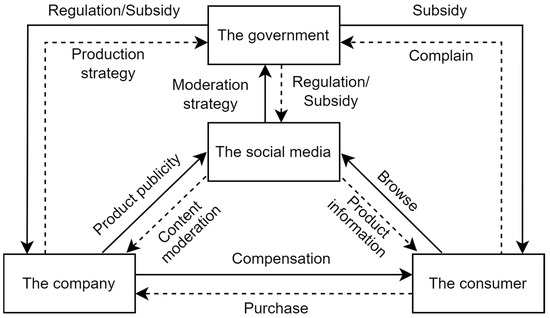
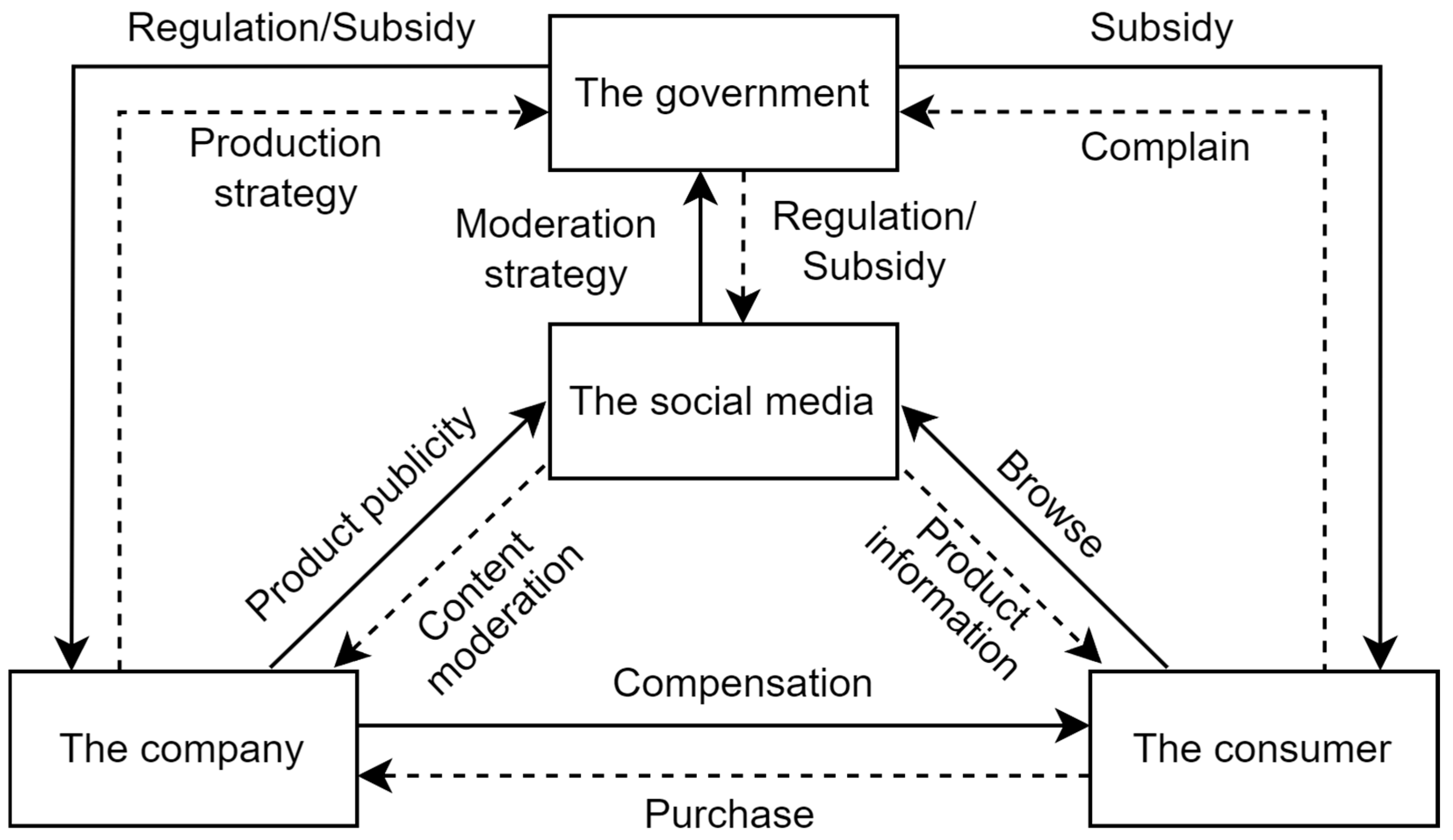
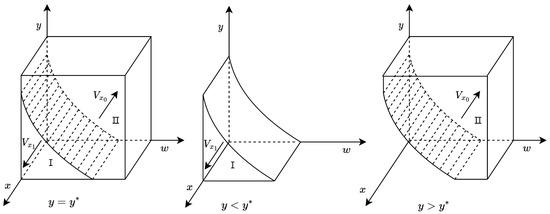
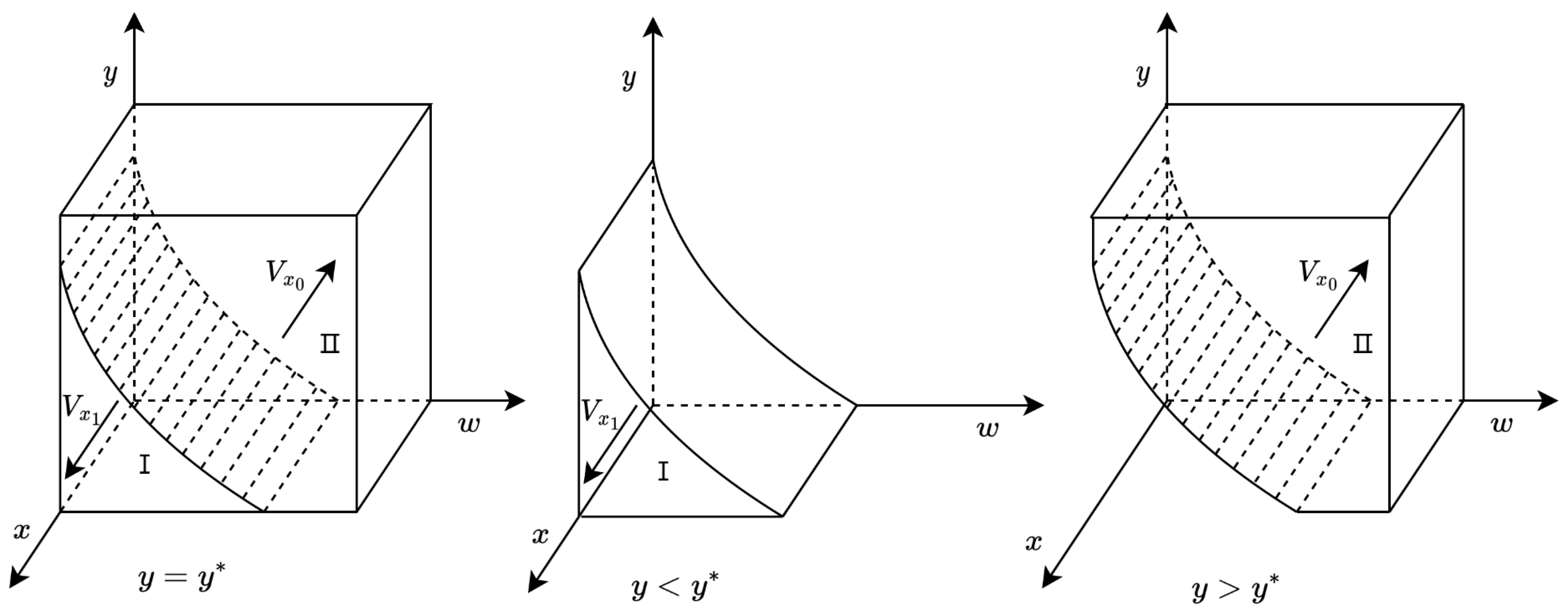
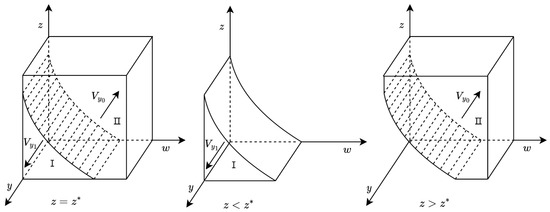
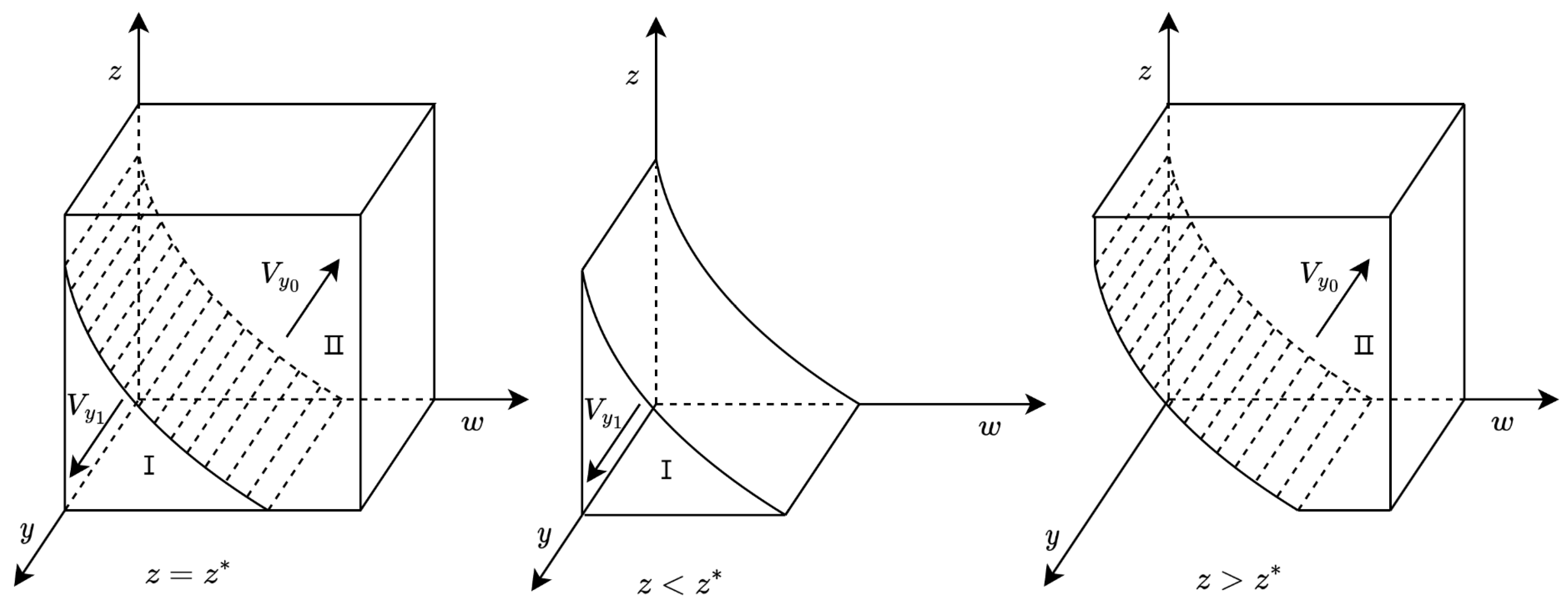
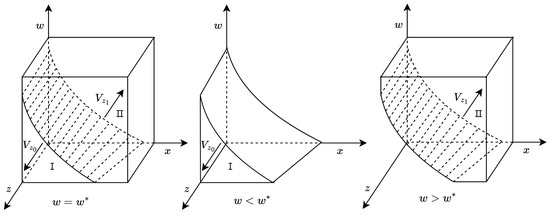
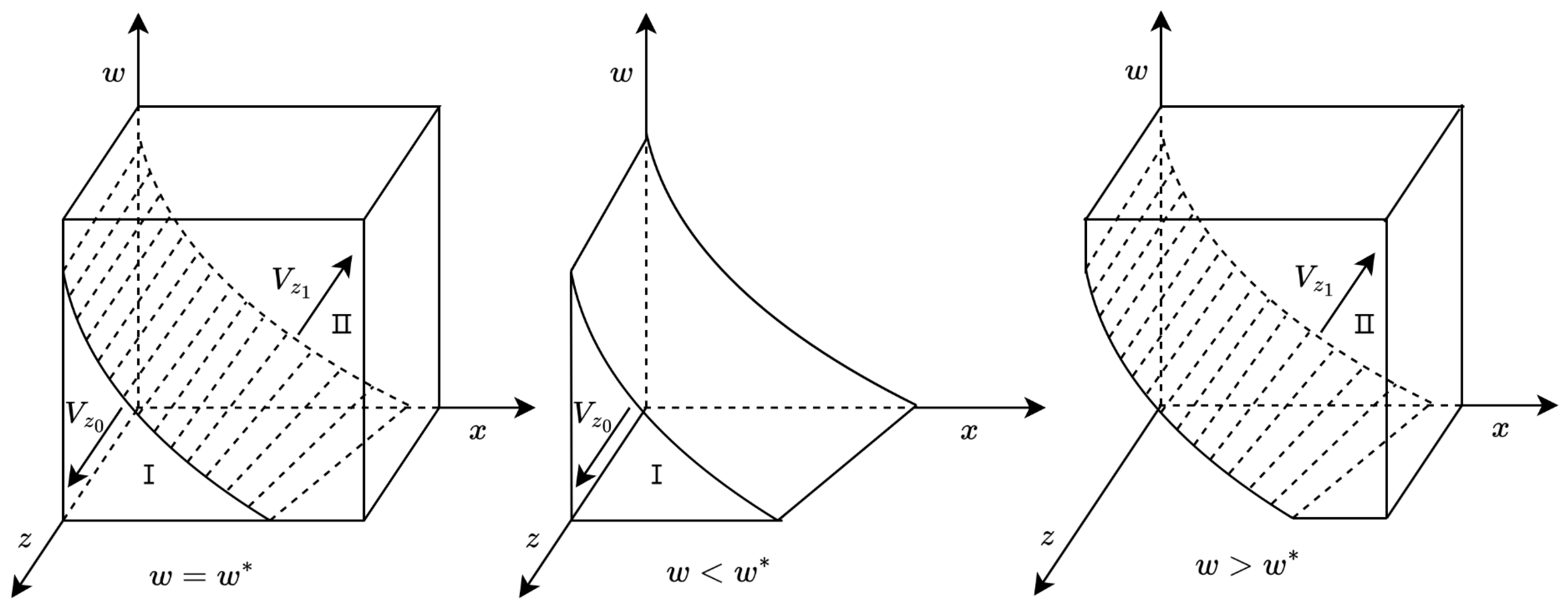
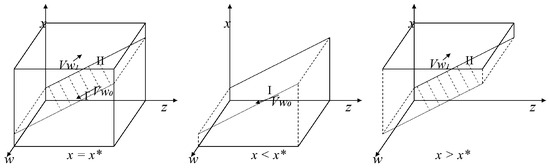
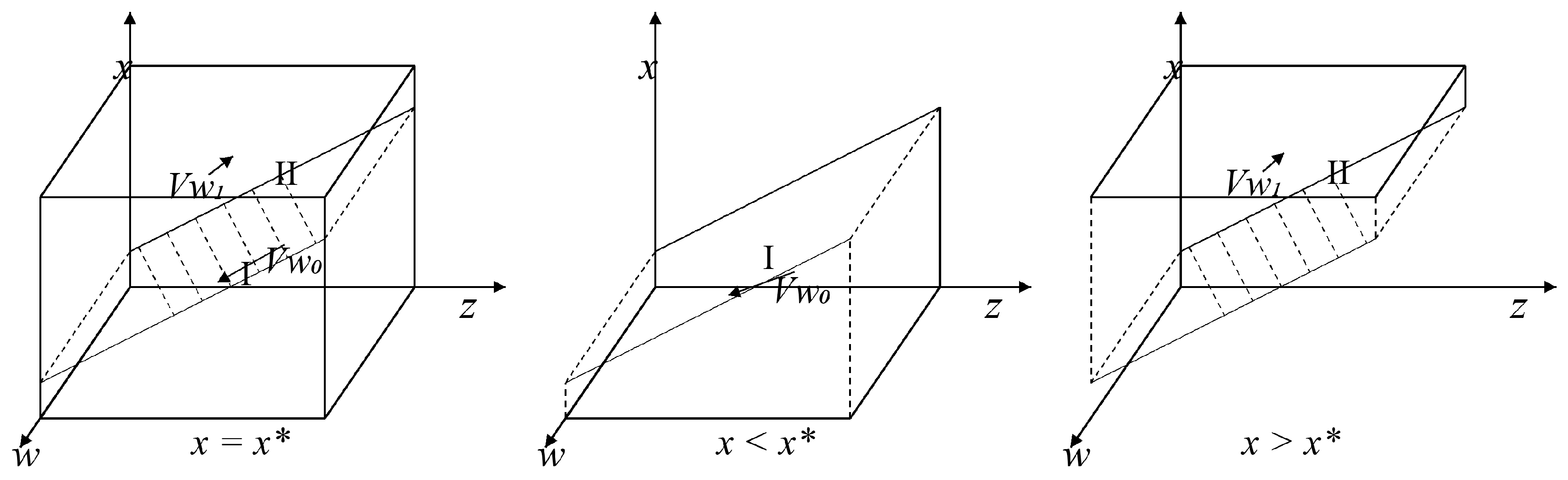
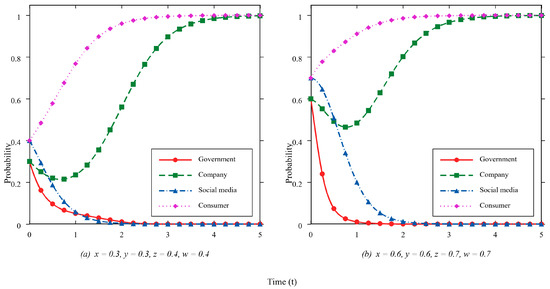
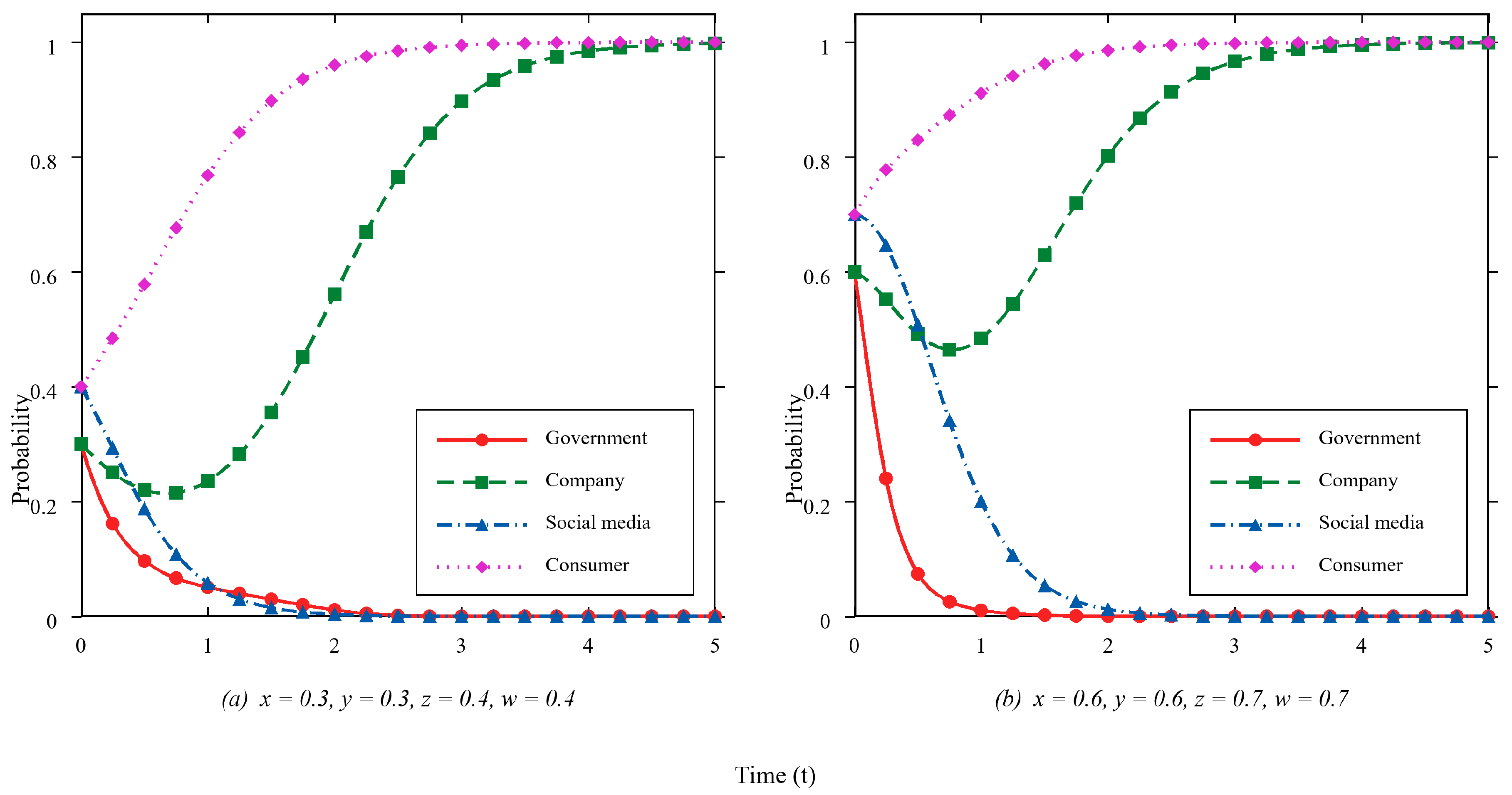
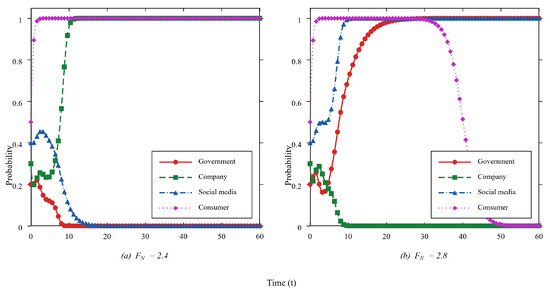
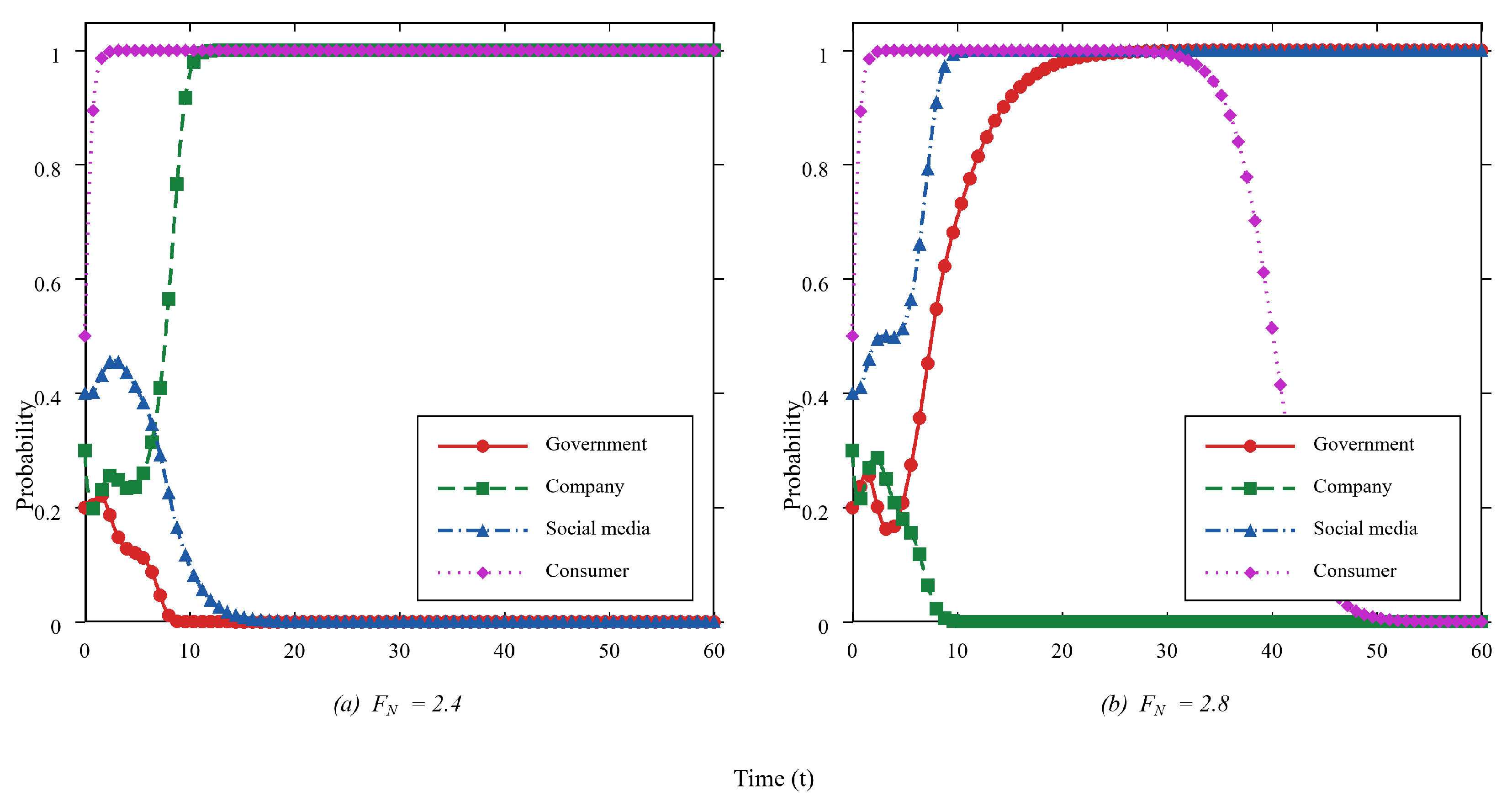
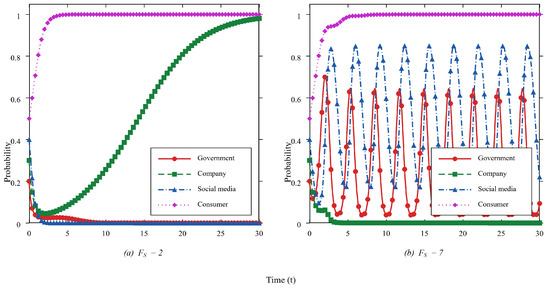
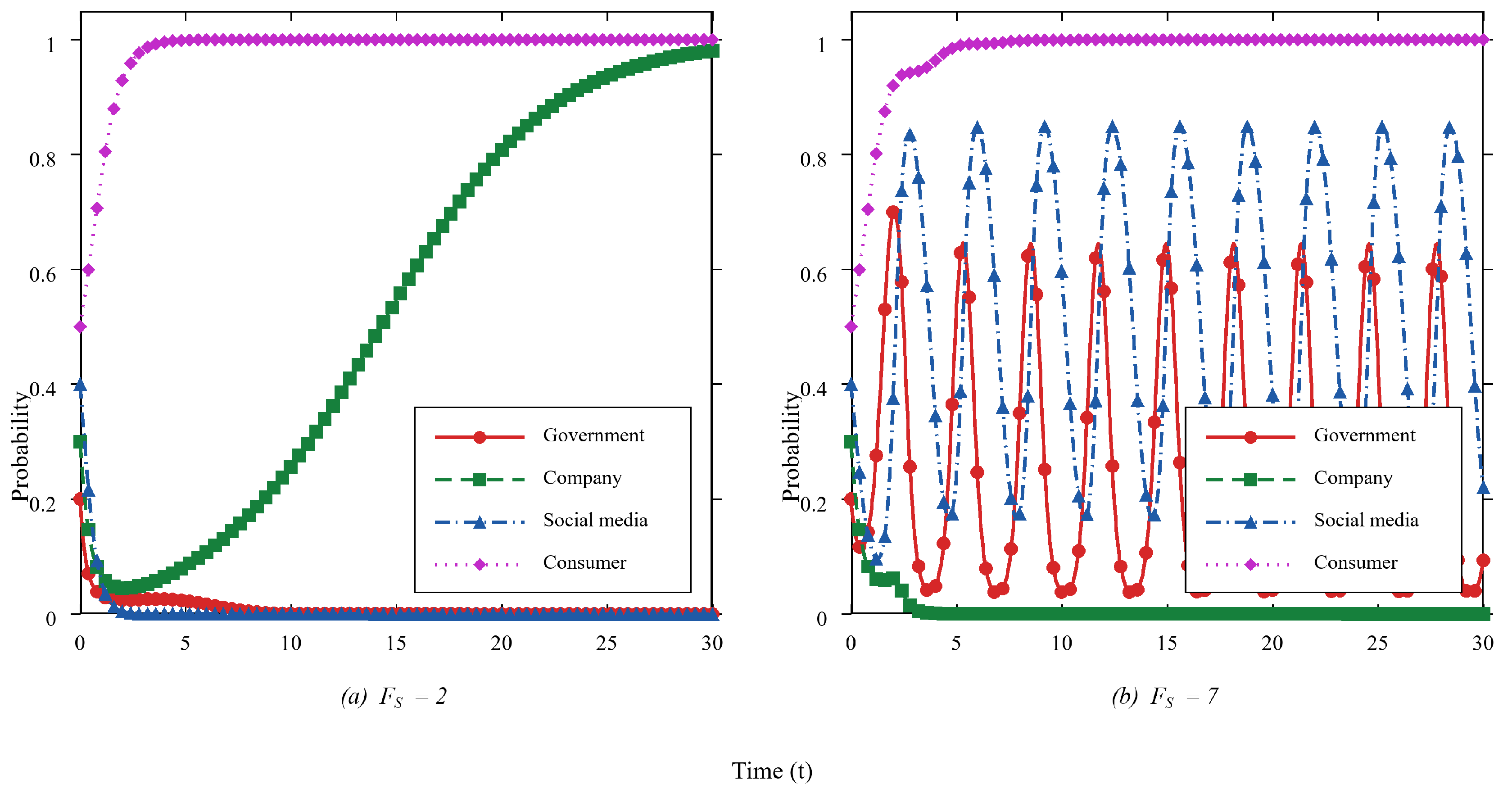
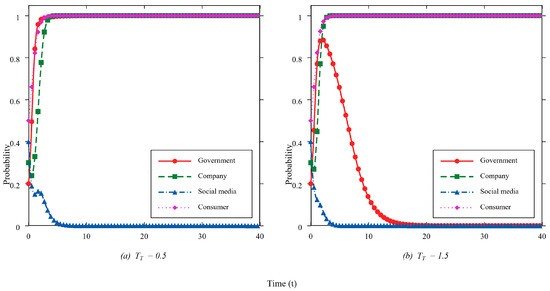
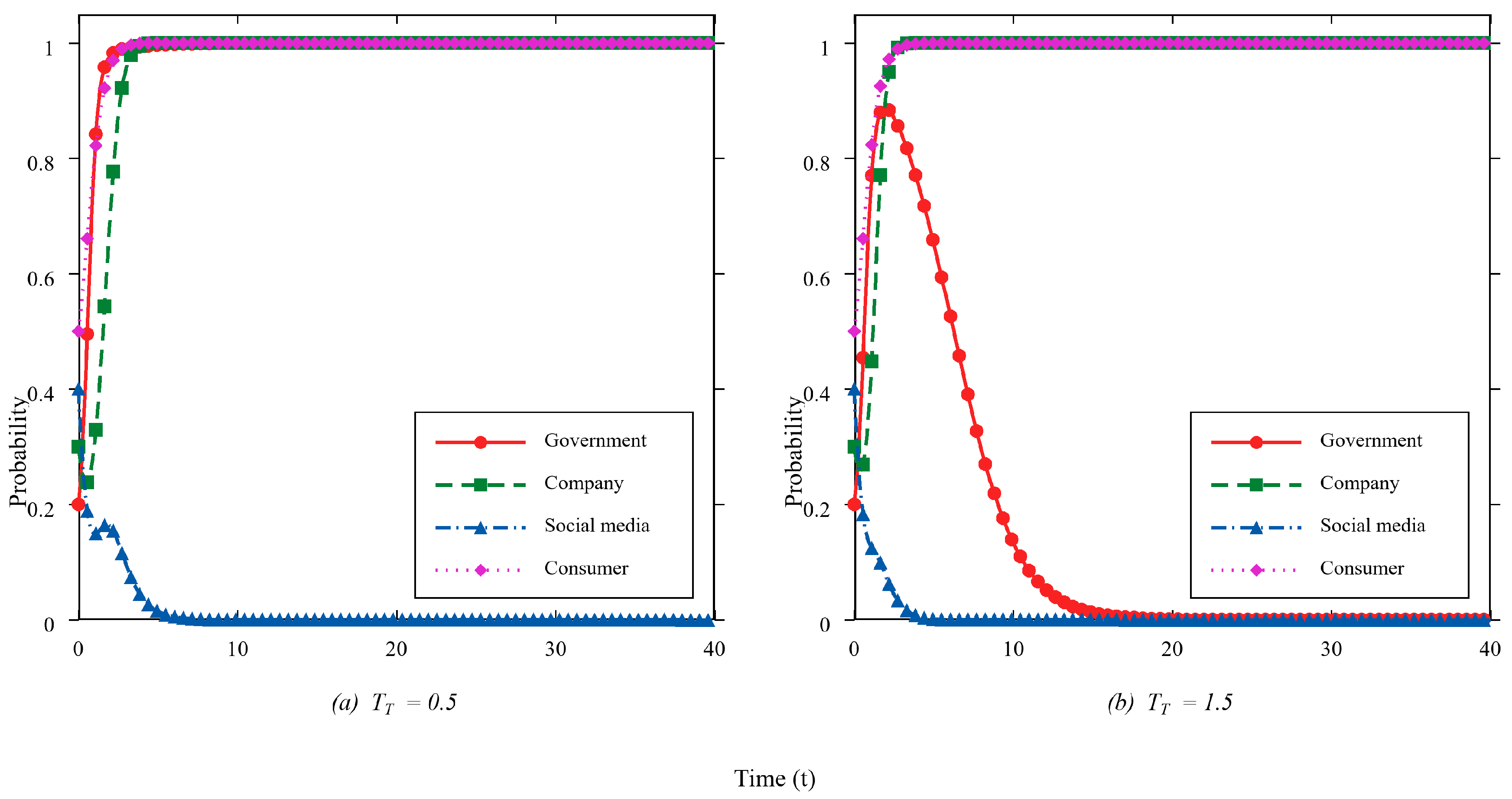
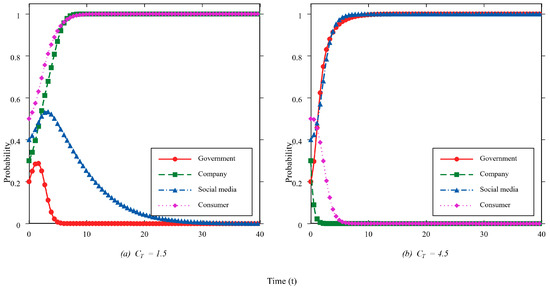
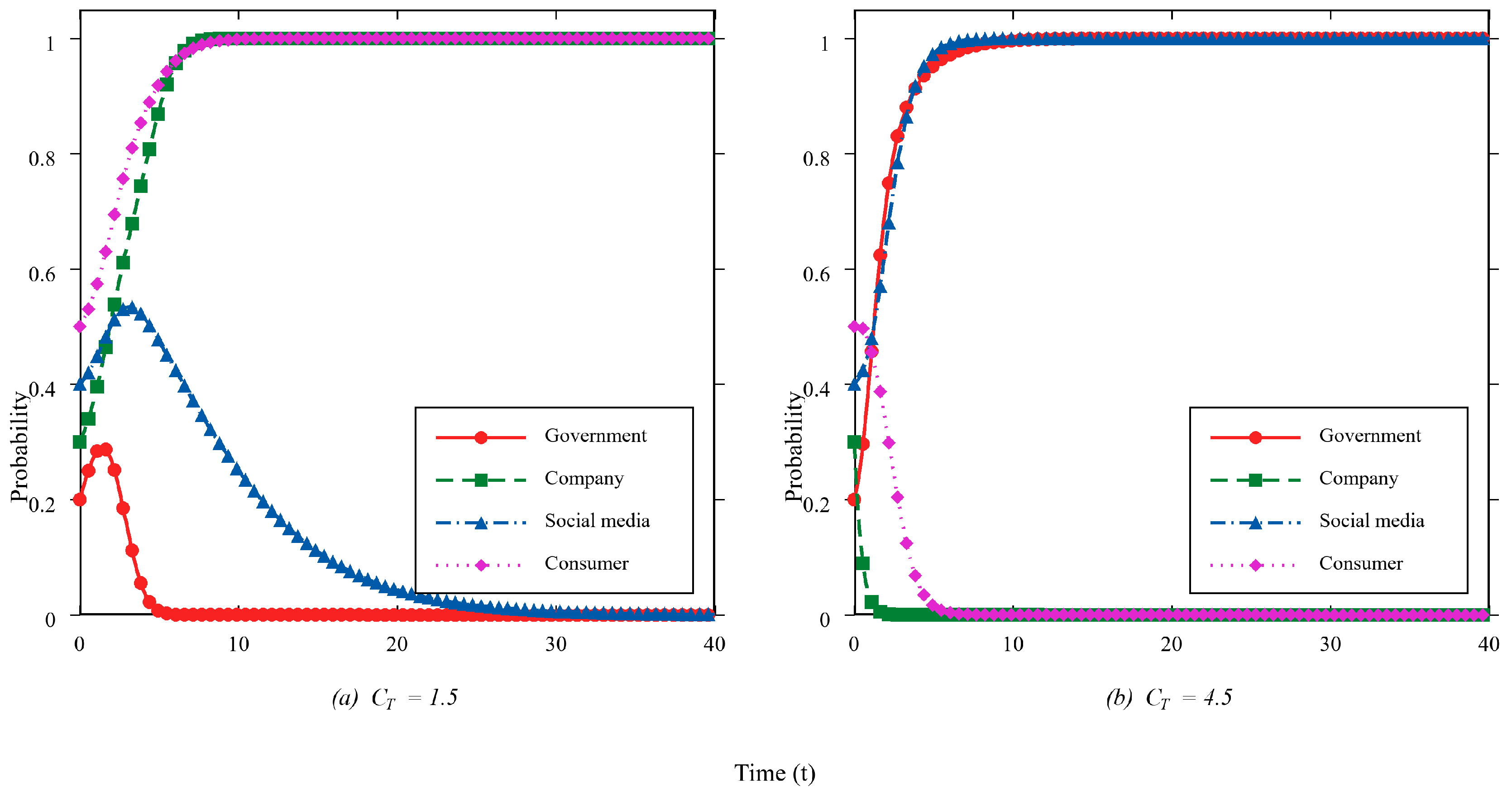
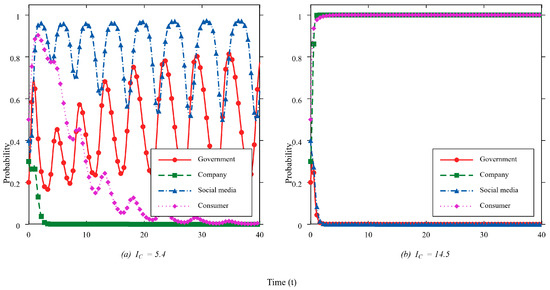
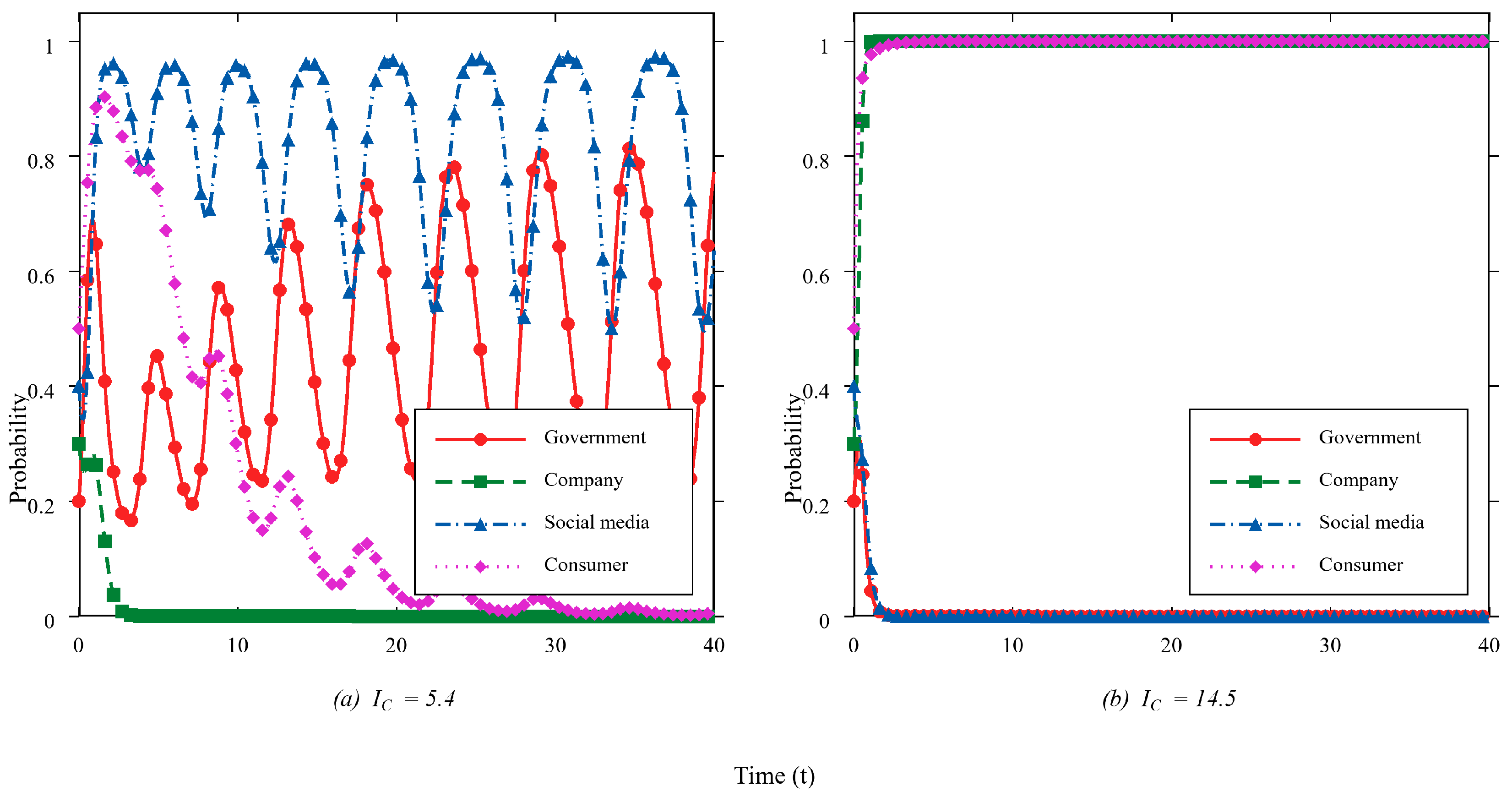
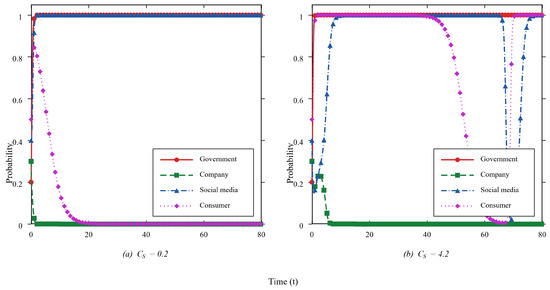
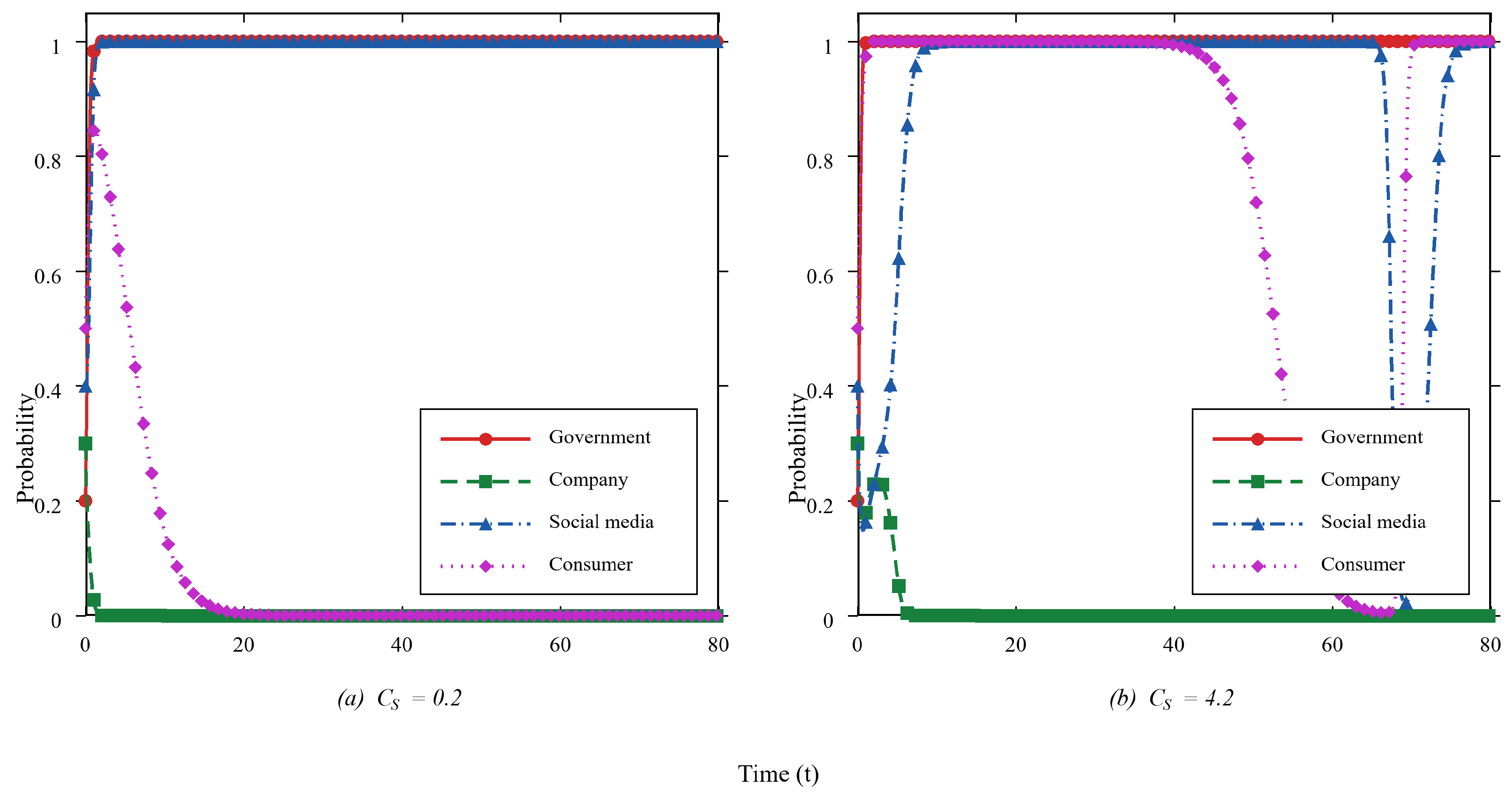
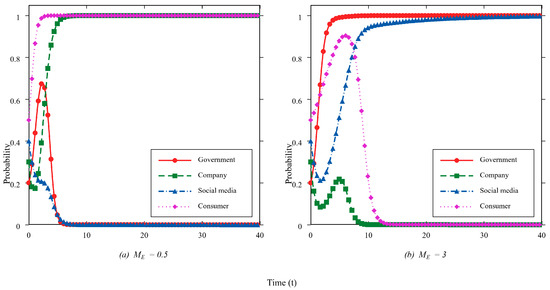
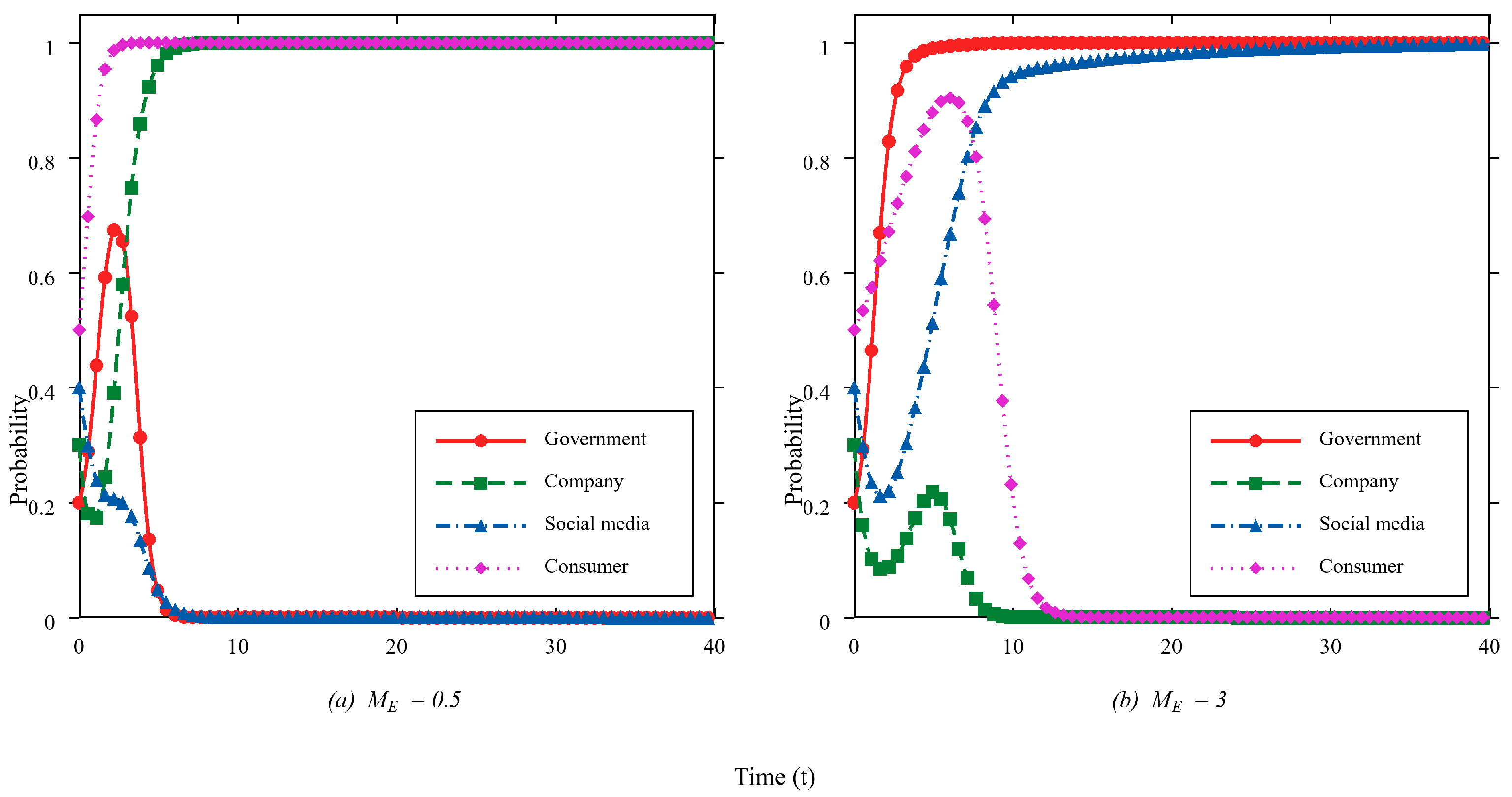

Disclaimer/Publisher’s Note: The statements, opinions and data contained in all publications are solely those of the individual author(s) and contributor(s) and not of MDPI and/or the editor(s). MDPI and/or the editor(s) disclaim responsibility for any injury to people or property resulting from any ideas, methods, instructions or products referred to in the content. |
© 2026 by the authors. Licensee MDPI, Basel, Switzerland. This article is an open access article distributed under the terms and conditions of the Creative Commons Attribution (CC BY) license.