


Abstract
This study analyzes the characteristics and functioning of -functions, -homeomorphisms, and -homeomorphisms in generalized topological spaces . A few important points to emphasize are -continuous functions, -irresolute functions, perfectly -continuous, and strongly -continuous functions in and generalized primal topological spaces . Some specific kinds of functions, such as -open mappings and -closed mappings, are discussed. We also analyze the , providing a thorough look at the way these functions work in this specific context. The goal here is to emphasize the concrete implications of functions and to further the theoretical understanding of them by merging different viewpoints. This work advances the area of topological research by providing new perspectives on the behavior of functions and their applicability in various topological settings. The outcomes reported here contribute to our theoretical understanding and establish a foundation for further research.
Keywords:
generalized primal topological space; τg–MSC:
54A05; 54A10; 54A20
1. Introduction
Studying different kinds of functions and their characteristics is essential to expanding our knowledge of topological structures and how they relate to each other in the framework of . In topological space, Levine [1] initiated the generalized set. Numerous authors [2,3,4,5,6,7,8,9,10] have examined generalized sets, their generalizations, and related notions that are comparable. General topology is crucial in many domains of mathematics and the applied sciences. In actuality, it is utilized in particle physics, quantum physics, computer-aided geometric design, digital topology, computational topology for computer-aided design, data mining, and computational topology for geometric and molecular design.
Csaszar established the idea of generalized topological spaces in [10,11,12,13] and investigated these classes’ elementary nature. Refs. [14,15,16] provided a generalized continuous map in topological space. In particular, refs. [6,15,17,18,19] explored the notion of generalized continuous functions and proposed the ideas of continuous functions on generalized topological spaces and generalized primal topological spaces. We revisit certain concepts delineated in [19]. Of these functions, the function has drawn a great deal of attention because of its prospective applications and capacity for merging ideas from other topological frameworks. Several important topics are covered in this paper’s exploration of the function in the context of , including -continuous, -irresolute, perfectly -continuous, and strongly -continuous functions. We also explore more specialized forms such as functions that are -open and -closed mappings. The objective of this study is to expand current theories and gain new insights by investigating these qualities in . Moreover, this study broadens the scope of our analysis to the , offering a thorough explanation of the behavior of these -functions, -homeomorphisms, and -homeomorphisms in this more focused context. With its distinct structure and properties, the provides an extensive framework for studying the subtleties of functions, -homeomorphisms, and -homeomorphisms along with their interactions.
This paper is organized as follows. In the following Preliminaries section, we present the definitions and key terms required to comprehend functions. The Main Results section is split into four subsections. The first of these explores -continuous, -irresolute, perfectly -continuous, and strongly -continuous functions along with -open and -closed mappings and other features of functions in generalized topological spaces. The second subsection deal with the preservation of topological structures under -homeomorphisms and -homeomorphisms in a generalized topology. The analysis is expanded to functions in generalized primal topological spaces in the third part, encompassing the same features as in the generalized case within the more challenging primal framework. The discussion in the fourth and final subsection involves generalized primal topological spaces, namely, -homeomorphisms and -homeomorphisms, discusses the behavior of these functions in the primal context, and contrasts its characteristics with those of the generalized topology. In conclusion, we provide a summary of our research and suggest future possibilities for investigation. By providing a new perspective on the behavior of these functions in diverse topological spaces, our research aims to advance knowledge of topological functions’ features and consequences.
2. Preliminaries
The purpose of this section is to explain the main results through a discussion of various definitions and results from the literature.
Definition 1
([20]). Consider that . A generalized topology on is defined as a collection if and if all unions of non-empty subsets of are components of . The is the pair , .
Remark 1
([10]). The members of are indicated as -open. We consider to be any subset of , . is considered as -closed if ∖ is -open. -closure of is indicated by . is the intersection of all -closed sets that contain . -interior is represented as . Finally, is the union of all -open sets contained in .
Definition 2
([21,22,23,24]).
- 1.
- Assume that , is a . Let be any subset of . is generalized semi-open if there is a -open set in such that ⊆ (), or, appropriately, if ()).
- 2.
- A generalized semi-closed set is the complement of a generalized semi-open set. The family of all generalized semi-open sets in . is indicated as -SO.
- 3.
- The union of all generalized semi-open sets of contained in is the generalized semi-interior of (briefly, ()).
- 4.
- Generalized semi-closure of (briefly, ()) is the intersection of all generalized semi-closed sets of containing .
Definition 3.
- 1.
- Consider , as a . A subset of is generalized semi-generalized closed (briefly, -closed) if Cl ⊆ whenever ⊆ and is generalized semi-open in . Similarly, -closed) is generalized semi-generalized open, and is indicated as -open.
- 2.
- The generalized semi-generalized interior (briefly, ) of is specified as the union of all -open sets of contained in .
- 3.
- Assuming a subset of , , the generalized semi-generalized closure (briefly, ) of is termed as the intersection of all -closed sets in containing .
Definition 4.
Assume , to be a ; any subset of generalized topological space is termed as generalized S-open set (briefly, --open) if there exists a -open set in such that ⊆ ⊆ . The collection of all --open sets in , is represented by O, .
Definition 5
([8,25]). Consider ≠ ϕ. A collection of is indicated as primal on if the following criteria are met:
- 1.
- ∉.
- 2.
- For , ⊆ has ⊆ such that ∉ if ∉ .
- 3.
- For , ⊆ ; then, ∩ ∉ whenever ∉ and ∉ .
A pair , with a primal on is termed generalized primal topological space , symbolized as , , . The members of , , are known as , -open sets, while their complements are considered , -closed sets.
Definition 6
([26]). Consider , , to be a . Suppose an operator : → , defined as ∪, for a subset of . Here, is a Kuratowskis closure operator.
Definition 7
([27]).
- 1.
- Assume that , , is a . A subset of , , is generalized primal semi-open if there exists a -open set in such that ⊆ ⊆ , or equivalently if Int.
- 2.
- The generalized primal semi-closed set is the complement of the generalized primal semi-open set. Thus, , , is the collection of all generalized primal semi-open sets in , , .
- 3.
- The , semi-interior of (briefly, , sInt) is the union of all generalized primal semi-open sets of contained in .
- 4.
- The intersection of all generalized primal semi-closed sets of containing is , (semi-closure of , briefly , sCl).
Definition 8
([28]). Assume , and , as . The mapping → is termed a -continuous function if there is an inverse image that is -open in , for every -open set in , .
3. Main Results
This instance summarizes the main results of our study on functions, -homeomorphisms, and -homeomorphisms, emphasizing how they behave in generalized primal topological spaces as well as generalized topological spaces. Four subsections make up this section, each focusing on particular characteristics of functions, -homeomorphisms, and -homeomorphisms in various topological frameworks.
3.1. Functions in
The fundamental characteristics and definitions of - functions in are covered in this section. We first define --continuous and --irresolute functions, then examine their properties and how they go beyond the ideas of standard continuity. After that, the topic of --open and --closed mappings are discussed, along with their functions and ramifications in these generalized frameworks. Strongly --continuous and perfectly --continuous functions are examined at the section’s conclusion, emphasizing their significance for comprehending advanced topological aspects.
3.1.1. --Continuous Functions
Definition 9.
Assume , and , as . If is a -semi-open set in , for all -open sets ∈, , then the mapping → is indicated as -semi-continuous.
Definition 10.
Assume , and , as . If is a –Sg-closed set in , for all -closed sets ∈, , then the mapping → is indicated as –Sg-continuous.
Definition 11.
Assume , and , as . The function → is indicated as –-continuous if there is an inverse image that is –-open in , for every -open set in , .
Theorem 1.
Every -continuous function is –-continuous.
Proof.
Consider the mapping : → to be a -continuous function; then, according to Definition 8, ∀∈, , is -open in , . As every -open is –-open ⇒ is –-open in , ; thus, → is –-continuous. □
Remark 2.
The subsequent illustration indicates that the converse of Theorem 1 is not valid.
Example 1.
Suppose d, k, q}, w, m} and , , {d along with O, , , {d}, {d, k}, {d, q and = , , {w. Define , → , by and . Here, wd, , which is –O but not -open. Hence, is –-continuous but not -continuous.
Theorem 2.
Every –-continuous function is -semi-continuous.
Proof.
Assume that , → , is a –-continuous mapping. Consider as a -open set in , . Because is a –-continuous function, ⇒ is a –-open set in . Notably, every –-open set is -semi-open; consequently, is a -semi-open set in ⇒ and is -semi-continuous. □
Remark 3.
As illustrated below, the converse of Theorem 2 is false.
Example 2.
Suppose d, k, q}, w, m, v} and , {d}, {q}, {d, qO, . = , {w, m. Define , → , by (k) = m and (q) = v. Here, w, d, , which is -semi-open but not –O. Hence, is -semi-continuous but not –-continuous.
Theorem 3.
Every –-continuous function is –Sg-continuous.
Proof.
Assume , → , is a –-continuous mapping. Consider as a -open set in , . Because is –-continuous ⇒, is --open in . As every –-open set is –Sg-open ⇒ is –Sg-open in . Thus, is –Sg-continuous. □
Remark 4.
The subsequent illustration demonstrates that the converse of Theorem 3 is not valid.
Example 3.
Suppose that d, k, q}, w, m, v} and , {d}, {q}, {d, qO, . = , {w, m. Define , → , by , and . Here, w, d, which is –Sg-open but not -O. Hence, is –Sg-continuous but not –-continuous.
Theorem 4.
If , → , is –-continuous and , → , is -continuous, then , → , is –-continuous.
Proof.
Consider as -open in . Because is -continuous ⇒, is -open in . Furthermore, is –-continuous ⇒ is --open in . Consequently, = is –-open in ⇒ is –-continuous. □
Theorem 5.
Assume and as and a mapping , → , from to . Then, is --continuous iff every -closed set in has an inverse image that is –-closed in .
Proof.
Necessity: Assume to be any -closed set in ⇒∖ is -open in . Because is –-continuous ⇒, ∖ is --open in . Consequently, ∖ = ∖ is --open in . Hence, is --closed in .
Sufficiency: Assume is -open set in ⇒∖ is -closed in . According to the presumptions, ∖ is --closed in . Consequently, ∖ = ∖ is --closed in ⇒ is --open in . Thus, is --continuous. □
Theorem 6.
If , → , is --continuous, then -Cl ⊆ .
Proof.
Because ⊆ , ⊆ ). As is –-continuous and is a -closed set in ⇒) is --closed set in . Consequently, -Cl ⊆ ) ⇒-Cl ⊆ . □
Theorem 7.
Assume two generalized topological spaces , and , . If , → , , then the subsequent illustrations are equivalent.
- 1.
- is --continuous.
- 2.
- For every -closed set in , there is an inverse image that is --closed in .
- 3.
- -Cl⊆∀∈.
- 4.
- -Cl⊆∀ in .
- 5.
- ⊆-Int for every in .
Proof.
(1) ⇒ (2) indicated by Theorem 5.
(2) ⇒ (3) assume any subset of . Then, Cl is in . Consequently, according to (2), is --closed in . Hence, = -Cl) ⊇-Cl.
(3) ⇒ (4) let be any -open subset of . By (3), ⊇-Cl⊇-Cl. Hence, -Cl ⊆ .
(4) ⇒ (5) assume -Cl ⊆ for every ∈. Then, -Cl ⊆ ) ⇒-Cl ⊇)) –Int). Then, –Int⊇ for every set in .
(5) ⇒ (1) consider to be any -open in ⇒ ⊆ -Int⇒ ⊆ -Int. Additionally, ⊇-Int. Hence, -Int. Consequently, is --open in ⇒ (1). □
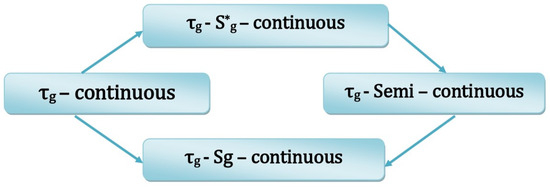
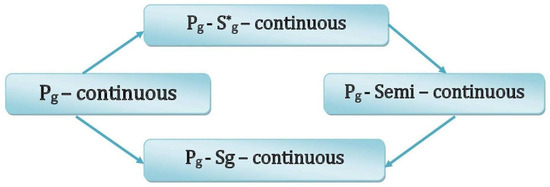
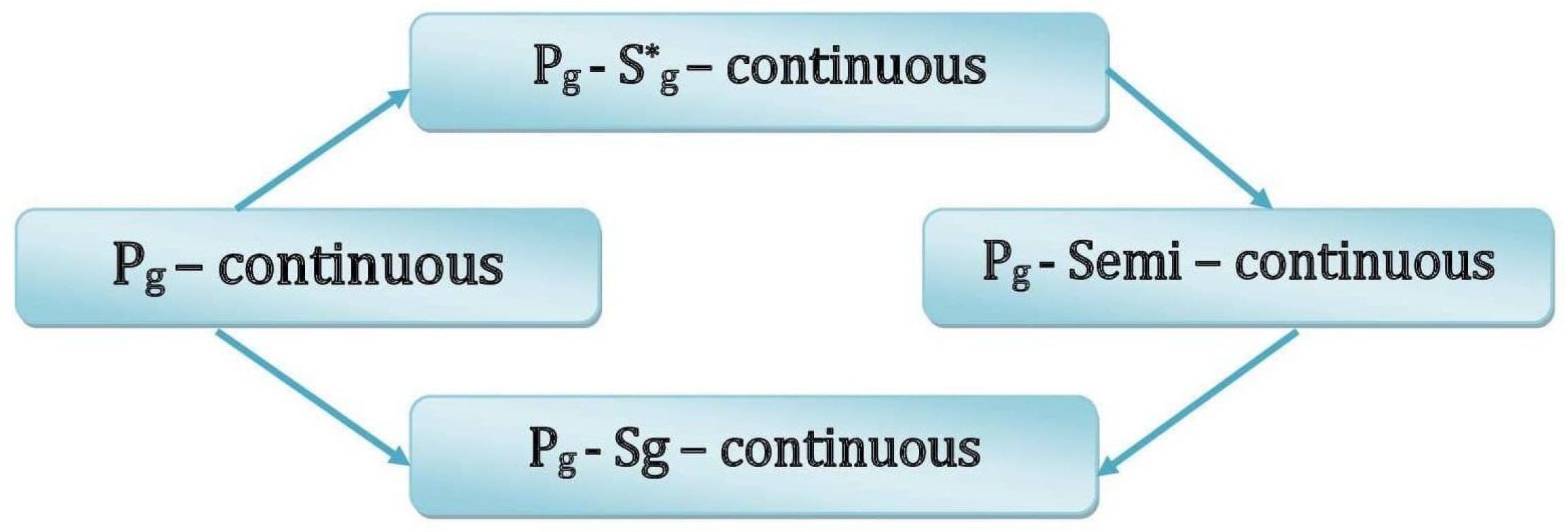
Now we provide the relationship of the above theorems in Figure 1.
Figure 1.
The relations of all theorems above concerning mappings.
3.1.2. --Irresolute Function
Definition 12.
Assume , and , as . A map , → , is --irresolute if for every --open set in , there is an inverse image that is --open in .
Similarly, a map , → , is --irresolute if for every --closed set in , there is an inverse image that is --closed in .
Theorem 8.
If , → , is a --irresolute map then is –-continuous.
Proof.
Assume to be an -open set in . Subsequently, every -open set is --open ⇒ is --open in . Because is --irresolute ⇒, is --open in . Thus, is --continuous. However, the converse of this statement is invalid. □
Example 4.
Suppose = {d, k, q, , {d}, {q}, {d, q}, O, , = , {d}, {d, k}, and , O = , {d}, {d, k}, {d, q}, . Define , → , by , and . Here, d, qk, , which is not -O in . Hence, is not –-irresolute.
Theorem 9.
Assume , , , and , as . If , → , is --irresolute and , → , is --irresolute, then , → , is --irresolute.
Proof.
Assume is --open in . As is --irresolute, is --open in . Additionally, is --irresolute, and is --open in . Consequently, = is --open in . Hence, is --irresolute. □
Theorem 10.
If , → , is --irresolute and , → , is --continuous, then , → , is --continuous.
Proof.
Assume to be a -open set and to be --open in . As is --continuous, is --open in . Additionally, is --irresolute, is --open in . However, = . Hence, is --continuous. □
3.1.3. Strongly –-Continuous Function
Definition 13.
Consider , and , to be any two . A mapping , → , is called strongly –-continuous if for every –-open set in there is an inverse image that is -open in .
Theorem 11.
If , → , is strongly --continuous, then is a -continuous function.
Proof.
Assume to be any -open set in . Because every -open set is –-open ⇒, is –-open in . Because , → , is strongly --continuous ⇒ is -open in . Hence, is -continuous. However, the converse does not hold, as demonstrated by the illustration below. □
Example 5.
Assume = {d, k, q, , {d}, {q}, {d, q}, and = , {d}, {d, k}, . Define , → , by , and . Here, O, , {d}, {q}, {d, q}, and , O = , {d}, {d, k}, {d, q}, ⇒ is -continuous but not strongly –-continuous, as d, qk, , which is not -open in .
Theorem 12.
The mapping , → , is strongly –-continuous if and only if for every –-closed set in there is an inverse image that is -closed in .
Proof.
Consider , → , as strongly –-continuous. Assume to be any –-closed set in . Then, is –-open in . Because is strongly –-continuous ⇒, is -open in . However, ∖∖. Hence, is -closed in .
Conversely, for every –-closed set in , consider an inverse image that is -closed in . Assume to be any –-open set in ⇒ is –-closed set in . Now, is -closed in but ∖. Hence, is -open in ⇒, → , is strongly --continuous. □
Theorem 13.
Consider , → , as strongly –-continuous and the mapping , → , as –-continuous; then, , → , is -continuous.
Proof.
Assume to be any -open set in . As is –-continuous is --open in . Furthermore, is strongly –-continuous, is -open in . Therefore, = is -open in . Hence, is -continuous. □
Theorem 14.
Consider , , is strongly –-continuous and the mapping , , is –-irresolute. Then, , , is strongly --continuous.
Proof.
Assume to be any –-open set in . As is –-irresolute is --open in . Furthermore, is strongly –-continuous, is -open in . Therefore, is -open in . Hence, , , is strongly –-continuous. □
Theorem 15.
Consider , , as –-continuous and the mapping , , as strongly –-continuous; then, , , is –-irresolute.
Proof.
Let be any –-open set in . As is strongly –-continuous is -open in . Furthermore, is –-continuous, is –-open in . However, . Hence, , , is –-irresolute. □
3.1.4. Perfectly –-Continuous Function
Definition 14.
Consider , and , as . A mapping , , is called perfectly –-continuous if for every –-open set in there is an inverse image that is -open and -closed in .
Theorem 16.
If a mapping , , is perfectly –-continuous, then is strongly –-continuous.
Proof.
Assume to be any –-open set in . Because , , is perfectly –-continuous is -open in . Hence, is strongly --continuous. The subsequent illustration demonstrates why the contrary of this theorem need not be true. □
Example 6.
Assume , . Define an identity map , , . Thus, is –-continuous but not perfectly –-continuous, as is -open in but not -closed in .
Theorem 17.
A mapping is perfectly –-continuous iff for every --closed set in there is an inverse image that is both -open and -closed in .
Proof.
Consider as perfectly --continuous. Let be any --closed set in . Then, is a –-open set in . Because is perfectly –-continuous, is both -open and -closed in . However, . Hence, is both -open and -closed in .
Conversely, consider that for every –-closed set in there is an inverse image that is both -open and -closed in . Assume to be any --open set in is --closed set in . Because is both -open and -closed in . But, . Hence, is both -open and -closed in is perfectly --continuous. □
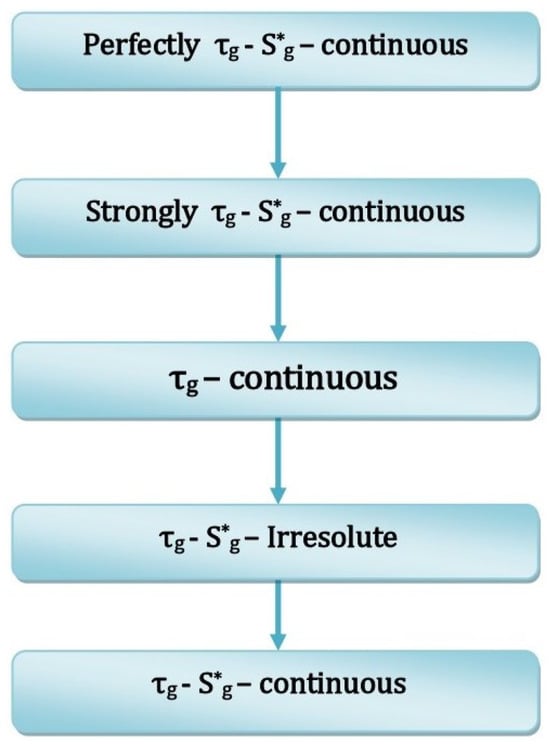
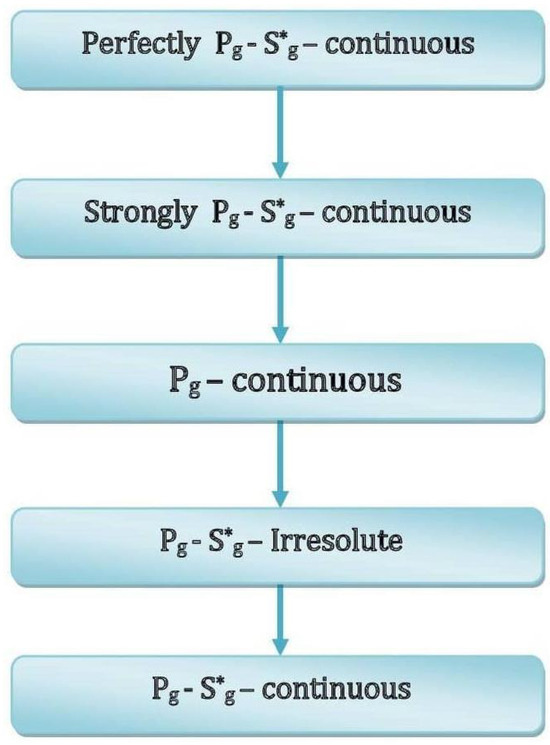
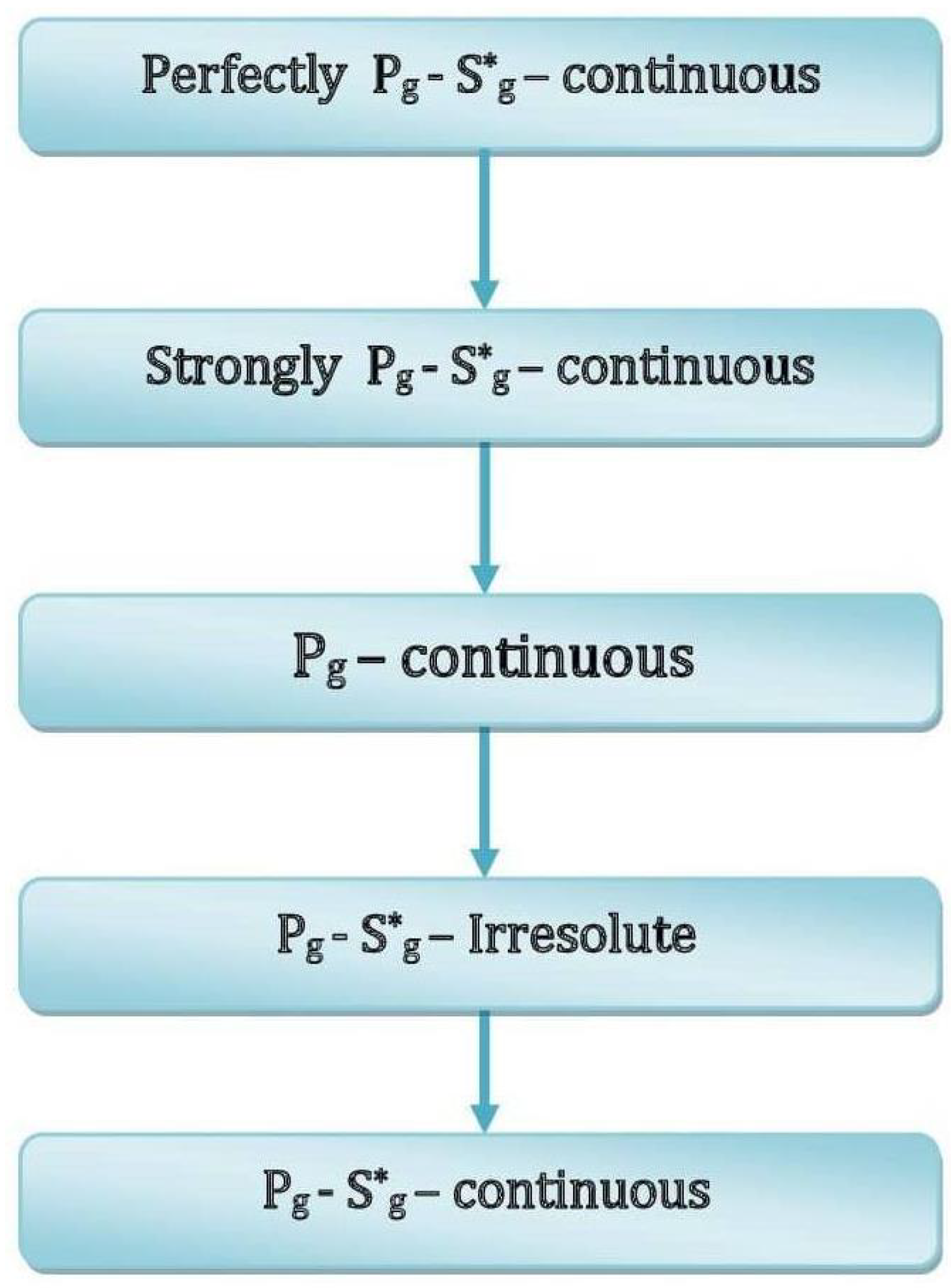
Now we provide a relationship of the above theorems in the below Figure 2.
Figure 2.
The relations of all the above theorems concerning mappings.
3.1.5. –-Open Map
Definition 15.
Assume and as . A map is a –-open map if for every -open set in is --open in .
Theorem 18.
If is a -open map, then is a --open map.
Proof.
Assume to be any -open set in ; then, is -open in . Because every -open set is –-open, is –-open in . Hence, is a –-open map. However, the converse is invalid. □
Example 7.
Assume and . Define by and . Here, , which belongs to -O in but does not belong to . Hence, the inverse image is –O but not -open.
3.1.6. –-Closed Map
Definition 16.
Assume and as . A map is said to be a –-closed map if for every -closed set in is --closed in .
Theorem 19.
If is a -closed map, then is a --closed map.
Proof.
Assume to be any -closed set in ; then, is -closed in . Because every -closed set is –-closed is –-closed in . Hence, is –-closed map. The subsequent example demonstrates that the converse is invalid. □
Example 8.
Assume and . Define by and . Here, d, q, which belongs to -C in but does not belong to -closed ⇒ inverse image is -C but not -closed.
Theorem 20.
If is -closed and is –-closed, then is –-closed.
Proof.
Assume to be any -closed in . Because is a -closed map, is -closed in . Furthermore, is –-closed is –-closed in . Hence, is a –-closed map. □
3.2. –-Homeomorphism and –-Homeomorphism
The idea of a –-homeomorphisms is introduced and analyzed in this part, with an emphasis on how to maintain the structure of -open and -closed sets as we proceed between generalized topological spaces. We have discovered a new type of mapping that is weaker than –-homeomorphism, known as –-homeomorphism. According to the composition of mappings, the –-homeomorphism subclass of the –-homeomorphism class is closed.
3.2.1. –-Homeomorphism
Definition 17
([10]). Assume to be a generalized topological space and to be any subset of ; then, is known as:
- 1.
- Generalized closed (g-closed), if for any open set of we have Cl whenever .
- 2.
- Generalized semi-closed (gs-closed), if for any open set of we have sCl whenever .
- 3.
- Semi-generalized closed (sg-closed), if for any semi-open set of we have sCl whenever .
Definition 18.
Assume that a mapping from a generalized topological space into a generalized topological space is called:
- 1.
- Generalized continuous (briefly, -continuous) if for each closed in is g-closed in .
- 2.
- Generalized semi-continuous (briefly, -continuous) if for each closed in is gs-closed in .
- 3.
- Semi-generalized continuous (briefly, -continuous) if for each closed in is sg-closed in .
Definition 19.
Assume that a bijective mapping from a generalized topological space into a generalized topological space is called:
- 1.
- A -homeomorphism if and are both -continuous.
- 2.
- A -homeomorphism if and are both -continuous.
- 3.
- A -homeomorphism if and are both -continuous.
Definition 20.
A bijection function from a generalized topological space into a generalized topological space is called a -homeomorphism if is both -continuous and -open.
Theorem 21.
For any bijection from a generalized topological space into a generalized topological space , the following are equivalent:
- 1.
- The inverse function is –-continuous.
- 2.
- is a –-open function.
- 3.
- is a –-closed function
Proof.
Because is a bijection from a generalized topological space into a generalized topological space ,
1 ⇒2, as is -continuous. Moreover, is -open in whenever is -open in is -open.
2 ⇒3, as is --open. If is -closed, is -open; then, is --open, that is, is --open is --closed, that is, is --closed.
3 ⇒1. If is -open in is -closed is --closed, that is, is --closed in is ––-open in . Hence, is –-continuous. □
Definition 21.
A bijection function from a generalized topological space into a generalized topological space is called a –-homeomorphism if is both –-continuous and –-open.
Theorem 22.
Any bijection function from a generalized topological space into a generalized topological space which is –-continuous has the analogous statements listed below:
- 1.
- The function is –-open.
- 2.
- is –-homeomorphism.
- 3.
- is a –-closed function
Proof.
1⇒2 Since is both --continuous and --open, is --homeomorphism.
2⇒3 is –-continuous and is –-homeomorphism is –-open; hence, it is –-closed by Theorem 21.
3⇒1 is a --closed is a --open by the Theorem 21. □
Remark 5.
From the subsequent illustrations, a composition of two –-homeomorphisms need not be a –-homeomorphism.
Example 9.
Let and . Consider and defined by , , and and , , and , respectively. Then, and are –-homeomorphisms; however, the composition o is not a –-homeomorphism.
Example 10.
Let d, k, q, w}, , {d, k}, {q, w}, , , {d}, {k}, {d, k}, {d, k, q}, and , {d}, {d, k}, {d, k, q}, be generalized topologies on , and , respectively. Then, the mappings , → , and , → , are defined by , and , , , , , . Here, and are both –-homeomorphisms, but is not a –-homeomorphism.
Theorem 23.
Every -homeomorphism is a –-homeomorphism.
Proof.
Assume , → , to be a -homeomorphism. If is an open set in , then is -open in , as is a -open function. Hence, is --open and is a –-open function. Further, the -continuity ⇒ is –-continuous, that is, is a –-homeomorphism. □
Remark 6.
The converse of the above Theorem 23 is invalid, as demonstrated by the subsequent illustrations.
Example 11.
Suppose d, k, q}, w, m} and , , {d and O, , , {d}, {d, k}, {d, q. = , , {w. Define , → , by and . Here, wd, which is –O but not -open. Hence, is a –-homeomorphism but not a -homeomorphism.
Example 12.
Consider d, k}, , {d}, and , {k}, {d, k}, . Assuming , → , as the identity function, ⇒ is a –-homeomorphism, but not a -homeomorphism.
Theorem 24.
Every -homeomorphism is a –-homeomorphism.
Proof.
Assume , → , to be a -homeomorphism. As every -continuous map is –-continuous and any -open map is also –-open, any -homeomorphism is a –-homeomorphism. □
Remark 7.
The converse of the above Theorem 24 is invalid, as demonstrated by the subsequent illustrations.
Example 13.
Suppose d, k, q}, w, m} and , , {d and O, , , {d}, {d, k}, {d, q. = , , {w. Define , → , by and . Here, wd, which is –O but not -open. Hence, is a --homeomorphism but not a -homeomorphism.
3.2.2. –-Homeomorphism
Definition 22.
A bijective mapping , → , from a generalized topological space into a generalized topological space is known as a –-homeomorphism if and are both –-irresolute.
Theorem 25.
Any –-homeomorphism is a –-homeomorphism, but not conversely. A –-homeomorphism is a subclass of the class of –-homeomorphisms.
Proof.
Because any –-open map is a –-open map [29], the proof follows from Theorem 3.32 [29]. In Example 10, the mapping is a –-homeomorphism but not a –-homeomorphism. Because {k, q} is a –-closed set in but (k, qd, w} is not –-closed in , it is the case that is not –-irresolute. Hence, is not a –-homeomorphism. □
Theorem 26.
If , → , and , → , are –-homeomorphisms, then the composition : , → , is a –-homeomorphism.
Proof.
Assume to be a –-open set in . Now, ( = , where . By hypothesis, is a –-open set in ; again by hypothesis, is a –-open set in . Thus, is –-irresolute. Moreover, for any –-open set in , , )) = , where . By hypothesis, is a –-open set in , and )) = is a –-open set in , ; thus, is –-irresolute, proving that is a –-homeomorphism. □
Corollary 27.
In the collection of all topological spaces, a –-homeomorphism is an equivalence relation.
Proof.
Because the composition of a bijective mapping is an equivalence relation ⇒–-homeomorphism is an equivalence relation. □
3.3. Functions in
This section builds on the preceding one, but analyzes . With its distinct open set structures, provides an innovative perspective on functions. In this particular context, we study how the features of –-continuous, –-irresolute, and other related functions appear. Furthermore, the behavior of perfectly –-continuous and strongly –-continuous functions in is examined, and additional aspects or challenges are highlighted.
3.3.1. –-Continuous Functions
Definition 23.
Assume , , and , , to be two . The mapping → is termed as a -continuous function if every -open set in , , has an inverse image that is -open in , , .
Definition 24.
Assume , , and , , to be two . If is a -semi-open set in , , for all -open sets ∈, , , then the mapping → is indicated as -semi-continuous.
Definition 25.
Assume , , and , , as . If is a , Sg-closed set in , , for all -closed set ∈, , , then the mapping → is indicated as –Sg-continuous.
Definition 26.
The function → is indicated as –-continuous if every -open-set in , , has an inverse image that is –-open in , , .
Theorem 28.
Every -continuous function is –-continuous.
Proof.
Consider the mapping : → to be -continuous; then, according to Definition 23, ∀∈, , , is -open in , , . As every -open is –-open ⇒ is –-open in , , . Thus, → is –-continuous. □
Remark 8.
The subsequent illustration demonstrates that the converse of Theorem 28 is not valid.
Example 14.
Let , =, , w, m}, =, and , , , . Define , , → , , by and . Here, w k, , which is –O but not -open. Hence, is -=-continuous but not -continuous.
Theorem 29.
Every =--continuous function is -semi-continuous.
Proof.
Assume that , , → , , is --continuous. Consider as a -open set in , , . Because is a –-continuous function ⇒ is a --open in . But, every –-open set is -semi-open. Consequently, is a -semi-open set in ⇒ is -semi-continuous. □
Remark 9.
The subsequent illustration indicates that the converse of Theorem 29 is not valid.
Example 15.
Consider , , and p = , . Here -, , and -SO = , , . Define , , → , , by identity map. Here, d, q d, , which is -semi-continuous but not –-continuous.
Theorem 30.
Every –-continuous function is –Sg-continuous.
Proof.
Assume that , , → , , is a –-continuous mapping. Consider as a -open set in , , . Because is –-continuous ⇒ is –-open in . As every –-open is –Sg-open ⇒ is –Sg-open in . Thus, is –Sg-continuous. □
Remark 10.
The subsequent illustration demonstrates that the converse of Theorem 30 is not valid.
Example 16.
Assume and , and p = , . In this space -O = , and -SgO = , , , , . Define , , → , , by identity map. Here, dd}, which is –Sg-continuous but not –-continuous.
Theorem 31.
If , , → , , is –-continuous and , , → , , is -continuous, then , , → , , is –-continuous.
Proof.
Consider as -open in . Because is -continuous ⇒ is -open in . Furthermore, is –-continuous ⇒ is –-open in . Consequently, = is –-open in ⇒ is –-continuous. □
Theorem 32.
Assume a mapping , , → , , from into a . Then, is –-continuous iff every -closed set in has an inverse image that is –-closed in .
Proof.
Necessity: Assume to be any -closed set in , , ⇒∖ is -open in , , . Because is –-continuous ⇒∖ is –-open in . Consequently, ∖ = ∖ is –-open in . Hence, is –-closed in .
Sufficiency: Assume to be a -open set in ⇒∖ is -closed in . According to the presumptions, ∖ is –-closed in . Consequently, ∖ = ∖ is –-closed in ⇒ is –-open in . Thus, is –-continuous. □
Theorem 33.
If , , → , , is -continuous; then, -Cl ⊆ .
Proof.
Because ⊆ , ⊆ ). As is –-continuous and is a -closed set in ⇒) is a –-closed set in . Consequently, -Cl ⊆ ) ⇒-Cl ⊆ . □
Theorem 34.
Assume any two generalized primal topological spaces , , and , , . If , , → , , , then the following illustrations are equivalent:
- 1.
- is –-continuous.
- 2.
- For every -closed set in , there is an inverse image that is –-closed in .
- 3.
- -Cl⊆∀∈.
- 4.
- -Cl⊆∀ in .
- 5.
- ⊆-Int for every in .
Proof.
(1) ⇒ (2) indicated by Theorem 32.
(2) ⇒ (3) assume any subset of . Then, is in . Consequently, according to (2), is –-closed in . Hence, = -Cl) ⊇-Cl.
(3) ⇒ (4) let be any -open subset of . By (3), ⊇-Cl⊇-Cl. Hence, -Cl ⊆ .
(4) ⇒ (5) assume -Cl ⊆ for every ∈. Then, -Cl ⊆ ) ⇒ - -Cl ⊇ - )) ⇒-Int - ⊇ - ). Then, -Int⊇ for every set - in .
(5) ⇒ (1) consider to be any -open in ⇒ ⊆ -Int⇒ ⊆ -Int. Additionally, ⊇-Int. Hence, -Int. Consequently, is –-open in ⇒ (1). □
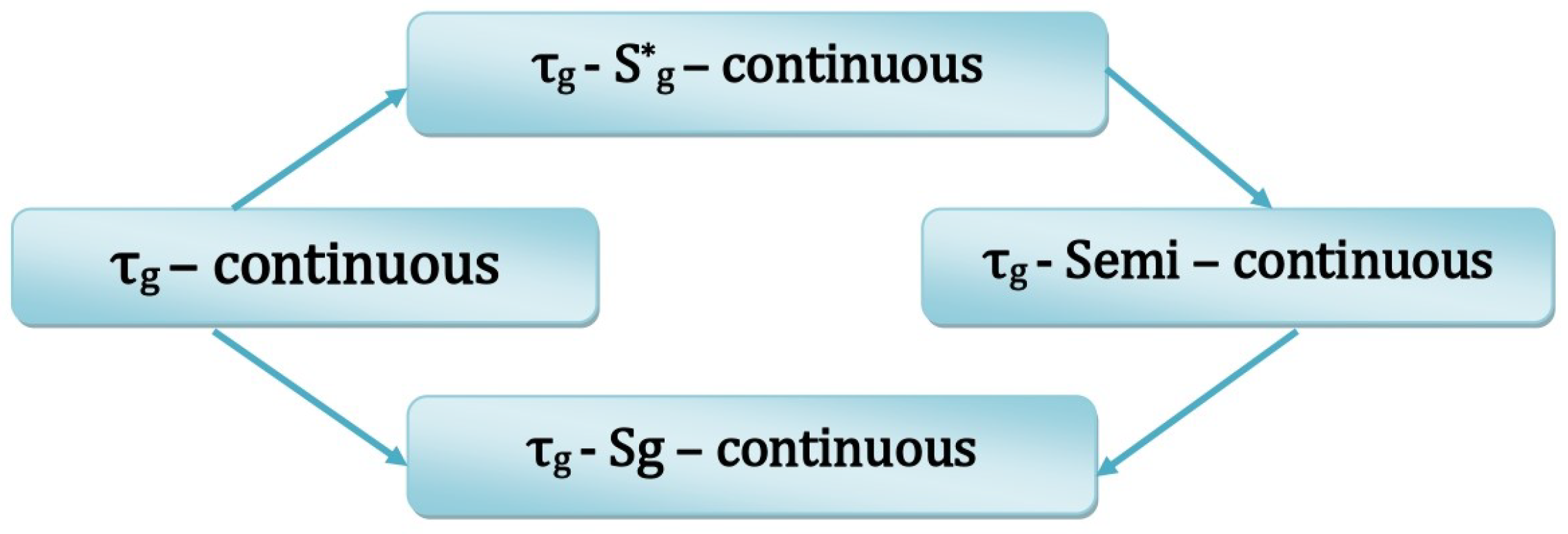
Now, we provide the relationship of the above theorems in Figure 3.
Figure 3.
The relations of all the above theorems concerning mappings.
3.3.2. –-Irresolute Function
Definition 27.
Assume and as and that a mapping , , → , , from to is --irresolute if for every –-open set in , , there is an inverse image that is –-open in .
Remark 11.
A mapping , , → , , is --irresolute if for every –-closed set in , , there is an inverse image that is –-closed in .
Theorem 35.
If , , → , , is a –-irresolute map, then is –-continuous.
Proof.
Assume to be an -open set in . Subsequently, every -open set is –-open ⇒ is –-open in . Because is –-irresolute ⇒ is –-open in . Thus, is –-continuous. □
Remark 12.
The subsequent illustration demonstrates that above theorem’s converse is invalid.
Example 17.
Assuming d, k, q}, , {k, , and and d, k, q}, , {d}, {k}, {d, k and , {d}, {q}, {d, q, in this generalized primal topological space , , open sets = , and , , . Defining , , → , , by (k) = and (q) = ⇒ is --continuous but not --irresolute.
Theorem 36.
Assume , , , , , and , , as . If , , → , , is –-irresolute and , , → , , is –-irresolute, then , , → , , is –-irresolute.
Proof.
Assume is –-open in . As is –-irresolute, is --open in . Additionally is –-irresolute, is –-open in . Consequently, = is –-open in . Hence, is –-irresolute. □
Theorem 37.
If , , → , , is –-irresolute and , , → , , is –-continuous, then , , → , , is –-continuous.
Proof.
Assume to be a -open set and to be –-open in . As is –-continuous, is –-open in . Additionally is –-irresolute and is –-open in . However, = . Hence, is –-continuous. □
3.3.3. Strongly –-Continuous Function
Definition 28.
Consider , , and , , as . A mapping , , → , , is called strongly –-continuous if for every –-open set in there is an inverse image that is -open in .
Theorem 38.
If , , → , , is strongly --continuous; then, is a -continuous function.
Proof.
Assume to be any -open set in . Because every -open set is –-open ⇒ is –-open in . Because , , → , , is strongly –-continuous ⇒ is -open in . Hence, is -continuous. □
Remark 13.
The subsequent illustration demonstrates why the contrary of the preceding theorem need not be true.
Example 18.
Assume d, k, q}, , , , and and d, k, q}, , , {k}, {d, k and , {d}, {q}, {d, q. In this generalized primal topological space, , , Open sets = , and , , . Defining , , → , , by (k) = and (q) = ⇒ is a -continuous function but not strongly –-continuous.
Theorem 39.
The mapping , , → , , is strongly –-continuous if and only if for every –-closed set in there is an inverse image that is -closed in .
Proof.
Consider , , → , , as strongly –-continuous. Assume to be any –-closed set in . Then, is –-open in . Because is strongly –-continuous ⇒ is -open in . But, ∖∖. Hence, is -closed in .
Conversely, consider that for every –-closed set in there is an inverse image that is -closed in . Assume to be any –-open set in ⇒ is –-closed in . Because is -closed in but ∖, it is the case that is -open in ⇒, , → , , is strongly –-continuous. □
Theorem 40.
Consider , , → , , is strongly –-continuous and the mapping , , → , , is –-continuous; then, , , → , , is -continuous.
Proof.
Assume to be any -open set in . As is –-continuous ⇒ is –-open in . Furthermore, as is strongly –-continuous, is -open in . Therefore, = is -open in . Hence, is -continuous. □
Theorem 41.
Consider , , → , , as strongly –-continuous and the mapping , , → , , as –-irresolute; then, , , → , , is strongly –-continuous.
Proof.
Assume to be any --open set in . As is –-irresolute, ⇒ is –-open in . Furthermore, as is strongly –-continuous, is -open in . Therefore, = is -open in . Hence, , , → , , is strongly –-continuous. □
Theorem 42.
Consider , , → , , as –-continuous and the mapping , , → , , as strongly –-continuous; then, , , → , , is –-irresolute.
Proof.
Let be any –-open set in . As is strongly –-continuous ⇒ is -open in . Furthermore, is –-continuous, is –-open in , but = . Hence, , , → , , is –-irresolute. □
3.3.4. Perfectly –-Continuous Function
Definition 29.
Consider , , and , , as . A mapping , , → , , is called perfectly –-continuous if for every –-open set in there is an inverse image that is -open and -closed in .
Theorem 43.
If a mapping , , → , , is perfectly –-continuous, then is strongly –-continuous.
Proof.
Assume to be any --open set in . Because , , → , , , is perfectly –-continuous ⇒ is -open in . Hence, is strongly –-continuous. □
Remark 14.
The subsequent illustration demonstrates why the contrary of the preceding theorem need not be true.
Example 19.
Assuming d, k, q}, , {d}, {k}, {d, k and , {d}, {q}, {d, q, in this generalized primal topological space , , open sets = , and , , . Defining , , → , , by (k) = and is strongly –-continuous but not perfectly –-continuous.
Theorem 44.
A mapping , , → , , is perfectly –-continuous iff for every –-closed set in there is an inverse image that is both -open and -closed in .
Proof.
Consider that , , → , , is perfectly --continuous. Let be any –-closed set in . Then, is a –-open set in . Because is perfectly –-continuous ⇒ is both -open and -closed in . But, ∖. Hence, is both -open and -closed in .
Conversely, consider that for every --closed set in there is an inverse image that is both -open and -closed in . Assume to be any –-open set in ⇒ is –-closed set in . Because is both -open and -closed in , but ∖, we have that is both -open and -closed in ⇒, , → , , is perfectly –-continuous. □
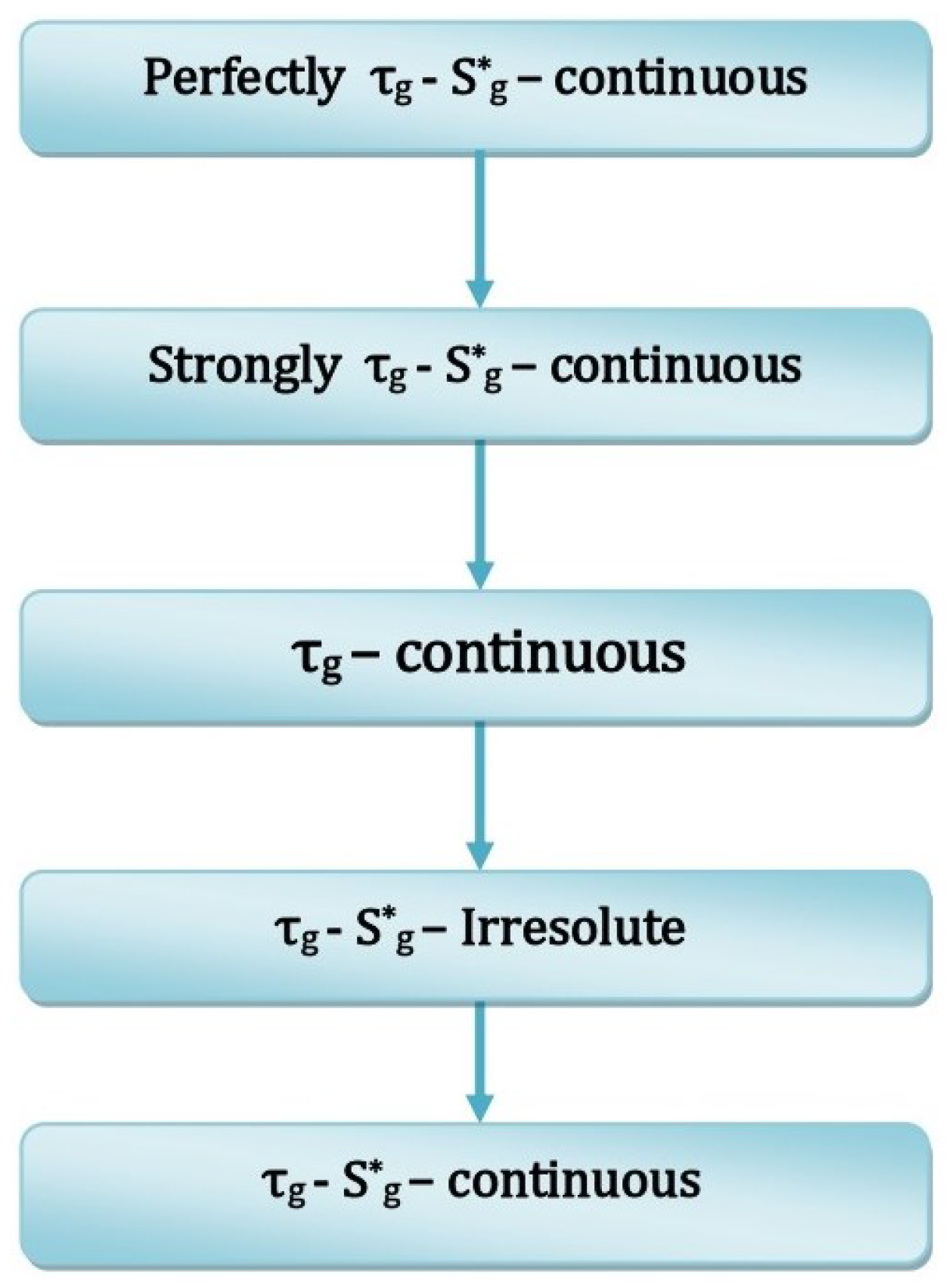
Now we provide the relationship of the above theorems in Figure 4.
Figure 4.
The relations of all above theorems concerning mappings.
3.3.5. –-Open Map
Definition 30.
Assume and , , as . A map , , → , , is a –-open map if for every -open set in , is –-open in .
Theorem 45.
If , , → , , is -open, then is a –-open map.
Proof.
Assume to be any -open set in ; then, is -open in . Because every -open set is –-open ⇒ is –-open in . Hence, is a –-open map. □
Remark 15.
The subsequent example demonstrates that the above theorem’s converse is invalid.
Example 20.
Let , =, , w, m }, =, and , , , . Define , , → , , by (k) = (q) = {w } and . Here, w k, , which is -O but not -open. Hence, is a --open map but not a -open map.
3.3.6. –-Closed Map
Definition 31.
Assume , , and , , as . A map , , → and , , is said to be –-closed if for every -closed set in , is –-closed in .
Theorem 46.
If , , → , , is a -closed map, then is a –-closed map.
Proof.
Assume to be any -closed set in ; then, is -closed in . Because every -closed set is –-closed ⇒ is –-closed in . Hence, is a –-closed map. □
Remark 16.
The subsequent example demonstrates that the above theorem’s converse is invalid.
Example 21.
Similar to the illustration in Example 20.
Theorem 47.
If , , → , , is -closed and , , → , , is –-closed, then , , → , , is –-closed.
Proof.
Assume to be any -closed in . Because , , → , , is a -closed map ⇒ is -closed in . Furthermore, , , → , , is –-closed ⇒ is –-closed in . Hence, , , → , , is a –-closed map. □
3.4. –-Homeomorphism and -Homeomorphism
The notions of –-homeomorphism and -homeomorphism are examined in this section in the context of generalized primal topological spaces. Primal topology imposes extra limitations that are not presented in generalized topological spaces, which makes the study of homeomorphisms more complex in this context.
3.4.1. –-Homeomorphism
Definition 32
([8]). Assume , , to be a generalized primal topological space and to be any subset of ; then, is known as:
- 1.
- A generalized primal closed (gp-closed) set if for any open set of , Cl ⊆ whenever ⊆ .
- 2.
- A generalized primal semi-closed (gps-closed) set if for any open set of , sCl ⊆ whenever ⊆ .
- 3.
- A semi-generalized primal closed (sgp-closed) set if for any semi-open set of , sCl ⊆ whenever ⊆ .
Definition 33.
Assume that a mapping , , → , , from a generalized primal topological space into a generalized primal topological space is called:
- 1.
- Generalized primal continuous (briefly, -continuous) if for each closed in , , , is gp-closed in , , .
- 2.
- Generalized primal semi-continuous (briefly, -continuous) if for each closed in , , , is gps-closed in , , .
- 3.
- Semi-generalized primal continuous (briefly, -continuous) if for each closed in , , , is sgp-closed in , , .
Definition 34.
Assume that a bijective mapping , , → , , from a generalized primal topological space into a generalized primal topological space is called:
- 1.
- A -homeomorphism if and are both -continuous.
- 2.
- A -homeomorphism if and are both -continuous.
- 3.
- A -homeomorphism if and are both -continuous.
Definition 35.
A bijection function , , → , , from a generalized primal topological space into a generalized primal topological space is called a -homeomorphism if is both -continuous and -open.
Theorem 48.
For any bijection , , → , , from a generalized primal topological space into a generalized primal topological space , the following are equivalent:
- 1.
- The inverse function is –-continuous.
- 2.
- is a –-open function.
- 3.
- is a –-closed function
Proof.
Because , , → , , from a generalized primal topological space into a generalized primal topological space .
1 ⇒2, as is -continuous. is -open in whenever is -open in ⇒ is -open.
2 ⇒3, as is –-open. If is -closed ⇒ is -open, then is –-open, that is, ∖ is –-open ⇒ is –-closed, that is, is –-closed.
3 ⇒1. If is -open in , is -closed ⇒ is –-closed, that is, ∖ is –-closed in ⇒ is –-open in ; hence, is –-continuous. □
Definition 36.
A bijection function , , → , , from a generalized primal topological space into a generalized primal topological space is called a –-homeomorphism if is both –-continuous and –-open.
Theorem 49.
Any bijection function , , → , , from a generalized primal topological space into a generalized primal topological space which is –-continuous has the analogous statements listed below:
- 1.
- The function , , → , , is –-open.
- 2.
- is a –-homeomorphism.
- 3.
- is a –-closed function
Proof.
1 ⇒2 Because is both –-continuous and –-open, is –-homeomorphism.
2 ⇒3 is –-continuous and is a –-homeomorphism ⇒ is –-open; hence, it is –-closed by Theorem 48.
3 ⇒1 is –-closed ⇒ is –-open, by Theorem 48. □
Theorem 50.
Every -homeomorphism is a –-homeomorphism.
Proof.
Assume , , → , , to be a -homeomorphism. If is an open set in , then is -open in , as is a -open function; hence, is –-open, meaning that is a –-open function. Further, the -continuity ⇒ is –-continuous, that is, is a –-homeomorphism. □
Remark 17.
The converse of the above Theorem 50 is invalid, as demonstrated by the subsequent illustration.
Example 22.
Consider d, k}, , {k}, {d, k, , {d}, and , {k}, {d, k}, . Assuming that , , → , , is the identity function ⇒ is a –-homeomorphism, but not a -homeomorphism.
Remark 18.
From the subsequent illustration, a composition of two –-homeomorphisms need not be a –-homeomorphism.
Example 23.
Let d, k, q, w}, , {d, k}, {d}, {k}, {q, w}, {q}, {w, , {d, k}, {q, w}, , , {d}, {k}, {d, k}, {d, k, q}, and , {d}, {d, k}, {d, k, q}, be generalized primal topologies on , and , respectively. Then, the mappings , , → , , and , , → , , are defined by and , , , , . Here, and are both –-homeomorphisms, but is not a –-homeomorphism.
3.4.2. –-Homeomorphism
Definition 37.
A bijective mapping , , → , , from a generalized primal topological space into a generalized primal topological space is known as a –-homeomorphism if and are both –-irresolute.
Theorem 51.
Any --homeomorphism is a –-homeomorphism, but not conversely. The –-homeomorphism is a subclass of the class of –-homeomorphisms.
Proof.
Because any –-open map is a –-open map [27], the proof follows from Theorem 3.32 [29]. In Example 23, the mapping is a –-homeomorphism but not a –-homeomorphism. Because {k, q} is a –-closed set in but (k, qd, w} is not –-closed in , it is the case that is not –-irresolute. Hence, is not a –-homeomorphism. □
Theorem 52.
If , , → , , and , , → , , are –-homeomorphisms, then the composition : , , → , , is a –-homeomorphism.
Proof.
Assume to be a –-open set in . Now, ( = , where . By hypothesis, is a –-open set in ; again by hypothesis, is a –-open set in . Thus, is –-irresolute. In addition, for any –-open set in , , )) = , where . By hypothesis, is a –-open set in , and )) = is a –-open set in , ; thus, is –-irresolute, proving that is a –-homeomorphism. □
Corollary 53.
In the collection of all topological spaces, a –-homeomorphism is an equivalence relation.
Proof.
Because the composition of a bijective mapping is an equivalence relation ⇒ a –-homeomorphism is an equivalence relation. □
4. Methodology
The research technique utilized in this study aims to provide a thorough analysis of the function, -homeomorphism, and -homeomorphism in both and . To do this, a methodological approach must be used to define, prove, and examine the characteristics of these functions in many contexts. The stages involved in this research are outlined below:
- Review of Existing Literature: The study starts with a thorough analysis of the existing literature and prior research on generalized topological spaces, generalized primal topological spaces, and – functions. Important basic ideas and earlier research on open maps, continuity, and both irresolute and closed mappings in topological spaces are noted. The definitions and theorems established later are based on this review.
- Definition of – functions: Here, the –-function and all of its associated characteristics are indicated, such as:
- –
- --continuous mapping: A function that maintains –-open sets under continuous mappings.
- –
- –-irresolute: A function such that each –-open set’s inverse image is also –-open.
- –
- Strongly –-continuous mapping: A mapping in which for every –-open set there is an inverse image that is open.
- –
- Perfectly –-continuous mapping: A mapping in which for every –-open set there is an inverse image that is both open and closed.
- –
- –-open and –-closed maps: Functions that respectively map –-open sets to -open sets and –-closed sets to -closed sets.
- Development of Propositions and Theorems: After defining each function type, we proceed to develop associated theorems and propositions. This comprises the following aspects:
- –
- Theorems that specify the circumstances in which a function is either –-irresolute or –-continuous.
- –
- The links between –-open and –-closed maps, along with how they affect the topological structure.
- –
- Theoretical analysis of the behavior of strongly and perfectly –-continuous functions in generalized topological spaces.
- Extension to Generalized Primal Topological Spaces: Subsequently, we broaden the scope of our analysis by including these functions in the context of . Within this framework, we redefine – functions to emphasize the fundamental character of the space. This allows for analysis of these functions under additional conditions and limitations, as the generalized primal topological space provides a more constrained framework.
- Analysis of - and -Homeomorphisms: The fourth stage explores the ways in which these homeomorphisms maintain the -closed and -open sets in various spaces. –-homeomorphisms in generalized topological spaces and --homeomorphisms in generalized primal topological spaces make up this section. Through the use of formal arguments and comparative analysis, the characteristics and behavior of homeomorphisms in both contexts are examined.
- Proofs and Verification: Precise mathematical proofs support every theorem and statement. To confirm the accuracy of our findings, we utilize conventional methods in topology such as continuity rules and arguments from set theory. This stage guarantees that the conclusions are sound both mathematically and logically.
- Comparative Study: We carry out a comparative study of the behaviors of functions, -homeomorphisms, and -homeomorphisms in generalized topological spaces and generalized primal topological spaces to gain a deeper understanding of their relevance. This comparison demonstrates the differences and similarities in their behavior under various topological contexts.
- Conclusions and Upcoming Work: The last phase entails a summary of the main study’s findings and suggestions for future work paths. We explain the consequences of our findings and point out possible directions for future research that might provide fresh insights, especially in more specialized or applied topological situations.
5. Conclusions
A thorough analysis of functions, -homeomorphisms, and -homeomorphisms in the frameworks of both generalized primal topological spaces and generalized topological spaces is presented in this research. We have looked at several important characteristics of these functions, such as strongly -continuous and perfectly -continuous functions, -open and -closed maps, and -continuous and -irresolute functions. We have uncovered new findings about the properties and behaviors of these functions in generalized topological spaces while providing thorough definitions, theorems, and assertions. Our research gains greater depth by extension to generalized primal topological spaces, which enables us to study the behavior of -functions in a more specific context. The results of this study show that although many of the features remain the same, there are distinct differences in the behavior of these functions due to the more profound constraints of primal topological spaces. The outcomes advance the theoretical knowledge of -functions, -homeomorphisms, and -homeomorphisms in primal and generalized topological spaces. This study establishes connections between various types of functions and provides rigorous proofs, paving the way for future research into topological function theory. Subsequent research endeavors might explore more precise uses of -functions or expand these ideas to encompass other specialized topological configurations. To sum up, the study of -functions extends the reach of topological studies by providing fresh ideas about function characteristics in many topological contexts. These findings not only support existing theories but also create opportunities for more study in this area in the future.
Author Contributions
Conceptualization, M.S., T.K., U.I., M.I., I.-L.P. and F.M.M.; methodology, M.S., T.K., U.I., M.I., I.-L.P. and F.M.M.; software, M.S., T.K., U.I., M.I., I.-L.P. and F.M.M.; validation, M.S., T.K., U.I., M.I., I.-L.P. and F.M.M.; formal analysis, M.S., T.K., U.I., M.I., I.-L.P. and F.M.M.; investigation, M.S., T.K., U.I., M.I., I.-L.P. and F.M.M.; resources, M.S., T.K., U.I., M.I., I.-L.P. and F.M.M.; data curation, M.S., T.K., U.I., M.I., I.-L.P. and F.M.M.; writing—original draft preparation, M.S., T.K., U.I., M.I., I.-L.P. and F.M.M.; writing—review and editing, M.S., T.K., U.I., M.I., I.-L.P. and F.M.M.; visualization, M.S., T.K., U.I., M.I., I.-L.P. and F.M.M.; supervision, M.S., T.K., U.I., M.I., I.-L.P. and F.M.M.; project administration, M.S., T.K., U.I., M.I., I.-L.P. and F.M.M.; funding acquisition, M.S., T.K., U.I., M.I., I.-L.P. and F.M.M. All authors have read and agreed to the published version of the manuscript.
Funding
This research received no external funding.
Data Availability Statement
Data will be made available from the corresponding author on demand.
Acknowledgments
The authors extend their appreciation to the Deanship of Research and Graduate Studies at King Khalid University for funding this work through the Large Research Project initiative under grant number RGP2/166/45.
Conflicts of Interest
The authors declare no conflicts of interest.
References
- Levine, N. Generalized closed sets in topology. Rend. Circ. Mat. Palermo 1970, 19, 89–96. [Google Scholar] [CrossRef] [Scilit]
- Bhattacharyya, P. Semi-generalized closed sets in topology. Indian J. Math. 1987, 29, 376–382. [Google Scholar]
- Dunham, W.; Levine, N. Further results on generalized closed sets in topology. Kyungpook Math. J. 1980, 20, 169–175. [Google Scholar]
- Dunham, W. T 1/2-SPACES. Kyungpook Math. J. 1977, 17, 161–169. [Google Scholar]
- Kumar, M.V. Between closed sets and g-closed sets. Mem. Fac. Sci. Kochi Univ. (Math.) 2000, 21, 1–19. [Google Scholar]
- Sundaram, P.; Maki, H.; Balachandran, K. Semi-generalized continuous maps and semi-spaces. Bull. Fukuoka Univ. Ed. Part III 1991, 40, 33–40. [Google Scholar]
- Møller, J.M. General Topology; Matematisk Institut: København, Denmark, 2007. [Google Scholar]
- Al-Saadi, H.; Al-Malki, H. Generalized primal topological spaces. AIMS Math. 2023, 8, 24162–24175. [Google Scholar] [CrossRef] [Scilit]
- Császár, Á. Generalized open sets. Acta Math. Hung. 1997, 75, 65–87. [Google Scholar] [CrossRef] [Scilit]
- Császár, A. Generalized open sets in generalized topologies. Acta Math. Hung. 2005, 106, 53–66. [Google Scholar] [CrossRef] [Scilit]
- Császár, A. Intersections of Open Sets in Generalized Topological Spaces. Univ. Sci. Budapestinensis Rolando Eotvos Nomin. 2006, 49, 53–57. [Google Scholar]
- Császár, Á. γ-connected sets. Acta Math. Hung. 2003, 101, 273–279. [Google Scholar] [CrossRef] [Scilit]
- Császár, Á. Product of generalized topologies. Acta Math. Hung. 2009, 123, 127–132. [Google Scholar] [CrossRef] [Scilit]
- Balachandran, K. On generalized continuous maps in topological spaces. Mem. Fac. Sci. Kochi Univ. Ser. A Math. 1991, 12, 5–13. [Google Scholar]
- Iyappan, D.; Nagaveni, N. On Semi Generalized b-Continuous Maps, Semi Generalized b-Closed Maps in Topological Space. Int. J. Math. Anal. 2012, 6, 1251–1264. [Google Scholar]
- Banakh, T.; Bokalo, B. On scatteredly continuous maps between topological spaces. Topol. Its Appl. 2010, 157, 108–122. [Google Scholar] [CrossRef] [Scilit]
- Gierz, G.; Lawson, J. Generalized continuous and hypercontinuous lattices. Rocky Mt. J. Math. 1981, 11, 271–296. [Google Scholar] [CrossRef] [Scilit]
- Cueva, M.C. Semi-generalized continuous maps in topological spaces. Port. Math. 1995, 52, 399–407. [Google Scholar]
- Császár, A. Generalized topology, generized continuity. Acta Math. Hung. 2002, 96, 351–357. [Google Scholar] [CrossRef] [Scilit]
- Khayyeri, R.; Mohamadian, R. On base for generalized topological spaces. Int. J. Contemp. Math. Sci. 2011, 6, 2377–2383. [Google Scholar]
- Sarsak, M.S. On some properties of generalized open sets in generalized topological spaces. Demonstr. Math. 2013, 46, 415–427. [Google Scholar] [CrossRef] [Scilit]
- Maki, H.; Balachandran, K.; Devi, R. Remarks on semi-generalized closed sets and generalized semi-closed sets. Kyungpook Math. J. 1996, 36, 155. [Google Scholar]
- Maki, H.; Rao, K.C.; Gani, A.N. On generalizing semi-open sets and preopen sets. Pure Appl. Math. Sci. 1999, 49, 17–30. [Google Scholar]
- Navalagi, G.; Page, H. ϑ-Generalized semi-open and ϑ-generalized semi-closed functions. Proyecciones-J. Math. 2009, 28, 111–123. [Google Scholar] [CrossRef] [Scilit]
- Acharjee, S.; Özkoç, M.; Issaka, F.Y. Primal topological spaces. arXiv 2022, arXiv:2209.12676. [Google Scholar]
- Özkoç, M.; Köstel, B. On the Topology of Primal Topological Spaces. arXiv 2024, arXiv:2402.08572. [Google Scholar]
- Al-Saadi, H.; Al-Malki, H. Categories of open sets in generalized primal topological spaces. Mathematics 2024, 12, 207. [Google Scholar] [CrossRef] [Scilit]
- Min, W. Generalized continuous functions defined by generalized open sets on generalized topological spaces. Acta Math. Hung. 2010, 128, 299–306. [Google Scholar] [CrossRef] [Scilit]
- Krishnappa, R.; Ittanagi, B. On R#-Closed and R#-Open Maps in Topological Spaces. Int. J. Eng. Technol. 2018, 7, 770. [Google Scholar] [CrossRef] [Scilit]
Disclaimer/Publisher’s Note: The statements, opinions and data contained in all publications are solely those of the individual author(s) and contributor(s) and not of MDPI and/or the editor(s). MDPI and/or the editor(s) disclaim responsibility for any injury to people or property resulting from any ideas, methods, instructions or products referred to in the content. |
© 2024 by the authors. Licensee MDPI, Basel, Switzerland. This article is an open access article distributed under the terms and conditions of the Creative Commons Attribution (CC BY) license (https://creativecommons.org/licenses/by/4.0/).