


Abstract
In this paper, we investigate the event-triggered consensus problems of nonlinear strict feedback MASs under directed graph. Based on the high-gain control technique, we firstly give a state-based event-triggered consensus algorithm and prove that Zeno behavior can be excluded. When the full state information is unavailable, a high-gain observer is given to estimate state information of each agent and an observer-based algorithm is developed. Finally, we give an example to verify the effectiveness of both state-based and observer-based event-triggered consensus algorithms.
Keywords:
multi-agent systems; consensus control; event-triggered control; strict feedback systems; directed graph MSC:
93A16
1. Introduction
Due to its practical applications in various control systems, such as satellite coordination [1], UAV formation [2], information infusion of sensor networks [3], traffic flow [4], and cooperation of multi robots [5], consensus control of MASs has received increasing attention from engineering. In fact, most MASs are composed of mobile agents, which are equipped with embedded systems and limited energy resource. In recent years, many researchers have been devoted to event-triggered consensus control of MASs, which can effectively reduce continuous information transmission and save limited energy.
The past decade witnessed a rapid development of event-triggered consensus control of MASs, including single-integrator MASs [6,7,8], double-integrator MASs [9,10], and general linear MASs [11,12,13]. However, papers mentioned above only considered linear models. Many dynamical systems, such as Chua’s circuit and Lagrange systems, are depicted by nonlinear systems. Therefore, it is necessary to study event-triggered consensus problems of nonlinear MASs. In [14], Adaldo et al. studied event-triggered pinning synchronization for first-order nonlinear MASs with time-varying undirected topology. Event-triggered consensus problems for first-order nonlinear MASs under directed graph were studied by using combinational state measurements in [15]. By using event-triggered and intermittent control mechanisms, Hu and Cao studied an event-triggered tracking control algorithm for first-order nonlinear MASs under directed graph [16]. Based on neural network weight estimation, event-triggered consensus control for second-order uncertain nonlinear MASs with undirected graph was studied in [17,18]. In [19], an event-triggered semi-global robust consensus problem for second-order uncertain nonlinear MASs was studied. By using periodic data sampling framework, an event-triggered synchronization controller with time varying control gain was designed for nonlinear multi-agent systems under directed graph in [20]. By estimating the states of neighboring agents, an event-triggered controller was developed for a type of nonlinear leader–follower MAS in [21]. Consensus control problems of nonlinear coupled parabolic PDE-ODE-based multi-agent systems were studied in [22].
Most of the nonlinear MASs mentioned above considered the first/second-order nonlinear MASs. However, first/second-order nonlinear systems do not contain many nonlinear systems, such as high-order nonlinear systems and output-feedback nonlinear systems. Nonlinear strict feedback systems are typical nonlinear dynamics, which include first/second/high-order nonlinear systems and output feedback nonlinear systems. Wang and Ji studied the distributed tracking problem for nonlinear strict feedback leader–follower MASs in [23]. S.J. Yoo studied the adaptive containment control for uncertain nonlinear strict feedback MASs under a directed topology in [24]. In [25], Shen and Shi considered the distributed tracking problem of uncertain nonlinear strict feedback MASs under a weighted undirected graph. Li and Ji studied the finite-time coordination control problems for nonlinear strict feedback MASs with directed topologies in [26]. Event-triggered tracking problems of nonlinear strict feedback MASs under undirected topologies were also considered in some recent papers. For uncertain nonlinear strict feedback MASs, an adaptive distributed event-based tracking algorithm was studied in [27]. Event/self-triggered leader–following tracking algorithms for stochastic nonlinear MASs were investigated in [28]. However, event-triggered consensus problems of leaderless nonlinear strict feedback MASs with directed topology are seldom considered.
From papers mentioned above, we can clearly see that papers [6,7,8,9,10,11,12,13] only consider event-triggered consensus problems of linear MASs, and papers [14,15,16,17,18,19,20,21,22] consider event-triggered consensus problems of first or second order nonlinear MASs. Although nonlinear strict feedback systems are typical nonlinear dynamics, papers [23,24,25,26] only consider cooperative control of nonlinear strict feedback MASs, and papers [27,28] only study event-triggered tracking problems for nonlinear strict feedback MASs. To overcome the disadvantages of the above papers, we will study event-triggered consensus problems of nonlinear MASs in strict feedback form under directed graph. The main contributions are listed as follows:
(1) Since nonlinear strict feedback systems are typical and general, MASs studied in [6,7,8,9,10,11,12,13] are special cases of our paper. (2) Different from papers [27,28], we study event-triggered consensus problems for leaderless MASs. The Laplacian matrix for leaderless MASs with directed topology is singular and asymmetric; it is a hard task to design Lyapunov function for such MASs. Moreover, our results can be extended to event-triggered tracking problems for leader–follower MASs easily. (3) Backstepping design technique is the traditional control method for strict feedback nonlinear systems, and its disadvantage is the tedious design of virtual control law. However, based on the high-gain control technique, the design of our controller can be easily achieved by solving the Riccati equation.
Notation 1.
Denote as the identity matrix of , as a vector with each entry being 1, ⊗ as the Kronecker product, and as a diagonal matrix. For square matrix , means that P is positive definite. For a symmetric matrix , denote its N eigenvalues. For a vector , , , and .
2. Problem Statement and Preliminaries
2.1. Problem Statement
We investigate event-triggered consensus problems of nonlinear strict feedback MASs with directed graph in this paper. Each agent is described by the following dynamics:
where are the state, control input, and output of agent i, respectively. are nonlinear functions.
The control goal of MASs (1) is state consensus, which is defined as follows.
Definition 1.
To design the event-triggered controller, we need nonlinear functions to satisfy the following assumption.
Assumption 1.
For any n-dimensional vectors , there exists a known nonnegative real ρ, such that
Remark 1.
Nonlinear strict feedback systems are typical and general enough [26], and nonlinear systems, such as first/second/high-order nonlinear systems and output feedback nonlinear systems, are special cases of nonlinear strict feedback systems. In the literature [29], one can find the geometric conditions for how to translate a nonlinear system into strict feedback form.
2.2. Preliminaries
The topology of MASs (1) is depicted by a directed graph , where , and are the agent set, edge set, and adjacent matrix, respectively. If agent i can receive local information from its neighbor agent j, then there exists a directed edge and ; otherwise . This paper does not consider the self-loop case, i.e., . Edge sequence depicts a directed path from agent to agent . If there exists at least one directed path from agent i to agent j , is said to be strongly connected. Denote as the Laplacian matrix of with and .
Assumption 2.
The topology of MASs (1) is strongly connected.
Lemma 1
([30]). If directed graph is strongly connected, there exists a real vector satisfying and such that . Denote and . The second smallest eigenvalue of L is a positive number.
Lemma 2
([31]). (Barbalat’s Lemma) Let be a uniformly continuous function on . Suppose that exists and is finite. Then, .
Lemma 3
([31]). (Comparison Lemma) Consider the scalar differential equation
where is continuous in t and locally Lipschitz in u, for all and all . Let (T could be infinity) be the maximal interval of existence of the solution , and suppose for all . Let be a continuous function whose upper right-hand derivative satisfies the differential inequality
with for all . Then, for all .
3. State-Based Event-Triggered Algorithm
In this section, we will develop an event-triggered consensus algorithm for MASs (1) by using local relative state information.
Denote with being a constant to be determined later. Let be the local relative state information of agent i. Then, we obtain the dynamics of as
where .
Let and . We have . Moreover, according to the definition of , we know that indicates .
We use to denote the sampled error of relative to its latest measurement
By using , we give the following event-triggered consensus algorithm for agent i:
where is the feedback gain and is the solution of Riccati equation below.
with . Triggering instant is determined by the following trigger function:
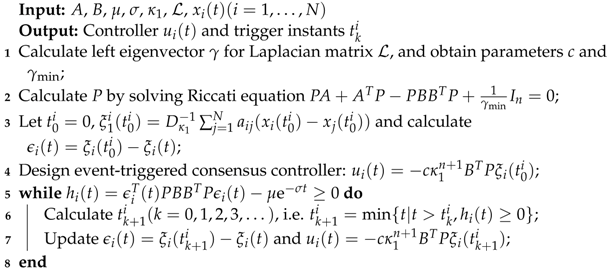
with and being positive constants. The method for calculating the event-triggered controller is presented as the following state-based event-triggered Algorithm 1.
| Algorithm 1: State-based event-triggered algorithm |
 |
Remark 2.
According to the definition of Laplacian matrix , if Assumption 2 holds, 0 is a simple eigenvalue of and other eigenvalues of have positive real parts. Moreover, is an associated eigenvector of eigenvalue 0. Since is nonsingular and , means . According to system (4), is controllable, i.e., there exists a positive definite matrix P that satisfies the Ricccati Equation (8). Theorem 1 below shows that the system (5) can be stabilized by the event-triggered controller (7).
Theorem 1.
Proof.
Take Lyapunov function candidate as follows:
Denote . Since , we have
According to Lemma 1, one obtains
From Young’s inequality, one obtains
where .
Since , one has
where . Hence, we obtain the following inequality
Since and , Riccati Equation (8) ensures that
Denote . Trigger function (9) and choice of guarantee that
From definition of , we know . Inequality (19) indicates that both and are bounded for . From (10) and (18), it is easy to obtain that and are bounded too.
From the boundedness of , we know that is uniformly continuous. Since , is monotonously increasing. Then, we obtain that exists and is finite.
According to Barbalat’s Lemma, we obtain , i.e., MASs (1) reaches consensus.
Besides consensus analysis, we should prove that Zeno behavior can be ruled out.
For , the Dini derivative of satisfies the following inequalities
Denote
Notice that . Hence, we obtain
At triggering instant , will be reset. According to the comparison Lemma, one obtains
From trigger function (9), one can check that the th event will not be triggered if , and can be guaranteed by the following inequality:
In light of (24), when the th event is triggered, is bigger than , i.e.,
Then, we have
Note that approaches zero only when . Hence, we obtain that is strictly positive for any finite time, and Zeno behavior is ruled out. □
4. Observer-Based Event-Triggered Algorithm
In last section, we studied the event-triggered consensus problem by using local relative state information. In this part, we consider another case where local relative state information is unavailable. A high-gain observer is designed for each agent to estimate its state.
where is a matrix to be determined and with being the solution of the following Riccati equation:
Let be the local relative information of agent i and be the sample error of relative to its latest measurement . Then, we give agent i the following observer-based consensus algorithm
The associated trigger function is given as
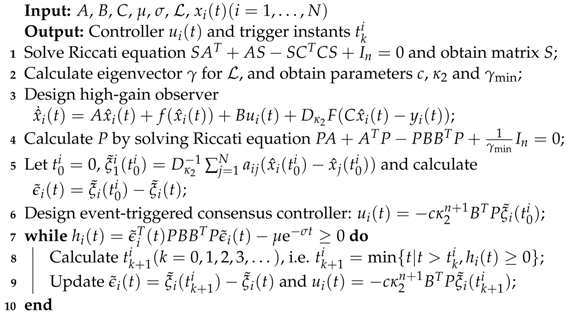
Algorithm 2 shows how to calculate the observer-based event-triggered controller .
| Algorithm 2: Observer-based event-triggered algorithm |
 |
Theorem 2.
Proof.
Let be the estimation error. Then, we have
Denote , and one obtains
Since is detectable, Riccati Equation (27) guarantees that is Hurwitz. Hence, there exists a positive definite matrix Q such that
Along error dynamics (30), one obtains
Note that
And we obtain
Now, we take the following Lyapunov function candidate for MASs (1)
Notice that
where . Then, we obtain
where and .
Following from (12)–(15), we have
and
where . For the fourth term of right side of (36), we have
where , .
Denote . Choose and , and we obtain
From the last proof of Theorem 1, we can draw the conclusion that , i.e., . Note that . Inequality (33) indicates that , that is, . Then, MAS (1) reaches consensus.
The proof of how to rule out Zeno behavior is similar to that of the last Theorem. We omit it. □
5. Simulations
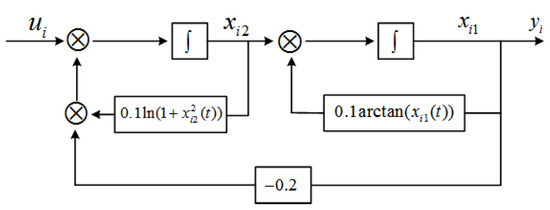
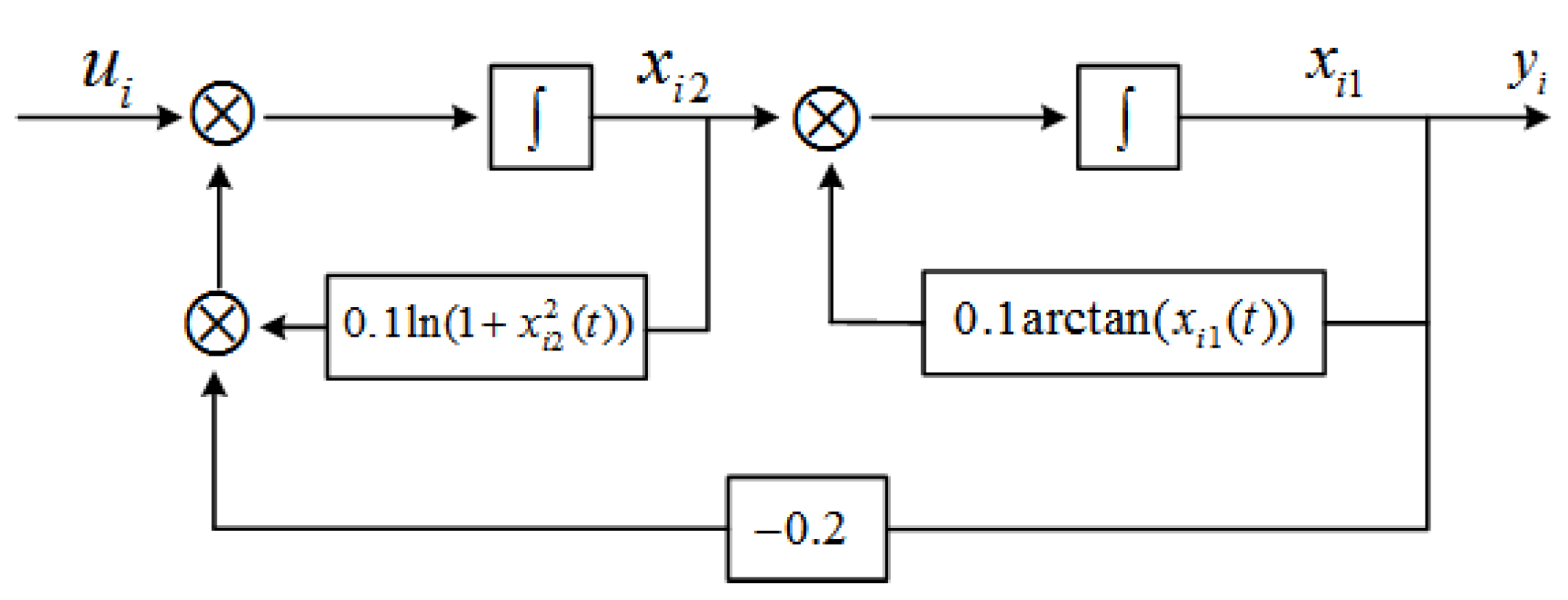
To illustrate the proposed event-triggered consensus algorithms, we consider a nonlinear MAS with four agents:
where , are the state, control input, and measurement output of agent i, respectively.
Figure 1.
Block diagram of system (42).
The topology of MAS (42) is depicted by the following adjacent matrix:
5.1. State-Based Consensus
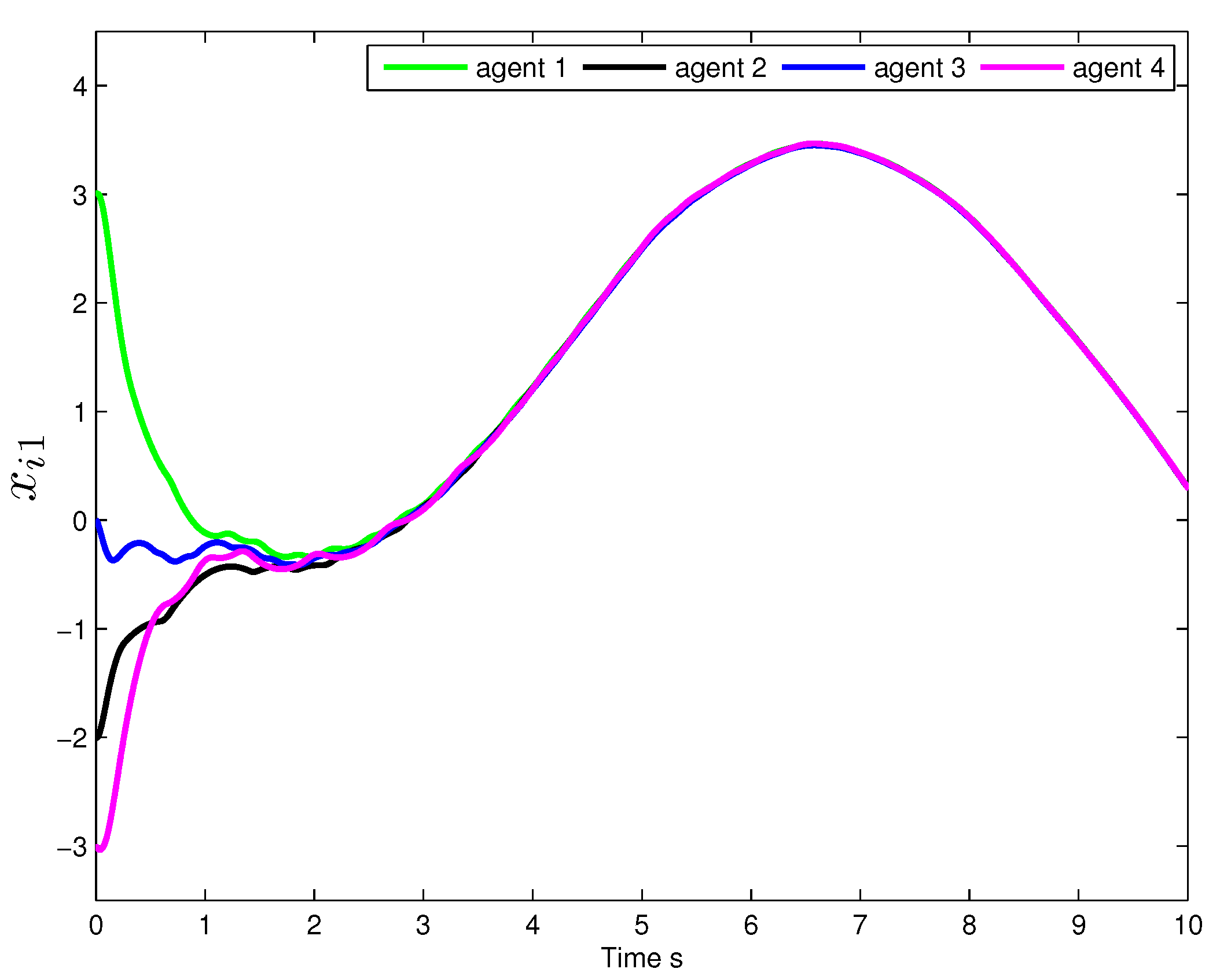
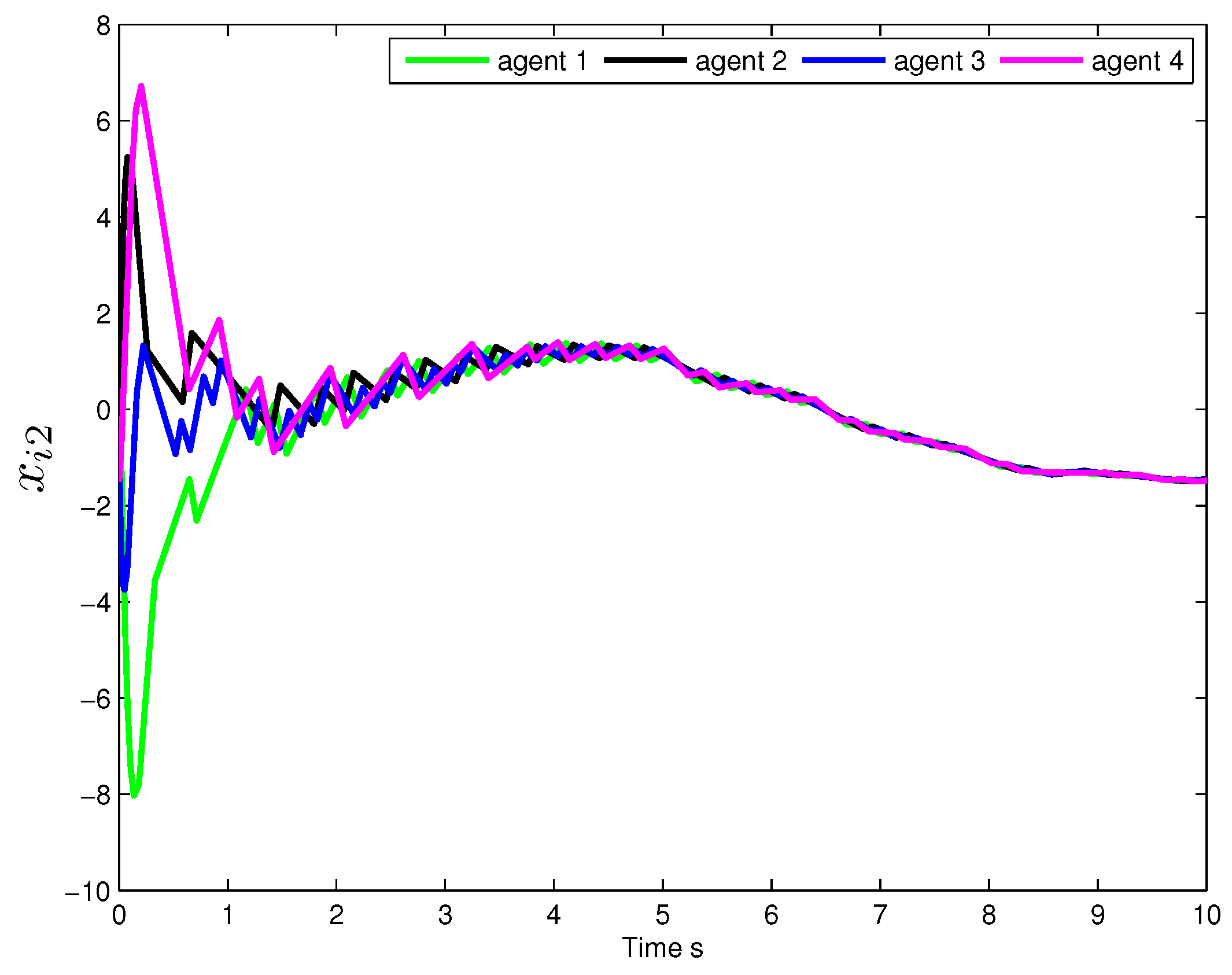
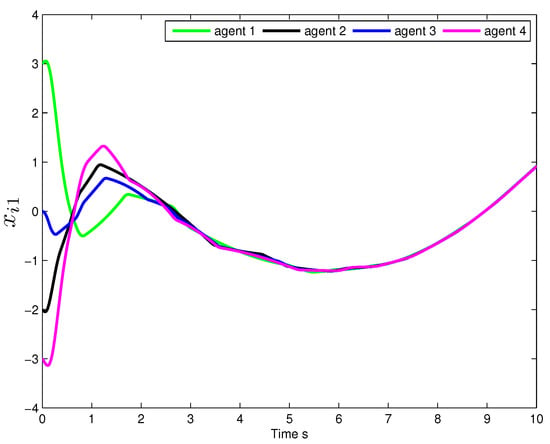
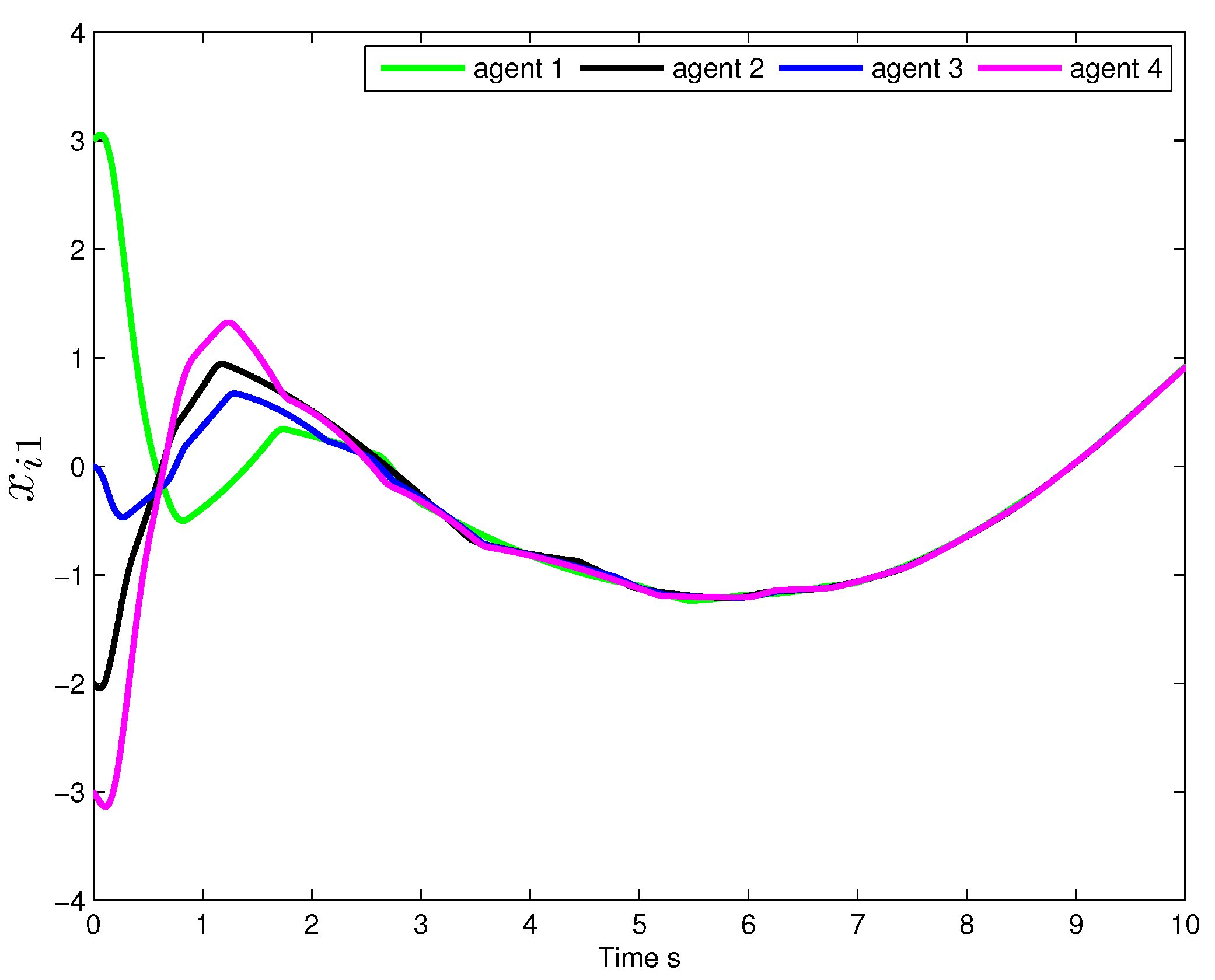
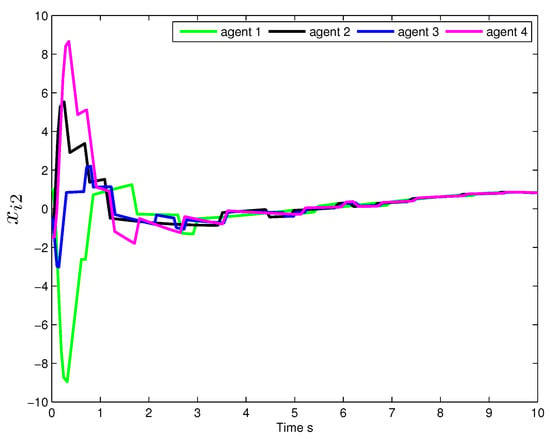
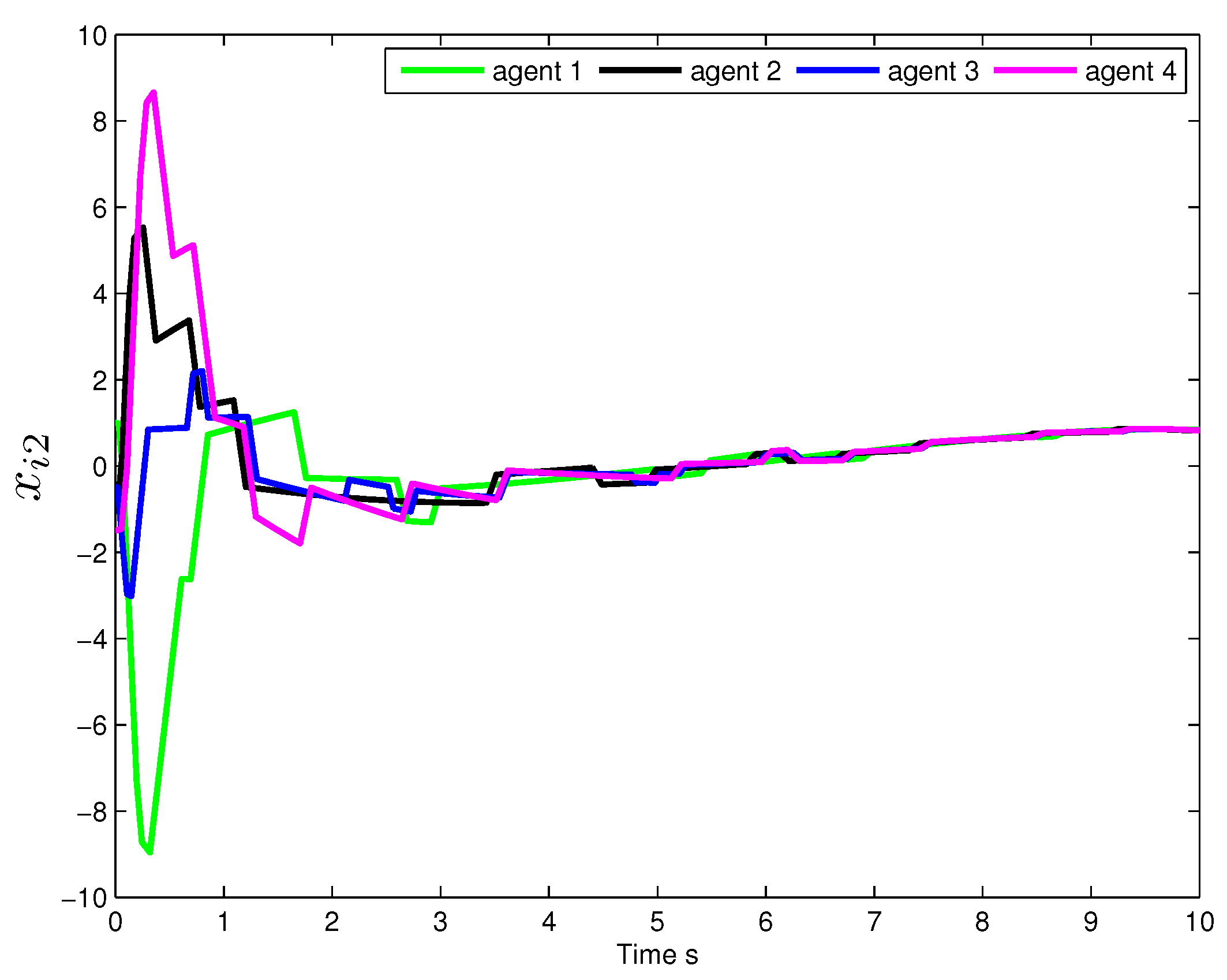
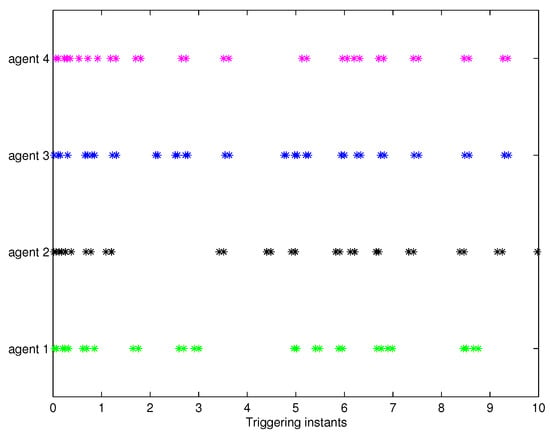
By solving Riccati Equation (8), we obtain the feedback matrix . For controller (7), we set and select , , and . The initial states of MAS (42) are randomly chosen. Under event-triggered consensus Algorithm 1, simulation results are shown in Figure 2, Figure 3 and Figure 4. From Figure 2, one can see that the first state of each agent reaches consensus in five seconds. Figure 3 shows that the second state of each agent achieves consensus in nine seconds. Figure 4 displays that the time interval between two sequential events will not approach to zero, and Zeno behavior will not occur. Hence, our algorithm (7) is valid for the event-triggered consensus problem of (42).
Figure 2.
trajectories of MAS (42) with state-based algorithm.
Figure 3.
trajectories of MAS (42) with state-based algorithm.
Figure 4.
Triggering instants of MAS (42) with state-based algorithm.
5.2. Observer-Based Consensus
When the full state information is unavailable, we design high-gain observers to estimate full state information by using measurement outputs . First, we calculate gain matrix by solving Riccati Equation (27). Then, we use the following observers to estimate the full states of MAS (42):
with .
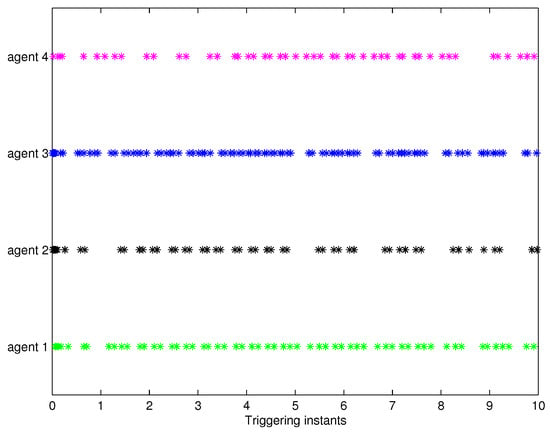
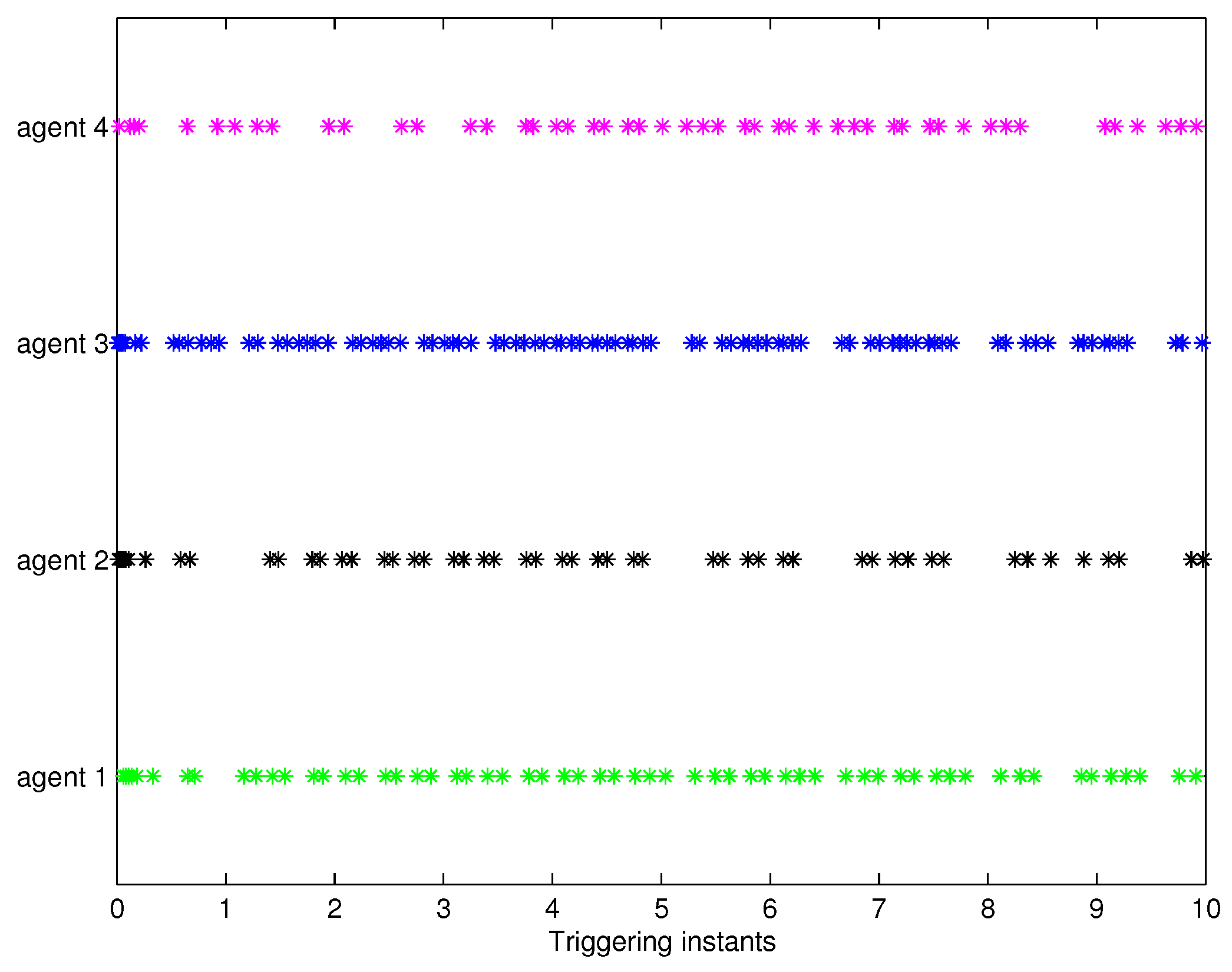
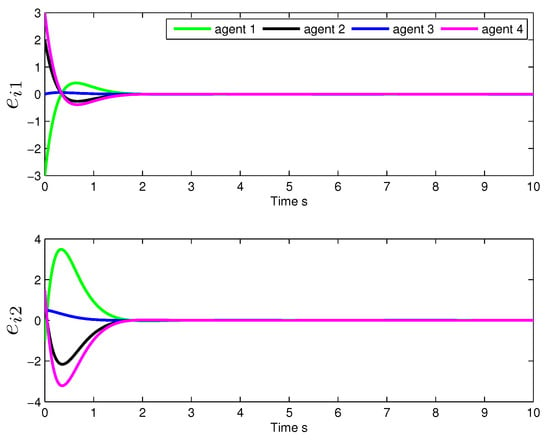
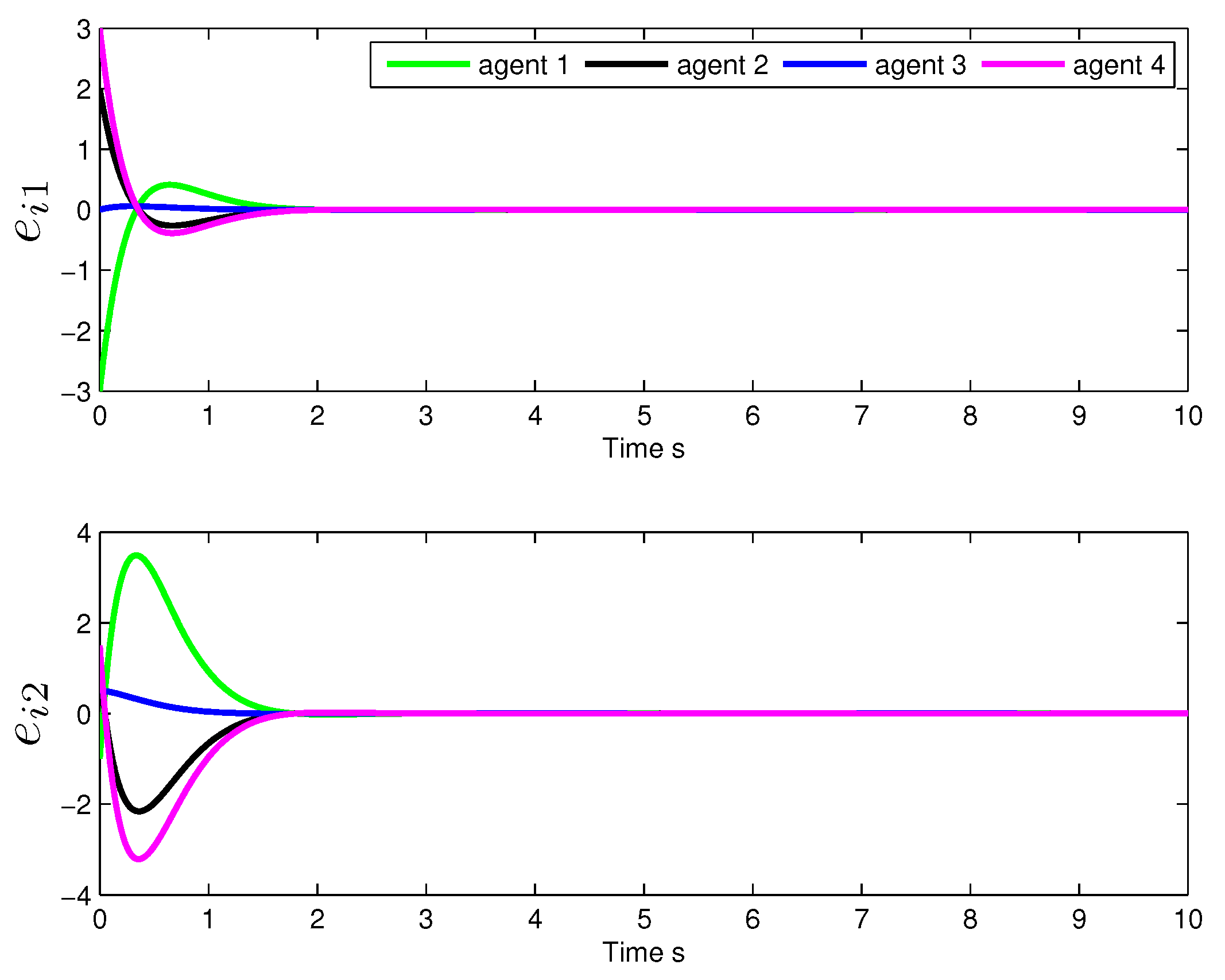
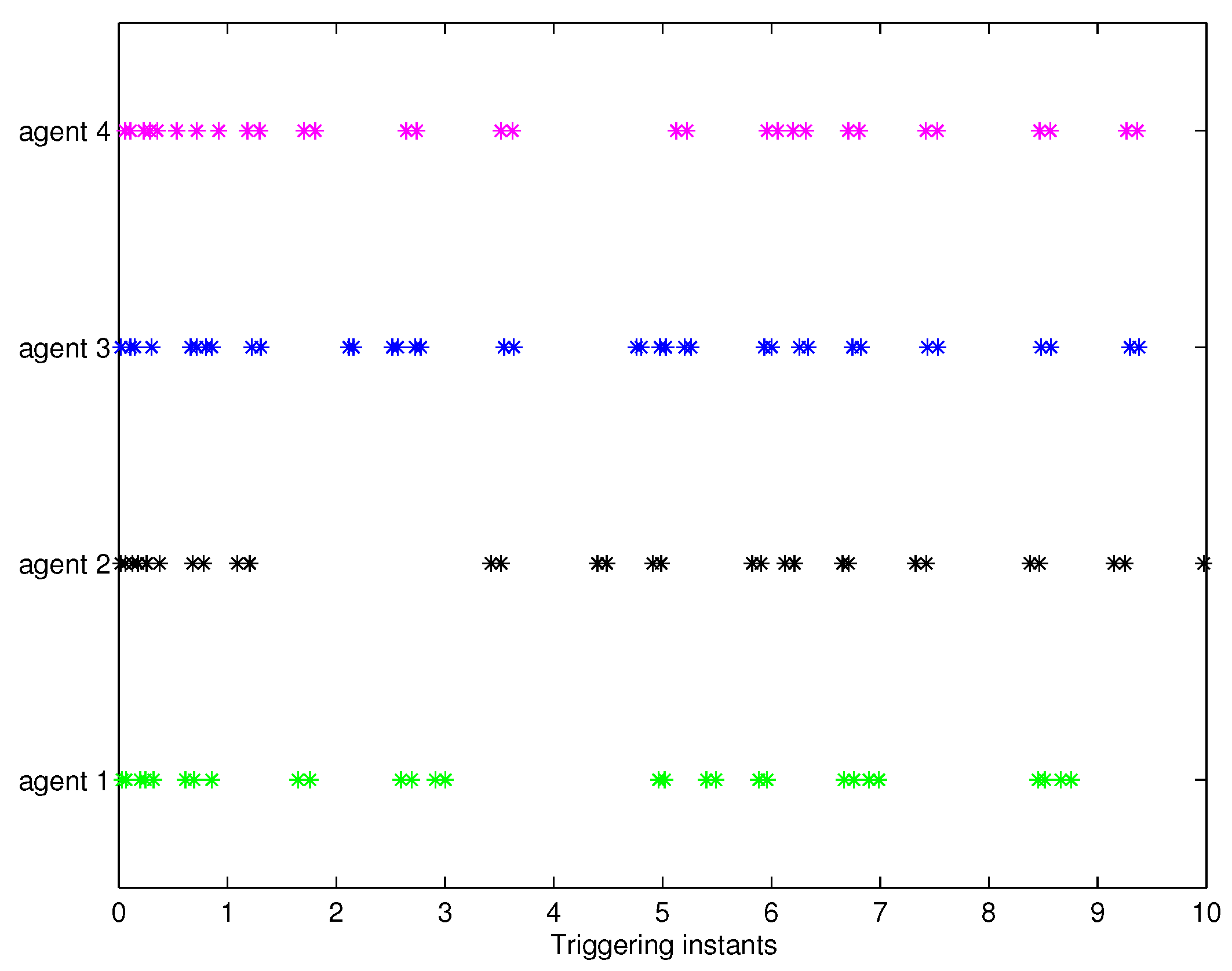
We set and select , , , and . Under observer-based Algorithm 2 simulation results of MAS (42) are displayed in Figure 5, Figure 6, Figure 7 and Figure 8. From Figure 5 and Figure 6, we can see that the first and second states of each agent reach consensus in ten seconds. Figure 7 shows that estimation errors of high-gain observers (43) converge to zero exponentially. Figure 8 displays that the time interval between two sequential events will not approach to zero, and Zeno behavior is ruled out.
Figure 5.
trajectories of MAS (42) with observer-based algorithm.
Figure 6.
trajectories of MAS (42) with observer-based algorithm.
Figure 7.
Observer errors of (43).
Figure 8.
Triggering instants of MAS (42) with observer-based algorithm.
6. Conclusions
In this paper, we investigated the event-triggered consensus problems of nonlinear strict feedback MASs. Based on high-gain control technique and high-gain observer, we propose both state-based and observer-based event-triggered consensus algorithms to solve consensus problems of nonlinear strict feedback MASs. In addition, we proved that those two consensus algorithms are free from Zeno behavior. Theoretical analysis shows that the presented algorithms can solve the event-triggered consensus problems of nonlinear strict feedback MASs. Moreover, we also give a numerical example to verify the effectiveness of our event-triggered algorithms; the simulation results show that the given algorithms reach the objectives.
Author Contributions
Methodology, Z.L.; software, Z.H.; writing—original draft preparation, J.Z.; writing—review and editing, C.Y. All authors have read and agreed to the published version of the manuscript.
Funding
This work was funded by Scientific Foundation of Shandong under Grant ZR2021QE299, China Postdoctor Foundation under Grant 2017M620183.
Institutional Review Board Statement
Not applicable.
Informed Consent Statement
Not applicable.
Data Availability Statement
Not applicable.
Conflicts of Interest
The authors declare no conflict of interest.
Abbreviations
The following abbreviations are used in this manuscript:
| MASs | Multi-agent Systems |
| UAV | Aerial Vehicle |
| PDE-ODE | Partial Differential Equations and Ordinary Differential Equations |
References
- Jin, E.; Jiang, X.; Sun, Z. Robust decentralized attitude coordination control of spacecraft formation. Syst. Control Lett. 2008, 57, 567–577. [Google Scholar]
- Chen, Y.; Yu, J.; Su, X.; Luo, G. Path planning for multi-UAV formation. J. Intell. Robot. Syst. 2015, 77, 229–246. [Google Scholar] [CrossRef] [Scilit]
- Pavlin, G.; de Oude, P.; Maris, M.; Nunnink, J.; Hood, T. A multi-agent systems approach to distributed bayesian information fusion. Inf. Fusion 2010, 11, 267–282. [Google Scholar] [CrossRef] [Scilit]
- Kusic, K.; Ivanjko, E.; Vrbanic, F.; Greguric, M.; Dusparic, I. Spatial-temporal traffic flow control on motorways using distributed multi-agent reinforcement learning. Mathematics 2021, 9, 3081. [Google Scholar] [CrossRef] [Scilit]
- Kaminka, G.; Schechter-Glick, R.; Sadov, V. Using sensor morphology for multirobot formations. IEEE Trans. Robot. 2008, 24, 271–282. [Google Scholar] [CrossRef] [Scilit]
- Dimarogonas, D.V.; Frazzoli, E.; Johansson, K.H. Distributed event-triggered control for multi-agent systems. IEEE Trans. Autom. Control 2012, 57, 1291–1297. [Google Scholar] [CrossRef] [Scilit]
- Meng, X.; Xie, L.; Soh, Y.C. Asynchronous periodic event-triggered consensus for multi-agent systems. Automatica 2017, 84, 214–220. [Google Scholar] [CrossRef] [Scilit]
- Jia, Q.; Tang, W.K.S. Event-triggered protocol for the consensus of multi-agent systems with state-dependent nonlinear coupling. IEEE Trans. Circuits Syst. 2018, 65, 723–732. [Google Scholar] [CrossRef] [Scilit]
- Yan, H.; Shen, Y.; Zhang, H.; Shi, H. Decentralized event-triggered consensus control for second-order multi-agent systems. Neurocomputing 2014, 133, 18–24. [Google Scholar] [CrossRef] [Scilit]
- Wei, B.; Xiao, F.; Dai, M. Edge event-triggered control for multi-agent systems under directed communication topologies. Int. J. Control 2018, 91, 887–896. [Google Scholar] [CrossRef] [Scilit]
- Zhang, H.; Feng, G.; Yan, H.; Chen, Q. Consensus of multi-agent systems with linear dynamics using event-triggered control. IET Control Theory Appl. 2014, 8, 2275–2281. [Google Scholar] [CrossRef] [Scilit]
- Garcia, E.; Cao, Y.; Casbeer, D.W. Periodic event-triggered synchronization of linear multi-agent systems with communication delays. IEEE Trans. Autom. Control 2017, 62, 366–371. [Google Scholar] [CrossRef] [Scilit]
- Liu, X.; Du, C.; Liu, H.; Lu, P. Distributed event-triggered consensus control with fully continuous communication free for general linear multi-agent systems under directed graph. Int. J. Robust Nonlinear Control 2018, 28, 132–143. [Google Scholar] [CrossRef] [Scilit]
- Adaldo, A.; Alderisio, F.; Liuzza, D.; Shi, G.; Dimarogonas, D.V.; Bernardo, M.; Johansson, K.H. Event-triggered pinning control of switching networks. IEEE Trans. Control Netw. Syst. 2015, 2, 204–213. [Google Scholar] [CrossRef] [Scilit]
- Li, H.; Chen, G.; Xiao, L. Event-triggered nonlinear consensus in directed multi-agent systems with combinational state measurements. Int. J. Syst. Sci. 2016, 47, 3364–3377. [Google Scholar] [CrossRef] [Scilit]
- Hu, A.; Cao, J. Consensus of multi-agent systems via intermittent event-triggered control. Int. J. Syst. Sci. 2017, 48, 280–287. [Google Scholar] [CrossRef] [Scilit]
- Gao, F.; Chen, W.; Li, Z.; Li, J.; Xu, B. Neural network-based distributed cooperative learning control for multiagent systems via event-triggered communication. IEEE Trans. Neural Netw. Learn. Syst. 2020, 31, 407–419. [Google Scholar] [CrossRef] [Scilit]
- Yang, Y.; Li, Y.; Yue, D.; Yue, W. Adaptive event-triggered consensus control of a class of second-order nonlinear multiagent systems. IEEE Trans. Cybern. 2020, 50, 5010–5020. [Google Scholar] [CrossRef] [Scilit]
- Meng, H.; Zhang, H.; Wang, Z.; Chen, G. Event-triggered control for semi-global robust consensus of a class of nonlinear uncertain multi-agent systems. IEEE Trans. Autom. Control 2020, 65, 1683–1690. [Google Scholar] [CrossRef] [Scilit]
- Han, Z.; Tang, W.K.S.; Jia, Q. Event-triggered synchronization for nonlinear multi-agent systems with sampled data. IEEE Trans. Circuits Syst. 2020, 67, 3553–3561. [Google Scholar] [CrossRef] [Scilit]
- Shi, J. Cooperative control for nonlinear multi-agent systems based on event-triggered scheme. IEEE Trans. Circuits Syst. 2021, 68, 1977–1981. [Google Scholar] [CrossRef] [Scilit]
- Ni, X.; Yi, K.J.; Jiang, Y.M.; Zhang, A.C.; Yang, C.D. Consensus control of leaderless and leader-following coupled PDE-ODEs modeled multi-agent systems. Mathematics 2022, 10, 201. [Google Scholar] [CrossRef] [Scilit]
- Wang, X.; Ji, H. Leader-follower consensus for a class of nonlinear multi-agent systems. Int. J. Control Autom. Syst. 2012, 10, 27–35. [Google Scholar] [CrossRef] [Scilit]
- Yoo, S.J. Distributed adaptive containment control of uncertain nonlinear multi-agent systems in strict-feedback form. Automatica 2013, 49, 2145–2153. [Google Scholar] [CrossRef] [Scilit]
- Shen, Q.; Shi, P. Distributed command filtered backstepping consensus tracking control of nonlinear multiple-agent systems in strict-feedback form. Automatica 2015, 53, 120–124. [Google Scholar] [CrossRef] [Scilit]
- Li, Z.; Ji, H. Finite-time consensus and tracking control of a class of nonlinear multiagent systems. IEEE Trans. Autom. Control 2018, 63, 4413–4420. [Google Scholar] [CrossRef] [Scilit]
- Li, Y.; Yang, G.; Tong, S. Fuzzy adaptive distributed event-triggered consensus control of uncertain nonlinear multiagent systems. IEEE Trans. Syst. Man Cybern. Syst. 2019, 49, 1777–1786. [Google Scholar] [CrossRef] [Scilit]
- Li, Y.; Liu, L.; Hua, C.; Feng, G. Evnet-triggered/self-triggered leader-following control of stochastic nonlinear multiagent systems using high-gain method. IEEE Trans. Cybern. 2019, 40, 881–891. [Google Scholar]
- Krstic, M.; Kanellakopoulos, I.; Kokotovic, P.V. Nonlinear and Adaptive Control Design; Wiley-Interscience: New York, NY, USA, 1995. [Google Scholar]
- Yu, W.; Chen, G.; Cao, M.; Kurths, J. Second-order consensus for multiagent systems with directed topologies and nonlinear dynamics. IEEE Trans. Syst. Man Cybern. Syst. 2010, 49, 1777–1786. [Google Scholar]
- Khalil, H.K. Nonlinear Systems, 3rd ed.; Prentice-Hall: Hoboken, NJ, USA, 2002. [Google Scholar]
Publisher’s Note: MDPI stays neutral with regard to jurisdictional claims in published maps and institutional affiliations. |
© 2022 by the authors. Licensee MDPI, Basel, Switzerland. This article is an open access article distributed under the terms and conditions of the Creative Commons Attribution (CC BY) license (https://creativecommons.org/licenses/by/4.0/).