


Abstract
Purpose: The purpose of the current study was to evaluate adults’ retrospective recollection regarding childhood cursive writing requirements and their view of their current reading–writing abilities, efficiency, speed, confidence, accuracy, and the perceived ease in and value of learning to read and write print and cursive. Method: An online survey, consisting of 24 questions, was administered to adults. A total of 190 participants without any history of speech, language, or reading disorders were included in the current analysis. Results: Of the 190 respondents, 70.53% were required and 29.47% were not required to learn cursive. Mann–Whitney U test revealed no significant differences between the two groups in the ratings for reading print, writing print, or communication. All participants reported poorer ability and ease, higher stress levels, and lower perceived value of learning to read and write cursive compared to print. Participants’ beliefs regarding their reading efficiency, speed, accuracy, or confidence levels did not differ based on whether they recalled having a childhood cursive requirement. Some of the participants (56.25%) with cursive requirements found it beneficial and worth the effort. Conclusions: Overall, adult perspectives provide little subjective justification for requiring young children to learn cursive to enhance reading and writing skills.
1. Introduction
Students produce better-quality passages via handwriting than via keyboarding (Malpique et al., 2024). The visual, proprioceptive, spatial, and temporal information available from the highly controlled movements when writing by hand contributes to the neural networks that promote learning. Handwriting leads to much more elaborate theta/alpha connectivity coherence between parietal and central brain regions compared to typewriting. Thus, exposing children to handwriting is recommended (Van der Weel & Van der Meer, 2024). Handwriting can be taught in either print/manuscript or cursive script styles. Print or manuscript letters are discrete, frequently upright, and appear similar to those appearing in printed manuscripts or textbooks. During printing, the pen is lifted for each letter. Cursive letters are connected to each other, allowing the writing of words without lifting the pen for each letter. The cursive letters are frequently slanted.
1.1. Historical Perspectives and Practices
From a historical perspective, Winch (1926) noted that English schools had largely discarded the previously universally taught cursive script and had adopted a script that approximated printed materials. In 1942, the Written English Committee found unsatisfactory writing accomplishments of high school students in the schools in Brookline, Massachusetts, USA. After reviewing surveys and research studies, the committee noted several advantages of the print style and gradually introduced it in all primary grades, beginning in grade I and continuing through higher grades. The teachers of two schools tried manuscript/print writing in 4th to 6th grades, with results favoring the print style. After additional testing and review of results, the committee unanimously recommended continued use of print style for all children with the goal of easy, fluent, and legible writing (Hendricks, 1955).
1.2. Current Perspectives and Practices
Currently, depending on the specific school and its location, children can be taught either print or cursive, or both print and cursive writing styles. For example, in France, the preference is to teach only cursive style from kindergarten (Gosse et al., 2021), and in Mexico, only the print style is typically taught (Morin et al., 2012). In the United States and Canada, both styles are taught in some schools. Over the years, the debate surrounding the requirement of teaching cursive writing in schools has continued. Some U.S. states have passed legislation to continue teaching cursive writing. It has been suggested that the orthographic loop of working memory, which supports written language learning, may become stronger with practice in multiple handwriting modes by strengthening the connections between the visual pathways and the movements of hands and fingers (Alstad et al., 2015). Several other opinions have been expressed advocating cursive writing. However, the research evidence supporting the need to require cursive or two different styles appears to be mixed.
When two different writing styles are taught, opinions vary on the timing of introducing cursive. In the United States and Canada, if cursive is recommended or introduced, it is typically taught after the manuscript style is initially taught. In one study conducted in the province of Quebec, 94% of the teachers reported teaching print style in kindergarten, and 53% reported introducing cursive style during the first grade. When expressing their opinion about the need to teach cursive style, 28% of the teachers believed that it should not be taught. Of those who thought it ought to be taught, 62% preferred to introduce cursive in the first grade, and 23% felt the introduction would be more appropriate in the second grade (Cantin & Hubert, 2019).
1.3. Effect of Script Style on Writing Fluency/Legibility
Writing quality is partially dependent on writing fluency (Graham et al., 1997; Kim, 2024; Malpique et al., 2024) because fluent writers have more cognitive resources available to improve the quality of their writing. Thus, investigators have compared writing fluency across print versus cursive writing. A simple measure of writing fluency is the speed of writing, or the number of words or letters written in a designated time.
Alstad et al. (2015) asked 4th, 5th, 6th, and 7th graders who had learned print style in first and second grades and cursive in third and fourth grades to write as many letters as possible in 15 s. The mean number of letters written was consistently lower in the cursive style. First and second graders who learn cursive writing first yield similar writing fluency for cursive versus print in copying words, but more legibility errors during print writing (Morales-Rando et al., 2022). In another study, second graders who learned only cursive, or print in first grade/cursive in second grade, showed lower writing speed than those who had learned only print on a task that involved writing as many letters of the alphabet as possible in one minute (Morin et al., 2012).
Graham et al. (1998) compared the handwriting speed and legibility of 600 students in grades 4 to 9 using a copying task and narrative and expository writing. The handwriting speed of students using a mixed style (mixed-mostly print, mixed-mostly cursive) was faster than that of students who used only print or cursive. Also, narrative or expository papers written with a mixed-mostly cursive style were rated as being more legible than papers written with print, cursive, or mixed-mostly print styles. When the investigators re-analyzed the data by classifying it as either print or cursive depending on how 50% or more letters were written, they found better writing speed for print than cursive, and superior legibility for cursive during the narrative assignment and copying tasks than print.
Berninger et al. (2006) asked elementary-grade students to write all alphabetical letters from memory in three modes: print and cursive writing with a pen and selecting letters on a keyboard. The students were consistently slower and less accurate in the cursive mode than in the print or keyboard modes.
With reference to improvement in writing fluency with increasing grades, Semeraro et al. (2019) demonstrated that first graders who received systematic instruction in cursive showed a significant decrease in reading fluency over time, whereas the children in the regular classroom instruction in both print and cursive showed a significant increase in their reading fluency. From 4th to 7th grade, an increase is apparent in letter writing fluency across the print and cursive modes, although the fluency is consistently higher in the print mode across these grades (Alstad et al., 2015).
Although the results are mixed, the lower cursive fluency noted in many investigations may occur due to the greater complexity of motor movements in cursive writing and the higher demand on the grapho-motor planning pathways. Berninger et al. (2006) found that grapho-motor planning (timed imitation of sequential finger-thumb touches without visual cues) and oral language skills (phoneme analysis) uniquely contribute to the developmental changes in cursive writing. They suggested that cursive writing requires complex sequential motor movements necessary to form the loops and connections, which place greater demands on the grapho-motor planning system.
1.4. Effect of Script Style on Other Parameters
Bara et al. (2016) found that first graders who had learned to only print or both print and cursive (mixed; print first and then cursive) performed better than those who learned only cursive on measurements of letter recognition, letter-name knowledge, and letter-sound knowledge. The mixed group was more accurate in reading words than the other two groups, and the cursive group was the poorest. In this study, the cursive group had learned writing in a different cultural environment (France) than the other two groups (Quebec, Canada).
Morin et al. (2012) asked children to produce a written summary after reading a short narrative at the end of second grade. Children were allowed three minutes to think about what they would write and 10 min to write the text. The writing type did not affect the length or the quality of the summary, but the syntax scores based on sentence structure with respect to meaning and word order were significantly better for children who had learned only cursive compared to those who had learned only print or print in the first grade/cursive in the second grade. However, there was one additional difference in how writing was taught to the cursive group compared to the other groups. Only teachers who taught the cursive style integrated verbal information while teaching handwriting.
As noted previously, Semeraro et al. (2019) compared a group of first graders who received systematic intensive instruction in cursive writing with another group of first graders who received regular classroom instruction in both cursive and print writing. As can be expected, children who received systematic, intensive instruction using just one, cursive mode performed better on some tasks, including semi-circling, two-letter search, and handwriting speed, than those who received regular classroom instruction in two modes, cursive and print. However, these researchers did not include a group that received systematic and intensive instruction in only the print writing mode, nor a group of children who received systematic and intensive instruction in both cursive and print writing.
Karlsdottir (1996a, 1996b) compared the reading and spelling skills of 103 primary school children who learned to write print first with 104 children who learned to write disjointed cursive first. Both groups were taught the same cursive writing starting in the second grade. No significant differences were apparent between the two groups in the reading and spelling scores at any grade level. The average development of handwriting quality during the first grade was similar across the print-first and the disjointed cursive-first groups. In another study, children who received consistent print handwriting instruction during the first and second grades showed better improvement in handwriting compared to those who received manuscript instruction in the first grade and were introduced to cursive style in the second grade (Wolf et al., 2017).
A review noted insufficient evidence to conclude whether cursive or print is best for children when first learning to write and questioned the need to require both (Schwellnus et al., 2012). Danna et al. (2018) noted a cost associated with reading cursive for both skilled adult readers and French second-grade children who had learned exclusively to write cursive. Adults showed lower accuracy in reading the cursive compared to the print font, and children were slower in reading cursive compared to print stimuli, suggesting higher processing costs for the cursive font. With the cursive font, participants in the study were unable to capitalize on the between-letter spacing to guide eye movements, thus disrupting the within-word eye behavior due to the continuity of letters in the cursive style. The authors concluded that the reading experience of adults and the writing practice of children are insufficient in overcoming the perceptual difficulty resulting from the cursive font and questioned the need to teach cursive. The authors suggested that learning to read and write a single style would facilitate the connection between reading and writing. Studies using evoked potentials have shown impairment in the early encoding of orthographic information in words due to a reduction in inter-letter spacing or crowding (Civera et al., 2024), which can occur with the cursive style.
1.5. Children with Learning Difficulties
Using one handwriting style may be especially beneficial to children with learning difficulties and working memory deficits. With one handwriting style, they need to remember or have two mental representations of the same letter, including capital and lowercase. With two handwriting styles, they need to remember four different mental representations of the dynamic strokes of the same letter (Schwellnus et al., 2012). Specific learning deficits are associated with distinct deficits in working memory (Schuchardt et al., 2008), and poor readers show lower working memory (Cadime et al., 2024; Peng et al., 2018). Lower working memory increases the risk of repeated academic problems, including reading difficulties (Morgan et al., 2019). Among children with learning difficulties, 50% of the children who write print, 83.3% of the children who write cursive, and 100% of the children who use mixed letters (cursive and print) show signs of dysgraphia (Borges et al., 2020).
Pagliarini et al. (2015) found that 7- to 11-year-old children were less fluent when asked to write in cursive compared to print, which may be partially due to the introduction of cursive writing later than print writing in their education programs. The children also exerted higher pressure when writing in cursive compared to print. In addition, children with both dyslexia and dysgraphia took a longer time to write in cursive compared to print. As expected, children with dyslexia and with both dyslexia and dysgraphia took a longer time to write and made more errors than typically developing children. Arfé et al. (2020) noted that although children with dyslexia and handwriting difficulties (DH) were slower in copying in both cursive and print styles compared to their age-matched controls, they were quicker in copying sentences in cursive compared to print but showed no differences in cursive versus print styles when copying simple or complex word lists. Their age-matched controls were quicker in copying simple and complex word lists and sentences in print compared to cursive.
1.6. Research Gap and Current Study Questions
Most previous studies have been performed on young children who are still in the process of developing cursive writing skills, yielding mixed results. Research on the effects of exposure to cursive writing in the early education period on later reading and writing skills is limited. The present study is the first step towards addressing this gap in the literature by administering a retrospective survey to adults designed to answer the following questions:
- (1)
- Do adults who recall a childhood cursive requirement differ in their current self-assessed ability to read and write print and cursive and communicate compared to those who do not recall such a requirement? We hypothesized better cursive reading and writing ability in adults who were required to learn cursive, but no differences in the ability to read or write print across the two groups based on the literature review and daily exposure to the print format.
- (2)
- How easy or difficult or stressful was it to learn to read and write print and cursive among those who were and were not required to learn cursive? We hypothesized lower ease and higher stress levels for learning cursive compared to learning print across all participants due to daily exposure to the print style and more complex sequential motor movements necessary to form the loops and connecting strokes in cursive, with greater demands on the grapho-motor planning system (Berninger et al., 2006) and exertion of higher pressure while writing in cursive (Pagliarini et al., 2015) with increased hand-strain.
- (3)
- How valuable do participants think the ability to read and write in print and cursive is? We expected a higher value assigned to the print style due to daily exposure to the print style and less daily relevance of the cursive style.
- (4)
- Do participants attribute their current reading efficiency, speed, confidence, and accuracy to their childhood cursive writing requirement? We hypothesized no significant attribution of the cursive writing requirement to reading efficiency, speed, accuracy, and confidence levels based on the literature review.
- (5)
- What are participants’ current viewpoints regarding the perceived usefulness and benefits of print and cursive writing skills? We expected all participants to consider reading and writing in print as beneficial due to daily exposure to print, but expected at least some participants to consider reading and writing in cursive as not beneficial due to a lack of daily exposure.
- (6)
- Do participants recommend teaching cursive reading and writing to young children? Although some of the participants in the current study may have moved from out of state, most were from a state that required cursive writing during the implementation of the study. Thus, most participants were expected to recommend teaching cursive to young children.
- (7)
- Do participants wish they had learned cursive if they did not learn cursive reading and writing? We expected no indication of a wish to learn cursive due to the lack of daily exposure or need to write cursive.
2. Method
This project was approved by the Institutional Review Board (IRB) at the University of Mississippi. The IRB determined the research Protocol #23x-291, to be exempt under 45 CFR 46.101(b)(#2). Participants provided written consent before completing the survey.
2.1. Survey
To answer the specific research questions, an online survey titled “Benefits of Cursive Writing” (Supplementary Materials), with 24 questions, was created using the Qualtrics survey platform (Qualtrics XM—Experience Management Software, June 2023). Please see the Supplementary Materials. The survey was based on a comprehensive review of the literature and the experiences of the research team. In addition, it was initially piloted on a small sample of students to ensure clarity of instructions and questions.
The survey took approximately 10 min to complete. The first page of the survey was an informational sheet with a required question ensuring participants were above the age of eighteen, resided in the United States, and consented to be a participant in the study. For all slider questions, the initial placement of the slider was at zero. If their desired response was zero, participants were asked to move the slider above zero and then slide it back to zero to ensure their response was captured. Without this movement, the software can denote the “zero” response as “no response”.
For current functional ability, questions related to reading and writing skills were separated because writing is universally recognized as a far more complex and strenuous cognitive task. Writing requires the simultaneous coordination of low-level transcription skills (spelling and physical generation) and high-level executive processes (planning, structuring, and word choice). This places an intense demand on working memory that reading does not replicate to the same extent. However, for value judgements, reading and writing were combined into single value judgements for each of the writing modes. This is because the value judgements may be dissimilar for print versus cursive modes but are expected to be similar for reading and writing skills within each mode.
We asked participants to rate their general “ability to communicate,” to establish a baseline for how participants perceive their overall expressive skills. Because communication is a broad, everyday necessity, it acts as a comparison anchor against the highly specific transcription tasks of reading and writing.
2.2. Participant Recruitment and Consent Procedures
Due to the time constraints for project completion, a non-probability convenience sampling procedure was used to quickly recruit participants. All individuals above the age of 18 years who resided in the United States were considered eligible for participation. A recruiting script describing the project, along with the survey web link, was distributed by a post on one of the investigator’s social media accounts and an email to students at a university. Contact information was provided to ask any questions. If individuals agreed to participate, a link to a Qualtrics-based survey created by the researchers was provided to them. They were also informed that their participation in the survey would remain anonymous, and data collection would not include any identifying information. They were informed that they could discontinue the survey at any point if they did not feel comfortable answering the questions or did not wish to continue.
A total of 213 participants began the survey. Participants were given a choice to indicate their age by clicking on the following age groups: 18 to 40; 41 to 55; 56 and above. All 213 participants selected the first age group, indicating that their age was between 18 and 40 years. Given the population recruited for the study, who were students at a University, participants are likely to be in the range of 18 to 22 years. Out of the 213 participants who began the survey, 167 participants responded to all the questions on the survey (78.4%).
2.2.1. Language Background of Participants
Most of the 213 participants (97.2%) indicated that their first learned language was English. For six participants, the first language was not English; this included participants whose first language was either Arabic (1), Gujarati (1), Marathi (1), Punjabi (2), and Spanish (1).
English was the current primary language for 209 (98.12%) participants; one participant indicated that his or her primary language was not English, and 3 participants did not respond. Twenty-four out of the 213 participants (11.3%) indicated they were fluent in languages other than English. One person reported fluency in both Spanish and French, and two individuals reported fluency in three other languages (Italian, Hindi, & Punjabi; Arabic, Urdu, & Punjabi).
2.2.2. Individuals Reporting Language or Reading Disorder
Out of the total 213 participants, 15 did not respond to questions related to language or reading disorders, and 198 responded. Five participants reported a previous diagnosis of a language disorder; one of these participants also reported a reading disorder. Altogether, 193/213 (90.6%) participants reported no such diagnosis. Four participants indicated that they had been diagnosed with a reading disorder; as noted previously, one of these participants also reported a language disorder. In total, 194/213 (91%) participants reported no diagnosis of a reading disorder.
2.2.3. Participants Included in the Current Analyses
Fifteen individuals who did not respond to questions related to language or reading disorders were excluded from the analyses due to unknown status. Due to a small sample size of participants with language and/or reading disorders, all 8 cases with such disorders were excluded before conducting the following analyses on the remaining 190 participants.
2.2.4. Cursive Requirement Status and Sex of Participants
Of the 190 respondents, 70.53% (n = 134) were required to learn cursive, and 29.47% (n = 56) were not required to learn cursive in their schools. The group with the cursive requirement had 22 male and 110 female participants. The group with no cursive requirement had 18 male and 35 female participants. Thus, there were a total of 40 male and 145 female participants. All participants did not respond to all questions.
2.3. Analyses
The SPSS software (version 32.0.0.0 (134)) was used to analyze data.
Since the data were collected anonymously, the survey was not re-administered to any participants. Because the survey items capture fundamentally distinct dimensions of literacy experiences (e.g., functional capability, ease of learning, affective stress, and ideological values judgements), items were treated as independent, single-item constructs rather than being compiled into an aggregate global scale. To evaluate these constructs without altering the structure of the data, analyses are presented in matching, parallel blocks that directly contrast the Print Modality Constructs against the matching Cursive Modality Constructs within each experiential domain. All comparative analyses utilize non-parametric testing to account for the ordinal nature of the single-item slider metrics.
Descriptive Statistics were used to summarize data obtained through the Slider scale. The descriptive statistics represented the self-assessed ratings of ability, ease, stress, and value. Mann–Whitney U tests were conducted to investigate potential differences between participants who were required or not required to learn cursive writing in their reported abilities, ease, stress levels, and perceived value of learning to read and write print and cursive.
Related-Samples Friedman’s Two-Way Analysis of Variance by Ranks was carried out to examine whether there were significant differences within each group in ability, ease, and stress levels for reading and writing cursive or print. For post hoc paired comparisons, the Dunn test was conducted with Bonferroni corrections to account for multiple comparisons. For questions with yes, no, or other responses, Chi-Square Tests were conducted within each group to evaluate differences across the percentage of participants who said “Yes”, “No”, or selected the third option, where applicable (I did not learn to write cursive, or Not sure, or Not applicable).
For handling missing data, case-wise deletion was utilized for Mann–Whitney U and Chi-Square tests to maximize the available data per item, resulting in varying sample sizes due to missing and “Not applicable” responses. Conversely, listwise deletion was applied to the summary descriptive statistics presented in Table 1, figures, and Friedman’s Two-Way Analysis of Variance by Ranks. Listwise deletion was chosen for descriptive statistics in Table 1 and figures to maintain a uniform baseline sample across all reported variables, enabling easier visual and numeric comparisons, and preventing sample size discrepancies across Table 1 and figures. For Friedman’s test, listwise deletion was methodologically required to satisfy the design assumption of complete within-subject observations across all evaluated conditions.
The significance level was set at .01. In addition, where applicable, the significance levels reported in the results section for the Dunn post hoc tests are adjusted for multiple comparisons with Bonferroni corrections.
3. Results
Descriptive statistics for all questions using the slider scale are shown in Table 1.
Table 1.
Descriptive statistics related to slider scale (0 to 100) data. Missing data were handled by listwise exclusion of cases. IQR = Interquartile range, n = sample size.
3.1. Rating of Functional Capabilities
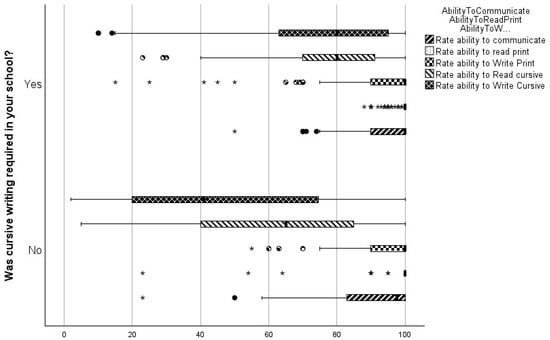
Participants’ self-assessed ratings (0 = Very poor, 100 = Excellent) of their current functional competence constructs (reading print, writing print, Communication, writing cursive, and reading cursive) are shown in Figure 1.
Figure 1.
Box-plots of Self-assessed Ratings (0: Very poor, 100: Excellent) for Various Abilities Across Participants With (n = 134) or Without (n = 52) the Requirement of Cursive Writing. The first and third quartiles are shown by the Box. The whiskers represent the minimum and maximum values. The median values are shown by the thick vertical lines inside the boxes. Mild outliers (1.5 x interquartile range above the third quartile) are shown by the circles. The asterisks represent extreme outliers (3 x interquartile range above the third quartile). Note that almost all participants rated the ability to print as excellent (100), and thus there is no box around it.
Mann–Whitney U test revealed no significant differences between those who were required to learn cursive (n = 134) and those who were not required to learn cursive in the ratings for reading print (z = −0.347, p = .728, n = 55), writing print (z = 0.319, p = .750, n = 55), or communication (z = −0.852, p = .394, n = 56). As can be expected, the ratings of participants who were required to learn cursive writing (n = 134) were significantly better than those who were not required to learn it. This group difference was moderately strong for reading cursive (z = −3.877, p < .001, n = 53, rank-biserial r = −0.28) and particularly pronounced for writing cursive (z = −5.664, p < .001, n = 52, rank-biserial r = −0.42) (Figure 1).
The related-samples Friedman’s two-way ANOVA among participants who were required to learn cursive writing (n = 134) revealed significant differences in the self-ratings across the five abilities, χ2(4) = 250.096, p < .001. This yielded a moderate-to-strong global effect size (Kendall’s W = 0.47), indicating highly distinct perceptual tracking across the items. The Dunn–Bonferroni post hoc test revealed significantly lower ratings for the ability to read and write cursive compared to the ability to read print, write print, or communicate (all adjusted p < .001, representing strong pairwise effects). In addition, the ability to communicate was judged to be significantly lower than the ability to read print (adjusted p = .002, a moderate pairwise effect). Other differences were not significant. The mean ranks for the high-competence print constructs were 4.09 (reading) and 3.54 (writing), while those for the lower-competence cursive constructs were 1.93 (reading) and 2.06 (writing), with general communication anchoring the middle baseline at 3.38.
Friedman statistics also revealed significant differences in self-ratings across the five abilities among those who were not required to learn cursive (n = 52), χ2(4) = 138.932, p < .001. This yielded a strong global effect size (Kendall’s W = 0.67), indicating highly distinct perceptual tracking across the items. The Dunn–Bonferroni post hoc test revealed significantly lower ratings for the ability to read and write cursive than to read and write print or communicate (p < .001, representing a strong pairwise effect). There were no significant differences between reading versus writing cursive, reading versus writing print, and communicating versus reading and writing print. The mean ranks for the higher-competence print constructs were 4.16 (reading) and 3.85 (writing), while those for the lower-competence cursive constructs were 1.92 (reading) and 1.52 (writing), with general communication anchoring the middle baseline at 3.55.
In summary, as apparent in Figure 1, regardless of the requirement to write cursive, the ability to read and write cursive was significantly poorer compared to the ability to read or write print or communicate across both groups.
3.2. Rating of Ease in Learning to Read and Write Print and Cursive
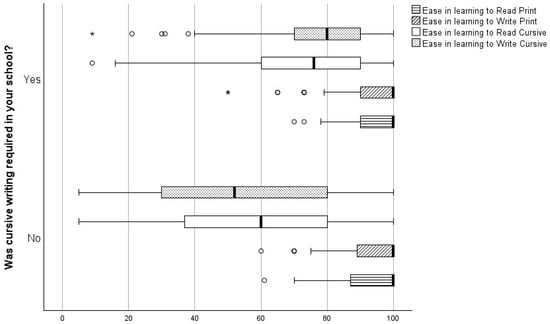
Survey question 11 requested participants to assess the retrospective ease-of-learning construct for both reading and writing in print and cursive modalities side-by-side. Participants’ self-assessed ratings (0: Very poor, 100: Excellent) for the reported ease in learning to read and write print and cursive are shown in Figure 2.
Figure 2.
Box-Plots of the Self-assessed Ratings (0: Very poor, 100: Excellent) for the Reported Ease in Learning to Read and Write Print and Cursive Across Participants With (n = 116) or Without (n = 45) the Cursive Writing Requirement. The first and third quartiles are shown by the Box. The whiskers represent the minimum and maximum values. The median values are shown by the thick vertical lines inside the boxes. Mild outliers (1.5 x interquartile range above the third quartile) are shown by the circles. The asterisks represent extreme outliers (3 x interquartile range above the third quartile).
Mann–Whitney U test results revealed no statistically significant differences in the ease in learning to write (z = −0.235, p = .814) or read print (z = −0.925, p = .355) between those who were required (n = 116) or not required (n = 50) to learn cursive. As anticipated, participants who were required to learn cursive writing (n = 116) indicated significantly more ease than those who were not required to learn cursive. This group difference was moderately strong for learning to write cursive (z = −4.624, p < .001, n = 46, rank-biserial r = −0.36) and moderate for learning to read cursive (z = −3.567, p < .001, n = 48, rank-biserial r = −0.28) (Figure 2).
The Related-Samples Friedman’s Two-Way ANOVA by Ranks revealed significant differences in the reported ease across the various skills for both those who were required to learn cursive, χ2(3) = 189.601, p < .001, n = 116, yielding a strong global effect size (Kendall’s W = 0.54), and those who were not required to learn cursive, χ2(3) = 100.803, p < .001, n = 45, showing a very strong global effect size (Kendall’s W = 0.75) (Figure 2). The Dunn–Bonferroni post hoc test revealed no significant differences in the reported ease in reading versus writing cursive (p = .381 for the required group and p = 1.000 for the non-required group) or reading versus writing print (p = 1.000 for both groups). Conversely, the reported ease was significantly higher for reading and writing print versus reading and writing cursive in both groups (p < .001, representing a strong pairwise distinction). For the group required to learn cursive, the mean ranks for the ease in reading and writing print were 3.33 and 3.13, and those for reading and writing cursive were 1.61 and 1.93. For those who were not required to learn cursive, the mean ranks for the ease in reading and writing print were 3.40 and 3.33, and those for reading and writing cursive were 1.76 and 1.51.
3.3. Rating of Stress in Learning to Read and Write Print and Cursive
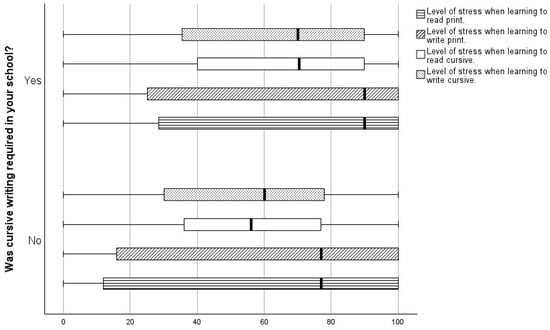
Survey question 12 prompted participants to assess the degree of stress they experienced while learning different skills. Participants’ self-assessed ratings for the degree of stress (0 = Very Stressful, 100 = No stress at all) are shown in Figure 3.
Figure 3.
Box-plots of the Self-assessed Ratings (0: Very stressful, 100: No stress at all) for the Reported Stress Levels in Learning to Read and Write Print and Cursive Across Participants With (n = 116) or Without (n = 45) the Cursive Writing Requirement. Lower ratings indicate greater stress. The first and third quartiles are shown by the Box. The whiskers represent the minimum and maximum values. The median values are shown by the thick vertical lines inside the boxes.
Retrospective stress levels during learning did not significantly differ between the two groups for any skill area. Specifically, Mann–Whitney U test results showed no significant differences between the cursive-required (n = 116) and cursive-not-required groups for writing print (z = −0.565, p = .572, n = 49) or reading print (z = −0.382, p = .702, n = 49). Similarly, no significant group differences emerged for recollections of stress when learning to write cursive (z = −1.508, p = .132; Not Required n = 47) or read cursive (z = −1.622, p = .105; Not Required n = 48).
The related-samples Friedman’s Two-Way Analysis of Variance by Ranks revealed significant differences in recalled stress levels across the four literacy skills for the 116 participants who were required to learn cursive, χ2(3) = 23.699, p < .001, yielding a small global effect size (Kendall’s W = 0.07). The Dunn–Bonferroni post hoc test revealed significantly higher stress levels when learning to read (p = .004) and write (p = .003) cursive compared to when learning to read print, representing a distinct pairwise burden. No other pairwise differences were significant. The mean ranks for learning to read and write cursive were 2.26 and 2.25, and those for reading and writing print were 2.84 and 2.65.
For participants who were not required to learn cursive writing (n = 45), there were no significant differences [χ2(3) = 0.111, p = .990] in the ratings of the reported stress levels in learning to read or write print or cursive. The mean ranks for learning to read and write cursive were 2.49 and 2.47, and those for reading and writing print were 2.54 and 2.50.
In summary, there were higher stress levels associated with learning to read and write cursive compared to learning to read print among those who were required to learn cursive.
3.4. Rating of the Value of Learning to Read and Write Print and Cursive
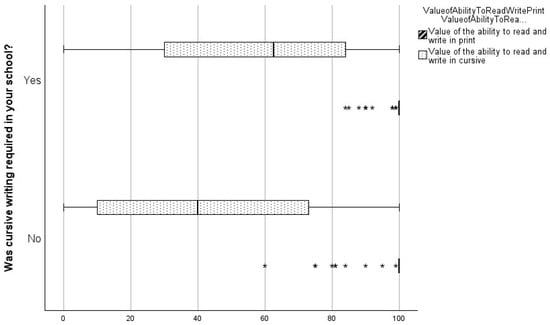
Survey question 18 asked participants to judge the attitudinal value constructs of learning to read and write in print and cursive using a slider. Participants’ ratings (0 = not at all valuable, 100 = very valuable) for these value constructs are shown in Figure 4.
Figure 4.
Box-plots of the Ratings (0: Not at all valuable, 100: Very valuable) of the Judgements of Value of the Ability to Read and Write Print and Cursive Across Participants With (n = 112) or Without (n = 47) the Cursive Writing Requirement. The first and third quartiles are shown by the Box. The whiskers represent the minimum and maximum values. The median values are shown by the thick vertical lines inside the boxes. The asterisks represent extreme outliers (3 x interquartile range above the third quartile). Note that the value of the ability to read and print was judged as very valuable (100) by most participants and thus the box showing the interquartile range is not seen.
Mann–Whitney U test results indicated significant differences in the judged value of learning to read and write cursive between the two groups (Cursive required n = 112; cursive not required n = 47, z = −2.609, p = .009). Those who were required to learn cursive gave higher value ratings, although the practical strength of this association was small-to-moderate (rank-biserial r = −0.21). The difference in the judged value in learning to read or write print among the two groups missed significance (z =−2.146, p = .032). Overall, the mean judged value was very high (above 96) for the print style, while it was below 58 for the cursive style (Figure 4).
The Related-Samples Friedman’s Two-Way Analysis of Variance by Ranks revealed that the judged value of the ability to read and write cursive was significantly lower than the value of the ability to read and write in print among those who were required to learn cursive, χ2(1) = 96.040, p < .001, n = 112, yielding a very strong global effect size (Kendall’s W = 0.86). A similarly significant and pronounced discrepancy was observed among those who were not required to learn cursive, χ2(1) = 37.356, p < .001, n = 47, which also demonstrated a very strong global effect size (Kendall’s W = 0.79). Among those who were required to and not required to learn cursive, the mean rank for the value to read and write print was 1.94, and that for cursive was 1.06.
3.5. Learning to Read in Print Before Learning to Write Cursive
Survey question 13 asked participants if they could read effectively in print before learning how to write in cursive. Out of a total of 115 respondents who were required to learn cursive, 112 (97.4%) learned to read print effectively before learning to write cursive and 3 (2.6%) did not. Out of the 48 participants who were not required to learn cursive, 32 (66.67%) learned to read print effectively, and 1 (2.08%) did not learn to read print effectively before learning to write cursive, and 15 (31.25%) did not learn to write cursive. In summary, 144 (88.34%) of the 163 participants could read effectively in print before learning to write cursive.
3.6. Attribution of Cursive Requirement to Reading Efficiency
Question 14 asked participants if they became more efficient readers due to the requirement to learn cursive writing. The Pearson Chi-Square test revealed significant results, χ2(2) = 51.414, p < .001, showing a very strong association between participant responses and their childhood cursive requirement status (Cramér’s V = 0.56) (Table 2).
Table 2.
Attribution of learning Cursive Writing to reading efficiency, speed, confidence, and accuracy. Results of the Pearson Chi-Square test to indicate differences between the two groups and the Chi-Square test to indicate differences across the percentage of participants who said “Yes”, “No”, or “Other” (“I did not learn to write cursive” for the first 2 questions in the table, and “I was not required to learn cursive” for the last 2 questions) within each group. Significance level is set at .01. Asterisks (*) indicate significant findings.
However, this overall significant association largely reflects the fact that participants in the non-required group could select “Other” (“I did not learn to write cursive”; 16/48, 33.33%), whereas those in the required group did not select this option (0/115, 0.00%), rather than necessarily representing a substantive difference in perceived literacy benefit between the two groups. This interpretation applies to all the remaining questions in Table 2 and discussed in Section 3.7, Section 3.8 and Section 3.9.
Among those who were mandated to learn cursive, there was no statistically significant difference (p = .305) between those who responded “Yes” (63/115, 54.78%) and “No” (52/115, 45.22%). Overall, these results indicate that participants did not attribute any long-term improvement in their reading efficiency to a childhood cursive writing requirement.
Among participants who were not obligated to learn cursive, a significantly higher percentage (p = .006) answered “No” (25/48, 52.08%) compared to those who answered “Yes” (7/48, 15.58%).
3.7. Attribution of Cursive Requirement to Reading Speed
Question 15 asked participants if their reading speed improved due to the requirement to learn cursive writing. The Pearson Chi-Square test revealed significant results, χ2(2) = 49.291, p < .001, indicating that participant responses were strongly associated with their childhood cursive requirements (Cramér’s V = 0.55) (Table 2).
Among participants who were obligated to learn cursive, there were no significant differences (p = .926) in the percentages of individuals responding “Yes” (58/115, 50.43%) versus “No” (57/115, 49.57%). These findings suggest no significant attribution of cursive requirements to participants’ current perceptions of their reading speed.
Among those who were not required to learn cursive, a significantly higher percentage (p = .006) responded “No” (25/48, 52.06%) compared to those who responded “Yes” (7/48, 14.58%).
3.8. Attribution of Cursive Requirement to Reading Confidence
Survey question 16 asked participants if they had become more confident readers due to the requirement to learn cursive writing. The Pearson Chi-Square test revealed significant results [χ2(2) = 54.240, p < .001], showing a very strong association between participants and their childhood cursive requirement status (Cramér’s V = 0.58) (Table 2). Among those who were mandated to learn cursive, the differences in the percentage of participants who responded “Yes” (60.87%) and those who responded “No” (49.13%) did not reach significance (p = .02). These findings suggest no significant attribution of the cursive requirement to reading confidence.
Similarly, among those who were not required to learn cursive, the percentages of individuals responding “No,” “Yes,” or “I was not required to learn cursive writing” did not exhibit significant differences (p = .174).
3.9. Attribution of Cursive Requirement to Reading Accuracy
Question 17 asked participants if their reading accuracy improved due to the requirement to learn cursive writing. The Pearson Chi-Square test revealed significant results [χ2(2) = 53.068, p < .001], showing a very strong association between participant responses and their childhood cursive requirement status (Cramér’s V = 0.57) (Table 2).
Among participants who were mandated to learn cursive, there were no significant differences (p = 0.78) in the percentages of individuals responding “Yes” (59/115, 51.3%) versus “No” (56/115, 48.7%). These findings show no significant attribution of cursive learning requirement to long-term reading accuracy.
Among those who were not required to learn cursive, there were no significant differences in the percentage of participants who responded “No” (22/48, 45.83%) or selected the option of “cursive writing was not required” (18/48, 37.5%) compared to those who responded “Yes” (8/48, 16.66%) (p = .039).
3.10. Benefits of Learning Print and Cursive
Question 19 asked participants if learning to read and write in print was beneficial, and all participants, except one, responded with “Yes.” Question 20 inquired whether learning to read and write cursive was beneficial. The Pearson Chi-Square test results did not reach statistical significance [χ2(2) = 5.900, p = .052], showing no differences across the two groups (Table 3). Among those who were obligated to learn cursive, a significantly higher percentage (62.5%) responded with “Yes” compared to those who responded with “No” (16.07%) or “Not sure” (21.43%) (p < .001). Among those who were not required to learn cursive, there were no significant differences in the percentages of individuals responding with “No,” “Yes,” or “Not Sure” (p = .198).
Table 3.
Perceived benefit of learning to write and related recommendations. Results of the Pearson Chi-Square test to indicate differences between the two groups and the Chi-Square test within each group to indicate differences across the percentage of participants who responded “Yes”, “No”, or Other (“Not sure” for the first four questions in the Table and “Not applicable, I learned cursive writing” for the last question). The significance level is set at .01. The last column shows asymptotic significance. Asterisks (*) indicate significant findings.
Question 21 asked participants if the effort to learn cursive writing was worthwhile in terms of the benefits it provides. The Pearson Chi-Square test results did not reach statistical significance [χ2(2) = 5.539, p = .063], showing no differences across the two groups (Table 3). Among those who were obligated to learn cursive, a significantly higher percentage (56.25%) responded “Yes” compared to those who responded “No” (24.11%) or “not sure” (19.64%) (p < .001). In contrast, among those who were not required to learn cursive, there were no significant differences in percentages of individuals responding with “No,” “Yes,” or “Not sure” (p = .059).
3.11. Recommendation to Teach Cursive
Question 22 inquired whether participants would recommend teaching cursive reading and writing to young children. The Pearson Chi-Square test revealed significant results [χ2(2) = 16.795, p < .001], indicating that participant responses were moderately associated with their own childhood requirement status (Cramér’s V = 0.32) (Table 3). Out of the 112 participants who were required to learn cursive, 85 (75.89%), and out of the 47 respondents who were not required to learn cursive, 26 (55.31%) would recommend teaching cursive to young children. Among all participants, the percentage of individuals responding “Yes” was significantly higher (p < .001) than those who responded with “No” or “Not sure.”
3.12. Desire to Learn Cursive
Question 23 inquired whether participants who did not learn cursive reading or writing wished they had learned it. 110/122 participants who were required to learn cursive responded using “Not applicable, I learned cursive writing,” demonstrating the validity of responses. As expected, the Pearson Chi-Square statistics revealed significant (χ2(2) 65.988, p < .001) differences in responses depending on childhood cursive requirements, yielding an exceptionally strong overall association (Cramér’s V = 0.62) (Table 3). Among those who were not required to learn cursive, no significant differences were apparent in the percentages of participants responding with “Yes,” “No,” or “Not applicable” (p = .256). Therefore, there is no strong indication that those who had not learned cursive wished they had learned it.
4. Discussion
A summary of findings is presented in Table 4. As shown in column 1 of Table 4, some of the retrospective perceptions of participants provide no support for requiring cursive, including poorer ability, poorer ease, higher stress levels, and lower perceived value of learning to read and write cursive compared to reading and writing print. As shown in column 2 of Table 4, the requirement to learn cursive did not improve reading efficiency, speed, accuracy, or confidence. As shown in the third column of Table 4, limited support was found for requiring cursive since some of the participants who were required to learn cursive found it beneficial and worth the effort. Most of the participants recommended teaching cursive to young children, although we did not ask the reason for this recommendation. In summary, these results provide minimal experiential support for requiring cursive for young children from the learners’ perspective. Any such support must be balanced against the perceived costs of learning cursive, such as higher perceived stress levels.
Table 4.
Summary of viewpoints related to the requirement to learn cursive.
4.1. Reading, Writing, and Communication Skills
While childhood cursive requirements were completely unrelated to how adults view their overall communication success later in life, adults viewed cursive as a low-competence domain compared to their broader communicative and print skills.
As hypothesized, participants who were required to learn cursive perceived better abilities only in reading and writing cursive and not in print, compared to those who were not required to learn cursive. The ability to read and write cursive was perceived to be weaker compared to the ability to read or write print, regardless of the requirement to learn cursive (Figure 1). As noted in the introduction, the weaker cursive ability is expected due to the greater perceptual difficulties associated with the cursive font resulting from the absence of spaces between letters (Danna et al., 2018), the more complex motor movements with a higher demand on the grapho-motor planning pathways (Berninger et al., 2006), and less exposure to and relevance of the cursive font in daily activities.
4.2. Ease and Stress Levels in Learning to Read and Write
As hypothesized, regardless of the cursive requirement, learning to read and write cursive was perceived as being more difficult compared to learning to read or write print by all participants. Furthermore, significantly higher stress levels for reading and writing cursive compared to reading print were reported by the group with the cursive requirement. Participants exert higher pressure while writing in cursive (Pagliarini et al., 2015), which can increase hand strain. Higher stress levels can reduce learning and recall (Vogel & Schwabe, 2016; Klier & Buratto, 2020) and thus may interfere with learning to read and oral reading fluency. The perception of significantly greater difficulty and higher stress levels in learning cursive should be considered in making policy decisions about the cursive requirement, especially for children who are struggling to read or write print and may have deficits in working memory (Carretti et al., 2009).
4.3. Value of Reading and Writing Ability
As hypothesized, the perceived value of the ability to read and write in print was relatively high among all participants due to daily exposure and relevance in everyday life. The perceived mean value of learning to read and write cursive was about half of that assigned to reading and writing print. However, participants who were required to learn cursive assigned a slightly greater value to reading and writing in cursive than the values assigned by those who did not have such a requirement (Figure 4).
4.4. Cursive Writing Mandate and Reading Skills
As hypothesized, the requirement to learn cursive did not lead to perception of improved reading efficiency, speed, accuracy, or confidence. A previous study (Danna et al., 2018) similarly reported lower cursive reading efficiency compared to reading printed words in both young adults and second graders. More specifically, the study reported a negative impact of cursive font on the word reading speed of second graders who learned exclusively to write cursive and the word reading accuracy of adults.
4.5. Benefits and Recommendations to Teach Cursive
As expected, most participants believed that learning to read and write print was beneficial, and the perceived worthiness of learning cursive, in terms of its benefits, was higher among participants who were required to learn cursive. However, among the participants who were required to learn cursive, 24.11% (27/112) did not believe it was worth learning cursive, and 19.64% (22/112) were not sure about the worthiness of the efforts to learn cursive in terms of its benefits.
As expected, the recommendation to teach cursive reading and writing to young children received an overall positive response, with a substantial majority advocating for it. The reasons for this recommendation are unclear. One possible reason is that most participants were students at a university located in a state that required cursive writing in schools. Another possible reason is the campaign for cursive by the American Handwriting Analysis Foundation (n.d.).
Although 13 out of the 47 participants not required to learn cursive expressed a desire to have learned cursive, this desire was not expressed by the majority of the participants. There is no strong indication that individuals who did not learn cursive reading or writing wished they had acquired this skill.
4.6. Study Limitations
Like other studies, our study had some limitations. First, the participant distribution between those required to learn cursive and those who were not required to learn cursive was imbalanced. Nonetheless, due to a sufficient sample size in the group with no cursive requirement, results are unlikely to change. Secondly, our study had 145 female participants and 40 male participants. Although it is unlikely that the results will vary based on the gender of the participants, future studies with equal gender representation may be useful. Third, we did not know the rigor with which cursive learning requirements were implemented by teachers. Depending on the rigor of the cursive requirement, there may be differences in participant experiences, potentially impacting the reported outcomes. Fourth, 144 (88.34%) out of 163 respondents could read effectively in print before learning to write cursive. Thus, these results may not generalize to individuals with initial exposure to cursive. Fifth, we relied on a non-probability convenience sample recruited through social media and university email, and participants were likely mostly university students aged approximately 18–22. Overall, several features of our study limit generalizability since cursive instruction practices and policies vary by state, school, cohort, teacher, and implementation intensity.
An additional potential limitation is that the survey questions about stress levels and ease in learning relied on recall by participants of what happened in early childhood. Although the number of items recalled and the depth of episodic details can decline with increasing age, items recalled by participants are 93–95% accurate across age and time (Diamond et al., 2020). Other studies have shown moderate correlations between prospective and retrospective (20 years later) measures (Bell & Bell, 2018). In addition, adults may have difficulty in making retrospective causal judgements that may be vulnerable not just to memory bias but also to belief-based responding and post hoc rationalization. Future studies at an earlier age are recommended to address any issues with recall accuracy.
Although the survey had face validity and was piloted for clarity, test–retest reliability, construct validity, and structural validation were not established. Future research should focus on utilizing standardized, prospectively validated literacy measurement tools to build upon these preliminary findings.
4.7. Suggestions for Future Research
In future research, expanding the participant pool to include an equal representation of individuals who were required to learn cursive and not required to learn cursive, equal representation of male and female participants to identify any gender differences, and recording the rigor of the cursive requirements would enhance the validity and generalizability of findings. The current study predominantly relied on participants’ self-ratings of various skills. Future studies that require participants to read, copy, and write dictated words/sentences in cursive and print to determine speed, accuracy, and efficiency may be useful in confirming the current results. Additionally, investigating the perceptions of the benefits of cursive writing among individuals with reading or writing disorders could offer valuable insights. Understanding how individuals with such disorders perceive and experience the potential advantages or disadvantages of cursive writing may contribute to tailored interventions, support mechanisms, and educational policies.
5. Conclusions
The results of this preliminary investigation demonstrate that adults do not associate childhood cursive mandates with superior long-term literacy skills. Furthermore, retrospective recollections highlight a psychological cost, with accounts of lower ease and increased stress levels in learning to write cursive compared to print. In addition, these retrospective perceptions do not provide strong subjective support for requiring cursive instruction as a means of improving later literacy, but objective longitudinal or experimental research is needed before drawing instructional conclusions.
Supplementary Materials
The following supporting information can be downloaded at: https://www.mdpi.com/article/10.3390/educsci16081339/s1.
Author Contributions
Conceptualization, V.W.R.; methodology, V.W.R. and A.W.; formal Analysis, V.W.R.; writing-original draft preparation, V.W.R. and A.W.; writing-review and editing, V.W.R. and A.W.; visualization, V.W.R.; supervision, V.W.R.; project administration, A.W. All authors have read and agreed to the published version of the manuscript.
Funding
This research received no external funding.
Institutional Review Board Statement
The study was conducted in accordance with the Declaration of Helsinki, and approved by the Institutional Review Board (or Ethics Committee) of University of Mississippi (protocol code 23x-291 and date of approval: June 2023).
Informed Consent Statement
Informed consent was obtained from all subjects involved in the study.
Data Availability Statement
The data used in the current article can be accessed by using this link: https://osf.io/4brgp/overview?view_only=ec694df2d8d74474bf497088c601cdfd (accessed on 14 August 2026).
Conflicts of Interest
The authors declare no conflict of interest.
References
- Alstad, Z., Sanders, E., Abbott, R. D., Barnett, A. L., Henderson, S. E., Connelly, V., & Berninger, V. W. (2015). Modes of alphabet letter production during middle childhood and adolescence: Interrelationships with each other and other writing skills. Journal of Writing Research, 6(3), 199. [Google Scholar] [CrossRef] [Scilit] [PubMed]
- American Handwriting Analysis Foundation. (n.d.). AHAF’s campaign for cursive. Available online: https://ahafhandwriting.org/AHAF_s_Campaign_for_Cursive (accessed on 16 August 2026).
- Arfé, B., Corato, F., Pizzocaro, E., & Merella, A. (2020). The effects of script and orthographic complexity on the handwriting and spelling performance of children with dyslexia. Journal of Learning Disabilities, 53(2), 96–108. [Google Scholar] [CrossRef] [Scilit] [PubMed]
- Bara, F., Morin, M. F., Alamargot, D., & Bosse, M. L. (2016). Learning different allographs through handwriting: The impact on letter knowledge and reading acquisition. Learning and Individual Differences, 45, 88–94. [Google Scholar] [CrossRef] [Scilit]
- Bell, D. C., & Bell, L. G. (2018). Accuracy of retrospective reports of family environment. Journal of Child and Family Studies, 27(4), 1029–1040. [Google Scholar] [CrossRef] [Scilit] [PubMed]
- Berninger, V. W., Abbott, R. D., Jones, J., Wolf, B. J., Gould, L., Anderson-Youngstrom, M., Shimada, S., & Apel, K. (2006). Early development of language by hand: Composing, reading, listening, and speaking connections; three letter-writing modes; and fast mapping in spelling. Developmental Neuropsychology, 29(1), 61–92. [Google Scholar] [CrossRef] [Scilit] [PubMed]
- Borges, M. T., Aprígio, L. C. S., Azoni, C. A. S., & Crenitte, P. A. P. (2020). Types of handwriting and signs of dysgraphia in children and adolescents with learning difficulties. Revista CEFAC, 22(6), e17719. [Google Scholar] [CrossRef] [Scilit]
- Cadime, I., Rodrigues, B., Ribeiro, I., & Martín-Aragoneses, M. T. (2024). Executive functioning in different types of reading disabilities. Journal of Intelligence, 12(10), 101. [Google Scholar] [CrossRef] [Scilit] [PubMed]
- Cantin, N., & Hubert, J. (2019). A description of teachers’ approach to handwriting instruction in primary schools. Canadian Journal of Occupational Therapy, 86(5), 371–376. [Google Scholar] [CrossRef] [Scilit] [PubMed]
- Carretti, B., Borella, E., Cornoldi, C., & De Beni, R. (2009). Role of working memory in explaining the performance of individuals with specific reading comprehension difficulties: A meta-analysis. Learning and Individual Differences, 19(2), 246–251. [Google Scholar] [CrossRef] [Scilit]
- Civera, T., Perea, M., Leone-Fernández, B., & Vergara-Martínez, M. (2024). The effect of inter-letter spacing on the N170 during visual word recognition: An event-related potentials experiment. Cognitive, Affective, & Behavioral Neuroscience, 24(6), 1096–1108. [Google Scholar] [CrossRef] [Scilit] [PubMed]
- Danna, J., Massendari, D., Furnari, B., & Ducrot, S. (2018). The optimal viewing position effect in printed versus cursive words: Evidence of a reading cost for the cursive font. Acta Psychologica, 188, 110–121. [Google Scholar] [CrossRef] [Scilit] [PubMed]
- Diamond, N. B., Armson, M. J., & Levine, B. (2020). The truth is out there: Accuracy in recall of verifiable real-world events. Psychological Science, 31(12), 1544–1556. [Google Scholar] [CrossRef] [Scilit] [PubMed]
- Gosse, C., Parmentier, M., & Van Reybroeck, M. (2021). How do spelling, handwriting speed, and handwriting quality develop during primary school? Cross-classified growth curve analysis of children’s writing development. Frontiers in Psychology, 12, 685681. [Google Scholar] [CrossRef] [Scilit] [PubMed]
- Graham, S., Berninger, V. W., Abbott, R. D., Abbott, S. P., & Whitaker, D. (1997). Role of mechanics in composing of elementary school students: A new methodological approach. Journal of Educational Psychology, 89(1), 170. [Google Scholar] [CrossRef]
- Graham, S., Weintraub, N., & Berninger, V. W. (1998). The relationship between handwriting style and speed and legibility. The Journal of Educational Research, 91(5), 290–297. [Google Scholar] [CrossRef] [Scilit]
- Hendricks, A. E. (1955). Manuscript and cursive hand-writing in Brookline. The Elementary School Journal, 55(8), 447–452. [Google Scholar] [CrossRef] [Scilit] [PubMed]
- Karlsdottir, R. (1996a). Print-script as Initial Handwriting Style I: Effects on the development of handwriting. Scandinavian Journal of Educational Research, 40(2), 161–174. [Google Scholar] [CrossRef] [Scilit]
- Karlsdottir, R. (1996b). Print-script as Initial Handwriting Style II: Effects on the development of reading and spelling. Scandinavian Journal of Educational Research, 40(3), 255–262. [Google Scholar] [CrossRef] [Scilit]
- Kim, Y. S. G. (2024). Writing fluency: Its relations with language, cognitive, and transcription skills, and writing quality using longitudinal data from kindergarten to grade 2. Journal of Educational Psychology, 116(4), 590. [Google Scholar] [CrossRef] [Scilit] [PubMed]
- Klier, C., & Buratto, L. G. (2020). Stress and long-term memory retrieval: A systematic review. Trends in Psychiatry and Psychotherapy, 42(3), 284–291. [Google Scholar] [CrossRef] [Scilit] [PubMed]
- Malpique, A. A., Valcan, D., Pino-Pasternak, D., Ledger, S., & Merga, M. (2024). Effect sizes of writing modality on K-6 students’ writing and reading performance: A meta-analysis. The Australian Educational Researcher, 51(5), 2001–2030. [Google Scholar] [CrossRef] [Scilit]
- Morales-Rando, C., Pérez-Jorge, D., Strbová, L., & Ariño-Mateo, E. (2022). Manuscript vs cursive writing. Learning to write in primary education. Education 3-13, 50(7), 880–892. [Google Scholar] [CrossRef] [Scilit]
- Morgan, P. L., Farkas, G., Wang, Y., Hillemeier, M. M., Oh, Y., & Maczuga, S. (2019). Executive function deficits in kindergarten predict repeated academic difficulties across elementary school. Early Childhood Research Quarterly, 46, 20–32. [Google Scholar] [CrossRef] [Scilit]
- Morin, M. F., Lavoie, N., & Montésinos-Gelet, I. (2012). The effects of manuscript, cursive or manuscript/cursive styles on writing development in Grade 2. Language and Literacy, 14(1), 110–124. [Google Scholar] [CrossRef]
- Pagliarini, E., Guasti, M. T., Toneatto, C., Granocchio, E., Riva, F., Sarti, D., Molteni, B., & Stucchi, N. (2015). Dyslexic children fail to comply with the rhythmic constraints of handwriting. Human Movement Science, 42, 161–182. [Google Scholar] [CrossRef] [Scilit] [PubMed]
- Peng, P., Barnes, M., Wang, C., Wang, W., Li, S., Swanson, H. L., Dardick, W., & Tao, S. (2018). A meta-analysis on the relation between reading and working memory. Psychological Bulletin, 144(1), 48–76. [Google Scholar] [CrossRef] [Scilit] [PubMed]
- Schuchardt, K., Maehler, C., & Hasselhorn, M. (2008). Working memory deficits in children with specific learning disorders. Journal of Learning Disabilities, 41(6), 514–523. [Google Scholar] [CrossRef] [Scilit] [PubMed]
- Schwellnus, H., Cameron, D., & Carnahan, H. (2012). Which to choose: Manuscript or cursive handwriting? A review of the literature. Journal of Occupational Therapy, Schools, & Early Intervention, 5(3–4), 248–258. [Google Scholar] [CrossRef] [Scilit]
- Semeraro, C., Coppola, G., Cassibba, R., & Lucangeli, D. (2019). Teaching of cursive writing in the first year of primary school: Effect on reading and writing skills. PLoS ONE, 14(2), e0209978. [Google Scholar] [CrossRef] [Scilit] [PubMed]
- Van der Weel, F. R., & Van der Meer, A. L. (2024). Handwriting but not typewriting leads to widespread brain connectivity: A high-density EEG study with implications for the classroom. Frontiers in Psychology, 14, 1219945. [Google Scholar] [CrossRef] [Scilit] [PubMed]
- Vogel, S., & Schwabe, L. (2016). Learning and memory under stress: Implications for the classroom. npj Science of Learning, 1(1), 16011. [Google Scholar] [CrossRef] [Scilit] [PubMed]
- Winch, W. H. (1926). Print-script and cursive-script in schools: An investigation in nervo-muscular readjustments. Forum of Education, 4, 123–138. [Google Scholar]
- Wolf, B., Abbott, R. D., & Berninger, V. W. (2017). Effective beginning handwriting instruction: Multi-modal, consistent format for 2 years, and linked to spelling and composing. Reading and Writing, 30(2), 299–317. [Google Scholar] [CrossRef] [Scilit] [PubMed]

Disclaimer/Publisher’s Note: The statements, opinions and data contained in all publications are solely those of the individual author(s) and contributor(s) and not of MDPI and/or the editor(s). MDPI and/or the editor(s) disclaim responsibility for any injury to people or property resulting from any ideas, methods, instructions or products referred to in the content. |
© 2026 by the authors. Licensee MDPI, Basel, Switzerland. This article is an open access article distributed under the terms and conditions of the Creative Commons Attribution (CC BY) license.