


Abstract
This study examined (a) the development of vocabulary breadth and vocabulary depth, operationalized as homonym knowledge, across one academic year (fall to spring) in Grades 1–4 for multilingual learners and English monolinguals and (b) the concurrent and longitudinal relations between homonym knowledge and reading comprehension. Participants were 758 elementary students (60% multilingual learners) who completed measures of vocabulary breadth, homonym knowledge, word identification, and reading comprehension in fall and spring. Two 2 (Time) × 2 (Language) × 4 (Grade) mixed ANOVAs and hierarchical regressions were conducted. Both multilingual learners and monolinguals showed significant growth in vocabulary breadth and homonym knowledge over the academic year, but growth rates were comparable across language groups and grades, indicating a persistent vocabulary gap between multilingual learners and monolinguals. Hierarchical regressions showed that fall homonym knowledge uniquely contributed to fall reading comprehension after controlling for fall vocabulary breadth and word identification. Longitudinally, fall homonym knowledge also predicted spring reading comprehension after accounting for fall reading comprehension, word identification, and vocabulary breadth. These results highlight homonym knowledge as an aspect of vocabulary depth that is associated with reading comprehension in early elementary grades for both multilingual learners and monolinguals, and point to the potential value of explicit instruction on homonyms to support multilingual learners’ literacy and content-area learning.
1. Introduction
Vocabulary knowledge1 has long been recognized for its strong association with reading comprehension (e.g., Anderson & Freebody, 1981; Perfetti & Stafura, 2014; Proctor et al., 2012). Within theoretical models of reading, vocabulary is viewed not merely as a store of word meanings but as a dynamic system that enables rapid lexical access, supporting the phonological, orthographic, syntactic, and morphological processes that are central to comprehension (Cromley & Azevedo, 2007; Perfetti & Stafura, 2014; Stanovich, 1986). Stanovich (1986) proposed a reciprocal relation between vocabulary development and reading skills, which helps explain the gaps in reading comprehension, particularly in the upper elementary grades where students encounter increasingly sophisticated vocabulary through interaction with academic content. Although comprehension involves more than word recognition, it is impossible if a reader does not know “the meanings of a sufficient proportion of the words in the text” (Stahl & Nagy, 2007, p. 4). Understanding the role of vocabulary in reading is therefore essential for researchers and practitioners alike, particularly when supporting students who are learning to read in a language that is not their primary home language.
Compared to English monolinguals, multilingual learners2 face the dual challenge of simultaneously acquiring English language proficiency and learning to “analyze and comprehend sophisticated text in a language in which, in many cases, they are not fully proficient” (Lesaux et al., 2010, p. 475). National reports and research studies consistently show a marked written language achievement gap between multilingual learners and English monolinguals (e.g., Kieffer, 2008).
Limited vocabulary is a key contributor to the English language proficiency and academic achievement gap between multilingual learners and monolinguals (August et al., 2005; Carlo et al., 2004; Mancilla-Martinez & Lesaux, 2017). Using the Early Childhood Longitudinal Study datasets, Kieffer (2008) found that multilingual learners in various instructional contexts who started kindergarten with limited oral English proficiency continued to lag behind in fifth grade in reading achievement, with the gap growing wider as they continued into higher grades. This widening gap has been attributed in part to the persistent low vocabulary knowledge among multilingual learners (Kieffer, 2008). Babayiğit et al. (2022) reported that lack of vocabulary remains a primary barrier to reading comprehension for multilingual learners who show cognitive strengths such as working memory, executive function, and novel-word learning, underscoring the critical role of vocabulary breadth and depth for supporting multilingual learners’ academic literacy. This is particularly relevant in content-area learning, where language-intensive classroom learning in content areas such as science, social studies, and mathematics requires not only a wide vocabulary but also flexible, precise knowledge of word meanings in discipline-specific contexts (August et al., 2005). Recent syntheses of content-area literacy for multilingual learners also emphasized the importance of vocabulary in the development of literacy skills (National Academies of Sciences, Engineering, and Medicine, 2024).
Although there is a growing body of empirical research on the role of vocabulary breadth (the number of words a student knows) in reading comprehension for multilingual learners (e.g., August et al., 2014; Carlo et al., 2004; Cho et al., 2019), much less is known about vocabulary depth (the quality of word knowledge) for this population. The few existing studies have examined selected aspects of vocabulary depth, including a combination of syntax and semantics among elementary Spanish–English bilinguals (Leider et al., 2013), semantically related words among elementary Spanish–English bilinguals (Silverman et al., 2015), and polysemous words (different but related meanings) in middle school Spanish–English bilinguals (Logan & Kieffer, 2017). Notably absent from this body of work is attention to homonym knowledge in elementary multilingual learners. Homonyms are words with identical spellings but semantically unrelated meanings (e.g., bank as a financial institution vs. bank of a river) and are distinct from polysemous words, whose multiple meanings are semantically related (e.g., head referring to a body part or the leader of an organization) (Frisson, 2009). This distinction matters: because the multiple meanings of a homonym share no semantic overlap, readers cannot rely on semantic similarity to infer meaning from context and must instead retrieve and select among entirely distinct alternatives (Frisson, 2009). Homonyms can be challenging for students (Anderson & Freebody, 1981; Stahl & Nagy, 2007), and this challenge may be especially pronounced for multilingual learners, whose access to multiple meanings is often more limited than that of their monolingual peers (Carlo et al., 2004). Multilingual learners identified as English learners often acquire conversational vocabulary more quickly than academic vocabulary, and they often know only the common meanings of words (August et al., 2005). The challenge is further amplified in English, a language characterized by extensive homonyms, in which many high-frequency words have multiple unrelated or context-dependent meanings (Nagy & Scott, 2000; Frisson, 2009). The challenge is compounded in content-area texts, where familiar words often carry discipline-specific meanings that differ from their everyday uses (e.g., difference in mathematics, table in science, volume in physics).
Given the important role of vocabulary knowledge in reading comprehension and academic success in both multilingual learners and monolinguals (e.g., Carlo et al., 2004; Silverman et al., 2015), understanding vocabulary development among multilingual learners is essential. Multilingual learners who begin kindergarten with limited English show reading trajectories that increasingly diverge from their monolingual peers, resulting in large achievement gaps by Grade 5 (Kieffer, 2008). Although considerable research has examined vocabulary growth among elementary multilingual learners (Davison et al., 2011; Jackson et al., 2014), most studies have focused primarily on vocabulary breadth. Examining both vocabulary breadth and depth, including facets such as homonym knowledge that are directly relevant to content-area comprehension, is necessary to better understand how English vocabulary develops over time and contributes uniquely to reading comprehension among multilingual learners and monolinguals.
The present study was conducted in English-only elementary instructional programs and had two goals. We first compared the development of vocabulary breadth and depth (operationalized through homonym knowledge) across one academic year (fall to spring) for multilingual learners and monolinguals in Grades 1–4, examining both language-group and grade-level differences in growth. Second, we examined the unique concurrent and longitudinal contributions of homonym knowledge to reading comprehension for both language groups in Grades 1–4, after controlling for word identification and vocabulary breadth at each time point. Both goals were examined across the early elementary grades, a period when foundational reading skills and content-area literacy are developing rapidly. Findings are intended to inform vocabulary instruction that supports multilingual learners’ access to increasingly complex, meaning-dense texts of academic content areas.
1.1. Vocabulary Breadth and Depth
Vocabulary knowledge is not a monolithic construct but comprises multiple dimensions (P. Nation, 2001). P. Nation (2001) organized these into three broad categories: form (spoken, written, and word parts), meaning (form and meaning, concept and referents, and associations), and use (grammatical functions, collocations, and constraints on use). These dimensions align closely with Perfetti’s (2007) Lexical Quality Hypothesis, which holds that lexical quality (the extent to which the reader’s representation of a word captures its form, meaning, and use) directly influences the speed and reliability of meaning retrieval during reading.
Within literacy research, vocabulary knowledge is commonly described along two dimensions: breadth and depth (Anderson & Freebody, 1981; Kieffer & Lesaux, 2012). Anderson and Freebody (1981) made the first distinction and described vocabulary breadth as “the number of words for which the person knows at least some of the significant aspects of meaning” (p. 93), whereas vocabulary depth refers to “the quality or depth of understanding” (p. 93). Vocabulary depth can be operationalized in multiple ways, including the varied features of lexical representations captured in the Lexical Quality Hypothesis (Perfetti, 2007) and through linguistic domains such as morphology, semantics, and syntax (Proctor et al., 2012). Recent work with bilingual children further suggests that both L1 and L2 vocabulary breadth and depth contribute to L2 reading comprehension through direct and indirect pathways, underscoring the value of examining both dimensions across language groups (Tong & Tong, 2022). In the present study, we focused on homonym knowledge as a specific indicator of vocabulary depth because it reflects students’ ability to access and distinguish multiple, semantically unrelated meanings of the same orthographic form. This is theoretically related to lexical quality because successful reading requires efficient selection of contextually appropriate meanings, and it is practically relevant because multiple-meaning words frequently appear in school texts, including content-area texts. Homonym knowledge has also received comparatively limited attention in prior work with multilingual learners, making it a meaningful and timely focus.
Homonym
Homonyms are words that share the same spelling but carry “distinct, semantically unrelated interpretations” (e.g., bat as a flying mammal vs. bat used in baseball) (Frisson, 2009, p. 113). This is distinct from polysemy, where multiple meanings of a word are semantically related (Logan & Kieffer, 2017). In the present study, vocabulary depth was measured through a homonym task, where children were asked to provide as many distinct meanings as they could for each target word (Zipke et al., 2009). This task indexes one semantic dimension of lexical quality, or students’ ability to access and differentiate multiple unrelated meanings for the same orthographic form.
Examining the contribution of homonym knowledge to reading comprehension is theoretically motivated by the Lexical Quality Hypothesis (Perfetti, 2007), which holds that the quality of a reader’s word representations directly influences comprehension by enabling rapid and reliable meaning retrieval. A reader who knows only one meaning of a word has a less complete lexical representation than one who can access multiple distinct meanings, and this difference in lexical quality is likely to affect how efficiently the reader interprets words encountered in novel contexts (Perfetti, 2007). The richer a word’s representation in the mental lexicon, including knowledge of its multiple contextually appropriate meanings, the better equipped the reader is to rapidly retrieve and identify the specific meaning of the word within a given context, and to construct an accurate textbase and situation model of a text (Kintsch, 1988; Perfetti, 2007). Homonym knowledge, as an indicator of vocabulary depth that reflects a semantic facet of lexical quality, is thus expected to contribute to reading comprehension over and above vocabulary breadth alone, as prior work with monolinguals has shown (Yuill, 2009; Zipke et al., 2009) and in more recent intervention work with both multilingual learners and monolinguals (Booton et al., 2026). This contribution may be especially relevant in content-area texts, where high-frequency words (e.g., factor in mathematics, matter in science, bill in social studies) carry discipline-specific meanings that differ from their everyday uses, requiring readers to hold and flexibly access multiple meanings.
1.2. Vocabulary Depth and Reading Comprehension
Most existing research on the relation between vocabulary knowledge and reading comprehension has focused on vocabulary breadth, typically measured as the total number of words a student knows. The results are relatively consistent in that vocabulary breadth contributes to reading comprehension for both K-12 monolinguals (e.g., Cho et al., 2019; K. Nation & Snowling, 2004; G. P. Ouellette, 2006) and multilingual learners (August et al., 2014; Carlo et al., 2004; Cho et al., 2019; Mancilla-Martinez & Lesaux, 2017). However, the research on the relation between vocabulary depth and reading comprehension is fairly limited, particularly with multilingual learners, and the measures that reflect vocabulary depth vary greatly across studies.
With monolingual students, a growing body of research suggests an association between vocabulary depth and reading comprehension, despite differences in how vocabulary depth has been operationalized (K. Nation & Snowling, 2004; G. P. Ouellette, 2006; Proctor et al., 2012; Yuill, 2009; Zipke et al., 2009). Among the various indicators of vocabulary depth, relatively few studies have examined homonym knowledge. In Zipke et al.’s (2009) study with Grade 3 monolinguals, training on homonym knowledge in various contexts (homonyms, sentences in isolation, riddles, and texts that included ambiguity due to homonyms) improved reading comprehension. Similar work by Yuill (2009) suggested that teaching homonym knowledge to Grades 3 and 4 monolinguals through peer metalinguistic discussion of lexical ambiguity in joking riddles resulted in reading comprehension improvement. More recently, Booton et al. (2026) reported that a brief lexical inference intervention targeting homonyms resulted in significant gain in homonym knowledge for 7–8-year-old children, with comparable effects for multilingual learners and monolinguals.
Studies using other indicators of vocabulary depth have also generally reported positive relationships with reading comprehension. Vocabulary depth measured through word definition, synonym knowledge, semantics, syntax, or word associations predicted reading comprehension beyond vocabulary breadth in several studies with elementary grade students (K. Nation & Snowling, 2004; G. P. Ouellette, 2006; Proctor et al., 2012). Specifically, G. P. Ouellette (2006) reported that vocabulary depth (word definitions and selecting synonyms) predicted reading comprehension beyond vocabulary breadth among 60 typically developing Grade 4 monolinguals. K. Nation and Snowling (2004) found that vocabulary depth (word association and synonym judgment tasks) significantly predicted reading comprehension among a group of 72 monolinguals in England both at time one (8.5 years old) and time two (13 years old). Proctor et al. (2012) showed that vocabulary depth (both semantics and syntax, but not morphology) contributed to reading comprehension after controlling for word identification and vocabulary breadth regardless of students’ language backgrounds. In addition, students’ initial vocabulary depth did not contribute to one-academic-year change in reading comprehension beyond decoding and vocabulary breadth. Longitudinal evidence likewise suggests that initial status on vocabulary depth, measured via students’ skill to identify semantically related words, was linked to ending status in reading comprehension after two school years among monolinguals in Grades 2–5 (Silverman et al., 2015). However, one study reported no relation between vocabulary depth (semantic features) and reading comprehension among Grades 1 and 6 monolinguals after controlling for phonological awareness, decoding, irregular word reading, listening comprehension and vocabulary breadth (G. Ouellette & Beers, 2010). These inconsistencies likely reflect variation in grade levels, measures of vocabulary depth, reading comprehension outcomes, and the number and nature of control variables across studies (Silverman et al., 2015). Collectively, the literature supports the importance of vocabulary depth while highlighting the limited attention given to homonym knowledge in the elementary grades. The present study addresses this gap by examining homonym knowledge as a specific indicator of vocabulary depth among multilingual students and monolinguals in Grades 1–4.
Similarly, among multilingual learners, the existing empirical studies revealed a positive link between English vocabulary depth and reading comprehension (Leider et al., 2013; Logan & Kieffer, 2017; Silverman et al., 2015). Leider et al. (2013) reported that vocabulary depth (syntax and semantics) contributed to reading comprehension after controlling for decoding and vocabulary breadth among Spanish–English multilingual learners in Grades 2–4. Logan and Kieffer (2017) examined the association between polysemous vocabulary depth (words with different but closely related meanings: academic and casual sense) and reading comprehension among 107 Grade 7 bilingual adolescents. Their findings suggested that academic polysemous word knowledge was significantly associated with reading comprehension even after controlling for decoding skills and vocabulary breadth, whereas knowledge of casual meanings for polysemous words did not contribute uniquely to reading comprehension.
To our knowledge, only one study has examined homonym knowledge among multilingual learners. Specifically, Cartwright et al. (2022) recently examined math-specific homonym knowledge (e.g., knowledge of mathematical and common senses of words, such as difference, which can mean the answer to a subtraction problem in math or dissimilarity in everyday discourse) in multilingual learners and monolinguals, finding that while multilingual learners knew fewer meanings for such words than their monolingual counterparts, math homonym knowledge played similar roles in math word problem solving—a domain-specific form of reading comprehension—across language groups. Further, among the above-mentioned empirical studies on the contribution of vocabulary depth to reading comprehension for multilingual learners and monolinguals, one should note that the indicators for vocabulary depth varied greatly across studies. For instance, Silverman et al. (2015) referred vocabulary depth to students’ ability to identify semantically related words. Logan and Kieffer (2017) focused on polysemous words that share the same spelling and have different but closely related meanings. Given the limited but growing attention to homonyms as a facet of vocabulary depth (Booton et al., 2026; Cartwright et al., 2022; Yuill, 2009; Zipke et al., 2009), and the limited work with elementary multilingual learners in English-only instructional contexts, examining homonym knowledge and its contribution to reading comprehension in Grades 1–4 is a timely and necessary step.
1.3. The Present Study
The present study had two primary goals. First, we compared the development of vocabulary breadth and vocabulary depth, operationalized as homonym knowledge, for multilingual learners and monolinguals across one academic year in Grades 1–4. Students were assessed at two time points (fall and spring), allowing the examination of within-year growth and differences in growth rates across language groups and grades. Second, we examined the contribution of homonym knowledge, as an indicator of vocabulary depth, to reading comprehension among elementary multilingual learners and monolinguals. Due to the limited empirical work on homonym knowledge for multilingual learners (Cartwright et al., 2022) and only two studies with monolinguals (Yuill, 2009; Zipke et al., 2009), our hypotheses were grounded in the theoretical literature on vocabulary and reading comprehension (e.g., Cromley & Azevedo, 2007; Perfetti, 2007; Perfetti & Stafura, 2014; Stanovich, 1986) and the empirical literature on vocabulary depth and reading comprehension reviewed above. We hypothesized that both multilingual learners and monolinguals would show significant within-year growth in vocabulary breadth and homonym knowledge, but that multilingual learners would maintain lower levels than their monolingual peers, reflecting persistent gaps rather than convergence. We further hypothesized that homonym knowledge would make a unique contribution to concurrent reading comprehension over and above word identification and vocabulary breadth, and that fall homonym knowledge would uniquely predict spring reading comprehension after controlling for fall reading comprehension, word identification, and vocabulary breadth. Both goals were examined in an English-only instructional context across Grades 1–4, when foundational reading skills and content-area literacy are developing rapidly (Stanovich, 1986; Cartwright et al., 2022). The findings are intended to inform instruction that supports multilingual learners’ vocabulary depth, access to increasingly complex, meaning-dense texts of academic content areas.
2. Method
2.1. Participants
Data were drawn from the first year of a longitudinal project approved by the Institutional Review Board. Participants were 758 students in Grades 1–4 (M = 8.30 years, SD = 1.10) from three public elementary schools in a suburban district in the northeastern United States, all implementing English-only instructional programs. Sixty percent of the participants were multilingual learners, officially classified by the district as English learners based on (a) WIDA ACCESS for ELLs scores used to determine ESOL status and (b) a home-language questionnaire indicating regular use of a language other than English at home. Among multilingual learners (n = 455), 99% spoke Spanish as the home language and 1% spoke Arabic. Across sites, 60–72% of students identified as Hispanic, 22–37% as African American, and 91–95% qualified for free or reduced-price lunch. The sample included 185, 191, 209, and 173 students in Grades 1–4, respectively; among multilingual learners, grade-level counts were 119, 125, 114, and 97, respectively.
2.2. Measures
2.2.1. Vocabulary Breadth
The Picture Vocabulary subtest of the Woodcock Johnson-IV Tests of Achievement (WJ-IV; Schrank et al., 2014) assessed receptive vocabulary breadth. This 54-item test requires students to name pictured objects using primarily single words, with items becoming increasingly difficult as less common objects are displayed. Raw scores were converted to W scores (Mather & Wendling, 2014). Publisher-reported split-half reliability coefficients for ages 7–10 range from 0.77 to 0.78 (LaForte et al., 2014). The internal consistency in this sample was 0.83.
2.2.2. Vocabulary Depth: Homonym Knowledge
Vocabulary depth in English was operationalized as homonym knowledge using the Homonym Detection Task, Form A (Zipke et al., 2009). Students were orally presented with 10 target words (e.g., bank, can) one at a time and asked to provide as many distinct meanings as they could for each word. If students provided only one meaning, the examiner would prompt, “Does it mean anything else?”. Responses were scored for the number of distinct, correct word meanings by one trained rater following the scoring procedures described by Zipke et al. (2009). If students responded with additional contexts of a single meaning (e.g., sink: “A place where you wash your hands”, and “a place where you wash dishes”), the student received one point. If a student defined can as “something that holds soda,” “a container for food, like beans,” and “to be able to do something”, the student received a score of 2, because the first two meanings share the same cylindrical container concept in different contexts of the same underlying meaning, whereas the third reflects a distinct meaning. The open-ended format was selected because it measures students’ spontaneous retrieval of multiple meanings without contextual support (Zipke et al., 2009). This task evaluates students’ ability to independently access multiple semantic representations of a word, providing an indicator of vocabulary depth and lexical quality. Reliability in this sample was 0.81, consistent with prior reports (α = 0.82; Zipke et al., 2009). This task indexes students’ ability to access and distinguish multiple unrelated meanings for the same orthographic form, reflecting one aspect of English vocabulary depth that is theoretically linked to lexical quality and practically relevant for navigating multiple-meaning words in school texts (Perfetti, 2007; Zipke et al., 2009).
2.2.3. Word Identification
The Letter-Word Identification subtest of the WJ-IV (Schrank et al., 2014) assessed word identification accuracy. This test entails reading a list of 78 letters and real English words presented individually in print. Raw scores (total number correct) were converted to W scores (Mather & Wendling, 2014). Split-half reliability coefficients from the publisher for ages 7–10 range from 0.94 to 0.96 (LaForte et al., 2014), and internal consistency in this sample was 0.88.
2.2.4. Reading Comprehension
The Gates–MacGinitie Reading Tests (GMRT, MacGinitie et al., 2000) assessed reading comprehension. Participants silently read expository and narrative passages (3–15 sentences each) followed by 3–6 multiple-choice comprehension questions with passages in view. Items increase in difficulty, and there is a 35-min time limit. According to the manual, internal consistency reliability ranges from 0.91 to 0.93 and alternate form reliability from 0.80 to 0.87 across levels. The GMRT shows good convergent validity, correlating significantly with the Wechsler Individual Achievement Test Reading Comprehension subtest (r = 0.79) and the Gray Oral Reading Test (r = 0.64; Cutting & Scarborough, 2006). Because the Gates–MacGinitie Reading Test is designed for students in Grades 2–12, it was administered only to students in Grades 2–4 in the participating districts. A small number of additional missing scores resulted from student absences or incomplete assessment.
2.3. Data Analysis Plan
To address the first research goal, two 2 (Time: fall, spring) × 2 (Language: multilingual learners, monolinguals) × 4 (Grade: 1, 2, 3, 4) three-way mixed ANOVAs were conducted to examine language-group and grade-level differences in change for vocabulary breadth and homonym knowledge across the academic year. To address the second research goal, hierarchical regression analyses were conducted to examine (a) concurrent contributions of fall homonym knowledge to fall reading comprehension, and (b) longitudinal contributions of fall homonym knowledge to spring reading comprehension. For concurrent models, step 1 included fall word identification and vocabulary breadth as control variables. Step 2 added fall homonym knowledge (centered) as the predictor. Step 3 tested three-way interactions, with Language (multilingual learners, monolinguals) and Grade dummy-coded. For longitudinal models, spring reading comprehension was the dependent variable. Step 1 included fall reading comprehension, word identification, and vocabulary breadth as control variables; subsequent steps paralleled the concurrent analyses.
For all analyses, approximate normality was ensured via examination of Shapiro–Wilk tests, Q-Q plots, and inspection of skewness and kurtosis. For regression analyses, scatterplots of the dependent variable against each independent variable were examined to check for linear relationships. The scatterplots of the residuals were examined and suggested homoscedasticity. In addition, all VIF values were below 2, suggesting the absence of multicollinearity. Levene’s test violations in ANOVAs were addressed using robust F-tests (Blanca et al., 2018). Missing data were handled using the default procedures in SPSS Version 25. Correlation analyses used pairwise deletion, whereas regression analyses used listwise deletion (complete-case analysis), resulting in differences in sample sizes across analyses.
3. Results
3.1. Change in Vocabulary Breadth and Homonym Knowledge by Language and Grade
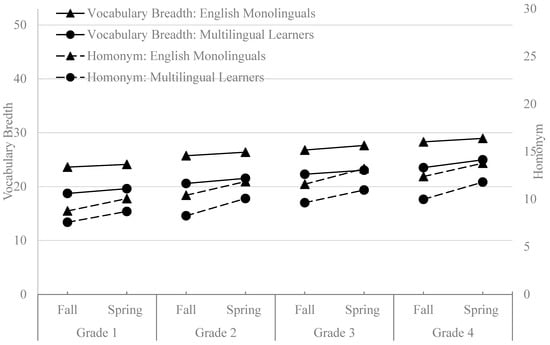
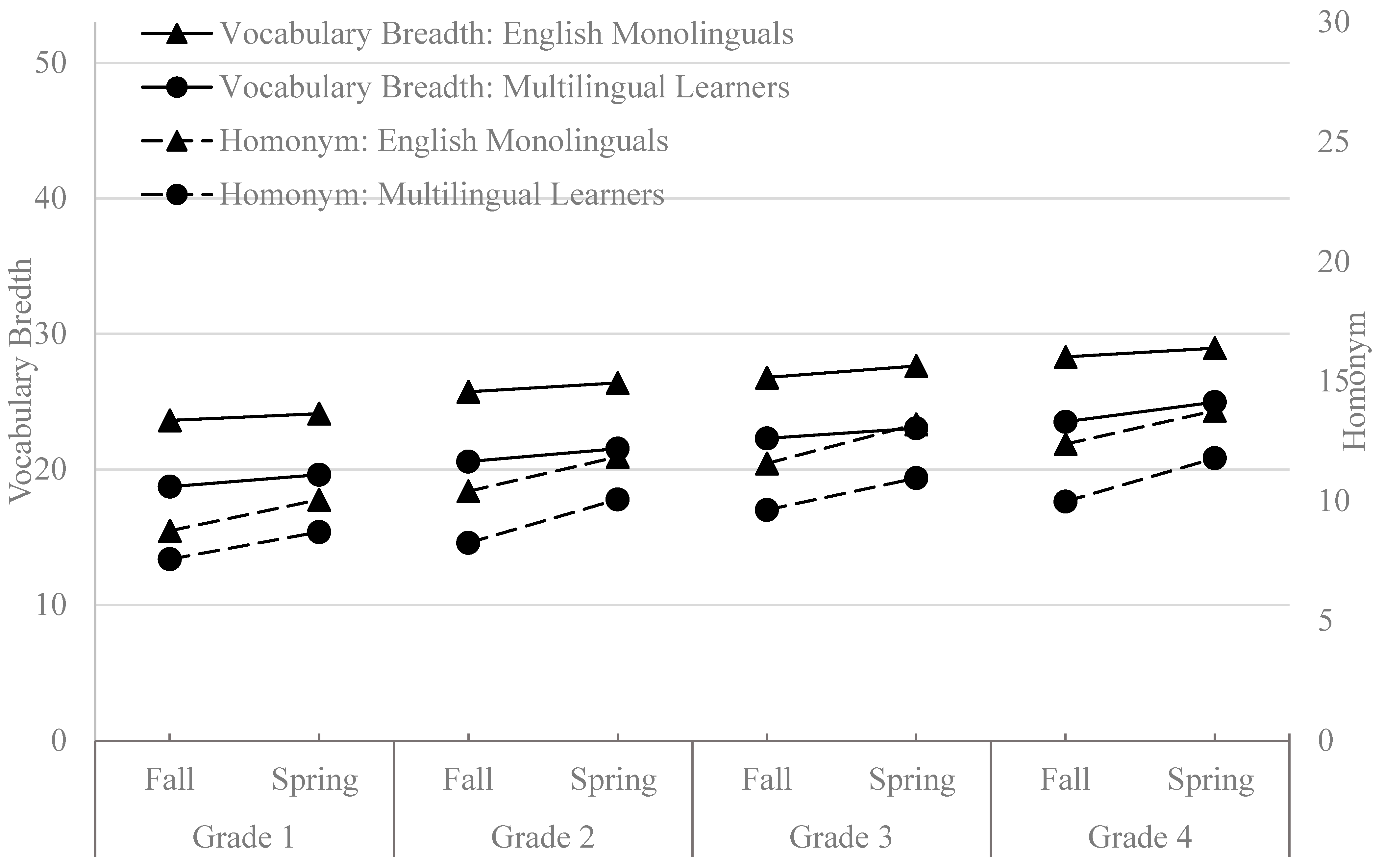
Two 2 (Time: fall, spring) × 2 (Language: multilingual learners, monolinguals) × 4 (Grade: 1, 2, 3, 4) mixed ANOVAs were conducted to examine change in vocabulary breadth and homonym knowledge across the school year by language groups and grade levels. Table 1 presents descriptive statistics and Table 2 presents ANOVA results. For vocabulary breadth, significant main effects emerged for Time, F(1, 750) = 81.63, p < 0.001, partial η2 = 0.10; Language, F(1, 750) = 406.57, p < 0.001, partial η2 = 0.35; and Grade, F(3, 750) = 78.76, p < 0.001, partial η2 = 0.24 (see Table 2 and Figure 1). No significant interactions were found.
Table 1.
Descriptive Statistics for Vocabulary Breadth and Homonym Knowledge.
Table 2.
Three-way Mixed ANOVA Results for Vocabulary Breadth and Homonym Knowledge Across Fall and Spring.
Figure 1.
ANOVA Results for Changes in Vocabulary Breadth and Homonym Knowledge as a Function of Language Group.
For homonym knowledge, a similar pattern emerged. There were significant main effects for Time, F(1, 728) = 169.81, p < 0.001, partial η2 = 0.19; Language, F(1, 728) = 108.80, p < 0.001, partial η2 = 0.13; and Grade, F(3, 738) = 58.70, p < 0.001, partial η2 = 0.20, with no significant interactions (see Table 2 and Figure 1).
Both multilingual learners and monolinguals showed significant growth in vocabulary breadth and homonym knowledge over the academic year, but growth rates were comparable across language groups and grades, indicating a persistent vocabulary gap between multilingual learners and monolinguals.
3.2. Concurrent Relation Between Homonym Knowledge and Reading Comprehension
Table 3 presents descriptive statistics and correlations among all variables. Hierarchical regression analyses were conducted to examine concurrent contributions of fall homonym knowledge to fall reading comprehension (Table 4). The results indicated that fall homonym knowledge significantly predicted fall reading comprehension after controlling for fall decoding skills and fall vocabulary breadth (β = 0.15, p < 0.001, ΔR2 = 0.02) (see Table 4, Model 2). The unique contribution of homonym knowledge was modest. The addition of the interaction terms in Model 3 explained an additional 8% of the variance in fall reading comprehension (ΔR2 = 0.08). Within this model, only the Language × Homonym Knowledge interaction was statistically significant (β = 0.23, p = 0.015). The remaining two-way and three-way interaction terms were not significant. Simple slope tests (Dawson, 2014) revealed that, in Grade 2, homonym knowledge predicted reading comprehension for monolinguals (β = 0.10, p = 0.021), but not multilingual learners (β = −0.06, p = 0.748). In Grade 3, fall homonym knowledge significantly predicted fall reading comprehension for both monolinguals and multilingual learners (β = 0.16, p = 0.017) with no language group difference (β = −0.07, p = 0.261). In Grade 4, fall homonym knowledge significantly predicted fall reading comprehension for both monolinguals and multilingual learners (β = 0.17, p = 0.024) with no language group difference (β = −0.048, p = 0.542). No three-way interactions were significant.
Table 3.
Descriptive Statistics and Correlations of Variables.
Table 4.
Results of Hierarchical Regression Analyses for Relation between Homonym and Reading Comprehension.
3.3. Longitudinal Relation Between Homonym Knowledge and Reading Comprehension
Hierarchical regression analyses were conducted to examine whether fall homonym knowledge predicted spring reading comprehension, controlling for fall reading comprehension, decoding, and vocabulary breadth (see Table 5). Fall homonym knowledge significantly predicted spring reading comprehension after controlling for fall word identification, vocabulary breadth, and reading comprehension (β = 0.09, p = 0.032, ΔR2 = 0.01) (Table 5, Model 2).
Table 5.
Summary of Hierarchical Regression Analyses for Longitudinal Relation between Fall Homonym and Spring Reading Comprehension.
A significant main effect emerged for Grade 4, G2 (β = 0.26, p = 0.017), suggesting that Grade 4 students showed higher reading comprehension than Grades 2 and 3 (Table 5, Model 3). A significant Language × Homonym knowledge interaction was also found (β = −0.22, p = 0.027) (Table 5, Model 3). Follow-up tests suggested that the longitudinal relationship between homonym knowledge and reading comprehension was significant for both monolinguals (β = 0.39, p < 0.001) and multilingual learners (β = 0.16, p < 0.001), but stronger for monolinguals.
4. Discussion
This study yielded three main findings: (a) both multilingual learners and monolinguals in Grades 1–4 showed growth in vocabulary breadth and homonym knowledge, but gaps persisted; (b) homonym knowledge contributed uniquely to reading comprehension concurrently after controlling for word identification and vocabulary breadth; and (c) homonym knowledge predicted later reading comprehension over and above prior reading comprehension and other language skills. These findings extend theoretical accounts of vocabulary depth and have implications for instruction supporting multilingual learners’ access to increasingly complex, content-rich texts in academic content areas.
4.1. Language Group Differences in Vocabulary Breadth and Homonym Knowledge
Both multilingual learners and monolinguals in Grades 1–4 showed significant gains in vocabulary breadth and homonym knowledge across the school year, but the growth rates were comparable across language groups in each grade, so gaps did not narrow. Our results are consistent with those of August et al. (2005) on persistent gaps in vocabulary breadth and vocabulary depth (polysemy comprehension and production tasks) over one year, and extend their work by focusing on homonym knowledge. Together with Cartwright et al. (2022), our findings underscore the need to address the development of homonym knowledge alongside other aspects of vocabulary depth for multilingual learners. Prior intervention studies with young monolinguals in the United States (Zipke et al., 2009) and in the United Kingdom (Yuill, 2009) show that explicit instruction on homonyms can improve both homonym knowledge and reading comprehension in Grades 3 and 4. Recent randomized controlled trials indicate that a brief lexical inference intervention targeting homonyms can be effective for multilingual learners and monolinguals (Booton et al., 2026). Given evidence that it typically takes four to seven years for multilingual learners to approach their monolingual peers’ English proficiency under high-quality language instruction (Education Northwest, 2018) and that vocabulary gaps often persist over multiple years (Farnia & Geva, 2011), it is unsurprising that one school year of English-only instruction did not close breadth and depth gaps in our sample.
4.2. Concurrent Relation Between Homonym Knowledge and Reading Comprehension
The findings suggest that homonym knowledge as an indicator of vocabulary depth contributed significantly to reading comprehension after controlling for decoding skills and vocabulary breadth for both language groups in Grades 2–4, indicating that homonym knowledge plays a unique role in reading comprehension. Our results contribute to the examination of the nature of the relation between vocabulary knowledge and reading comprehension and point to practice implications for literacy education. Our results support the Lexical Quality Hypothesis that emphasizes the relation between the quality of lexical representations and readers’ ability to rapidly and reliably retrieve word meanings during reading (K. Nation & Snowling, 2004; Perfetti & Stafura, 2014). Specifically, multilingual learners and monolinguals with greater vocabulary depth (i.e., deeper lexical knowledge about words) show better reading comprehension than peers with shallower vocabulary knowledge. Previous studies have identified varied indicators of vocabulary depth as important contributors to reading comprehension with elementary English monolingual students (G. P. Ouellette, 2006; Proctor et al., 2012) and elementary Spanish–English bilingual students (Proctor et al., 2012), middle school Spanish–English bilingual students (Logan & Kieffer, 2017, 2021), and college students who learned English as a second language (Qian, 2002). The present findings extend previous work that focused on such indicators of vocabulary depth as morphology and syntax (Proctor et al., 2012) and non-homonymous polysemous words with different but related meanings (Logan & Kieffer, 2017, 2021), and adds to the literature by examining the contribution of one specific aspect of vocabulary depth (i.e., homonym knowledge) to reading comprehension among elementary multilingual learners and monolinguals. The concurrent findings suggest that even in early elementary grades, sensitivity to multiple unrelated meanings contributes to how successfully students interpret text, above and beyond the number of words they know and their ability to identify printed words.
4.3. Longitudinal Relation Between Homonym Knowledge and Reading Comprehension
Our findings suggest that fall homonym knowledge as an indicator of vocabulary depth significantly predicted spring reading comprehension for both language groups after controlling for fall reading comprehension, decoding skills, and vocabulary breadth. Overall, the results indicate the unique role of homonym knowledge relative to other key predictors of reading comprehension. The findings are consistent with a previous report with multilingual learners in Grades 7–8: Logan and Kieffer (2021) reported that Grade 7 vocabulary depth (polysemous word knowledge) contributed to Grade 8 reading comprehension, after controlling for reading comprehension, decoding skills, and vocabulary breadth in Grade 7. Our findings add to Logan and Kieffer’s findings by supporting the significance of homonym knowledge to reading comprehension over time in the elementary grades for both language groups. The unique variance explained by homonym knowledge was modest, which is expected given that it represents a single facet of vocabulary depth in models that already include decoding, breadth, and prior comprehension. These findings suggest that homonym knowledge has a unique, meaningful role in reading development for multilingual learners and monolinguals, consistent with broader evidence that multiple dimensions of vocabulary depth support growth in comprehension over time (e.g., Logan & Kieffer, 2021; Silverman et al., 2015).
4.4. Implications
Our findings on persistent gaps in vocabulary breadth and homonym knowledge across one academic year are consistent with prior work, suggesting that multilingual learners often require several years of high-quality language support to approach monolingual peers’ English proficiency (Education Northwest, 2018; Farnia & Geva, 2011). Although multilingual learners might appear to acquire conversational vocabulary quickly, they can be well behind in academic vocabulary (Logan & Kieffer, 2017) compared to monolinguals who experience steady vocabulary growth with cumulative and rich language exposure (DiCerbo et al., 2014). These patterns underscore the importance of sustained, targeted high-quality language support for multilingual learners’ academic vocabulary and homonym knowledge, particularly in English-only instructional contexts like those examined here. Given that homonym knowledge represents only one facet of vocabulary depth (e.g., morphology, syntax, polysemy) and accounted for a modest amount of unique variance in reading comprehension in the present study, the instructional implications should be interpreted accordingly. Homonym instruction should be viewed as one component of comprehensive vocabulary instruction rather than a stand-alone approach to improving reading comprehension.
The findings of both concurrent and longitudinal relations between homonym knowledge as an indicator of vocabulary depth and reading comprehension suggest that knowing different meanings of words is related to better reading comprehension for both multilingual learners and monolinguals. The results are congruent with the Lexical Quality Hypothesis (Perfetti, 2007), which posits that students’ quality word representations help them rapidly retrieve and identify word meanings. Our results add to the existing body of research on the significant role of vocabulary depth as measured by different language dimensions (e.g., syntax, morphology, polysemy, synonym) and its contribution to reading comprehension for multilingual learners and monolinguals at varied grade levels (e.g., Logan & Kieffer, 2017; G. P. Ouellette, 2006; Qian, 2002; Proctor et al., 2009, 2012; Zipke et al., 2009). Taken together, these findings suggest that homonym knowledge is a worthwhile component of broader vocabulary instruction designed to strengthen students’ lexical quality and support reading comprehension; that is, students may become better equipped to retrieve word meanings to support their understanding of text. However, because vocabulary depth encompasses multiple dimensions, including morphology, syntax, and polysemy, instruction targeting homonyms should complement, rather than replace, evidence-based vocabulary instruction that develops multiple aspects of lexical knowledge. Prior intervention studies also suggest that instruction targeting homonyms can support students’ metalinguistic awareness and reading comprehension. Yuill (1998) reported that young monolinguals improved their reading comprehension after they learned about homonyms along with making up jokes using word compounds, playing communication games, and reading ambiguous stories. Similarly, an intervention involving the analysis of homonyms and ambiguous sentences effectively enhanced Grade 3 monolinguals’ performance on identifying multiple meanings of homonyms and ambiguous sentences as well as reading comprehension on a paragraph-completion task (Zipke et al., 2009). Explicit homonym instruction also improved Grade 1 monolinguals’ skills in identifying multiple meanings of homonyms in isolation (Zipke, 2011).
Taken together with the present findings, this prior intervention work points to several classroom practices that may be worth considering in Grades 1–4. These include explicitly highlighting multiple meanings of high-utility words during read-alouds and shared reading, engaging students in brief discussions about which meaning fits a particular sentence or content-area problem and why, incorporating wordplay and riddles involving homonyms to build metalinguistic awareness, and revisiting key homonyms across oral language, reading, and writing tasks so students encounter multiple meanings in varied contexts. For multilingual learners, connecting English homonyms to students’ home languages when feasible (e.g., discussing whether the same word has multiple meanings in both languages) may also further support lexical depth and biliteracy, although this possibility warrants further empirical study.
Developing vocabulary depth is likely to be especially relevant for multilingual learners, who may fall behind monolinguals in their English vocabulary breadth and depth (e.g., August et al., 2005; Carlo et al., 2004). Developing students’ lexical knowledge is a long-term and challenging task considering the complexity of vocabulary knowledge (Graves, 2016) and the sheer amount of vocabulary to be learned to succeed academically (Nagy & Scott, 2000). Developing students’ lexical knowledge is also a long-term endeavor as students’ vocabulary depth develops gradually with multiple exposures in authentic reading texts in varied content areas (Graves, 2016). Accordingly, homonym instruction is likely to be most effective when embedded within comprehensive vocabulary instruction and authentic literacy experiences rather than taught in isolation. Given the importance of vocabulary for content-area success, integrating homonym tasks into science, social studies, and mathematics instruction, rather than treating them as isolated language activities, may be a promising direction for building multilingual learners’ lexical flexibility that they need to access disciplinary texts and tasks. Because many discipline-specific terms (e.g., difference in mathematics, table in science, volume in both mathematics and science) have multiple meanings, early instruction that explicitly highlights and practices these multiple meanings in context may be particularly relevant for multilingual learners’ content-area reading. Building on Cartwright et al. (2022), future studies should examine subject-specific homonym instruction embedded in math and science units to determine whether it improves both lexical depth and content learning. Recent research on science and social studies vocabulary learning among second-grade Latino bilingual students further suggests that students’ general language and vocabulary skills are foundational for content-area vocabulary acquisition (Arizmendi et al., 2025), which is consistent with the possibility that attention to vocabulary depth instruction could be productively embedded within content-area teaching for multilingual learners.
Although this study cannot assert a causal relation between homonym knowledge and reading comprehension, the field of literacy instruction has shown evidence of varied effective vocabulary instruction practices that positively impact vocabulary and/or reading comprehension. For example, integrated instruction that includes more than one component of language (i.e., vocabulary, morphology, syntax) seems to positively affect vocabulary learning for multilingual learners and monolinguals but to be more effective for multilingual learners in improving reading comprehension (e.g., Silverman et al., 2020). Explicit instruction on key words and vocabulary strategies also seems to be effective in improving multilingual learners’ vocabulary breadth and depth. In a longitudinal intervention study focusing on improving vocabulary and reading comprehension among multilingual learners and monolinguals in Grades 4 through 6, McLaughlin et al. (2000) reported a significant effect on vocabulary development and reading comprehension among multilingual learners as a result of receiving enriched vocabulary instruction in the classroom (e.g., vocabulary strategies of context clues, morphological analysis, words with multiple meanings, semantic links among words, rich instruction, word play). The vocabulary gain was more substantial for multilingual learners than monolinguals, which led to a decrease in vocabulary knowledge gap between multilingual learners and monolinguals at the end of the second year of the intervention. Our results suggest that homonym knowledge could be a specific, worthwhile focus within such enriched vocabulary instruction, particularly in early elementary classrooms serving multilingual learners. Recent evidence from homonym-focused lexical inference training indicates that even brief, small-group interventions can improve homonym knowledge for young multilingual learners and monolinguals (Booton et al., 2026).
4.5. Limitations and Future Directions
Several limitations should be noted. First, the homonym task indexed only one facet of English vocabulary depth; other dimensions such as morphology, syntax, and polysemy were not directly assessed. Accordingly, the findings should not be generalized to vocabulary depth as a whole. Future research might examine multiple dimensions of vocabulary depth to better understand their relative contributions to reading comprehension. Second, the sample was drawn from three English-only elementary schools in a single U.S. district serving predominantly Spanish-speaking multilingual learners, and all language and literacy assessments were administered in English. Therefore, the findings should be interpreted within this educational context and may not generalize to other program models or language backgrounds. Future research might examine vocabulary breadth and depth across students’ languages to better understand how lexical knowledge develops across languages and contribute to reading comprehension. Third, we had limited information on the Spanish-speaking multilingual learners’ English and Spanish proficiency levels. Future research might explore whether English and home-language proficiency could moderate the relation between homonym knowledge and reading comprehension. Such work would be particularly valuable in bilingual and dual-language programs in the United States, where students receive systematic literacy instruction in two languages, as well as in multilingual educational contexts internationally. Finally, although our longitudinal analyses controlled for prior reading comprehension, decoding, and vocabulary breadth, the observational design precludes causal inferences. Future experimental and quasi-experimental work is needed to determine whether homonym-focused instruction improves vocabulary depth and reading comprehension. Further work should also investigate how homonym knowledge supports content-area reading, and whether instruction on multiple-meaning words in subjects such as mathematics and science yields differential benefits for multilingual learners and monolinguals.
Author Contributions
Conceptualization, Q.D., A.T.B., S.L.K. and K.B.C.; methodology, Q.D. and A.T.B.; formal analysis, Q.D.; investigation, Q.D. and A.T.B.; resources, A.T.B.; data curation, Q.D. and A.T.B.; writing—original draft preparation, Q.D. and A.T.B.; writing—review and editing, Q.D., A.T.B., S.L.K. and K.B.C.; visualization, Q.D.; supervision, A.T.B.; project administration, A.T.B.; funding acquisition, A.T.B. All authors have read and agreed to the published version of the manuscript.
Funding
This research was funded by the Institute of Education Sciences, grant number R305A160280.
Institutional Review Board Statement
The study was conducted in accordance with the Declaration of Helsinki and approved by the University of Maryland College Park (UMCP) Institutional Review Board (date of approval: 23 June 2016).
Informed Consent Statement
Informed consent was obtained from all subjects involved in the study.
Data Availability Statement
The datasets presented in this article are not readily available because they are subject to data-sharing regulations and institutional policies tied to the funding grant. Requests to access the datasets should be directed to Dr. Ana Taboada Barber, ataboada@umd.edu.
Conflicts of Interest
The authors declare no conflicts of interest.
Notes
| 1 | Throughout this manuscript, unless otherwise specified, vocabulary knowledge, homonym knowledge, and other language knowledge only refer to English language knowledge and all assessments were administered in English. |
| 2 | We use the term multilingual learners to align with current equity-oriented language in literacy research. Our sample in this study consists of students officially classified as English learners (or emergent bilinguals) by their districts. Thus, while the term multilingual learners typically also encompass students who may have exited ELL programs or those who are fluent in English and other languages, the term in this study specifically refers to those who hold English-learner designation. |
References
- Anderson, R. C., & Freebody, P. (1981). Vocabulary knowledge. In J. T. Guthrie (Ed.), Comprehension and teaching: Research reviews (pp. 77–117). International Reading Association. [Google Scholar]
- Arizmendi, G. D., Palma, J. R., & Baker, D. L. (2025). Predicting science and social studies vocabulary learning in Spanish-English bilingual children. Language, Speech, and Hearing Services in Schools, 56(4), 1069–1087. [Google Scholar] [CrossRef] [Scilit] [PubMed]
- August, D., Carlo, M., Dressler, C., & Snow, C. (2005). The critical role of vocabulary development for English language learners. Learning Disabilities Research & Practice, 20(1), 50–57. [Google Scholar] [CrossRef] [Scilit]
- August, D., McCardle, P., Shanahan, T., & Burns, M. (2014). Developing literacy in English language learners: Findings from a review of the experimental research. School Psychology Review, 43(4), 490–498. [Google Scholar] [CrossRef] [Scilit]
- Babayiğit, S., Hitch, G. J., Kandru-Pothineni, S., Clarke, A., & Warmington, M. (2022). Vocabulary limitations undermine bilingual children’s reading comprehension despite bilingual cognitive strengths. Reading and Writing, 35(7), 1651–1673. [Google Scholar] [CrossRef] [Scilit]
- Blanca, M. J., Alarcón, R., Arnau, J., Bono, R., & Bendayan, R. (2018). Effect of variance ratio on ANOVA robustness: Might 1.5 be the limit? Behavior Research Methods, 50(3), 937–962. [Google Scholar] [CrossRef] [Scilit] [PubMed]
- Booton, S. A., Birchenough, J. M. H., Gilligan-Lee, K., Jelley, F., & Murphy, V. A. (2026). Lexical inference training for homonyms: Two randomized controlled trials for children with English as a first and an additional language. British Journal of Educational Psychology, 96, 875–895. [Google Scholar] [CrossRef] [Scilit] [PubMed]
- Carlo, M. S., August, D., McLaughlin, B., Snow, C. E., Dressler, C., Lippman, D. N., Lively, T. J., & White, C. E. (2004). Closing the gap: Addressing the vocabulary needs of English language learners in bilingual and mainstream classrooms. Reading Research Quarterly, 39(2), 188–215. [Google Scholar] [CrossRef] [Scilit]
- Cartwright, K. B., Taboada Barber, A., & Archer, C. J. (2022). What’s the difference? Contributions of lexical ambiguity, reading comprehension, and executive functions to math word problem solving in linguistically diverse 3rd to 5th graders. Scientific Studies of Reading, 26(6), 565–584. [Google Scholar] [CrossRef] [Scilit]
- Cho, E., Capin, P., Roberts, G., Roberts, G. J., & Vaughn, S. (2019). Examining sources and mechanisms of reading comprehension difficulties: Comparing English learners and non-English learners within the simple view of reading. Journal of Educational Psychology, 111(6), 982–1000. [Google Scholar] [CrossRef] [Scilit] [PubMed]
- Cromley, J. G., & Azevedo, R. (2007). Testing and refining the direct and inferential mediation model of reading comprehension. Journal of Educational Psychology, 99(2), 311–325. [Google Scholar] [CrossRef] [Scilit]
- Cutting, L. E., & Scarborough, H. S. (2006). Prediction of reading comprehension: Relative contributions of word recognition, language proficiency, and other cognitive skills can depend on how comprehension is measured. Scientific Studies of Reading, 10(3), 277–299. [Google Scholar] [CrossRef] [Scilit] [PubMed]
- Davison, M. D., Hammer, C., & Lawrence, F. R. (2011). Associations between preschool language and first grade reading outcomes in bilingual children. Journal of Communication Disorders, 44(4), 444–458. [Google Scholar] [CrossRef] [Scilit] [PubMed]
- Dawson, J. F. (2014). Moderation in management research: What, why, when, and how. Journal of Business and Psychology, 29(1), 1–19. [Google Scholar] [CrossRef] [Scilit]
- DiCerbo, P. A., Anstrom, K. A., Baker, L. L., & Rivera, C. (2014). A review of the literature on teaching academic English to English language learners. Review of Educational Research, 84(3), 446–482. [Google Scholar] [CrossRef] [Scilit]
- Education Northwest. (2018, September). How long does it take for beginning English learners to become English language proficient? Available online: https://educationnorthwest.org/resources/how-long-does-it-take-beginning-english-learners-become-english-language-proficient (accessed on 1 July 2023).
- Farnia, F., & Geva, E. (2011). Cognitive correlates of vocabulary growth in English language learners. Applied Psycholinguistics, 32(4), 711–738. [Google Scholar] [CrossRef] [Scilit]
- Frisson, S. (2009). Semantic underspecification in language processing. Language and Linguistics Compass, 3(1), 111–127. [Google Scholar] [CrossRef] [Scilit]
- Graves, M. F. (2016). The vocabulary book: Learning and instruction. Teachers College Press. [Google Scholar]
- Jackson, C. W., Schatschneider, C., & Leacox, L. (2014). Longitudinal analysis of receptive vocabulary growth in young Spanish English–speaking children from migrant families. Language, Speech, and Hearing Services in Schools, 45(1), 40–51. [Google Scholar] [CrossRef] [Scilit] [PubMed]
- Kieffer, M. J. (2008). Catching up or falling behind? Initial English proficiency, concentrated poverty, and the reading growth of language minority learners in the United States. Journal of Educational Psychology, 100(4), 851–868. [Google Scholar] [CrossRef] [Scilit]
- Kieffer, M. J., & Lesaux, N. K. (2012). Knowledge of words, knowledge about words: Dimensions of vocabulary in first and second language learners in sixth grade. Reading and Writing, 25(2), 347–373. [Google Scholar] [CrossRef] [Scilit]
- Kintsch, W. (1988). The role of knowledge in discourse comprehension: A construction-integration model. Psychological Review, 95(2), 163–182. [Google Scholar] [CrossRef] [Scilit] [PubMed]
- LaForte, E. M., McGrew, K. S., & Schrank, F. A. (2014). WJ IV technical abstract (Woodcock-Johnson IV Assessment Service Bulletin No. 2). Riverside.
- Leider, C. M., Proctor, C. P., Silverman, R. D., & Harring, J. R. (2013). Examining the role of vocabulary depth, cross-linguistic transfer, and types of reading measures on the reading comprehension of Latino bilinguals in elementary school. Reading and Writing: An Interdisciplinary Journal, 26(9), 1459–1485. [Google Scholar] [CrossRef] [Scilit]
- Lesaux, N. K., Crosson, A. C., Kieffer, M. J., & Pierce, M. (2010). Uneven profiles: Language minority learners’ word reading, vocabulary, and reading comprehension skills. Journal of Applied Developmental Psychology, 31(6), 475–483. [Google Scholar] [CrossRef] [Scilit] [PubMed]
- Logan, K. J., & Kieffer, M. J. (2017). Evaluating the role of polysemous word knowledge in reading comprehension among bilingual adolescents. Reading and Writing, 30(8), 1687–1704. [Google Scholar] [CrossRef] [Scilit]
- Logan, K. J., & Kieffer, M. J. (2021). Investigating the longitudinal and concurrent relationships between polysemous word knowledge and reading comprehension among Spanish-English bilingual middle school students. Reading and Writing, 34(2), 301–335. [Google Scholar] [CrossRef] [Scilit]
- MacGinitie, W. H., MacGinitie, R. K., Maria, K., Dreyer, L. G., & Hughes, K. E. (2000). Gates-macginitie reading tests (4th ed.). Riverside. [Google Scholar]
- Mancilla-Martinez, J., & Lesaux, N. K. (2017). Early indicators of later English reading comprehension outcomes among children from Spanish-speaking homes. Scientific Studies of Reading, 21(5), 428–448. [Google Scholar] [CrossRef] [Scilit] [PubMed]
- Mather, N., & Wendling, B. J. (2014). Examiner’s manual: Woodcock-Johnson III tests of achievement. Riverside Publishing. [Google Scholar]
- McLaughlin, B., August, D., & Snow, C. (2000). Vocabulary knowledge and reading comprehension in English language learners [Final Performance Report]. Office of Educational Research and Improvement. Available online: https://eric.ed.gov/?id=ED457696 (accessed on 5 July 2024).
- Nagy, W. E., & Scott, J. A. (2000). Vocabulary processes. In M. L. Kamil, P. B. Mosenthal, P. D. Pearson, & R. Barr (Eds.), Handbook of reading research (Vol. 3, pp. 269–284). Lawrence Erlbaum Associates, Inc. [Google Scholar]
- Nation, K., & Snowling, M. J. (2004). Beyond phonological skills: Broader language skills contribute to the development of reading. Journal of Research in Reading, 27(4), 342–356. [Google Scholar] [CrossRef] [Scilit]
- Nation, P. (2001). Learning vocabulary in another language. Cambridge University Press. [Google Scholar]
- National Academies of Sciences, Engineering, and Medicine. (2024). A new vision for high-quality preschool curriculum. The National Academies Press. [Google Scholar] [CrossRef] [Scilit] [PubMed]
- Ouellette, G., & Beers, A. (2010). A not-so-simple view of reading: How oral vocabulary and visual-word recognition complicate the story. Reading and Writing, 23(2), 189–208. [Google Scholar] [CrossRef] [Scilit]
- Ouellette, G. P. (2006). What’s meaning got to do with it: The role of vocabulary in word reading and reading comprehension. Journal of Educational Psychology, 98(3), 554–566. [Google Scholar] [CrossRef] [Scilit]
- Perfetti, C. (2007). Reading ability: Lexical quality to comprehension. Scientific Studies of Reading, 11(4), 357–383. [Google Scholar] [CrossRef] [Scilit]
- Perfetti, C., & Stafura, J. (2014). Word knowledge in a theory of reading comprehension. Scientific Studies of Reading, 18(1), 22–37. [Google Scholar] [CrossRef] [Scilit]
- Proctor, C. P., Silverman, R. D., Harring, J. R., & Montecillo, C. (2012). The role of vocabulary depth in predicting reading comprehension among English monolingual and Spanish–English bilingual children in elementary school. Reading and Writing, 25(7), 1635–1664. [Google Scholar] [CrossRef] [Scilit]
- Proctor, C. P., Uccelli, P., Dalton, B., & Snow, C. E. (2009). Understanding depth of vocabulary online with bilingual and monolingual children. Reading & Writing Quarterly, 25(4), 311–333. [Google Scholar] [CrossRef] [Scilit]
- Qian, D. D. (2002). Investigating the relationship between vocabulary knowledge and academic reading performance: An assessment perspective. Language Learning, 52(3), 513–536. [Google Scholar] [CrossRef] [Scilit]
- Schrank, F. A., Mather, N., & McGrew, K. S. (2014). Woodcock-Johnson IV tests of achievement. Riverside. [Google Scholar]
- Silverman, R. D., Johnson, E., Keane, K., & Khanna, S. (2020). Beyond decoding: A meta-analysis of the effects of language comprehension interventions on k–5 students’ language and literacy outcomes. Reading Research Quarterly, 55(1), 95–122. [Google Scholar] [CrossRef] [Scilit]
- Silverman, R. D., Proctor, C. P., Harring, J. R., Hartranft, A. M., Doyle, B., & Zelinke, S. B. (2015). Language skills and reading comprehension in English monolingual and Spanish–English bilingual children in grades 2–5. Reading and Writing, 28(9), 1381–1405. [Google Scholar] [CrossRef] [Scilit]
- Stahl, S. A., & Nagy, W. E. (2007). Teaching word meanings. Routledge. [Google Scholar]
- Stanovich, K. E. (1986). Matthew effects in reading: Some consequences of individual differences in the acquisition of literacy. Reading Research Quarterly, 21, 360–407. [Google Scholar] [CrossRef] [Scilit]
- Tong, X., & Tong, S. X. (2022). How vocabulary breadth and depth influence bilingual reading comprehension: Direct and indirect pathways. Learning and Individual Differences, 100, 102227. [Google Scholar] [CrossRef] [Scilit]
- Yuill, N. (1998). Reading and riddling: The role of riddle appreciation in understanding and improving poor text comprehension in children. Cahiers de Psychologie Cognitive, 17(2), 313–342. [Google Scholar]
- Yuill, N. (2009). The relation between ambiguity understanding and metalinguistic discussion of joking riddles in good and poor comprehenders: Potential for intervention and possible processes of change. First Language, 29(1), 65–79. [Google Scholar] [CrossRef] [Scilit]
- Zipke, M. (2011). First graders receive instruction in homonym detection and meaning articulation: The effect of explicit metalinguistic awareness practice on beginning readers. Reading Psychology, 32(4), 349–371. [Google Scholar] [CrossRef] [Scilit]
- Zipke, M., Ehri, L. C., & Cairns, H. S. (2009). Using semantic ambiguity instruction to improve third graders’ metalinguistic awareness and reading comprehension: An experimental study. Reading Research Quarterly, 44(3), 300–321. [Google Scholar] [CrossRef] [Scilit]

Disclaimer/Publisher’s Note: The statements, opinions and data contained in all publications are solely those of the individual author(s) and contributor(s) and not of MDPI and/or the editor(s). MDPI and/or the editor(s) disclaim responsibility for any injury to people or property resulting from any ideas, methods, instructions or products referred to in the content. |
© 2026 by the authors. Licensee MDPI, Basel, Switzerland. This article is an open access article distributed under the terms and conditions of the Creative Commons Attribution (CC BY) license.