1. Introduction
The environment in which teachers work is changing rapidly, and several pressures are at play simultaneously: sociopolitical instability, persistent staffing shortages, demands for accountability, the steady push of digital technologies into the classroom, and an ever-widening range of student needs (
Carver-Thomas & Darling-Hammond, 2019;
Orland-Barak & Wang, 2020). The international literature ties these pressures to attrition from the profession and the risk of burnout, and points to targeted induction and mentoring as one of the more effective levers for counteracting them (
Madigan & Kim, 2021;
Nguyen et al., 2020). The COVID-19 pandemic brought all of this into sharp relief: teachers were expected to set up digital learning environments at very short notice, while at the same time facing heightened demands for pedagogical innovation, emotional support, and professional resilience (
König et al., 2020).
In international scholarship, mentoring is considered one of the principal channels through which teachers are socialised into the profession, continue to learn, and shape their own professional identity. It helps close the familiar gap between what initial teacher training delivers in theory and what schools require in practice, strengthens the sense of self-efficacy among early-career teachers, and appears to lower the likelihood that they leave the classroom altogether (
Ellis et al., 2020;
Kutsyuruba et al., 2019;
Orland-Barak, 2014). The very notion of what a mentor is has also broadened in recent years: rather than the figure of the senior expert or the institutional supervisor, more recent work portrays the mentor as a developmental partner, a companion in reflection, a facilitator of learning, and someone who actively looks out for the mentee’s professional well-being (
Hobson & Maxwell, 2020;
Mullen & Klimaitis, 2021).
One of the strengths of research on mentoring—and at the same time, one of its principal methodological challenges—is its multidisciplinary character. The field draws on educational science, organisational psychology, professional identity, self-determination theory, education policy studies, and research into teacher training, and has to find ways of speaking across all of them.
For this reason, discourse is often organised into parallel conceptual islands (
Mullen & Klimaitis, 2021;
Rushton et al., 2023). Qualitative reviews, such as those by
Castanheira (
2016),
Orland-Barak (
2014), and
Goodwin et al. (
2023), offer deep insights but are less capable of capturing the structural, temporal, and network dynamics of an entire scientific field (
Donthu et al., 2021).
In this context, a bibliometric and science mapping approach is warranted. The combined analysis of performance indicators, conceptual networks, temporal overlay maps, and density visualisations provides a macro-level perspective which, complementing narrative reviews, is capable of revealing the hidden structure of the knowledge domain (
Aria & Cuccurullo, 2017;
Donthu et al., 2021;
Patty et al., 2024;
van Eck & Waltman, 2010;
Zupic & Čater, 2015). Therefore, this study interprets the development of research on teacher mentoring between 2010 and 2025 not merely as a literature review but as a longitudinal bibliometric cartography.
This study is particularly aligned with contemporary research trends that examine mentoring in dynamic, uncertain, and challenging educational contexts. Building on these strands of literature, we formulated the expectation—as a research motivation rather than an established conclusion—that the discourse on teacher mentoring may have shifted from classical, formal, and dyadic models towards more digital, collaborative, autonomy-supportive, holistic, and equity-oriented approaches (
Heikkinen et al., 2020;
Shanks et al., 2022;
Tynjälä et al., 2021). Whether and to what extent such a shift is visible in the bibliometric record is treated as an empirical question addressed by the analysis below.
2. Materials and Methods
2.1. Research Questions
The bibliometric and science-mapping design is organised around three interlocking research questions, each illuminating a different facet of the same broader problem:
Q1: How did research on teacher mentoring and professional learning develop between 2010 and 2025 in terms of publication volume, the range of topics addressed, and the underlying conceptual structure of the field?
Q2: Drawing on the co-word analysis conducted in VOSviewer (version 1.6.20; Centre for Science and Technology Studies (CWTS), Leiden University, Leiden, The Netherlands), which thematic clusters, network hubs, and bridging concepts emerge from the literature on teacher mentoring and professional learning?
Q3: What temporal shifts and points of concentration become visible in the overlay and density visualisations, and what do these patterns reveal about the way the field has responded to a rapidly changing and demanding educational context?
2.2. Methodology
The methodological logic of this study is based on a multi-layered, longitudinal bibliometric science mapping design. The aim was not only to quantify the growth of research on teacher mentoring but also to reconstruct the conceptual and temporal structures of the field. The methodological architecture consisted of three, interrelated analyses.
- (1)
Descriptive bibliometric profile.
- (2)
VOSviewer-based co-occurrence network analysis.
- (3)
Interpretative cluster analysis supported by overlay and density visualisation.
This framework enabled us to simultaneously analyse mentoring discourse from the perspectives of performance indicators, conceptual relationships, and temporal shifts.
2.3. Research Design: Longitudinal Bibliometric Cartography
The analysis was conducted as a bibliometric and science mapping review, integrating the bibliometric analysis recommendations of
Donthu et al. (
2021), the science mapping logic of
Aria and Cuccurullo (
2017), and the network visualisation approach of
van Eck and Waltman (
2010); Furthermore, the research design took into account the main steps of the co-word analysis workflow by
Zupic and Čater (
2015), as well as the VOSviewer-based bibliometric framework for educational science by
Patty et al. (
2024). The design was longitudinal, as the corpus was interpreted not as a single snapshot but as a conceptual field that changed with time. The methodological focus was on how dominant keywords, conceptual relationships, and thematic centres evolved from the 2010s to the post-pandemic period.
The central analytical approach of this study was co-word analysis. This technique revealed the field’s ‘living vocabulary’: which concepts occur together, which become network centres, and what thematic clusters structure the mentoring discourse. We supplemented the network map with an overlay visualisation, which showed temporal shifts based on the average publication year of the keywords, as well as a density visualisation, which made it possible to identify the densest conceptual nodes in the discourse. The overall methodological architecture of the study is summarised in
Table 1.
2.4. Data Source and Institutional Access
The Scopus database was used as the data source for the analysis, and institutional access was provided by the University of Győr, Hungary. The choice of Scopus is methodologically justified because it offers extensive coverage of journals at the intersection of educational science, teacher training, organisational psychology, and education policy, and provides structured metadata for bibliometric analysis (
Mongeon & Paul-Hus, 2016). The fields that Scopus makes available on export—title, abstract, author keywords, affiliation, DOI, source title, and cited references—correspond directly to what VOSviewer requires as input for its network analyses. A parallel search of the Web of Science could not be conducted, as the institution does not provide access to that database; the implications of this restriction are discussed in the
Section 6. Methodologically, however, working with Scopus alone made it possible to assemble a reproducible corpus built on a single consistent metadata schema. The raw metadata export retrieved from Scopus is provided as
Supplementary File S1.
2.5. Search Protocol and Query Calibration
The search strategy was developed not as a one-off selection of keywords but as an iterative query-calibration process. In the first step, we developed a conceptual core based on the thematic focuses of the Special Issue—mentoring, professional learning, professional development, teacher education, and teacher induction—as well as key reviews in the field (
Castanheira, 2016;
Ellis et al., 2020;
Orland-Barak, 2014). In the second step, we randomly selected 312 records from an initial set of results and refined the Boolean combination through checks at the title, abstract, and keyword levels. The aim was for the search term to be sufficiently sensitive to the many different terms used for mentoring while also being sufficiently specific to the educational context of teacher mentoring.
The final search strategy linked three conceptual blocks: (a) mentoring relationships and programs, (b) professional learning, teacher training, induction, and teacher identity, and (c) school and pedagogical context. The query targeted the titles, abstracts, and keyword fields.
TITLE-ABS-KEY ((“teacher mentor*” OR “mentor teacher*” OR “mentoring teacher*” OR
“teacher mentoring” OR “induction mentor*” OR “peer mentoring” OR “peer-group mentoring” OR
“mentoring programme*” OR “mentor relationship*”))
AND
TITLE-ABS-KEY ((“professional learning” OR “professional development” OR “teacher education” OR
“teacher induction” OR “early career teacher*” OR “preservice teacher*” OR “pre-service teacher*” OR
“novice teacher*” OR “beginning teacher*” OR “teacher identity”))
AND
TITLE-ABS-KEY (school* OR education* OR teach* OR pedagog*)
Taken together, these three blocks ensured that every retrieved record spoke at once to mentoring practice, teachers’ professional learning, and the educational-institutional context within which both take place. The search was further restricted to English-language publications, articles, and review papers, since these are the document types in which peer review can be most reliably assumed and in which the bibliometric metadata tend to be most complete.
2.6. Inclusion and Exclusion Criteria
The period under review was from 1 January 2010 to 31 October 2025. The choice of 2010 as the starting point was justified by two factors: first, the Scopus indexing of international journals dealing with teacher mentoring became more stable from this point onwards; second, the time window is sufficiently long to allow for the examination of thematic shifts both before and after the pandemic.
The inclusion criteria were as follows:
- (I)
an English-language, peer-reviewed journal article or review;
- (II)
publication falls within the designated time window.
- (III)
The title, abstract, and author keywords are available.
- (IV)
The publication was explicitly related, at the level of title, abstract, or keywords, to teacher mentoring, professional learning for teachers, induction programmes, or teacher training mentoring.
The exclusion criteria were as follows:
- (I)
general mentoring literature not related to an educational context, such as business, healthcare, or corporate mentoring;
- (II)
editorial forewords, conference announcements, book reviews, or non-research-based publications;
- (III)
studies that mention teacher mentoring only as a secondary concept without substantive analysis;
- (IV)
records with incomplete metadata that are unsuitable for network-based processing.
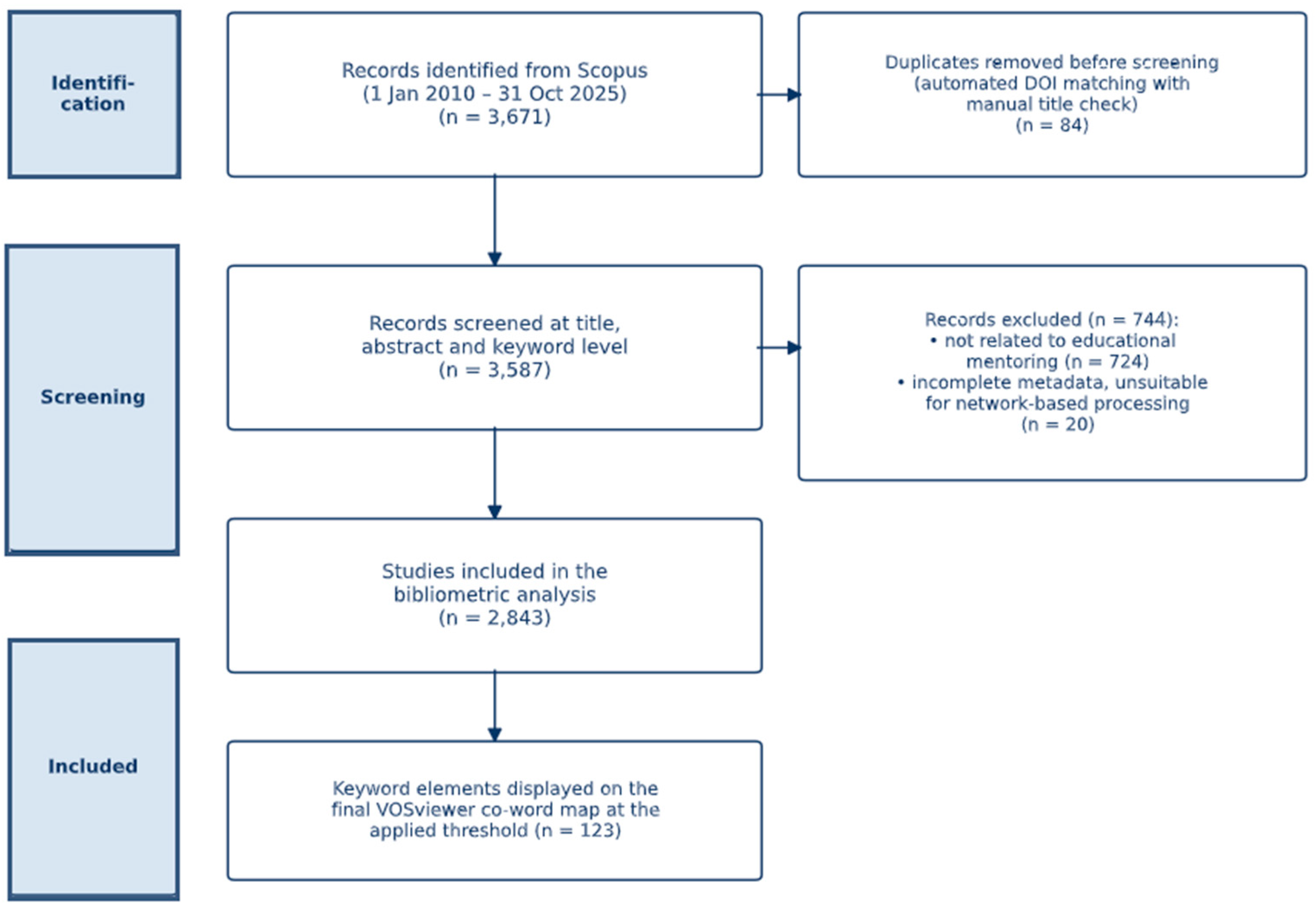
The initial search yielded 3671 screened records. After filtering for duplicates based on DOI and title, 3587 records remained eligible for inclusion in the study. During relevance checks at the title, abstract, and keyword levels, we excluded 744 records: 724 records unrelated to educational mentoring and 20 records that did not meet the criteria for metadata completeness. The final analysed corpus contained 2843 documents; of these, VOSviewer displayed 123 keyword elements on the final co-word map at a set threshold. We documented the selection process according to the PRISMA 2020 guidelines (
Page et al., 2021). The selection process is summarised in the PRISMA 2020 flow diagram (
Figure 1).
2.7. Temporal Segmentation: Pre-Pandemic and Post-Pandemic Analytical Windows
We divided the corpus into two sub-periods: 2010–2019 (pre-pandemic period;
n = 1248) and 2020–2025 (pandemic and post-pandemic periods;
n = 1595). The 2020 turning point can be interpreted not only as a chronological boundary but also as a theoretical and contextual one. The COVID-19 pandemic resulted in forced pedagogical innovation, digital adaptation, online and hybrid learning environments, and an increased need for emotional and professional support (
König et al., 2020). In parallel, research on mentoring has seen a rise in the prominence of approaches that support autonomy, are holistic, peer-group-based, and well-being-oriented (
Goodwin et al., 2023;
Heikkinen et al., 2020;
Kaplan et al., 2026;
Larsen et al., 2023;
Pennanen et al., 2018;
Tynjälä et al., 2021).
The aim of the temporal breakdown was to ensure that the mentoring discourse was not presented as a static thematic field but rather as an evolving academic system that responds sensitively to transformations in the professional environment. Comparing the two periods made it possible to distinguish between traditional, institutionalised mentoring models and new forms of mentoring that respond to challenging contexts.
2.8. Data Cleaning, Normalisation and Metadata Harmonisation
We exported the full dataset from Scopus as a CSV file, using the option that includes complete records together with cited references. The aim of preprocessing was to bring this raw metadata into a form consistent enough to function as a bibliometric corpus. Cleaning began with the removal of duplicates, identified by matching DOIs and titles; we then checked the remaining records for the presence of title, abstract, and keyword fields. Duplicate removal combined automated DOI matching with a manual check of titles and author names for records lacking a DOI; borderline cases were inspected individually before removal, and the completeness of the metadata fields was likewise verified manually on a random subsample of records. The VOSviewer run reported here was set up as an exploratory all-keyword map: Scopus-indexed keywords were included alongside those supplied by the authors themselves. The aim of this decision was to make the broader interdisciplinary conceptual scope of mentoring visible.
When interpreting the keyword fields, we paid particular attention to terms with identical or related meanings, such as mentor teacher(s), pre-service teacher(s), and professional development/professional learning. The maps presented are based on the raw Scopus all-keywords fields; consequently, interdisciplinary terms such as ‘medical education’ and ‘nursing education’ also appear in the network. We did not automatically remove these, as they provide methodologically important information about the broader field of professionalisation within mentoring; however, we note among the limitations that, for a more narrow analysis of teacher mentoring, thesaurus- and exclusion-keyword-based filtering may be warranted at a later stage.
2.9. Network-Based Analytical Procedures and Parameterisation
The analysis was performed using VOSviewer 1.6.20 software (
van Eck & Waltman, 2010). We chose this program because it is suitable for visualising large bibliometric corpora, normalising link strengths, and generating clusters and temporal overlay maps. In interpreting the networks, node size indicated frequency of occurrence or citation, edge thickness indicated link strength, proximity of nodes indicated conceptual or citation similarity, and cluster colours indicated thematic groupings.
Co-word analysis was based on the co-occurrence of author and indexed keywords exported from Scopus. The analysis type was co-occurrence, the analysis unit was all keywords, and the counting method was full counting. Using the applied threshold, the final map contained 123 keyword elements, which VOSviewer organised into four clusters; 3312 connections and 17,024 total connection strengths were identified in the network. In the interpretation of the network, the size of the nodes indicates the frequency of occurrence, the thickness of the edges indicates connection strength, the colours indicate cluster membership, and the overlay scale indicates the average publication year of the keywords. The analysis techniques, threshold values, and interpretation functions applied are summarised in
Table 2.
2.10. Cluster Labelling and Interpretative Validation
Bibliometric maps are not interpretations but structured visual data. Therefore, the thematic labelling of the clusters was conducted using an interpretative expert procedure. During interpretation, we considered the most significant keywords of the clusters, connection structure, central nodes within the clusters, and spatial position of the clusters. The aim of the labelling was to transform the structural patterns identified by VOSviewer into publishable thematic categories with educational significance. The labels were first proposed independently by two researchers on the basis of the dominant keywords, the internal connection structure, and the network position of each cluster; the small number of divergent proposals was discussed until consensus was reached, and the agreed labels were then cross-checked against the full keyword lists of the clusters.
Interpretative validation was based on methodological transparency: the cluster labels did not appear as independent statistical results but as professional interpretations of the dominant keywords, network centres, and bridge concepts. This is particularly important because the naming of bibliometric clusters is inevitably interpretative. Therefore, the analysis sought to present numerical indicators and interpretative decisions together in a single table.
2.11. Reproducibility, Transparency and Methodological Positioning
Reproducibility, in this study, was a matter of getting four things on the record: (1) the full Boolean search query, as it was actually entered; (2) the inclusion and exclusion criteria, set out without ambiguity; (3) a quantitative trail showing exactly how the corpus was thinned down at each stage; and (4) the VOSviewer settings, threshold values, and cluster-interpretation criteria. Taken together, these were not just procedural concessions to the journal’s methods section. The point was to push the work past the descriptive bibliometric review that the field is now full of, and toward something more like a properly contextualised science map of the mentoring discourse, one whose interpretive moves are themselves theoretically anchored.
There is one methodological move worth pausing over. Mentoring is not being treated as just another term to be counted up across a corpus. It is being read as a field in motion, both professionally and academically. Co-occurrence analysis lets us see how concepts in that field connect to one another. The overlay map shows how those patterns shift across time. And the density visualisation marks the moments at which the discourse pulls together into something more concentrated. The methodology lines up, in other words, with the theoretical claim that runs through the whole study. Teacher mentoring is not a static programme. It works more like an adaptive system of professional learning, one that is responsive to relationships and shaped by the contexts in which it operates.
3. Results
3.1. General Metrics of the VOSviewer Co-Occurrence Network
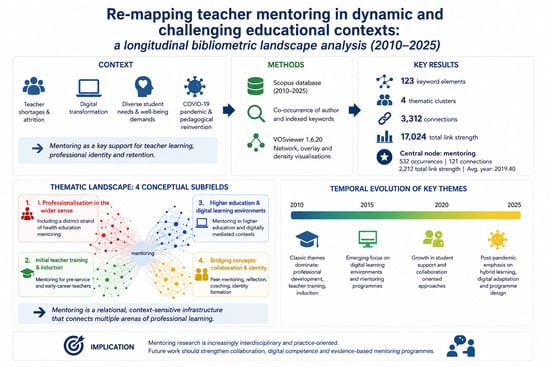
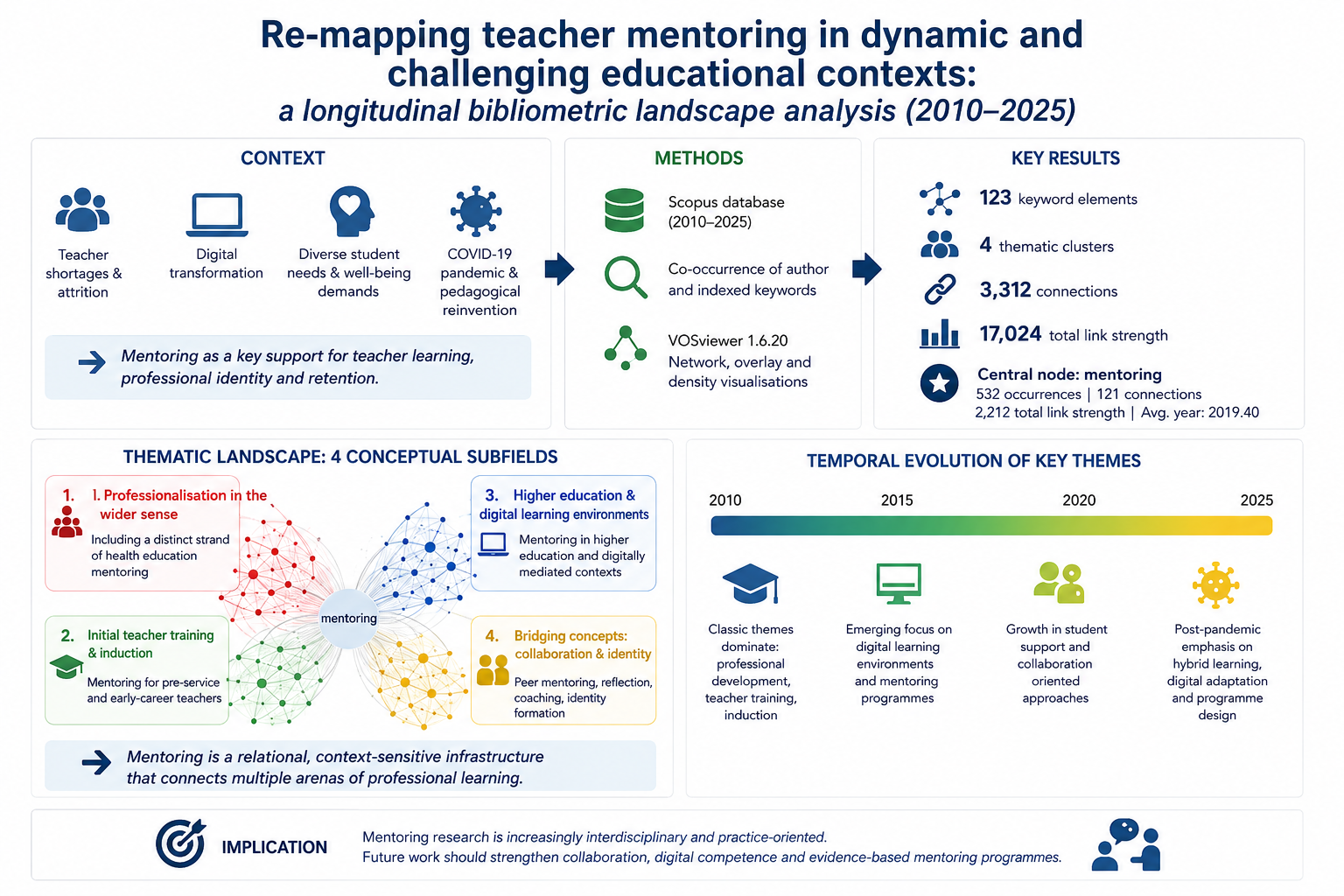
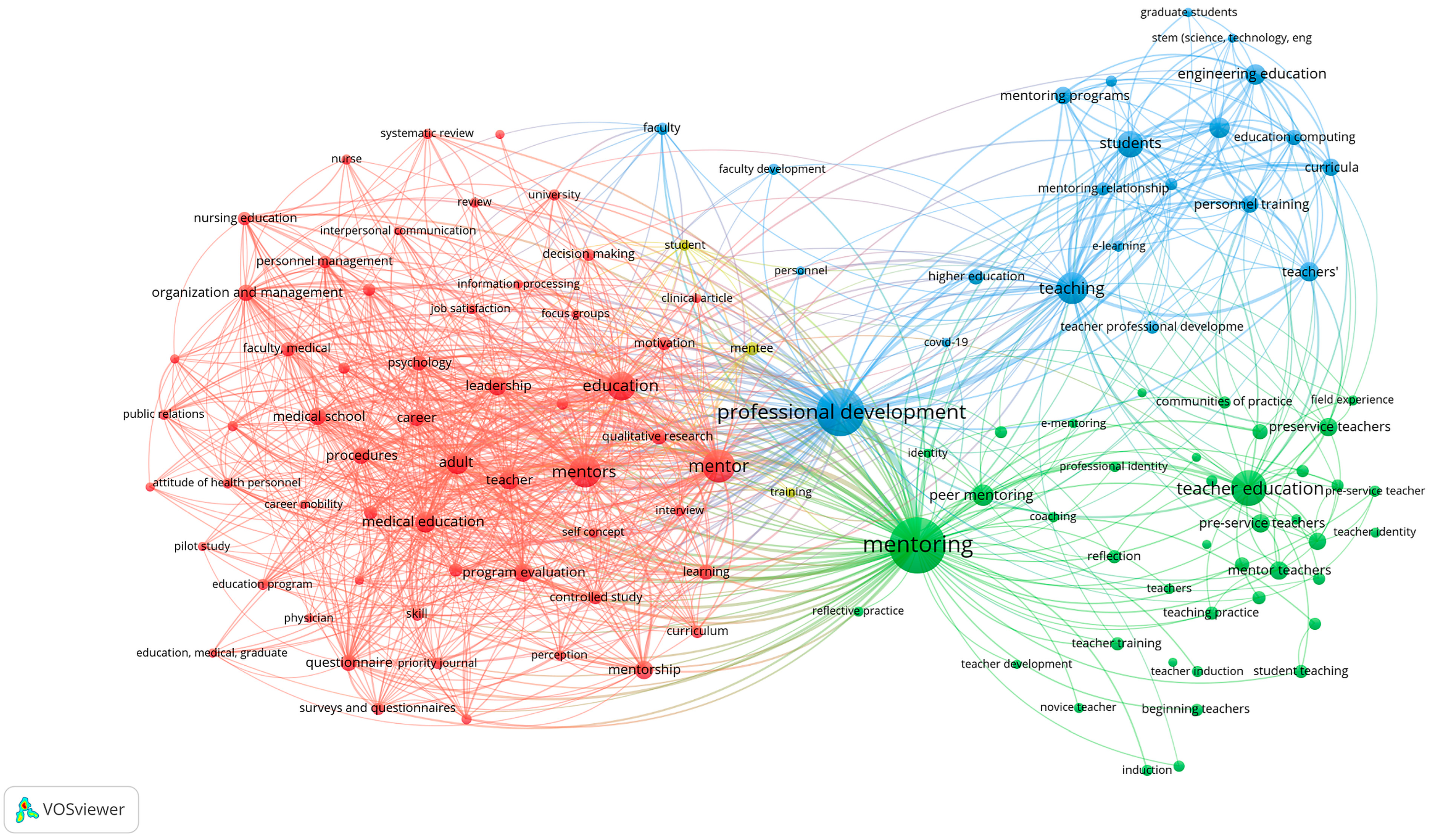
The co-occurrence analysis sorted 123 keywords into four thematic clusters. The network that links them is held together by 3312 connections, with a total link strength of 17,024. These indicators suggest that the field of mentoring and professional learning does not consist of isolated topics but forms a densely interconnected conceptual system. The terms doing most of the integrating work, holding the network together at its core, were ‘mentoring’, ‘professional development’, ‘education’, ‘mentors’, ‘teacher education’, and ‘teaching’. These are not just the words that show up most often. They are the points at which the discourse crosses between disciplines and between institutional contexts. The key indicators of the co-occurrence network are reported in
Table 3.
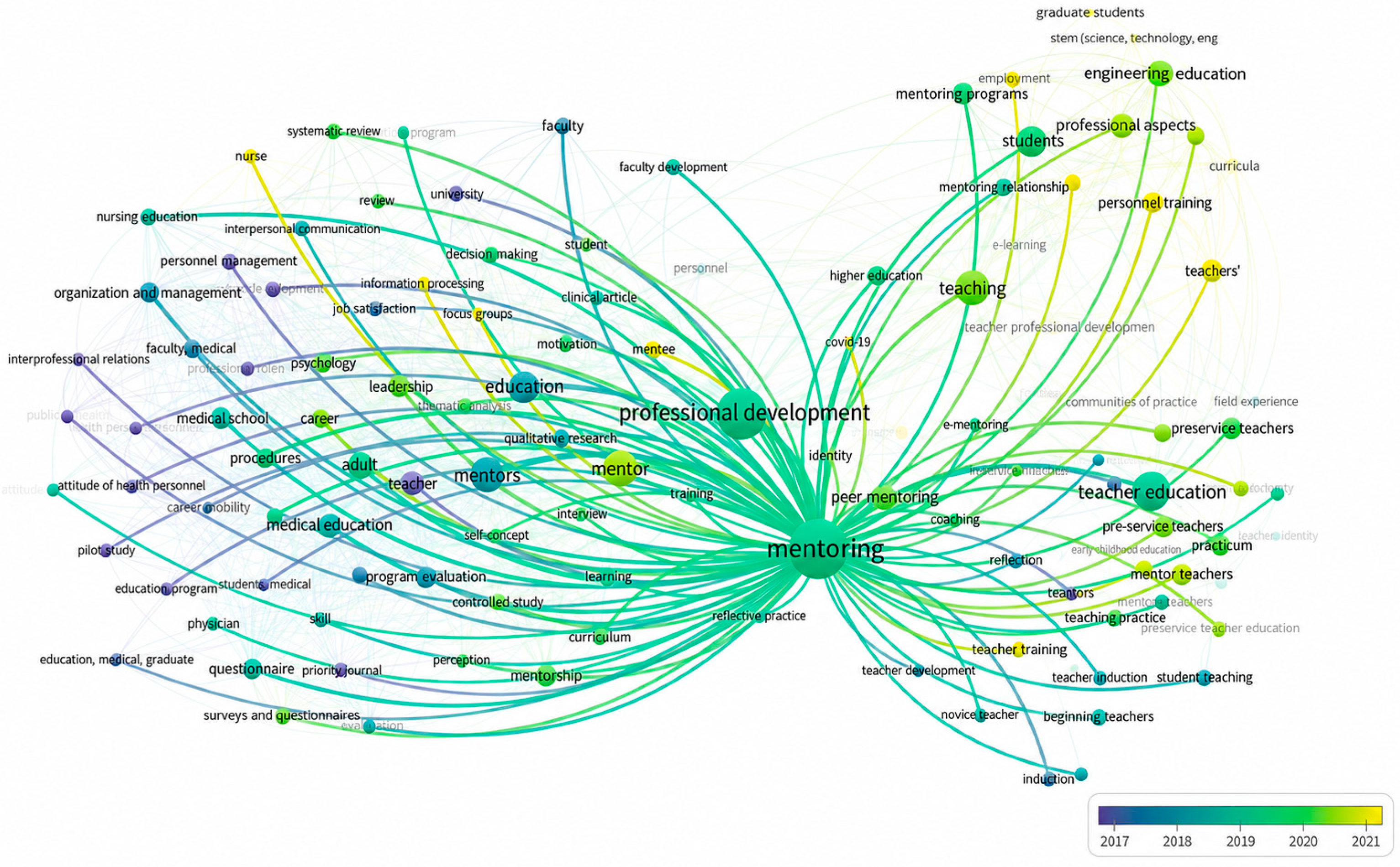
The central hub was ‘mentoring’ itself. It turned up 532 times across the corpus, with 121 connections to other terms, a total link strength of 2212, and an average publication year of 2019.40. These values indicate that ‘mentoring’ occupies a central rather than peripheral position in this body of literature, functioning as the node that connects the discussions of professional development, teacher training, higher-education learning, induction, reflective practice, and digital learning environments. The resulting co-occurrence network is presented in
Figure 2.
3.2. Thematic Clusters: Four Conceptual Subfields of the Mentoring Discourse
The network was divided into four clusters, which do not denote rigidly separate themes but rather interrelated conceptual subfields. In interpreting the clusters, we considered the most significant keywords, the spatial position of the clusters, and the network bridges. The interpretation of the four clusters is summarised in
Table 4.
The first cluster, on the left side of the map, sketches out the broader professionalisation context in which mentoring is embedded. The keywords associated with it—‘medical education’, ‘nursing education’, ‘adult’, ‘leadership’, ‘career’, and ‘programme evaluation’—make clear that mentoring is treated as an important form of professional support well beyond teacher training, reaching into other domains of professional learning as well. The cluster, in other words, signals both how widely mentoring travels across disciplines and how broad the thematic horizon of the literature actually is.
The second cluster sits at the conceptual centre of the map and brings together the literature on teacher education, induction, and the support of early-career teachers. The co-occurrence of ‘teacher education’, ‘pre-service teachers’, ‘mentor teachers’, ‘teacher induction’, ‘novice teachers’, and ‘beginning teachers’ points to mentoring as a decisive factor in the way trainee and novice teachers come to form their professional identity, build up their practical knowledge, and find their place within the school as an institution.
The third cluster gathers around ‘professional development’, ‘teaching’, ‘higher education’, ‘mentoring programs’, ‘e-learning’, and ‘educational computing’. The picture that emerges here is one in which mentoring is increasingly bound up with higher-education learning environments, with programme-based forms of professional development, and with digitally mediated learning spaces.
The near-central position of the keyword ‘COVID-19’ suggests that the pandemic has also brought to light a technological and organisational reorganisation of the mentoring discourse in the literature.
The fourth cluster and the bridging concepts between the clusters and particularly peer mentoring, coaching, identity, reflection, professional identity, and learning—indicate that the discourse on mentoring is gradually moving away from the exclusively hierarchical mentor–mentee model. Based on the map, contemporary mentoring can increasingly be understood as a collaborative, reflective, identity-forming, and mutual professional learning process.
3.3. Network Hubs and Bridging Concepts
The central structure of the network shows that mentoring and professional development form a mutually reinforcing conceptual axis. The central position of ‘mentoring’ is in itself expected, given that it is the dominant search term of the corpus; its analytical value therefore lies less in its centrality as such than in the pattern of its connections across all four clusters. The mentoring node is directly connected to numerous clusters, thus playing an integrating role between discourses on teacher training, higher education, professional development, and interdisciplinary professionalisation. Professional development is the other major network hub. We interpret its position cautiously: the strong direct link between ‘mentoring’ and ‘professional development’, together with the co-occurrence of both terms with programme-related keywords such as ‘mentoring programmes’ and ‘programme evaluation’, is consistent with—although it cannot by itself demonstrate—a gradual embedding of mentoring within formal structures of professional development.
Particularly noteworthy is the bridging role played by ‘peer mentoring’, ‘reflection’, ‘coaching’, ‘identity’, and ‘professional identity’. These terms do not sit quietly within any single cluster; they function instead as connective tissue between the classical mentoring literature, the work on teacher training, and the broader scholarship on professional development. This in turn lends weight to the reading that mentoring, as it is understood today, has moved well beyond the transmission of knowledge or the exercise of supervision: it has come to function as a relational infrastructure through which professional identity and the capacity for reflection are themselves cultivated.
3.4. Temporal Shifts Based on Overlay Visualisation
The overlay visualisation illustrates thematic shifts based on the average publication year of the keywords. On this scale, items with an earlier average publication year tended to be linked to classic professional development, teacher training, and institutional support themes. Among the keywords with a more recent average publication year, terms related to digital and technological learning environments, mentoring programs, student support, and pandemic-related educational transformations were more prominent.
The average publication year of 2019.40 for the keyword ‘mentoring’ suggests that mentoring became an integral concept in the middle to late stages of the period under review. The spatial distribution of the keywords COVID-19, e-learning, education computing, mentoring programmes, and students indicates that in the post-pandemic period, mentoring is increasingly linked to hybrid learning environments, digital adaptation, and issues of formal programme design. These temporal shifts across the period are shown in
Figure 3.
3.5. Density Map: Conceptual Focal Points of the Discourse
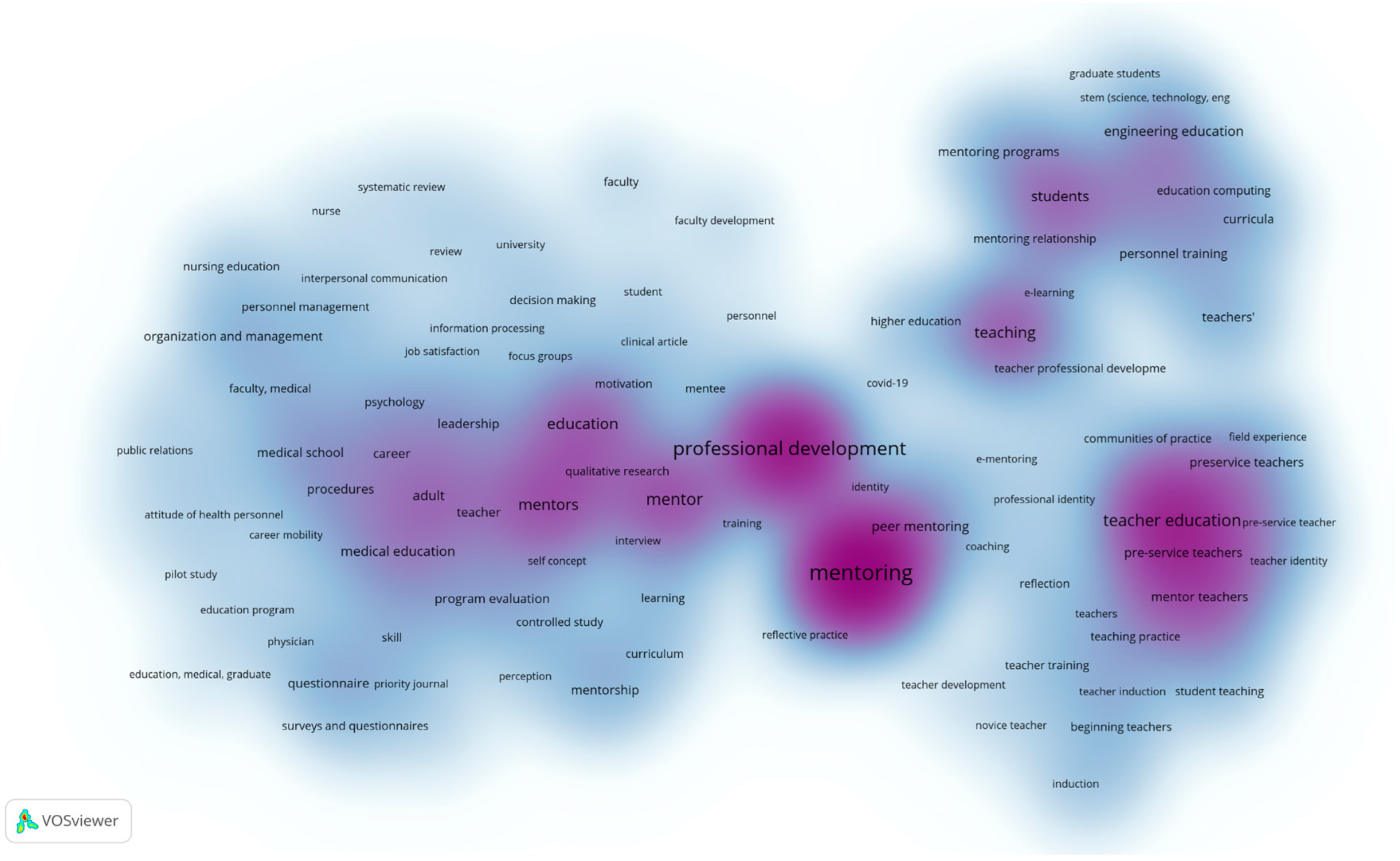
Based on density visualisation, the densest points of the discourse are organised around the keywords mentoring, professional development, education, mentors, teacher education, and teaching. The highest intensity was observed at the intersection of mentoring and professional development, indicating a strong thematic association between the two concepts in the examined literature; this association does not, by itself, establish that mentoring primarily functions as a mechanism of professional development.
The secondary hotspots on the density map cluster around teacher education and the learning environments of higher education. The grouping of ‘teacher education’, ‘pre-service teachers’, ‘mentor teachers’, and ‘teacher induction’ shows how tightly research on teacher mentoring is tied to the practical preparation of trainee teachers and to the support of those in their early career years. A second set of hotspots—‘medical education’, ‘nursing education’, ‘adult’, ‘leadership’, and ‘programme evaluation’—points in a different direction, suggesting that mentoring also cuts across other professional fields, well beyond education itself. These fields appear in the corpus because the all-keywords analysis included Scopus-indexed terms, and keywords from health-professional education met the co-occurrence threshold; their presence therefore delineates the wider professional-learning ecosystem surrounding teacher mentoring rather than extending the substantive scope of the study, whose teacher-mentoring core is represented by Cluster 2 and its associated hotspots (see also
Section 3.6 and
Section 6). The density visualisation of these conceptual focal points is presented in
Figure 4.
3.6. Methodological Reflection Based on the Results
One important methodological lesson from the results is that the Scopus-based all-keywords analysis encompassed not only teacher mentoring but also the broader professional field of mentoring. The presence of the terms ‘medical education’, ‘nursing education’, ‘clinical article’, ‘physician’, and ‘personnel management’ indicates that mentoring also functions as a broader, interdisciplinary infrastructure for professional learning. This pattern can be interpreted in two ways: on the one hand, as evidence of the transversal nature of mentoring; on the other hand, as a methodological caveat that in subsequent analyses focusing on teacher mentoring, it may be worthwhile to further refine the corpus using exclusionary keywords or an analysis based solely on author-provided keywords. We also acknowledge that the transversal character of mentoring across professional fields is well documented in the literature; it is therefore reported here as a contextual observation rather than as a novel finding, and follow-up analyses will align the search and screening strategy with the teacher-mentoring focus from the outset.
4. Discussion
Based on the VOSviewer results, research on mentoring does not appear as a single, self-contained pedagogical topic but rather as a network structure linking several professional fields of learning. The central position of the mentoring node indicates that mentoring is simultaneously linked to professional development, teacher training, induction, higher-education learning environments, digital adaptation, and interdisciplinary professionalisation. This supports the theoretical claim that, in contemporary educational contexts, mentoring is no longer merely a supplementary tool for supporting early career teachers but rather a relational professional learning infrastructure (
Hobson & Maxwell, 2020;
Mullen & Klimaitis, 2021). Throughout this section, the interpretations are intended to remain within the analytical scope of co-word analysis: the maps document conceptual associations and thematic structures within the published literature, not the educational effectiveness of mentoring or actual changes in mentoring practice.
The teacher education cluster is particularly important in terms of the main focus of this study. The convergence of teacher education, pre-service teachers, mentor teachers, teacher induction, novice teachers, and beginning teachers indicates that mentoring is a key element of the practical training of trainee teachers and the professional socialisation of early career teachers (
Kutsyuruba et al., 2019). The bridging position occupied by ‘reflection’, ‘teacher identity’, and ‘professional identity’ points to a mentoring whose effects reach well beyond the giving of technical advice. Mentoring, on this reading, also helps shape how teachers come to see themselves professionally, how they think reflectively about their practice, and how they exercise pedagogical agency (
Rushton et al., 2023;
Simon & Nissim, 2023).
Read together, the overlay and density maps suggest that digital and programme-based forms of professional support have grown in importance in the post-pandemic discourse. The appearance of ‘COVID-19’, ‘e-learning’, ‘educational computing’, and ‘mentoring programs’ as recurrent terms shows that mentoring is increasingly being situated within hybrid environments—learning spaces that are technology-mediated and at the same time organised at an institutional level (
Carpenter & Munshower, 2020;
Erdoğan et al., 2022;
König et al., 2020). This sits well with the thematic concerns of the present Special Issue, which seeks to rethink mentoring and professional learning under conditions that are dynamic, uncertain, and often difficult.
At the same time, the strong showing of ‘health education’ and ‘organisational learning’ is worth pausing over. The network does not, in the end, capture the narrow field of teacher mentoring in public schooling alone; it captures the wider ecosystem of professional learning in which mentoring takes place. Far from weakening the interpretation, this complicates and enriches it: teacher mentoring sits within a broader paradigm of professional learning, one in which mentoring functions as a shared form of support across career development, reflective practice, programme evaluation, leadership, and the formation of professional identity (
Cardinot & Flynn, 2022;
Mullen & Klimaitis, 2021;
Zhao et al., 2022).
Compared with previous bibliometric and review studies, the present analysis extends earlier work in two respects. Prior VOSviewer-based analyses in education have documented general methodological trends in the use of science mapping (
Patty et al., 2024) or have mapped adjacent fields such as career education (
Zhao et al., 2022), while recent syntheses of mentoring and induction have concentrated on outcomes for early-career teachers (
Luong, 2025). The present study, by contrast, provides a longitudinal co-word map of the mentoring discourse itself, identifying its cluster structure, network hubs, bridging concepts, and temporal shifts. The importance of these results lies precisely here: they show where the conceptual weight of the field is concentrated, which concepts connect otherwise separate subfields, and how the discourse repositioned itself around digital and programme-based forms of support after 2020—structural information that narrative reviews cannot make explicit in a comparable form.
The practical implications outlined below are anchored in specific bibliometric patterns rather than in general considerations: the mentoring–professional development axis (
Section 3.3 and
Section 3.5), the bridging position of reflective and identity-related keywords (
Section 3.3), and the post-2020 prominence of digital and programme-related terms (
Section 3.4). The first implication concerns mentor preparation. Mentor preparation needs to take much more seriously the link between professional development and teacher training, a link that, in current practice, is too often left to chance. Equipping someone to mentor cannot mean simply walking them through the practicalities or the paperwork. Real preparation has to bring several things into the same room at once: reflective practice, the formation of professional identity, the kinds of support that early-career teachers actually need, and the longer-term work of programme-based development (
Aharonian, 2021;
Ellis et al., 2020).
A second point concerns the digital. Mentoring no longer happens only in the staffroom or the classroom corridor, and the recurrence of terms like ‘e-learning’, ‘educational computing’, and ‘COVID-19’ in the corpus makes this difficult to ignore. Mentor preparation programmes will need to treat digital and hybrid environments as a built-in feature, not as an extra module bolted on at the end. The mentoring that emerges in these settings is mediated by technology and held together by professional frameworks; it often plays out across networks that go well beyond the original mentor–mentee pair (
Carpenter & Munshower, 2020;
Erdoğan et al., 2022;
König et al., 2020).
There is also the question of what kind of learning mentoring actually supports. The fact that ‘peer mentoring’, ‘coaching’, and ‘reflection’ all turn up as bridging terms across the network is telling. It suggests that mentoring systems need to make space for learning that is more horizontal in character: collaborative, reciprocal, the kind of arrangement where mentor and mentee are often learning at the same time, and sometimes from each other. Building a mentoring system, on this view, is not just about putting two people together in a pair. It also means building the reflective communities and the wider learning networks within which those pairs can do their best work (
Heikkinen et al., 2020;
Larsen et al., 2023;
Tynjälä et al., 2021).
Finally, the institutional dimension of the results warrants attention. The presence of ‘programme evaluation’, ‘leadership’, and ‘professional development’ among the prominent keywords reminds us that mentoring is not only an interpersonal matter. The mentoring programme itself has to be evaluated, supported, and improved at the institutional level. A good mentor relationship can take a teacher only so far if the organisation around it has not figured out how to sustain and develop the quality of what it provides (
Hobson & Maxwell, 2020;
Nguyen et al., 2020).
5. Conclusions
The bibliometric mapping carried out with VOSviewer presents research on mentoring and professional learning as a densely interconnected, multi-centred field. With 123 keywords distributed across four clusters, 3312 links between them, and a total link strength of 17,024, the network places mentoring at the meeting point of several traditions: professional development, teacher training, higher-education learning, digital adaptation, and the broader move toward interdisciplinary professionalisation.
That mentoring itself surfaces as one of the central hubs of the network is not a marginal finding. It signals that mentoring is not an auxiliary or supplementary element of the system, but an integrative mechanism of professional learning in its own right. What this study mostly does, in the end, is offer a different way of reading teacher mentoring. Mentoring is not really a training technique you teach someone and then send them off to apply. The picture that emerges from the maps is closer to an infrastructure: it shifts when conditions shift, it pulls in more people than the mentor–mentee pair, and it works differently in different settings. That kind of reading matters now in particular. Teachers today work under conditions defined by uncertainty, by rapid digital change, by shortages that show no sign of easing, by classrooms whose student populations are more varied than they used to be, and by a steady rise in the demand for professional support, the kind of support that earlier models of the profession simply did not have to factor in (
Larsen et al., 2023;
Mullen & Klimaitis, 2021;
Nguyen et al., 2020).
Finally, it should be emphasised that this study maps the intellectual structure of the literature on teacher mentoring and professional learning; it does not provide empirical evidence regarding the effectiveness of mentoring practices. The bibliometric findings identify where scholarly attention has been concentrated and how it has shifted over time, while their educational implications remain interpretative and need to be tested in empirical and evaluative research.
6. Limitations
Several limitations must be taken into account when interpreting the study’s results. First, the analysis relied exclusively on the Scopus database. Although Scopus provides extensive coverage, the parallel use of Web of Science or ERIC could have offered further perspectives (
Mongeon & Paul-Hus, 2016;
Patty et al., 2024). The practical implication of this restriction is that journals indexed only in Web of Science or ERIC—including several practitioner-oriented and regionally focused outlets relevant to teacher education—are absent from the corpus; the maps may therefore underrepresent certain strands of the mentoring literature, and the reported frequencies and link strengths should be read as Scopus-specific estimates rather than as universal characteristics of the field.
Second, the present VOSviewer run was based on authors and indexed keywords. This resulted in a richer network, but at the same time included not only teacher mentoring but also related professional fields such as medical and nursing education mentoring. The presence of the terms ‘medical education’, ‘nursing education’, ‘clinical article’, and ‘physician’ can therefore be interpreted both as evidence of interdisciplinary nature and as methodological noise.
Third, co-occurrence analysis reveals conceptual associations but does not prove causal or substantive deep-level relationships. Consequently, none of the patterns reported here—including the centrality of ‘mentoring’ and its association with ‘professional development’—can be read as evidence of the educational effectiveness of mentoring or of actual changes in mentoring practice; they describe the vocabulary and structure of the published discourse. Keyword co-occurrence is also sensitive to indexing conventions, keyword granularity, and threshold choices, all of which affect cluster composition and should temper strong substantive conclusions. The naming of clusters is an interpretative decision based on the professional interpretation of dominant keywords and network positions (
Donthu et al., 2021;
Zupic & Čater, 2015). In future research, it may be worthwhile to further clean the corpus using a thesaurus file, apply exclusionary keywords to filter out healthcare contexts, and conduct a separate analysis based solely on author keywords.
Fourth, this report rests deliberately on VOSviewer’s co-occurrence, overlay, and density maps; the focus, in other words, has been on the conceptual structure of the field and on the ways its themes have shifted over time. A separate look at citation networks—through co-citation analysis or bibliographic coupling—would open up a productive next step, allowing the intellectual roots of the field and its current research frontiers to be traced with greater precision.