1. Introduction
The emergence of Generative AI (GenAI) holds immense implications across various fields in education, and a growing body of work has begun to establish what GenAI can reliably do for L2 writers. Specifically, learners can use GenAI to generate ideas, develop outlines, condense source material, translate among languages, and proofread for accuracy and rhetorical inconsistencies (
Li, 2025), while GenAI has simultaneously transformed teachers’ roles in content creation, personalized learning, and student engagement (
Zhai, 2024). Related work has extended this landscape to feedback and assessment specifically. For instance, GenAI has been shown to enable more active student engagement with feedback (
Zhan et al., 2025), while broader reviews confirmed the promise of GenAI tools by highlighting the potential of GenAI in literacy development (
Chandel & Lim, 2024). These studies have established GenAI as a flexible, increasingly normalized presence across L2 writing contexts.
What remains far less examined, nonetheless, is how GenAI’s capabilities interact with human input, and several strands of research now converge to show that GenAI–human interaction, not GenAI alone, is where the real pedagogical value lies. Drawing on conversation analysis on human–AI interactions,
Voss and Waring (
2025) found that current AI models still struggle to embody core interactional principles, pointing to a persistent naturalness gap that human interlocutors continue to fill. In a similar vein,
Yang (
2025) argued that AI-based feedback enhances immediate learning outcomes, but its full potential is only realized in combination with human pedagogical expertise, balancing efficiency against the social, emotional, and interactional dimensions of learning.
Meniado’s (
2024) research further supported this by proposing human–machine collaboration as a synergistic partnership in which humans and AI complement each other’s distinct strengths, and
Lin and Chen (
2025) extended this into the ethical domain, theorizing a PAA (Plurilingualism, Affect, and Agency) model for responsible AI engagement in education. Similarly,
Zhang et al. (
2025) found that the use of AI in diagnostic English language needs assessment does not eliminate the need for human involvement. Across these different methodologies and framings, the pattern observed is consistent: GenAI’s contribution to language learning is best understood as conditional/contingent on human mediation, not as a standalone substitute for it.
Nonetheless, this consensus has produced little research into how moment-to-moment human mediation actually operates alongside GenAI, that is, the situated, embodied dynamics of the pairing itself, focusing on the process rather than the outcomes. This gap has real consequences: much of the current concern around GenAI in L2 writing centers on ethical and integrity risks precisely because the interactional dynamics between human and AI feedback remain undertheorized. Researchers have raised concerns about the ethical dilemmas of unrestricted GenAI use (
Hockly, 2023), the originality and attribution of GenAI-generated text (
Kohnke et al., 2023), and the debates over GenAI detection in higher education assessments (
Ardito, 2025). Moreover,
Shrolyk and Whitney (
2023) documented that among 88 students referred for academic misconduct review in the first winter semester following the initial public release of ChatGPT (November 2022), 91% were L2 writers and 35% of referred students had used GenAI tools to fabricate academic work. These concerns all scratch the surface of GenAI’s role without addressing how human feedback dynamically shapes, mediates, and optimizes GenAI-assisted writing, and without that understanding, it remains difficult to design feedback ecosystems that use GenAI responsibly rather than simply ban it. Even large-scale, outcome-focused work confirms this tendency. For example,
Zou et al. (
2025) investigated the impact of human–AI collaborative feedback on the writing proficiency of English-as-a-Foreign-Language (EFL) students, confirming that such feedback significantly improves writing accuracy, complexity, and fluency, mediated by writing enjoyment and cognitive competencies, yet even this rigorous design leaves the moment-to-moment collaborative process itself unexamined. Taken together, these threads—undertheorized interactional dynamics, ethical anxiety, detection-focused responses, and outcome-oriented feedback research—point towards the need to reframe the problem itself of not whether GenAI feedback is legitimate or helpful but how the roles of human and AI are enacted and structured together as a situated, interactional system, one in which human mediation is treated as a constitutive feature of the process rather than merely a variable correlated with its outcomes.
Ecological Languaging Competencies (ELC) offers a framework suited to exactly this gap, because it treats languaging not as an exchange of information but as embodied, distributed, and situated activity co-constituted by people, artifacts, and environments (
Thibault, 2011,
2021a,
2021b). Rather than asking only whether GenAI feedback is accurate or useful, an ELC lens asks how writers’ whole-body sense-making, individual agency, and environmental affordances are (de)activated as they move iteratively between human and GenAI input. This study foregrounds the fundamental role of human feedback by examining it through this ecological lens, guided by the following research questions:
How does the meshing of first-order languaging and second-order language unfold as tertiary L2 writers move between human and GenAI feedback?
What ecological affordances distinguish human from GenAI mediation in this process, and how do they shape writers’ agency?
2. Theoretical Framework
The theoretical framework that underpins this study is the notion of Ecological Languaging Competencies (ELC) that was first coined by Paul Thibault. ELC is premised on interpreting language as a verb-like term rather than being traditionally regarded as a noun, which indicates the process of languaging as dynamic, against the language-as-code view (
Halliday, 1984). The plural form of competency, competencies, transcends single, fixed, rule-based linguistic knowledge, foregrounding the emergent individual’s engagement in practices embodied in specific tasks (
The New Territories Group, forthcoming). Human languaging is grounded in autopoiesis (
Maturana, 1978), the self-producing, self-maintaining organization through which individual living systems continuously exchange with their environment to sustain their own existence. Through the process of languaging, people participate in embodied and distributed biosocial person–environment cognitive–semiotic dynamics (
Thibault, 2011,
2021a,
2021b), so the concept of ELC regards human languaging as whole-body dynamics that integrate persons and their activities with aspects of the environment and their worlds.
Central to ELC is the distributed language view that includes first-order languaging and second-order language (
Thibault & Lin, 2025). This distributed view builds on
Maturana and Varela’s (
2012) biological theory of cognition and
Larsen-Freeman’s (
2015) ecological perspective on second language development, departing from Chomsky’s fixed, rule-based model of grammar (
Öhman, 2025). First-order languaging refers to real-time engagement, such as gestures, movements, texts, and dialogs, in the immediate environment. It is a whole-body sense-making activity that involves “synchronized interindividual bodily dynamics on very short, rapid timescales of the order of fractions of seconds to milliseconds” (
Thibault, 2011, p. 214). Second-order language draws on more abstract patterns that are conventionalized under long social, cultural and historical timescales as part of the community traditions that people utilize when engaging in languaging activities (
Thibault, 2011). In the L2 writing process, the writer’s capacity to draw on their intuitive first-order languaging that meshes with their second-order resources through embodied practices enables them to write ecologically. Crucially, effective languaging requires the ongoing meshing of both orders as neither alone is sufficient. However, in language education and particularly in L2 writing, the interaction between these two systems remains largely underexplored.
While several frameworks could plausibly account for GenAI–human writing collaboration, ELC offers an analytic mechanism the others lack. Sociocultural theory frames individual thinking as a developmental sequence and is first mediated by others (people and tools) before becoming internalized and self-mediated by the learner, whereas ELC’s first-order languaging and second-order patterns are not developmental stages in this sense but are two modes continuously and recursively available within a single moment of interaction (
Qin & Dong, 2025). Activity theory addresses how learning is mediated by tools (e.g., textbooks) and community but overlooks the immediate primacy of learner agency in navigating their learning environments, which ELC captures through the writer’s real-time negotiation of first-order languaging and second-order language (
Chong et al., 2023). Distributed cognition unsettles anthropocentric boundaries by building dialog between human and non-human but does not foreground the affective, embodied dimensions of languaging that ELC centers (
Wang et al., 2025). Ecological theories are the closest relative to ELC, as they offer a distinctive perspective on contexts, yet they are concerned primarily with the spatial, temporal, and intermodal continuities of real objects, leaving little room for moment-to-moment meshing central to the L2 writing process (
Zapata et al., 2024). ELC’s distinction between first-order languaging and second-order language, with its emphasis on the real-time, embodied, and sub-second responsiveness, and its alignment with
Thibault’s (
2026) reconceptualization of languaging, sociality, and human (and non-human) intelligence, provides precisely this tracing mechanism. It is this apparatus that allows the present study to locate where these two orders mesh in GenAI–human-mediated writing and to reconsider communicative competencies in light of languaging itself. This makes visible not only whether a writer accepts or rejects GenAI’s suggestions, but the finer-grained moments of hesitation, partial uptake, and selective retention that constitute the meshing process itself, and these are the data invisible to frameworks that track only the outcomes or artifacts.
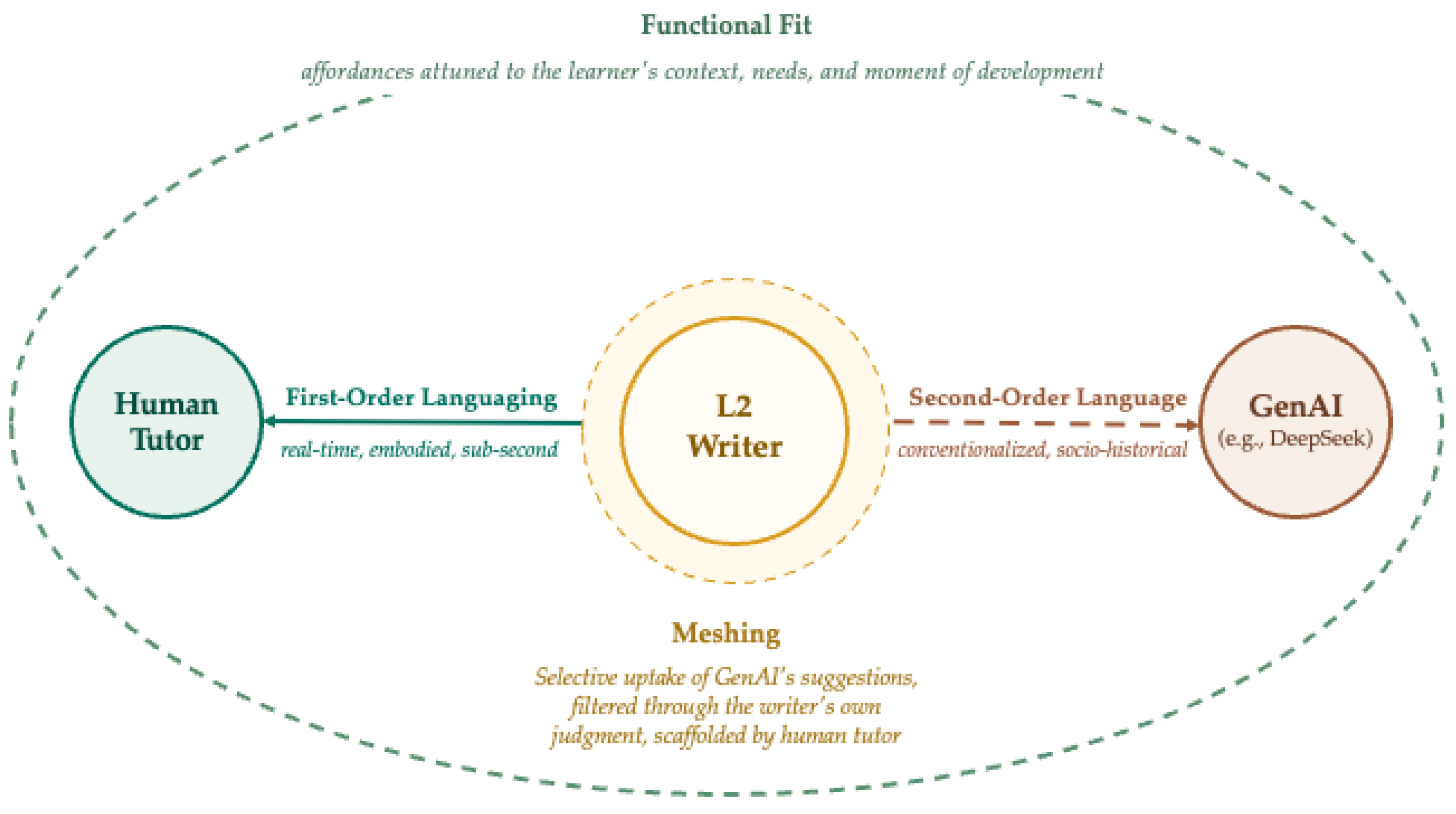
Figure 1 offers a provisional visualization of this heuristic, situating the writer between first-order languaging (human-mediated) and second-order (GenAI-mediated) language pathways, with their meshing at the center of analytic attention, and functional fit the L2 writers draw on within the GenAI–human-mediated L2 writing process.
As
Figure 1 illustrates, the L2 writer occupies the center of a distributed ecology connected to two structurally distinct affordances: the human assistant, connected via first-order languaging: the real-time, embodied interaction operating at the scale of milliseconds (
Thibault, 2011); and GenAI, connected via second-order language—conventionalized patterns accumulated over long socio-historical timescales (
Cowley et al., 2025). The dashed inner boundary surrounding the L2 writer marks the site of meshing, where the moment-to-moment negotiation takes place. In this meshing, the L2 writer selectively takes up GenAI’s suggestions, filtered through their own embodied judgment and scaffolded by the human assistant, rather than adopting them indiscriminately. These moments of meshing would be invisible to any framework tracking only final outcomes or written products. The outer functional fit boundary signals that both pathways operate within a broader ecology of context-sensitive affordances, where L2 writers agentively utilize what is available and usable from the environmental affordances, elaborated further in the Findings and Discussion sections. However, this diagram is a provisional heuristic visualization of ELC in L2 writing, offering only a starting point for further theoretical development given the nascency of empirical ELC scholarship in this domain.
Theorizing on the ELC perspective of language education, this study aims to explore how GenAI–human-mediated feedback either facilitates or disrupts this meshing in tertiary L2 writing. Drawing on conventionalized, rule-governed patterns of language, GenAI may be understood as a resource well-suited to supporting second-order language, while human interlocutors uniquely furnish the embodied, real-time responsiveness that first-order languaging requires. Although GenAI operates continuously and offers personalized support through multimodal, human-like interactions 24/7 (
Huang et al., 2024), it remains unclear how tertiary-level L2 writers perceive and respond to AI-generated feedback alongside human input. Therefore, it is crucial to explore how whole-body sense-making and individual languaging in this writing process connect with and intertwine with environmental affordances as learners exercise their agentic capacities, where functional fit distinguishes between affordances that are merely available and those that are genuinely attuned to the learner’s specific context, needs, and moment of development (
Thibault, 1993,
2004). In this exploration, first-order languaging and second-order language serve as the primary analytic categories guiding the Findings section. This investigation extends ELC previously theorized primarily in the human-only international contexts into the GenAI era, where the GenAI–human–learner triad has not yet been examined through an ecological lens. Understanding how writers respond to and co-exist with GenAI in the presence of human assistance will contribute to understanding GenAI–human affordances in L2 writing at the tertiary level.
3. Context and Methodology
This study was conducted in the Spring semester of 2025 at a university in Hong Kong. The course lecturer was the second author, and my role (the first author) was a teaching assistant. This course focused specifically on analyzing discourse features in second/foreign language classroom contexts. All students were from Mainland China and Hong Kong SAR, and they were expected to explore the dynamics and potential of classroom interactions, as well as their impacts on pedagogical effectiveness in diverse classroom contexts.
3.1. Initial Collaborative Planning and Study Design Development
This study took place in a course titled ENG3266 Classroom Discourse Analysis (CDA), delivered to a Bachelor of Education (Honors) (English Language) cohort during the Spring semester 2025. The course ran from 6 January 2025 to 29 April 2025, meeting weekly, in person, three hours per week. Building on students’ previous knowledge of discourse analysis, the course focused specifically on analyzing discourse features in second/foreign language classroom contexts. A total of 18 students enrolled.
This study took shape following the tenth class session, on 12 March 2025, which involved analyzing a classroom transcript—a teacher–student exchange on the topic of Understanding and Reframing Classroom Discourse—by identifying frames using Generative AI tools. Frames are the interactional and social contexts surrounding individual utterances, influencing turn-taking, contextualization cues, narratives, and classroom knowledge. Students were instructed to analyze who had a voice in the interaction, what frames were shaping what could and could not be said, and to reframe the transcript to give the student a more authentic voice, use more inclusive language, and validate different forms of participation. Moving between groups as they worked, I observed marked differences in their GenAI-using behaviors and group dynamics: some engaged in heated discussion, while others worked more individually with little interaction. These distinctions sparked my curiosity about how students would use GenAI in the final assignment, especially with me present as a teaching assistant. After I reported this observation to the second author, he suggested I explore students’ GenAI practices in L2 writing by assisting them in the final writing assignment, which required the students to reflect on their personal learning/teaching journey by applying discourse analysis in 2000–3500 words. Since this would entail GenAI use, he proposed I participate in this process by offering my own feedback and observing how students responded to it compared with GenAI’s. This allowed students to know the kind of feedback their teaching assistant could offer, while giving me insight into their GenAI-mediated L2 writing process and how they negotiated it ecologically.
3.2. Participants and Data Generation
Participants were recruited via a Moodle announcement in Week 12 of the semester, three weeks before the final assignment deadline, inviting students to volunteer for personal tutorial sessions on their final assignment. No inclusion criteria beyond voluntary participation were applied. Two students volunteered and participated as they wanted guidance on the final assignment from me: Aron, a Cantonese-English bilingual with Mandarin proficiency educated at international schools in Hong Kong; and Jenny, who completed secondary education in Mainland China before pursuing her undergraduate degree in Hong Kong. This study therefore relies on self-selected participation (
n = 2) since Aron and Jenny were not statistically representative of the class, nor were they chosen for their contrastive profiles. While it complies with the credibility and authenticity of participation (
Wiley, 2024), this study acknowledges that this selection criteria falls into what
Hiratsuka (
2025) termed as volunteer participation paradox where research may face limitations due to potentially unbalanced data. Beyond questions of sample size, Aron and Jenny’s profiles are themselves significant: both navigate multilingual repertoires and cross-border educational trajectories characteristic of Hong Kong’s postsecondary landscape, where Cantonese, Mandarin, and English coexist alongside transnational academic mobility (e.g., Mainland Chinese students, such as Jenny, pursuing degrees in Hong Kong). This illuminates multilingual learning experiences in the specific context of Hong Kong postsecondary education, instead of making statistical claims about the broader population. This context resonates with recent qualitative work on intercultural communicative competence among Chinese students, which similarly foregrounds learner identity, multilingual experience, and communicative practice within comparable educational pathways (
Feng et al., 2025). Situating Aron and Jenny’s languaging within this specific sociolinguistic landscape allows this study to attend to dynamics within this group of linguistically and culturally diverse multilingual students.
Two consultation sessions were held with Aron, conducted in his preferred mix of English, Cantonese, or Mandarin, with drafts shared and revised iteratively between sessions; one session was held with Jenny. No formal, separate follow-up interviews were conducted. These tutorial sessions served a dual purpose, combining assignment writing support with embedded interview-style questions (in the
Appendix A). Alongside providing feedback on their drafts, I asked participants about their experiences and perspectives on receiving GenAI-generated feedback, how they negotiated it with/against my own feedback, and how they perceived my role as their tutor throughout the process. To protect confidentiality, participants were assigned pseudonyms not reflecting their real names or identities, and sessions were video recorded with consent. Participants were also informed that they could withdraw from the tutorial sessions at any point during the study without penalty. The second author, as course instructor, was involved conceptually but not in empirical data collection to preserve the impartiality of his grading. We established a confidentiality rule that he would not learn which students had sought personal feedback until after final assignment grades were released. This study was approved by the Human Research Ethics Committee (HREC) at the institution where it was conducted (Ref. no. 2024-2025-0082).
The corpus for this study comprised three data types. First, tutorial session recordings: two sessions were held with Aron (13 April, one hour; 21 April, two hours) and one with Jenny (19 April, one hour and ten minutes), all conducted and recorded via Zoom. Recordings were transcribed using Zoom’s automated transcription function, then manually proofread and corrected by the first author against the original audio. Second, GenAI chat logs, captured screenshot image pages before sessions: 35 pages for Aron, spanning five prompts across three functions, including grammar checking (two prompts), coherence checking (two prompts), and concept checking (one prompt); and 25 pages for Jenny, comprising five exchanges with DeepSeek that included asking for suggestions, responding to its output, and directly challenging its suggestions. Third, participants’ final paper (reflective portfolio) drafts: both participants shared multiple draft versions of their final papers with the first author prior to formal submission. All shared versions were included in the corpus without additional sampling or selection. Data are stored securely on the first author’s password-protected, encrypted device, accessible only to the research team; data will be retained for one year following publication and used solely for the purposes of this research, after which they will be permanently deleted.
Data analysis followed a combined inductive–deductive (abductive) approach. In the first phase, all data sources were open-coded inductively, without reference to the ELC framework, and recurring moments where participants engaged with human or GenAI feedback were identified, such as instances of accepting, rejecting, or negotiating a suggestion. In the second phase, these inductively generated codes were reviewed deductively against ELC constructs, including first-order languaging and second-order resources, whole-body sense-making, and environmental affordances/functional fit, to identify where the codes (mis)aligned or complicated the existing framework. The iterative moves between emergent codes and established theories allowed the three themes presented in the Discussion section to develop neither purely from the data nor imposed wholly by the theory but through their mutual refinement. The corresponding author (the third author), also the leader of the team, facilitated over one-year learning of the ELC framework in the team. The first author did the first phase of inductive coding, and the second author informed the second phase of deductive coding; they came together to map student ELC-related behaviors onto ELC-related concepts. No coding software was employed.
3.3. Methodological Grounding, Positionality, and Trustworthiness
This study is methodologically grounded in ethnography (
Oranga & Matere, 2023) as its overarching design, drawing on narrative inquiry (
Clandinin, 2022) as the primary strategy for representing participants’ experiences and a phenomenological sensibility as an interpretive lens (
Burns et al., 2022) attentive to lived experience. Ethnography structured the overall sustained immersion, and that was my presence as a TA across the semester, embedded within the course community rather than observing from outside it (
Cahnmann-Taylor & Jacobsen, 2024). Narrative inquiry shaped the way that participants’ experiences were represented: as connected and unfolding stories (Aron’s and Jenny’s cases) rather than as fragmented, decontextualized codes (
Ghanbar et al., 2024). Phenomenology informed the reflexivity of my position as I interpreted participants’ in-the-moment reactions and decisions (
Stolz, 2023). Woven together, these three traditions allowed my own perspectives to actively inform my interpretations of students’ behaviors. To ensure rigor and transparency, I carefully reported my observations and engaged in ongoing dialog with participants to validate and align my interpretations with their viewpoints through personal verbal conversations with the students in class and informal communication channels, such as WhatsApp and WeChat.
My positionality also calls for critical reflection. As a TA living in the course community, my relationship with Aron and Jenny may have shaped what they chose (not) to share, or how favorably they characterized my feedback relative to GenAI’s, especially given the rapport built through informal channels like WhatsApp and WeChat. Consistent with a phenomenological sensibility, I aimed to remain attentive to these dynamics throughout data interpretation, treating my closeness to participants as both productive and partial. Drawing on this insider position, I kept handwritten fieldnotes after key interactions in class, documenting students’ GenAI-using behaviors. I also held two brief in-person meetings (each approximately 15 min, audio-recorded) with the second author throughout the project to talk through emerging interpretations and coding procedures. Transcripts of the tutorial sessions and participants’ writing drafts were revisited multiple times to identify where rapport may have shaped what was said, and I explicitly foregrounded my multiple roles as the feedback-giver, data collector and analyst, as a source of partial, situated insight rather than neutrality (
Potter, 2026). During the tutorial sessions, I engaged in real-time member-checking with participants as they shared their perspectives and experiences with GenAI, confirming that my understanding aligned with what they meant as the conversation unfolded. This was one additional check against misremembering/misconstruing participants’ meaning during analysis, and it decreases the incidence of incorrect data interpretation resulting from memory illusions (
Roediger & Gallo, 2022) and ensures the validity of this study (
Harper & Cole, 2012).
4. Findings
The findings presented here are exploratory instead of confirmatory and illustrative as opposed to representative. They offer an in-depth account of how ELC dynamics unfolded for two specific participants in this specific context, rather than a generalizable claim about how tertiary L2 writers as a population engage with GenAI–human feedback. Aron and Jenny’s cases should be read as instructive examples that surface possibilities and mechanisms worth further investigation, not as evidence that these patterns hold uniformly across other students, courses, or institutions.
4.1. The Case of Aron
Aron is a local Cantonese-English bilingual undergraduate with extensive international teaching experience and was the first student to volunteer for personal tutorial sessions. On the two online Zoom consultations on 13 April 2025 (an hour) and on 21 April 2025 (two hours), I worked with him on his final assignment, focusing primarily on essay structure, logical coherence, and content development rather than surface-level grammar. Aron confessed that he used DeepSeek chatbot for grammar and coherence checking during his writing process. He accepted most of its suggestions while also selectively retained his own phrasing. For instance, he used his own “put students in the driving seat” other than accepting AI’s suggestion “return agency to students”.
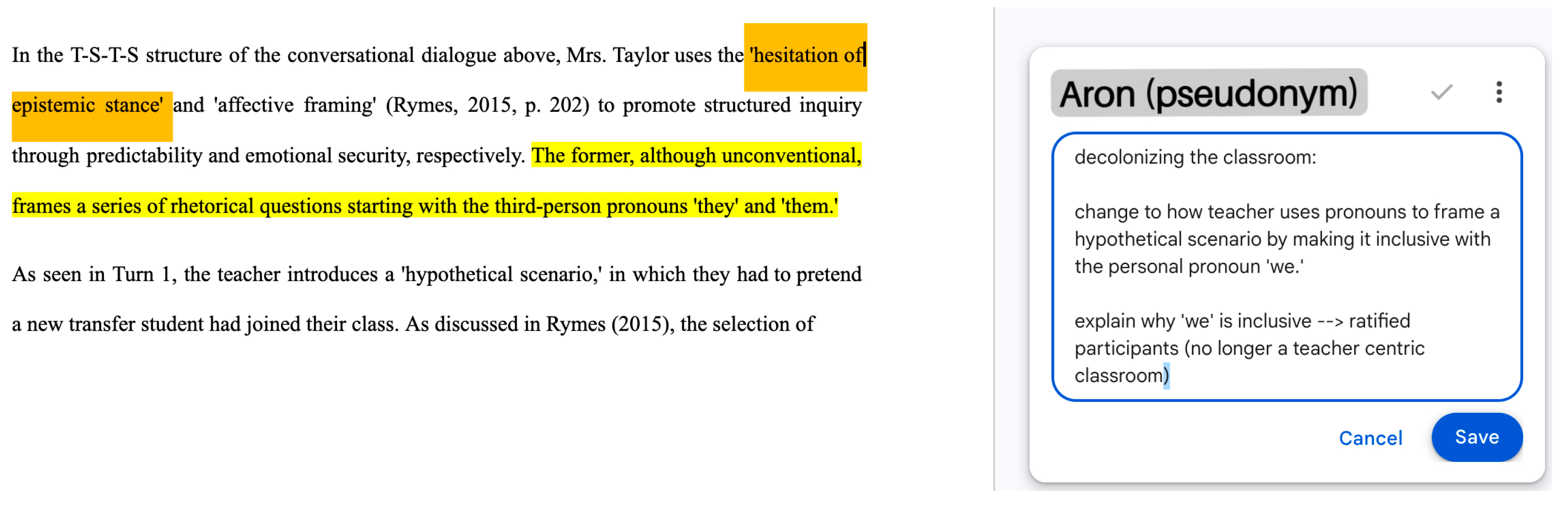
During the second Zoom tutorial session, Aron expressed uncertainty about the phrase “hesitation of epistemic stance” (
Figure 2). Although he had included this term in the paper, he was also skeptical about its appropriateness because he could not provide a compelling justification. When I asked him: “Can you define this term? What is the purpose of bringing up this concept here?” He replied hesitantly: “I find it hard to define it myself as well. Actually, as you can see from the sidebar, I also noted this question to myself. Although I wanted to use this term because I saw it in the textbook and it sounds cool, to be honest, I am not sure the exact definition by reading the example on the book”. Unable to provide rationales upon my probing, Aron removed the “hesitation of epistemic stance” in his draft.
Moreover, Aron screenshared a YouTube video of an elementary classroom that he intended to analyze. In the snippet Aron played, the teacher used a drumstick as a pedagogical tool to teach number counting. We watched the snippet together and Aron explained to me his analysis of the video, as well as flagging how each moment corresponded with the IRE pattern using a table, analyzing the turn-taking in the Math classroom. Aron re-read what he had written and split his thinking process to feed me, a process where he also made sense of what he thought and wrote. In this process, Aron marked some questions he had for me to provide suggestions. For example, he flagged out rhetorical questions he intended to ask but unsure if those questions were formed in a good academic manner. I assessed the alignment between what Aron saw and what he wrote, as well as evaluated if what Aron wrote was accurate and coherent. This video watching and analyzing part was one that GenAI could not, in its current form, directly function on, so Aron chose to resort to me.
In the two tutorial sessions, Aron consistently expressed a preference for my feedback over GenAI’s, although both were helpful in his L2 writing process for structuring and content decisions. He also noted that my feedback could be serendipitous compared to that from GenAI tools: “when seeking advice from GenAI, you first need to have a clear understanding of what you want to ask to generate a good prompt.” However, when Aron sent me his finalized paper, I provided not only structural and grammatical feedback he had asked but also noticed that his references did not strictly follow APA format. I pointed this out and he was very grateful for this observant reminder. Rapport was also evident through our communication channel, WhatsApp. Aron described consultations with me as “more accessible and less mentally burdensome” than approaching the course instructor, because the informal, daily nature of WhatsApp as a communication platform signals a less formal working relationship than email. After the second meeting, he submitted a final draft for proofreading before his formal submission.
4.2. The Case of Jenny
Jenny is a Mainland Chinese student pursuing her undergraduate degree at the university being researched. Jenny came to me expressing her frustration of how her initial idea failed to gain the course lecturer’s affirmation. Her initial intention was to critique the performative nature of demonstration lessons, where teachers deliver artificially polished performances far exceeding their usual classroom standards. She argued that this phenomenon reflects a broader “competitive culture among teachers,”, which sometimes compels them to adopt an idealized persona as “exceptionally noble” educators. However, when Jenny presented her preliminary thoughts to the course lecturer after class, he dismissed the focus on teacher competitiveness and the disparity between demonstration and regular lessons since such an approach lacked analytical depth for studying authentic CDA-focused assignment. Due to time constraints and the huge demands from other students to consult the lecturer, Jenny was unsatisfied that she received no further clarification on how to proceed with the assignment.
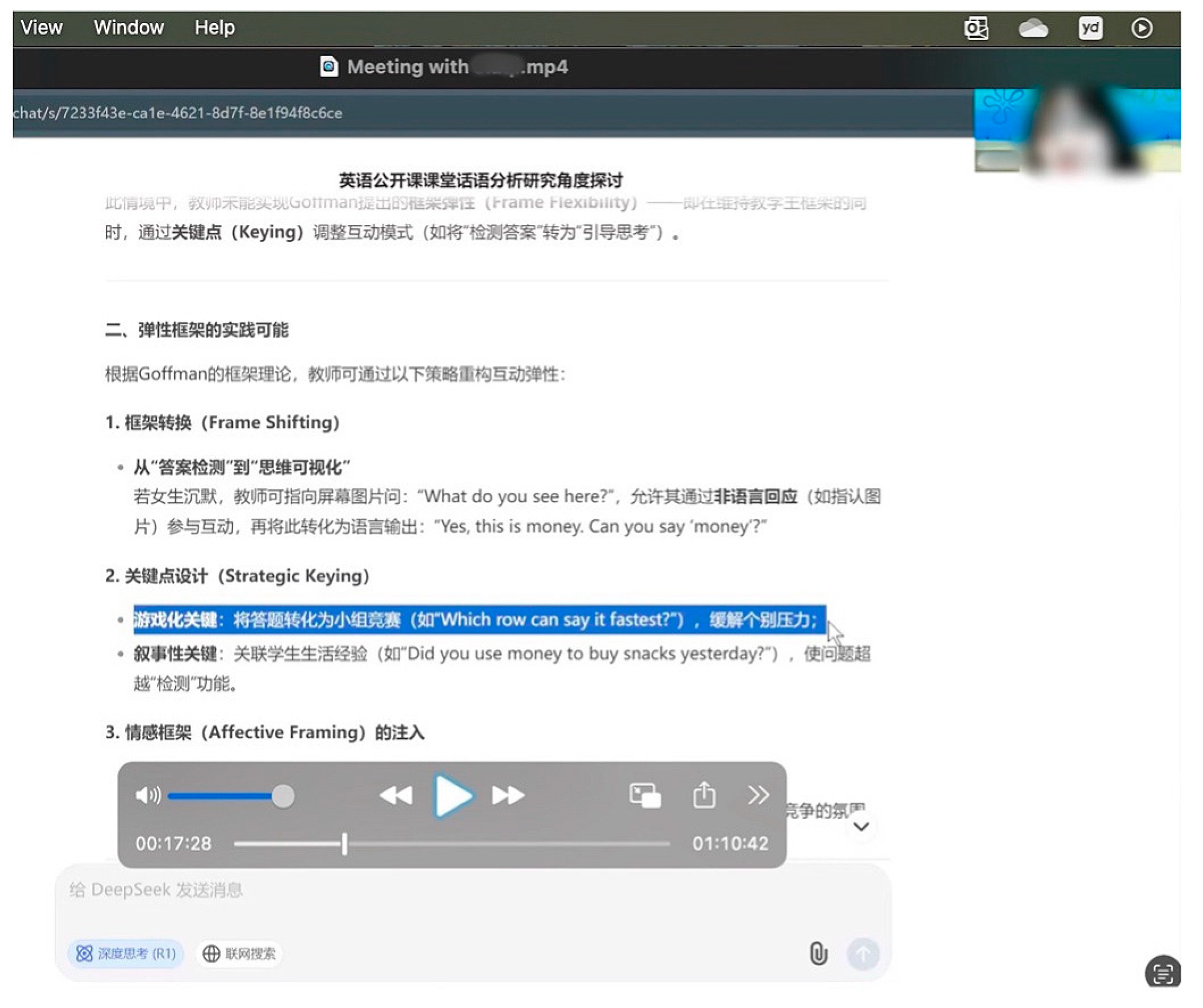
Jenny then shared that she consulted DeepSeek for guidance before resorting to my assistance. As shown in
Figure 3, DeepSeek’s response included a suggestion to incorporate gamification into her analysis. Jenny said that she would only partially agree on what DeepSeek suggested: “The feedback is way too broad and can be applied to almost anything.” She highlighted her critique with a vivid Chinese phrase “扯蛋” (chě dàn), which means nonsense or bullshit to express her visible frustration. “It even proposed gamification (
Figure 3), which is way too broad and has zero relevance to CDA.” She rolled her eyes as she said it. When I asked Jenny whether she was concerned about being accused of stealing GenAI’s answers, she responded with a firm denial: “I don’t think the copying process should be equated with stealing,” she further defended: “I provided the prompts, and GenAI simply generates new content based on my input. These ideas are MINE! Who copies whose ideas?”.
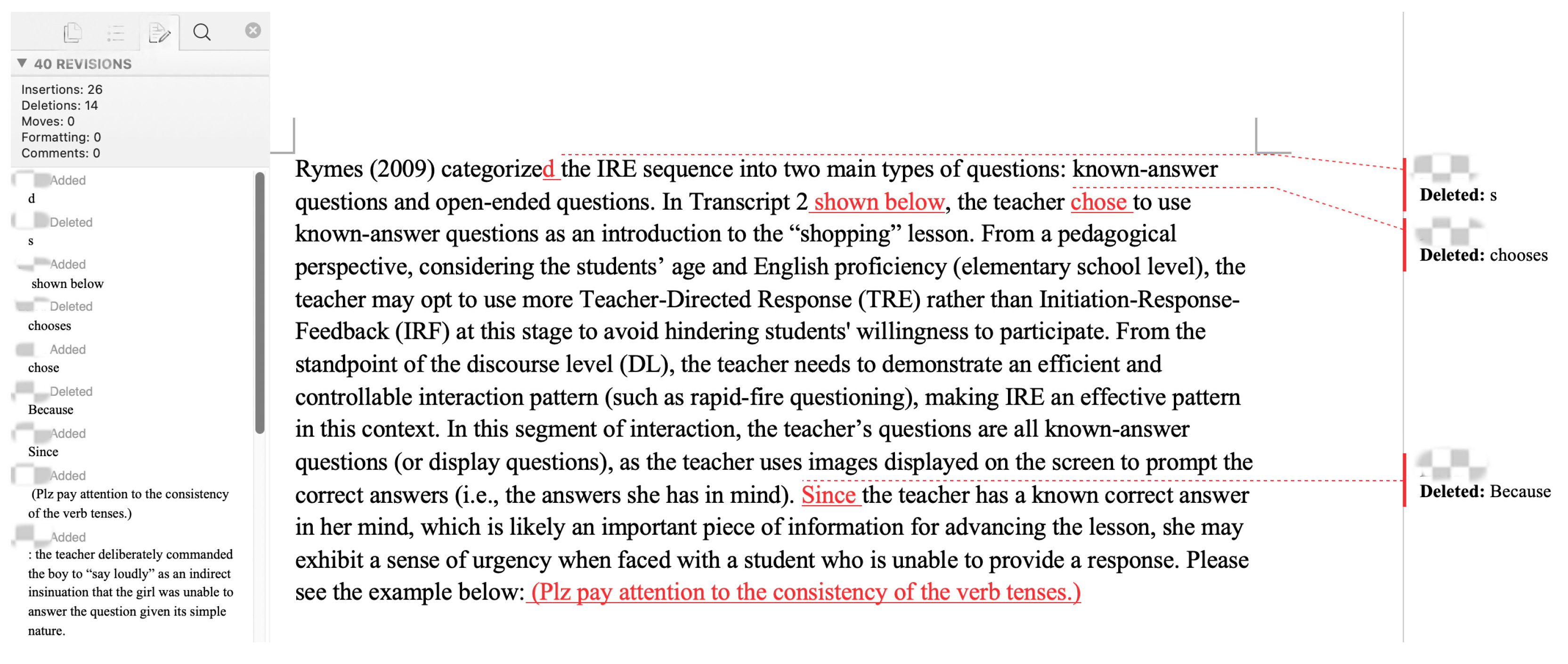
Through a series of guided questions from me and Jenny’s iterative thinking, which focused on her core course takeaways, such as IRE (Initiation Response Evaluation)/IRF (Initiation Response Feedback) patterns, Jenny reoriented her topic and ultimately produced a final submission that organically integrated CDA frameworks (
Figure 4). Her revised work centered on teacher’s absolute control over the allocation of interactive resources, following a triadic interaction pattern typical of the IRE pattern.
5. Discussion
During languaging, individuals participate in meaning-making by integrating actions, emotions, and interactions with people as well as with material artifacts within socio-ecological systems, where meaning arises through the entanglement of body, mind, and environment (
Thibault, 2026). Building on the data presented in the Findings section, this session analytically summarizes three themes of how Aron and Jenny’s L2 writing involves ELC perspectives of the different angles that it entails: whole-body sense-making, individual languaging within a distributed ecosystem, as well as environmental affordances and agency.
Theme 1: Whole-Body Sense-Making
The whole-body sense-making process involves what
Thibault (
2011) termed as first-order languaging. The instance of Aron’s incorporation of the term “hesitation of epistemic stance” presented in the Findings section captures the meshing of first-order languaging and second-order resources. My questioning for him to define this phrase served as a first-order prompt that challenged his decision in citing this phrase. Our interaction exposed a gap between the second-order term and his first-order understanding of it, evidenced by Aron’s serious reflection on the appropriateness of adopting the term without genuinely integrating into his own understanding. The decision to remove the term consequently reflects the primacy of first-order understanding when second-order language remains unmeshed or ungrounded. This process reflects what
Young (
2013) described as the perception–action cycle, or what
He et al. (
2026) applied in the ELC-based three-phase loop pedagogy in a primary English language teaching (ELT) classroom: students first wrote/drew on a topic without prior preparation (first-order languaging); they then talked in groups recorded by Zoom (first-order languaging meshed with the second-order language; lastly, they reshaped the final writing essay based on the feedback the human assistant gave (second-order language). Aron’s initial adoption, iterative reflection, and final abandonment of the phrase “hesitation of epistemic stance” embodied the first-order languaging and second-order language where perception became the motive for his actions in flows of languaging as whole-body sense-making.
Jenny’s case offers an equally compelling instance of whole-body sense-making. Her verbal–bodily reaction in dismissing DeepSeek’s gamification suggestion, describing it as “扯蛋” (chě dàn) (nonsense/bullshit) while rolling her eyes, grounds her rejection as more than a purely emotional response, suggesting an embodied epistemic assessment in which judgment was registered in coordination with her explicit articulation of why DeepSeek’s output was irrelevant, though this remains as one instance rather than a recurring pattern. This reflects what
Thibault (
2021a) addressed as the distributed language view, where feelings and emotions of an individual affect and are affected (Jenny’s reaction) by those of other agents and agencies (GenAI’s responses and my role as a tutor). In this sense, affects are the motives that function as a driving force in their socio-ecological system (
Turner, 2025), where cognition and languaging arise within complex, multilevel ecosystems of capacities and skills (Jenny’s feeling and reasoning with GenAI’s responses) developed in coordination with others through cultural, social, multimodal, interpersonal, and technological interactions. This process demonstrates writing as an embodied and situated practice that is dependent on environmental affordances (
Smith et al., 2025), where, in this study, human feedback also plays an important role.
These instances suggest that whole-body sense-making makes up a central part in the L2 writing process. First-order languaging and second-order language participate in this complex process, and they operate within a rich ecology of embodied signals, both simultaneously and subsequently. Aron’s hesitation and Jenny’s frustration were not registered by GenAI tools as the time of this study, GenAI, in its current form, cannot language. It can produce output, but it cannot participate in the embodied, situated, and affectively attuned meaning-making that languaging entails. Agency was instead afforded through the interaction with the human assistant iteratively and organically. This finding builds on
He et al.’s (
2026) ELC-based loop pedagogy and answers its call to investigate GenAI’s role as a learning companion within a co-languaging ecology involving the learner and human assistant, featuring the indispensable role of human feedback for simultaneous inquiry, exploration, and mediation. However, this role should not be read as sheer superiority of the human assistant. This study also attends to moments where GenAI functioned successfully without human assistant: Aron’s unassisted acceptance of DeepSeek’s grammar and coherence suggestions is one such example. This indicates that human feedback is not uniformly superior to GenAI’s but that the two serve different purposes under different circumstances. Whereas human feedback scaffolds first-order languaging, GenAI orients towards conventionalized, second-order refinement.
Theme 2: Individual Languaging within a Distributed Ecosystem
During the first Zoom meeting with Aron, he shared his use of DeepSeek and how he reacted to its responses. He stuck with his own colloquial expression “put students in the driving seat” rather than the DeepSeek’s suggestion “return agency to students”. Aron’s engagement with DeepSeek embodies what
Wang et al. (
2025) described as a spectrum of approaches to GenAI: “from prescriptive to dialogic uses” (p. 1). Aron’s prompt “Check my grammar” to DeepSeek revealed a tool-based usage, yet after he absorbed its second-order correction, he retained his first-order voice. This demonstrates that Aron took an attentive attitude toward AI’s feedback, so as to preserve his personal tone and style in English writing. In this distributed ecosystem, Aron consulted DeepSeek for linguistic refinement while simultaneously mediating his writerly identity, actively navigating, deliberating, and acting on his agency with purpose (
Teng, 2019). This demonstrated use of GenAI along a spectrum reveals that L2 writers retain authorial agency even in the presence of GenAI. I, as the tutor, affirmed his decision by supporting his choice, a move intended to reinforce Aron’s confidence in his first-order judgment (
Moorhouse et al., 2025). This way of using GenAI is not unethical, since the writer makes the final decision about what to adopt or abandon, continuously recalibrating GenAI–human collaboration. This dynamic illustrates a form of human–GenAI complementarity when DeepSeek’s second-order suggestions scaffolded Aron’s grammatical and structural refinement, reducing his cognitive loads for first-order languaging. In this case, GenAI enhanced his own voice and stance, instead of replacing his writerly self.
Another dimension of distributed agency emerged in Jenny’s conversation with me. When Jenny expressed her frustration at not receiving detailed feedback from the course instructor after class, she approached me, and I probed her takeaway from the course. This Socratic questioning was intended not just to supply an answer but to prompt Jenny’s reflection of her epistemic relationship to concepts learned in class, enabling her to identify IRE/IRF as what she ultimately anchored her paper in. Our Zoom session functioned as a network of affordances, people (Jenny and me), technology (DeepSeek and Zoom), and artifact (Jenny’s GenAI logs and writing drafts), together scaffolding her attunement towards completing the writing task. Moreover, Jenny’s thought-provoking viewpoint on GenAI plagiarism is another perspective that challenges the conventional understanding rooted in academic misconduct frameworks (e.g.,
Bittle & El-Gayar, 2025;
Bjelobaba et al., 2025). By characterizing GenAI primarily as a language-polishing tool, Jenny articulated a more nuanced positioning of GenAI’s role in her writing process. This suggests a promising avenue for responsible AI integration in L2 writing. Her perspective moved the conversation beyond a don’t cheat epistemic stance to a more nuanced, meta-level one: a distributed yet agentic model of co-authorship, in which Jenny positioned herself as the co-orchestrater of her L2 writing within a GenAI–human ecosystem, rather than a passive copycat of GenAI’s intellectual output. This reframes GenAI ethics discourse under the broader understanding of GenAI’s role in distributed GenAI–human L2 writing processes.
Taken together, Aron and Jenny’s agency within this distributed GenAI–human ecosystem points to a deeper pattern in GenAI’s limitations. Yet Jenny’s “扯蛋” (chě dàn) (nonsense/bullshit) response to DeepSeek’s suggestion points to a deeper layer. GenAI, lacking this autopoietic grounding, generates patterned output without a living system’s intention of meaning or self-continuation. This absence may help explain why Jenny positioned DeepSeek’s suggestion as external to the collaborative, agentive process she was co-constructing with human input. This artificiality, by the time of this study, remains distinct from human ecological scaffolding. In these two cases, GenAI did not observe or respond to the writers’ first-order languaging and agentive moves. This limitation, given the fast-shifting pace of multimodal AI development, may not hold invariably across future GenAI systems (
Achuthan et al., 2026). Therefore, continuing to understand wider acceptance and integration of GenAI over time (particularly the adoption of these practices in educational institutions) will go a long way towards framing these conversations.
Theme 3: Environmental Affordances and Agency
In the cases of Aron and Jenny, both GenAI and the human teaching assistant functioned as environmental affordances within this network, yet their functional fit differed fundamentally. GenAI offered broad, on-demand linguistic resources that operated from outside the course ecology, while the human TA brought insider knowledge of the specific course context, the instructor’s expectations, and each student’s developing writerly identity. It is this difference in ecological embeddedness, rather than any simple hierarchy of human over machine or vice versa, that explains the differential roles of GenAI and human assistance in both cases. This is the specific dimension of this difference that this section now turns to.
The embeddedness articulates that effective L2 writing feedback is not a fixed rule or template but something local that only an insider knows (
Yu et al., 2023). The affordance networks are operated through communication channels. The first author’s use of WhatsApp, rather than the institutional email, created an informal, low-stakes channel that mitigated hierarchical power dynamics between teacher and student (
Jesacher-Roessler et al., 2026), shaping not just how feedback was delivered but how willingly it was received. Moreover, my role as an in-betweener was close enough to the students’ own experience, yet knowledgeable enough to offer substantive guidance. This positioning may have lowered what Krashen termed the affective filter (
Luo, 2024), plausibly contributing to the openness Aron showed towards critical feedback, more so than he might have in a more formal hierarchical relationship. This is consistent with the view that caring and supportive environments can enhance students’ agency and confidence as languaging agents (
Mosqueda, 2025).
Jenny’s experience with DeepSeek also compellingly illustrates what happens when environmental affordances lack functional fit. For instance, when Jenny was confronted with DeepSeek’s generic response of gamification in English open classes, she critiqued that it had nothing to do with CDA. This instance reflects a recognizable GenAI pattern in educational discourse, where GenAI gives suggestions without any embodied, situated understanding of who or where Jenny was, what her instructor expected, or what her own thinking was already reaching towards. DeepSeek fell short as it was ecologically unequipped, failing to provide a functional fit for Jenny’s specific moment of need. By contract, my role, both as a tutor and as a friend, succeeded for precisely the opposite reason. Rather than supplying a ready-made answer, my Socratic probing suited Jenny’s specific course context, her prior exchange with the instructor, and her own half-formed but genuine intellectual instincts, which turned the consultation into a functionally fitted affordance that GenAI tools, which were built outside Jenny’s ecology, could not solely provide. However, Jenny’s rejection of DeepSeek’s gamification suggestion did not render the tool valueless but revealed her own reflective clarity about what her analysis needed. Here, GenAI’s role was not diminished to uselessness but contextually scoped, while human probing remained uniquely positioned for real-time scaffolding. Read along Aron’s case (Theme 2), where DeepSeek’s grammar and coherence suggestions were substantially taken up rather than resisted; Jenny’s instance indicates that GenAI’s fit varies with the specific alignment between the task and the tool. GenAI and human tutoring, then, should not be selected as either/or but understood as contingently both/and complementary, since they are by nature not binary oppositions.
In summary, environmental agency proved most effective for Aron and Jenny when it was situated and context-sensitive, a fit that GenAI, operating from outside the course ecology, could not fully replicate. The findings do not negate the value of GenAI’s assistance but further affirm it by highlighting the significant work that all ecological affordances, including human assistants, can achieve together. This extends
He et al.’s (
2026) conceptualization of affordance networks beyond the primary classroom to tertiary-level GenAI-mediated writing and proposes a distinction with practical implications for how we design GenAI–human feedback approaches involving people, artifacts, and technologies. As GenAI becomes an increasingly normalized affordance in L2 writing ecosystems, the contribution of human feedback lies not in what it knows, but in where it stands: inside the ecology, perceiving the wholeness of the learner, attending to what is learnable and actionable.
6. Conclusions
This study, employing an ethnographic approach informed by narrative inquiry, explored the dynamics of GenAI–human mediated feedback in tertiary L2 writing through an ELC framework. It reveals that the two are not competing alternatives but ecologically compatible affordances within the learner’s distributed socio-ecological system. While GenAI offers genuine benefits, such as round-the-clock availability, immediate linguistic assistance, and consistent second-order pattern suggestions, it struggles to deliver the situated, context-sensitive scaffolding that effective L2 writing development requires. The value of human assistance, by contrast, lies not merely in academic knowledge, but in ecological embeddedness. For instance, in active participation in the course community, attunement to student’s embodied and affective state, and the capacity to facilitate the meshing of first-order languaging and second-order resources in real time. These are dimensions of feedback that GenAI, positioned outside the course ecology, can hardly, if at all, replicate. The GenAI–human ecological system carries implications for L2 writing revolving around whole-body sense-making, environmental affordances, and the meshing of first-order languaging and second language, opening new possibilities for the roles of GenAI tools, human assistants, and academic ethics.
Several limitations are observed in this study. At the first step, it may be impractical for every L2 writing classroom to employ a human teaching assistant. Even where a TA is available, providing personalized feedback to every student remains a significant challenge given the labor and time it demands. This study was feasible precisely because only two students sought assistance, yet it also flags the small sample limitation that restricts transferability. This study also recognizes its single-course, single-institution context, as well as how the insider positionality of the first author could shape the data. At the same time, this same positionality afforded a depth of contextual insight and sustained rapport with participants that would have been difficult to achieve as an external or unfamiliar researcher, lending the findings a richness and situational grounding that partially offsets the limits on generalizability. In real-world classrooms, considerably more students would likely seek support, placing greater strain on already limited educational resources. Given the rapid evolution of large language model (LLM) capabilities and their expanding adoption across educational contexts, the specific limitations of GenAI observed here should be read as reflecting the tools and moment of this study rather than an inherent or permanent ceiling on GenAI’s capacities. To address these foreseeable constraints, future research should explore how peer tutoring, where students provide feedback to one another, could potentially form the GenAI–peer-mediated L2 writing ecosystem with diverse participant groups. The fast-evolving GenAI tools should also be re-examined, and its future potentials should not be assumed, since the GenAI–human complementarity is confirmed as opposed to their binary standings. First-order languaging and second-order language, functional fit, and affective attunement can be specifically investigated as pedagogical affordances with the different forms of GenAI–human-mediated L2 writing.