1. Introduction
1.1. The Evolution and Landscape of Distance Higher Education
Distance education, now often referred to as Open and Distance Learning (ODL), involves delivering education to students who are physically separated from their instructors or institutions (
Rumble, 2001;
Gunawardena, 2004). Initially developed in the 19th century through correspondence courses, distance education has evolved dramatically, shifting through distinct technological generations (
Garrison, 1985;
Keegan, 2013). This evolution has accelerated rapidly with the advent of the internet and modern digital learning platforms, enabling exponential growth and widespread institutional adoption in recent years (
Zawacki-Richter & Naidu, 2016). From early correspondence courses to the use of radio, television, and now online platforms, distance education has broadened its reach (
Saykili, 2018). Online learning management systems (LMS) and interactive tools now provide high-quality education directly to learners’ homes.
A key factor in its increasing importance is the accessibility and flexibility it offers. Distance education eliminates barriers such as geographical distance, work commitments, or personal constraints, allowing learners to access resources and engage at their own pace (
Tu & McIsaac, 2002). It also plays a vital role in lifelong learning and professional development (
Head et al., 2015), allowing professionals to balance career and educational goals. By transcending geographical boundaries, it enables global enrollment, fostering cultural exchange and diversity through cross-cultural interactions.
Technological advancements, including high-speed internet, multimedia tools, and gamification, have transformed online learning into a more interactive and personalized experience (
Veletsianos, 2010). As the demand for flexible learning and skill development grows, distance education has emerged as a response to these needs, aligning with the preferences of modern learners (
Beaudoin, 2003). To sum up, distance education has evolved into a crucial component of the educational ecosystem due to its accessibility, support for lifelong learning, global reach, and use of technology. As technology advances, it will likely become even more important in shaping the future of education. Therefore, modern digital environments increasingly require innovative pedagogical strategies to sustain learner engagement and combat the “engagement gap” and student isolation inherent in online learning. A prominent strategy that has emerged to address this need within online higher education is gamification.
1.2. Definition and Architectural Mechanics of Educational Gamification
Gamification is widely defined as “the use of game design elements in non-game contexts” (
Deterding et al., 2011, p. 10). It involves the application of game-like features—such as points, levels, badges, leaderboards, and quests—to educational activities, thereby motivating learners to actively participate, progress, and achieve specific learning objectives (
Sailer et al., 2017). When implemented effectively within digital spaces, these mechanics establish clear progress pathways and goal-oriented behaviors that sustain long-term student involvement (
Zainuddin et al., 2020). Gamification has recently gained attention as a trend of online learning, which is often seen as a natural extension of serious games, as it concerns the application of playful elements in learning activities (
Kougioumtzidou et al., 2023).
Gamification in education typically incorporates various elements and mechanics to create a structurally scaffolded experience (
Al-Azawi et al., 2016). These elements include:
Points and Rewards: Students earn points or virtual rewards for completing tasks, achieving milestones, or demonstrating desired learning outcomes (
Su & Cheng, 2015).
Levels and Progression: Learners advance through different levels or stages, unlocking new content, challenges, or privileges as they progress, which structures their learning path (
Buckley & Doyle, 2016).
Badges and Achievements: Students earn digital badges or achievements as recognition for accomplishing specific goals, acquiring skills, or demonstrating mastery (
Gibson et al., 2015).
Leaderboards and Competition: Students can compare their performance with peers through leaderboards, fostering healthy competition and motivating them to excel (
de Freitas et al., 2017).
Quests and Challenges: Learning activities are structured as quests or missions, presenting students with engaging tasks, puzzles, or problems to solve (
Kapp, 2013;
Prensky, 2011).
By utilizing these mechanics, gamification gives students prompt feedback about their performance, progress, and areas for improvement, allowing learners to effectively monitor and self-regulate their growth (
Kapp, 2013;
Sailer et al., 2017;
Domínguez et al., 2013).
1.3. Theoretical Foundations of Gamified Learning
The integration of gamification in distance education is supported by several multi-disciplinary theoretical foundations that explain its influence on human cognition, motivation, and behavior.
A central framework is Self-Determination Theory (SDT) (
Deci & Ryan, 1985;
Ryan & Deci, 2000), which underscores the importance of intrinsic motivation in fostering meaningful learning. Gamification aims to satisfy the core psychological needs of autonomy (experiencing individual agency and personalized pathways), competence (achieving mastery through manageable challenges), and relatedness (fostering social interaction and community connection) (
Dicheva et al., 2015).
Building on SDT’s focus on intrinsic drivers, Flow Theory (
Csikszentmihalyi, 1990) introduces the concept of an optimal learning state (“flow”) achieved when learners are fully absorbed in activities that perfectly balance task difficulty with the user’s evolving skill level. Gamified systems facilitate this state through clear goals, narrative immersion, and real-time feedback loops (
Seaborn & Fels, 2015;
Dickey, 2011).
From a structural standpoint, Cognitive Load Theory (CLT) (
Sweller, 1988) highlights the critical importance of managing mental effort in digital environments. Gamification can optimize cognitive processing by breaking down complex instructional content, offering guided practice, and utilizing progress visualizations (e.g., progress bars) to reduce extraneous cognitive load (
Plass et al., 2009).
Complementing these internal cognitive mechanisms, behaviorist theories—particularly Operant Conditioning (
Skinner, 1953)—explain how external reinforcement shapes baseline behavior. Gamification applies this principle by integrating systematic rewards, tokens, and immediate feedback to encourage repetition, error-correction, and persistence (
Clark & Mayer, 2016;
Richter et al., 2015). Finally, adding a macro-social dimension, Social Learning Theory (
Bandura & Walters, 1977) emphasizes the role of observation and peer interaction. Gamified distance environments implement this through collaborative multiplayer tasks, team-based challenges, and social features, reducing remote isolation and facilitating learning through modeling and community engagement (
Koivisto & Hamari, 2019;
Hamari et al., 2014;
Cao, 2023;
Ibisu, 2024).
1.4. Research Gap and Review Novelty
Despite the rapid proliferation of individual empirical studies investigating gamified elements in online learning, a critical fragmentation persists in the current literature. Previous systematic reviews on gamification have frequently targeted K-12 environments or mixed hybrid classrooms, often failing to isolate the unique pedagogical dynamics of fully online and distance higher education (Open and Distance Learning), where student attrition and psychological isolation are exponentially higher. Furthermore, existing meta-syntheses tend to treat “engagement” as a monolithic metric, often conflating behavioral interactions (such as login frequencies) with complex internal cognitive outcomes (such as long-term memory retention and higher-order problem-solving capabilities).
This systematic review directly addresses these literature gaps through a distinct threefold novelty:
Targeted Contextual Scope: It focuses exclusively on adult learners within distance higher education, capturing the specific self-regulatory demands of ODL systems.
Tri-Theoretical Triangulation: Rather than relying solely on motivation models, this review synthesizes empirical evidence at the intersection of three complementary frameworks: Self-Determination Theory (motivation quality), Cognitive Load Theory (mental schema processing), and Flow Theory (sustained learning absorption).
Cognitive vs. Affective Differentiation: It systematically decouples and maps game mechanics against different levels of learning, explicitly separating lower-order knowledge retention from higher-order problem-solving, while evaluating the strength of the evidence against methodological quality.
Consequently, this review moves beyond a descriptive “catalogue” of positive claims. By synthesizing a robust dataset of 70 primary studies, this work aims to answer explicit research questions (RQs) regarding the behavioral, motivational, and cognitive effects of gamification, providing actionable, evidence-based insights for instructional designers and educators in the distance learning ecosystem.
2. Materials and Methods
This systematic literature review was conducted to evaluate the transformative impact of gamification on distance education. The methodology followed the PRISMA (Preferred Reporting Items for Systematic Reviews and Meta-Analyses) guidelines (
Page et al., 2021) to ensure transparency and academic rigor.
2.1. Search Strategy and Information Sources
A comprehensive electronic search was conducted across core international citation indexes and academic databases, specifically including Web of Science, Scopus, PubMed, ERIC, ScienceDirect, JSTOR, SpringerLink, and the ACM Digital Library. Additionally, Google Scholar and ResearchGate were utilized strictly as secondary discovery tools to perform forward and backward “snowballing” (citation tracking) and ensure no grey literature or peer-reviewed chapters were omitted. The search covered publications from January 2011 to December 2025 to capture critical technological and pedagogical advancements in online higher education. To ensure a meticulous and reproducible retrieval of literature, database-specific search strings were deployed using Boolean operators (AND, OR) across titles, abstracts, and keywords. The operationalized search strings were structured as follows:
String 1: (“Gamification” OR “Game-based learning”) AND (“Distance Education” OR “Online Learning”) AND (“Engagement” OR “Motivation” OR “Learning Outcomes”)
String 2: (“Instructional design strategies” OR “instructional techniques” OR “pedagogical approaches”) AND (“gamification” OR “game-based learning” OR “game elements”) AND (“distance education” OR “online learning” OR “e-learning”
String 3: (“Gamification” OR “game-based learning” OR “game elements”) AND (“learner engagement” OR “student engagement” OR “learner motivation” OR “student motivation”) AND (“cognitive processes” OR “learning processes” OR “memory” OR “problem-solving”) AND (“distance education” OR “online learning” OR “e-learning”) AND (“Open and Distance Learning”)
To ensure a comprehensive synthesis of contemporary distance higher education, the screening process accommodated various structural delivery models hosted by, or affiliated with, higher education institutions, such as academic Massive Open Online Courses (MOOCs), university-led Technical and Vocational Education and Training (TVET) programs, and hybrid frameworks. In the modern digital landscape, these formats do not operate in isolation; university consortia routinely deploy MOOCs to deliver accredited courses, and professional TVET initiatives frequently function under university lifelong learning centers. Furthermore, hybrid models utilize the exact same institutional Learning Management Systems (LMS) for their asynchronous, gamified tracks. Therefore, their inclusion within the evidence base is methodologically justified, as they share identical pedagogical infrastructures and instructional design parameters tailored for adult learners within the higher education ecosystem.
2.2. Research Questions and Rationale
While previous reviews have extensively mapped the general benefits of gamification in traditional brick-and-mortar classrooms, a significant research gap remains regarding how structured game-design elements comprehensively manifest in remote higher education environments. Existing literature often presents fragmented findings, conflating student engagement with actual cognitive processing or treating motivation as a monolith rather than analyzing it through established frameworks like Self-Determination Theory (SDT). Furthermore, there is a distinct lack of synthesis concerning how specific game mechanics translate to tangible cognitive outcomes like problem-solving and long-term knowledge retention in open and distance learning (ODL) contexts. To bridge these critical empirical gaps and provide a systematic framework for instructional designers, this investigation addresses the following specific research questions:
RQ1: How does the integration of game-design elements (points, badges, leaderboards) influence student engagement in distance learning?
RQ2: What is the impact of gamification on intrinsic and extrinsic motivation according to Self-Determination Theory?
RQ3: How do gamified learning environments affect specific learning outcomes and cognitive processes?
2.3. Review Protocol Registration
While a formal review protocol was not prospectively registered in an external database (such as PROSPERO) due to the focus on broader pedagogical, behavioral, and social constructs rather than clinical health outcomes, a rigid internal methodology protocol was established by the research team prior to data collection. This protocol detailed the exact search limits, data extraction fields, and analytical categories to prevent post hoc bias and ensure systematic replication.
2.4. Eligibility Criteria
To maintain high methodological standards, unambiguous inclusion and exclusion criteria were established prior to the screening process:
Inclusion Criteria: (1) Peer-reviewed journal articles, full conference proceedings, or book chapters published in recognized academic presses; (2) Studies focused specifically on gamification or digital game-based learning embedded within distance, online, open, or hybrid higher education settings; (3) Studies that explicitly distinguish between empirical data and theoretical/conceptual frameworks, ensuring that different evidence types are categorized and synthesized according to their respective methodological weights; (4) Peer-reviewed academic literature published within the designated 15-year period (2011–2025) to guarantee alignment with contemporary learning management systems (LMS) and remote technologies; (5) Research evaluating the impact of gamification on explicit variables, including behavioral engagement, motivation types, academic performance, or cognitive skills (such as memory retention, self-regulation, and problem-solving).
Exclusion Criteria: (1) Studies focusing exclusively on traditional face-to-face classrooms; (2) non-English publications; (3) Editorials, opinion pieces, book reviews, or grey literature lacking rigorous empirical validation or transparent, peer-reviewed theoretical backing; (4) Studies published prior to the 2011 threshold, ensuring a strict focus on the contemporary 15-year analytical window; (5) Research evaluating general engagement-enhancement methodologies (e.g., standard flipped classrooms or standard blended learning) without the operational integration of gamified mechanics.
2.5. Study Selection and Data Extraction
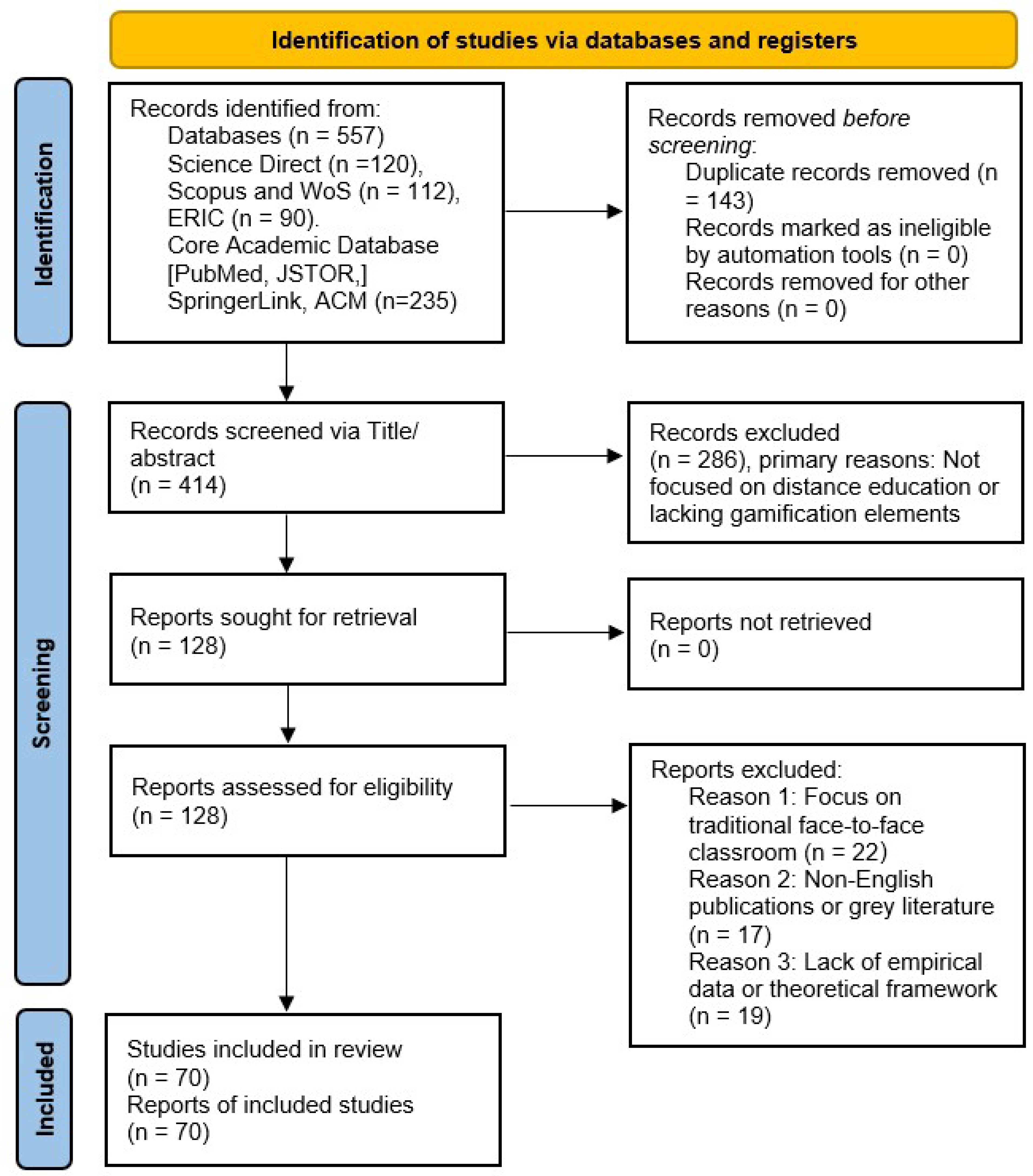
The selection process followed a rigorous four-stage workflow—Identification, Screening, Eligibility, and Inclusion—as conceptualized in the PRISMA flow diagram (
Figure 1). To minimize selection bias and ensure inter-rater reliability, two researchers independently screened all titles and abstracts against the eligibility criteria, yielding a Cohen’s kappa coefficient of κ = 0.84, which represents an ‘almost perfect’ level of inter-rater agreement according to the benchmark criteria established by
Landis and Koch (
1977). Disagreements regarding full-text inclusion were systematically resolved through consensus during scheduled reconciliation sessions or via consultation with a third independent reviewer.
As detailed in
Figure 1, the initial database search yielded 557 records. Following the removal of duplicates (
n = 143), 414 records were retained for initial title and abstract screening. Of these, 286 records were excluded due to irrelevance or mismatch with the inclusion criteria (e.g., focus on face-to-face traditional settings). Consequently, 128 full-text articles were comprehensively evaluated for eligibility. Fifty-nine articles were excluded during the full-text assessment for the following explicit reasons: focus on traditional face-to-face classroom contexts (
n = 22), non-English publications or grey literature (
n = 17), and lack of empirical data or theoretical framework (
n = 19).
Ultimately, 70 unique studies met all criteria and were included in the final qualitative synthesis. To address the heterogeneity of the included evidence (comprising qualitative, quantitative, and mixed-methods research), a systematic quality appraisal was conducted using the Mixed-Methods Appraisal Tool (MMAT), version 2018 (
Hong et al., 2018). Each eligible empirical source was evaluated on its specific methodological design, sample appropriateness, and data collection validity, yielding a standardized MMAT quality score ranging from 1/5 to 5/5. To eliminate subjectivity and minimize bias, the quality assessment process was conducted independently by two reviewers. Initial independent MMAT scoring demonstrated high reliability (κ = 0.88), (
Landis & Koch, 1977). Any initial scoring discrepancies or ambiguities regarding specific evaluation criteria were subsequently resolved through open discussion and comparative analysis until a 100% consensus was achieved. These finalized quality scores are integrated directly into the descriptive evidence tables, ensuring a balanced interpretation and calibrating the evidentiary weight of the findings throughout the synthesis.
To ensure methodological rigor, a strict differentiation was maintained during the quality assessment phase. The Mixed-Methods Appraisal Tool (MMAT, version 2018) was applied exclusively to empirical primary studies (
n = 59). To accommodate the specific methodological designs of these empirical sources, evaluation was operationalized through the tool’s dedicated sub-sections:
Section 1 was applied to qualitative designs (
n = 17);
Section 2 was utilized for mixed-methods studies (
n = 14), including one doctoral dissertation) to assess integration integrity; and
Section 3,
Section 4 and
Section 5 were dynamically deployed for the quantitative cohort (
n = 28) based on their specific research architectures (e.g., quasi-experimental or descriptive designs). Conceptual papers, theoretical discussions, and framework-oriented studies (
n = 11) were excluded from MMAT scoring, as the tool is inherently designed for empirical studies; instead, these sources underwent a rigorous qualitative relevance and structural integrity screening. Regarding the diversity of document types, all included conference proceedings and doctoral dissertations were verified for rigorous academic review processes (i.e., editorial/peer-review for proceedings and committee examination for dissertations) to ensure high-standard academic criteria. Furthermore, the inclusion of dissertations served as a methodological countermeasure against publication bias, in strict accordance with PRISMA guidelines for comprehensive literature coverage.
To provide full transparency regarding the composition of this literature matrix, a comprehensive overview of this methodological stratification, alongside the respective quality appraisal framework applied to each category, is presented in
Table 1.
Regarding the influence of quality appraisal on the synthesis, no primary study was excluded strictly on the basis of a low MMAT score, adhering to the methodological recommendations of
Hong et al. (
2018), who argue that excluding studies may omit valuable, context-rich insights. Instead, the quality appraisal scores were systematically utilized to weigh the robustness of the synthesized findings. Insights derived from high-quality empirical studies (meeting all MMAT criteria) formed the core foundation of our thematic synthesis, whereas insights from lower-scoring empirical studies or non-empirical grey literature were contextualized with appropriate caveats during the Discussion section to prevent overgeneralization.
Evidence Weighting and Synthesis Strategy
To avoid treating disparate sources as equivalent evidence, a strict methodological hierarchy was maintained during the qualitative synthesis. The included primary literature was systematically segregated into two functional evidence categories based on study design: Empirical Investigations (comprising quantitative, qualitative, and mixed-methods research providing primary dataset evaluations) and Theoretical/Conceptual Frameworks (comprising peer-reviewed articles and book chapters proposing pedagogical models, literature reviews, or gamified system architectures).
These sources were weighted and synthesized according to their distinct epistemological contributions to the review:
Empirical Investigations: This body of literature served as the foundational baseline to evaluate objective student outcomes. Statistical correlations, behavioral metrics (such as LMS logs), affective shifts, and direct impacts on academic performance were synthesized exclusively from these data-driven sources. Furthermore, the evidentiary weight and reliability of these findings were directly anchored to their respective methodological quality scores derived from the MMAT appraisal.
Theoretical and Conceptual Papers: Rather than being treated as empirical validation of gamification efficacy, these secondary sources were utilized as interpretive and structural scaffolds. They provided the necessary pedagogical grounding to synthesize complex design models, interpret underlying psychological mechanisms (e.g., mapping observed behaviors to Self-Determination Theory or Flow Theory constructs), and contextualize the instructional rationale behind distance learning architectures.
By applying this dual-track synthesis strategy, the review ensures that conceptual propositions are never conflated with empirical proof, thereby maintaining a rigorous, transparent, and balanced thematic framework that accurately reflects the varying weights of the included evidence.
3. Results
The systematic analysis of the 70 selected studies reveals a multifaceted transformation of the distance learning experience through gamification. The findings are categorized into four thematic areas: the technical implementation of mechanics, the psychological impact on motivation, the dimensions of student engagement, and the resulting learning outcomes.
3.1. Conceptual Clarification and Operationalization of Review Constructs
An inherent challenge in synthesizing gamification research in distance higher education is the conceptual heterogeneity across the literature. The included studies (
N = 70) exhibit variance in how they define and measure core educational outcomes. To ensure absolute analytical precision, this review establishes a strict distinction between gamification and adjacent digital interventions. Following established educational technology frameworks, Gamification is operationalized as the integration of game mechanics and design elements (e.g., points, badges, leaderboards, and quests) into non-game learning contexts to drive motivation and engagement (
Deterding et al., 2011;
Landers, 2014). This is explicitly distinguished from Game-Based Learning (GBL), which utilizes actual games as primary instructional vehicles (
Plass et al., 2015), and Serious Games, which refer to full-scale, autonomous software specifically developed for educational or training purposes rather than entertainment (
Zyda, 2005). Furthermore, Simulations are treated as interactive, risk-free experiential digital environments representing real-world processes that may—or may not—incorporate gamified incentive layers (
Landers, 2014). The focus of this synthesis remains rigorously centered on the structural and content gamification of distance learning architectures, mapping how these specific mechanics intersect with student workflows.
To ensure analytical rigor and a unified synthesis, this review operationalized Engagement, Motivation, and Learning Outcomes based on multi-dimensional, validated theoretical frameworks, categorizing individual study variables as follows:
3.1.1. Student Engagement
Across the primary literature, engagement is occasionally conflated with mere system usage or, conversely, with purely psychological states. To resolve this, this review operationalizes engagement as a tripartite construct comprising:
Behavioral Engagement: Measured through quantifiable metrics of system interaction, such as login frequency, time spent on the Learning Management System (LMS), assignment completion rates, and participation rates in asynchronous discussion forums (e.g.,
Bouchrika et al., 2021;
Mat et al., 2021).
Emotional/Affective Engagement: Defined as the student’s affective reactions within the gamified environment, including feelings of enjoyment, curiosity, belonging (relatedness), and the mitigation of online isolation or anxiety (e.g.,
Lelli et al., 2020).
Cognitive Engagement: Characterized by the psychological investment in deep learning, self-regulation, strategic goal-setting, and the willingness to exert the mental effort required to master complex procedural tasks (e.g.,
Elshiekh & Butgerit, 2019). To provide a transparent overview of how these three dimensions are distributed across the evaluated literature, as shown in
Table S1 (see Supplementary Materials) delivers a comprehensive data extraction and methodological synthesis of the primary sources specifically focused on student engagement (
n = 24), detailing their respective contexts, methodologies, and key findings.
3.1.2. Student Motivation
While some primary studies treat motivation and engagement interchangeably, this review maintains a strict theoretical distinction grounded in Self-Determination Theory (SDT). Motivation is operationalized not as a monolithic gauge of “effort,” but as a continuum reflecting the quality of the student’s drive:
Extrinsic Motivation: Triggered by outer game mechanics, where behavior is regulated by external rewards, points accumulation, leaderboards, and compliance-driven micro-tasks (e.g.,
Gafni et al., 2018;
Wilson et al., 2015).
Intrinsic Motivation: Characterized by autonomous engagement with the academic material for its inherent satisfaction, curiosity, and challenge, structurally scaffolded by the satisfaction of the basic psychological needs for autonomy, competence, and relatedness (e.g.,
Howard et al., 2021;
Pakinee & Puritat, 2021).
3.1.3. Learning Outcomes
Learning outcomes vary heavily across the dataset depending on the academic discipline (e.g., STEM vs. Humanities). To harmonize these findings, learning outcomes were categorized into two distinct levels of cognitive processing:
Lower-Order Learning Outcomes (Recall & Comprehension): Operationalized as factual knowledge retrieval, conceptual familiarity, and performance on standard formative quizzes or immediate memory retention tasks (e.g.,
Strmecki et al., 2015).
Higher-Order Learning Outcomes (Problem Solving & Application): Operationalized as the ability to apply theoretical knowledge to novel scenarios, execute critical thinking, succeed in complex software/clinical simulations, and develop domain-specific professional competencies through iterative, low-risk trial-and-error scaffolding (e.g.,
de la Peña et al., 2021;
Inangil et al., 2022).
By establishing these boundaries, the subsequent synthesis translates the disparate empirical indicators of the included studies into a standardized, theoretically grounded evaluation matrix. Ultimately, 70 unique primary studies met all inclusion criteria and were subjected to full data extraction. To provide a comprehensive overview of the structural and baseline characteristics of the finalized dataset,
Table 2 outlines the detailed demographic and methodological distribution of the literature based on educational level, research design, and MMAT quality scoring.
It should be noted that while the systematic literature mapping focused on
N = 70 unique primary sources, several studies addressed multiple behavioral and cognitive dimensions simultaneously. Specifically, core gamification interventions frequently intersected across categories such as motivation and complex problem-solving, or combined behavioral engagement with social interaction metrics. To ensure methodological rigor and avoid artificial inflation of the sample size,
Table 1 filters these overlapping elements, treating each study as a single, unique analytical unit based on its primary pedagogical context and baseline MMAT evaluation.
3.2. Gamification and Student Engagement in Distance Education
Engagement in distance higher education is a multidimensional construct that gamification aims to enhance by transforming passive consumption into active participation. The synthesized evidence from the analyzed studies suggests that gamification serves as a strategic bridge to overcome the “engagement gap” inherent in online learning (
Lynn, 2013;
McGrath & Bayerlein, 2013). Mechanics such as the “PBL triad” (Points, Badges, Leaderboards) are consistently correlated with higher completion rates and increased frequency of interaction with e-learning systems (
Mat et al., 2021;
Castro et al., 2018;
Bouchrika et al., 2021).
From the perspective of Self-Determination Theory (SDT), these elements primarily support the psychological need for competence. When students track their progress through dashboards or receive immediate formative feedback via gamified quizzes, they gain a tangible sense of mastery over the curriculum (
Vaibhav & Gupta, 2014;
Zainuddin et al., 2022;
Şahin et al., 2017). This immediate feedback loop is also a core construct of Flow Theory; by providing clear, real-time indicators of performance, gamified systems help distance learners maintain focus and enter a state of deep absorption (flow), mitigating the distractions typical of isolated learning environments.
The literature further emphasizes that high-level engagement is not merely a product of rewards but of meaningful challenges and narrative structures.
Elshiekh and Butgerit (
2019) demonstrate that storytelling and “treasure hunts” can simplify complex concepts, such as Java programming, thereby sustaining cognitive engagement. In terms of Cognitive Load Theory, such immersive design strategies act as instructional scaffolds that optimize germane cognitive load, allowing students to allocate their mental resources toward building complex mental schemas rather than battling text-heavy, unengaging interfaces.
This cognitive progression is closely linked to autonomy within the SDT framework; platforms that offer affordances for self-expression, such as avatars or choice-based missions, allow students to feel a sense of agency in their learning environment (
Yıldız et al., 2021;
Veryaeva & Solovyeva, 2021). According to Flow Theory, balancing these tailored challenges with the student’s evolving skill level prevents both anxiety (when a task is too difficult) and boredom (when a task is too simple), thereby sustaining long-term behavioral engagement. Strategic designs that align gamification with learner personality traits further ensure that engagement remains relevant to the individual’s intrinsic predispositions (
Pakinee & Puritat, 2021).
To systematically map how these disparate technological interventions, influence remote learners, a cross-cutting synthesis of the identified game elements was conducted.
Table 3 illustrates the interaction between core gamification mechanics, their foundational theoretical frameworks, and the synthesized educational outcomes across the behavioral, cognitive, and socio-emotional dimensions.
As synthesized in
Table 3, the operational success of gamification design within distance learning architectures is heavily contingent upon the alignment between specific game mechanics and their underlying psychological mechanisms. The structural analysis demonstrates that while reward-centric mechanics (the PBL triad) are potent catalysts for immediate behavioral compliance, cognitive and procedural scaffolding techniques (such as structured quests and real-time progress tracking) yield more sustainable educational outcomes. These findings highlight the necessity of transitioning from simplistic competitive frameworks to adaptive, theory-driven digital strategies that mitigate cognitive overload and actively foster socio-emotional connectivity among remote learners.
3.2.1. Social Interaction and Relatedness
The integration of gamification significantly addresses the inherent challenge of student isolation by restructuring social interaction patterns through game-based mechanics. Research indicates that gamified environments foster a robust sense of community, primarily by satisfying the psychological need for relatedness as defined by Self-Determination Theory (SDT). Studies such as those by
de la Peña et al. (
2021) and
Jayalath and Esichaikul (
2022) demonstrate that when students engage in social challenges and team-based scoring, they exhibit higher levels of cooperation and collective problem-solving.
This transition from solitary study to collaborative engagement is crucial in virtual settings, where the lack of physical presence often hinders spontaneous peer interaction. This structural support is further verified by
Çakiroğlu and Kiliç (
2018), who noted that collaborative gamified environments directly combat online isolation by providing structured peer-interaction spaces that lower learning anxieties. This relational architecture is further optimized by
Alabbasi (
2017), who proved that gamification serves as a robust social conduit, actively driving student participation and peer connectedness when direct physical presence is absent.
From the perspective of Flow Theory (
Csikszentmihalyi, 1990), this collaborative dynamic can catalyze “social flow” or collective absorption. When team members work interdependently toward shared, gamified goals, the shared momentum helps maintain high engagement and buffers against the isolation-induced boredom common in online environments. Furthermore, the use of immersive elements like social avatars and hologram-based gamification has been identified as a feasible strategy to bridge the gap in social presence, effectively reducing the perceived distance between learners (
Rathnayake et al., 2020).
Beyond mere socialization, gamification acts as a catalyst for improving the quality of academic discourse and feedback.
Huang et al. (
2019) highlight that rewarding peer-feedback with points or badges not only increases the frequency of interactions but also enhances the density of students’ social networks and the substantive quality of their critiques. This aligns with findings from
Abu-Hammad and Hamtini (
2023), who demonstrated that embedding social rewards into virtual learning platforms actively drives peer-to-peer communication and reduces the perceived psychological distance in digital classrooms.
This dynamic satisfies the SDT need for competence, as students feel more capable and empowered when their contributions to the learning community are recognized through social rewards. In terms of Cognitive Load Theory (
Sweller, 1988), high-quality peer feedback loop structures act as distributed cognitive scaffolds; by clarifying misconceptions and sharing alternative problem-solving strategies, students collectively reduce each other’s extraneous cognitive load, making complex topics easier to process. Additionally, adaptive gamification models that align with individual learning styles further support autonomy by providing personalized pathways for interaction, ensuring that social engagement feels volitional rather than forced (
Hassan et al., 2021). The structural characteristics, empirical methodologies, and MMAT quality appraisals of the primary literature exploring these collaborative dynamics are systematically synthesized in
Table S5 (see Supplementary Materials), which catalogs the subset of sources dedicated to social interaction and relatedness (
n = 12).
While competitive elements like rankings and leaderboards can stimulate peer-to-peer discussion in specific fields like accounting (
Gómez & Monroy, 2018), the literature suggests that the most substantial impact on long-term engagement occurs when these mechanics facilitate meaningful feedback loops and system-wide involvement (
Bouchrika et al., 2021). Consequently, the gamification of learning materials transforms passive discussion boards into active social hubs, ensuring that interaction remains a central pillar of the online educational experience (
McGrath & Bayerlein, 2013).
3.2.2. Critical Caveats and Limitations of Gamified Engagement
However, the synthesis also reveals critical caveats regarding the sustainability of gamified engagement. A significant concern is the lack of long-term empirical evidence, with many gains potentially attributed to the “novelty effect” (
Yıldız et al., 2021;
Huang et al., 2019;
Bouchrika et al., 2021).
Muntean (
2011) warns that gamification must complement intrinsic motivation rather than replace it, as an over-reliance on external rewards can lead to a “crowding out” effect where interest wanes once the rewards are removed—a shift that disrupts the psychological autonomy necessary for self-sustained flow. This structural vulnerability is heavily emphasized by
Hudiburg (
2016), who argued that poorly integrated extrinsic incentives fail to build authentic student attachment, resulting in a rapid drop in platform engagement once the novelty of the reward system wears off.
There is also evidence of skepticism among certain cohorts; for instance,
Gunnars et al. (
2021) found that while gamification might reduce perceived workload (extraneous cognitive load), some adult learners remain skeptical of its behavioral intent. This adult learner friction is further detailed by
Oropeza et al. (
2021), who found that mature or non-traditional students often perceive simple badge or point mechanics as superficial distractions, which can induce frustration rather than meaningful engagement if the tasks lack clear professional utility.
Additionally, intense competition through public leaderboards can be counterproductive. According to Cognitive Load Theory (
Sweller, 1988), public rankings can generate high extraneous cognitive load by forcing students to process social anxiety and peer comparison alongside their academic tasks, leading to cognitive clutter, decreased satisfaction, and a total withdrawal from the social space (
Urh et al., 2015;
Gómez & Monroy, 2018). There is also the risk of “gaming the system,” where students engage in superficial interactions merely to accumulate points or badges, rather than pursuing meaningful academic discourse—a behavioral shift that breaks the organic state of flow and replaces deep focus with fragmented, reward-driven tasks (
Csikszentmihalyi, 1990).
To prevent superficial “pointsification” and ensure deep, dual-track (psychological and cognitive) engagement, the literature suggests that gamification must be grounded in behavioral models (e.g., the Fogg Behavior Model) that prioritize pedagogical value over mere entertainment (
Butgereit, 2015;
Almaguer et al., 2021).
3.3. The Impact of Gamification on Student Motivation via SDT
The primary objective of integrating gamification in distance higher education is to catalyze student motivation and sustain cognitive drive in environments often characterized by isolation and passivity. The synthesized literature indicates that gamified elements serve as powerful external triggers that, when properly designed, can transition into internal drivers of learning. According to studies such as
Bouchrika et al. (
2021) and
Rincon-Flores and Santos-Guevara (
2021), the use of challenge-based mechanics and immediate feedback loops notably enhances student psychological involvement with e-learning systems.
This process is best explained through the lens of Self-Determination Theory (SDT), where gamification acts as a scaffold for the three basic psychological needs. Specifically, the sense of competence is bolstered when students receive instant recognition of their progress through badges or points, providing a clear map of their academic growth (
Gafni et al., 2018). A comprehensive extraction of the empirical data, motivational directions, and MMAT quality assessments for these specific interventions is systematically mapped in
Table S2 (see Supplementary Materials), which synthesizes the subset of primary sources focused on student motivation (
n = 20). In alignment with Flow Theory (
Csikszentmihalyi, 1990), this clear map and immediate feedback serve as vital prerequisites for optimal cognitive experiences. By knowing exactly where they stand, distance learners can better navigate educational tasks without experiencing the cognitive disorientation that breaks the state of deep absorption or flow.
Furthermore, the need for autonomy is addressed when gamified platforms allow for personalized learning paths and volitional participation in “missions,” giving students a sense of agency over their educational journey (
Pakinee & Puritat, 2021). Targeted validation shows that tailoring game strategies to specific user classifications—such as Achievers, Philanthropists, or Free Spirits—dramatically maximizes motivational yields (
Bovermann & Bastiaens, 2020). From a cognitive perspective, providing these adaptive, self-selected pathways directly supports the principles of Cognitive Load Theory (
Sweller, 1988). It allows learners to self-pace their progression, thereby optimizing their available working memory and ensuring that intrinsic cognitive load (the inherent difficulty of the learning material) does not turn into overwhelming frustration.
This motivational architecture is further corroborated in professional development contexts;
Betts et al. (
2013) indicated that integrating interactive game-like loops into complex tracks appears to enhance learning performance, further reinforcing student problem-solving capacities through structured, low-risk engagement. This aligns with the empirical observations of
Mårell-Olsson (
2021), who confirms that implementing deliberate gamified strategies within remote higher education environments operates as an explicit catalyst for expanding 21st-century skills, steering students away from shallow compliance toward highly structured, collaborative problem-solving competencies.
Similarly,
Kleiber (
2020) establishes that when complex informational tasks are structurally reframed as active, game-based learning tracks, distance learners demonstrate superior analytical application and a more refined navigation of procedural knowledge, transforming asynchronous architectures into highly volitional spaces. Even in highly technical subjects like chemistry or programming, competitive tournaments and progress-tracking mechanics have been shown to maintain high levels of student wellness and active participation during periods of remote instruction by structurally guiding the formation of complex mental schemas (
Fontana, 2020;
Piteira et al., 2017).
The “Pointsification” Trap and Hyper-Competition Risks
However, a critical evaluation of the motivation nexus reveals significant limitations. A recurring theme in the research is the risk of the “novelty effect,” where the initial heightening of motivation tends to decline as the game-like features become familiar and lose their hedonic appeal (
Huang et al., 2019). Moreover, critics argue that an over-reliance on extrinsic rewards—often termed “pointsification”—can inadvertently undermine intrinsic motivation. If students begin to perceive gamification as a controlling mechanism rather than a supportive one, their psychological autonomy is disrupted, preventing them from entering an authentic state of flow. Consequently, their engagement may become superficial, focused solely on “gaming the system” for rewards rather than deep conceptual mastery (
Wilson et al., 2015;
Butgereit, 2015). This threat varies heavily by player persona;
Şenocak et al. (
2019) note that specific user personas like Disruptors exhibit a strict negative correlation with internal drive, proving that uncalibrated systems can accidentally damage motivation.
Additionally, intense competition through public leaderboards can be counterproductive for some learners. According to Cognitive Load Theory (
Sweller, 1988), public rankings can generate high extraneous cognitive load by forcing students to process social anxiety and peer comparison alongside their academic tasks. This cognitive overload directly damages their sense of competence, leading to increased anxiety and a diminished capacity for problem-solving, particularly for those at the bottom of the rankings (
Gómez & Monroy, 2018). Therefore, the literature emphasizes that for gamification to be a sustainable motivational tool, its structural design must be carefully balanced with pedagogical goals to ensure it supports, rather than replaces, the student’s intrinsic interest in the subject matter.
3.4. Gamification, Cognitive Processes, and Learning Outcomes
Beyond mere engagement, gamification serves as a fundamental facilitator of the instructional process in distance higher education by restructuring how knowledge is acquired, internalized, and retained. The synthesized research indicates that gamified systems empower Open and Distance Learning (ODL) through structured mechanics that sustain student interest over long durations (
Abdul Rahman et al., 2021). A core mechanism in this facilitation is the support of self-directed learning (SDL); by integrating mechanics that allow for goal-setting and choice, gamification enhances the learner’s ability to navigate complex digital environments independently (
Palaniappan & Noor, 2022).
From the perspective of Self-Determination Theory (SDT), this alignment effectively nurtures autonomy, as students transition from passive recipients of information to active managers of their own learning trajectories. According to Cognitive Load Theory (
Sweller, 1988), this self-directed structuring is highly beneficial; by allowing students to control their navigation paths, gamified frameworks function as external cognitive scaffolds that reduce extraneous cognitive load, freeing up vital working memory resources for actual schema construction. This foundational positioning is heavily validated by
Nahl and James (
2013), who demonstrated that game-like elements systematically foster critical thinking and empower remote students to organize complex knowledge assets more effectively. To further trace how these digital interventions structurally facilitate the overarching online instructional architecture,
Table S3 (see Supplementary Materials) provides a targeted methodological synthesis of primary sources dedicated specifically to facilitating learning (
n = 6).
3.4.1. Application in Clinical Contexts and Problem-Solving Scaffolds
The facilitation of learning is particularly evident in specialized clinical and competency-based contexts. For instance,
Inangil et al. (
2022) demonstrate that the integration of animation and gamification facilitates clinical learning progress more effectively than traditional online methods, leading to significant improvements in objective knowledge levels. This process directly addresses the SDT need for competence, as the gamified scaffold provides immediate feedback and a clear sense of progression through difficult curriculum stages. Simultaneously, this scaffolding triggers a state of optimal experience outlined by Flow Theory (
Csikszentmihalyi, 1990). By dividing complex clinical scenarios into incremental, animated milestones, the design ensures a precise balance between the challenge of the task and the evolving skill of the medical student, preventing anxiety and maintaining deep cognitive absorption.
Furthermore, during disruptive periods such as remote emergency teaching, challenge-based gamification maintains active learning progress and superior academic performance by focusing on specific competencies (
Rincon-Flores & Santos-Guevara, 2021). This deployment functions as a sophisticated cognitive scaffold that fundamentally enhances students’ higher-order problem-solving capabilities. According to the analyzed literature, gamified environments provide a structured “sandbox” where learners can engage in iterative trial-and-error processes, which is essential for developing complex analytical skills (
de la Peña et al., 2021;
Hung, 2018). By framing academic challenges as “missions” or “quests,” design models allow students to navigate high-stakes scenarios—such as industrial engineering simulations or complex programming tasks—in a low-risk environment (
Kladchuen & Srisomphan, 2021;
Almaguer et al., 2021).
3.4.2. Memory Processes and Information Retention
Regarding memory processes, the research emphasizes that gamification facilitates the encoding and retrieval of information by transforming passive content into active, participatory experiences.
Bouchrika et al. (
2021) and
Strmecki et al. (
2015) argue that gamified elements, such as interactive quizzes and progress bars, act as “cognitive anchors” that improve information retention by “chunking” complex data into digestible segments.
In terms of Cognitive Load Theory (
Sweller, 1988), this chunking mechanism is a powerful way to manage intrinsic cognitive load, ensuring that the limited capacity of the human working memory is not exceeded during the processing of dense information. This spatial interaction pattern directly dictates recall strength;
Novak et al. (
2018) indicates that higher conceptual immersion and structural user satisfaction significantly advance direct retention metrics, turning complex educational milestones into enjoyable experiences. Similarly, memory recall benefits enormously from interactive visual elements, avatars, and chunked challenges, with
Heliawati et al. (
2022) verifying that the integration of persistent gamified layers and adaptive hypermedia architectures systematically elevates independent regulation, functioning as stable cognitive anchors that facilitate deep information encoding and long-term recall. This reduction in extraneous cognitive load is particularly effective in technical fields, where procedural memory is reinforced through immediate rewards and feedback, allowing students to efficiently transfer new knowledge into their long-term memory and construct well-structured mental schemas (
Jayalath & Esichaikul, 2022).
The long-term retention of these schemas is heavily accelerated when information architecture is supported by automated pedagogical tools. Integrating specialized gamified testing platforms such as Quizizz or Socrative has been shown to induce high levels of academic alertness, reinforcing long-term data consolidation by forcing active, real-time memory retrieval during formative checkpoints (
Abdul Rahman et al., 2021).
Moreover, the use of narrative-driven gamification allows students to contextualize abstract concepts, thereby deepening their understanding and aiding long-term recall (
Şahin et al., 2017). This structural stabilizing effect remains highly resilient across divergent delivery modes; as
Lelli et al. (
2020) confirmed, the integration of persistent gamified layers effectively maintains student retention performance even within completely asynchronous setups, ensuring that cognitive schema consolidation does not decay in the absence of real-time instructor presence. The extensive empirical evidence detailing the cross-variable impacts of these instructional scaffolds on cognitive development, data consolidation, and executive functioning is fully cataloged in
Table S4 (see Supplementary Materials), which provides a comprehensive data extraction of primary sources focused on problem solving and memory (
n = 33).
3.4.3. Cognitive Overload and Superficial Learning Risks
However, a critical analysis suggests that facilitating the learning process through gamification is not without severe cognitive drawbacks. A primary concern is that a poorly designed, reward-heavy system may lead students to prioritize point accumulation over deep conceptual understanding, potentially leading to superficial learning outcomes (
Abdul Rahman et al., 2021;
Robinson, 2020). In terms of Cognitive Load Theory, such “pointsification” can lead to split-attention effects, where the learner’s cognitive processing is divided between tracking the mechanics of the game and absorbing the actual instructional content, ultimately hindering the development of germane cognitive load.
Furthermore,
Gafni et al. (
2018) caution that poorly designed gamified interfaces can actually increase extraneous cognitive load through “visual clutter,” thereby introducing unnecessary mental distractions that shatter working memory and long-term retention. This architectural failure highlights the explicit warning articulated by
Urh et al. (
2015), who stated that a failure to distinguish between superficial gaming layers and actual instructional requirements during platform development severely impedes learning quality, noting that true satisfaction and performance only emerge when the game mechanics are natively synchronized with learner workflows.
On the other hand, the risk of cognitive overload represents a major systemic constraint. As cautioned by
Darejeh (
2021), over-engineered gamified platforms, excessive micro-tasks, and visual clutter inject substantial extraneous cognitive load; this overstimulation clutters the working memory, disrupting the germane cognitive load required for actual learning and severely limiting backend system application.
Additionally, if the competitive elements are too intense or poorly calibrated, they can break the state of flow by creating a mismatch between the challenge and the student’s perceived capability (
Csikszentmihalyi et al., 2014). This imbalance discourages lower-performing students, thwarting their sense of competence, causing cognitive disengagement, and over-simplifying complex professional competencies that cannot entirely replace the nuance of hands-on experience (
Inangil et al., 2022).
This micro-level risk of cognitive overload is directly tied to macro-level architectural choices; as
Ozcinar et al. (
2021) stress, there is an absolute need for rigorous design and continuous evaluation of gamification strategies to prevent structural failures, while
Hudiburg (
2016) outlines the extensive operational limitations and challenges faced during backend system application. Navigating these environmental obstacles requires active structural modulation;
Cheng et al. (
2025) discuss how managing these structural challenges can mitigate the negative side-effects of gamification, transforming its broader impacts on education.
Without this structural balance, unique systemic vulnerabilities emerge; as
Brady et al. (
2019) argues, poorly calibrated digital environments can trigger unintended consequences within institutional systems, where highly competitive or mismatched mechanics shift the learners’ focus toward strategic task completion and ultimately disrupt overall curriculum delivery through superficial learning.
Therefore, the literature concludes that for gamification to truly facilitate cognitive development, it must be strategically integrated as a supportive scaffold that balances extrinsic incentives with the intrinsic pedagogical goals of the course.
3.5. Design Strategies and Techniques in Gamified Distance Education
The effectiveness of gamification in distance higher education is fundamentally predicated on deliberate design strategies that move beyond superficial mechanics toward pedagogically aligned frameworks. The analyzed literature suggests that successful implementation is not a “one-size-fits-all” approach, but a multi-dimensional framework requiring strategic scaffolding, personalization, and social coordination.
3.5.1. Scaffolding, Personalization, and Collaborative Mechanics
Strategic Scaffolding and Mind Tools: Strategic scaffolding, as evidenced by
Chen et al. (
2023) and
Palaniappan and Noor (
2022), integrates “mind tools” and self-directed learning (SDL) architectures. These techniques serve as critical instructional supports that manage intrinsic cognitive load by breaking down complex, dense curricular tasks into bite-sized, structured achievements. This sequential delivery prevents the student’s working memory from becoming overloaded, guiding distance learners through operational complexity and facilitating the smooth construction of mental schemas.
Personalization and Adaptive Alignment: The shift toward personalization—exemplified by
Pakinee and Puritat (
2021) through the integration of personality traits into system design—highlights a growing requirement to tailor gamified environments to individual learner profiles. This personalized calibration ensures that the challenges presented are dynamically matched to the user’s evolving skill level and intrinsic predispositions, maximizing focus and preventing online disengagement. Within this integrated matrix, baseline system traits cannot be overlooked;
Veryaeva and Solovyeva (
2021) established that platform usability and technical stability are the primary structural determinants that dictate whether a user will volitionally accept and engage with an adaptive gamified framework.
Collaborative and Competency-Based Coordination: Rather than relying solely on individual competition, designs that emphasize relational coordination and team-based missions (
Estriegana et al., 2021;
Reyes-Cabrera, 2022) embed social interdependence into the remote curriculum. This structural integration is especially effective for bridging transactional distances over long durations; as
Lynn (
2013) argued, programmatic gamified design operates as an enduring framework that secures longitudinal behavioral compliance across extended academic tracks. This is further reinforced by the implementation of gamified peer-assessment models (
Tenorio et al., 2016), which transform evaluation into a constructive social dialogue, while the targeted deployment of gamified platforms (such as Quizizz) actively transforms assessment checkpoints from competitive metrics into accountable, peer-supported learning experiences (
Hajar et al., 2025). This operational fluidity is heavily optimized when self-monitoring tracking is offered natively;
Piteira et al. (
2017) emphasize that clear self-monitoring gauges within the LMS allow distance learners to exercise complete ownership over their learning timeline.
Synchronous Scenario Modulation: When implementing gamification within synchronous online environments, specific design strategy models are required to sustain active participation;
Çakiroğlu and Kiliç (
2018) provide explicit structural evidence on how utilizing targeted example scenarios successfully guides student interaction, ensuring that gamified live sessions remain pedagogically grounded without inducing cognitive fatigue. In specialized fields such as Organic Chemistry or Microbiology, the design of serious games and virtual tournaments (
Fontana, 2020;
Dustman et al., 2021,
Strmecki et al., 2015) demonstrates that gamification can sustain higher-order thinking and mental well-being even under isolation constraints. As
Fontana (
2020) noted, embedding these gamified architectures within difficult scientific tracks serves the critical dual purpose of anchoring student academic confidence and driving collective peer community formation. When gamification is treated as a core educational model rather than an elective add-on (
Reyes Cabrera & Quiñonez Pech, 2020), it ensures a deeper teaching presence (
Mahmud et al., 2020;
Piteira et al., 2017). Ultimately, a holistic overview of the specific game elements, instructional configurations, and personalization strategies utilized across the entire dataset is systematically cross-referenced in
Table S6 (see Supplementary Materials), which synthesizes the final group of primary sources focused on design strategies and techniques (
n = 24).
3.5.2. Design Challenges: The Fatigue and Clutter Constraints
However, a critical synthesis of these strategies also reveals significant design challenges. A recurring concern is the “pointsification” trap, where an over-reliance on points, badges, and leaderboards (PBL) without a strong narrative or meaningful challenge leads to rapid diminishing returns (
Wilson et al., 2015).
Gafni et al. (
2018) caution that poorly designed, over-gamified interfaces induce severe “cognitive clutter,” which introduces extraneous cognitive load that disrupts information processing. This structural vulnerability highlights the critical caveat raised by
Urh et al. (
2015), who isolated a direct link between uncalibrated gaming structures, high extraneous load, and a collapse in longitudinal user satisfaction.
Additionally, while daily challenges can mitigate procrastination (
Butgereit, 2015), constant micro-tasks frequently induce cognitive fatigue and shift the student’s focus toward mere compliance rather than deep conceptual understanding. To alleviate this fatigue, the social architecture of the system must be protective;
Lin (
2025) explore how gamification design explicitly influences emotional well-being and social interaction, noting that positive affective design can act as a psychological buffer against learning fatigue. This is further expanded by
Wang et al. (
2024), who analyze how gamified environments can strengthen social relationships and collaboration, transforming isolated peer groups into supportive learning communities.
On a macroscopic scale, understanding these dynamics is essential; as
Bai et al. (
2020) examine, the overarching pedagogical deployment of these systems dictates whether game mechanics foster a deeply engaging digital environment or merely reduce learning to rigid behavioral feedback loops driven by superficial compliance.
Therefore, the literature underscores that the most robust design techniques are those that structurally balance competitive mechanics with collaborative support, ensuring that the gamified system acts as a supportive scaffold for both professional skill acquisition and student well-being (
Kalashnikova et al., 2022;
Rincon-Flores & Santos-Guevara, 2021).
3.6. Cross-Variable Synthesis and Methodological Nuances
To transition from a descriptive aggregation to a systematic, multi-dimensional synthesis, this section cross-evaluates the efficacy of gamification across key contextual variables: educational levels, academic disciplines, intervention durations, and delivery modalities, while explicitly balancing positive, null, and negative findings.
3.6.1. Influence of Educational Level and Academic Discipline
Educational Level: In undergraduate cohorts, gamified elements linked to immediate feedback (e.g., badges, progress bars, and automated quizzes) consistently reduces online anxiety and scaffold baseline behavioral engagement (
Bouchrika et al., 2021;
Mat et al., 2021). However, in postgraduate or adult distance education settings, these explicit, surface-level reward structures frequently generate a “pointsification” trap, yielding null or even negative impacts on intrinsic motivation (
Schöbel et al., 2023;
Wilson et al., 2015). Advanced or non-traditional learners exhibit a strong preference for autonomous, non-linear learning pathways and narrative-driven gamification that supports deep conceptual mastery over rigid, compliance-driven mechanics, often displaying severe skepticism toward overly explicit gamified behavioral intent (
Gunnars et al., 2021).
Academic Discipline: A clear divergence emerges between technical fields (STEM) and the humanities. In highly procedural disciplines like engineering, computer science, and microbiology (e.g.,
Dustman et al., 2021;
Piteira et al., 2017), simulation-based gamification and low-risk “sandbox” environments show consistently positive effects on higher-order problem-solving skills. This discipline-specific acceleration is highly pronounced when complex concepts are gamified from the ground up;
Hew et al. (
2020) showed that using gamification in challenging learning tasks reduces student anxiety, which helps students engage more actively with the subject matter and increases their interest. Conversely, in softer sciences or humanities, intense competitive elements (such as public leaderboards) often introduce high extraneous cognitive load and social anxiety, resulting in mixed or negative engagement outcomes for lower-performing students (
Gómez & Monroy, 2018).
3.6.2. Influence of Intervention Duration and Delivery Modality
Intervention Duration: The dataset reveals a distinct chronological threshold regarding gamification efficacy. Short-term interventions (ranging from a single lecture to 4 weeks) regularly report inflated positive outcomes in student engagement and short-term memory retention. Methodologically, this elevated motivation is heavily driven by the “novelty effect” (
Huang et al., 2019;
Schöbel et al., 2023). Long-term longitudinal studies (spanning full semesters or academic years), however, present much more mixed results. As the novelty of game mechanics declines, baseline engagement often returns to pre-intervention levels, unless the gamification is deeply integrated with adaptive personalization or collaborative peer-feedback loops.
Synchronous vs. Asynchronous Modality: In asynchronous distance learning contexts, gamification serves as a vital self-regulatory tool. Progress trackers, micro-milestones, and interactive elements manage intrinsic cognitive load and combat isolation;
Lelli et al. (
2020) empirically verified that the inclusion of gamified feedback mechanics provides an effective behavioral anchor that sustains user interaction patterns across asynchronous delivery tracks. In synchronous virtual settings, however, the real-time introduction of competitive gamification (e.g., live timers or dynamic rankings) yields highly polarized outcomes. While it notably increases behavioral engagement for highly competitive individuals, it simultaneously thwarts the sense of competence and breaks the psychological state of “flow” for students requiring reflective processing time. This disruption is heavily amplified during wider environmental crises;
Zainuddin et al. (
2022) highlighted that while gamified formative tools provided vital stabilization during the remote emergency shifts of the COVID-19 pandemic, their real-time application required precise pedagogical tracking to prevent student exhaustion.
3.6.3. Methodological Quality and Evidentiary Weight
Finally, the strength of the synthesized claims is directly tied to the methodological rigor of the primary literature. A critical meta-evaluation of the included evidence shows that studies utilizing weak, single-group pre-post designs or purely self-reported qualitative surveys tend to over-report universally positive gamification outcomes.
In contrast, high-quality empirical studies—characterized by rigorous quasi-experimental designs with distinct control groups and evaluated via objective LMS log data (e.g.,
Bouchrika et al., 2021)—paint a more cautious, nuanced picture. These high-bias-controlled studies confirm that while gamification is a powerful cognitive scaffold for specific structural tasks, its success is fundamentally conditional upon pedagogical alignment rather than the mere overlay of point-based rewards.
4. Discussion
The synthesized literature provides a comprehensive, albeit highly nuanced, understanding of the impact of gamification on learner engagement, motivation, and cognitive processes within distance higher education. While gamification strategies—such as points, badges, leaderboards, and progress tracking—demonstrate significant potential in mitigating the isolation inherent in Open and Distance Learning (ODL), their efficacy is fundamentally conditional. The evidence suggests that the success of gamification depends not on the mere presence of game mechanics, but on their structural alignment with cognitive load thresholds, learner personality profiles, and specific pedagogical objectives.
4.1. The Motivation-Engagement Nexus and the “Pointsification” Boundary
Psychological engagement and motivation emerged as the primary domains where gamification exerts a substantial, immediate impact. The findings of
Lynn (
2013),
Mat et al. (
2021), and
Abdul Rahman et al. (
2021) highlight how interactive gamification tools (e.g., Quizizz, Socrative) foster behavioral engagement by promoting active participation and structural accountability. These mechanics increase immediate system interactivity and encourage distance learners to exercise self-regulation.
Furthermore,
Fontana (
2020) and
Castro et al. (
2018) demonstrate that when gamification is strategically embedded into challenging disciplines like chemistry, it serves as an affective buffer, reducing dropout rates and maintaining student confidence against isolation-induced anxiety. This is further supported by
Bouchrika et al. (
2021) in technical subjects like programming, where immediate feedback loops and custom-designed gamified programming tools consistently enhance learner interest, eliminate initial academic hesitation, and render abstract procedural tasks more accessible.
However, the compiled evidence strongly cautions that heightened behavioral engagement or short-term excitement does not automatically translate into superior academic performance. A critical cross-variable tension is exemplified by
Gafni et al. (
2018), who observed that while gamified environments for complex technical commands significantly enhanced student motivation, they yielded null effects regarding objective exam scores. This dichotomy underscores the “pointsification” boundary: external rewards can easily catalyze surface-level compliance or reward-driven tasks while failing to trigger the deep conceptual processing required for long-term schema construction (
Wilson et al., 2015;
Butgereit, 2015).
As
Hudiburg (
2016) heavily emphasizes, poorly integrated extrinsic incentives fail to build authentic student attachment, resulting in a rapid drop in platform engagement once the novelty of the reward system wears off. This risk is particularly pronounced among adult or non-traditional learners, as detailed by
Oropeza et al. (
2021), who found that mature cohorts often perceive simple badge or point mechanics as superficial, compliance-driven distractions that induce frustration rather than meaningful engagement if the tasks lack clear professional utility.
Consequently, as suggested by
Bovermann and Bastiaens (
2020) and
Şenocak et al. (
2019), motivation quality is heavily dictated by personalization. Aligning gamified mechanics with specific learner player types (e.g., Achievers, Philanthropists, and Free Spirits) optimizes intrinsic motivation by satisfying the baseline psychological needs of Self-Determination Theory (SDT). Conversely, uncalibrated or rigid layouts may alienate cohorts like “Disruptors” or adult learners who remain deeply skeptical of gamification’s behavioral intent (
Gunnars et al., 2021).
4.2. Cognitive Processing, Scaffolding, and Social Flow
Regarding cognitive outcomes, the literature presents a bifurcated landscape. On one hand, gamification can function as an effective cognitive scaffold for higher-order problem-solving and information retrieval when tasks are framed as collaborative missions or nested quests (
Kladchuen & Srisomphan, 2021;
Schöbel et al., 2023). Under the principles of Flow Theory, these immersive environments promote a state of deep absorption by maintaining an equilibrium between task difficulty and the student’s evolving skill level, transforming solitary, high-stakes distance learning into a low-risk, iterative sandbox (
Rincon-Flores & Santos-Guevara, 2021).
This discipline-specific acceleration is highly pronounced when complex concepts are gamified from the ground up; Similarly, memory recall benefits from interactive visual elements, avatars, and chunked challenges (
Alabbasi, 2017;
Heliawati et al., 2022), with
Nahl and James (
2013) further validating that game-like elements systematically foster critical thinking and empower remote students to organize complex knowledge assets more effectively by functioning as cognitive anchors that facilitate information encoding.
On the other hand, the risk of cognitive overload represents a major systemic constraint. As cautioned by
Darejeh (
2021), over-engineered gamified platforms, excessive micro-tasks, and visual clutter inject substantial extraneous cognitive load. According to Cognitive Load Theory (CLT), this overstimulation clutters the working memory, disrupting the germane cognitive load required for actual learning and schema construction.
This micro-level risk of cognitive overload is directly tied to macro-level architectural choices; as
Ozcinar et al. (
2021) stress, there is an absolute need for rigorous design and continuous evaluation of gamification strategies to prevent structural failures. Navigating these environmental obstacles requires active structural modulation;
Cheng et al. (
2025) discuss how managing these structural challenges can mitigate the negative side-effects of gamification, transforming its broader impacts on education. Without this structural balance, unique systemic vulnerabilities emerge; as
Brady et al. (
2019) argues, poorly calibrated digital environments can trigger unintended consequences within institutional systems, where highly competitive or mismatched mechanics shift the learners’ focus toward strategic task completion, thereby replacing deep conceptual mastery with superficial learning.
To counteract these constraints, the synthesis underscores the necessity of deliberate instructional scaffolding, platform usability (
Veryaeva & Solovyeva, 2021), and real-time feedback loop structures. Systems utilizing explicit progress bars, self-directed visual tracking, and immediate formative guidance (
Chen et al., 2023;
Mahmud et al., 2020;
Piteira et al., 2017) effectively reduce extraneous mental processing, allowing students to exercise complete ownership over their learning timeline and successfully navigate complex digital curricula independently. In professional development contexts,
Betts et al. (
2013) demonstrated that integrating interactive game-like loops into complex tracks appears to enhance learning performance, significantly reinforcing student problem-solving capacities through structured, low-risk engagement. This aligns with the empirical observations of
Mårell-Olsson (
2021) and
Kleiber (
2020), who confirm that implementing deliberate gamified strategies within remote higher education environments operates as an explicit catalyst for expanding 21st-century skills and procedural knowledge application.
Furthermore, this review highlights that the social integration of gamification transforms the traditionally isolated distance learning experience into a collective effort. Gamified group activities and collaborative missions (
Reyes-Cabrera, 2022;
Estriegana et al., 2021) foster peer interaction, cultivating a sense of relatedness and facilitating “social flow” or collective absorption. This relational architecture is further optimized by
Abu-Hammad and Hamtini (
2023) and
Çakiroğlu and Kiliç (
2018), who proved that embedding social rewards and collaborative spaces into virtual learning platforms actively drives peer-to-peer communication, lowers learning anxieties, and reduces the perceived psychological distance in digital classrooms. When implementing gamification within synchronous online environments,
Çakiroğlu and Kiliç (
2018) provide explicit evidence on how utilizing targeted example scenarios successfully guides student interaction, ensuring that gamified live sessions remain pedagogically grounded without inducing cognitive fatigue.
However, a critical design challenge lies in managing competitive mechanics. While public rankings and leaderboards can drive specific cohorts to surpass their peers (
Palaniappan & Noor, 2022;
Tenorio et al., 2016), they can be highly counterproductive. As demonstrated by
Urh et al. (
2015), a failure to distinguish between superficial gaming layers and actual instructional requirements severely impedes learning quality, noting that true satisfaction only emerges when the game mechanics are natively synchronized with learner workflows.
If uncalibrated, public rankings generate severe social anxiety and peer comparison metrics for lower-performing students (
Gómez & Monroy, 2018). This hyper-competitive overstimulation thwarts the learner’s sense of competence and increases extraneous cognitive load, causing anxious cohorts to completely withdraw from the social and academic space.
Ultimately, as
Lin (
2025) and
Wang et al. (
2024) explore, positive affective and social gamification design can act as a psychological buffer against learning fatigue and strengthen social relationships. On a macroscopic scale, understanding these dynamics is essential; as
Bai et al. (
2020) examine, the overarching pedagogical deployment of these systems dictates whether game mechanics foster a deeply engaging digital environment or merely reduce learning to rigid behavioral feedback loops driven by superficial compliance.
Synthesizing these pedagogical dimensions underscores the need for methodological caution when evaluating the broader impact of gamified architectures. While the reviewed literature consistently highlights immediate positive shifts in student problem-solving capacities and behavioral alignment, the long-term durability of these outcomes remains an open question. The underlying evidence base is characterized by significant temporal and methodological heterogeneity, consisting predominantly of short-term interventions that rarely extend beyond a single academic term. Consequently, claims regarding long-term knowledge retention, permanent attrition reduction, and durable learning gains must be interpreted with caution, as they are frequently susceptible to the short-term ‘novelty effect’. Until standardized, longitudinal research frameworks are widely deployed to track these metrics over extended periods, these promising trends should be viewed as contextual and evolutionary rather than definitive.
5. Limitations of the Synthesis
While this systematic review provides valuable insights into the deployment of game elements in Open and Distance Learning, several critical limitations inherent in the primary evidence base must be explicitly acknowledged:
Methodological and Contextual Heterogeneity: The included studies exhibit substantial variance in terms of sample sizes, intervention durations, and academic disciplines. The literature is heavily skewed toward higher education and highly technical or procedural subjects (e.g., STEM, computer programming, and business management). Consequently, the generalizability of these findings to lower educational levels (K-12), vocational training, or purely qualitative humanities curricula remains constrained.
Over-Reliance on Subjective Metrics: A notable limitation across the synthesized dataset is the disproportionate reliance on subjective, self-reported measures of engagement and perceived learning (e.g., cross-sectional surveys and post-intervention questionnaires). High-rigor experimental designs utilizing objective, independent academic performance metrics or longitudinal tracking are heavily underrepresented. This over-reliance increases the risk of social desirability bias and limits our capacity to verify whether gamification causes durable learning gains or superficial system usage.
The “Novelty Effect” Confound: The vast majority of the analyzed interventions were short-term or cross-sectional in nature. This structural limitation makes it exceptionally difficult to decouple authentic pedagogical efficacy from the “novelty effect” (
Huang et al., 2019;
Yıldız et al., 2021). The observed increases student motivation and system interaction frequently reflect the temporary hedonic appeal of a novel interface, with evidence indicating a steep decline in engagement once the game mechanics become familiar.
6. Future Research Directions
To address the empirical and methodological gaps identified across the 70 synthesized studies, the following avenues for future research are proposed:
Longitudinal Tracking and Objective Data Integration: Future studies must shift away from short-term interventions and cross-sectional surveys. There is an urgent need for longitudinal research designs spanning entire academic years to accurately evaluate the sustainability of gamification beyond the novelty effect. Furthermore, researchers should prioritize the triangulation of subjective data with objective, real-time analytics, such as Learning Management System (LMS) log data, clickstream frequencies, time-on-task metrics, and formalized exam performance.
Granular Isolation of Independent Game Mechanics: The current literature frequently evaluates gamification as a monolithic, multi-element package (e.g., implementing the entire PBL triad simultaneously). Future empirical work should utilize multi-arm experimental designs to systematically isolate and compare the independent effects of specific mechanics (e.g., collaborative quests vs. competitive leaderboards) on distinct cognitive and affective outcomes.
Socio-Economic Equity and Technological Access: Future research must explicitly investigate the intersections of gamification, equity, and the digital divide. Empirical focus should be directed toward optimizing low-tech, low-bandwidth, and mobile-friendly gamified systems tailored for distance learners in rural, underrepresented, or low-income regions, ensuring that gamification does not inadvertently exacerbate educational disparities due to hardware or connectivity constraints.
7. Conclusions
This systematic literature review of 70 peer-reviewed studies suggests that gamification functions as a promising, context-dependent pedagogical scaffold capable of enhancing student behavioral engagement and short-term motivation within distance higher education. When purposefully aligned with verified learning frameworks, mechanics such as progress visualization, narrative scaffolding, and collaborative missions can effectively mitigate the psychological isolation and attrition rates that traditionally characterize remote digital environments.
However, a critical and objective evaluation of the evidence base indicates that gamification is not a standalone technological panacea. While game mechanics are consistently linked with immediate affective participation, their capacity to generate durable learning gains, deeper knowledge retention, and higher-order problem-solving capabilities remains highly uneven and methodologically limited.
Ultimately, the long-term success of educational gamification is strictly predicated on moving beyond superficial “pointsification”. For practitioners and instructional designers, this review indicates that a single, “one-size-fits-all” framework is fundamentally counterproductive. To ensure sustainable, dual-track (psychological and cognitive) development, gamification must be implemented as a customizable, flexible instructional tool that carefully balances competitive elements with inclusive, collaborative support, prioritizing core pedagogical value over mere technological entertainment.
Supplementary Materials
The following supporting information can be downloaded at:
https://www.mdpi.com/article/10.3390/educsci16081200/s1, Table S1: Comprehensive data extraction and methodological synthesis of primary sources focused on Engagement (
n = 26); Table S2: Comprehensive data extraction and methodological synthesis of primary sources focused on Motivation (
n = 18); Table S3: Comprehensive data extraction and methodological synthesis of primary sources focused on Facilitating Learning (
n = 6); Table S4: Comprehensive data extraction and methodological synthesis of primary sources focused on Problem Solving and Memory (
n = 30); Table S5: Comprehensive data extraction and methodological synthesis of primary sources focused on Interaction (
n = 12); Table S6: Comprehensive data extraction and methodological synthesis of primary sources focused on Design Strategies and Techniques (
n = 24).
Author Contributions
Conceptualization, E.K., K.B. and E.B.; methodology, E.K. and K.B.; formal analysis, E.K. and E.B.; resources, E.K. and G.F.; data curation, E.K., K.B. and G.F.; writing—original draft preparation, E.K., K.B. and E.B.; writing—review and editing, E.K., K.B., E.B. and G.F. All authors have read and agreed to the published version of the manuscript.
Funding
This work was funded under the COIN-3D project, which has received funding from the European Union’s Horizon Europe research and innovation program under grant agreement No. 101159667.
Institutional Review Board Statement
Not applicable.
Informed Consent Statement
Not applicable.
Data Availability Statement
No new data were created or analyzed in this study. Data sharing is not applicable to this article.
Conflicts of Interest
The authors declare no conflict of interest.
Abbreviations
| CLT | Cognitive Load Theory |
| GBL | Game Based Learning |
| LMS | Learning Management System |
| MMAT | Mixed-Methods Appraisal Tool |
| MOOCs | Massive Open Online Courses |
| ODL | Open and Distance Learning |
| PBL | Points, Badges, and Leaderboards |
| RQ | Research Question |
| SDL | Self-Directed Learning |
| SDT | Self-Determination Theory |
| STEM | Science, Technology, Engineering, and Mathematics |
| TVET | Technical and Vocational Education and Training |
References
- Abdul Rahman, A., Shaffie, S. S., Ibrahim, I. M., Ismail, S. R., & Najmuddin, A. F. (2021). Empowering the online distance learning using gamification. Journal of Physics: Conference Series, 1874, 012019. [Google Scholar]
- Abu-Hammad, R. M., & Hamtini, T. M. (2023). A gamification approach for making online education as effective as in-person education in learning programming concepts. International Journal of Emerging Technologies in Learning, 18, 4–22. [Google Scholar] [CrossRef] [Scilit]
- Alabbasi, D. (2017). Exploring graduate students’ perspectives towards using gamification techniques in online learning. Turkish Online Journal of Distance Education, 18, 180–196. [Google Scholar] [CrossRef] [Scilit]
- Al-Azawi, R., Al-Faliti, F., & Al-Blushi, M. (2016). Educational gamification vs. gamebased learning: Comparative study. International Journal of Innovation, Management and Technology, 7, 131–136. [Google Scholar] [CrossRef] [Scilit]
- Almaguer, C. A. G., Acosta, A. C. A., & Murueta, P. O. P. (2021). Gamification and simulation: Distance education for industrial engineering students. In 2021 machine learning-driven digital technologies for educational innovation workshop (pp. 1–7). IEEE. [Google Scholar] [CrossRef] [Scilit]
- Bai, S., Hew, K. F., & Huang, B. (2020). Does gamification improve student learning outcome? Evidence from a meta-analysis and synthesis of qualitative data in educational contexts. Educational Research Review, 30, 100322. [Google Scholar] [CrossRef] [Scilit]
- Bandura, A., & Walters, R. H. (1977). Social learning theory (Vol. 1, pp. 33–52). Prentice-Hall. [Google Scholar]
- Beaudoin, M. F. (2003). Distance education leadership: An essential role for the new century. Journal of Leadership Studies, 9, 65–75. [Google Scholar] [CrossRef] [Scilit]
- Betts, B. W., Bal, J., & Betts, A. W. (2013). Gamification as a tool for increasing the depth of student understanding using a collaborative e-learning environment. International Journal of Continuing Engineering Education and Life-Long Learning, 23, 213–228. [Google Scholar] [CrossRef] [Scilit]
- Bouchrika, I., Harrati, N., Wanick, V., & Wills, G. (2021). Exploring the impact of gamification on student engagement and involvement with e-learning systems. Interactive Learning Environments, 29, 1244–1257. [Google Scholar] [CrossRef] [Scilit]
- Bovermann, K., & Bastiaens, T. J. (2020). Towards a motivational design? Connecting gamification user types and online learning activities. Research and Practice in Technology Enhanced Learning, 15, 1. [Google Scholar] [CrossRef] [Scilit]
- Brady, M., Fellenz, M., & Devitt, A. (2019). Reflections on using a theory-based online simulation in the classroom: Unintended consequences with obvious and hidden lessons for adopters. All Ireland Journal of Higher Education, 11, 1–18. [Google Scholar] [CrossRef] [Scilit]
- Buckley, P., & Doyle, E. (2016). Gamification and student motivation. Interactive Learning Environments, 24, 1162–1175. [Google Scholar] [CrossRef] [Scilit]
- Butgereit, L. (2015). An experiment in using gamification in an information technology distance classroom. In Proceedings of the 44th conference of the Southern African computer lecturers’ association (SACLA) (pp. 69–76). University of the Witwatersrand. [Google Scholar]
- Cao, C. (2023). Exploring the effectiveness of gamification beyond traditional mechanics in cultivating Chinese international postgraduate students’ sense of belonging in programming courses [Doctoral dissertation, University of Sheffield]. [Google Scholar]
- Castro, K. A. C., Sibo, Í. P. H., & Ting, I.-H. (2018). Assessing gamification effects on e-learning platforms: An experimental case. In L. Uden, D. Liberona, & J. Ristvej (Eds.), Learning technology for education challenges (pp. 3–14). Springer. [Google Scholar] [CrossRef] [Scilit]
- Chen, M. F., Chen, Y. C., Zuo, P. Y., & Hou, H. T. (2023). Design and evaluation of a remote synchronous gamified mathematics teaching activity that integrates multi-representational scaffolding and a mind tool for gamified learning. Education and Information Technologies, 28, 13207–13233. [Google Scholar] [CrossRef] [Scilit] [PubMed]
- Cheng, J., Lu, C., & Xiao, Q. (2025). Effects of gamification on EFL learning: A quasi-experimental study of reading proficiency and language enjoyment among Chinese undergraduates. Frontiers in Psychology, 16, 1448916. [Google Scholar] [CrossRef] [Scilit] [PubMed]
- Clark, R. C., & Mayer, R. E. (2016). E-learning and the science of instruction: Proven guidelines for consumers and designers of multimedia learning (4th ed.). John Wiley & Sons. [Google Scholar]
- Csikszentmihalyi, M. (1990). Flow: The psychology of optimal experience. Harper & Row. [Google Scholar]
- Csikszentmihalyi, M., Abuhamdeh, S., & Nakamura, J. (2014). Flow. In Flow and the foundations of positive psychology: The collected works of Mihaly Csikszentmihalyi (pp. 227–238). Springer. [Google Scholar] [CrossRef] [Scilit]
- Çakiroğlu, Ü., & Kiliç, S. (2018). How to gamify? Example scenarios for participation in synchronous online learning. E-Learning and Digital Media, 15, 254–266. [Google Scholar] [CrossRef] [Scilit]
- Darejeh, A. (2021). The effect of gamification elements on novice users’ cognitive load while learning software applications via e-learning systems [Doctoral dissertation, UNSW Sydney]. [Google Scholar]
- Deci, E. L., & Ryan, R. M. (1985). Intrinsic motivation and self-determination in human behavior. Plenum Press. [Google Scholar] [CrossRef] [Scilit]
- de Freitas, S., Gibson, D., Alvarez, V., Irving, L., Star, K., Charleer, S., & Verbert, K. (2017). How to use gamified dashboards and learning analytics for providing immediate student feedback and performance tracking in higher education. In Proceedings of the 26th international conference on world wide web companion (pp. 429–434). Association for Computing Machinery. [Google Scholar] [CrossRef] [Scilit]
- de la Peña, D., Lizcano, D., & Martínez-Álvarez, I. (2021). Learning through play: Gamification model in university-level distance learning. Entertainment Computing, 39, 100430. [Google Scholar] [CrossRef] [Scilit]
- Deterding, S., Dixon, D., Khaled, R., & Nacke, L. (2011). From game design elements to gamefulness: Defining “gamification”. In Proceedings of the 15th international academic MINDTREK conference: Envisioning future media environments (pp. 9–15). Association for Computing Machinery. [Google Scholar] [CrossRef] [Scilit]
- Dicheva, D., Dichev, C., Agre, G., & Angelova, G. (2015). Gamification in education: A systematic mapping study. Educational Technology & Society, 18, 75–88. [Google Scholar]
- Dickey, M. D. (2011). Murder on grimm isle: The impact of game narrative design in an educational game-based learning environment. British Journal of Educational Technology, 42(3), 456–469. [Google Scholar] [CrossRef] [Scilit]
- Domínguez, A., Saenz-de-Navarrete, J., de-Marcos, L., Fernández-Sanz, L., Pagés, C., & Martínez-Herraiz, J. J. (2013). Gamifying learning experiences: Practical implications and outcomes. Computers & Education, 63, 380–392. [Google Scholar] [CrossRef] [Scilit]
- Dustman, W. A., King-Keller, S., & Marquez, R. J. (2021). Development of gamified, interactive, low-cost, flexible virtual microbiology labs that promote higher-order thinking during pandemic instruction. Journal of Microbiology & Biology Education, 22, e00112-21. [Google Scholar] [CrossRef] [Scilit] [PubMed]
- Elshiekh, R., & Butgerit, L. (2019). Using gamification to teach programming concepts for distance learning students (SUST) (master java treasure hunt game as a model). Journal of Educational Sciences, 20(2), 150–158. [Google Scholar]
- Estriegana, R., Medina-Merodio, J. A., Robina-Ramírez, R., & Barchino, R. (2021). Analysis of cooperative skills development through relational coordination in a gamified online learning environment. Electronics, 10, 2032. [Google Scholar] [CrossRef] [Scilit]
- Fontana, M. T. (2020). Gamification of ChemDraw during the COVID-19 pandemic: Investigating how a serious, educational-game tournament (molecule madness) impacts student wellness and organic chemistry skills while distance learning. Journal of Chemical Education, 97, 3358–3368. [Google Scholar] [CrossRef] [Scilit]
- Gafni, R., Achituv, D. B., Eidelman, S., & Chatsky, T. (2018). The effects of gamification elements in e-learning platforms. Online Journal of Applied Knowledge Management, 6, 37–53. [Google Scholar] [CrossRef] [Scilit] [PubMed]
- Garrison, D. R. (1985). Three generations of technological innovations in distance education. Distance Education, 6, 235–241. [Google Scholar] [CrossRef] [Scilit]
- Gibson, D., Ostashewski, N., Flintoff, K., Grant, S., & Knight, E. (2015). Digital badges in education. Education and Information Technologies, 20, 403–410. [Google Scholar] [CrossRef] [Scilit]
- Gómez, J. L., & Monroy, L. D. (2018). Gamification in accounting distance education. Journal of International Scientific Publications, 12, 145–156. [Google Scholar]
- Gunawardena, C. N. (2004). Cross-cultural challenges and implications for online instruction. Open Learning: The Journal of Open, Distance and e-Learning, 19, 199–207. [Google Scholar]
- Gunnars, F., Palmquist, A., & Sundgren, M. (2021). Adult education teacher’s perception of gamification implemented in distance education. In Proceedings of the 14th international conference of education, research and innovation (ICERI) (pp. 3049–3056). IATED. [Google Scholar] [CrossRef] [Scilit]
- Hajar, N., Haris, H., Mustari, M., Kasmawati, A., Najamuddin, N., & Sahabuddin, R. (2025). Exploration of the application of gamification methods in Pancasila education learning. Journal La Edusci, 6, 1138–1154. [Google Scholar] [CrossRef] [Scilit]
- Hamari, J., Koivisto, J., & Sarsa, H. (2014). Does gamification work? A literature review of empirical studies on gamification. In 2014 47th Hawaii international conference on system sciences (pp. 3025–3034). IEEE. [Google Scholar] [CrossRef] [Scilit]
- Hassan, M. A., Habiba, U., Majeed, F., & Shoaib, M. (2021). Adaptive gamification in e-learning based on students’ learning styles. Interactive Learning Environments, 29, 545–565. [Google Scholar] [CrossRef] [Scilit]
- Head, A. J., Van Hoeck, M., Eschler, J., & Fullerton, S. (2015). Lifelong learning in the digital age: A study of recent college graduates. First Monday, 20, 1–22. [Google Scholar]
- Heliawati, L., Lidiawati, L., & Pursitasari, I. D. (2022). Articulate Storyline 3 multimedia based on gamification to improve critical thinking skills and self-regulated learning. International Journal of Evaluation and Research in Education, 11, 1435–1444. [Google Scholar] [CrossRef] [Scilit]
- Hew, K. F., Jia, C., Gonda, D. E., & Bai, S. (2020). Transitioning to the “new normal” of learning in unpredictable times: Pedagogical practices and learning performance in fully online flipped classrooms. International Journal of Educational Technology in Higher Education, 17(1), 57. [Google Scholar] [CrossRef] [Scilit] [PubMed]
- Hong, Q. N., Fàbregues, S., Bartlett, G., Boardman, F., Cargo, M., Dagenais, P., Vedel, I., Khanassov, V., El Sherif, R., & Pluye, P. (2018). The Mixed Methods Appraisal Tool (MMAT) version 2018 for information professionals and researchers. Education for Information, 34, 285–291. [Google Scholar] [CrossRef] [Scilit]
- Howard, J. L., Bureau, J., Guay, F., Chong, J. X., & Ryan, R. M. (2021). Student motivation and associated outcomes: A meta-analysis from self-determination theory. Perspectives on Psychological Science, 16(6), 1300–1323. [Google Scholar] [CrossRef] [Scilit] [PubMed]
- Huang, B., Hwang, G. J., Hew, K. F., & Warning, P. (2019). Effects of gamification on students’ online interactive patterns and peer-feedback. Distance Education, 40, 350–379. [Google Scholar] [CrossRef] [Scilit]
- Hudiburg, M. L. (2016). Motivation and learning in an online collaborative project using gamification [Doctoral dissertation, Old Dominion University]. [Google Scholar]
- Hung, A. C. Y. (2018). Gamification as design thinking. International Journal of Teaching and Learning in Higher Education, 30, 549–559. [Google Scholar]
- Ibisu, A. E. (2024). Development of a gamification model for personalized e-learning. arXiv, arXiv:2404.15301. [Google Scholar] [CrossRef] [Scilit]
- Inangil, D., Dincer, B., & Kabuk, A. (2022). Effectiveness of the use of animation and gamification in online distance education during pandemic. Computers, Informatics, Nursing, 40, 511–519. [Google Scholar] [CrossRef] [Scilit] [PubMed]
- Jayalath, J., & Esichaikul, V. (2022). Gamification to enhance motivation and engagement in blended eLearning for technical and vocational education and training. Technology, Knowledge and Learning, 27, 119–146. [Google Scholar] [CrossRef] [Scilit]
- Kalashnikova, L., Hrabovets, I., Chernous, L., Chorna, V., & Kiv, A. (2022). Gamification as a trend in organizing professional education of sociologists in the context of distance learning: Analysis of practices. Educational Technology Quarterly, 5, 45–62. [Google Scholar] [CrossRef] [Scilit]
- Kapp, K. M. (2013). The gamification of learning and instruction fieldbook: Ideas into practice. John Wiley & Sons. [Google Scholar]
- Keegan, D. (2013). Foundations of distance education (3rd ed.). Routledge. [Google Scholar]
- Kladchuen, R., & Srisomphan, J. (2021). The synthesis of a model of problem-based learning with the gamification concept to enhance the problem-solving skills for high vocational certificate. International Journal of Emerging Technologies in Learning, 16, 4–18. [Google Scholar] [CrossRef] [Scilit]
- Kleiber, I. (2020). A gamified distance learning course on gamification and game-based learning for (pre-service) language teachers. Teaching and Learning English with Technology, 26, 88–105. [Google Scholar]
- Koivisto, J., & Hamari, J. (2019). The rise of motivational information systems: A review of gamification research. International Journal of Information Management, 45, 191–210. [Google Scholar] [CrossRef] [Scilit]
- Kougioumtzidou, E., Botsoglou, K., & Zygouris, N. (2023). Computer science and primary education teachers’ perceptions, in using digital games as learning tools. Obstacles and factors that lead to their effective use. European Journal of Social Sciences Studies, 9, 44–62. [Google Scholar] [CrossRef] [Scilit]
- Landers, R. N. (2014). Developing a theory of gamified learning: Linking serious games and gamification of learning. Simulation & Gaming, 45(6), 752–768. [Google Scholar] [CrossRef] [Scilit]
- Landis, J. R., & Koch, G. G. (1977). The measurement of observer agreement for categorical data. Biometrics, 33(1), 159–174. [Google Scholar] [CrossRef] [Scilit]
- Lelli, V., Andrade, R. M., Freitas, L. M., Silva, R. A., Filho, F. G. S., Gomes, R. F., & de Oliveira Severo, J. S. (2020). Gamification in remote teaching of SE courses: Experience report. In Proceedings of the 34th Brazilian symposium on software engineering (pp. 844–853). Association for Computing Machinery. [Google Scholar] [CrossRef] [Scilit]
- Lin, J. (2025). Immersive experience in virtual reality gamification teaching: Analysis of the mediating effect on educational learning outcomes. Scientific Reports, 15, 4321. [Google Scholar] [CrossRef] [Scilit] [PubMed]
- Lynn, C. A. (2013). Gamification: An emerging strategy for your distance learning toolbox. Distance Learning, 10, 45–52. [Google Scholar] [CrossRef] [Scilit]
- Mahmud, S. N. D., Husnin, H., & Tuan Soh, T. M. (2020). Teaching presence in online gamified education for sustainability learning. Sustainability, 12, 3801. [Google Scholar] [CrossRef] [Scilit]
- Mat, R. C., Zin, S. M., Ismail, N., Jahidin, A. H., Hazizul, M., Hasan, Y. Z., & Abidin, Z. Z. (2021). Gamification approach to enhance students’ engagement in online distance learning (ODL) classes. International Journal of Academic Research in Progressive Education and Development, 10, 111–121. [Google Scholar] [CrossRef] [Scilit] [PubMed]
- Mårell-Olsson, E. (2021). Using gamification as an online teaching strategy to develop students’ 21st century skills. Interaction Design and Architecture(s), 47, 69–93. [Google Scholar] [CrossRef] [Scilit]
- McGrath, N., & Bayerlein, L. (2013). Engaging online students through the gamification of learning materials: The present and the future. In Proceedings of the 30th ASCILITE conference (pp. 573–577). Australasian Society for Computers in Learning in Tertiary Education. [Google Scholar]
- Muntean, C. I. (2011). Raising engagement in e-learning through gamification. In Proceedings of the 6th international conference on virtual learning (ICVL) (Vol. 1, pp. 323–329). Bucharest University Press. [Google Scholar]
- Nahl, D., & James, L. (2013). Gamification in instruction and the management of intersubjectivity in online university courses. International Journal of Web Portals, 5, 48–62. [Google Scholar] [CrossRef] [Scilit]
- Novak, E., Librea-Carden, M. R., & Weiszhauz, Y. (2018). I need a training program! Gamification of online case-based learning. In Proceedings of EdMedia + innovate learning (pp. 1011–1017). Association for the Advancement of Computing in Education. [Google Scholar]
- Oropeza, I., Muñoz, R., & Madero, S. (2021, April 14–16). The road to learning: Using gamification as an educational innovation in the era of digital education. 7th International Conference on Education (Vol. 7, pp. 590–603), Macau, China. [Google Scholar] [CrossRef] [Scilit]
- Ozcinar, Z., Orekhovskaya, N., Svintsova, M., Panov, E., Zamaraeva, E., & Khuziakhmetov, A. (2021). University students’ views on the application of gamification in distance education. International Journal of Emerging Technologies in Learning, 16, 4–15. [Google Scholar] [CrossRef] [Scilit]
- Page, M. J., McKenzie, J. E., Bossuyt, P. M., Boutron, I., Hoffmann, T. C., Mulrow, C. D., Shamseer, L., Tetzlaff, J. M., Akl, E. A., Brennan, S. E., Chou, R., Glanville, J., Grimshaw, J. M., Hróbjartsson, A., Lalu, M. M., Li, T., Loder, E. W., Mayo-Wilson, E., McDonald, S., … Moher, D. (2021). The PRISMA 2020 statement: An updated guideline for reporting systematic reviews. BMJ, 372, n71. [Google Scholar] [CrossRef] [Scilit] [PubMed]
- Pakinee, A., & Puritat, K. (2021). Designing a gamified e-learning environment for teaching undergraduate ERP course based on Big Five personality traits. Education and Information Technologies, 26, 4049–4067. [Google Scholar] [CrossRef] [Scilit] [PubMed]
- Palaniappan, K., & Noor, N. M. (2022). Gamification strategy to support self-directed learning in an online learning environment. International Journal of Emerging Technologies in Learning, 17, 104–116. [Google Scholar] [CrossRef] [Scilit]
- Piteira, M., Costa, C. J., & Aparicio, M. (2017). A conceptual framework to implement gamification on online courses of computer programming learning: Implementation. In Proceedings of the 10th international conference of education, research and innovation (ICERI2017) (pp. 7022–7031). IATED. [Google Scholar] [CrossRef] [Scilit]
- Plass, J. L., Homer, B. D., & Hayward, E. O. (2009). Design factors for educationally effective animations and simulations. Journal of Computing in Higher Education, 21, 31–61. [Google Scholar] [CrossRef] [Scilit]
- Plass, J. L., Homer, B. D., & Kinzer, C. K. (2015). Foundations of game-based learning. Educational Psychologist, 50, 258–283. [Google Scholar] [CrossRef] [Scilit]
- Prensky, M. (2011). Digital wisdom: Hope, promise, and preparing support for 21st-century learning. In Deconstructing digital natives (pp. 15–32). Routledge. [Google Scholar]
- Rathnayake, B. M. T. N., De Silva, I., & Senavirathne, B. (2020). Feasibility study of hologram gamification in Sri Lankan higher education distance learning. Journal of Digital Learning and Education, 1, 14–25. [Google Scholar] [CrossRef] [Scilit]
- Reyes-Cabrera, W. (2022). Gamification and collaborative online learning: An analysis of strategies in a Mexican university. ALTERIDAD. Revista de Educación, 17, 24–35. [Google Scholar]
- Reyes Cabrera, W. R., & Quiñonez Pech, S. H. (2020). Gamificación en la educación a distancia: Experiencias en un modelo educativo universitario. Apertura: Revista de Innovación Educativa, 12, 6–21. [Google Scholar]
- Richter, G., Raban, D. R., & Rafaeli, S. (2015). Studying gamification: The effect of rewards and incentives on motivation. In T. Reiners, & L. C. Wood (Eds.), Gamification in education and business (pp. 21–46). Springer. [Google Scholar] [CrossRef] [Scilit]
- Rincon-Flores, E. G., & Santos-Guevara, B. N. (2021). Gamification during COVID-19: Promoting active learning and motivation in higher education. Australasian Journal of Educational Technology, 37, 43–60. [Google Scholar] [CrossRef] [Scilit]
- Robinson, T. M. (2020). Community college students’ perspectives on the use of gamification in online learning [Doctoral dissertation, Walden University]. [Google Scholar]
- Rumble, G. (2001). Re-inventing distance education, 1971–2001. International Journal of Lifelong Education, 20, 31–43. [Google Scholar] [CrossRef] [Scilit]
- Ryan, R. M., & Deci, E. L. (2000). Intrinsic and extrinsic motivations: Classic definitions and new directions. Contemporary Educational Psychology, 25, 54–67. [Google Scholar] [CrossRef] [Scilit] [PubMed]
- Sailer, M., Hense, J. U., Mayr, S. K., & Mandl, H. (2017). How gamification motivates: An experimental study of the effects of specific game design elements on psychological need satisfaction. Computers in Human Behavior, 69, 371–380. [Google Scholar] [CrossRef] [Scilit]
- Saykili, A. (2018). Higher education in the digital age: The impact of technology. Journal of Educational Technology and Online Learning, 1, 1–14. [Google Scholar]
- Schöbel, S. M., Janson, A., & Leimeister, J. M. (2023). Gamifying online training in management education to support emotional engagement and problem-solving skills. Journal of Management Education, 47, 166–203. [Google Scholar] [CrossRef] [Scilit]
- Seaborn, K., & Fels, D. I. (2015). Gamification in theory and action: A survey. International Journal of Human-Computer Studies, 74, 14–31. [Google Scholar] [CrossRef] [Scilit]
- Skinner, B. F. (1953). Science and human behavior. Macmillan. [Google Scholar]
- Strmecki, D., Bernik, A., & Radosevic, D. (2015). Gamification in e-learning: Introducing gamified design elements into e-learning systems. Journal of Computer Science, 11, 1108–1117. [Google Scholar] [CrossRef] [Scilit]
- Su, C. H., & Cheng, C. H. (2015). A mobile gamification learning system for improving the learning motivation and achievements of students. Computers & Education, 83, 73–86. [Google Scholar] [CrossRef] [Scilit]
- Sweller, J. (1988). Cognitive load during problem solving: Effects on learning. Cognitive Science, 12, 257–285. [Google Scholar] [CrossRef] [PubMed]
- Şahin, Y. L., Karadağ, N., Bozkurt, A., Doğan, E., Kılınç, H., Ugur, S., & Güler, C. (2017). The use of gamification in distance education: A web-based gamified quiz application. Turkish Online Journal of Qualitative Inquiry, 8, 372–395. [Google Scholar] [CrossRef] [Scilit]
- Şenocak, D., Büyük, K., & Bozkurt, A. (2019). Distribution of HEXAD gamification user types and their association with intrinsic motivation in open and distance learning systems. In Proceedings of the 12th international conference of education, research and innovation (ICERI2019) (pp. 1011–1017). IATED. [Google Scholar] [CrossRef] [Scilit]
- Tenorio, T., Bittencourt, I. I., Isotani, S., Pedro, A., & Ospina, P. (2016). A gamified peer assessment model for on-line learning environments in a competitive context. Computers in Human Behavior, 64, 247–263. [Google Scholar] [CrossRef] [Scilit]
- Tu, C. H., & McIsaac, M. (2002). The relationship of social presence and interaction in online classes. American Journal of Distance Education, 16, 131–150. [Google Scholar] [CrossRef] [Scilit] [PubMed]
- Urh, M., Vukovic, G., & Jereb, E. (2015). The model for introduction of gamification into e-learning in higher education. Procedia—Social and Behavioral Sciences, 197, 388–397. [Google Scholar] [CrossRef] [Scilit]
- Vaibhav, A., & Gupta, P. (2014). Gamification of MOOCs for increasing user engagement. In 2014 IEEE international conference on MOOC, innovation and technology in education (MITE) (pp. 290–295). IEEE. [Google Scholar] [CrossRef] [Scilit]
- Veletsianos, G. (2010). Emerging technologies in distance education. Athabasca University Press. [Google Scholar] [CrossRef] [Scilit]
- Veryaeva, K., & Solovyeva, O. (2021). The influence of gamification and platform affordances on user engagement in online learning. International Journal of Distance Education Technologies, 19, 1–17. [Google Scholar] [CrossRef] [Scilit]
- Wang, Y. F., Hsu, Y. F., Fang, K. T., & Kuo, L. T. (2024). Gamification in medical education: Identifying and prioritizing key elements through Delphi method. Medical Education Online, 29, 2302231. [Google Scholar] [CrossRef] [Scilit] [PubMed]
- Wilson, D., Calongne, C., & Henderson, B. (2015). Gamification challenges and a case study in online learning. Journal of Online Learning Research and Practice, 4, 112–128. [Google Scholar] [CrossRef] [Scilit]
- Yıldız, M., Kayaduman, H., & Kurşun, E. (2021). The use of gamification elements in Open and Distance Learning (ODL) environments. Ahi Evran Üniversitesi Kırşehir Eğitim Fakültesi Dergisi, 22(3), 1389–1428. [Google Scholar]
- Zainuddin, Z., Chu, S. K. W., Shujahat, M., & Perera, C. J. (2020). The impact of gamification on learning and instruction: A systematic review of empirical evidence. Educational Research Review, 30, 100326. [Google Scholar] [CrossRef] [Scilit]
- Zainuddin, Z., Farida, R., Keumala, C. M., Kurniawan, R., & Iskandar, H. (2022). Synchronous online flip learning with formative gamification quiz: Instruction during COVID-19. Interactive Technology and Smart Education, 19, 236–259. [Google Scholar] [CrossRef] [Scilit]
- Zawacki-Richter, O., & Naidu, S. (2016). Mapping research trends from 35 years of publications in Distance Education. Distance Education, 37, 245–269. [Google Scholar] [CrossRef] [Scilit]
- Zyda, M. (2005). From visual simulation to virtual reality to games. Computer, 38(9), 25–32. [Google Scholar] [CrossRef] [Scilit]
| Disclaimer/Publisher’s Note: The statements, opinions and data contained in all publications are solely those of the individual author(s) and contributor(s) and not of MDPI and/or the editor(s). MDPI and/or the editor(s) disclaim responsibility for any injury to people or property resulting from any ideas, methods, instructions or products referred to in the content. |