Article

From Dissonance to Emotional Regulation: Pre-Service Teachers’ Lived Experiences of the SEL Loop in Role-Based Simulation


by
María Laura Angelini
*,
Isabel Torrijos-Martí
and
Neus Álvarez-Rubio
Faculty of Education, Universidad Católica de Valencia San Vicente Martir, Sagrado Corazón 5, 46110 Godella, Valencia, Spain
*
Author to whom correspondence should be addressed.
Educ. Sci. 2026, 16(8), 1186; https://doi.org/10.3390/educsci16081186
Submission received: 21 June 2026 / Revised: 20 July 2026 / Accepted: 22 July 2026 / Published: 24 July 2026
(This article belongs to the Special Issue Social–Emotional Learning and Inclusive and Special Education)

Abstract

Simulation-based learning (SBL) is recognized as a transformative methodology in teacher education, yet the social–emotional processes through which pre- and in-service teachers navigate role dissonance remain underexplored. Drawing on the Social–Emotional Learning (SEL) framework proposed by CASEL, this study conceptualizes simulation as a cyclical SEL loop across three phases, pre-briefing, simulation, and debriefing, each activating distinct competencies: self-awareness, self-management, social awareness, relationship skills, and responsible decision-making. This qualitative phenomenological inquiry examines the lived social–emotional experiences of pre- and in-service teachers participating in The School of Valtance, a large-scale, multi-role international simulation embedded in a postgraduate teacher qualification program. Participants from 9 international faculties were deliberately assigned to roles, such as pedagogue, head of studies, and parent, divergent from their professional backgrounds, generating the cognitive–emotional disruption known as the “valley of despair”. Data were gathered through semi-structured interviews, reflective journals, and facilitator field notes across all three simulation phases and subjected to thematic analysis. The findings reveal that role dissonance disrupts participants’ emotional equilibrium, activating self-awareness and social awareness competencies that precede and enable metacognitive growth. The debriefing phase emerges as the space in which the SEL loop closes, as participants articulate and consolidate both the emotional turbulence and relational learning generated during the simulation, transforming affective experience into transferable social–emotional competence. These findings offer practical guidance for simulation designers seeking to embed SEL intentionally across all phases of the pedagogical cycle in intercultural teacher training contexts.

1. Introduction

This study is grounded in the intersection of three complementary theoretical perspectives: Kolb’s Experiential Learning Theory (ELT), Piaget’s constructivist concept of cognitive disequilibrium, and the CASEL Social–emotional Learning (SEL) framework. Together, these three bodies of theory articulate a coherent account of how pre- and in-service teachers move through the emotional and cognitive turbulence of simulation toward the development of social–emotional competence, a trajectory conceptualized in this study as the SEL loop.
The focus on pre-service teachers is particularly salient in the current landscape of teacher education, where programmes are under pressure to prepare professionals capable of navigating rapidly changing educational environments, diverse classrooms, and heightened expectations around social–emotional competence (Lovett et al., 2026). Preservice teachers often enter the profession with limited opportunities to practice high-stakes interpersonal and ethical decision-making in authentic contexts, and may experience a significant gap between theoretical coursework and the complex realities of school life. Integrating simulation-based learning into pre-service programmes offers a way to bridge this gap by providing structured, supervised opportunities to engage with realistic dilemmas, test emerging professional identities, and develop the emotional regulation and relational skills required for sustainable practice (Kasperski et al., 2025; Schonert-Reichl, 2017). In this study, foregrounding pre-service teachers’ experiences enables us to examine how the SEL loop supports the formation of professional dispositions at an early stage, before patterns of coping and engagement become consolidated in long-term practice.
Simulation-based learning has gained increasing prominence in teacher education as a pedagogical approach that enables participants to engage in complex, practice-oriented scenarios within structured yet challenging environments (Fischetti et al., 2022; Levin, 2024; Torrijos-Martí, 2026). Previous research has shown its effectiveness in fostering communication, collaboration, and decision-making skills (Kasperski & Crispel, 2022), as well as promoting deep experiential engagement (Crookall, 2010; Reime et al., 2017). However, despite this growing evidence, the social–emotional processes through which learning unfolds in simulation contexts remain comparatively underexplored, particularly in relation to how participants experience and regulate role-based dissonance.
To conceptualize these processes, this study draws on the CASEL Social–emotional Learning framework (CASEL, 2020), which identifies five core competencies: self-awareness, self-management, social awareness, relationship skills, and responsible decision-making. Within the SEL loop, these competencies are understood as situationally activated capacities that emerge in response to the emotional and relational demands of simulation-based learning, rather than as fixed or sequential traits (CASEL, 2020; Durlak et al., 2011).
Kolb’s Experiential Learning Theory (Kolb, 1984) provides the structural backbone of this study, conceptualizing learning as a cyclical process in which knowledge is created through the transformation of experience across four interrelated stages: concrete experience, reflective observation, abstract conceptualization, and active experimentation. These stages map directly onto the three phases of simulation-based learning: pre-briefing, simulation and debriefing (Angelini, 2026; Crookall, 2010; Rudolph et al., 2014). Within this framework, the pre-briefing establishes anticipatory preparation, the simulation immerses participants in embodied experience requiring in-action reflection, and the debriefing enables structured reflection and conceptual consolidation.
Importantly, this study extends Kolb’s model beyond a purely cognitive interpretation by foregrounding its affective dimension. Following Angelini et al. (2024) and Angelini et al. (2026), emotional activation, discomfort, and regulation are understood not as incidental by-products but as constitutive elements of the learning process. This reconceptualization positions Kolb’s cycle as the temporal architecture of the SEL loop, within which different social–emotional competences are dynamically activated across simulation phases. The centrality of active participation in this process has been highlighted by Reime et al. (2017), while the debriefing phase has been identified as the critical space in which cognitive and emotional processing converge to generate durable professional insight (Kriz, 2010; Dieckmann, 2020).
Piaget’s constructivist theory of cognitive development provides the cognitive–emotional engine of this process. Learning is driven by the tension between assimilation and accommodation, with states of disequilibrium emerging when existing schemas fail to account for new experiences (Piaget, as cited in Flavell, 2013). In the context of simulation-based learning, cognitive disequilibrium is deliberately engineered through role dissonance, as participants are required to inhabit professional identities that diverge from their own (Angelini & Álvarez, 2024; Angelini et al., 2024; de Wijse-van Heeswijk, 2021; Van Laere et al., 2021). This tension materializes in what has been described as the valley of despair—a phase characterized by cognitive overload, emotional discomfort, and perceived inadequacy, which paradoxically serves as a catalyst for deeper reflection and professional growth (Carrera et al., 2016; Dieckmann, 2020).
Crucially, this study extends Piaget’s account by framing the valley of despair not only as a cognitive state but as a profoundly emotional and regulatory experience. As Flavell (2013) suggests, awareness of one’s own limitations is inherently affective, while Kriz (2010) emphasizes the role of facilitation and debriefing in guiding learners through this discomfort. Building on this work, the present study proposes that navigating emotional dissonance is not merely a precondition for learning but the mechanism through which social–emotional competences are activated and developed. This dimension remains insufficiently addressed in existing simulation research, which has tended to privilege cognitive and performance-based outcomes (Angelini et al., 2024; Levin, 2024; Theelen et al., 2019).
Despite the growing body of research on simulation in teacher education, existing studies have tended to prioritize cognitive, performance-based, or technical outcomes, such as classroom management skills, diagnostic competences, and self-efficacy, often operationalized through quantitative measures of performance (Levin, 2024; Levin & Flavian, 2022; Theelen et al., 2019). Far less attention has been paid to the lived social–emotional experiences of pre- and in-service teachers as they navigate complex, role-based simulations, particularly the ways in which emotional dissonance, regulation, and relational negotiation unfold over time (Frei-Landau et al., 2022; Angelini et al., 2024). Within this landscape, the “valley of despair” has been acknowledged as a moment of cognitive and affective disequilibrium, yet it is rarely examined as a qualitatively rich, emotionally dense process through which social–emotional competences are activated and transformed (de Wijse-van Heeswijk et al., 2025).
This study addresses that gap by offering a phenomenological analysis of the SEL loop as it is lived by pre- and in-service teachers participating in a large-scale, multi-role international simulation, The School of Valtance. Rather than focusing on performance outcomes, the study traces how participants narrate their emotional trajectories across pre-briefing, simulation, and debriefing, and how they make sense of role dissonance as a trigger for social–emotional learning (Angelini, 2026). In doing so, the study contributes an integrated conceptual and empirical account of simulation as a social–emotional process, extending existing work on practice-based teacher education and simulation-based learning by foregrounding affective experience, emotional regulation, and relational competence as central outcomes in their own right.
To address this gap, the study proposes the SEL loop as an integrative conceptual model in which Kolb’s experiential cycle provides the temporal structure, Piaget’s disequilibrium theory explains the generative tension, and the CASEL framework identifies the specific social–emotional competences activated throughout the process. Within this loop, the pre-briefing phase most prominently activates self-awareness, the simulation phase tends to intensify social awareness, relationship skills, and self-management under conditions of dissonance, and the debriefing phase primarily enables the consolidation of responsible decision-making alongside renewed self-awareness (CASEL, 2020). In this sense, each phase foregrounds particular competencies without delimiting them exclusively to that moment, since social–emotional competencies are dynamically and situationally activated across the entire SEL loop.
The intervention on which this study is based is The School of Valtance, a synchronous, online, large-scale simulation situated in a postgraduate teacher qualification programme and implemented collaboratively across nine international faculties of education. Participants were assigned to roles that represent key stakeholders in a school ecosystem (e.g., pedagogue, head of studies, parent, English teacher) and engaged in a series of structured meetings in which they negotiated a complex, multi-layered educational dilemma. The simulation was conducted entirely in English as a lingua franca, bringing together pre- and in-service teachers from diverse national, linguistic, and cultural backgrounds and intentionally engineering role dissonance to generate the cognitive–emotional disequilibrium that characterizes the valley of despair. Within this context, the SEL loop is examined as it unfolds longitudinally across the three phases of pre-briefing, simulation, and debriefing. The study is guided by two research questions that emerge directly from this theoretical framework and address the social–emotional dynamics of the simulation experience at both the processual and the transformative level.
RQ1. How do pre- and in-service teachers narrate their social–emotional experiences across the three phases of simulation (pre-briefing, simulation, and debriefing), and what patterns of the SEL loop are discernible in their accounts?
RQ2. In what ways does cognitive–emotional dissonance, the ‘valley of despair’, function as a trigger for social–emotional competence development, and how do participants narrate the process of moving from dissonance toward regulated engagement?

2. The CASEL SEL Framework as the Interpretive Lens

The CASEL Social–Emotional Learning framework (CASEL, 2020) functions in this study as the primary interpretive lens for analyzing the social–emotional processes activated within the SEL loop. As outlined in the introduction, SEL is understood as the process through which individuals develop the capacity to understand and regulate emotions, establish meaningful relationships, and make responsible decisions. The framework identifies five core competences: self-awareness, self-management, social awareness, relationship skills, and responsible decision-making (CASEL, 2020).
In line with contemporary perspectives, these competences are conceptualized not as fixed sequential traits, but as situationally activated capacities that emerge in response to contextual demands (CASEL, 2020; Zins et al., 2007, as cited in Durlak et al., 2011). Within simulation-based learning environments, this activation is shaped by the interaction of role dissonance, social negotiation, and emotional intensity, resulting in dynamic and non-linear patterns of competence development.
Rather than reintroducing a phase-by-phase mapping already outlined above, this section emphasizes how SEL competences operate in interaction. During the simulation itself, social awareness and relationship skills are tested under conditions of cognitive and emotional pressure, as participants must navigate multicultural teams, negotiate divergent perspectives, and respond empathically to the positions of other stakeholders (Angelini, 2021; Angelini & Álvarez, 2024; Byram, 2020; Frei-Landau et al., 2022). This perspective foregrounds the interdependence of SEL competences, aligning with the recursive and iterative nature of experiential learning.
The debriefing phase is of particular significance within this interpretive framework. Consistent with Kriz’s (2010) systemic–constructivist approach and Rudolph et al.’s (2014) emphasis on psychological safety, debriefing provides the structured environment in which participants reflect on their emotional and relational experiences, articulate their learning, and reframe their responses in ways that support professional transfer.

2.1. The SEL Loop: An Integrated Model

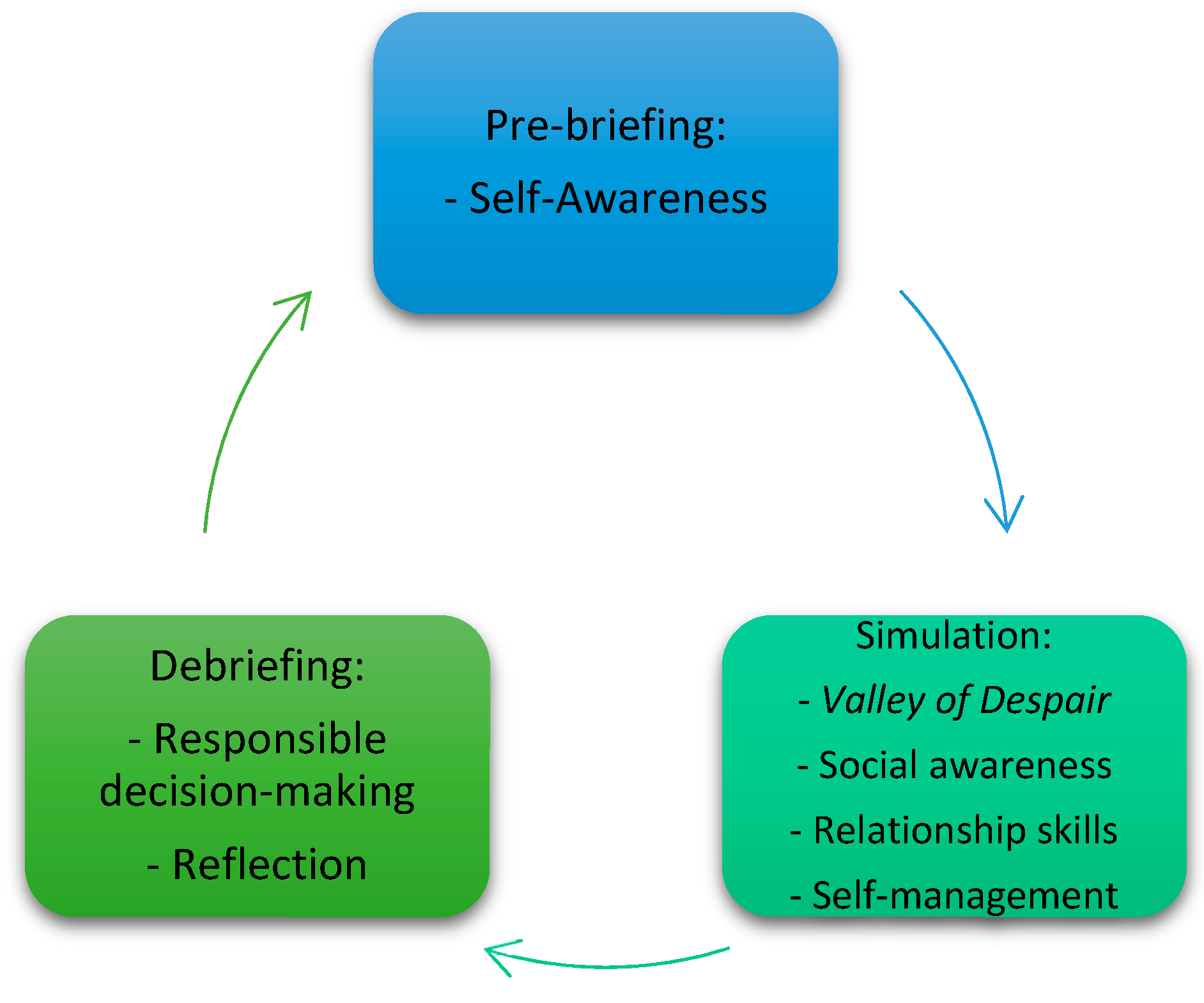
Building on the interpretive framework outlined above, the SEL loop, illustrated in Figure 1, is conceptualized as an integrative model that captures simulation-based learning as a cyclical and recursive social–emotional process. Rather than representing a fixed sequence of stages, the model brings together complementary theoretical perspectives to account for how learning unfolds through the interaction of experience, disruption, and reflection.
Within this model, Kolb’s experiential learning cycle provides a temporal orientation, Piaget’s notion of disequilibrium captures the tensions that drive transformation, and the CASEL framework offers a lens for interpreting the social–emotional competences mobilized throughout (Angelini et al., 2024; CASEL, 2020; Kolb, 1984).
Central to the SEL loop is the idea that emotional disruption constitutes a generative condition for learning. Moments of dissonance prompt participants to engage in processes of awareness, regulation, and relational negotiation, through which meaning is constructed and revised.
Although the phases of simulation provide a structural reference for understanding how different social–emotional competencies are typically foregrounded at key moments, engagement with the SEL loop is inherently non-linear and recursive. Participants move iteratively between different states of engagement as new challenges emerge, so that particular competencies become more salient in each phase without operating in isolation, reflecting the interdependent activation of the broader constellation of social–emotional competences.
By foregrounding these dynamics, the SEL loop extends prior research in simulation-based teacher education, which has often privileged cognitive and performance outcomes (Levin, 2024; Levin & Flavian, 2022; Levin et al., 2023; Theelen et al., 2019). In doing so, it responds directly to calls for simulation research that attends not only to technical competence, but also to the reflective, adaptive, and relational capacities essential for effective professional practice (Fischetti et al., 2022), positioning learning as a process grounded in social–emotional engagement and regulation.
This understanding is consistent with broader simulation research in teacher education, which has emphasized the pedagogical value of simulations for developing interpersonal competence, reducing professional anxiety, and supporting reflective engagement with authentic practice dilemmas (Theelen et al., 2019; Theelen, 2021; Darling-Hammond et al., 2023).

2.2. Simulations in Teacher Preparation and Training

Simulation-based learning has increasingly been recognized as a key component of practice-based teacher education, offering preservice and in-service teachers safe yet demanding environments in which to rehearse complex professional practices. Simulations create opportunities to experiment with decision-making, classroom management, and interpersonal communication under realistic conditions, while allowing for structured feedback and iterative refinement of practice that are not always feasible in school placements. Recent work has shown that simulations can complement or, in some cases, temporarily supplant clinical experiences by providing representations of practice that foreground productive struggle, equity considerations, and collaborative problem-solving (Torrijos-Martí, 2026). For preservice teachers in particular, simulations support the development of interpersonal competence and diagnostic judgement, enabling them to engage with complex classroom and school scenarios before assuming full responsibility for pupils. Within this broader field, The School of Valtance extends the use of simulations beyond technical or instructional rehearsals by explicitly embedding social–emotional learning as a core pedagogical goal, positioning emotional regulation, empathy, and relationship skills as central to teacher professionalism rather than as secondary outcomes.
Focusing on preservice teachers also responds to recent calls for teacher education to move beyond purely cognitive or technical conceptions of professionalism and to incorporate social–emotional and intercultural competences as core elements of initial preparation. As preservice teachers encounter increasing demands to address issues of equity, wellbeing, and diversity, simulations such as The School of Valtance offer a structured arena in which they can experiment with emotionally challenging roles, receive feedback on their responses, and reflect collaboratively on the implications of their decisions for pupils, families, and colleagues. In this sense, the SEL loop does not merely describe how experienced teachers regulate their emotions; it functions as a developmental scaffold through which future teachers learn to inhabit the emotional and relational dimensions of their profession in a changing educational landscape.
In sum, these theoretical perspectives position the SEL loop not as a fixed sequence of discrete stages, but as a lived and dynamically unfolding process in which emotional, relational, and reflective movements may recur across the simulation trajectory. This conceptualization has direct methodological implications: because the phenomenon under investigation is recursive, situated, and experienced subjectively over time, a qualitative phenomenological design is especially well suited to examining how participants narrate and make sense of these movements across pre-briefing, simulation, and debriefing.

3. Methodology

3.1. Research Design

As noted in the introduction, The School of Valtance is designed as a multi-role, multi-site simulation embedded in a postgraduate teacher qualification programme and implemented across nine international faculties of education. Its online, synchronous format and reliance on English as a lingua franca create an intercultural and multilingual learning environment in which role dissonance, emotional intensity, and social negotiation are deliberately foregrounded as generative conditions for professional learning.
In line with contemporary accounts of simulation in teacher education, The School of Valtance functions as a practice-based environment in which participants can rehearse complex relational, ethical, and organizational decisions in a controlled yet authentic setting, thus supporting the development of both technical and social–emotional dimensions of teacher competence.
This study adopts a qualitative phenomenological design to explore the lived social–emotional experiences of pre- and in-service teachers engaging in simulation-based learning. Phenomenological inquiry is particularly suited to this research purpose as it privileges participants’ first-person accounts of subjective experience, seeking to uncover the essential structures and meanings of phenomena as they are lived rather than merely observed from the outside (van Manen, 1990; Creswell & Poth, 2018). In the context of this study, the phenomenon of interest is the SEL loop as it unfolds across the three phases of simulation, namely the pre-briefing, the simulation itself, and the debriefing, and the qualitative lens enables an in-depth examination of the affective, relational, and regulatory dimensions of this process that quantitative instruments cannot adequately capture.
The study is situated within an interpretive paradigm, assuming that meaning is constructed through participants’ interactions with their social and pedagogical environment (Merriam & Tisdell, 2016). This epistemological stance is consistent with the theoretical framework of the study, which draws on Kolb’s experiential learning theory, Piaget’s constructivism, and the CASEL SEL framework, all of which foreground the active, meaning-making role of the learner in the construction of knowledge and competence. The qualitative design thus extends and complements the quantitative findings of the preceding study by Angelini et al. (2024), which demonstrated statistically that role dissonance and the valley of despair predict metacognitive engagement, but did not investigate the social–emotional processes through which participants navigate these experiences.
The intervention on which the study is based is a large-scale, multi-role, international simulation, The School of Valtance, delivered synchronously in an online environment across nine international faculties of education. The qualitative data were gathered systematically across all three simulation phases, enabling a longitudinal mapping of the SEL loop as it developed over the course of participants’ engagement with the simulation. The design is thus both phenomenological, in its commitment to capturing lived experience, and phase-structured, in its alignment with the three-part temporal architecture of the SEL loop (Angelini, 2021; Kriz, 2010; Rudolph et al., 2014).

Description of the School of Valtance Simulation

The School of Valtance is structured as a series of three interconnected phases—pre-briefing, simulation, and debriefing—aligned with Kolb’s experiential learning cycle and the SEL loop model. In the pre-briefing sessions, participants receive detailed role profiles, background information on the fictional school, and an overview of the central dilemma, and are invited to articulate initial expectations, concerns, and emotional responses to their assigned roles.
The simulation phase consists of multiple synchronous online meetings in which role groups (e.g., school leadership, pedagogical staff, parents) negotiate the educational dilemma through moderated discussions, decision-making tasks, and collaborative planning activities conducted in English. Each session is designed to progressively intensify role dissonance by introducing new information, conflicting stakeholder interests, and time pressure, thereby provoking the valley of despair as participants grapple with competing demands, emotional discomfort, and perceived inadequacy. The debriefing phase provides a structured space for reflection, where participants step out of character to narrate their emotional trajectories, identify moments of dissonance and regulation, and connect their experiences to the SEL competencies and their emerging professional identities as teachers. Facilitators guide the debriefing through open-ended questions, thematic prompts, and collaborative analysis of critical incidents, supporting participants in transforming emotional turbulence into articulated social–emotional insight.

3.2. Participants

A purposive sample of 20 participants was selected from the broader population of 79 individuals who took part in the full simulation study. The sample included 14 pre-service teachers and 6 in-service teachers, representing nine different national contexts (e.g., Spain, Tunisia, Poland, Ukraine, USA) and a range of teaching levels from primary to secondary education. Participants varied in age from early twenties to mid-forties and had differing levels of prior experience with simulation-based learning, from no previous exposure to having participated in several simulation-based workshops. To ensure variation in role dissonance, participants were selected so that the sample included individuals assigned to both highly dissonant roles (e.g., pedagogue, head of studies, parent) and more identity-proximate roles (e.g., English teacher). This strategy enabled us to capture diverse social–emotional trajectories through the SEL loop and to explore how factors such as professional status (pre-service vs. in-service), national context, and assigned role intersected with experiences of the valley of despair and regulation (Angelini et al., 2024). Purposive sampling was employed to ensure that participants represented a range of assigned role types, including those who occupied highly dissonant profiles such as pedagogue, head of studies, and parent, as well as those assigned to the more identity-proximate role of English teacher. This sampling strategy was designed to maximize the diversity of social–emotional experiences captured in the data, in line with the phenomenological goal of identifying the full range of meaningful variation within the phenomenon under study (Patton, 2015; Creswell & Poth, 2018).
The broader participant population comprised pre-service and in-service teachers enrolled in postgraduate teacher qualification programs across 9 international faculties of education: Universidad Catolica de Valencia (Spain), Universidad de Zaragoza (Spain), University Babes-Bolyai Cluj-Napoca (Romania), Universite Virtuelle de Tunis (Tunisia), Carthage University (Tunisia), Northeastern Illinois University (USA), Maria Curie-Sklodowska University (Poland), Mechnikov Odessa National University (Ukraine), and Universite Abdelhamid Ibn Badis Mostaganem (Algeria) (Angelini et al., 2024). The majority of participants (N = 68) were pre-service teachers in their final academic year or enrolled in the secondary school teacher qualification program, while 11 were experienced in-service teachers who performed the most dissonant profile roles. For the present qualitative study, the selected subsample of 20 participants included at least two representatives from each assigned role type and encompassed participants from a minimum of five of the nine participating institutions, to preserve the intercultural dimension of the simulation experience.
Participation in the qualitative component of the study was voluntary and independent of participants’ compulsory engagement with the simulation as part of their academic program. Written informed consent was obtained from all participants prior to the collection of qualitative data. The study was conducted in compliance with the ethical approval previously granted by the Institutional Review Board of the Universidad Católica de Valencia (approval number: UCV/2025-2026/128), which covers the broader simulation research project from which this study derives.

3.3. The Simulation: The School of Valtance

The simulation at the center of this study is The School of Valtance, a large-scale, multi-role educational simulation developed and refined across successive iterations by Angelini and collaborators (Angelini, 2021; Angelini et al., 2024). The simulation is structured around a fictional school community facing a range of complex, multi-stakeholder educational challenges, encompassing active methodologies, special education, internationalization, co-teaching, cyberbullying, artificial intelligence in education, world peace, and equity. These themes were selected to reflect the real-world complexities and dialectical tensions that characterize contemporary educational practice, ensuring that the simulation generated authentic cognitive and emotional engagement (Angelini et al., 2024; Crookall, 2010; Jones, 2013).
The simulation unfolded synchronously across three structured phases. In the pre-briefing phase, participants received detailed role profiles, contextual documents, and preparatory materials related to their assigned educational identity, whether head of studies, pedagogue, parent, or English teacher. This phase was designed to establish the psychological and informational container for the simulation, creating the conditions for safe yet challenging engagement (Rudolph et al., 2014). Participants were deliberately assigned to profiles that did not align with their own professional backgrounds and identities, generating anticipatory dissonance and activating self-awareness as the first competency of the SEL loop.
In the simulation phase, participants engaged in role-based negotiation, decision-making, conflict resolution, and collaborative problem-solving within multicultural teams of four to six members, each team comprising participants from different national and institutional contexts. Academic facilitators from the participating universities observed synchronous sessions but did not intervene in the flow of the simulation, thereby preserving the authenticity of participants’ experience (Angelini et al., 2024; Kriz, 2010; Van Laere et al., 2021). This phase constituted the primary locus of the valley of despair, as participants confronted the cognitive and emotional demands of inhabiting unfamiliar professional identities under conditions of real-time social pressure.
The debriefing phase was facilitated by academic coordinators at each participating institution following the conclusion of the synchronous simulation sessions. Consistent with Kriz’s (2010) systemic–constructivist model, the debriefing was structured to encourage participants to articulate their emotional responses, identify gaps in their professional knowledge, and collectively negotiate the meaning of their experience. This phase was treated in the present study as the closing moment of the SEL loop, the space in which affective experience is transformed into social–emotional competence through structured reflection.

3.4. Data Collection

Data were collected through three complementary instruments deployed across the three simulation phases: semi-structured interviews, reflective journals, and facilitator field notes. The use of multiple data sources was designed to ensure triangulation, enhancing the credibility and depth of the qualitative analysis (Creswell & Poth, 2018; Merriam & Tisdell, 2016).
Semi-structured interviews were conducted individually with all 20 participants within one week of the completion of the debriefing phase. Each interview lasted between 45 and 60 min and was conducted in English, the language of instruction of the simulation, via video conferencing. The interview protocol was organized around the three phases of the SEL loop, with questions designed to elicit retrospective accounts of participants’ social–emotional experiences at each stage. Indicative questions included: ‘What were you feeling when you first received your role profile and began preparing for the simulation?’, ‘Can you describe a moment during the simulation when you felt particularly uncomfortable or challenged, and how you responded to it?’, and ‘How did the debriefing help you make sense of what you had felt and learned during the simulation?’ Follow-up probes were used to deepen participants’ accounts and to invite reflection on specific social–emotional competencies as identified in the CASEL framework. All interviews were audio-recorded and transcribed verbatim.
Reflective journals were completed by participants at three points corresponding to the three simulation phases: immediately after the pre-briefing, at the end of each synchronous simulation session, and following the debriefing. Participants were provided with a structured prompt at each stage, guiding them to reflect on their emotional state, the social dynamics of the group, the challenges they had encountered, and their sense of their own learning and development. This longitudinal structure was designed to capture the processual unfolding of the SEL loop in real time, rather than relying solely on retrospective accounts (Levin & Flavian, 2022; Theelen et al., 2019).
Facilitator field notes were collected by the academic coordinators at each participating institution. Facilitators were provided with a standardized observation guide covering participants’ visible emotional responses, group interaction patterns, moments of apparent cognitive conflict or disengagement, and the dynamics of the debriefing discussion. These notes served as a secondary data source to contextualize and enrich the analysis of participants’ self-reports, particularly in relation to the identification of the valley of despair and its resolution (Angelini et al., 2024; Angelini, 2026; de Wijse-van Heeswijk, 2021).

3.5. Data Analysis

Data were analyzed using reflexive thematic analysis following the six-phase framework proposed by Braun and Clarke (2006, 2019). This approach was selected for its flexibility and its explicit grounding in interpretive epistemology, making it well-suited to the phenomenological orientation of the study. Reflexive thematic analysis does not treat themes as pre-existing units waiting to be discovered in the data, but as the product of the researcher’s active, theoretically informed engagement with the dataset (Braun & Clarke, 2019). This is consistent with the theoretical framework of the present study, in which the SEL loop and the CASEL competency framework informed the analytical lens without predetermining the categories of meaning that emerged from participants’ accounts.
The six phases of the analysis were conducted as follows. In the first phase, familiarization with the data, all transcripts, journal entries, and field notes were read in full on multiple occasions, and initial observations were recorded in analytic memos. In the second phase, codes were generated inductively from the data, capturing meaningful units of experience related to participants’ emotional states, relational dynamics, regulatory strategies, and perceptions of learning. In the third phase, initial codes were collated into candidate themes by identifying patterns of shared meaning across the dataset. In the fourth phase, themes were reviewed and refined in relation to both the coded data and the full dataset, with particular attention to the coherence of each theme and its alignment with the three phases of the SEL loop. In the fifth phase, themes were defined and named to capture their essential character and analytical contribution. In the sixth phase, the findings were reported in the form of a rich, evidence-anchored narrative, with illustrative extracts from participants’ accounts (Braun & Clarke, 2006).
To enhance the rigor and trustworthiness of the analysis, a member-checking procedure was employed, whereby a summary of the preliminary themes and illustrative extracts was shared with five of the 20 participants, who were invited to comment on the accuracy and resonance of the interpretations (Lincoln & Guba, 1985). In addition, analytic decisions were documented throughout the process and subjected to peer review by a co-investigator not involved in primary data collection. Negative case analysis was also conducted, actively seeking data that challenged or complicated the emerging thematic structure, in order to avoid confirmatory bias and to ensure that the analysis represented the full range of participants’ experiences (Creswell & Poth, 2018; Merriam & Tisdell, 2016).
The analysis was conducted with the support of qualitative data analysis software (Dedoose, Version 10.0.34) (SocioCultural Research Consultants, LLC, 2025), which facilitated the systematic organization of codes, the visualization of thematic relationships, and the retrieval of coded extracts across the three data sources. The integration of data from interviews, journals, and field notes was achieved through a process of within-participant and across-participant comparison, enabling the identification of both shared patterns and individual variation in the social–emotional trajectories of participants through the SEL loop.

3.6. Positionality and Ethical Considerations

Consistent with the reflexive stance required by qualitative phenomenological inquiry, the researchers acknowledge their dual position as designers and facilitators of the simulation and as interpreters of participants’ accounts of the same experience. This insider positionality was managed through the systematic use of reflexive memos, regular peer debriefing among the research team, and the member-checking procedures described above (Braun & Clarke, 2019; Creswell & Poth, 2018). The researchers are committed to representing participants’ experiences with fidelity and to maintaining transparency about the analytical choices that shaped the findings.
The study was conducted in full compliance with the ethical approval (UCV/2025-2026/128), in which all participants provided written informed consent prior to data collection, were assured of the voluntary nature of their participation, and were informed of their right to withdraw at any time without consequence. All data were anonymized prior to analysis, and pseudonyms are used throughout the reporting of findings. Data are stored securely on institutional servers and will be retained in accordance with the ethical guidelines of the Universidad Católica de Valencia. No competing interests exist among the members of the research team.

4. Results

The following section presents the findings of the reflexive thematic analysis conducted across interview transcripts, reflective journals, and facilitator field notes. The analysis generated four central categories, each comprising recurrent and, in some cases, controversial themes that illuminate the activation of the SEL loop across the three simulation phases. The categories are presented sequentially in alignment with the phenomenological arc of the SEL loop: from the anticipatory self-awareness generated during the pre-briefing, through the emotional turbulence of the valley of despair during the simulation, to the consolidation of social–emotional competence in the debriefing. A fourth cross-cutting category addresses the intercultural dimension of the SEL loop, which emerged as a distinctive feature of the multi-institutional simulation context. Illustrative extracts from participants’ accounts are provided throughout to anchor the analysis in participants’ lived experience (Braun & Clarke, 2006; van Manen, 1990).
The four central categories are: (1) Anticipatory Dissonance and the Awakening of Self-Awareness, (2) The Valley of Despair as an Emotional-Regulatory Crisis, (3) Debriefing as the Closing of the SEL Loop, and (4) Intercultural Friction and Social Awareness. Each category is discussed in relation to the CASEL competencies it most prominently activates and the SEL loop phase to which it corresponds.

4.1. Central Category 1: Anticipatory Dissonance and the Awakening of Self-Awareness

The first central category encompasses participants’ experiences during the pre-briefing phase and captures the moment at which the SEL loop was first activated. Upon receiving their role profiles, most participants described an immediate and often unsettling awareness of the gap between their own professional identity and the demands of the assigned role. This phenomenon, conceptualized here as anticipatory dissonance, constitutes the entry point of the SEL loop, triggering the CASEL competency of self-awareness before the simulation had even begun (CASEL, 2020; Rudolph et al., 2014). Two recurrent themes and one controversial theme were identified within this category.

4.1.1. Recurrent Theme: Identity Gap Recognition

The most consistently reported experience during the pre-briefing was what participants described as the sudden recognition of a gap between who they were as trainee teachers and who they were being asked to become within the simulation. This recognition was often expressed in terms of surprise, uncertainty, and a questioning of their own competence. Participants assigned to the roles of head of studies and pedagogue were particularly vocal in articulating this gap, as these profiles carried institutional authority and decision-making responsibilities that felt remote from their experience as pre-service teachers (Angelini, 2026; Levin & Flavian, 2022).
“When I saw the profile I had been given, head of studies, I felt immediately out of place. […] I do not know how a head of studies thinks.”
(Participant 3, pre-service teacher, Spain, reflective journal, pre-briefing phase)
“The pedagogue role was completely foreign to me […] Reading the profile made me feel that I was being asked to pretend to be someone I am clearly not.”
(Participant 11, pre-service teacher, Poland, semi-structured interview)
These accounts are consistent with van Manen’s (1990) phenomenological description of the lived body as always already situated: participants did not experience the role profile as an abstract instruction but as a felt challenge to their sense of who they were. The pre-briefing thus functioned not as a neutral preparatory stage but as the first moment of social–emotional activation, prompting a reflexive self-assessment that is the hallmark of CASEL’s self-awareness competency (CASEL, 2020).

4.1.2. Recurrent Theme: Anticipatory Anxiety and Motivated Preparation

A second recurrent theme concerns the dual emotional response that identity gap recognition produced in participants: anxiety about their capacity to perform the assigned role convincingly, combined with a motivated impulse to prepare more thoroughly. This tension between threat and challenge was a defining feature of the pre-briefing experience and maps closely onto the self-management competency of the CASEL framework, specifically its sub-component of impulse control and goal-directed behavior (CASEL, 2020; Durlak et al., 2011).
“I was anxious, yes, but the anxiety made me read everything twice […] I was nervous, but I also felt strangely motivated.”
(Participant 7, pre-service teacher, Romania, semi-structured interview)
“I wrote in my journal that night: I do not feel ready for this. But I also wrote: I want to do this well. I think that tension, between fear and wanting to succeed, is what kept me engaged from the very beginning.”
(Participant 14, in-service teacher, Algeria, reflective journal, pre-briefing phase)
Rather than withdrawing from the challenge, most participants channeled their anxiety into intensified preparation, seeking additional information about their assigned role and consulting facilitators or peers.

4.1.3. Controversial Theme: Resistance to Role Assignment

A controversial theme that emerged within this category concerns a subset of participants who experienced the role assignment not as a challenge to be embraced but as an imposition that initially provoked resistance. These participants questioned the legitimacy of being asked to represent perspectives they found ethically or professionally incompatible with their own values, particularly those assigned to the parent role, which required them to adopt positions that sometimes conflicted with educational principles they held strongly. This finding is consistent with the results of Angelini et al. (2024), who identified the parent profile as among the most controversial in the simulation, and with the broader qualitative literature on role dissonance in simulation-based teacher education (de Wijse-van Heeswijk, 2021; Carrera et al., 2016).
“I was assigned the parent role […] I disagreed with completely […] That felt wrong to me, even before the simulation started.”
(Participant 19, pre-service teacher, USA, semi-structured interview)
This resistance, while initially appearing as a barrier to engagement, was retrospectively reframed by several participants as a productive form of ethical discomfort that heightened their self-awareness and sharpened their attention to the complexity of the stakeholder landscape in education. As one facilitator noted in their field notes, ‘the students who pushed back the most on their profiles in the briefing were often the most articulate participants during the debriefing.’ This observation resonates with the broader literature on the pedagogical value of productive discomfort in experiential learning (Kriz, 2010; Dieckmann, 2020).

4.2. Central Category 2: The Valley of Despair as an Emotional-Regulatory Crisis

The second central category is the most emotionally dense and analytically rich of the four. It encompasses participants’ experiences during the simulation phase and captures the processes through which the valley of despair materialized, was experienced, and was navigated. The valley of despair, as described by participants, was not a single moment but a sustained emotional-regulatory crisis that demanded the simultaneous activation of multiple CASEL competencies, most acutely self-management and social awareness, under conditions of real-time social pressure (Angelini, 2026; Piaget, as cited in Flavell, 2013; Kriz, 2010). Four themes were identified within this category: two recurrent and two controversial.

4.2.1. Recurrent Theme: Emotional Flooding and Loss of Role Coherence

The dominant emotional experience during the simulation was what participants consistently described as a sense of flooding, a moment at which the emotional and cognitive demands of the role exceeded their capacity to maintain role coherence. This experience was triggered by a range of simulation events, including direct challenges from other participants adopting opposing roles, unexpected dilemmas that the role profile had not prepared them for, and the experience of being unable to persuade other team members of their position. Participants described this flooding in vivid, embodied terms, suggesting that the valley of despair was not merely a cognitive phenomenon but a deeply somatic one (van Manen, 1990; Madsgaard et al., 2022).
“There was a moment in the second session when someone challenged everything my character was supposed to stand for and I just… went blank. I could not find the words. I could feel myself going red. I was no longer the head of studies; I was just me, a student, panicking. I felt completely exposed.”
(Participant 3, pre-service teacher, Spain, semi-structured interview)
“I wrote in my journal after the second session: today I hit a wall. I did not know what my character would do. I did not know what I would do. I felt lost inside the simulation and lost in myself. It was genuinely unpleasant.”
(Participant 8, pre-service teacher, Tunisia, reflective journal, simulation phase)
The experience of emotional flooding is consistent with Gross’s (2015) and Madsgaard et al. (2022) process model of emotional regulation, which identifies situations of high emotional intensity as those in which regulatory strategies are most heavily taxed. In the simulation context, the simultaneous demands of role performance, social negotiation, and linguistic production in a second language created the conditions for this intensity, making the valley of despair both more acute and more pedagogically productive than it might be in a monolingual or monocultural simulation environment (Byram, 2020; Diamanti & Angelini, 2025).

4.2.2. Recurrent Theme: Empathy as a Regulatory Strategy

A striking and recurrent theme in participants’ accounts of how they navigated the valley of despair was the emergence of empathy as a regulatory strategy. Rather than withdrawing from the emotional difficulty of the role, a significant number of participants described a deliberate shift toward perspective-taking, consciously attempting to understand the internal logic of their assigned role and the positions of other characters as a way of regaining cognitive and emotional stability.
“I realized at some point that I was not going to be able to perform this role if I kept fighting against it internally. So I tried to actually think like the parent. What would she be afraid of? What would she want for her child? When I did that, I felt calmer. And I also started to understand why parents sometimes seem unreasonable to teachers.”
(Participant 19, pre-service teacher, USA, semi-structured interview)
“The moment I stopped trying to win the argument and started trying to understand the other roles, something shifted. I could breathe again. I could speak again. The discomfort did not disappear, but it became something I could work with.”
(Participant 11, pre-service teacher, Poland, semi-structured interview)
This strategy maps directly onto the CASEL competencies of social awareness, defined as the ability to understand the perspectives of others, and self-management, specifically the regulation of emotional responses in social contexts (CASEL, 2020; Frei-Landau et al., 2022).

4.2.3. Controversial Theme: Performative Coping and Surface Engagement

A controversial theme concerns a subset of participants who, in the face of emotional flooding, adopted what may be described as performative coping strategies, maintaining the surface appearance of role engagement while internally disengaging from the affective and cognitive demands of the simulation. These participants described reverting to scripted or formulaic responses drawn from the role profile materials, avoiding the improvisational demands of the scenario, and waiting for the session to end rather than actively navigating the dilemma. This strategy temporarily prevented the full emotional-regulatory crisis of the valley of despair but also limited the depth of social–emotional learning, as it effectively short-circuited the SEL loop by bypassing self-management in favor of avoidance (Gross, as cited in Madsgaard et al., 2022; Kriz, 2010).
“After a while I just started repeating things from the briefing document. I was not really engaging with what was happening anymore. I was just going through the motions. I knew it was not good, but I did not know what else to do. I felt stuck.”
(Participant 5, pre-service teacher, Ukraine, reflective journal, simulation phase)
Facilitator field notes corroborated this pattern in several cases, noting participants who appeared withdrawn, who spoke less frequently as sessions progressed, and who contributed minimal novel argumentation to the group discussions. This finding raises important questions for simulation design about the conditions under which the valley of despair becomes productively discomforting versus overwhelming, and points to the need for in-session facilitator interventions calibrated to individual participants’ emotional regulation capacity (Madsgaard et al., 2022; Rudolph et al., 2014; de Wijse-van Heeswijk, 2021).

4.2.4. Controversial Theme: The Parent Role as the Apex of Dissonance

A second controversial theme concerns the distinctively polarizing character of the parent role within the simulation. Across multiple data sources, the parent profile emerged as the most emotionally charged and pedagogically contentious assignment, generating stronger expressions of dissonance, resistance, and transformative insight than any other role.
“Playing the parent was the hardest thing I have done in my training. Not because I did not know what to say, but because I disagreed with everything my character believed. It was like arguing against myself. But by the end, I understood something about parent–teacher communication that I had never understood before. I had been inside it.”
(Participant 2, pre-service teacher, Romania, semi-structured interview)
“I was angry during the simulation. Genuinely angry. Not at the game, but at the situation my character was in. And I realized afterwards that the anger was real information about how difficult this kind of interaction must be for actual parents. That realization was unexpected and very valuable.”
(Participant 17, in-service teacher, Spain, semi-structured interview)
This finding aligns with the quantitative results reported by Angelini et al. (2024), in which the parent profile was identified as a key predictor of perceived challenge, and with the qualitative study by Angelini et al. (2026), which identified the parent profile as the most controversial and dissonant role in the simulation context. Participants assigned to this role described navigating not only cognitive dissonance but moral dissonance, as they were required to advocate for positions that contradicted deeply held professional beliefs.

4.3. Central Category 3: Debriefing as the Closing of the SEL Loop

The third central category encompasses participants’ experiences of the debriefing phase and captures the processes through which the SEL loop was closed: that is, through which the raw emotional and relational experience of the simulation was transformed, through structured collective reflection, into consolidated social–emotional competence. The debriefing emerged in participants’ accounts as the most explicitly valued phase of the entire simulation experience, and the one in which the CASEL competencies of responsible decision-making and renewed self-awareness were most prominently articulated (CASEL, 2020; Kriz, 2010; Rudolph et al., 2014). Three themes were identified within this category.

4.3.1. Recurrent Theme: Relief, Recognition, and Collective Meaning-Making

The dominant affective tone of participants’ accounts of the debriefing was one of relief, specifically the relief of discovering that the discomfort they had experienced during the simulation was shared, named, and given pedagogical value by the facilitator and the group.
“When the facilitator asked us to describe how we had felt during the simulation, and everyone started saying things like ‘lost’, ‘overwhelmed’, ‘confused’, I felt an enormous sense of relief. I was not the only one. It was not my fault. It was the design. And then the question became: why did we all feel that way, and what does that tell us?”
(Participant 7, pre-service teacher, Romania, semi-structured interview)
“The debriefing was where everything became meaningful. During the simulation I was just surviving. During the debriefing I understood what I had been through and why it mattered. It felt like the difference between running in the dark and then turning a light on.”
(Participant 14, in-service teacher, Algeria, semi-structured interview)
This collective recognition of the valley of despair as a legitimate and productive experience rather than a sign of individual inadequacy was described by numerous participants as a turning point in their understanding of the simulation and of their own professional development (Kriz, 2010; Levin & Flavian, 2022).

4.3.2. Recurrent Theme: From Role to Self: Transfer of Social–Emotional Insight

A second recurrent theme concerns the process through which insights gained within the simulated role were transferred to participants’ understanding of themselves as future teachers and as social–emotional agents. Participants described the debriefing as the moment at which the boundary between the simulated role and their own professional identity became permeable, enabling them to appropriate the social–emotional learning generated by the simulation as their own.
“I kept thinking during the debriefing: this is what my future students’ parents might feel. This is why they come into parent meetings with that defensiveness. I had lived it. I was not going to forget it. That felt like real professional learning, not something from a textbook.”
(Participant 2, pre-service teacher, Romania, semi-structured interview)
“After the debriefing I wrote in my journal: today I learned more about what it means to be a teacher by not being one. Playing someone else taught me about myself. I think that is the point of all of this.”
(Participant 8, pre-service teacher, Tunisia, reflective journal, post-debriefing)
This process of appropriation, in which the competencies activated within the role (empathy, perspective-taking, emotional regulation) were recognized as competencies relevant to their actual future practice, constitutes the responsible decision-making dimension of the SEL loop (CASEL, 2020; Fischetti et al., 2022; Levin, 2024).

4.3.3. Controversial Theme: Incomplete Loop Closure and Unresolved Affect

A controversial theme within this category concerns participants for whom the debriefing did not fully close the SEL loop. A minority of participants described leaving the debriefing with residual negative affect that had not been adequately processed, including lingering frustration at the role assignment, unresolved disagreements with team members, and a sense that the debriefing had not provided sufficient time or depth for the full articulation of their experience. These accounts point to the conditions under which the debriefing may fail to perform its loop-closing function and constitute an important finding for simulation design (de Wijse-van Heeswijk, 2021; Madsgaard et al., 2022; Kriz, 2010).
“The debriefing felt rushed. We had so much to say and so little time. I left with a lot of things still inside me that I had not been able to express. I am not sure I have fully processed the experience even now, weeks later. I think I needed more time, or a different kind of space.”
(Participant 5, pre-service teacher, Ukraine, semi-structured interview)
This finding resonates with Rudolph et al.’s (2014) argument that psychological safety is not automatically established in debriefing but must be actively constructed through facilitation strategies that are responsive to individual participants’ emotional states. It also points to the importance of extending debriefing time in proportion to the emotional intensity of the simulation, particularly when highly dissonant roles such as the parent profile have been assigned.

4.4. Central Category 4: Intercultural Friction and Social Awareness

The fourth central category is cross-cutting: it traverses all three simulation phases and concerns the distinctive contribution of the multicultural composition of the simulation teams to the activation of the SEL loop. Participants from nine different national and institutional contexts brought divergent educational values, communicative norms, and professional expectations to the simulation, creating an additional layer of social–emotional complexity beyond that generated by role dissonance alone. This intercultural dimension was a consistent and, in some cases, contentious feature of participants’ accounts, generating themes related to social awareness and relationship skills as described by CASEL (2020) and to cross-cultural mirroring as theorized by Byram (2020) and documented by Angelini (2025).

4.4.1. Recurrent Theme: Cross-Cultural Mirroring and Expanded Social Awareness

A prominent recurrent theme concerns the experience of cross-cultural mirroring: the process by which participants became aware, through interaction with team members from different educational systems, of the cultural specificity of their own assumptions about schooling, professional roles, and appropriate behavior in institutional settings.
“My teammate from Algeria had a completely different view of what a head of studies should do in a conflict situation. At first I thought she was wrong. Then I realized I just thought she was wrong because I was thinking like a Spanish teacher. That moment was very important for me. I started to question what I take for granted.”
(Participant 3, pre-service teacher, Spain, semi-structured interview)
“Working with people from different countries inside a school simulation made me realize how much of what I call ‘good teaching’ is actually just the way things are done where I come from. That was uncomfortable, but it was also the most important thing I learned.”
(Participant 16, pre-service teacher, Poland, reflective journal, post-debriefing)
This heightened cultural self-awareness, generated by the friction of cross-cultural contact within the simulation, constitutes a form of social awareness that extends beyond the immediate relational dynamics of the team to encompass broader intercultural competence (Byram, 2020; Angelini, 2021).

4.4.2. Controversial Theme: Communicative Asymmetries and Relational Tension

A controversial theme within this category concerns the communicative asymmetries that emerged within multicultural simulation teams, specifically the differential ease with which participants from different linguistic and academic backgrounds were able to express themselves in English, the language of instruction of the simulation. Participants for whom English was a more distant second language described experiencing an additional layer of vulnerability during the simulation, as linguistic limitations compounded the cognitive and emotional demands of role performance. This finding introduces a dimension of relational tension that is not captured by the CASEL framework in its standard formulation and suggests the need for an intercultural and linguistic extension of the SEL loop as applied to multilingual simulation contexts (Angelini & Muñiz, 2023; Byram, 2020).
“I was not only trying to be someone I am not, I was doing it in a language that is not mine. When I could not find the word for what I needed to say, I felt doubly helpless. I think my English teammates did not always realize how much harder it was for me. That was a kind of loneliness inside the simulation.”
(Participant 12, pre-service teacher, Tunisia, semi-structured interview)
Facilitator field notes from the Tunisian and Algerian institutions corroborated this experience, noting that participants who faced greater linguistic demands tended to contribute less during the peak conflict moments of the simulation, even when their content knowledge and engagement were otherwise evident. This asymmetry was, however, partially remediated during debriefing, when facilitators provided additional space for written and multilingual reflection, enabling a more equitable distribution of voice across the group.

4.5. Cross-Cutting Synthesis: The SEL Loop as a Non-Linear Cycle

As a whole, the four central categories and their constituent themes reveal the SEL loop as a richly textured and non-linear cycle of social–emotional activation, disruption, regulation, and consolidation. Contrary to a simple sequential reading, in which self-awareness precedes self-management, which precedes social awareness, the data suggest that CASEL competencies were activated simultaneously, recursively, and unevenly across participants, roles, and simulation phases (CASEL, 2020; Durlak et al., 2011). The parent role consistently generated the most intense activation of the loop, functioning as a kind of stress test of participants’ social–emotional resources and yielding the deepest reported insights into professional empathy and stakeholder perspective-taking (Angelini et al., 2024, 2026).
The controversial themes identified across the four categories, specifically resistance to role assignment, performative coping, incomplete loop closure, and communicative asymmetry, are not peripheral anomalies but central pedagogical findings. They collectively identify the conditions under which the SEL loop risks being short-circuited and point toward concrete design and facilitation principles for strengthening its efficacy in future iterations of the simulation. These implications are discussed in the following section.

5. Discussion

This study provides qualitative evidence that simulation-based learning operates as a fundamentally social–emotional process, structured through what is conceptualized here as the SEL loop. The findings reveal how emotional dissonance, regulation, and reflection function as core mechanisms of professional learning in teacher education.

5.1. RQ1: Patterns of the SEL Loop Across Simulation Phases

The first research question asked how pre- and in-service teachers narrate their social–emotional experiences across the three phases of simulation and what patterns of the SEL loop are discernible in their accounts. The findings reveal a coherent yet non-linear pattern of SEL activation, consistent with the recursive nature of the SEL loop illustrated in Figure 1.
The pre-briefing phase can be understood as the point at which the SEL loop is activated through anticipatory dissonance, positioning self-awareness as an entry condition for subsequent learning. This finding extends and complements the quantitative results of Angelini et al. (2024), who demonstrated statistically that role dissonance predicts perceived challenge and metacognitive engagement, by showing that the anticipatory activation of self-awareness precedes the simulation itself and is already well underway during the briefing phase. This aligns with Rudolph et al. (2014) argument for the pre- briefing as a critical pedagogical space and with Kolb’s (1984) characterization of active experimentation as the preparatory stage of the experiential learning cycle.
During the simulation phase, the SEL loop entered its most turbulent and most generative stage. The valley of despair emerged not as a uniform experience but as a spectrum ranging from productive discomfort, in which emotional flooding was regulated through empathy and perspective-taking, to debilitating overwhelm, in which some participants disengaged through performative coping. This differentiation resonates with the findings of Angelini et al. (2026), whose qualitative study of the same simulation documented that the parent profile generated the most intense emotional tension and personal conflict, with outcomes that varied significantly depending on participants’ capacity for reflection and their relational resources within their team (Angelini et al., 2026). The present study extends those findings by identifying empathy as the primary regulatory strategy through which participants navigated the valley of despair and re-engaged with the simulation, a process that maps directly onto the CASEL competencies of social awareness and self-management (CASEL, 2020; Durlak et al., 2011).
During the debriefing phase, the dominant pattern was the closing of the SEL loop through collective meaning-making and the transfer of role-generated insight to participants’ sense of themselves as future teachers. This finding is consistent with Kriz’s (2010) systemic-constructivist account of debriefing as a space of re-equilibration and with Levin and Flavian’s (2022) qualitative study of simulation-based learning from the perspective of pre-service teachers, which found that debriefing was the phase most strongly associated with lasting professional learning. The present study contributes to this literature by framing the debriefing as the moment at which the CASEL competencies of responsible decision-making and renewed self-awareness crystallize from the affective experience of the simulation, and by identifying incomplete loop closure as a structural risk when debriefing time is insufficient or facilitation inadequate (de Wijse-van Heeswijk, 2021; Madsgaard et al., 2022).

5.2. RQ2: The Valley of Despair as a Trigger for Social–Emotional Competence

A central contribution of this study lies in reframing the valley of despair not as a temporary disruption, but as the primary mechanism through which social–emotional competencies are developed. In this sense, the findings provide qualitative evidence that cognitive–emotional dissonance functions as a key driver of learning, while also challenging the assumption, implicit in much simulation research, that dissonance alone is sufficient to produce development.
Importantly, participants moved from dissonance toward engagement through the practice of empathy, perspective-taking, and emotional regulation within the social dynamics of the simulation. This interpretation aligns with Kasperski and Hemi (2024), who state that simulation-based environments can explicitly foster socio-emotional learning competencies through role-based interaction and guided reflection. In this light, the present findings extend Piaget’s constructivist account by foregrounding the interpersonal and affective processes through which disequilibrium becomes pedagogically productive, bridging it with the CASEL framework’s emphasis on socially situated competence development and with simulation research that highlights the centrality of affective engagement in role-based learning (Madsgaard et al., 2022; Theelen et al., 2019).
The parent role, in particular, emerged as an exceptional pedagogical instrument precisely because of the moral, as well as cognitive and emotional, dissonance it generated. Participants assigned to this role narrated not merely intellectual challenge but a form of moral friction: being required to advocate for values they considered incompatible with their professional identity as teachers. This finding extends the theoretical account of role dissonance offered by Angelini et al. (2024), who identified the parent profile as a statistical predictor of perceived difficulty, by revealing the qualitative texture of that difficulty as a multi-layered ethical and social–emotional confrontation. Consistent with the qualitative study by Angelini et al. (2026), this confrontation ultimately proved transformative for most participants, generating insights into parent–teacher communication and stakeholder empathy that participants described as among the most significant professional learning of their training.
However, the findings also reveal the conditions under which the valley of despair fails to trigger social–emotional competence development. The controversial theme of performative coping identifies a subset of participants for whom the emotional demands of the simulation exceeded their regulatory capacity, leading to surface compliance rather than genuine engagement. This finding is consistent with Gross’s process model of emotional regulation (as cited in Madsgaard et al., 2022), which distinguishes between reappraisal strategies, which transform the meaning of an emotional event, and suppression strategies, which inhibit emotional expression without resolving the underlying experience. Participants who adopted performative coping strategies appeared to be employing suppression rather than reappraisal, effectively short-circuiting the SEL loop by preventing the emotional experience from generating the reflective insight that is its pedagogical purpose (Kriz, 2010; de Wijse-van Heeswijk, 2021).

5.3. The SEL Loop as a Theoretical Contribution

Beyond the specific findings in relation to the research questions, this study advances a broader theoretical contribution by proposing and empirically grounding the SEL loop as an integrative framework for understanding simulation-based learning in teacher education. In doing so, the model moves beyond existing approaches by explicitly positioning emotional disruption as a central driver of learning, rather than a secondary or contextual factor. The SEL loop synthesizes Kolb’s (1984) experiential learning cycle, Piaget’s constructivist account of disequilibrium, and the CASEL (2020) framework into a model that is both theoretically coherent and empirically tractable. The findings support three central claims: that simulation phases correspond to distinct moments of SEL competency activation, that the valley of despair operates as the emotional-regulatory engine of the process, and that debriefing functions as the space in which social–emotional competence is consolidated. In this sense, the SEL loop offers not only an explanatory model, but a framework for the intentional design of simulation-based learning environments.
At the same time, the findings introduce important refinements to the model. First, the data suggest that the SEL loop is not strictly sequential but recursive: participants returned to states of heightened self-awareness and emotional dysregulation at multiple points during the simulation, particularly after moments of interpersonal conflict or unexpected scenario developments.
This recursiveness is visible in the empirical material in several ways. Participants who had initially achieved a degree of emotional orientation in the pre-briefing often reported renewed uncertainty when interpersonal tensions escalated during the simulation, while others described moments of temporary regulation that were subsequently disrupted by unexpected reactions from other roles or by the moral discomfort of defending positions they did not personally endorse. Likewise, the debriefing did not simply function as a final endpoint; for some participants it reopened earlier feelings of discomfort and self-questioning before enabling them to reorganize those experiences into a more coherent professional understanding. These patterns suggest that the SEL loop operates through repeated returns to awareness, regulation, and relational negotiation rather than through a single forward progression.
Likewise, this recursiveness is consistent with Kolb’s (1984) characterization of experiential learning as a cycle rather than a linear progression and with Braun and Clarke’s (2019) reflexive account of meaning-making as an iterative process. Second, the cross-cutting category of intercultural friction and social awareness suggests that the SEL loop, as originally conceived in the CASEL framework, may require an intercultural extension when applied to multilingual and multicultural simulation contexts. The linguistic asymmetries identified in the data, through which participants with more limited English proficiency experienced compounded vulnerability during the simulation, point to a dimension of relational inequity within the SEL loop that the standard CASEL model does not adequately address (Byram, 2020; Angelini & Muñiz, 2023).

5.4. Implications for Simulation Design and Facilitation

The findings of this study have direct and actionable implications for the design and facilitation of simulation-based learning in teacher education. First, the pre-briefing should be reconceptualized as a social–emotional preparation space, not merely a logistical or informational one. The data indicate that identity gap recognition and anticipatory anxiety are activated during the briefing and that these experiences significantly shape participants’ capacity to engage productively with the simulation. Facilitators should design the briefing to explicitly acknowledge the emotional challenge of role dissonance and to provide participants with language and strategies for managing the affective demands of inhabiting an unfamiliar professional identity (Rudolph et al., 2014; Angelini, 2025).
Second, in-simulation facilitation should be calibrated to monitor the difference between productive discomfort and debilitating overwhelm. The controversial theme of performative coping suggests that some participants require targeted intervention during the simulation to prevent the valley of despair from exceeding their regulatory capacity. This implies the need for facilitators trained not only in simulation content but in the recognition and management of emotional dysregulation, consistent with the recommendations of Madsgaard et al. (2022) and de Wijse-van Heeswijk (2021). The SIM+VE project model developed by Angelini (2025), which integrates dialogic and simulation-based methodologies across six years of empirical development, offers a relevant evidence base for the design of such facilitation protocols.
Third, the debriefing must be allocated sufficient time and facilitation depth to close the SEL loop for all participants, including those whose experience of the valley of despair was most intense. The controversial theme of incomplete loop closure indicates that time constraints and inadequate facilitation are the primary risks to the debriefing fulfilling its loop-closing function. Facilitators should employ structured debriefing protocols that explicitly invite participants to narrate their emotional trajectory across the simulation phases, to identify the SEL competencies they exercised and those they found most challenging, and to connect their experience of the simulated role to their developing professional identity as teachers (Kriz, 2010; Levin, 2024).
Fourth, the linguistic and cultural asymmetries identified in the intercultural friction category call for differentiated facilitation strategies that acknowledge and mitigate the additional vulnerability of participants operating in a second or third language. The use of multilingual reflection tools, written supplementary prompts, and extended processing time for non-native English speakers would help to ensure that the social awareness and relationship skills components of the SEL loop are equally accessible to all participants, regardless of their linguistic background (Byram, 2020; Angelini & Muñiz, 2023; Angelini, 2025).
In sum, these implications suggest that effective simulation design requires intentional integration of emotional, relational, and reflective dimensions across all phases of the learning cycle.

5.5. Limitations and Future Directions

This study has several limitations that should be acknowledged. First, the qualitative phenomenological design, while appropriate to the research questions, limits the generalizability of the findings. The purposive sample of 20 participants was drawn from a specific simulation context and a specific population of pre-service and in-service teachers, and the findings may not transfer directly to other simulation designs, educational levels, or cultural contexts. Future research should examine the SEL loop in simulation contexts beyond teacher education, including healthcare, law, and social work, where role dissonance and interprofessional negotiation are equally central to professional training (Reime et al., 2017; Theelen et al., 2019).
Second, the reliance on retrospective interview data and longitudinal reflective journals, while methodologically sound, introduces the risk of post hoc rationalization, particularly in participants’ accounts of how they navigated the valley of despair. Future studies might supplement these instruments with in-simulation observation protocols or stimulated recall techniques, in which participants review video recordings of the simulation and comment on their emotional experience in real time (Levin & Flavian, 2022). The integration of such methods would enable a more fine-grained mapping of the SEL loop as it unfolds during the simulation, rather than only as it is reconstructed afterwards.
Third, while the SEL loop model proposed in this study represents a theoretically coherent integration of Kolb, Piaget, and CASEL, it remains a conceptual proposition grounded in a single empirical study. Future research should test the model’s applicability and generalizability through larger-scale qualitative or mixed-methods studies and should explore whether the phase-specific activation of CASEL competencies identified in this study holds across different simulation formats, role configurations, and cultural contexts. The ongoing development of the School of Valtance simulation across successive iterations (Angelini, 2021, 2025; Angelini et al., 2026; Torrijos-Martí, 2026) provides a strong foundation for such longitudinal research.
These limitations suggest the need for further development of the SEL loop, particularly regarding linguistic and cultural dimensions of social–emotional competence. The identification of communicative asymmetry as a source of relational tension highlights a gap in the CASEL framework, calling for its extension to multilingual and intercultural contexts (Byram, 2020; Angelini, 2025; Angelini & Muñiz, 2023).

6. Conclusions

This study set out to examine the lived social–emotional experiences of pre- and in-service teachers engaging in a large-scale, multi-role international simulation, using the SEL loop as an integrative theoretical and analytical framework. The findings demonstrate that simulation-based learning activates a rich and dynamic cycle of social–emotional engagement across its three phases: an anticipatory awakening of self-awareness during the pre-briefing, an emotional-regulatory crisis during the simulation that simultaneously disrupts and develops CASEL competencies, and a consolidating reflection during the debriefing in which the loop closes and social–emotional insight is transferred to professional identity. The parent role emerged as the most powerful catalyst for social–emotional learning, generating moral and emotional dissonance that ultimately produced the deepest insights into stakeholder empathy and parent–teacher communication.
This study also identifies the conditions under which the SEL loop risks are short-circuited: when emotional demands exceed participants’ regulatory capacity during the simulation, when debriefing is insufficiently deep or extended, and when linguistic asymmetries create inequitable access to the relational dimensions of the loop. These findings have direct implications for simulation design and facilitation, pointing toward the need for emotionally informed pre-briefing, calibrated in-simulation facilitation, extended and structured debriefing, and linguistically inclusive team design in multilingual simulation contexts.
More broadly, this study establishes the SEL loop as a theoretically grounded and empirically tractable construct for research and practice in simulation-based teacher education. By integrating Kolb’s experiential learning cycle, Piaget’s disequilibrium theory, and the CASEL framework into a unified model, it provides a language and an analytical architecture for understanding not only what participants learn through simulation but how they learn it, through the affective, relational, and regulatory processes that are the constitutive mechanism of transformative professional development (Angelini, 2021, 2025; Angelini et al., 2026; Levin, 2024).

Author Contributions

Conceptualization, M.L.A.; Methodology, M.L.A.; Software, N.Á.-R.; Formal Analysis, M.L.A.; Investigation, M.L.A. and I.T.-M.; Data Curation, I.T.-M.; Writing—Original Draft, M.L.A.; Writing—Review and Editing, I.T.-M. and N.Á.-R.; Visualization, I.T.-M.; Project Administration, M.L.A.; Funding Acquisition, M.L.A. All authors have read and agreed to the published version of the manuscript.

Funding

This research was funded by Valencia Catholic University Saint Vincent Martyr grant number 2025-175-002UCVINGENIO.

Institutional Review Board Statement

The study was conducted in accordance with the Declaration of Helsinki and approved by the Institutional Review Board of Universidad Católica de Valencia (protocol code UCV2025-2026175002 and date of approval 04 April 2026).

Informed Consent Statement

Informed consent was obtained from all subjects involved in the study.

Data Availability Statement

Access to the data supporting this study is restricted due to ethical considerations, including participant confidentiality and data protection requirements. The dataset is therefore not publicly available but may be made available by the authors upon reasonable request and subject to approval by the relevant ethics committee.

Acknowledgments

The authors used Perplexity AI (Sonar model) to support the refinement of language, enhance readability, and assist in verifying the accuracy and consistency of references. All intellectual content, interpretations, and conclusions remain the sole responsibility of the authors. The authors gratefully acknowledge the Universitat Catòlica de València (UCV) for its financial support of this study and for its ongoing commitment to fostering the academic and professional development of its researchers.

Conflicts of Interest

The authors declare no conflicts of interest.

References

  1. Angelini, M. L. (2021). Learning through simulations: Ideas for educational practitioners. Springer Nature. [Google Scholar]
  2. Angelini, M. L. (2025). Teacher education through integrated dialogic and simulation-based learning: A comprehensive approach to interpersonal interactions. Prima Educatione, 9, 101–117. [Google Scholar] [CrossRef] [Scilit]
  3. Angelini, M. L. (2026). Unlearning to learn in simulation-based learning. Learning and Instruction, 104, 102376. [Google Scholar] [CrossRef] [Scilit]
  4. Angelini, M. L., & Álvarez, N. (2024). Towards metacognitive development through simulation in teacher education. International Journal on Studies in Education (IJonSE), 6(1), 27–50. [Google Scholar] [CrossRef] [Scilit]
  5. Angelini, M. L., Diamanti, R., & Aguilar-Moya, R. (2024). Predictive factors for difficulty in simulation methodology in teacher education. Simulation & Gaming, 55(3), 502–526. [Google Scholar] [CrossRef] [Scilit]
  6. Angelini, M. L., Javadinejad, A., & Diamanti, R. (2026). The impact of dissonance on simulation experience: A teacher training case study. Educational Studies, 1–17. [Google Scholar] [CrossRef] [Scilit]
  7. Angelini, M. L., & Muñiz, R. (2023). Simulation for participatory education. Springer Nature. [Google Scholar]
  8. Braun, V., & Clarke, V. (2006). Using thematic analysis in psychology. Qualitative Research in Psychology, 3(2), 77–101. [Google Scholar] [CrossRef] [Scilit]
  9. Braun, V., & Clarke, V. (2019). Reflecting on reflexive thematic analysis. Qualitative Research in Sport, Exercise and Health, 11(4), 589–597. [Google Scholar] [CrossRef] [Scilit]
  10. Byram, M. (2020). Teaching and assessing intercultural communicative competence revisited. Multilingual Matters. [Google Scholar]
  11. Carrera, A. M., Naweed, A., Leigh, E., Crea, T., Krynski, B., Heveldt, K., & Khetia, S. (2016). Constructing safe containers for effective learning: Vignettes of breakdown in psychological safety during simulated scenarios. In A. Naweed, M. Wardaszko, E. Leigh, & S. Meijer (Eds.), Intersections in simulation and gaming (pp. 15–29). Springer. [Google Scholar]
  12. CASEL. (2020). Fundamentals of SEL. Collaborative for Academic, Social, and Emotional Learning. Available online: https://casel.org/fundamentals-of-sel/ (accessed on 25 May 2026).
  13. Creswell, J. W., & Poth, C. N. (2018). Qualitative inquiry and research design: Choosing among five approaches (4th ed.). Sage. [Google Scholar]
  14. Crookall, D. (2010). Serious games, debriefing, and simulation/gaming as a discipline. Simulation and Gaming, 41(6), 898–920. [Google Scholar] [CrossRef] [Scilit]
  15. Darling-Hammond, L., Wechsler, M. E., Levin, S., Leung-Gagné, M., Tozer, S., & Kee Campoli, A. (2023). Developing expert principals: Professional learning that matters (p. 172). Taylor & Francis. [Google Scholar]
  16. de Wijse-van Heeswijk, M. (2021). Ethics and the simulation facilitator: Taking your professional role seriously. Simulation and Gaming, 52(3), 312–332. [Google Scholar] [CrossRef] [Scilit]
  17. de Wijse-van Heeswijk, M., van Laere, J., Trautwein, F., Alf, T., Szatkowska, W., Leigh, E., Bekius, F., de Ries, K., & Naweed, A. (2025). Debriefing as a leverage point for the transfer of simulation game learning outcomes to reality: Building blocks before and during debriefing that enhance learning transfer. In Transferring gaming and simulation experience to the real world (pp. 39–71). Springer Nature. [Google Scholar]
  18. Diamanti, R., & Angelini, M. L. (2025). Simulation and video feedback as catalysts for linguistic skill development in psychology education. Frontiers in Education, 10, 1597291. [Google Scholar] [CrossRef] [Scilit]
  19. Dieckmann, P. (2020). The unexpected and the non-fitting: Considering the edges of simulation as social practice. Advances in Simulation, 5(1), 2. [Google Scholar] [CrossRef] [Scilit] [PubMed]
  20. Durlak, J. A., Weissberg, R. P., Dymnicki, A. B., Taylor, R. D., & Schellinger, K. B. (2011). The impact of enhancing students’ social and emotional learning: A meta-analysis of school-based universal interventions. Child Development, 82(1), 405–432. [Google Scholar] [CrossRef] [Scilit] [PubMed]
  21. Fischetti, J., Ledger, S., Lynch, D., & Donnelly, D. (2022). Practice before practicum: Simulation in initial teacher education. The Teacher Educator, 57(2), 155–174. [Google Scholar]
  22. Flavell, J. H. (2013). Structures, stages, and sequences in cognitive development. In W. A. Collins (Ed.), The concept of development (pp. 1–28). Psychology Press. [Google Scholar]
  23. Frei-Landau, R., Orland-Barak, L., & Muchnick-Rozonov, Y. (2022). What’s in it for the observer? Mimetic aspects of learning through observation in simulation-based learning in teacher education. Teaching and Teacher Education, 113, 103682. [Google Scholar] [CrossRef] [Scilit]
  24. Gross, J. J. (2015). Emotion regulation: Current status and future prospects. Psychological Inquiry, 26(1), 1–26. [Google Scholar] [CrossRef] [Scilit]
  25. Jones, K. (2013). Simulations: A handbook for teachers and trainers. Routledge. [Google Scholar]
  26. Kasperski, R., & Crispel, O. (2022). Preservice teachers’ perspectives on the contribution of simulation-based learning to the development of communication skills. Journal of Education for Teaching, 48(5), 521–534. [Google Scholar]
  27. Kasperski, R., & Hemi, M. E. (2024). Promoting socio-emotional learning competencies in teacher education through online clinical simulations. European Journal of Teacher Education, 47(4), 805–820. [Google Scholar] [CrossRef] [Scilit]
  28. Kasperski, R., Levin, O., & Hemi, M. E. (2025). Systematic literature review of simulation-based learning for developing teacher SEL. Education Sciences, 15(2), 129. [Google Scholar] [CrossRef] [Scilit]
  29. Kolb, D. A. (1984). Experiential learning: Experience as the source of learning and development. Prentice Hall. [Google Scholar]
  30. Kriz, W. C. (2010). A systemic-constructivist approach to the facilitation and debriefing of simulations and games. Simulation and Gaming, 41(5), 663–680. [Google Scholar]
  31. Levin, O. (2024). Simulation as a pedagogical model for deep learning in teacher education. Teaching and Teacher Education, 143, 104571. [Google Scholar] [CrossRef] [Scilit]
  32. Levin, O., & Flavian, H. (2022). Simulation-based learning in the context of peer learning from the perspective of preservice teachers: A case study. European Journal of Teacher Education, 45(3), 373–394. [Google Scholar]
  33. Levin, O., Frei-Landau, R., & Goldberg, C. (2023). Development and validation of a scale to measure the simulation-based learning outcomes in teacher education. Frontiers in Education, 8, 1116626. [Google Scholar] [CrossRef] [Scilit]
  34. Lincoln, Y. S., & Guba, E. G. (1985). Naturalistic inquiry. Sage. [Google Scholar]
  35. Lovett, J. M., Schonert-Reichl, K. A., Braun, S. S., Zinsser, K., Teasdale, R., & Rogers, A. (2026). Does school context shape social and emotional learning implementation? A national study of teachers in urban, suburban, and rural schools. Social and Emotional Learning: Research, Practice, and Policy, 7, 100203. [Google Scholar] [CrossRef] [Scilit]
  36. Madsgaard, A., Roykenes, K., Smith-Strom, H., & Kvernenes, M. (2022). The affective component of learning in simulation-based education: Facilitators’ strategies to establish psychological safety and accommodate nursing students’ emotions. BMC Nursing, 21(1), 91. [Google Scholar] [CrossRef] [Scilit] [PubMed]
  37. Merriam, S. B., & Tisdell, E. J. (2016). Qualitative research: A guide to design and implementation (4th ed.). Jossey-Bass. [Google Scholar]
  38. Patton, M. Q. (2015). Qualitative research and evaluation methods (4th ed.). Sage. [Google Scholar]
  39. Reime, M. H., Johnsgaard, T., Kvam, F. I., Aarflot, M., Engeberg, J. M., Breivik, M., & Brattebo, G. (2017). Learning by viewing versus learning by doing: A comparative study of observer and participant experiences during an interprofessional simulation training. Journal of Interprofessional Care, 31(1), 51–58. [Google Scholar] [PubMed]
  40. Rudolph, J. W., Raemer, D. B., & Simon, R. (2014). Establishing a safe container for learning in simulation: The role of the presimulation briefing. Simulation in Healthcare, 9(6), 339–349. [Google Scholar] [CrossRef] [Scilit] [PubMed]
  41. Schonert-Reichl, K. A. (2017). Social and emotional learning and teachers. The Future of Children, 27, 137–155. [Google Scholar] [CrossRef] [Scilit]
  42. SocioCultural Research Consultants, LLC. (2025). Dedoose (Version 10.0.34) [Computer software]. SocioCultural Research Consultants, LLC. Available online: https://www.dedoose.com (accessed on 12 June 2026).
  43. Theelen, H. (2021). Looking around in the classroom: Developing preservice teachers’ interpersonal competence with classroom simulations [Doctoral dissertation, Wageningen University and Research]. [Google Scholar]
  44. Theelen, H., Van den Beemt, A., & den Brok, P. (2019). Classroom simulations in teacher education to support preservice teachers’ interpersonal competence: A systematic literature review. Computers and Education, 129, 14–26. [Google Scholar] [CrossRef] [Scilit]
  45. Torrijos-Martí, I. (2026). Beyond fluency: Perceived professional growth across repeated simulation cycles in scientific English for psychology. Frontiers in Education, 11, 1855680. [Google Scholar] [CrossRef] [Scilit]
  46. Van Laere, J., Lindblom, J., & de Wijse-van Heeswijk, M. (2021). Complexifying facilitation by immersing in lived experiences of on-the-fly facilitation. Simulation and Gaming, 52(3), 346–363. [Google Scholar] [CrossRef] [Scilit]
  47. van Manen, M. (1990). Researching lived experience: Human science for an action sensitive pedagogy. State University of New York Press. [Google Scholar]
  48. Zins, J. E., Elias, M. J., & Greenberg, M. T. (2007). School practices to build social-emotional competence as the foundation of academic and life success. Educating people to be emotionally intelligent. Bloomsbury Publishing. [Google Scholar]
Figure 1. The SEL loop as a cyclical model of simulation-based learning, showing phases, competencies, and the central role of the valley of despair.
Education 16 01186 g001
Disclaimer/Publisher’s Note: The statements, opinions and data contained in all publications are solely those of the individual author(s) and contributor(s) and not of MDPI and/or the editor(s). MDPI and/or the editor(s) disclaim responsibility for any injury to people or property resulting from any ideas, methods, instructions or products referred to in the content.