


Abstract
Physical literacy (PL) has become a central concept in contemporary physical education (PE), promoting holistic movement experiences and lifelong engagement in physical activity. However, it remains unclear how PL principles are reflected in PE curricula and perceived by teachers. This study aimed to preliminarily evaluate the psychometric properties of the Croatian version of the PL-compatible pedagogy questionnaire, examine classroom teachers’ perceptions of Croatian PE curriculum alignment with PL principles, and investigate associations between teachers’ perceived PL and PL-compatible pedagogy. Thirty-three female classroom teachers from Croatia (49.80 ± 10.21 years) completed the Perceived Physical Literacy Questionnaire for Adults (PPLQ-SEE) and the PL-compatible pedagogy questionnaire. The questionnaire demonstrated acceptable internal consistency for exploratory purposes (Cronbach’s α = 0.65). The strongest agreement was observed for acknowledgement of students’ unique movement journeys (ID = 0.56), inclusion (ID = 0.55), meaningful engagement in physical activity (ID = 0.55), and embodiment (ID = 0.53), while lower agreement was found for student movement choice (ID = 0.38) and balanced holistic development (ID = 0.38). Significant associations between teachers’ perceived PL and specific PL-compatible pedagogy items provided initial evidence of construct validity, although these findings should be interpreted as exploratory. These preliminary findings suggest that future PL-based approaches may benefit from placing greater emphasis on student autonomy, movement choice, and holistic learning experiences within PE. However, confirmation in larger and more diverse samples is required.
1. Introduction
Physical education (PE) is the main subject in school that aims to develop lifelong participation in physical activity (PA) (Carl et al., 2026). It is a compulsory school subject in most countries, which means that it reaches the majority of children worldwide (Carl et al., 2026; Unesco, 2024). In recent decades, establishing pedagogically sound and comprehensive approaches to PE has become an important public health and educational concern due to increasing levels of physical inactivity, sedentary behavior, and obesity among children and youth worldwide (Carl et al., 2026; Guthold et al., 2020). Notably, the United Nations Educational, Scientific and Cultural Organization (UNESCO) published PE standards to increase the quantity and quality of PE teaching across the globe, giving a prominent role to the concept of physical literacy (PL) (McLennan & Thompson, 2015). PL is commonly defined as the motivation, confidence, physical competence, knowledge, and understanding necessary to value and engage in PA throughout life (Grauduszus et al., 2023). As a multidimensional construct, PL extends beyond the development of motor skills and emphasizes holistic development through the integration of physical, cognitive, affective, and social domains. Therefore, PL is the cornerstone of quality PE as it promotes meaningful movement experiences, student-centered learning, inclusion, autonomy, and lifelong participation in PA (McLennan & Thompson, 2015; Valle-Muñoz et al., 2025).
Even though there are some differences in definitions and approaches toward PL in various countries, all of them aim at encouraging children to participate in PA for an extended period; thus, the implementation of PL in school settings has tremendous potential (Bailey et al., 2023). The combination of physical, social, cognitive, and affective aspects through PA strives to eliminate the existing gap between mind and body and to be able to address the requirements and preferences of all students. PL-compatible pedagogy emphasizes principles such as student-centeredness, embodiment, inclusion, autonomy, meaningful engagement in PA, and lifelong learning, aiming to support the holistic development of children through positive movement experiences (Carl et al., 2026). Unlike traditional teacher-centered and performance-oriented PE approaches, PL-compatible pedagogy focuses on recognizing students’ individual movement journeys, promoting enjoyment and intrinsic motivation for PA, encouraging exploration and creativity, and creating inclusive environments in which all children can experience success and participation (Mandigo et al., 2009). Such pedagogical approaches are considered particularly important for supporting children’s confidence, motivation, and long-term valuing of movement and PA. However, a large European comparative study demonstrated great variability across countries regarding curriculum alignment with PL principles such as embodiment, inclusion, movement choice, and student-centered learning (Carl et al., 2025). Notably, Croatia is described as one of the European countries with the lowest alignment of the curriculum with PL principles (Carl et al., 2025). These findings suggest that although PL is increasingly recognized within educational policy, its practical implementation within curricula and teaching practices may vary considerably between educational contexts.
Within primary education, generalist classroom teachers play a particularly important role in the development of PL because they are often the first providers of PE in many countries, including Croatia (Yıldızer & Munusturlar, 2022). PE lessons in primary schools are often the first organized experience that children get with PA, which underlines the significance of initial experiences in developing positive movement attitudes, participation in PA, and overall PL development (Cairney et al., 2019; Kirk, 2009). Since the period of preadolescence is referred to as a critical stage for developing movement experiences and engagement in an active lifestyle in the future, it explains why quality PE programs are considered as an essential part of the process of developing PL skills and providing children with holistic movement development (Caldwell et al., 2020; McLennan & Thompson, 2015). As classroom teachers work with children much more often than specialist PE teachers, they have unique opportunities to incorporate the cognitive, affective, and physical aspects of PL into the educational processes (Essiet et al., 2024). Specifically, aside from PE lessons, classroom teachers are capable of promoting movement, autonomy, creativity, cooperation, and active engagement in PA on other occasions during the school day (such as transitions in classrooms, activities in the yard, interdisciplinary tasks) (Yıldızer & Munusturlar, 2022). Therefore, classroom teachers may play a significant role not only in developing movement competence, but also in fostering motivation, confidence, autonomy, inclusion, and positive attitudes toward PA among children (Mandigo et al., 2009).
However, despite their important role in promoting PL, classroom teachers often face numerous challenges in delivering quality PE. Previous studies have consistently shown that classroom teachers frequently feel insufficiently prepared and lack confidence for teaching PE and implementing PL-oriented pedagogical approaches (Morgan & Hansen, 2007; Xiang et al., 2002). One of the main reasons for these challenges is the limited amount of PE-related education provided during initial teacher training, which may result in insufficient content knowledge, pedagogical competencies, and difficulties in operationalizing PL principles in everyday teaching practice (DeCorby et al., 2005). Indeed, recent Croatian studies highlighted concerns regarding classroom teachers’ preparedness for PE delivery and the promotion of PL principles in schools. Precisely, one study reported insufficient pedagogical and content-related competencies of classroom teachers for implementing quality PE (Gerovac et al., 2025), while another emphasized variability in teachers’ ability to support children’s PA, health-related outcomes, and PL development through everyday school practice (Gilic et al., 2025a). Therefore, the capability of classroom teachers to deliver quality PE (i.e., PL-oriented PE) is questionable and should be monitored.
Despite the growing international emphasis on PL-compatible pedagogy, research examining the perceived alignment of the Croatian PE curriculum with PL principles remains limited. Although Croatia participated in a large international study investigating the compatibility of PE curricula with PL across Europe, Croatian participation was limited to expert evaluation, while the perceptions of classroom teachers themselves were not examined (Carl et al., 2025). It must be emphasized that the questionnaire regarding PL-compatible pedagogy has recently been developed by experts in the field, and only two large international studies have been published so far (Carl et al., 2025, 2026). Also, previous studies included county-level specialists/scientists that are investigating PL and not practitioners who deliver PE in schools (i.e., classroom teachers and PE teachers). Thus, the real-world situation regarding the delivery of PE and compatibility of PE with PL principles has not been studied yet.
Consequently, there is currently a lack of evidence regarding how Croatian classroom teachers perceive the alignment of the PE curriculum with PL-oriented pedagogical principles. Furthermore, since children acquire many behaviors through observation and modeling, teachers with higher levels of PL may be more likely to recognize, value, and implement PL-compatible pedagogical principles in PE practice. Previous research has also shown that teachers’ perceptions of PL are associated with teaching effectiveness and the delivery of quality PE (Valle-Muñoz et al., 2025). Given the lack of studies examining Croatian classroom teachers’ perceptions of PL-compatible pedagogy, the aims of this study were (i) to preliminarily evaluate the psychometric properties of the Croatian version of the PL-compatible pedagogy questionnaire, (ii) to examine classroom teachers’ perceptions of the extent to which the Croatian PE curriculum aligns with PL principles, and (iii) to preliminary check the construct validity of the questionnaire by examining the relationship between classroom teachers’ PL and their perceptions of PL-compatible pedagogy in PE.
2. Materials and Methods
2.1. Participants
This study included 33 female classroom teachers aged 49.80 ± 10.21 years from Croatia. Of the total sample, 24% of teachers had 7–10 years of teaching experience, 15% 11–20 years, 24% 21–30 years, and 37% more than 30 years of teaching experience. The inclusion criteria were a minimum of 6 years of classroom teaching experience. The study was conducted as part of the Croatian Science Foundation project “Physical Literacy in Preadolescents and Younger Adolescents: Effects of a Targeted Intervention on Physical Activity, Physical Fitness, and Health Outcomes” (UIP-2025-02-3974). Data was collected through an online survey using the Qualtrics platform. Participants completed the questionnaire independently after receiving prior instructions regarding the completion procedure. Participation in the study was voluntary and anonymous, and participants knew the aims and the procedures of the study. The study was conducted in accordance with the principles of the Declaration of Helsinki and was approved by the Ethics Committee of the Faculty of Kinesiology, University of Split (approved on 17 February 2025; No. 2181-205-02-05-25-020).
2.2. Variables and Measuring Procedures
This study included the following variables: demographic characteristics (age, gender), working experience, PL levels, and PL-compatible pedagogy.
PL levels were assessed using the Perceived Physical Literacy Scale-Southeastern version (PPLQ-SEE) (Gilic et al., 2025b). The questionnaire is a self-report measure intended to evaluate perceived PL across areas associated with competence, motivation and self-confidence, knowledge and understanding, and engagement in PA. Questionnaire items have been answered according to a Likert scale that varied between 0 and 5, where higher scores indicated higher perceived PL. All sub-scales, as well as overall PL, were calculated on a scale varying between 0 and 100, wherein higher scores indicated higher perceived PL. The PPLQ-SEE measure has shown satisfactory validity and reliability among populations in Southeastern Europe (Gilic et al., 2025b; Jukic et al., 2026).
The original PL-compatible pedagogy questionnaire was translated from English into Croatian using a standardized forward–backward translation procedure (Beaton et al., 2000; Carl et al., 2025). Two independent official translators, both native Croatian speakers, translated the original questionnaire separately. In accordance with recommendations for cross-cultural adaptation, one translator was familiar with the concept and purpose of the questionnaire, whereas the other had no prior knowledge of the construct being measured. Minor discrepancies between the two forward translations were resolved through discussion with an additional independent bilingual translator who was not involved in the initial translation process. The preliminary Croatian version was subsequently back-translated into English by a bilingual native English speaker who had no prior knowledge of the questionnaire or the study aims. The back-translated version was then compared with the original English questionnaire to ensure conceptual and linguistic equivalence. Any inconsistencies or ambiguities were reviewed and corrected by a team of experts until a final acceptable Croatian version was established. Finally, preliminary testing of the Croatian version of the PL-compatible pedagogy questionnaire was conducted on a small sample of teachers to identify potential grammatical, linguistic, or comprehension-related issues and to ensure clarity and comprehensibility of all items. The translation process and the final Croatian version of the questionnaire can be seen in Supplementary Table S1.
The PL-compatible questionnaire involved 15 items that included two pedagogical statements placed on opposing ends of the continuum. One of these statements expressed principles consistent with PL-compatible pedagogical approach, while another statement showed an approach inconsistent with the PL principles. The term ‘physical literacy’ was deliberately avoided in the questions so as not to distract from the underlying pedagogy. Pedagogical aspects covered by PL-oriented statements include student-centered acting, meaningful relationship with physical activity, awareness of students’ “unique journeys”, balance of physical, cognitive and psychosocial dimensions, exploration of various types of activity context, students’ agency and movement choice, embodiment and mind-body unity, accountability for one’s active participation in PA, assessing one’s own progress, life-long learning, variation and exploration, access and inclusion, student-determined reason for participating in activities, and creativity and problem solving (Carl et al., 2025). Respondents had to indicate to what extent the existing Croatian PE curricula reflect the above pedagogical principles with the aid of a five-point Likert scale. To reduce response bias, the position of PL-compatible statements varied across items, and negatively oriented items were reverse-scored prior to analysis so that higher scores consistently reflected greater agreement with PL-compatible pedagogy (Carl et al., 2025). The PL-compatible pedagogy questionnaire was not originally developed as a unidimensional scale. Rather, its 15 items represent complementary pedagogical principles of PL-compatible pedagogy (e.g., inclusion, meaningful engagement, autonomy, embodiment, and holistic development). Consequently, the questionnaire should not be interpreted as measuring a single latent construct, and moderate internal consistency together with lower inter-item correlations may be expected.
2.3. Statistical Analysis
All statistical analyses were conducted using Statistica software (Version 15; TIBCO, Palo Alto, CA, USA). All variables were presented via descriptive statistics in terms of mean (M), standard deviation (SD), minimum and maximum values. The psychometric characteristics of the Croatian translation of the PL-compatible pedagogy questionnaire were estimated via internal consistency and items’ analyses through the calculation of Cronbach’s alpha coefficient, standardized alpha, average inter-item correlation, corrected item-total correlations (RIT), and “alpha if deleted” coefficients for each questionnaire item in accordance with psychometric standards. The items with RIT values lower or equal to 0.20 were considered to have weak discrimination ability (Kline, 2015).
Descriptive analysis was additionally carried out for all 15 PL-compatible pedagogy items in terms of item means and standard deviations. The item difficulty indices (ID) were calculated for all 15 PL-compatible items according to the ID = (M − 1)/4 formula, where higher IDs implied greater adherence to the principles of PL-compatible pedagogy in comparison with items’ opposites. The item difficulty indices were used to reveal more or less alignment with the PL-compatible pedagogy parts of the PE curriculum. Finally, Pearson correlation coefficients were calculated in order to study the relationships between PL-compatible pedagogy items and PL levels of teachers. The level of significance was set at 0.05.
3. Results
The descriptive statistics of PA and PL variables can be seen in Table 1. Maximum values were attained for PL-UND, PL-MO, and PL-PAB variables, implying positive feelings regarding the importance of being physically active, as well as motivation for being active and actual engagement in such behavior. At the same time, low values were obtained for PL-PCO and PL-CON variables, meaning that teachers perceived psychosocial and cognitive elements of PL more positively compared to physical aspects. Finally, according to the PL TOTAL score, participants’ PL can be considered moderate to high.
Table 1.
Descriptive statistics of PL variables.
The PL-compatible pedagogy questionnaire demonstrated acceptable internal consistency for exploratory purposes, with a Cronbach’s alpha of 0.65 and a standardized alpha of 0.68. Nevertheless, several items demonstrated low or negative corrected item–total correlations, indicating that some items may require further refinement and evaluation in future validation studies involving larger samples. The average inter-item correlation was 0.13, indicating relatively low homogeneity among the questionnaire items and suggesting that the scale reflects a broad and multidimensional construct of PL-compatible pedagogy.
The results of descriptive statistics and reliability for the PL-compatible pedagogy questionnaire can be found in Table 2. Participants demonstrated a moderate level of agreement with the principles of PL-compatible pedagogical practices in PE classes. These findings might indicate that teachers perceived the PE curriculum as moderately aligned with PL-compatible pedagogy. The maximum mean values were achieved for questions about the recognition of “unique journeys” of students in terms of PL; building of a meaningful relationship with PA; inclusion and accessibility of PE for all students; and embodiment and integration of body and mind of individuals. At the same time, it is necessary to note low mean values for such items as balance between physical, cognitive, and psychosocial aspects of teaching; and choice of movement by students themselves.
Table 2.
Descriptive statistics and internal consistency of the PL-compatible pedagogy questionnaire.
Items N_14 (rit = 0.60), N_12 (rit = 0.57), N_7 (rit = 0.55), and N_15 (rit = 0.50) demonstrated the highest discriminatory power. Moderate item-total correlations were observed for N_4, N_6, N_8, and N_10, indicating acceptable contribution to the overall construct. In contrast, N_1, N_9, and N_11 showed low discriminatory power, while N_2, N_3, N_5, and N_13 demonstrated very low or near-zero item-total correlations, suggesting that these items may reflect more distinct aspects of PL-compatible pedagogy. Inspection of “alpha if deleted” coefficients indicated only minor changes in overall internal consistency following item removal.
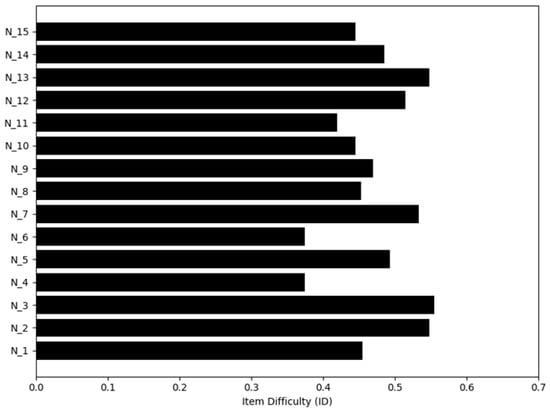
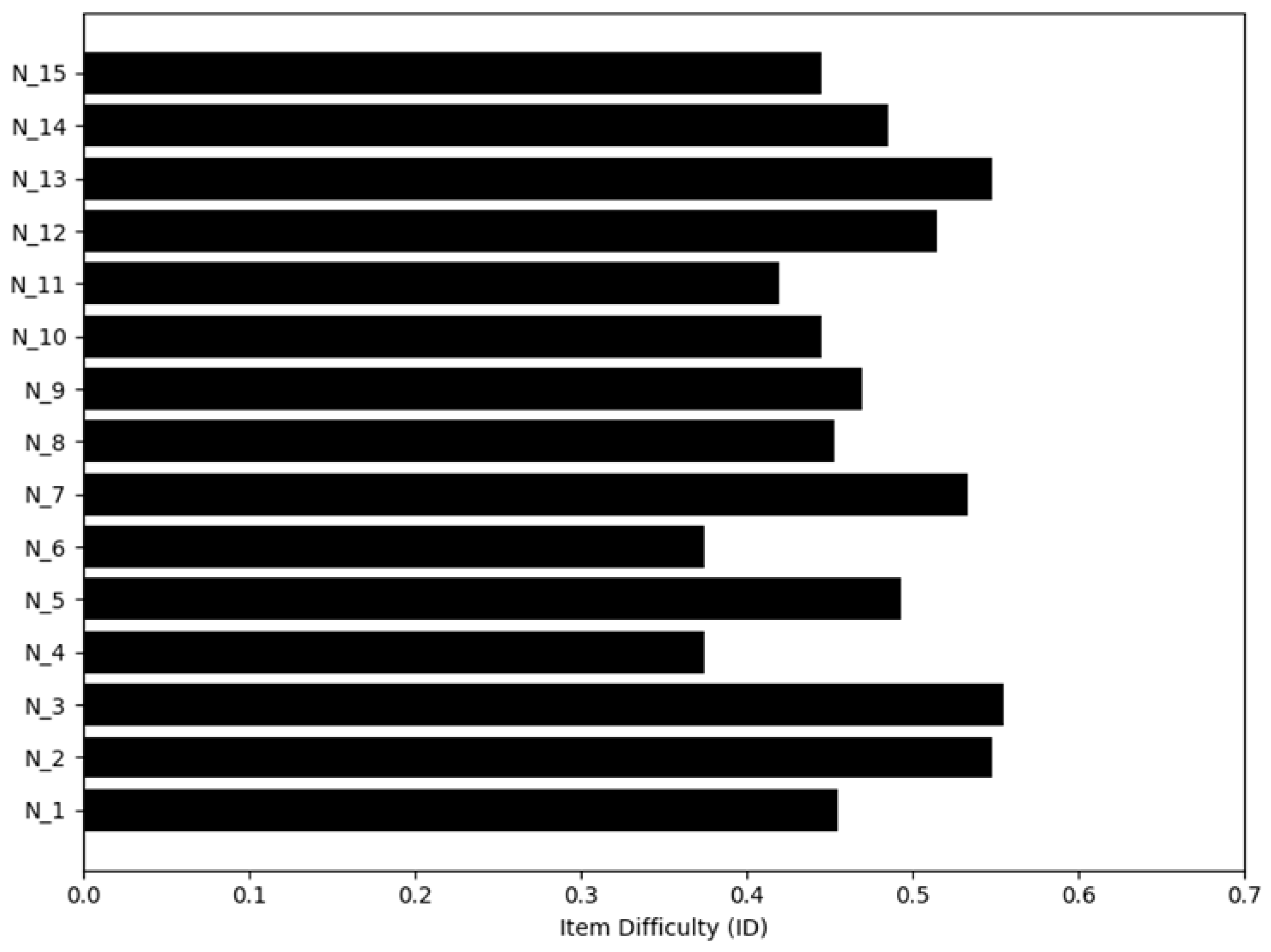
Figure 1 presents the item difficulty (ID) indices for the PL-compatible pedagogy items. Overall, ID values indicated moderate agreement with PL-compatible pedagogical principles across the examined items. The highest ID values were observed for N_3, N_13, N_2, and N_7, suggesting stronger agreement with principles related to “unique journeys”, inclusion, meaningful relationships with PA, and embodiment and integration of body and mind. In contrast, the lowest ID values were identified for N_4 and N_6, indicating comparatively lower agreement with principles related to balancing physical, cognitive, and psychosocial aspects and student involvement in movement choice.
Figure 1.
Item difficulty indices of PL-compatible pedagogy items. N_1 = Student-centered acting; N_2 = Development of a meaningful relationship with physical activities; N_3 = Acknowledgement of “unique journeys”; N_4 = Balance between physical, cognitive, and psychosocial aspects; N_5 = Exploration of different activity contexts; N_6 = Student involvement and provision of movement choice; N_7 = Embodiment and integration of body and mind; N_8 = Building own responsibility for engagement in physical activities; N_9 = Availability of assessment/charting methods for individual progress; N_10 = Transcendence of the current horizon through “lifelong learning”; N_11 = Prioritization of variety and exploration; N_12 = Reward and participation for everyone; N_13 = Inclusion and accessibility of PE for all; N_14 = Student-identified purpose for activities; N_15 = Encouragement of creativity and problem-solving.
Correlations of the PL-compatible items and PL variables are displayed in Table 3. A significant positive correlation was established between N_1 and PL-PAB. Also, significant negative correlations were noted between N_6 and PL-MOT and N_13 and PL-CON.
Table 3.
Correlations of the PL-compatible questionnaire items and PL variables.
4. Discussion
The findings of this pilot study suggest that the Croatian version of the PL-compatible pedagogy questionnaire demonstrated acceptable internal consistency for exploratory purposes and that the scale might reflect a multidimensional construct of PL-compatible pedagogy. Moreover, classroom teachers perceived the PE curriculum as moderately aligned with PL-compatible pedagogy. The strongest perceived agreement was observed for principles related to inclusion, meaningful engagement in PA, and embodiment, whereas lower agreement was found for movement choice and balanced holistic development (i.e., prioritizing fitness/sport/skill aspects). In addition, the questionnaire showed preliminary indications supporting construct validity as several PL-compatible pedagogy items had significant associations with PL dimensions, particularly PL-PAB, motivation, confidence, and overall PL, suggesting that teachers with higher PL may perceive PL-oriented pedagogical principles more strongly. However, given the exploratory nature of this pilot study and the limited sample size, all findings should be interpreted as preliminary and hypothesis-generating rather than confirmatory.
4.1. Questionnaire Validity and Perceived Alignment with PL-Compatible Pedagogy
The findings of this pilot study provide preliminary support for the use of the Croatian version of the PL-compatible pedagogy questionnaire among classroom teachers. Although internal consistency was moderate and the study was conducted on a relatively small and specific sample, the questionnaire appears to show promise as a potentially useful instrument for assessing perceptions of curriculum alignment with PL principles and may be suitable for further research and refinement in larger samples. The relatively low average inter-item correlation and variability in item-total correlations additionally support the assumption that PL-compatible pedagogy represents a broad and multidimensional construct encompassing several distinct pedagogical domains, including inclusion, embodiment, autonomy, meaningful engagement, and lifelong learning. Such multidimensionality is consistent with recent conceptualizations of PL-compatible pedagogy and curriculum alignment proposed in international research (Carl et al., 2025, 2026). Importantly, the questionnaire was not originally designed to measure a single latent construct, but rather to capture several complementary principles of PL-compatible pedagogy. Therefore, relatively modest internal consistency and variability in item–total correlations are not unexpected and should be interpreted in light of the multidimensional nature of the construct rather than solely as evidence of poor reliability. Nevertheless, the performance of several individual items indicates that further refinement and psychometric evaluation are warranted.
Furthermore, the variability observed across individual items may reflect differences in the extent to which specific PL principles are represented within the Croatian PE curriculum and everyday teaching practice. However, it is important to note that the questionnaire has been evaluated only among classroom teachers. Therefore, further studies involving more diverse populations, including PE teachers, are needed before its broader application can be recommended. Although the questionnaire demonstrated acceptable internal consistency for an exploratory study, the relatively modest Cronbach’s alpha coefficient and the low or negative item–total correlations observed for several items indicate that the Croatian version should be considered an initial translation requiring further psychometric evaluation. These findings likely reflect both the multidimensional nature of PL-compatible pedagogy and the limited sample size of the present study. Consequently, additional validation studies involving larger and more diverse populations are necessary before the questionnaire can be recommended for broader application.
Teachers reported the highest perceived alignment for PL-compatible principles related to inclusion, meaningful engagement in PA, and embodiment. Classroom teachers appeared to particularly value pedagogical approaches emphasizing accessibility of PE for all students, the development of positive and meaningful relationships with movement, and the integration of body and mind through movement experiences. In addition, embodiment and meaningful engagement are essential elements of PL as they stimulate students’ connection between movement experiences and emotions, motivation, identity, and lifelong participation in PA (Roberts et al., 2019). The high level of perceived agreement on principles related to inclusion could be associated with current trends in education and recent curricular changes in Croatia that favor inclusive and student-oriented approaches. Indeed, Croatian educational policies promote equal participation opportunities, individualized learning approaches, and the inclusion of all students regardless of their abilities or backgrounds, which may also be reflected in PE practice (Ministry of Science and Education, 2019). Such curricular orientations may contribute to teachers’ greater recognition of inclusion and accessibility as important components of quality PE and PL-compatible pedagogy.
In contrast, lower perceived alignment was observed for principles related to student movement choice and balanced holistic development. Specifically, teachers perceived less compatibility of the PE curriculum with approaches emphasizing student autonomy, individualized movement experiences, and equal integration of physical, cognitive, and psychosocial domains. These perceptions may partly reflect the traditionally performance-oriented emphasis often described in Croatian PE, which has maintained its emphasis on physical standards, sport-related performance, movement abilities, and fitness performance. These issues have also been highlighted by previous research into international literature, showing how, despite an ever-increasing theoretical focus on PL, there tends to be excessive attention paid to the aspect of fitness, skills, and performance in the PE curriculum (Kirk, 2009; Lounsbery & McKenzie, 2015). Such emphasis may leave fewer opportunities for student autonomy, creativity, and individualized movement experiences, which are considered important components of PL-compatible pedagogy. Importantly, these findings should not be interpreted as evidence that the Croatian PE curriculum lacks PL-oriented principles, but rather as an indication of potential areas where PL principles may be less recognized or more challenging to translate into everyday PE experiences. The Croatian PE curriculum already promotes active participation, individual development, and holistic learning; however, teachers’ perceptions suggest that certain PL components, particularly student autonomy, movement choice, and the integration of physical, cognitive, and psychosocial learning experiences, may require additional attention in practice (Ministry of Science and Education, 2019).
4.2. Associations Between Teachers’ Physical Literacy and Perception of PL-Compatible Pedagogy
The observed pattern of associations between teachers’ perceived PL and their perceptions of PL-compatible pedagogy provides preliminary indications supporting the construct validity of the questionnaire. The correlation findings should be interpreted cautiously because the relatively small sample size and the large number of statistical comparisons increase the possibility of unstable estimates and Type I error. Consequently, these associations should be regarded as exploratory and hypothesis-generating rather than confirmatory. Moreover, although most correlations were weak and insignificant, a few significant relations were found between some components of PL and certain pedagogical practices. There appeared to be statistically significant links for student-centered acting, student engagement and motor choices, embodiment, and inclusion, implying that the teachers’ own PL may be associated with their perception of PL-compatible features in the PE program. At the same time, the relatively low number of significant correlations and the lack thereof concerning the overall PL suggests that this association could be rather complicated and multi-dimensional.
When going into the detailed structure, there is a moderate negative correlation between motivation of teachers and their perception of alignment of the PE curriculum in relation to involvement and choice of movements. One possible explanation is that teachers with higher motivation may have greater awareness of PL principles and therefore perceive larger discrepancies between current practice and PL-compatible pedagogy. However, given the exploratory nature of the study, the limited sample size, and the relatively large number of statistical comparisons, this interpretation remains speculative and should be confirmed in future research. Moreover, there was a negative correlation between teachers’ confidence and views on the alignment of the curriculum to inclusive and accessible practice in PE for all children. The possible explanation is that teachers with higher perceived confidence may evaluate curriculum implementation more critically because they have greater awareness of PL principles. Nevertheless, this interpretation also remains speculative and should be confirmed in larger studies. On the other hand, there was a positive correlation between student-centered acting and PA behavior of teachers. That implies that physically active teachers tend to appreciate more the benefits of the adoption of student-centered educational strategies. Prior studies have highlighted that teachers’ beliefs, experiences, and engagement in physical activities play a significant role in promoting good experiences related to physical activities among children (Gomes et al., 2023; Liu et al., 2025). Thus, physically active teachers can realize the significance of creating a supportive learning environment for students to become physically active. Taken together, these correlations should be regarded as exploratory and hypothesis-generating rather than confirmatory, and they require replication in larger and more representative samples.
4.3. Limitations and Strengths
First, the study included a relatively small and homogeneous sample consisting exclusively of female classroom teachers, which limits the generalizability of the findings. However, the exclusively female sample reflects the demographic structure of the Croatian classroom teaching workforce, in which women constitute the majority of teachers in primary education. Although the sample was adequate for an initial exploratory investigation, it does not allow comprehensive psychometric validation of the questionnaire or robust conclusions regarding the broader population of Croatian classroom teachers. Furthermore, the sample size precluded advanced psychometric procedures, such as exploratory and confirmatory factor analyses, measurement invariance testing, and more detailed assessments of construct validity. Therefore, the present findings should be regarded as preliminary and require confirmation in larger samples. Second, due to the cross-sectional design, no causal inferences can be drawn regarding the relationship between teachers’ perceived PL and their perceptions of curriculum alignment with PL-compatible pedagogy. Moreover, no formal adjustment for multiple comparisons was applied because the correlation analyses were intended to be exploratory. Consequently, the possibility of Type I error cannot be excluded and the observed associations should be interpreted as preliminary. Therefore, significant associations should be interpreted cautiously until replicated in independent studies.
However, despite these limitations, the study still offers several important insights related to the use of the PL-compatible pedagogy questionnaire in the Croatian educational environment. To the best of our knowledge, this study is one of the first investigations assessing perceptions of classroom teachers in this regard and goes beyond previous expert assessments by providing insight into classroom teachers’ perceptions of curriculum alignment with PL-compatible pedagogy. In addition, this study adds new information on classroom teachers’ perceptions of the alignment between the Croatian PE curriculum and PL-compatible pedagogy.
5. Conclusions
This pilot study presents preliminary evidence supporting the feasibility and initial psychometric performance of the Croatian version of the PL-compatible pedagogy questionnaire as a measure of classroom teachers’ perceptions of the extent to which PE is compatible with PL principles. Despite being based on an exploratory sample, the questionnaire appeared to have acceptable preliminary psychometric characteristics for exploratory use. Nevertheless, further refinement and comprehensive validation in larger and more diverse samples are required before its broader application can be recommended.
Within this sample, classroom teachers perceived the Croatian PE curriculum as being moderately aligned with PL-compatible pedagogy. The highest levels of agreement were observed for principles related to inclusion, engaging children in physical activities in a meaningful way, respect for the individual experiences of movement, and body awareness. These findings suggest that teachers perceived several core PL principles to be reflected in current PE practice. On the other hand, lower agreement was observed for principles related to student involvement and provision of movement choice, as well as the balance between physical, cognitive, and psychosocial aspects of learning, indicating areas that may require greater attention in future educational practice and research.
However, these results should not be interpreted as evidence that changes to the current PE curriculum are required. Rather, findings provide preliminary insight into classroom teachers’ perceptions of PL-compatible pedagogy and may help inform future research and the development of PL-based educational initiatives. However, given the exploratory nature of the study, the findings should be interpreted with caution. Further validation of the questionnaire in larger and more diverse samples of classroom and PE teachers is needed before its broader use in research or educational practice can be recommended.
Supplementary Materials
The following supporting information can be downloaded at: https://www.mdpi.com/article/10.3390/educsci16081187/s1, Table S1: Translation and adaptation process of the PL-compatible pedagogy questionnaire.
Author Contributions
Conceptualization, B.G.S. and M.S.; Methodology, B.G.S.; Validation, B.G.S.; Formal analysis, B.G.S.; Investigation, P.R.V.; Resources, B.G.S.; Data curation, B.G.S.; Writing—original draft, B.G.S.; Writing—review & editing, P.R.V. and M.S.; Visualization, B.G.S. and P.R.V.; Supervision, M.S.; Project administration, B.G.S.; Funding acquisition, B.G.S. All authors have read and agreed to the published version of the manuscript.
Funding
This study was funded by the Croatian Science Foundation project UIP-2025-02-3974.
Institutional Review Board Statement
The study was conducted in accordance with the principles of the Declaration of Helsinki and was approved by the Ethics Committee of the Faculty of Kinesiology, University of Split (No. 2181-205-02-05-25-020, approved on 17 February 2025).
Informed Consent Statement
Informed consent was obtained from all subjects involved in the study.
Data Availability Statement
The dataset is available upon reasonable request.
Acknowledgments
The authors are grateful to all teachers who participated in this study.
Conflicts of Interest
The authors declare no conflicts of interest.
Abbreviations
The following abbreviations are used in this manuscript:
| PA | Physical activity |
| PE | Physical education |
| PL | Physical literacy |
References
- Bailey, R., Glibo, I., Koenen, K., & Samsudin, N. (2023). What is physical literacy? An international review and analysis of definitions. Kinesiology Review, 12(3), 247–260. [Google Scholar] [CrossRef] [Scilit]
- Beaton, D. E., Bombardier, C., Guillemin, F., & Ferraz, M. B. (2000). Guidelines for the process of cross-cultural adaptation of self-report measures. Spine (Phila Pa 1976), 25(24), 3186–3191. [Google Scholar] [CrossRef] [Scilit] [PubMed]
- Cairney, J., Dudley, D., Kwan, M., Bulten, R., & Kriellaars, D. (2019). Physical literacy, physical activity and health: Toward an evidence-informed conceptual model. Sports Medicine, 49(3), 371–383. [Google Scholar] [CrossRef] [Scilit] [PubMed]
- Caldwell, H. A. T., Di Cristofaro, N. A., Cairney, J., Bray, S. R., MacDonald, M. J., & Timmons, B. W. (2020). Physical literacy, physical activity, and health indicators in school-age children. International Journal of Environmental Research and Public Health, 17(15), 5367. [Google Scholar] [CrossRef] [Scilit] [PubMed]
- Carl, J., Goss, H., Lundvall, S., Pavlova, I., Algurén, B., Antala, B., Bartle, G., Birch, J., Black, V., Bryant, A. S., Carlos-Vivas, J., Christodoulides, E., Cowley, J. G., Csányi, T., De Martelaer, K., Emeljanovas, A., Eren, G., Fernāte, A., Foweather, L., … Salin, K. (2025). Compatibility of physical education curricula with physical literacy across 40 European countries. Journal of Curriculum Studies, 1–21. [Google Scholar] [CrossRef] [Scilit]
- Carl, J., Salin, K., Barnett, L. M., Foweather, L., Jurak, G., Martins, J., Müller, I., O’Brien, W., Venetsanou, F., Singh, A., Elsborg, P., Goss, H., Lundvall, S., Pavlova, I., D’Anna, C., & Vlček, P. (2026). Alignment of physical education curricula with physical literacy across Europe: An observational mapping study with country-level predictors. The Lancet Regional Health-Europe, 65, 101641. [Google Scholar] [CrossRef] [Scilit] [PubMed]
- DeCorby, K., Halas, J., Dixon, S., Wintrup, L., & Janzen, H. (2005). Classroom teachers and the challenges of delivering quality physical education. The Journal of Educational Research, 98(4), 208–221. [Google Scholar] [CrossRef] [Scilit]
- Essiet, I. A., Warner, E., Lander, N. J., Salmon, J., Duncan, M. J., Eyre, E. L. J., & Barnett, L. M. (2024). Exploring Australian teachers’ perceptions of physical literacy: A mixed-methods study. Physical Education and Sport Pedagogy, 29(1), 18–37. [Google Scholar] [CrossRef] [Scilit]
- Gerovac, A., Emeljanovas, A., Petrusic, T., & Novak, D. (2025). Generalist vs. physical education specialist elementary school teacher: Do teacher characteristics matter? Kinesiologia Slovenica: Inspiring Excellence: Empowering the Future of Physical Education and Sport, 31(1), 84–99. [Google Scholar] [CrossRef] [Scilit]
- Gilic, B., Rajkovic Vuletic, P., Maras, N., Sekulic, D., & Sajber, D. (2025a). Physical activity and body composition outcomes of the “primary school as a whole-day school” program in early school-age children from Croatia. Applied Sciences, 15(23), 12728. [Google Scholar] [CrossRef] [Scilit]
- Gilic, B., Sekulic, D., Munoz, M. M., Jaunig, J., & Carl, J. (2025b). Translation, cultural adaptation, and psychometric properties of the perceived physical literacy questionnaire (PPLQ) for adults in Southeastern Europe. Journal of Public Health, 1–11. [Google Scholar] [CrossRef] [Scilit]
- Gomes, L., Martins, J., Ramos, M., & Carreiro da Costa, F. (2023). The impact of non-physical education teachers’ perceptions on the promotion of active and healthy lifestyles: A cross-sectional qualitative study. International Journal of Environmental Research and Public Health, 20(3), 2026. [Google Scholar] [CrossRef] [Scilit] [PubMed]
- Grauduszus, M., Wessely, S., Klaudius, M., & Joisten, C. (2023). Definitions and assessments of physical literacy among children and youth: A scoping review. BMC Public Health, 23(1), 1746. [Google Scholar] [CrossRef] [Scilit] [PubMed]
- Guthold, R., Stevens, G. A., Riley, L. M., & Bull, F. C. (2020). Global trends in insufficient physical activity among adolescents: A pooled analysis of 298 population-based surveys with 1.6 million participants. The Lancet Child & Adolescent Health, 4(1), 23–35. [Google Scholar] [CrossRef] [Scilit] [PubMed]
- Jukic, N., Pehar, M., Kvesić, I., Kontić, D., & Zenić, N. (2026). Analyzing associations between health literacy, physical literacy, and physical activity: A structural comparison of exercising and non-exercising older women. Sport Mont, 24(1), 159–167. [Google Scholar] [CrossRef] [Scilit]
- Kirk, D. (2009). Physical education futures. Routledge. [Google Scholar]
- Kline, P. (2015). A handbook of test construction (psychology revivals): Introduction to psychometric design. Routledge. [Google Scholar]
- Liu, Y., Yan, J., & Li, J. (2025). The relationship between physical education teachers’ competence support and middle school students’ participation in sports: A chain mediation model of perceived competence and exercise persistence. PLoS ONE, 20(1), e0314338. [Google Scholar] [CrossRef] [Scilit] [PubMed]
- Lounsbery, M. A., & McKenzie, T. L. (2015). Physically literate and physically educated: A rose by any other name? Journal of Sport and Health Science, 4(2), 139–144. [Google Scholar] [CrossRef] [Scilit]
- Mandigo, J., Francis, N., Lodewyk, K., & Lopez, R. (2009). Physical literacy for educators. Physical & Health Education Journal, 75(3), 27. [Google Scholar]
- McLennan, N., & Thompson, J. (2015). Quality physical education (QPE): Guidelines for policy makers. Unesco Publishing. [Google Scholar]
- Ministry of Science and Education. (2019). Curriculum for the subject physical and health education for primary and secondary schools in the Republic of Croatia. Official Gazette.
- Morgan, P., & Hansen, V. (2007). Recommendations to improve primary school physical education: Classroom teachers’ perspective. The Journal of Educational Research, 101(2), 99–108. [Google Scholar] [CrossRef] [Scilit]
- Roberts, W. M., Newcombe, D. J., & Davids, K. (2019). Application of a constraints-led approach to pedagogy in schools: Embarking on a journey to nurture physical literacy in primary physical education. Physical Education and Sport Pedagogy, 24(2), 162–175. [Google Scholar] [CrossRef] [Scilit]
- Unesco. (2024). The global state of play: Report and recommendations on quality physical education. Unesco. [Google Scholar]
- Valle-Muñoz, V. M., Mendoza-Muñoz, M., & Villa-González, E. (2025). Physical literacy as a pedagogical model in physical education. Children, 12(8), 1008. [Google Scholar] [CrossRef] [Scilit] [PubMed]
- Xiang, P., Lowy, S., & McBride, R. (2002). The impact of a field-based elementary physical education methods course on preservice classroom teachers’ beliefs. Journal of Teaching in Physical Education, 21(2), 145–161. [Google Scholar] [CrossRef] [Scilit]
- Yıldızer, G., & Munusturlar, S. (2022). Differences in perceived physical literacy between teachers delivering physical education in schools: Classroom teachers vs. physical education teachers. Physical Education and Sport Pedagogy, 27(6), 626–639. [Google Scholar] [CrossRef] [Scilit]

Disclaimer/Publisher’s Note: The statements, opinions and data contained in all publications are solely those of the individual author(s) and contributor(s) and not of MDPI and/or the editor(s). MDPI and/or the editor(s) disclaim responsibility for any injury to people or property resulting from any ideas, methods, instructions or products referred to in the content. |
© 2026 by the authors. Licensee MDPI, Basel, Switzerland. This article is an open access article distributed under the terms and conditions of the Creative Commons Attribution (CC BY) license.