1. Introduction
Educational transformation is widely seen as a systemic process that transcends isolated innovations to shape school organization, culture and practices (
Gairín Sallán & Rodríguez-Gómez, 2011;
Murillo & Krichesky, 2015). This view entails a paradigm shift: moving away from top-down, externally driven teacher professional development models toward approaches in which schools cease to be mere recipients of guidelines and instead become active agents of their own development. Within this framework, teacher professional development plays a key role as a strategic driver of transformation, since collective learning and institutional reflection help redefine the school’s pedagogical identity (
Bolívar, 2019;
Fullan, 2007). To ensure meaningful impact, research highlights the need to approach professional development not as a fragmented activity, but as situated, reflective practice that creates professional learning communities capable of turning knowledge into tangible improvements in classroom practice (
Darling-Hammond et al., 2017;
Desimone, 2009).
Although there is growing theoretical consensus regarding the importance of sustained, school-based professional development for educational improvement, empirical evidence of how these initiatives contribute to institutional transformation remains comparatively limited. Existing research has largely focused on their effects on teachers’ knowledge, beliefs and classroom practices, whereas less attention has been paid to the organizational, cultural and pedagogical changes that emerge from long-term, school-based professional development processes, as well as to the indicators that may help identify and assess such transformations. As a result, a gap persists between what is known about individual teacher learning and what is understood about the mechanisms through which that learning becomes embedded in schools’ structures, cultures and improvement processes.
In response to this gap, this study analyses the changes resulting from two years of delivery of a sustained, school-based programme focused on collaborative reflection on practice. Specifically, it examines how ongoing teacher professional development contributes to processes of institutional transformation and identifies the organizational, cultural and pedagogical changes that emerge during this process. To guide the analysis, the study addresses the following research questions:
RQ1. What institutional, organizational and pedagogical changes are observed after two years of participation in a sustained school-based professional development programme?
RQ2. How do these changes contribute to processes of institutional transformation within participating schools?
RQ3. What indicators emerge from the implementation of the professional development programme that can inform the design, implementation and evaluation of future professional development initiatives aimed at fostering deep and sustainable school improvement?
By exploring the relationship between ongoing teacher education and organizational development, the study contributes empirical evidence to current debates on how educational transformation can be effectively enacted and sustained within schools.
2. Theoretical Framework
The literature on teacher professional development distinguishes between short-term, workshop-based models and sustained, school-based approaches embedded in teachers’ daily practice (
Feixas et al., 2013;
Gairín Sallán, 2010;
Pineda-Herrero et al., 2020;
Rodríguez Torres et al., 2022). From a school improvement perspective, these approaches are associated with organizational learning processes and the development of professional learning communities that support sustained change (
Agirdag & Muijs, 2023;
Harris, 2002;
Hopkins, 2001). Effective professional development is characterized by active learning, collaboration, continuity, and alignment with everyday school contexts (
Darling-Hammond et al., 2017;
Fernandes et al., 2023;
Postholm, 2018). These conditions are reinforced through leadership structures, professional cultures, and school–community relationships that support institutional learning and change.
Sustainability in educational transformation processes largely depends on schools’ capacity to create institutional learning processes. Within this framework, the school improvement movement (
Agirdag & Muijs, 2023;
Hopkins, 2001;
Harris, 2002) examines how schools develop processes aimed at improving both institutional quality and teaching practices.
Murillo and Krichesky (
2015) and
Agirdag and Muijs (
2023) argue that school effectiveness is built through high-quality professional development for both teachers and leaders, by developing professional learning communities and in-service training, which in turn improve teaching and learning outcomes.
The literature identifies key organizational dimensions that underpin these processes. These include: pedagogical and distributed leadership (
Galdames-Calderón, 2023), which spurs the involvement of the entire teaching staff and acts as a key factor in teachers’ professional development (
Murillo & Krichesky, 2015;
Pang et al., 2016); the construction of a collaborative professional culture based on trust and collective reflection among teachers, which fosters the development of professional learning communities (
Murillo & Krichesky, 2012); and strong relationships with the educational community and the local ecosystem, which legitimises change and strengthens schools’ social role (
Pericacho Gómez et al., 2019).
Viewed from this perspective, teacher professional development plays a significant role, since educational transformation depends on schools’ capacity to boost collective professional learning and channel it into sustainable changes in educational practices. Professional development programmes aiming for structural transformation respond to the needs of the institutional context and involve the whole teaching staff in collective learning processes. Thus, contemporary models of professional development emphasize the importance of collaborative learning, reflective practice, and the consolidation of professional communities capable of generating deep and lasting change. These processes tend to develop gradually and become embedded in school culture, often through non-linear dynamics characterized by tensions, adjustments and setbacks (
Darling-Hammond et al., 2017;
Murillo & Krichesky, 2012;
Timperley, 2011).
Building on such approaches, the literature has identified a set of characteristics defining high-impact professional development programmes. On the one hand, they should be aligned with workplace needs, foster participant engagement, and be supported by institutional conditions that facilitate the implementation of learning (
Pineda-Herrero et al., 2020). Further, they should include a focus on subject content, promote active learning and collaboration among teachers, be sustained across time, and be congruent with the school setting (
Desimone, 2009). Hence, a number of studies stress that research and practice should be closely linked in educational improvement, shaping each other mutually across consecutive phases of change (
Pericacho Gómez et al., 2019).
Despite the consensus on the potential of teacher professional development as a driver of educational improvement, its impact on educational practices remains uneven, and there is still limited empirical evidence on how these programmes translate into sustained institutional change in schools. A gap persists between the knowledge acquired through teacher education, its implementation in the classroom, institutional transformation, and the sustainability of change. Most studies on the impacts of professional development focus on individual educators taking part in isolated courses or workshops, whereas fewer explore impacts on the whole school (
Guskey, 2002). Thus, although many studies analyse individual teaching practices, teachers’ beliefs, or professional competencies (
Wang et al., 2024), real educational transformation involves changes in professional culture, collaborative work structures, pedagogical decision-making, and school organization. It is therefore necessary to examine how teacher professional development programmes contribute to institutional transformation. In this regard, a number of studies stress that the content and orientation of these programmes affect the depth of any resulting changes.
Processes of educational transformation, however, are often described in general terms, and there is still limited information as to what specific indicators can systematically characterize these processes. Identifying such indicators is essential for guiding the design of professional development programmes, assessing their impact, and understanding the mechanisms of change. Thus, some programme evaluation models, such as that developed by
Kirkpatrick (
1993), later expanded by
Kirkpatrick and Kirkpatrick (
2007), analyse impacts across various levels, including participant reactions, learning outcomes, implementation in professional practice, and results derived from implementation. Institutional transformation processes in schools have been less explored, however. In these cases, indicators of change may be found in the emergence of a collective culture of reflection, the redefinition of shared pedagogical criteria, or the adoption of new institutional practices. From a broader perspective,
Tejada Fernández and Ferrández Lafuente (
2007) emphasize that the impacts of ongoing teacher education should be analysed according to different purposes—diagnostic, formative, and summative—and across multiple levels of results, ranging from initial satisfaction and learning acquisition to implementation in the workplace and organizational effects. This perspective highlights the need to identify indicators that capture not only immediate outputs but also outcomes in the areas of institutional culture and professional practice.
3. Materials and Methods
This study adopts a longitudinal qualitative design aimed at analysing the institutional and pedagogical transformations resulting from the delivery of a four-year school-based professional development programme. Specifically, it examines the changes observed after two years of participation in the Magnet programme, in order to address the research questions concerning (a) the institutional, organizational and pedagogical changes that emerge during programme implementation, (b) how these changes contribute to institutional transformation, and (c) what indicators emerge from the implementation of the programme that can inform the identification and assessment of institutional transformation.
The research is grounded in the case study tradition and adopts a multiple-case study approach (
Yin, 2017), which yields an in-depth understanding of processes in their real-life setting and enables the exploration of the complexity of transformations through comparisons between schools. The study starts from a baseline (Year 0, the 2022–2023 academic year) and analyses its evolution in Year 2 (the 2024–2025 academic year), thus capturing processes of change over time and assessing their degree of consolidation within the social, organizational and educational context of each school.
3.1. Research Context: The Magnet Programme and Participating Schools
This article forms part of an overall assessment of a school-based professional development programme titled Magnet: Partnerships for Educational Success (Magnet: Aliances per a l’Èxit Educatiu), set up by the Jaume Bofill Foundation in cooperation with the Catalan Government Department of Education and Vocational Training. The programme combines pedagogical innovation and organizational change, with the aim of redefining school identity, strengthening professional learning communities, and improving schools’ visibility and engagement with their local ecosystem, with a specific focus on reducing school segregation. Its four-year design is based on sustained school-based training fostering co-creation, collaborative work, reflective practice, and the establishment of partnerships with external institutions in order to support school transformation. Magnet involves multiple actors, including educational administrators and external partners, thus creating a multi-level support structure. Each school is assigned a trainer who guides the process, facilitates collective reflection, and adapts the programme to the specific needs of the context. Trainers receive an initial ten-hour preparation course during Year 0, complemented by thirty hours of annual training and support sessions in subsequent years.
Given the progressive nature of the programme, the Education Sciences Institute (ICE in its Catalan initials), in cooperation with the Education Faculty at the Autonomous University of Barcelona, conducted an independent longitudinal evaluation. In the initial phase (Year 0), a baseline diagnostic study was conducted in the participating schools (n = 6; five primary schools and one secondary school). This assessment established the baseline conditions and developed a system of analytical dimensions for monitoring processes of change: the educational project, leadership, organization, methodology, school climate, relationship with the local ecosystem, and social composition. In Year 2 of the programme, the time period focused on in this article, the analysis examined the evolution of the schools that had continued participating from the initial phase (n = 3), using the same analytical dimensions. Across data collection points, participants in interviews and focus groups were primarily school staff members, and while some individuals participated in both Year 0 and Year 2, others varied due to staff turnover and availability. Therefore, the composition of respondents was partially consistent across time, reflecting the natural dynamics of school staffing. While the professional development programme focused on the implementation and consolidation of pedagogical practices, reflective practice, and organizational alignment, assessment focused on identifying observable changes and exploring factors explaining institutional transformation processes.
The final sample consisted of the three schools (School B, School C and School D) that had remained in the programme up to Year 2, out of the initial six schools initially meeting the programme criteria of (1) having unbalanced social composition in relation to their local context, and (2) having teaching staff predisposed to change. The remaining three schools withdrew from the programme due to internal organizational decisions agreed on with the programme. As these schools did not complete the implementation cycle under analysis, they were excluded from the final sample. This attrition introduces a potential selection effect, since schools that persisted in the programme may differ systematically from those that withdrew, for example in terms of leadership stability, institutional engagement, collaborative culture, and capacity for sustained participation in innovation processes. Consequently, the final sample reflects only schools that completed the first two years of implementation, which should be taken into account when interpreting the findings.
The three participating schools were state-maintained primary schools located in differing socio-educational settings: a semi-urban area in southern Catalonia, a peripheral rural-Pyrenean context, and a metropolitan urban socio-educational context characterized by high population mobility. Despite these differences, they all faced similar challenges relating to inclusion and educational equity. The schools numbered 300 to 450 students, of whom 35–48% were of foreign origin.
3.2. Data Production
Data production was carried out from March to September 2025, using a combination of qualitative methods to ensure triangulation of sources and perspectives within the educational ecosystem of the participating schools. Three main strategies were adopted: (a) focus groups and interviews; (b) non-participant observations; and (c) document analysis (
Table 1).
3.2.1. Focus Groups and Interviews
A total of 14 focus groups (6–8 participants) and 9 semi-structured interviews were conducted with key stakeholders from the schools, namely: the leadership teams, teachers, Magnet steering group, students, families, school inspectors, Magnet trainers, and representatives of partner institutions. These techniques made it possible to contrast perceptions of change, identify enablers and barriers, and gain deeper insight into the dynamics of institutional transformation.
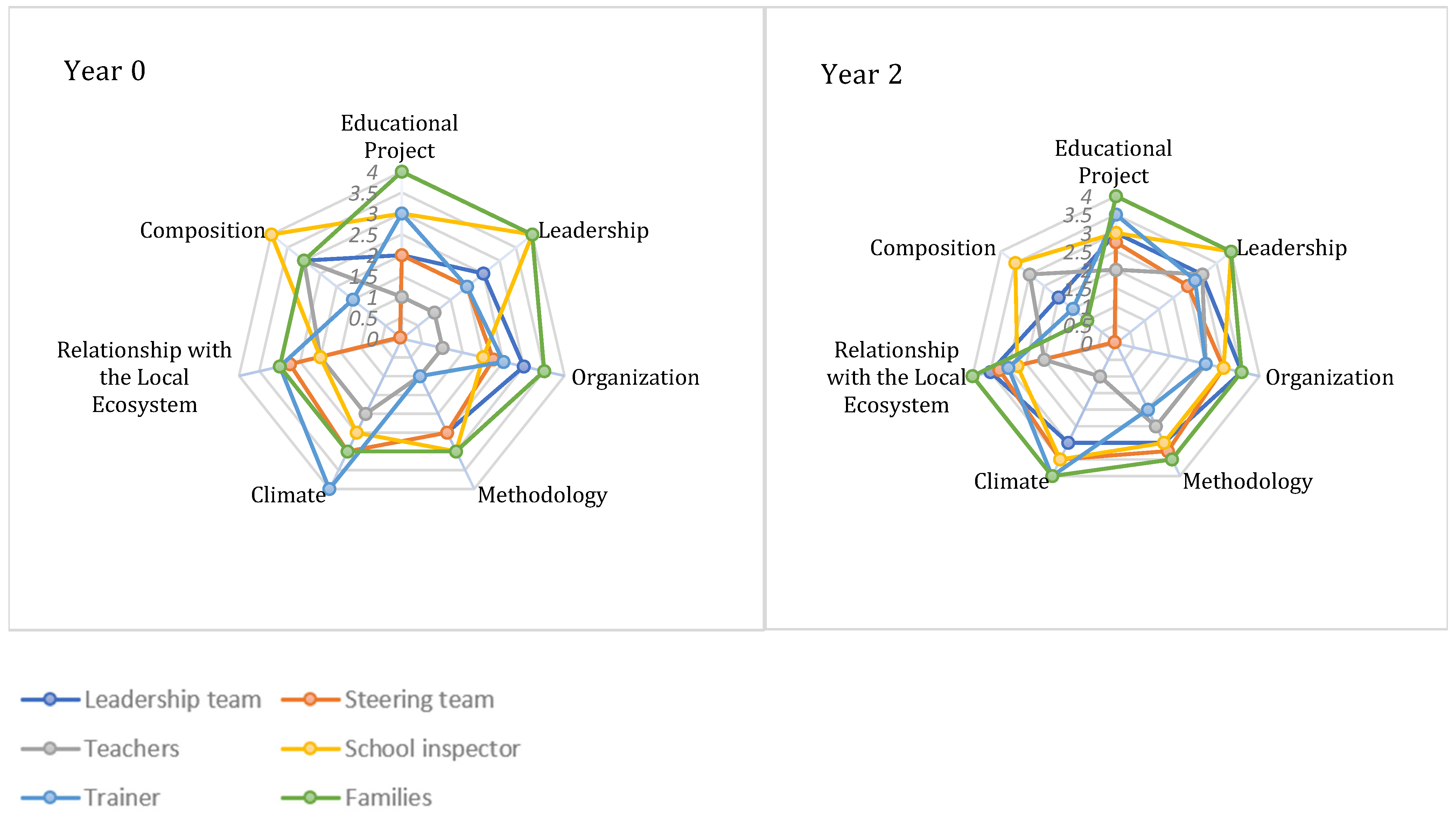
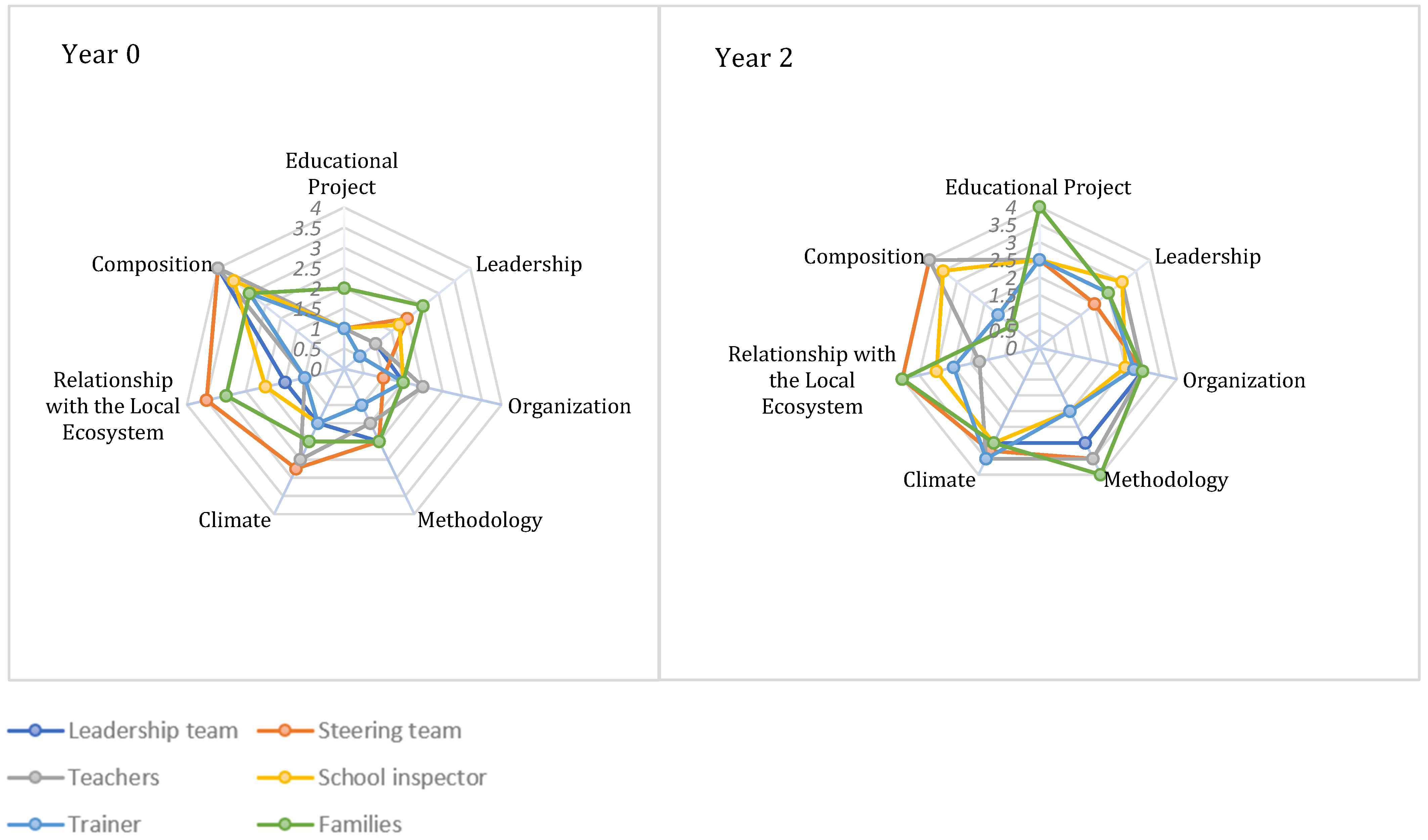
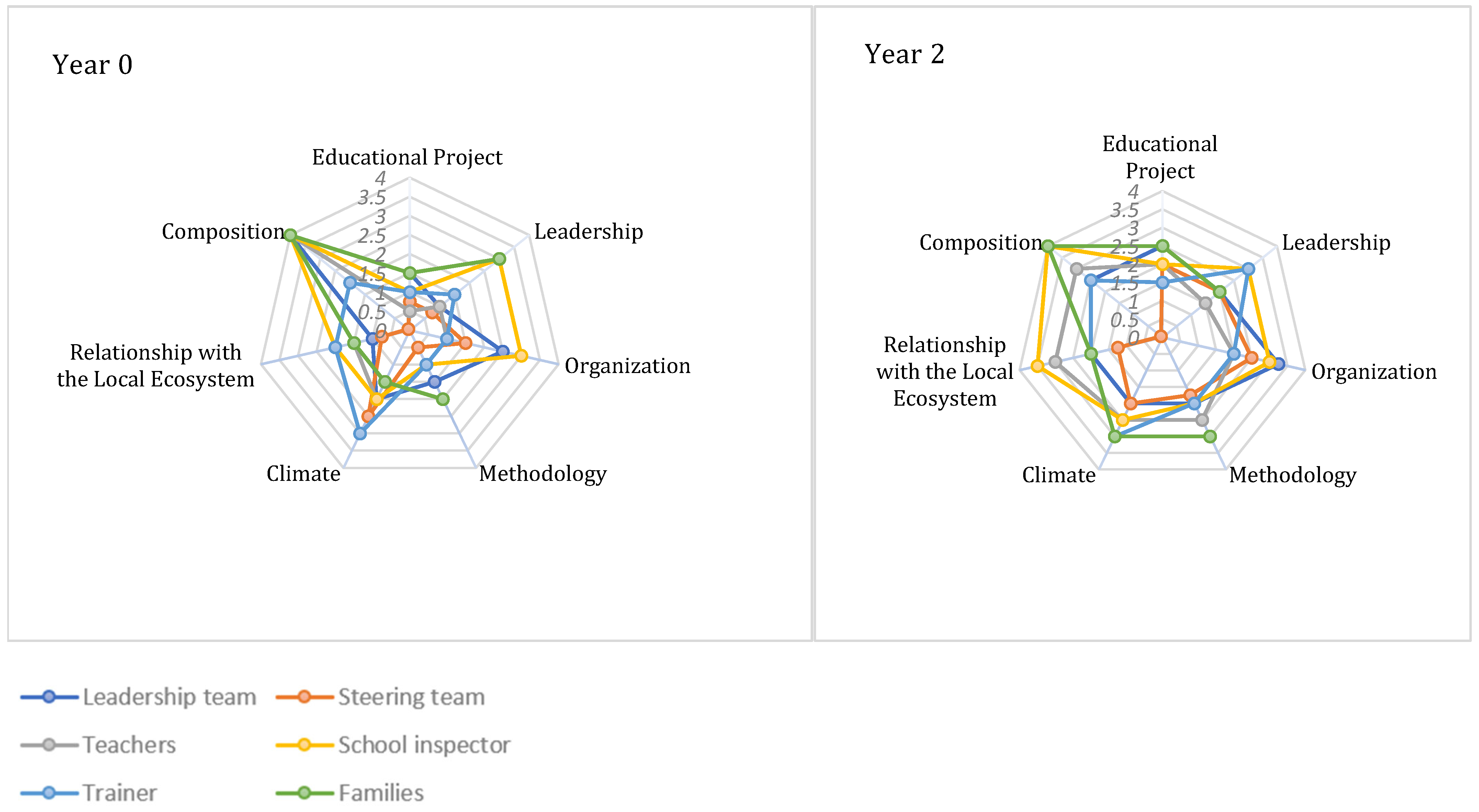
To facilitate participation and ensure comparability, the discussion groups were structured using a visual elicitation instrument based on a polygon diagram. Participants were asked to assess the school’s situation at two points in time (Year 0 and Year 2) in relation to the analytical dimensions defined in the baseline phase, using a scale from 0 to 4 (where 0 indicated absence or incipient practice and 4 indicated consolidation or widespread implementation). For example, in the area of leadership, 0 corresponded to “no visible leadership” and 4 to “distributed and shared leadership among staff members.”
Another version of this instrument was designed for partner institutions, focusing on eight dimensions: integration of the partner with the school, collaboration and co-creation, school methodologies, teacher participation, relationship with the local ecosystem, school image, partner learning, and partner recognition/image. Each dimension was also assessed on a 0–4 scale with specific descriptors.
This tool served both as a quantitative instrument for capturing perceived changes and as a qualitative resource, since its main value lay in the discussions it generated, encouraging reflection on the factors underlying these changes.
3.2.2. Non-Participant Observation
Nine non-participant classroom observations, school walkthroughs, and four observations of training sessions were also conducted in the same time period. These observations enabled us to document actual practices, interactions and organizational processes, providing direct, contextualized comparisons with participants’ testimonies. They also facilitated the identification of implicit aspects of school functioning, such as the level of teacher collaboration and student participation and the coherence of professional development with implementation in classroom practice.
3.2.3. Document Analysis
Document analysis was used as a complementary approach, and included a review of key institutional documents (the school educational project, school leadership project, annual reports, internal regulations, annual general planning and strategic plans). These documents were compared with those collected in Year 0 to identify changes in priorities, institutional discourse and organizational structures (
Table 2). This analysis made it possible to examine the degree of formal integration of the Magnet programme into school functioning and provided contextual information helping to interpret the changes observed.
3.3. Data Analysis
A comparative thematic approach using CAQDAS Atlas.ti v25 software was adopted for data analysis. In the first phase, qualitative data (interviews, focus groups, observations and documents) were coded with a combination of deductive categories (derived from the initial analytical framework) and emerging inductive categories. The initial coding framework included predefined dimensions (e.g., leadership, organization, methodology, school climate), which were progressively refined during open coding. For example, within leadership, sub-codes such as distributed coordination and steering group mediation were developed inductively. In the second phase, within-case analyses were carried out to reconstruct the trajectory of each school and identify key changes, processes and explanatory factors. Subsequently, cross-case analysis was performed to identify common patterns, divergences and recurring mechanisms of transformation. Triangulation of sources (discursive, observational and documentary) was used to strengthen the validity of the findings and to identify consistencies and discrepancies between perceptions and practices. Emerging findings were regularly discussed within the research team to challenge assumptions and refine interpretations. Reflexive notes were also used to track interpretive decisions and ensure transparency in the analytical process. Data from the polygon diagrams were used descriptively to complement and visualize the perceived changes.
The analysis approached institutional transformation as a multidimensional process integrating both organizational and pedagogical dimensions. The dimensions analysed included: (a) coherence and the common vision of the educational project; (b) leadership; (c) organization; (d) methodology; (e) school climate; (f) relationships with the local ecosystem; and (g) social composition. Empirical indicators of change were identified as observable or reported changes in practices, structures or relationships attributable to the professional development process. These indicators included: increases in collective planning and provision for reflection; introduction of enquiry-based methodologies; consolidation of coordination structures; strengthening of partnerships; and the incorporation of principles derived from the programme into institutional documents.
3.4. Ethical Considerations
All participants were informed on the objectives of the study and participated voluntarily. Informed consent was obtained from all adult participants and from the families of the students involved. Anonymity and confidentiality were ensured using pseudonyms for the schools, and data protection principles were strictly followed. The study was authorized by the Department of Education and Vocational Training of the Government of Catalonia and classified as non-invasive and of minimal risk. It was conducted in accordance with the ethical principles established by the by the Autonomous University of Barcelona ethics committee. The research team maintained full analytical independence from the programme’s sponsoring and implementing institutions, with no involvement of these entities in data analysis or interpretation.
4. Results
The aggregated analysis of the Magnet programme assessments provided by the different school stakeholders (leadership teams, steering groups, teachers, inspectors, trainers and families) revealed a significant evolution in the process experienced between the year of entry into the programme (Year 0) and the stage studied (Year 2). This evolution is summarized in the figures below (
Figure 1,
Figure 2 and
Figure 3) and in the scores assigned to the analytical dimensions under consideration, namely: the educational project, leadership, organization, methodology, school climate, relationships with the local ecosystem, and social composition.
4.1. Educational Project and Leadership
Across the three schools, improved definition of the educational project was observed, although with clear differences. At the time of entering the Magnet programme, Schools B and C were characterized by poorly defined educational projects and leadership with limited institutional impact. In contrast, School D started from an intermediate level of development, with a more structured educational project but divergent perceptions of leadership.
At year 2, all three schools showed a positive evolution. School B demonstrated favourable progression, albeit with less longitudinal consistency; School C consolidated improvements in internal coherence and leadership distribution; and School D revealed greater institutional maturity and consensus. Overall, there was a clear trend toward more sharply defined educational projects and more distributed leadership.
The incorporation of the Magnet principles had acted as a catalyst for this shift, enabling leadership teams to adopt more transformational, distributed and democratic leadership approaches.
Two years ago, we were working really separately. We had nothing to do with each other […] I’ve seen that there’s improvement and consensus, that we’re all moving in the same direction, but we still have a long way to go.
(Steering team, School B)
What’s most important in a school? The school’s direction. And with Magnet, what’s being attempted is to create a school direction. The projects. That’s what we’re working on.
(Steering team, School C)
Across the three schools, the Magnet programme was perceived to have made visible the state of the existing educational project, both within the teaching community—by prompting reflection and fostering channels and opportunities for pedagogical communication, thereby fomenting change—and in the establishment of partnerships and the external projection of the project. Thus, the programme’s contribution can be understood across a continuum, as having helped to enrich existing initiatives from their respective starting points:
Magnet has made it visible, encouraged reflection, and given it value, first in the teaching community itself, and with the belief that we need to project it outwards […] The feeling is that it’s a continuum.
(Steering team, School D)
4.2. Organization and Methodology
All three schools had established commissions (working groups composed of teachers from different educational stages) to address pervasive and systemic factors and to organize school-wide educational action. In all cases, an improvement in organizational processes was observed; in contrast, no group assigned a maximum score (4), and differences between the schools remained.
The creation of commissions and more horizontal structures (particularly the steering teams) had encouraged greater teacher participation in the core of the project across all three schools. This had strengthened teachers’ sense of belonging and increased their level of engagement. The steering groups had become key drivers of change, acting as catalysts for pedagogical leadership and serving as a link between leadership teams, trainers and teaching staff.
I think the steering group’s gained a lot of prominence, it’s become stronger, there’s a good deal of work in the steering group, there’s motivation—I’d say it’s quite a cohesive group—so I see a lot of strength there.
(Trainer, School C)
However, differing situations persisted. While Schools B and C started from more traditional organizational models and less participatory pedagogical practices, School D was in a more favourable position, although still rooted in conventional approaches and with room for development. At year 2, School C had made progress toward more collaborative and student-centred models, while in School D organizational improvements were stronger than methodological ones, in which progress had been more gradual. School B showed positive advances overall.
In general terms, although methodological changes were oriented towards more student-centred and active-learning practices, there was still a need to further develop learning environments which placed students at the centre of the process, fostered constructive, self-regulated learning, and made the most of the potential of the setting.
P3: I think we’re on the right track, but we need to keep working. […]
P4: Gradually changes have been made. With each passing year, I’ve seen improvement—we’re moving towards a more experiential methodology, placing the student at the centre of their own learning. My view’s very positive.
(Teachers, School D)
The Magnet programme had served as a stimulus for the exchange of experiences, collective reflection and peer observation. However, resistance to change and the diversity of existing practices at the beginning of the project, among other factors, had slowed progress and the consolidation of change. As a result, methodological transformation emerged as one of the areas with the slowest development.
4.3. School Climate
In the area of school climate and daily life, all three schools had seen improvements in internal relationships, with increased social cohesion, particularly in contexts where collaborative work dynamics and interactions among teachers from different stages had been strengthened. Schools B and C started from low or intermediate levels, with still limited perceptions of openness and cohesion, whereas School D’s initial situation was more favourable, despite internal differences in evaluations.
Over time, School C showed improvement in internal cohesion and a progressive strengthening of its links with the local ecosystem, while School D consolidated a more positive climate and stronger community connections. School B also demonstrated improvements in these areas. Overall, this was one of the dimensions showing the most across-the-board progress in all three schools.
P3: I think we’ve never had an opportunity for the whole staff to come together and talk, even if it was just… We talked about objectives, but now you have contact with people you wouldn’t normally interact with. […]
P5: It’s also given us an opportunity to share experiences, which we didn’t have before. And it’s opened the door to visiting other stages to see how they work, to engage in some cross-level collaboration.
(Steering group, School C)
The Magnet programme had encouraged the provision of opportunities for meetings, dialogue, reflection and joint construction, but it had also brought to light divergences among teachers.
P2: Maybe now we share more time, and that helps improve the climate.
P1: Because before you might never meet, and now you do. For one reason or another, you see each other more.
(Steering group, School B)
However, in schools where fragmented or “balkanized” relationships existed among teachers, or where reactive attitudes toward change persisted in opposition to leadership-driven initiatives, the school climate was negatively affected. This helps explain some of the lower ratings assigned by participants, which were sometimes linked to factors beyond the school itself, such as teacher mobility. In some cases, these perceptions were also associated with the excessive workload reported by teachers, which could generate tensions and influence professional and personal relationships.
4.4. Relationships with the Local Ecosystem
Relationships with the local ecosystem showed progress toward more stable and shared forms of working together. Participation in the Magnet programme had fostered greater openness among the schools towards their surroundings and students’ families, in addition to increased visibility in the local setting and on social media. Nevertheless, further efforts were needed to strengthen the schools’ external projection and to develop methodologies and objectives in common with local stakeholders.
Magnet has really helped with one thing that’s being worked on—and that we’re working on—which is external communication. It’s a school that has opened up. In other words, what they do… they’re doing more things now than two years ago, than in Year 0, but what they’re doing is being shared, communicated to the outside. And this has reached, it’s reaching the [local area].
(Trainer, School B)
In terms of relationships with partner institutions, experiences varied. In some cases, partner involvement evolved from occasional participation to having an increasing influence on the pedagogical and organizational life of the school, while in others their role remained more limited. However, in most cases, the assessment was positive, particularly in School D:
P5: With the partner—amazing. Top marks, top marks, I mean……
[Affirmative reactions]
P1: Yes, with the partner, really good.
I1: Would you give the partner a score of 4? [the maximum score in the discussion group]
P5: Yes—and 25 if we could. Incredible.
[Unanimous response] “Yes, yes.”
P4: Very involved, very professional… […]
P5: They make proposals. First, they’re open to requests, but then based on those requests they’re extremely creative and make proposals. Some have come from the partner and others from the trainer… It’s also helped a lot to have a liaison person from the partner for each level… Some things are repeated, but everyone—each level—clearly knows who their liaison person is.
(Teachers, School D)
Nevertheless, several factors limited both the nature and sustainability of these collaborations. These included the challenges associated with project-based work, teachers’ need to follow the prescribed curriculum, and the availability of personnel within partner organizations. Despite the progress made, then, there was still room for improvement, particularly in some schools, both in terms of fostering more proactive relationships with partners and in ensuring the continuity of cooperation throughout the school year.
4.5. Social Composition
As previously noted, the programme included a specific focus on reducing segregation. Thus, the social composition of the student body was one of the main challenges for all three schools. After two years of programme implementation, most stakeholders maintained a willingness to address this issue, particularly in Schools B and C, where initial concern regarding this dimension was already relatively high. However, this area showed the greatest heterogeneity in its development and the widest variation in interpretations.
While in some cases (School C) the leadership team reported a decrease in the priority assigned to this objective, in others (such as School D) teachers continued to value positively—as in Year 0—diversity in student and family backgrounds. Nevertheless, in two of the three schools (B and D), it was precisely the families of children at the school who perceived a decline in attention to this issue.
I think it’s more the local area that needs to change its mindset about this school than those of us who are here inside.
(Steering team, School C)
Maybe the issue isn’t the social composition itself—maybe it’s the social values that exist in society. So what we need to change are the values, not the composition of a school… The desired change isn’t the composition of the students, but the image that this school has at the social level…
(Steering team, School D)
In this regard, three key issues going beyond changes in student composition emerged from the interviews and focus groups:
The interest of schools in transforming their external image;
The importance of having an educational project that made the school attractive;
The need to address broader social values, preconceptions and stigmas associated with social class and migration, particularly those linked to certain specific origins.
Overall, then, the three schools showed positive trajectories of transformation, although with different starting points and degrees of consolidation (
Table 3). Schools B and C began from more incipient situations and developed toward progressive changes, whereas School D, from a more consolidated initial base, advanced toward higher levels of institutional maturity. The most consistent improvements were observed in the educational project, leadership and school climate, while methodological changes—and especially social composition—remained areas requiring further development. Despite differences between schools and stakeholders, the general trends pointed toward sustained transformation processes with gradual structural impacts.
4.6. The Centrality of Teacher Professional Development to Effective Change
Within the Magnet programme, professional development plays a central role in the process of change. In this study, the participation of the whole teaching staff was found to foster both professional and personal development, in addition to promoting a better understanding among teachers of their work within the school. This collective involvement also had a positive impact on the achievement of the programme’s objectives.
However, for this impact to materialize, certain conditions must be met. Among these, it is essential that participants are aware from the outset of the characteristics of the programme and the roadmap to be followed. Clarity in this regard helps to build trust among teachers, increases their level of engagement, and enhances the likelihood of the programme’s success. Conversely, lack of definition in the professional development process causes discomfort and dissatisfaction among staff members.
In this context, trainers are key players in the process of educational transformation, as they act as models and guides for teaching staff. Although in our case the characteristics attributed to the role varied, the degree of alignment between the trainer and the teaching team emerged as a determining factor for the programme’s success:
Apart from expertise and sensitivity to the subject, the trainer was expected to act as a “critical friend” or “critical colleague”; that is, to both support and challenge the school’s actions, practices and ways of working.
I1: What makes you say now, “this works”?
P5: I think X (the trainer) really makes you reflect.
P4: And helps you move forward.
P5: And challenges you.
P4: And pushes you forward with the course; she doesn’t let you get bogged down. She redirects you quickly.
P5: I think she tries to push you out of your comfort zone, because obviously stepping out of your comfort zone means progress. So she creates those situations.
(Leadership team, School B)
P3: I mean, she’s been a teacher, because sometimes training’s delivered by people who aren’t teachers, and they don’t really know what they’re talking about. […] The way she communicates, how she captures your attention, how she redirects the group when it drifts…
P4: And her mastery of the topic she’s talking about…
P1: And something really important, which I think we all agree on, is that she enjoys what she does. Also, you can tell she suggests things she’s actually tried herself. She often says so, and you can see she’s genuinely involved.
(Teachers, School D)
It was seen as crucial for the trainer to take into account the school’s starting point and to understand its needs, challenges and potential, using this understanding to define the roadmap of the course.
Participants stated that trainers should be approachable and skilled in listening, while also providing feedback and guidance that helped support the development and consolidation of the school’s educational project.
Participants also stated that trainers should be capable of providing specific tools for addressing the challenges identified, facilitating agreements around the creation or consolidation of a common pedagogical approach, building trust, and legitimizing processes of change.
In addition, for the programme to be successful, the agreements reached during training and the tasks, commitments and responsibilities deriving from these agreements needed to be documented and scheduled for action. The impact of the programme was also enhanced when the progress achieved was reflected in the school’s institutional documents.
Furthermore, creating opportunities for small-group dialogue between programme sessions to discuss the work being done was found to aid the application of new approaches in everyday practice and to reinforce teachers’ engagement with the programme’s objectives. In this regard, setting up intermediate structures such as the steering group had a positive impact on school transformation processes.
Another change I see is that new people are joining the steering group. I remember that two years ago they had many concerns, a lot of doubts. And these people are gradually appearing, doing things, making contributions. You can see how this is slowly growing, right? And the people who got on board aren’t dropping out, and those who weren’t on board before are now joining.
(Trainer, School B)
The steering group acted as a bridge between teaching staff and coordination structures, ensuring the continuity of the professional development process and preventing it from becoming an isolated activity. When the group participated in preparing programme sessions, teacher engagement increased, needs were more effectively identified, and relevant information was provided to trainers which helped them adjust their interventions. Thus, the continuity of the programme beyond formal training was strengthened, partly through the consolidation of the steering group.
5. Discussion
Our findings confirm that educational transformation, understood as a systemic process affecting school culture, organization and practices, unfolds unevenly but follows recognizable patterns. Consistently with the theoretical framework, participation in a sustained and contextualized professional development programme such as Magnet was found to act as a catalyst for change processes that extended beyond individual teacher improvement and had an impact on schools’ institutional capacities as a whole.
A first important factor was the identification of differentiated transformation trajectories across schools, both in terms of their starting points and in the pace and degree of consolidation of change. This heterogeneity strengthens the thesis that educational transformation is neither linear nor universal, but rather deeply conditioned by the institutional setting (
Fullan, 2007;
Murillo & Krichesky, 2015). Thus, while Schools B and C, with initially weaker structures, showed progressive but less firmly established advances, School D, with a stronger initial base, evolved toward higher levels of institutional maturity. This suggests that professional development programmes do not operate in isolation, but interact with pre-existing school capacities, either expanding or challenging them.
At the organizational level, significant advances were observed in the definition of the educational project and the development of more distributed leadership, in line with the literature on effective schools and school improvement, which identifies pedagogical leadership and the coherence of the educational project as key factors for change (
Galdames-Calderón, 2023;
Hopkins, 2001). In this case, teacher professional development contributed not only to redefining the educational project, but also to making it visible, open to all and available for collective reflection. The programme acted as a mechanism for enhancing existing practices while also facilitating the construction of a shared pedagogical direction, thereby reinforcing the schools’ institutional identity.
These developments are closely linked to the consolidation of more horizontal structures, such as commissions and steering groups, which emerged as key drivers of change. As
Bolívar (
2019) and
Timperley (
2011) found, these collaborative leadership spaces both strengthened teachers’ sense of belonging and facilitated the transfer of learning into practice. The steering group, in particular, emerged as a central mechanism for ensuring the continuity of professional development and its connection to everyday school life, acting as a bridge between different organizational levels.
In the area of pedagogical practices, a shift toward more student-centred, active learning approaches was observed, albeit with a lower level of uptake in comparison to other dimensions. This finding is consistent with the literature highlighting the complexity and gradual nature of methodological change (
Darling-Hammond et al., 2017;
Desimone, 2009). Resistance to change, diversity of initial practices, and tensions between innovation and curricular demands emerged as factors hindering consolidation, indicating the interdependence of the pedagogical, organizational and cultural dimensions.
By contrast, progress was stronger in the collective and structural dimensions, such as school climate and professional culture. Improvements in internal cohesion, strengthened professional relationships, and the creation of opportunities for reflection and dialogue reflected the consolidation of professional learning communities (
Murillo & Krichesky, 2012), although these processes were not without tensions. In some cases, the appearance of divergences or increased workload negatively affected school climate, highlighting the non-linear and sometimes conflictual nature of educational change.
Rather than unfolding in a linear manner, school improvement involves the continuous negotiation of shared meanings, the redefinition of professional roles, and the management of tensions arising from the coexistence of established practices and emerging ways of working (
Fullan, 2007;
Hargreaves & Shirley, 2009;
Timperley, 2011). From this perspective, the forms of resistance identified should not be understood solely as barriers to change, but also as inherent expressions of organizational learning and the collective construction of educational improvement (
Guskey, 2002).
Similarly, the dimension related to social composition showed slower and more uneven progress across the participating schools. This finding suggests that certain educational transformation goals depend on structural factors that extend beyond schools’ capacity to act, including patterns of school segregation, residential distribution, admission policies, and the social stigma associated with particular educational contexts (
Galdames-Calderón, 2023).
Consequently, although professional development programmes can strengthen schools’ institutional capacities and enhance their strategies for engaging with their local communities, their potential to promote changes in social composition remains limited unless accompanied by broader educational and social policies aimed at reducing structural inequalities (
Darling-Hammond et al., 2017).
One of the most significant contributions of this study is the evidence of teacher professional development transfer at the institutional level. Unlike research focusing primarily on individual change (
Guskey, 2002), our findings reveal transformations in organizational structures, pedagogical decision-making and the development of common criteria. This underlines the need for professional development programmes that address the collective and structural dimensions of change.
At the same time, these findings highlight key conditions that enable teacher professional development to have an impact on schools. This development is most effective when conceived as a sustained, contextualized and collaborative process, integrated into the school’s educational project. Our findings show that participation of the whole staff, clarity of the programme roadmap, and alignment with institutional objectives all increase teacher engagement and the likelihood of success. Although not always explicitly emphasized in the literature, this aspect can be interpreted in relation to the institutional conditions for training transfer (
Pineda-Herrero et al., 2020), since clarity of objectives and processes encourages active participation and reduces resistance to change. Conversely, uncertainty or lack of initial guidance may create discomfort and limit the programme’s impact, thereby stressing the importance of structured support in professional development processes.
Similarly, the role of the trainer as a “critical friend” aligns with approaches to reflective practice and collaborative learning described by
Timperley (
2011) and
Postholm (
2018). Further, the finding that trainers’ pedagogical authority is strengthened by a deep understanding of classroom realities reinforces the idea that effective professional development must be closely connected to teaching practice and the institutional context.
Lastly, our findings contribute to advances in the identification of indicators of educational transformation. Moving beyond traditional evaluation models (
Kirkpatrick, 1993), this study identifies evidence of change in institutional culture, organizational structures and pedagogical practices. Factors such as the consolidation of a common pedagogical direction, the institutionalization of coordinating groups, and the strengthening of relationships with the local ecosystem emerged as key indicators of impact. In contrast, dimensions such as social composition showed slower and more uneven evolution, reflecting the influence of external factors beyond the school, such as social stigma and the dynamics of segregation.
From an applied perspective, our findings highlight the need to design professional development programmes that go beyond classroom practice to address school culture and organization, ensuring sustainability through internal structures such as steering groups. From a research perspective, they underscore the importance of further investigating mechanisms of transfer and of refining indicators that will enable more precise assessment of institutional transformation.
For such evaluation to be rigorous and useful, the literature highlights a number of criteria, namely: the relevance of training to contextual needs; the quality of learning processes; the effective transfer of knowledge to teaching practice; and the collective impact on school outcomes and culture.
However, assessing the impact of professional development on school transformation requires not only pre- and post-evaluation, considering the influence of contextual factors, but also a system of indicators capable of capturing and evidencing processes of change. This study contributes to the development of such an integrated system of indicators, aimed at providing evidence of the impact of teacher professional development on school transformation and identifying the conditions under which it is effective and transferable across different structures, actors and domains within schools.
To this end, the study draws on the model developed by
Kirkpatrick (
1993), later revised by
Kirkpatrick and Kirkpatrick (
2007), one of the most widely recognized frameworks for evaluating the effectiveness of teacher education and professional development. This model identifies four areas of assessment (
Table 4): reaction, learning, behaviour and results. It aligns with the notion of comprehensive integrated evaluation (
Gairín Sallán, 2010) and has a qualitative orientation that moves beyond approaches focused solely on efficiency or return on investment.
The first two areas, as noted by
Pineda-Herrero et al. (
2020) and
Gairín Sallán (
2010), focus on participants’ satisfaction with the organization and delivery of the programme and on increases in knowledge and the development of professional competencies. The first area (reaction) represents the initial stage of effective professional development, and examines, from participants’ perspectives, the design, process and resources used in the programme. The second area (learning) addresses what has been learned, which is essential for progressing to the subsequent areas. The third and fourth areas consider whether what has been learned is effectively applied in practice and whether such application produces the desired effects within the professional context. The third area (behaviour) considers the extent to which teacher learning is applied within the school (the workplace), apart from any changes that may have occurred in professional competencies (area 2). The fourth and final area (results) assesses the impact of the professional development course.
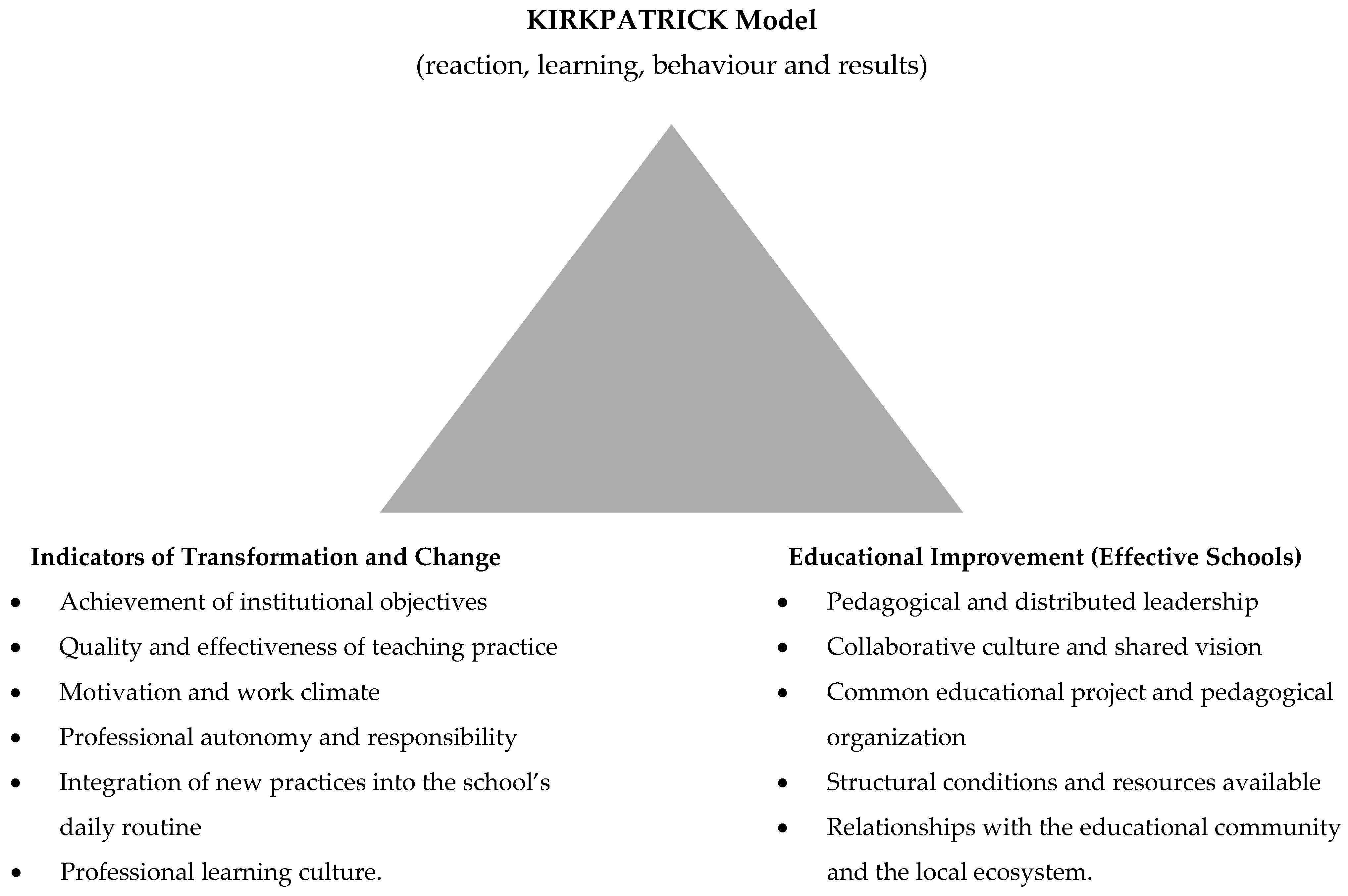
By combining the Kirkpatrick model, the indicators of transformation identified in this study, and the dimensions of school improvement highlighted in the literature on effective schools, it is possible to establish a triangular relationship that encompasses the processes of evaluation, transformation and improvement (
Figure 4).
Visualizing this triangular relationship, together with the dimensions identified and the transformation processes observed in the participating schools, made it possible to build the set of indicators presented in
Appendix A. The indicator framework was developed through an iterative process combining theoretical and empirical inputs. Initial categories were informed by the literature on school improvement and professional development, but indicators were refined inductively through thematic analysis of data collected. The resulting framework therefore reflects a convergence between theory-informed dimensions and empirically observed patterns of institutional change.
6. Conclusions: Implications, Limitations, and Future Research
This study provides empirical evidence of the role of sustained, collaborative, and context-responsive teacher professional development as a driver of institutional transformation in schools. The findings show that the impact of such programmes extends beyond individual teacher improvement, leading to organizational, cultural, and pedagogical change (
Bolívar, 2019).
From a theoretical perspective, the findings reinforce the conceptualization of educational transformation as a complex, gradual, context-dependent process, shaped by schools’ pre-existing institutional capacities and characterized by non-linear dynamics involving periods of tension, adjustment, and redefinition (
Timperley, 2011). From a practical perspective, the study highlights the importance of designing professional development programmes that are embedded within the school’s educational project, supported by a clear roadmap, distributed leadership mechanisms, and stable organizational structures—such as steering groups—that facilitate the transfer and long-term sustainability of change.
The study also underscores the importance of evaluating professional development at the school level. Assessing its impact makes it possible to determine the extent to which programmes contribute not only to teachers’ professional growth and improved instructional practices but also to broader institutional development aligned with schools’ strategic goals. In this regard, the indicator framework developed in this study offers a useful tool for monitoring and supporting school-wide transformation processes.
This study has several limitations that should be considered when interpreting the findings. The final sample included only the schools that completed the two-year implementation, as three initial participants withdrew from the programme. This attrition may have introduced selection bias, since participating schools may differ systematically from those that did not complete the process. Consequently, the findings should be interpreted in terms of their transferability to similar contexts. In addition, the absence of a comparison group of non-participating schools limits the possibility of contrasting experiences across different settings. The results therefore reflect participants’ accounts within the schools involved and should be understood in relation to the specific contexts in which the programme was implemented.
Future research should further examine the mechanisms through which teacher learning becomes institutionalized, investigate the long-term sustainability of educational transformation, and assess the applicability of the proposed indicator framework across diverse educational contexts.
In conclusion, this study contributes to the growing body of research on teacher professional development by demonstrating how sustained, collaborative, and context-based training can strengthen schools’ capacity for continuous improvement. More broadly, it highlights that lasting educational transformation depends not only on the quality of professional learning opportunities but also on the organizational conditions that enable schools to translate that learning into enduring institutional change.



 ,
,