


Abstract
The integration of algorithm-mediated grading in virtual higher education demands an urgent reevaluation of Digital Teaching Competencies to address critical algorithmic opacity. This study aims to systematize available scientific evidence on the intersection between DTC and Algorithmic Ethics in learning assessment within virtual environments. Following PRISMA 2020 guidelines and strict eligibility criteria, the search was executed in Web of Science and Scopus using Boolean operators, screening 262 initial records down to a final corpus of six empirical studies; the protocol was registered in OSF. Regarding results, the reviewed literature suggests that teachers may primarily employ technical and operational DTC for automated assessment design, leaving critical evaluation potentially underdeveloped. Furthermore, empirical research frequently highlights ethical dilemmas concerning data privacy risks, potential automation bias, and sociotechnical discrimination against marginalized students. Additionally, higher levels of advanced DTC and data literacy appear to serve as relevant factors for mitigating these ethical risks and auditing automated outcomes. To address this, the literature proposes implementing institutional algorithmic governance frameworks, systematic socio-ethical teacher training, and shifting automated designs toward formative, transparent feedback models. In conclusion, ethical automated assessment seems to rely substantially on individual teaching competence due to institutional policy gaps, highlighting a potential need for a transition toward techno-pedagogical frameworks focused on algorithmic justice.
1. Introduction
Historically, assessment in higher education has relied on standardized practices and face-to-face mechanisms that often conceive of knowledge as a static product limited in time (Davidovitch et al., 2024). In the contemporary era, the massive migration toward virtual learning environments—exponentially accelerated by the post-COVID-19 transition—has radically altered this dynamic (Acuña-Gamboa et al., 2023; Liberona et al., 2023). This structural shift has transcended physical classrooms, establishing a new native digital ecosystem where teaching, learning, and, fundamentally, academic assessment are completely reconfigured (Piñán et al., 2025).
From this perspective, with the advent of digital transformation, the dynamics of supervision and measurement have not disappeared. According to Nekhass et al. (2024), it has become significantly more complex through the integration of Artificial Intelligence (AI), predictive algorithms, and advanced learning analytics systems. Current educational research, such as that by Kovalchuk et al. (2025); Nopas (2025); and Salendab et al. (2025), has highlighted that the experience in virtual learning environments no longer depends exclusively on human interaction; rather, it emerges from a sociotechnical co-construction where algorithmic automation infrastructures play an invisible yet restrictive governance role.
Virtual classrooms and learning management systems possess the potential to make formative assessment more flexible and enriched (Shahzad et al., 2023). However, they can also deepen pre-existing gaps and intensify student vulnerability in the absence of equity-oriented regulation. In this constantly evolving landscape of teaching practice, the scientific literature has increasingly documented the urgent need for specialized training that critically intertwines with the obligation to audit, question, and challenge automated grading and predictive profiling of academic risk (Srinivasan et al., 2025; Tariq, 2025; Trejo-Macotela, 2026; Vetrivel et al., 2025).
Although global educational policies actively promote frameworks for teaching digital competence (TDC) (Mattar et al., 2022), such as the European Framework for the Digital Competence of Educators (DigCompEdu), its practical translation into pedagogical settings systematically prioritizes a purely instrumental and operational dimension. This operational focus often displaces critical concerns regarding the biases inherent in training datasets and the pervasive opacity of algorithmic black boxes—factors that risk exacerbating the systematic exclusion and sociotechnical discrimination of vulnerable student groups.
While several empirical investigations address teachers’ digital competences (García-Vandewalle García et al., 2023; Moreira et al., 2023) or the general governance of artificial intelligence (Adamakis & Rachiotis, 2025; Choiriyah et al., 2025) in isolation, the previous literature has overlooked the articulation of these constructs within evaluative praxis. Previous reviews in the field of AI applied to education (González-Calatayud et al., 2021; Memarian & Doleck, 2023) have been limited to examining the technical efficiency or instrumental optimization of automated grading software, omitting the role of the educator as a deontological guarantor. This theoretical disconnect is critical, given that the general literature on learning analytics and data ethics has consistently demonstrated that automation without human oversight can amplify sociocultural and historical biases (Hu & Rangwala, 2020; Idowu et al., 2024).
The originality and scientific novelty of this systematic review lies in the fact that it transcends the purely instrumental approach of current competence frameworks (such as DigCompEdu) to position the teacher’s digital maturity within contemporary currents of algorithmic fairness, explainable AI (XAI), and institutional data governance (Hillman, 2023; Khosravi et al., 2022). Unlike previous states of the art, this study generates fundamental contributions spanning how the design of automated assessments can incur opacity (“black-box”) and algorithmic vulnerability for minority groups if it is not pedagogically mediated; the transfer of ethical responsibility from absent institutional guidelines to the individual agency of the teacher; and the proposal of integrated strategies where AI literacy critically intersects with the ethics of learning analytics to transition toward an assessment guided by socio-technical justice.
Therefore, this review pioneeringly addresses this conceptual gap by systematizing the available scientific evidence on the intersection between Digital Teaching Competencies and Algorithmic Ethics in learning assessment processes within virtual environments. Guided by this objective, the research addresses the following research questions:
RQ1: According to the scientific literature, what digital competencies do teachers employ for the design, management, and implementation of algorithm-mediated assessment processes in virtual contexts?
RQ2: What algorithmic ethical dilemmas, such as automation bias, decision-making opacity, data privacy, and sociotechnical discrimination, are reported in empirical research on automated assessment?
RQ3: What empirical evidence does the literature report regarding the articulation between digital competencies and their algorithmic ethics in learning assessment processes within virtual environments?
RQ4: What pedagogical, governance, and teacher-training strategies are proposed in the literature for developing a critical agency in TDC, capable of transitioning from punitive automated assessment toward formative, equitable, and ethical feedback models?
It should be noted that while the scientific literature contains previous reviews focused exclusively on the analysis of artificial intelligence associated with education or on the generic development of digital competences in teaching staff, a methodological and conceptual gap is observed in the articulation of both fields. Existing reviews tend to focus on the technical or instrumental dimension of automated learning tools, ignoring the active role of the teacher as an ethical guarantor against these systems. Therefore, the need for this systematic review lies in the study of how the teaching of digital competences critically converges with ethical auditing and bias mitigation. In this way, the study seeks to move away from a strictly operational perspective to place teaching staff at the center of current techno-pedagogical governance.
1.1. Literature Review
1.1.1. The Three Waves of Virtual Assessment: From Basic Digitization to Intelligent Assessment
The evolution of assessment within virtual learning environments can be conceptualized through three technological milestones, reflecting a distinct transition from basic digital substitution to an intelligent, automated ecosystem (Quindemil-Torrijo et al., 2025). The first phase, Assessment 1.0 (Basic Digitization), merely replicated traditional paper-and-pencil testing using office software and closed-ended multiple-choice questionnaires, prioritizing a punitive, summative approach characterized by binary feedback. This was followed by Assessment 2.0 (Formative Approach and Interactivity), driven by the widespread adoption of Learning Management Systems (LMS) such as Moodle. This phase embraced socio-constructivist methodologies, integrating dynamic rubrics, e-portfolios, and peer assessment within interactive forums, thereby establishing continuous qualitative tracking.
Currently, higher education operates under Assessment 3.0 (The Era of AI and Analytics), a contemporary paradigm where assessment is structurally anchored to the student’s digital footprint (Quindemil-Torrijo et al., 2025). Through real-time learning analytics, adaptive assessment algorithms, and biometrics-based remote proctoring systems, diagnostic and summative evaluations are fully automated and personalized.
The institutionalization of Assessment 3.0 began in distance education, serving as testing grounds for anti-plagiarism tools and remote exam proctoring, which prompted universities to invest heavily in cloud infrastructure and Artificial Intelligence (AI) software (Li et al., 2026). Upon returning to physical classrooms, institutions recognized the strategic value of these harvested datasets. Learning Analytics was reoriented, transforming from an automated grading mechanism into a predictive tool against student attrition and a key metric for international accreditation agencies. Consequently, this shift has reshaped teaching practices, moving from individual pedagogical experimentation to an institutional dependency on external, intelligent software ecosystems (Li et al., 2026). However, this era raises complex ethical challenges regarding data opacity, privacy breaches, and algorithmic vulnerability (Quindemil-Torrijo et al., 2025).
1.1.2. International Frameworks for Teachers’ Digital Competencies (TDC)
Teachers’ digital competence is conceived as the set of knowledge, skills, attitudes, and strategies that enable educators to critically, creatively, and securely utilize information and communication technologies (ICT) and digital media within both personal and professional contexts (Basantes-Andrade et al., 2020; Rodríguez-Jiménez et al., 2022). This competence is essential for guiding, supporting, and facilitating student learning processes, particularly within digital or hybrid educational environments.
To standardize these profiles, international bodies have developed reference frameworks. The European Framework for the Digital Competence of Educators (DigCompEdu), designed by the European Commission’s Joint Research Centre (JRC), provides a unified structure to define digital competence in higher education. Unlike technical frameworks that measure operational software skills, DigCompEdu focuses on the pedagogical and ethical appropriation of technology (Cabero-Almenara et al., 2020, 2021). It posits that digital competence does not mean overloading a virtual classroom with ICT tools, but rather knowing how to utilize them to enhance learning, personalize learning pathways, and guarantee fair assessment strategies.
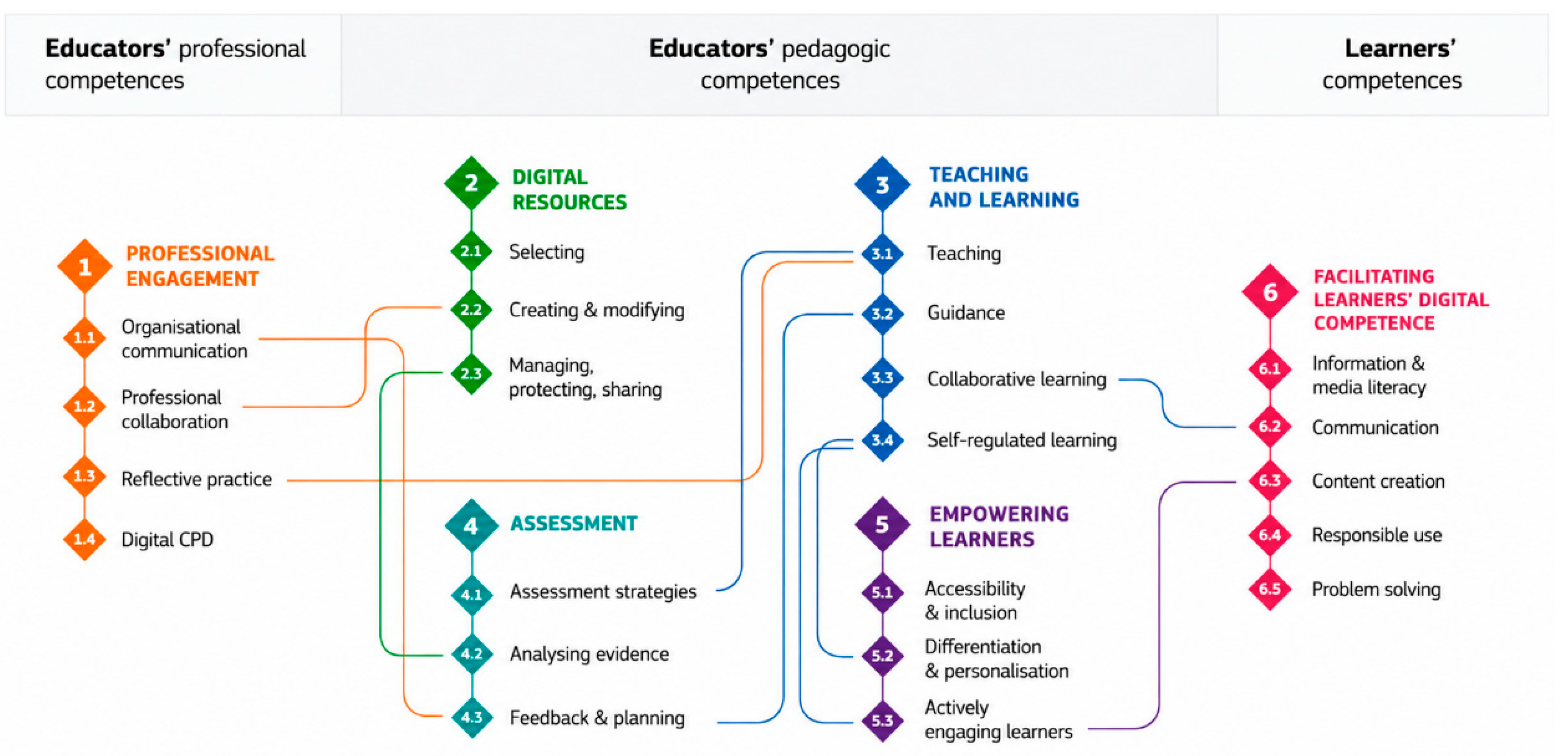
Within the Spanish-speaking context, the Common Framework for Teaching Digital Competence (MRCDD, Marco Común para la Enseñanza de la Competencia Digital), structurally aligned with DigCompEdu, organizes these competencies into six core areas to assess faculty performance in the digital age: (1) professional engagement, (2) digital resources, (3) teaching and learning, (4) assessment and feedback, (5) empowering learners, and (6) facilitating learners’ digital competence (Mattar et al., 2022). Figure 1 details the areas as established by Redecker (2017).
Figure 1.
The areas, competencies, and connections of DigCompEdu. Source. Adapted from European Framework for the Digital Competence of Educators: DigCompEdu by Redecker (2017).
1.1.3. Generative Artificial Intelligence and Algorithmic Ethics in Automated Assessment
The emergence of generative AI and automated grading systems has reconfigured the teaching role, making the development of an “algorithmic ethical competence” indispensable for the critical oversight of automated decision-making (Garzón-González et al., 2025). Contemporary higher education relies on a series of highly sophisticated automated assessment systems (C. Wang et al., 2026), which include generative artificial intelligence and large language models trained to autonomously process and produce content; biometric proctoring systems that utilize computer vision and facial recognition for remote exam supervision; and predictive learning analytics. These machine learning models (e.g., decision trees, logistic regressions, or neural networks) are trained on institutional big data to predict student performance, provide automated feedback, and detect academic fraud (G. Wang et al., 2026).
Thus, algorithmic ethics encompasses the critical study of justice, transparency, accountability, and fairness applied to the design, training, deployment, and interpretation of automated systems (Chiclayo Padilla et al., 2026; Koska, 2025). In the field of higher education, this concept is defined as a normative framework aimed at overseeing the responsible use of these data-driven systems within academic practice (Memarian & Doleck, 2023). Its objective is to ensure transparency in pedagogical processes, which is particularly relevant in the face of challenges such as access to misleading information, educational automation, and the negative impacts on rights and equity that arise when integrating these innovative technologies (Alghamdi & Alghizzi, 2025). This competency goes beyond the mastery of virtual learning environments; it requires understanding algorithmic opacity, the “black box” phenomenon, to ensure a fair, formative, and transparent evaluation process across three operational dimensions: design (diagnostic/predictive phase), management (formative/processual phase), and implementation (summative/feedback phase) (Pattnaik & Padhi, 2021).
This algorithmic assessment cycle functions as a systemic framework to safeguard educational validity. In the design dimension, the educator acts as a techno-pedagogical architect, selecting and parameterizing tools based on constructive alignment. In the management dimension, the teacher continuously monitors data streams through learning analytics. Meanwhile, the cycle culminates in the implementation dimension, where data is translated into formative, empathetic, and augmented feedback. At this stage, teachers act as pedagogical auditors, ensuring the explainability of algorithms and defending students’ rights against opaque and automated grading (Kotikalapudi & Gayatri, 2026).
1.1.4. The Sociotechnical Dimension of AI in Education: Equity, Explainability, and Data Governance
The proliferation of automated systems in higher education is a process shaped by complex sociotechnical dynamics (Yu et al., 2020). This notion is supported by authors such as Idowu et al. (2024), who noted that the use of algorithms for automated assessment may widen pre-existing social gaps, consistent with studies by Hu and Rangwala (2020) and Yu et al. (2020) in which African American and male students were victims of algorithmic bias, recording lower assessment scores than their counterparts. In this sense, algorithmic equity emerges as a critical pillar for predictive models and learning analytics, which risk replicating or amplifying historical biases related to gender, ethnicity, and socioeconomic status present in training data (Hu & Rangwala, 2020; Yu et al., 2020). Therefore, pursuing equity in the design of these technologies is a mandatory requirement to ensure that digital tools function as an engine for inclusion rather than a barrier affecting the performance of higher education students.
Faced with this scenario of opacity, it is not sufficient for data systems to be equitable; they must also address the “black box” problem through the implementation of Explainable AI (XAI). Under this approach, systems must be capable of explaining their decisions and allowing for their audit, ensuring that the process is transparent and ethically responsible (Mersha et al., 2024). In the educational context, advancements in Explainable AI have shifted the sociotechnical perspective of learning, establishing a dynamic of accountability based on explanations that instructors must make available to students (Khosravi et al., 2022). It should be noted that this demand for transparency necessitates the evaluation of critical perspectives on automated assessment, as the quality and effectiveness of these processes require pedagogical judgment and personalized instructor action rather than purely algorithmic mediation (González-Calatayud et al., 2021).
Consequently, this entire structure of justice, explainability, and critical analysis requires robust institutional support, which can only be achieved through optimal data governance and a sound learning analytics ethics framework (Tzimas & Demetriadis, 2021). Because virtual environments record every minute a student spends on these platforms, institutions have the responsibility to closely monitor the privacy, storage, and secure use of the data stored within automated systems (Hillman, 2023). This implies that institutions cannot leave algorithmic ethics to the discretion of individual instructors but must instead establish clear regulations regarding the moral boundaries of such constant information tracking (Hina & Dominic, 2020).
2. Materials and Methods
The present study was developed using the systematic review method, which involves the comprehensive and structured collection of relevant research findings on a specific topic (Rossi, 2023). This approach allowed for the application of rigorous literature evaluation processes to select studies that met predefined eligibility criteria, extract relevant data, and conduct the corresponding analysis regarding digital teaching competencies and algorithmic ethics in learning assessment within virtual environments. Consequently, it facilitated the systematic summarization of the subject matter and the derivation of reliable conclusions (Andrews, 2005).
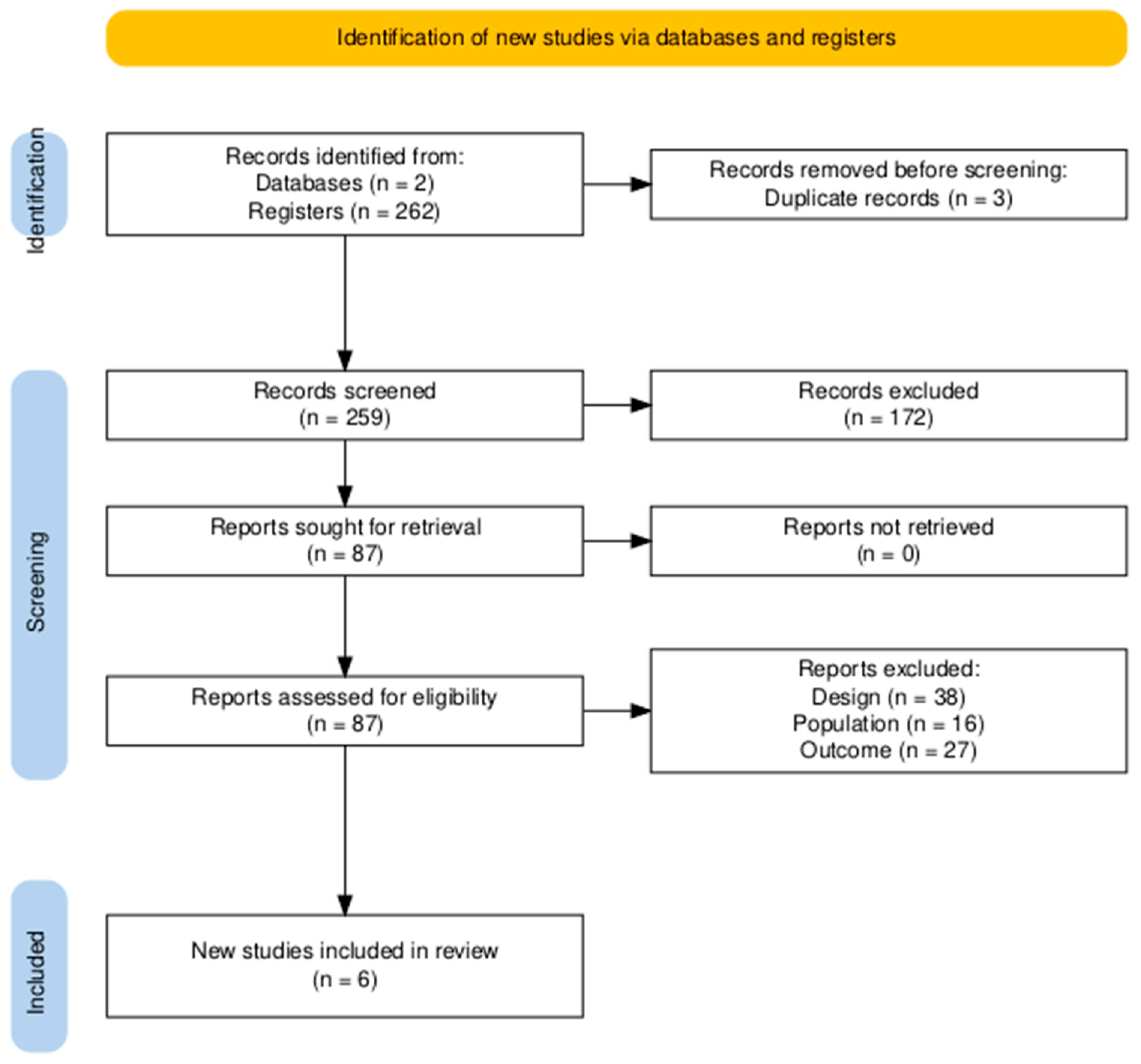
The study followed the PRISMA 2020 guidelines (Preferred Reporting Items for Systematic reviews and Meta-Analyses) (Page et al., 2021), which guaranteed transparency, comprehensiveness, and methodological rigor across the evaluated studies. Concurrently, the processes of literature identification, screening, and inclusion were illustrated using the PRISMA flow diagram proposed by Haddaway et al. (2022) presented in Figure 2; the PRISMA 2020 item checklists are included in the Supplementary Materials. The protocol was previously registered on the Open Science Framework (OSF) portal (Available at https://doi.org/10.17605/OSF.IO/RQKXM).
Figure 2.
PRISMA flow diagram. Source. Adapted from the template by Page et al. (2021).
2.1. Databases and Search Strategy
The search was conducted across major academic databases, including Web of Science and Scopus. Search strategies utilized combinations of terms associated with the research topic, such as ‘digital teaching competence,’ ‘teacher digital competence,’ and ‘digital teacher training’; ‘algorithmic ethics,’ ‘ethics of algorithms,’ ‘algorithmic bias,’ and ‘ethical artificial intelligence’; ‘learning assessment,’ ‘educational assessment,’ and ‘formative assessment’; and ‘virtual environments,’ ‘online education,’ and ‘e-learning.’ The strategy also involved the use of Boolean operators (AND/OR), truncation using the asterisk (*) to capture grammatical variations and plural forms, and field tags: TITLE-ABS-KEY for Scopus and Topic (TS) for Web of Science. Table 1 details the search strings generated for each database.
Table 1.
Details of the scientific databases considered in this review.
Specific database refinement filters were also applied to optimize the sample based on standards of quality, relevance, and transparency. The document type was strictly limited to peer-reviewed journal articles to guarantee that the synthesized evidence had undergone rigorous expert evaluation, thereby excluding the unverified literature or gray documents. Regarding language, the selection was restricted exclusively to English and Spanish; these were chosen as they represent the global scientific standard where the debate on artificial intelligence, algorithmic ethics, and teacher digital competence frameworks within the educational context is concentrated. Furthermore, the open-access filter was implemented, ensuring full-text availability, absolute reproducibility, and the democratization of the analyzed primary sources.
2.2. Eligibility Criteria
To refine the final study selection, the following inclusion and exclusion criteria were applied during the eligibility assessment phase (Table 2).
Table 2.
Eligibility criteria for document selection.
2.3. Selection Process and Study Identification
The process of searching, selecting, and filtering the scientific literature was executed in strict adherence to the methodological phases structured by the PRISMA statement (Preferred Reporting Items for Systematic Reviews and Meta-Analyses), thereby ensuring a transparent, reproducible, and systematic approach. The analytical progression of this procedure is visually detailed in the flow diagram in Figure 2, which sequentially illustrates the phases of identification, screening, and final inclusion of the corpus.
- Identification: The initial search strategy implemented in the high-impact databases Scopus and Web of Science (WoS) yielded a total of 262 scientific articles. After subjecting the results to an automated and manual duplicate detection process, 3 documents were removed, consolidating a total of 259 unique records for the next stage.
- Screening and Eligibility: The remaining 259 records were subjected to an initial screening phase based on the critical reading of titles and abstracts, which led to the exclusion of 172 documents that were not directly related to the object of study. Subsequently, the full text of the 87 pre-selected articles was retrieved for an exhaustive eligibility evaluation. This rigorous refinement process led to the exclusion of 81 manuscripts, as they failed to meet the inclusion criteria pre-established in Table 2. The reasons for exclusion are detailed rigorously below:
- (a)
- design: theoretical essays, previous systematic reviews, opinion pieces, editorials, and book reviews that did not provide the primary or secondary data required for empirical analysis were discarded (n = 38);
- (b)
- population: studies focused solely on non-university educational levels (early childhood, primary, and secondary education) and research directed specifically at software developers without direct pedagogical implications were removed (n = 16);
- (c)
- results: research whose findings did not report an intersection between teacher digital competence and algorithmic ethics was excluded, as were studies developed in face-to-face educational contexts without virtual mediation and settings that did not involve learning assessment processes (n = 27).
- Inclusion: Following the systematic application of quality and conceptual relevance filters, the process concluded with the final selection of 6 high-impact empirical studies. This final corpus provides the scientific evidence and statistical data necessary to comprehensively answer the formulated research questions, unequivocally linking the development of digital teaching competencies with the management of algorithmic ethics in learning assessment within virtual environments.
2.4. Data Extraction and Synthesis
To ensure the reliability and reproducibility of the findings, the data extraction process was executed independently by two reviewers, who entered the retrieved information into a structured extraction matrix in Microsoft Excel. Any discrepancies arising during this process were resolved through critical discussion and consensus between both researchers. This matrix included essential descriptive and methodological variables from each article, including: (a) study title; (b) authors; (c) year of publication; (d) country or geographical context; (e) methodological design (qualitative, quantitative, or mixed); (f) sample characteristics (teachers, experts, sample size); (g) data collection instruments employed; and (h) study outcome.
The extraction of specific content focused rigorously on empirical evidence linked to the intersection between Digital Teaching Competencies (DTC) and Algorithmic Ethics within the framework of learning assessment in virtual environments. The synthesis strategy was structured under a thematic and qualitative approach, systematizing the distribution of the six (6) selected studies based on their applicability and direct response to the four research questions of this study.
2.5. Risk of Bias and Methodological Quality Assessment
The risk of bias and methodological quality assessment of the included studies was executed systematically to safeguard the internal validity, reliability, and scientific rigor of the evidence synthesis. This procedure was grounded in the rigorous application of pre-established eligibility criteria and was carried out through a blind and collaborative evaluation approach between the reviewers. The intermittent analysis encompassed a critical audit of the structural variables of the manuscripts, examining everything from the consistency of the research designs to the appropriateness of the instruments and multivariate techniques employed by the primary authors.
To mitigate selection and detection biases during the process, the full-text review was performed in duplicate. Any discrepancy or asymmetry in the quality weighting of the articles was resolved through critical discussion and binding consensus between both researchers. This methodological filter allowed for the timely identification and exclusion of those documents exhibiting a high risk of bias, characterized by opaque operational descriptions, weaknesses in predictive models, incomplete empirical data, or conclusions lacking traceability. Through this quality control, it was guaranteed that the final corpus of six studies possessed the optimal methodological standard to substantiate discussions surrounding digital teaching competence and algorithmic justice.
2.6. Declaration on the Use of Generative Artificial Intelligence (GAI)
During the development of this systematic review, generative artificial intelligence tools were utilized to support data collection and linguistic refinement. Specifically, Scopus AI (version updated as of May 2026) was employed during the literature search phase to complement and expand the initial query strategies through semantic mapping and conceptual synthesis. Additionally, Google Gemini (version 1.5 Pro) was used exclusively to enhance text drafting, optimize academic phrasing, and ensure technical accuracy in the translation of complex conceptual terminology from Spanish to English. In alignment with academic integrity guidelines, these tools were used strictly as assistive technologies; all search strategies, data extractions, critical appraisals, and final interpretations were independently executed and verified by the authors.
3. Results
The nature of the methodological approaches identified within the analyzed corpus exerts an influence on the degree of confidence and transferability of the reported findings (Table 3). On one hand, the employment of exploratory qualitative designs via semi-structured interviews (Muñoz Martínez et al., 2025) and mixed-methods case studies (Oliveira et al., 2026) fosters a deep and contextualized phenomenological understanding of faculty perceptions regarding algorithmic opacity. Nonetheless, this situational specificity and the size of the descriptive samples could limit the statistical generalizability of their conclusions toward broader institutional contexts. On the other hand, the integration of expert panels and the sequential Delphi technique (Ilieva et al., 2026) significantly and robustly enhances the content validity of assessment indicators through the intersubjective consensus of specialists. In spite of this, the latter methodological approach exposes the outcomes to potential intra-group conformity biases, suggesting the need to interpret the resulting causal networks with analytical prudence.
Table 3.
General characteristics of the final corpus.
In a complementary manner, the predominance of cross-sectional and correlational quantitative methodologies supported by surveys (Acosta-Enriquez et al., 2025; Antón-Sancho et al., 2023; Gómez-García et al., 2026) allows for an extensive, macro-scale examination of the predictive interrelationships between digital competencies and ethical disposition toward artificial intelligence. However, the non-experimental and synchronic nature of these studies restricts the possibility of establishing definitive causal inferences over time, capturing only a specific situational state. Likewise, the reliance on self-report psychometric questionnaires could introduce self-perception or social desirability biases on behalf of the evaluated faculty members. Despite these inherent methodological limitations in each design, the convergence of the different perspectives within the global corpus seems to provide a balanced methodological solidity, suggesting that the complementarity between qualitative depth and quantitative representativeness reduces uncertainty surrounding the integrated evidence.
3.1. RQ1: Digital Competencies in Algorithm-Mediated Assessment Processes in Virtual Contexts
In Table 4, the findings of the review demonstrate that the ethical governance of artificial intelligence is evidenced through the maturity of digital identity and technical curation. Scientific evidence highlights that critical decision-making regarding automated systems and the selection of structured digital resources demand a robust professional deontology from the teacher (Gómez-García et al., 2026; Oliveira et al., 2026). Furthermore, the literature confirms that the instructional orchestration of virtual assistants and the rigorous design of conceptual items act as filters that prevent automation from replacing the evaluator’s reasoning (Muñoz Martínez et al., 2025; Ilieva et al., 2026). In this way, instrumental and reflective readiness is consolidated as the organizational pillar that articulates formative mediation within contemporary virtual environments.
Table 4.
Digital Teaching Competencies and Algorithmic Ethics Operationalization.
On the other hand, the results position the oversight of learning analytics and the control of predictive feedback as the most urgent fields of technical action. Research demonstrates that the methodological proficiency to calibrate and audit item difficulty on digital platforms is key to avoiding systematic biases that disadvantage students (Ilieva et al., 2026; Antón-Sancho et al., 2023). The strategic use of these complex metrics allows faculty to transition from simple software adoption to rigorous formative assessment. This advanced analytical capacity equips the teaching staff with the indispensable mechanisms to correct, in a timely manner, the opacity of supervised learning algorithms applied in higher education (Acosta-Enriquez et al., 2025; Muñoz Martínez et al., 2025).
Meanwhile, student empowerment and the promotion of a reflective stance toward generative artificial intelligence emerge as the ultimate goals of assessment equity. Scientific evidence warns that the development of interpretive skills prevents the passive assimilation of biased information and significantly reduces sociotechnical vulnerability (Acosta-Enriquez et al., 2025; Antón-Sancho et al., 2023). By promoting assessments designed for students to contrast, question, and co-evaluate algorithmic outputs, the reproduction of sociocultural gaps related to gender or background is actively neutralized (Gómez-García et al., 2026; Muñoz Martínez et al., 2025). Thus, the highest dimensions of competency frameworks ensure a fair, inclusive, and fully sustainable digital governance.
3.2. RQ2: Algorithmic Ethical Dilemmas in Automated Assessment
The findings derived from the categorization demonstrate that ethical dilemmas do not constitute isolated technical anomalies; rather, they form a complex sociotechnical fabric that impacts the equity of learning assessments within virtual environments (Table 5). The supporting scientific literature warns that algorithmic opacity directly undermines the students’ fundamental right to receive transparent and pedagogically traceable feedback (Oliveira et al., 2026; Ilieva et al., 2026). Furthermore, the automated delegation of evaluative functions and the intensive processing of biometric or behavioral data without clear governance deepen the risks of critical thinking homogenization and privacy violations (Muñoz Martínez et al., 2025; Antón-Sancho et al., 2023).
Table 5.
Categorization of Algorithmic Ethical Dilemmas in Automated Learning Assessment.
Conversely, the persistence of embedded prejudices within predictive matrices and pronounced geographical asymmetries reconfigure the traditional digital divide into a concerning state of algorithmic vulnerability (Acosta-Enriquez et al., 2025; Antón-Sancho et al., 2023). In the face of scarce explicit institutional regulations, the responsibility to audit educational software and guarantee genuine assessment design mandatorily falls upon individual techno-pedagogical readiness (Oliveira et al., 2026; Gómez-García et al., 2026). Thus, active ethical oversight by the teacher consolidates as the only viable filter to ensure virtual assessment processes that are inclusive, fair, and sustainable.
3.3. RQ3: Evidence of the Articulation Between Digital Competencies and Their Algorithmic Ethics
The empirical evidence analyzed in Table 6 reveals that the interaction between automated technologies and grading practices in virtual environments demands a profound evolution of digital competence toward dimensions of deontological oversight. The literature demonstrates that the deployment of Generative Artificial Intelligence and technical monitoring systems imposes a reconfiguration of traditional instruments, transitioning toward highly complex formative tasks that require active teacher intervention as an indispensable ethical filter (Muñoz Martínez et al., 2025). Given algorithmic opacity and the dilemmas of closed proctoring structures, simple operational skills are insufficient; advanced competency proficiency is required to ensure that predictive flows do not result in exclusion or violate essential student rights (Oliveira et al., 2026).
Table 6.
Empirical Evidence on the Articulation between Digital Teaching Competence and Algorithmic Ethics.
From a sociotechnical and analytical perspective, research shows that the fairness and equity of feedback in adaptive virtual platforms depend on the educator’s technical capacity to audit algorithms. When teachers possess the necessary methodological qualifications to parameterize software criteria, the machine’s inherent biases are effectively prevented from unfairly penalizing student performance (Ilieva et al., 2026). Likewise, statistical path analyses confirm that ethical concerns act as critical barriers to technological assimilation, but adequate information literacy empirically empowers faculty to proactively intervene against indirect discrimination and mitigate algorithmic vulnerability in institutional data streams (Acosta-Enriquez et al., 2025).
Advanced predictive models based on Machine Learning confirm that professional engagement and the inclusive empowerment of students are the most powerful statistical factors for achieving an equitable assessment design. When transferring these dynamics to complex environments such as immersive Virtual Reality simulators, where behavioral patterns are captured automatically, findings reveal that an intermediate competency level is insufficient to structure standardized criteria (Antón-Sancho et al., 2023). Therefore, the scientific literature concludes that teachers’ digital–ethical competencies establish themselves as the primary predictive element to neutralize demographic and macro-technological gaps, safeguarding objectivity within contemporary evaluative praxis (Gómez-García et al., 2026).
3.4. RQ4: Pedagogical, Governance, and Teacher Training Strategies
To transition toward a formative and ethical assessment, the literature proposes intelligent governance strategies centered on organizational readiness, institutional resilience, and the development of clear regulatory frameworks to guide technological adoption (Muñoz Martínez et al., 2025; Gómez-García et al., 2026). These governance policies seek to mitigate deontological dilemmas and the algorithmic opacity of the “black box” through institutional sociotechnical audits that guarantee the transparency of predictive metrics (Oliveira et al., 2026). By establishing structural guidelines for inclusion, the homogenization of thought in asynchronous assessment is actively prevented, promoting a virtual infrastructure that prioritizes student rights and equity (Muñoz Martínez et al., 2025).
At the pedagogical level, strategies are oriented toward the co-design of adaptive environments and the replacement of traditional items with tasks of high cognitive complexity (Muñoz Martínez et al., 2025). The integration of expert-validated hybrid models, such as the multi-criteria DEMATEL-ANP approach, is proposed to parameterize computer systems under criteria of pedagogical justice (Ilieva et al., 2026). These actions allow for the structuring of activities grounded in virtual co-evaluation, ethical–digital curation, and the critical use of immersive Virtual Reality simulators (Antón-Sancho et al., 2023). In this way, technology ceases to be a punitive instrument of control and is transformed into a support structure that optimizes the quality of formative and personalized feedback (Ilieva et al., 2026).
In the field of teacher training, the urgent need to develop advanced AI literacy that transcends operational or technical training is highlighted (Oliveira et al., 2026). Training strategies must focus on strengthening critical-pedagogical competence, enhancing the dimensions of professional engagement and inclusive student empowerment regulated by frameworks such as DigCompEdu (Gómez-García et al., 2026). This comprehensive preparation empirically empowers faculty to proactively intervene against indirect discrimination and neutralize technical biases within data streams (Acosta-Enriquez et al., 2025). By reducing technological prejudices and demographic gaps, an authentic critical agency is consolidated, capable of safeguarding objectivity within contemporary evaluative praxis (Antón-Sancho et al., 2023).
3.5. Evidence Synthesis by Research Question
Table 7 presents a summary that explicitly links each research question to the evidence provided by the scientific corpus.
Table 7.
Summary of evidence from each study.
4. Discussion
4.1. Theoretical Contribution and Paradigm Shift
The contribution of this research lies in its potential capacity to systematize the complex sociotechnical frontier emerging from the intersection of Digital Teaching Competencies (DTC) and Algorithmic Ethics, specifically within the evaluative praxis of higher education. In a contemporary scenario characterized by the accelerated deployment of generative artificial intelligence, predictive analytics systems, and immersive learning environments, the development of faculty digital competence appears to have transitioned from a simple operational or technical requirement toward an ethical and deontological consideration linked to social justice. By structuring and articulating the findings, this investigation highlights how, in the documented absence of clear institutional guidelines, the teacher’s techno-pedagogical and informational maturity may establish itself as a critical human filter to audit biases, neutralize “black-box” opacities, and safeguard students’ right to formative, equitable, and transparent feedback within virtual environments.
The systematization of the scientific evidence analyzed in this review suggests that the intersection of Digital Teaching Competencies and Algorithmic Ethics in virtual assessment environments is becoming a central issue of sociotechnical justice in higher education. The synthesis of the analyzed literature highlights that the expansion of artificial intelligence (AI) and automated monitoring systems has initiated a critical paradigm shift, wherein technical operational competence might be insufficient to guarantee fair practices. As Tartari and Çerma (2026) indicate, a transition toward advanced deontological supervision and algorithmic auditing appears to be urgently required.
4.2. The Sociotechnical Contradiction and Ethical Displacement
The structural analysis of the analyzed corpus exposes what appears to be a significant sociotechnical contradiction regarding the practical implementation of AI in academic evaluation. While institutional discourse and international digital frameworks actively promote an ideal ecosystem of ethical, formative, and equitable AI mediation, real-world educational practices frequently reveal an implementation gap.
The primary inconsistency points toward the phenomenon of individual ethical displacement: because several higher education institutions lack mature data governance models and standardized algorithmic auditing tools, a substantial part of the moral responsibility of managing complex automated outputs tends to be shifted directly onto the individual competence of the faculty. This trend is qualitatively reported by Oliveira et al. (2026) and supported by the analytical models of Ilieva et al. (2026). Consequently, teachers who lack advanced analytical skills to configure, parameterize, and audit learning analytics risk operating under a “black-box” model, potentially jeopardizing students’ fundamental right to transparent and pedagogically traceable feedback (Karimi & Khawaja, 2025; Oliva-Córdova et al., 2023).
4.3. The Operational Paradox and Algorithmic Vulnerability
Furthermore, empirical data from the analyzed corpus suggest a possible operational paradox: a high frequency of technical software usage by faculty does not automatically correlate with greater ethical sensitivity or algorithmic literacy. In practice, this decoupling may manifest as automation bias and uncritical trust in predictive metrics (RQ2), where educators tend to validate platform scores without fully addressing their underlying statistical weightings (Muñoz Martínez et al., 2025). This operational vulnerability could transform traditional educational inequities—originally defined as asymmetries in infrastructure or basic access (Areba et al., 2025)—into a contemporary condition of “algorithmic vulnerability” (Bird et al., 2025) and exclusion.
As indicated by Acosta-Enriquez et al. (2025) through Partial Least Squares Structural Equation Modeling (PLS-SEM) and Antón-Sancho et al. (2023) via ex post facto analysis, subtle biases embedded within demographic and geographical training datasets may remain invisible and uncorrected for educators with lower data literacy.
Conversely, the Machine Learning-based evidence derived from RQ1 and RQ3 and provided by Gómez-García et al. (2026) indicates that the “Professional Engagement” and “Empowering Learners” dimensions of international frameworks like DigCompEdu (Redecker, 2017) emerge as robust predictors to mitigate these exclusion gaps. This suggests that an ethical AI ecosystem depends strictly on teaching capacities oriented toward real-time algorithmic auditing rather than simple familiarity with computer tools.
4.4. Data Saturation and Bias Amplification in Complex Environments
This risk tends to intensify when automated structures are implemented in complex, data-rich environments, such as immersive virtual reality simulators or advanced learning management systems (LMS). Here, the systematic collection of behavioral, biometric, and sociodemographic data can introduce subtle vectors of indirect discrimination (Acosta-Enriquez et al., 2025; Antón-Sancho et al., 2023).
Both faculty and students frequently exhibit a tendency to validate automated results without comprehensive cross-checking, potentially leading to an undesired homogenization of thought and a restriction of critical thinking skills during formative assessment cycles (Muñoz Martínez et al., 2025). Without active and competent human intervention capable of identifying historical or statistical biases embedded within training datasets, algorithmic assessment may amplify gaps, potentially reducing educational opportunities and causing long-term negative impacts on students from marginalized groups (Trejo-Macotela, 2026).
4.5. Multilevel Strategy for Sustainable Formative Assessment
To address these sociotechnical tensions and foster genuine critical agency (RQ4), the analyzed literature points toward the necessity of a transition toward sustainable, transformative, and equitable formative assessment through a coordinated, multi-level strategy. At the governance level, higher education institutions must implement intelligent frameworks and sociotechnical audits that treat ethical data management, privacy, and transparency not merely as peripheral administrative checkmarks, but as enabling constraints regulating software acquisition and systemic validation (Ilieva et al., 2026). Pedagogically, this systemic shift requires replacing easily automated traditional multiple-choice tests with high-level cognitive tasks, such as virtual co-evaluation, collaborative problem-solving, and comparative analysis of machine-generated outputs. Within this framework, the algorithm acts strictly as temporary scaffolding rather than a definitive substitute for human evaluative judgment (Muñoz Martínez et al., 2025).
Simultaneously, teacher professional development programs must be urgently redesigned to move beyond the simple instrumental operation of software. Training initiatives need to actively integrate advanced AI literacy grounded in critical pedagogy, potentially enabling educators to understand the underlying mathematical and causal logic of predictive systems (Acosta-Enriquez et al., 2025; Oliveira et al., 2026). Ultimately, the transition toward a truly ethical AI ecosystem appears to be constrained by a systemic mismatch between abstract institutional policies and the lack of applied techno-pedagogical training. Bridging this gap arguably requires embedding real-time algorithmic auditing directly into the core of digital teaching competencies to ensure long-term sociotechnical justice.
4.6. Limitations and Future Research Lines
Although this systematic review offers a rigorous consolidation of the literature within higher education contexts, certain limitations must be acknowledged. Regarding search scope, the selection process was exclusively circumscribed to high-impact databases indexed in Scopus and Web of Science (WoS), and was restricted solely to empirical research that had passed peer-review processes. While this decision guaranteed maximum scientific rigor, quality control, and homogeneity of the analyzed corpus, it may have omitted relevant grey literature, emerging conference proceedings, or technical developments reported in regional databases or specialized repositories.
Meanwhile, the current corpus relied heavily on cross-sectional designs, predictive machine learning models, and expert panels which, despite their high statistical and methodological validity, offer limited information regarding long-term behavioral changes and faculty techno-pedagogical adoption. In addition, the rapid and non-linear evolution of generative AI tools frequently outpaces the editorial and publication cycles of empirical educational research, creating an unavoidable chronological gap between technologies running in real-time within virtual classrooms and the available scientific literature.
An apparent limitation of this systematic review lies in the limited size of the final corpus, restricted to six (6) primary empirical studies that met the strict eligibility criteria. However, methodologically, this sample size should not be interpreted as a lack of comprehensiveness in the search design, but rather as an epistemological finding and an indicator of the state of this field of knowledge. The current scientific literature presents a saturation of theoretical essays, opinion pieces, and generic state-of-the-art reviews on AI ethics; however, empirical and quantitative validation using multivariate models or structural equations to jointly analyze teaching competence and algorithmic ethics in assessment is a strictly emerging phenomenon, concentrated almost exclusively between the years 2025 and 2026. This corpus of six studies represents the frontier of actual empirical knowledge in higher education virtual classrooms. Its systematization is crucial because it highlights the urgency of transitioning from abstract theoretical narratives toward applied and measurable research, providing a rigorous and transparent starting point for future lines of research seeking to standardize algorithmic justice indicators in evaluative praxis.
Based on these considerations, future lines of research must prioritize the development of longitudinal studies and controlled trials—both randomized and non-randomized—that measure the actual impact and transfer of training programs in AI literacy and algorithmic auditing within daily faculty assessment routines. Likewise, it is imperative to delve deeper into how algorithmic vulnerability differentially affects historically marginalized student groups or those in conditions of socioeconomic and gender vulnerability within virtual environments. Finally, future studies should orient toward the coding of standardized, adaptive, and intercultural assessment rubrics, built under validated frameworks such as DigCompEdu, which are specifically designed to measure the ethical and sociotechnical dimensions of teaching practice across diverse regional and macro-technological contexts.
5. Conclusions
The systematization of the selected scientific evidence suggests that algorithm-mediated learning assessment in higher education should not be addressed from a purely instrumental or technological standpoint. The effectiveness and integrity of the assessment process in virtual environments seem to rely on the structural intersection between Digital Teaching Competencies (DTC) and Algorithmic Ethics. Based on the reviewed literature, it can be inferred that the development of an advanced level of DTC not only optimizes pedagogical management but also appears to constitute a relevant predictive factor and auditing mechanism to aid the transition from punitive, opaque automation toward a transparent, equitable assessment practice oriented around sociotechnical justice within current university ecosystems.
University faculty primarily employ technical, procedural, and content curation competencies for the initial design and configuration of assessment tasks and instruments within virtual platforms. However, the reviewed studies indicate a potential underdevelopment in the advanced reflective and critical dimensions demanded by these new automated environments. While instructors demonstrate operational proficiency in orchestrating assessment resources and virtual assistants, the deployment of their professional deontology to autonomously calibrate, question, and audit the predictive analytical criteria implemented by the software remains incipient, frequently delegating pedagogical judgment to instrumental automation.
The unregulated implementation of assessment systems based on artificial intelligence and learning analytics can generate cross-cutting ethical dilemmas that threaten educational equity. The most significant risks identified in the empirical research include automation bias (the tendency to blindly trust machine grading), “black box” opacity in decision-making, vulnerabilities regarding personal data privacy, and sociotechnical discrimination. These biases tend to penalize and exclude traditionally marginalized and vulnerable student populations, thereby reproducing or deepening pre-existing gender and sociocultural gaps.
The evidence suggests that elementary technical training may be insufficient to safeguard educational validity; educators who achieve advanced data literacy and a solid grasp of algorithmic ethics are seemingly better positioned to act as pedagogical auditors. This critical articulation empowers faculty to interpret predictive metrics with professional skepticism, correct algorithmic opacity in a timely manner, and design strategies that promote co-assessment and critical thinking, thereby shielding students’ rights to receive fair evaluations.
To overcome the current institutional dependence on automated ecosystems and safeguard pedagogical validity, the literature points toward the implementation of a three-pronged systemic intervention strategy. First, at the governance level, universities should consider establishing clear ethical and institutional regulatory frameworks to avoid shifting the entire weight of ethical responsibility onto individual faculty members. Second, the findings strongly suggest that re-designing teacher training programs is crucial, moving beyond instrumental training to focus on the socio-ethical and techno-pedagogical dimensions of AI. Finally, regarding feedback and returns, the current corpus indicates that automated assessment designs would benefit from a transformation, shifting away from mere surveillance and sanctioning toward models of formative, empathetic, transparent feedback centered on the student’s autonomous development.
Supplementary Materials
The following supporting information can be downloaded at https://www.mdpi.com/article/10.3390/educsci16071066/s1: Table S1: PRISMA_2020_abstract_checklist; Table S2: PRISMA_2020_checklist.
Author Contributions
Conceptualization, W.A.Z.V., E.I.D.C. and C.L.M.S.; methodology, W.A.Z.V. and C.A.L.M.; validation, W.A.Z.V., E.I.D.C. and C.L.M.S.; formal analysis, W.A.Z.V., C.L.M.S. and C.A.L.M.; investigation, W.A.Z.V., E.I.D.C., C.L.M.S. and C.A.L.M.; resources, E.I.D.C. and C.A.L.M.; data curation, W.A.Z.V. and C.L.M.S.; writing—original draft preparation, W.A.Z.V., E.I.D.C. and C.L.M.S.; writing—review and editing, W.A.Z.V. and C.A.L.M.; visualization, W.A.Z.V. and C.L.M.S.; supervision, W.A.Z.V.; project administration, W.A.Z.V. All authors have read and agreed to the published version of the manuscript.
Funding
This research was funded by Universidad Estatal Península de Santa Elena: 009.
Institutional Review Board Statement
Not applicable.
Informed Consent Statement
Not applicable.
Data Availability Statement
The supporting data for the study are registered on the OSF platform: https://doi.org/10.17605/OSF.IO/RQKXM.
Acknowledgments
The authors express their institutional gratitude to the Universidad Estatal Península de Santa Elena (UPSE) for the administrative and technical support provided during the development of this research project. During the preparation of this manuscript, the authors used Scopus AI (2026 version) for the purpose of literature identification and relevant study sourcing, and Gemini (Gemini 1.5 Pro/Ultra, May 2026) for the purposes of technical translation from Spanish to English, semantic polishing, and refining the academic writing style. The authors have reviewed and edited the output and take full responsibility for the content of this publication.
Conflicts of Interest
The authors declare no conflicts of interest.
References
- Acosta-Enriquez, B. G., Huamaní Jordan, O., Morales-Angaspilco, J. E., Campoverde Ventura, G., Ruiz Carrillo, J. A., Blanco-García, L. E., & Huaranga Rivera, L. (2025). Influence of perceived ethics, prejudice, and teacher concerns on artificial intelligence literacy and implementation: A cross-sectional study using path analysis. Computers in Human Behavior Reports, 20, 100829. [Google Scholar] [CrossRef] [Scilit]
- Acuña-Gamboa, L.-A., Mérida-Martínez, Y., & Pons-Bonals, L. (2023). COVID-19, competencias digitales docentes y educación especial en México. Siglo Cero, 54(2), 29–51. [Google Scholar] [CrossRef] [Scilit]
- Adamakis, M., & Rachiotis, T. (2025). Artificial intelligence in higher education: A State-of-the-Art overview of pedagogical integrity, artificial intelligence literacy, and policy integration. Encyclopedia, 5(4), 180. [Google Scholar] [CrossRef] [Scilit]
- Alghamdi, L. H., & Alghizzi, T. M. (2025). Educators’ reflections on AI-automated feedback in higher education: A structured integrative review of potentials, pitfalls, and ethical dimensions. Frontiers in Education, 10, 1704820. [Google Scholar] [CrossRef] [Scilit]
- Andrews, R. (2005). The place of systematic reviews in education research. British Journal of Educational Studies, 53(4), 399–416. [Google Scholar] [CrossRef] [Scilit]
- Antón-Sancho, Á., Vergara, D., & Fernández-Arias, P. (2023). Impact of the digitalization level on the assessment of virtual reality in higher education. International Journal of Online Pedagogy and Course Design, 13(1), 1–19. [Google Scholar] [CrossRef] [Scilit]
- Areba, G. N., Nyakundi, E., & Nyakan, B. (2025). The digital divide in higher education: Challenges and opportunities for leaders. In G. N. Areba, B. N. Gisore, E. W. Njurai, F. M. Awuor, & R. Makiya Cyprian (Eds.), Transformative leadership and enhancing equity in technological advancements in higher education (pp. 81–110). IGI Global Scientific Publishing. [Google Scholar] [CrossRef] [Scilit]
- Basantes-Andrade, A., Cabezas-González, M., & Casillas-Martín, S. (2020). Digital competences in e-learning. Case study: Ecuador. In A. Basantes-Andrade, M. Naranjo-Toro, M. Zambrano Vizuete, & M. Botto-Tobar (Eds.), Technology, sustainability and educational innovation (TSIE) (Vol. 1110, pp. 85–94). Springer International Publishing. [Google Scholar] [CrossRef] [Scilit]
- Bird, K. A., Castleman, B. L., & Song, Y. (2025). Are algorithms biased in education? Exploring racial bias in predicting community college student success. Journal of Policy Analysis and Management, 44(2), 379–402. [Google Scholar] [CrossRef] [Scilit]
- Cabero-Almenara, J., Barroso-Osuna, J., Palacios-Rodríguez, A., & Llorente-Cejudo, C. (2020). Marcos de Competencias Digitales para docentes universitarios: Su evaluación a través del coeficiente competencia experta. Revista Electrónica Interuniversitaria de Formación del Profesorado, 23(2), 1–18. [Google Scholar] [CrossRef] [Scilit]
- Cabero-Almenara, J., Barroso-Osuna, J., Palacios-Rodríguez, A., & Llorente-Cejudo, C. (2021). Evaluación de t-MOOC universitario sobre competencias digitales docentes mediante juicio de expertos según el Marco DigCompEdu. Revista de Educación a Distancia (RED), 21(67), 1–30. [Google Scholar] [CrossRef] [Scilit]
- Chiclayo Padilla, H. J., Hilario-Vargas, J., Vela Meléndez, L., & Rios Villacorta, M. A. (2026). Ética e integridad en la investigación universitaria apoyada con inteligencia artificial: Revisión sistemática de literatura. Revista de Ciencias Sociales, 32(2), 489–506. [Google Scholar] [CrossRef] [Scilit]
- Choiriyah, S., Nugroho, A., Ramadhan, S., Pembangunan, H. R. P., & Muharom, F. (2025). Artificial intelligence-driven learning assessment in faculties of education: An exploratory study. Munaddhomah: Jurnal Manajemen Pendidikan Islam, 6(3), 482–495. [Google Scholar] [CrossRef] [Scilit]
- Davidovitch, N., Gerkerova, A., & Kyselyova, O. (2024). Comparative analysis of knowledge control and evaluation methods in higher education. Education Sciences, 14(5), 505. [Google Scholar] [CrossRef] [Scilit]
- García-Vandewalle García, J. M., García-Carmona, M., Trujillo Torres, J. M., & Moya Fernández, P. (2023). Analysis of digital competence of educators (DigCompEdu) in teacher trainees: The context of Melilla, Spain. Technology, Knowledge and Learning, 28(2), 585–612. [Google Scholar] [CrossRef] [Scilit]
- Garzón-González, R. E., López-López, H. L., Salavarria-Melo, P. I., & Vergara-Párraga, J. S. (2025). Competencias digitales docentes: Clave para la innovación y la calidad en la Educación Superior. Revista de Ciencias Sociales, 31(4), 59–73. [Google Scholar] [CrossRef] [Scilit]
- González-Calatayud, V., Prendes-Espinosa, P., & Roig-Vila, R. (2021). Artificial intelligence for student assessment: A systematic review. Applied Sciences, 11(12), 5467. [Google Scholar] [CrossRef] [Scilit]
- Gómez-García, M., Cáceres-Troche, D., Boumadan-Hamed, M., & Soto-Varela, R. (2026). Generative AI readiness in public higher education: Assessing digital teaching competence in paraguay through machine learning models. Applied Sciences, 16(9), 4302. [Google Scholar] [CrossRef] [Scilit]
- Haddaway, N. R., Page, M. J., Pritchard, C. C., & McGuinness, L. A. (2022). PRISMA2020: An R package and Shiny app for producing PRISMA 2020-compliant flow diagrams, with interactivity for optimised digital transparency and Open Synthesis. Campbell Systematic Reviews, 18(2), e1230. [Google Scholar] [CrossRef] [Scilit] [PubMed]
- Hillman, V. (2023). Bringing in the technological, ethical, educational and social-structural for a new education data governance. Learning, Media and Technology, 48(1), 122–137. [Google Scholar] [CrossRef] [Scilit]
- Hina, S., & Dominic, P. D. D. (2020). Information security policies’ compliance: A perspective for higher education institutions. Journal of Computer Information Systems, 60(3), 201–211. [Google Scholar] [CrossRef] [Scilit]
- Hu, Q., & Rangwala, H. (2020). Towards fair educational data mining: A Case study on detecting at-risk students (pp. 431–437). International Educational Data Mining Society. [Google Scholar]
- Idowu, J. A., Koshiyama, A. S., & Treleaven, P. (2024). Investigating algorithmic bias in student progress monitoring. Computers and Education: Artificial Intelligence, 7, 100267. [Google Scholar] [CrossRef] [Scilit]
- Ilieva, G., Yankova, T., Ruseva, M., & Klisarova-Belcheva, S. (2026). A DEMATEL–ANP-Based evaluation of AI-assisted learning in higher education. Computers, 15(2), 79. [Google Scholar] [CrossRef] [Scilit]
- Karimi, H., & Khawaja, S. (2025). Exploring digital competence among higher education teachers: A systematic review. International Journal of Learning, Teaching and Educational Research, 24(1), 298–314. [Google Scholar] [CrossRef] [Scilit]
- Khosravi, H., Shum, S. B., Chen, G., Conati, C., Tsai, Y.-S., Kay, J., Knight, S., Martinez-Maldonado, R., Sadiq, S., & Gašević, D. (2022). Explainable artificial intelligence in education. Computers and Education: Artificial Intelligence, 3, 100074. [Google Scholar] [CrossRef] [Scilit]
- Koska, C. (2025). Ethics of algorithms: In search of numbers and values. Springer. [Google Scholar] [CrossRef] [Scilit]
- Kotikalapudi, K. B., & Gayatri, S. N. (2026). Artificial intelligence in education an educational perspective on personalization equity and ethics. Discover Education, 5(1), 187. [Google Scholar] [CrossRef] [Scilit]
- Kovalchuk, V., Reva, S., Volch, I., Shcherbyna, S., Mykhailyshyn, H., & Lychova, T. (2025). Artificial intelligence as an effective tool for personalized learning in modern education. Environment Technology Resources Proceedings of the International Scientific and Practical Conference, 3, 187–194. [Google Scholar] [CrossRef] [Scilit]
- Li, J., Cheng, Y., Xie, Q., & Xiao, Y. (2026). Building a contextual READINESS model for AI-triggered crises: Global lessons from algorithmic exploitation in China’s food-delivery platforms. Journal of Contingencies and Crisis Management, 34(2), e70157. [Google Scholar] [CrossRef] [Scilit]
- Liberona, D., Kumaresan, A., Valenzuela, L., Tarazona, G., & Lonhinova, M. (2023). Virtual campuses with Social learning environments: A future alternative for traditional campuses. In L. Uden, & D. Liberona (Eds.), Learning technology for education challenges (Vol. 1830, pp. 30–41). Springer Nature Switzerland. [Google Scholar] [CrossRef] [Scilit]
- Mattar, J., Santos, C. C., & Cuque, L. M. (2022). Analysis and comparison of international digital competence frameworks for education. Education Sciences, 12(12), 932. [Google Scholar] [CrossRef] [Scilit]
- Memarian, B., & Doleck, T. (2023). Fairness, Accountability, Transparency, and Ethics (FATE) in Artificial Intelligence (AI) and higher education: A systematic review. Computers and Education: Artificial Intelligence, 5, 100152. [Google Scholar] [CrossRef] [Scilit]
- Mersha, M., Lam, K., Wood, J., AlShami, A. K., & Kalita, J. (2024). Explainable artificial intelligence: A survey of needs, techniques, applications, and future direction. Neurocomputing, 599, 128111. [Google Scholar] [CrossRef] [Scilit]
- Moreira, J. A., Nunes, C. S., & Casanova, D. (2023). Digital competence of higher education teachers at a distance learning university in Portugal. Computers, 12(9), 169. [Google Scholar] [CrossRef] [Scilit]
- Muñoz Martínez, C., Roger-Monzo, V., & Castelló Sirvent, F. (2025). IA generativa y pensamiento crítico en la educación universitaria a distancia: Desafíos y oportunidades. RIED-Revista Iberoamericana de Educación a Distancia, 28(2), 233–273. [Google Scholar] [CrossRef] [Scilit]
- Nekhass, H., Yassine, F. E., Ben Boumediane, M., Azzi, O., Lahiala, M. A., & Lahiala, A. (2024). Digital transformation and Artificial Intelligence: A new horizon for higher education effectiveness. In 2024 mediterranean smart cities conference (MSCC) (pp. 1–4). IEEE. [Google Scholar] [CrossRef] [Scilit]
- Nopas, D. (2025). Algorithmic learning or learner autonomy? Rethinking AI’s role in digital education. Qualitative Research Journal. [Google Scholar] [CrossRef] [Scilit]
- Oliva-Córdova, L. M., Amado-Salvatierra, H. R., & Bojórquez-Roque, M. S. (2023). Implementation of learning analytics in the university classroom: A model based on interventions. In G. Durak, & S. Cankaya (Eds.), Advances in educational technologies and instructional design (pp. 363–384). IGI Global. [Google Scholar] [CrossRef] [Scilit]
- Oliveira, A. P., Coelho, M., Póvoa, O., Morgado, B., & Guerra, C. (2026). Higher education teachers’ perspectives on the ethical challenges of using artificial intelligence—A case study in the Alto Alentejo region, Portugal. Frontiers in Education, 11, 1780142. [Google Scholar] [CrossRef] [Scilit]
- Page, M. J., McKenzie, J. E., Bossuyt, P. M., Boutron, I., Hoffmann, T. C., Mulrow, C. D., Shamseer, L., Tetzlaff, J. M., Akl, E. A., Brennan, S. E., Chou, R., Glanville, J., Grimshaw, J. M., Hróbjartsson, A., Lalu, M. M., Li, T., Loder, E. W., Mayo-Wilson, E., McDonald, S., … Moher, D. (2021). The PRISMA 2020 statement: An updated guideline for reporting systematic reviews. BMJ, 372, n71. [Google Scholar] [CrossRef] [Scilit] [PubMed]
- Pattnaik, S., & Padhi, M. (2021). Challenges in Assessment centres: Lessons from experience. Management and Labour Studies, 46(3), 313–336. [Google Scholar] [CrossRef] [Scilit]
- Piñán, A., Meza, M., Solano, J., & Mansilla, I. (2025). Digital teaching competencies and students success: A systematic review. Millenium—Journal of Education, Technologies, and Health, 2(28), e41576. [Google Scholar] [CrossRef]
- Quindemil-Torrijo, E. M., Briones Fernández, J. A., & Rumbaut León, F. (2025). Competencias docentes digitales y discapacidad: Una propuesta desde universidades ecuatorianas. European Public & Social Innovation Review, 11, 1–22. [Google Scholar] [CrossRef] [Scilit]
- Redecker, C. (2017). European framework for the digital competence of educators: DigCompEdu. (Punie, Yves). Publications Office of the European Union. [Google Scholar] [CrossRef]
- Rodríguez-Jiménez, F. J., Pérez-Ochoa, M. E., & Ulloa-Guerra, Ó. (2022). Competencias digitales docentes y retos durante la pandemia COVID-19. Magis, Revista Internacional de Investigación en Educación, 15, 1–23. [Google Scholar] [CrossRef] [Scilit]
- Rossi, E. (2023). Introducción a las revisiones sistemáticas y metaanálisis. Acta Gastroenterológica Latinoamericana, 53(1), 7–14. [Google Scholar] [CrossRef] [Scilit] [PubMed]
- Salendab, F. A., Sumalapao, A. P., Nazareno, R. J., & Millendez, G. J. T. (2025). Digital Citizenship and students’ rights in digital age. In F. A. Salendab (Ed.), Digital policy and regulation in educational governance (pp. 29–58). IGI Global Scientific Publishing. [Google Scholar] [CrossRef] [Scilit]
- Shahzad, R. K., Ström, E., & Mozelius, P. (2023). FAMS: A Formative assessment management system for generating individualised feedback. In O. Viberg, I. Jivet, P. J. Muñoz-Merino, M. Perifanou, & T. Papathoma (Eds.), Responsive and sustainable educational futures (Vol. 14200, pp. 642–647). Springer Nature Switzerland. [Google Scholar] [CrossRef] [Scilit]
- Srinivasan, K., Choudhary, S., Ravisankar, P., V, A. M. R., Kani, R. M., & Devi, V. C. (2025). Auto-Grading system for higher education using BERT-XGBoost to reduce teacher workload and improve academic performance. In 2025 world skills conference on universal data analytics and sciences (WorldSUAS) (pp. 1–6). IEEE. [Google Scholar] [CrossRef] [Scilit]
- Tariq, M. U. (2025). AI-Powered assessment platforms: Transforming higher education evaluation. In H. Zaky (Ed.), Innovating assessment and evaluation in higher education (pp. 117–146). IGI Global Scientific Publishing. [Google Scholar] [CrossRef] [Scilit]
- Tartari, E., & Çerma, U. (2026). Pedagogical competencies in the age of artificial intelligence: Social, ethical, and educational perspectives. European Journal of Social Science Education and Research, 13(1), 37–54. [Google Scholar] [CrossRef] [Scilit]
- Trejo-Macotela, F. R. (2026). Automated grading systems for smart campuses: Integrating assessment into digital higher-education ecosystems. In C. Marques, & V. Santos (Eds.), Reinventing higher education through digital transformation and smart campuses (pp. 65–102). IGI Global Scientific Publishing. [Google Scholar] [CrossRef] [Scilit]
- Tzimas, D., & Demetriadis, S. (2021). Ethical issues in learning analytics: A review of the field. Educational Technology Research and Development, 69(2), 1101–1133. [Google Scholar] [CrossRef] [Scilit]
- Vetrivel, S. C., Arun, V. P., Ambikapathi, R., & Saravanan, T. P. (2025). Automated grading systems. In T. Murugan, K. Periasamy, & A. M. Abirami (Eds.), Adopting artificial intelligence tools in higher education (1st ed., pp. 41–61). CRC Press. [Google Scholar] [CrossRef] [Scilit]
- Wang, C., Yin, Y., & Hu, H. (2026). The rise of algorithmic governance and the dual revolution: Applications, challenges, and governance of artificial intelligence in public administration. Technology in Society, 86, 103264. [Google Scholar] [CrossRef] [Scilit]
- Wang, G., Xiang, L., & Li, X. (2026). Algorithmic design, value trade-offs, and public preferences for autonomous buses: Insights from a conjoint experiment. Government Information Quarterly, 43(2), 102132. [Google Scholar] [CrossRef] [Scilit]
- Yu, R., Li, Q., Fischer, C., Doroudi, S., & Xu, D. (2020). Towards accurate and fair prediction of college success: Evaluating different sources of student data (pp. 292–301). International Educational Data Mining Society. [Google Scholar]

Disclaimer/Publisher’s Note: The statements, opinions and data contained in all publications are solely those of the individual author(s) and contributor(s) and not of MDPI and/or the editor(s). MDPI and/or the editor(s) disclaim responsibility for any injury to people or property resulting from any ideas, methods, instructions or products referred to in the content. |
© 2026 by the authors. Licensee MDPI, Basel, Switzerland. This article is an open access article distributed under the terms and conditions of the Creative Commons Attribution (CC BY) license.