


Abstract
Teacher turnover and talent retention are dire issues for many education systems across the globe. Utilizing the Four-Capital Framework, this study explores how teachers’ four capitals (i.e., human, social, structural, and psychological) influence their turnover intentions. The study employed a cross-sectional survey design, involving 1010 in-service teachers from public and private schools in Qatar. Descriptive and inferential analyses were performed using SPSS software. The findings indicate that teachers in Qatar perceived high levels of human, social, and psychological capital, though structural capital is lowest, and turnover intentions are moderate. Higher turnover intentions were identified among female and Qatari national teachers, compared to their counterparts. The structural capital showed the strongest negative relationship to turnover intentions. However, a “competency paradox” was discovered, where teachers with stronger human capital reported higher turnover intentions. From a policymaking perspective, these findings suggest that institutional support structures may play a stronger role in retention than individual professional capacity alone. Future initiatives should focus on enhancing institutional frameworks to ensure that high human capital translates into long-term professional commitment rather than attrition.
1. Introduction
A recent report from UNESCO highlights a growing concern over global teacher turnover, estimating that more than 44 million additional teachers will be required by 2030 to meet the United Nations’ Sustainable Development Goals (UNESCO, 2024). High turnover poses multiple challenges, including the financial burden of recruitment and training, and the indirect consequences of the quality of education and student learning outcomes (Sorensen & Ladd, 2020). Although each country or region has unique challenges that teachers encounter, educational administrations and policymakers play a key role in developing and implementing effective teacher retention strategies (Shaoan et al., 2025).
On a global scale, the evidence is clear: teacher retention or attrition is driven by a complex set of systemic and personal factors (Ekmekci et al., 2025; Koerber et al., 2023; Nguyen & Springer, 2023). Many teachers exit the profession due to a lack of professional autonomy, stagnant salaries, and unsupportive work environments. These realities stress the need to understand the factors that influence teachers’ decisions to stay or leave, and to consider support that may help their retention (Ingersoll & Tran, 2023).
Although teacher shortages are well-documented across the Gulf Cooperation Council (Dickson, 2024), specialized research in Qatar is notably scarce. There is a prevailing assumption that Qatar’s lucrative, tax-free salaries and comprehensive benefits serve as a natural buffer against teachers’ attrition (Hazaimeh et al., 2023). However, persistently high burnout rates throughout the region suggest that financial incentives are insufficient to address the systemic causes of teacher instability (Al-Dababneh et al., 2026; Alloh et al., 2019). These retention challenges are exacerbated by Qatar’s heavy reliance on expatriate teachers, whose lack of long-term local commitment and the enticing opportunities in competing Gulf countries or in their home markets compromise workforce stability (Romanowski et al., 2018). Supporting this, Abu-Tineh et al. (2023) found that dissatisfaction with career advancement frameworks significantly undermines Qatari teachers’ job satisfaction and commitment, emphasizing an urgent need for organizational redesign to improve teachers’ talent retention in Qatar.
To address this gap, this research adopts the Four-Capital Theoretical framework (Mason & Matas, 2015), to understand the levels and relationships between the teachers’ four capitals (i.e., human, social, structural, and psychological) and their turnover intentions in Qatar’s educational system. Research integrating all four capitals into a single retention model is scarce (Ekmekci et al., 2025; Vaidya & Hanna, 2023). This study is conceptually built on the work of Ekmekci et al. (2025), who demonstrated that teacher retention is driven by a synergy of four capitals, including teachers’ self-efficacy, teacher–school fit, leadership engagement, diversity dispositions, community connections, and social networks. Although prior research has investigated isolated dimensions of teacher retention, including professional competence, school climate, or psychological resilience, few studies have examined how these capitals function simultaneously in a unified explanatory model, particularly in non-Western labor markets. In rentier and migration-based economies such as Qatar, where teacher mobility is structurally embedded in the labor system, understanding how these capitals interact is analytically important.
This study seems to be the first to use the Four-Capital Framework in exploring teacher retention and turnover intention in Qatar. Indeed, Qatar presents a distinctive case due to the nature of its labor structure, which has a small national workforce and a large expatriate teaching population working in a contract-based residency system. This condition makes turnover intention an organizational issue and a labor-market problem affected by migration policies. Despite increasing attention to teacher retention globally, empirical research examining the interplay of multiple forms of capital in Gulf education systems is limited. In particular, the interaction between structural, social, psychological, and human capital has rarely been examined simultaneously in migration-based education systems such as Qatar, where teacher mobility is structurally embedded in the labor market.
This study has four objectives. First, it assesses the level of teachers’ perceptions of the four capitals (human, social, structural, and psychological) and their turnover intentions in Qatar’s educational context. Second, it examines differences in turnover intentions across nationality, gender, and school type. Third, it investigates the relationship between the four capitals and turnover intentions. Finally, it explores the extent to which the four capitals predict teachers’ turnover intentions. Therefore, the study addresses the following research questions:
- RQ1: What are the levels of teachers’ human, social, structural, and psychological capital, as well as their turnover intentions, in the Qatari educational context?
- RQ2: Do teachers’ turnover intentions differ according to gender, nationality, and school type?
- RQ3: What is the relationship between the four forms of teacher capital and turnover intention?
- RQ4: To what extent do human, social, structural, and psychological capital predict teachers’ turnover intentions?
2. Literature Review
2.1. Teacher Turnover Intention
Teacher turnover is a major concern for education systems worldwide because workforce instability disrupts instructional continuity, increases recruitment and training costs, and undermines long-term school improvement efforts. In the literature, teacher turnover refers to movement in or out of the teaching workforce, including transfers between schools, transitions into other educational roles, or complete exit from the profession (Räsänen et al., 2020). Accordingly, scholars view turnover intention as teachers’ conscious consideration or expressed likelihood of leaving their current position or the teaching profession in the future (Yang & Chan, 2025). Because decisions to leave develop gradually and not occur abruptly, turnover intention is widely considered a psychological precursor to actual departure and is an important indicator used by researchers and policymakers to anticipate possible workforce instability (Nguyen, 2021).
Teacher turnover should also be distinguished from related forms of teacher mobility. Organizational turnover refers to teachers leaving one school but continuing to work in the teaching profession, mostly by transferring to another school or district. Occupational turnover, in contrast, occurs when teachers exit the teaching profession entirely to pursue careers in other sectors (Ingersoll & Tran, 2023; Räsänen et al., 2020). Although both forms of mobility affect workforce stability, occupational turnover is generally considered more consequential for education systems because it reduces the overall supply of qualified teachers.
Empirical research has identified turnover intention as one of the strongest predictors of actual teacher attrition. For instance, longitudinal studies reveal that teachers who repeatedly express intentions to leave are significantly more likely to exit the profession in subsequent years (Nguyen et al., 2025). As a result, turnover intention is widely used as an early indicator of potential workforce instability, enabling researchers and policymakers to identify retention risks before they translate into observable attrition (Borman & Dowling, 2008; Nguyen & Springer, 2023).
Although teacher turnover is discussed as a global phenomenon, the factors that influence teachers’ intentions to remain in or leave the profession vary considerably across contexts. Comparative research indicates that turnover intentions are influenced by national education policies, professional status, working environments, and societal perceptions of teaching (Jiang et al., 2025). In education systems where teaching is supported by strong institutional recognition and stable working settings, teachers are more likely to view the profession as a long-term career. Limited professional autonomy, constrained career advancement opportunities, and insufficient institutional support can increase teachers’ intentions to leave.
A growing body of research has sought to identify the factors affecting teachers’ decisions to remain in or exit the profession. Early studies tended to focus on isolated predictors such as salary levels or workload, whereas more recent scholarship emphasizes that teacher retention reflects the interaction of multiple influences interacting at individual, organizational, and systemic levels (Koerber et al., 2023; Nguyen & Springer, 2023). Systematic reviews conducted in diverse educational contexts confirm that no single factor adequately explains teacher turnover, as teachers’ career decisions typically arise from the influence of personal characteristics, workplace environments, and institutional contexts (Borman & Dowling, 2008; Toropova et al., 2021). Overall, the literature shows that teacher turnover is influenced by interconnected individual, organizational, and systemic factors. Turnover intention remains a key predictor of actual attrition and an important indicator of workforce stability and teacher retention.
2.2. Determinants of Teacher Retention
Teacher retention is shaped by factors that interact at multiple levels of the education system. Teachers’ decisions to remain in or leave the profession result from the interaction of individual characteristics, organizational working conditions, and structural or policy contexts (Borman & Dowling, 2008; Nguyen & Springer, 2023). Accordingly, the available literature typically groups these determinants into three domains: individual, organizational, and structural factors.
2.2.1. Individual Determinants
At the individual level, teachers’ professional competencies, career motivations, and psychological resources significantly affect their commitment to the profession. Human capital, defined as the knowledge, skills, and experience accumulated through education and professional practice, is recognized as a central component of teacher effectiveness. Teachers who possess strong pedagogical expertise and subject-matter knowledge tend to demonstrate higher instructional confidence and professional agency.
However, the relationship between human capital and teacher retention is not always straightforward. Some studies suggest that highly skilled teachers may actually be more likely to leave the profession when they perceive limited opportunities for professional growth or recognition in their institutions (Palma-Vasquez et al., 2022). Because advanced skills increase teachers’ employability in other sectors or educational systems, high human capital can sometimes encourage professional mobility and reduce long-term retention (Arviv Elyashiv & Navon, 2021).
Psychological resources also play a key role in determining teachers’ professional paths. Research on teacher well-being increasingly highlights the importance of resilience, optimism, and self-efficacy in sustaining long-term engagement in teaching (Skaalvik & Skaalvik, 2019). Teachers who possess strong psychological resources are better able to cope with classroom challenges, adapt to institutional changes, and maintain motivation in demanding professional environments (Mvana, 2025). In contrast, prolonged stress and emotional exhaustion can significantly increase teachers’ intentions to leave the profession (Collie, 2021).
Demographic factors further contribute to variation in retention outcomes. For example, age, teaching experience, subject specialization, and gender have all been associated with different patterns of teacher mobility in different contexts (Fu et al., 2022). Early career teachers, for instance, often face adjustment challenges and may lack the institutional support needed to stay in the profession. In contrast, experienced teachers may consider leaving when career progression opportunities are limited.
2.2.2. Organizational Determinants
At the organizational level, teachers’ experiences in a school play an important role in shaping their decisions to remain in or leave the profession. Recent research indicates that turnover intentions develop when teachers perceive a persistent mismatch between their professional expectations and the realities of their workplace environments (Ingersoll & Tran, 2023; Nguyen & Springer, 2023). Factors such as excessive workload, limited decision-making autonomy, weak leadership support, and insufficient recognition of teachers’ professional contributions can gradually erode teachers’ commitment to their schools (Collie, 2021; Pan et al., 2023).
Among organizational factors, school leadership has been identified as particularly influential. Teachers who perceive their school leaders as supportive, fair, and responsive to professional concerns are significantly more likely to remain in their positions (Liebowitz & Porter, 2019). Leadership practices that promote teacher autonomy, provide constructive feedback, and encourage collaborative decision-making contribute to stronger professional commitment and a greater sense of belonging in schools (Asianab, 2023).
Social relationships in schools also affect retention outcomes. The concept of social capital, which involves trust, collaboration, and professional support among educators, has gained considerable attention in teacher retention research (Casely-Hayford et al., 2025). Schools characterized by strong collegial relationships and collaborative professional communities tend to exhibit lower levels of teacher turnover (Ford & Forsyth, 2021). These environments allow teachers to exchange instructional practices, seek professional guidance, and develop a sense of responsibility for student learning.
Institutional environments further influence teachers’ decisions to remain in their positions. Organizational resources such as adequate infrastructure, transparent promotion systems, equitable workload distribution, and professional development opportunities contribute to perceptions of stability and fairness in schools (Arnold & Rahimi, 2025). However, when institutional arrangements are perceived as bureaucratic, inequitable, or insufficiently supportive, teachers may begin to consider alternative professional opportunities.
2.2.3. Structural and Contextual Determinants
Beyond school-related factors, structural and labor-market factors also influence teacher retention. Education systems function under national policy systems that regulate teacher recruitment, career progression, and employment environments. These structural factors can either stabilize or destabilize the teaching workforce. For example, national policies governing teacher salaries, contract structures, and professional recognition influence the attractiveness of teaching as a career (OECD, 2023; Toropova et al., 2021). In contexts where teaching is perceived as a respected and stable profession, teachers are more likely to remain in their positions over time. However, when alternative career opportunities offer higher compensation or greater flexibility, teachers may be more inclined to leave the profession (Hanushek et al., 2016).
Structural influences are particularly important in education systems characterized by high levels of international teacher mobility. In international education systems, teachers compare employment conditions in different countries and examine factors such as salary, contract stability, and career development opportunities when making professional decisions (Loeb & Myung, 2020; Nguyen et al., 2023). As a result, decisions to remain in or leave these systems are often driven by labor-market influences and not just by school-level factors (Williams et al., 2022). These determinants illustrate the complex nature of teacher retention and highlight the need for theoretical frameworks capable of integrating individual, organizational, and structural influences.
2.3. The Four-Capital Framework
The preceding discussion shows that teacher retention is determined by a combination of individual attributes, organizational working conditions, and structural contexts. While this multidimensional perspective is widely acknowledged in the literature (Nguyen, 2021; Toropova et al., 2021), many studies continue to examine these determinants in isolation. Such approaches risk overlooking the ways in which different influences drive teachers’ professional decisions. To address this limitation, scholars have increasingly turned to integrative frameworks that conceptualize teacher retention as the outcome of multiple interrelated factors.
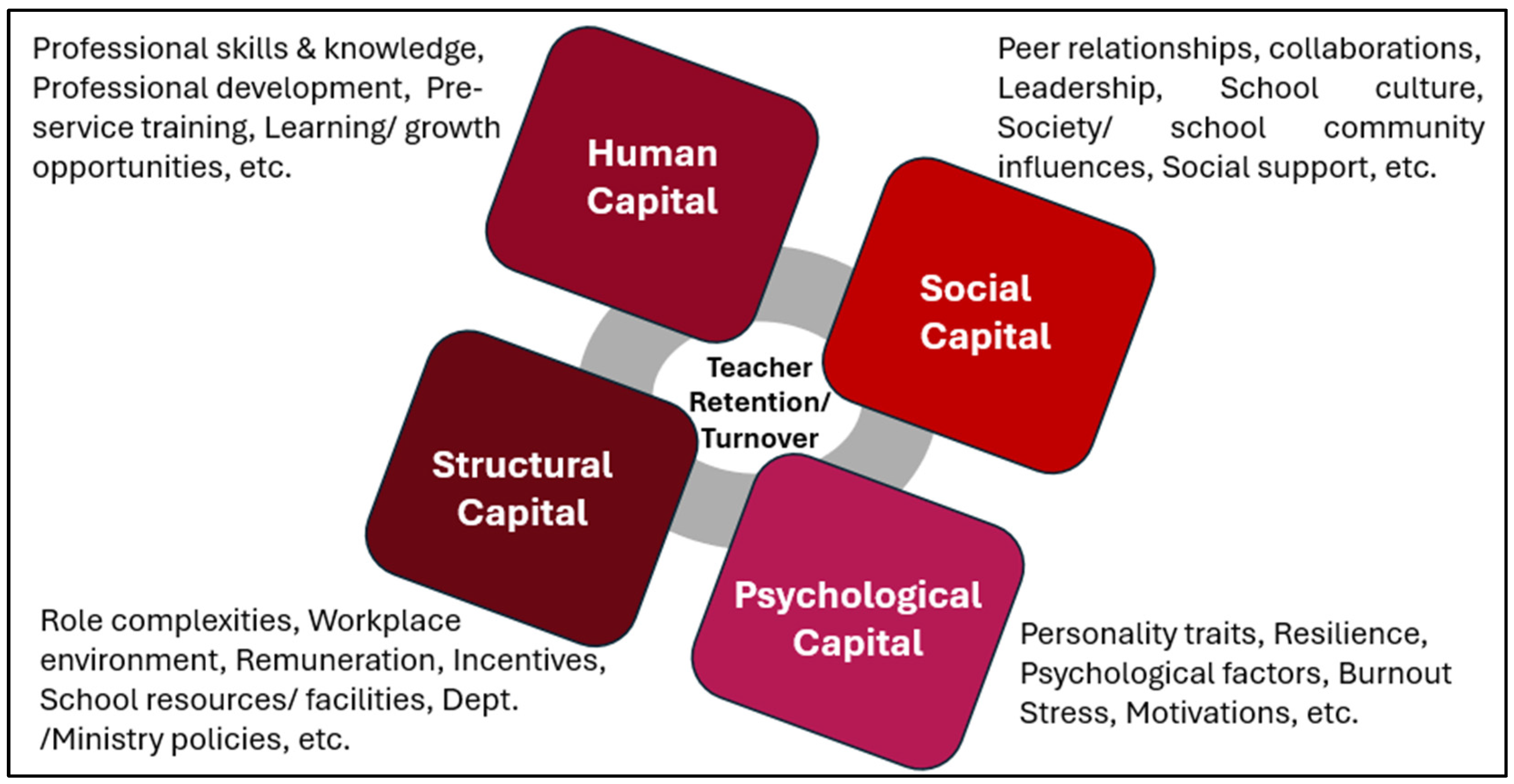
One such framework is the Four-Capital Framework proposed by Mason and Matas (2015), which conceptualizes teacher retention and attrition as the result of interactions among four forms of professional resources: human capital, social capital, structural capital, and psychological capital (Figure 1). Drawing conceptually on theories of organizational capital and positive organizational behavior, the framework suggests that teachers’ professional commitment depends on the availability and interaction of these resources in their working environments. Rather than functioning independently, these forms of capital shape teachers’ professional experiences, influencing job satisfaction, engagement, and decisions to remain in or leave the profession.
Figure 1.
Four-Capital Framework for Assessing Teachers’ Talent Retention or Turnover Intention.
Human capital refers to the professional knowledge, pedagogical competencies, and instructional expertise teachers acquire through education, certification, and professional practice. Strong human capital has been associated with greater instructional effectiveness and professional confidence (Darling-Hammond, 2017). However, human capital alone does not guarantee long-term retention. Teachers with advanced skills may be more likely to seek alternative opportunities when institutional environments fail to provide adequate professional recognition or career development pathways (Arviv Elyashiv & Navon, 2021).
Social capital reflects the professional relationships and collaborative networks that support teachers at school. Collegial collaboration, mentoring relationships, and supportive leadership contribute to the development of trust-based professional communities (Leana & Pil, 2006). Teachers who experience strong professional relationships and collaborative working environments typically report higher levels of job satisfaction and stronger intentions to remain in their schools (Jhonshon et al., 2024; Ronfeldt et al., 2015). In contrast, limited collegial interaction and professional isolation have been linked to increased turnover intentions.
Structural capital involves institutional systems and organizational arrangements that affect teachers’ working conditions. This includes leadership practices, administrative policies, workload distribution, professional development opportunities, and compensation structures (Nguyen et al., 2020). These structural factors influence teachers’ perceptions of fairness, professional autonomy, and institutional support. Research has shown that supportive leadership and well-organized professional environments contribute to stronger teacher retention (Grissom et al., 2021).
Psychological capital represents the internal psychological resources that support teachers’ professional engagement in demanding environments. Drawing on positive organizational psychology, psychological capital typically includes self-efficacy, resilience, optimism, and hope (Erden, 2025). Teachers with higher levels of psychological capital tend to cope more effectively with workplace stressors and maintain stronger professional (Collie, 2021; Skaalvik & Skaalvik, 2019). These psychological resources can therefore mitigate the negative effects of challenging working conditions.
Overall, the literature highlights that teacher retention is shaped by the interaction of human, social, structural, and psychological capital. The Four-Capital Framework provides a comprehensive perspective for understanding how professional resources and workplace conditions collectively influence teachers’ satisfaction, engagement, and retention decisions. A key premise of the Four-Capital Framework is that teacher retention depends on the interaction among these forms of capital and cannot be explained by the influence of any single factor. Teachers are more likely to remain in the profession when professional competencies, supportive relationships, enabling institutional environments, and psychological resilience complement one another. Conversely, imbalances among these capitals may contribute to dissatisfaction and increased turnover intentions.
Despite its conceptual value, empirical applications of the Four-Capital Framework are relatively limited, particularly in education systems characterized by high levels of international teacher mobility. Much of the existing research on teacher retention has been conducted in Western education systems, where teachers are primarily domestically recruited (Ingersoll & Tran, 2023). As a result, less is known about how the interactions among these forms of capital manifest in education systems that depend heavily on expatriate teaching workforces.
This limitation is especially relevant in Qatar, where the teaching workforce includes a large proportion of expatriate teachers employed under contract-based residency arrangements. In such contexts, teachers’ professional decisions may be influenced not only by school-level conditions but also by labor-market opportunities and migration-related factors. Examining teacher retention through the Four-Capital Framework provides a useful analytical lens for understanding how individual competencies, professional relationships, institutional conditions, and psychological resources interact in migration-dependent education systems.
3. Methods
3.1. Study Design
This study adopted a quantitative cross-sectional survey design to examine the relationships between teachers’ four forms of capital and their turnover intentions. Data were collected from in-service teachers working in public and private schools across Qatar. A non-probability convenience sampling strategy was used due to access constraints associated with the national school system. To partially address sectoral imbalances between public and private schools, post-stratification weighting was applied during analysis based on national teacher distribution statistics reported by the Ministry of Education and Higher Education. Although this procedure improves comparability across different school types, the findings need to be interpreted as indicative rather than statistically representative of the entire teacher population.
3.2. Participants
The study sample comprised 1010 in-service teachers from both public and private schools across Qatar. Teachers were recruited through two channels. Public school teachers received the survey through official distribution facilitated by the Ministry of Education and Higher Education; private school teachers were contacted directly by the research team through school administration offices. Participation was voluntary and anonymous, and no incentives were offered. The participants represent a pedagogical spectrum, including teachers from primary, middle, and high school levels across all subject areas. Detailed demographic characteristics of the participants, including gender, nationality, school type, years of experience, and age groups, are presented in Table 1. The demographic composition of the sample reflects national workforce patterns reported in official education statistics, including a high proportion of expatriate teachers and a predominantly female workforce. The final sample size of teachers exceeds recommended thresholds for regression analysis and provides sufficient statistical power to detect moderate effects.
Table 1.
Participant Demographics (N = 1010).
3.3. Survey
The online survey was designed by the authors using Microsoft Forms. Survey items were adapted from validated instruments used in previous research on teacher capital and turnover intention (Ekmekci et al., 2025). Survey items were contextually modified to reflect the institutional structure of Qatar’s school system. Each construct was measured using seven items, and minor wording adjustments were made following expert feedback.
3.4. Measures
The online survey consisted of three main sections: (A) consent form, (B) teacher demographics, and (C) teacher capitals and turnover intention items. A five-point Likert scale was used to assess closed-ended questions across five constructs: (1) human capital, (2) social capital, (3) structural capital, (4) psychological capital, and (5) teacher turnover intention. Most items followed a disagree-agree format, with responses ranging from strongly disagree (1) to strongly agree (5). The four dimensions of capital (i.e., human, social, structural, and positive psychological) were treated as independent variables, and the teacher turnover intention as the dependent variable.
Human Capital: This construct was measured through items assessing teacher pedagogical knowledge, skills, training, and learning opportunities. The following coding was assigned: “strongly disagree = 1”, “disagree = 2”, “neutral = 3”, “agree = 4”, and “strongly agree = 5”. The same coding format was followed in the following constructs:
Social Capital: Social capital focuses on items related to the quality of teachers’ relationships and support in the school environment.
Structural Capital: Structural capital measured teachers’ perception regarding organizational systems, policies, incentives, workload manageability, resource availability, and recognition structures that influence teacher retention or attrition.
Psychological Capital: Psychological capital assessed teachers’ motivation, resilience, optimism, and sense of purpose in their profession. Items captured job satisfaction, hope for career growth, emotional well-being, and teachers’ belief in their ability to overcome challenges.
Teacher Turnover Intention: This construct measured the extent to which teachers consider leaving their current position. Items explored the thoughts about quitting, searching for alternative jobs, unmet professional goals, and value misalignment in the workplace. These items were adapted and operationalized to reflect the Qatari schooling context.
Content validity was evaluated through expert review by three faculty members with expertise in educational leadership and organizational psychology. Reviewers assessed item clarity, construct alignment, and contextual relevance to Qatar’s school system. Minor wording adjustments were made based on their feedback before survey distribution.
3.5. Data Collection
Ethical clearance was secured from the Qatar University Institutional Review Board (IRB No.: QU-IRB 314/2025-EA) and the Ministry of Education and Higher Education (MoEHE), Qatar. The MoEHE facilitated survey distribution to public schools, whereas the authors conducted direct outreach to private schools via personalized emails. Participation was voluntary and contingent upon providing digital informed consent; the survey platform prevented progress until consent was documented. Although a formal pilot study was not conducted due to project timeline constraints, the instrument demonstrated strong internal consistency across all scales, as reported in the Results section.
3.6. Data Analysis
Data was analyzed using SPSS version 27. Prior to hypothesis testing, the dataset was screened for missing values and distributional assumptions. Cases with incomplete responses were removed prior to analysis using listwise deletion. Normality was examined using the Kolmogorov–Smirnov and Shapiro–Wilk tests as well as skewness and kurtosis statistics. Internal consistency reliability was evaluated using Cronbach’s alpha and McDonald’s omega coefficients. Descriptive statistics (means and standard deviations) were calculated to summarize teachers’ perceptions of the four capitals and turnover intentions. Because normality assumptions were not satisfied, non-parametric procedures were employed, including Mann–Whitney U tests to examine demographic differences and Spearman’s rho correlations to assess relationships between constructs. Finally, multiple linear regression analysis was conducted to examine the predictive effects of the four forms of capital on turnover intention.
4. Results
4.1. Validation of Instruments
To validate the underlying structure of the constructs (teachers’ human, social, psychological, and structural capital, and turnover intention), a factor analysis was conducted. The suitability of the data for factor extraction was confirmed by the Kaiser–Meyer–Olkin (KMO) measure, which yielded values above 0.85 for all constructs, and a significant Bartlett’s Test of Sphericity (p < 0.001), which indicated sufficient correlation between items (Field, 2024). All items exhibited strong factor loadings exceeding 0.75. Furthermore, internal consistency was verified using Cronbach’s Alpha and McDonald’s Omega, with all values surpassing 0.75 (i.e., high scale reliability) (Tavakol & Dennick, 2011) (see Table 2). Finally, Shapiro–Wilk and Kolmogorov–Smirnov tests were performed, revealing that the data followed a non-normal distribution (p < 0.05). Consequently, non-parametric procedures were prioritized for the subsequent inferential analyses.
Table 2.
Internal consistency—Cronbach’s Alpha and McDonald’s Omega.
The following sections present a systematic analysis of the data to address the four primary RQs of this study. First, RQ1 examines the descriptive statistics of the four capitals (i.e., human, social, structural, and psychological), alongside teachers’ turnover intentions. RQ2 then investigates whether these intentions differ significantly across key demographic groups, specifically gender, nationality, and school type. Moving from descriptive to relational analysis, RQ3 explores the strength and direction of the correlations between the four capitals and turnover intention. Finally, RQ4 employs multiple regression analysis to determine which of these capitals serves as the most significant predictor of a teacher’s decision to remain in or exit the Qatari educational workforce.
4.2. RQ1: What Are the Levels of Teachers’ Human, Social, Structural, and Psychological Capital, as Well as Their Turnover Intentions, in the Qatari Educational Context?
The findings indicate that teachers in Qatar perceive themselves as possessing high levels of the four capitals investigated (Table 3). On a typical 5-point Likert scale, the means for all four capitals were positioned above the midpoint. The teachers’ human capital (M = 4.31, SD = 0.59) emerged as the highest-rated construct, showcasing that teachers have a very high degree of confidence in their individual competencies, including their pedagogical knowledge, professional experience, and specialized skills. Social capital (M = 4.21, SD = 0.73) followed closely, illuminating that the Qatari educational landscape is characterized by strong interpersonal trust, effective collaboration, and efficient professional networks. Psychological capital (M = 4.06, SD = 0.75) also yielded a high mean, indicating that teachers generally possess a positive psychological state, suggesting a workforce that is psychologically equipped to handle the demands of the classroom. Structural capital (M = 3.70, SD = 0.86) was the lowest-rated of the four dimensions, reporting teachers’ perception of the need for organizational improvements. Finally, teachers’ turnover intention (M = 3.09, SD = 1.04) reported a moderate mean score and exhibited the highest standard deviation in the dataset. This indicates significant variability in teachers’ responses, with some teachers likely to have very low intentions to leave, and a substantial portion may be considering a transition.
Table 3.
Descriptive statistics (N = 1010).
4.3. RQ2: Do Teachers’ Turnover Intentions Differ According to Gender, Nationality, and School Type?
The analysis of RQ2 uncovers distinct demographic fractures in how teachers perceive their turnover intention in the Qatari educational landscape (Table 4). Utilizing the Mann–Whitney U test, the study found a statistically significant disparity in turnover intentions based on gender (U = 198,602, p < 0.001), with female teachers reporting a higher mean rank (743) than their male colleagues (621). This suggests that the female cohort exhibits greater turnover intentions, despite both genders operating in the same academic framework. Similarly, nationality also emerged as a critical predictor of teacher turnover intention (U = 845,221, p < 0.001), with Qatari national teachers exhibiting a substantially higher mean rank (821) compared to their non-Qatari counterparts (681). This finding suggests that despite the high levels of human and social capital identified in the workforce, Qatari nationals possess a higher inclination to exit the profession than the expatriate. In contrast, the teachers’ school type appears to play a negligible role in these intentions, where the public school and private school teachers reported identical levels of turnover intent.
Table 4.
Mann–Whitney U Test results comparing teachers’ turnover intentions across demographic groups.
Although statistical significance was observed for gender and nationality, the magnitude of these differences should be interpreted alongside effect size estimates to assess their practical significance in policy contexts. For nonparametric comparisons using the Mann–Whitney test, effect size can be calculated as r = Z/√N, where Z represents the standardized test statistic and N is the total sample size. This provides an estimate of the strength of the observed differences beyond statistical significance.
4.4. RQ3: What Is the Relationship Between the Four Forms of Teacher Capital and Turnover Intention?
RQ3 explores the relationship (correlation) between teachers’ four capitals and their turnover intention (Table 5). Spearman’s rho correlation matrix demonstrates that the four capitals (i.e., human, social, structural, and psychological) are all strongly and positively intercorrelated, with coefficients ranging from r = 0.601 to r = 0.792 (p < 0.01). The highest correlation was observed between social and structural capital (r = 0.792), suggesting that in the Qatari context, high-functioning professional networks are deeply intertwined with the institutional systems. This probably implies that when teachers feel the structural capital (i.e., the school system) works for them, their social capital (i.e., professional relationships) tends to flourish as well.
Table 5.
Spearman’s Rho correlation matrix for teachers’ four capitals and turnover intention.
Regarding the relationship with teachers’ turnover intention, the findings confirm a significant negative correlation between all four dimensions of capital, suggesting that these dimensions serve as critical protective factors. Notably, structural capital emerged as the strongest determinant of turnover intention (r = −0.476, p < 0.01), indicating that the organization’s infrastructure is the most influential factor in anchoring a teacher to their role. In contrast, human capital demonstrated a significantly weaker protective effect (r = −0.111, p < 0.01). This disparity suggests that whereas teachers’ individual expertise (human capital) is valuable in Qatar, it is the strength of the institutional support (structural capital) that effectively limits teachers’ teacher turnover intention. These results emphasize that retaining talent in Qatar may depend less on individual skill development and more on the systemic support structures provided by the institution.
4.5. RQ4: To What Extent Do Human, Social, Structural, and Psychological Capital Predict Teachers’ Turnover Intentions?
The multiple regression analysis model demonstrated a moderate fit, explaining 28.9% of the variance in teachers’ turnover intention (R2 = 0.289, Adjusted R2 = 0.286) (Table 6). Most importantly, structural capital emerged as the most powerful predictor of teachers’ turnover intention (β = −0.567, p < 0.001), showcasing that the institutional systems and administrative support are the primary anchors for teacher retention. Psychological capital also serves as a significant protective factor (β = −0.194, p < 0.001), suggesting that personal resilience and optimism help shield teachers from the desire to leave. However, human capital acted as a positive predictor of turnover intention (β = 0.327, p < 0.001), which demonstrated that highly skilled and qualified teachers may perceive their expertise as an asset, granting them the professional mobility to seek alternative employment if they are dissatisfied. Interestingly, social capital did not independently predict turnover (β = 0.046, p = 0.353), likely because the benefits of professional networks are already mediated through the school’s structural systems and the teacher’s psychological state. Conclusively, these findings suggest that even though high human capital is essential for educational quality, it must be paired with structural support to ensure that the most talented teachers remain in Qatar’s schools. Given the high intercorrelations among the independent variables, multicollinearity diagnostics were conducted. Variance Inflation Factor (VIF) values were below the threshold of 5, indicating acceptable collinearity levels and supporting the stability of the regression estimates.
Table 6.
Multiple regression analysis predicting teachers’ turnover intentions via the four capitals.
5. Discussion
The findings of this study reveal an important pattern in the relationship between teachers’ professional resources and their intentions to remain in the profession in Qatar. Although teachers reported high levels of human, social, and psychological capital, turnover intention appears to be moderate and varied considerably among participants. This pattern indicates an important imbalance between individual professional capacity and the institutional environments in which teachers work. Consistent with the Four-Capital Framework proposed by Mason and Matas (2015), this imbalance suggests that strong personal capabilities alone are insufficient to maintain long-term professional commitment when organizational systems do not provide comparable levels of support.
The findings illustrate this imbalance clearly: teachers reported the highest mean scores for human capital, indicating strong confidence in their pedagogical knowledge, instructional expertise, and professional experience. Similarly, structural capital received comparatively lower evaluations, suggesting that teachers view limitations in organizational structures, including administrative support, institutional processes, and career paths. This discrepancy indicates a mismatch between individual expertise and institutional support, in which high levels of individual competence are not matched by supportive institutional contexts. Research in other educational settings similarly demonstrates that organizational systems, including school infrastructure, leadership practices, and institutional policies, affect teachers’ professional experiences and influence their long-term retention in schools (Ismail & David, 2024; Koerber et al., 2023). When institutional systems fail to provide opportunities for career progression or professional recognition that correspond to teachers’ competencies, highly skilled educators may seek alternative opportunities outside the profession (Wanke et al., 2024).
Demographic differences in turnover intentions provide further insight into how Qatar’s labor context can influence teachers’ professional decisions. Our analysis shows that female teachers and Qatari national teachers reported significantly higher turnover intentions compared to male and expatriate counterparts. These findings challenge assumptions that workforce stability in Gulf education systems is determined by economic incentives such as competitive salaries or employment benefits (Almutairi, 2024; Hvidt, 2020). For Qatari nationals, higher turnover intention may reflect career mobility opportunities in the national labor market. In Qatar, a wide range of employment opportunities is available outside the sphere of education, including positions in family-owned businesses and other private sector enterprises (Salamzadeh & Dana, 2022). In these fields, teaching may not be a long-term occupational destination and, as a result, dissatisfaction in the school environment may encourage transitions into alternative professional roles.
Expatriate teachers appear to work under different professional constraints. Because residency status and employment opportunities are closely tied to contractual arrangements, expatriate teachers may prioritize employment stability even when they encounter workplace challenges (Aarthi & Sahu, 2021). Research examining expatriate educators across Gulf countries similarly indicates that financial incentives, relative employment stability, and professional development opportunities encourage teachers to stay in the region despite workplace pressures (Mohamed et al., 2024). Compared with labor conditions in many teachers’ home countries, employment in the Gulf’s education sector may therefore represent a relatively secure professional option.
Higher turnover intentions observed among female teachers may also reflect structural pressures associated with work–family balance and professional expectations. Previous research reveals that female educators frequently experience competing demands between professional responsibilities and family obligations (Sultan et al., 2023), which can contribute to increased occupational stress and higher intentions to leave the profession (Sellami et al., 2022; Toprak et al., 2021). Work–family conflict and limited institutional flexibility have been identified as factors that influence women’s professional paths in the education sector worldwide. In this sense, the observed gender differences may signal structural conditions rather than individual preferences alone.
The correlational analysis highlights the importance of institutional factors in shaping teacher retention. All four forms of capital were negatively associated with turnover intention, indicating that these resources serve as protective factors against teachers’ intentions to leave the profession. Specifically, structural capital demonstrated the strongest association with turnover intention. This finding demonstrates the importance of institutional structures, including administrative support, clear policies, manageable workloads, and access to professional development. Schools characterized by supportive leadership practices and well-organized professional environments tend to retain teachers successfully because they provide the stability and recognition necessary for professional engagement (Ford & Forsyth, 2021; Räsänen et al., 2020).
The strong correlation between social and structural capital also provides insight into the organizational dynamics of schools. Professional relationships among teachers do not develop independently of institutional contexts; instead, they are determined by the structures that organize professional collaboration. When schools establish supportive leadership practices, clear communication channels, and opportunities for collaboration, professional relationships among teachers are more likely to flourish. Research on teacher collaboration similarly shows that strong collegial networks contribute to school stability and professional commitment when they are part of supportive institutional systems. In contrast, professional relationships alone may not compensate for structural deficiencies in schools.
The regression analysis provides additional evidence for the key role of organizational conditions. Structural capital was identified as the strongest predictor of turnover intention, followed by psychological capital. Teachers who perceived higher levels of institutional support and who possessed stronger psychological resources were significantly less likely to consider leaving their positions. Psychological capital, which encompasses resilience, optimism, and professional confidence, appears to help teachers cope with the challenges of teaching and maintain commitment to their work even under demanding conditions (Collie, 2021; Skaalvik & Skaalvik, 2019).
The analysis further revealed an important and somewhat counterintuitive finding: human capital was positively associated with turnover intention. This suggests that teachers with stronger professional competencies may be more inclined to consider alternative career opportunities when they encounter institutional limitations. This finding may be interpreted through the lens of human capital mobility theory, which suggests that individuals with higher levels of transferable skills face lower barriers when transitioning between professional roles (Palma-Vasquez et al., 2022). In labor markets characterized by diverse employment opportunities, professional competence may increase teachers’ awareness of external opportunities and reduce dependence on a single institutional setting.
The absence of a significant independent effect of social capital in the regression model suggests that collegial relationships alone are insufficient to anchor teachers in their positions when other institutional supports are limited. Although professional networks can provide emotional and instructional support, they cannot substitute for organizational conditions, including effective leadership, transparent policies, and fair workload distribution (Koerber et al., 2023). These findings suggest that teacher retention strategies should focus on improving institutional environments that support teachers’ work and not merely on professional development (Jhonshon et al., 2024). Policies aimed at improving school leadership practices, enhancing administrative support (Ackah-Jnr et al., 2022), and promoting teachers’ psychological well-being (John & Wani, 2026) may therefore play a central role in stabilizing the teaching workforce in Qatar.
In conclusion, the findings suggest that teacher retention in Qatar is strongly influenced by organizational and structural conditions alongside individual professional resources. While teachers demonstrated high levels of human, social, and psychological capital, structural capital emerged as the strongest predictor of turnover intention, highlighting the central role of institutional support, leadership, and workplace conditions in sustaining teacher commitment.
6. Conclusions
6.1. Findings
This study examined teacher turnover intention in Qatar through the lens of the Four-Capital Framework, focusing on the roles of human, social, structural, and psychological capital in determining teachers’ professional decisions. The findings reveal an important imbalance between teachers’ individual capabilities and the institutional environments in which they work. Although teachers reported high levels of human, social, and psychological capital, structural capital emerged as the most influential factor in predicting turnover intention. These results suggest that organizational conditions play a decisive role in determining whether teachers remain in the profession.
The analysis also identified a clear competency paradox. Teachers with stronger professional competencies reported higher intentions to leave the profession, indicating that highly skilled educators may be more willing to explore alternative career opportunities when institutional environments fail to meet their professional expectations. In these cases, professional expertise may increase teachers’ awareness of external opportunities as opposed to fostering organizational commitment. This finding highlights the importance of institutional environments that can accommodate and support highly capable educators through well-defined career paths and professional recognition.
Demographic differences also illustrate the influence of the larger labor context in Qatar. Higher turnover intentions among Qatari national teachers and female teachers suggest that workforce stability cannot be explained solely through financial incentives or employment benefits. National teachers may have access to alternative employment opportunities outside the education sector, while female teachers may experience structural pressures related to work–family balance and professional expectations. These findings emphasize the importance of contextually responsive retention strategies that address the specific needs and constraints of different groups in the teaching workforce in the country.
6.2. Limitations
Some limitations should be considered when interpreting the findings. First, the study relied on cross-sectional survey data, which captures teachers’ perceptions at a single point in time and cannot establish causal relationships. Longitudinal research would be useful to determine whether turnover intentions observed in this study translate into actual attrition over time. Second, our analysis relied on self-reported data, which may be influenced by social desirability or response bias. Although efforts were made to ensure anonymity and encourage honest responses, these biases cannot be completely ruled out. Third, the study measured turnover intention rather than actual turnover behavior. Whereas prior research shows that intention is a strong predictor of departure from the profession, the relationship between intention and actual behavior may be influenced by external factors such as contractual obligations or labor-market conditions.
Future research could build on these findings in different ways. Qualitative studies examining teachers’ lived experiences would provide deeper insight into how institutional conditions influence professional decisions in Qatar’s education system. Longitudinal research could also explore how teachers’ perceptions evolve over time and how turnover intentions translate into career transitions. In addition, comparative research in Gulf education systems would clarify how labor markets that are based on migration affect teacher mobility and retention.
6.3. Recommendations
From a policy perspective, the results indicate that teacher retention strategies should focus on strengthening structural and institutional conditions in schools. Enhancing administrative support systems, establishing transparent promotion opportunities, and improving professional development opportunities may help ensure that teachers’ professional competencies translate into commitment to the profession. In addition, targeted initiatives such as leadership development opportunities for experienced teachers, flexible working arrangements for women, and mentorship programs designed to enhance psychological resilience may further contribute to workforce stability.
Author Contributions
Conceptualization: M.E.S., A.S. and M.A.-D.; methodology: M.E.S.; validation: M.E.S.; formal analysis: M.E.S.; investigation: M.E.S.; original draft preparation: M.E.S.; writing: M.E.S., A.S. and M.A.-D.; review and editing: M.E.S., A.S. and M.A.-D. All authors have read and agreed to the published version of the manuscript.
Funding
This research was funded by Qatar Research, Development, and Innovation Council (QRDI). Grant No: PTP02-0302-250027.
Institutional Review Board Statement
The study was conducted in accordance with the Declaration of Helsinki and approved by the Qatar University Institutional Review Board with approval number QU-IRB 314/2025-EA on 17 December 2025.
Informed Consent Statement
Informed consent was obtained from all subjects involved in the study.
Data Availability Statement
The datasets for this study are included in the article. Raw data can be provided on reasonable request from the corresponding authors.
Conflicts of Interest
The authors declare no conflicts of interest.
Abbreviations
The following abbreviations are used in this manuscript:
| KMO | Kaiser–Meyer–Olkin |
| MoEHE | Ministry of Education and Higher Education |
| VIF | Variance Inflation Factor |
References
- Aarthi, S., & Sahu, M. (2021). Migration policy in the Gulf Cooperation Council (GCC) states: A critical analysis. Contemporary Review of the Middle East, 8(4), 410–434. [Google Scholar] [CrossRef] [Scilit]
- Abu-Tineh, A. M., Romanowski, M. H., Chaaban, Y., Alkhatib, H., Ghamrawi, N., & Alshaboul, Y. M. (2023). Career advancement, job satisfaction, career retention, and other related dimensions for sustainability: A perception study of Qatari public school teachers. Sustainability, 15(5), 4370. [Google Scholar] [CrossRef] [Scilit]
- Ackah-Jnr, F. R., Appiah, J., Abedi, E. A., Opoku-Nkoom, I., & Salaam, M. A. (2022). Quality education: Critical policy considerations that impact teacher retention in schools. European Journal of Education and Pedagogy, 3(3), 26–32. [Google Scholar] [CrossRef] [Scilit]
- Al-Dababneh, P. K. A., Abdulla M Al-Attiyah, P. A., & K. Al-Zboon, P. E. (2026). Levels of psychological burnout among female special-education teachers working with children with disabilities: A comparative study between Jordan and Qatar. International Journal of Disability, Development and Education, 73(1), 19–44. [Google Scholar] [CrossRef] [Scilit]
- Alloh, M. M., Hasan, M. A., Du, X., & Romanowski, M. H. (2019). Burnout of primary teachers in Qatar government schools during an era of educational reform. International Journal of Learning, Teaching and Educational Research, 18(10), 1–19. [Google Scholar] [CrossRef] [Scilit]
- Almutairi, N. T. (2024). Does investment in human capital via education stimulate economic growth in an oil-rich country? A case study of Saudi Arabia. Journal of the Knowledge Economy, 15(1), 2933–2955. [Google Scholar] [CrossRef] [Scilit]
- Arnold, B., & Rahimi, M. (2025). Teachers’ working conditions, wellbeing and retention: An exploratory analysis to identify the key factors associated with teachers’ intention to leave. The Australian Educational Researcher, 52(3), 1947–1973. [Google Scholar] [CrossRef] [Scilit]
- Arviv Elyashiv, R., & Navon, Y. (2021). Teacher attrition: Human capital and terms of employment—Do they matter? Education Policy Analysis Archives, 29(76), n76. [Google Scholar] [CrossRef] [Scilit]
- Asianab, E. (2023). Influence of leadership styles on staff retention: A review of literature. International Journal of Multidisciplinary Studies and Innovative Research, 11(2), 26–34. [Google Scholar] [CrossRef]
- Borman, G. D., & Dowling, N. M. (2008). Teacher attrition and retention: A meta-analytic and narrative review of the research. Review of Educational Research, 78(3), 367–409. [Google Scholar] [CrossRef] [Scilit]
- Casely-Hayford, J., Toropova, A., Björklund, C., Bergström, G., Lindqvist, P., & Kwak, L. (2025). Are schools with a better work environment better at retaining teachers? A repeated cross-sectional study examining schools’ organisational and social risk factors and teacher retention. Scandinavian Journal of Educational Research, 1–14. [Google Scholar] [CrossRef] [Scilit]
- Collie, R. J. (2021). COVID-19 and teachers’ somatic burden, stress, and emotional exhaustion: Examining the role of principal leadership and workplace buoyancy. AERA Open, 7, 2332858420986187. [Google Scholar] [CrossRef] [Scilit]
- Darling-Hammond, L. (2017). Teacher education around the world: What can we learn from international practice? European Journal of Teacher Education, 40(3), 291–309. [Google Scholar] [CrossRef] [Scilit]
- Dickson, J. A. (2024). International schools and teacher retention: A qualitative study [Ph.D. thesis, Carson Newman]. [Google Scholar]
- Ekmekci, A., Aqazade, M., McGraw, R., Rushton, G., Gibson, D. J., Cerosaletti, C., Daley, M., & Kucuk, B. (2025). Using human, social, structural, and positive psychological capital to explore science and mathematics teacher retention. International Journal of STEM Education, 12(1), 14. [Google Scholar] [CrossRef] [Scilit]
- Erden, H. (2025). The influence of teachers’ psychological capital on the quality of work life: Exploring the mediating impact of emotions. Frontiers in Psychology, 16, 1557030. [Google Scholar] [CrossRef] [Scilit]
- Field, A. (2024). Discovering statistics using IBM SPSS statistics. Sage Publications Limited. [Google Scholar]
- Ford, T. G., & Forsyth, P. B. (2021). Teacher corps stability: Articulating the social capital enabled when teachers stay. Journal of Educational Administration, 59(2), 233–252. [Google Scholar] [CrossRef] [Scilit]
- Fu, W., Pan, Q., Zhang, C., & Cheng, L. (2022). Influencing factors of Chinese special education teacher turnover intention: Understanding the roles of subject well-being, social support, and work engagement. International Journal of Developmental Disabilities, 68(3), 342–353. [Google Scholar] [CrossRef] [Scilit]
- Grissom, J. A., Egalite, A. J., & Lindsay, C. A. (2021). How principals affect students and schools. Wallace Foundation, 2(1), 30–41. [Google Scholar]
- Hanushek, E. A., Rivkin, S. G., & Schiman, J. C. (2016). Dynamic effects of teacher turnover on the quality of instruction. Economics of Education Review, 55, 132–148. [Google Scholar] [CrossRef] [Scilit]
- Hazaimeh, S. A., Elbanna, S., & Fatima, T. (2023). Education and employment reforms toward developing human capital: The case of Qatar. The CASE Journal, 19(2), 252–272. [Google Scholar] [CrossRef] [Scilit]
- Hvidt, M. (2020). Economic diversification and job creation in the Arab Gulf countries: Applying a value chain perspective. In When can oil economies be deemed sustainable? (pp. 281–300). Springer. [Google Scholar]
- Ingersoll, R. M., & Tran, H. (2023). Teacher shortages and turnover in rural schools in the US: An organizational analysis. Educational Administration Quarterly, 59(2), 396–431. [Google Scholar] [CrossRef] [Scilit]
- Ismail, S. M. M., & David, S. A. (2024). The impact of school leadership support on teacher retention: A study among school leaders and teacher. International Journal of Educational Administration and Leadership: Theory and Practice, 3(1), 1–15. [Google Scholar] [CrossRef] [Scilit]
- Jhonshon, E., Mendoza, C., & Sobirin, M. S. (2024). Strategies of school principals in improving educational quality an analysis of best practices in American schools. JMPI: Jurnal Manajemen, Pendidikan dan Pemikiran Islam, 2(2), 112–124. [Google Scholar] [CrossRef] [Scilit]
- Jiang, J., Yip, S. Y., & Gong, C. (2025). What Affects teachers’ turnover intention? Examining the impact of teacher professional status. The Asia-Pacific Education Researcher, 34(5), 1963–1975. [Google Scholar] [CrossRef] [Scilit]
- John, G., & Wani, M. A. (2026). Supporting teachers’ social-emotional well-being: A pathway to stronger teacher retention. In Creative approaches to teacher retention (pp. 229–250). IGI Global Scientific Publishing. [Google Scholar]
- Koerber, N., Marquez-Mendez, M., Mensah, A., Fasching-Varner, K., & Schrader, P. (2023). Sustaining teacher needs: A systematic narrative review exploring teacher retention, attrition, and motivation. Literature Reviews in Education and Human Services, 2(2), 1–20. [Google Scholar]
- Leana, C. R., & Pil, F. K. (2006). Social capital and organizational performance: Evidence from urban public schools. Organization Science, 17(3), 353–366. [Google Scholar] [CrossRef] [Scilit]
- Liebowitz, D. D., & Porter, L. (2019). The effect of principal behaviors on student, teacher, and school outcomes: A systematic review and meta-analysis of the empirical literature. Review of Educational Research, 89(5), 785–827. [Google Scholar] [CrossRef] [Scilit]
- Loeb, S., & Myung, J. (2020). Economic approaches to teacher recruitment and retention. In The economics of education (pp. 403–414). Elsevier. [Google Scholar]
- Mason, S., & Matas, C. P. (2015). Teacher attrition and retention research in Australia: Towards a new theoretical framework. Australian Journal of Teacher Education (Online), 40(11), 45–66. [Google Scholar] [CrossRef] [Scilit]
- Mohamed, A., Dasoo, N., & Israel, H. (2024). South African expatriate teachers in the Gulf Arab States: Push and pull factors for leaving. Migration and Development, 13(2), 274–288. [Google Scholar] [CrossRef] [Scilit]
- Mvana, S. W. (2025). Understanding the psychology of teacher retention in the African context. Annals of the University of Craiova for Journalism, Communication and Management, 11(1), 81–87. [Google Scholar]
- Nguyen, T. D. (2021). Linking school organizational characteristics and teacher retention: Evidence from repeated cross-sectional national data. Teaching and Teacher Education, 97, 103220. [Google Scholar] [CrossRef] [Scilit]
- Nguyen, T. D., Anglum, J. C., & Crouch, M. (2023). The effects of school finance reforms on teacher salary and turnover: Evidence from national data. AERA Open, 9, 23328584231174447. [Google Scholar] [CrossRef] [Scilit]
- Nguyen, T. D., Bettini, E., Redding, C., & Gilmour, A. F. (2025). Comparing teacher turnover intentions to actual turnover: Cautions and lessons for the field. Educational Evaluation and Policy Analysis, 47(3), 970–979. [Google Scholar] [CrossRef] [Scilit]
- Nguyen, T. D., Pham, L. D., Crouch, M., & Springer, M. G. (2020). The correlates of teacher turnover: An updated and expanded meta-analysis of the literature. Educational Research Review, 31, 100355. [Google Scholar] [CrossRef] [Scilit]
- Nguyen, T. D., & Springer, M. G. (2023). A conceptual framework of teacher turnover: A systematic review of the empirical international literature and insights from the employee turnover literature. Educational Review, 75(5), 993–1028. [Google Scholar] [CrossRef] [Scilit]
- OECD. (2023). Education at a glance 2023: OECD indicators. OECD Publishing. [Google Scholar] [CrossRef] [Scilit]
- Palma-Vasquez, C., Carrasco, D., & Tapia-Ladino, M. (2022). Teacher mobility: What is it, how is it measured and what factors determine it? A scoping review. International Journal of Environmental Research and Public Health, 19(4), 2313. [Google Scholar] [CrossRef] [Scilit] [PubMed]
- Pan, H.-L. W., Chung, C.-H., & Lin, Y.-C. (2023). Exploring the predictors of teacher well-being: An analysis of teacher training preparedness, autonomy, and workload. Sustainability, 15(7), 5804. [Google Scholar] [CrossRef] [Scilit]
- Räsänen, K., Pietarinen, J., Pyhältö, K., Soini, T., & Väisänen, P. (2020). Why leave the teaching profession? A longitudinal approach to the prevalence and persistence of teacher turnover intentions. Social Psychology of Education, 23(4), 837–859. [Google Scholar] [CrossRef] [Scilit]
- Romanowski, M. H., Alkhateeb, H., & Nasser, R. (2018). Policy borrowing in the gulf cooperation council countries: Cultural scripts and epistemological conflicts. International Journal of Educational Development, 60, 19–24. [Google Scholar] [CrossRef] [Scilit]
- Ronfeldt, M., Farmer, S. O., McQueen, K., & Grissom, J. A. (2015). Teacher collaboration in instructional teams and student achievement. American Educational Research Journal, 52(3), 475–514. [Google Scholar] [CrossRef] [Scilit]
- Salamzadeh, A., & Dana, L.-P. (2022). Family business in Qatar. In Family business in Gulf cooperation council countries (pp. 53–66). Springer. [Google Scholar]
- Sellami, A., Arar, K., & Sawalhi, R. (2022). Higher education and scientific research in the Arabian Gulf states: Opportunities, aspirations, and challenges. Routledge. [Google Scholar]
- Shaoan, M. M. R., Namanyane, T., Feng, M., & Arif, M. (2025). A systematic literature review on the importance of teacher recruitment and retention in global educational reform. Frontiers in Education, 9, 1447752. [Google Scholar] [CrossRef] [Scilit]
- Skaalvik, E., & Skaalvik, S. (2019). Teacher self-efficacy and teacher burnout: A longitudinal study. Teaching and Teacher Education, 78, 178–186. Available online: https://www.researchgate.net/publication/282773376_Teacher_Self-Efficacy_and_Teacher_Burnout_A_Study_of_Relations (accessed on 10 May 2026).
- Sorensen, L. C., & Ladd, H. F. (2020). The hidden costs of teacher turnover. AERA Open, 6(1), 2332858420905812. [Google Scholar] [CrossRef] [Scilit]
- Sultan, S., Jeganatha, S., Sameem, M., & Hamzah, I. (2023). The impact of work family conflict on female teacher’s intention to leave the job a survey of female teaching staff in public sector colleges. Journal of Mental Health and Social Rehabilitation, 1(1), 1–14. [Google Scholar] [CrossRef] [Scilit]
- Tavakol, M., & Dennick, R. (2011). Making sense of Cronbach’s alpha. International Journal of Medical Education, 2, 53. [Google Scholar] [CrossRef] [Scilit] [PubMed]
- Toprak, M., Karakus, M., & Chen, J. (2021). Teachers’ attitudes towards their school managers and their intent to leave: A gender-moderated model. Current Psychology, 40(12), 5919–5933. [Google Scholar] [CrossRef] [Scilit]
- Toropova, A., Myrberg, E., & Johansson, S. (2021). Teacher job satisfaction: The importance of school working conditions and teacher characteristics. Educational Review, 73(1), 71–97. [Google Scholar] [CrossRef] [Scilit]
- UNESCO. (2024). Global report on teachers: Addressing teacher shortages and transforming the profession. Available online: https://www.unesco.org/en/articles/global-report-teachers-addressing-teacher-shortages-and-transforming-profession (accessed on 15 February 2026).
- Vaidya, S. R., & Hanna, C. (2023). The four-capital theory as framework for teacher retention and attrition. International Education Studies, 16(6), 21–32. [Google Scholar] [CrossRef] [Scilit]
- Wanke, P., Lauro, A., dos Santos Figueiredo, O. H., Faria, J. R., & Mixon, F. G., Jr. (2024). The impact of school infrastructure and teachers’ human capital on academic performance in Brazil. Evaluation Review, 48(4), 636–662. [Google Scholar] [CrossRef] [Scilit]
- Williams, J. A., III, Hill-Jackson, V., Caldwell, C., & Craig, C. J. (2022). Teacher recruitment and retention: Local strategies, global inspiration (Vol. 73, pp. 333–337). SAGE Publications Sage CA. [Google Scholar]
- Yang, Y., & Chan, L. (2025). Research on teachers’ turnover intention–bibliometric analysis-based review. Asian Education and Development Studies, 14(5), 1106–1125. [Google Scholar] [CrossRef] [Scilit]

Disclaimer/Publisher’s Note: The statements, opinions and data contained in all publications are solely those of the individual author(s) and contributor(s) and not of MDPI and/or the editor(s). MDPI and/or the editor(s) disclaim responsibility for any injury to people or property resulting from any ideas, methods, instructions or products referred to in the content. |
© 2026 by the authors. Licensee MDPI, Basel, Switzerland. This article is an open access article distributed under the terms and conditions of the Creative Commons Attribution (CC BY) license.