


Abstract
As Hong Kong approaches 1 July 2027—the 30th anniversary of its return to the People’s Republic of China—questions of cultural belonging and political identity remain salient. This study examined how local, national, and global identities have been constructed and hierarchically organized through post-handover school music education. Drawing on qualitative discourse analysis of policy documents and government-approved junior secondary music textbooks, the analysis examined how these orientations are articulated and mediated in the curriculum. The findings showed that local identity is sustained through heritage canonization, Cantonese repertoire, and affective attachment. Additionally, national identity is reinforced more programmatically through Putonghua repertoire, patriotic theming, civilizational narratives, and the legally codified status of the national anthem. Finally, global identity is cultivated through structured multicultural exposure, including Western art music and international popular genres. Together, these orientations form calibrated layering, through which music education functions as cultural governance by stabilizing multiscalar belonging.
1. Introduction
Situated in Hong Kong’s post-handover context, this study examined how local, national, and global identities have been constructed and institutionally ordered through school music education as the city approaches the 30th anniversary of its return to the People’s Republic of China (PRC). Hong Kong’s colonial history, distinctive local consciousness, and longstanding global connectivity make it an especially revealing site for analyzing how multiscalar identities have been recalibrated during the political transition and intensified cultural governance.
Public discourse in Hong Kong has often framed identity as polarized between “local” and “national.” Educational practices, however, have revealed a more complex configuration (Flowerdew & Scollon, 1997; S. M. Leung, 2020). Rather than displacing one layer of belonging with another, curriculum policies and textbook representations have incorporated local heritage and global multiculturalism alongside an increasingly institutionalized national framework. The central issue, therefore, is not whether multiple identities coexist, but how they are prioritized, mediated, and hierarchically structured within authorized curricular knowledge.
To address this issue, the current study adopted a two-level analytical approach. At the macro level, the study examined official education policy documents and curriculum guidelines to identify how cultural and identity discourses have been articulated and prioritized. The macro-level policy corpus comprised officially issued documents published between 1 July 1997, and December 2025 by the Education Bureau (EDB), the Curriculum Development Council (CDC), the Curriculum Development Institute (CDI), the Education Commission, and related statutory authorities. Documents were selected according to four criteria: (1) formal institutional authority; (2) system-wide applicability; (3) direct relevance to curriculum reform, arts/music education, and civic or national education; and (4) substantive reference to identity-related themes, such as national belonging, Chinese culture, local heritage, globalization, and multiculturalism.
Pre-1997 curriculum documents were consulted for historical contextualization but were not included in the systematic analytical corpus. All documents were retrieved from official government websites and archival repositories between January and March 2026. The analysis focused exclusively on formally promulgated curriculum guides, reform reports, circular memoranda, and official supplementary guidelines used only for contextual background.
At the meso level, the study analyzed government-approved junior secondary music textbooks as key mediating texts that have translated policies into pedagogical representations. By tracing the movement from policy discourse to textbook mediation, the findings showed that music education functions as a site of cultural governance in which layered forms of belonging are symbolically organized and hierarchically calibrated.
This study was guided by two research questions:
- How have local, national, and global identities been constructed and prioritized in Hong Kong’s official education policies and music curriculum documents in the period leading up to the 30th anniversary of Hong Kong’s return to the People’s Republic of China?
- How are these identity orientations mediated, negotiated, and hierarchically structured in the government-approved junior secondary music textbooks?
The study did not examine classroom enactment or student reception; rather, it focused on the institutional structuring of identity representations at the policy and curricular levels.
2. Theoretical Framework: Curriculum, Cultural Governance, and Music Education
To examine how cultural meanings and identity narratives become educational knowledge, this study drew on Lawton’s (1973, 1975) cultural analysis model, which conceptualizes curriculum as a process of cultural selection. Based on this model, curriculum identifies knowledge, values, and practices deemed essential to social continuity and aligns them with institutional and state priorities. Lawton (1986) further framed curriculum planning as intergenerational cultural transmission, defining culture broadly to include language, music, art, beliefs, and social values. Curriculum thus functions as a central mechanism through which culture is organized and reproduced.
Cultural selection, however, is never politically neutral. To foreground its power-laden dimensions, this study situated Lawton’s model within the critical curriculum theory. Bernstein (2000) conceptualized curriculum as a field structured by relations of classification and framing, through which knowledge is hierarchically organized and pedagogically regulated. Bernstein’s notion of recontextualization is particularly instructive: policy discourses are selectively transformed as they move into pedagogic texts, embedding ideological priorities within everyday instructional practices. Similarly, Apple (2004, 2014) and Young (2013) have argued that curriculum reflects ongoing struggles over legitimacy, authority, and the production of “official knowledge.” What counts as valued culture is therefore shaped by relations of power, rather than by inherited traditions alone.
This perspective aligns with Foucault’s (1991) concept of governmentality, which highlights how modern governance operates not solely through coercive regulation but through subtle techniques that shape conduct, subjectivity, and self-understanding. From this viewpoint, curriculum may be understood as a technology of governance: it organizes symbolic resources in ways that cultivate modes of belonging and civic orientation. The notion of cultural governance employed in this study refers to the institutional processes through which identity narratives are selected, normalized, and hierarchically ordered in educational practices.
Music education provides a particularly revealing lens for examining these institutional processes. Music engages affect, memory, and embodied participation, translating abstract identity narratives into lived experiences (DeNora, 2000; Small, 1998). Small’s concept of musicking emphasized meaning as emerging through social performance, while DeNora demonstrated how music functions as a resource for identity formation and emotion regulation. Through collective singing, ritualized performance, and repeated repertoire exposure, students do not simply learn about identity—they enact it. At the same time, musical meaning in schools is institutionally mediated. As Green (2003) has argued, school music is shaped by curricular norms, assessment structures, and teacher authority. Musical works do not carry fixed ideological meanings; their significance is produced through selection, sequencing, and contextual framing. Repertoire inclusion, omission, and thematic clustering are therefore politically consequential acts of cultural positioning (Stokes, 1994).
Cultural identity, in this study, refers to individuals’ sense of affiliation with a particular cultural group, the value attached to that membership, and participation in its shared traditions and practices (Meca et al., 2023; Tajfel & Turner, 1986). Identity is thus not merely symbolic representation but lived alignment enacted through collective practice. National identity can be understood through Anderson’s (1983) notion of the nation as an “imagined community” sustained by shared symbols and ritual participation, alongside Smith’s (1998, 1999) emphasis on myths, memories, and symbolic traditions as foundations of continuity. Curricula reproduce such imaginaries by circulating common cultural texts and organizing collective participation in them. Complementing this perspective, Halbwachs’s (1992) concept of collective memory highlighted how shared pasts are socially framed and institutionally sustained. Schools function as key sites in which collective memory is structured and normalized, enabling historical narratives to be experienced as continuous and communal rather than distant or abstract.
Global identity can likewise be understood through Appadurai’s (1996) account of global cultural flows, in which transnational images, media, and symbolic forms circulate across borders and reshape local cultural imaginaries. From this perspective, the inclusion of international repertoire in school music education does not simply signal openness to diversity; it reflects selective participation in global flows, mediated by institutional priorities and local policy agendas. Global culture, like national culture, is filtered through processes of curricular selection and pedagogic framing.
Thus, the study’s theoretical framework positioned curriculum as a site of cultural governance in which local, national, and global identities are differentially organized. Moreover, the analysis examined how these orientations are institutionally ordered in Hong Kong’s school music education.
3. Negotiating Local, National, and Global Identities in Hong Kong and in Its Music Education
Hong Kong’s cultural identity has long been shaped by negotiation among three interrelated orientations: local consciousness, Chinese national affiliation, and global cosmopolitanism. The relative prominence of these orientations has shifted across political moments, particularly before and after the resumption of Chinese sovereignty on 1 July 1997. Education policies constitute a central arena in which these orientations are articulated and institutionally structured. As curriculum functions as a selective cultural construction that legitimates symbolic hierarchies (Apple, 2004, 2014), the organization of knowledge is a means of defining belonging and authority.
Music education occupies a strategic position in this process. Given music’s affective force and its association with ritual, memory, and collective performance, music translates political narratives into embodied practices. Through repertoire selection, pedagogical framing, and school ceremonies, local attachment, national belonging, and global orientation are enacted rather than merely described.
To address Research Question 1, this section will examine the defined post-handover policy corpus through qualitative content analysis and thematic interpretation. Policy texts were read iteratively and coded manually for: (a) explicit references to local, national, and global identity; (b) normative language regarding values, belonging, and civic responsibility; (c) mechanisms of institutional reinforcement, such as legal codification, ceremonial prescription, and curriculum mandates; and (d) the discursive positioning of cultural traditions within broader representational frameworks. Coding was conducted through iterative close reading, with themes refined through constant comparison across the documents to ensure internal consistency and analytical coherence.
Analytical significance was not determined solely by frequency of occurrence, but by the contextual prominence of the themes, the consistency of their articulation across the documents, and the forms of institutional embedding through which they were expressed. This approach enabled the study to distinguish between symbolic affirmations and more formally embedded policy orientations within a plural discursive landscape.
The thematic categories developed through policy analysis informed the analytical framework subsequently applied to the textbook corpus, enabling a systematic comparison between macro-level policy articulation and meso-level pedagogical mediation.
This section will therefore examine how these identities have been constructed, positioned, and prioritized in Hong Kong’s education and music curriculum policies, first, by outlining the historical formation of this multiscalar configuration, and then, by analyzing how policy documents have discursively framed and hierarchized these orientations in the lead-up to the 30th anniversary of Hong Kong’s return to the PRC.
3.1. Historical Formation of a Multiscalar Identity
Hong Kong’s identity developed in a landscape shaped by colonial governance, migration, modernization, and sovereignty transition. After 1949, large-scale migration from Mainland China transformed the city’s social composition. While many initially regarded Hong Kong as a temporary refuge, prolonged separation fostered a locally rooted identity grounded in a shared urban experience rather than ancestral origin (Pang, 2022; Tsang, 2004). Later, leftist unrest influenced by the Cultural Revolution taking place in the mainland alienated many residents from the PRC’s political ideology (Lau, 1982; Tong, 2016), reinforcing perceptions of Hong Kong’s distinct social order. The 1967 riots and subsequent modernization further consolidated this local consciousness, marked by stability, rule of law, and economic opportunity. Rapid growth in the 1970s and 1980s deepened this orientation: “Lion Rock Spirit” (Chu, 2013) symbolized resilience and upward mobility; Cantonese and Cantopop articulated shared emotional experience; English retained institutional prestige; and Western art music dominated formal curricula (Cheung, 2004; Ho, 1999, 2000), embedding an Anglo-centric cultural hierarchy within education.
After 1 July 1997, these orientations did not disappear but acquired renewed political salience. Linguistic alignments between Cantonese, English, and Putonghua increasingly indexed identity positions. During the 2014 Umbrella Movement, Cantonese signaled local civic identity, English enabled global advocacy, and Putonghua was often associated with mainland authority (Hansen Edwards, 2021). Lion Rock Spirit was reinterpreted as a democratic aspiration (Veg, 2017), illustrating the fluidity of symbolic narratives. Following the National Security Law in 2020, national identity and constitutional awareness were more explicitly framed as civic foundations in education policies (EDB, 2021a, 2025).
Hong Kong identity is therefore best understood not as binary opposition but as a dynamic tripartite configuration comprising local attachment, national affiliation, and global orientation (Chong, 2015; Law, 2004; Lo & Li, 2023), continually recalibrated through political transitions and institutional practices, and education constitutes a central arena in which these orientations are organized and prioritized.
3.2. Historical and Institutional Positioning of Music in the Curriculum
School music education materially organized Hong Kong’s multiscalar identity through repertoire hierarchies and policy discourses. The development of this identity reflected cumulative layering rather than replacement: political transitions recalibrated existing priorities instead of dismantling them. During the colonial period, music education institutionalized an Anglo-centric hierarchy in which “global” largely signified Western classical traditions (Ho, 1999, 2000, 2021; Ho & Law, 2006). Moreover, the Oxford Music Course and Curwen’s Tonic Sol-fa method (Ho, 2000) normalized Western notation and tonal harmony, while 1980s syllabi privileged European repertoire and theoretical frameworks (Curriculum Development Committee, 1983, 1987). Likewise, Western art music functioned as institutionalized cultural capital aligned with English-medium instruction and examination pathways, reinforcing a stratified cultural order in which European traditions held normative authority.
After the 1997 handover, this hierarchy was recalibrated under the framework of “One Country, Two Systems.” While educational autonomy formally continued, reform discourse increasingly foregrounded national affiliation alongside globalization. Learning for Life and Learning through Life (Education Commission, 2000) linked curriculum reform to local, national, and global transformations, making identity formation explicit. Policy initiatives such as Report on Curriculum Inspection: Chinese Elements in the School Curriculum (CDI, 1998) and Reinforcing Learning on Understanding China—Informal Curriculum (CDI, 1999) strengthened Chinese cultural elements across formal and informal domains. Music was repositioned in the Arts Education Key Learning Area (CDC, 2002) and remained compulsory from Primary One to Secondary Three; following the introduction of 12-year free education in 2008–2009, junior secondary music achieved near-universal coverage. Post-2000 reforms further promoted “diversified arts learning experiences” spanning Chinese, Western, local, and global traditions (CDC, 2017a, p. 5), framing pluralization as a curricular objective.
This diversification has expanded into symbolic distinctions and produced a form of structured pluralism. Western art music has retained institutional authority as technical and examinable knowledge; Chinese traditional music has gained prominence as national heritage; and multicultural repertoire has increased intercultural exposure. Multiple traditions coexist, yet the symbolic weight of each differs; thus, music education operates as an institutional arena in which layered histories and evolving identity priorities are organized, mediated, and hierarchically ordered.
3.2.1. Local Identity in the Curriculum
Local cultural attachments rooted in Hong Kong’s linguistic and socio-historical experience have been extended to music education. As Guibernau (2004) observed, national identity relies on shared symbols, culture, and memory, yet internal diversity often complicates homogenization. Hong Kong exemplifies a layered configuration in which local identity persists alongside national frameworks, rather than being fully subsumed by them. Beginning in the 1980s, curriculum policies sought to balance Chinese and Western musical traditions, reflecting Hong Kong’s colonial inheritance and its position as a cultural crossroads (Ho, 1999). This dual orientation is visible in contemporary curriculum documents, where Western art music, Chinese traditional music, and selected local genres coexist within a formally pluralistic structure.
Within this framework, Cantonese Opera represents the most institutionalized local tradition. From the early 2000s onward, targeted funding initiatives and curriculum resources have strengthened Cantonese Opera’s presence in schools (B. W. Leung, 2014), aligning music education with broader heritage preservation efforts. Cantonese Opera is now symbolically recognized as part of Hong Kong’s intangible cultural heritage, securing a measure of curricular legitimacy. Cantopop, in contrast, occupies a more ambiguous position: although it is closely associated with the Cantonese language and media culture and shapes students’ everyday musical identities, Cantopop remains marginal in formal syllabi. Chu (2024) has argued that policies can revitalize Cantopop through greater curricular recognition; however, despite its strong cultural resonance, popular music lacks the institutional authority accorded to Western art music and Chinese heritage forms.
Even where localism is acknowledged (Veg, 2017), it is typically framed as a component of broader Chinese cultural heritage, rather than as autonomous civic foundations. Local identity is thus acknowledged and culturally valued, but it operates within parameters structured by national policies and broader curricular hierarchies.
3.2.2. Framing and Prioritizing National Identity
Beginning in 1997, national identity became progressively institutionalized within the curriculum. According to Yiu (2024), the EDB noted in a circular that the revised visual arts guide incorporates Confucian and Taoist aesthetics and recommends traditional Chinese painting theory as a criterion for assessing students’ artwork. Similar orientations appear in music education. Through the appreciation and performance of Chinese instrumental works, folk songs, and art songs, students are guided to examine the relationship between musical features and their cultural contexts, thereby cultivating values and attitudes aligned with broader cultural objectives (Yiu, 2024). Music education thus functioned as a strategic medium for cultivating national belonging through symbolic literacy and ritual practices. This curricular orientation developed alongside post-1997 language reforms in which, although Cantonese remained the primary medium of instruction in most schools, policy initiatives encouraged the teaching of Chinese language through Putonghua as part of strengthening national integration.
Earlier curriculum reform documents had already advocated incorporating “Chinese elements.” The CDI (1998) called for the systematic integration of Chinese cultural elements across subjects, including the arts, as part of strengthening students’ understanding of national culture. This orientation was reinforced in subsequent guidance that encouraged schools to deepen students’ knowledge of China through both formal and informal curricula (CDI, 1999). In music education, this translated into an increased inclusion of Chinese repertoire—particularly traditional and folk songs—as vehicles for cultural identification.
The Music Curriculum Guide emphasized teaching and performing “March of the Volunteers,” the PRC’s national anthem, recommending its inclusion in school ceremonies to foster “a sense of belonging to the nation and society” (CDC, 2003, p. 66). The anthem was framed not merely as repertoire but also as a symbolic text linking musical learning with civic formation. The institutional weight of “March of the Volunteers” increased after the National Anthem Law took effect on 1 October 2017, and it was incorporated into Annex III of the Basic Law on 4 November 2017. The Hong Kong National Anthem Ordinance (June 2020) formalized expectations of respectful performances of the anthem, embedding statutory authority within school practices. The anthem thus acquired juridical as well as symbolic status.
Language choice further reinforced this orientation. Recommended performance practices frequently foregrounded Putonghua as the appropriate linguistic medium for Chinese repertoire. Singing folk and patriotic songs in Putonghua aligned with broader efforts to promote national linguistic integration and symbolically situated musical participation within a standardized national soundscape (CDC, 2003, 2024). National identity was thus advanced not only through patriotic themes and civilizational narratives but also through repertoire selection and linguistic positioning.
These orientations extended beyond the classroom into public commemorative practices. At a concert marking the 80th anniversary of victory in the War of Resistance on 3 September 2025, seven primary and secondary schools in Yau Tsim Mong jointly performed patriotic songs, culminating in a mass rendition of “My Motherland and I” in Putonghua (Hong Kong Wen Wei Po, 2025). Such events illustrate how music education operates as an affective and ritualized civic practice through which national identity is publicly enacted and collectively experienced.
Broader curricular restructuring has reinforced this shift. Implemented in 2021–2022, Citizenship and Social Development foregrounds patriotic values and the strengthening of Chinese national identity (Vickers, 2024). The EDB (2021a, 2021b) issued a curriculum example, “Learning about the National Anthem and the Related Ordinances,” linking the study of “March of the Volunteers” to national conditions, identity formation, and performance etiquette. Although other anthems can be introduced comparatively, only “March of the Volunteers” carries statutory regulations (also see EDB, 2022, 2024).
Legal codification, ceremonial practice, repertoire selection, linguistic standardization, and structured curriculum guidance have converged to reinforce national identity as a central organizing principle within Hong Kong’s music education.
3.2.3. Globalization and Multicultural Orientation
In response to globalization and sociocultural changes, Hong Kong’s music curriculum has articulated a global and multicultural orientation alongside national and local priorities. Rather than opposing global culture to Chinese traditions, official documents (CDC, 2002, 2017a, 2017b) have consistently framed multicultural engagement as complementary to national education and integral to students’ holistic development. The CDC’s (2003) Music Curriculum Guide encouraged “understanding and respect for traditions as well as values of other cultures through appraising music from different cultures” (p. 15), while early reform documents identified perseverance, respect for others, responsibility, national identity, and commitment as priority values (CDC, 2002). Cultural diversity and national identity have thus been presented as mutually reinforcing rather than contradictory, positioning global openness as supportive of civic formation.
Subsequent curriculum revisions have extended this orientation by more explicitly linking music education to lifelong engagement and the enhancement of cultural literacy. Revised primary and junior secondary curricula have aimed “to raise the standard of and cultural qualities of Hong Kong” (CDC, 2003, p. 8), framing exposure to world musical traditions as a means of broadening students’ horizons and deepening sociocultural understanding. Music has consistently been conceptualized as a culturally embedded practice shaped by social values and historical contexts (CDC, 2003, 2017a). The CDC’s (2024) Music Curriculum Guide reiterates this position, describing music as a “world language” that fosters global outlooks and intercultural empathy (p. 4). At the senior secondary level, the commitment to “broad and balanced music learning experiences” has been sustained (CDC & Hong Kong Examinations and Assessment Authority, 2015, p. 2) by the inclusion of diverse global traditions framed as promoting intercultural awareness and openness (Ho, 2021).
Within this framework, globalization has been constructed not as a force displacing national identity but as a condition requiring intercultural competence. Global engagement has enhanced cultural literacy and personal development, yet it remains normatively anchored in a curriculum that foregrounds national belonging while acknowledging local heritage. Global openness is therefore positioned as expansive, but not foundational, in the overall ordering of identities.
3.3. Synthesis: Construction and Prioritization of Identity
Across the policy and curriculum documents, local, national, and global identities have been institutionally constructed in a layered configuration. Local forms have been acknowledged and preserved, often framed within broader Chinese heritage; national identity has been reinforced through legal codification, ceremonial practices, and structured policy guidance; and global repertoire has broadened cultural horizons and intercultural awareness. Within this configuration, plurality has been affirmed, but not equally weighted: local identity provides contextual grounding; national identity occupies a foundational position; and global engagement operates as calibrated expansion within a nationally anchored framework.
4. Textbook Analysis: Scope, Analytical Approach, and Findings
This section will address Research Question 2 by examining how local, national, and global identities are represented, mediated, and hierarchically structured in the government-approved junior secondary music textbooks. Moving beyond policy discourse, the analysis focused on officially sanctioned pedagogical texts that have translated curricular objectives into concrete representations of musical knowledge, cultural value, and historical narratives. The analysis also identified the articulation and prioritization of local, national, and global identities through repertoire selection, thematic organization, contextual explanation, imagery, and narrative framing, as well as the cultural hierarchies embedded within authorized curricular knowledge through the processes of categorization and contextual positioning.
Identity is conceptualized not as a fixed essence but as discursively produced through selection, classification, and narration. Textbooks are therefore treated as instruments of cultural governance: they foreground certain traditions, stabilize interpretations, and legitimize narratives of continuity and belonging (Li et al., 2023; Wu, 2021). Through these mechanisms, music education participates in structuring students’ cultural imaginaries.
4.1. Scope of the Study and Textbook Corpus
Building on the policy context outlined in Section 3, this study examined identity representation in government-approved junior secondary music textbooks. This level of compulsory education was selected because music learning has increasingly moved beyond foundational skills toward structured engagement with music in relation to culture, history, and identity. Textbooks at this stage introduce more explicit categorization and contextualization, making them particularly suitable for analyzing identity construction. Primary textbooks, in contrast, emphasize activity-based learning and basic skills. Although they may include value-oriented themes, their focus is interpersonal rather than sociopolitical, and thus primary textbooks fall outside the scope of this study.
The corpus comprised four complete junior secondary textbook series published by two widely used Hong Kong publishers: Hong Kong Music Publishers (HKMP) and Excellence Publication Company Limited (EPCL). Each series spanned Secondary One to Secondary Three, totaling twelve volumes:
- HKMP
- Approach to Music (AM 1–3) (HKMP, 2015a, 2015b, 2015c)
- Integrated Music (IM 1–3) (HKMP, 2013a, 2013b, 2013c)
- EPCL
- New Era Music (Books 1–3) (Tchiang & Chun, 2011a, 2011b, 2011c)
- New Trend in Music (Books 1–3) (EPCL, 2012a, 2012b, 2012c)
All selected textbooks appeared on the EDB’s Recommended Textbook List and were in circulation during data collection. Although these series were published between 2011 and 2015, they have remained on the Recommended Textbook List for use in schools during the 2025/26 academic year. In Hong Kong, arts subjects—including music—typically undergo less frequent textbook revision cycles than examination-oriented core subjects. Substantial revisions are generally implemented only when curriculum frameworks are formally restructured, partly to mitigate financial burden on families. Frequent new editions may also raise parental concerns regarding repeated textbook purchases. In practice, many students use second-hand textbooks, while others report that school-owned classroom sets are retained for repeated in-class use, meaning that individual purchase is not always required. Under these conditions, textbooks published in the 2010s have remained pedagogically operative well into the mid-2020s.
Accordingly, despite the study’s framing around the period leading up to the 30th anniversary of Hong Kong’s return to the PRC in 2027, the selected textbook corpus represents the materials through which policy orientations continue to be mediated in classrooms during the 2025/26 academic year. The analysis therefore examined how earlier curricular constructions of local, national, and global identity have remained institutionally embedded and pedagogically sustained in the period immediately preceding the 30th anniversary, including after the post-2020 policy recalibrations discussed in Section 3.
4.2. Analytical Approach: Qualitative Content and Thematic Analysis
To address the second research question, this study employed qualitative content analysis and thematic analysis to examine how local, national, and global identities were represented and hierarchically positioned in officially sanctioned textbooks. The aim was interpretive rather than statistical: to analyze how cultural meanings were constructed, normalized, and stabilized in pedagogical discourse.
Qualitative content mapping provided an initial structural overview of the corpus. Textbook units, repertoire selections, song titles, accompanying commentaries, and visual imagery were systematically identified and organized according to cultural reference points. The textbook materials were mapped across local, national, and global orientations to clarify how the identity dimensions were embedded within formal curricular structures. This stage did not seek quantification; rather, it ensured analytical transparency, comprehensive coverage, and sensitivity to patterns of inclusion, emphasis, and juxtaposition.
The primary interpretive strategy was reflexive thematic analysis, following Braun and Clarke’s (2006, 2021) six-phase framework: (1) familiarization with the data; (2) generating initial codes; (3) constructing themes; (4) reviewing themes; (5) defining and naming themes; and (6) producing the report. This approach was selected for its theoretical flexibility and its explicit recognition of researcher subjectivity as a resource in meaning-making, rather than as a source of bias (Braun & Clarke, 2006, 2021). Reflexive thematic analysis facilitated attention not only to recurring content but also to underlying narrative logics, value discourses, and hierarchical constructions embedded within the curricular representations (Braun & Clarke, 2013).
Coding was both theoretically informed and iterative. Initial analytical categories were guided by the study’s conceptual framework of local, national, and global orientations. Textual framing, repertoire selection, historical references, imagery, and symbolic motifs were coded in relation to cultural origin, implied forms of belonging, and associated value discourses. Through sustained and recursive engagement with the data, the codes were refined, collapsed, and reconfigured into higher-order themes that captured patterned forms of cultural positioning and identity negotiation.
Consistent with reflexive thematic analysis, analytical significance was determined not by frequency alone but by interpretive salience and discursive function (Braun & Clarke, 2006, 2021). Attention was paid to hierarchical positioning, affective framing, and narrative stabilization across all four-textbook series. By integrating systematic corpus mapping with reflexive thematic interpretation, the study maintained methodological rigor while enabling a nuanced analysis of how the music textbooks contributed to shaping students’ cultural imaginaries.
4.3. Findings
The presentation of the findings is organized by three interrelated thematic patterns based on the structural representations of cultural identity across the textbook corpus: (1) local identity; (2) national identity; and (3) global identity. These categories are analytical constructions derived from thematic interpretation and do not correspond to the textbooks’ explicit structural organization.
Across all four textbook series—Approach to Music (AM), Integrated Music (IM), New Era Music (NEM), and New Trend in Music (NTM)—the units are predominantly organized by musical elements, compositional techniques, performance practices, and genre-based exploration, rather than identity labels. The dominant organizing principles include meter, rhythm, melody, harmony, tonality, texture, musical form, composition, arrangement, performance context, and genre (e.g., pop music, opera, musicals) (see Table 1).
Table 1.
Overview of unit themes across the junior secondary music textbook series.
Within this concept-driven structure, works from diverse cultural contexts are frequently juxtaposed under shared analytical themes. The units on rhythm, melody, and genre, for example, incorporate Cantonese Opera (EPCL, 2012c, Unit 4), Western classical repertoire (EPCL, 2012c, Unit 5), Cantopop (HKMP, 2015c, Unit 6), musicals (EPCL, 2012c, Unit 6), and global popular genres (HKMP, 2013b, Unit 6) within a single sequence. Cultural references are conveyed through repertoire selection, historical notes, contextual explanation, and visual imagery, rather than explicit identity framing. Identity is embedded within musical knowledge structures instead of presented as a discrete curricular category.
A smaller number of units foreground cultural and civic themes more directly, including Music from Cantonese Opera (HKMP, 2013a), A Pearl of Local Culture and Heritage—Cantonese Opera (HKMP, 2015a), Let’s Talk about Cantonese Opera (EPCL, 2012c), Passion for Home and Country (HKMP, 2015b), Salute to the Country (EPCL, 2012c), Music for Different Occasions (EPCL, 2012b), The Function of Music (HKMP, 2015b), The Important Role of Music (1) and (2) (EPCL, 2012b), Music from Different Lands (HKMP, 2013b), and Sharing Harmony (Tchiang & Chun, 2011b). Even in these explicitly titled units, identity-related content is structured through musical concepts and repertoire analysis. Their significance lies not in structural dominance but in selective intensification: they mark instances where heritage, belonging, and civic orientation are more overt in an otherwise concept-centered curriculum.
4.3.1. Local Identity in the Junior Secondary Music Textbooks
Across both the HKMP and the EPCL series, local identity is constructed through three interrelated mechanisms: heritage canonization, affective socialization, and spatial-linguistic anchoring. Rather than articulating belonging through explicit civic doctrine, the textbooks embed local identity within culturally familiar musical forms presented as emotionally resonant and linguistically intimate. Belonging emerges indirectly through repertoire selection, repetition, visual reinforcement, and affective framing.
- Heritage canonization: Cantonese Opera as cultural foundation
Cantonese Opera represents the most institutionally stabilized and symbolically privileged form of local culture, aligning with the EDB’s (n.d.) support initiatives. Dedicated units—A Pearl of Local Culture and Heritage—Cantonese Opera, Music from Cantonese Opera, Let’s Talk about Cantonese Opera, and Cantonese Opera Workshop (Tchiang & Chun, 2011c)—position Cantonese Opera as emblematic inheritance.
Recurring excerpts, such as The Flower Princess, The Tale of the Purple Hairpin, and The Dragon and the Phoenix, appear across publishers, signaling curricular consensus regarding legitimate local cultural memory. Cantonese Opera is framed not merely as repertoire but as cultivated heritage: the textbooks emphasize role types, stylized vocal productions, symbolic gestures, costume conventions, and narrative lineages. Descriptions such as a “pearl” of local culture elevate the genre to treasured inheritance.
Through repetition and formalization, Cantonese Opera anchors local identity in historical continuity, aesthetic refinement, and Cantonese linguistic tradition.
- Affective socialization: Cantopop
If Cantonese Opera conveys historical depth, Cantopop provides affective immediacy. Across publishers, Cantopop appears in units on melody, rhythm, lyric writing, composition, film music, and social function (EPCL, 2012a, 2012b, 2012c; HKMP, 2013a, 2013b, 2013c, 2015c; Tchiang & Chun, 2011a, 2011b, 2011c). Unlike Cantonese Opera’s heritage orientation, Cantopop is embedded within students’ everyday emotional worlds.
Songs emphasizing filial devotion and relational intimacy, such as “Truly Loving You” (HKMP, 2013a, pp. 32–33; HKMP, 2015a, pp. 34–35), “The Brothers” (HKMP, 2015b, pp. 26–27), “Gratitude to Parents” (EPCL, 2012a, p. 81; HKMP, 2015b, pp. 28–29), “Bicycle” (EPCL, 2012c, pp. 116–117; HKMP, 2013b, pp. 82–83), and “The Love of Relatives” (EPCL, 2012b, p. 121) foreground filial devotion and familial solidarity. Others, including “Farewell My School” (HKMP, 2013c, pp. 50–52) and “Childhood Times” (Tchiang & Chun, 2011a, pp. 98–99), evoke nostalgia and the continuity of growing up. Across publishers, belonging is articulated through intimate relational ties, rather than abstract civic discourse. Visual imagery reinforces this orientation; for example, illustrations accompanying “Gratitude to Parents” depict familial embraces, amplifying the themes of care and protection.
A parallel emphasis on perseverance and hope recurs. Songs such as “Cheer” (Tchiang & Chun, 2011b, pp. 39–41), “Encouragement” (HKMP, 2015a, pp. 58–59), “Strong” (Tchiang & Chun, 2011c, pp. 98–101), “A Man Should Better Himself” (EPCL, 2012a, p. 98), “Hope” (HKMP, 2013a, pp. 100–101), and “Candlelight” (HKMP, 2015a, pp. 36–37) promote resilience and optimism. Even songs with broader historical resonances—“Glorious Years” (EPCL, 2012c, pp. 20–21), “Boundless Ocean Vast Sky” (EPCL, 2012b, pp. 9–11), and “Under the Lion Rock” (EPCL, 2012c, p. 49)—are pedagogically oriented toward dignity and moral courage, rather than overt political critique. Hardship, referenced in “How Many Rainy Days?” (HKMP, 2015c, pp. 32–33) and “Striving” (HKMP, 2013c, pp. 108–109), is acknowledged yet consistently resolved through endurance and collective effort.
Cantopop thus functions as an emotional repertoire in which gratitude, resilience, and social harmony are foregrounded, cultivating a form of emotional citizenship grounded in relational attachment, rather than in formal civic doctrine.
- Spatial and linguistic anchoring: Imagining belonging
Local identity is further naturalized through spatial imagination and linguistic consolidation. Songs such as “Under the Lion Rock”, “Hong Kong Our Home” (EPCL, 2012b, pp. 106–107), “We Love Hong Kong” (EPCL, 2012c, p. 54), “Queen’s Road East” (HKMP, 2013c, pp. 120–121), and “The Land” (HKMP, 2015b, pp. 56–57) symbolically inhabit Hong Kong as a shared urban landscape.
“Under the Lion Rock” is particularly prominent. By invoking a recognizable landmark alongside Lion Rock Spirit, it transforms geography into a moral metaphor: perseverance and solidarity are mapped onto the city’s silhouette, anchoring identity in both place and value.
“Queen’s Road East” adds historical layering. Referring to one of Hong Kong’s earliest colonial roads (built in 1841 to 1843, and named after Queen Victoria), the song evokes a landscape shaped by British rule. References to both “the Queen” and “the Comrade” subtly signal colonial legacy and political transition, situating local identity within continuity and change.
Recurring “sky” imagery—“Under the Clear Sky” (HKMP, 2015a, pp. 16–17), “Under the Sunny Sky” (Tchiang & Chun, 2011c, pp. 96–97), and “Under the Bright Sky” (EPCL, 2012b, pp. 128–129)—extends this symbolism. The shared sky evokes a collective destiny beneath a common horizon. Unlike overt nationalist iconography, this imagery is understated, reinforcing unity without explicit political declaration.
Language consolidates this spatial anchoring. The predominance of Cantonese functions as both an emotional medium and a boundary of recognition. Even when melodies originate from non-local sources—such as adaptations of Kitaro’s “Years Flowing Like Water” (Tchiang & Chun, 2011c, pp. 18–19) and Henry Mancini’s “Moon River” (Tchiang & Chun, 2011a, pp. 60–61)—Cantonese lyrics domesticate global materials in a familiar sonic register. Musical cosmopolitanism is thus accommodated without displacing vernacular rootedness.
4.3.2. National Identity in the Junior Secondary Music Textbooks
In contrast to the culturally intimate and diffusely embedded local identity constructed through Cantonese repertoire, national identity in the junior secondary music textbooks is articulated more explicitly and programmatically on a broader civilizational scale. Across both the HKMP and the EPCL series, national belonging is constructed by three interrelated mechanisms: linguistic-national alignment; civilizational integration; and the affective cultivation of patriotic devotion. Rather than emerging from everyday relational intimacy, national identity is framed by historical continuity, territorial breadth, and collective aspiration. Through repertoire selection and thematic framing, students are positioned not only as members of the Hong Kong community but also as participants in a culturally expansive and historically continuous Chinese nation.
- Linguistic–national alignment
A foundational layer of this construction is linguistic repositioning. Whereas local identity is predominantly mediated through Cantonese, national repertoire is largely presented—and pedagogically intended to be sung—in Putonghua, the official standard language of Mainland China. Through performances in Putonghua, musical participation is symbolically aligned with a broader Sinitic linguistic community. Songs such as “My Country” (HKMP, 2013a, pp. 88–89; HKMP, 2015a, p. 76), “Chinese People” (EPCL, 2012c, p. 42; HKMP, 2015b, pp. 34–35), “Chinese Dream” (Tchiang & Chun, 2011a, pp. 133–134), and “The People Descended from the Dragon” (EPCL, 2012a, pp. 30–31; HKMP, 2013a, pp. 14–15) foreground a national register that transcends regional dialect boundaries. The songs’ inclusion in Putonghua reinforces a standardized national soundscape in which linguistic uniformity accompanies patriotic theming.
The repeated inclusion of the “National Anthem of the People’s Republic of China” (EPCL, 2012c, p. 40; HKMP, 2015a, p. 116; Tchiang & Chun, 2011a, pp. 24–25), to be performed in its official Putonghua version, further institutionalizes this alignment, situating patriotic expression within the codified sonic repertoire of the state. Through the pairing of Putonghua lyrics and anthem performance, musical participation is symbolically linked to national citizenship and state authority. This patriotic framing is reinforced through the juxtaposition of the anthem with the popular song “Chinese People,” accompanied by a photograph of Hong Kong singer Andy Lau dressed in white Chinese-style attire while performing the song, visually merging state symbolism with celebrity culture to illustrate and popularize national sentiment (EPCL, 2012c, p. 41).
Authorship reinforces this linguistic integration. Taiwanese composers and songwriters—including Lo Ta-yu, Hou Dejian, Jay Chou, Kan Ming-yiu, and Liang Hongzhi—are featured across publishers (EPCL, 2012a, 2012b; HKMP, 2013a, 2013b). The Chinese pop song “Wish We Live Long Lives,” composed by Taiwanese musician Liang Hongzhi, with lyrics adapted from Su Shi’s (1037–1101) poem “Water Melody” (HKMP, 2015c, pp. 62–64), is likewise presented in Putonghua, embedding classical literary heritage within a standardized national linguistic form. The repeated presence of Taiwanese composers and songwriters extends the imagined cultural community across the Taiwan Strait, implicitly constructing the nation as culturally unified despite geographical and political distinctions. Language, performance practice, and authorship thus operate together as mechanisms of symbolic consolidation, repositioning students within a wider Putonghua-centered Chinese cultural sphere.
- Civilizational integration and cultural continuity
National identity is further consolidated through structured exposure to regional diversity presented as components of a shared civilizational heritage. Folk songs such as “Jasmine Flower” (HKMP, 2015a, pp. 88–89), “Tai Hu Chuan (Tai Lake Boat Song)” (EPCL, 2012a, pp. 34–35), “Fengyang Flower Drum” (Tchiang & Chun, 2011a, pp. 52–53), and “Meng Gu Mu Ge (Mongolian Pastoral Song)” (Tchiang & Chun, 2011b, p. 15) introduce musical traditions associated with Jiangsu, Anhui, Mongolian, and other regional contexts. Ethnic repertoire such as “The Beautiful Girl” (a Kazakh folk song) (HKMP, 2013b, p. 132) extends this representation beyond Han-majority traditions. The illustration accompanying “Fengyang Flower Drum” reinforces this celebratory framing: three boys and three girls smile as they perform on Chinese gongs and front-strapped drums, striking them with drumsticks in a scene that emphasizes communal festivity, rhythmic coordination, and youthful vitality. Folk traditions thus operate as audible and visual markers of geographic breadth, enabling students to symbolically traverse northern grasslands, southern waterways, and inland provinces within a single curricular framework. Cultural differences are seen as internal richness rather than as fragmentation. Regional and ethnic variations are acknowledged yet narratively incorporated into a unified cultural whole, reinforcing the idea of a multiethnic but singular nation.
Historical layering deepens this civilizational framing. Adaptations of classical poetry—including “Dan Yuan Ren Chang Jiu” (EPCL, 2012b, pp. 34–35) and “Man Jiang Hong” (EPCL, 2012b, p. 38)—link contemporary music education to the Song Dynasty’s literary heritage. Art songs such as “Seeking Plum Blossoms in Snow” (HKMP, 2015a, pp. 52–53) evoke refined aesthetic traditions, while revolutionary works, including “The Bay of Nanni” (Tchiang & Chun, 2011a, pp. 28–29) and “Huang He Song (Ode to the Yellow River)” (Tchiang & Chun, 2011b, pp. 24–25), recall twentieth-century narratives of struggle and resilience. Orchestral compositions such as “Colorful Clouds Chasing the Moon” (Tchiang & Chun, 2011a, pp. 48–49), with Chinese lyrics, exemplify the development of a modern Chinese musical idiom rooted in traditional sensibilities.
Through the juxtaposition of classical, regional, revolutionary, and modern works, the curriculum presents Chinese culture as historically layered and internally diverse, yet continuous across time. The nation is thus imagined not as a recent political formation but as an enduring civilizational entity.
- Patriotic affective cultivation
Alongside linguistic alignment and civilizational integration, the textbooks advance a sustained cultivation of patriotic sentiment. Songs such as “My Country,” “Chinese People,” “Chinese Dream, Man Jiang Hong” (EPCL, 2012b, p. 38), “The River All Red” (HKMP, 2015b, p. 40), and the “National Anthem of the People’s Republic of China” foreground the themes of loyalty, unity, sacrifice, and national rejuvenation. Through such repertoire, patriotic devotion is articulated explicitly rather than implicitly inferred.
Visual imagery reinforces this orientation. One textbook depicts the national flag flying at Golden Bauhinia Square during a National Day flag-raising ceremony (Tchiang & Chun, 2011a, p. 25). Home to the 1997 handover commemorative sculpture “Forever Blooming Bauhinia,” the site symbolizes Hong Kong’s return to Chinese sovereignty. By linking the performance of the national anthem to this ceremonial setting, the curriculum situates musical participation within a recognizable civic ritual and spatial emblem of state authority.
Curricular organization further consolidates this emotional framing as a pedagogical objective. The units Passion for Home and Country and Salute to the Country cluster repertoire around themes that include brotherhood, gratitude to parents, Lion Rock Spirit, national identity, the national anthem, and love for Hong Kong. Works that are less overtly political also contribute symbolically: “Huang He Song (Ode to the Yellow River)” casts the Yellow River as a metaphor for endurance and historical continuity, while “The People Descended from the Dragon” invokes shared ancestry as a unifying origin narrative. The Olympic theme song “You and Me” (HKMP, 2013b, pp. 114–115) places China in a global arena, framing national pride through harmony and international recognition. Through this layered repertoire and thematic clustering, patriotic identification is cultivated across registers of history, landscape, kinship, and global achievement, extending students’ sense of belonging beyond the local toward participation in a historically continuous Chinese nation.
4.3.3. Global Identity in the Junior Secondary Music Textbooks
Beyond local and national orientations, the textbooks construct a third layer of belonging: global identity. Across both the HKMP (AM/IM series) and the EPCL (EPCL and Tchiang & Chun’s series) publications, global identity is articulated through three interrelated strategies: transnational repertoire circulation, multilingual mediation, and the normalization of Western canons and global popular culture.
Where local identity is rooted in Cantonese intimacy and national identity in civilizational continuity and patriotic affect, global identity emerges through cosmopolitan exposure, stylistic plurality, and participation in internationally circulating musical forms. Students are positioned not only within Hong Kong and China but also within a broader transnational musical sphere.
- Under the same sky: Hope, peace, and shared humanity
The world is presented as a shared moral and emotional space in which cultural differences coexist with aspirations for peace. HKMP (2015a) opens Unit 1, Under the Same Sky, with repertoire drawn from multiple contexts, including “Edelweiss,” “Spanish Gypsy Dance,” “Over the Rainbow,” “Shalom,” and “Snowflakes” (pp. 8–10, 12–13, 18–19). The unit title itself operates metaphorically, framing humanity as united beneath a common horizon despite cultural and geographical distinctions. A comparable vision appears in “It’s a Small World” (Tchiang & Chun, 2011a, pp. 95–97), whose lyrics emphasize global unity across distance. Diversity is acknowledged but harmonized in an overarching imaginary of coexistence rather than conflict.
Visual representations reinforce this affective universalism. In association with “It’s a Small World,” children with varied skin tones and cultural dress—including a girl in Muslim attire—are depicted standing hand in hand and smiling (Tchiang & Chun, 2011a, pp. 96–97). Similarly, “Auld Lang Syne” (Tchiang & Chun, 2011b, pp. 80–81) is accompanied by images of students in different school uniforms holding hands, visually staging cross-cultural friendship. Repeated motifs of smiling children joined together (Tchiang & Chun, 2011a, pp. 95–97) present global belonging not as abstract cosmopolitanism but as emotionally grounded participation enacted through gestures, proximity, and shared songs.
Religious and humanitarian repertoires extend this universal orientation beyond cultural plurality toward moral aspiration. Hymns such as “Amazing Grace” (EPCL, 2012b, p. 25; HKMP, 2015b, pp. 74–75), “When a Child Is Born” (HKMP, 2015b, pp. 76–77), and “Angels We Have Heard on High” (HKMP, 2015b, p. 81), alongside peace songs that include “We Shall Overcome” (HKMP, 2013a, pp. 34–35) and “Let There Be Peace on Earth” (Tchiang & Chun, 2011a, pp. 76–77), frame music as a vehicle for shared ethical commitment. In this configuration, global identity is constructed less through geopolitical reference than through affective alignment with hope, compassion, and harmony. Belonging expands beyond the nation toward an imagined community grounded in universal human values (see Figure 1, Figure 2 and Figure 3).
Figure 1.
Students demonstrating friendship by holding hands.
Figure 2.
Children smiling while singing and holding hands.
Figure 3.
More children smiling while singing and holding hands.
- Musical multiculturalism across genres: Folk, popular, and classical repertoires
This repertoire design is visible through geographical clustering and genre sequencing. HKMP (2013b), for example, includes a unit titled Music from Different Lands, featuring Italian, Mexican, American, Spanish, and Russian folk songs (pp. 90–103), alongside works drawn from Czech, German, Yiddish, Korean, and Japanese traditions. Similar selections—“Hol-la-hi” (Tchiang & Chun, 2011a, p. 2), “The Singing School” (an Italian folk song) (Tchiang & Chun, 2011a, pp. 16–17), “Home on the Range” (an American folk song) (Tchiang & Chun, 2011a, pp. 80–81), “Planting Rice” (a Philippine folk song) (EPCL, 2012a, p. 26), “Sakura” (a Japanese folk song) (EPCL, 2012a, p. 36), “Jamaica Farewell” (EPCL, 2012b, p. 73), and “O Sole Mio” (Tchiang & Chun, 2011c, pp. 12–13)—situate students within an expansive cartography of music cultures. Multiculturalism thus operates as curricular architecture, rather than as incidental inclusion, embedding geographic diversity into routine musical study.
Within this plural field, Anglophone popular music occupies a particularly prominent position. Pop-themed units include Take Me Home, Country Road, Let It Be, Blowin’ in the Wind, and I’ll Be Missing You (HKMP, 2013c, pp. 99–102), accompanied by overviews of popular music from the 1970s to the 2000s. Songs such as “I’d Like to Teach the World to Sing” (HKMP, 2013b, pp. 122–123) align musical learning with globally circulating media culture, reinforcing English-language repertoire as a shared transnational idiom. Film music and musical theatre further consolidate this orientation: selections such as “Do You Hear the People Sing?,” “Memory,” “Angel of Music,” and “The Phantom of the Opera” (HKMP, 2015c, pp. 53–62), alongside screen themes such as “Moon River,” “What a Wonderful World,” “Carrying You,” and “A Whole New World” (HKMP, 2015b, pp. 8–9, 15–17, 18–19), connect classroom study to globally recognizable soundscapes. The inclusion of Joe Hisaishi’s “Carrying You” signals that transnational circulation is not exclusively Euro-American, foregrounding East Asian participation in global media networks.
At the same time, Western art music retains authoritative status in this curated plurality. Works by Mozart, Mendelssohn, Verdi, Bach, Schubert, Dvořák, Beethoven, Purcell, Tchaikovsky, Haydn, Bizet, Sibelius, and Clementi are embedded within units on melody, harmony, and form, positioning the European classical canon as foundational technical knowledge and as a benchmark for analytical study. The result is not an undifferentiated multiculturalism but a layered hierarchy in which folk diversity, global popular culture, and canonical art music coexist in a structured pedagogical order.
Through this repertoire design, global identity is constructed as habitual familiarity with music cultures beyond the Chinese sphere. Music literacy is associated with participation in repertoires that traverse linguistic, stylistic, and geographic boundaries. Whereas local identity emphasizes Cantonese intimacy and national identity stresses civilizational continuity and patriotic affect, global identity is framed by cosmopolitan musical participation, situating students within an interconnected transnational soundscape.
5. Discussion
By tracing the movement from policy discourse to textbook mediation, this study found that music education in post-handover Hong Kong operates as a site of cultural governance through which layered belonging is represented and symbolically organized, while its internal hierarchy is institutionally calibrated. Such layered belonging reflects the multidimensional and context-sensitive nature of cultural identity, which may encompass local, national, and global affiliations simultaneously (Meca et al., 2023). The findings directly addressed the two research questions by first examining how identity orientations are constructed and prioritized in policies, and then analyzing how these orientations are mediated and hierarchically organized in the government-approved junior secondary music textbooks. Importantly, the analysis focuses on the representational and discursive organization of identity within policy and curricular texts; it does not assume that these orientations translate directly into students’ lived identity formation, which unfolds within classroom interaction and broader social contexts.
5.1. Identity Construction and Prioritization in Policies
Addressing the first research question, the analysis of official education and curriculum documents showed that local, national, and global identities are formally articulated as complementary dimensions of holistic development. Since the early 2000s, policy texts have emphasized diversified exposure to Chinese, Western, local, and global traditions (CDC, 2002, 2017a, 2024). Music is described as a “world language” capable of fostering intercultural understanding (CDC, 2017a, 2024), positioning respect for cultural diversity alongside the cultivation of national identity (CDC, 2002). At the level of discourse, plurality is explicitly affirmed.
However, a closer examination of differentiated institutional reinforcement showed that national identity is uniquely embedded within legal codification, ceremonial obligation, and moral discourse. The CDC’s (2003) Music Curriculum Guide recommended performing “March of the Volunteers” at school ceremonies, and subsequent legislation—the National Anthem Law and the Hong Kong National Anthem Ordinance—has transformed anthem performance into a statutory expectation. Curriculum exemplars have further linked anthem study to constitutional awareness and civic responsibility (EDB, 2021a, 2021b), while the CDC’s (2024) Music Curriculum Guide situates the anthem within the principle of “fostering virtue through education,” explicitly aligning an appreciation of Chinese culture with moral formation (CDC, 2024).
Under Bernstein’s (2000) framework, national culture appears more strongly classified and tightly framed within the policy corpus, reinforced by juridical authority and normative guidance. Local and global orientations, though present, lack comparable statutory anchoring. In Apple’s (2004) terms, national culture is positioned as official knowledge, while from a Foucauldian perspective (Foucault, 1991), governance operates through normalization embedded within curricular routine. From a social identity perspective, such differentiated reinforcement has enhanced the salience of national group membership by embedding it within authoritative norms and institutionalized practice (Tajfel & Turner, 1986).
In response to the first research question, therefore, although policy discourse formally affirms multiscalar identity, it prioritizes national identity through differential institutional reinforcement, consolidating the symbolic and legal infrastructure through which a nationally imagined community is represented as stabilized (Anderson, 1983; Smith, 1998).
5.2. Mediation and Hierarchical Structuring in the Textbooks
Turning to the second research question, the textbook analysis found that policy orientations are pedagogically mediated and hierarchically structured. Identity categories are rarely presented as explicit thematic divisions. Instead, they are embedded within concept-driven units organized by musical elements, genres, and compositional techniques. Through this process of recontextualization (Bernstein, 2000), identity discourse is naturalized in musical knowledge itself.
Local identity is expressed primarily through heritage canonization and affective socialization. The sustained inclusion of Cantonese Opera reflects the curriculum as cultural transmission (Lawton, 1975, 1986), linking belonging to historical continuity. Cantopop selections foreground the themes of gratitude, perseverance, family intimacy, and Lion Rock Spirit, illustrating how vernacular repertoire translates abstract belonging into embodied affect (DeNora, 2000; Small, 1998). Spatial references and the predominance of Cantonese further anchor identity in shared urban and linguistic experiences. Yet local identity is generally framed as heritage nested within a broader Chinese civilizational narrative, rather than as an autonomous civic foundation (Guibernau, 2004).
The unit Devotion to School and Home (EPCL, 2012c, p. 12) offers a condensed illustration of this mediation. During an end-of-year ceremony, students perform Chopin’s “Etude Op.10 No.3” under the theme “Treasuring Love among Friends,” accompanied by an illustration of a certificate presentation by a teacher (see also Figure 1, Figure 2 and Figure 3 for related representations of love and social harmony). Local belonging is articulated through peer affection and school-based recognition, yet the emotional vocabulary of farewell is expressed through canonical Western art music. The ceremonial structure reinforces institutional hierarchy, aligning affective intimacy with moral order. Within a single pedagogical episode, local attachment, global repertoire, and structured authority are integrated, demonstrating how identity layers coexist within a shared instructional frame.
National identity, in contrast, is articulated more programmatically and on a broader civilizational scale. Putonghua repertoire, the national anthem, classical poetry adaptations, and themed units such as Passion for Home and Country distribute patriotic sentiment across the curriculum. Shared symbols and ritualized practices enable students to be positioned as participants in a historically continuous collective (Anderson, 1983; Smith, 1998, 1999). Visual imagery—such as flag-raising ceremonies at Golden Bauhinia Square—links musical participation to sovereignty and post-1997 historical memory. In Halbwachs’s (1992) terms, such representations demonstrate how collective memory is socially framed and institutionally sustained, enabling historical narratives to be experienced as communal and continuous rather than distant abstractions. Through repetition, thematic clustering, and imagery, patriotic orientation is discursively reinforced rather than delivered as overt ideological instruction (Stokes, 1994).
Global identity is constructed through structured multiculturalism and the continued normalization of Western art music alongside international popular culture. European composers remain embedded within technical instruction (Ho, 1999, 2000; Ho & Law, 2006), while folk traditions, Broadway repertoire, Anglophone popular music, and Japanese film scores reflect participation in global cultural flows (Appadurai, 1996). While global repertoire has expanded cultural literacy, rather than anchoring civic obligation, it is neither legally mandated nor ceremonially prescribed.
In response to the second research question, although the textbooks mediate plurality through integration, they are structured hierarchically: national identity is programmatically reinforced; local identity is affectively grounded; and global identity is framed as cosmopolitan extensions. These findings illuminate how identity orientations are symbolically organized within curricular representation. However, the ways teachers interpret these materials and how students negotiate, appropriate, or resist these orientations in classroom practice remain empirical questions beyond the scope of this study. Future research should therefore examine classroom enactment and student reception to better understand how curricular representations are translated into lived educational experience.
6. Implications and Concluding Reflection
The findings converge on a model of calibrated layering. Policies have established a formally plural framework while prioritizing national identity through legal and moral reinforcement. The textbooks have translated this framework into pedagogical practice by embedding multiple orientations within musical knowledge, yet distributing them with differentiated symbolic weight. Hierarchy has emerged not through exclusion, but through differential institutional reinforcement.
Rather than displacing alternative affiliations, the curriculum organizes them structurally, positioning national belonging as institutionally central while sustaining local familiarity and global openness. This hierarchical arrangement corresponds to social identity theory’s proposition that group memberships acquire differential salience depending on contextual cues and normative reinforcement (Tajfel & Turner, 1986). National identity is institutionally foregrounded, while local and global affiliations remain available but comparatively less authoritative.
As Hong Kong approaches 1 July 2027—the 30th anniversary of its return to Chinese sovereignty—the music curriculum reflects an educational project aimed at stabilizing belonging in a nationally anchored yet globally connected city. Across policies and textbook levels, local, national, and global identities are consistently represented, yet they are not institutionally equivalent. Local identity provides affective grounding through heritage preservation and vernacular repertoire. National identity is uniquely embedded in legal codification, ceremonial practices, and explicit moral discourse, positioning it as foundational in the curricular hierarchy. Global identity extends cultural horizons through multicultural and Western repertoires, but remains situated within a nationally prioritized civic framework.
This study contributes to curriculum scholarship by demonstrating how identity hierarchy can operate within formally plural educational structures. Rather than displacing alternative affiliations, the curriculum organizes them structurally, positioning national belonging as institutionally central while sustaining local familiarity and global openness. The concept of calibrated layering offers an analytical lens for examining how education systems in politically sensitive contexts manage multiscalar identities without erasing plurality.
The findings also underscore the distinctive role of music education in this process. Because music is participatory and affectively powerful (DeNora, 2000; Small, 1998), these calibrated layers are not merely discursive; they are represented as pedagogically enacted through collective singing, repeated repertoire exposure, and ritualized performance within the curricular design. Policy priorities are translated into embodied and emotional experiences, inviting civic orientations within institutional settings. At the same time, Hong Kong’s post-handover music curriculum does more than reflect layered identity—it actively organizes and stabilizes it through structured repertoires, ritualized performances, and differentiated symbolic reinforcement. Through calibrated layering, the curriculum shapes how students are invited to imagine their place within the city, nation, and world, sitting in a hierarchically ordered field of civic meaning.
At the same time, while this study focused on policy documents and textbooks, identity formation ultimately unfolds in classroom enactment, where meanings are interpreted and lived. Cultural identity is not fixed but continually negotiated across contexts and developmental trajectories (Meca et al., 2023), suggesting that students may appropriate, reinterpret, or hybridize the curricular identity orientations presented to them. Future research should examine how teachers and students interpret, negotiate, and potentially reconfigure these curricular representations in practice. Recognizing this dynamic dimension does not diminish the curriculum’s structuring force; rather, it highlights the ongoing interaction between institutional design and lived experience through which layered belonging is reproduced, adapted, or contested.
Funding
This research received no external funding.
Institutional Review Board Statement
Not applicable.
Informed Consent Statement
Not applicable.
Data Availability Statement
The original contributions presented in this study are included in the article. Further inquiries can be directed to the author.
Acknowledgments
The study was entirely self-funded by the author. Nevertheless, the author sincerely thanks the two anonymous reviewers for their insightful comments and constructive suggestions, which have significantly enhanced the quality and clarity of this manuscript.
Conflicts of Interest
The author declares no conflicts of interest.
Abbreviations
The following abbreviations are used in this manuscript:
| CDC | Curriculum Development Council |
| CDI | Curriculum Development Institute |
| EDB | Education Bureau |
| EPCL | Excellence Publication Company Limited |
| HKMP | Hong Kong Music Publisher |
| PRC | People’s Republic of China |
References
- Anderson, B. (1983). Imagined communities: Reflections on the origins and spread of nationalism. Verso. [Google Scholar]
- Appadurai, A. (1996). Modernity at large: Cultural dimensions of globalization. University of Minnesota Press. [Google Scholar]
- Apple, M. W. (2004). Ideology and curriculum (3rd ed.). RoutledgeFalmer. [Google Scholar]
- Apple, M. W. (2014). Official knowledge: Democratic education in a conservative age. Routledge. [Google Scholar]
- Bernstein, B. (2000). Pedagogy, symbolic control and identity: Theory, research, critique (Rev. ed.). Rowman & Littlefield. [Google Scholar]
- Braun, V., & Clarke, V. (2006). Using thematic analysis in psychology. Qualitative Research in Psychology, 3(2), 77–101. [Google Scholar] [CrossRef] [Scilit]
- Braun, V., & Clarke, V. (2013). Teaching thematic analysis: Overcoming challenges and developing strategies for effective learning. The Psychologist, 26(2), 120–123. [Google Scholar]
- Braun, V., & Clarke, V. (2021). Thematic analysis: A practical guide. SAGE. [Google Scholar]
- Cheung, J. (2004). Mapping music education research in Hong Kong. Psychology of Music, 32(3), 343–356. [Google Scholar] [CrossRef] [Scilit]
- Chong, E. K. M. (2015). Global citizenship education and Hong Kong’s secondary school curriculum guidelines. Asian Education and Development Studies, 4(2), 221–247. [Google Scholar] [CrossRef] [Scilit]
- Chu, Y. W. (2013). Lost in transition: Hong Kong culture in the age of China. SUNY Press. [Google Scholar]
- Chu, Y. W. (2024). Hong Kong popular music education: A critical pedagogy and students as partners approach. Journal of Popular Music Education, 8(1), 63–80. [Google Scholar] [CrossRef] [Scilit]
- Curriculum Development Committee. (1983). Syllabuses for secondary schools: Syllabus for music (Forms 1–III). Government Printer.
- Curriculum Development Committee. (1987). Syllabuses for primary schools: Music. Government Printer.
- Curriculum Development Council (CDC). (2002). Arts education key learning area: Music curriculum guide (Primary 1–Secondary 3). Government Printer.
- Curriculum Development Council (CDC). (2003). Arts education key learning area: Music curriculum guide (Primary 1–Secondary 3). Government Printer.
- Curriculum Development Council (CDC). (2017a). Arts education: Key learning area curriculum guide (Primary 1–Secondary 6). Government Printer.
- Curriculum Development Council (CDC). (2017b). Personal, social & humanities education. Government Printer.
- Curriculum Development Council (CDC). (2024). Music curriculum guide (Primary 1–Secondary 6). Government Printer.
- Curriculum Development Council (CDC) & Hong Kong Examinations and Assessment Authority. (2015). Arts education key learning area: Music (curriculum and assessment guide) (Secondary 4–6). Government Printer.
- Curriculum Development Institute (CDI). (1998). 課程檢視報告:學校課程內的中國元素 [Report on curriculum inspection: Chinese elements in the school curriculum]. Government Printer.
- Curriculum Development Institute (CDI). (1999). 加強學習:認識中國——非正規課程 [Reinforcing learning: Understanding China—Non-formal curriculum]. Government Printer.
- DeNora, T. (2000). Music in everyday life. Cambridge University Press. [Google Scholar]
- Education Bureau (EDB). (n.d.). 音樂課程配套資源 [Supporting resources for the music curriculum]. Available online: https://www.edb.gov.hk/tc/curriculum-development/kla/arts-edu/resources/mus-curri/index.html#com (accessed on 3 March 2026).
- Education Bureau (EDB). (2021a). Curriculum framework of national security education in Hong Kong. EDB Circular Nos. 2/2021, 4/2021, & 6/2021. Government of the Hong Kong Special Administrative Region.
- Education Bureau (EDB). (2021b). Learning about the national anthem and the related ordinances. Government of the Hong Kong Special Administrative Region.
- Education Bureau (EDB). (2022). Education Bureau circular memorandum no. 173/2022: Celebrating national day “Shaonian Zhongguo Shuo” music video. Government of the Hong Kong Special Administrative Region.
- Education Bureau (EDB). (2024, September 26). Education Bureau circular memorandum no. 203/2024: Celebrating national day music video “On the Young China 2024”. Government of the Hong Kong Special Administrative Region.
- Education Bureau (EDB). (2025). Curriculum framework of national security education in Hong Kong. Chinese version. Government of the Hong Kong Special Administrative Region.
- Education Commission. (2000). Learning for life, learning through life: Reform proposals for the education system in Hong Kong. Government Printer.
- Excellence Publication Company Limited (EPCL). (2012a). New trend in music (Book 1). EPCL. [Google Scholar]
- Excellence Publication Company Limited (EPCL). (2012b). New trend in music (Book 2). EPCL. [Google Scholar]
- Excellence Publication Company Limited (EPCL). (2012c). New trend in music (Book 3). EPCL. [Google Scholar]
- Flowerdew, J., & Scollon, R. (1997). Public discourse in Hong Kong and the change of sovereignty. Journal of Pragmatics, 28(4), 417–426. [Google Scholar] [CrossRef] [Scilit]
- Foucault, M. (1991). Governmentality. In G. Burchell, C. Gordon, & P. Miller (Eds.), The Foucault effect: Studies in governmentality (pp. 87–104). University of Chicago Press. [Google Scholar]
- Green, L. (2003). Music education, cultural capital, and social group identity. In M. Clayton (Ed.), The cultural study of music: A critical introduction (pp. 263–273). Routledge. [Google Scholar]
- Guibernau, M. (2004). Nation formation and national identity. Belgisch Tijdschrift voor Nieuwste Geschiedenis/Revue Belge d’Histoire Contemporaine, 34(4), 657–682. [Google Scholar]
- Halbwachs, M. (1992). On collective memory (L. A. Coser, Trans.). University of Chicago Press. [Google Scholar]
- Hansen Edwards, J. G. (2021). “I have to save this language, it’s on the edge like an endangered animal”: Perceptions of language threat and linguistic mainlandisation in Hong Kong. Journal of Multilingual and Multicultural Development, 42(4), 307–326. [Google Scholar] [CrossRef] [Scilit]
- Ho, W. C. (1999). The sociopolitical transformations and Hong Kong secondary music education: Politicization, culturalization, and marketization. Bulletin of the Council for Research in Music Education, 140, 41–56. [Google Scholar]
- Ho, W. C. (2000). Political impact on curriculum content and musical meaning: Hong Kong secondary music education, 1949–1997. Journal of Historical Research in Music Education, 22(1), 5–24. [Google Scholar] [CrossRef] [Scilit]
- Ho, W. C. (2021). Globalization, nationalism, and music education in the twenty-first century in greater China. Amsterdam University Press. [Google Scholar]
- Ho, W. C., & Law, W. W. (2006). Challenges to globalisation, localisation, and sinophilia in music education: A comparative study of Hong Kong, Shanghai, and Taipei. British Journal of Music Education, 23(2), 217–237. [Google Scholar] [CrossRef] [Scilit]
- Hong Kong Music Publisher (HKMP). (2013a). Integrated music (Book 1). HKMP. [Google Scholar]
- Hong Kong Music Publisher (HKMP). (2013b). Integrated music (Book 2). HKMP. [Google Scholar]
- Hong Kong Music Publisher (HKMP). (2013c). Integrated music (Book 3). HKMP. [Google Scholar]
- Hong Kong Music Publisher (HKMP). (2015a). Approach to music (Book 1). HKMP. [Google Scholar]
- Hong Kong Music Publisher (HKMP). (2015b). Approach to music (Book 2). HKMP. [Google Scholar]
- Hong Kong Music Publisher (HKMP). (2015c). Approach to music (Book 3). HKMP. [Google Scholar]
- Lau, S. K. (1982). Society and politics in Hong Kong. The Chinese University Press. [Google Scholar]
- Law, W. W. (2004). Globalisation and citizenship education in Hong Kong and Taiwan. Comparative Education Review, 48(3), 253–273. [Google Scholar] [CrossRef]
- Lawton, D. (1973). Social change, educational theory and curriculum planning. University of London Press. [Google Scholar]
- Lawton, D. (1975). Class, culture and the curriculum. Routledge & Kegan Paul. [Google Scholar]
- Lawton, D. (1986). Cultural analysis and curriculum planning. Hodder & Stoughton. [Google Scholar]
- Leung, B. W. (2014). Teacher’s transformation as learning: Teaching Cantonese opera in Hong Kong schools with a teacher–artist partnership. International Journal of Music Education, 32(1), 119–131. [Google Scholar] [CrossRef] [Scilit]
- Leung, S. M. (2020). Imagining a national/local identity in the colony: The Cultural Revolution discourse in Hong Kong youth and student journals, 1966–1977. Cultural Studies, 34(2), 317–340. [Google Scholar] [CrossRef] [Scilit]
- Li, Y., Wu, Y., & Xiao, M. (2023). A corpus-based discourse analysis of liberal studies textbooks in Hong Kong: Legitimatizing populism. Politics and Governance, 11(2), 261–271. [Google Scholar] [CrossRef] [Scilit]
- Lo, W. Y. W., & Li, D. (2023). Reimagining the notion of Hong Kong as an education hub: National imperative for higher education policy. International Journal of Educational Development, 103, 102938. [Google Scholar] [CrossRef] [Scilit]
- Meca, A., Allisom, K. K., Cruz, B., Wright, A., Gonzales-Backen, M., & Scury, M. (2023). Cultural identity development among ethnic-racial minorities: An examination of ethnic-racial identity, national identity, and biculturalism. Encyclopedia of Child and Adolescent Health, 2, 79–92. [Google Scholar] [CrossRef] [Scilit]
- Pang, A. T. F. (2022). Stamping “imagination and sensibility”: Objects, culture, and governance in late colonial Hong Kong. The Journal of Imperial and Commonwealth History, 50(4), 789–816. [Google Scholar] [CrossRef] [Scilit]
- Small, C. (1998). Musicking: The meanings of performing and listening. Wesleyan University Press. [Google Scholar]
- Smith, A. D. (1998). Nationalism and modernism. Routledge. [Google Scholar]
- Smith, A. D. (1999). Myths and memories of the nation. Oxford University Press. [Google Scholar]
- Stokes, M. (Ed.). (1994). Ethnicity, identity and music: The musical construction of place. Berg. [Google Scholar]
- Tajfel, H., & Turner, J. C. (1986). The social identity theory of intergroup behavior. In S. Worche, & W. G. Austin (Eds.), Psychology of intergroup relation (pp. 7–24). Hall Publishers. [Google Scholar]
- Tchiang, C. R., & Chun, E. (2011a). New era music (Book 1). Excellence Publication Company Limited. [Google Scholar]
- Tchiang, C. R., & Chun, E. (2011b). New era music (Book 2). Excellence Publication Company Limited. [Google Scholar]
- Tchiang, C. R., & Chun, E. (2011c). New era music (Book 3). Excellence Publication Company Limited. [Google Scholar]
- Tong, C. T. M. (2016). The Hong Kong week of 1967 and the emergence of Hong Kong identity through contradistinction. Journal of the Royal Asiatic Society Hong Kong Branch, 56, 40–66. [Google Scholar]
- Tsang, S. (2004). A modern history of Hong Kong. I.B. Tauris. [Google Scholar]
- Veg, S. (2017). The rise of localism and civic identity in post-handover Hong Kong. The China Quarterly, 230, 323–347. [Google Scholar] [CrossRef] [Scilit]
- Vickers, E. (2024). The motherland’s suffocating embrace: Schooling and public discourse on Hong Kong identity under the national security law. Comparative Education, 60(1), 138–158. [Google Scholar] [CrossRef] [Scilit]
- Wu, W. (2021). Politics, textbooks, and the boundary of “official knowledge”: The case of liberal studies in Hong Kong. Pedagogy, Culture & Society, 29(4), 537–554. [Google Scholar] [CrossRef] [Scilit]
- Yiu, W. (2024, August 9). Hong Kong revamps school guides for visual arts, music to promote national identity, security. South China Morning Post. Available online: https://amp.scmp.com/news/hong-kong/education/article/3273905/hong-kong-revamps-school-guides-visual-arts-music-promote-national-identity-security (accessed on 23 February 2026).
- Young, M. (2013). Bringing knowledge back in: From social constructivism to social realism in the sociology of education. Routledge. [Google Scholar]
- 香港文匯網 (Hong Kong Wen Wei Po). (2025, September 3). 油尖旺區舉辦音樂會紀念抗戰勝利80周年 [Yau Tsim Mong District holds concert to commemorate the 80th anniversary of victory in the war of resistance]. Available online: https://www.wenweipo.com/a/202509/03/AP68b81698e4b011bbdbb9d5dc.html (accessed on 26 February 2026).
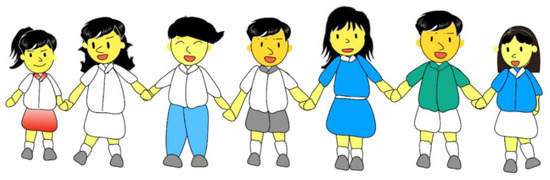
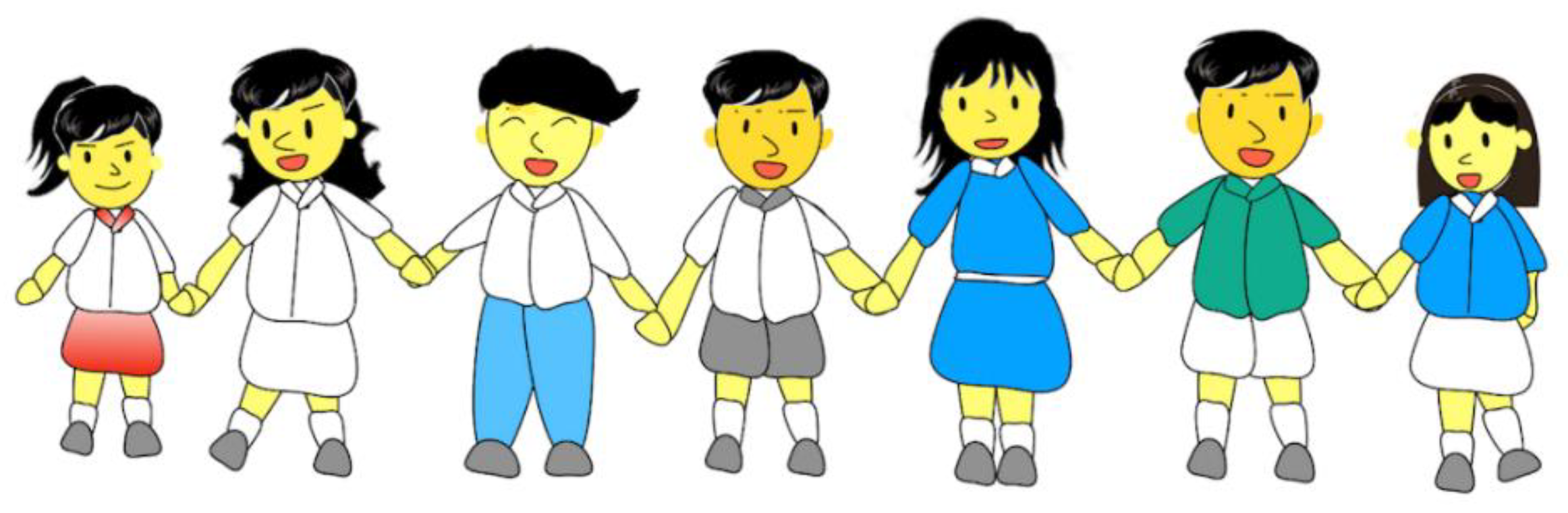
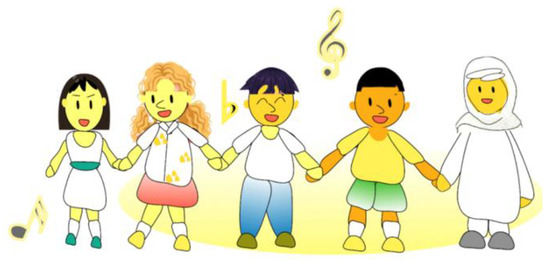
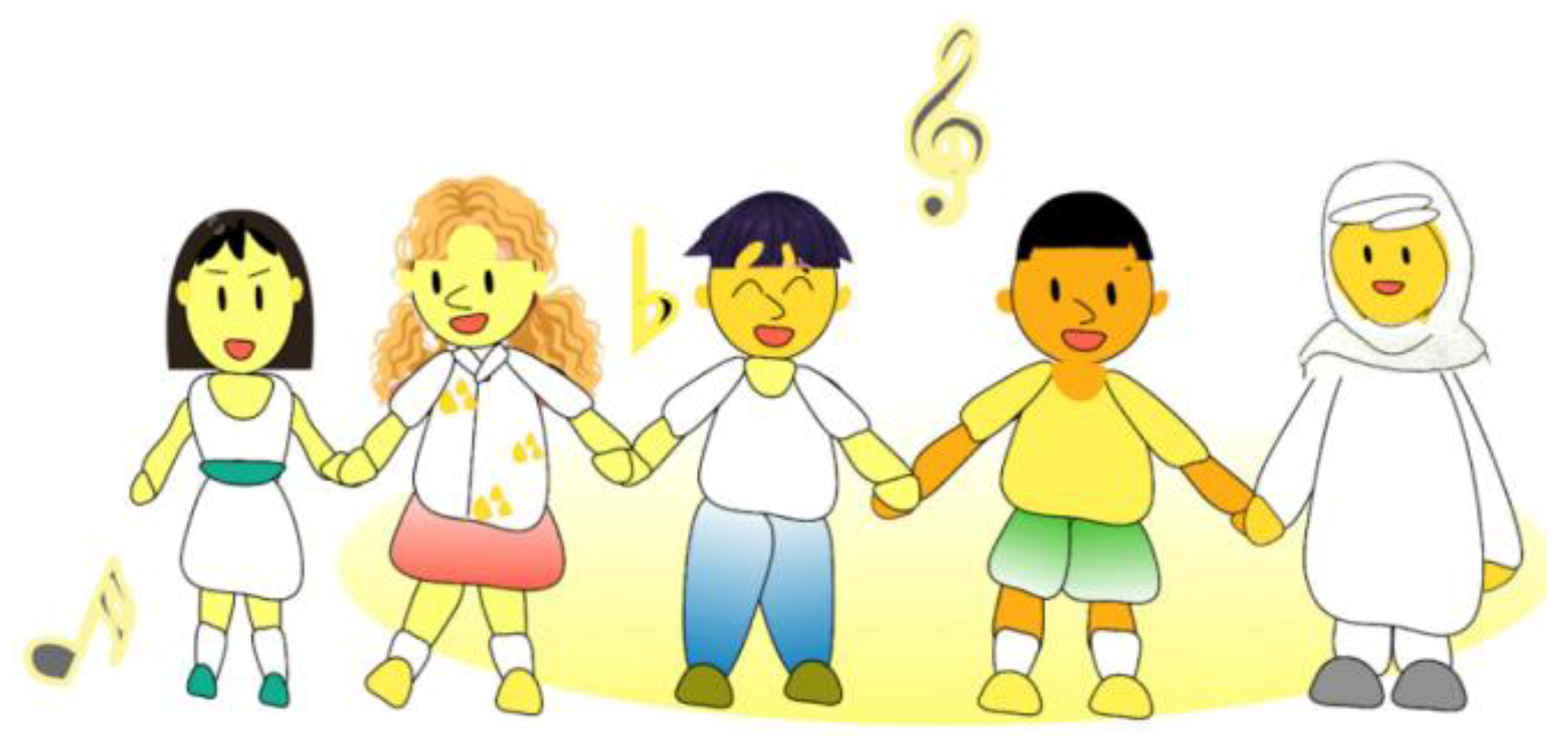
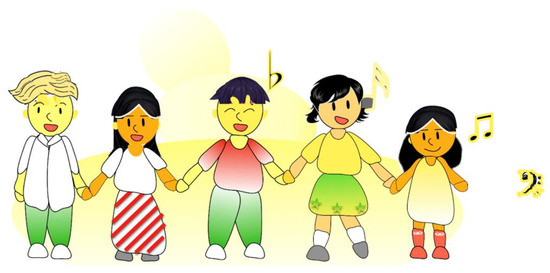
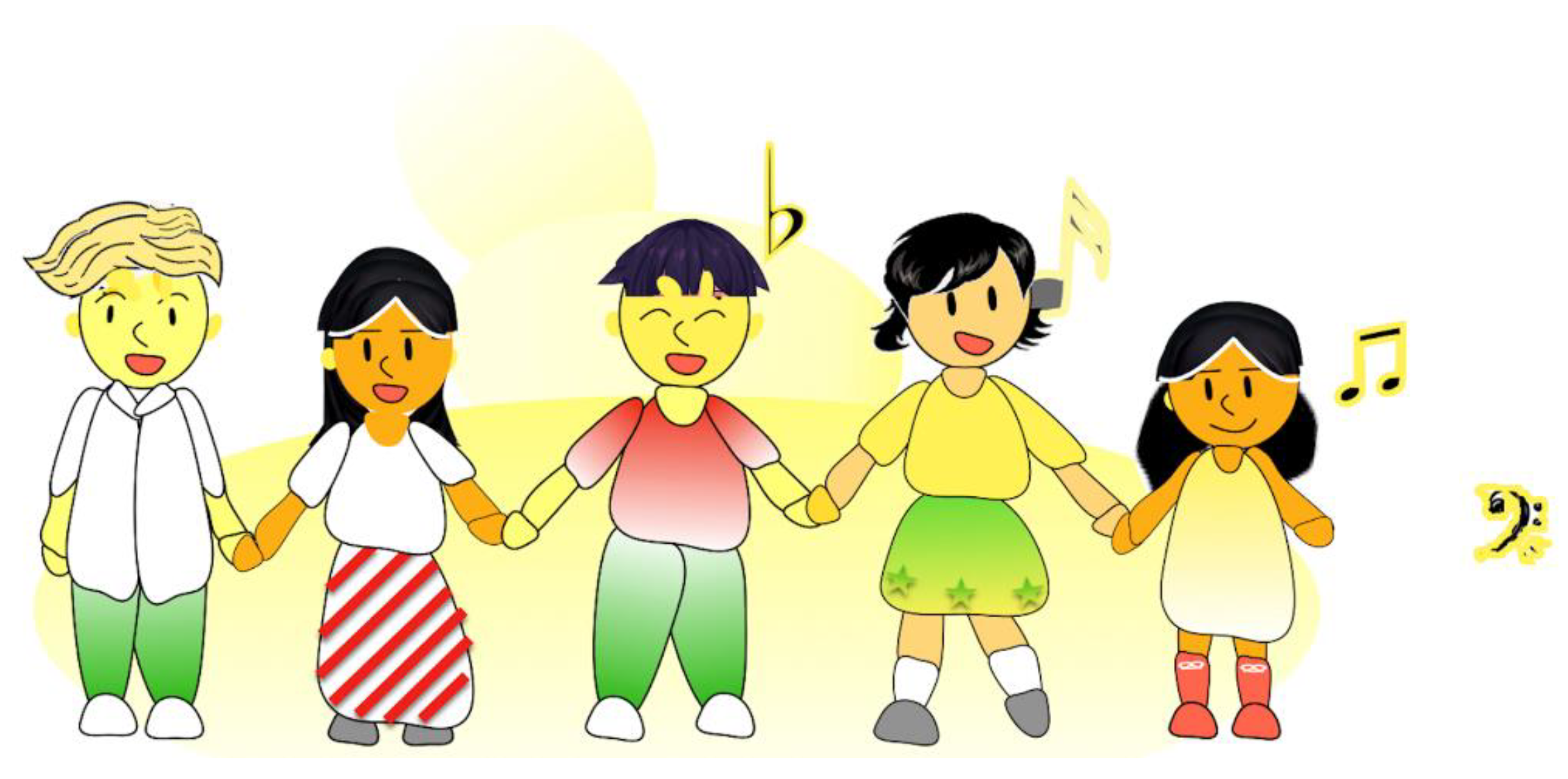

Disclaimer/Publisher’s Note: The statements, opinions and data contained in all publications are solely those of the individual author(s) and contributor(s) and not of MDPI and/or the editor(s). MDPI and/or the editor(s) disclaim responsibility for any injury to people or property resulting from any ideas, methods, instructions or products referred to in the content. |
© 2026 by the author. Licensee MDPI, Basel, Switzerland. This article is an open access article distributed under the terms and conditions of the Creative Commons Attribution (CC BY) license.