


Abstract
International literature has documented a sustained increase in female representation in higher education; however, less is known about how this process unfolds in segmented and highly privatized systems such as Chile’s. Evidence also remains limited on how gender parity varies across institutional types and disciplinary fields. This study examines the evolution of the Gender Parity Index (GPI) in Chilean universities between 2010 and 2024, disaggregating trends by institutional subsystem and field of knowledge. Using administrative data from the Higher Education Information System and a longitudinal panel of 49 universities, the analysis combines descriptive indicators and mixed-effects models to identify long-term trajectories. The results show a sustained increase in female participation in first-year enrollment, total enrollment, and undergraduate graduation. Institutional patterns differ markedly: increases are strongest in non-traditional private universities, more gradual in state universities, and relatively stable in traditional private institutions. At the disciplinary level, persistent horizontal segregation remains evident, with female overrepresentation in education, health, and social sciences, and male predominance in technology-related fields. These findings provide novel longitudinal evidence on gender stratification in Chilean and Latin American higher education and underscore the need for institutionally differentiated gender equity policies aligned with Sustainable Development Goals 4 and 5.
1. Introduction
Gender equity in higher education is a fundamental prerequisite for social and economic development. Beyond its intrinsic normative value, it is explicitly recognized in the 2030 Agenda through Sustainable Development Goals (SDGs) 4, 5, and 8—quality education, gender equality, and decent work—and is widely regarded as a key mechanism for reducing structural inequalities (Mott, 2022; Ochoa Cervantes, 2023; Walby, 2009). In the university context, achieving parity between women and men involves not only ensuring access, but also securing conditions that support persistence, progression along academic trajectories, and recognition of academic and labor achievements (Espinoza, 2015; Esteban-Ramiro et al., 2024; Ochoa Cervantes, 2023). From a higher education perspective, gender equity is increasingly understood as an institutional and educational process shaped by organizational cultures, academic structures, and policy frameworks, rather than by access alone (David, 2015). The persistence of gender inequalities in higher education therefore underscores the need for longitudinal analyses in segmented university systems. These analyses are needed to understand how such inequalities evolve over time and to generate robust evidence for SDG-aligned public policy.
Over recent decades, female participation in higher education has increased steadily worldwide. According to UNESCO (2022), the gross female tertiary enrollment rate reached 45% in 2022, exceeding the male rate of 39%. In relative terms, this corresponds to 113 women for every 100 men enrolled in tertiary education, reflecting a profound reversal of the historical patterns that prevailed during the second half of the twentieth century. Yet this numerical expansion has not eliminated the structural inequalities embedded within higher education systems.
Historically, women’s access to higher education was constrained by social and economic barriers (Becker, 2014). The transition toward knowledge-based economies progressively weakened these constraints and contributed to a sustained expansion of female enrollment (Buchmann et al., 2008). Nevertheless, women remain underrepresented in fields associated with higher prestige and remuneration—particularly engineering and technology—and continue to face disadvantages in labor-market outcomes, both in access to employment and in earnings (Vega Rojas et al., 2025). Consequently, higher female participation in enrollment does not in itself guarantee substantive equality, nor do educational advances necessarily translate into equitable outcomes (Vega Rojas et al., 2025; Worthman, 2020).
Gender distribution in higher education is commonly assessed through the Gender Parity Index (GPI), defined as the ratio of female to male enrollment. Values below 1 indicate male predominance, values above 1 indicate female predominance, and values close to 1 reflect parity. According to the Global Education Monitoring Report 2025, parity is typically interpreted as values near unity, whereas more divergent values indicate meaningful gender imbalances (UNESCO, 2025). To extend the analytical usefulness of the GPI beyond a simple parity threshold, Tienxhi (2017) proposed a seven-category typology ranging from extreme male disparity (GPI < 0.50) to extreme female disparity (GPI > 1.50), later expanded by Elhadary and Abdelatti (2024). This classification enables a more nuanced interpretation of numerical shifts in gender representation and facilitates comparative analyses across disciplines, training levels, and institutional contexts. Therefore, the GPI-based terms feminization and masculinization are used strictly to refer to changes in numerical representation, and not to broader cultural, identity-related, or attitudinal transformations.
Comparative studies based on the GPI reveal markedly different gender equity trajectories across countries and higher education systems. In contexts such as Saudi Arabia, female enrollment substantially exceeds male enrollment, reflecting patterns of extreme female overrepresentation (Clancy & O’Sullivan, 2020; Elhadary & Abdelatti, 2024). In Malaysia, for example, public universities reached a GPI of 1.71 in 2013, with strong female predominance in health and social sciences alongside persistent gaps in engineering and technology (Tienxhi, 2017). By contrast, elite and research-intensive systems—such as those of the United States, the United Kingdom, and Taiwan—continue to show low female representation at postgraduate and doctoral levels, confirming the persistence of vertical inequalities (Chang, 2018; Chang et al., 2022; Chen, 2021).
Evidence from Asia indicates that the expansion of higher education in countries such as Taiwan, China, and India has reduced gender gaps at the undergraduate level, but has not reversed inequalities at postgraduate stages or high-prestige institutions (Chang et al., 2022). Similarly, studies in Europe and North America show that higher female participation does not translate into full equity, as women remain underrepresented in senior academic positions and continue to face barriers to leadership (Correa et al., 2025; Stoet & Geary, 2020).
In Latin America, women outperform men in both access to and completion of higher education (UNESCO, 2025; Valenzuela & Yáñez, 2022). This trend has been associated with equity-oriented public policies, expanded university coverage, and labor-market transformations (Camou & Maubrigades, 2013; Huerta, 2017; Gómez et al., 2019; Luque-Martínez et al., 2020). Methodologically, however, regional research remains largely descriptive and focused on specific disciplines or institutions, which limits the development of longitudinal and comparative analyses capable of identifying systemic patterns over time (Troncoso et al., 2023).
Despite sustained gains in access, the literature consistently documents persistent horizontal gender segregation, with men predominating in engineering, technology, and the exact sciences (Kriesi & Imdorf, 2019; Stoet & Geary, 2020). Even in systems characterized by overall feminization, STEM fields remain strongly male-dominated, with only partial advances in selected bioscience areas (Clancy & O’Sullivan, 2020). Moreover, women in highly male-dominated academic environments often face symbolic and emotional costs, particularly when they are first-generation higher education students (Mkhize & Idahosa, 2025). Qualitative research further documents experiences of discrimination and exclusion that affect women’s academic participation and professional self-perception (Brito et al., 2020).
Gender gaps are also shaped by institutional and organizational factors. Recent evidence highlights the central role of institutional governance, strategic planning, and the formalization of gender equality policies in shaping educational outcomes within universities (Ibáñez-Cubillas et al., 2026; Mullen & Baker, 2018). Public universities have often led progress toward parity, supported by regulatory frameworks and explicit gender policies, whereas private institutions tend to exhibit more heterogeneous and uneven trajectories (Clancy & O’Sullivan, 2020; Elhadary & Abdelatti, 2024). Institutional segmentation further reinforces vertical inequalities, particularly in research-intensive and high-prestige universities, where female representation remains comparatively lower (Chang, 2018; Chang et al., 2022; Chang & ChangTzeng, 2018).
In addition, equity protocols, the integration of gender perspectives into curricula, and the commitment of university leadership play an important role in shaping gender outcomes (Nkosi & Maphalala, 2025). However, recent studies emphasize that gender equality initiatives do not always stem from consolidated institutional strategies. Instead, they often depend on individual, project-based, or fragmented actions, which limit their structural reach and transformative potential within universities (Lopes et al., 2024). Accordingly, a growing body of research calls for targeted institutional reforms and inclusive practices to reduce disciplinary inequalities and promote gender equity in decision-making positions and academic staff composition (Condron et al., 2025; Correa et al., 2025; Nkosi & Maphalala, 2025; Rosa & Clavero, 2022). Hinton-Smith (2025) further argues that universities not only reflect social inequalities but also actively reproduce them through their organizational structures and curricula, while Crimmins et al. (2024) stress that effective equity policies require multifaceted strategies that extend beyond quotas and promote broader cultural transformation.
1.1. The Chilean Case
The Chilean university system constitutes a particularly relevant setting for analyzing gender equity because of its highly segmented institutional structure—comprising state universities, traditional private universities, and non-traditional private universities—and the profound transformations it has undergone in recent decades. A major turning point came with the 1981 higher education reform, which enabled the rapid expansion of non-traditional private universities. Although this reform substantially widened access to higher education, it also deepened structural asymmetries in institutional quality, funding, selectivity, and educational outcomes (Bernasconi, 2015; Brunner, 2013; Rivas et al., 2014).
As a result, the Chilean system consolidated into a mixed and segmented configuration composed of three university subsystems—state, traditional private (G9), and non-traditional private institutions—that differ markedly in their historical trajectories, research capacity, governance models, and funding structures (Espinoza et al., 2025; Veliz et al., 2022). These institutional differences have direct implications for gender dynamics, shaping both access patterns and academic trajectories across subsystems.
Within this configuration, gender dynamics have evolved unevenly over time, shaped by both historical constraints and recent expansion processes. By the mid-2020s, universities accounted for approximately 59% of total tertiary enrollment, while undergraduate education represented more than half of national enrollment (SIES, 2025b). Between 2021 and 2025, university enrollment increased by more than 10%, reinforcing universities as the main space for advanced human capital formation. At the same time, the high proportion of students enrolled in accredited institutions—exceeding 97% in 2025—reflects the growing importance of quality assurance and institutional differentiation within the system (SIES, 2025b).
Women’s access to higher education in Chile has historically been shaped by restrictive social norms and the strong influence of the Catholic Church on university governance and curricula (Flecha-García & Palermo, 2019). Female participation expanded gradually throughout the twentieth century but accelerated sharply from the 1990s onward, contributing both to the growing female presence in student enrollment and to the diversification of the academic workforce (Baeza & Lamadrid, 2018; Castillo & Cardozo, 2023; Colther, 2022).
Currently, women constitute the majority of university students and graduates. By 2025, they accounted for 53.3% of total enrollment and 56.1% of undergraduate graduations (SIES, 2025a), placing Chile among the Latin American countries with the highest levels of female participation in higher education, where women generally represent between 50% and 52% of total enrollment (Valenzuela & Yáñez, 2022). Despite this overall increase in female participation, pronounced disciplinary inequalities persist. In 2024, women accounted for only 20.8% of first-year enrollment in STEM programs, compared with more than 70% in education and health-related fields (SIES, 2025a).
Gender trajectories also differ systematically across institutional subsystems. Non-traditional private universities concentrate a higher proportion of female students, particularly in non-STEM programs, whereas state universities have advanced more consistently in the institutionalization of gender policies and equity frameworks. Traditional private universities, by contrast, tend to occupy an intermediate position, combining relatively balanced enrollment patterns with slower institutional change (Colther, 2022; Ríos González et al., 2017).
Over the past decade, several public policies have sought to address gender inequalities within the Chilean higher education system. These include Law 21.091 on Higher Education, Law 21.094 on state universities, and Law 21.369 on sexual harassment, all of which have strengthened regulatory frameworks related to equity, inclusion, and institutional accountability (Vergara et al., 2024). These national initiatives have been complemented by institutional Equality Plans and interministerial agreements aimed at mainstreaming gender perspectives within universities (Lagos, 2020; Ministerio de Educación de Chile, 2017).
In parallel, the feminist mobilizations of 2018 constituted a critical juncture by making gender-based violence and inequality within universities highly visible. These mobilizations accelerated the adoption of formal protocols, reshaped institutional governance practices, and encouraged the incorporation of gender perspectives into university regulations and organizational cultures (Castillo & Cardozo, 2023; Vergara et al., 2024).
Despite these advances, recent studies confirm the persistence of gender inequalities within the Chilean university system (Guizardi et al., 2023). Colther (2022) documents sustained patterns of gender segregation across 62 universities between 2009 and 2019, while Brito et al. (2020) report practices of discrimination and exclusion affecting female students. Although partial progress has been made, the available evidence remains fragmented, with limited integration of temporal, institutional, and disciplinary dimensions within a unified analytical framework capable of capturing system-level dynamics. This fragmentation constrains a comprehensive understanding of how gender parity evolves across subsystems and fields of knowledge within Chilean higher education.
Taken together, these patterns suggest that gender parity in Chilean higher education has evolved unevenly across institutional subsystems and fields of knowledge, raising important questions about the mechanisms underlying these differentiated trajectories.
1.2. Research Approach and Hypotheses
Building on the gaps identified in the literature, the present study examines the longitudinal evolution of gender parity in the Chilean university system, explicitly considering institutional segmentation and disciplinary differences. In this context, the use of standardized indicators such as the Gender Parity Index (GPI) is essential for analyzing gender dynamics across time, institutional subsystems, and fields of knowledge. Accordingly, this study analyzes gender parity trajectories in Chilean universities between 2010 and 2024, distinguishing patterns by institutional type and disciplinary field, and providing updated empirical evidence to inform debates on gender equity in higher education.
This study contributes to the literature in three main ways. First, it provides a longitudinal analysis of gender parity over a 15-year period, allowing for the identification of sustained trends rather than cross-sectional patterns. Second, it incorporates institutional segmentation as a central analytical dimension, distinguishing between state, traditional private, and non-traditional private universities. Third, it integrates disciplinary differences into the analysis, offering a comprehensive understanding of how gender parity evolves across fields of knowledge within a highly stratified higher education system.
From a conceptual perspective, feminization is understood as a structural but uneven process, shaped by institutional segmentation and persistent horizontal segregation across disciplines. Based on this framework, the following hypotheses guide the empirical analysis:
H1.
The Chilean university system experienced a process of progressive feminization between 2010 and 2024, reflected in sustained increases in the GPI for first-year enrollment, total enrollment, and undergraduate graduation.
H2.
Persistent disciplinary gaps remain, with lower female participation in STEM fields and higher concentrations in education, health, and the social sciences.
H3.
Female participation increases more rapidly in non-traditional private universities compared to state and traditional private universities.
These hypotheses are articulated as components of a single explanatory model. H1 captures the temporal dimension of feminization as a long-term structural trend. H2 introduces the disciplinary dimension, emphasizing persistent horizontal segregation. H3 incorporates the institutional dimension, proposing that the pace of change differs across university subsystems. Together, these hypotheses define a model in which the evolution of the GPI results from the interaction between temporal, disciplinary, and institutional factors.
Empirically, this framework is examined through three longitudinal mixed-effects models corresponding to different stages of the academic trajectory: first-year enrollment, total enrollment, and undergraduate graduation.
2. Materials and Methods
This study adopts a quantitative, longitudinal, and comparative research design aimed at analyzing the evolution of gender parity within the Chilean university system over the period 2010–2024. The research is structured as a panel data analysis, in which repeated annual observations (Level 1) are nested within universities (Level 2), allowing for the examination of temporal dynamics and institutional heterogeneity. The unit of analysis corresponds to the university, disaggregated by institutional type and field of knowledge. The study followed a sequential research procedure consisting of data extraction, panel construction, GPI computation, descriptive longitudinal analysis, mixed-effects modeling, and robustness assessment.
2.1. Data Sources and Study Design
The data were obtained from administrative records of the Higher Education Information System (SIES) of the Chilean Ministry of Education. The final dataset included 49 universities with complete information for the entire study period: 16 state universities, 9 traditional private universities, and 24 non-traditional private universities. Together, they account for more than 80% of total enrollment and undergraduate graduations in the Chilean university system. Among the excluded institutions, 13 non-traditional private universities that ceased operations during the study period and two recently established state universities lacking longitudinal data were excluded from the analysis. Because the data derive from publicly available, aggregated sources with no individual-level identifiers, the study did not require formal ethical approval, in accordance with the open-access data policies of the Chilean Ministry of Education.
The analysis is based on the GPI, defined as the ratio of female to male enrollment. For interpretative purposes, the thresholds proposed by UNESCO (2012) and Tienxhi (2017) were adopted and consolidated into five categories: extreme masculinity (GPI < 0.50), intermediate masculinity (0.50–0.96), relative parity (0.97–1.03), intermediate feminization (1.04–1.50), and extreme feminization (GPI > 1.50). This typology does not alter the calculation of the index but provides a structured framework for the comparative interpretation of observed trajectories.
To distinguish between results reflecting institution-level patterns and those capturing population-weighted dynamics, two complementary GPI metrics were employed: (a) the institutional average GPI (), which assigns equal weight to each university within a subsystem, and (b) the enrollment-weighted aggregate GPI (), which accounts for institutional size within each subsystem.
In these expressions, the subscript k denotes the type of university (state, traditional private, or non-traditional private), t represents the year of observation (2010–2024), and i indexes the individual university. The term refers to the number of universities in subsystem k in year t, while and denote the number of female and male students, respectively, in university i during year t.
2.2. Analytical Strategy
The analytical strategy followed a structured and sequential procedure. First, administrative records from the Chilean Higher Education Information System (SIES) were cleaned and harmonized to construct a consistent longitudinal dataset. Second, the GPI was calculated and classified according to established thresholds to ensure comparability across institutions, time periods, and fields of knowledge.
The analysis was then conducted in two complementary stages. First, a longitudinal descriptive analysis was performed to examine the evolution of the GPI in first-year enrollment, total enrollment, and undergraduate graduations, disaggregated by type of university and field of knowledge. Both the institutional average GPI (which assigns equal weight to each university) and the enrollment-weighted aggregate GPI (which reflects the population size of each subsystem) were analyzed. This dual approach allows for comparisons across subsystems while accounting for differences in institutional size. It is also consistent with recent recommendations for comparative studies in higher education, as it distinguishes between typical institutional patterns and structural dynamics of the system (Cepal, 2022).
Second, linear mixed-effects models with a multilevel structure were estimated. This approach is appropriate for longitudinal data because repeated observations are nested within the same institution, which often violates the assumption of independence. Three independent models were specified: (a) Model 1 for the GPI in first-year enrollment; (b) Model 2 for the GPI in total enrollment; and (c) Model 3 for the GPI in undergraduate graduations.
In all cases, a hierarchical structure was adopted in which annual observations (Level 1) are nested within universities (Level 2), incorporating random intercepts to capture persistent institutional heterogeneity associated with unobserved factors such as institutional history, selectivity, disciplinary composition, and institutional size, among others.
The general equation of the estimated mixed-effects model is as follows:
In this specification, represents the Gender Parity Index (the ratio of female to male students) for university i in year t; represents the time variable (years), centered at 2010 to facilitate the interpretation of coefficients and reduce multicollinearity; is a dummy variable equal to 1 if university i is a non-traditional private university and 0 otherwise; is a dummy variable equal to 1 if university i is a traditional private university and 0 otherwise; represents the university-specific random intercept, capturing unobserved structural differences across institutions; and represents the idiosyncratic error term.
This specification estimates differences in initial levels of feminization (intercepts) and in rates of change over time (interactions with the time variable). It therefore provides evidence on differential gender parity trajectories across institutional subsystems. Estimation was performed using restricted maximum likelihood (REML), and the Satterthwaite approximation was employed to compute degrees of freedom and p-values. In addition, estimated marginal means (EMMs) with 95% confidence intervals were calculated for the years 2010, 2016, 2020, and 2024, enabling standardized comparisons of predicted GPI levels over time. These time points were selected to capture the initial conditions, intermediate stages, and most recent trends within the study period. The use of EMMs facilitates interpretation by translating regression estimates into comparable predicted values. This allows for a clearer assessment of differences in both levels and trajectories of gender parity across subsystems. This modeling strategy is particularly well suited for longitudinal panel data with repeated observations nested within institutions and offers clear advantages over traditional ANOVA approaches, especially in its treatment of within-institution dependence, heteroskedasticity, and multilevel variance (Plonsky, 2015; Snijders & Bosker, 2012; West et al., 2022).
To assess the robustness of the results, three additional robustness checks were conducted. First, the inclusion of random slopes for the time effect was evaluated. Alternative models with both random intercepts and random slopes were compared using AIC and BIC, with the random-intercept-only model ultimately selected due to its superior balance between model fit and parsimony. Second, alternative covariance structures—including AR(1)—were explored, but no substantial improvements in model fit were observed. Accordingly, a model with independent residual errors conditional on the random effects was retained, given its stability and consistency with REML criteria. Finally, the models were re-estimated excluding the year 2020; coefficient signs, magnitudes, and levels of statistical significance remained stable, confirming that the results are not artifacts of the pandemic shock.
2.3. Procedures and Software
All analyses were conducted in R (R Core, 2024) using the lme4, lmerTest, emmeans, dplyr, tidyr, and ggplot2 packages. A significance level of α = 0.05 was adopted. For each model, we report estimated coefficients, standard errors, t-values, p-values, and 95% confidence intervals (95% CIs), as well as the variances of the random effects and the REML criterion.
3. Results
3.1. Overall Evolution of Gender Parity (H1)
Table 1 summarizes the evolution of first-year enrollment, total enrollment, and undergraduate graduations by type of university between 2010 and 2024. In aggregate terms, the results show a sustained increase in female participation within the Chilean university system. The proportion of women rises from 53% to 56% in both first-year and total enrollment, while in undergraduate graduations it increases from 57% to 60%, indicating a stronger female presence at the point of completion.
Table 1.
Evolution of enrollment and graduation by university type (2010–2024).
This pattern is observed across all three university subsystems, albeit with differentiated intensities. Non-traditional private universities exhibit structurally higher levels of female participation from the beginning of the period, state universities display a gradual and continuous increase in female participation, and traditional private universities remain closer to gender parity throughout the period.
To examine relative gender equity, two complementary GPI metrics are compared using graphical representations: (a) the institutional average GPI and (b) the enrollment-weighted aggregate GPI.
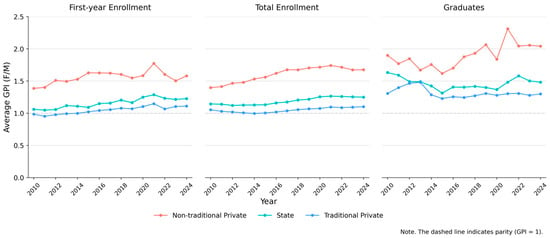
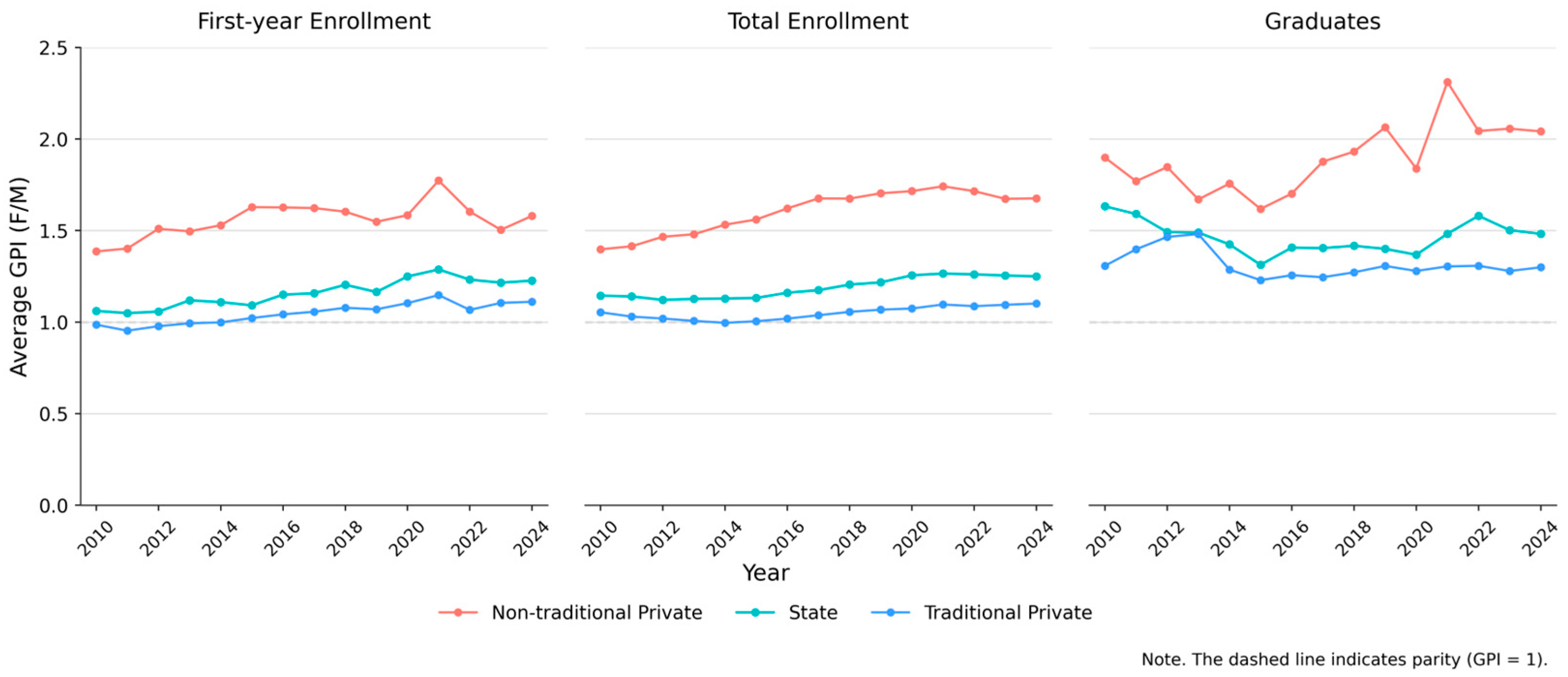
The institutional average GPI (Figure 1) reflects the typical situation of each subsystem, without weighting by institutional size. The trajectories reveal clear differences across the three types of universities. In state universities, the GPI evolves from levels of intermediate masculinity in 2010 (GPI < 0.97) toward values corresponding to intermediate feminization by 2024 (GPI between 1.04 and 1.50), indicating a gradual yet sustained shift toward female overrepresentation. Traditional private universities remain close to relative parity in enrollment (GPI between 0.97 and 1.03), with intermediate feminization observed only in undergraduate graduations, suggesting that the female advantage becomes more pronounced at the final stage of the educational trajectory. In contrast, non-traditional private universities exhibit high levels of intermediate feminization from the beginning of the period, with GPI values exceeding 1.30 in enrollment and 1.70 in graduations in the most recent years, approaching the threshold of extreme feminization (GPI > 1.50) at the point of completion.
Figure 1.
Evolution of the institutional average GPI by university type (2010–2024). Note. GPI = Gender Parity Index. Values greater than 1.0 indicate female predominance.
Overall, this analysis shows that the institutional average GPI for the system increases from 1.09 to 1.19 in first-year enrollment, from 1.07 to 1.16 in total enrollment, and from 1.12 to 1.20 in undergraduate graduations. These values consistently fall within the range of intermediate feminization, confirming a sustained and system-wide increase in female participation, albeit with differentiated intensities depending on institutional type and stage of the academic trajectory.
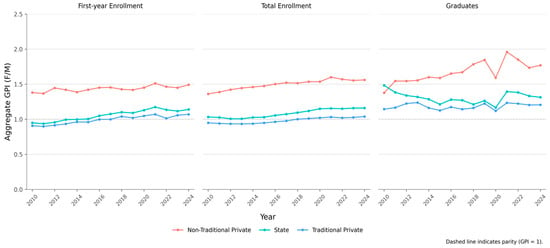
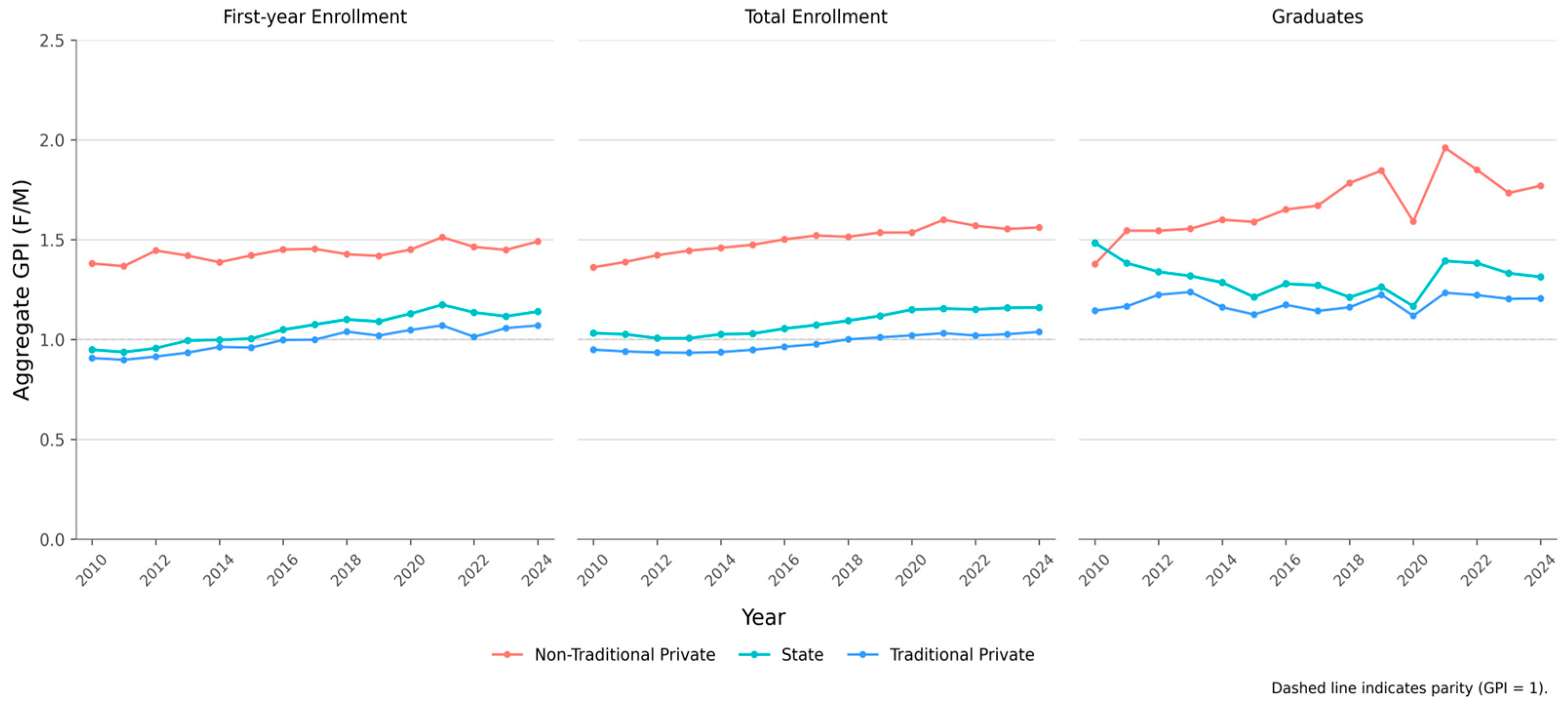
By contrast, the enrollment-weighted aggregate GPI (Figure 2), which weights institutions by student population, reveals more clearly the relative weight of non-traditional private universities, which concentrate a substantial share of national enrollment and undergraduate graduations. Under this metric, a pattern of sustained structural increase in female participation is observed in this subsystem. By 2024, the aggregate GPI reaches 1.49 in first-year enrollment and 1.56 in total enrollment, values located at the boundary between intermediate feminization (1.04–1.50) and extreme feminization (>1.50). In undergraduate graduations, the value of 1.77 unequivocally corresponds to extreme feminization, indicating a markedly strong female overrepresentation at the point of completion.
Figure 2.
Evolution of the enrollment-weighted aggregate GPI by institution type, 2010–2024. Note. GPI = Gender Parity Index. Values greater than 1.0 indicate female predominance.
In state universities, the transition toward increased female participation is also evident. The GPI increases from 0.95 in 2010 (intermediate masculinity) to 1.14 in 2024 (intermediate female overrepresentation) in first-year enrollment, and from 1.03 to 1.16 in total enrollment, shifting from relative parity to intermediate levels. In undergraduate graduations, GPI values decline slightly from 1.48 to 1.33, remaining within the range of intermediate female overrepresentation, although with lower intensity in recent years.
In traditional private universities, stability predominates. In 2024, the GPI for first-year enrollment (1.07) and total enrollment (1.03) falls within the range of relative parity or slight female overrepresentation. In undergraduate graduations, the value of 1.21 corresponds to intermediate levels, confirming that the female advantage is primarily expressed at the final stage of the educational trajectory.
Taken together, the interpretation based on the GPI typology indicates that gender patterns in the Chilean university system are system-wide but asymmetric, reflecting its segmented institutional structure. Non-traditional private universities operate within ranges of intermediate to extreme female overrepresentation, while state universities consolidate within intermediate levels. Traditional private universities remain closer to relative parity, with female overrepresentation emerging mainly at the undergraduate graduation stage.
These descriptive trends are subsequently corroborated through mixed-effects models, the results of which are presented in Section 3.3.
3.2. Gender Gaps by Disciplinary Field (H2)
To examine structural patterns of horizontal segregation within the university system, this section focuses on the enrollment-weighted aggregate GPI. This indicator is preferable because fields of knowledge differ substantially in enrollment size across universities, whereas the institutional average GPI gives equal weight to institutions regardless of size and may therefore overrepresent smaller universities or those with a limited academic offering.
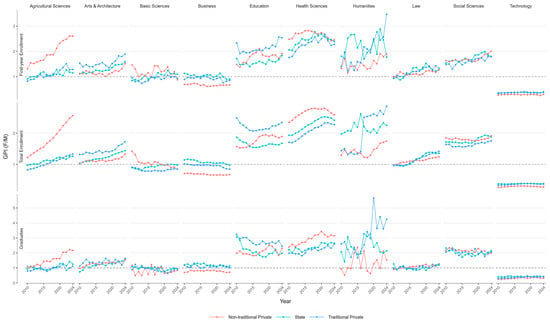
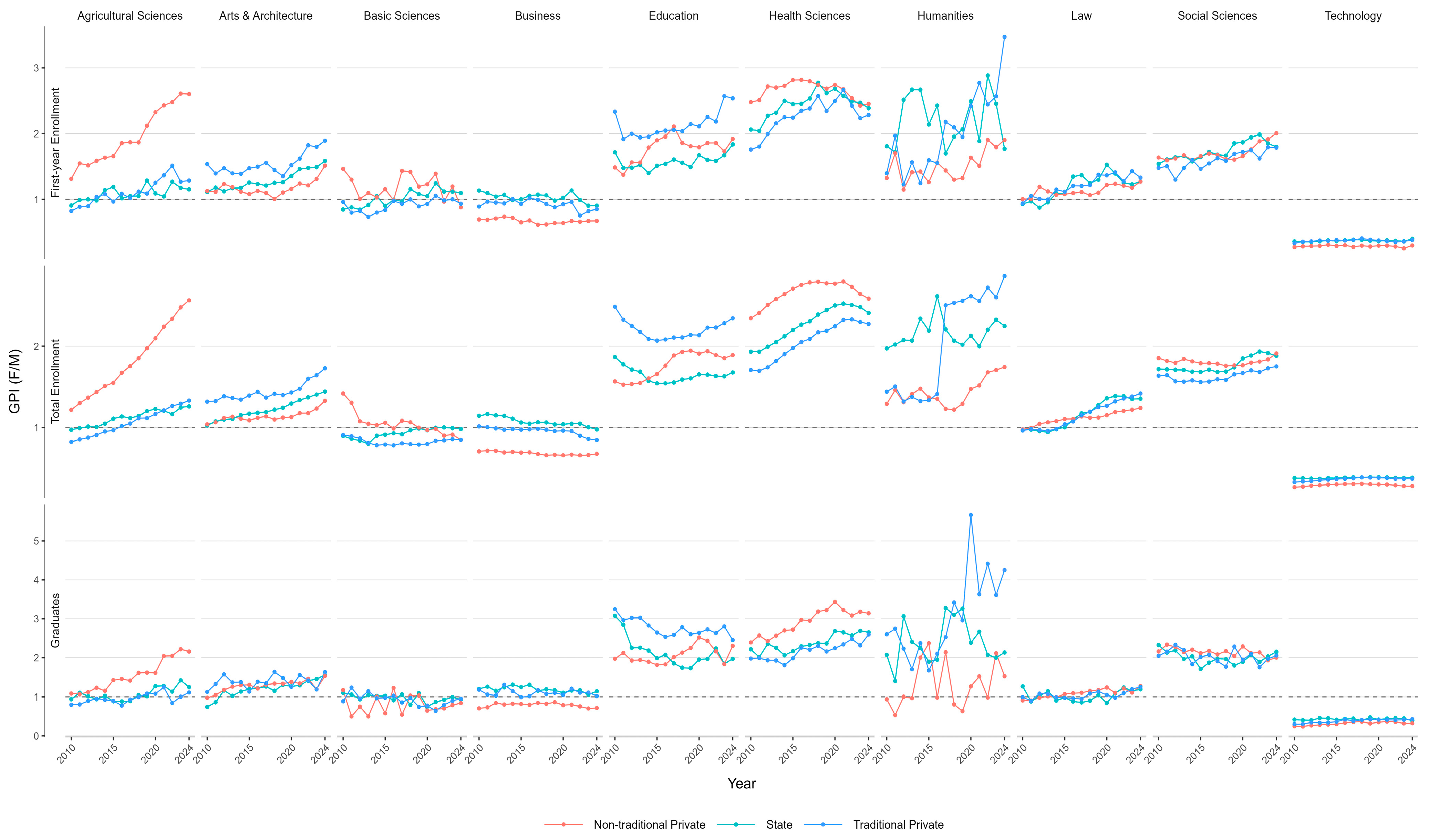
Figure 3 summarizes the evolution of the aggregate GPI by field of knowledge, institutional type, and stage of the academic trajectory between 2010 and 2024. For ease of interpretation, the figure should be read by comparing each field’s distance from parity (GPI = 1), its stability over time, and the differences observed across institutional types and academic stages. Overall, the figure reveals persistent patterns of horizontal segregation, with marked and stable disciplinary differences across institutional subsystems.
Figure 3.
Enrollment-weighted aggregate GPI by field of knowledge, institutional type, and stage of the academic trajectory (2010–2024). Note. The dashed horizontal line indicates parity (GPI = 1). Values above 1 indicate female overrepresentation, whereas values below 1 indicate male overrepresentation. The figure presents trajectories by field of knowledge, institutional type, and academic stage for the period 2010–2024.
The disciplinary analysis confirms persistent patterns of horizontal segregation, with clear differences across fields both in the level and temporal dynamics of female participation. The highest levels of female overrepresentation are concentrated in Humanities and Health Sciences, particularly at the graduation stage. At this stage, the strongest female overrepresentation in the system is observed.
In Humanities, these patterns are characterized by high interannual volatility, with pronounced peaks, especially in state universities. The pronounced peaks suggest episodes of extreme female overrepresentation rather than stable trajectories over time. This variability is also consistent with smaller cohort sizes. By contrast, Health Sciences shows very high levels of female overrepresentation, but with a more sustained and consistent pattern across first-year enrollment, total enrollment, and graduates, although with some variation by institutional subsystem.
Alongside these fields, Education displays a pattern of high and stable female overrepresentation across all three types of institutions and stages of the academic trajectory. Unlike Humanities, Education does not always reach the highest GPI peaks. However, it consistently remains well above parity, frequently within the range of intermediate to extreme female overrepresentation. This places it among the fields with the highest and most stable female overrepresentation in the system in terms of temporal stability. A similar, though slightly less intense, pattern is observed in Social Sciences, which remains systematically above parity across subsystems.
A particularly relevant dynamic emerges in Agricultural Sciences, where a sustained increase in female overrepresentation is observed in non-traditional private universities throughout the period. In this subsystem, the GPI rises steadily and exceeds 1.5 in first-year enrollment, total enrollment, and graduates, indicating a consistent pattern of female overrepresentation across all stages of the academic trajectory. In contrast, state and traditional private universities in Agricultural Sciences remain closer to parity or exhibit only slight female overrepresentation, underscoring the subsystem-specific nature of this trend.
In contrast to these fields, STEM-related disciplines display the most pronounced gender gaps in favor of men. Technology consistently records extremely low GPI values—approximately between 0.2 and 0.4—across all institutional types and stages of analysis, corresponding to persistent extreme male predominance with no evidence of convergence toward parity. Basic Sciences are predominantly located within the range of intermediate masculinity (approximately 0.6–0.9), showing limited variation over time and no sustained increase in female representation.
Other disciplines exhibit more moderate and subsystem-dependent trajectories. Law shows a gradual shift toward greater female representation in state and traditional private universities, while remaining closer to relative parity in non-traditional private universities. Business is largely situated around relative parity, with only modest fluctuations across years and subsystems. Arts & Architecture, by contrast, displays clearly higher levels of female participation, particularly in traditional private universities. In this subsystem, the GPI frequently exceeds 2.0, especially in first-year and total enrollment, although without reaching the extreme levels observed in Humanities or Health Sciences.
Taken together, these findings indicate that patterns of female participation in the Chilean university system are not evenly distributed across disciplines. Rather, they reflect persistent horizontal segregation, combining fields with high and stable female overrepresentation, fields with extreme female overrepresentation, and disciplines that remain systematically male-dominated.
The results also show that the institutional subsystem plays a key moderating role in shaping both the intensity and trajectory of these patterns, as illustrated by the sustained increase observed in Agricultural Sciences within the non-traditional private subsystem. Overall, these findings provide strong support for Hypothesis H2, confirming that horizontal segregation is not only discipline-specific, but also mediated by institutional subsystems.
3.3. Differences in Gender Parity by University Type (H3)
To evaluate Hypothesis H3, mixed-effects models as described in the methodological section were estimated, complemented by the computation of adjusted marginal means (EMMs). Table 2 reports the estimated fixed effects for the three dimensions of the GPI: first-year enrollment (Model 1), total enrollment (Model 2), and undergraduate graduates (Model 3).
Table 2.
Results of mixed linear models (2010–2024).
The results reveal clear differences across the three university subsystems. First, for first-year enrollment (model 1), non-traditional private universities exhibit a significantly higher initial level of female overrepresentation than state universities (β = 0.421, p = 0.003). This indicates that the subsystem begins the period with moderate levels of female overrepresentation. By contrast, traditional private universities do not differ significantly from state universities, indicating a situation close to relative parity at the starting point. The estimated time slope (β = 0.015, p < 0.001) indicates a steady increase in the GPI over the period, although no statistically significant differences in the rate of change are observed across subsystems at this stage.
For total enrollment (model 2), the initial advantage of non-traditional private universities persists (β = 0.329, p = 0.019). A significantly steeper temporal slope is also observed for this group (year × non-traditional private interaction: β = 0.012, p < 0.001). This finding indicates that non-traditional private universities not only display higher levels of female overrepresentation, but also experience more rapid increases in female participation over time. In contrast, traditional private universities follow trajectories statistically indistinguishable from those of state universities, with no significant differential effects.
In the case of undergraduate graduates (model 3), the most pronounced differences emerge in the temporal trajectories rather than in initial levels. In this model, the overall time trend is not significant for the reference group (state universities), but the significant interaction indicates a steeper increase over time in non-traditional private universities relative to state universities. Non-traditional private universities present the steepest time slope (β = 0.031, p < 0.001), indicating that the increase in female participation is particularly strong at the graduation stage. This result is consistent with the descriptive evidence, which places graduates from non-traditional private universities at the boundary between intermediate and extreme female overrepresentation, with GPI values exceeding 1.7 in 2024. Once again, traditional private universities do not exhibit statistically significant differences relative to state universities.
Taken together, the mixed-effects models show that time is a positive and statistically significant predictor of the GPI for both first-year and total enrollment. This pattern reflects a sustained increase in female participation at the system level. In addition, the moderate variance in the institutional-level random intercepts across the three models indicates the presence of persistent structural differences between universities, consistent with the segmented nature of the Chilean higher education system. Nevertheless, the consistent direction of the temporal effects suggests a gradual convergence toward higher levels of female overrepresentation, particularly within the non-traditional private subsystem.
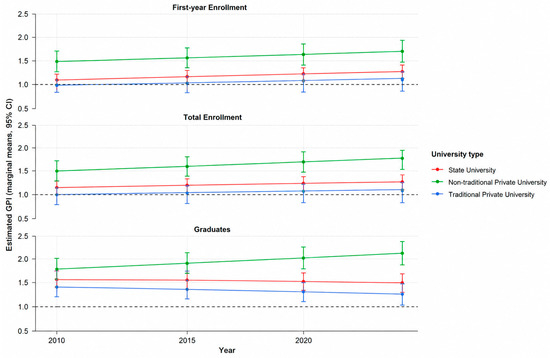
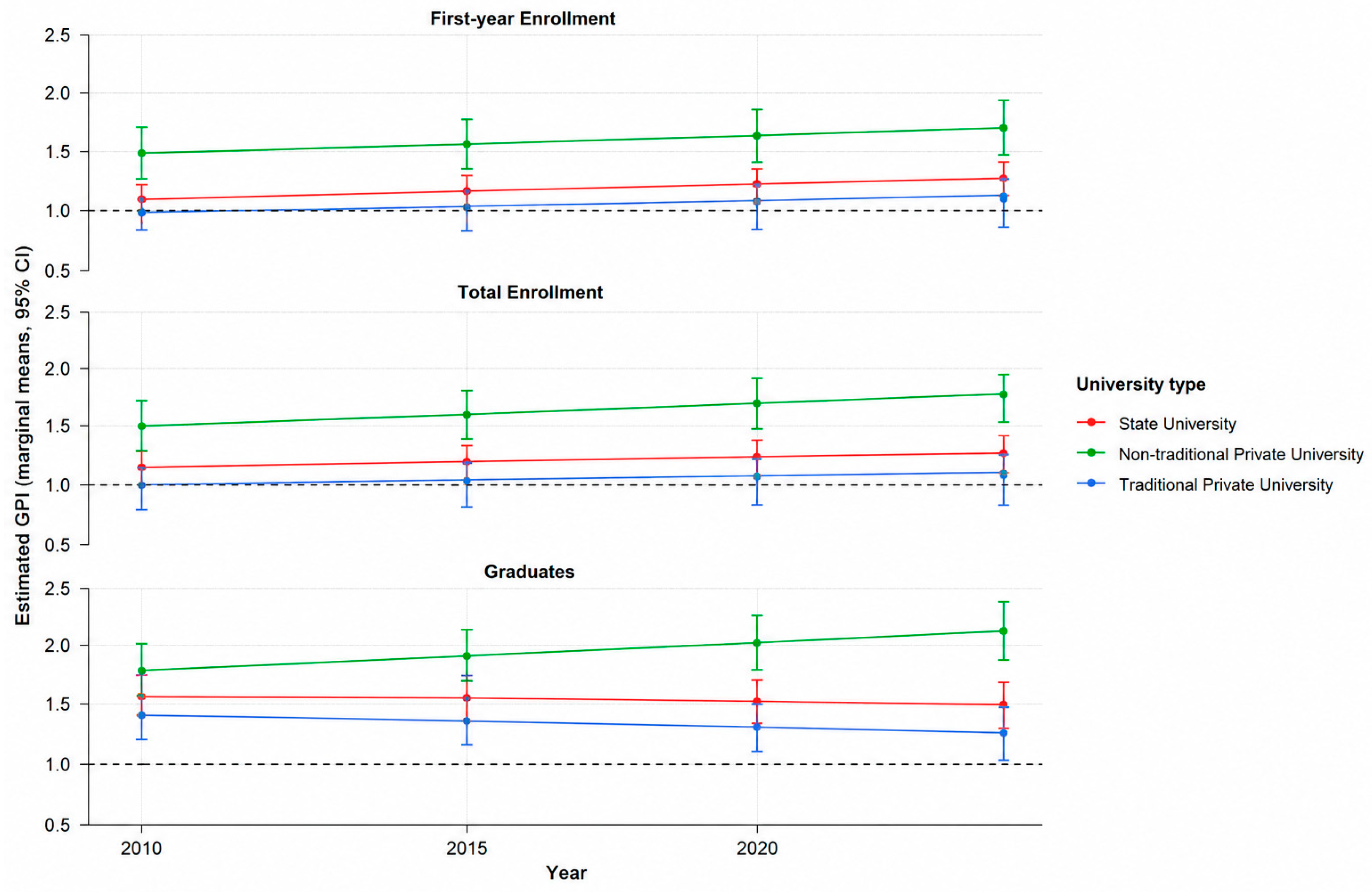
Figure 4 complements the results reported in Table 2 by presenting the estimated marginal means for four representative years (2010, 2016, 2020, and 2024), enabling a clearer visualization and interpretation of the trajectories and differences across institutional subsystems.
Figure 4.
Marginal means (95% CI) of GPI by university type in 2010, 2016, 2020, and 2024. Note. Mixed linear models with random intercepts by university; year centered at 2010; reference category: state university. Dashed line: parity (GPI = 1).
The estimated trajectories indicate that non-traditional private universities remain systematically above parity across all three dimensions. They reach intermediate to high levels of female overrepresentation and, in the case of graduates, approach extreme levels. State universities show a stable progression toward moderate levels of female participation, while traditional private universities remain closer to relative parity, exhibiting only slight increases in female participation at the graduation stage.
Overall, the mixed-effects models corroborate the descriptive evidence and provide robust empirical support for Hypothesis H3. The results indicate that increases in female participation are both stronger and more accelerated in non-traditional private universities. In contrast, state universities exhibit a more gradual shift toward moderate levels, while traditional private universities maintain trajectories closer to relative parity.
4. Discussion
This study provides one of the first longitudinal and institutionally differentiated analyses of gender parity trajectories in Chile’s highly segmented higher education system. Taken together, the findings for overall trends (H1), disciplinary gaps (H2), and institutional differentiation (H3) reveal a pattern of change that is progressive but uneven. This trajectory is consistent with international evidence, yet it is strongly shaped by the distinctive features of a highly segmented and privatized system such as Chile’s (Buchmann et al., 2008; Mott, 2022; Walby, 2009).
4.1. Temporal Evolution of Gender Parity (H1)
The results related to Hypothesis 1 provide robust evidence of a sustained increase in female participation in the Chilean university system between 2010 and 2024. Both the institutional average GPI and the enrollment-weighted aggregate GPI show consistent growth across first-year enrollment, total enrollment, and undergraduate graduation. This pattern indicates a transition from relative parity toward intermediate levels of female overrepresentation.
This trajectory clearly situates Chile within broader global trends, where female participation in higher education has expanded steadily over recent decades (Buchmann et al., 2008; Elhadary & Abdelatti, 2024). Importantly, the convergence between the two GPI measures strengthens this interpretation. While the institutional average reflects typical institutional behavior, the weighted GPI captures the demographic relevance of each subsystem. The consistency between both indicators suggests that this pattern is not driven by isolated cases, but rather reflects a structural transformation of the system.
From a higher education perspective, these findings reinforce the interpretation of gender parity as an institutional process shaped by expansion dynamics and organizational configurations, rather than as a purely compositional outcome (David, 2015; Ibáñez-Cubillas et al., 2026). The more pronounced increase observed at the graduation stage aligns with international evidence showing higher female persistence and completion rates (Clancy & O’Sullivan, 2020; Valenzuela & Yáñez, 2022).
From a temporal perspective, the stability of these trends indicates that this is not a short-term phenomenon. Rather, it reflects a sustained transformation associated with expanded access, labor market incentives, and broader social changes (Buchmann et al., 2008; Walby, 2009; Mott, 2022). However, these results must be interpreted strictly in terms of numerical representation. The GPI captures participation patterns but does not account for qualitative dimensions of gender equity, such as academic experiences, institutional conditions, or labor market outcomes. As highlighted in prior research, increased female participation does not necessarily imply the elimination of gender inequalities across disciplines or institutional contexts (Correa et al., 2025; Stoet & Geary, 2020; David, 2015).
4.2. Disciplinary Segregation (H2)
The results strongly support Hypothesis 2, revealing persistent patterns of horizontal segregation across the Chilean university system. Disciplines such as Education, Health Sciences, and Social Sciences remain consistently characterized by high female participation, while Technology exhibits persistent levels of strong male predominance. Basic Sciences occupies an intermediate position, remaining below parity but without reaching extreme imbalance.
These findings closely align with international evidence showing that STEM-related fields—particularly those linked to engineering and technology—display strong resistance to gender convergence, even in systems characterized by overall female expansion (Costa et al., 2020; Kriesi & Imdorf, 2019; Stoet & Geary, 2020). This persistence suggests that disciplinary segregation reflects historically embedded gendered constructions of knowledge, academic identities, and occupational pathways (Buchmann et al., 2008; Walby, 2009; David, 2015).
From this perspective, educational expansion alone is insufficient to dismantle deeply rooted symbolic and economic hierarchies across fields of study. Female overrepresentation tends to concentrate in disciplines associated with care, social reproduction, and lower expected labor market returns. By contrast, male predominance persists in fields linked to technological expertise and higher remuneration (Clancy & O’Sullivan, 2020; Stoet & Geary, 2020). These patterns are actively reproduced through institutional practices, curricular structures, and academic cultures that continue to encode gendered expectations (Ibáñez-Cubillas et al., 2026).
At the same time, disciplinary trajectories are not entirely uniform across institutional subsystems. The pronounced increase in female participation observed in Agricultural Sciences within non-traditional private universities suggests processes of gender reconfiguration under specific institutional and territorial conditions. A plausible explanation is that these programs may include more applied or interdisciplinary pathways, together with stronger links to regional labor markets, which may make them more attractive to female students (Clancy & O’Sullivan, 2020; Kriesi & Imdorf, 2019). However, as noted by Lopes et al. (2024), these dynamics may be contingent rather than the result of consolidated institutional strategies.
Importantly, high levels of female overrepresentation should not be interpreted as evidence of gender equity. From a critical perspective, very high GPI values may reflect persistent horizontal segregation and the concentration of women in a limited number of disciplines. In this sense, numerical dominance does not imply balanced participation across the system; rather, it may reveal structural imbalances in the distribution of educational opportunities.
4.3. Institutional Differentiation (H3)
The results for Hypothesis 3 provide strong evidence of differentiated gender parity trajectories across institutional subsystems. Non-traditional private universities exhibit both the highest initial levels of female participation and the most rapid growth over time, particularly in total enrollment and graduation outcomes. This accelerated trajectory may be explained by several factors. These institutions have expanded more strongly in fields with historically higher female participation, and tend to operate under less selective, more access-oriented models aligned with mass higher education markets (Bernasconi, 2015; Luque-Martínez et al., 2020; Chang, 2018; Clancy & O’Sullivan, 2020). Together, these features help explain faster increases in female participation.
State universities, in contrast, show a more gradual but stable increase. This pattern is consistent with their dual role as public institutions and mass providers, operating under stronger regulatory frameworks and explicit gender equity policies. Prior research suggests that governance structures and institutional accountability mechanisms can promote more balanced gender trajectories, even when change occurs more slowly (Mullen & Baker, 2018; Nkosi & Maphalala, 2025). Traditional private universities, by contrast, occupy an intermediate position, remaining closer to parity and exhibiting more moderate changes. This pattern reflects their historical positioning between elite-oriented and access-oriented institutional models.
Taken together, these findings support a conceptualization of gender parity in higher education as a structural but uneven process, shaped by the interaction of temporal expansion, disciplinary segregation, and institutional differentiation. While female participation has increased consistently across the system, this expansion coexists with persistent forms of stratification. In line with international research, these results suggest that expansion processes may reinforce existing inequalities when they occur unevenly across disciplines and institutional segments (Buchmann et al., 2008; Walby, 2009; Stoet & Geary, 2020). Accordingly, increased female participation should not be interpreted automatically as evidence of substantive gender equity, particularly in contexts where structural imbalances continue to shape educational opportunities.
4.4. Policy Implications
The findings of this study have important implications for higher education policy and institutional strategies. First, the differentiated patterns observed across institutional subsystems indicate that gender equity policies should not be designed as uniform interventions. Instead, they must be tailored to the structural characteristics of each subsystem, particularly in relation to selectivity, program offerings, and student composition. Second, the persistence of horizontal segregation highlights the need for targeted interventions to increase female participation in STEM fields. These may include early orientation programs, mentoring initiatives, and institutional incentives aimed at reducing gendered barriers in traditionally male-dominated disciplines. Third, the higher levels of female participation observed in non-traditional private universities suggest that access-expansion models play a key role in shaping gender parity trajectories. However, this also raises concerns about the quality of educational pathways and subsequent labor market outcomes, emphasizing the need for policies that address both access and equity.
4.5. Limitations and Future Research
This study has several limitations that should be acknowledged. First, the reliance on aggregated administrative data constrains the analysis of individual academic trajectories, intersectional dimensions, and vertical segregation processes, as well as internal dynamics such as persistence, dropout, and progression—particularly relevant in STEM fields. Second, the linear specification of the models may not fully capture non-linear, discontinuous, or period-specific patterns of change over time. In addition, although clear differences across institutional subsystems are identified, the analysis does not incorporate organizational-level variables that could help explain the mechanisms underlying these trajectories. Building on these limitations, future research should integrate longitudinal microdata to examine gendered academic pathways in greater depth; incorporate institutional covariates such as size, selectivity, territorial context, and the formalization of gender equality policies; and explicitly link educational trajectories to labor market outcomes. Complementary qualitative approaches would also be valuable to explore the motivations, barriers, and lived experiences that sustain persistent gendered patterns across disciplines and institutional settings.
5. Conclusions
This study provides a longitudinal and comparative analysis of gender parity trajectories in Chilean universities between 2010 and 2024, offering robust evidence on gender dynamics within a highly segmented and privatized higher education system. The findings show a sustained increase in female participation across first-year enrollment, total enrollment, and undergraduate graduation, accompanied by clearly differentiated patterns across institutional subsystems. In particular, increases are more pronounced in non-traditional private universities, more gradual in state universities, and relatively stable in traditional private institutions. At the disciplinary level, persistent gender gaps confirm the continued relevance of horizontal segregation, with high levels of female participation concentrated in education, health sciences, and social sciences, and strong male predominance in STEM fields. Beyond documenting these trends, the results highlight the central role of institutional context in shaping gender trajectories. They also underscore the limitations of relying solely on aggregate parity indicators, emphasizing the need for more nuanced approaches that consider disciplinary structures and institutional differentiation. Although based on aggregated administrative data, this study provides a solid empirical foundation for future research on gendered academic pathways, institutional determinants of equity, and the relationship between higher education trajectories and labor market outcomes. Overall, it contributes to ongoing debates on gender equity by offering a longitudinal and system-level perspective that remains scarce in the literature.
Author Contributions
Conceptualization, A.M.-P., V.O.-C., E.H.-C. and A.A.-R.; methodology, A.M.-P., V.O.-C. and S.S.-G.; software, A.M.-P. and S.S.-G.; validation, A.M.-P. and S.S.-G.; formal analysis, A.M.-P. and S.S.-G.; investigation, A.M.-P., V.O.-C., E.H.-C. and A.A.-R.; resources, A.M.-P. and S.S.-G.; data curation, A.M.-P., E.H.-C. and A.A.-R.; writing—original draft preparation, A.M.-P., S.S.-G. and V.O.-C.; writing—review and editing, A.M.-P., V.O.-C. and S.S.-G.; visualization E.H.-C. and A.A.-R.; supervision, A.M.-P. and V.O.-C.; project administration, S.S.-G. All authors have read and agreed to the published version of the manuscript.
Funding
This research was funded by the Agencia Nacional de Investigación y Desarrollo (ANID), FONDECYT Project No. 1251200.
Institutional Review Board Statement
Not applicable.
Informed Consent Statement
Not applicable.
Data Availability Statement
Data are publicly available from SIES https://www.mifuturo.cl/bases-de-datos-de-matriculados/ and https://www.mifuturo.cl/bases-de-datos-titulados/ (accessed on 1 April 2025).
Acknowledgments
Generative AI tools were used solely for English translation and for minor stylistic editing.
Conflicts of Interest
The authors declare no conflicts of interest.
Abbreviations
The following abbreviations are used in this manuscript:
| SUs | state universities |
| NTPUs | non-traditional private universities |
| TPUs | traditional private universities |
References
- Baeza Reyes, A., & Lamadrid Álvarez, S. (2018). Trayectorias educativas según género. Lo invisible para la política educativa chilena. Revista de Investigación Educativa, 36(2), 471–490. [Google Scholar] [CrossRef] [Scilit]
- Becker, R. (2014). Reversal of gender differences in educational attainment: An historical analysis of the West German case. Educational Research, 56(2), 184–201. [Google Scholar] [CrossRef] [Scilit]
- Bernasconi, A. (2015). La educación superior de Chile: Transformación, desarrollo y crisis. Ediciones UC. [Google Scholar]
- Brito, S., Basualto, L., & Posada, M. (2020). Percepción de prácticas de discriminación, exclusión y violencia de género en estudiantes universitarias. Revista Interdisciplinaria de Estudios de Género de El Colegio de México, 6(1), 1–36. [Google Scholar] [CrossRef] [Scilit]
- Brunner, J. (2013). Sobre la clasificación de universidades. Pensamiento Educativo: Revista de Investigación Educacional Latinoamericana, 50(1), 115–129. [Google Scholar] [CrossRef] [Scilit]
- Buchmann, C., DiPrete, T., & McDaniel, A. (2008). Gender inequalities in education. Annual Review of Sociology, 34, 319–337. [Google Scholar] [CrossRef] [Scilit]
- Camou, M. M., & Maubrigades, S. (2013). Desigualdades de género y desarrollo en América Latina en el S. XX: Su historia a través de indicadores del desarrollo. Revista Encuentros Latinoamericanos, 7(2), 208–238. [Google Scholar]
- Castillo, T., & Cardozo, R. (2023). Perspectiva de género en la educación universitaria en Chile: Desafíos pendientes. DIDAC, 81, 60–70. [Google Scholar] [CrossRef] [Scilit]
- Cepal, N. (2022). Panorama social de América latina y el caribe, 2022. Available online: https://hdl.handle.net/11362/48518 (accessed on 2 October 2025).
- Chang, D. (2018). Effects of higher education expansion on gender parity: A 65-year trajectory in Taiwan. Higher Education, 76(3), 449–466. [Google Scholar] [CrossRef] [Scilit]
- Chang, D., & ChangTzeng, H. (2018). Patterns of gender parity in the humanities and STEM programs: The trajectory under the expanded higher education system. Studies in Higher Education, 45(2), 1108–1120. [Google Scholar] [CrossRef] [Scilit]
- Chang, D., Chou, W., & Chen, T. (2022). Comparing gender diversity in the process of higher-education expansion in Japan, Korea, Taiwan, and the UK for SDG 5. Sustainability, 14(17), 10929. [Google Scholar] [CrossRef] [Scilit]
- Chen, T.-L. (2021). Comparing the expanded effect of higher education systems on their GPI in China and India. International Journal of Social Science and Humanity, 11(1), 1–4. [Google Scholar] [CrossRef] [Scilit]
- Clancy, P., & O’Sullivan, S. (2020). Gender parity in higher education enrolments: Trends and paradoxes. Irish Educational Studies, 39(3), 337–354. [Google Scholar] [CrossRef] [Scilit]
- Colther, C. (2022). Desigualdad de género en el sistema universitario chileno. Multidisciplinary Business Review, 15(1), 50–62. [Google Scholar] [CrossRef] [Scilit]
- Condron, C., Power, M., Mathew, M., Lucey, S., Henn, P., Dean, T., Hons, B. A., Scott, M. K., Eppich, W., & Lucey, S. M. (2025). Gender equality training for students in higher education: Scoping review. LMIR Medical Education, 11, e60061. [Google Scholar] [CrossRef] [Scilit]
- Correa, A., Glas, M. G., & Opara, J. (2025). Females in higher education and leadership: Insights from a multi-method approach. Frontiers in Education, 9, 1485395. [Google Scholar] [CrossRef] [Scilit]
- Costa, V., Calandra, M. V., & Gallego, J. (2020). Motivación por estudiar carreras de ingeniería: Un estudio con perspectiva de género en la Facultad de Ingeniería de la Universidad Nacional de La Plata. Revista Binacional Brasil-Argentina Diálogo Entre as Ciência, 9(1), 15–33. [Google Scholar] [CrossRef] [Scilit]
- Crimmins, G., Marshall, E., & Read, G. J. M. (2024). Gender quotas are not enough: The need for multiple strategies to address gender equity in Australian universities. Gender and Education, 36(6), 581–598. [Google Scholar] [CrossRef] [Scilit]
- David, M. E. (2015). Women and gender equality in higher education? Education Sciences, 5, 10–25. [Google Scholar] [CrossRef] [Scilit]
- Elhadary, Y., & Abdelatti, H. (2024). Gender equality at public universities in Saudi Arabia: Achievements and ambitions. Journal of Educational and Social Research, 14(4), 40–59. [Google Scholar] [CrossRef] [Scilit]
- Espinoza, O. (2015). Equidad en el sistema de educación superior en Chile desde la perspectiva de los resultados. Propuesta Educativa, 43(1), 46–64. Available online: http://www.redalyc.org/articulo.oa?id=403041714006%0A (accessed on 1 July 2025).
- Espinoza, O., Corradi, B., Sandoval, L., Miranda, C., & McGinn, N. (2025). Different universities for different students: Mapping the socioeconomic and academic segmentation of the chilean university system. Studies in Higher Education, 1–19. [Google Scholar] [CrossRef] [Scilit]
- Esteban-Ramiro, B., Moreno-López, R., & Marí, R. (2024). ¿De ciencias o de letras? Brechas de género en el espacio educativo STEM science or arts? European Public y Social Innovation Review, 9, 1–20. [Google Scholar] [CrossRef] [Scilit]
- Flecha-García, C., & Palermo, A. I. (2019). Women at university. Strategies and achievements of a secular presence in Latin America and Spain. Culture and History Digital Journal, 8(1), e002. [Google Scholar] [CrossRef] [Scilit]
- Gómez, M. T., Vicente, M. P., & Martín, H. (2019). Mujeres en la universidad española: Diferencias de género en el alumnado de grado. International Journal of Developmental and Educational Psychology. Revista INFAD de Psicología, 2(1), 443. [Google Scholar] [CrossRef] [Scilit]
- Guizardi, M., Nazal-Moreno, E. A., Araya-Morales, I., & López-Contreras, L. (2023). De avances y retrocesos. Políticas y normativas de igualdad de género en ciencia y educación superior en Chile (2015–2023). Rumbos TS, 18(30), 61–96. [Google Scholar] [CrossRef] [Scilit]
- Hinton-Smith, T. (2025). Positioning gender inequality awareness in higher education teaching internationally: Colonial legacies, cultural explanations and responsibility of universities. Gender and Education, 37(1), 1–15. [Google Scholar] [CrossRef] [Scilit]
- Huerta, R. (2017). Ingreso y presencia de las mujeres en la matrícula universitaria en México. Revista de El Colegio de San Luis, 7(14), 281–306. [Google Scholar] [CrossRef] [Scilit]
- Ibáñez-Cubillas, P., Cuevas-López, M., & Stoner, S. (2026). Equality plans in andalusian universities: Professional promotion policies. Education Sciences, 16, 30. [Google Scholar] [CrossRef] [Scilit]
- Kriesi, I., & Imdorf, C. (2019). Gender segregation in education. In Research handbook on the sociology of education (pp. 193–212). Edward Elgar Publishing. [Google Scholar] [CrossRef] [Scilit]
- Lagos, E. (2020). Chile: The challenge of providing relevant information from ILSA studies for the improvement of educational quality. In N. Crato (Ed.), Improving a country’s education: PISA 2018 results in 10 countries (pp. 49–82). Springer International Publishing. [Google Scholar] [CrossRef] [Scilit]
- Lopes, M., Santos, C., Ferreira, V., Monteiro, R., & Vieira, C. C. (2024). The transformative potential of gender equality plans to expand women’s, gender, and feminist studies in higher education: Grounds for vigilant optimism. Education Sciences, 14, 889. [Google Scholar] [CrossRef] [Scilit]
- Luque-Martínez, T., Faraoni, N., & Doña-Toledo, L. (2020). Academic rankings and the distribution by gender of the universities. Revista Espanola de Documentacion Cientifica, 43(2), e261. [Google Scholar] [CrossRef] [Scilit]
- Ministerio de Educación de Chile. (2017). Educación para la igualdad de género. Plan 2015–2018. Unidad de Género, Santiago. Available online: https://media.mineduc.cl/wp-content/uploads/sites/28/2017/07/Educación-para-la-Igualdad-de-Género-2015-2018.pdf (accessed on 5 June 2025).
- Mkhize, Z. V., & Idahosa, G. E. (2025). Intersectionality, neoliberal meritocracy and the lived experiences of African first-generation women students in STEM in South African universities. Gender and Education, 37(2), 137–155. [Google Scholar] [CrossRef] [Scilit]
- Mott, H. (2022). Gender equality in higher education: Maximising impacts. British Council. Available online: https://www.britishcouncil.org/sites/default/files/gender_equality_in_higher_education_report.pdf (accessed on 5 June 2025).
- Mullen, A. L., & Baker, J. (2018). Gender gaps in undergraduate fields of study: Do college characteristics matter? Sociological Research for a Dynamic World, 4, 1–14. [Google Scholar] [CrossRef] [Scilit]
- Nkosi, N., & Maphalala, M. (2025). Advancing gender equity in higher education research. African Journal of Inter/Multidisciplinary Studies, 7, 1–14. Available online: https://hdl.handle.net/10520/ejc-ajims_v7_nsi1_a7 (accessed on 16 September 2025). [CrossRef] [Scilit]
- Ochoa Cervantes, D. (2023). La equidad educativa: Un análisis teórico conceptual desde el contexto de la educación superior educational equity: A conceptual theoretical analysis from the context of higher education resumen. LATAM Revista Latinoamericana de Ciencias Sociales y Humanidades, 4(1), 833–847. [Google Scholar] [CrossRef] [Scilit]
- Plonsky, L. (2015). Advancing quantitative methods in second language research (1st ed.). Routledge. [Google Scholar] [CrossRef] [Scilit]
- R Core, T. (2024). R: A language and environment for statistical computing (Version 4.4.2) [Computer software]. R Foundation for Statistical Computing. Available online: https://www.r-project.org/ (accessed on 10 April 2025).
- Rivas, L., Gaete, H., & Llinas-Audet, X. (2014). Segmentación y clasificación de las universidades en Chile: Desventajas de inicio y efectos de las políticas públicas de financiamiento. Ingeniare. Revista Chilena de Ingeniería, 22(3), 384–397. [Google Scholar] [CrossRef] [Scilit]
- Ríos González, N., Mandiola Cotroneo, M., & Varas Alvarado, A. (2017). Haciendo género, haciendo academia: Un análisis feminista de la organización del trabajo académico en Chile. Psicoperspectivas, Individuo y Sociedad, 16(2), 114–124. [Google Scholar] [CrossRef] [Scilit]
- Rosa, R., & Clavero, S. (2022). Gender equality in higher education and research. Journal of Gender Studies, 31(1), 1–7. [Google Scholar] [CrossRef] [Scilit]
- Servicio de Información en Educación Superior (SIES). (2025a). Brechas de género en educación superior 2024. Available online: https://www.mifuturo.cl/wp-content/uploads/2025/03/Informe_Brechas_de_Genero_2024_SIES.pdf (accessed on 2 October 2025).
- Servicio de Información en Educación Superior (SIES). (2025b). Matrícula en educación superior en Chile. Available online: https://mifuturo.cl/wp-content/uploads/2025/07/Informe_-Matricula_Educacion_Superior_SIES_2025.pdf (accessed on 2 October 2025).
- Snijders, T., & Bosker, R. (2012). Multilevel analysis: An introduction to basic and advanced multilevel modeling. SAGE Publications. [Google Scholar]
- Stoet, G., & Geary, D. C. (2020). Gender differences in the pathways to higher education. Proceedings of the National Academy of Sciences of the United States of America, 117(25), 14073–14076. [Google Scholar] [CrossRef] [Scilit]
- Tienxhi, J. Y. (2017). The gender gap in malaysian public universities: Examining the ‘lost boys’. Journal of International and Comparative Education, 6(1), 1–16. [Google Scholar] [CrossRef] [Scilit]
- Troncoso, E., Suárez-Amaya, W., Ormazábal, M., & Sandoval, L. (2023). Does the faculty’s perception of gender discrimination relate to its assessment of organizational democracy in the university? Behavioral Sciences, 13(6), 450. [Google Scholar] [CrossRef] [Scilit]
- UNESCO. (2012). World atlas of gender equality in education. UNESCO, United Nations Educational, Scientific and Cultural Organization. Available online: https://resourcecentre.savethechildren.net/document/unesco-world-atlas-gender-equality-education (accessed on 10 May 2025).
- UNESCO. (2022). Higher education global data report (Summary). A contribution to the World Higher Education Conference 18–20 May 2022. Available online: https://www.right-to-education.org/sites/right-to-education.org/files/resource-attachments/UNESCO_Higher%20Education%20Global%20Data%20Report_Working%20document_May2022_EN_0.pdf (accessed on 10 July 2025).
- UNESCO. (2025). Global education monitoring report 2025: Gender report—women lead for learning. UNESCO. [Google Scholar] [CrossRef] [Scilit]
- Valenzuela, J. P., & Yáñez, N. (2022). Trayectoria y políticas de inclusión en educación superior en América Latina y el Caribe en el contexto de la pandemia. Dos décadas de avances y desafíos. In Documentos de proyectos (LC/TS.2022/50), Santiago, Comisión Económica para América Latina y el Caribe (CEPAL). Naciones Unidas. [Google Scholar]
- Vega Rojas, M., Gutierrez Navarrete, C., Orellana Roco, C., Yañez Villouta, C., & Mindiola Bracho, D. (2025). Sesgo de género en la Educación Superior: Una deuda persistente y desafíos para la equidad. Ciencia Latina Revista Científica Multidisciplinar, 9(3), 6008–6033. [Google Scholar] [CrossRef] [Scilit]
- Veliz, D., Pickenpack, A., & Villalobos, C. (2022). Policy translation of social movement demands: The case of tuition-free higher education in Chile. Berkeley Review of Education, 11(2), 118–140. [Google Scholar] [CrossRef] [Scilit]
- Vergara, G., Vargas, D., Sepúlveda-Páez, G., & Araneda-Guirriman, C. (2024). Políticas de género implementadas en las universidades chilenas: Reflexiones a partir de un análisis documental. Formación Universitaria, 17(5), 17–26. [Google Scholar] [CrossRef] [Scilit]
- Walby, S. (2009). Globalization and inequalities: Complexity and constested modernities (Vol. 24). SAGE Publications Ltd. [Google Scholar]
- West, B. T., Welch, K. B., & Galecki, A. T. (2022). Linear mixed models: A practical guide using statistical software (3rd ed.). Chapman and Hall/CRC. [Google Scholar] [CrossRef] [Scilit]
- Worthman, S. S. (2020). Las políticas de equidad educativa a nivel superior: Una propuesta de marco de análisis. Revista de Ciencias Sociales, 14(48), 147–173. [Google Scholar]

Disclaimer/Publisher’s Note: The statements, opinions and data contained in all publications are solely those of the individual author(s) and contributor(s) and not of MDPI and/or the editor(s). MDPI and/or the editor(s) disclaim responsibility for any injury to people or property resulting from any ideas, methods, instructions or products referred to in the content. |
© 2026 by the authors. Licensee MDPI, Basel, Switzerland. This article is an open access article distributed under the terms and conditions of the Creative Commons Attribution (CC BY) license.