1. Introduction
While the fundamental purpose of education—preparing new generations to become contributing members of society—has remained constant throughout decades of schooling, achieving this goal has become increasingly complex. Multifaceted societal transformations across technological, cultural, economic, and social domains, alongside the ongoing inclusion of learners with diverse special needs, present ever-new challenges to educational effectiveness, creating pressure to constantly innovate and adapt pedagogical approaches (
Flavian, 2024).
Although educational leaders and policymakers worldwide continuously seek innovative pedagogical models that address diverse learner needs and respond to rapid societal changes, the answer may be found by taking a deeper look at what we already know. Since major pedagogical traditions such as progressive education, constructivism, behaviorism, constructivism, behaviorism, social learning, and critical pedagogy were developed independently of one another, each rooted in distinct philosophical and contextual origins, there is an impression of fragmentation and disconnection within the field, rather than any focus on the potential contribution of integrating the distinct approaches. However, this article challenges the assumption that educational quality requires constant novelty to be found by continuously pursuing entirely new approaches, suggesting instead that solutions may lie in the innovative integration of these established pedagogical theories developed over the past 150 years. By synthesizing these foundational frameworks from fresh perspectives, teachers can learn to construct robust approaches that respond to contemporary challenges without abandoning proven principles. Moreover, policymakers, teacher educators and teachers may find in this article some practical suggestions to implement the main arguments presented herein.
Furthermore, the worldwide dynamic social, technological and other changes highlight the need to promote teachers’ professional and resilience development (
Avidov-Ungar, 2023). One of the core methods to allow the development of both professionalism and resilience among teachers is based on broad knowledge combined with opportunities to create their own pedagogical perspectives. Thus, the primary objective is to encourage educational leaders and teacher educators to reconceptualize innovation in teacher education by prioritizing pedagogical integration over attempting to continuously adapt to rapidly expanding domain-specific knowledge and emerging technologies. Thus, all actors in the educational sphere are encouraged to look for innovative solutions that may be hidden among existing theories, rather than looking for totally new ones. Since curricula cannot always keep up with expanding domain-specific knowledge and emerging technologies, they must use their integrated pedagogies to cultivate independent, lifelong learners. Additionally, given growing learner diversity as expressed in differences in cognitive skills, emotional phases, cultural background and more, contemporary teacher education programs must embed academic training that encourages recognition of and response to diversity in all its forms (
Naiditch et al., 2024). This article addresses diversity from a dual perspective: acknowledging that both teachers and learners bring unique characteristics, strengths, and needs to educational contexts (
Flavian, 2019). Just as learners require differentiated strategies to achieve common educational goals, teachers possess distinct professional identities and approaches to promoting learning. Thus, it is necessary to empower both preservice and in-service teachers to cultivate their unique professional methodologies, grounded in integrated pedagogical understanding, in order to foster meaningful learning for themselves and for all their learners. The proposed approach centers on equipping teachers with the theoretical foundations and practical tools to foster their learners’ independence, critical thinking skills, and holistic development across cognitive, emotional, and social domains. This shift from innovation-centered to integration-centered teacher education offers a sustainable path toward educational quality and academic excellence.
2. Educational Foundations
Throughout history, education has served to communicate cultural values and prepare young generations for their future roles in society. Consequently, since the beginning of the development of formal education, many models have been developed by educational researchers, reflecting societal needs and promoting philosophical shifts. Indeed, the 20th century witnessed educational movements transition from the behaviorist approach to constructivist pedagogies, each attempting to optimize learning according to the goals of different cultures and societies.
Today’s educators face unprecedented challenges; preparing all their learners to cope efficiently with rapid technological advances, climate crises, shifting job markets, and increasingly diverse classrooms, all of which demand flexible, innovative approaches. Yet
Dewey’s (
1897) declaration that education must prepare all learners for their future environment remains fundamentally unchanged. This creates a profound tension regarding the methods educators may use to honor timeless educational goals while adapting to contexts that are changing faster than ever before. The challenge lies not in abandoning foundational principles, but in understanding their possible application to our dynamic reality (
Waks, 2013), while at the same time, we must strive to develop and teach relevant ways to integrate those approaches in different educational settings and among diverse preservice and in-service teachers. From this perspective, it becomes critically important to provide teachers with comprehensive pedagogical and didactic tools that will empower them to develop both professional competence and the adaptive flexibility necessary for appropriate tailoring of their pedagogical methods to suit specific learning contexts and diverse student needs. The approach of creating new pedagogical methods based on those previously developed can also be found in the work of
Salonen et al. (
2023), who extended traditional social pedagogy’s focus on individual-society relationships by developing an integrative pedagogy framework applicable across formal, nonformal, and informal educational contexts. Their model centers on cultivating learners’ capacity to develop adaptive skills for navigating societal change.
3. Core Pedagogical Frameworks
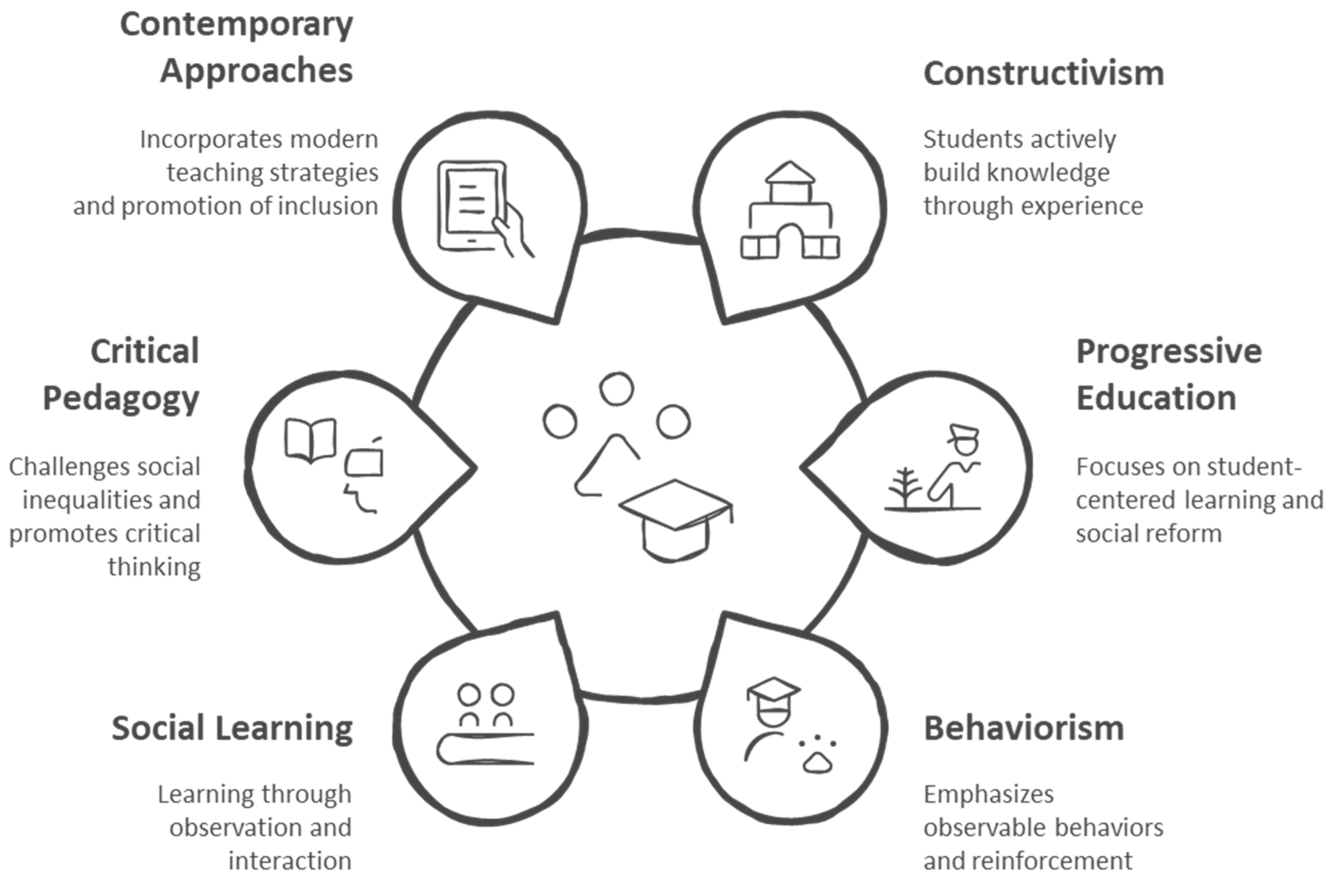
The variety of pedagogical approaches that have been developed and have shaped modern educational practice may be organized into six major traditions that readers can understand, compare, and critically evaluate. This enables educators to integrate the educational approaches they find meaningful and thereby develop their professional paths (
Pollard, 2010). Although all approaches share the same core goal of educating the young to prepare them for adult life, each one relates to learning from a different perspective. The presentation of each of the six approaches below reflects historical context, identifies key theorists and explains core principles, offering examples of practical implementation as well as critical analysis of strengths and limitations.
3.1. Progressive Education
Progressive education emerged in the late 19th and early 20th centuries as a transformative movement challenging traditional teacher-centered, routine-learning approaches. This educational philosophy emphasizes experiential learning, critical thinking, problem-solving, and the development of the whole child within democratic and child-centered environments. The two pioneers of the progressive approach were John Dewey (1859–1952) and Maria Montessori (1870–1952) (
Ilijevski, 2022).
John Dewey’s democratic learning principles positioned education as essential preparation for participatory citizenship in democratic societies.
Dewey (
1897) argued that schools should function as miniature democratic communities where learners learn through active engagement with real-world problems rather than passive absorption of abstract knowledge. His experiential learning model emphasized learning by doing, believing that education must connect to learners’ experiences and interests to be meaningful. The pragmatic philosophy he developed advocated for curriculum integration across disciplines, collaborative inquiry, and reflective thinking. Dewey viewed education not merely as preparation for future life but as life itself, where learners develop critical thinking skills, social responsibility, and adaptive problem-solving abilities through authentic experiences and democratic participation.
During the same era, building upon democratic and humanistic foundations, Maria Montessori developed a distinctly child-centered approach grounded in scientific observation of children’s natural development (
Ilijevski, 2022). Montessori’s method emphasizes respect for children’s intrinsic motivation, self-directed learning, and developmental readiness. Her carefully prepared environments feature hands-on materials designed to facilitate independent exploration and discovery across sensory, practical, academic, and social domains. Montessori advocated for mixed-age classrooms that promote peer learning and individualized pacing that honors each child’s developmental trajectory. Accordingly, the teacher’s role focuses on guiding and facilitating rather than conducting direct learning.
Together, Dewey’s democratic principles and Montessori’s child-centered methodology represent complementary expressions of progressive education, prioritizing active learning, holistic development, and respect for all learners as capable constructors of their own knowledge and democratic participants in their communities. It is essential to implement the core principles of progressive education in today’s education programs, mainly because of the easy access learners have to a wide variety of sources of information in any area they choose. Therefore, educators should consider including in their lessons opportunities in which learners investigate their environment and individually look for something they wish to know more about. To support this kind of learning, teachers should work on developing the learners’ understanding of how to ask relevant questions and which research strategies they must acquire in order to address different research questions. These strategies should also be mediated according to learners’ skills and individual challenges. For example, visual or graphic strategies such as infographs may be significantly useful for learners with reading challenges. Alternatively, the use of strategies involving short and simple sentences can be helpful for learners with Attention Deficiency Hyperactive Disorders.
3.2. Constructivism
Constructivism represents a fundamental shift in understanding how learning occurs, while still positioning learners as active builders of knowledge rather than passive recipients of information (
Bada & Olusegun, 2015). This theoretical framework emerged from the work of two influential scholars: Jean Piaget (1896–1980) and Lev Vygotsky (1896–1934), whose complementary yet distinct perspectives continue to shape contemporary educational practice (
Flavian, 2019;
Kozulin, 2025).
Throughout his cognitive constructivism approach (
Kalina & Powell, 2009), Piaget emphasized individual knowledge construction through interaction with the physical environment. He proposed that learners progress through distinct developmental stages, each characterized by qualitatively different cognitive capabilities. The core elements Piaget focused on were assimilation and accommodation, through which learners integrate new experiences into existing cognitive schemas or modify those schemas when confronted with contradictory information. Piaget also viewed cognitive conflict and disequilibrium as essential catalysts for learning, arguing that children actively construct understanding through exploration, experimentation, and discovery (
DeVries, 2000).
In contrast, Vygotsky referred to constructivism from social perspectives by highlighting the social and cultural dimensions of learning (
Kozulin, 2025). He argued that knowledge construction occurs primarily through social interaction and cultural tools, particularly language. Vygotsky’s concept of the Zone of Proximal Development (ZPD) identifies the space between what learners can accomplish independently and what they can achieve with guidance from more knowledgeable others. This framework underscores the importance of scaffolding, collaborative learning, and the role of teachers and peers as mediators of knowledge. Vygotsky also emphasized that higher-order thinking skills develop through the internalization of socially shared activities, making cultural context and social interaction inseparable from cognitive development (
Liu & Matthews, 2005). Vygotsky’s references to the role of society in everyone’s learning led his theory to also become part of the
Social Learning and Communities of Practice approach, as described later on.
While Piaget focused on individual cognitive structures and developmental readiness, Vygotsky emphasized social mediation and cultural transmission. Nevertheless, given the ongoing dynamics of immigration which require learners to relate to their own needs along with relating to the culture they are currently living in, integrating these perspectives provides a comprehensive constructivist foundation that recognizes both individual sense-making and social collaboration as essential to meaningful learning, informing contemporary approaches to differentiated instruction, cooperative learning, and culturally responsive pedagogy that can be implemented even today in a variety of educational environments.
3.3. Behaviorism and Direct Instruction
Behaviorism emerged as a dominant psychological paradigm in the early 20th century, fundamentally reshaping educational theory and practice by focusing exclusively on observable behaviors rather than internal mental processes (
Watson, 2017). Behaviorist principles fundamentally shaped direct instruction approaches characterized by explicit teaching, structured lessons, teacher-directed learning, systematic skill progression, and frequent assessment. Three pioneering psychologists—John Watson, Edward Thorndike, and B. F. Skinner—established foundational principles that continue to inform direct systematic instruction methodologies and structured teaching approaches for efficient learning, each contributing to this approach from a different perspective. The common goal of all three was the desire to enable behaviorism to turn psychology into a natural science.
John Watson (1878–1958) rejected introspection and subjective analysis, insisting that psychology must study only observable, measurable behaviors. He argued that learning results from conditioning in which environmental stimuli trigger behavioral responses. Watson’s emphasis on objective observation and controlled experimentation established behaviorism as a rigorous scientific discipline, positioning teachers as architects of learning environments who systematically shape learners’ behavior through carefully designed stimulus-response patterns (
Watson, 2017).
From a different perspective, Edward Thorndike (1874–1949) focused on his views regarding behaviors that recur as a result of satisfying or unsatisfying experiences. He demonstrated that learning occurs through trial and error, with successful responses gradually ingrained through positive outcomes. As a consequence of this, he emphasized the need for integrated practices along with relevant feedback and repetitions in order to improve learning (
Brau et al., 2016).
B. F. Skinner (1904–1990) (
Ziafar & Namaziandost, 2019) advanced behaviorism through operant conditioning, distinguishing between respondent behaviors (involuntary responses to stimuli) and operant behaviors (voluntary actions influenced by consequences). Skinner’s frameworks for behavior modification were founded on the concepts of positive reinforcement, negative reinforcement, and punishment. He argued that learning must be developed as programmed instruction, by breaking complex learning into small, sequential steps with immediate feedback. Accordingly, learning should be systematic, with clearly defined learning objectives and carefully sequenced instruction, where learners’ progress is continuously monitored and reinforced.
Although the behaviorism approach to learning began more than a century ago, the different points of view Watson, Thorndike, and Skinner expressed allow today’s educators to look for opportunities to implement teaching methods based on observing how different learners behave throughout their learning and accordingly create effective learning opportunities. Implementing the principles of
behaviorism and direct instruction approaches is mostly relevant within inclusive educational settings, for example, while promoting the inclusion of learners with Autism Spectrum Disorder (ASD). These learners are mainly characterized by behavioral neurodevelopmental disorders (
Ousley & Cermak, 2014). Accordingly, they should have specific educational adaptations that will allow them to improve both their academic and their behavioral skills, for efficient inclusion in schools and the society in which they live. Applied Behavior Analysis (ABA) exemplifies a therapeutic and intervention framework for children with ASD. This approach centers on intervention within social interaction contexts and the environmental influences affecting learners. Although intervention grounded in ABA principles facilitates behavioral development in children with ASD, empirical evidence suggests more limited effects on their cognitive and/or linguistic development (
Eckes et al., 2023). Accordingly, it is necessary to also integrate approaches that address cognitive growth alongside behavioral development. To illustrate the integration of the
Behaviorism and Direct Instruction approaches, one might consider teaching reading comprehension through carefully selected short stories that explore social dilemmas, interpersonal interactions, and ethical decision-making. Through this method, learners with ASD not only enhance their reading comprehension abilities but simultaneously develop an understanding of diverse perspectives regarding socially acceptable norms and behaviors. Extending this principle to middle and high school contexts, when learners study political transformations that have occurred across recent centuries, educators who integrate the behaviorism approach can adapt instruction for learners with ASD by emphasizing how different societies maintain distinct social norms and cultural values, and examining the ways in which political changes influence and reshape these normative frameworks over time.
3.4. Social Learning and Communities of Practice
Social learning theories recognize that learning is fundamentally a social process occurring through interaction, observation, collaboration, and participation within communities (
Flavian, 2019,
2024). This paradigm shifts from individualistic to socially situated learning and emphasizes the critical roles of context, culture, relationships, and collective knowledge construction, while allowing for individual differentiation.
The sociocultural theory of Lev Vygotsky (1896–1934), which became known in the West only during the second half of the 20th century, some 30–40 years after his death, established foundational principles for social learning. He formulated his concept of the Zone of Proximal Development (ZPD) to describe the space between what learners can accomplish independently and what they can achieve only with guidance from more knowledgeable people around them (
Kozulin, 2025). Vygotsky argued that higher-order thinking emerges through social interaction and cultural mediation, with language serving as the primary psychological tool for cognitive development. He also emphasized that knowledge is co-constructed within social contexts, as a result of collaborative learning among all learners. Reuven Feuerstein extended Vygotsky’s principles through his theory of Mediated Learning Experience (MLE), highlighting the role of intentional human mediation in cognitive development (
Feuerstein et al., 2006). Feuerstein argued that effective mediators, who could be anyone in the child’s environment, transcend immediate learning tasks to foster transferable thinking strategies, metacognitive awareness, and cognitive modifiability. His Structural Cognitive Modifiability theory challenged notions of fixed intelligence, asserting that all learners possess potential for cognitive growth through quality mediation (
Feuerstein et al., 2006;
Flavian, 2019,
2024). Feuerstein’s emphasis on cognitive modifiability through mediated learning finds empirical support in
Claro et al.’s (
2016) research demonstrating that growth mindsets predict achievement across all socioeconomic levels. When learning environments function as communities of practice that model persistence and frame challenges as growth opportunities, learners internalize beliefs about their developmental potential that transcend background factors. This suggests that social learning contexts grounded in mediational principles can promote educational equity by cultivating both cognitive modifiability and growth mindsets.
The Multiple Intelligences theory of Howard Gardner (b. 1943) further expanded the understanding of human capability beyond traditional domains, by identifying diverse core intelligence profiles including linguistic, logical–mathematical, spatial, musical, bodily kinesthetic, interpersonal, intrapersonal, naturalistic, and existential intelligences (
Gardner, 2011). Nevertheless, Gardner also emphasized the role of social interaction and cultural participation through the development of individual cognitive profiles. Albert Bandura (1925–2021) also related learning and social interactions, and developed the Social Cognitive Theory, through which he demonstrated that learning occurs through observation, imitation, and modeling within social contexts (
Bandura & Walters, 1977). Bandura emphasized learners’ self-efficacy as central to motivation and achievement, highlighting how social modeling and vicarious experiences shape these beliefs.
The contemporary Social–Emotional Learning (SEL) frameworks were developed by integrating the above theoretical foundations. SEL is based on the recognition that academic success requires concurrent development of emotional intelligence, social competence, and self-regulation. Five core competencies are emphasized within SEL: (a) self-awareness; (b) self-management; (c) social awareness; (d) relationship skills; and (e) responsible decision-making. These frameworks also acknowledge that cognitive development cannot be separated from emotional and social growth (
McClelland et al., 2017). The recognition that the surrounding environment exerts a significant influence on learners’ emotional and cognitive development is exemplified in
Seligman’s (
2018) PERMA framework (Positive Emotion, Engagement, Relationships, Meaning, and Accomplishment), which emphasizes the promotion of well-being among learners. Seligman posits that a society committed to fostering well-being cultivates the fundamental cognitive developmental tools necessary for learners, consequently enhancing learning effectiveness across all domains.
Schools are social environments, and thus, as expressed by social learning theoreticians, social events learners experience throughout their lives must be taken into consideration while educators assess and develop learning procedures. This approach is particularly important when social transitions occur worldwide and learners with different cultural backgrounds must learn together. What is common to all the above social learning and communities of practice theoreticians is the understanding that all learners have the potential for meaningful cognitive development, and therefore it is up to their teachers and caregivers to know how to mediate in order to allow them to develop higher cognitive skills in order to promote their better inclusion in the society within which they reside. That is not to say that this is a simple path to quality education and inclusion for either teachers or learners. However, following Vygotsky, Feuerstein, Gardner, Bandura, and others, if teachers focus on the cognitive, emotional, and social skills each of their learners needs to develop, rather than on teaching specific domain knowledge, both learning and inclusion will become a norm that all learners and people in their society will respect and wish to foster. From a practical standpoint, the implementation of these pedagogical methods can be accomplished through a variety of approaches and frameworks. Feuerstein, for instance, developed a comprehensive structured intervention program titled ‘Instrumental Enrichment,’ which maintains relevance across diverse student populations regardless of cultural or linguistic background, and through which educators can systematically mediate for the development of cognitive skills among all learners. Recognizing the fundamental reality that cultural context and environmental factors profoundly influence each individual’s cognitive development trajectory, teachers must invest effort in understanding their learners’ unique backgrounds, experiences, and cultural frameworks, and thoughtfully integrate this knowledge when mediating for social norms, diverse learning styles, and the variety of educational situations that emerge throughout the school environment.
3.5. Critical Pedagogy
Critical pedagogy emerged as a transformative educational philosophy challenging traditional power dynamics and advocating for education as a tool for social justice and liberation (
Giroux, 2010;
Guerriero, 2014). This approach views teaching and learning as inherently political acts, rejecting neutral or value-free education in favor of consciously empowering marginalized voices and fostering critical consciousness. Two influential scholars, Paulo Freire (1921–1997) and bell hooks (1952–2021), articulated foundational principles that position educators as facilitators of social transformation and critical thinking. The commonality between Freire and hooks is the focus on educators not as neutral transmitters of predetermined knowledge but as active agents of social change who cultivate critical thinking, question hegemonic assumptions, and empower learners to become conscious participants in reshaping society (
Sahoo, 2025).
In his seminal work, “Pedagogy of the Oppressed”,
Freire (
2020) criticized the way teachers ‘deposit’ knowledge into passive learners. Freire argued that this approach perpetuates oppression by treating learners as objects rather than subjects of their own learning. His alternative, problem-posing education, positions teachers and learners as co-learners engaged in dialogic relationships where knowledge emerges through critical inquiry into lived realities. According to Freire, the fundamental goal of pedagogy is to develop critical consciousness through which learners recognize and challenge oppressive social structures. Freire emphasized praxis, the cyclical process of reflection and action, as essential for transforming unjust conditions. His approach validates learners’ experiential knowledge while fostering critical analysis of power relations, inequality, and social injustice.
Bell hooks (
Carolissen et al., 2011), who is recognized for her vision of a “Pedagogy of Hope”, extended and deepened critical pedagogy by focusing on issues such as race and gender, while challenging academic detachment, arguing that transformative education requires emotional investment, vulnerability, and authentic presence from both teachers and learners. Her vision included classrooms as democratic spaces, where diverse voices and experiences are celebrated, particularly those historically marginalized. Hooks insisted that critical pedagogy must address the whole person, rejecting mind–body dualism prevalent in traditional academia. She emphasized that educators committed to liberation must traverse boundaries, challenge dominant narratives, and create brave spaces where difficult conversations about privilege, oppression, and difference can occur authentically (
Sahoo, 2025).
Both Freire and hooks emphasized the need to promote critical thinkers and learners while teaching different domains. Their educational philosophy is particularly salient in the contemporary context of global social transformations, as only through critical thinking can individuals discern which innovations or different perspectives on current situations align with their needs and express their perspectives effectively in this dynamic era. Furthermore, advancing meaningful and effective inclusion that is implemented not merely within school contexts but extends throughout broader societal frameworks fundamentally requires the development of critical thinking capacities among all educators and learners. This critical consciousness demands that all participants engage in rigorous self-examination from objective and critical perspectives, systematically recognizing both their individual strengths and areas of challenge as an essential foundation for cultivating an inclusive society that genuinely respects and values every member. The foundational principles of critical pedagogy provide the theoretical and practical framework through which all stakeholders can develop a nuanced understanding of others’ diverse perspectives, viewpoints, and lived experiences, thereby positioning this approach as instrumental in fostering authentic and sustainable inclusion throughout the lifespan.
3.6. Contemporary Approaches: Toward Inclusive Education
Contemporary educational approaches reflect evolving understandings of diversity, equity, and human potential, moving decisively away from deficit-based models toward strengths-based, inclusive frameworks that honor all learners as capable and valued members of learning communities. These approaches recognize that all aspects of diversity—cognitive, physical, sensory, emotional, cultural, linguistic, and other differences—enrich rather than complicate educational environments (
Flavian, 2024). Central to contemporary thinking is the paradigm shift from exclusion and segregation toward full inclusion of learners with special needs within mainstream educational settings.
The inclusive education movement challenges traditional special education models that isolate learners with disabilities in separate classrooms or institutions. Contemporary inclusive pedagogy asserts that all children, regardless of ability, have the right to learn together in supportive environments where diversity is normalized and celebrated (
Tremblay, 2013). This shift is grounded in social justice principles, research demonstrating academic and social benefits of inclusion for all learners, and recognition that segregation perpetuates stigma and inequality. However, inclusion requires more than physical placement; it demands fundamental transformation of curriculum, instruction, assessment, and school culture to ensure meaningful participation and belonging for every student (
Flavian & Alstete, 2024).
Universal Design for Learning (UDL) represents a cornerstone of contemporary inclusive practice, providing flexible frameworks that proactively address learner variability. Without focusing on one specific pedagogical approach, UDL principles recognize that there is no single way to learn and that barriers arise from inflexible curricula rather than learner deficits. By building flexibility and options into initial design, UDL benefits all learners while specifically supporting those with identified disabilities, learning differences, or language barriers (
Rusconi & Squillaci, 2023).
Differentiated instruction, Response to Intervention (RTI), and collaborative teaching models further operationalize inclusive principles by providing tiered support, individualized accommodations, and specialized expertise within general education contexts (
Grosche & Volpe, 2013). Contemporary approaches also emphasize co-teaching partnerships where general and special educators share responsibility for all learners, peer support systems, assistive technologies, and culturally responsive practices that honor diverse identities and experiences.
In summary, educational theories spanning constructivism, progressive education, behaviorism, social learning, critical pedagogy, and inclusive approaches each offer valuable insights for addressing diverse learner needs and contemporary societal challenges. Despite the fact that they were developed independently of one another, they all contributed to the aim of educating learners and preparing them for their future as adults in the society they live in. From Piaget’s developmental frameworks and Dewey’s democratic principles to Skinner’s systematic instruction, Vygotsky’s social mediation, Freire’s liberatory pedagogy, and contemporary inclusive practices, these perspectives provide complementary rather than competing tools. Yet critical questions emerge: How can educators navigate this theoretical abundance? Rather than rigid adherence to a single approach or a search for a new method of teaching, effective teaching may require strategic integration aligned with specific contexts, learners, and goals. Through this process, not only will all learners be able to benefit, but teachers will also enhance their professionalism. By developing their own integrated pedagogical approach, one that they truly believe in, one that has evolved from their strength in educating, they will be better able to promote a successful inclusive learning environment.
4. Discussion
In an era of dynamically accumulating knowledge and cultural changes, there is a need to develop a pedagogical approach that will allow all learners to be educated and to develop their thinking skills efficiently. Nevertheless, within such an ongoing developing process, the educational sphere faces several challenges. Moreover, just as learners differ from one another, so do teachers, and therefore the assumption that all teachers should always use the same teaching method with all their learners is unrealistic from the outset. Therefore, rather than trying to develop a “one-size-fits-all” pedagogical approach to be implemented in all schools, preservice and in-service teachers must deepen their knowledge about all the main pedagogical approaches and about their own strengths, challenges and pedagogical beliefs. In addition, they must acquire a holistic view of their learners before planning any educational process, creating a pedagogical approach that will fit both them and their learners. By doing so, not only will they be able to educate a broad diversity of learners efficiently, but they will also achieve a much greater level of professionalism. Following this belief, this article proposes a conceptual synthesis of the main pedagogical approaches described above in order to allow teacher educators and active teachers to integrate them efficiently so that they can support inclusive education and promote inclusive environments in the current era of dynamic change. The following
Figure 1 presents educators of all types at the center of the pedagogical process, integrating a variety of pedagogical approaches, rather than implementers of a specific pedagogical approach.
Following the above figure, high-quality inclusive education can be established when educators are encouraged and trusted to develop their overall pedagogical approach, which they can then modify to suit the specific needs in any given classroom. The fundamental questions about teacher professionalism and the capacity to construct personalized pedagogical approaches that synthesize multiple frameworks into coherent, responsive practice cannot absolutely be resolved, but it is the best way to promote quality education in updated inclusive environments. To establish a solid foundation for this discussion, teacher educators and active teachers must develop as reflective practitioners who construct their own coherent pedagogical approaches, drawing strategically from multiple theoretical traditions to create responsive, equitable, and effective learning environments that prepare learners for democratic participation in diverse, interconnected societies. Such professional development significantly contributes to each educator’s resilience (
Leroux & Théorêt, 2014), which is essential when aiming to achieve high-quality inclusive education. This process should begin during teachers’ preservice training and continue within professional development throughout the teaching career.
Providing teacher educators, preservice teachers and active teachers with opportunities to develop their own pedagogical vision in ways that enable them to address all learners’ needs effectively is not a simple task. Nevertheless, it is entirely achievable. To begin with, teacher education programs worldwide should ensure that all theoretical coursework on core pedagogical theorists is accompanied by practical application. This means that pre-service teachers should practice through their training how to develop teamwork skills in order to prepare lessons that incorporate the integration of different pedagogical methods, aiming to develop their independent educational path (
Vesisenaho et al., 2023). Practicing these methods with diverse learner populations allows prospective teachers to reflect critically on how, when, and whether these approaches should form the foundation of their teaching practice, while examining how to integrate some of these methods according to learners’ needs and their own pedagogical beliefs. Only through practice and reflection can deep understanding emerge. Furthermore, educators develop their professional expertise by reflecting on their own teaching, which ultimately enables them to become practitioners who know how to promote genuine inclusion in their classrooms.
For experienced teachers who did not have opportunities to develop their professionalism in this manner, it is not too late. Educational leaders must integrate targeted professional development workshops conducted in schools, focusing on the integration of multiple pedagogical theories aimed at promoting effective teaching and learning. The content of these workshops must include a range of core pedagogical approaches, enabling those who did not study them during teacher preparation to do so while providing others with essential reinforcement of theoretical frameworks they likely encountered but may have forgotten. Additionally, throughout these workshops, teachers must discuss how to implement each approach in their teaching practice, engage in collaborative lesson planning tailored to the diversity of their various classes, and reflect on their implementation through peer discussion and critique.
Furthermore, while dynamically evolving technological innovations must be carefully considered for integration into daily practice, it is essential to recognize that all technologies are merely tools that cannot replace human teachers who thoughtfully select and integrate pedagogical methods to promote effective learning among diverse learners. Regarding inclusive practices, teachers must carefully observe all their learners before determining appropriate instructional approaches. Inclusion, understood in its broadest sense, encompasses all individuals who have special needs in one context or another. Therefore, from an inclusive perspective, teachers must remain open-minded regarding the tailored pedagogical methods they choose to apply. For instance, learners with visual impairments, hearing impairments, attention deficits, learning disorders, giftedness, or any other special needs require instruction that integrates differentiated pedagogical approaches that promote the search for the educational adaptations they need from different points of view, regardless of emerging technological innovations or social transformations occurring in their society. According to this article’s perspectives, planning one’s teaching must begin with recognizing learners’ strengths and challenges, along with their cultural background, in order to choose the relevant principles from the core pedagogical theories and integrate them into the teaching of various domains.
A critical consideration that warrants emphasis is the process of evaluating the suggested model’s implementation effectiveness. While this article advocates for teacher educators, preservice and in-service teachers to construct novel integrations across pedagogical theories tailored to their own needs and those of their learners, such integration must not proceed without systematic evaluation of planning and implementation at each stage. Teachers must operate deliberatively, carefully determining which theoretical elements to integrate in order to advance all learners’ cognitive development and inclusion. Furthermore, they must design assessment mechanisms to evaluate learning processes and their efficacy. Equally important, teachers must maintain flexibility in pursuing innovative alternatives when chosen integrations prove unsuitable for particular students. As underscored throughout this article, learner diversity necessitates recognition that theoretical integrations effective for some learners may be inappropriate for others.
A critical principle for integrating core pedagogical methods while developing individualized teaching approaches is emphasizing commonalities across theories rather than focusing on their differences. Despite their varied origins, all the aforementioned pedagogical frameworks share a fundamental commitment: promoting effective learning and developing independent learners situated within their social contexts. This shared sociocultural foundation suggests that teachers should conceptualize their classrooms as culturally diverse learning communities and environments where students recognize and respect one another’s cultural backgrounds and knowledge and diverse learning challenges their peers may be dealing with, learn collaboratively, and collectively progress toward building a more inclusive society.