


Abstract
Contemporary education increasingly emphasises transferable competencies that enable learners to analyse situations, evaluate information, and make responsible decisions. This study examined the effects of a structured educational intervention based on inquiry, problem-solving, and role-play activities on the development of decision-making competence in primary school students. A quasi-experimental pre-test–post-test design with a control group was employed. The initial sample consisted of 64 second-grade students, with final analyses conducted on 39 complete cases. Decision-making competence was assessed using a researcher-developed multidimensional scale encompassing six dimensions: identification of alternatives, justification of decisions, anticipation of consequences, autonomy, collaboration, and responsibility. The results indicated a significant improvement in decision-making competence from pre-test (M = 13.23, SD = 1.68) to post-test (M = 20.05, SD = 4.49), t(38) = 8.45, p < 0.001, d = 1.35. Additionally, analysis of covariance revealed a significant effect of group on post-test scores, F(1, 36) = 9.82, p = 0.003, ηp2 = 0.21, with the experimental group demonstrating greater improvement than the control group. A 2 × 2 repeated-measures ANOVA further indicated that gains were more pronounced in the cognitive domain than in the socio-emotional domain. These findings suggest that structured classroom activities involving inquiry, problem-solving, and role-play can support primary school students’ ability to analyse situations, generate alternatives, and justify decisions, particularly within the cognitive dimensions of decision-making competence. At the same time, the more moderate gains observed in collaboration and responsibility highlight the need for sustained, interaction-based learning contexts to support the development of socio-emotional dimensions.
1. Introduction
Contemporary education increasingly prioritises the development of transferable competencies that enable learners to analyse situations, evaluate information, and make responsible decisions (OECD, 2024; Pellegrino & Hilton, 2012; Voogt & Roblin, 2012). Within this framework, Gottschalk and Borhan (2023) highlight that decision-making competence represents a key component of student development, supporting critical thinking, autonomy, and responsible behaviour in learning contexts.
From a cognitive perspective, decision-making can be understood as a sequence of interrelated processes, including identifying problems, generating alternatives, evaluating consequences, and selecting appropriate actions (Kahneman, 2011; Lunenburg, 2011; Stanovich & West, 2000). During childhood, these abilities develop progressively, as children become capable of logical reasoning in concrete situations and begin to understand causal relationships (Flavell, 2004; Piaget, 1970). At the same time, sociocultural perspectives emphasise the role of social interaction and guided participation in shaping cognitive development (Bodrova & Leong, 2015; Vygotsky, 1978).
In the present study, decision-making competence is conceptualised as a multidimensional ability involving the identification of alternatives, justification of decisions, anticipation of consequences, autonomous action, collaboration with others, and responsibility for outcomes. This conceptualisation integrates both cognitive and socio-emotional components of decision-making and provides the operational framework for the present research.
In educational contexts, active teaching methods such as inquiry-based learning, problem-solving, and argumentation have been widely associated with the development of higher-order cognitive skills. Inquiry-based learning, problem-solving approaches, and argumentation-based activities promote deeper understanding and transferable competencies (Barron & Darling-Hammond, 2008; Bayat et al., 2022; Hmelo-Silver et al., 2007; Jonassen, 2011; Kuhn, 2015; Kuhn et al., 2020). These approaches engage students in analysing situations, generating alternatives, and justifying decisions, processes that are central to decision-making competence.
Decision-making competence is also closely related to self-regulated learning and socio-emotional development. Panadero (2017), Zimmerman (2002), and Zimmerman and Schunk (2021) highlight the importance of reflection, autonomy, and strategic control in guiding behaviour. At the same time, Durlak et al. (2022) and Immordino-Yang et al. (2019) emphasise the interdependence of cognitive, emotional, and social processes in learning. Competencies such as collaboration, responsibility, and self-regulation are therefore essential components of effective decision-making (OECD, 2021, 2024).
Despite the growing body of research on inquiry-based learning, problem-solving, and argumentation, decision-making competence has rarely been examined as a distinct, multidimensional outcome in primary education. Existing studies have tended to focus primarily on cognitive processes, with less attention given to the integration of socio-emotional dimensions such as collaboration and responsibility. Moreover, relatively few studies have investigated how these dimensions evolve in response to structured educational interventions in natural classroom settings.
The present study addresses this gap by conceptualising decision-making competence as a multidimensional construct that integrates both cognitive and socio-emotional components, and by examining its development following an educational intervention based on inquiry, problem-solving, and role-play activities.
The study aimed to examine the extent to which educational activities based on inquiry, problem-solving, and role-playing are associated with the development of decision-making competence in primary school students.
The research was guided by the following question: To what extent are educational activities based on inquiry, problem-solving, and role-playing associated with the development of decision-making competence in primary school students?
The overarching objective of the study was to investigate the effects of an educational intervention based on active teaching methods on the development of decision-making competence in primary school students.
The specific objectives were:
- to identify the initial level of decision-making competence in participating students;
- to analyse changes in decision-making competence following the educational intervention;
- to examine students’ progress across cognitive and socio-emotional dimensions;
- to evaluate the development of autonomy within the decision-making process.
Based on the literature reviewed, the following hypotheses were formulated:
H1.
Students participating in the educational intervention will show an improvement in decision-making competence from pre-test to post-test.
H2.
The improvement in decision-making competence will be greater in the experimental group than in the control group.
H3.
Improvements will be more pronounced in cognitive dimensions than in socio-emotional dimensions of decision-making competence.
2. Materials and Methods
2.1. Research Design
The study employed a quasi-experimental pre-test–post-test design with a control group. Two intact classroom groups of second-grade students participated: an experimental group, which was exposed to a structured educational intervention based on active learning methods, and a control group, which followed regular classroom instruction.
Given the natural classroom setting, participants were not randomly assigned to conditions; group allocation was determined by existing classroom organisation. The design therefore reflects a non-randomised between-group structure, which is common in school-based educational research conducted under ecological conditions.
Both groups were assessed at two time points: prior to the intervention (pre-test) and after the intervention (post-test). This structure corresponds to a 2 (group: experimental vs. control) × 2 (time: pre-test vs. post-test) design, allowing for the examination of both within-subject changes over time and between-group differences.
The inclusion of a control group and baseline (pre-test) assessment enabled the control of initial differences between participants and strengthened the internal validity of the study. Although the absence of random assignment limits strict causal inference, the use of comparable groups, identical assessment procedures, and consistent instructional conditions (except for the intervention) supports the interpretation of observed differences as being associated with the educational intervention.
Ethical approval for the study was obtained from the relevant institutional ethics committee prior to data collection (Protocol No. 5/12.11.2025). Written informed consent was obtained from the parents or legal guardians of all participating students before participation. Students took part in the activities as part of regular classroom practice, and participation in the research component was voluntary. All data were recorded, stored, and analysed in anonymised form, in accordance with the ethical standards for research involving human participants.
2.2. Participants
The initial sample consisted of 64 second-grade students enrolled in a public primary school, aged between 8.0 and 8.3 years. Participants were selected through convenience sampling, a method frequently used in school-based educational research conducted in natural classroom settings. The study was carried out within intact classroom groups, and no random assignment to conditions was performed.
At baseline, the sample was equally distributed across the two study groups: 32 students in the experimental group and 32 students in the control group. Group allocation was determined by the existing classroom organisation, with one class assigned to the experimental condition and the other to the control condition. Both groups followed the same school curriculum and were taught in the same school context; the principal difference between them was the implementation of the educational intervention in the experimental group.
For the final statistical analyses, 39 complete cases were retained, including 19 students in the experimental group and 20 students in the control group. Only participants for whom both pre-test and post-test data were available were included in the inferential analyses.
The reduction in sample size was due to student absence or incomplete data collection at one of the two assessment points. Specifically, 13 students from the experimental group and 12 students from the control group were excluded from the final analyses. Accordingly, a complete-case approach was adopted, and cases with missing data were excluded from inferential analyses.
The decision to use a complete-case approach was based on the relatively small sample size and the nature of the missing data, which were primarily associated with temporary student absence rather than with systematic non-response. Under these conditions, data imputation procedures were not considered appropriate, as they may have introduced additional estimation bias in a small-sample context.
This represents a retention rate of 60.9% of the initial sample. Preliminary comparisons of available pre-test scores did not indicate statistically significant baseline differences between retained and non-retained participants, suggesting that attrition was unlikely to have introduced systematic bias. However, the relatively high proportion of missing cases should be taken into account when interpreting the findings.
All participants took part in the study as part of regular classroom activities. Informed consent was obtained from the parents or legal guardians of all students, and the study was conducted in accordance with relevant ethical standards for research involving human participants.
2.3. Research Variables
The independent variable consisted of a structured educational intervention implemented in the experimental group, based primarily on inquiry-oriented activities, problem-solving tasks, and role-playing. Within this broader instructional framework, case studies and group debates were used as complementary formats to support students’ analysis, discussion, and justification of decisions. The intervention was systematically applied over the instructional period, while the control group followed the standard curriculum without exposure to these activities.
This instructional approach was designed to actively engage students in reasoning, reflection, and collaborative decision-making processes. As highlighted by Barron and Darling-Hammond (2008) and further supported by Hmelo-Silver et al. (2007) and Jonassen (2011), such approaches create meaningful learning environments that foster higher-order thinking. In addition, Kuhn (2015) and Kuhn et al. (2020) emphasise that dialogic and argument-based activities contribute to the development of reasoning and decision-making skills, a perspective also supported by Bayat et al. (2022).
The independent variable was operationalised as a between-group factor (experimental vs. control condition), reflecting students’ exposure to the educational intervention.
The dependent variable was the level of decision-making competence, operationalised as a multidimensional construct encompassing six interrelated dimensions: (1) identification of alternatives, (2) justification of decisions, (3) anticipation of consequences, (4) autonomy in the decision-making process, (5) collaboration in decision-making, and (6) responsibility for the consequences of decisions.
Each dimension was assessed on a five-point scale, and the total score was calculated as the sum of the six dimensions, resulting in a continuous variable ranging from 6 to 30, with higher scores indicating higher levels of decision-making competence.
This multidimensional operationalisation is consistent with theoretical and empirical perspectives on cognitive and socio-emotional development. Diamond (2013) highlights the role of executive functions in supporting planning, flexibility, and evaluation processes involved in decision-making. From the perspective of self-regulated learning, Panadero (2017), together with Zimmerman (2002) and Zimmerman and Schunk (2021), emphasise the importance of reflection, autonomy, and strategic control in guiding behaviour. Furthermore, Pellegrino and Hilton (2012) argue that competence-based education frameworks require the integration of cognitive, social, and emotional dimensions, which are essential for effective decision-making in real-world contexts.
Together, these dimensions capture both the analytical and socio-emotional components of decision-making competence, as reflected in students’ responses to structured problem-solving situations.
The dependent variable was assessed at two time points (pre-test and post-test), allowing for the examination of within-subject changes over time and between-group differences associated with the intervention, in line with the quasi-experimental design of the study.
2.4. Assessment Instrument
Decision-making competence was assessed using a researcher-developed multidimensional scale, designed in alignment with the objectives of the study and grounded in relevant theoretical and empirical literature on decision-making, self-regulated learning, and critical thinking. As emphasised by Stanovich and West (2000), decision-making involves complex reasoning processes, while Panadero (2017) highlights the role of self-regulation in guiding behaviour and choices. Similarly, Zimmerman (2002), together with Zimmerman and Schunk (2021), conceptualise decision-making as closely related to reflective and strategic learning processes.
The instrument operationalised decision-making competence as a multidimensional construct comprising six interrelated dimensions: (1) identification of alternatives, (2) justification of decisions, (3) anticipation of consequences, (4) autonomy in decision-making, (5) collaboration in decision-making, and (6) responsibility for the consequences of decisions. These dimensions reflect both cognitive and socio-emotional components of decision-making, in line with competence-based educational frameworks described by Pellegrino and Hilton (2012).
Each dimension was assessed using a five-point rating scale, ranging from 1 (very low level) to 5 (very high level). The total score was calculated as the sum of the six dimension scores, resulting in a possible range from 6 to 30 points, with higher scores indicating higher levels of decision-making competence. This scoring approach enabled both an overall assessment of competence and a differentiated analysis of its component dimensions.
The assessment was based on students’ responses to 20 structured problem-solving scenarios, each designed to elicit responses across the six dimensions of decision-making competence. The development of these scenarios followed three key criteria: age appropriateness, contextual relevance, and alignment with decision-making processes. The situations reflected familiar school-related contexts (e.g., resolving interpersonal conflicts, making decisions during group activities, or responding to classroom dilemmas) and required students to analyse situations, generate alternative courses of action, justify their choices, and anticipate potential consequences.
The assessment was performance-based and relied on the evaluation of students’ responses rather than on self-report measures. Students provided written or verbal responses to each scenario, which were subsequently evaluated by the researcher using predefined scoring criteria aligned with the six dimensions of decision-making competence.
Before completing the assessment tasks, students were instructed to read or listen carefully to each scenario, think of one or more possible responses, explain which option they considered most appropriate, and describe what might happen as a result of their decision. When necessary, instructions were reformulated in age-appropriate language to ensure comprehension. For example, one scenario required students to decide how to respond to a classroom conflict between peers, propose multiple possible solutions, justify their preferred option, and discuss the possible outcomes of their decision.
To increase transparency regarding the assessment procedure, an example of a task and its scoring criteria is provided. One scenario presented to students was the following: “During group work, two classmates want to use the same materials and begin to argue. What could you do in this situation? Which option do you think is the best? Why? What might happen next?” Students’ responses were evaluated across the six dimensions of decision-making competence. For example, for the identification of alternatives dimension, a score of 1 was assigned when the student provided no relevant solution or an unclear response, a score of 3 was assigned when the student proposed one relevant alternative, and a score of 5 was assigned when the student proposed two or more relevant alternatives. For the justification of decisions dimension, a score of 1 indicated no justification or an irrelevant explanation, a score of 3 reflected a basic but coherent justification, and a score of 5 reflected a clear, well-structured justification that explicitly connected the chosen action to the situation and its likely consequences.
In this type of task, students were expected to propose alternative courses of action, justify their preferred option, and discuss possible consequences. Their responses were evaluated across the six dimensions using predefined performance descriptors aligned with each level of the scale. Higher scores were assigned to responses that included multiple relevant alternatives, coherent justification, and explicit consideration of consequences, whereas lower scores reflected limited or unclear reasoning.
These descriptors reflected observable behaviours associated with each dimension. In general, a score of 1 indicated a minimal or unclear response, characterised by limited understanding and absence of relevant reasoning. A score of 3 reflected an adequate response, including at least one relevant alternative and a basic but coherent justification. A score of 5 indicated a highly developed response, characterised by multiple relevant alternatives, well-structured and coherent reasoning, and explicit consideration of both immediate and longer-term consequences.
All responses were evaluated using a standardised scoring procedure applied consistently across participants and across both assessment points. The use of explicit scoring criteria contributed to reducing subjectivity and enhancing the consistency of the evaluation process.
The internal consistency of the scale was not formally assessed in the present study due to the relatively small sample size and the exploratory nature of the instrument. However, the scale was constructed based on clearly defined theoretical dimensions, and scoring was guided by explicit performance descriptors applied consistently across participants. Although this approach supports the coherence of the instrument, the absence of formal reliability indices represents a limitation. Future research should examine internal consistency (e.g., Cronbach’s alpha) as well as construct validity.
The content of the instrument was designed to reflect key components of decision-making competence identified in the literature, supporting its content validity.
All responses were evaluated by a single trained evaluator (the researcher), using the predefined scoring criteria. Although this approach ensured consistency in scoring, the absence of multiple raters represents a limitation, as inter-rater reliability could not be assessed. Future studies should include independent raters and report inter-rater agreement indices (e.g., Cohen’s kappa or intraclass correlation coefficients).
For each student, a final score from 1 to 5 was assigned to each dimension on the basis of the overall quality and consistency of responses across the 20 scenarios, using the predefined performance descriptors. Thus, the dimension scores represented synthesised performance ratings rather than simple counts of correct responses. The total decision-making competence score was then computed as the sum of the six dimension scores.
2.5. Research Procedure
The research procedure was conducted over a period of six weeks and comprised three main stages.
Stage 1—Initial Assessment. In the first stage, an initial assessment of students’ decision-making competence was conducted. Students participated in structured problem-solving activities derived from familiar school-related contexts. These scenarios were designed to elicit key components of decision-making, including the identification of alternative courses of action, the analysis of possible consequences, and the justification of decisions.
All students completed the assessment under similar classroom conditions. Students’ responses were evaluated using the structured assessment criteria described in the Assessment Instrument section. All responses were scored by the same evaluator (the researcher), using a standardised scoring procedure. The use of a single evaluator ensured consistency in the application of scoring criteria across participants and across both assessment points.
Stage 2—Educational Intervention. The educational intervention was implemented over a six-week period and consisted of two structured sessions per week, resulting in a total of 12 instructional sessions. Each session had a duration of approximately 45–50 min and was integrated into regular classroom activities.
The intervention was based primarily on inquiry-oriented activities, problem-solving tasks, and role-playing, which represented the core instructional strategies. In addition, case studies and group debates were used as complementary formats to create opportunities for analysis, discussion, and justification of decisions.
Each instructional session followed a similar sequence. First, the teacher introduced a problem situation connected to students’ everyday school experiences. Second, students analysed the situation individually or in pairs and generated possible alternative responses. Third, they discussed and justified their preferred choices in small groups or in whole-class discussions. Finally, students reflected on the possible consequences of different options and received teacher feedback aimed at supporting more explicit and reasoned decision-making.
In general, approximately 10–15 min were devoted to introducing and clarifying the problem situation, 15–20 min to individual or group analysis and discussion, and 10–15 min to whole-class reflection, justification of decisions, and feedback.
To enhance the transparency and replicability of the intervention, several examples of instructional activities are provided. For instance, one activity involved presenting students with a classroom dilemma (e.g., resolving a conflict between peers) and asking them to generate multiple possible solutions, justify their preferred option, and discuss potential consequences. Another activity required students to work in small groups to analyse a problem situation, compare alternative courses of action, and reach a shared decision through discussion and argumentation.
Role-playing activities were used to simulate real-life situations, in which students assumed different roles and explored the implications of their decisions from multiple perspectives. Each session included guided questioning by the teacher, prompting students to reflect on their reasoning (e.g., “What could happen next?”, “Why is this a good choice?”, “Are there other possible solutions?”). Feedback was provided during and after activities to support students’ reflection and reasoning processes.
Across the 12 sessions, the intervention gradually increased in complexity, moving from simpler classroom dilemmas to more elaborated situations requiring perspective-taking, justification of decisions, and anticipation of consequences.
The intervention was designed to ensure active student participation and to promote both individual reflection and collaborative learning. As highlighted by Barron and Darling-Hammond (2008) and further supported by Hmelo-Silver et al. (2007) and Jonassen (2011), such approaches create meaningful learning environments that foster higher-order thinking. In addition, Kuhn (2015) and Kuhn et al. (2020) emphasise that argumentation and dialogue play a central role in the development of reasoning and decision-making processes, while Immordino-Yang et al. (2019) underline the importance of socially mediated learning experiences.
The same teacher implemented all activities in the experimental group, following a consistent instructional approach across sessions. The control group continued to follow the standard curriculum without exposure to the intervention activities. This ensured that the main difference between groups was the presence or absence of the structured intervention.
Stage 3—Final Assessment. Following the completion of the intervention, a final assessment of decision-making competence was conducted using the same instrument and procedures as in the initial stage. The same assessment tasks, scoring criteria, and performance descriptors were applied in order to ensure comparability between the two assessment points.
As in the initial assessment, all responses were evaluated by the same evaluator using the same standardised scoring procedure. This approach contributed to maintaining consistency in scoring across time points.
2.6. Data Analysis
The data were analysed using both descriptive and inferential statistical methods. All inferential analyses were conducted on complete cases, including only participants for whom both pre-test and post-test data were available. Descriptive statistics included means and standard deviations for the total score and for each indicator at both assessment points.
To test Hypothesis 1, regarding improvement in decision-making competence from pre-test to post-test, a paired-samples t-test was conducted on the total scores for the full analysed sample. The test statistic, significance level, 95% confidence interval for the mean difference, and Cohen’s d were reported.
To test Hypothesis 2, concerning differences between the experimental and control groups, an analysis of covariance (ANCOVA) was conducted on post-test total scores, with group (experimental vs. control) as the independent variable and pre-test total score as the covariate.
ANCOVA was selected as the primary between-group analysis because it allows for the comparison of post-test scores while statistically controlling for pre-test differences, thereby providing a more accurate estimate of the intervention effect in quasi-experimental designs without random assignment. Although the design can be conceptualised as a 2 × 2 (group × time) structure, ANCOVA was preferred over a repeated-measures ANOVA because it allows for a more precise estimation of group differences at post-test by controlling for baseline variability.
The F value, p value, and partial eta squared (ηp2) were reported as indicators of statistical significance and effect size, respectively.
Prior to conducting the ANCOVA, its assumptions were examined. The linear relationship between the covariate and the dependent variable was inspected graphically, the homogeneity of regression slopes was tested by examining the interaction between group and pre-test score, and residuals were inspected to assess normality and homoscedasticity.
To test Hypothesis 3, two composite domain scores were computed: a cognitive domain score and a socio-emotional domain score. The cognitive domain included identification of alternatives, justification of decisions, anticipation of consequences, and autonomy in decision-making, whereas the socio-emotional domain included collaboration in decision-making and responsibility for the consequences of decisions. Because each dimension was rated on a 1-to-5 scale, domain scores were calculated as mean scores across the dimensions included in each domain, in order to ensure comparability across domains and consistency with the overall decision-making competence score.
To examine whether the magnitude of improvement differed between the two domains, a 2 × 2 repeated-measures ANOVA was conducted, with Time (pre-test vs. post-test) and Domain (cognitive vs. socio-emotional) as within-subjects factors. This analysis allowed for a direct test of whether changes over time differed across the two domains within a single analytical framework.
To provide a more detailed analysis of changes across the six individual indicators, paired-samples t-tests were also conducted for each dimension by comparing pre-test and post-test scores. These analyses were used as complementary indicator-level analyses to identify the dimensions in which statistically significant changes occurred.
3. Results
3.1. Descriptive Statistics of Decision-Making Competence
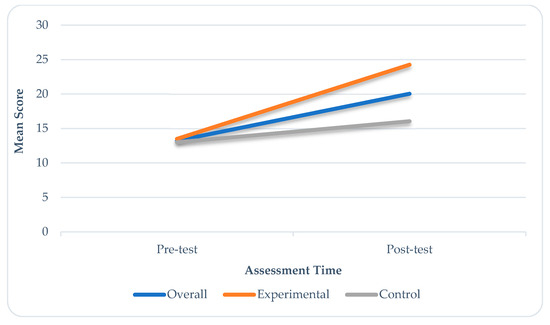
The descriptive results show an increase in the mean decision-making competence score from pre-test (M = 13.23, SD = 1.68) to post-test (M = 20.05, SD = 4.49). The lower standard deviation at pre-test and the higher standard deviation at post-test indicate greater dispersion in scores at the final assessment. The mean increase was ΔM = +6.82.
As shown in Figure 1, decision-making competence increased in both the experimental and control groups from pre-test to post-test. However, the rate of increase differs between groups, with the experimental group displaying a steeper upward trajectory compared to the control group.
Figure 1.
Evolution of decision-making competence scores from pre-test to post-test (overall sample and by group).
This divergence suggests that, while some degree of improvement may be associated with general cognitive development and ongoing classroom activities, the experimental group experienced a more pronounced increase in scores. The graphical pattern therefore provides an initial descriptive indication of differential progress between groups, which is further examined through inferential analysis in the following sections.
This initial descriptive pattern provides a foundation for the inferential analyses presented in the following sections, which examine the statistical significance of these observed changes.
Because each indicator was rated on a 1-to-5 scale, subsequent domain-level analyses were conducted using mean scores per dimension in order to maintain comparability across the cognitive and socio-emotional domains.
3.2. Evolution of Decision-Making Competence
To examine changes in decision-making competence from pre-test to post-test, a paired-samples t-test was conducted on the total scores. The results indicated that post-test scores (M = 20.05, SD = 4.49) were significantly higher than pre-test scores (M = 13.23, SD = 1.68), t(38) = 8.45, p < 0.001, 95% CI [5.12, 8.53], Cohen’s d = 1.35, indicating a large increase in decision-making competence. The magnitude of the effect size suggests that this improvement was large. In addition, the increase in variability observed at post-test (SD = 4.49), compared to pre-test (SD = 1.68), indicates greater dispersion in scores at the final assessment. Overall, these findings support Hypothesis 1, demonstrating a significant improvement in decision-making competence from pre-test to post-test.
3.3. Group Differences in Post-Test Scores (ANCOVA)
As illustrated in Figure 1, both groups showed improvement over time; however, the increase was more pronounced in the experimental group. To examine whether these differences remained statistically significant after controlling for baseline performance, an analysis of covariance (ANCOVA) was conducted, with post-test scores as the dependent variable, group (experimental vs. control) as the independent variable, and pre-test scores as the covariate.
Preliminary analyses indicated that the assumptions of ANCOVA were met, as the relationship between the covariate and the dependent variable was linear, the interaction between group and pre-test score was not statistically significant, indicating homogeneity of regression slopes, and inspection of residuals did not reveal major deviations from normality or homoscedasticity.
The ANCOVA revealed a significant effect of group on post-test scores, F(1, 36) = 9.82, p = 0.003, ηp2 = 0.21, indicating that, after controlling for baseline performance, students in the experimental group achieved significantly higher adjusted post-test scores than those in the control group. The effect size suggests a substantial intervention-related difference between groups.
Overall, these findings support Hypothesis 2 and suggest that participation in the educational intervention was associated with greater improvement in decision-making competence compared to standard instructional practices.
3.4. Comparison of Progress in Cognitive and Socio-Emotional Dimensions
To examine whether improvements in decision-making competence were more pronounced in cognitive dimensions than in socio-emotional dimensions, the six indicators were grouped into two broader domains. The cognitive domain included identification of alternatives, justification of decisions, anticipation of consequences, and autonomy in decision-making, whereas the socio-emotional domain included collaboration in decision-making and responsibility for the consequences of decisions. Domain scores were calculated as mean scores per dimension on the original 1-to-5 scale.
Descriptive statistics indicated that the overall decision-making competence score increased from M = 13.23 (SD = 1.68) at pre-test to M = 20.05 (SD = 4.49) at post-test. Expressed on the original 1-to-5 scale, this corresponds to an average increase from 2.21 to 3.34 points per dimension. At the domain level, the cognitive domain increased from M = 2.19 (SD = 0.30) at pre-test to M = 3.76 (SD = 0.88) at post-test, whereas the socio-emotional domain increased from M = 2.23 (SD = 0.32) to M = 2.51 (SD = 0.60).
A 2 × 2 repeated-measures ANOVA was conducted with Time (pre-test vs. post-test) and Domain (cognitive vs. socio-emotional) as within-subjects factors. The analysis revealed a significant main effect of Time, F(1, 38) = 71.40, p < 0.001, ηp2 = 0.66, indicating that scores increased significantly from pre-test to post-test across domains. The main effect of Domain was also significant, F(1, 38) = 9.87, p = 0.003, ηp2 = 0.21, suggesting overall differences between the two domains. Importantly, the Time × Domain interaction was significant, F(1, 38) = 11.92, p = 0.001, ηp2 = 0.24, indicating that the magnitude of improvement differed across domains, with significantly greater gains observed in the cognitive domain than in the socio-emotional domain.
To further examine changes at the level of individual indicators, paired-samples t-tests were conducted for each dimension by comparing pre-test and post-test scores. These analyses were conducted as complementary indicator-level analyses following the domain-level comparison based on the repeated-measures ANOVA. The results showed statistically significant improvements across all six indicators of decision-making competence, as presented in Table 1.
Table 1.
Pre-test and post-test means, standard deviations, mean gains, and paired-samples t-test results for the six indicators of decision-making competence.
Descriptively, the largest mean increases were observed in identification of alternatives (+1.60), justification of decisions (+1.50), anticipation of consequences (+1.50), and autonomy in decision-making (+1.40). In contrast, the gains observed in collaboration (+0.50) and responsibility (+0.40) were more moderate. This pattern is consistent with the repeated-measures ANOVA results, which indicated that improvement over time was significantly greater in the cognitive domain than in the socio-emotional domain.
These findings suggest a differentiated pattern of development, with the intervention appearing to support cognitive dimensions of decision-making competence more strongly than socio-emotional ones. This pattern may be partly explained by the relatively higher baseline level observed for collaboration and responsibility compared to several of the cognitive indicators, which may have limited the observable magnitude of improvement in these dimensions.
4. Discussion
The present study examined the impact of an educational intervention based on inquiry, problem-solving, and role-play on the development of decision-making competence in primary school students. Overall, the findings indicate a substantial and statistically significant improvement in students’ performance from pre-test to post-test, accompanied by clear differences in the magnitude of progress between the experimental and control groups.
The observed increase in decision-making competence suggests that the intervention was not only statistically significant but also educationally meaningful. Furthermore, the results obtained through the ANCOVA analysis strengthen this interpretation, indicating that the experimental group outperformed the control group even after controlling for baseline performance.
The analysis of progress across domains revealed a differentiated pattern of development, with improvements being more pronounced in cognitive dimensions than in socio-emotional ones. Importantly, this conclusion is supported by the repeated-measures ANOVA, which showed a significant Time × Domain interaction, indicating that the degree of change over time differed across the two domains. This finding suggests that the analytical and reflective components of decision-making competence may respond more rapidly to structured instructional interventions, whereas socio-emotional components may require longer periods of development and sustained social interaction.
These findings are consistent with previous research highlighting the effectiveness of active and student-centred instructional approaches in fostering higher-order cognitive skills (Barron & Darling-Hammond, 2008; Hmelo-Silver et al., 2007; Jonassen, 2011; Sawyer, 2022). Inquiry-based learning, problem-solving, and role-play provide contexts in which students are actively engaged in analysing situations, evaluating alternatives, and reflecting on their decisions—processes that are essential for the development of decision-making competence.
From a theoretical perspective, the results align with constructivist and sociocultural frameworks of learning. According to Vygotsky (1978), cognitive development is mediated through social interaction and guided participation, while Bodrova and Leong (2015) emphasise the role of scaffolding in the development of higher mental functions. The structured nature of the intervention appears to have created learning contexts in which students were progressively supported in engaging in increasingly complex reasoning processes, such as generating alternatives, evaluating consequences, and justifying decisions.
A more detailed analysis of the six dimensions of decision-making competence also highlights a differentiated pattern of development. The most substantial improvements were observed in the identification of alternatives, justification of decisions, and anticipation of consequences, followed by autonomy in decision-making. These dimensions are primarily associated with analytical and reflective cognitive processes, suggesting that the intervention was particularly effective in supporting students’ ability to analyse situations and formulate reasoned decisions.
In contrast, gains observed in collaboration and responsibility were more moderate, although still statistically significant. These dimensions involve complex socio-emotional processes, such as perspective-taking, interpersonal coordination, and the internalisation of norms, which develop gradually and require repeated and sustained social interaction. This interpretation is consistent with integrated models of learning, which emphasise that socio-emotional competencies develop over extended periods and in interaction-rich contexts (Durlak et al., 2022; Immordino-Yang et al., 2019; OECD, 2021).
Given this pattern of results, several targeted classroom practices may further support the development of socio-emotional dimensions of decision-making competence. For instance, structured cooperative learning activities in which students are assigned specific roles (e.g., facilitator, recorder, spokesperson) can promote shared responsibility and accountability within group decision-making tasks. In addition, perspective-taking exercises—such as asking students to explain how a situation might be experienced by different classmates—can foster empathy and improve the quality of collaborative decisions.
Teachers may also incorporate short socio-emotional reflection prompts during or after activities (e.g., “How did your decision affect others?”, “Did everyone in your group have a chance to contribute?”, “What would you do differently to work better together next time?”), encouraging students to become more aware of the interpersonal consequences of their actions. Establishing classroom norms that emphasise respect, active listening, and inclusive participation can further support the development of collaborative decision-making.
Additionally, conflict-resolution routines, such as guided peer mediation or structured dialogue protocols, may help students practise negotiating solutions and taking responsibility for shared outcomes. Regular opportunities for joint decision-making—such as choosing group strategies, setting classroom rules, or planning activities—can also contribute to the gradual internalisation of responsibility and cooperative behaviour.
Taken together, these practices suggest that socio-emotional dimensions of decision-making competence are best developed through consistent, guided interaction in socially meaningful contexts, rather than through isolated instructional tasks.
Beyond these socio-emotional considerations, the findings also have broader implications for educational practice. First, they suggest that decision-making competence can be supported through structured instructional activities that engage students in analysing situations, generating alternatives, and justifying their choices. For example, teachers can regularly introduce classroom dilemmas based on familiar situations (e.g., peer conflicts, group work situations, classroom rules) and guide students to generate multiple possible solutions, compare options, and explain their reasoning.
In this context, strategies such as think–pair–share can be effectively used, allowing students to reflect individually on a situation, discuss possible solutions in pairs, and then share their ideas with the class. Similarly, the use of graphic organisers (such as decision trees or pros-and-cons tables) can support students in structuring options and evaluating potential consequences.
The use of guided questions (e.g., “What might happen next?”, “What are the consequences of this choice?”, “Why do you think this is the best option?”, “Are there other alternatives?”) can further contribute to the development of reflective thinking and help make the decision-making process more explicit. These questions can be integrated into whole-class discussions, group activities, or individual reflection moments.
Age-appropriate debate activities represent another effective strategy. For example, students can be organised into small groups and asked to support different perspectives on a given situation, being encouraged to provide arguments and respond to the arguments of their peers. This type of activity contributes to the development of the ability to evaluate alternatives and justify decisions.
Role-play is a particularly valuable strategy, as it allows students to explore decision-making situations from multiple perspectives. For instance, students may be assigned different roles within a scenario (e.g., a student involved in a conflict, an observing peer, a teacher) and analyse how different decisions influence the outcome of the situation. This approach supports the development of empathy, responsibility, and the ability to anticipate consequences.
Teachers may also use progressive scenarios, in which situations gradually increase in complexity, requiring students not only to identify a solution but also to justify it, compare alternatives, and anticipate both short-term and long-term consequences.
Integrating reflection into classroom practice is essential. Teachers can introduce short reflection moments at the end of lessons, asking students questions such as “What decision did you make?”, “Why did you choose this option?”, or “Would you do anything differently next time?”. Reflection journals or structured worksheets can also be used to help students articulate their own decision-making processes.
With regard to socio-emotional dimensions, the findings suggest the need for frequent opportunities for collaboration. Group work activities, collaborative projects, and tasks involving shared decision-making can support the development of responsibility and co-operation skills. In this context, the teacher plays an important role in facilitating interaction and modelling collaborative and respectful behaviours.
Overall, these practices suggest that the development of decision-making competence should not be approached through isolated activities, but rather through the systematic integration of varied instructional strategies that combine analysis, reflection, and social interaction within everyday learning activities.
5. Limitations and Future Research
While the findings of this study indicate that the educational intervention was associated with improvements in decision-making competence among primary school students, several limitations should be acknowledged.
First, the study employed a quasi-experimental design without random assignment of participants to groups. Although the experimental and control groups showed comparable baseline levels of decision-making competence, the absence of randomisation limits the extent to which causal inferences can be drawn. Therefore, the observed differences between groups should be interpreted as being associated with the intervention rather than as definitive causal effects.
Second, the study was conducted within a single educational setting and involved a relatively small sample. Although the sample size allowed for meaningful statistical analysis, the generalisability of the findings is limited. Future research should replicate the study across diverse educational contexts, including different schools, regions, and age groups, in order to strengthen external validity.
Third, the reduction in sample size due to incomplete data represents an additional limitation. Only participants with complete pre-test and post-test data were included in the final analyses, which may have introduced a risk of attrition bias. Although preliminary comparisons did not reveal statistically significant baseline differences between retained participants and those with incomplete data, this issue should be interpreted with caution, particularly given the relatively high proportion of missing cases. In addition, the complete-case approach may have reduced statistical power and may have introduced bias if the missing data were not completely random, even though the preliminary comparisons did not suggest systematic attrition effects.
Fourth, the study relied on a researcher-developed assessment instrument. Although the scale was grounded in relevant theoretical frameworks and supported by structured scoring criteria, further psychometric validation is needed. Future research should examine the reliability and construct validity of the instrument, including internal consistency indices and factor structure, as well as its applicability in different educational contexts.
An additional limitation concerns the scoring procedure. All student responses were evaluated by a single researcher, which may have introduced a risk of scorer bias. Although predefined performance descriptors supported scoring consistency, future studies should include independent raters and inter-rater reliability analyses in order to enhance the objectivity and robustness of the assessment process.
Furthermore, the relatively short duration of the intervention may have influenced the pattern of results. While substantial gains were observed in cognitive dimensions of decision-making competence, the more moderate improvements in socio-emotional dimensions such as collaboration and responsibility suggest that these aspects may require longer periods of sustained practice. Future studies should consider longer intervention periods and follow-up assessments in order to examine the stability and long-term development of decision-making competence.
Finally, contextual factors such as classroom climate, teaching style, and peer interactions were not systematically controlled in the present study. Previous research has shown that these variables can significantly influence learning outcomes and the development of higher-order competencies. Future research should incorporate these contextual dimensions, potentially through multilevel or mixed-methods designs, in order to better understand the conditions under which educational interventions are most effective.
Taken together, these limitations highlight the need for cautious interpretation of the findings, while also outlining directions for future research. Further studies could employ longitudinal designs, validated measurement instruments, and more robust analytical approaches (e.g., multilevel modelling or structural equation modelling) to deepen understanding of how decision-making competence develops and can be effectively supported in educational settings.
6. Conclusions
The present study examined the impact of educational activities based on inquiry, problem-solving, and role-playing on the development of decision-making competence in primary school students. The findings indicate that participation in structured, active learning experiences was associated with improvements in students’ performance across multiple dimensions of decision-making competence, as operationalised in the present study.
A clear increase in overall decision-making competence was observed from pre-test to post-test, with greater gains in the experimental group compared to the control group. This pattern supports the interpretation that the educational intervention was associated with enhanced development of decision-making competence beyond what might be expected from regular classroom instruction.
A more fine-grained analysis revealed a differentiated pattern of development across the assessed dimensions. Improvements were more pronounced in the cognitive domain, particularly in identification of alternatives, justification of decisions, anticipation of consequences, and autonomy in decision-making. In contrast, collaboration and responsibility also improved, but the magnitude of change was more moderate. This pattern suggests that while structured educational activities may support both cognitive and socio-emotional aspects of decision-making competence, socio-emotional dimensions may require more sustained and interaction-rich learning contexts.
These findings support the conceptualisation of decision-making competence as a multidimensional construct that can be meaningfully assessed in primary education. At the same time, the results indicate that instructional approaches based on inquiry, problem-solving, and role-play can support the development of both cognitive and socio-emotional dimensions of decision-making competence, as operationalised through the six assessed indicators. References to broader constructs in the interpretation of findings should therefore be understood as theoretically informed perspectives rather than as direct outcomes measured in the present study.
From a practical perspective, the findings suggest that integrating structured classroom activities that engage students in analysing situations, generating alternatives, justifying decisions, and anticipating consequences may support the development of decision-making competence. However, given the more gradual progress observed in collaboration and responsibility, these dimensions may require sustained opportunities for guided interaction, shared decision-making, and reflective practice over extended periods of time.
Although the findings should be interpreted in light of the study’s limitations, they provide evidence that structured, student-centred learning environments can support the development of decision-making competence in primary education. Future research using larger samples, psychometrically validated instruments, and longer intervention periods is needed to further examine the development and stability of both cognitive and socio-emotional dimensions of this competence.
Funding
This research received no external funding.
Institutional Review Board Statement
The study was conducted in accordance with the Declaration of Helsinki and approved by the Ethics Committee of Avram Iancu Secondary School, Baia Mare, Romania (Protocol No. 5/12.11.2025, approved on 12 November 2025).
Informed Consent Statement
Informed consent was obtained from the parents or legal guardians of all students involved in the study.
Data Availability Statement
The data presented in this study are available from the author upon reasonable request.
Acknowledgments
During the preparation of this manuscript, the author used DeepL (v2), Grammarly (v8.936.0), and ChatGPT (OpenAI, GPT-5.3) for translation, grammatical correction, language editing, and stylistic refinement. All outputs were carefully reviewed and edited by the author, who takes full responsibility for the content of the manuscript.
Conflicts of Interest
The author declares no conflict of interest.
References
- Barron, B., & Darling-Hammond, L. (2008). Teaching for meaningful learning: A review of research on inquiry-based and cooperative learning. George Lucas Educational Foundation. [Google Scholar]
- Bayat, M., Banihashem, S. K., & Noroozi, O. (2022). The effects of collaborative reasoning strategies on improving primary school students’ argumentative decision-making skills. Journal of Educational Research, 115(6), 349–358. [Google Scholar] [CrossRef] [Scilit]
- Bodrova, E., & Leong, D. J. (2015). Tools of the mind: The Vygotskian approach to early childhood education (3rd ed.). Pearson. [Google Scholar]
- Diamond, A. (2013). Executive functions. Annual Review of Psychology, 64, 135–168. [Google Scholar] [CrossRef] [Scilit] [PubMed]
- Durlak, J. A., Mahoney, J. L., & Boyle, A. E. (2022). What we know and what we need to find out about universal, school-based social and emotional learning programs for children and adolescents. Psychological Bulletin, 148(11–12), 765–782. [Google Scholar] [CrossRef] [Scilit]
- Flavell, J. H. (2004). Theory-of-mind development: Retrospect and prospect. Current Directions in Psychological Science, 13(3), 90–93. [Google Scholar] [CrossRef] [Scilit]
- Gottschalk, F., & Borhan, H. (2023). Child participation in decision making: Implications for education and beyond (OECD Education Working Papers No. 301). OECD Publishing. [Google Scholar] [CrossRef] [Scilit]
- Hmelo-Silver, C. E., Duncan, R. G., & Chinn, C. A. (2007). Scaffolding and achievement in problem-based learning and inquiry learning. Educational Psychologist, 42(2), 99–107. [Google Scholar] [CrossRef] [Scilit]
- Immordino-Yang, M. H., Darling-Hammond, L., & Krone, C. (2019). The brain basis for integrated social, emotional, and academic development. Aspen Institute. [Google Scholar]
- Jonassen, D. H. (2011). Learning to solve problems: A handbook for designing problem-solving learning environments. Routledge. [Google Scholar]
- Kahneman, D. (2011). Thinking, fast and slow. Farrar, Straus and Giroux. [Google Scholar]
- Kuhn, D. (2015). Thinking together and alone. Educational Researcher, 44(1), 46–53. [Google Scholar] [CrossRef] [Scilit]
- Kuhn, D., Hemberger, L., & Khait, V. (2020). Arguing to learn: Realizing the potential of argumentation for learning. Routledge. [Google Scholar]
- Lunenburg, F. C. (2011). Decision making in organizations. International Journal of Management, Business and Administration, 15(1). [Google Scholar]
- OECD. (2021). Beyond academic learning: First results from the survey of social and emotional skills. OECD Publishing. [Google Scholar] [CrossRef] [Scilit]
- OECD. (2024). PISA 2022 results (Volume III): Creative minds, creative schools. OECD Publishing. [Google Scholar] [CrossRef] [Scilit]
- Panadero, E. (2017). A review of self-regulated learning: Six models and four directions for research. Frontiers in Psychology, 8, 422. [Google Scholar] [CrossRef] [Scilit] [PubMed]
- Pellegrino, J. W., & Hilton, M. L. (Eds.). (2012). Education for life and work: Developing transferable knowledge and skills in the 21st century. National Academies Press. [Google Scholar] [CrossRef] [Scilit]
- Piaget, J. (1970). Science of education and the psychology of the child. Viking. [Google Scholar]
- Sawyer, R. K. (Ed.). (2022). The Cambridge handbook of the learning sciences (3rd ed.). Cambridge University Press. [Google Scholar]
- Stanovich, K. E., & West, R. F. (2000). Individual differences in reasoning: Implications for the rationality debate. Behavioral and Brain Sciences, 23(5), 645–665. [Google Scholar] [CrossRef] [Scilit] [PubMed]
- Voogt, J., & Roblin, N. P. (2012). A comparative analysis of international frameworks for 21st century competences: Implications for national curriculum policies. Journal of Curriculum Studies, 44(3), 299–321. [Google Scholar] [CrossRef] [Scilit]
- Vygotsky, L. S. (1978). Mind in society: The development of higher psychological processes. Harvard University Press. [Google Scholar]
- Zimmerman, B. J. (2002). Becoming a self-regulated learner: An overview. Theory Into Practice, 41(2), 64–70. [Google Scholar] [CrossRef] [Scilit]
- Zimmerman, B. J., & Schunk, D. H. (Eds.). (2021). Handbook of self-regulation of learning and performance (2nd ed.). Routledge. [Google Scholar] [CrossRef] [Scilit]

Disclaimer/Publisher’s Note: The statements, opinions and data contained in all publications are solely those of the individual author(s) and contributor(s) and not of MDPI and/or the editor(s). MDPI and/or the editor(s) disclaim responsibility for any injury to people or property resulting from any ideas, methods, instructions or products referred to in the content. |
© 2026 by the author. Licensee MDPI, Basel, Switzerland. This article is an open access article distributed under the terms and conditions of the Creative Commons Attribution (CC BY) license.