


Abstract
In multilingual contexts such as the Basque Autonomous Community, fostering cross-linguistic awareness is essential to support literacy development and overall academic achievement. This study investigates a pedagogical intervention aimed at developing morphological awareness as a foundation for cross-linguistic reflection to enhance reading comprehension. A quasi-experimental design was implemented in a trilingual school with 70 sixth-grade students who were assigned to an experimental group (n = 24) or a control group (n = 46). Over a six-week period, the experimental group received explicit morphological instruction in the curricular languages—Basque, Spanish, and English. Morphological awareness and reading comprehension were assessed in all three languages. Although no statistically significant improvements were observed in reading comprehension, the experimental group demonstrated significantly greater gains in morphological awareness across the three languages. In addition, out-of-school exposure to Basque was positively associated with both morphological awareness and reading comprehension, highlighting the role of linguistic input. A strong association was also found between morphological awareness and reading comprehension, supporting the interdependence of these skills. Overall, the findings underscore the potential of pedagogical translanguaging to foster metalinguistic awareness across languages in multilingual educational contexts.
1. Introduction
Multilingualism is not a new phenomenon; however, its contemporary manifestations are shaped by specific historical, economic, political, and technological conditions. As Martín Rojo and Pujolar Cos (2020) argue, understanding multilingualism is essential for interpreting individuals’ lived experiences and educational trajectories. Given its complexity, multilingualism encompasses both individual and social dimensions, raising key questions related to cognitive development, identity construction, linguistic interaction, and language policy. Addressing these issues requires a multidisciplinary perspective that goes beyond purely linguistic considerations. However, current research focuses on the development of metalinguistic awareness, and more specifically, morphological awareness, as a key component of multilingual competence and reading comprehension (Varga, 2021; Cheng & Zhang, 2023). This line of inquiry is particularly relevant in contemporary educational contexts, as learners are increasingly required to interpret information critically, construct meaning, and develop a conscious understanding of language use in response to the challenges of the twenty-first century. International frameworks, such as the 2030 Agenda for Sustainable Development, emphasize the need for inclusive, equitable, and high-quality education, which in turn requires strong linguistic and communicative competence. Within this framework, metalinguistic awareness, including morphological awareness, plays a crucial role due to its direct contribution to literacy development.
This study is situated within the trilingual educational framework established in the Basque Autonomous Community (Spain), which promotes the development of linguistic competence in three languages, Basque, Spanish, and English, by integrating their learning and use across educational contexts. The current educational framework is regulated by the Spanish Government Organic Law 3/2020 (LOMLOE; Government of Spain, 2020), which identifies multilingual competence as one of the core competences of the curriculum. This competence involves the effective and appropriate use of multiple spoken and signed languages to communicate, interact, and understand texts across diverse contexts (Government of Spain, 2020). It also emphasizes the recognition and respect of learners’ linguistic repertoires and prior experiences, fostering strategies for mediation and cross-linguistic transfer, as well as the maintenance and development of family and official languages. In accordance, at the regional level, Decree 77/2023 establishes the curriculum for Compulsory Education in the Basque Autonomous Community, explicitly highlighting the importance of multilingual competence in alignment with the Sustainable Development Goals and European recommendations on key competences for lifelong learning. The overarching aim is to promote inclusive, equitable, and high-quality education that enables students to navigate successfully across different life domains. This approach is grounded in the principles of multilingual education, which highlight individuals’ capacity to manage multiple languages and flexibly transfer linguistic resources across them (Council of Europe, 2001, 2020; Cenoz & Gorter, 2021). Gradually moving away from monolingual perspectives, multilingual approaches have been increasingly incorporated into educational systems, including the Basque educational system. Within this trilingual educational framework, multilingualism is understood not merely as the ability to speak more than one language, but as the capacity to build relationships across languages and transfer knowledge effectively between them (Basque Government, 2023; Cenoz & Gorter, 2021). In this regard, metalinguistic awareness constitutes a fundamental competence, as it enables learners to reflect on the structure and functioning of languages and to mobilize linguistic resources in a flexible and strategic manner across languages (Cenoz & Gorter, 2021; Leonet & Saragueta, 2023).
In the Basque educational system, the minority language, Basque, is taught alongside two socially dominant languages, Spanish and English. Its minority status is a critical factor to consider, as an increasing number of students do not have Basque as their first language, despite the fact that approximately 80% of primary education students receive instruction through Basque. When a minority language functions as the main language of instruction, this situation has direct academic implications, particularly for the development of academic literacy and reading comprehension. In such contexts, students’ access to the linguistic resources required to engage successfully with school-based learning cannot be assumed and must be explicitly supported through pedagogical approaches that promote metalinguistic awareness and equitable learning opportunities (Gaspar, 2025). In recent years, reading comprehension has become a central concern in the Basque educational system, as declining performance has been observed (Basque Government, 2023), mirroring trends reported in many other educational contexts (OECD, 2023). According to the OECD’s PISA 2022 assessment, the mean reading performance across OECD countries declined by approximately 10 score points compared with the 2018 cycle, representing one of the largest drops in reading outcomes between consecutive assessments in the history of the program (OECD, 2023). This decline was observed in about half of the participating countries with comparable data, highlighting widespread challenges in reading literacy development internationally. While multiple factors contribute to this phenomenon (OECD, 2023), it is important to note that multilingualism itself is not associated with lower reading performance. Rather, challenges in multilingual educational contexts are often linked to differences in exposure to the language of instruction, the development of academic vocabulary, and the level of pedagogical scaffolding available to learners. For this reason, bilingual and multilingual systems in which instruction takes place in a second or additional language require particular attention, especially when that language holds minority status.
Metalinguistic Awareness and Reading Comprehension
Metalinguistic awareness refers to the ability to consciously reflect on language and its structures, allowing speakers to analyze, compare, and manipulate linguistic elements (Hofer & Jessner, 2019). It is a key skill for language development, as it facilitates the acquisition of new languages and enhances reading and comprehension abilities (S. E. Ke et al., 2023; S. Ke & Xiao, 2015). According to Bialystok et al. (2014), this competence develops gradually during childhood and is influenced by exposure to multiple languages. As a result, multilingual speakers tend to display greater metalinguistic awareness (Cenoz, 2013), since they are accustomed to managing various languages and reflecting on similarities and differences between them (Leonet et al., 2020; Kasprowicz et al., 2022).
Morphological awareness is widely recognized as a core metalinguistic skill that supports reading comprehension development. Research in monolingual contexts has shown that the ability to analyze and manipulate morphemic units contributes significantly to successful reading processes (Verhoeven & Perfetti, 2017). Comparable findings have been reported in second-language and bilingual settings, where morphological awareness facilitates word recognition, vocabulary development, and text comprehension (Deacon et al., 2007; Tong & McBride-Chang, 2010; Wang et al., 2009). A meta-analysis by Goodwin and Ahn (2010) further confirms that explicit morphology instruction leads to reliable gains in reading comprehension.
Morphological awareness is closely linked to semantic awareness. As learners develop knowledge of morphological structure, they become more sensitive to systematic relationships among words that share common roots and affixes, supporting deeper semantic processing. Varga (2021) highlights the contribution of morphological awareness to literacy and broader cognitive development, while Cheng and Zhang (2023) identify it as a key metalinguistic ability underlying semantic processing and meaning construction in reading (Leonet et al., 2025b).
From a cross-linguistic perspective, previous studies suggest that metalinguistic abilities developed through literacy experiences in the first language can be leveraged when learning to read in an additional language. Koda (2005) argues that morphological awareness functions as a transferable cognitive resource that supports second-language reading development. This view is further elaborated in Koda’s transfer facilitation model (Koda, 2005, 2007, 2008), which conceptualizes bilingual reading as a process driven by the transfer of specific cognitive and metalinguistic subskills rather than entire linguistic systems. As highlighted in a recent review by Chung et al. (2019), this model emphasizes that skills such as phonological and morphological awareness, shaped through first-language literacy, play a central role in cross-linguistic transfer.
Empirical evidence consistently supports this framework. Several studies have reported significant associations between morphological awareness in the first and second languages (Kieffer & Lesaux, 2012; Tong & McBride-Chang, 2010). In addition, a systematic review and meta-analysis conducted by S. Ke et al. (2021) identified robust correlations between L1 and L2 morphological awareness across multiple languages and writing systems. These findings indicate that well-developed morphological skills in the first language can facilitate the acquisition of analogous skills in additional languages.
Regarding the development of metalinguistic awareness in classroom settings, Surmont et al. (2016) emphasize the necessity of explicit instruction deliberately drawing learners’ attention to linguistic features such as grammatical structures. This view is based on the premise that exposure to learning environments does not guarantee the development of awareness about language and language learning processes. Therefore, metalinguistic awareness needs to be intentionally and systematically fostered through explicit pedagogical support (Surmont et al., 2016).
Morphology-based instruction has been shown to enhance word reading, vocabulary knowledge, and listening and reading comprehension (Kim et al., 2020). S. Ke and Xiao (2015) emphasize that morphological awareness primarily contributes to reading by supporting meaning construction through morphemic analysis. This mediating role has been empirically confirmed. For instance, Oliveira et al. (2020) found that the relationship between morphological awareness and reading comprehension is indirectly mediated by word reading and listening comprehension. Earlier studies, such as Carlisle (2000), similarly reported improvements in reading comprehension among elementary school students with stronger morphological skills.
Evidence from bilingual contexts reinforces these conclusions. Research has shown that students do not always fully leverage their multilingual repertoires; in other words, they often fail to identify potential cross-linguistic transfer opportunities (Cenoz & Gorter, 2021), underscoring the need to make such transfers explicit through targeted instruction. Pedagogical translanguaging promotes the recognition of similarities and differences between languages, enhancing students’ metalinguistic awareness. Zhang (2016) showed that learners who received explicit morphological instruction outperformed their peers in derivational knowledge and reading comprehension tasks in both English and Malay. Likewise, Deacon et al. (2007) demonstrated that morphological awareness supported reading comprehension in both languages among English-speaking children learning French, with age-related differences in the direction of influence.
Consequently, first-language literacy experiences and morphological awareness can be viewed as interrelated components of multilingual reading development. Nevertheless, the degree of transfer may be influenced by language-specific characteristics, particularly similarities in word formation processes. Although the present study involves three typologically distinct languages, Basque, Spanish, and English share comparable morphological mechanisms, especially in derivation and compounding, which may support cross-linguistic transfer. In this context, Leonet et al. (2020) examined the development of morphological awareness in students learning English as a third language. Specifically, the study investigated the potential impact of activating learners’ prior linguistic knowledge on morphological awareness. The participants were 104 primary school students from a public school in the Basque Autonomous Community, enrolled in a Basque-medium instruction program. Students in the experimental group took part in a pedagogical intervention aimed at developing morphological awareness through a pedagogical translanguaging approach. The intervention sought to encourage students to draw on their full linguistic repertoires and to make use of their multilingual resources. The results showed that students in the experimental group achieved significantly higher scores on a morphological awareness assessment than those in the control group. In addition, data from post-intervention questionnaires and focus group discussions indicated that students in the experimental group perceived the use of translanguaging strategies as both helpful and engaging.
Against this backdrop, the present study examined a targeted pedagogical intervention designed to foster cross-linguistic reflection on morphological structures across Basque, Spanish, and English through the explicit and systematic development of metalinguistic awareness. In line with multilingual education frameworks that emphasize the dynamic interaction and transfer across languages (Cenoz & Gorter, 2021), this study moves beyond an isolated classroom intervention to address a broader strategic need within the educational system: the design of a language-integrated, communicatively grounded approach that incorporates metalinguistic strategies to support the development of multilingual communicative competence and academic literacy (Uccelli, 2023). Through a six-week intervention implemented in a sixth-grade classroom, students engaged in explicit activities aimed at reflecting on linguistic structures across the three languages, with a particular focus on the development of morphological awareness and reading comprehension. This study contributes to previous research by examining the effects of an explicit morphology-based intervention implemented across the three curricular languages of the Basque educational system (Basque, Spanish, and English) within a trilingual primary school context. In addition, it explores the relationship between morphological awareness and reading comprehension in this multilingual setting, as well as the role of students’ exposure to Basque, a minority language, in shaping these outcomes. By focusing on the interaction between multilingual repertoires, metalinguistic instruction, and literacy development, this study aims to provide empirical evidence on how cross-linguistic pedagogical approaches can support reading development in minority-language educational contexts.
Based on the theoretical framework presented above and previous studies exploring explicit morphology instruction, the intervention is expected to lead to improvements in students’ morphological awareness across the three languages involved (Basque, Spanish, and English). Given the documented relationship between morphological awareness and reading comprehension, improvements in reading comprehension are also anticipated. However, considering the relatively short duration of the intervention, these effects are expected to be more modest than those observed for morphological awareness. These expectations are reflected in the research questions presented in the following section. In addition, this study examines the role of students’ exposure to Basque, a minority language, in shaping these outcomes. In minority-language educational contexts, differences in language exposure are often associated with variation in students’ literacy development. For this reason, Basque exposure is expected to be related to students’ baseline performance in morphological awareness and reading comprehension. This study also explores whether students with different levels of exposure to Basque respond differently to the intervention.
2. Materials and Methods
2.1. Aim and Research Questions
The main objective of this study was to examine the impact of a pre-designed pedagogical intervention on students’ morphological awareness and, consequently, on their reading comprehension. The intervention was specifically developed to address gaps identified in the treatment of metalinguistic awareness within the educational materials currently used in the school. It aims to deepen students’ knowledge and reflection on the underlying linguistic mechanisms of the three languages of the school curricula: Basque, Spanish, and English. Through a series of activities and exercises focused on developing morphological awareness, the intervention seeks to help students engage in more structured reflection on language use, thereby improving their overall linguistic and communicative competence in the three languages. To achieve this objective, this study addresses the following research questions:
- RQ 1:
- What is the effect of a pedagogical intervention based on metalinguistic awareness on sixth-grade primary education students’ reading comprehension and morphological awareness?
- RQ 2:
- How does students’ level of exposure to Basque, as a minority language, influence the outcomes of the intervention in terms of morphological awareness and reading comprehension?
2.2. Research Design
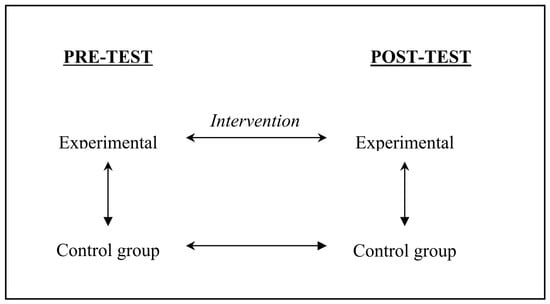
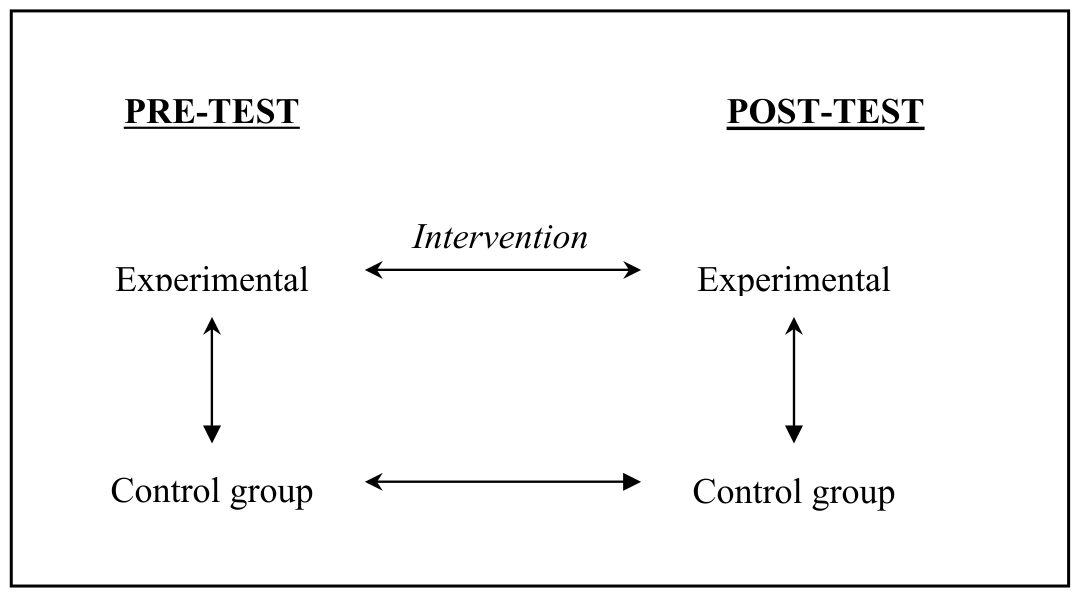
This study follows a quasi-experimental design based on a comparison between two groups: the experimental group will complete the tests and participate in a six-week intervention, while the control group will only take the tests and serve as a comparison for the experimental group’s results (see Figure 1).
Figure 1.
Structure of the Quasi-Experimental Design.
This study uses a quantitative data collection methodology. All students will complete the tests both before and after the intervention, providing quantitative data to measure the impact of the intervention on metalinguistic awareness and reading comprehension. The intervention will be implemented in one classroom taught by a single teacher responsible for the three curricular languages, while the control condition will consist of two other intact classrooms. As a result, the allocation of groups is confounded with classroom context and teacher effects.
2.3. Context and Participants of Study
The study was conducted in a semi-private school located in the Basque Autonomous Community (Spain), a sociolinguistic context in which Basque, a minority language, coexists with Spanish as the dominant societal language, along with additional languages introduced through migrant communities. The school belongs to an educational network that promotes a multilingual pedagogical model, in which Basque serves as the main language of instruction, while Spanish and English are taught as language subjects. During the six weeks of the intervention, each language subject (Basque, Spanish, and English) included three hours per week of instructional activities related to the intervention. This resulted in a total of 18 h of intervention per language and 54 h of intervention overall.
The educational project of this school network aims to promote the interconnected learning of Basque, Spanish, and English in order to foster students’ multilingual and communicative competences. The pedagogical approach focuses not only on the acquisition and use of these languages, but also on their effective application in diverse and authentic contexts, supporting students’ ability to interact and communicate successfully across a range of situations. In addition, the project encourages collaboration and pedagogical innovation by teaching strategies and instructional materials that promote interaction among languages and contribute to the development of students’ metalinguistic awareness.
The present research is designed to complement this school-based pedagogical project by integrating concrete instructional strategies aimed at developing students’ metalinguistic awareness, with a particular focus on morphological awareness. By linking the teaching of the three languages, this study seeks to support students’ communicative competence and to provide opportunities for learners to reflect on language use by engaging with underlying linguistic mechanisms.
The participants in this study were 6th-grade primary education students aged between 11 and 12, with a total sample of 70 students distributed across three classrooms: 6A with 23 students, 6B with 24 students, and 6D with 23 students. The pre-test and post-test was administered to all three classes in order to analyze the overall development of students’ metalinguistic awareness, although the intervention itself was implemented exclusively in classroom 6B, where specific activities designed to foster metalinguistic awareness was carried out to strengthen the students’ skills in Basque, Spanish, and English. The sample was therefore divided into an experimental group of 24 students from class 6B and a control group of 46 students from classes 6A and 6D. No specific selection criteria were applied beyond students’ enrolment in the participating classrooms, making this a convenience sample representative of the school’s 6th-grade population. Although 70 students initially participated in the study, 2 students were absent during post-test administration. Consequently, the final analyses were conducted with data from 68 students.
The participating teacher was the regular tutor of class 6B, which allowed the study to maintain and respect the students’ established classroom routines. This teacher was also responsible for teaching Basque, Spanish, and English to the group, ensuring continuity and familiarity in the learning environment. Furthermore, she actively participated in the delivery of the intervention, implementing the instructional activities designed for this study.
2.4. Pedagogical Intervention
The aim of the intervention is to provide students with strategies and resources that allow them to reflect on language in a more structured and conscious way, not only within language classes but also across all contexts where languages interact. Through this intervention, the goal is to foster a deeper understanding of linguistic mechanisms, promoting the development of strong metalinguistic skills that complement and enhance the learning of the three languages in an effective and meaningful way. The instructional activities mainly targeted derivational morphology, focusing on the identification and analysis of roots, prefixes, and suffixes that allow for the formation of new words. Basic inflectional forms were occasionally addressed when necessary to illustrate morphological structure across the three languages. The intervention also focused on reading comprehension development. Since morphology was a new topic for the students, the initial sessions were highly guided, with words written on the board and roots, prefixes, and suffixes identified collaboratively. From the second week onwards, students began working individually on morphology tasks, progressively increasing the level of difficulty. Some activities were based on their regular textbooks, while additional worksheets were completed individually, in pairs, or in small groups. To enhance engagement and consolidate learning, language games were also incorporated, making the process more meaningful.
Reading comprehension was also addressed using the school’s trilingual textbooks (Basque, Spanish, and English). As these materials do not include comprehension questions, the teacher proposed oral questions, encouraging different response formats: whole-class discussions, small-group reflections with a spokesperson, and individual thinking time. These strategies aimed to deepen reading comprehension and foster critical thinking.
The intervention was designed following the principles of the Universal Design for Learning (UDL) (Rose et al., 2005), aligning with the 78/2024 Decree (Basque Government, 2023) on inclusive education. Universal measures were implemented to ensure flexibility in methodology, promoting inclusion and providing equal learning opportunities for all students, regardless of their needs and abilities. The intervention also prioritized student motivation and active participation, incorporating collaborative learning, peer support, educational games, and challenge-based activities to foster autonomy and meaningful learning experiences.
2.5. Instruments and Data Collection
For data collection, three ad hoc quantitative instruments were designed.
In addition to sociodemographic data, the background questionnaire collected information on students’ level of exposure to Basque by examining their language use and habits in different contexts. These results offered insights into students’ linguistic practices and the factors influencing their use of Basque, serving as a reference point for subsequent analyses and informing the design of the intervention.
The pre-test and post-test were administered in Basque, Spanish, and English and included two main sections. The first section consisted of three reading comprehension tasks, one in each language. Students read a text and answered comprehension questions. Each language included 6 multiple-choice questions, resulting in a total of 18 questions across the three languages. Each correct answer was awarded one point, while incorrect or unanswered questions received zero points. In cases where students selected two answers, the question was also scored as zero, regardless of whether one of the options was correct.
The second section assessed morphological awareness through two types of tasks in each language: a word segmentation task, in which students identified prefixes, roots, and suffixes within words, and a word formation task, in which students produced the appropriate word form in context. First, in the word segmentation task, they were given a list of words and asked to segment them into prefixes, roots, and suffixes. Each word could be segmented once or twice, depending on its structure. In each language, students were asked to segment 10 words, with 2 words allowing two segmentations and 8 words allowing only one. For example, in English, students were asked to segment words such as happiness or prehistory into their morphological components (happi-ness; pre-history). Similar tasks were designed for Basque and Spanish. Incorrect segmentations or unanswered items were scored as zero. For words requiring a single segmentation, students received 2 points for a correct answer. For words allowing two segmentations, students received 1 point if they identified one part correctly and 3 points if both segmentations were correct. The maximum score for this task was 22 points per language, resulting in a total of 66 points across the three languages.
Next, students completed a sentence completion task, where they had to select the appropriate word form considering the context based on word formation. In each language, six sentences were provided with a gap to fill. A key word appeared in bold, and students had to modify it to fit the sentence. For example: “My neighbors from the 1st floor are the nicest from the ________”. Scoring followed a three-level system: 0 points for incorrect or blank answers, 1 point for the correct word form with a spelling error, and 2 points for a correct and accurately spelled response. The maximum score for this task was 12 points per language, leading to a total of 36 points.
The instruments were developed specifically for the purposes of this study in order to align the assessment tasks with the instructional content of the intervention and to ensure comparable measurement across the three languages involved (Basque, Spanish, and English). In designing the tasks, particular attention was given to the students’ grade level and linguistic proficiency to ensure that the lexical items were appropriate and commonly encountered in the school context. In addition, the selected items included clearly identifiable morphological structures, allowing students to focus on analyzing prefixes, roots, and suffixes rather than unfamiliar vocabulary.
As shown in Table 1, the reliability of the two sections of the instrument was assessed using Cronbach’s alpha and McDonald’s omega in both groups. These indices are widely used to evaluate internal consistency and provide complementary estimates of reliability. The results confirmed the reliability of the instrument as all values exceeded 0.70, as shown in the following table.
Table 1.
Internal consistency of the instrument: Cronbach’s alpha (α) and McDonald’s omega (ω).
The data collection procedure was conducted simultaneously in the three classrooms. Students were given one hour to complete the reading comprehension test and the morphology test. Both the pre-test and post-test were administered at the same time across the three groups to ensure consistency. The same researcher was present at the beginning of each session in all classrooms to provide uniform instructions, which were delivered in Basque to respect the school’s language of instruction. Additionally, each class’s homeroom teacher remained in the room to oversee classroom behavior and maintain an exam-like environment.
2.6. Procedure and Statistical Analyses
Before the data analysis, all responses were anonymized, coded, corrected, and scored, and the data were then entered into SPSS version 29.0 for statistical analysis. For the analyses, descriptive statistics (means and standard deviations) were first calculated for both reading comprehension and for morphological awareness to provide a general overview of the students’ performance before the intervention. Group-level statistics were also computed for each class (A, B, and D) and for each language, facilitating comparisons across groups and languages.
Independent sample t-tests were conducted to examine the effect of the intervention on reading comprehension and morphological awareness in the three languages. To complement the t-test results, Cohen’s d was computed as a measure of effect size.
Finally, Pearson correlation analyses were carried out to explore the relationship between exposure to Basque (a minority language) and students’ performance in reading comprehension and morphological awareness in Basque, identifying whether there was a significant association between language exposure and learning outcomes. Exposure to Basque was operationalized as a composite index based on students’ self-reported language use across different contexts, including interactions with parents, siblings, and the family at home, peer interactions inside and outside school, and the language of thought. Higher scores indicated greater exposure to Basque. Additional t-tests were performed to assess differences in Basque pre-test scores between students with high and low exposure to Basque and to explore the impact of language exposure on performance. Participants were divided into high- and low-exposure groups using a median split of the Basque exposure index.
3. Results
Although 70 students initially participated in the study (24 in the experimental group and 46 in the control group), 2 students were absent during post-test administration. Since improvement scores required both pre-test and post-test data, the final analyses were conducted with 68 students (experimental group n = 23; control group n = 45).
3.1. The Effects of a Metalinguistic Awareness-Based Pedagogical Intervention on Sixth-Grade Students’ Reading Comprehension and Morphological Awareness
To address the first research question, the previous performance of both the experimental and control groups was first assessed in the two measured variables, as evaluated by the testing instrument. This initial analysis provided insight into the students’ starting levels prior to the intervention. As shown in Table 2, before the intervention, no significant differences were found between the experimental and control groups in reading comprehension across the three languages (Basque p = 0.742; Spanish p = 0.833; and English p = 0.846). These results indicate that both groups started from a comparable baseline level in reading comprehension, with no statistically significant differences prior to the intervention.
Table 2.
Descriptive statistics of reading comprehension pre-test results for the experimental and control groups.
Similarly, no statistically significant differences were found between the experimental and control groups in morphological awareness across the three languages (Basque p = 0.522; Spanish p = 0.085; and English p = 0.873) before the intervention (see Table 3).
Table 3.
Descriptive statistics of morphological awareness pre-test results for the experimental and control groups.
To facilitate interpretation of the results, Table 4 presents the descriptive statistics for the pre-test and post-test outcomes in both the experimental and control groups across the three languages before calculating the improvement in each group. In addition, the pre-test means also indicate that students’ initial scores were well below the maximum possible values in both measures, suggesting that sufficient room for improvement was available and that ceiling effects were unlikely to influence the interpretation of the results.
Table 4.
Pre-test and post-test descriptive statistics by group.
To examine the effect of the intervention, improvement scores were calculated for each group, in each variable, and in each language. Table 5 shows the results of the independent-samples t-tests in reading comprehension across the three languages. The results show that the differences between the experimental group and the control group were not statistically significant. Although the differences did not reach statistical significance in any of the three languages, it is worth noting that the experimental group demonstrated greater improvements than the control group in Basque and Spanish, while in English, the control group showed slightly higher gains.
Table 5.
Group comparisons of reading comprehension improvement.
Table 6 shows the comparisons between the experimental and control groups in morphological awareness improvement across the three languages. The experimental group significantly outperformed the control group on all tasks across the three languages. All comparisons yielded statistically significant differences with large effect sizes (Cohen’s d ranging from 1.41 to 1.61), indicating that the intervention had a strong and consistent positive effect on morphological awareness in Basque, Spanish, and English.
Table 6.
Group comparisons of morphological awareness improvement.
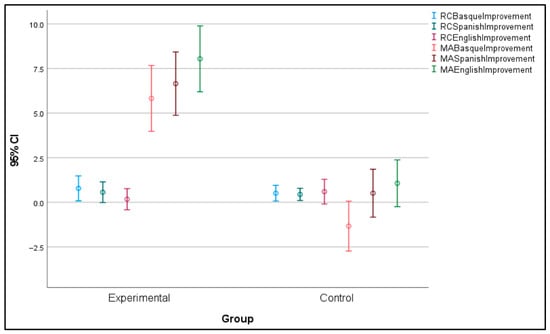
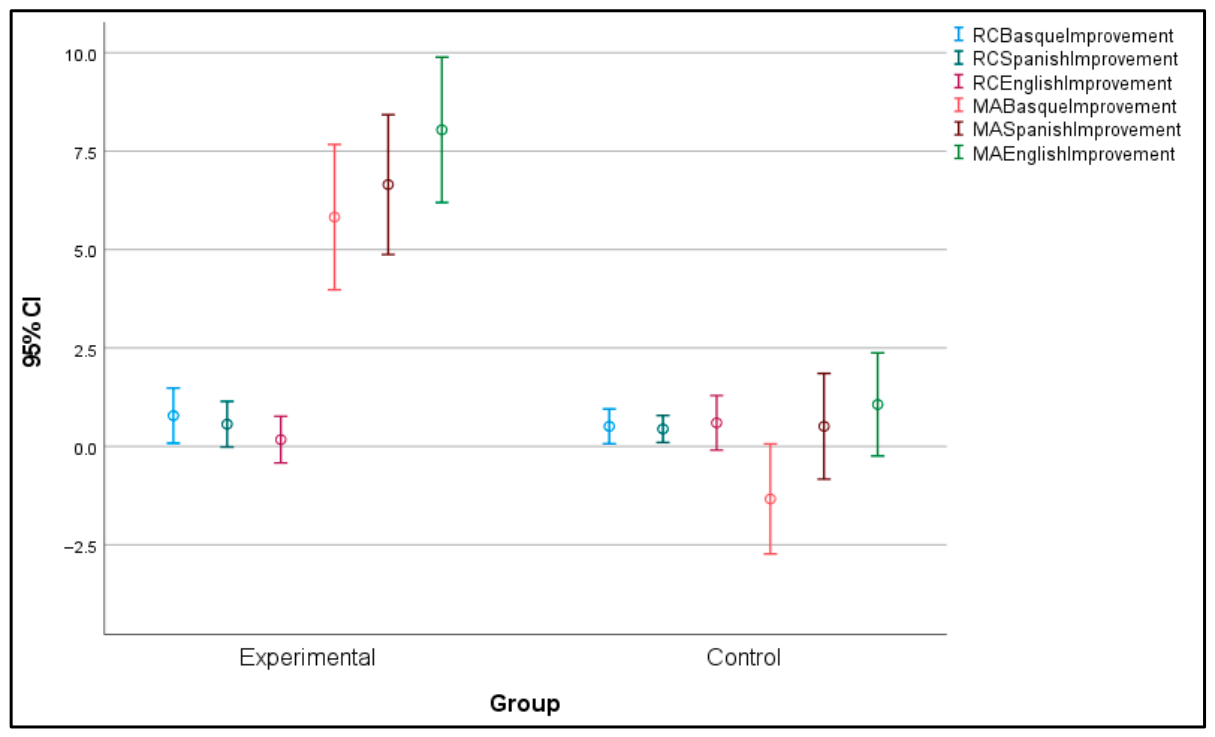
Figure 2 presents the mean improvement scores for reading comprehension (RC) and morphological awareness (MA) in Basque, Spanish, and English, comparing the experimental group and the control group. The graph includes 95% confidence intervals, allowing for visual interpretation of statistical significance. In the experimental group, there was a substantial improvement in morphological awareness across all three languages. The greatest gains were observed in Spanish and English morphological awareness, with means approaching 8 to 10 points and confidence intervals that do not overlap with 0, suggesting statistically significant improvements. Improvements in Basque morphological awareness were also notable, though slightly smaller. In contrast, reading comprehension improvements in the experimental group were modest, with mean changes around 1 to 2 points in the three languages. The confidence intervals for these measures were wide and include zero, indicating that the gains in reading comprehension were not statistically significant. The control group showed minimal or no improvement in both reading comprehension and morphological awareness. All confidence intervals for the control group were either close to or overlapping with zero, suggesting no statistically significant changes in the absence of the intervention.
Figure 2.
Improvements in reading comprehension and morphological awareness across groups and languages.
3.2. Influence of Basque Language Exposure on Intervention Outcomes in Morphological Awareness and Reading Comprehension
This section addresses the second research question by examining how students’ exposure to Basque, the minority language, influences the outcomes of the pedagogical intervention in terms of morphological awareness and reading comprehension. A Pearson correlation analysis was conducted to examine the relationship between Basque language exposure and Basque language skills. Specifically, the analysis focused on the two skills measured in the pre-test: reading comprehension and morphological awareness. The results of this analysis are presented in Table 7.
Table 7.
Correlation between Basque language exposure, reading comprehension, and morphological awareness.
The findings revealed a small-to-moderate significant positive correlation between Basque exposure and reading comprehension (r = 0.311, p = 0.010), as well as between Basque exposure and morphological awareness (r = 0.269, p = 0.027). These results suggest that students with greater exposure to Basque tend to perform better in both reading comprehension and morphological tasks. Furthermore, a strong positive correlation was found between reading comprehension and morphological awareness (r = 0.538, p < 0.001), indicating that students with higher reading comprehension scores also tended to have better morphological awareness in Basque. Overall, these findings highlight the interdependence between language exposure, reading comprehension, and morphological awareness in the Basque context.
Based on these correlations, an analysis was conducted to examine whether the differences in outcomes between students with high and low exposure to Basque were statistically significant. To classify the groups, the median of the exposure scores was used as a cut-off point, dividing the sample into two equal halves. The results obtained from the independent samples t-tests were consistent with the correlation findings. The detailed results are presented in Table 8.
Table 8.
Statistical differences according to exposure level in Basque language skills.
The results show that students with high exposure to Basque performed significantly better in both reading comprehension and morphological awareness. For reading comprehension, the difference was statistically significant (t = 2.655, p = 0.027), with a medium effect size (d = 0.651). For morphological awareness, the difference was also statistically significant (t = 2.265, p = 0.010), with a medium effect size (d = 0.555). These findings suggest that greater exposure to Basque is associated with higher performance in both reading comprehension and morphological awareness.
In addition, improvement scores were calculated according to the students’ level of exposure to Basque. Table 9 shows no statistically significant differences in improvement between the low- and high-exposure groups for reading comprehension or morphological awareness.
Table 9.
Group comparisons of language skills by students’ exposure to Basque.
These results indicate that both groups benefited equally from the intervention, regardless of their initial level of Basque language exposure. This is a positive outcome, as it suggests that the intervention was effective in promoting improvements in reading comprehension and morphological awareness even among students with lower levels of Basque exposure.
4. Discussion
This study investigated the effects of a pedagogical intervention grounded in morphological awareness on sixth-grade primary students’ reading comprehension and morphological awareness. A six-week explicit and systematic intervention was implemented through activities conducted in three languages, and empirical data were collected using a quasi-experimental design.
The results indicate a positive effect on students’ morphological awareness, with statistically significant improvements observed in the experimental group across all three languages in tasks related to morpheme segmentation and word formation. These findings are in line with previous research conducted in comparable multilingual educational contexts (Leonet et al., 2020; Leonet et al., 2025b). The substantial gains observed in the experimental group may be partly attributable to the relatively low baseline scores obtained in the pre-test. Overall, the results suggest the potential of the multilingual-focused intervention and the specific didactic strategies employed to support the development of students’ morphological awareness. At the same time, these findings should be interpreted within the constraints of the classroom-based quasi-experimental design, which involved a comparison between one intervention classroom and two control classrooms. Therefore, while the results suggest positive effects associated with the intervention, they should not be interpreted as definitive causal evidence. The reading comprehension results showed a different pattern. Although some improvement was observed, these gains were not statistically significant overall, and comparable trends were identified in the control group. This finding suggests that the development of reading comprehension is a more complex process. Although it is closely related to morphological awareness (S. Ke & Xiao, 2015; Carlisle, 2000), it may require a longer period and more comprehensive instructional approaches. This finding also suggests that the transfer from morphological awareness to reading comprehension may not occur automatically in the short-term. Explicit short-term activities appear to lead to clear and rapid gains in morphological awareness. However, their transfer to reading comprehension likely depends on the development of additional metalinguistic skills, such as the use of cohesion and coherence markers, inferential skills, and the interpretation of anaphoric references. It should also be noted that vocabulary knowledge was not assessed as a separate construct in this study. Although the lexical items included in the tasks were selected to be familiar to students, vocabulary knowledge may still have influenced the students’ performance in both the morphological awareness and reading comprehension tasks. In addition, methodological factors specific to the present study may also have contributed to the absence of statistically significant gains in reading comprehension. In particular, the reading comprehension measure consisted of a relatively small number of items, which may have limited the sensitivity of the assessment.
The second research question examined the extent to which students’ exposure to Basque, as a minority language, was associated with their performance in morphological awareness and reading comprehension, as well as with their response to the pedagogical intervention. Overall, the findings point to a relationship between language exposure and baseline language skills while also suggesting that the intervention benefited students similarly regardless of their initial level of exposure.
The correlation analyses revealed that greater exposure to Basque was moderately and positively associated with both reading comprehension and morphological awareness in Basque. These results are consistent with previous research highlighting the role of language exposure in the development of literacy-related skills in minority-language contexts (Leonet et al., 2025a), and they reinforce the interdependence between input quantity, morphological knowledge, and reading comprehension. In particular, the strong association observed between reading comprehension and morphological awareness aligns with theoretical accounts that conceptualize morphological awareness as a key metalinguistic resource supporting reading development (Deacon et al., 2007; Tong & McBride-Chang, 2010; Verhoeven & Perfetti, 2017; Wang et al., 2009). The group comparisons further confirmed these patterns, showing that students with higher exposure to Basque outperformed their peers with lower exposure in both reading comprehension and morphological awareness at the outset. The medium effect sizes observed for both outcomes suggest that language exposure constitutes a meaningful factor in students’ linguistic development in Basque. These findings underscore the importance of considering students’ linguistic backgrounds when interpreting achievement differences in multilingual educational settings, especially in contexts where the minority language is not equally present in students’ everyday environments.
However, when improvement scores were examined, no statistically significant differences emerged between students with high and low levels of Basque exposure. This finding suggests that although students with greater exposure started from a higher baseline, both groups benefited from the intervention to a comparable extent. In other words, even though not all students have the same opportunities to use the minority language of the region (Basque), which is the language of instruction of the school, after a specific intervention focused on developing morphological awareness, students were able to achieve similar levels of improvement regardless of their exposure to Basque outside school. This suggests that targeted pedagogical actions can help reduce linguistic inequality and foster equitable learning outcomes, contributing to a more inclusive educational model. From a pedagogical perspective, this result is particularly relevant, as it indicates that explicit and systematic instruction in morphological awareness can support learning gains regardless of students’ initial exposure to the minority language. A substantial proportion of students in the Basque educational system are currently educated through the minority language, which is often their second, third, or even fourth language. In this context, the potential of a language-integrated curriculum that explicitly and systematically enhances students’ metalinguistic awareness represents a particularly positive outcome. These findings may also have implications for other multilingual contexts involving minority-language learners.
5. Conclusions
Academic literacy constitutes a foundational dimension of equitable and inclusive education, particularly in linguistically diverse classrooms, as it provides all students with access to the linguistic resources necessary to participate meaningfully in school-based learning. While metalinguistic awareness is often discussed within the strictly linguistic dimension of academic literacy, the findings of this study reinforce its role as a key component of reading comprehension. From this perspective, metalinguistic awareness can be understood as a social and ethical resource that supports students’ academic success and fosters more equitable participation in educational and social contexts.
The results related to morphological awareness were particularly positive, likely reflecting the explicit and structured focus of the intervention on this specific component. However, in order to achieve a stronger impact on reading comprehension, future instructional approaches may need to integrate additional components of metalinguistic awareness. These findings point to the need for curricula that explicitly and systematically integrate metalinguistic instruction across languages, as well as for initial and in-service teacher education programs that prepare educators to address linguistic diversity through pedagogically informed, language-aware practices.
Taken together, these findings suggest that, while language exposure plays an important role in shaping students’ initial levels of reading comprehension and morphological awareness, well-designed instructional interventions may help reduce exposure-related gaps by providing learning opportunities that are accessible to all learners. The results support the potential of targeted pedagogical approaches to promote more equitable learning outcomes in minority-language contexts. However, a limitation of this study concerns the absence of detailed control variables, such as students’ socio-economic background, prior academic achievement, or potential differences in teaching practices in the control classrooms. Although all participating classes belonged to the same school and followed the same institutional curriculum, these factors were not systematically measured and may have influenced the results. At the same time, future research involving longer interventions and larger samples is needed to further examine the potential of cross-curricular pedagogical projects that integrate a communicative focus with the development of metalinguistic awareness. Moreover, future research could benefit from incorporating standardized measures, such as nationally validated reading assessments, in order to enhance the external comparability of the findings.
Author Contributions
Conceptualization, O.L. (Olatz Lucas) and O.L. (Oihana Leonet); methodology, O.L. (Olatz Lucas); validation, O.L. (Olatz Lucas); formal analysis, O.L. (Olatz Lucas); O.L. (Olatz Lucas) and A.L.; resources, A.L.; data curation, O.L. (Olatz Lucas); writing—original draft preparation, O.L. (Olatz Lucas) and A.L.; writing—review and editing, O.L. (Olatz Lucas) and O.L. (Oihana Leonet); visualization, O.L. (Oihana Leonet); supervision, O.L. (Oihana Leonet); project administration, O.L. (Oihana Leonet); funding acquisition, O.L. (Oihana Leonet). All authors have read and agreed to the published version of the manuscript.
Funding
Grant PID2024-159125OA-I00 funded by MICIU/AEI/10.13039/501100011033 and, by “ERDF A way of making Europe”. Grants IT1666-22 and HEZKUNTZA25/13 funded by Basque Government.
Institutional Review Board Statement
The study adhered to the principles of the Declaration of Helsinki (revised 2013) and received approval from the Ethics Committee of the University of the Basque Country EHU (NO.M10_2024_159, date 17 February 2014).
Informed Consent Statement
Informed consent was obtained from all subjects involved in the study.
Data Availability Statement
Data is available from the authors on request.
Conflicts of Interest
The authors declare no conflicts of interest.
References
- Basque Government. (2023, June 9). Decree 77/2023, of May 30, on the establishment of the basic education curriculum and its implementation in the autonomous community of the basque country. Official Gazette of the Basque Country. Available online: https://www.euskadi.eus/web01-bopv/eu/bopv2/datos/2023/06/2302729e.pdf (accessed on 4 March 2025).
- Bialystok, E., Peets, K. F., & Moreno, S. (2014). Producing bilinguals through immersion education: Development of metalinguistic awareness. Applied Psycholinguistics, 35(1), 177–191. [Google Scholar] [CrossRef] [Scilit]
- Carlisle, J. F. (2000). Awareness of the structure and meaning of morphologically complex words: Impact on reading. Reading and Writing, 12(3), 169–190. [Google Scholar] [CrossRef] [Scilit]
- Cenoz, J. (2013). The influence of bilingualism on third language acquisition: Focus on multilingualism. Language Teaching, 46(1), 71–86. [Google Scholar] [CrossRef] [Scilit]
- Cenoz, J., & Gorter, D. (2021). Pedagogical translanguaging. Cambridge University Press. [Google Scholar] [CrossRef] [Scilit]
- Cheng, X., & Zhang, H. (2023). Contributions of metalinguistic awareness and lexical inference to reading comprehension in upper-elementary Chinese students. Journal of Research in Reading, 46(1), 86–103. [Google Scholar] [CrossRef] [Scilit]
- Chung, S. C., Chen, X., & Geva, E. (2019). Deconstructing and reconstructing cross-language transfer in bilingual reading development: An interactive framework. Journal of Neurolinguistics, 50, 149–161. [Google Scholar] [CrossRef] [Scilit]
- Council of Europe. (2001). Common European framework of reference for languages: Learning, teaching, assessment. Cambridge University Press. [Google Scholar]
- Council of Europe. (2020). Common European framework of reference for languages: Learning, teaching, assessment: Companion volume. Council of Europe Publishing. [Google Scholar]
- Deacon, S. H., Wade-Woolley, L., & Kirby, J. (2007). Crossover: The role of morphological awareness in French immersion children’s reading. Developmental Psychology, 43(3), 732. [Google Scholar] [CrossRef] [Scilit]
- Gaspar, A. (2025). Developing metalinguistic awareness through pedagogical translanguaging: An introspective study in the Basque Country. International Journal of Multilingualism, 1–23. [Google Scholar] [CrossRef] [Scilit]
- Goodwin, A. P., & Ahn, S. (2010). A meta-analysis of morphological interventions: Effects on literacy achievement of children with literacy difficulties. Annals of Dyslexia, 60(2), 183–208. [Google Scholar] [CrossRef] [Scilit] [PubMed]
- Government of Spain. (2020). Ley Orgánica 3/2020, de 29 de diciembre, por la que se modifica la ley orgánica 2/2006, de educación (LOMLOE). Boletín Oficial del Estado, 340, 122868–122953. Available online: https://www.boe.es/eli/es/lo/2020/12/29/3 (accessed on 6 April 2026).
- Hofer, B., & Jessner, U. (2019). Multilingualism at the primary level in South Tyrol: How does multilingual education affect young learners’ metalinguistic awareness and proficiency in L1, L2 and L3? The Language Learning Journal, 47(1), 76–87. [Google Scholar] [CrossRef] [Scilit]
- Kasprowicz, R., Roehr-Brackin, K., & Macrory, G. (2022). Metalinguistic awareness in early foreign language learning. In K. McManus, & M. S. Schmid (Eds.), How special are early birds? Foreign language teaching and learning (pp. 93–117). Language science press. [Google Scholar]
- Ke, S., Miller, R. T., Zhang, D., & Koda, K. (2021). Crosslinguistic sharing of morphological awareness in biliteracy development: A systematic review and meta-analysis of correlation coefficients. Language Learning, 71(1), 8–54. [Google Scholar] [CrossRef] [Scilit]
- Ke, S., & Xiao, F. (2015). Cross-linguistic transfer of morphological awareness between Chinese and English. Language Awareness, 24(4), 355–380. [Google Scholar] [CrossRef] [Scilit]
- Ke, S. E., Zhang, D., & Koda, K. (2023). Metalinguistic awareness in second language reading development. Cambridge University Press. [Google Scholar]
- Kieffer, M. J., & Lesaux, N. K. (2012). Direct and indirect roles of morphological awareness in the English reading comprehension of native English, Spanish, Filipino, and Vietnamese speakers. Language Learning, 62, 1170–1204. [Google Scholar] [CrossRef] [Scilit]
- Kim, Y. S. G. (2020). Toward integrative reading science: The direct and indirect effects model of reading. Journal of Learning Disabilities, 53(6), 469–491. [Google Scholar] [CrossRef] [Scilit]
- Koda, K. (2005). Insights into second language reading: A cross-linguistic approach. Cambridge University Press. [Google Scholar] [CrossRef] [Scilit]
- Koda, K. (2007). Reading and language learning: Crosslinguistic constraints on second language reading development. Language Learning, 57(s1), 1–44. [Google Scholar] [CrossRef] [Scilit]
- Koda, K. (2008). Impacts of prior literacy experience on second-language learning to read. In K. Koda, & A. M. Zehler (Eds.), Learning to read across languages: Cross-linguistic relationships in first- and second-language literacy development (pp. 68–96). Routledge. [Google Scholar] [CrossRef] [Scilit]
- Leonet, O., Cenoz, J., & Gorter, D. (2020). Developing morphological awareness across languages: Translanguaging pedagogies in third language acquisition. Language Awareness, 29(1), 41–59. [Google Scholar] [CrossRef] [Scilit]
- Leonet, O., Lucas, O., & Lamarka, A. (2025a). Bigarren Hezkuntzan eskola-hizkuntza garatzeko diziplinarteko diseinu bat: Kasu-azterketa bat. Fontes Linguae Vasconum: Studia et Documenta, 57(140), 405–432. [Google Scholar] [CrossRef] [Scilit]
- Leonet, O., Santos, A., & Saragueta, E. (2025b). La competencia comunicativa y su autopercepción como claves para el desarrollo académico en contextos multilingües [Communicative competence and its self-perception as a key to academic development in multilingual contexts]. Revista de Educación, 1(407), 217–242. [Google Scholar] [CrossRef]
- Leonet, O., & Saragueta, E. (2023). The case of a pedagogical translanguaging intervention in a trilingual primary school: The students’ voice. International Journal of Multilingualism, 21, 2112–2130. [Google Scholar] [CrossRef] [Scilit]
- Martín Rojo, L., & Pujolar Cos, J. (2020). Claves para entender el multilingüismo contemporáneo (Vol. 12). Prensas de la Universidad de Zaragoza. [Google Scholar]
- OECD. (2023). PISA 2022 results (Volume I): The state of learning and equity in education. OECD Publishing. [Google Scholar] [CrossRef] [Scilit]
- Oliveira, M., Levesque, K. C., Deacon, S. H., & da Mota, M. M. P. E. (2020). Evaluating models of how morphological awareness connects to reading comprehension: A study in Portuguese. Journal of Research in Reading, 43(2), 161–179. [Google Scholar] [CrossRef] [Scilit]
- Rose, D. H., Meyer, A., & Hitchcock, C. (2005). The universally designed classroom: Accessible curriculum and digital technologies. Association for Supervision and Curriculum Development. Available online: https://eric.ed.gov/?id=ED491521 (accessed on 4 March 2025).
- Surmont, J., Struys, E., Van Den Noort, M., & Van De Craen, P. (2016). The effects of CLIL on mathematical content learning: A longitudinal study. Studies in Second Language Learning and Teaching, 6(2), 319–337. [Google Scholar] [CrossRef] [Scilit]
- Tong, X., & McBride-Chang, C. (2010). Chinese-English biscriptal reading: Cognitive component skills across orthographies. Reading and Writing, 23(3–4), 293–310. [Google Scholar] [CrossRef] [Scilit]
- Uccelli, P. (2023). The language demands of analytical reading and writing at school. Written Communication, 40(2), 518–554. [Google Scholar] [CrossRef] [Scilit]
- Varga, S. (2021). The relationship between reading skills and metalinguistic awareness. Gradus, 8(1), 52–57. [Google Scholar] [CrossRef] [Scilit]
- Verhoeven, L., & Perfetti, C. (Eds.). (2017). Learning to read across languages and writing systems. Cambridge University Press. [Google Scholar] [CrossRef] [Scilit]
- Wang, M., Ko, I. Y., & Choi, J. (2009). The importance of morphological awareness in Korean–English biliteracy acquisition. Contemporary Educational Psychology, 34, 132–142. [Google Scholar] [CrossRef] [Scilit]
- Zhang, D. (2016). Morphology in Malay–English biliteracy acquisition: An intervention study. International Journal of Bilingual Education and Bilingualism, 19(5), 546–562. [Google Scholar] [CrossRef] [Scilit]

Disclaimer/Publisher’s Note: The statements, opinions and data contained in all publications are solely those of the individual author(s) and contributor(s) and not of MDPI and/or the editor(s). MDPI and/or the editor(s) disclaim responsibility for any injury to people or property resulting from any ideas, methods, instructions or products referred to in the content. |
© 2026 by the authors. Licensee MDPI, Basel, Switzerland. This article is an open access article distributed under the terms and conditions of the Creative Commons Attribution (CC BY) license.