1. Introduction
Adult education traditionally focuses on elementary and secondary levels with specific training techniques and resources. However, when attention shifts to the university context, it is often directed mainly toward those pursuing undergraduate or postgraduate studies. As a result, discussions of university education often overlook those who, not having the qualifications to access university degrees or wanting to avoid having to undertake formal education again, are nonetheless interested in learning at later stages of life.
Within non-formal university education, several alternatives are available. These include university extension courses, micro-credentials, course auditing, and senior classroom programs. In some higher education systems, particularly in countries such as the United States, course auditing provides older adults with an additional pathway to participate in university-level learning without formally enrolling in a degree program or completing assessed coursework. By contrast, this option is generally not available within the Spanish university system. While university extension courses and micro-credentials are usually intended for specialization or updating of knowledge and skills without age restrictions, senior classroom programs are specifically aimed at adults over 50 who wish to engage in university-level learning, drawing on their considerable life experience and without the need to pursue an official degree or meet formal admission requirements. These programs can be considered within what in most countries is called a University of the Third Age.
In the case of Spain, there are usually no entities exclusively dedicated to university teaching for senior learners, but rather each university within the state education system has its own program to serve this population sector. Regarding this type of university teaching,
Palmero-Cámara and Jiménez-Eguizábal (
2008) analyzed the existing regulations in Spain, as well as the institutions that carried out this type of activity in the first decade of the 21st century, placing special emphasis on the rapid and progressive aging observed in Spanish society and the increasingly urgent need for appropriate programs for active aging. Moreover, the methodology in university education for senior learners must adapt to different standards than those applied in official degree studies, in addition to ensuring attractive and motivating topics for people who are not looking for formal training, but rather to satisfy their curiosity to learn and engage in learning activities with peers of a similar age. In this respect, studies such as
Formosa (
2022),
Hachem (
2023) and
Martínez-Serrano (
2025) provide useful insights into the implementation of university programs for senior learners.
The education of senior learners has been widely addressed across the European Union. For example,
Krupková et al. (
2022) showed that university programs for senior learners can play an important role in reducing social exclusion in this age group. Because these programs are generally open to participants regardless of prior educational background and are designed with this audience in mind, people can maintain ongoing contact with other peers of a similar age and can integrate into an active group with shared interests.
Zhang et al. (
2022) stated that the demographic trend in the population makes it necessary to promote the participation of senior learners in higher education, especially since
Nascimento and Giannouli (
2019) predicted that this population sector will double, going from 11% in 2000 to 22% circa 2050 (almost a quarter of the global population). Moreover, we must take into consideration that the number of students who have not had formal (or, at best, informal) training before entering these types of programs is significantly high; see
Ellis (
2013) or
Marcinkiewicz-Wilk (
2020).
It is important to note that, for this type of student, topics related to Humanities and Social Sciences (including Laws) are more easily understood. This is primarily because these are issues that are easier to connect with most students’ lived experiences and with the real world, as they perceive it around them (for example, in TV news broadcasts). Obviously, this is not an impediment to discussing topics related to the STEAM field in these training programs, but it will be necessary to do so in a way that avoids technical formalities and focuses on a more accessible language (
Martín-Caraballo & Tenorio-Villalón, 2017;
Padgaonkar & Schafer, 2021;
Sobral & Sobral, 2021;
Teles et al., 2024).
In this context, mathematics represents a particularly interesting field of knowledge for senior learners in university programs addressed to them. While often perceived as abstract or technically demanding, this discipline also provides opportunities for intellectual curiosity, reflective thinking, and meaningful dialog, as long as we approach mathematical topics from a contextualized and experiential perspective based on students’ surrounding reality. Despite this potential, relatively few studies have examined how mathematics can be taught in university programs for senior learners from an andragogical standpoint; on the contrary, most existing studies focus on older undergraduate students, but not those enrolled in university programs for senior learners.
Recent literature has reflected increasing interest in later-life university education, particularly in relation to active aging, social inclusion, learner motivation, and the role of higher education institutions in promoting meaningful learning opportunities for older adults (
Krupková et al., 2022;
Zhang et al., 2022;
Formosa, 2022;
Hachem, 2023;
Gonçalves-Gaia et al., 2024;
Martínez-Serrano, 2025). However, within this growing field, relatively little attention has been paid to the place of mathematics in university programs specifically designed for senior learners. In this sense, this paper contributes to the ongoing discussion by examining the role of mathematics within the Senior Classroom Program at Pablo de Olavide University in Spain. Drawing on longitudinal teaching records and qualitative reflections derived from classroom practice, the study investigates both the sustained presence of mathematics within the program and the pedagogical features that characterize its implementation for senior learners. Particular attention is paid to the extent to which these features can be interpreted in light of andragogical principles such as autonomy, relevance, life experience, and intrinsic motivation.
Accordingly, the study is guided by the following three research questions:
RQ1: How has mathematical content been incorporated and sustained over time within the Senior Classroom Program at Pablo de Olavide University?
RQ2: What pedagogical features of these mathematics modules align with key andragogical principles for senior learners?
RQ3: What do the longitudinal and teaching-practice data suggest about the conditions that make mathematics meaningful and accessible in later-life university education?
The remainder of the paper is structured as follows: First, we present the institutional and educational context of the Senior Classroom Program in Spain and at Pablo de Olavide University. Next, we describe the materials and methods used in the study, followed by the presentation of the main results and their discussion in relation to previous literature and the andragogical framework.
2. Universities of the Third Age in Spain
The concept of a “University for the Third Age” emerged in the second half of the 20th century when, throughout the world, the need arose to make university education accessible to older people. Obviously, the aim was not to offer formal degree programs, but rather to develop alternative proposals with a more informal approach that did not require prior training for prospective students.
Both globally and in Europe, Pierre Vellas is considered the founding father of Universities of the Third Age, establishing the first one in 1973 (
Formosa, 2014;
Marina, 2025). Their idea was to use the logistical and personnel resources that universities had to formulate specific educational programs for older people so that they could feel fully integrated into society and continue to be useful to it, as well as continue to develop as individuals without having to face a formal training program. In this sense,
Vellas (
1974) himself published this approach as an annex in his essay in which he critically reflected on the implications of the aging of the population in the society of his time, inviting awareness of the challenges and opportunities associated with third age and coining the concept of “University of the Third Age” to formulate a practical example and central axis of his social and educational proposal aimed at that sector of the population. In later works, as
Vellas (
1977,
1990) or
Lemieux and Vellas (
1986), the author developed his argument that universities should open themselves up to older adults, integrating them into their structure, but also formulating specific programs that allow them to feel mentally and socially active. To this end, he argued for the need to consider a level of content and methodological resources that would focus on both their own life experiences and their learning interests, framing it as a form of personal and intellectual development rather than simply the acquisition of knowledge specific to a particular discipline.
Next, we describe the system of university programs for senior learners in Spain and emphasize the main characteristics that, according to the literature, programs of this type are generally expected to meet, as well as the content taught. In any case, and before proceeding, you can consult, in more detail, the evolution of the programs belonging to the universities for senior learners in
Formosa (
2014) or
Casanova et al. (
2024), among others.
Regarding the motivations that lead adults to return to classrooms in general and to university in particular, these were formulated in three categories by
Lakin et al. (
2008), and are still valid today:
Learning to learn: People maintain a need for continued personal growth, and updating or acquiring new knowledge can be a valuable resource for this. Furthermore, it is a way to stay active and age healthily, even contributing to a sense of rejuvenation. On this matter, see
Gonçalves-Gaia et al. (
2024) or
Rosser and Soler (
2026).
Learning to connect: Education also fosters socialization among peers and, therefore, allows for the establishment of bonds between people with similar interests (in this case, educational or knowledge-seeking). Generally, this tends to be more enriching when interaction between different generations is facilitated, but in any case, training programs are a resource for preventing the isolation of citizens, especially at certain stages of life. See, for example,
Formosa (
2022),
Rosser and Soler (
2026) or
Talmage et al. (
2019).
Learning to work: Professional development and updating are also motivating factors for people of a certain age to return to university studies, since either this updating or this additional training (different from what they have previously studied) can be interesting to improve their job prospects and progress in their job positions.
In the case of senior learners, the first two factors are usually present in their motivations for attending programs at Universities of the Third Age, while the last one, due to the very nature of these programs and the target audience, is not relevant since these programs do not constitute formal training.
Since the beginning of this type of educational program, four key elements have been considered for its formulation (
Vellas, 1997), which remain valid today:
Improving the quality of life for senior learners;
Structuring permanent educational programs, facilitating relational interaction with younger students;
Coordinating gerontological research programs;
Performing permanent education programs focused on gerontology.
From the perspective of teachers in training modules addressed to senior learners, it is important to focus on the first two previous aspects. In that sense, as
Villar and Celdrán (
2012) indicate, in Spain there are no access requirements to enroll in these programs beyond an interest in learning and being of the minimum permitted age to be considered a senior, which is usually 50 or 55 years old, depending on the educational institution. The absence of such prerequisites necessarily entails a non-academic approach to training, which must therefore be focused on, hierarchically in this order: facilitating the socialization of students in such a way that they stay active and enjoy all the activities included in the training program.
Furthermore, as some authors have asserted (
Villar & Celdrán, 2012;
Martín-Caraballo & Tenorio-Villalón, 2017), it is essential that all learning activities be focused on finding the social utility of the content covered for these students and contextualizing it within the vast amount of life knowledge they have accumulated over the years. Related to this, the need for methodological changes in teaching is evident, as these senior students are significantly more motivated than undergraduate students and, therefore, much more active in the classroom (
Villar et al., 2010). This means that teachers must design their lectures to promote participation and be more flexible and adaptable to the questions and concerns raised by students in these senior programs. The important thing is not the curriculum itself, but that the students gain vital benefits from the topics covered by contextualizing them with their own experiences.
3. Materials and Methods
3.1. Research Design
This study adopts an exploratory case study design focused on the role of mathematics within the Senior Classroom Program at Pablo de Olavide University (Spain). The case-study approach is appropriate because it allows for an in-depth examination of a specific educational context in which university learning for senior learners, non-formal education, and mathematics teaching intersect. Rather than seeking statistical generalization, the study aims to provide a contextualized and analytically grounded understanding of how mathematics has been incorporated into this program over time and how its pedagogical design can be interpreted in light of andragogical principles.
The study combines two complementary sources of evidence. First, it draws on longitudinal program data documenting the presence, continuity, and thematic diversity of mathematics-related modules across academic years and municipalities. Second, it incorporates qualitative reflections derived from teaching practice within the program, with particular attention to the ways in which sessions were designed and implemented for senior learners. This combination of descriptive longitudinal evidence and practice-based qualitative interpretation makes it possible to address both the temporal development of mathematics within the program and the pedagogical features that characterize its delivery.
The study is guided by the three research questions outlined in
Section 1.
3.2. Context of the Study
The study is situated within the Senior Classroom Program at Pablo de Olavide University, a non-formal university education initiative aimed at people aged 50 and over. As in other university programs for senior learners in Spain, this initiative is not oriented toward formal accreditation or degree completion, but toward providing opportunities for intellectual development, cultural participation, and lifelong learning in later life. The program operates in collaboration with local municipalities and offers a wide range of cultural, scientific, and humanistic subjects designed to promote lifelong learning and active participation in academic environments (
Pablo de Olavide University, 2025), thereby broadening access while strengthening the program’s social and territorial dimension.
In the academic year 2025–2026, Pablo de Olavide University is delivering the program for senior learners in 23 municipalities, with financial support from regional and local government bodies as well as the collaboration of private entities. Each municipality helps shape the training program by combining activities delivered by university teaching staff with others led by local personnel, according to local learners’ interests.
Within this framework, mathematics has been included as part of the broader educational offer in several municipalities over multiple academic years through thematic modules designed to present mathematical notions and ideas in accessible and meaningful ways. The lectures included in these modules do not follow a traditional formal curriculum; instead, they are designed around contextualized topics such as astronomy, games, historical facts, philosophy, or everyday quantitative reasoning.
3.3. Data Sources
The analysis is based on two types of data sources.
The first consists of longitudinal program records corresponding to the mathematics-related teaching activity developed within the Senior Classroom Program. These records include information on academic years, municipalities in which the modules were taught, module titles, thematic orientation, and the number of sessions associated with each teaching proposal. These data were used to identify the continuity, recurrence, and diversity of mathematics-related content within the program over time.
The second source consists of qualitative teaching-practice material derived from the authors’ experience in the design and implementation of mathematics sessions within the program. This includes course planning criteria, recurrent thematic lines, observations derived from classroom practice, and reflective notes on the pedagogical decisions involved in adapting mathematical content to senior learners. These materials were not treated as personal testimony in an anecdotal sense, but as practice-based evidence capable of illuminating the pedagogical logic underlying the modules analyzed.
Together, these two sources allow the study to address both structural and pedagogical dimensions of the phenomenon under consideration: on the one hand, the longitudinal presence of mathematics within the program; on the other, the educational features that appear to support its accessibility and relevance for senior learners.
3.4. Selection and Delimitation of Mathematics-Related Modules
For the purposes of this study, mathematics-related modules were defined as teaching units explicitly centered on mathematical ideas, mathematical culture, quantitative reasoning, or the application of mathematics to everyday, scientific, historical, or social contexts. This broad definition was adopted to reflect the actual nature of mathematics teaching in senior education settings, where formal disciplinary boundaries are often softened in favor of accessibility, contextualization, and interdisciplinarity.
Modules were included when their titles, descriptions, or documented contents showed a clear mathematical orientation, even when these were presented through topics such as astronomy, everyday decision-making, games, historical developments, patterns in nature, or social interpretation of quantitative information. This criterion made it possible to capture not only conventionally mathematical courses but also those in which mathematics was used as a framework for interpretation, curiosity, or cultural understanding.
3.5. Analytical Approach
The analysis was carried out in two complementary phases aligned with the three research questions.
In the first phase, a descriptive longitudinal analysis was conducted on the program records. The purpose of this stage was to identify how mathematics-related content had been incorporated and sustained over time within the Senior Classroom Program. Specifically, the analysis considered the temporal continuity of the modules, their distribution across academic years and municipalities, and the thematic diversity of the mathematics-related teaching offer. This phase primarily addresses RQ1 while also providing the empirical basis for interpreting the broader educational significance of the program.
In the second phase, a qualitative interpretive analysis was undertaken on the teaching-practice material. This analysis focused on identifying recurrent pedagogical features in the design and implementation of the mathematics modules. The interpretation was guided by four andragogical principles that are recurrent in the literature on adult and later-life education: autonomy, relevance, life experience, and intrinsic motivation. These principles were used as analytical lenses rather than as rigid categories imposed in advance. The aim was to examine whether, and in what ways, the pedagogical characteristics of the modules could be understood as consistent with these principles.
More specifically, the analysis considered aspects such as the use of real-life contexts, cultural or historical entry points, non-technical language, opportunities for dialog and participation, flexibility in content delivery, and the extent to which prior life experience could function as a resource for understanding mathematical ideas. This interpretive phase mainly addresses RQ2 and contributes to RQ3, since it allows us to reflect on the broader conditions under which mathematics may become meaningful and accessible in university education for senior learners.
The analytical strategy is therefore descriptive and interpretive rather than causal. The study does not seek to measure learning outcomes experimentally, but to examine patterns of continuity and pedagogical design that can shed light on the educational role of mathematics in this specific non-formal university setting.
3.6. Trustworthiness and Scope of Interpretation
Given the qualitative and case-based nature of this study, we have taken particular care to ensure coherence between the data sources, the research questions, and the claims made in the analysis. The longitudinal records provide an empirical basis for documenting the sustained presence and diversity of mathematics-related teaching within the program, while the practice-based reflections allow for a situated interpretation of how this teaching was shaped pedagogically.
The study does not claim that the observed features are universally applicable to all senior education programs. Rather, it offers an analytically grounded account of one institutional case that may be informative for similar contexts of learning in later life. In this sense, the value of the study lies in its capacity to make explicit a pedagogical experience that is rarely documented in the literature on adult mathematics education and to connect that experience with broader andragogical concerns.
4. Results
This section presents the main findings derived from the longitudinal records of mathematics-related modules delivered within the Senior Classroom Program at Pablo de Olavide University, together with the interpretive analysis of teaching practice. The results are organized according to the three research questions introduced in
Section 1. First, we examine how mathematical content has been incorporated and sustained over time within the program. Second, we analyze the pedagogical features that characterize these modules and their alignment with key andragogical principles. Third, we consider what the combined evidence suggests about the conditions under which mathematics may become meaningful and accessible in senior university education.
4.1. RQ1: Incorporation and Sustained Presence of Mathematics over Time
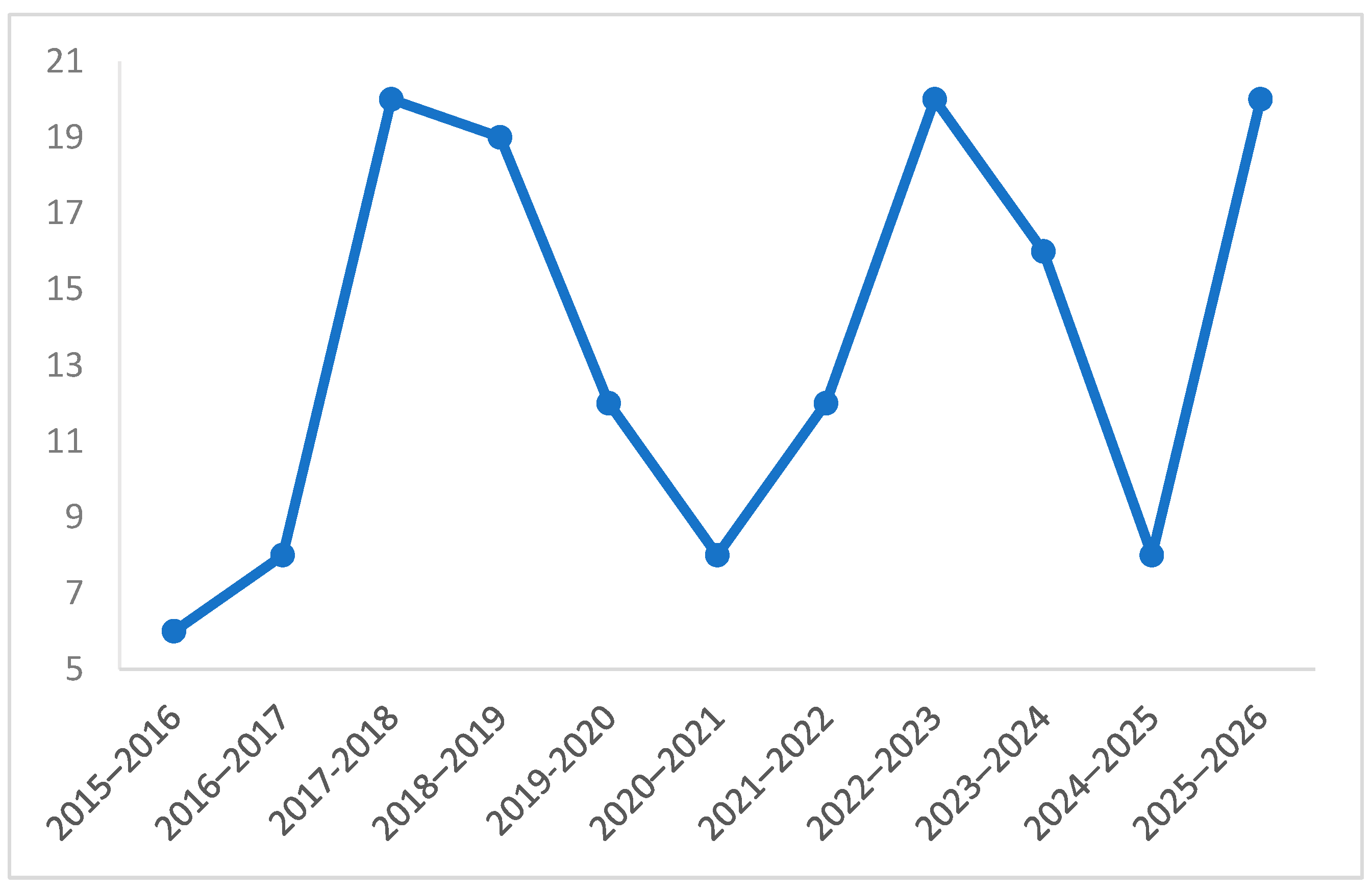
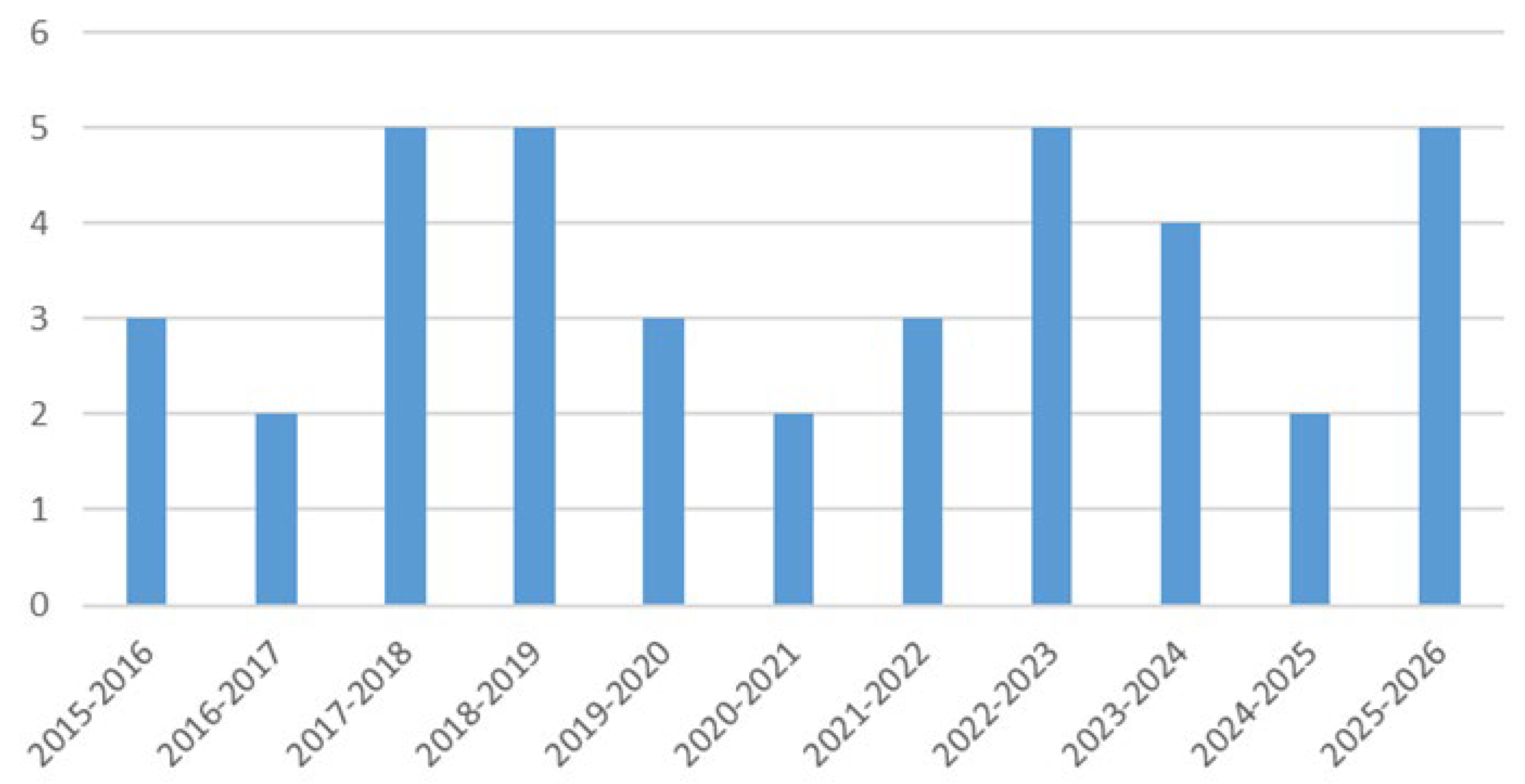
The longitudinal dataset shows that mathematics-related content has maintained a continuous presence within the Senior Classroom Program across multiple academic years. Although the number of sessions varies from year to year according to institutional planning, municipal demand, and local logistical conditions, mathematics does not appear as an isolated or occasional component of the program. On the contrary, it emerges as a recurring part of the educational offer over the period analyzed. In the current version of the manuscript, this pattern is reflected in the yearly evolution of sessions and in the record of municipalities and modules included in
Table 1 and
Figure 1 and
Figure 2.
To facilitate interpretation,
Table 1 summarizes the annual presence of mathematics-related teaching in the Senior Classroom Program in terms of territorial reach, number of course deliveries, and main thematic lines. This condensed presentation makes it easier to identify patterns of continuity, variation, and thematic diversification over time. A more detailed list of municipalities, topics, and course titles is included in
Appendix A (see
Table A1).
The available data indicate that the annual number of mathematics-related sessions ranges approximately from 6 to 20 (see
Figure 1), reflecting both continuity and adaptability. Rather than exhibiting a pattern of linear growth, the presence of mathematics varies in response to the expansion or contraction of municipal participation. This variation should not, therefore, be interpreted as evidence of instability in the educational value of mathematics, but rather as an inherent feature of a decentralized non-formal program whose implementation depends in part on local demand and institutional collaboration. The decline observed around the 2020–2021 academic year can reasonably be associated with the disruption caused by the COVID-19 pandemic, which affected the continuity of many face-to-face educational activities for older adults; indeed, two planned courses had to be canceled because online delivery was not feasible. A further decrease in 2024–2025 appears to be associated not with a decline in interest in mathematics, but with a temporary reduction in the number of participating municipalities and course offerings during that academic year. In this regard,
Figure 1 and
Figure 2 should be interpreted in conjunction, as the number of sessions is closely linked to the number of municipalities in which mathematics-related modules were offered each academic year.
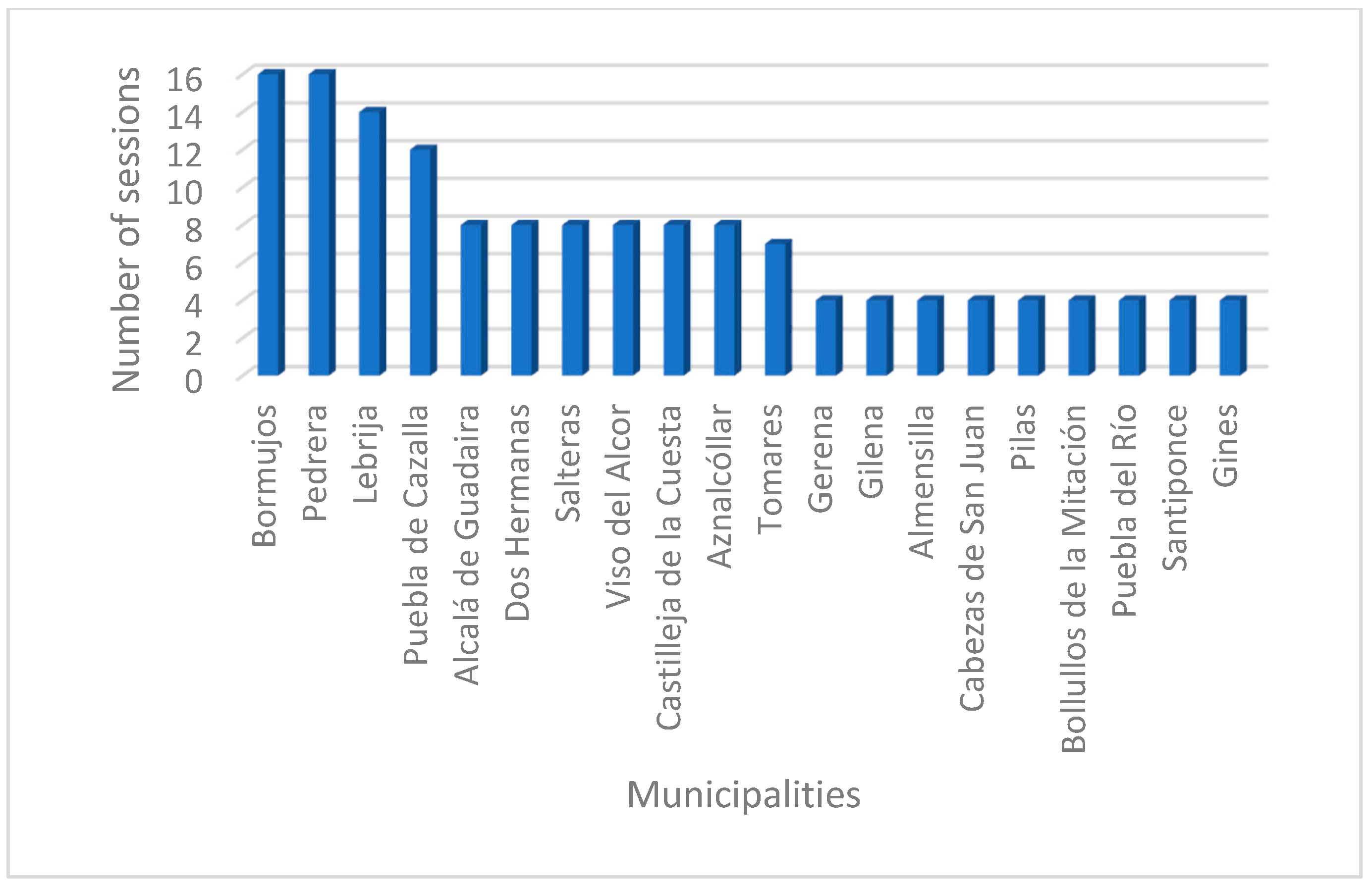
A second relevant aspect concerns territorial distribution. Mathematics-related modules were delivered in multiple municipalities across the province of Seville (see
Figure 3), which indicates that this type of educational offer has not been restricted to the university campus or to a single local context. The geographical spread of the modules reflects the decentralized structure of the Senior Classroom Program and suggests that mathematics can be incorporated into later-life learning in diverse municipal settings. In this sense, the data point not only to temporal continuity, but also to territorial reach and institutional sustainability.
Taken together, these findings suggest that mathematics has been progressively consolidated as a stable component of the program. The evidence does not support interpreting it as merely experimental or marginal. Rather, its persistence across academic years and municipalities indicates that it has become an established part of the non-formal university curriculum for senior learners in this institutional context.
4.2. RQ2: Pedagogical Features of the Mathematics Modules and Their Alignment with Andragogical Principles
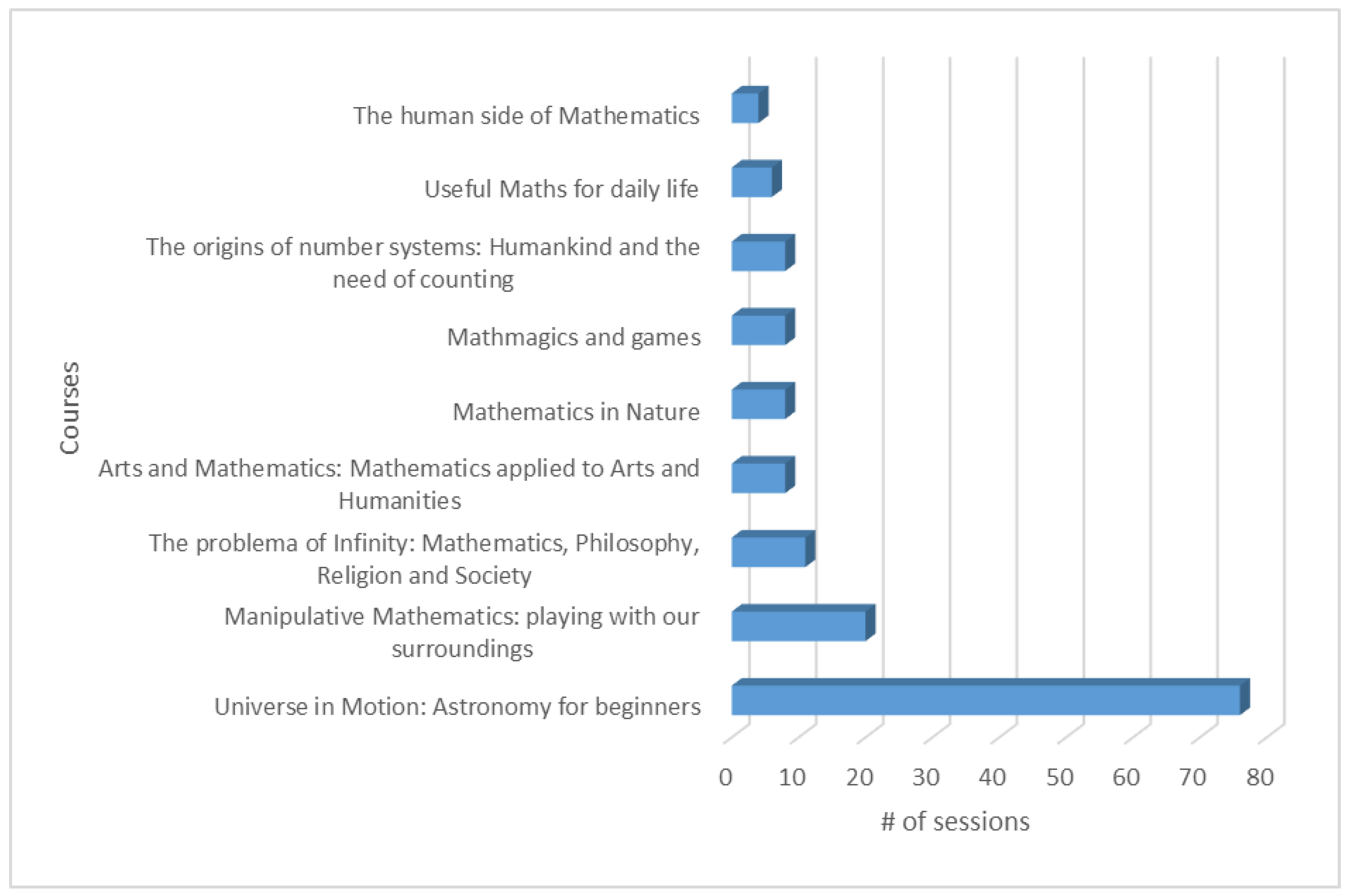
Beyond continuity over time, the data also reveal a marked diversity in the thematic and pedagogical design of the mathematics-related modules. Rather than being organized around formal or procedural mathematical training, the sessions were structured through contextualized themes intended to make mathematical ideas accessible and relevant to senior learners. The current dataset includes modules related to astronomy, games and logic, applied geometry, mathematics in everyday life, number systems, infinity, mathematics in nature, and the relationship between mathematics, art, philosophy, religion, or society (see
Figure 4).
Figure 4 also shows that this diversity was not merely occasional but recurrent across the period analyzed. Some thematic lines, such as astronomy and history, appear with particular frequency, while others broaden the educational offer by linking mathematics to art, games, philosophy, or everyday reasoning. This pattern reinforces the idea that the role of mathematics within the program has been sustained not through a single fixed model, but through a range of contextualized pedagogical approaches.
This thematic diversity is pedagogically significant because it shows that mathematics is not presented as a self-contained formal system, but as a flexible cultural and intellectual resource capable of connecting with different interests and experiences. In this respect, a recurrent feature of the modules is their strong orientation toward meaningful contexts. Mathematics is introduced through familiar domains such as everyday decision-making, games, visual culture, history, natural phenomena, or broader reflections on society and knowledge. This contextualization is consistent with andragogical principles of relevance and life experience, since it allows older learners to interpret mathematical ideas in relation to situations and references that are already meaningful to them.
A second pedagogical feature concerns the accessibility of language and format. The modules do not follow a conventional technical curriculum, nor do they rely primarily on symbolic formalism or procedural drill. Instead, they privilege explanatory, dialogic, and informative modes of presentation, reducing unnecessary formalities and opening space for discussion, curiosity, and interpretation. From an andragogical perspective, this feature is relevant because it makes it possible to approach mathematical content without reproducing barriers commonly associated with formal mathematics instruction.
A third relevant feature is the modular structure of the sessions. The dataset suggests the existence of a relatively stable organization in short teaching units, often around four sessions of two hours each. This format appears pedagogically appropriate in the context of senior learning because it provides sufficient time to explore each topic with depth while avoiding excessive cognitive overload. Moreover, this makes it easier to adapt the rhythm of the sessions to participants’ interaction, questions, and emerging interests. In this sense, the structure of the modules seems compatible with an andragogical emphasis on flexibility, participation, and sustained intrinsic motivation.
Overall, the pedagogical profile of the modules suggests a clear alignment with key andragogical principles. Relevance is reflected in the use of contextualized topics; life experience is activated through connections with familiar cultural and everyday references; intrinsic motivation is supported by curiosity-driven themes; and learner participation is facilitated through an accessible and discussion-oriented teaching style. These elements do not prove effectiveness in a formal evaluative sense, but they do indicate that the design of the modules is pedagogically consistent with later-life learning contexts.
4.3. RQ3: Conditions That Make Mathematics Meaningful and Accessible in Later-Life University Education
When the longitudinal and practice-based evidence are considered together, several conditions emerge as especially relevant for making mathematics meaningful and accessible in this type of educational setting. First, mathematics is more likely to be sustained within senior university programs when it is framed through themes that are culturally recognizable, intellectually stimulating, and connected to learners’ prior life experience. In this case, modules linked to astronomy, games, history, arts, philosophy, or everyday reasoning appear to have functioned as effective entry points for mathematical engagement.
Second, the data suggest that accessibility depends not only on content selection but also on pedagogical mediation. The modules analyzed here tend to avoid excessive formalism and instead emphasize explanation, contextual interpretation, and dialog. This does not imply a loss of intellectual rigor, but rather a reconfiguration of mathematical teaching in accordance with the characteristics and motivations of senior learners. In this sense, accessibility appears to be linked to the ability to translate mathematical ideas into forms of discourse and exploration that invite participation rather than intimidation.
Third, continuity over time and across municipalities suggests that meaningful mathematics education in later life also depends on institutional and territorial conditions. The existence of repeated modules over several years (see
Table A1) indicates that such teaching can be sustained when there is organizational flexibility, collaboration with local municipalities, and a program structure capable of adapting to heterogeneous groups. Therefore, the meaningfulness of mathematics in this context should not be understood only as a classroom-level issue, but also as the result of a broader educational framework that makes this offer viable and recurrent.
Taking all of the above into account, these findings suggest that mathematics can acquire a meaningful place in later-life university education when three conditions are simultaneously present: first, when it is connected to recognizable and worthwhile contexts; second, when it is taught through an accessible, participatory, and non-excessively formal pedagogical style; and third, when the institutional structure allows for continuity, territorial reach, and adaptation to diverse learner profiles. These results should be interpreted cautiously, as this study does not directly measure learning outcomes or participant perceptions. However, they do provide a grounded basis for understanding how mathematics may function as an intellectually engaging component of non-formal university education for senior learners.
5. Discussion
The findings of this study should be interpreted in relation to the three research questions that guided our analysis throughout this work. Taken together, they suggest that mathematics can occupy a meaningful place within later-life university education when it is institutionally sustained, pedagogically contextualized, and aligned with key andragogical principles. This interpretation is consistent with previous literature showing that senior university programs can foster active aging, inclusion, personal development, and meaningful educational participation when they respond to the interests and characteristics of older learners (
Palmero-Cámara & Jiménez-Eguizábal, 2008;
Boulton-Lewis, 2010;
WHO, 2015;
Findsen & Formosa, 2016;
Narushima et al., 2018;
Krupková et al., 2022;
Formosa, 2022;
Gonçalves-Gaia et al., 2024). Rather than demonstrating effectiveness in a formal evaluative sense, the present study provides a longitudinal and practice-based account of the conditions under which mathematics may become accessible, relevant, and intellectually engaging for senior learners in this non-formal university program.
Regarding RQ1, the results show that mathematics-related courses have maintained a recurring presence within the Senior Classroom Program across multiple academic years and municipalities. This continuity is significant because it suggests that mathematics is not merely an occasional or marginal topic in this non-formal university setting, but a viable and sustained component of the educational offer. This finding extends previous work on university programs for older adults, which has mainly emphasized their social, motivational, and participatory value (
Lakin et al., 2008;
Formosa, 2014;
Findsen & Formosa, 2016;
Zhang et al., 2022;
Martínez-Serrano, 2025), by showing that mathematics can also be consolidated over time as part of such programs when it is appropriately adapted. Institutional sustainability and organizational continuity appear to function as key enabling conditions in later-life learning programs. Although senior university programs are often more readily associated with humanities, cultural studies, or social participation, our findings broaden the scope of what later-life university education may include. At the same time, the results do not imply that mathematics is automatically successful or universally attractive in these contexts. Rather, they indicate that its sustained presence is possible when supported by an institutional structure capable of adapting to local demand and diverse learner profiles.
With regard to RQ2, the pedagogical profile of the modules appears strongly consistent with key andragogical principles. The sessions were not organized around a conventional technical curriculum, but around meaningful themes such as astronomy, games, history, infinity, number systems, art, or everyday reasoning. This thematic and contextualized approach is in line with the adult and later-life education literature, which stresses the importance of relevance, prior experience, learner motivation, and participation in educational design (
Boulton-Lewis, 2010;
Knowles, 1980;
Villar & Celdrán, 2012;
Kasworm, 2010;
Hachem, 2023). It is also compatible with previous studies showing that STEAM or science-related content can be successfully adapted to older adults when it is presented through accessible and meaningful frameworks rather than through formal disciplinary structures (
Lee & Coughlin, 2015;
Liu & Joines, 2020;
Padgaonkar & Schafer, 2021;
Teles et al., 2024;
Khan et al., 2026;
Herscu-Kluska & Pe’er, 2026). In this sense, the present study adds to previous research by showing how mathematics, specifically, may be approached not primarily as a system of formal procedures, but as a resource for interpretation, reflection, modeling, and intellectual exploration in senior university settings (
Ernest, 2018;
Radford, 2021).
A further point emerging from the results is the importance of pedagogical mediation. The study suggests that accessibility in mathematics does not depend simply on reducing difficulty, but on reshaping how mathematical ideas are introduced and discussed. The use of accessible language, dialogic teaching formats, and non-excessively formal presentations appears particularly important in this context. This observation is consistent with prior reflections on teaching in university programs for older adults, where flexibility, dialog, and responsiveness to learners’ interests are considered central pedagogical features (
Villar et al., 2010;
Villar & Celdrán, 2012;
Alexander, 2020). It also resonates with earlier work specifically concerned with the communication of mathematical ideas to senior learners without relying on conventional formalism (
Martín-Caraballo & Tenorio-Villalón, 2017;
Niss & Højgaard, 2019;
Ernest, 2018;
Gal, 2024).
In relation to RQ3, the combined analysis suggests that mathematics may become more meaningful and accessible in later-life university education under three main conditions. First, mathematics needs to be contextualized through themes that learners can perceive as worthwhile and meaningful, such as everyday life, culture, science, history, or philosophy. Second, mathematics also needs to be pedagogically framed in ways that privilege explanation, dialog, and interpretation over excessive formalism. Third, it benefits from institutional continuity, since the sustained presence of these modules across years and municipalities indicates that meaningful mathematics education for senior learners depends not only on classroom practice, but also on an organizational framework that makes such teaching viable over time (
Gutstein, 2006;
Radford, 2021;
Boaler, 2022). In this respect, the study complements broader research on senior education by specifying conditions under which a discipline often perceived as difficult or exclusionary may nevertheless become part of inclusive later-life learning environments (
Formosa, 2014;
Narushima et al., 2018;
Krupková et al., 2022).
From a theoretical perspective, this study contributes to the literature on lifelong learning and senior university programs by bringing mathematics into a field where it remains relatively underexplored (
Findsen & Formosa, 2016). While previous studies have examined older adults’ motivation for learning, social inclusion, active aging, or engagement in later-life university settings (
Lakin et al., 2008;
Hachem, 2023;
Gonçalves-Gaia et al., 2024), much less attention has been paid to how mathematics can be meaningfully taught in these environments (
Gutstein, 2006;
Ernest, 2018;
Gal, 2024). The present study therefore extends previous work by showing that mathematics may be understood not only as a technical discipline but also as a cultural and reflective field of knowledge that can be pedagogically adapted to later-life learning. More specifically, the study contributes by showing not only that mathematics can be included in senior university programs, but also which pedagogical and institutional conditions appear to support its continuity and accessibility over time.
The findings also have an important equity dimension. Mathematics is often perceived as a discipline reserved for those with strong prior academic preparation. By showing how mathematical content can be reintroduced in non-formal university settings for older adults (
Gutstein, 2006;
Niss & Højgaard, 2019;
Boaler, 2022), this study points toward a more inclusive understanding of who mathematics is for and at what stages of life it may remain educationally relevant. In this sense, the case examined here suggests that access to mathematical culture and reasoning can be widened beyond conventional student profiles.
While these findings offer a meaningful account of how mathematics may be incorporated into later-life university education, they should also be interpreted in light of several limitations. First, this is a single-case study focused on one institutional program, so the findings are not intended to be statistically generalizable. Second, the study does not include direct participant data through interviews, surveys, or formal learning measures, which means that it cannot establish impact in terms of achievement, satisfaction, or attitudinal change. Third, part of the interpretation is based on teaching-practice reflection, which offers valuable insider knowledge but also introduces a degree of subjectivity. These limitations should be taken into account when interpreting the findings.
Future research could build on this work by incorporating participants’ perspectives, comparative analyses across institutions, and more systematic evidence on engagement and learning outcomes in later-life mathematics education. Such work would help deepen our understanding of how and under what conditions mathematics can continue to play a meaningful role in senior university programs.
Overall, the study suggests that the place of mathematics in senior university programs should not be judged solely through the lens of disciplinary difficulty or prior formal preparation. In the case analyzed here, mathematics appears capable of becoming a meaningful component of later-life university education when it is taught through contextually rich, pedagogically accessible, and institutionally sustained forms. This does not eliminate the intellectual demands of the subject, but it does suggest that its educational value in later life depends largely on how it is framed, experienced, and supported.