


Abstract
The low participation of men in primary education is a persistent and structural phenomenon that cannot be adequately understood through homogeneous views of teachers’ motivations and experiences. This study is conducted in the Chilean context, which is characterized by a highly feminized teaching workforce and persistent challenges related to working conditions, social valuation of teaching, and teacher retention. It aims to analyze profiles of male primary school teachers, considering their motivations, perceptions, and the meanings they attribute to the teaching profession. A sequential explanatory mixed-methods design (QUAN → qual) was employed. First, 144 male in-service primary teachers completed the FIT-Choice scale and a latent class analysis was conducted. Subsequently, in-depth interviews were carried out with an intentionally selected subsample of 20 teachers, which were analyzed using qualitative content analysis. Three distinct motivational profiles were identified: altruistic, pragmatic, and critical. The qualitative findings complemented these profiles, highlighting the influence of personal trajectories and working conditions on teachers’ career choice and retention in the profession. Overall, the findings suggest that policies for training, support, and professional induction must recognize teacher heterogeneity and promote inclusive working environments, moving beyond approaches that focus exclusively on increasing the number of men in primary education. Implications for the design of policies aimed at attracting and retaining male primary school teachers are discussed.
1. Introduction
Primary teaching has historically been a highly feminized field, a condition that continues to shape how it is socially valued and who is attracted to it (Heinz et al., 2023). Increasing gender diversity in the teaching workforce is relevant for its potential to challenge enduring gender norms that have linked teaching and childcare to femininity (McGrath et al., 2020; Ovando & Falabella, 2021). The low representation of male teachers in primary education is a complex phenomenon that can be examined through a motivational lens, as the feminization of the workforce shapes how teaching is evaluated in terms of its social utility, personal relevance, and perceived costs for men. However, men who do enter the profession cannot be assumed to share uniform motivations, as their decisions are shaped by diverse interpretations of these contextual conditions. These conditions are particularly relevant in the Chilean context, where the feminization of primary education coexists with structural challenges related to working conditions, professional status, and teacher retention, which together shape both entry into and persistence in the teaching profession (González et al., 2022; OECD, 2024, 2025a, 2025b). Examining these dynamics makes it possible to understand the heterogeneity of motivational profiles that emerge from male teachers’ trajectories and experiences in highly feminized school contexts (Fernández et al., 2020; McDowell, 2023; McGrath et al., 2020; Meader & Larwin, 2022; Mistry & Sood, 2016).
1.1. Male Primary Teachers in a Feminized Teaching Profession
The gender composition of the teaching workforce reveals a marked global imbalance, particularly at the early levels of the education system, where male participation is significantly lower (Cruickshank et al., 2020; Heinz et al., 2023; OECD, 2025b). Although education systems have undergone significant transformations over recent decades, teaching remains a highly feminized field. Comparative international data show that the presence of men in primary education continues to be low across OECD countries, not exceeding 25% of the total teaching workforce in any of these contexts (OECD, 2024), and a sustained decline in male participation has been documented over the past fifty years (McGrath & Van Bergen, 2017).
Within this broader context, the Chilean case is illustrative of the persistence of these dynamics, with men representing approximately 19% of the primary education teaching workforce (OECD, 2024). The consolidation of the feminization of the teaching workforce can be understood in relation to educational policies developed since the nineteenth century, which actively promoted women’s entry into teaching and reinforced a sexual division of labor. The introduction of compulsory primary education and the creation of teacher training institutions primarily oriented toward women contributed to the naturalization of their presence in classrooms, sustained by cultural representations that attribute a supposedly “natural” predisposition for childcare to women (Fiorucci et al., 2022; Salinas Urrejola, 2018).
Numerous studies agree that this distribution cannot be explained solely by individual career choices, but is deeply linked to a range of structural, cultural, and economic barriers that have shaped teaching as a predominantly female occupation and discouraged men’s entry into and retention in the teaching profession (Dantas & Antloga, 2023; Fiorucci et al., 2022; Meader & Larwin, 2022). The historical feminization of teaching has been closely associated with the low social value of the profession. A negative feedback loop is generated in which greater feminization is linked to lower perceived prestige, and lower prestige, in turn, reduces men’s attraction to teaching as a career (OECD, 2025b).
Among these barriers, the comparatively low salary relative to other occupations requiring similar qualifications is particularly salient (González et al., 2022; OECD, 2025b). This is especially relevant in primary education, where remuneration is lower than at the secondary and tertiary levels and salary progression is notably slow, requiring 25 years to reach the top pay scale (OECD, 2025a). In Chile, these disparities are particularly evident: on average, a male primary school teacher earns approximately 34% less than he could obtain in other occupations, creating strong economic incentives to pursue alternative career paths (OECD, 2024).
These factors are compounded by persistent gender stereotypes that subject men to heightened social scrutiny. Previous studies document fears of false accusations of abuse, distrust toward men working with young children, and pressures to conform to dominant forms of masculinity, associated with disciplinary control or authoritarian leadership (Cruickshank, 2019; Davis & Hay, 2018; McDowell, 2023; Ovando & Falabella, 2021; Sargent, 2004). These dynamics are also associated with higher rates of professional turnover and attrition among male teachers (Hwang & Fitzpatrick, 2021).
This set of tensions is embedded within a broader global context of teacher shortages. According to UNESCO and International Task Force on Teachers for Education 2030 (2024), education systems worldwide will need to recruit approximately 44 million additional teachers by 2030 to ensure universal access to primary and secondary education. In Chile, although the teaching workforce has grown by around 47% over recent decades, 85% of this increase corresponds to women, meaning that for every new male teacher, approximately six new female teachers have entered the profession (McGrath, 2025), leaving the gender composition of primary education largely unchanged. Against this backdrop, there is a clear need to understand what motivates male teachers to enter and remain in the profession.
1.2. Motivations for Entering the Teaching Profession
Teacher motivation is central for understanding how teachers relate to the profession, and how they sustain their commitment and shape their professional trajectories over time (Hartl & Holzberger, 2022; Heinz, 2015; Richardson & Watt, 2016). While motivation is often anchored in entry into the profession, in this study, it is examined retrospectively, with in-service teachers, and complemented by their reflections on motivations to remain in teaching, acknowledging the interplay between initial motivations and those shaped through professional experience. The literature consistently distinguishes three broad sources of motivation for the teaching profession—intrinsic, extrinsic, and altruistic—which often coexist and combine in diverse ways within teachers’ professional experiences (Arribas et al., 2022; García-Poyato et al., 2018; Heinz, 2015; Richardson & Watt, 2016; Yüce et al., 2013).
First, intrinsic motivations are defined as affective and psychological predispositions, linked to personal interest in teaching and to the satisfaction derived from the activity of educating children (Richardson & Watt, 2006). Second, extrinsic motivations refer to incentives associated with the professional context, including salary, social prestige, job security, the influence of family members or other influential figures (Mungarro & Zayas, 2009), conditions related to employability, periods of leave (Arribas et al., 2022). Finally, altruistic motivations refer to the desire to contribute positively to the lives and social well-being of others through teaching and to feelings of self-fulfillment associated with this social impact (Heinz et al., 2023).
The literature on teacher motivation shows that motivational orientations toward the profession vary by gender, although not in a uniform way (Arribas et al., 2022; Heinz, 2015; Yüce et al., 2013). In general terms, men tend to place greater relative emphasis on extrinsic motivations, such as professional prestige, economic considerations, and access to employment (Arribas et al., 2022; Silva & Obaco, 2020; Yüce et al., 2013). Nevertheless, among men who choose teaching, relevant intrinsic and altruistic motivations are also identified; these coexist with instrumental factors and are articulated in different ways compared to their female counterparts (Heinz et al., 2023; Silva & Obaco, 2020).
Likewise, the literature highlights that factors such as beliefs about one’s own teaching ability, prior experiences working with children, and the influence of significant others contribute to the development of motivation toward the teaching profession, although these elements tend to be reported more strongly by women than by men (Mizala et al., 2011; Montecinos & Nielsen, 1997). From this perspective, various approaches caution against reducing teacher motivation to individual dispositions, emphasizing instead the role of cultural beliefs and gender stereotypes in shaping expectations, values, and senses of belonging; this is an issue that is particularly relevant for understanding men’s entry into educational levels that have been historically feminized (Bigler & Liben, 2007; Eccles & Wigfield, 2020; Master, 2021).
From this perspective, which conceives teacher motivation as a heterogeneous configuration of intrinsic, extrinsic, and altruistic sources that is socially and culturally situated, it is appropriate to approach motivation through a profile-centered perspective. This approach makes it possible to capture the diversity of motivational orientations that coexist among male primary school teachers.
1.3. Motivational Profiles
Various studies in diverse contexts have applied a typological approach and found different teacher motivational profiles (Bergey & Ranellucci, 2021; Lohbeck & Frenzel, 2022; Valdenegro-Fuentes & González-Sanzana, 2024; H. M. G. Watt & Richardson, 2008; H. M. Watt et al., 2014). This approach recognizes that teachers are not a homogenous group regarding teaching motivations and perceptions and reveals different sub-groups with unique configurations that may be hidden within the larger sample (Bergey & Ranellucci, 2021; H. M. G. Watt & Richardson, 2008).
Many studies are based on the FIT-Choice (H. M. Watt & Richardson, 2007) while others have used the FEMOLA (Pohlmann & Möller, 2010); both instruments are based on the expectancy–value motivational theory (Wigfield & Eccles, 2000), which posits that career-related choices are influenced by factors such as expectation of success, task values, task demands, and social influences. Most of these studies are purely quantitative and in addition to teaching motivations, they examine relationships with other variables: demographic variables such as race and gender, or other constructs such as level of engagement, commitment, persistence, leadership aspirations, self-efficacy, career satisfaction, among others (Lohbeck & Frenzel, 2022; H. M. Watt et al., 2014).
From these person-centered approaches, the literature has consistently identified between three and four motivational profiles across different contexts and educational levels (Bergey & Ranellucci, 2021; Hartl & Holzberger, 2022; Valdenegro-Fuentes & González-Sanzana, 2024; H. M. G. Watt & Richardson, 2008; H. M. Watt et al., 2014). Although the criteria used to classify profiles vary across studies, this body of evidence converges in showing that motivations for teaching are organized into differentiated configurations that combine intrinsic, extrinsic, and social utility motivations to varying degrees (Hartl & Holzberger, 2022; König et al., 2018).
Across studies, several profiles are described that are characterized by a strong intrinsic interest in teaching, high commitment to working with students, and a pronounced sense of vocation or social utility (Thomson & Palermo, 2014; Valdenegro-Fuentes & González-Sanzana, 2024; H. M. G. Watt & Richardson, 2008). Other profiles are associated with more conventional or pragmatic orientations, in which motivation is primarily sustained by extrinsic factors such as job stability, working conditions, or the instrumental value of the profession, often combined with moderate levels of intrinsic interest (Bergey & Ranellucci, 2021; Lohbeck & Frenzel, 2022). Finally, some studies have identified profiles characterized by more fragile or ambivalent motivation, marked by higher levels of disenchantment or declining commitment in response to the demands of professional practice, particularly as teachers confront the everyday challenges of schoolwork (H. M. G. Watt & Richardson, 2008; H. M. Watt et al., 2014).
The vast majority of these motivational profile studies have been conducted with pre-service teachers (Adams et al., 2026; Bergey & Ranellucci, 2021; Hartl & Holzberger, 2022; Lohbeck & Frenzel, 2022; H. M. G. Watt & Richardson, 2008; H. M. Watt et al., 2014; Valdenegro-Fuentes & González-Sanzana, 2024). However, it is relevant to note that Hartl and Holzberger (2022), in their longitudinal study that examined pre-service teachers’ motivational profiles and then followed up two years after the teachers had entered the school system, found that pre-service teachers’ motivational profiles are dynamic and are reshaped as they transition into professional practice and begin working in schools.
Additionally, the existing literature has examined motivational profiles using samples aggregated by sex, without specifically analyzing within-gender variability in the configuration of these profiles. Consequently, limited attention has been paid to how motivations for teaching are organized among particular groups of teachers, such as male teachers working in educational levels that have been historically feminized, including primary education.
1.4. Current Study
Building on this body of research, the present study makes two key contributions to the literature on teacher motivation and gender. First, it conceptualizes male teachers in a feminized profession as a heterogeneous group, moving beyond sex-aggregated analyses to examine within-gender motivational diversity. Second, it extends existing profile research by focusing on in-service teachers, capturing how motivational profiles evolve as teachers enter and experience professional practice. Therefore, this study aims to identify and examine within-gender diversity, by identifying distinct motivational profiles among male in-service teachers. In line with this purpose, the study is organized around the following research questions:
- What motivational profiles can be identified among male primary school teachers?
- How do qualitative narratives help explain, contextualize, and deepen the understanding of these motivational profiles?
2. Materials and Methods
2.1. Research Design
The study followed a sequential QUAN → qual mixed-methods design (Creswell & Plano Clark, 2018). Integration occurred at two points across the research process. First, the qualitative phase was embedded within the quantitative phase, as the interview sample was purposively drawn from participants who completed the survey. Second, integration took place at the interpretation stage, where qualitative narratives were used to contextualize and enrich the motivational patterns identified through quantitative analyses.
This sequential explanatory design was particularly suitable for the purposes of this study, as it allowed for the identification of distinct motivational profiles through quantitative analysis and the subsequent use of qualitative data to explain and contextualize these profiles. While alternative designs may begin with qualitative exploration, the present approach was aligned with the objective of examining within-group heterogeneity and interpreting statistically derived profiles through participants’ experiences.
2.2. Participants and Sampling
A two-stage sampling strategy was employed. In the first stage, participants were recruited through a non-probabilistic sampling strategy using professional networks and institutional contacts within primary education. Those who met the inclusion criteria completed the survey, resulting in a total sample of 298 primary school teachers. Given the focus of the study on male teachers, the quantitative analyses reported here were based on the subsample of 144 male primary school teachers. This subsample included participants with diverse motivational profiles, years of teaching experience, school types, and geographic locations across Chile (Table 1).
Table 1.
Characteristics of male primary school teachers in the quantitative sample (n = 144).
Most participants reported working full-time schedules (40–44 h per week or more), indicating a relatively high workload consistent with broader characteristics of the teaching profession in Chile (OECD, 2025b). Salaries varied across participants, although a majority were concentrated in middle-income ranges (approximately USD 1000–1600 per month), reflecting the heterogeneous but generally moderate compensation levels associated with teaching in the Chilean context. These working conditions offer relevant context for interpreting the motivational configurations observed.
In the second stage, a purposive subsample of 20 male participants was selected for in-depth individual interviews. The qualitative sample was selected with the aim of reflecting, though not necessarily in a strict manner, the diversity observed in the quantitative sample, including the distribution of motivational profiles as well as variation in years of experience, school type, geographic region, and school context. Participants from each motivational profile (altruistic, pragmatic, and critical) were intentionally included. Additional criteria were applied to ensure heterogeneity in regional representation, years of professional experience, school context (urban and rural), and type of school administration. Detailed demographic and professional characteristics of the interview participants are presented in Table 2.
Table 2.
Characteristics of the qualitative sample of interview participants (n = 20).
2.3. Data Collection
2.3.1. Factors Influencing Teaching Choice Scale
The Factors Influencing Teaching Choice (FIT-Choice) Scale, developed by H. M. Watt and Richardson (2007), is a validated instrument, representing one of the most significant developments in empirical research on motivations for entering the teaching profession (Heinz et al., 2023). It has been widely used across diverse international contexts, including countries such as Australia, the United States, Norway, Germany, China, Ireland, the Netherlands, Turkey, Croatia, and Indonesia (Heinz, 2015; Heinz et al., 2023).
This instrument is designed to examine the motivational, social, and perceptual factors underlying the decision to enter teaching. It provides a theoretical basis for analyzing motivations and perceptions related to teaching; therefore, the variables in this study were derived from this framework rather than being defined ad hoc. The scale comprises 57 items rated on a 7-point Likert-type scale ranging from 1 (not at all important) to 7 (extremely important).
Motivational values capture the extent to which individuals are driven by intrinsic interest in teaching, anticipated personal benefits such as job security, transferability, and compatibility with family life, and broader social-oriented motives including contributing to society, promoting equity, and working with children. Social influences reflect perceived encouragement or discouragement from significant others, as well as the impact of prior teaching and learning experiences. The scale also includes self-perceptions of teaching ability and perceptions of the profession, which distinguish between perceived task demands (e.g., required expertise and workload) and expected task returns (e.g., social status and salary). Finally, career evaluation encompasses satisfaction with the decision to pursue teaching and the extent to which teaching represents a fallback career option (H. M. Watt & Richardson, 2007).
Meta-analytic evidence indicates that the FIT-Choice instrument demonstrates adequate internal consistency, with an average Cronbach’s alpha of approximately 0.80 for the motivations construct and 0.78 for the beliefs construct (Navarro-Asencio et al., 2021). Additionally, previous studies report Cronbach’s alpha coefficients ranging from 0.62 to 0.93 across subscales (Heinz et al., 2023), indicating acceptable to high levels of reliability. Evidence for construct validity has been provided through confirmatory factor analyses indicating adequate model fit in Spanish-speaking contexts (RMSEA = 0.048; SRMR = 0.054; CFI = 0.966; TLI = 0.959) (Gratacós & López-Jurado, 2016). Similarly, in the Chilean context, large-scale studies have demonstrated acceptable psychometric properties of the instrument in samples of teacher education students (RMSEA = 0.053; SRMR = 0.054; CFI = 0.912; TLI = 0.897) (González-Sanzana et al., 2024).
2.3.2. In-Depth Individual Interviews
Data were collected through in-depth individual interviews aimed at eliciting reflective accounts of teachers’ educational and professional trajectories. The interviews were conducted in an open, non-directive manner and were guided by broad thematic areas related to career choice, initial teacher training, professional practice, and future projections. Participants were encouraged to reflect on key events, experiences, and influential people across different stages of their careers.
Interviews were conducted in person in quiet, private settings. Each interview lasted approximately 60–90 min, was audio-recorded with participants’ consent, and was transcribed verbatim by a professional transcriber.
2.4. Data Analysis
2.4.1. Latent Class Analysis
Latent class analysis (LCA) was conducted to identify unobserved motivational profiles based on participants’ response patterns across the FIT-Choice dimensions. LCA is a statistical method used to identify unobserved groups within a population based on individuals’ response patterns. Rather than assuming that all individuals are homogeneous, LCA classifies participants into distinct latent classes that share similar response configurations across a set of variables, allowing the identification of different profiles without defining them a priori (Collins & Lanza, 2010).
Models specifying between two and six latent classes were estimated and compared. Model selection was guided primarily by the Bayesian Information Criterion (BIC), with lower values indicating better fit while accounting for model parsimony (Nylund et al., 2007). In addition to statistical fit indices, the interpretability and substantive meaningfulness of the classes were considered when selecting the final model. The three-class solution was selected as it provided the best balance between statistical fit (lowest BIC) and substantive interpretability; models with additional classes showed poorer fit or reduced clarity of interpretation.
The analysis was conducted under standard LCA assumptions, including the existence of a finite number of latent classes, conditional independence of indicators within classes, and independence of observations. The indicators included in the model were derived from Likert-type items corresponding to FIT-Choice subdimensions. Specifically, the model included indicators representing: (a) social influences (e.g., prior teaching and learning experiences and social encouragement), (b) motivational values (e.g., intrinsic career value, job security, time for family, social utility value such as enhancing social equity, and working with children), (c) perceptions of the profession (e.g., perceived task demand and task return), and (d) self-perceptions (e.g., perceived teaching ability), as well as fallback career motivations. These subdimensions capture key aspects of participants’ motivations and beliefs about the teaching profession.
The Likert-type indicators were treated as nominal variables in the LCA to emphasize the identification of distinct response patterns rather than the modeling of ordered intensity. Although Likert scales are inherently ordinal, the analytical objective was not to estimate incremental changes across response categories, but to detect qualitatively different motivational profiles based on combinations of responses across dimensions. Responses were recoded into broader categories (low, medium, high) and, by treating them as nominal, the model captures heterogeneity in response configurations without imposing assumptions about equal spacing or monotonic relationships between categories. This approach is consistent with a person-centered framework, which focuses on distinguishing groups with different characteristic patterns rather than modeling gradual variation along a continuum.
To aid interpretation of the latent classes, mean scores were calculated for each FIT-Choice dimension and described using quartile-based categories, with lower values indicating weaker endorsement and higher values indicating stronger endorsement. These descriptive summaries were used to characterize the motivational profiles identified by the LCA.
Only cases with complete responses on the selected FIT-Choice indicators were included in the analysis; therefore, no missing data handling procedures were required. All analyses were conducted in R (version 4.4.0) using the poLCA package (version 1.6.0.1).
2.4.2. Qualitative Content Analysis
Qualitative data from the interviews were analyzed using qualitative content analysis to identify patterns and themes related to participants’ experiences and career motivations (Flick, 2014). The analysis followed an iterative and collaborative process involving repeated reading of the transcripts, initial coding of meaningful segments, and the progressive identification of emerging categories. An initial coding framework, informed by the literature, was refined through constant comparison across cases and the incorporation of emerging categories, which were subsequently grouped into broader themes.
Coding was conducted through a collaborative and iterative process involving six researchers organized into rotating coding dyads. An initial subset of 6 interviews was coded jointly by the full team to calibrate the coding scheme and refine the codebook. The 14 remaining interviews were then analyzed in pairs, with researchers rotating to incorporate multiple perspectives. Inter-coder agreement in each dyad was assessed using Krippendorff’s alpha coefficient, yielding an average value of α = 0.68 prior to consensus, indicating an acceptable level of agreement. Regular team meetings were held throughout the process to discuss coding decisions, resolve discrepancies, and ensure consistency. This process continued until thematic saturation was reached, defined as the point at which no new codes or themes emerged from successive rounds of analysis. The analysis was supported by ATLAS.ti (version 25), which facilitated data organization and code management.
Finally, selected excerpts were translated from the original Spanish into English by a bilingual member of the research team and subsequently checked against the original texts to ensure fidelity to the intended meaning.
2.4.3. Ethical Considerations
Participation in the study was voluntary, and all participants provided informed consent prior to data collection. To ensure confidentiality and anonymity, all data were coded, securely stored, and reported in aggregate form, with pseudonyms used where applicable. The research project was reviewed and approved by the ethics committee of the affiliated institution and was conducted in accordance with relevant national and international ethical standards for research involving human participants.
3. Results
3.1. Identification of Motivational Profiles
Latent class analysis (LCA) was conducted to identify distinct motivational profiles among male primary school teachers based on their response patterns across the FIT-Choice dimensions. Competing models specifying between two and six latent classes were estimated and compared. Model selection was informed by multiple criteria, including the Akaike Information Criterion (AIC), the Bayesian Information Criterion (BIC), and substantive interpretability, with greater weight given to BIC due to its suitability for balancing model fit and parsimony in latent class modeling.
As shown in Table 3, the three-class solution yielded the lowest BIC value (BIC = 4977.04), indicating the best overall fit among the tested models. Although the Akaike Information Criterion (AIC) continued to decrease in models with a higher number of classes, these solutions were associated with substantially higher BIC values and offered limited substantive interpretability. Based on these criteria, the three-class solution was retained for subsequent analyses.
Table 3.
Model fit indices for competing latent class solutions.
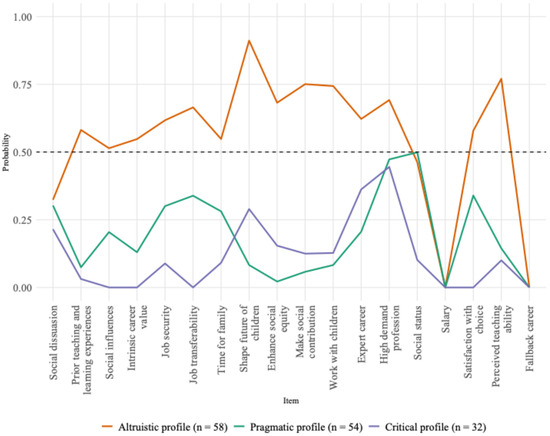
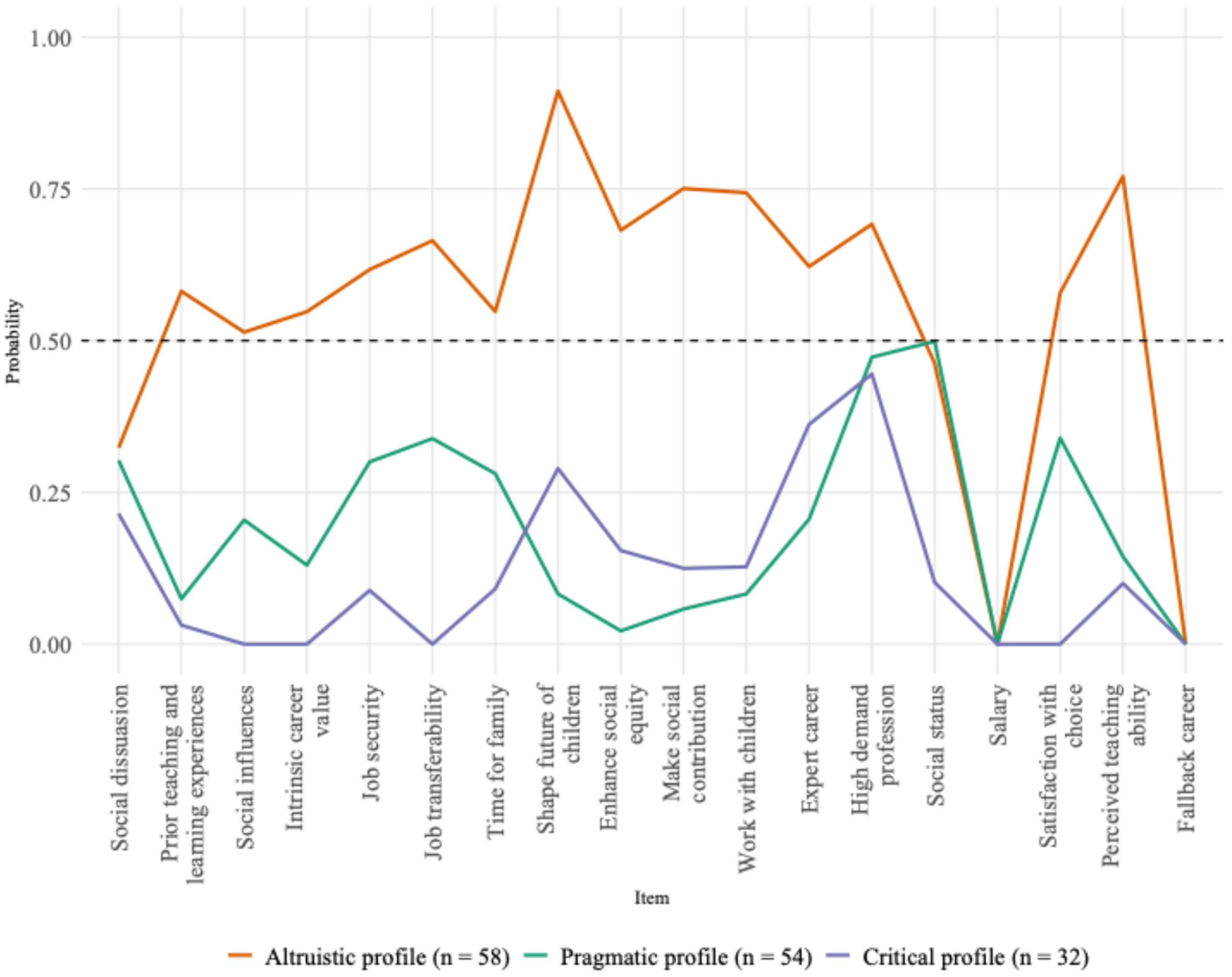
The retained model classified participants into three latent classes of adequate size, with 58 teachers assigned to Class 1 (40.3%), 54 to Class 2 (37.5%), and 32 to Class 3 (22.2%). Classification quality was further supported by a high entropy value (entropy = 0.944), indicating good separation between the identified classes. Figure 1 presents the motivational profiles identified through the latent class analysis, illustrating differences in levels of endorsement across the FIT-Choice dimensions.
Figure 1.
Motivational profiles of male primary school teachers identified through latent class analysis. Note. Profile labels are descriptive and reflect dominant motivational patterns across dimensions.
3.2. Motivational Profiles Identified
The three latent classes were characterized by distinct configurations of motivational values, perceptions of the teaching profession, and levels of satisfaction with career choice. Based on their dominant motivational patterns, the profiles were labeled Altruistic, Pragmatic, and Critical. Figure 1 provides a visual summary of these profiles.
To facilitate comparison across profiles, Table 4 summarizes their key characteristics.
Table 4.
Summary of motivational profiles of male primary school teachers.
In the sections below, we have described the quantitative profiles in more detail; the qualitative data, in the form of interview excerpts, are presented to illustrate how these motivational configurations were experienced and articulated by teachers.
3.3. Altruistic Profile
Teachers classified in the Altruistic profile (n = 58 in the quantitative sample) showed high probabilities of endorsement across most motivational dimensions. This profile was characterized by consistently high probabilities on intrinsic career value and social utility dimensions, including motivations related to contributing to society and working with children. High probabilities were also observed for prior teaching and learning experiences and perceived teaching ability. In contrast to the more differentiated patterns observed in other profiles, participants in this group also showed high probabilities of satisfaction with their career choice, reflecting a consistently positive pattern across motivational and perceptual dimensions.
Qualitative narratives from teachers interviewed within this profile (11 interviews) emphasized teaching as a meaningful and transformative practice, consistent with their high social utility values and desire to contribute to society. As one participant from the altruistic profile described:
Maybe I see myself reflected in them. No one should tell them they can’t do it ‘because you come from a family of criminals, you’ll be the same.’ I learned what it’s like to work with children who are even more wounded: kids who came from foster homes, or who told you they didn’t have parents, that their parents were in prison. […] You realize there are people whose lives are even more shattered than yours. But if they’re in school, it’s because they want to change their lives. And if there is a teacher who is motivated, the kids believe that that world is possible. If they let us guide them, we can transform them. My work impacts others and transforms them, because I was transformed too.(Matthew)
The teachers in the altruistic profile group were also more likely to have had meaningful prior experiences with children, approximations to teaching that gave them a deep appreciation of community service and served to pique their intrinsic interest in pursuing a degree in education. As one participant described:
I prepared myself, at the church they always provided a kind of training to work with children and young people, and I started out working with children. It’s what is known as Sunday school and different activities are carried out. So, I would prepare the lessons and the teaching materials, if there was a need, do some kind of dramatization. It is very similar to what I do nowadays at school. ‘Today we’re going to learn this, we’re going to work on this, we’re going to do this. What did we learn today?’(Daniel)
These accounts reflect the key motivational patterns identified in the quantitative profile.
3.4. Pragmatic Profile
The Pragmatic profile (n = 54 in the quantitative sample) was characterized by moderate probabilities of endorsement across most motivational dimensions. Teachers in this class showed relatively higher probabilities of endorsing extrinsic and instrumental dimensions, such as job security, employment stability and transferability, and working conditions and salary, compared to intrinsic and social utility dimensions, which were endorsed at lower levels. Probabilities of prior teaching and learning experiences and perceived teaching ability were also moderate, indicating a less strongly defined motivational pattern than that observed in the altruistic profile. Participants in this group also showed moderate probabilities of satisfaction with their career choice.
Qualitative excerpts from teachers interviewed within this profile (six interviews) highlighted the importance of job stability and working conditions in sustaining engagement with teaching, consistent with the quantitative profiles outlined above. As one teacher explained:
I have a very privileged schedule […] honestly, I won’t get this schedule anywhere else, so fine, I’ll put up with it a while longer. Because I can be at home more, which is what we need right now. In the end, that’s a big part of my motivation now. I have a stable job, I know my salary will come every month. I also have January and February [summer holidays] guaranteed. And this is an area that still allows me to be pretty comfortable.(Brian)
These narratives framed teaching primarily in terms of its tangible and relational benefits. Participants emphasized the profession’s role in enabling social mobility and economic stability, dimensions prioritized in the quantitative results, as can be seen in Michael’s account:
Teaching has also given me everything I have today. I was able to break a cycle, from a family that was not very connected to culture. I was able to achieve all those things I dreamed of as a child: having a home, having a car, having seen the world, which is also important for a person’s fulfillment. It’s not only about the spiritual.(Michael)
The participants also maintained that, in addition to economic stability, the teaching profession offered employment security and transferability, which was valued as part of their desire to keep teaching in the system.
There’s still this idea going around that the pay is low and the system is unstable, when actually the career is really stable. I haven’t been unemployed for a single day since I graduated. I’ve worked in the north, in the south; I came back to my home area and I’m really happy here. I’m still stable. So, I think this is something that just needs to be communicated better.(Jeremy)
These perceptions are consistent with the pragmatic and instrumental motivations that characterize this profile.
3.5. Critical Profile
Teachers in the Critical profile (n = 32 in the quantitative sample) exhibited moderate probabilities of endorsement in the social utility dimension and lower endorsement across intrinsic and extrinsic dimensions. In contrast to the more clearly differentiated pattern observed in the altruistic profile, this configuration reflected a more mixed and internally tensioned motivational structure. Teachers in this profile showed relatively higher probabilities on items related to perceived demands, lower perceived returns (e.g., workload, social status, and salary), and lower levels of satisfaction with their career choice, suggesting a more evaluative stance toward the profession. Accordingly, this profile was characterized by a form of moderated commitment, coupled with a heightened awareness of professional demands, workload intensification, and institutional constraints.
Qualitative narratives from teachers interviewed within this profile (three interviews) conveyed a critical engagement with teaching, emphasizing both commitment to students and dissatisfaction with working conditions and lack of support, especially for novice teachers, as this teacher expressed:
Yes, that’s when I thought about leaving. I was living in [the city] and had to travel to work every day in [the town], taking the bus down and then back up again. I arrived exhausted, and on top of that I had all this administrative work, which I was very behind on. There was also the way I was treated by my supervisor, the way they would leave you feeling embarrassed in front of other people. And when you’re just starting out, you’re just a fledgling; you’re still very new and inexperienced.(Mark)
Rather than indicating disengagement, these accounts point to a form of professionally situated critique, in which dissatisfaction emerges in response to the normalization of precarious conditions and systemic limitations, as illustrated in the following excerpt:
Then there’s another issue, which is the feeling of being abandoned […] these colors you see here, we painted them ourselves, with the parents. Many colleagues prefer to buy their own projectors. I mean, I use my own laptop, I use my own markers […] it feels like we’ve gotten used to it […] These curtains were from my house […] and this year we said: we’re not putting up any curtains until someone comes and sees that we don’t have any. Because, sure, it still looks nice, but it’s not right. It’s not right.(Harold)
Taken together, these results suggest that male primary teachers do not constitute a homogeneous motivational group, but rather display distinct patterns, differentiated by how altruistic, pragmatic, and critical orientations are combined in their accounts of career choice, commitment, and professional engagement.
4. Discussion
This section is organized explicitly around the two research questions. It begins by addressing the first question concerning the identification of motivational profiles and then examines how qualitative narratives contribute to their interpretation. This structure allows for a coherent integration of the study’s findings with prior literature on teacher motivation, motivational profiles, and men’s teaching in feminized educational contexts.
From the outset, it is important to emphasize that the motivational profiles identified are not conceived as rigid typologies. In line with person-centered approaches, the profiles are understood as analytical constructs that capture motivational heterogeneity and enrich understanding of professional trajectories (Hartl & Holzberger, 2022; H. M. G. Watt & Richardson, 2008; H. M. Watt et al., 2014).
4.1. Motivational Profiles of Male Primary School Teachers
With respect to the first research question, what motivational profiles can be identified among male primary school teachers?, the results reveal the existence of three distinct motivational configurations: altruistic, pragmatic, and critical. The three profiles differ in their relative patterns of endorsement across intrinsic, social utility, personal utility, and professional perception dimensions, providing a quantitative basis for their qualitative interpretation. This finding is consistent with previous studies using person-centered approaches, which have identified between three and four motivational profiles across different educational contexts (Bergey & Ranellucci, 2021; Hartl & Holzberger, 2022; Lohbeck & Frenzel, 2022; Valdenegro-Fuentes & González-Sanzana, 2024; H. M. G. Watt & Richardson, 2008; H. M. Watt et al., 2014).
The altruistic profile is organized around a strong sense of social contribution and commitment to educational work, features that have been widely described in profiles characterized by high intrinsic interest in teaching, vocational orientation, and social utility motivations (Thomson & Palermo, 2014; Valdenegro-Fuentes & González-Sanzana, 2024; H. M. G. Watt & Richardson, 2008). This profile is marked by high endorsement of intrinsic career value and social utility dimensions, especially working with children, making a social contribution, and shaping the future of students; while personal utility motives remain present, they are less central to the overall configuration.
By contrast, the pragmatic profile prioritizes job stability, predictability, and work–life balance, shaping a relationship with teaching grounded in instrumental criteria. This configuration aligns with profiles previously described as conventional or pragmatic, in which extrinsic motivations play a prominent role (Bergey & Ranellucci, 2021; Lohbeck & Frenzel, 2022). This profile shows stronger endorsement of personal utility dimensions, particularly job security, working conditions, and job transferability, with lower levels of intrinsic and social utility motivations.
The critical profile is characterized by a combination of moderate commitment to teaching and a reflective stance toward the institutional conditions of teachers’ work. In quantitative terms, it is distinguished by intermediate endorsement across intrinsic and social utility dimensions, and stronger perceptions of teaching as a demanding profession. While this profile shares features with more ambivalent configurations described in prior literature (H. M. G. Watt & Richardson, 2008; H. M. Watt et al., 2014), the findings allow for a more nuanced interpretation. Qualitative accounts suggest that these motivational patterns are closely linked to tensions experienced in teachers’ work, including workload intensification, administrative demands, and perceived lack of recognition, yet coexisting with continued commitment to students and to the work of teaching.
Collectively, these findings point to forms of professional engagement that are shaped by institutional conditions and expressed through critical reflection on the contexts in which teaching is enacted. These configurations reflect different ways of sustaining participation in the profession and can be interpreted as differentiated forms of negotiating professional identity and legitimacy in teaching. In this sense, motivations are organized not only in relation to the task of teaching itself, but also in dialogue with gender expectations, material working conditions, and experiences accumulated over the course of teachers’ professional trajectories (McDowell, 2023; McGrath et al., 2020; Ovando & Falabella, 2021).
The profiles identified in this study resonate with configurations described in the existing literature on teacher motivation, while also extending this body of work by situating the analysis within a sample of in-service male primary school teachers. Whereas the altruistic and pragmatic profiles show clear continuities with previously identified profiles, the critical profile offers an alternative reading to interpretations that have tended to associate critique with disengagement or motivational weakening (Hartl & Holzberger, 2022; König et al., 2018; Valdenegro-Fuentes & González-Sanzana, 2024).
Beyond identifying distinct motivational profiles, this study contributes to the literature by showing that teacher motivation may be organized in ways that do not fit neatly into binary distinctions such as engagement versus disengagement. In particular, the critical profile suggests that professional commitment may coexist with skepticism, external pressures, and critical reflection on institutional conditions. This points to the value of more contextually grounded approaches to teacher motivation, especially when examining teachers working in historically feminized professional fields.
4.2. The Mixed-Methods Contribution and the Interpretive Value of Qualitative Narratives
With respect to the second research question, how do qualitative narratives help explain, contextualize, and deepen the understanding of these motivational profiles?, the findings show that the integration of qualitative evidence constitutes a central contribution of the study. While the latent class analysis identifies distinct motivational configurations, the interviews make it possible to examine how these configurations are interpreted and experienced in teachers’ professional trajectories, in line with approaches that emphasize the value of integrating qualitative evidence to contextualize motivational patterns (Mičiulienė & Kovalčikienė, 2023; Thomson & Palermo, 2014).
In particular, the qualitative evidence makes it possible to access the meanings teachers attribute to their professional trajectories, the concrete conditions under which they practice teaching, and the strategies they employ to sustain their commitment to the profession. In this way, the qualitative component does not serve a merely illustrative function, but rather enriches the interpretation of the profiles, avoiding strictly numerical or decontextualized readings.
This contribution is particularly relevant in the case of the critical profile. Rather than simply documenting the presence of tensions, the qualitative narratives reveal how teachers interpret and respond to these conditions, showing how they position themselves in relation to institutional demands and expectations. In line with research that conceptualizes teacher motivation as a contextual, relational, and dynamic phenomenon (Han & Yin, 2016; Thomson & Palermo, 2014), these findings highlight how professional commitment is negotiated under conditions that may also give rise to strain, uncertainty, and, in some cases, considerations of leaving the profession.
Likewise, the qualitative analysis reveals that even within a single profile, diverse trajectories, experiences, and forms of commitment coexist. This highlights the importance of understanding profiles as configurations that are shaped through the interaction between individual pathways and working conditions (Hartl & Holzberger, 2022; H. M. G. Watt & Richardson, 2008).
5. Conclusions
Overall, the findings of this study reveal that motivation to teach in primary education as a man cannot be understood as a homogeneous individual disposition or as a unidimensional vocation. Rather, it is organized into diverse, socially situated configurations that express different ways of sustaining professional commitment.
Accordingly, the retention of male teachers in primary education does not depend solely on initial levels of motivation, but rather on the possibility of articulating a sense of vocation, material working conditions, and legitimate spaces for critical reflection on the education system. Within this framework, the findings show that engaging in such reflection can constitute a form of professional involvement oriented toward improving teaching conditions and strengthening the profession.
5.1. Implications for Educational Policy
Overall, the findings of this study suggest that educational policies could benefit from greater attention to the heterogeneity of motivations among male teachers in primary education. Rather than focusing exclusively on increasing their numerical presence, policies related to initial teacher education, induction, and retention may be strengthened by incorporating more differentiated approaches that are sensitive to diverse motivational orientations, reflecting the heterogeneity of male teachers’ trajectories and experiences (Bergey & Ranellucci, 2021; H. M. G. Watt & Richardson, 2008; H. M. Watt et al., 2014).
In this regard, recognizing distinct motivational configurations, altruistic, pragmatic, and critical, points to the potential value of designing supports that attend not only to entry into the profession but also to the conditions that sustain teachers’ continued engagement over time (Valdenegro-Fuentes & González-Sanzana, 2024). This may include attention to working conditions, opportunities for professional development, and spaces for reflection that enable teachers to navigate the tensions associated with working in a historically feminized field.
While remaining attentive to the scope of the evidence presented here, the findings offer initial insights that may inform the development of more context-sensitive and inclusive approaches to teacher attraction and retention in primary education that value diverse motivational and professional trajectories.
5.2. Limitations and Projections
With regard to limitations, although the person-centered approach facilitates the examination of within-gender heterogeneity, the profiles should be understood as situated analytical constructs, sensitive to the sociocultural context and the working conditions in which the study is embedded, rather than as stable or universal typologies. In addition, the cross-sectional nature of the study does not allow for a direct examination of changes in motivational configurations over time.
In addition, although the FIT-Choice scale has been applied in studies involving in-service teachers (Martínez-Moreno & Petko, 2024; Parr et al., 2021), its validation in the Chilean context has been conducted primarily with pre-service teachers; therefore, its use in this population should be interpreted with caution.
Furthermore, the study relies on a non-probabilistic sample, which limits the generalizability of the findings; the profiles identified may not be extrapolated beyond the specific population studied. In addition, the sample size may affect the stability and replicability of the profiles identified through latent class analysis, as smaller samples can produce solutions that are sensitive to sample composition.
Due to the voluntary nature of participation in the interview phase, some motivational profiles were unevenly represented in the qualitative subsample, with altruistic profiles being overrepresented and critical profiles underrepresented relative to the quantitative sample.
Building on these limitations, future research could further examine the motivational profiles of male teachers through longitudinal designs that allow for the analysis of how these configurations evolve across formative and professional trajectories. Additional studies could explore how motivational profiles relate to institutional conditions and educational policies, and how these factors influence teachers’ retention and professional commitment.
Author Contributions
Conceptualization, M.N., A.M. and A.D.-S.; methodology, M.N., A.M. and A.D.-S.; formal analysis, M.N., A.M. and A.D.-S.; investigation, M.N., A.M., A.D.-S., R.O.-B. and C.B.-R.; data curation, M.N., A.M., A.D.-S., R.O.-B. and C.B.-R.; writing—original draft preparation, M.N., A.M. and A.D.-S.; writing—review and editing, M.N., A.M., A.D.-S., R.O.-B. and C.B.-R.; supervision, M.N.; project administration, M.N.; funding acquisition, M.N. All authors have read and agreed to the published version of the manuscript.
Funding
This work was supported by the ‘Agencia Nacional de Investigación y Desarrollo’ ANID Fondecyt Regular 1240753 ‘Why so few? Analyzing the obstacles and facilitators that affect the participation of male teachers in primary education’.
Institutional Review Board Statement
The study was conducted in accordance with the Declaration of Helsinki and approved by the Ethics Committee (Comité Ético Científico, CEC) of Universidad de los Andes, Chile (protocol code CEC2024041; date of approval: 31 May 2024).
Informed Consent Statement
Informed consent was obtained from all subjects involved in the study prior to their participation, in accordance with the approved ethical protocol.
Data Availability Statement
The data presented in this study are not publicly available due to ethical and confidentiality restrictions related to the protection of participants. De-identified data may be available from the corresponding author upon reasonable request and with permission of the relevant ethics committee.
Acknowledgments
The authors would like to acknowledge the Data Science team of the ANID–InES I+D–INID220012 Project.
Conflicts of Interest
The authors declare no conflicts of interest. The funders had no role in the design of the study; in the collection, analyses, or interpretation of data; in the writing of the manuscript; or in the decision to publish the results.
References
- Adams, F., Li, Q., & Mu, H. (2026). Identifying motivation profiles among individuals choosing a teaching career: Associations with perceptions of the teaching profession and teachers’ agency. Journal of Education for Teaching, 52(2), 286–300. [Google Scholar] [CrossRef] [Scilit]
- Arribas, M. A., Gajardo, K., Reyes, A., & Vargas, P. (2022). Factores que inciden en la elección de la enseñanza como carrera: Un análisis en Iberoamérica. Revista Interuniversitaria de Formación del Profesorado. Continuación de la Antigua Revista de Escuelas Normales, 36(97), 285–306. [Google Scholar] [CrossRef] [Scilit]
- Bergey, B. W., & Ranellucci, J. (2021). Motivation profiles of urban preservice teachers: Relations to socialization, initial career perceptions, and demographics. Contemporary Educational Psychology, 64, 101936. [Google Scholar] [CrossRef] [Scilit]
- Bigler, R. S., & Liben, L. S. (2007). Developmental intergroup theory: Explaining and reducing children’s social stereotyping and prejudice. Current Directions in Psychological Science, 16(3), 162–166. [Google Scholar] [CrossRef] [Scilit]
- Collins, L. M., & Lanza, S. T. (2010). Latent class and latent transition analysis: With applications in the social, behavioral, and health sciences. Wiley. [Google Scholar]
- Creswell, J. W., & Plano Clark, V. L. (2018). Designing and conducting mixed methods research (3rd ed.). SAGE Publications. [Google Scholar]
- Cruickshank, V. (2019). Male primary teachers’ fear and uncertainty surrounding physical contact. Education 3–13, 47(2), 247–257. [Google Scholar] [CrossRef] [Scilit]
- Cruickshank, V., Pedersen, S., Cooley, D., & Hill, A. (2020). How do male primary teachers negotiate expectations to perform gendered roles in their schools? The Australian Educational Researcher, 47, 307–322. [Google Scholar] [CrossRef] [Scilit]
- Dantas, G., & Antloga, C. (2023). Mujeres, trabajo docente y feminización. GIGAPP Estudios Working Papers, 10(248–255), 136–150. Available online: https://www.gigapp.org/ewp/index.php/GIGAPP-EWP/article/view/309 (accessed on 19 January 2026).
- Davis, I., & Hay, S. (2018). Primary masculinities: How male teachers are regarded as employees within primary education—A global systematic literature review. Sex Education, 18(3), 280–292. [Google Scholar] [CrossRef] [Scilit]
- Eccles, J. S., & Wigfield, A. (2020). From expectancy–value theory to situated expectancy–value theory: A developmental, social cognitive, and sociocultural perspective on motivation. Contemporary Educational Psychology, 61, 101859. [Google Scholar] [CrossRef] [Scilit]
- Fernández, F., Neyra, R. L., & Ruiz-Ruiz, M. F. (2020). Baja representación de docentes varones en la educación primaria peruana. Revista ESPACIOS, 41(26), 263–275. Available online: https://www.revistaespacios.com/a20v41n26/a20v41n26p22.pdf (accessed on 19 January 2026).
- Fiorucci, F., Navarro, C. P., Batista, P., Espinoza, G. A., & Goetschel, A. M. (2022). Trayectorias de feminización del magisterio en Sudamérica: Los casos de Argentina, Chile, Ecuador, Perú y Uruguay. Revista de Historia de América, (163), 85–133. [Google Scholar] [CrossRef] [Scilit]
- Flick, U. (2014). The SAGE handbook of qualitative data analysis. SAGE Publications. [Google Scholar]
- García-Poyato, J., Cordero, G., & Torres, R. M. (2018). Motivaciones para ingresar a la formación docente: Revisión de estudios empíricos publicados en el siglo XXI. Perspectiva Educacional, 57(2), 51–72. [Google Scholar] [CrossRef] [Scilit]
- González, Á., Acosta, K., Valenzuela, J., Miranda, J., & Valdenegro, L. (2022). Motivational and perceptual factors for choosing teaching as a career in Chile: Sex differences. International Journal of Learning, Teaching and Educational Research, 21(10), 212–227. [Google Scholar] [CrossRef] [Scilit]
- González-Sanzana, Á., Valenzuela-Carreño, J., Cáceres-Serrano, P., & Valdenegro-Fuentes, L. (2024). Psychometric properties of the Fit-Choice scale factors influencing the choice of education careers in Chilean pedagogy students. Electronic Journal of Research in Educational Psychology, 22(62), 213–236. [Google Scholar] [CrossRef] [Scilit]
- Gratacós, G., & López-Jurado, M. (2016). Validación de la versión en español de la escala de los factores que influyen en la elección de los estudios de educación (FIT-Choice). Revista de Educación, (372), 87–110. [Google Scholar] [CrossRef] [Scilit]
- Han, J., & Yin, H. (2016). Teacher motivation: Definition, research development and implications for teachers. Cogent Education, 3(1), 1217819. [Google Scholar] [CrossRef] [Scilit]
- Hartl, A., & Holzberger, D. (2022). Identifying teachers’ motivational profiles and their changes from teacher education into practice: A longitudinal study. Zeitschrift für Erziehungswissenschaft, 25, 427–451. [Google Scholar] [CrossRef] [Scilit]
- Heinz, M. (2015). Why choose teaching? An international review of empirical studies exploring student teachers’ career motivations and levels of commitment to teaching. Educational Research and Evaluation, 21(3), 258–297. [Google Scholar] [CrossRef] [Scilit]
- Heinz, M., Keane, E., & Davison, K. (2023). Gender in initial teacher education: Entry patterns, intersectionality and a dialectic rationale for diverse masculinities in schooling. European Journal of Teacher Education, 46(1), 134–153. [Google Scholar] [CrossRef] [Scilit]
- Hwang, N., & Fitzpatrick, B. (2021). Male teacher assignment and teacher turnover in elementary schools. AERA Open, 7, 23328584211054106. [Google Scholar] [CrossRef] [Scilit]
- König, J., Drahmann, M., & Rothland, M. (2018). Motivprofile von Studierenden zu Beginn der Lehrerbildung [Motivation profiles of students at the beginning of their teacher training]. Zeitschrift für Bildungsforschung, 8(2), 153–171. [Google Scholar] [CrossRef] [Scilit]
- Lohbeck, A., & Frenzel, A. C. (2022). Latent motivation profiles for choosing teaching as a career: Links to self-concept and emotions during teacher education. British Journal of Educational Psychology, 92, e12437. [Google Scholar] [CrossRef] [Scilit]
- Martínez-Moreno, J., & Petko, D. (2024). Motives for becoming a teacher in times of digital change: Development and validation of the (D) FIT-Choice scale. Education and Information Technologies, 29(11), 13221–13245. [Google Scholar] [CrossRef] [Scilit]
- Master, A. (2021). Gender stereotypes influence children’s STEM motivation. Child Development Perspectives, 15(3), 203–210. [Google Scholar] [CrossRef] [Scilit]
- McDowell, J. (2023). ‘If you’re a male primary teacher, there’s a big “why are you doing that? What is wrong with you?”’ Gendered expectations of male primary teachers: The ‘double bind’. Sociology Compass, 17(12), e13145. [Google Scholar] [CrossRef] [Scilit]
- McGrath, K. F. (2025, November 25). Men in teaching: Social and economic significance [Keynote lecture]. Seminario Hombres en Educación Básica: ¿Por qué tan Pocos? Obstáculos y Oportunidades, Las Condes, Chile. [Google Scholar]
- McGrath, K. F., Moosa, S., Van Bergen, P., & Bhana, D. (2020). The plight of the male teacher: An interdisciplinary and multilevel theoretical framework. The Journal of Men’s Studies, 28(2), 149–164. [Google Scholar] [CrossRef] [Scilit]
- McGrath, K. F., & Van Bergen, P. (2017). Elementary teachers’ emotional and relational expressions when speaking about disruptive and well-behaved students. Teaching and Teacher Education, 67, 487–497. [Google Scholar] [CrossRef] [Scilit]
- Meader, K., & Larwin, K. H. (2022). Exploring the perceptions of male teachers about the shortage of male elementary school teachers: AQ methodology. Journal of Education, 202(4), 416–435. [Google Scholar] [CrossRef] [Scilit]
- Mičiulienė, R., & Kovalčikienė, K. (2023). Motivation to become a vocational teacher as a second career: A mixed-methods study. Vocations and Learning, 16(3), 395–419. [Google Scholar] [CrossRef] [Scilit]
- Mistry, M., & Sood, K. (2016). Busting the myth of gender bias: Views from men and women primary-school trainees and teachers. Education 3–13, 44(3), 283–296. [Google Scholar] [CrossRef] [Scilit]
- Mizala, A., Hernández, T., & Makovec, M. (2011). Determinantes de la elección y deserción en la carrera de pedagogía. FONIDE. Available online: https://bibliotecadigital.mineduc.cl/bitstream/handle/20.500.12365/18233/E11-0019.pdf (accessed on 19 January 2026).
- Montecinos, C., & Nielsen, L. E. (1997). Gender and cohort differences in university students’ decisions to become elementary teacher education majors. Journal of Teacher Education, 48(1), 47–54. [Google Scholar] [CrossRef] [Scilit]
- Mungarro, G., & Zayas, F. (2009). Elección de carrera docente. In X congreso nacional de investigación educativa (pp. 1–11). Veracruz, México. [Google Scholar]
- Navarro-Asencio, E., López-Martín, E., Asensio-Muñoz, I., Expósito-Casas, E., Carpintero-Molina, E., & Ruiz de Miguel, C. (2021). Meta-analysis of reliability generalisation of the FIT-Choice questionnaire (factors influencing teaching choice). Revista de Educación, 393, 223–251. [Google Scholar] [CrossRef] [Scilit]
- Nylund, K. L., Asparouhov, T., & Muthén, B. O. (2007). Deciding on the number of classes in latent class analysis. Structural Equation Modeling: A Multidisciplinary Journal, 14(4), 535–569. [Google Scholar] [CrossRef] [Scilit]
- Organisation for Economic Co-operation and Development. (2024). Education at a glance 2024: OECD indicators. OECD Publishing. [Google Scholar] [CrossRef] [Scilit]
- Organisation for Economic Co-operation and Development. (2025a). Education at a glance 2025: OECD indicators. OECD Publishing. [Google Scholar] [CrossRef] [Scilit]
- Organisation for Economic Co-operation and Development. (2025b). Results from TALIS 2024: The state of teaching. OECD Publishing. [Google Scholar] [CrossRef] [Scilit]
- Ovando, V., & Falabella, A. (2021). Hombres de cotona verde. Revista de Estudios y Experiencias en Educación, 20(44), 149–163. [Google Scholar] [CrossRef] [Scilit]
- Parr, A., Gladstone, J., Rosenzweig, E., & Wang, M. T. (2021). Why do I teach? A mixed-methods study of in-service teachers’ motivations, autonomy-supportive instruction, and emotions. Teaching and Teacher Education, 98, 103228. [Google Scholar] [CrossRef] [Scilit]
- Pohlmann, B., & Möller, J. (2010). Fragebogen zur Erfassung der Motivation für die Wahl des Lehramtsstudiums (FEMOLA) [Motivation for choosing teacher education questionnaire]. Zeitschrift für Pädagogische Psychologie, 24(1), 73–84. [Google Scholar] [CrossRef] [Scilit]
- Richardson, P. W., & Watt, H. M. G. (2006). Who chooses teaching and why? Asia-Pacific Journal of Teacher Education, 34(1), 27–56. [Google Scholar] [CrossRef] [Scilit]
- Richardson, P. W., & Watt, H. M. G. (2016). Factors influencing teaching choice: Why do future teachers choose the career? In J. Loughran, & M. Hamilton (Eds.), International handbook of teacher education. Springer. [Google Scholar] [CrossRef] [Scilit]
- Salinas Urrejola, I. A. (2018). Formación y desarrollo de las preceptoras chilenas. Trashumante. Revista Americana de Historia Social, (12), 76–97. [Google Scholar] [CrossRef] [Scilit]
- Sargent, P. (2004). Between a rock and a hard place. The Journal of Men’s Studies, 12(3), 173–192. [Google Scholar] [CrossRef] [Scilit]
- Silva, J. C., & Obaco, E. E. (2020). Motivaciones en la elección de carrera. Revista Cognosis, 5(1), 149–164. [Google Scholar] [CrossRef] [Scilit]
- Thomson, M. M., & Palermo, C. (2014). Preservice teachers’ understanding of professional goals. Teaching and Teacher Education, 44, 56–68. [Google Scholar] [CrossRef] [Scilit]
- UNESCO & International Task Force on Teachers for Education 2030. (2024). Global report on teachers: Addressing teacher shortages and transforming the profession. UNESCO Publishing. [Google Scholar]
- Valdenegro-Fuentes, L., & González-Sanzana, Á. (2024). Motivational profiles for choosing special education teaching as a career. South African Journal of Education, 44(4), 1–11. [Google Scholar] [CrossRef] [Scilit]
- Watt, H. M., & Richardson, P. W. (2007). Motivational factors influencing teaching as a career choice. The Journal of Experimental Education, 75(3), 167–202. [Google Scholar] [CrossRef] [Scilit]
- Watt, H. M., Richardson, P. W., & Wilkins, K. (2014). Profiles of professional engagement and career development aspirations among USA preservice teachers. International Journal of Educational Research, 65, 23–40. [Google Scholar] [CrossRef] [Scilit]
- Watt, H. M. G., & Richardson, P. W. (2008). Motivations, perceptions, and aspirations. Learning and Instruction, 18(5), 408–428. [Google Scholar] [CrossRef] [Scilit]
- Wigfield, A., & Eccles, J. S. (2000). Expectancy–value theory of achievement motivation. Contemporary Educational Psychology, 25(1), 68–81. [Google Scholar] [CrossRef] [Scilit]
- Yüce, K., Şahin, E. Y., Koçer, Ö., & Kana, F. (2013). Motivations for choosing teaching as a career. Asia Pacific Education Review, 14, 295–306. [Google Scholar] [CrossRef] [Scilit]

Disclaimer/Publisher’s Note: The statements, opinions and data contained in all publications are solely those of the individual author(s) and contributor(s) and not of MDPI and/or the editor(s). MDPI and/or the editor(s) disclaim responsibility for any injury to people or property resulting from any ideas, methods, instructions or products referred to in the content. |
© 2026 by the authors. Licensee MDPI, Basel, Switzerland. This article is an open access article distributed under the terms and conditions of the Creative Commons Attribution (CC BY) license.