Article

Navigating the Dual-View Phenomenon: Social Ambivalence, Ambivalence Literacy, and Lecturer Role Transformation in AI-Integrated Transnational STEM Education


1
Electronic and Electrical Engineering, University of Leeds, Leeds LS2 9JT, UK
2
SWJTU-Leeds Joint School, Southwest Jiaotong University, Chengdu 610031, China
3
Faculty of Engineering and Physical Sciences, University of Leeds, Leeds LS2 9JT, UK
4
College of International Education, Chengdu University of Technology, Chengdu 610059, China
*
Author to whom correspondence should be addressed.
Educ. Sci. 2026, 16(4), 554; https://doi.org/10.3390/educsci16040554
Submission received: 19 February 2026 / Revised: 18 March 2026 / Accepted: 25 March 2026 / Published: 1 April 2026

Abstract

Generative AI chatbots are becoming routine study companions in STEM, which raises a pedagogical question: what do students expect human lecturers to do differently when AI support is ubiquitous? This study examines STEM undergraduates’ expectations for a transformation of the lecturer role and their social ambivalence toward AI chatbots in Sino-foreign transnational education (TNE) programmes in China. We administered an online survey to 467 consenting undergraduates across four partnership institutions (three with sufficient subgroup sizes for institutional comparison). The survey instrument captured adoption readiness, perceived AI-enabled learning enhancement, expected changes to the lecturer role (multi-select), perceived social enhancement and social reduction mechanisms, and perceived support needs; it also asked an open-ended question, collecting 454 usable comments. We report descriptive statistics, χ2 tests, Spearman correlations, and exploratory content analysis results. Students expected lecturers to shift from content delivery to facilitation: 52.7% anticipated that chatbots would handle routine questions, enabling more discussion and practical activities, and 49.7% expected greater emphasis on guiding deep thinking and problem solving. Perceived social impacts were strongly ambivalent: 92.2% endorsed at least one social enhancement and at least one social reduction mechanism, and enhancement and reduction indices were positively associated (ρ = 0.547, p < 0.001), a pattern that remained stable under alternative scoring and response-style trimming (ρ range = 0.526–0.590). Importantly, higher social ambivalence was linked to stronger expectations of lecturer governance and orchestration, including the curation of chatbot resources (42.5% vs. 9.7% in high vs. low ambivalence; χ2(1) = 44.12, p < 0.001) and accuracy checking (27.6% vs. 13.4%; χ2(1) = 8.82, p = 0.003). We therefore propose ambivalence literacy as a conceptual framework for responsible AI integration: a teachable capability to recognise and navigate simultaneous social benefits and risks of AI use, and to translate that recognition into concrete expectations for lecturer governance, orchestration, and facilitative teaching design in AI-integrated transnational STEM programmes.

1. Introduction

At any hour of the day, a student stuck on a mechanics derivation question or a programming error can now ask an AI chatbot for an explanation, a worked example, or a hint, which can be obtained in seconds. In higher education, generative AI chatbots have shifted from tools used out of curiosity to commonplace study support, with students using them to interpret unfamiliar concepts, debug code, and draft or revise explanations (Kasneci et al., 2023; Labadze et al., 2023; Schei et al., 2024). For STEM programmes, the attraction is obvious: chatbot responses are immediate, conversational, and easily iterated, qualities that align well with the step-by-step nature of scientific reasoning and engineering problem solving (Deng & Yu, 2023; R. Wu & Yu, 2024).
However, the rapid diffusion of AI chatbots creates a second-order challenge that is at least as consequential as the technology itself: the renegotiation of roles in teaching and learning. If chatbots can answer routine questions and provide explanations that resemble instructor feedback, what remains uniquely valuable about the lecturer? Recent policy and scholarly discussions increasingly emphasise that AI integration is not simply a tool adoption problem but a pedagogical and ethical redesign problem, affecting assessment, academic integrity, and student wellbeing (Bond et al., 2024; Cotton et al., 2024; UNESCO, 2023). Within this debate, the lecturer’s role is a focal point because lecturers mediate how AI tools are framed, used, and constrained in practice (Mishra et al., 2023; Zhai et al., 2024).
This renegotiation is already visible in institutional guidance. Quality assurance bodies and education ministries increasingly emphasise transparent AI use, assessment redesign, and explicit teaching of AI literacy, rather than relying only on detection or prohibition (Department for Education, 2025; QAA, 2023). However, policy documents rarely specify how students themselves expect lecturers to change their teaching, counselling, or support. Because students are direct users of chatbots and direct recipients of teaching design, their expectations are an essential input for practical AI integration.
Most existing research on generative AI in higher education has prioritised either tool performance or broad adoption outcomes (e.g., attitudes, intention to use). Large and rapidly growing reviews document both the benefits (e.g., personalised explanations) and risks (e.g., overreliance, misinformation, integrity concerns), but they rarely specify what students expect lecturers to do differently when chatbots are embedded into courses (Bond et al., 2024; Crompton & Burke, 2023; F. Wu et al., 2025). While prior work documents students’ perceived benefits and risks of generative AI and emerging discussions of changing teacher roles, few studies empirically test whether social benefit and social risk perceptions co-activate within individuals and how such ambivalence relates to students’ expectations for lecturer governance and facilitation, particularly in transnational education contexts. When discussing the role of the lecturer, the emphasis is often on instructor perspectives, policy statements, or generic lists of responsibilities rather than on empirically grounded student expectations (Chan & Hu, 2024; Lee et al., 2024; Moorhouse et al., 2023). This gap matters because role expectations influence engagement: students who view lecturers as less relevant may disengage from human instruction, while lecturers who underestimate students’ needs may design AI-integrated activities that fail to sustain motivation or interaction.
This gap is particularly salient in transnational education (TNE). TNE programmes operate across institutions, languages, and academic cultures, often requiring students to navigate different pedagogical norms and assessment expectations (Montgomery, 2016). In Sino-foreign STEM partnerships, English-medium instruction and diverse classroom cohorts create both opportunities and challenges for learning support. In this context, AI chatbots may be attractive for language mediation and on-demand clarification, but they may also intensify anxieties about authenticity, equity, and the social fabric of learning communities (British Council, 2021; UNESCO, 2023). Understanding student expectations for lecturers in AI-integrated TNE settings, therefore, has practical relevance for partnership governance and staff development, as well as theoretical relevance for models of teacher knowledge and agency.
Beyond cognitive utility, student expectations are shaped by social ambivalence: students may simultaneously believe that chatbots can enhance social learning (e.g., by boosting confidence before speaking) and reduce it (e.g., by displacing peer or teacher interaction). This coexistence challenges the common assumption, considered implicit in many technology acceptance and ‘attitude toward AI’ measures, that evaluations fall on a single positive–negative continuum. Building on technology paradox perspectives, we operationalise this two-dimensional social evaluation as a dual-view phenomenon and treat its prevalence and structure as an empirical question. Because persistent ambivalence is not merely a measurement inconvenience but a learning design reality, we also introduce the idea of ambivalence literacy: a teachable capability to recognise trade-offs, decide when AI support versus human dialogue is appropriate, and make verification and interaction practices explicit (Jarvenpaa & Lang, 2005; Scherer et al., 2019).
Using survey data from STEM undergraduates across four Sino-foreign TNE programmes, we investigate two interlinked questions: (1) what role transformations do students expect from lecturers in AI-integrated learning, and (2) how do students simultaneously construct the social benefits and social risks of chatbot use? We also examine how these expectations vary across institutions and year levels and how they relate to adoption readiness and perceived support needs. Our approach is intentionally bounded. Rather than proposing a new grand theory of AI in education, we document student expectations and test a small set of empirically checkable relationships that can inform course design, professional development, and institutional policy. This study makes five contributions, summarised in Table 1 at the end of Section 2.3.
The remainder of this paper is structured as follows: Section 2 reviews the literature and develops the conceptual framework, including the dual-view phenomenon and ambivalence literacy. Section 3 describes the study context, survey instrument, and analysis approach. Section 4 presents the quantitative and qualitative results. Section 5 discusses implications for lecturer roles and responsible AI integration in transnational STEM education. Section 6 offers practical recommendations, Section 7 outlines limitations and future research directions, and Section 8 concludes the paper.

2. Literature Review and Conceptual Framing

2.1. Generative AI Chatbots in STEM Higher Education

Chatbots have been studied in education for more than a decade, but the capabilities of large language models have expanded the scope of what students can offload to conversational systems. Earlier chatbot research focused on scripted tutoring or administrative support, while contemporary generative systems can synthesise explanations, translate between languages, and generate new examples or prompts (Okonkwo & Ade-Ibijola, 2021; Wollny et al., 2021). Recent meta-analyses and systematic reviews suggest that chatbot use can improve learning outcomes in some settings. However, effects vary by design quality, task type, and the degree to which chatbots are integrated into instruction rather than used ad hoc (Deng & Yu, 2023; R. Wu & Yu, 2024).
In STEM contexts, where learning often involves iterative problem solving and immediate feedback on conceptual errors (Prince, 2004), students use chatbots as always available tutors for concept clarification, especially when immediate human support is unavailable. Chatbots can also support programming and data analysis tasks by suggesting code and explaining errors, thereby reducing barriers to entry for novices (Kasneci et al., 2023). However, the same generative mechanism that enables flexible explanations also produces plausible but incorrect answers, particularly when tasks require precise computation or prompts are underspecified. This creates a need for epistemic vigilance: students must learn to check, triangulate, and justify claims rather than accept fluent responses at face value.
High-profile discussions highlight additional risks, including misinformation, challenges to academic integrity, and unequal access to premium tools (Dwivedi et al., 2023; UNESCO, 2023). These risks are not purely technical. They intersect with learner autonomy, the distribution of support across students with different backgrounds and language proficiency, and the design of assessment and feedback (Cotton et al., 2024; Romero et al., 2024). As a result, a key research question is not only whether students use chatbots, but how institutions and lecturers shape the conditions of use.
A further complication is that chatbot use is often ‘invisible’ to instructors: students may use chatbots outside formal learning activities, producing a form of shadow tutoring. When this occurs, learning outcomes depend less on the chatbot itself and more on whether students have guidance on how to prompt, interpret, and verify outputs. Review papers have suggested that learning gains are more likely when chatbots are integrated with scaffolds such as prompts, constraints, reflection tasks, and opportunities for human feedback (Bond et al., 2024; R. Wu & Yu, 2024). This places the lecturer’s design decisions at the centre of impact.
Student adoption is shaped by perceived usefulness, ease of use, social norms, and institutional guidance, which is consistent with broader technology acceptance theories (Scherer et al., 2019; Venkatesh et al., 2003). Empirical studies on ChatGPT (primarily GPT-3.5 and GPT-4 versions) report generally positive student attitudes alongside caution and uncertainty, with variation across disciplines and contexts (Abbas et al., 2024; Abdaljaleel et al., 2024; Strzelecki, 2024; Stöhr et al., 2024). However, a positive intention to use does not directly specify how students believe teaching should change. Even when students value chatbots, they may still desire human facilitation, accountability, and a sense of belonging that cannot be reduced to information delivery (Chan & Hu, 2024; Lodge et al., 2024).
STEM education presents distinctive challenges compared with other disciplines, particularly the need for conceptual reasoning, quantitative problem-solving, and collaborative project work (Freeman et al., 2014; Felder & Brent, 2016). Because these activities often involve iterative explanation, debugging, and peer discussion, AI chatbots may influence STEM learning dynamics differently from text-based disciplines. Understanding how students expect lecturers to manage these dynamics is therefore particularly important in engineering and science contexts.

2.2. Lecturers’ Role, Agency, and Professional Knowledge in the Age of Generative AI

The role transformation of the lecturer has been discussed in the context of digital learning for decades, often framed as a shift from content transmission to facilitation, coaching, and learning design. Contemporary AI chatbots intensify this shift by automating parts of explanation and feedback that traditionally signalled instructor expertise. Teacher knowledge frameworks such as Technological Pedagogical Content Knowledge (TPACK) emphasise that effective integration depends on how technological affordances interact with pedagogy and disciplinary content (Mishra & Koehler, 2006). Recent work argues that generative AI requires updating these frameworks to include prompt literacy, critical evaluation of AI outputs, and ethical management of data and bias (Mishra et al., 2023).
To make this interplay concrete, consider a structural mechanics tutorial on beam deflection. Students prompt a chatbot to outline two solution approaches (e.g., the Euler–Bernoulli differential equation and the energy method) and to state the assumptions and units. Working in pairs, they verify each step against lecture notes and a hand calculation, identify any unjustified assumptions or algebraic slips, and then present a short critique. In TPACK terms, content knowledge specifies what a correct solution must include, pedagogical knowledge structures the compare-and-justify activity, and technological knowledge is expressed in prompt design and evaluation of AI output; the lecturer’s role is to orchestrate verification and discussion rather than provide the final answer.
From this perspective, lecturer roles do not disappear; they are reconfigured around tasks that demand contextual judgement and human responsibility. These tasks include designing assessments that remain meaningful when AI assistance is available, modelling epistemic vigilance (how to check, triangulate, and justify claims), and supporting student motivation and self-regulation (Farazouli et al., 2024; Moorhouse et al., 2023). Studies on educator perspectives suggest that many teachers anticipate increased workload in monitoring AI use and in redesigning learning activities, alongside opportunities to personalise support and increase time for higher-order learning (Lee et al., 2024; Zhai et al., 2024).
Lecturer roles in AI-integrated environments also involve stewardship and boundary setting. Because chatbots can be used in both legitimate and problematic ways, lecturers become key communicators of norms: what counts as acceptable assistance, how to document AI involvement, and how to avoid replacing learning processes with automation. Quality assurance guidance increasingly emphasises transparency, assessment alignment, and student AI literacy, implying that lecturers will need support to develop consistent practices across modules (Department for Education, 2025; QAA, 2023).
Ethical integration frameworks further highlight lecturers’ responsibility to protect equity and student wellbeing. Guidance from UNESCO and quality assurance bodies emphasises transparency, data governance, and the need to avoid reinforcing existing educational inequalities (QAA, 2023; UNESCO, 2023). These issues are not peripheral to teaching: decisions about which tools to recommend, whether to require accounts, and how to handle student data have become part of pedagogical responsibility. In addition, lecturers must consider how AI tools may differentially benefit students with stronger English proficiency or greater access to paid services, a concern that is particularly relevant in TNE contexts.
Intelligent-TPACK extends TPACK by foregrounding ethical decision making and the responsible integration of AI-based tools, positioning ethics as a core competence rather than an optional add-on (Celik, 2023). Student expectations can be interpreted as a demand signal for which aspects of this professional knowledge are most visible and valued in AI-integrated classrooms: facilitation and motivation, as well as guidance, verification, and interaction protection.

2.3. Social Interaction, Ambivalence, and the Dual-View Phenomenon

Learning in STEM is not only cognitive but also social. Students develop understanding through explanation, argumentation, and feedback from peers and instructors, and they develop a professional identity through participation in disciplinary communities. Digital tools can support these processes, but they can also displace them if they become substitutes for dialogue. Recent research suggests that AI-mediated support may intensify this tension: chatbots can lower the social cost of asking questions, yet they may also reduce face-to-face help seeking and the informal interactions that sustain belonging (Al-Zahrani, 2025; Lodge et al., 2024).
Social effects are particularly relevant in engineering and science programmes that emphasise teamwork, laboratory practice, and communication skills. If students rely on chatbots to resolve uncertainty privately, fewer questions may be asked in class, resulting in fewer opportunities for peer explanation. Conversely, if chatbots are used to prepare or rehearse explanations, they may increase participation by reducing anxiety. This suggests that the social impact of chatbots is not fixed; it depends on how chatbots are positioned relative to human interaction.
From a design perspective, chatbots can be used to strengthen rather than weaken interactions when explicitly aligned with social learning goals. For example, lecturers can ask students to use a chatbot to generate alternative explanations or counterexamples and then compare these in peer discussion. Alternatively, chatbots can help students articulate questions before bringing them to office hours or tutorials, turning private uncertainty into shared inquiry. These strategies make the lecturer’s role as orchestrator and facilitator more important, not less.
Much of the current literature treats social tension as a list of benefits and drawbacks. While useful, such lists do not explain whether students who perceive many benefits also perceive many risks, or whether different groups cluster into optimistic or sceptical profiles. Drawing on work on technology paradoxes, we conceptualise this as a dual-view phenomenon: students may hold a structured ambivalence in which perceived social enhancement and perceived social reduction arise together rather than cancel each other out (Jarvenpaa & Lang, 2005). Operationally, the dual-view phenomenon can be examined by measuring both sets of perceptions and by testing whether they are positively associated.
Technology acceptance research is highly relevant here, but it is often operationalised with unidimensional indicators (e.g., overall attitude or intention), which can obscure coexisting positive and negative appraisals. For generative AI, the same affordance (immediacy, privacy, fluency) can produce competing social outcomes depending on how it is used. Treating social enhancement and social reduction as separable belief dimensions makes it possible to distinguish polarisation from ambivalence and to test whether students’ positive and negative social expectations balance out or co-activate (Scherer et al., 2019; Venkatesh et al., 2003).
If co-activation is common, then responsible AI integration requires more than prompt skills or rules about acceptable use. Students must also be able to articulate competing implications and to choose practices that preserve interaction and belonging. Ambivalence literacy differs from AI literacy (which emphasises technical skills such as prompting, output evaluation, and tool selection) and critical AI literacy (which emphasises societal critique of bias, power, and ethics) by focusing specifically on the within-individual navigation of competing affordances in learning contexts. It is a practical judgement capability, not a knowledge base or a critical stance, to know when to use AI instead of engaging in human dialogue in a specific learning moment. While AI literacy asks ‘Can I use this tool effectively?’ and critical AI literacy asks ‘Should this tool exist?’, ambivalence literacy asks ‘Should I use this tool right now, for this purpose, given the trade-offs for my learning and social connection?’
Understanding the dual-view phenomenon is important for designing the role of the lecturer. If ambivalence is common, then effective AI integration requires pedagogy that explicitly manages trade-offs, for example, through the use of chatbots to support preparation while protecting peer interaction during class. Conversely, if students are polarised into distinct profiles, then a one-size-fits-all approach may be inadequate. In this study, we treat the dual-view phenomenon as an empirical question, testing for it by examining the association between social enhancement and social reduction endorsements and assessing its robustness across scoring specifications.
Unlike prior research that treats ambivalence as a list of competing pros and cons (e.g., Bond et al., 2024; Crompton & Burke, 2023), we operationalise it as a measurable pattern: a positive correlation between perceived enhancement and perceived reduction. This operationalisation allows the empirical testing of whether ambivalence is structured (systematic co-occurrence) rather than merely descriptive. Furthermore, while technology acceptance research typically collapses evaluations into single attitude scores (Scherer et al., 2019; Venkatesh et al., 2003), we show that benefit and risk perceptions can be high simultaneously, challenging the implicit assumption that they balance out. Table 2 positions this study relative to prior work.
Table 1. Summary of contributions.
NoContributionWhat We ShowHow It Advances the Field
1Student expectations for role transformation52.7% expect delegation; 49.7% expect facilitation shiftFirst systematic student-side evidence in TNE STEM
2Dual-view phenomenonρ = 0.547 (p < 0.001); robust across scoring checksOperationalises ambivalence as a measurable pattern, not just a narrative
3Ambivalence → expectations linkχ2(1) = 44.12, p < 0.001, V = 0.38 (curation expectation)Shows ambivalence is associated with role expectations.
4Institutional variationχ2(8) = 18.59, p = 0.017, V = 0.14 (willingness by institution; Institution-1–3)Demonstrates context matters within TNE partnerships
5Ambivalence literacy constructNew construct: recognise, judge, enact (proposed conceptual construct; not directly measured in this study)Extends AI literacy with the social judgement dimension
Table 2. Our extensions to prior studies on students’ AI perceptions.
StudySampleFocusKey FindingOur Extension
Chan and Hu (2024)Hong Kong HEFaculty vs. student viewsPerception gaps exist between groupsWe document what students expect lecturers to DO differently
Abdaljaleel et al. (2024)MultinationalAdoption factorsAttitudes predict use intentionWe show benefits AND risks co-occur within individuals
Strzelecki (2024)PolandUTAUT applicationAcceptance predictors identifiedWe challenge unidimensional attitude framing
Lodge et al. (2024)ConceptualAI and lonelinessSocial risks of AI substitutionWe show students perceive BOTH social benefits and risks
This studyTNE China (n = 467)Role expectations + ambivalenceTests dual-view phenomenonProvides one of the first empirical operationalisations of ambivalence linked to role expectations

2.4. AI Chatbots in Transnational Education Settings

Transnational education involves degree programmes delivered through cross-border partnerships, branch campuses, or joint institutes. Such programmes often promise global curricula and international standards, but they also create complex learning ecologies shaped by language, assessment regimes, and differing expectations about classroom interaction (Montgomery, 2016). In Sino-foreign STEM partnerships in China, students may encounter a mix of local and international teaching staff. They may encounter pedagogical norms that differ from those typical in domestic programmes (Watkins & Biggs, 2001).
In this context, AI chatbots could serve as informal academic support, helping students interpret English-medium materials, rehearse explanations before speaking, or obtain immediate feedback outside scheduled contact hours. At the same time, TNE programmes face heightened governance demands, as partner institutions must align their policies on assessment, integrity, and acceptable tool use. Generative AI, therefore, adds a new dimension to partnership coordination, especially when students access tools across different platforms or under different regulatory constraints (British Council, 2021; QAA, 2023).
Despite this relevance, empirical evidence on AI chatbot adoption and lecturer role expectations in TNE remains scarce. This scarcity is problematic because TNE settings may amplify both benefits and risks: students may benefit more from language and access support, but misalignment in guidance across partner institutions may create confusion about acceptable use. Understanding student expectations is, therefore, a practical precondition for coordinated governance and staff development.
To address this gap, we propose a conceptual framing that connects adoption readiness, expected lecturer role transformation, and the dual-view phenomenon in social perceptions. We treat institutional context (partnership model, programme culture, and support structures) as a source of variation that can shape expectations, rather than as a nuisance factor to be averaged away.
Four research questions guided this study:
RQ1: What changes in the lecturer’s role do STEM students expect as AI chatbots become integrated into science and engineering education?
RQ2: Do students exhibit a dual-view phenomenon in the perceived social impacts of AI chatbots (i.e., simultaneously perceiving social enhancement and social reduction), and how robust is this relationship across scoring approaches?
RQ3: What levels of support do students believe they need to use AI chatbots effectively, and how do support needs relate to adoption readiness (e.g., familiarity, comfort, willingness)?
RQ4: To what extent do these expectations and perceptions vary across institutions and years of study within a TNE context?
These four questions form an integrated framework: RQ1 and RQ2 establish the core phenomena (role expectations and dual-view ambivalence), while RQ3 and RQ4 examine how these patterns relate to adoption readiness and contextual factors. Addressing them together provides a more complete picture than treating each in isolation. Table 1 summarises these contributions.
Figure 1 summarises the conceptual relationships examined in this study. We view adoption readiness (familiarity, perceived importance, comfort, and willingness) as a background condition that can shape students’ anticipation of using chatbots and their expectations of lecturers. Expected lecturer role changes reflect how students believe teaching labour will be redistributed in AI-integrated settings. The dual-view phenomenon captures structured ambivalence in social expectations, and support needs represent students’ perceived requirement for scaffolding and policy clarity. Institution and year of study are examined as contextual moderators.

3. Methods

3.1. Design and Study Context

This study used a cross-sectional survey. Quantitative items were supplemented with an open-ended question to provide qualitative context: quantitative items captured adoption readiness, perceived learning affordances, expected changes in the lecturer role, and perceptions of social enhancement and reduction, while an open-ended item invited students to describe experiences, concerns, and suggestions regarding technology and AI chatbots in their STEM education. This study was conducted in four China-based transnational STEM programmes representing different Sino-foreign partnership configurations, including joint schools and institutes. All participating programmes were delivered primarily in English, where students navigated both local and partner university expectations. Institutional comparative analyses refer to Institutions 1–3 unless otherwise stated.
This study extends a prior descriptive survey on perceptions of AI chatbots in transnational STEM education (Kajan et al., 2025). The prior study collected data from a single Sino-UK programme (n = 297) and reported item-level frequencies for adoption readiness, perceived benefits, and concerns, without conducting inferential analyses. The present study expanded data collection to three additional Sino-foreign partnership programmes, yielding a larger, more institutionally diverse sample (n = 467 across seven degree programmes). The same survey instrument was used across all four institutions; no modifications were made between data collection waves. Crucially, the current analysis addresses distinct research questions, expectations for the transformation of the lecturer role, the dual-view phenomenon in social perceptions, and the proposed construct of ambivalence literacy, none of which were examined in the prior work.

3.2. Participants and Recruitment

The survey was distributed to undergraduate students enrolled in participating programmes via programme communication channels between March and December 2025. Participation was voluntary. Students first provided informed consent; only those who consented were included in the analyses. A total of 481 survey records were received, of which 467 provided informed consent and complete responses to the core survey items (analytic sample n = 467). Because distribution occurred through programme communication channels rather than individualised invitations, precise counts of total recipients are unavailable, and formal response rates cannot be calculated. We acknowledge potential non-response bias: students with greater interest in AI or more frequent chatbot use may have been more likely to participate, potentially inflating estimates of familiarity and positive attitudes. As shown in Table 3, the largest subgroup was Institution-1 (64.2%), followed by Institution-2 (23.3%), Institution-3 (11.1%), and Institution-4 (1.1%). A small number of respondents did not report an institution (0.2%). Participants represented a range of engineering and computing programmes, from Year 1 to Year 4. The survey was administered in English, the primary language of instruction across all participating programmes. All 467 consented respondents were retained for pooled descriptive analyses. Because Institution-4 (n = 5) and one record with missing institution information do not permit meaningful subgroup inference, all between-institution comparisons were conducted for Institutions 1–3 only (n = 461).

3.3. Survey Instrument

The questionnaire included four types of items. First, adoption readiness was measured using single-item indicators of AI familiarity, perceived importance of AI in STEM education over the next 5–10 years, comfort using an AI chatbot in a STEM module, willingness to use a chatbot for learning, and willingness to recommend chatbot use. Second, students rated the perceived enhancement of learning and skills (concept learning, problem solving, collaboration, creativity) on five-point scales ranging from ‘Not at all’ to ‘Extremely’. Third, multi-select questions captured (a) expected lecturer role changes in AI-integrated STEM education and (b) perceived ways chatbots could enhance or reduce the social aspects of learning. Fourth, an open-ended question invited students to describe prior experiences with technology tools and to share additional ideas, concerns, or suggestions regarding AI chatbots. The full item wording is provided in Appendix A.
Survey items were developed from prior research on AI in education, chatbot adoption, and teacher professional knowledge frameworks and were reviewed for clarity and relevance to STEM and TNE contexts (Bond et al., 2024; Celik, 2023; R. Wu & Yu, 2024). No formal pilot study was conducted; instead, the instrument drew on established item formats from prior chatbot adoption research (Bond et al., 2024; R. Wu & Yu, 2024). Items were reviewed independently by three faculty members with expertise in educational technology research and survey methodology. Reviewers assessed clarity, relevance, and appropriateness for STEM and TNE contexts; discrepancies were resolved through discussion, and feedback led to minor wording revisions to improve clarity. We acknowledge that multi-select items capture endorsement frequency rather than belief intensity; future research could use scaled items to assess strength of agreement. The perceived learning enhancement items formed a coherent scale (Cronbach’s alpha = 0.79), supporting internal consistency for this component.

3.4. Data Analysis

Quantitative analyses were conducted using descriptive statistics and non-parametric tests suited to ordinal and multi-response data. For multi-select items, we report the percentage of students selecting each option. For group comparisons, χ2 tests of independence were used for categorical outcomes (e.g., willingness to use chatbots by institution). Effect sizes are reported as Cramer’s V (V) for the χ2 tests. For associations between ordinal indicators, Spearman’s rank correlations (ρ) were used. Non-parametric tests were used throughout because the outcome variables were ordinal or multi-select counts rather than continuous measures. As noted in Section 3.2, between-institution tests used the three-programme subsample (n = 461). Descriptive statistics are reported for all groups.
To operationalise the dual-view phenomenon, we created two indices: a social enhancement index (the count of selected enhancement options, excluding ‘no effect’) and a social reduction index (the count of selected reduction options, excluding ‘no effect’). Robustness was examined using two approaches: we (1) included ‘no effect’ as a counted selection (excluded in the primary analysis) and (2) trimmed respondents in the top 5% (n = 23) and top 10% (n = 47) of total selections across all multi-select questions to reduce the influence of possible response-style bias. Correlations ranged from ρ = 0.526 to 0.590 across specifications, indicating stability of the dual-view pattern.
To examine whether social ambivalence is associated with lecturer role expectations, we computed a social ambivalence intensity index as the minimum of the normalised enhancement and reduction indices (min (enhancement/4, reduction/5)). This index increases when students endorse multiple enhancement and reduction mechanisms simultaneously. For interpretability, we formed tertiles (low, mid, and high ambivalence) and compared the low and high groups on selected lecturer role expectation items using χ2 tests with Cramér’s V.
Open-ended responses were analysed using exploratory content analysis (Hsieh & Shannon, 2005). Two researchers collaboratively coded all 454 usable responses, developing the codebook iteratively through discussion on an initial subsample before applying it to the full dataset. Interpretive differences were reconciled through discussion, and the codebook was refined until consensus was reached. The final codebook comprised eight categories (see Appendix B). Illustrative quotes were selected to represent the range of expressed views within each category, prioritising comments that were concrete and specific and that could not be attributed to individual respondents. Counts of comments per category are reported for transparency only and are not used for inferential claims. The qualitative component is explicitly supplementary and is not used to extend or modify the primary quantitative conclusions.
Because the survey was administered in an authentic programme setting rather than a controlled experiment, the analysis focused on descriptive and interpretive rather than causal goals. Reported associations should therefore be interpreted as patterns of co-occurrence that inform hypothesis generation and practical design.

3.5. Ethics

This study was conducted in accordance with the Declaration of Helsinki and approved by the Research Ethics Committee of the Faculty of Engineering and Physical Sciences at the University of Leeds (reference: 2714; 8 March 2025). Participation was voluntary and based on informed consent. No personally identifying information was collected. Because some survey items concerned perceptions of teaching and institutional support, results are reported in aggregate to maintain confidentiality and avoid the identification of individuals.

4. Results

4.1. Adoption Readiness, Perceived Learning Enhancement, and Support Needs

Overall, students reported high readiness to engage with AI chatbots, coupled with a strong expectation of guidance to use them effectively. Two-thirds of respondents described themselves as familiar or very familiar with AI (67.9%), and 89.1% rated AI as essential or very important for science and engineering education in the next 5–10 years. Most students indicated they would be somewhat or very likely to use an AI chatbot to support learning in a STEM module (78.6%), and 76.7% reported feeling somewhat or very comfortable using a chatbot for learning. Recommendation intentions were also positive: 71.3% were somewhat or very likely to recommend chatbot use to peers or instructors. Table 4 summarises the key indicators of adoption readiness and perceived support needs among respondents.
Students also perceived substantial potential for chatbots to enhance learning and skill development. Across four enhancement items (Table 5), students were most optimistic about concept learning: 71.1% believed a chatbot could enhance learning ‘Very much’ or ‘Extremely’ (mean = 3.91 on a 1–5 scale). Perceived potential was also high for problem solving (54.8% top two responses; mean = 3.62). Perceptions were more cautious regarding collaboration (43.0% top two responses; mean = 3.33) and creativity (42.2% top two responses; mean = 3.33), suggesting that students expect the most significant benefits from individual cognitive support rather than from inherently social or open-ended dimensions.
Despite these positive adoption and perceived enhancement indicators, students overwhelmingly anticipated needing support. Only 4.5% reported needing very little or no support, while 95.5% indicated needing at least moderate support (moderate, high, or extensive). This combination of willingness and requested scaffolding suggests that support needs are not a limitation but a demand for structured guidance toward responsible and effective use.
Spearman’s correlations indicated that adoption readiness indicators were broadly positive across the three compared institutions and years. AI familiarity was associated with comfort using chatbots (ρ = 0.296, p < 0.001) and willingness to use them (ρ = 0.366, p < 0.001). Perceived importance of AI was more strongly associated with willingness (ρ = 0.475, p < 0.001) and comfort (ρ = 0.502, p < 0.001), which were also positively associated (ρ = 0.514, p < 0.001).

4.2. Expected Lecturer Role Transformation in AI-Integrated STEM Education (RQ1)

Students most frequently anticipated that chatbots would handle routine queries, enabling lecturers to allocate more time to higher-value interaction. Specifically, 52.7% expected that AI chatbots would handle simple questions so that lecturers could lead more interesting discussions or practical activities, and 49.7% expected lecturers to spend less time explaining basic facts and more time guiding deep thinking and problem solving. In addition, 39.0% expected chatbots to answer common questions, allowing lecturers to focus on more complex topics.
Beyond the reallocation of class time for explanation, many students articulated the expectation that lecturers’ responsibilities would become more relational and facilitative. Over one-third (38.1%) expected lecturers to devote more time to motivating students and helping them overcome learning challenges. Nearly three in ten (29.6%) expected chatbots to help lecturers understand individual students’ problems and provide more personalised support. Around one quarter anticipated improved capacity to support international students (26.8%), and 21.4% expected lecturers to create and curate chatbot resources.
At the same time, a smaller but non-trivial subset anticipated added demands and oversight responsibilities. About one in six expected lecturers would need new technology skills (16.7%) and would need to check chatbot accuracy and appropriateness (16.9%), and almost one in five (19.5%) believed chatbots could reduce pressure on lecturers, implying a redistribution of effort rather than the disappearance of teaching work. Table 6 summarises the full distribution of expected role changes.
Institutional variation in lecturer role expectations was generally modest but detectable for several items (analyses limited to Institutions 1–3; n = 461). For example, students in Institution-2 were more likely to expect chatbots to answer common questions so lecturers could focus on complex topics (51.4%), compared to students in Institution-1 (34.7%) (χ2(2) = 9.53, p = 0.009, V = 0.14). Expectations that lecturers would need new technology skills also differed (χ2(2) = 11.32, p = 0.003, V = 0.16), with the lowest endorsement in Institution-1 (12.3%) and the highest in Institution-3 (28.8%). Two additional items showed institutional differences: lecturers creating/curating chatbot resources (χ2(2) = 7.28, p = 0.026, V = 0.13) and lecturers supporting international students more effectively (χ2(2) = 8.65, p = 0.013, V = 0.14). These differences may reflect variation in programme culture, prior AI exposure, or the degree to which institutions have already communicated expectations about AI use; however, the cross-sectional design does not allow causal attribution. By contrast, year-of-study differences were limited; only the expectation that lecturers would need new technology skills varied by year (χ2(3) = 8.00, p = 0.046, V = 0.13), increasing from 12.7% in Year 1 to 24.5% in Year 4.
In summary, addressing RQ1, students expect AI chatbots to redistribute lecturer effort from routine explanation toward facilitation, higher-order thinking, and motivational support. The dominant expectation is not that lecturers become less important, but that their role shifts toward activities requiring human judgement, relationship, and orchestration.

4.3. Social Ambivalence and the Dual-View Phenomenon (RQ2)

Students reported multiple ways in which AI chatbots could reshape the social aspects of learning, both positively and negatively. On the enhancement side, the most frequently selected mechanisms were helping students prepare so that they feel more comfortable speaking in class or group activities (58.5%), increasing confidence by allowing students to ask questions privately before engaging publicly (51.6%), and supporting collaboration by providing quick assistance during group projects (48.6%). Fewer students selected the option that chatbots might encourage discussions by offering interesting or novel ideas (32.1%). Only 6.0% selected the ‘no effect’ option for social enhancement.
On the reduction side, students were most concerned that chatbots might reduce face-to-face interaction with teachers or peers (48.8%) and that students might become less skilled at working in groups if they depend on chatbots (47.8%). A substantial number of respondents also anticipated that students might talk less with classmates because they rely on chatbot answers (42.2%) and might feel less socially connected if they mostly interact with a chatbot rather than real people (40.9%). Concerns about avoiding interaction with peers from different backgrounds were endorsed by 26.3% of students. The ‘no effect’ option for social reduction was selected by 8.8%.
Altogether, these responses indicate that many students simultaneously anticipate social benefits and social risks. Using our operational definition (selecting at least one enhancement mechanism and at least one reduction mechanism, excluding the “no effect” option), 92.2% of students were classified as dual-view holders. To contextualise this prevalence, we calculated the expected co-occurrence rate under statistical independence. Given the marginal endorsement rates for individual enhancement items (58.5%, 51.6%, 48.6%, and 32.1%) and reduction items (48.8%, 47.8%, 42.2%, 40.9%, and 26.3%), the probability of selecting at least one enhancement item was 93.0% (calculated as 1 − [0.415 × 0.484 × 0.514 × 0.679]) and the probability of selecting at least one reduction item was 93.3% (calculated as 1 − [0.512 × 0.522 × 0.578 × 0.591 × 0.737]). The expected co-occurrence rate under independence was therefore 86.7% (0.930 × 0.933). The observed 92.2% rate exceeds this baseline by 5.5 percentage points, suggesting modest additional co-occurrence beyond what would be expected from the multi-select response structure alone. We therefore emphasise the positive correlation (ρ = 0.547) as the primary evidence that enhancement and reduction perceptions co-occur within individuals. A smaller group selected enhancement mechanisms without selecting reduction mechanisms (3.9%), while 1.3% selected reduction mechanisms without selecting enhancement mechanisms. An additional 2.6% selected ‘no effect’ (or no substantive options) for both enhancement and reduction.
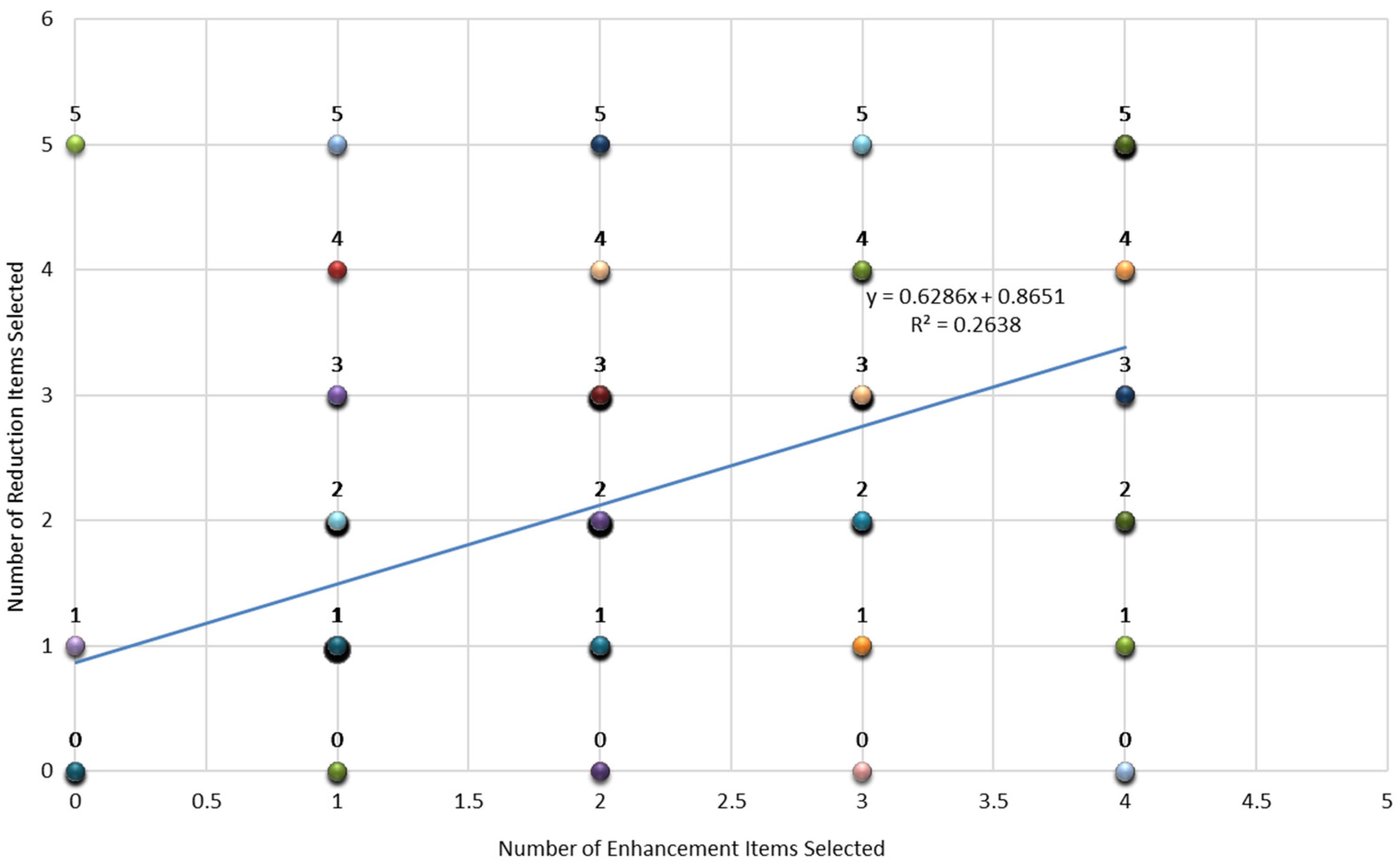
The dual-view phenomenon was also evident as a positive association between the breadth of perceived enhancement and reduction mechanisms. The social enhancement index (0–4) and social reduction index (0–5) were positively correlated (Spearman’s ρ = 0.547, p < 0.001). To evaluate whether this association could be obtained due to ‘select-all-that-apply’ responses, we conducted robustness checks. When the ‘no effect’ option was included as a counted selection, the correlation remained positive (ρ = 0.590, p < 0.001). When we trimmed the top 5–10% of respondents based on overall selections across other multi-select questions, the correlation remained positive and of similar magnitude (ρ range = 0.526–0.583). Together, these results support a robust dual-view phenomenon rather than a simple split between optimists and sceptics. Willingness to use chatbots was positively associated with both the social enhancement index (ρ = 0.23, p < 0.001) and the social reduction index (ρ = 0.15, p = 0.002), indicating that enthusiasm and concern co-occur within individuals rather than characterise separate groups. Table 7 and Table 8 present the specific mechanisms through which students believe AI chatbots may enhance and reduce the social dimensions of learning.
Figure 2 visualises the dual-view phenomenon by plotting the number of selected social enhancement mechanisms against the number of selected social reduction mechanisms.
Dual-view endorsement was consistently high across institutions (88.5–95.4%) and year groups (85.7–97.5%). An institution-by-dual-view χ2 test (Institutions 1–3) was not statistically significant, χ2(2) = 2.63, p = 0.269, V = 0.08, indicating broadly similar dual-view prevalence across partnership contexts. Differences by year group were statistically detectable but small, χ2(3) = 9.62, p = 0.022, V = 0.14, driven by lower dual-view prevalence in the smallest senior-year subgroup.
Ambivalence intensity mattered for lecturer role expectations. Students in the high ambivalence tertile were substantially more likely to expect lecturers to curate chatbot resources (42.5% vs. 9.7% in the low tertile; χ2(1) = 44.12, p < 0.001, V = 0.38) and to check chatbot accuracy (27.6% vs. 13.4%; χ2(1) = 8.82, p = 0.003, V = 0.17). High-ambivalence students were also more likely to expect lecturers to spend more time motivating students and helping them overcome learning challenges (55.9% vs. 23.7%; χ2(1) = 32.40, p < 0.001, V = 0.32) and to expect chatbots to handle simple questions so lecturers can lead discussions and practical activities (72.0% vs. 56.2%; χ2(1) = 8.25, p = 0.004, V = 0.17). Table 9 summarises these comparisons.

4.4. Support Needs and Their Relationship with Adoption Readiness (RQ3)

Most students indicated that they would need substantial support to use AI chatbots effectively in STEM modules. High support (43.7%) and moderate support (35.1%) were the most common responses, followed by extensive support (16.7%). Only 4.5% indicated very little or no support.
Support needs were positively associated with adoption attitudes. Students who reported higher comfort using chatbots also reported higher support needs (ρ = 0.414, p < 0.001), as did students with stronger willingness to use chatbots (ρ = 0.375, p < 0.001) and stronger intentions to recommend them (ρ = 0.527, p < 0.001). AI familiarity was also positively associated with support needs (ρ = 0.250, p < 0.001). One interpretation is that students who are more engaged with AI tools recognise a greater need for structured guidance, policies, and learning design to use chatbots responsibly and effectively. Table 10 reports the distribution of perceived support needs for effective chatbot use.
Table 10 reveals two key patterns. First, most students report needing substantial support (high or moderate), indicating that adoption readiness does not imply self-sufficiency. Second, the positive associations between support needs and adoption indicators suggest that engaged students recognise the complexity of responsible AI use rather than assuming chatbots are straightforward tools.

4.5. Variation Across Institutions and Year of Study (RQ4)

Adoption readiness indicators were broadly positive across institutions and years, but several differences were statistically detectable. Willingness to use an AI chatbot varied across institutions (Institution-1 to Institution-3) (χ2(8) = 18.59, p = 0.017, V = 0.14). Across these three institutions, the shares of students reporting they were somewhat or very likely to use a chatbot were in the following order: 76.1% (Institution-2), 77.7% (Institution-1), and 88.5% (Institution-3). Willingness also differed by year of study (χ2(12) = 26.20, p = 0.010, V = 0.14), although all year groups reported high willingness (76.0–87.8%).
Support needs also varied by year (χ2(12) = 25.33, p = 0.013, V = 0.13), with senior students more likely to report extensive support needs. However, because the dominant pattern across all groups was high support demand, these differences should be interpreted as shifts in degree rather than as a change in overall direction.
Regarding lecturer role expectations, as noted in Section 4.2, institutional differences appeared for several specific role change items but not for the overarching expectation of a shift toward facilitation and higher-order learning. Similarly, the dual-view phenomenon described in Section 4.3 was observed across partnership contexts, with a high prevalence in each institution and year group.

4.6. Qualitative Insights from Open-Ended Responses

Open-ended responses provided additional context for interpreting the quantitative patterns. Of the 467 participants, 454 provided usable written comments. Many responses were brief (e.g., ‘none’ or ‘no’), but a substantial subset articulated concrete use cases and concerns. Using keyword-assisted reading, we determined that the most common themes were concept clarification and explanation, efficiency and time savings, overreliance and reduced independent thinking, and concerns about accuracy or reliability. Comments about interactions with teachers and peers, and about institutional policy or training, appeared less frequently but were often detailed. Below, we summarise four themes that directly illuminate lecturer role expectations and the dual-view phenomenon.

4.6.1. Theme 1: Efficiency, Access, and Just-in-Time Support

Students often described chatbots as a practical supplement to limited contact time, especially for routine questions and when they were stuck. Several comments framed chatbots as a tool to obtain immediate clarification without the need to schedule office hours or tutoring sessions. This aligns with the survey finding that many students expect chatbots to handle simple questions, allowing lecturers to focus class time on deeper activities.
“I use ChatGPT when I am stuck and have a problem. I can solve it quickly, and I don’t need to book an appointment with a tutor.”
“ChatGPT 的使用大大提高了我对于知识点学习的效率。” (Translated from Chinese: ‘Using ChatGPT greatly improves my efficiency in learning key concepts.’)

4.6.2. Theme 2: Accuracy, Verification, and Epistemic Vigilance

Alongside efficiency, students highlighted limitations in accuracy and the need to verify chatbot outputs, particularly for calculations and technical details. Some students described chatbots as applicable for explanation but risky for exact computation, echoing lecturer role expectations that emphasise checking and guiding appropriate use.
“It should not be used for any equation calculation, because it may output incorrect results.”
“AI should be carefully used in studies and should be checked for precision.”

4.6.3. Theme 3: Overreliance, Independent Thinking, and Social Interaction

Students frequently expressed concern that easy access to answers could reduce effort, weaken independent thinking, or decrease interaction with others. Notably, some comments explicitly linked overreliance to reduced peer engagement, illustrating how perceived benefits and risks can co-exist in the same response.
“In fact, I used it to solve some exercises… it should not be used frequently, because it might make the students overly reliant and thus reduce the interaction with others.”

4.6.4. Theme 4: The Lecturer as a Facilitator, Motivator, and Guide

Several students framed chatbots as tools that can reduce learning friction, but they also underscored the need for human support in motivation, emotional experience, and responsible practice. Some explicitly called for institutional provision of tools and training. These comments provide a qualitative counterpart to the survey pattern in which students expect more lecturer time for motivation and support, alongside high perceived support needs.
“The advantages are that it can give positive emotional value and so on. It is more encouraging, while teachers may be impatient.”
“It is important to set some courses to teach students how to use it. The improper use may lead to harm.”
One student explicitly requested institutionally supported tools and curricular integration: “I think the university should provide some official AI tools, and some courses could require the appropriate use of AI to help students adapt”.

5. Discussion

5.1. From Content Delivery to Learning Facilitation

The most consistent message in the data is that students expect AI chatbots to change what lecturers spend time on, not whether lecturers matter. The two most frequently endorsed expectations—delegating routine questions to chatbots and reallocating time from basic explanation to deep thinking and problem solving—both describe a shift in emphasis toward facilitation. This aligns with long-standing arguments in educational technology that new tools alter the instructor’s value proposition by making information more accessible while increasing the importance of design, scaffolding, and interaction.
Interpreted through a professional knowledge lens, these expectations resonate with TPACK and its recent extensions for generative AI. If chatbots can produce explanations, then lecturers’ distinctive contribution lies in curating disciplinary ways of thinking: framing problems, modelling reasoning, and helping students evaluate and justify solutions using evidence and constraints (Mishra & Koehler, 2006; Mishra et al., 2023). Students’ endorsement of motivation and individual support items further underscores that the lecturer’s role is not only cognitive but also relational. Even highly capable chatbots do not possess responsibility for student progression or hold the institutional authority to set standards, interpret learning outcomes, or mediate assessments.
At the same time, the results do not imply that facilitation is effortless. Students recognised that lecturers may need new technology skills and may need to check chatbot accuracy and appropriateness. These expectations mirror concerns from instructor-focused studies: integrating generative AI can increase workload through monitoring, feedback redesign, and the need to teach AI literacy (Lee et al., 2024; Zhai et al., 2024). Rather than treating this as a contradiction, it is more useful to interpret it as a reallocation of labour. Routine explanation may decrease, but design, oversight, and emotional support may increase.
This redistribution has assessment implications. If lecturers reallocate time toward higher-order learning, then assessment must also value higher-order outcomes. Guidance from quality assurance bodies emphasises aligning assessment with learning outcomes in the context of AI availability (QAA, 2023). In practical terms, this may mean greater emphasis on reasoning steps, oral explanation, lab performance, and reflective critique of AI outputs, rather than solely on final written products that chatbots can easily generate.

5.2. Understanding the Dual-View Phenomenon in Social Perceptions

The dual-view phenomenon offers a useful correction to both polarised narratives and overly ‘net attitude’ models of AI adoption. Students in this study were not simply ‘for’ or ‘against’ chatbots. Instead, most students simultaneously perceived ways chatbots could enhance social learning (e.g., reducing anxiety before speaking) and ways they could reduce it (e.g., displacing peer discussion). The positive association between enhancement and reduction endorsements suggests that perceived benefits and perceived risks often go hand in hand.
This pattern challenges a standard analytical shortcut in technology acceptance research: collapsing evaluations into a single overall attitude or intention score. In our data, willingness to use chatbots was positively associated not only with perceived social enhancement (ρ = 0.23, p < 0.001) but also with perceived social reduction (ρ = 0.15, p = 0.002). Enthusiasm and concern therefore co-exist, which helps explain why students can be simultaneously eager to use AI and anxious about its social consequences. From a theoretical perspective, this supports treating social enhancement and social reduction as separable belief dimensions and treating ambivalence as a meaningful state rather than as noise (Scherer et al., 2019; Venkatesh et al., 2003).
Importantly, ambivalence was linked to lecturer role expectations. Students with higher social ambivalence were far more likely to expect lecturers to curate chatbot resources, check chatbot accuracy, and reallocate effort toward motivation and higher-order engagement. These findings indicate that the management of trade-offs partly shapes the lecturer’s role: the more students perceive competing implications, the more they expect lecturers to provide structure, boundaries, and interpretive guidance.
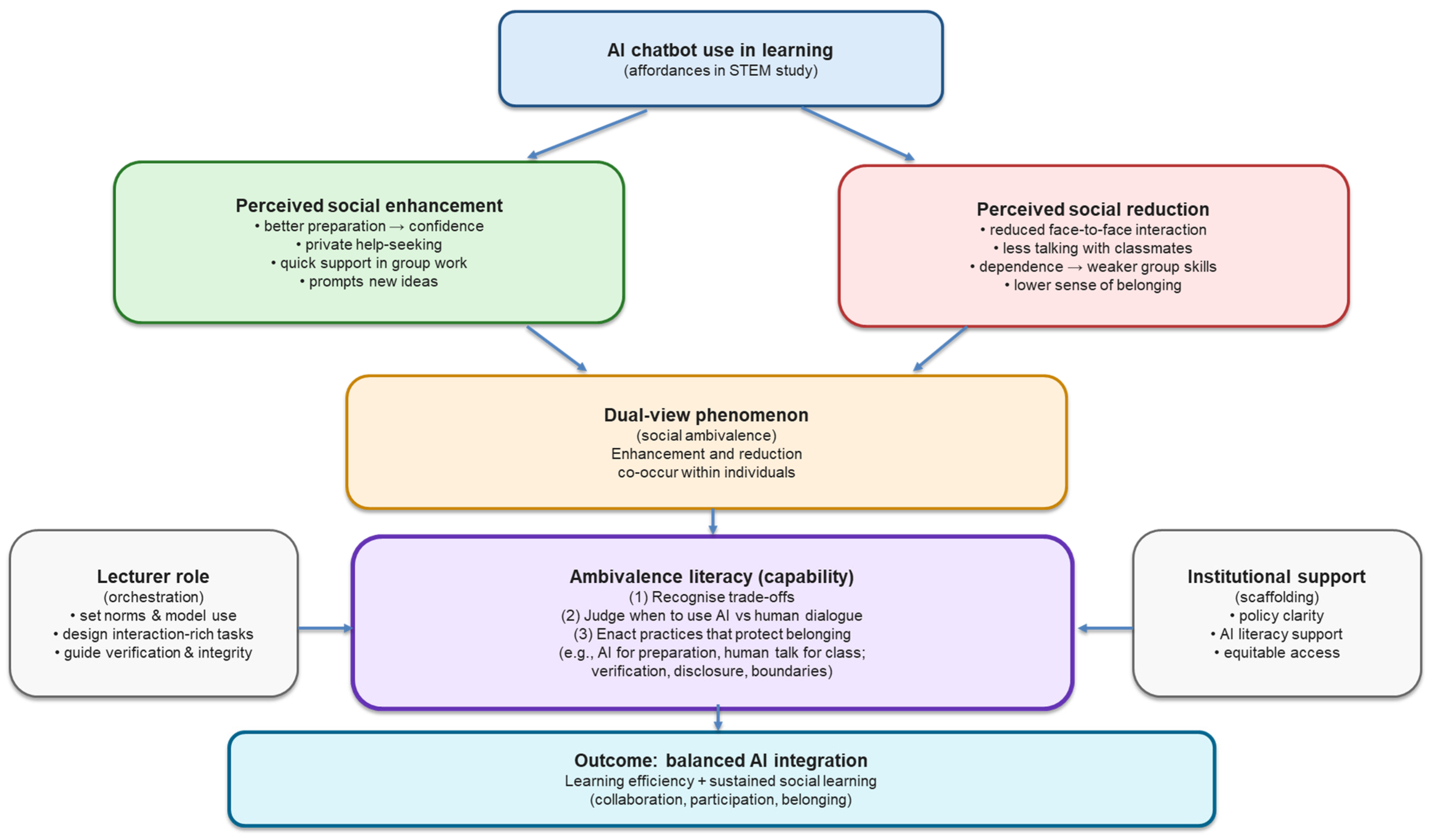
These findings point to a practical–theoretical contribution: ambivalence literacy. By ambivalence literacy, we mean the capability to recognise competing AI functionalities, to make context-sensitive choices about when to use AI versus human dialogue, and to enact verification and interaction practices that protect belonging while still benefiting from AI support. Developing ambivalence literacy reframes AI integration from ‘allow or ban’ decisions toward cultivating students’ judgement under uncertainty. Figure 3 presents a conceptual model summarising how ambivalence literacy operates within this framework.
One interpretation is that students who think more deeply about social consequences have more considerations in both directions. Rather than indicating confusion, dual-view responses may reflect a nuanced understanding that technology adoption involves trade-offs. This interpretation is consistent with technology paradox perspectives, in which the same affordance can yield competing outcomes depending on the context of use (Jarvenpaa & Lang, 2005). For example, private question asking can be empowering for hesitant students, but it may weaken the community if it becomes a substitute for peer dialogue. Similarly, quick support during group projects can help teams progress, but it may reduce the negotiation and explanation aspects that foster collaboration.
In pedagogy, the implication is that social interaction should be treated as a design objective rather than an accidental by-product. If instructors assume that chatbots will automatically ‘improve participation’ because they provide support, they may overlook substitution effects in which students choose chatbots instead of people. Conversely, if instructors respond to integrity concerns by banning chatbots, they may miss opportunities to use chatbots to prepare students for richer in-class interaction. A dual-view perspective encourages targeted interventions: using chatbots for preparation, drafting, and self-explanation while designing class time for peer argumentation, lab activity, and feedback that students cannot easily replace with a chatbot.
The robustness checks strengthen confidence in this interpretation. Even when scoring rules were altered and the influence of high multi-select responders was reduced, the association remained positive and substantive. These findings indicate that the dual-view phenomenon is not merely a measurement artefact but a stable feature of students’ perceptions in this context.

5.3. Transnational Education as a Context for AI Integration

While the dual-view phenomenon appeared universal, the institutional context still mattered for specific expectations. Although many patterns were consistent across the three compared institutions, the observed institutional differences suggest that partnership context shapes which aspects of role transformation are most relevant. For example, students in one programme were more likely to expect chatbots to handle common questions and saw a stronger role for lecturers in supporting international students. These differences may reflect variation in cohort composition, teaching arrangements, or baseline support structures, which are common sources of heterogeneity in TNE environments.
In TNE, AI integration is also a governance challenge. Partner institutions must align on policies for assessment, integrity, and acceptable tool use, while recognising that students may access different platforms and receive mixed messages across courses (British Council, 2021; QAA, 2023). Role expectations, therefore, matter at multiple levels: they shape not only classroom practice but also how institutions communicate responsibilities and resources. If students expect lecturers to provide guidance and verification, then a policy that focuses only on student misconduct may miss a core need: structured teaching about how to use AI tools within disciplinary norms.
The finding that students expect enhanced support for international students is particularly relevant in English-medium TNE settings. AI chatbots can assist with language mediation and with interpreting course requirements, but they cannot replace culturally responsive teaching or the development of academic discourse practices. Lecturers may need to design interaction structures that ensure chatbots support inclusion rather than create parallel learning tracks in which some students interact mainly with AI while others engage with peers and staff.

5.4. Support Needs as an Institutional Design Requirement

A striking result is the near-universal expectation that support will be needed to use chatbots effectively. Importantly, support needs were higher among students who were more willing, more comfortable, and more likely to recommend chatbots. These findings indicate that support should not be framed only as remediation for reluctant users. Instead, it should be treated as part of responsible innovation: students who intend to use AI tools want more explicit guidance on how to use them well.
Qualitative comments help explain what support likely means from a student perspective. Students asked for official access to tools, training on appropriate use, and checks for precision and reliability. These requests align with policy guidance that emphasises transparency, AI literacy, and safeguards against misinformation and inequity (UNESCO, 2023). In STEM, where minor errors can propagate through calculations and designs, the need for epistemic vigilance is particularly salient. Lecturers can model this by showing how to test chatbot outputs against first principles, known constraints, and external references.
Taken together, the quantitative and qualitative results suggest a pragmatic stance among students: use chatbots to reduce friction and increase access, but retain the lecturer’s responsibilities regarding learning design, motivation, and the protection of interaction and integrity. This stance provides a practical basis for AI integration strategies that avoid both naive enthusiasm and blanket rejection.

5.5. Toward Responsible AI Integration: Balancing Efficiency, Integrity, and Belonging

The combination of high willingness, high perceived learning benefit, and high support demand suggests that responsible integration should be framed as an educational design challenge rather than a compliance exercise. Students appear ready to use chatbots regardless of whether courses explicitly integrate them, suggesting that the absence of guidance may push their use into private spaces. In such settings, students may default to convenience strategies (e.g., asking for complete solutions) that reduce learning and interaction, even when they recognise the risks. Embedding guidance within teaching is therefore likely to be more effective than relying on warnings alone.
Academic integrity is an obvious pressure point. If chatbots can generate fluent explanations and code, then assessment tasks that primarily reward polished output become vulnerable to outsourcing. Institutional guidance increasingly recommends assessment redesign toward process evidence, authentic performance, and reflective critique of AI assistance (Department for Education, 2025; QAA, 2023). Our findings add a student-side rationale for such redesign: students expect lecturers to focus on complex topics, deep thinking, and motivation, which are difficult to assess through product-only tasks. Assessments that value reasoning and interaction can also reduce the perceived need to hide AI use.
Equity and belonging are equally important. The dual-view phenomenon indicates that students anticipate both confidence gains and potential social disconnection. If chatbots replace speaking with peers and teachers, students who are already socially marginalised may become even more isolated. In contrast, students with greater access to tools may gain a disproportionate advantage. In TNE settings, where language and cultural norms already shape participation, lecturers may need to pay particular attention to interaction structures that create psychological safety and shared responsibility for learning. This again positions the lecturer as an active designer of participation, rather than simply a content expert.

5.6. Lecturer Development and Institutional Capacity

Student expectations imply a substantial professional development agenda. Even though only a minority explicitly selected the option that lecturers would need new technology skills, this item still reflects a meaningful portion of the cohort. Moreover, students’ qualitative comments frequently emphasised accuracy, verification, and responsible use, which are not purely technical concerns but pedagogical ones. Educator-focused research similarly reports that lecturers anticipate needing support in redesigning learning activities, monitoring AI use, and developing confidence in guiding students (Lee et al., 2024; Zhai et al., 2024). In STEM modules, where misconceptions can cascade through multi-step reasoning, lecturer competence in diagnosing errors in AI-generated explanations and in modelling checking practices becomes a visible marker of teaching quality.
Frameworks such as Intelligent-TPACK provide a helpful structure for such capacity development because they treat ethics and responsibility as central factors rather than peripheral ones (Celik, 2023). From this perspective, lecturer development should include at least four elements: first, practical prompt literacy: how to formulate prompts that elicit reasoning steps, reveal assumptions, and encourage multiple solution paths; second, evaluation literacy: how to test chatbot outputs against disciplinary constraints, authoritative sources, and empirical checks, and how to teach students to do the same; third, design literacy: how to integrate chatbots into activities that preserve learning processes such as explanation, practice, and feedback, rather than allowing chatbots to replace them; and fourth, ethical and policy literacy: how to manage privacy, bias, and acceptable use in line with institutional guidance (Mishra et al., 2023; QAA, 2023; UNESCO, 2023).
Finally, the lecturer role transformation is unlikely to succeed if treated as an individual burden. Because generative AI evolves rapidly, sustainable practice requires collective resources such as shared prompt banks, example tasks, and assessment templates that can be updated across modules and, in TNE settings, across partner institutions. It also requires clear boundaries: lecturers cannot be expected to individually verify every possible chatbot interaction that students conduct outside class. Instead, lecturers can set norms, teach verification strategies, and design assessments and learning activities that reward process evidence and human interaction. Institutional investment in staff development, learning analytics, and support services can reduce workload volatility while making expectations more consistent for students.

5.7. Cultivating Student Self-Regulation in AI-Assisted Learning

Beyond lecturer development, cultivating student self-regulation is essential in AI-assisted learning. Chatbots can create an illusion of competence: a fluent answer may appear convincing even when the student has not internalised the reasoning. To counter this, lecturers can require students to externalise thinking and to make their use of AI visible for learning rather than for policing. Practical approaches include asking students to submit a brief ‘AI interaction log’ that records prompts, revisions, and verification steps; using prompts that force the chatbot to present alternative methods and to state assumptions; and incorporating reflection questions such as ‘Which step do you not trust and why?’ or ‘How would you test this result differently?’ These strategies align with calls to teach critical AI literacy and self-regulated learning skills as part of AI integration, shifting the emphasis from answer production to judgement and reasoning (Farazouli et al., 2024; Moorhouse et al., 2023).
Ambivalence literacy provides a complementary lens for this self-regulation agenda. Because many students anticipate both social benefits and costs, lecturers can legitimise ‘mixed feelings’ and use them as material for learning design. Practical approaches include structured trade-off reflection (e.g., ‘How did AI help you prepare, and what interaction did you replace?’), scenario-based boundary setting (what to ask a chatbot versus a classmate or lecturer), and activities that require students to bring AI outputs into peer discussion for critique and revision. Such strategies help students treat AI support as a prelude to human interaction rather than a substitute for it, building habits that align efficiency with integrity and belonging.

5.8. Theoretical Implications

Beyond documenting student expectations, this study has three interlinked theoretical implications for research on AI-enabled learning and lecturer role transformation.
First, the dual-view phenomenon indicates that social beliefs about AI chatbots are not well represented by a single “overall attitude” continuum. Technology acceptance research often models positive beliefs as counterpoints to perceived risk, then collapses these beliefs into intention and use (Venkatesh et al., 2003; Scherer et al., 2019). In our data, perceived social enhancement and perceived social reduction were positively associated, and willingness to use chatbots co-occurred with concern. This pattern supports the view that benefit and risk are co-activated belief dimensions, consistent with technology-paradox perspectives in which the same affordance can generate competing outcomes (Jarvenpaa & Lang, 2005). For AI in education research, these findings suggest that “acceptance” measures may under-specify the social domain: students can be high-intention users while remaining vigilant about what might be lost.
Second, we propose ambivalence literacy as a bridge between attitudinal research and pedagogy. Ambivalence literacy frames students’ mixed evaluations as a learnable capability comprising: (i) recognising competing affordances, (ii) making context-sensitive choices about when AI support is appropriate versus when human dialogue is preferable, and (iii) making verification and interaction practices explicit. Rather than treating ambivalence as noise to be minimised, this perspective positions it as a design-relevant signal that can guide course policies, assessment expectations, and staff development for responsible AI-integrated learning.
Third, the findings extend lecturer role transformation frameworks by incorporating student expectations as a validity lens. TPACK and its generative AI-era extensions conceptualise what educators should know and do in technology-rich environments (Mishra & Koehler, 2006; Mishra et al., 2023; Celik, 2023), while recent work has focused on shifts in teacher agency and roles in the generative AI era (Zhai et al., 2024). Our data suggest that students primarily expect lecturers to (a) redistribute labour toward facilitation, motivation, and higher-order thinking and (b) coordinate AI-related trade-offs (curation, norm-setting, and guidance on verification and interaction). We therefore propose that teacher knowledge frameworks may usefully include ‘orchestration of ambivalence’—helping students use AI to prepare for richer human interaction rather than allowing AI to replace it. This hypothesis warrants empirical testing in future research.
Together, these implications suggest a research agenda that treats ambivalence as structured rather than residual, by developing measures of ambivalence literacy, examining whether it is linked to productive but socially sustainable AI use, and testing how lecturer orchestration and institutional scaffolding jointly shape these outcomes, particularly in transnational education settings where policy signals and cultural expectations may diverge (British Council, 2021; Montgomery, 2016; QAA, 2023).

6. Implications and Recommendations

Because student expectations integrate strong interest in chatbot use with great concern for social and epistemic risks, effective AI integration requires coordinated action by lecturers and institutions. Based on the findings, we offer recommendations organised around two levels: individual lecturers and teaching teams (Section 6.1), and institutions and programme leadership (Section 6.2). Each recommendation is grounded in the empirical patterns reported above.

6.1. Recommendations for Lecturers and Teaching Teams

The following practices address student expectations for facilitation, epistemic vigilance, and support:
  • Use chatbots to support preparation, not to replace interaction: assign chatbot-supported pre-class work (e.g., concept explanations or practice generation) and reserve class time for peer discussion, labs, and feedback.
  • Teach epistemic vigilance explicitly: demonstrate how to verify chatbot outputs, identify hallucinations, and justify solutions using disciplinary norms and external sources.
  • Redesign assessment around process and judgement: emphasise reasoning steps, reflection, oral explanation, and authentic tasks that require contextual decision making, rather than only final answers.
  • Address motivation and help seeking: frame chatbots as tools for reducing anxiety and lowering the cost of asking questions, while encouraging students to bring chatbot-generated uncertainties to peers and instructors.
  • Clarify boundaries and expectations: communicate when chatbot use is acceptable, what constitutes misconduct, and how students should acknowledge AI assistance where relevant.

6.2. Recommendations for Institutions and Programme Leadership

  • Provide structured support and training: develop short modules or workshops on effective and ethical chatbot use for STEM, including examples aligned with module learning outcomes.
  • Offer approved tools and guidance: where possible, provide institutionally supported AI tools or access arrangements, and publish guidance on data privacy, bias, and acceptable use.
  • Invest in lecturer development: support staff in prompt literacy, AI-integrated pedagogy, and assessment redesign, drawing on frameworks such as Intelligent-TPACK to integrate ethics alongside skills (Celik, 2023).
  • Monitor equity implications: track whether access to paid tools, language proficiency, or prior experience creates uneven benefits, and design supports to mitigate disparities.
  • Coordinate policy across partner institutions in TNE: align assessment and integrity policies and ensure that students receive consistent messaging across modules and campuses.

6.3. Additional Recommendations for Transnational Education Partnerships

Because TNE programmes are jointly governed, AI integration benefits from explicit coordination across partner institutions. Based on the institutional variation and students’ requests for guidance observed in this study, we recommend that TNE partnerships consider the following partnership-level actions:
  • Publish a joint statement on acceptable AI chatbot use applicable across modules taught by different partner institutions.
  • Develop shared training resources (student- and staff-facing) that use discipline-specific STEM examples and clarify expectations for verification and attribution.
  • Create agreed upon processes for assessment review when AI tools materially change what tasks can be outsourced, including cross-partner moderation where appropriate.
  • Provide consistent access arrangements and support channels so that students are not advantaged or disadvantaged by which campus or platform they use.

7. Limitations and Future Research

This study has several limitations. First, the data are cross-sectional and self-reported, capturing expectations and perceptions rather than observed behaviour or learning outcomes. Students may overestimate or underestimate how chatbots will affect their interaction and skill development in practice. Future research could pair survey data with learning analytics or classroom observations to examine whether expressed expectations align with actual behaviour in AI-integrated settings.
Second, the sample was drawn from four China-based transnational STEM programmes. While this context is theoretically and practically relevant, caution is recommended when generalising to other countries, disciplines, or non-TNE settings. One institution in the dataset had a small sample, limiting precision for that subgroup. TNE students navigate unique cross-cultural pedagogical dynamics, including Western emphases on critical inquiry alongside Chinese educational traditions, which may heighten expectations for facilitation compared to those in domestic programmes. STEM disciplines also involve problem-solving tasks where AI chatbots are particularly capable, potentially amplifying both perceived benefits and concerns relative to humanities or social science disciplines.
Third, multi-select items provide breadth but also create analytic constraints. Counts of selected options are useful as indices, but they do not capture the intensity of agreement, and response styles can influence them. We addressed this with robustness checks, but future work could use scale-based measures or latent profile analysis to examine perception clusters more formally.
Fourth, Institution-4 contributed only five respondents, and one additional record lacked institution data. These six cases were retained in pooled descriptive analyses (n = 467) but excluded from all between-institution comparisons (n = 461). Because five responses cannot support meaningful institutional inference, the comparative findings should be interpreted as reflecting only the three larger programmes. Should future data collection yield a viable sample from Institution-4, a four-programme replication would strengthen the cross-institutional evidence base.
Fifth, the qualitative analysis reported here is exploratory. Keyword-assisted grouping and illustrative quotations help contextualise patterns, but a complete thematic analysis with double coding and richer narrative data would strengthen interpretive claims.
Sixth, we propose ambivalence literacy as a conceptual construct but did not directly measure it as a psychometric scale. Future research should develop and validate an ambivalence literacy instrument to examine whether individual differences in this capability predict productive AI use, sustained social engagement, and learning outcomes. Such a scale could also test whether ambivalence literacy can be taught through targeted interventions.
Future research can build on these findings in at least three directions. Longitudinal studies could examine how expectations change as institutional policies stabilise and as students gain experience. Experimental or quasi-experimental designs could test whether specific AI-integrated pedagogies can preserve social interaction while improving learning efficiency. Finally, comparative work across different TNE partnership types and across domestic programmes could clarify which contextual features most strongly shape lecturer role expectations.

8. Conclusions

As AI chatbots become embedded in students’ everyday study practices, lecturers and institutions need clearer evidence of what learners expect from human teaching. Survey data from 467 STEM undergraduates across four transnational education programmes indicate that students anticipate a meaningful transformation of the lecturer role rather than replacement. Students most often expect chatbots to absorb routine questions and factual explanations so that lecturers can devote more time to deeper discussion, practical activities, and guidance on how to think and solve problems.
At the same time, students display a robust dual-view phenomenon in social perceptions. Most students simultaneously anticipate that chatbots can enhance social learning (e.g., increasing confidence and supporting collaboration) and reduce it (e.g., decreasing face-to-face interaction and weakening social connections). This ambivalence is not noise: the breadth of perceived enhancement is positively associated with the breadth of perceived reduction even under alternative scoring and response-style robustness checks. Moreover, students with stronger social ambivalence were substantially more likely to expect lecturers to curate chatbot resources, check chatbot accuracy, and provide motivational and facilitative support. This pattern suggests that ambivalence is associated with expectations for lecturer governance, making it a relevant consideration for learning design.
Finally, students’ strong willingness to use chatbots co-exists with a strong expectation of support. These findings indicate that responsible AI integration should focus on scaffolding, epistemic vigilance, and interaction design. For TNE programmes, the findings underscore the importance of coordinating policy and professional development across partners to ensure students receive consistent guidance and equitable support. As a conceptual direction, we propose ambivalence literacy as a framework for AI-integrated pedagogy, helping students recognise trade-offs and develop habits that benefit from AI while protecting human interaction and belonging.

Author Contributions

Conceptualization, K.K. and D.W.; methodology, K.K., D.W. and W.S.; software, K.K., D.W. and W.S.; validation, K.K.; formal analysis, K.K.; investigation, K.K., D.W. and W.S.; resources, K.K., D.W. and W.S.; data curation, K.K., D.W., M.R. and W.S.; writing—original draft preparation, K.K.; writing—review and editing, K.K., D.W., M.R. and W.S.; visualisation, K.K.; project administration, K.K., D.W. and W.S. All authors have read and agreed to the published version of the manuscript.

Funding

This research received no external funding.

Institutional Review Board Statement

This study was conducted in accordance with the Declaration of Helsinki and approved by the Research Ethics Committee of the Faculty of Engineering and Physical Sciences at the University of Leeds (reference: 2714; 8 March 2025).

Informed Consent Statement

Informed consent was obtained from all subjects involved in this study.

Data Availability Statement

All relevant data are presented within this paper. The data are available on request from the corresponding author.

Acknowledgments

The authors thank Sophia Zuoqiu at the Sichuan University–Pittsburgh Institute (SCUPI) for facilitating the distribution of the survey.

Conflicts of Interest

The authors declare no conflicts of interest.

Appendix A. Key Survey Items (Abridged)

The survey instrument included the following core items. Wording is summarised for brevity.
Adoption readiness (single items; five-point response scales):
  • AI familiarity (Not familiar–Very familiar).
  • Perceived importance of AI in STEM education over the next 5–10 years (Not important–Very important).
  • Willingness to use an AI chatbot in a STEM module (Very unlikely–Very likely).
  • Comfort using an AI chatbot in a STEM module (Very uncomfortable–Very comfortable).
  • Willingness to recommend AI chatbot use (Very unlikely–Very likely).
  • Support needed to use AI chatbots effectively (No support–Extensive support).
Expected lecturer role changes (multi-select; choose all that apply):
  • AI chatbots could handle simple questions, allowing lecturers to lead more interesting discussions or practical activities.
  • Instead of explaining basic facts, lecturers could spend more time guiding students on how to think deeply or solve problems.
  • Chatbots could answer common questions so that lecturers can focus on more complex topics.
  • Lecturers will spend more time motivating students and helping them overcome learning challenges, rather than just giving lectures.
  • With chatbot help, lecturers can better understand individual students’ problems and spend more time helping them personally.
  • Lecturers might better support international students individually, given chatbot assistance on routine queries.
  • Lecturers may create and choose chatbot resources.
  • Less pressure on lecturers.
  • Lecturers might need to check chatbot accuracy.
  • Lecturers will need new technology skills.
Perceived social impacts (two multi-select items; choose all that apply):
Social enhancement options:
  • Chatbots can help students prepare better, so they feel more comfortable speaking in class or group activities.
  • Students might feel more confident asking questions privately to a chatbot first.
  • Chatbots could help students collaborate by providing quick support during group projects.
  • Chatbots might encourage discussions by giving interesting or new ideas.
  • No effect: I don’t think an AI chatbot would change social interaction at all.
Social reduction options:
  • Chatbots might reduce face-to-face interaction with teachers or peers.
  • Students might become less skilled at working in groups if they depend on the chatbot.
  • Students might talk less with classmates because they rely on chatbot answers.
  • Students might feel less connected socially if they mostly interact with a chatbot instead of real people.
  • Students might avoid interacting with peers from different backgrounds if chatbot reliance increases
  • No effect: I don’t think an AI chatbot would change social interaction at all.

Appendix B. Qualitative Codebook

Table A1. Qualitative codebook: categories, definitions, inclusion criteria, and illustrative student quotes (n = 454 usable responses).
CategoryDefinitionInclusion CriteriaIllustrative Quote(s)
1. Efficiency and Access
(n = 29)
AI chatbots are described as time-saving, providing instant responses, or improving access to information and study support.Must reference speed, convenience, time saving, or availability. Excludes general positive statements with no efficiency rationale.“Artificial intelligence can save time to ask a teacher.” (Year 2, EEE)
“I think its biggest advantage is the quick response.” (Year 1, ME)
2. Accuracy and Verification Concerns
(n = 39)
Concern about incorrect, unreliable, or shallow AI outputs, and the need to check or verify AI-generated answers.Must reference errors, wrong answers, checking, verification, or reliability. Includes mathematical and factual inaccuracies.“Sometimes the AI chatbot will offer the wrong answers… if I didn’t check, I will easily repeat these in my notebook.” (Year 2, EEE)
“AI may have some mistakes.” (Year 1, MSE)
3. Over-reliance and Critical Thinking
(n = 22)
Concern that students may become dependent on AI, lose independent thinking skills, or reduce creative and critical engagement.Must reference dependency, reliance, laziness, loss of critical thinking, or reduced creativity.“It might be a potential threat for students who rely on AI.” (Year 1, ME)
“It will decrease the critical thinking ability in many fields.” (Year 1, ME)
4. Complementary Tool and Human Balance
(n = 29)
AI is framed as a supplementary tool that should support rather than replace human teaching, peer interaction, or independent learning.Must reference complementing, not replacing, or a balance between AI and human elements.“AI chatbots are powerful allies but require intentional design to complement, not replace, human-led pedagogy.” (Year 1, CET)
“Chatbots should assist schools rather than dominate learning.” (Year 4, SE)
5. Specific Use Cases and Disciplinary Applications
(n = 73)
Particular tasks or contexts in which students use or would use AI chatbots, including coding, mathematics, writing, research, and concept clarification.Must name a specific task or discipline. General statements without task specifics are excluded.“I use GitHub’s AI to help me write code in VSCode, which is very convenient.” (Year 3, CS)
“I use AI to deal with experiment data.” (Year 1, ME)
6. Language and Communication Support
(n = 10)
AI assistance with English writing, terminology, translation, or communication in the English-medium instructional context.Must reference language, English, writing support, terminology, or translation.“I sometimes use it to improve my English writing.” (Year 1, MSE)
“I use LLM to understand some complex concepts and terminologies, which enables better learning.” (Year 3, CS)
7. Governance, Policy, and Institutional Support
(n = 12)
Expectations or requests regarding institutional provision, official tools, guidelines, or lecturer oversight of AI use.Must reference institutional actions, official tools, policy, guidelines, or the role of the university or lecturer in governing AI use.“Provide official AI tools by Leeds.” (Year 2, EEE)
“I hope teachers can guide us on how to use AI correctly.” (Year 2, CS)
8. Limitations and Improvement Requests
(n = 34)
Current limitations of AI chatbots or suggestions for features and improvements, including visual content, personalisation, and depth of response.Must identify a specific limitation or improvement need. Vague dissatisfaction without specifics is excluded.“AI’s drawing capabilities are still underdeveloped.” (Year 4, SE)
“The answer could be more humane.” (Year 4, SE)
“Sometimes it cannot give the answer I want.” (Year 1, EEE)

References

  1. Abbas, M., Jam, F. A., & Khan, T. I. (2024). Is it harmful or helpful? Examining the causes and consequences of generative AI usage among university students. International Journal of Educational Technology in Higher Education, 21, 10. [Google Scholar] [CrossRef] [Scilit]
  2. Abdaljaleel, M., Barakat, M., Alsanafi, M., Salim, N. A., Abazid, H., Malaeb, D., Mohammed, A. H., Hassan, B. A. R., Wayyes, A. M., Farhan, S. S., El Khatib, S., Rahal, M., Sahban, A., Abdelaziz, D. H., Mansour, N. O., AlZayer, R., Khalil, R., Fekih-Romdhane, F., Hallit, R., … Sallam, M. (2024). A multinational study on the factors influencing university students’ attitudes and usage of ChatGPT. Scientific Reports, 14, 1983. [Google Scholar] [CrossRef] [Scilit]
  3. Al-Zahrani, A. M. (2025). Exploring the impact of artificial intelligence chatbots on human connection and emotional support among higher education students. SAGE Open, 15. [Google Scholar] [CrossRef] [Scilit]
  4. Bond, M., Khosravi, H., De Laat, M., Bergdahl, N., Negrea, V., Oxley, E., Pham, P., Chong, S. W., & Siemens, G. (2024). A meta-systematic review of artificial intelligence in higher education: A call for increased ethics, collaboration, and rigour. International Journal of Educational Technology in Higher Education, 21, 4. [Google Scholar] [CrossRef] [Scilit]
  5. British Council. (2021). The shape of global higher education: Understanding the ASEAN region. British Council. [Google Scholar]
  6. Celik, I. (2023). Towards Intelligent-TPACK: An empirical study on teachers’ professional knowledge to ethically integrate artificial intelligence (AI)-based tools into education. Computers in Human Behaviour, 138, 107468. [Google Scholar] [CrossRef] [Scilit]
  7. Chan, C. K. Y., & Hu, W. (2024). Will generative AI replace teachers in higher education? A study of teacher and student perceptions. International Journal of Management Education, 22, 100974. [Google Scholar] [CrossRef] [Scilit]
  8. Cotton, D. R. E., Cotton, P. A., & Shipway, J. R. (2024). Chatting and cheating: Ensuring academic integrity in the era of ChatGPT. Innovations in Education and Teaching International, 61, 228–239. [Google Scholar] [CrossRef] [Scilit]
  9. Crompton, H., & Burke, D. (2023). Artificial intelligence in higher education: The state of the field. International Journal of Educational Technology in Higher Education, 20, 22. [Google Scholar] [CrossRef] [Scilit]
  10. Deng, X., & Yu, Z. (2023). A meta-analysis and systematic review of the effect of chatbot technology use in sustainable education. Sustainability, 15, 2940. [Google Scholar] [CrossRef] [Scilit]
  11. Department for Education. (2025). Generative artificial intelligence in education. UK Government. Available online: https://www.gov.uk/government/publications/generative-artificial-intelligence-in-education (accessed on 10 January 2026).
  12. Dwivedi, Y. K., Kshetri, N., Hughes, L., Slade, E. L., Jeyaraj, A., Kar, A. K., Baabdullah, A. M., Koohang, A., Raghavan, V., Ahuja, M., Albanna, H., Albashrawi, M. A., Al-Busaidi, A. S., Balakrishnan, J., Barlette, Y., Basu, S., Bose, I., Brooks, L., Buhalis, D., … Wright, R. (2023). Opinion paper: “So what if ChatGPT wrote it?” Multidisciplinary perspectives on opportunities, challenges and implications of generative conversational AI for research, practice and policy. International Journal of Information Management, 71, 102642. [Google Scholar] [CrossRef] [Scilit]
  13. Farazouli, A., Cerratto-Pargman, T., Laksov, K., & McGrath, C. (2024). Hello GPT! Goodbye, home examination? An exploratory study of AI chatbots’ impact on university teachers’ assessment practices. Assessment & Evaluation in Higher Education, 49, 363–375. [Google Scholar] [CrossRef] [Scilit]
  14. Felder, R. M., & Brent, R. (2016). Teaching and learning STEM: A practical guide. Jossey-Bass. [Google Scholar]
  15. Freeman, S., Eddy, S. L., McDonough, M., Smith, M. K., Okoroafor, N., Jordt, H., & Wenderoth, M. P. (2014). Active learning increases student performance in science, engineering, and mathematics. Proceedings of the National Academy of Sciences of the United States of America, 111, 8410–8415. [Google Scholar] [CrossRef] [Scilit] [PubMed]
  16. Hsieh, H. F., & Shannon, S. E. (2005). Three approaches to qualitative content analysis. Qualitative Health Research, 15(9), 1277–1288. [Google Scholar] [CrossRef] [Scilit] [PubMed]
  17. Jarvenpaa, S. L., & Lang, K. R. (2005). Managing the paradoxes of mobile technology. Information Systems Management, 22(4), 7–23. [Google Scholar] [CrossRef] [Scilit]
  18. Kajan, K., Shi, W., & Wanatowski, D. (2025). STEM undergraduates’ perceptions of AI chatbots: A cross-sectional descriptive survey. AI in Education, 1(1), 4. [Google Scholar] [CrossRef] [Scilit]
  19. Kasneci, E., Seßler, K., Küchemann, S., Bannert, M., Dementieva, D., Fischer, F., Gasser, U., Groh, G., Günnemann, S., Hüllermeier, E., Krusche, S., Kutyniok, G., Michaeli, T., Nerdel, C., Pfeffer, J., Poquet, O., Sailer, M., Schmidt, A., Seidel, T., … Kasneci, G. (2023). ChatGPT for good? On opportunities and challenges of large language models for education. Learning and Individual Differences, 103, 102274. [Google Scholar] [CrossRef] [Scilit]
  20. Labadze, L., Grigolia, M., & Machaidze, L. (2023). Role of AI chatbots in education: Systematic literature review. International Journal of Educational Technology in Higher Education, 20, 56. [Google Scholar] [CrossRef] [Scilit]
  21. Lee, D., Arnold, M., Srivastava, A., Plastow, K., Strelan, P., Ploeckl, F., Lekkas, D., & Palmer, E. (2024). The impact of generative AI on higher education learning and teaching: A study of educators’ perspectives. Computers & Education: Artificial Intelligence, 6, 100221. [Google Scholar] [CrossRef] [Scilit]
  22. Lodge, J. M., de Barba, P., & Maiden, N. (2024). When artificial intelligence substitutes humans in higher education: The cost of loneliness, student success, and retention. Studies in Higher Education, 49, 883–897. [Google Scholar] [CrossRef] [Scilit]
  23. Mishra, P., & Koehler, M. J. (2006). Technological pedagogical content knowledge: A framework for teacher knowledge. Teachers College Record, 108, 1017–1054. [Google Scholar] [CrossRef] [Scilit]
  24. Mishra, P., Warr, M., & Islam, R. (2023). TPACK in the age of ChatGPT and generative AI. Journal of Digital Learning in Teacher Education, 39, 235–251. [Google Scholar] [CrossRef] [Scilit]
  25. Montgomery, C. (2016). Transnational partnerships in higher education in China: The diversity and complexity of elite strategic alliances. London Review of Education, 14(1), 70–85. [Google Scholar] [CrossRef] [Scilit]
  26. Moorhouse, B. L., Yeo, M. A., & Wan, Y. (2023). Generative AI tools and assessment: Guidelines of the world’s top-ranking universities. Computers and Education Open, 5, 100151. [Google Scholar] [CrossRef] [Scilit]
  27. Okonkwo, C. W., & Ade-Ibijola, A. (2021). Chatbots applications in education: A systematic review. Computers and Education: Artificial Intelligence, 2, 100033. [Google Scholar] [CrossRef] [Scilit]
  28. Prince, M. (2004). Does active learning work? A review of the research. Journal of Engineering Education, 93, 223–231. [Google Scholar] [CrossRef] [Scilit]
  29. QAA. (2023). Artificial intelligence in assessment. Quality Assurance Agency for Higher Education. Available online: https://www.qaa.ac.uk/sector-resources/generative-artificial-intelligence/qaa-advice-and-resources (accessed on 15 December 2025).
  30. Romero, M., Frøsig, T., Taylor-Beswick, A. M., Laru, J., Bernasco, B., Urmeneta, A., & Girard, M. A. (2024). Manifesto in defence of human-centred education in the age of artificial intelligence. In Creative applications of artificial intelligence in education (pp. 157–178). Springer. [Google Scholar] [CrossRef] [Scilit]
  31. Schei, V., Nerstad, C. G. L., Gärtner, M., & Arntzen Nordqvist, A. A. (2024). Perceptions and use of AI chatbots among students in higher education: A scoping review of empirical studies. Education Sciences, 14, 922. [Google Scholar] [CrossRef] [Scilit]
  32. Scherer, R., Siddiq, F., & Tondeur, J. (2019). The technology acceptance model (TAM): A meta-analytic structural equation modelling approach to explaining teachers’ adoption of digital technology in education. Computers & Education, 128, 13–35. [Google Scholar] [CrossRef] [Scilit]
  33. Stöhr, C., Ou, A. W., & Malmström, H. (2024). Perceptions and use of AI chatbots among students in higher education, by gender, academic level, and field of study. Computers & Education: Artificial Intelligence, 7, 100259. [Google Scholar] [CrossRef] [Scilit]
  34. Strzelecki, A. (2024). To use ChatGPT or not in higher education? A study of students’ acceptance and use of technology. Interactive Learning Environments, 32, 3611–3627. [Google Scholar] [CrossRef] [Scilit]
  35. UNESCO. (2023). Guidance for generative AI in education and research. United Nations Educational, Scientific and Cultural Organisation. Available online: https://www.unesco.org/en/articles/guidance-generative-ai-education-and-research (accessed on 15 December 2025).
  36. Venkatesh, V., Morris, M. G., Davis, G. B., & Davis, F. D. (2003). User acceptance of information technology: Toward a unified view. MIS Quarterly, 27, 425–478. [Google Scholar] [CrossRef] [Scilit]
  37. Watkins, D., & Biggs, J. (Eds.). (2001). Teaching the Chinese learner: Psychological and pedagogical perspectives. Comparative Education Research Centre, University of Hong Kong. [Google Scholar]
  38. Wollny, S., Schneider, J., Di Mitri, D., Weidlich, J., Rittberger, M., & Drachsler, H. (2021). Are we there yet?—A systematic literature review on chatbots in education. Frontiers in Artificial Intelligence, 4, 654924. [Google Scholar] [CrossRef] [Scilit] [PubMed]
  39. Wu, F., Dang, Y., & Li, M. (2025). A systematic review of responses, attitudes, and utilization behaviors on generative AI for teaching and learning in higher education. Behavioral Sciences, 15(4), 467. [Google Scholar] [CrossRef] [Scilit]
  40. Wu, R., & Yu, Z. (2024). Do AI chatbots improve students’ learning outcomes? Evidence from a meta-analysis. British Journal of Educational Technology, 55, 10–33. [Google Scholar] [CrossRef] [Scilit]
  41. Zhai, X., Nyaaba, M., & Shi, L. (2024). Transforming teachers’ roles and agencies in the era of generative AI: Perceptions, acceptance, knowledge, and practices. arXiv, arXiv:2410.03018. [Google Scholar] [CrossRef] [Scilit]
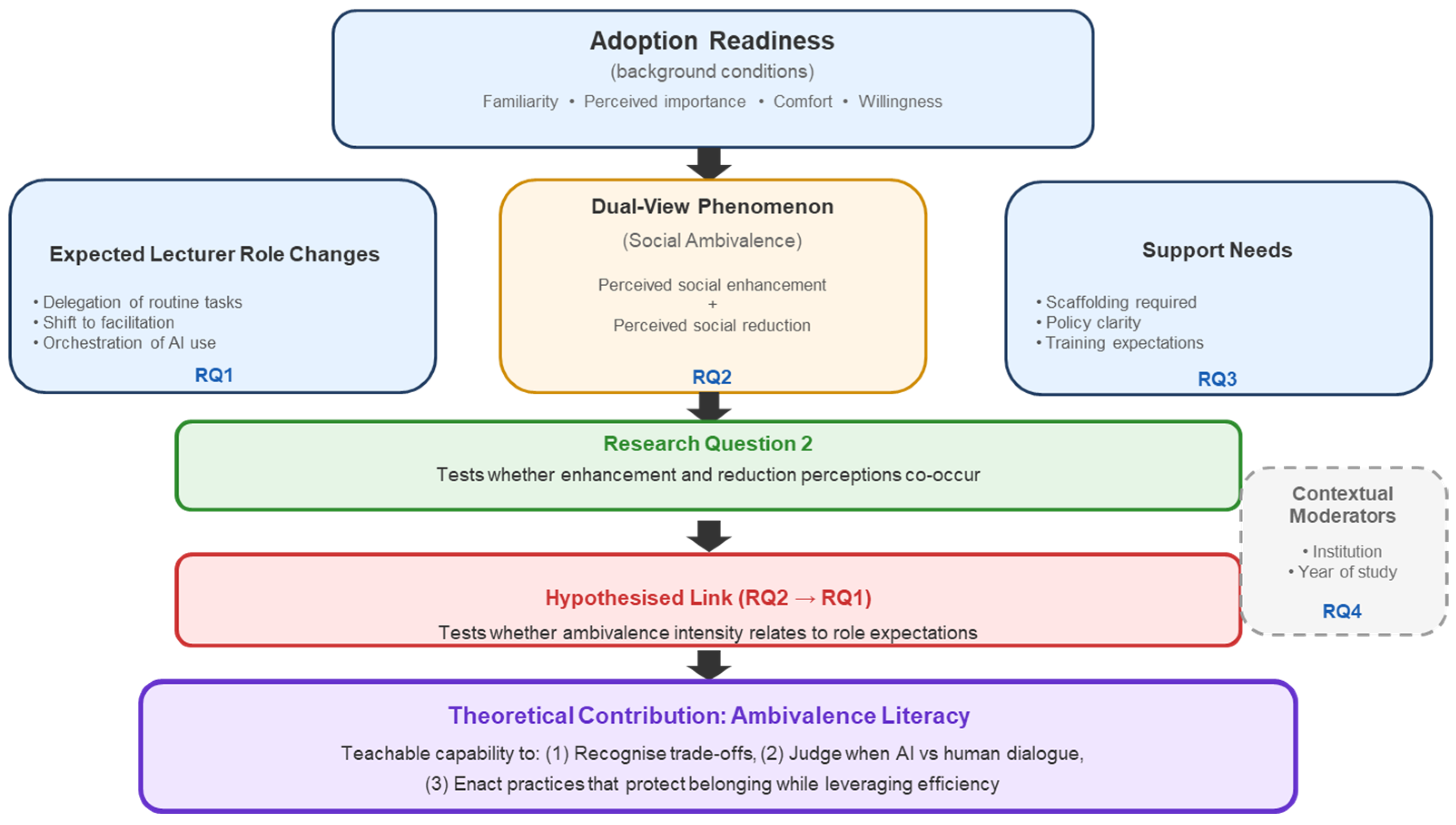
Figure 1. Conceptual framework of lecturer role transformation, social ambivalence (dual-view), and ambivalence literacy in AI-integrated transnational STEM education.
Education 16 00554 g001
Figure 2. Dual-view phenomenon: association between the number of selected social enhancement and social reduction mechanisms.
Education 16 00554 g002
Figure 3. Ambivalence literacy: a conceptual model for managing AI-related trade-offs in social learning.
Education 16 00554 g003
Table 3. Participant characteristics (n = 467).
VariableCategoryn%
InstitutionInstitution-130064.2
Institution-210923.3
Institution-35211.1
Institution-451.1
ProgrammeElectronic and Electrical Engineering11925.5
Environmental Engineering11123.8
Computer Science7315.6
Software Engineering4710.1
Civil Engineering with Transport429.0
Materials Science and Engineering388.1
Mechanical Engineering377.9
Year of studyYear 115833.8
Year 212125.9
Year 313929.8
Year 44910.5
Table 4. Indicators of adoption readiness and support needs (n = 467).
Indicator (Positive Response)n%
Familiar or very familiar with AI31767.9
Is AI essential or very important in STEM education (next 5–10 years)41689.1
Somewhat or very likely to use an AI chatbot for learning36778.6
Somewhat or very comfortable using an AI chatbot for learning35876.7
Somewhat or very likely to recommend chatbot use33371.3
Needs at least moderate support to use chatbots effectively44695.5
Table 5. Perceived potential for AI chatbots to enhance learning and skills (n = 467).
DomainMean (1–5)SD% ‘Very Much’ or ‘Extremely’
Learning (concept understanding and application)3.910.7671.1
Problem solving3.620.8854.8
Collaboration3.330.9943.0
Creativity3.330.9942.2
Table 6. Expected changes to lecturer role (multi-select; n = 467).
Expected Role Change (Option Text)n%
AI chatbots could handle simple questions, allowing lecturers to lead more interesting discussions or practical activities.24652.7
Instead of explaining basic facts, lecturers could spend more time guiding students on how to think deeply or solve problems.23249.7
Chatbots could answer common questions, allowing lecturers to focus on more complex topics.18239.0
Lecturers will spend more time motivating students and helping them overcome learning challenges, rather than just giving lectures.17838.1
With chatbot help, lecturers can better understand individual students’ problems and spend more time helping them personally.13829.6
Lecturers might better support international students individually, given chatbot assistance on routine queries.12526.8
Lecturers may create and choose chatbot resources.10021.4
Less pressure on lecturers.9119.5
Lecturers might need to check the chatbot’s accuracy.7916.9
Lecturers will need new technology skills.7816.7
Table 7. Perceived social enhancement mechanisms of AI chatbot use (multi-select; n = 467).
Enhancement Mechanism (Option Text)n%
Chatbots can help students prepare better, so they feel more comfortable speaking in class or group activities.27358.5
Students might feel more confident asking questions privately to a chatbot first.24151.6
Chatbots could help students collaborate by providing quick support during group projects.22748.6
Chatbots might encourage discussions by giving interesting or new ideas.15032.1
No effect: I don’t think an AI chatbot would change social interaction at all.286.0
Table 8. Perceived social reduction mechanisms of AI chatbot use (multi-select; n = 467).
Reduction Mechanism (Option Text)n%
Chatbots might reduce face-to-face interaction with teachers or peers.22848.8
Students might become less skilled at working in groups if they depend on the chatbot.22347.8
Students might talk less with classmates because they rely on chatbot answers.19742.2
Students might feel less socially connected if they mostly interact with a chatbot rather than real people.19140.9
Students might avoid interacting with peers from different backgrounds if chatbot reliance increases.12326.3
No effect: I don’t think an AI chatbot would change social interaction at all.418.8
Table 9. Lecturer role expectations by social ambivalence intensity (low vs. high tertiles; n = 313).
Lecturer Role Expectation ItemLow Ambivalence %High Ambivalence %χ2(1)pCramer’s V
Lecturers may create and choose chatbot resources9.742.544.12<0.0010.38
Lecturers will spend more time motivating students and helping them overcome learning challenges, rather than just giving lectures23.755.932.40<0.0010.32
Chatbots could answer common questions, allowing lecturers to focus on more complex topics28.559.127.91<0.0010.30
Lecturers might need to check the chatbot’s accuracy13.427.68.820.0030.17
Handle simple questions so lecturers lead discussions/activities56.272.08.250.0040.17
Note. n = 313 reflects the low and high ambivalence tertiles only; the middle tertile (n = 154) was excluded from these comparisons as the analysis was designed to contrast the two extremes of the ambivalence distribution.
Table 10. Perceived support needed to use AI chatbots effectively (n = 467).
Support Leveln%
Extensive support7816.7
High support20443.7
Moderate support16435.1
Very little support204.3
No support at all10.2
Disclaimer/Publisher’s Note: The statements, opinions and data contained in all publications are solely those of the individual author(s) and contributor(s) and not of MDPI and/or the editor(s). MDPI and/or the editor(s) disclaim responsibility for any injury to people or property resulting from any ideas, methods, instructions or products referred to in the content.