Problem Design Characteristics in School-Based PBL: A PRISMA-Informed Review of Korean K-12 Cases


Abstract
1. Introduction
2. Literature Review
2.1. Features of PBL
2.2. Features of Problem in PBL
2.2.1. Authenticity and Contextual Relevance
2.2.2. Cognitive Complexity and Learning Outcomes
2.2.3. Social and Collaborative Structure
2.2.4. Pedagogical Design and Implementation
2.3. Prior Reviews of PBL and Literature Gap
3. Research Method
3.1. Research Design
3.2. Data Collection
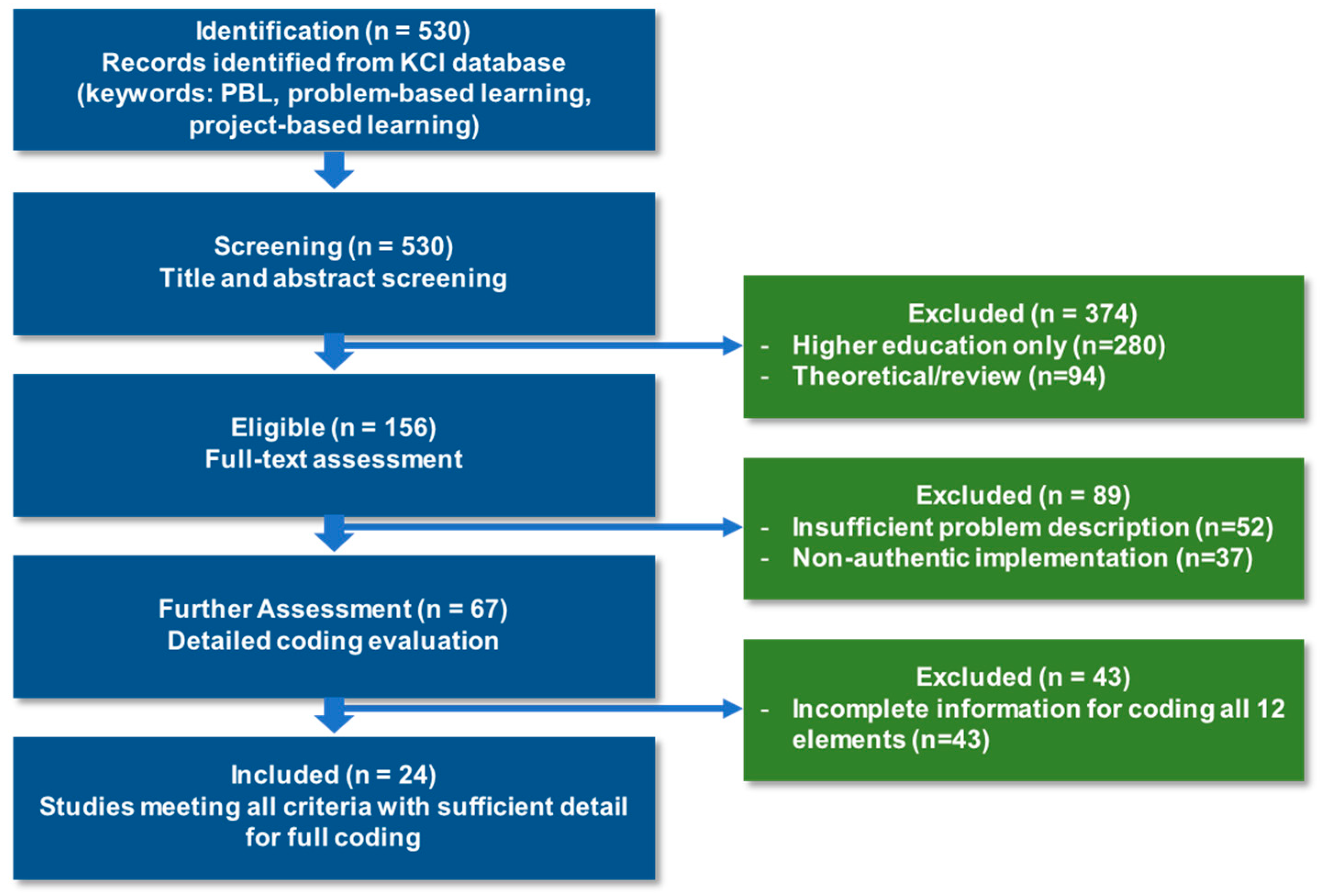
3.3. Search Strategy and Screening
- Initial scenario/context: a background situation, commission, or challenge task;
- Constraints and resources: time, materials, tools, or norms;
- Stakeholders/perspectives: relevant actors, multiple viewpoints, or requirements;
- Output and process requirements: expected deliverables, process criteria, or assessment expectations.
3.4. Analytical Framework
- Real-World Authenticity
- Context Authenticity: The extent to which the problem reflects real-life situations and challenges;
- Societal Relevance: The problem’s connection to contemporary issues and its potential impact on society;
- Connection to Student Lives: The problem’s relatability and relevance to students’ personal experiences and interests.
- Cognitive Engagement
- Complexity Structure: The level of complexity and the presence of multiple interrelated elements within the problem;
- Cognitive Conflict Level: The degree to which the problem challenges students’ existing knowledge and stimulates critical thinking;
- Analysis Requirements: The depth and breadth of analysis required to effectively address the problem.
- Collaborative Learning
- Group Interaction: The extent to which the problem promotes collaborative learning and teamwork;
- Knowledge Construction: The problem’s potential to facilitate the co-construction of knowledge through peer interaction;
- Perspective Integration: The problem’s ability to elicit diverse perspectives and encourage the integration of different viewpoints.
- Pedagogical Alignment
- Curriculum Integration: The problem’s alignment with curricular objectives and learning outcomes;
- Skill Development Range: The variety of skills and competencies that the problem aims to develop;
- Assessment Opportunities: The problem’s potential for formative and summative assessment of student learning.
3.5. Data Analysis
4. Results
4.1. Relationships Among Individual Elements
4.2. Multi-Element Patterns
5. Discussion and Conclusions
5.1. Interpretation of Problem Design Patterns
5.2. The Cognitive Conflict Design Tension: Balancing Ideals and Constraints
5.3. Design Implications
5.4. Limitations and Contextual Boundaries
5.5. Conclusions
Author Contributions
Funding
Institutional Review Board Statement
Informed Consent Statement
Data Availability Statement
Conflicts of Interest
Abbreviations
| PBL | Problem-Based Learning |
| PRISMA | PRISMA-informed |
| PjBL | Project-Based Learning |
| CBL | Challenge-Based Learning |
| KCI | Korea Citation Index |
Appendix A

| Dimension | Element | Level 0 | Level 1 | Level 2 | Level 3 |
|---|---|---|---|---|---|
| Context Authenticity | Context Authenticity | Absent or not evident | Simplified scenarios with some real elements | Adapted real community issues with authentic elements | Actual current challenges with genuine constraints |
| Societal Relevance | Absent or not evident | Connected to classroom or school experience | Related to local community concerns | Addresses broader societal issues and systemic challenges | |
| Connection to Student Lives | Absent or not evident | Within immediate experience of students | Requires some new context exploration | Introduces unfamiliar yet important contexts | |
| Cognitive engagement | Complexity Structure | Absent or not evident | Well-defined problem with clear parameters | Semi-structured problem with some ambiguity | Ill-structured problem with significant ambiguity |
| Cognitive Conflict Level | Absent or not evident | Minimal conceptual challenges | Moderate conflicts with existing knowledge | Significant challenges to established understanding | |
| Analysis Requirements | Absent or not evident | Basic information processing and organization | Requires analytical thinking and evaluation | Demands synthesis and creation of new knowledge | |
| Collaborative learning | Group Interaction | Absent or not evident | Individual work with sharing opportunities | Small group collaboration with defined roles | Complex interdependent collaboration with negotiated roles |
| Knowledge Construction | Absent or not evident | Individual knowledge building with sharing | Co-construction of knowledge in small groups | Distributed knowledge creation across networks | |
| Perspective Integration | Absent or not evident | Single perspective consideration | Dual or competing perspective analysis | Multiple stakeholder viewpoints integration | |
| Pedagogical alignment | Curriculum Integration | Absent or not evident | Single subject/concept focus | Cross-disciplinary connections | Full thematic integration across domains |
| Skill Development Range | Absent or not evident | Targets specific content knowledge | Balances content and process skills | Integrates content, process, and metacognitive skills | |
| Assessment Opportunities | Absent or not evident | Single product assessment | Multiple evidence points | Comprehensive portfolio with process documentation |
References
- Akçay, B. (2009). Problem-based learning in science education. Journal of Turkish Science Education, 6(1), 26–36. [Google Scholar]
- Al-Bahadli, K., Al-Obaydi, L., & Pikhart, M. (2023). The impact of the online project-based learning on students’ communication, engagement, motivation, and academic achievement. Psycholinguistics, 33(2), 217–237. [Google Scholar] [CrossRef] [Scilit]
- Ali, S. (2019). Problem based learning: A student-centered approach. English Language Teaching, 12(5), 73–78. [Google Scholar] [CrossRef] [Scilit]
- Alves, A., Sousa, R., Fernandes, S., Cardoso, E., Carvalho, M., Figueiredo, J., & Pereira, R. (2016). Teacher’s experiences in PBL: Implications for practice. European Journal of Engineering Education, 41, 123–141. [Google Scholar] [CrossRef] [Scilit]
- Anderson, L. W., & Krathwohl, D. R. (Eds.). (2001). A taxonomy for learning, teaching, and assessing: A revision of Bloom’s taxonomy of educational objectives. Longman. [Google Scholar]
- Barrows, H. S. (1986). A taxonomy of problem-based learning methods. Medical Education, 20, 481–486. [Google Scholar] [CrossRef] [Scilit]
- Bate, E., Hommes, J., Duvivier, R., & Taylor, D. (2014). Problem-based learning (PBL): Getting the most out of your students—Their roles and responsibilities: AMEE Guide No. 84. Medical Teacher, 36, 1–12. [Google Scholar] [CrossRef] [Scilit]
- Biggs, J. (1996). Enhancing teaching through constructive alignment. Higher Education, 32(3), 347–364. [Google Scholar] [CrossRef] [Scilit]
- Cahyaningsih, U., Salimi, M., Nahdi, D. S., Jatisunda, M. G., & Rasyid, A. (2025). Improving understanding of fraction concepts through problem-based learning in elementary schools. Journal of Innovation and Research in Primary Education, 4(3), 1356–1366. [Google Scholar] [CrossRef] [Scilit]
- Capon, N., & Kuhn, D. (2010). What’s so good about problem-based learning? Cognition and Instruction, 22, 61–79. [Google Scholar] [CrossRef] [Scilit]
- Chang, J. T. (2024). Learner-led class design and effectiveness through international PBL (problem-based learning) exchange. Korea and Global Affairs, 8(4), 731–751. [Google Scholar] [CrossRef]
- Chatila, H., & Malaeb, M. (2025). Impact of cross-disciplinary project-based learning approach on students’ high order thinking skills. International Journal of Research in Education and Science (IJRES), 11(4), 831–849. [Google Scholar] [CrossRef] [Scilit]
- Cui, X.-M., & Han, S.-K. (2017). A case study of problem-based learning for university physics. In Proceedings of the 2017 international conference on education, economics and management research (ICEEMR 2017) (pp. 534–537). Atlantis Press. [Google Scholar] [CrossRef] [Scilit]
- Edwards, S., & Hammer, M. (2007). Problem-based learning in early childhood and primary pre-service teacher education: Identifying the issues and examining the benefits. Australian Journal of Teacher Education, 32(2), 21–36. [Google Scholar] [CrossRef] [Scilit]
- Ertmer, P. A., & Simons, K. D. (2006). Jumping the PBL implementation hurdle: Supporting the efforts of K–12 teachers. Interdisciplinary Journal of Problem-Based Learning, 1(1), 40–54. [Google Scholar] [CrossRef] [Scilit]
- Fauzi, A., Ruswandi, U., Suhartini, A., & Nursobah, A. (2025). Project-based learning in Islamic education: Enhancing independent character and critical thinking skills in junior high school students. European Journal of Education and Pedagogy, 6(4), 34–37. [Google Scholar] [CrossRef] [Scilit]
- Fitriati, F., Rahmi, R., Novita, R., Salmina, M. I. K., Sari, I. K., Nasriadi, A., Muzakir, U., & Fajri, N. (2023). Measuring the effect of problem based learning with instructional video on primary school students’ problem solving skills development. Jurnal Ilmiah Teunuleh, 4(2), 53–61. [Google Scholar] [CrossRef] [Scilit]
- Gallagher, S. A., Stepien, W. J., & Rosenthal, H. (1992). The effects of problem-based learning on problem solving. Gifted Child Quarterly, 36(4), 195–200. [Google Scholar] [CrossRef] [Scilit]
- Gómez-Pablos, V., Del Pozo, M., & Muñoz-Repiso, A. (2017). Project-based learning (PBL) through the incorporation of digital technologies: An evaluation based on the experience of serving teachers. Computers in Human Behavior, 68, 501–512. [Google Scholar] [CrossRef] [Scilit]
- Gu, P., Cheng, Z., Cheng, M., Poggio, J., & Dong, Y. (2025). Integrating project-based learning with self-regulated learning to enhance programming learning motivation. Journal of Computer Assisted Learning, 41(2), e70011. [Google Scholar] [CrossRef] [Scilit]
- Ha, J. (2024). Development and effect analysis of data-driven problem-based learning model for economics classes in social studies. Theory and Research in Citizenship Education, 56(2), 289–318. [Google Scholar] [CrossRef]
- Han, J., Lee, E. M., & Ryu, S. (2022). Exploring the possibility of teaching-learning for reconstruction of literary works based on the PBL model. Korean Literature Education Research, 76, 547–574. [Google Scholar] [CrossRef] [Scilit]
- Hendarwati, E., Nurlaela, L., Bachri, B., & Sa’ida, N. (2021). Collaborative problem based learning integrated with online learning. International Journal of Emerging Technologies in Learning (IJET), 16(13), 29–39. [Google Scholar] [CrossRef] [Scilit]
- Herrington, J., & Oliver, R. (2000). An instructional design framework for authentic learning environments. Educational Technology Research and Development, 48(3), 23–48. [Google Scholar] [CrossRef] [Scilit]
- Hmelo-Silver, C. E. (2004). Problem-based learning: What and how do students learn? Educational Psychology Review, 16(3), 235–266. [Google Scholar] [CrossRef] [Scilit]
- Hung, W. (2006). The 3C3R model: A conceptual framework for designing problems in PBL. Interdisciplinary Journal of Problem-Based Learning, 1(1), 6. [Google Scholar] [CrossRef] [Scilit]
- Hung, W. (2009). The 9-step problem design process for problem-based learning: Application of the 3C3R model. Educational Research Review, 4(2), 118–141. [Google Scholar] [CrossRef] [Scilit]
- Im, J., Lee, J. H., & Kwon, H. (2022). A case study of problem-solving start-up education using PBL teaching methods in non-face-to-face class. The Journal of Humanities and Social Science, 13(6), 1177–1190. [Google Scholar] [CrossRef] [Scilit]
- Jaganathan, S., Bhuminathan, S., & Ramesh, M. (2024). Problem-based learning—An overview. Journal of Pharmacy & Bioallied Sciences, 16(2), S1435–S1437. [Google Scholar] [CrossRef] [Scilit]
- Khoirunnisa, Y., Nuro, F. M. A., & Wahyuningrum, L. (2023). Penerapan model PBL berbasis permainan untuk meningkatkan motivasi dan hasil belajar IPAS di Sekolah Dasar. Jurnal Pendidikan Profesi Guru, 4(3), 97–107. [Google Scholar] [CrossRef] [Scilit]
- Kim, D. (2021). A study on the teaching method of new words using flip learning in Korean language education. Eomunyeongu, 108, 195–221. [Google Scholar] [CrossRef]
- Kim, D., Chae, D. Y., & Park, S. H. (2023). Development and application of PBL-based machine learning education program to improve elementary school students’ problem solving skills. The Journal of Learner-Centered Curriculum and Instruction, 23(6), 639–661. [Google Scholar] [CrossRef] [Scilit]
- Kim, J., & Lee, Y. (2022). The effect of PBL-based young children-led inquiry activity on creative problem-solving ability and self-directed learning ability. Korean Journal of Early Childhood Education, 42(6), 405–426. [Google Scholar] [CrossRef]
- Kim, M. (2023). A study on the effectiveness of PBL classes focusing on solving community problems for education for sustainable development. Korean Journal of General Education, 17(3), 217–228. [Google Scholar] [CrossRef] [Scilit]
- Kim, S. J., & Lee, S. W. (2024). Development of environmental conflict resolution education program using problem-based learning. Korean Journal of Elementary Education, 35(2), 1–24. [Google Scholar] [CrossRef]
- Kim, S. S., & Lee, Y. S. (2022). The effect of PBL-applied environmental writing class on climate literacy and environmental sensitivity of elementary school students. Journal of the Korean Society of Earth Science Education, 15(3), 345–353. [Google Scholar] [CrossRef]
- Kokotsaki, D., Menzies, V., & Wiggins, A. (2016). Project-based learning: A review of the literature. Improving Schools, 19, 267–277. [Google Scholar] [CrossRef] [Scilit]
- Kuo, H., Yang, Y., Chen, J., Hou, T., & Ho, M. (2021). The impact of design thinking PBL robot course on college students’ learning motivation and creative thinking. IEEE Transactions on Education, 65, 124–131. [Google Scholar] [CrossRef] [Scilit]
- LaForce, M., Noble, E., & Blackwell, C. (2017). Problem-based learning (PBL) and student interest in STEM careers: The roles of motivation and ability beliefs. Education Sciences, 7(4), 92. [Google Scholar] [CrossRef] [Scilit]
- Lara-Bercial, P., Gaya-López, M., Martínez-Orozco, J., & Lavado-Anguera, S. (2024). PBL impact on learning outcomes in computer engineering: A 12-year analysis. Education Sciences, 14(6), 653. [Google Scholar] [CrossRef] [Scilit]
- Lee, A., & Jeong, E. (2024). The effect of problem-based learning on high school students’ positive experiences about science in ‘life and science’ class. Biology Education, 52(3), 385–398. [Google Scholar]
- Lee, H. W. (2022). A study on creative traditional dance education plans: Focused on elementary PBL program development. The Southeast Korea Dance Society, 10(3), 99–120. [Google Scholar] [CrossRef]
- Lee, J. (2021). A study on a digital collaborative reading-writing teaching and learning model using PBL tasks. Ratio et Oratio, 14(3), 39–76. [Google Scholar] [CrossRef]
- Lee, S. (2020). An exploration of content and language integrated lesson design and implementation in EFL Korean primary school English education setting: A focus on PBL based CLIL lesson. Korean Journal of Elementary Education, 31(3), 39–56. [Google Scholar] [CrossRef]
- Lee, S. H., Choi, K. A., Park, M., & Han, J. (2020). Investigating learning type in online problem-based learning: Applying learning analysis techniques. The Journal of Korean Association of Computer Education, 23(1), 77–90. [Google Scholar] [CrossRef] [Scilit]
- Lee, Y. J., & Kim, H. (2021). The effects of sustainable design class on sense of community: Focusing on 3rd graders of middle school. Journal of Art Education, 64, 261–298. [Google Scholar] [CrossRef]
- Lee, Y. W. (2020). Utilizing problem-based learning (PBL) in cultural learning through movies. The Journal of Foreign Studies, 52, 33–58. [Google Scholar] [CrossRef]
- Lim, E. J. (2023). A study on the PBL (project based learning) learning method for music-centered films. Korean Journal of Culture and Arts Education Studies, 18(1), 129–148. [Google Scholar] [CrossRef]
- Loyens, S., Jones, S., Mikkers, J., & Gog, T. (2015). Problem-based learning as a facilitator of conceptual change. Learning and Instruction, 38, 34–42. [Google Scholar] [CrossRef] [Scilit]
- Loyens, S., Wijnia, L., Van der Sluijs-Duker, I., & Rikers, R. (2020, August 27). Problem-based learning. Oxford research encyclopedia of education. Available online: https://oxfordre.com/education/view/10.1093/acrefore/9780190264093.001.0001/acrefore-9780190264093-e-861 (accessed on 21 September 2025).
- Magdalena, T. A., Utami, I. L. P., & Adnyayanti, N. L. P. E. (2024). Project-based learning for the 21st century: Skills for the future. Jurnal Penelitian Mahasiswa Indonesia, 4(3), 313–320. [Google Scholar]
- Mezak, I., & Pejić Papak, N. (2019). Problem based learning for primary school junior grade students using digital tools. In 42nd international convention on information and communication technology (pp. 697–702). IEEE. [Google Scholar] [CrossRef] [Scilit]
- Nariman, N., & Chrispeels, J. (2016). PBL in the era of reform standards: Challenges and benefits perceived by teachers in one elementary school. Interdisciplinary Journal of Problem-Based Learning, 10(1). [Google Scholar] [CrossRef] [Scilit]
- Naviri, S., Sumaryanti, S., & Paryadi, P. (2021). Explanatory learning research: Problem-based learning or project-based learning? Acta Facultatis Educationis Physicae Universitatis Comenianae, 61(1), 107–121. [Google Scholar] [CrossRef] [Scilit]
- Neves, A., & Ribeiro, F. (2024). Enhancing engineering education through project-based learning: A case study of biometry and computer vision courses. In 2024 IEEE global engineering education conference (EDUCON) (pp. 1–5). IEEE. [Google Scholar] [CrossRef] [Scilit]
- Nizami, M., Xue, V., Wong, A., Yu, O., Yeung, C., & Chu, C. (2023). Challenge-based learning in dental education. Dentistry Journal, 11(1), 14. [Google Scholar] [CrossRef] [Scilit]
- Page, M. J., McKenzie, J. E., Bossuyt, P. M., Boutron, I., Hoffmann, T. C., Mulrow, C. D., Shamseer, L., Tetzlaff, J. M., Akl, E. A., Brennan, S. E., Chou, R., Glanville, J., Grimshaw, J. M., Hróbjartsson, A., Lalu, M. M., Li, T., Loder, E. W., Mayo-Wilson, E., McDonald, S., … Moher, D. (2021). The PRISMA 2020 statement: An updated guideline for reporting systematic reviews. BMJ, 372, n71. [Google Scholar] [CrossRef] [Scilit]
- Palwe, S. (2022). Check solve pass: A new technique for student centric learning. Journal of Engineering Education Transformations, 35(S1), 299–302. [Google Scholar] [CrossRef] [Scilit]
- Park, C. S. (2020). A study on method of musical utilization by elementary school integrated curriculum: Focusing on elementary education curriculum. Korean Journal of Culture and Arts Education Studies, 15(1), 73–98. [Google Scholar] [CrossRef] [Scilit]
- Park, H. (2020). Social studies blended PBL instruction model design and development -economic classes utilizing online programs-. Theory and Research in Citizenship Education, 52(2), 197–227. [Google Scholar] [CrossRef]
- Park, H., & Scanlon, D. (2024). General educators’ perceptions of struggling learners in an inaugural project-based learning Capstone. International Journal of Inclusive Education, 29(11), 1875–1903. [Google Scholar] [CrossRef] [Scilit]
- Park, Y. K., Park, S., Kim, J., Kim, J., & Yu, S. H. (2023). A collaborative action research on the development and implementation of an elementary school social studies blended PBL (problem-based learning) model. Journal of Studies on Schools and Teaching, 8(2), 95–127. [Google Scholar] [CrossRef]
- Piaget, J. (1985). The equilibration of cognitive structures: The central problem of intellectual development. University of Chicago Press. [Google Scholar]
- Piñeiro, J. L., & Vásquez Ortiz, C. (2019). Un estudio exploratorio a las tensiones en los criterios de selección de problemas en profesores de educación primaria. Educar em Revista, 35(78), 65–84. [Google Scholar] [CrossRef] [Scilit]
- Savery, J. (2006). Overview of problem-based learning: Definitions and distinctions. Interdisciplinary Journal of Problem-Based Learning, 1(1), 9–20. [Google Scholar] [CrossRef] [Scilit]
- Schmidt, H. (1983). Problem-based learning: Rationale and description. Medical Education, 17(1), 11–16. [Google Scholar] [CrossRef] [Scilit] [PubMed]
- Schmidt, H. (1993). Foundations of problem-based learning: Some explanatory notes. Medical Education, 27(5), 422–432. [Google Scholar] [CrossRef] [Scilit] [PubMed]
- Senyah, A. O. (2024). An integrative review of K-12 teachers’ strategies and challenges in adapting problem-based learning [Doctoral dissertation, Virginia Tech]. VTechWorks. Available online: https://hdl.handle.net/10919/120717 (accessed on 6 June 2025).
- Shin, G. W., Cha, H., & Park, J. (2023). Effects of e-PBL program using COVID-19 related data on science core competence of high school students in biology clubs. Journal of the Korean Association for Science Education, 43(6), 583–594. [Google Scholar] [CrossRef]
- Smith, G., Ichda, M. A., Alfan, M., & Kuncoro, T. (2023). Literacy studies: Implementation of problem-based learning models to improve critical thinking skills in elementary school students. KnE Social Sciences, 8(10), 222–233. [Google Scholar] [CrossRef] [Scilit]
- Song, M., & Kim, M. H. (2022). A study on the online project-based learning (PBL) applied extra-curricular program development. Journal of Engineering Education Research, 25(6), 3–13. [Google Scholar] [CrossRef]
- Susilawati, W., Maryono, I., Widiastuti, T., & Abdullah, R. (2018). Improvement of mathematical lateral thinking skills and student character through challenge-based learning. In Proceedings of the international conference on Islamic education. Atlantis Press. [Google Scholar] [CrossRef] [Scilit]
- Takahashi, S., & Saito, E. (2013). Unraveling the process and meaning of problem-based learning experiences. Higher Education, 66, 693–706. [Google Scholar] [CrossRef] [Scilit]
- Utama, D. P., & Muhammadi, M. (2023). Peningkatan hasil belajar tematik terpadu peserta didik menggunakan metode problem based learning di sekolah dasar. E-Jurnal Inovasi Pembelajaran Sekolah Dasar, 10(2), 85. [Google Scholar] [CrossRef] [Scilit]
- Vilalta-Perdomo, E., Michel-Villarreal, R., & Thierry-Aguilera, R. (2022). Integrating industry 4.0 in higher education using challenge-based learning: An intervention in operations management. Education Sciences, 12(10), 663. [Google Scholar] [CrossRef] [Scilit]
- Weon, J. W., & Nam, Y. K. (2023). The impact of place-based learning on middle school students’ perception of sustainable parks and environmental literacy. Korean Journal of Environmental Education, 36(1), 17–34. [Google Scholar] [CrossRef] [Scilit]
- Yew, E. H., & Schmidt, H. G. (2012). What students learn in problem-based learning: A process analysis. Instructional Science, 40, 371–395. [Google Scholar] [CrossRef] [Scilit]

| Framework/Source | Core Contribution to PBL | Primary Dimension(s) | Related Element(s) |
|---|---|---|---|
| 3C3R model (Hung, 2006, 2009) | Integration of content, context, connection, and inquiry processes | Real-world authenticity; Cognitive engagement | Context authenticity; connection to student lives; complexity structure; cognitive conflict level; analysis requirements |
| Effective PBL case design principles (Ertmer & Simons, 2006; Savery, 2006) | Goal alignment, prior-knowledge activation, and appropriate openness | Cognitive engagement; Pedagogical alignment | Complexity structure; cognitive conflict level; analysis requirements; curriculum integration; skill development range |
| Authentic learning framework (Herrington & Oliver, 2000) | Real-world relevance, situated tasks, and meaningful constraints | Real-world authenticity | Context authenticity; societal relevance; connection to student lives |
| Cognitive alignment (Biggs, 1996) | Alignment among outcomes, tasks, and assessment | Pedagogical alignment | Curriculum integration; skill development range; assessment opportunities |
| Social-constructivist PBL tradition (Hmelo-Silver, 2004; Schmidt, 1983; Savery, 2006) | Collaborative inquiry, knowledge sharing, and perspective taking | Collaborative learning | Group interaction; knowledge construction; perspective integration |
| Dimension | Element | Level 0 | Level 1 | Level 2 | Level 3 |
|---|---|---|---|---|---|
| Real-world Authenticity | Context authenticity | ||||
| Societal relevance | |||||
| Connection to students’ lives | |||||
| Cognitive complexity and learning outcomes | Complexity structure | ||||
| Cognitive conflict level | |||||
| Analysis requirements | |||||
| Collaborative learning | Group interaction | ||||
| Knowledge construction | |||||
| Perspective integration | |||||
| Pedagogical design | Curriculum integration | ||||
| Skill development range | |||||
| Assessment opportunities |
| Element | Level 0 | Level 1 | Level 2 | Level 3 | Mean | SD |
|---|---|---|---|---|---|---|
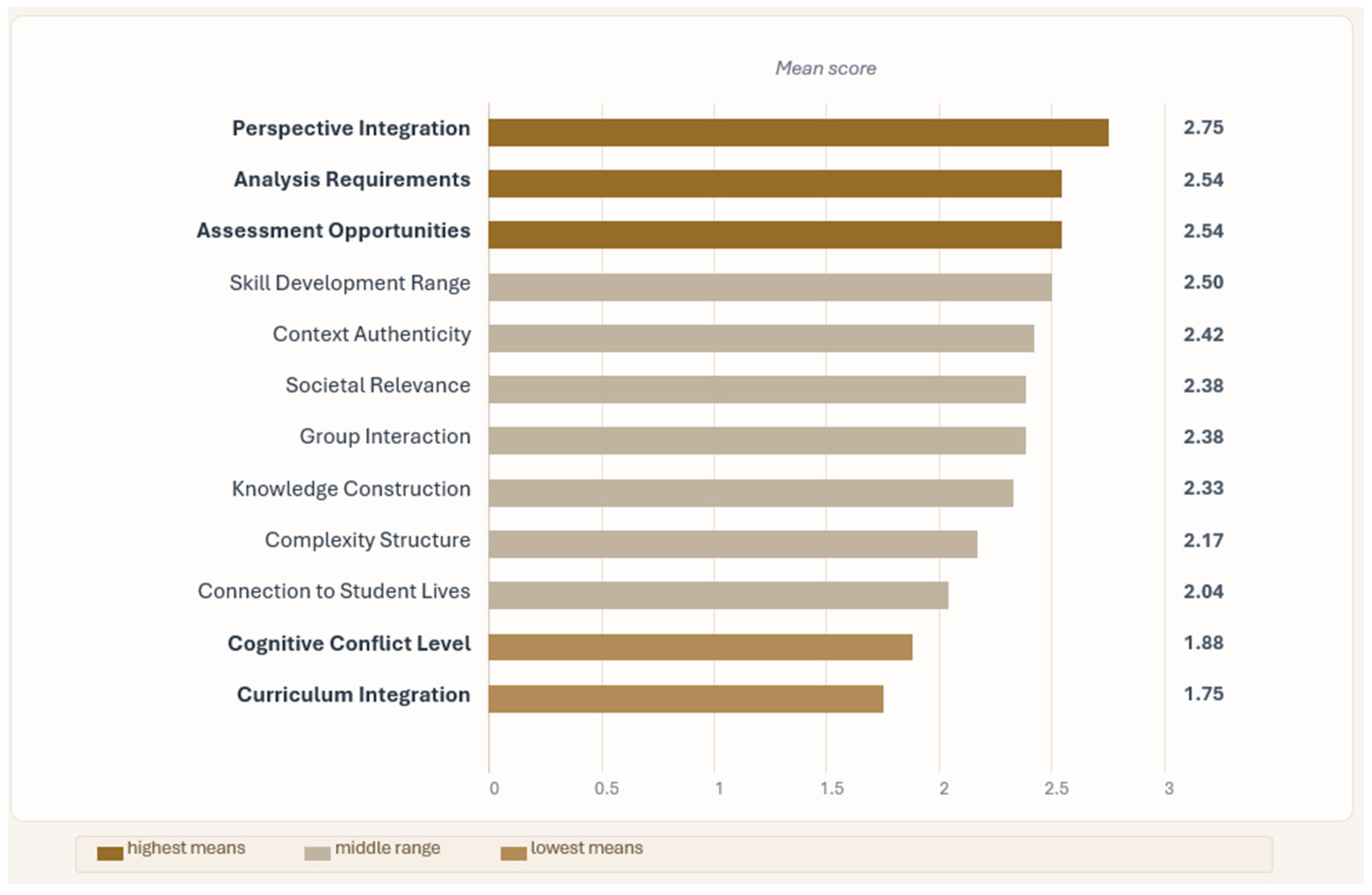
| Context Authenticity | 0 | 1 | 12 | 11 | 2.42 | 0.58 |
| Societal Relevance | 0 | 6 | 3 | 15 | 2.38 | 0.88 |
| Connection to Student Lives | 0 | 5 | 13 | 6 | 2.04 | 0.69 |
| Complexity Structure | 0 | 2 | 16 | 6 | 2.17 | 0.56 |
| Cognitive Conflict Level | 0 | 5 | 17 | 2 | 1.88 | 0.54 |
| Analysis Requirements | 0 | 0 | 11 | 13 | 2.54 | 0.51 |
| Group Interaction | 1 | 3 | 6 | 14 | 2.38 | 0.88 |
| Knowledge Construction | 1 | 2 | 9 | 12 | 2.33 | 0.82 |
| Perspective Integration | 1 | 1 | 1 | 21 | 2.75 | 0.74 |
| Curriculum Integration | 0 | 15 | 0 | 9 | 1.75 | 0.99 |
| Skill Development Range | 0 | 1 | 10 | 13 | 2.50 | 0.59 |
| Assessment Opportunities | 0 | 3 | 5 | 16 | 2.54 | 0.72 |
| Element 1 | Element 2 | ρ | p |
|---|---|---|---|
| Context Authenticity | Skill Development Range | 0.44 | 0.031 |
| Context Authenticity | Assessment Opportunities | 0.42 | 0.041 |
| Complexity Structure | Cognitive Conflict Level | 0.50 | 0.013 |
| Complexity Structure | Analysis Requirements | 0.45 | 0.027 |
| Cognitive Conflict Level | Analysis Requirements | 0.42 | 0.041 |
| Cognitive Conflict Level | Knowledge Construction | 0.48 | 0.018 |
| Cognitive Conflict Level | Perspective Integration | 0.42 | 0.041 |
| Cognitive Conflict Level | Curriculum Integration | 0.51 | 0.011 |
| Group Interaction | Knowledge Construction | 0.63 | 0.001 |
| Group Interaction | Perspective Integration | 0.54 | 0.006 |
| Perspective Integration | Assessment Opportunities | 0.61 | 0.002 |
| Perspective Integration | Skill Development Range | 0.50 | 0.013 |
| Assessment Opportunities | Cognitive Conflict Level | 0.59 | 0.002 |
| Triad (All Elements at Level 3) | Studies | % of Sample | Common Attributes |
|---|---|---|---|
| Collaboration Triad (GI + KC + PI) | 10 | 41.7 | Interdependent teamwork, distributed knowledge building, multi-stakeholder integration; 8 of 10 also had advanced assessment. |
| Authenticity-Skill Triad (CA + Skill + Assess) | 8 | 33.3 | Authentic real-world tasks paired with integrated competence goals and process assessment. |
| Cognitive-Demand Triad (Comp + Conflict + Analysis) | 2 | 8.3 | Highly ill-structured problems, strong dissonance, knowledge creation; one also satisfied the Collaboration Triad. |
Disclaimer/Publisher’s Note: The statements, opinions and data contained in all publications are solely those of the individual author(s) and contributor(s) and not of MDPI and/or the editor(s). MDPI and/or the editor(s) disclaim responsibility for any injury to people or property resulting from any ideas, methods, instructions or products referred to in the content. |
© 2026 by the authors. Licensee MDPI, Basel, Switzerland. This article is an open access article distributed under the terms and conditions of the Creative Commons Attribution (CC BY) license.
Share and Cite
Kim, H.; Kim, J. Problem Design Characteristics in School-Based PBL: A PRISMA-Informed Review of Korean K-12 Cases. Educ. Sci. 2026, 16, 553. https://doi.org/10.3390/educsci16040553
Kim H, Kim J. Problem Design Characteristics in School-Based PBL: A PRISMA-Informed Review of Korean K-12 Cases. Education Sciences. 2026; 16(4):553. https://doi.org/10.3390/educsci16040553
Chicago/Turabian StyleKim, Hyunwook, and Jino Kim. 2026. "Problem Design Characteristics in School-Based PBL: A PRISMA-Informed Review of Korean K-12 Cases" Education Sciences 16, no. 4: 553. https://doi.org/10.3390/educsci16040553
APA StyleKim, H., & Kim, J. (2026). Problem Design Characteristics in School-Based PBL: A PRISMA-Informed Review of Korean K-12 Cases. Education Sciences, 16(4), 553. https://doi.org/10.3390/educsci16040553