


Abstract
Although males typically outperform women on spatial tasks, we investigated whether structured training with 3D-printed heart models substantially reduces performance differences in echocardiographic education. A total of 144 medical students (95 female, 49 male) were enrolled in an interventional study via propensity score matching (n = 80: 40 female, 40 male). They received standardized echocardiography training with physical 3D models, tutoring, PowerPoint instruction, and self-directed practice. All measured outcomes showed significant improvements (p < 0.001) but no sex-related differences: 2D visualization (females: +2.30; males: +2.55; p = 0.738), 3D visualization (females: +3.52; males: +3.23; p = 0.661), and visual thinking (females: +5.83; males: +5.78; p = 0.961). Notably, females required more time before and after the intervention (post-test: f: min vs. m: ; p = 0.006) and rated spatial tasks as more difficult (f: vs. m: ; p = 0.0016). Yet they achieved identical objective results. Both groups rated the 3D models as highly effective (4.65 ± 0.86). These findings demonstrate that multi-modal anatomy training with physical 3D-printed models narrows sex differences in spatial learning outcomes and enables equitable development of anatomical visualization skills through appropriate educational scaffolding. However, process-related differences remain.
1. Introduction
Learning echocardiography presents unique challenges. Due to the complex three-dimensional relationships, examiners need to mentally rotate cardiac structures and integrate information from multiple two-dimensional imaging planes. Echocardiographic competency requires not only anatomical knowledge but also the ability to visualize cardiac structures in three dimensions. Simultaneously, the examiner needs to translate between different imaging orientations. Men usually outperform women in mental rotation ability (Hervin & Gibson, 2026; Jacobs et al., 2024). However, implicit gender–science associations (e.g., the stereotype that men are better in STEM subjects) correlate with mental rotation test performance in both men and women (Sanchis-Segura et al., 2018), but inter-gender differences only show under stereotype-assuring conditions. Neuroimaging studies suggest that men and women may recruit partially distinct cortical networks during mental rotation (Hänggi et al., 2010; Kawamichi et al., 2007). Women in the early follicular and mid-luteal phase, as well as women on oral contraceptives, perform less well in the Cross-Section Task (CST) (Gaizauskaitė et al., 2025). Women with an intrauterine device for contraception performed better and showed comparable results to men. So, there are sex and gender differences in spatial ability: “Sex” refers to the dichotomous biological concept of male and female. It seldom includes presentations outside the binary. “Gender”, however, consists of a multidimensional construct. It takes into account sociocultural imprinting, roles, and societal expectations. Self-perception plays a role in gender, as it usually does not in “sex”. Gender contains norms and behaviors that are usually assigned to one sex or the other. Gender is not strictly binary (Reale et al., 2023). “Spatial abilities” include but are not limited to qualities such as mental rotation (as in playing Tetris), spatial perception (as in aligning a framed picture exactly vertically on a wall), spatial visualization (as in paper folding), spatial navigation (map reading), intrinsic qualities within an object (being able to imagine the interior of a cut apple), and extrinsic qualities between objects (imagining the allocation of a set table from the person’s view on the opposite side). Some of these show sex differences (Hegarty, 2018; Newcombe, 2020). Large-scale evidence suggests that sex-related differences in spatial and mathematical performance can emerge early in schooling and may widen over time. For example, a recent nationwide analysis in France reported a small but statistically significant gender gap in mathematics favoring boys within the first months of grade one, with the effect size increasing over the first school year (Martinot et al., 2025). More broadly, persistent gender gaps in STEM (Science, Technology, Engineering, Mathematics) participation have been documented across educational stages and disciplines (Wang & Degol, 2017). Spatial abilities form a changeable aspect of human mental capacity (Cherney et al., 2014; Uttal et al., 2013) and sex differences in these abilities can be reduced by training (Stericker & LeVesconte, 1982; Tzuriel & Egozi, 2010). In contrast, the Gender Similarities Hypothesis states that males and females are “quite similar on most—but not all—psychological variables.” (Hyde, 2016). The distinction is clinically relevant beyond cognition, as sex and gender independently modify health outcomes and disease trajectories (Mauvais-Jarvis et al., 2020). Yet in 1985, a meta-analysis by Linn and Petersen suggested that sex differences occur on some types of spatial ability but not others. Larger sex differences are found only on measures of mental rotation, while smaller sex differences are found on measures of spatial perception. They can be detected across the lifespan (Linn & Petersen, 1985).
Whether such patterns translate into unequal learning outcomes in echocardiography remains insufficiently characterized. Physical 3D models have shown promise in anatomy education by reducing the cognitive load associated with the mental reconstruction of three-dimensional structures from two-dimensional representations. In traditional gross anatomy courses, 3D-printed models have been demonstrated to improve spatial understanding and reduce learning time (Yammine & Violato, 2015). This cognitive demand places a substantial load on spatial abilities, particularly mental rotation and spatial visualization skills. However, the application of 3D-printed cardiac models in echocardiography training and their potential to reduce sex-related differences in spatial learning remains underexplored. Echocardiography requires rapid mental transformation between anatomical orientations (frontal, sagittal, and transverse) and standardized imaging planes, such as the parasternal long-axis (PLAX), parasternal short-axis (PSAX), and apical four-chamber (A4C) views. Many novices struggle with mental rotation, which can slow early skill acquisition. Three-dimensional (3D)-printed cardiac models have been proposed to scaffold spatial visualization by linking palpable anatomy to echocardiographic planes. In our prior work, 3D-printed models were associated with improved test performance compared to the control group without 3D models. The largest gains occurred in measures of visual thinking; learners with lower baseline spatial performance appeared to benefit the most (Salewski et al., 2022). Previously, a backward multivariate linear regression model excluded age and sex as independent variables and confirmed the use of 3D-printed models as helpful. While our prior study established the general effectiveness of 3D-printed models and excluded sex as a predictor of overall learning gains, it was not designed to examine sex differences in detail. The present study extends this work by applying propensity score matching to create balanced sex-based comparison groups and by separately analyzing objective performance, processing time, and subjective experience. Outcome parity was distinguished from process equity for the first time in this educational context. Building on our earlier implementation of a 3D-model-supported curriculum in medical education, we re-examined potential sex differences using a larger cohort and controlled for baseline imbalances via propensity score matching. We evaluated pre-to-post-training changes in anatomy knowledge, 2D/3D spatial visualization, a composite visual thinking score, task completion time, and perceived difficulty and helpfulness. We hypothesized that (first) the curriculum would improve all objective outcomes and (second) that sex differences in learning gains would be reduced. For simplicity, all spatial ability measurements in this study are interpreted against the background of the biological male and female sexes. Gender properties such as self-perception, femininity or masculinity indices, social upbringing, assigned gender roles, and parents’ professions, whether in the humanities or in “STEM” subjects, were not obtained from participants. Accordingly, the term “sex” is used when referring to our own data, while “gender” is retained when referencing broader sociocultural phenomena or external literature that employs this terminology.
2. Materials and Methods
2.1. Study Design
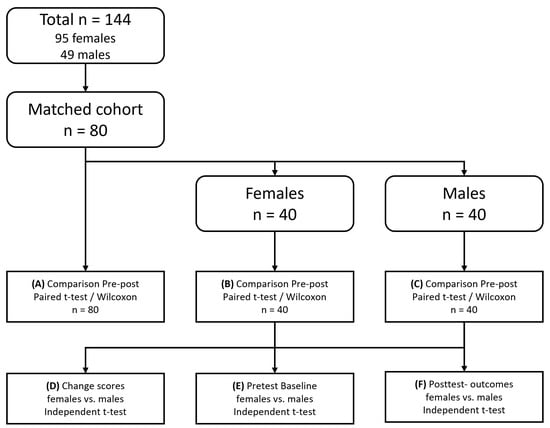
We conducted a single-center, retrospective pre–post study with a propensity score-matched comparison of male and female participants, evaluating spatial cognition outcomes among participants of a standardized echocardiography class. Participation was voluntary, and subjects gave their written informed consent. We analyzed cohorts taught between 2017 and 2025 using the same standardized curriculum (Figure 1 and Section 2.3). The extended enrollment period was necessary to accumulate a sufficient sample size. Given the female-predominant composition of medical student cohorts at our institution, it took longer to include sufficient male participants for propensity score matching. Importantly, the course was delivered by the same instructor throughout the study period, using identical learning objectives, assessment instruments, and 3D-printed models. No changes were made to the curriculum structure, test content, or grading criteria between 2017 and 2025.
Figure 1.
Strategy for analysis. The cohort consists of n = 144 participants. Out of 95 women, 40 were selected to pair with 40 men of the study cohort after propensity score matching. A–C compare pre-test to post-test. D–F compare outcomes between males and females. (A) The first pre-test–post-test comparisons will be made of the entire cohort. (B) Then pre-test–post-test comparisons of all female participants will be made. (C) Pre-test–post-test comparisons of all male participants will be made. (D) There will be a comparison of all the change scores between men and women (difference between pre-test and post-test). (E) Baseline comparisons between female and male participants will be made. (F) Post-test comparisons between female and male participants will be made. For paired comparisons t-tests were used for normally distributed data and the Wilcoxon signed-rank test for non-normally distributed data.
2.2. Statistical Analysis
2.2.1. Study Design and Participants
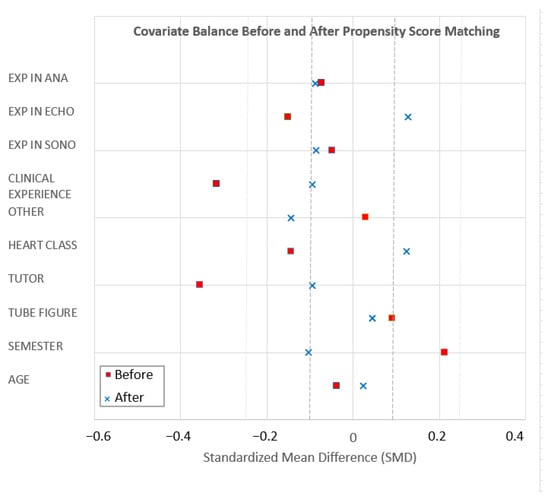
In total, 294 medical students participated in the class. All 249 provided written informed consent to participate in the study. A total of 164 were taught using 3D-printed heart models. The control group from the former study was excluded, as no 3D-printed heart models were used. We obtained 144 complete data sets. This study employed a propensity score matching (PSM) approach to create a balanced cohort for analysis. From an initial sample of 144 participants (95 females, 49 males), we generated 40 matched pairs (n = 80 total) using PSM to control for potential confounding variables. The matching procedure ensured comparable groups with respect to demographic and baseline educational variables. Propensity scores were estimated via logistic regression, including age, semester, baseline anatomy/2D/3D/visual thinking scores, and prior exposure variables (sono class, tutor, and heart class). One-to-one nearest-neighbor matching without replacement was performed with a caliper of 0.2 SD. Covariate balance was assessed using standardized mean differences (SMD), targeting SMD < 0.1 as the preferred threshold (SMD < 0.2 acceptable), and summarized in a Love plot (Figure 2).
Figure 2.
The Love plot displays standardized mean differences (SMDs) before and after matching. Dashed vertical lines indicate SMD = 0.1 (preferred) and 0.2 (acceptable). Points closer to zero indicate better balance.
2.2.2. Baseline Characteristic Analysis
Baseline characteristics were compared between matched groups using appropriate statistical tests. For continuous variables (age, semester, and tube figure), independent samples t-tests were applied. Categorical and ordinal variables (sono class, tutor, heart class, and other educational experiences) were analyzed using Mann–Whitney U tests. For experience variables measured on Likert scales (experience in sonography, echocardiography, and anatomy), Fisher’s exact tests were employed. Statistical significance was set at = 0.05 for all analyses.
2.2.3. Primary Outcome Analysis
The primary analysis consisted of six complementary approaches: (A) pre–post comparison for the total cohort (n = 80), (B) pre–post comparison for female participants (n = 40), (C) pre–post comparison for male participants (n = 40), (D) comparison of change scores between sexes, (E) baseline (pre-test) comparison between sexes, and (F) outcome (post-test) comparison between sexes (Figure 1). For within-group pre–post comparisons (A–C), we first assessed normality using skewness and kurtosis metrics (|skewness| < 2 and |kurtosis| > 7 as pragmatic thresholds for approximate normality, complemented by visual inspection (Q-Q plots)). Based on these assessments, paired t-tests were used for normally distributed data, while Wilcoxon signed-rank tests were applied for non-normally distributed outcomes. Outcome measures included anatomy scores, 2D visualization scores, 3D visualization scores, visual thinking scores (2D + 3D combined), and completion time. For between-group comparisons (D–F), independent samples t-tests were utilized for continuous variables meeting normality assumptions, while Mann–Whitney U tests were employed for non-normally distributed data. Change scores were calculated as the difference between post-test and pre-test values (post − pre) for each participant.
2.2.4. Secondary Outcome Analysis
Subjective difficulty and helpfulness ratings were analyzed as secondary outcomes. Difficulty ratings assessed four aspects: tube figure test, anatomical structures, imaging planes, and spatial orientation. Helpfulness ratings evaluated four teaching methods: tutoring, PowerPoint presentations, 3D-printed heart models, and free practice sessions. All ratings were measured on 5-point Likert scales. Gender differences in difficulty and helpfulness ratings were examined using Mann–Whitney U tests, accounting for the ordinal nature of the data. For the total cohort, descriptive statistics (mean ± standard deviation and median) were calculated, and items were ranked by mean scores to identify the most challenging aspects and the most helpful teaching methods.
2.2.5. Statistical Software and Reporting
Statistical analyses were conducted with SPSS (Version 31. IBM Corp., Armonk, NY, USA). All statistical analyses were conducted using appropriate computational methods. Results are presented as mean ± standard deviation for continuous variables. Tables and box plots were generated to visualize distributions, including medians (thick lines), interquartile ranges (boxes), whiskers (1.5 × IQR), means (filled circles), and outliers (individual points). Statistical significance was denoted as * p < 0.05, ** p < 0.01, and *** p < 0.001. All tests were two-tailed unless otherwise specified.
2.3. Intervention: The Echocardiography Course
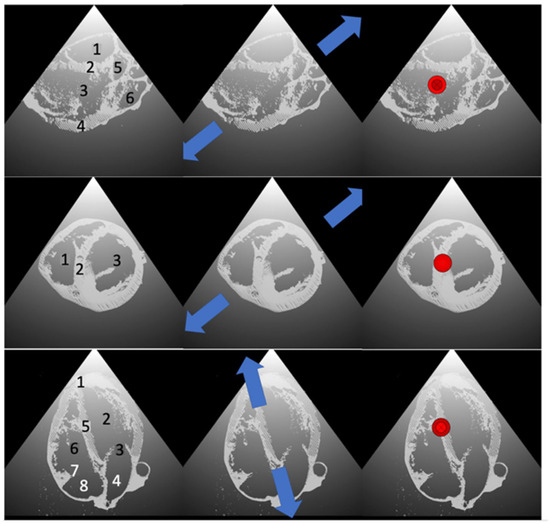
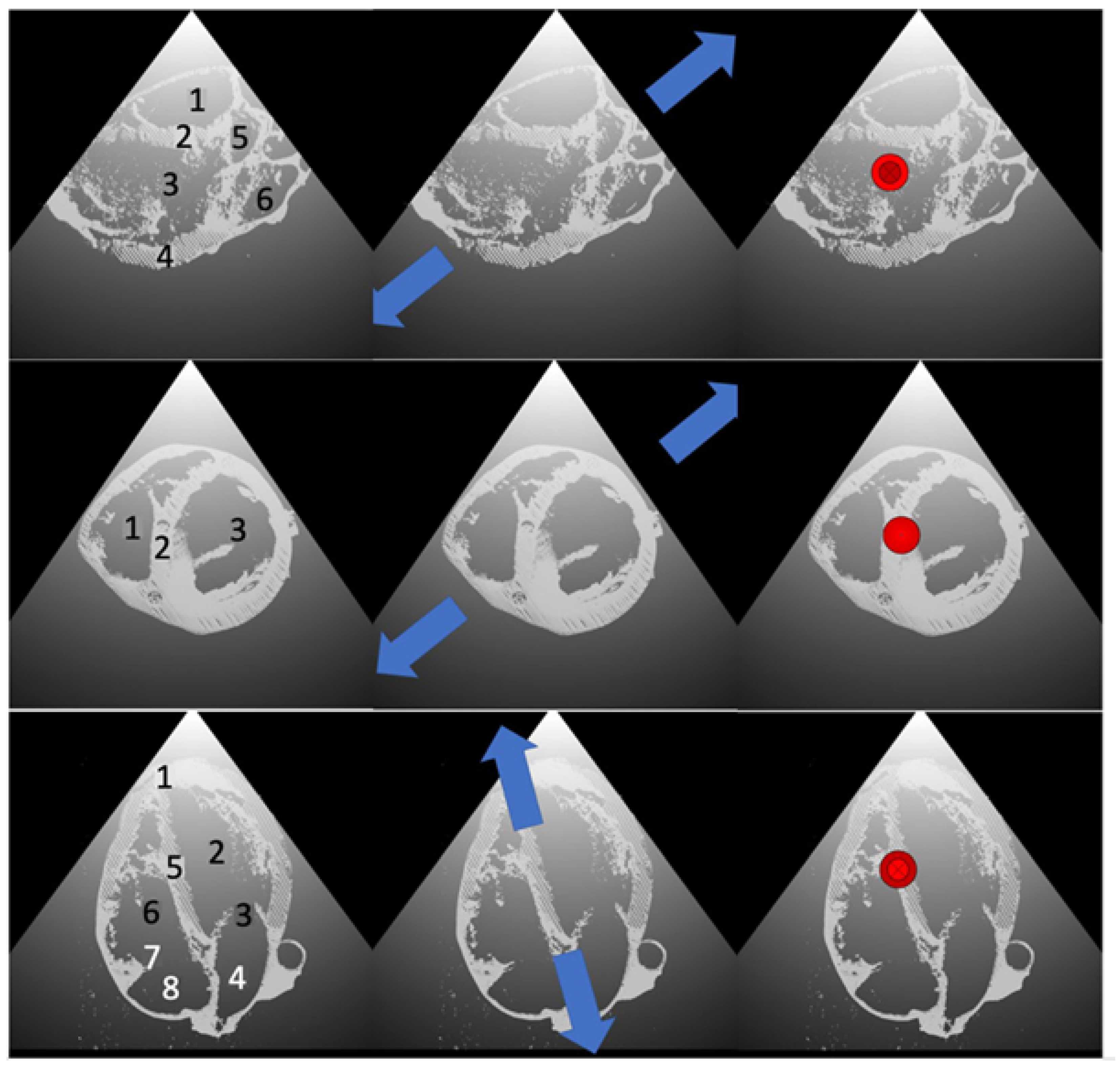
The Department of Thoracic and Cardiovascular Surgery at the University Hospital of Tübingen, Germany, offers a voluntary echocardiography elective for medical students of the Tübingen Medical Faculty. The course has been delivered continuously for approximately ten years by a stable core faculty with unchanged learning objectives and assessment formats, providing a longstanding, standardized curriculum that minimizes instructor- and curriculum-related variability across cohorts. Prior work from this program has shown that 3D-printed cardiac models support spatial imagination tasks in novices. The study course consists of alternating online and hands-on units and has demonstrated the benefit of 3D-printed cardiac models on spatial imagination tasks, as published previously (Salewski et al., 2022). This consistent training environment forms the basis for the present analysis. The participants completed an online mental rotation test (tube figure test) for entry, adjusted from Stumpf and Fay (1983). Five jars containing tubes were photographed from two sides. The first picture showed the front view; the second showed either the left side, the right side, or the rear side. The participants were asked to identify the correct view. Then, they completed a questionnaire regarding group demographics. We recorded their age, sex, semester, and subjective experience in sonography, echocardiography, and cardiac anatomy on a 5-point Likert scale. In addition, we inquired whether the participants worked as sonography tutors at our faculty, which is not uncommon for medical students. We asked about a concomitant sono class during the same semester. One part of the echocardiography class involved an online pre-test/post-test scenario. Before the hands-on echocardiography training, the participants conducted an initial online performance test on recognizing anatomical structures, 2D directions, and 3D orientations in three echocardiographic standard views (PLAX parasternal long-axis, PSAX parasternal short-axis, and A4C apical four-chamber views) (Figure 3). Current guidelines from the American Society of Echocardiography emphasize the need for structured, resource-supported training programs that combine online didactics with hands-on scanning practice and adapt to diverse trainee backgrounds (Kirkpatrick et al., 2020). Our curriculum aligns with these recommendations by integrating standardized online assessments, expert-guided hands-on sessions, and supplementary 3D-printed models within a longitudinally consistent framework.
Figure 3.
Nine test images. Each row shows PLAX, PSAX, and A4C views. The first column asks to name the numbered anatomical structures, and the second column asks for extremities the blue (2D) arrows point to, i.e., center top image: Upper right arrow → right shoulder. Lower left arrow → left hip. Center middle image: Upper right arrow → left shoulder. Lower left arrow → right hip. Center bottom image: Upper arrow (apex) → left hip. Lower arrow (base) → right shoulder. Right row, top image: The red (3D) arrow is pointing into the PLAX plane; therefore it points towards the right hip. Middle image: The arrow is pointing out of the PSAX plane, therefore pointing towards the left hip. Bottom image: The arrow is pointing into the A4C plane, therefore pointing to the anterior chest wall.
2.4. 3D-Printed Cardiac Models
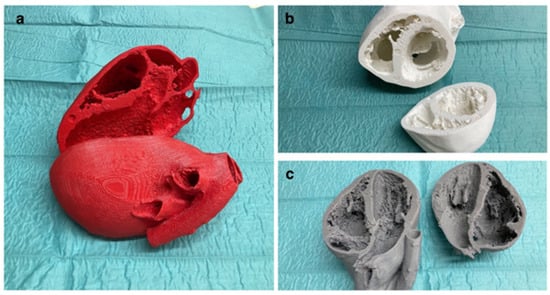
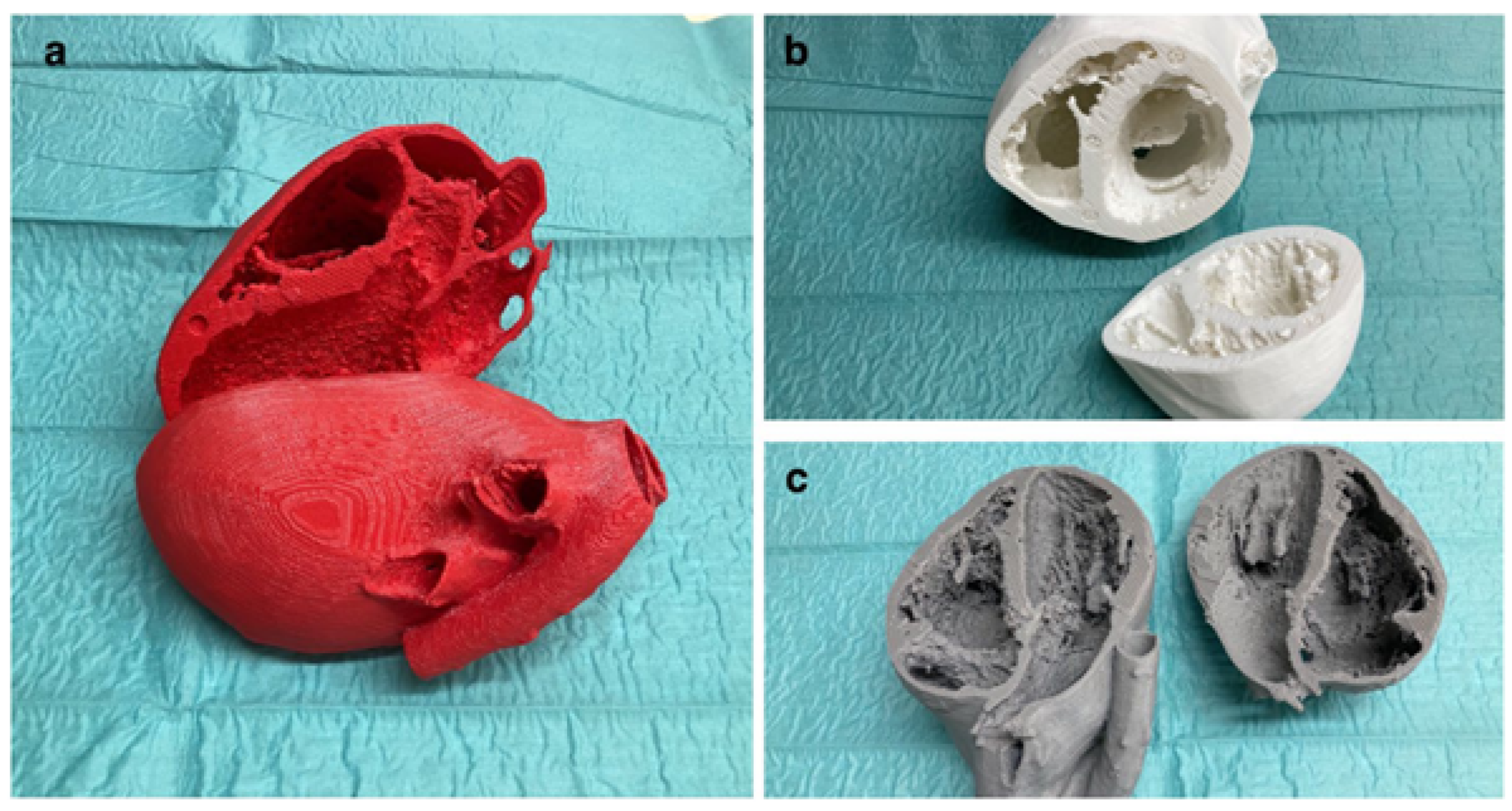
The 3D-printed heart models were designed to represent normal cardiac anatomy, with anatomically accurate ventricles, atria, valves, and major vessels. Models were printed from extrudable filament, allowing for the visualization of internal structures. They were produced at a 1:1 scale. Each model featured valves and ventricular walls, enabling hands-on exploration of spatial relationships. Students could physically manipulate the models to understand imaging plane orientations and the relationship between 2D echocardiographic images and 3D cardiac structures. The 3D printing files were retrieved from the Resuscitative TEE Project website (https://www.resuscitativetee.com/3d-printed-models accessed on 20 March 2026). Strictly speaking, these models are taken from the trans-esophageal point of view, not from the transthoracic one. They include the mid-esophageal long-axis view, trans-gastric short-axis view, and mid-esophageal four-chamber view. These nuances were negligible for the level of understanding necessary for this TTE class. The printing files were fed to a MakerBot replicator 3D filament printer (MakerBot Industries, Brooklyn, NY, USA). The fused deposition modeling filament was an economic standard poly-acrylic acid. The heart models are detachable in the exact planes of the echocardiographic standard views (Figure 4).
Figure 4.
Three 3D-printed cardiac models resembling the (a) PLAX (red), (b) PSAX (white), and (c) A4C views (grey). The participants may orientate the model according to the echocardiographic view and resolve which part of the model is “cut away” and which part remains. Thus they can further rotate the image seen on the echo screen with the help of the model and find the 3D orientation within their body. Thus she/he can answer 2D and 3D mental orientation questions.
3. Results
Of all valid data sets of the participants, a propensity-matched cohort was derived. The comprehensive analysis followed a systematic six-stage approach (Figure 1), examining within-group improvements [(A) total cohort, (B) females, (C) males] and between-group comparisons [(D) change scores, (E) baseline, (F) outcomes]. The intervention produced consistent, significant learning improvements across all participants. Despite females perceiving spatial tasks as more difficult, objective performance outcomes were equivalent between sexes. The initial baseline difference in completion time persisted after training.
3.1. Sample Size, Group Characteristics, and Propensity Score Matching
We analyzed 144 valid data sets (95 female, 49 male). Baseline characteristics by sex are shown in Table 1. Demographics and most of the variables reporting experience were broadly similar in the total cohort. Male participants rated their prior knowledge in anatomy, sonography, and echocardiography higher than female participants, although it was not significantly higher (Table 1).
Table 1.
Baseline characteristics by sex.
To achieve comparability, we performed 1:1 nearest-neighbor propensity score matching (PSM) without replacement, yielding 40 female–male pairs (n = 80). The Love plot (Figure 2) demonstrates improved covariate balance; standardized mean differences (SMDs) were mostly <0.10, but all <0.2. Table 2 lists baseline characteristics for the matched cohort.
Table 2.
Baseline characteristics of matched cohort (propensity score matching).
3.2. Pre-to-Post-Test Comparisons
- (A)
- Pre- and post-test comparison in the matched cohort
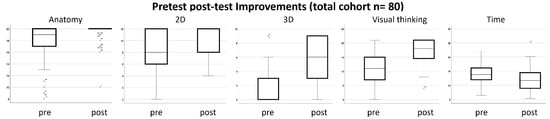
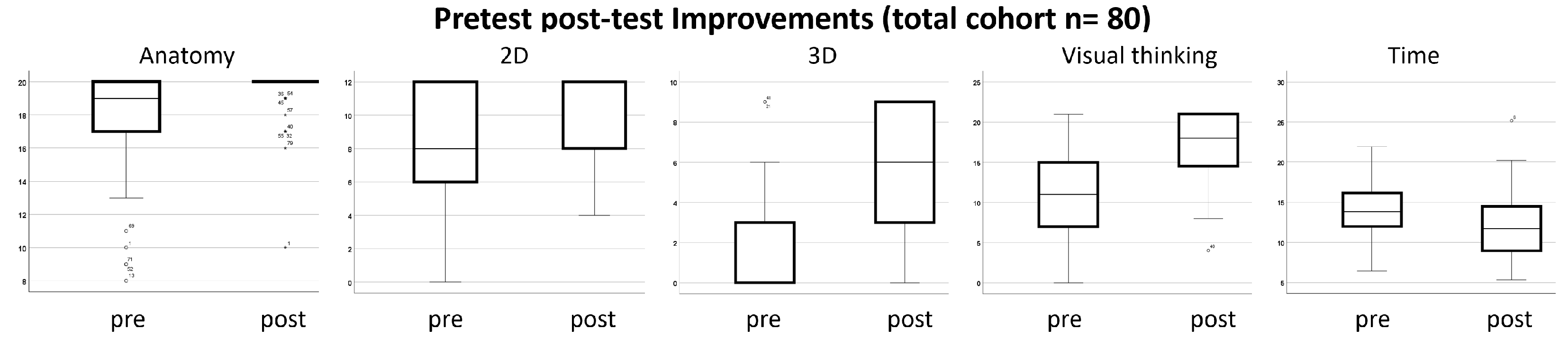
The structure of the presentation of results follows Figure 1. In the matched cohort (n = 80), all outcomes improved significantly from pre- to post-test (all p < 0.001): anatomy (17.80 ± 2.96 → 19.55 ± 1.37), 2D (8.30 ± 3.49 → 10.72 ± 1.94), 3D (2.55 ± 2.44 → 5.92 ± 3.06), visual thinking (10.85 ± 4.89 → 16.65 ± 4.08), and time (14.09 ± 3.29 → 11.91 ± 4.03 min; = −2.18 ± 3.09) (Figure 5). Test statistics are reported in Table A1.
Figure 5.
The cohort significantly improved from pre- to post-test in every objectively measured aspect (all p < 0.001). The anatomy, 2D, and 3D scores, and thus the visual thinking score, were higher. In the post-test, the participants achieved these scores in less time than in the pre-test.
- (B)
- Pre- and post-test comparison of female participants
Female participants (n = 40) showed significant improvements in all domains. Anatomy scores increased by 1.15 points (p < 0.001), 2D scores by 2.30 points (p < 0.001), 3D scores by 3.52 points (p < 0.001), and visual thinking scores by 5.83 points (p < 0.001). Completion time decreased by 2.20 min (p < 0.001). See Table A2.
- (C)
- Pre- and post-test comparison of male participants
Male participants (n = 40) demonstrated comparable learning gains. Significant gains were observed in all domains: anatomy (+2.35 points, p <0.001), 2D scores (+2.55 points, p <0.001), 3D scores (+3.23 points, p < 0.001), and visual thinking scores (+5.78 points, p < 0.001). Time efficiency improved by 2.16 min (p < 0.001). See Table A3.
3.3. Comparisons of Males and Females
- (D)
- Comparison of Learning Gains
Comparison of learning gains between sexes revealed no significant differences. Female and male participants improved equally in anatomy ( = 1.20, p = 0.051), 2D skills ( = 0.25, p = 0.738), 3D skills ( = 0.29, p = 0.661), visual thinking ( = 0.05, p = 0.961), and time efficiency ( = −0.04 min, p = 0.962). This demonstrates the equal effectiveness of the intervention. See Table A4. In ANCOVA sensitivity analyses (post − pre + sex), sex was not an independent predictor of post-test performance (all p < 0.05), confirming the change score results.
- (E)
- Baseline Comparison
At baseline, male participants scored lower in anatomy (17.12 ± 3.34 vs. 18.48 ± 2.37, p < 0.041), and female participants required more time (+2.46 min on average; 15.32 ± 2.83 vs. 12.86 ± 3.28 min; p < 0.001). Pre-test comparison showed similar baseline performance between males and females across all cognitive measures. See Table A5.
- (F)
- Post-test comparison
Post-test comparison revealed no significant sex differences in cognitive measures. Both groups achieved comparable final performance levels in anatomy (p = 0.627), 2D skills (p = 0.302), 3D skills (p = 0.663), and visual thinking (p = 0.415). Males closed the anatomy gap from the pre-test. However, the initial time difference observed at baseline persisted, with female participants completing the post-test more slowly than male participants (13.12 ± 3.87 vs. 10.69 ± 3.86 min; p = 0.006). See Table A6.
3.4. Secondary Outcomes
3.4.1. Perceived Difficulty
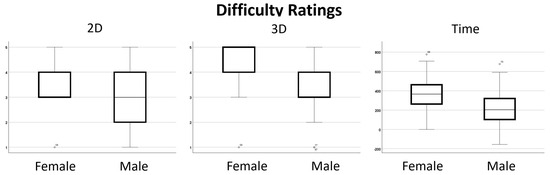
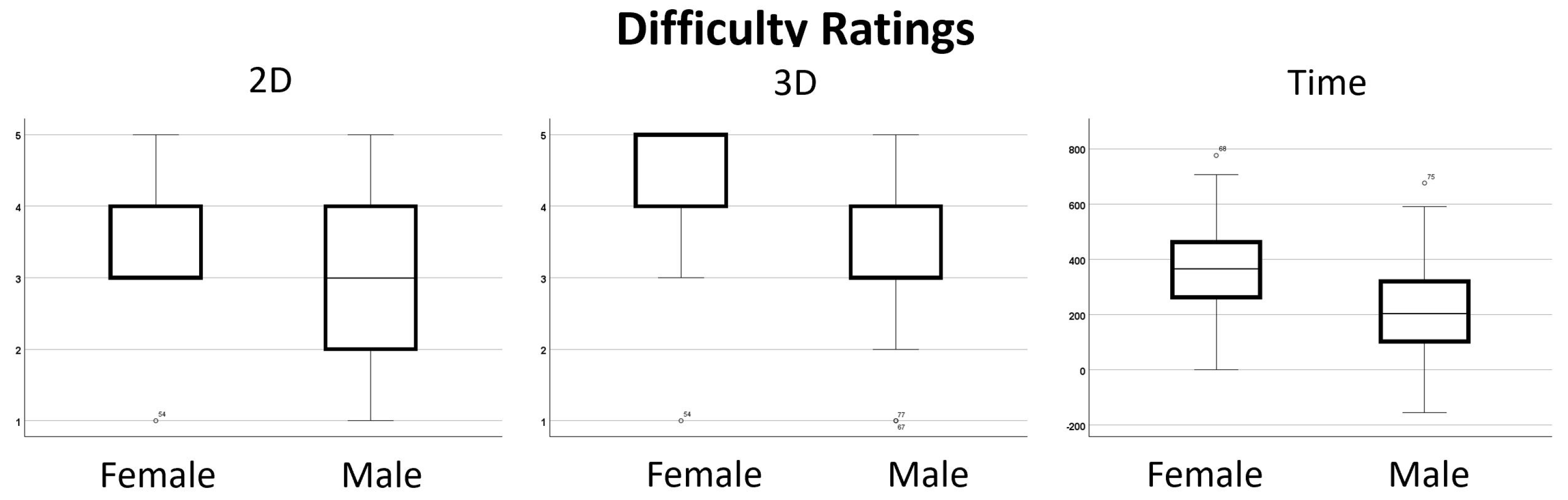
Participants rated spatial orientation as the most challenging (3.91 ± 1.04), followed by imagining planes (3.42 ± 0.92), anatomical structures (2.38 ± 1.11), and tube manipulation (2.34 ± 1.10). Female participants rated imaging planes (3.77 ± 0.77 vs. 3.08 ± 0.94, p < 0.001) and spatial orientation (4.20 ± 0.85 vs. 3.62 ± 1.14, p = 0.016) as significantly more difficult than male participants. No differences emerged for structural anatomy (p = 0.235) or tube manipulation (p = 0.697) (Figure 6). See Table A7.
Figure 6.
Significant differences were shown mostly in subjectively reported measures. Women reported having more difficulty in 2D orientation (p ) and in 3D spatial rotation (p ) than men. A significant difference in performance was pre-test time (p ). Men were faster in both the pre-test and post-test than women.
3.4.2. Perceived Helpfulness
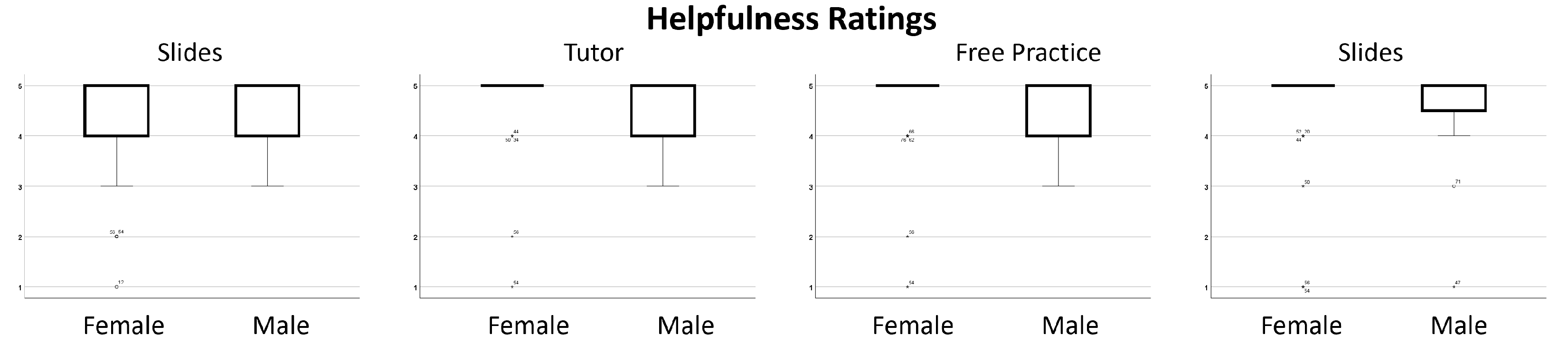
All teaching methods received high ratings (>4.1/5.0), with tutoring ranked highest (4.70 ± 0.70), followed by free practice (4.66 ± 0.70), 3D-printed models (4.65 ± 0.86), and PowerPoint slides (4.18 ± 0.93). Critically, no significant sex differences were observed for any teaching method (all p > 0.05), indicating a universal appreciation of the multi-modal approach (Figure 7). See Table A8.
Figure 7.
During the class, participants had tutoring, 3D-printed heart models, free practice, and PowerPoint Slides for help. The helpfulness ratings have a ceiling effect. There were no different perceptions of helpfulness of the different teaching means.
4. Discussion
This confirmatory study examined whether the benefits of 3D-model-assisted echocardiography training, previously demonstrated in a controlled trial (Salewski et al., 2022), are equally distributed across sexes. Our findings largely support this hypothesis for objective performance measures, while revealing persistent disparities in processing time and subjective experience. In our class, participants could align the complete 3D-printed hearts to a “venous cross” (venae cavae vertically and pulmonary veins horizontally) in front of their chests. Then, they could observe the echocardiographic standard views (PLAX, PSAX, or A4C) on the screen and detach the model in the exact same plane. They were asked to keep the part that matched the standard view on the screen and set aside the complementary part. They would hold the correct part beside the screen of the echocardiography machine and give the examiner the opportunity to adjust and improve the position of the echo probe. Furthermore, they would finally align the matching part in front of their chests again to imitate the visualized plane. Thus, they could experience the anatomical plane of the echocardiographic view.
Physical 3D models may reduce working memory demands by externalizing spatial information that would otherwise need to be maintained and manipulated mentally. Thereby, the cognitive load is lowered. This externalization could be particularly beneficial for learners with lower baseline spatial abilities or higher spatial anxiety, explaining why females who reported higher perceived difficulty still achieved equivalent outcomes. Unlike static anatomical structures, cardiac anatomy must be understood in relation to dynamic imaging modalities. The ability to physically manipulate models while viewing corresponding echocardiographic images may create stronger mental connections between 2D representations and 3D reality than traditional teaching methods alone.
4.1. Sample Characteristics and Generalizability
Consistent with documented stereotypes, men perform better in spatial ability tasks than women and are therefore over-represented in STEM professions (Sanchis-Segura et al., 2018). The study cohort consists of medical students. This cohort must be defined as young, intelligent, motivated in their subject of choice, and willing to participate in this class. Therefore, a selection bias exists for both men and women. They might not represent the general population. One study shows that men and women in STEM subjects do not differ in mental rotation tasks (Sanchis-Segura et al., 2018); another shows the opposite (Tsigeman et al., 2023). Our cohort may be seen as a subgroup of STEM students. Although medicine is not a classical STEM subject and more women study medicine than men, fundamental classes must be passed in physics, chemistry, bio-chemistry, physiology, and statistics. Thus, a basic university-level STEM training must be taken into account.
4.2. Internal Validation and Limitations
The eight-year data collection period (2017–2025) introduces the possibility of unmeasured temporal confounders. Societal shifts in gender-related stereotypes, evolving attitudes toward spatial tasks in medical education, or changes in students’ prior digital and simulation-based learning experiences may have influenced performance across cohorts. Additionally, the COVID-19 pandemic (2020–2022) may have altered learning behaviors or baseline preparedness in affected cohorts. Although the curriculum remained standardized throughout, we cannot exclude subtle cohort effects. Furthermore, treating gender as a binary variable based on self-reported biological sex remains a simplification. Gender identity, socialization experiences, and stereotype vulnerability may independently influence spatial performance and vary substantially within sex categories. This binary classification cannot capture such within-group heterogeneity of genders. Future studies with larger samples should consider dimensional approaches, potentially incorporating gender-role orientation or spatial self-concept to better characterize who benefits most from model-assisted training.
The propensity score matching approach improved comparability between male and female participants with respect to observed baseline covariates. However, PSM cannot replace a randomized trial. It cannot account for unmeasured confounders such as spatial anxiety, learning motivation, prior gaming experience, or cognitive strategy preferences, all of which may independently influence spatial learning outcomes. The present study did not include a concurrent control group without 3D-printed models. However, the superiority of 3D-model-assisted training over conventional instruction was shown in our prior controlled trial (Salewski et al., 2022). The 3D intervention group scored significantly higher in visual thinking. A backward multivariate regression excluded sex as a predictor of learning gains. The present study builds on this evidence by addressing a distinct question: whether the demonstrated benefits of 3D model training are equally distributed across sexes. Repeating a no-model control condition would have been difficult to justify, given the prior evidence of its inferiority.
The comprehensive outcome assessment captured cognitive (anatomy and visualization), practical (completion time), and subjective (difficulty and helpfulness) dimensions. The matched-pairs design with 40 pairs provided adequate statistical power while maintaining rigorous comparability. The multi-faceted analysis strategy systematically examined within-group improvements and between-group differences. However, important limitations must be acknowledged. The single-center design may limit generalizability to other educational contexts. The relatively short time frame between pre- and post-testing precludes assessment of long-term retention. Our outcomes are obtained from a single session. While completion time decreased significantly, this study did not evaluate clinical competency or patient outcomes, representing a crucial gap between educational performance and practical application. A notable finding concerns the discrepancy between subjective and objective measures: despite female participants perceiving spatial tasks as significantly more difficult, objective performance outcomes were equivalent between sexes. This dissociation challenges assumptions about self-perceived difficulty predicting actual performance and suggests that an increased perception of task difficulty does not necessarily impair learning effectiveness. Relatedly, sex-specific confidence bias may contribute to longer test times. Finally, potential mediators (e.g., spatial anxiety, stereotype threat, and hormonal status) were not measured and, therefore, cannot be modeled explicitly. Furthermore, anatomy scores approached the test ceiling in both groups (post-test: 19.55 ± 1.37 out of 20), which may have compressed between-group variability. However, anatomy items assessed factual knowledge of cardiac structures rather than spatial ability, making this ceiling less relevant to the central sex comparison. The spatial subscales—3D visualization and visual thinking—remained well below the ceiling, and it is these measures where outcome parity is most meaningful. The identical pre- and post-test introduces practice effects from repeated item exposure; while this affects both groups equally and does not invalidate the between-group comparison, it may inflate within-group improvement. The multi-component intervention does not allow attribution of effects to any single element. However, our prior controlled trial demonstrated that 3D models specifically predicted visual thinking gains (Salewski et al., 2022). Participants in the present study rated 3D models among the most helpful teaching methods (4.65 ± 0.86), with no sex differences in this rating. Together, this suggests that 3D models contribute meaningfully beyond the multi-modal package alone.
4.3. Distinguishing Outcome Parity from Process Equity
The performance outcomes concerning mental rotation do not show significant differences. It is not possible to look at a single test score and determine with certainty whether it belongs to a male or a female. This curriculum reached outcome parity. However, this does not mean that the learning process has reached equity. Male participants gave their answers faster. Female participants may have taken more time to deliberately check their answers, or they needed more time to come to their conclusions. These possibilities cannot be disentangled from the present data. As female participants reported the tasks to be more difficult, the latter may be assumed. The origins of perceived difficulty cannot be determined. Neither can the differences in the mental rotation processes of men and women. This suggests that different ways of processing the same information exist. Men and women engage in different cognitive strategies that require varying amounts of processing time to solve the tests. So, sex equity only relates to the outcome, but not to the problem solving process. The mental rotation task seems to affect male and female participants differently. This dissociation carries practical implications. Learners who experience equal tasks as more demanding may be at greater risk of disengagement. Avoidance of spatial challenges or reduced self-efficacy over time might occur—even when their objective performance gives no reason for concern. Equivalent outcomes achieved under greater perceived difficulty should not be equated with an equivalent learning experience. However, the reducibility of sex differences through training is not universally supported. Tsigeman et al. found that gender differences in spatial ability persisted even among STEM experts with extensive domain-specific experience. This suggests that prolonged engagement in spatially demanding fields does not necessarily eliminate the gap (Tsigeman et al., 2023). Our finding of equivalent cognitive outcomes but persistent time differences is consistent with this nuanced picture. Structured training may equalize what learners achieve, while differences in how they process spatial information remain.
4.4. Literature Context
There is current evidence on gender differences in spatial abilities, as extensive meta-analytic research demonstrates that men, on average, outperform women on spatial imagination tasks, particularly mental rotation, with moderate effect sizes persisting from childhood to adulthood being shown (Hegarty, 2018; Lauer et al., 2019; Miola et al., 2023; Voyer et al., 2017). This male advantage in visuospatial processing has been well-established across diverse populations and experimental paradigms. Echocardiography fundamentally requires mentally reconstructing three-dimensional cardiac anatomy from two-dimensional images—a task heavily dependent on spatial cognition. These documented sex differences might be expected to manifest in echocardiographic learning and performance outcomes. However, recent evidence reveals mediating factors that indicate that spatial performance differences are significantly modulated by psychological and contextual factors, contradicting the concept of an innate ability. Spatial anxiety, self-confidence, and stereotype threat have been shown to substantially disadvantage women in high-demand spatial tasks, with these factors potentially accounting for the observed performance gaps (Ariel et al., 2018; L. Arrighi & Hausmann, 2022; Sanchis-Segura et al., 2018; Tarampi et al., 2016). Critically, Sanchis-Segura et al. demonstrated that gender-related stereotypes can artificially widen observed sex differences in mental rotation tasks, suggesting that psychosocial factors may be as important as—or more important than—innate cognitive differences (Sanchis-Segura et al., 2018). Furthermore, training interventions, emotional context, and even hormonal status can mitigate these differences. Women using hormonal intra-uterine devices (IUDs) for contraception perform comparably to men on spatial tasks (Gaizauskaitė et al., 2025). Consistent with the hypothesis that equivalent outcomes may arise from different processing pathways, men and women might assign spatial abilities to distinct brain areas (Hänggi et al., 2010; Kawamichi et al., 2007). Prior experiments with action video games have shown reduced sex differences in spatial cognition (Feng et al., 2007), and women reach men’s scores in learning spatial skills with training (Spence et al., 2009). This represents an unmeasured confounder, but structured training may serve as an equalizing intervention regardless of prior gaming experience. The mental rotation process seems not to be the only source of the sex difference in mental rotation tasks. Alternative strategy use is another source of sex differences in these tasks (Boone & Hegarty, 2017). Alternatively, sexes possess different perceptual (visual search) and decision-making mechanisms, but similar mental rotation processes. Furthermore, men presented longer visual search processing (Scheer et al., 2018). Putting our findings in the context of the literature, our data suggest a dissociation between perception and performance in echocardiography. Our results provide real-world evidence that challenges the direct translation of documented spatial ability differences into practical educational outcomes for the task of performing echocardiography. Female participants rated spatial tasks as significantly more difficult (imaging planes: 3.77 ± 0.77 vs. 3.08 ± 0.94, p < 0.001; spatial orientation: 4.20 ± 0.85 vs. 3.62 ± 1.14, p = 0.016). This is consistent with lower self-confidence and higher spatial anxiety reported in the literature (Ariel et al., 2018; R. Arrighi et al., 2022). Nevertheless, objective performance outcomes were entirely equivalent. Both groups achieved comparable improvements in 3D visualization (females: +3.52 points, males: +3.23 points, p = 0.661), visual thinking (females: +5.83 points, males: +5.78 points, p = 0.961), and overall echocardiographic competency. Our findings align with the observation by Ariel et al. that metacognitive monitoring accuracy for spatial tasks differs between sexes, with potential overconfidence in males and underconfidence in females despite comparable actual performance (Ariel et al., 2018). When appropriate instructional support is provided, greater perceived difficulty does not translate into reduced learning effectiveness.
Implications for Stereotype Threat and Educational Design: The sex-equivalent learning outcomes, despite differential subjective experiences, may reflect successful mitigation of factors known to impair female spatial performance. Our structured, multi-modal educational intervention—incorporating tutoring, 3D-printed models, PowerPoint presentations, and hands-on practice—was universally appreciated across sexes (all teaching methods p > 0.05 for gender comparisons). This uniform positive reception suggests the intervention successfully created a supportive learning environment that may have reduced the stereotype threat effects documented by Sanchis-Segura et al. (2018) and Tarampi et al. (2016).
Importantly, the initial baseline time difference (females: 15.32 ± 2.83 min vs. males: 12.86 ± 3.28 min, p < 0.001) persisted in the post-test (females: 13.12 ± 3.87 min vs. males: 10.69 ± 3.86 min, p < 0.006). While both groups improved comparably in speed ( = −2.20 vs. −2.16 min, p = 0.962), the absolute gap remained unchanged. This finding qualifies the scope of outcome parity observed for cognitive measures. Sex-related differences were not eliminated but shifted in their manifestation—from performance accuracy to processing time and subjective experience. Whether the persistent time difference reflects a deliberate speed–accuracy tradeoff, with higher spatial anxiety requiring additional cognitive effort, or more fundamental differences in spatial processing pathways cannot be determined from the present data. Critically, this pattern suggests that equivalent outcomes may be achieved at unequal cognitive or emotional costs. This is a distinction with practical implications for learner well-being and long-term engagement that warrants further investigation.
Bridging Cognitive Research and Clinical Application: We found no direct studies linking gender differences in spatial imagination to echocardiographic performance, despite robust evidence for sex differences in spatial cognition (R. Arrighi et al., 2022; Hegarty, 2018; Lauer et al., 2019; Miola et al., 2023; Newcombe, 2020; Voyer et al., 2017). Our study begins to fill this gap by examining actual echocardiographic learning rather than abstract spatial tasks. The finding that documented spatial ability differences do not translate into differential learning outcomes in echocardiography training has important implications for medical education. The literature suggests that training as an equalizing factor can narrow spatial ability differences (R. Arrighi et al., 2022; Gaizauskaitė et al., 2025; Miola et al., 2023). Our results provide strong support for this hypothesis in an echocardiographic context. The matched-pairs design controlled for baseline differences. The intensive hands-on training with multiple modalities appears to have provided sufficient scaffolding to support equivalent skill acquisition regardless of baseline spatial abilities or confidence levels. The particular effectiveness of 3D-printed models (rated 4.65 ± 0.86, third-highest among teaching methods after tutoring and free practice) may be especially relevant. Physical manipulation of three-dimensional models could reduce the working memory demands of pure mental rotation, thereby bypassing some of the cognitive processes where sex differences are most pronounced (Lauer et al., 2019; Voyer et al., 2017). This interpretation suggests that thoughtful educational design can compensate for documented cognitive differences without requiring those differences to disappear. Time pressure, patient variability, and clinical settings may add cognitive demands. The translation of our findings into this setting remains unknown. Additionally, long-term skill retention cannot be reported. If time and difficulty differences persist, transfer to clinical scenarios remains an untested consequence. Future studies should report long-term skill retention and evaluate outcomes involving real patient examinations. In the absence of such evidence, the present findings should be interpreted as demonstrating outcome parity on a structured test, not as evidence of equivalent clinical readiness. However, there are several limitations. Our assessment occurred immediately post-intervention, precluding conclusions about whether sex-equivalent performance persists over time or whether differential retention rates might emerge. The single-center design limits generalizability, and we did not directly measure spatial anxiety, stereotype threat, or hormonal status—factors identified as important mediators in the spatial cognition literature (Ariel et al., 2018; R. Arrighi et al., 2022; Gaizauskaitė et al., 2025; Sanchis-Segura et al., 2018; Tarampi et al., 2016). Future research could assess these psychological and physiological mediators to understand the mechanisms underlying the perception–performance dissociation we observed. Additionally, while our study examined educational outcomes, we did not assess clinical competency in real patient scenarios. Our findings challenge deterministic interpretations of spatial ability differences and demonstrate that appropriate educational interventions could achieve gender equity in echocardiographic skill acquisition. The documented male advantage in abstract spatial tasks (R. Arrighi et al., 2022; Hegarty, 2018; Lauer et al., 2019; Miola et al., 2023; Voyer et al., 2017) does not inevitably translate into superior clinical learning outcomes. Rather, our results suggest that the combination of multi-modal instruction, hands-on practice, and supportive learning environments can effectively mitigate factors that typically disadvantage learners in spatial domains. Rather than accepting gender differences in spatial performance as immutable, we should focus on designing curricula that accommodate diverse learning approaches and address psychosocial factors that may artificially widen performance gaps (Sanchis-Segura et al., 2018). Future echocardiography training programs should incorporate evidence-based strategies—including physical models, varied practice opportunities, and emotionally supportive contexts (Gaizauskaitė et al., 2025; Salewski et al., 2022)—that have been shown to reduce spatial performance gaps. Our demonstration that gender equity in learning outcomes is achievable provides an optimistic counterpoint to the literature documenting persistent sex differences in spatial cognition. The clinical application of spatial skills may be more important than abstract cognitive testing would suggest.
5. Conclusions
Echocardiography educators should consider incorporating physical 3D models not merely as supplementary aids but as core instructional tools, particularly for complex spatial content. Our results suggest that structured, multi-modal anatomy training can achieve equivalent objective performance outcomes across sexes in echocardiography training. However, persistent differences in processing time and perceived difficulty indicate that outcome parity should not be equated with full equity in the learning experience. Educators should be aware that learners who achieve comparable scores may nonetheless experience the learning process as more demanding, and instructional design should account for this disparity. For cardiac anatomy education specifically, the combination of physical models, imaging practice, and expert guidance appears to create an optimal learning environment that accommodates diverse spatial abilities. Future anatomy curricula should leverage 3D printing technology to create customized models that address specific learning objectives and student needs. Thoughtful educational design can compensate for differences in objective performance outcomes without requiring documented cognitive differences to disappear.
Author Contributions
Conceptualization, C.J.R. and C.S. (Christoph Salewski); methodology, C.J.R. and C.S. (Christoph Salewski); software, C.J.R. and C.S. (Christoph Salewski); validation, C.J.R. and C.S. (Christoph Salewski); formal analysis, C.J.R. and C.S. (Christoph Salewski); investigation, C.S. (Christoph Salewski), A.N. and R.B.; resources, C.S. (Christoph Salewski), A.N., R.B., C.J.R. and C.S. (Christian Schlensak); data curation, C.J.R. and C.S. (Christoph Salewski); writing—original draft preparation, C.S. (Christoph Salewski) and C.J.R.; writing—review and editing, C.S. (Christoph Salewski) and C.J.R.; visualization, C.S. (Christoph Salewski); supervision, C.S. (Christian Schlensak); project administration, C.S. (Christoph Salewski); funding acquisition, C.S. (Christoph Salewski). All authors have read and agreed to the published version of the manuscript.
Funding
The study was supported by the PROFIL-PROJECT Grant from the Medical Faculty of the University of Tübingen, Germany. Grant No. F.7232020.3: €20,000. Dr. Christoph Salewski (corresponding author) was the recipient of this grant.
Institutional Review Board Statement
This study was conducted in accordance with the Declaration of Helsinki and approved by the local Ethics Committee (Internal Review Board) part of the Medical Faculty of the Eberhard-Karls-University of Tübingen on 5 February 2025 (No. 461/2021BO2).
Informed Consent Statement
Informed consent was obtained from all subjects involved in the study.
Data Availability Statement
The data presented in this study are available on request from the corresponding author.
Acknowledgments
During the preparation of this manuscript/study, the author(s) used Claude.ai Sonnet 4.6 for the purposes of advice in data analysis strategy. All analyses were then conducted and controlled by the authors in SPSS. The authors have reviewed and edited the output and take full responsibility for the content of this publication.
Conflicts of Interest
The authors declare no conflicts of interest.
Abbreviations
The following abbreviations are used in this manuscript:
| A4C | Apical four-chamber view |
| PLAX | Parasternal long-axis view |
| PSAX | Parasternal short-axis view |
| 2D | Two-dimensional |
| 3D | Three-dimensional |
Appendix A
Table A1.
Pre–post comparison of matched cohort (n = 80).
Table A2.
Pre–post comparison of female participants (n = 40).
Table A3.
Pre–post comparison of male participants (n = 40).
Table A4.
Comparison of change scores between females and males (n = 40 each).
Table A5.
Comparison of pre-test values between females and males (n = 40 each).
Table A6.
Comparison of post-test values between females and males (n = 40 each).
Table A7.
Perceived difficulty ratings (1 = very easy, 5 = very difficult).
Table A8.
Perceived helpfulness ratings (1 = not helpful, 5 = very helpful).
References
- Ariel, R., Lembeck, N. A., Moffat, S., & Hertzog, C. (2018). Are there sex differences in confidence and metacognitive monitoring accuracy for everyday, academic, and psychometrically measured spatial ability? Intelligence, 70, 42–51. [Google Scholar] [CrossRef] [Scilit]
- Arrighi, L., & Hausmann, M. (2022). Spatial anxiety and self-confidence mediate sex/gender differences in mental rotation. Learning & Memory, 29, 312–320. [Google Scholar]
- Arrighi, R., Scocchia, L., & Alais, D. (2022). Visual search for motion direction: A laboratory simulation of everyday visual performance. iScience, 25, 104211. [Google Scholar]
- Boone, A. P., & Hegarty, M. (2017). Sex differences in mental rotation tasks: Not just in the mental rotation process! Journal of Experimental Psychology: Learning, Memory, and Cognition, 43, 1005–1019. [Google Scholar] [CrossRef] [Scilit]
- Cherney, I. D., Bersted, K., & Smetter, J. (2014). Training spatial skills in men and women. Perceptual and Motor Skills, 119, 82–99. [Google Scholar] [CrossRef] [Scilit]
- Feng, J., Spence, I., & Pratt, J. (2007). Playing an action video game reduces gender differences in spatial cognition. Psychological Science, 18, 850–855. [Google Scholar] [CrossRef] [Scilit]
- Gaizauskaitė, R., Zelionkaitė, I., & Grikšienė, R. (2025). Study of spatial abilities: The role of sex, female hormonal status and emotional context in visualizing 2D cross sections of 3D objects. Behavioural Brain Research, 485, 115520. [Google Scholar] [CrossRef] [Scilit]
- Hänggi, J., Buchmann, A., Mondadori, C. R. A., Henke, K., Jäncke, L., & Hock, C. (2010). Sexual dimorphism in the parietal substrate associated with visuospatial cognition independent of general intelligence. Journal of Cognitive Neuroscience, 22, 139–155. [Google Scholar] [CrossRef] [Scilit]
- Hegarty, M. (2018). Ability and sex differences in spatial thinking: What does the mental rotation test really measure? Psychonomic Bulletin & Review, 25, 1212–1219. [Google Scholar]
- Hervin, J., & Gibson, C. L. (2026). EXPRESS: A systematic review and meta-analysis examining sex differences in mental rotation ability. The Quarterly Journal of Experimental Psychology, 17470218261419079. [Google Scholar] [CrossRef] [Scilit]
- Hyde, J. S. (2016). Sex and cognition: Gender and cognitive functions. Current Opinion in Neurobiology, 38, 53–56. [Google Scholar] [CrossRef] [Scilit]
- Jacobs, O. L., Andrinopoulos, K., Steeves, J. K. E., & Kingstone, A. (2024). Sex differences persist in visuospatial mental rotation under 3D VR conditions. PLoS ONE, 19, e0314270. [Google Scholar]
- Kawamichi, H., Kikuchi, Y., Noriuchi, M., Senoo, A., & Ueno, S. (2007). Distinct neural correlates underlying two- and three-dimensional mental rotations using three-dimensional objects. Brain Research, 1144, 117–126. [Google Scholar]
- Kirkpatrick, J. N., Grimm, R., Johri, A. M., Kimura, B. J., Kort, S., Labovitz, A. J., Lanspa, M., Phillip, S., Raza, S., Thorson, K., & Turner, J. (2020). Recommendations for echocardiography laboratories participating in cardiac point of care cardiac ultrasound (POCUS) and critical care echocardiography training: Report from the American Society of Echocardiography. Journal of the American Society of Echocardiography, 33, 409–422.e4. [Google Scholar] [CrossRef] [Scilit]
- Lauer, J. E., Yhang, E., & Lourenco, S. F. (2019). The development of gender differences in spatial reasoning: A meta-analytic review. Psychological Bulletin, 145, 1162–1190. [Google Scholar] [CrossRef] [Scilit]
- Linn, M. C., & Petersen, A. C. (1985). Emergence and characterization of sex differences in spatial ability: A meta-analysis. Child Development, 56, 1479–1498. [Google Scholar] [CrossRef] [Scilit]
- Martinot, P., Colnet, B., Breda, T., Sultan, J., Touitou, L., Huguet, P., Spelke, E., Dehaene-Lambertz, G., Bressoux, P., & Dehaene, S. (2025). Rapid emergence of a maths gender gap in first grade. Nature, 643, 1020–1029. [Google Scholar] [CrossRef] [Scilit]
- Mauvais-Jarvis, F., Merz, N. B., Barnes, P. J., Brinton, R. D., Carrero, J.-J., DeMeo, D. L., De Vries, G. J., Epperson, C. N., Govindan, R., Klein, S. L., Lonardo, A., Maki, P. M., McCullough, L. D., Regitz-Zagrosek, V., Regensteiner, J. G., Rubin, J. B., Sandberg, K., & Suzuki, A. (2020). Sex and gender: Modifiers of health, disease, and medicine. The Lancet, 396, 565–582. [Google Scholar] [CrossRef] [Scilit]
- Miola, P., Giofré, D., & Piazza, M. (2023). Spatial training is an effective method for reducing gender-related differences in space perception and cognition. Journal of Cognitive Psychology, 35, 478–495. [Google Scholar]
- Newcombe, N. S. (2020). The puzzle of spatial sex differences: Current status and prerequisites to solutions. Child Development Perspectives, 14(4), 251–257. [Google Scholar] [CrossRef] [Scilit]
- Reale, C., Invernizzi, F., Panteghini, C., & Garavaglia, B. (2023). Genetics, sex, and gender. Journal of Neuroscience Research, 101(5), 553–562. [Google Scholar]
- Salewski, C., Nemeth, A., Sandoval Boburg, R., Berger, R., Hamdoun, H., Frenz, H., Spintzyk, S., Hahn, J. K., Schlensak, C., & Krüger, T. (2022). The impact of 3D printed models on spatial orientation in echocardiography teaching. BMC Medical Education, 22, 180. [Google Scholar] [CrossRef] [Scilit] [PubMed]
- Sanchis-Segura, C., Aguirre, N., Cruz-Gómez, A. J., Solozano, N., & Forn, C. (2018). Do gender-related stereotypes affect spatial performance? Exploring when, how and to whom using a chronometric two-choice mental rotation task. Frontiers in Psychology, 9, 1277. [Google Scholar]
- Scheer, C., Maturana, F. M., & Jansen, P. (2018). Sex differences in a chronometric mental rotation test with cube figures: A behavioral, electroencephalography, and eye-tracking pilot study. Neuroreport, 29, 870–875. [Google Scholar] [PubMed]
- Spence, I., Yu, J. J., Feng, J., & Marshman, J. (2009). Women match men when learning a spatial skill. Journal of Experimental Psychology: Learning, Memory, and Cognition, 35, 1097–1103. [Google Scholar] [CrossRef] [Scilit]
- Stericker, A., & LeVesconte, S. (1982). Effect of brief training on sex-related differences in visual–spatial skill. Journal of Personality and Social Psychology, 43, 1018–1029. [Google Scholar] [CrossRef]
- Stumpf, H., & Fay, E. (1983). Schlauchfiguren. Hogrefe Verlag. [Google Scholar]
- Tarampi, M. R., Heydari, N., & Hegarty, M. (2016). A tale of two types of perspective taking: Sex differences in spatial ability. Psychological Science, 27, 1507–1516. [Google Scholar]
- Tsigeman, E. S., Likhanov, M. V., Budakova, A. V., Akmalov, A., Sabitov, I., & Kovas, Y. (2023). Persistent gender differences in spatial ability, even in STEM experts. Heliyon, 9, e15247. [Google Scholar] [CrossRef] [Scilit]
- Tzuriel, D., & Egozi, G. (2010). Gender differences in spatial ability of young children: The effects of training and processing strategies. Child Development, 81, 1417–1430. [Google Scholar] [CrossRef] [Scilit]
- Uttal, D. H., Meadow, N. G., Tipton, E., Hand, L. L., Alden, A. R., Warren, C., & Newcombe, N. S. (2013). The malleability of spatial skills: A meta-analysis of training studies. Psychological Bulletin, 139, 352–402. [Google Scholar] [CrossRef] [Scilit]
- Voyer, D., Voyer, S. D., & Saint-Aubin, J. (2017). Sex differences in visual-spatial working memory: A meta-analysis. Psychonomic Bulletin & Review, 24, 307–334. [Google Scholar]
- Wang, M. T., & Degol, J. L. (2017). Gender gap in science, technology, engineering, and mathematics (STEM): Current knowledge, implications for practice, policy, and future directions. Educational Psychology Review, 29, 119–140. [Google Scholar] [CrossRef] [Scilit]
- Yammine, K., & Violato, C. (2015). A meta-analysis of the educational effectiveness of three-dimensional visualization technologies in teaching anatomy. Anatomical Sciences Education, 8, 525–538. [Google Scholar] [CrossRef] [Scilit]

Disclaimer/Publisher’s Note: The statements, opinions and data contained in all publications are solely those of the individual author(s) and contributor(s) and not of MDPI and/or the editor(s). MDPI and/or the editor(s) disclaim responsibility for any injury to people or property resulting from any ideas, methods, instructions or products referred to in the content. |
© 2026 by the authors. Licensee MDPI, Basel, Switzerland. This article is an open access article distributed under the terms and conditions of the Creative Commons Attribution (CC BY) license.