


Abstract
Considering the UN’s Sustainable Development Goals to foster quality education, curricula should encompass inclusive, equitable and contextually meaningful education. Since the textbook is the main support for EFL teaching in Chile, this study examines the alignment between 1st to 4th-grade English language textbooks and the unofficial Chilean English school curriculum. The research questions are as follows: (1) What content do the 1st to 4th-grade English language textbooks build? (2) To what extent does the content align with the unofficial curriculum for the first cycle of primary education? This is relevant since Chile has not improved proficiency in English despite substantial public investment in textbooks. To answer these questions, pedagogic discourse analysis was conducted, framed methodologically and analytically within the register model of Systemic Functional Linguistics, focusing on the field. The corpus comprises the textbooks and the vocabulary to certify young learners’ proficiency (pre-A1 and A1), as defined by the Common European Framework of Reference for Languages. The analysis reveals content building consistency across the textbooks and curriculum alignment, which ensures equitable access to quality learning opportunities.
1. Introduction
Education plays a central role in advancing sustainable development by ensuring equitable access to quality learning opportunities. In alignment with the United Nations’ Sustainable Development Goals, particularly Goals 4 (Quality Education) and 10 (Reduced Inequalities) (United Nations, 2026), the Chilean National Curriculum should promote inclusive, equitable and contextually meaningful education. In this context, English language education has gained strategic relevance in many Global South countries, as proficiency in English is associated with access to education, international mobility and global labor markets (Sumonte et al., 2025; Sibanda & Herman, 2024; Vieira & Finardi, 2019).
However, when English proficiency is unevenly distributed across socio-economic groups—as is the case in Chile—it risks reinforcing structural inequalities rather than alleviating them (Epperson, 2024; Matear, 2008). Despite substantial public investment in English language education, proficiency outcomes remain limited in state-funded school students, contrary to private school students (Cárcamo, 2018). To put the investment into perspective, the Chilean government spent about US$24 million on the procurement and distribution of textbooks for all subjects, which were distributed to more than 3 million public school students by 2022 (Subsecretaría de Educación, 2022). The gap between public and private schools questions not only the pedagogical effectiveness of teaching materials but also the sustainability of language education policy, which has turned English language education into a matter of social justice (Birkner & Cortés Seitz, 2024; Yilorm, 2016).
In Chile, English is compulsory from 5th grade onward, yet textbooks are distributed from 1st grade despite the absence of an official curriculum for the first four years of primary school. Consequently, textbooks work as policy-in-action, effectively shaping early English education. Evaluating their alignment with CEFR-based public policy expectations becomes key to assessing whether early instruction contributes to equitable and sustainable learning trajectories.
Language policy involves the purposeful decisions and actions that influence how languages are used, taught, regulated, and perceived within a society or educational context (Calvet, 1998). Chile’s adoption of the Common European Framework of Reference for Languages (CEFR) (Council of Europe, 2020) reflects a broader pattern of policy transfer from the Global North to the Global South. While these kinds of frameworks offer valuable standardization of teaching and assessment (Canale, 2023), their implementation raises questions concerning contextual, cultural and epistemic sustainability. If English is to contribute to sustainable development, materials should reflect learners’ realities and local identities (Sibanda & Herman, 2024).
Furthermore, sustainable education systems require internal coherence between language policy, curriculum, teaching materials, and classroom practice (Scarlota, 2025). Research converges on the problem of weak or inconsistent alignment between what English-language textbooks present and what curricula require, which undermines the quality of education and, therefore, exacerbates inequalities. In Chile, Scarlota (2025), for example, finds that this misalignment compels primary school teachers to adapt materials in order to meet language policy expectations regarding targeted proficiency levels. Textbook content is often more demanding than the curriculum prescribes, and classroom conditions realistically allow, potentially widening learning gaps. In this line, Toledo-Sandoval (2020) examines the cultural dimension of textbook implementation and shows that even locally produced English language teaching materials do not fully reflect students’ cultural realities. Although national cultural references are included (such as food or landscapes), their representation is limited and uneven, prompting teachers to actively bridge the gap by adapting and contextualizing content in their classrooms.
Similar patterns emerge in Chilean secondary education. Ramirez Draughn et al. (2025), for instance, observe that textbooks do not adequately fulfil the curriculum’s requirement to develop oral production skills, instead privileging comprehension over production. Cárcamo (2018) also demonstrates that listening exercises tend to foster literal comprehension of decontextualized vocabulary rather than critical thinking, especially in public schools. However, not all studies report misalignment. In particular, Lizasoain and Vargas-Mutizabal (2023) find that the content of 1st and 2nd-grade textbooks is consistent with students’ everyday language needs and with the proficiency levels expected for young learners (pre-A1 to A2) according to the CEFR. Research in Chile, then, suggests that alignment may vary across grades and analytical lenses.
Research from other contexts reveals similar concerns. In Sweden, Nordlund (2016) finds that preschool textbooks present isolated and low-frequency vocabulary with little progression or connection to learners’ communicative needs. In Slovakia, Kamenická et al. (2024) find that idiomatic expressions and set phrases in English are underrepresented in some textbooks, limiting opportunities for their acquisition. Similarly, in China, Mo and Bi (2024) show that although textbook vocabulary aligns with curricular requirements, it does not reflect high-frequency usage patterns, and repetition is limited, thus reducing learning opportunities. Comparable findings are reported in Japan, where Sugiura et al. (2020) observe that while secondary textbooks present appropriately challenging vocabulary, neither textbooks nor curricula demonstrate systematic progression across units. In contrast, evidence from Brazil suggests stronger coherence: Vieira and Finardi (2019) report that EFL textbooks selected through the National Textbook Program demonstrate clear alignment with language policy and curriculum objectives, integrating diverse forms of knowledge to support holistic student development. Similarly, in South Africa, Sibanda and Herman (2024) observe that while learners’ social worlds are mostly represented in local English-language textbooks, there are notable limitations in how diversity is portrayed, so the content is not always meaningful, inclusive, and engaging for every learner.
To conclude, research reveals that consistency between language policy, curriculum, textbooks, and classroom practice is generally weak, which poses additional demands on teachers and may limit students’ opportunities to develop English in equitable ways, particularly in under-resourced contexts. An examination of how textbook content is built and up to what point it aligns with curricular expectations, such as CEFR alignment, becomes essential for understanding the extent to which English language education contributes to sustainable and equitable learning pathways, especially when the curriculum is not official, as is the case in 1st to 4th grades.
Thus, this research investigates the contents that 1st to 4th-grade English language textbooks build, as well as the alignment between the English language ministerial 1st to 4th-grade textbooks and the CEFR-oriented targeted proficiency levels that are implicit in the unofficial school curriculum for these grades. The research questions are as follows:
- Research question 1: What kind of content do the 1st to 4th-grade English language textbooks build?
- Research question 2: To what extent does the content built in the 1st to 4th grade English language textbooks align with the CEFR-oriented unofficial curriculum for the first cycle of primary education?
The study will contribute to local and global discussions on curriculum consistency, educational equity, and the implementation of sustainable language policy not only in Chile but also in other developing countries. In particular, our study contributes in two ways. On the one hand, it addresses the textbooks used in the complete first primary education cycle, from 1st to 4th grade, which is useful for understanding how young learners build knowledge at school. On the other hand, it tests a theoretical and methodological framework for analyzing textbook content and its alignment with the curriculum, rendering it useful and productive.
2. Materials and Methods
This pedagogic discourse analysis of a corpus of four English language school textbooks was conducted using the register model proposed by Systemic Functional Linguistics (Halliday, 2004) and its associated cultural domain framework (Macken-Horarik, 1996). Additionally, and based on the level of communicative competence proposed in the unofficial curriculum, the content in the textbooks was compared with the content in the Wordlist document published by Cambridge Assessment English (2018) to verify the CEFR pre-A1 and A1 communicative competence levels of young learners aged 6 to 10. The corpus is described in Table 1 below.
Table 1.
Analyzed corpus.
As shown in Table 1, the corpus comprises the textbooks Get Ready with English 1 to 4 (Ministerial editions adapted from Richmond’s Beep series) and the Cambridge Assessment English (2018)’s Wordlist for pre-A1 and A1 levels. Each textbook contains eight thematic units (32 total units analyzed). To fully understand the research method, the analysis frameworks will be explained below.
2.1. Analytical Frameworks: The Register Model and Cultural Domains
Systemic Functional Linguistics (SFL) is a theoretical and methodological linguistic framework that approaches language as a system of linguistic options that individuals select and organize to communicate. The selection and organization of options depend strongly on the context, including resources that build experience, participants, and channels, which speakers should be able to identify and respond to at different stages of their lives (Christie, 2012; Painter, 2008). In these terms, EFL textbooks should align with students’ lives and language stages and present relevant linguistic resources.
The SFL model of register seems powerful to us because it helps identify the relationship between linguistic options and the context of use (Eggins, 2012; Macken-Horarik, 1996). Context can be analyzed through the notion of register, which involves three variables: field (or content), tenor (or social relationships), and mode (or channels of communication). The field enables the description of what is being said or negotiated, commonly referred to as ‘content’ or ‘topic’ (Eggins, 2012). The tenor perspective allows for identifying the type of social relationships among the participants, such as hierarchical ones. Finally, the mode helps describe the linguistic organization of the field and the tenor (Halliday, 2004). For example, the lexical choices to say ‘hi’ (field) will vary if the context is formal or informal (tenor) or if the means of communication is oral, written, or multimodal (mode), ranging from a formal ‘How are you, madam?’ to an informal emoji of a waving hand. This is how the register model helps explain the relationship between language and context.
The description of the language used to build the field is useful for explaining the content presented in the textbooks and their alignment with the school curriculum, in terms of the linguistic resources that students need to communicate in expected scenarios. Macken-Horarik (1996) and De Silva Joyce and Hood (2009) further develop the register model to describe the language that school students need to understand and to demonstrate learning across disciplines and levels. Although they propose the cultural domain framework to describe the curricula for English as a First Language and English for Specific Purposes, the framework also applies to the EFL curriculum and its implementation in textbooks as explained below.
The cultural domain is defined as the social sphere or space in which students are expected to participate as the curriculum unfolds; that is, the language they need to learn content, perform social roles, and produce texts (Macken-Horarik, 1996; De Silva Joyce & Hood, 2009). Learning corresponds to the expansion of the cultural domain across three subdomains: everyday life, specialized, and reflective (see Table 2).
Table 2.
Relationship Between Register and Cultural Domains.
To describe the content of the 1st through 4th-grade EFL textbooks and determine their alignment with the unofficial CEFR-oriented curriculum, this study focuses on the field to identify the cultural domain in which students are expected to participate; that is, on the content they need to communicate.
As shown in Table 2, the nature of the cultural domain can be explained in terms of the field, tenor, and mode of the register. The field shows a progression from common-sense knowledge to specialized knowledge and, eventually, to critical reflective knowledge. Thus, individuals first learn to select and organize linguistic resources to represent their immediate and familiar experiences of everyday life, and over time—subject to the amount and quality of the input—learn to represent more complex meanings. At the beginning of the schooling process, students bring to school what they have learned in their communities; this learning is fundamental for disciplinary specialization (Painter, 2008). For instance, language learners first learn to name food at home and then classify it as protein or fiber at school. Regarding tenor, this register variable evolves from community roles (family members, friends, or classmates, for example) to expert roles (e.g., students of natural or social sciences) and multiple roles (e.g., scientists or creators of knowledge). This means that the school curriculum not only presents increasingly complex content but also imagines and prepares students to interact with it, understand it and reproduce it to demonstrate mastery. Multiple roles, finally, allow individuals to create new knowledge, as is the case with scientists or literature writers. Lastly, the mode reflects the use of language first as part of reality (to name and classify it), then as a construction of reality (to describe it), and finally as a challenge to reality (to reinvent it). Therefore, students must learn to build increasingly complex texts to advance their content knowledge and social relationships.
Consequently, the curriculum should be designed to help students interact effectively across the cultural domain continuum proposed by Macken-Horarik (1996). Concerning field, specifically, in the first cycle of primary education, the cultural domain should correspond to common-sense knowledge, community roles, and language as part of reality. Likewise, under the current unofficial English curriculum in Chile, primary school students from grades 1st to 4th should be able to develop pre-A1 and A1 levels of communicative competence, as defined by the CEFR. In turn, the greater the linguistic resources a student can access, the greater their capacity to participate in increasingly complex communicative situations.
2.2. Analytical Procedure
To answer question 1, the fields were identified from the titles of units in textbooks for 1st to 4th grade to define the content they represent (see Table 3). Then, the fields in the textbooks were analyzed considering the cultural domain framework to establish the kind of knowledge that the textbooks build and the social spheres in which they imagine students of that age interacting. Table 3 also shows how some fields are expanded across grades 1st to 4th, such is the case of ‘school’ or ‘animals’, which are highlighted in green in the case of ‘school’, and pale blue in the case of ‘animals’.
Table 3.
Units in 1st to 4th-grade Textbooks.
To answer question 2, once the different fields in the units were recognized according to the realities they represent, a comparison was made among them and the CEFR Wordlist’s thematic categories, seeking concordance (see Table 4). These thematic categories are presented in the Wordlist document in alphabetical order: animals, body and face, clothes, colours, family and friends, food and drink, health, home, materials, names, numbers, places and directions, school, sports and leisure, time, toys, transport, weather, work, and the world around us (Cambridge Assessment English, 2018, pp. 38–43). Since Wordlist represents phenomena in the real world, they were interpreted as fields as well. Table 4 shows some fields that are clearly expanded across the grades from 1st to 4th such as ‘school’ (in green) and ‘animals’ (in pale blue), and adds the categories from Wordlist.
Table 4.
Consistency Between Content in Textbooks and Wordlist.
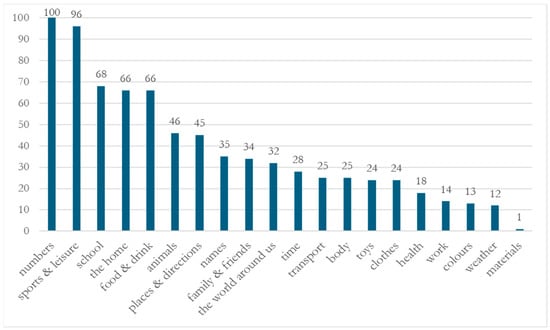
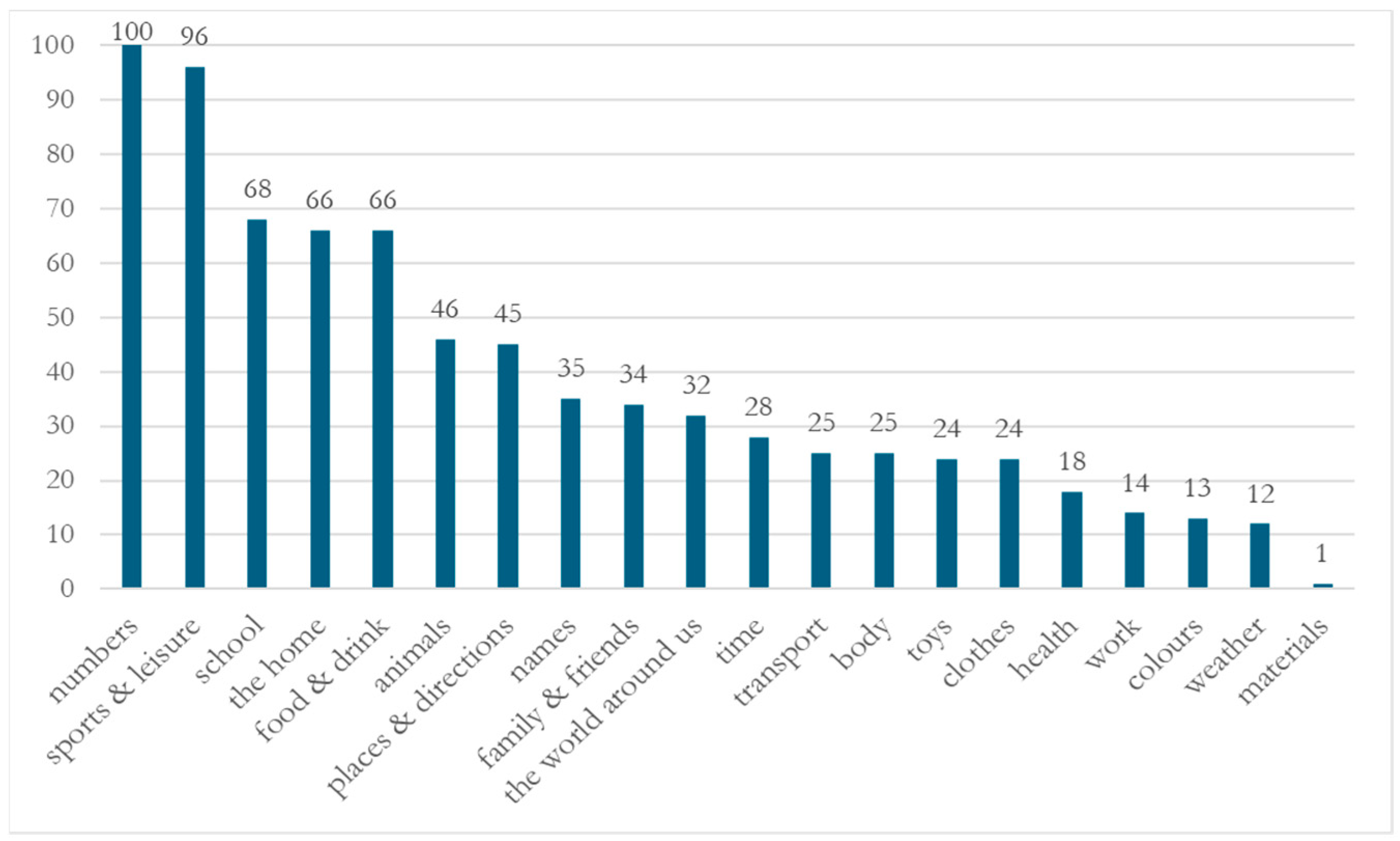
The comparison between the fields in the textbooks and the Wordlist thematic categories aimed to conclude whether textbooks distributed in Chilean schools covered the CEFR content required to assess students’ communicative competence in English in the 1st to 4th-grade primary level. This comparison is presented in Table 4, which shows the thematic categories and their corresponding units across the textbooks. The number of times that the Wordlist’s thematic categories appeared in the textbook was also estimated to assess their relevance to learners’ development of the targeted communicative competence (pre-A1–A1), as shown in Table 5. The interpretation of this relevance was supported by a graph (Figure 1) that shows the number of items included in the Wordlist’s thematic categories.
Table 5.
Number of Textbook Units Related to Wordlist’s Thematic Categories.
Figure 1.
Fields in Wordlist.
3. Results
3.1. Research Question 1: What Content Do the 1st to 4th-Grade EFL Textbooks Build?
This section examines the field in the four EFL textbooks distributed in Chilean primary education from 1st to 4th grade: Get Ready with English 1 through 4, and Wordlist. These books were adapted by the Ministry of Education from Richmond’s Beep series, originally designed for English as a Second Language (ESL) contexts in Asia and Europe. This background is relevant because teaching EFL differs from teaching ESL, particularly in terms of learners’ exposure to English outside the classroom; therefore, the suitability of content organization and sequencing must be considered in the design of teaching material.
As shown in Table 3, each textbook comprises eight units, each corresponding to a specific field. For example, in the textbook for 1st grade (Get Ready with English 1), Unit 1 refers to the ‘school’ field; Unit 2 refers to the ‘body’ field; Unit 3 is about the ‘family’ field, and so on. Thus, if analyzed vertically, the content is presented in blocks, and it seems decontextualized and isolated.
However, if analyzed horizontally, most of the fields are related. For instance, the first unit in each textbook refers to ‘school’ (At school, Time for school; Ready for school; Time for school). The same phenomenon can be observed concerning ‘animals’, which is built through Unit 4 in textbook 1 (Perfect pets); Unit 4 in textbook 2 (Animals); and Unit 6 in textbook 4 (Minibeasts). Another example is ‘food’, as observable in Unit 5 in textbook 1 (My favourite foods); Unit 7 in textbook 2 (The garden); and Unit 5 in textbook 4 (Let’s eat). It is also worth noticing that in the four textbooks, the first units refer to content related to school and the last ones relate to leisure or entertainment (On holiday, The school show, Summer Fun, and Summer camp). The positioning of school as the first unit and holiday or leisure as the final unit in each textbook echoes the Chilean academic calendar, meaning that the textbooks introduce content that matches learners’ real-world experiences at precisely the moments they are living them.
Regarding the field and cultural domains, the names of the units presented in Table 2 show that textbooks build common-sense knowledge, which is related to what students can already do in their mother tongue, in accordance with their age and communicative needs. The names of the units also show an attempt to introduce some level of abstraction, which is relevant to expand the cultural domain and eventually move from common-sense knowledge to disciplinary knowledge (see Table 1); that is, maybe from a pre-A1 or A1 level to an A2 communicative competence level. For example, the unit titles in the 1st-grade textbook are transparent and concrete: At school, My body, My family, My favourite pets, etc. In contrast, the unit titles in the 3rd-grade textbook, such as Busy Morning, Story World, and Nature Park, are more abstract.
3.2. Research Question 2: To What Extent Does the Content Built in the 1st to 4th-Grade EFL Textbooks Align with the Unofficial Curriculum for the First Cycle of Primary Education?
It was also found that the content developed in the textbooks highly aligns with Wordlist, which includes the vocabulary that Cambridge Assessment English (2018) deems necessary to certify young learners’ pre-A1 and A1 communicative competence. These lists of words have been identified from a big sample of interactions among children (Council of Europe, 2018) and reflect the vocabulary that they need to communicate in English as an additional language (second or foreign). These words are organized and presented in three formats: alphabetically, by grammatical function, and by thematic categories. The concept of field matches with thematic categories in Wordlist: animals, body and face, clothes, colours, family and friends, food and drink, health, home, materials, names, numbers, places and directions, school, sports and leisure, time, toys, transport, weather, work, and the world around us (Cambridge Assessment English, 2018, pp. 38–43).
The fields in the 1st to 4th-grade textbooks were compared to the thematic categories in Wordlist to establish their consistency with the CEFR-oriented EFL subject in Chile. The result of this comparison is shown in Table 4, where the thematic categories are bulleted below the unit titles.
Thus, Table 4 shows strong alignment between the fields in the EFL textbook and the unofficial CEFR-oriented curriculum, since all units refer to Wordlist’s thematic categories, except for Unit 3 in textbook 3, titled Story world (in grey). Besides, out of the 32 units that compose the four textbooks analyzed, the most frequent were ‘time’ (9), ‘places and directions’ (7), ‘sports and leisure’ (7), ‘school’ (5), and ‘the world around us’ (4). Table 5 shows these results in more detail
Table 5 also shows that some Wordlist categories are absent from the four textbooks (0 occurrences), including colours, health, materials, names, and numbers. This is expected since colours, names and numbers, for instance, are usually included in all units and are not studied in one unit only.
The relevance of the content in the textbooks was contrasted with the relevance of the content in Wordlist (Figure 1). Wordlist contains a high concentration of vocabulary in numbers (100 words), sports and leisure (96), school (68), home (66), food and drink (66), animals (46), and places and directions (45). Together, these categories account for more than half of the Wordlist items (487 out of 772 words). This analysis further supports the conclusion that the textbooks broadly reflect a CEFR-oriented curriculum, particularly in the prominence of fields related to sports and leisure, school, and places and directions.
In sum, the textbooks analyzed in this study align with the unofficial CEFR-oriented EFL curriculum for 1st to 4th grades. Therefore, textbooks promote communicative competence at pre-A1 and A1 levels for students aged 6 to 10.
4. Discussion
Regarding question one, we observed that the textbooks may contribute to achieving the UN’s Goals 4 and 10, which aim to ensure equitable access to quality learning opportunities. This is reflected in the fields that the textbooks build, related to language that allows students to interact in the cultural domain of daily life, regardless of their socio-economic context, and correspond to meanings of basic personal information, time, names, celebrations, family, and friends, among others. Thus, this study challenges research that points to the reproduction of social injustice in the EFL classroom (Birkner & Cortés Seitz, 2024; Epperson, 2024; Yilorm, 2016; Matear, 2008).
Secondly, and in relation to question 1, the content in the textbooks becomes increasingly complex, evolving from the everyday cultural domain towards a more specialized one. In this respect, although the organization of the textbook units may seem isolated and decontextualized within each grade, a cross-grade view shows progression and, therefore, the expansion of the cultural domain (especially regarding leisure, school, time, and places). This can also be interpreted as a form of ‘planned recycling’, which is key for EFL teaching and learning in primary school classrooms (Fuentealba et al., 2023). Besides, this content is related to experiences that students have already represented in their mother tongue, in accordance with their age and communicative needs. This means that knowledge is little by little scaffolded to become specialized across time. In this line, textbooks may facilitate explicit teaching and learning pathways that allow progressive language development in a contextualized manner, effectively addressing young learners’ needs.
Concerning question two, this study shows that the EFL textbooks distributed by the Ministry of Education align with the unofficial CEFR-oriented English curriculum and, therefore, with the learning stage of young learners as defined by the CEFR. This alignment has three implications related to sustainable English language education. First, the textbooks analyzed meet the criteria set by the State in that adequate teaching and learning materials must align with the curriculum and students’ cognitive levels (Ministerio de Desarrollo Social y Familia, 2021). In this sense, the textbooks contribute to the coherence among language policy, curriculum, teaching materials, and classroom practice, which is necessary for the promotion of sustainable education systems (Scarlota, 2025). Consequently, this study challenges previous research that has underscored the misalignment between EFL textbooks and the curriculum, locally and globally, as well as the negative impact this mismatch has on learning (e.g., Ramirez Draughn et al., 2025; Toledo-Sandoval, 2020). On the contrary, this study is in line with Lizasoain and Vargas-Mutizabal (2023), which highlights the consistency between the 1st and 2nd-grade textbooks and the curriculum, as well as the relevance of the language they present to children’s prior knowledge and communicative needs.
The latter is particularly relevant in Chile, where the first language should be considered a building block for the development of new knowledge. This fact may, in turn, help build a culture in which English is not considered ‘foreign’ but part of an intercultural world where the international language is seen as necessary for communicating a reality they already know and share with others around the world.
An interesting point of divergence, though, concerns the categories that appear strongly represented in Wordlist but are not explicitly developed in the textbook units. This happens specifically with numbers, colors, materials, and personal names. However, this absence does not necessarily mean misalignment. In fact, these language items work as relational resources, which means that they are typically learned in context because their meaning depends on the nouns they modify (e.g., two blue crayons or a wooden table). Therefore, they are expected to be integrated into other units, consistent with systemic-functional linguistic principles (Martin, 1992).
Although it was not the focus of our analysis, we also observed that the textbooks also build content that is somewhat disconnected from Chilean students’ socio-semiotic experience, something also noted by Toledo-Sandoval (2020) and Cárcamo (2018). This disconnect is likely because the textbooks were initially designed for English as a second language contexts, which differ significantly from ours. Specifically, units such as The garden, Nature park, and Summer camp may not resonate with the realities of students in Chilean and other Latin American countries’ public schools. Many of these students lack access to nearby green spaces and are unfamiliar with concepts such as summer camps, which are uncommon in Chile. Presenting cultural content that is largely unfamiliar to our children may lead to frustration rather than motivation (Sibanda & Herman, 2024). In this regard, we echo Epperson’s (2024) concern about the nature of the English language instruction provided in Chilean schools: What English are we teaching? Is it in line with the paradigm shift from a foreign to a decolonized international language that values local experiences (Sumonte et al., 2025; Vieira & Finardi, 2019).
5. Conclusions
Communicative competence in English continues to be a source of educational inequality. Despite sustained public investment in English teaching material, learning remains difficult to achieve, particularly in state-funded schools. This gap has led to a research line that examines the alignment between school textbooks and the curriculum, with a focus on ensuring coherence between policy and everyday classroom practice. In this context, textbooks matter not only as teaching and learning resources but also as policy in action, as they implement curricular expectations. Chile adheres to the United Nations’ Sustainable Development Goals (United Nations, 2026), so the entire educational system must orient to quality education (Goal 4) and, therefore, reduced inequalities (Goal 10).
The findings show strong consistency between textbook content and Wordlist content, which we operationalized as the field variable in the register model. Thus, our study supports the conclusion that the materials are adequate for teaching English to young learners in Chile when the right conditions are in place. Therefore, the textbooks can develop pre-A1 and A1 communicative competence and serve as a building block for the A2 level that students must develop in the second cycle of primary education, according to the current Chilean unofficial EFL curriculum. Progression is evident in how the materials build common-sense meanings while also introducing abstraction, potentially scaffolding the expansion of the cultural domain towards more specialized language over time. Thus, our findings are encouraging compared to the state of the art, which mostly reports misalignment.
Now it is necessary to examine in detail the content of the textbooks at the lexical level and to describe the semantic relations that are built across units and the whole series used in primary education. It is also worth replicating this methodology in the analysis of 5th to 8th-grade textbooks and their alignment with the curriculum for those grades.
Finally, although this study is limited to the Chilean reality, we must not lose sight of the fact that these are textbooks published by the Richmond Publishing House, which has an international reach. Therefore, the conclusions are generalizable to other countries in the Global South that also experience poor outcomes in communicative competence goals: low average English proficiency, strong dependence on textbooks, and unequal school-level opportunities to enact the curriculum. Our results suggest that consistent and relevant materials can leverage equity, supporting the development of early communicative competence when accompanied by the institutional conditions required for effective use.
Author Contributions
Conceptualization, A.L. and G.T.-V.; methodology, A.L. and G.T.-V.; formal analysis, A.L. and K.C.-O.; investigation, A.L.; writing—original draft preparation, A.L.; writing—review and editing, K.C.-O. and G.T.-V.; supervision, A.L.; project administration, A.L.; funding acquisition, A.L. All authors have read and agreed to the published version of the manuscript.
Funding
This research was funded by the National Agency of Investigation and Development (Agencia Nacional de Investigación y Desarrollo, ANID), Chile, and corresponds to the Fondecyt Regular project, number 1240667, entitled “Description and Progression of Ideational Meanings in the English Primary School Textbooks Distributed by the Ministry of Education of Chile” (Descripción y progresión de los significados ideacionales representados en los libros escolares de inglés entregados por el Ministerio de Educación en la enseñanza básica).
Institutional Review Board Statement
Not applicable.
Informed Consent Statement
Not applicable.
Data Availability Statement
The original contributions presented in this study are included in the article. Further inquiries can be directed to the corresponding authors.
Conflicts of Interest
The authors declare no conflicts of interest. The funders had no role in the design of the study; in the collection, analysis, or interpretation of the data; in the writing of the manuscript; or in the decision to publish the results.
Abbreviations
The following abbreviations are used in this manuscript:
| CEFR | Common European Framework of Reference for Languages |
| EFL | English as a foreign language |
| ESL | English as a second language |
| SFL | Systemic Functional Linguistics |
References
- Birkner, V., & Cortés Seitz, T. (2024). ELT textbook adaptation as a tool for social justice in disadvantaged schools: Empowering marginalised students. In L. Veliz, M. Barahona, & S. Darwin (Eds.), Critiquing the teaching and learning of English in Chile: Challenges and opportunities for transformative practice. Routledge. [Google Scholar] [CrossRef] [Scilit]
- Calvet, L. (1998). Language wars and linguistic politics. Oxford University Press. [Google Scholar] [CrossRef] [Scilit]
- Cambridge Assessment English. (2018). Pre A1 starters, A1 movers, A2 flyers wordlist for exams 2018. Cambridge University Press. Available online: https://www.cambridgeenglish.org/images/149681-yle-flyers-word-list.pdf (accessed on 18 March 2026).
- Canale, G. (2023). A multimodal and ethnographic approach to textbook discourse. Routledge. [Google Scholar]
- Cárcamo, B. (2018). Types of listening comprehension promoted in the Chilean EFL textbook global English. Colombian Applied Linguistics Journal, 20(1), 49–61. [Google Scholar] [CrossRef] [Scilit]
- Christie, F. (2012). Language education throughout the school years: A functional perspective. Wiley-Blackwell. [Google Scholar]
- Council of Europe. (2018). Collated representative samples of descriptors of language competences developed for young learners. Available online: https://rm.coe.int/collated-representative-samples-descriptors-young-learners-volume-1-ag/16808b1688 (accessed on 18 March 2026).
- Council of Europe. (2020). Common European framework of reference for languages: Learning, teaching, assessment. Companion volume. Available online: https://rm.coe.int/common-european-framework-of-reference-for-languages-learning-teaching/16809ea0d4 (accessed on 18 March 2026).
- De Silva Joyce, H., & Hood, S. (2009). English for community membership: Planning for actual and potential needs. In D. Belcher (Ed.), English for specific purposes in theory and practice (pp. 1–19). University of Michigan Press. [Google Scholar]
- Eggins, S. (2012). An introduction to systemic functional linguistics (2nd ed.). Bloomsbury. [Google Scholar]
- Epperson, M. (2024). Chilean ELT teachers’ strategies for selecting texts in vulnerable learning contexts. In L. Véliz, M. Barahona, & S. Darwin (Eds.), Critiquing the teaching and learning of English in Chile (pp. 164–176). Routledge. [Google Scholar]
- Fuentealba, L. A., Balgová, S., & Díaz, E. (2023). Teaching English as a foreign language: Building language awareness for teaching young learners. Ediciones Universidad Católica del Maule. [Google Scholar]
- Halliday, M. A. K. (2004). Language and the reshaping of human experience. In M. A. K. Halliday, & J. Webster (Eds.), The language of science (Vol. 5, pp. 7–23). Continuum. [Google Scholar]
- Kamenická, J., Králová, Z., & Grmanová, A. (2024). The structure and the distribution of phraseological units in intermediate and upper-intermediate EFL textbooks. Arab World English Journal, 15(1), 3–16. [Google Scholar] [CrossRef] [Scilit]
- Lizasoain, A., & Vargas-Mutizabal, J. (2023). Knowledge in the EFL textbooks delivered in the Chilean public school: What do they teach? Árboles y Rizomas, 5(1), 21–37. [Google Scholar] [CrossRef] [Scilit]
- Macken-Horarik, M. (1996). Literacy and learning across the curriculum: Towards a model of register for secondary school teachers. In R. Hasan, & G. Williams (Eds.), Literacy in society (pp. 232–278). Addison Wesley Longman. [Google Scholar]
- Martin, J. R. (1992). English text: System and structure. John Benjamins. [Google Scholar]
- Matear, A. (2008). English language learning and education policy in Chile: Can English really open doors for all? Asia Pacific Journal of Education, 28(2), 131–147. [Google Scholar] [CrossRef] [Scilit]
- Ministerio de Desarrollo Social y Familia. (2021). Programa modernización de textos escolares. Available online: https://www.dipres.gob.cl/597/articles-212485_doc_pdf1.pdf (accessed on 18 March 2026).
- Mo, J., & Bi, P. (2024). Evaluation of vocabulary use in EFL textbooks: Evidence from curriculum words. English Teaching & Learning, 49, 1–16. [Google Scholar] [CrossRef] [Scilit]
- Nordlund, M. (2016). EFL textbooks for young learners: A comparative analysis of vocabulary. Education Inquiry, 7(1), 27764. [Google Scholar] [CrossRef] [Scilit]
- Painter, C. (2008). Language for learning in early childhood. In J. R. Martin, & F. Christie (Eds.), Language, knowledge and pedagogy (pp. 131–155). Continuum. [Google Scholar]
- Ramirez Draughn, R. M., Saldivia Cárcamo, T. A., & Cárdenas Tamburini, N. I. (2025). Estudio de caso en el sur de Chile: Percepciones de profesores de inglés hacia libros de texto para el desarrollo de macrohabilidades. Cuadernos de Investigación Educativa, 16(1). [Google Scholar] [CrossRef] [Scilit]
- Scarlota, N. (2025). Curricular changes in EFL in Chile and their implementation conditions: Fragmentation and other challenges. Current Issues in Language Planning, 1–19. [Google Scholar] [CrossRef] [Scilit]
- Sibanda, L., & Herman, T. (2024). Do textbooks reflect learners’ diversity? A case study of grade 4 English and life skills textbooks. South African Journal of Education, 44(2), 1–9. [Google Scholar] [CrossRef] [Scilit]
- Subsecretaría de Educación. (2022). Reporte proceso monitoreo y seguimiento 2022/Programa modernización de textos. Available online: https://www.dipres.gob.cl/597/articles-310274_doc_pdf.pdf (accessed on 18 March 2026).
- Sugiura, R., Imai, N., Hamilton, M., Dean, E., & Ashcroft, R. J. (2020). Input and output in Japanese high school government-approved English textbooks. Journal of Higher Education Tokai University, 2(1), 1–16. [Google Scholar]
- Sumonte, V., Fuentealba, L., Ayala Herrera, E., Gaete Mella, C., & Finardi, K. (2025). Beliefs about English as a Lingua Franca (ELF) or International Language (EIL) in intercultural contexts: Voices from Brazil and Chile. Forum for Linguistic Studies, 7(12), 375–391. [Google Scholar] [CrossRef] [Scilit]
- Toledo-Sandoval, F. (2020). Local culture and locally produced ELT textbooks: How do teachers bridge the gap? System, 95, 102362. [Google Scholar] [CrossRef] [Scilit]
- Toledo-Vega, G. (2016). Propuesta didáctica para la enseñanza de español como segunda lengua a inmigrantes haitianos en Chile. Lengua y Migración, 8(1), 81–103. [Google Scholar]
- United Nations. (2026). The 17 goals. Available online: https://sdgs.un.org/goals (accessed on 18 March 2026).
- Vieira, G., & Finardi, K. R. (2019). Language policies in Brazil and the epistemology underlying the selection of foreign language textbooks. Árboles y Rizomas, 1(1), 59–74. [Google Scholar] [CrossRef] [Scilit]
- Yilorm, Y. (2016). Proceso de enseñanza aprendizaje de la lengua inglesa en escuelas públicas chilenas: ¿Producción o reproducción? Estudios Pedagógicos, 42, 103–116. [Google Scholar] [CrossRef] [Scilit]

Disclaimer/Publisher’s Note: The statements, opinions and data contained in all publications are solely those of the individual author(s) and contributor(s) and not of MDPI and/or the editor(s). MDPI and/or the editor(s) disclaim responsibility for any injury to people or property resulting from any ideas, methods, instructions or products referred to in the content. |
© 2026 by the authors. Licensee MDPI, Basel, Switzerland. This article is an open access article distributed under the terms and conditions of the Creative Commons Attribution (CC BY) license.