


Abstract
Children gifted for music are often described as possessing heightened perceptual and sensory abilities, yet little is known about how these abilities are understood within different family contexts or how giftedness is experienced as an identity. This mixed-methods study examined alignment between gifted children’s and parents’ perceptions of children’s mental–perceptual abilities, the role of parental musical background, and how giftedness is explained and emotionally negotiated. Twenty-two children identified as gifted for music and 25 parents completed a survey based on Gagné’s Differentiated Model of Giftedness and Talent assessing six mental–perceptual abilities, followed by semi-structured interviews. Quantitative analyses revealed a strong positive association between child and parent ratings, alongside a consistent tendency for parents to provide higher evaluations. Parental professional musical background did not significantly moderate alignment but was associated with greater variability in both children’s and parents’ ratings. Qualitative findings indicated shared experiential understandings of ability across families, alongside systematic differences in evaluative frameworks: musician parents more frequently drew on technical, comparative, and training-based standards, whereas non-musician parents relied on affective and everyday observations. Children across contexts often expressed modesty or ambivalence toward being labeled gifted, while parents balanced pride with concern about pressure. Overall, perceptions of mental–perceptual ability emerged as relationally constructed within family environments that shape how musical giftedness is recognized and supported.
1. Introduction
Giftedness is increasingly understood as a domain-specific and developmental phenomenon shaped by the dynamic interaction between individual predispositions and environmental influences (Gagné, 2004, 2021; Subotnik et al., 2011, 2023; Kuznetsova et al., 2024). Contemporary models of talent development emphasize that exceptional performance does not emerge solely from training or opportunity but is rooted in underlying natural abilities that provide the foundation for later expertise. In the domain of music, these early predispositions are often described in terms of heightened perceptual sensitivity, refined auditory discrimination, and advanced sensory–motor coordination (Hallam, 2010; McPherson & Williamon, 2006). Such characteristics are frequently noted by teachers and parents of highly able young musicians and are embedded in theoretical accounts of musical giftedness, including Gagné’s Differentiated Model of Giftedness and Talent (DMGT), which conceptualizes sensory and perceptual capacities (i.e., vision, hearing, smell, taste, touch, proprioception) as core natural abilities that can be transformed into observable musical talent (Gagné, 2021; see also, VanTassel-Baska, 2022). Despite this theoretical recognition, the ways in which these foundational abilities are perceived and understood within children’s everyday developmental contexts—and how relational and socio-emotional factors shape these perceptions—remain insufficiently explored as argued in recent studies (López-Íñiguez & McPherson, 2023; see also, Tirri & Margrain, 2023).
1.1. Mental–Perceptual Foundations of Musical Giftedness
Research in music psychology and cognitive neuroscience has long suggested that musical development is grounded in domain-relevant perceptual and sensory capacities. Auditory discrimination, fine-grained pitch perception, temporal sensitivity, and sensorimotor integration have been identified as foundational mechanisms supporting musical learning and performance (e.g., Levitin & Tirovolas, 2009; Zatorre et al., 2007). Beyond audition alone, multisensory processes—including visual monitoring, tactile feedback, and kinaesthetic awareness—contribute to instrumental control and expressive performance (e.g., Keller, 2012; McPherson & Zimmerman, 2011). These perceptual and bodily systems allow young musicians to map sound, movement, and intention into coordinated action, particularly during sensitive developmental periods (e.g., Habibi et al., 2018).
While such capacities are well documented in expert performers and adult musicians, far less is known about how these abilities are experienced, recognized, and described by children themselves during earlier stages of development. Even less attention has been given to how parents perceive these same foundational abilities, despite their central role in shaping children’s learning environments, opportunities, and self-concepts (McPherson, 2009; Kuznetsova et al., 2024). This gap is particularly relevant for children identified as gifted for music, for whom early perceptual sensitivities may represent both developmental strengths and sources of emotional or sensory intensity. Recent work advocates examining these experiences through relational and ethical lenses, highlighting the importance of care and socio-emotional support in nurturing musical talent (López-Íñiguez & McPherson, 2023, in press; López-Íñiguez, 2024).
While audition is central to musical functioning, the Mental–Perceptual Domain in Gagné’s DMGT is not limited to domain-specific musical skills but refers to broader biologically rooted perceptual sensitivities that may support talent development across domains. From this perspective, sensory modalities such as smell and taste are not conceptualized as musical abilities per se, but as indicators of heightened perceptual responsiveness and sensory differentiation. Research in developmental psychology suggests that generalized sensory sensitivity may be associated with enhanced attentional focus, aesthetic responsiveness, and embodied awareness, all of which can indirectly support musical learning and expressivity. Including smell and taste within the Mental–Perceptual Domain therefore aligns with DMGT’s emphasis on natural abilities as foundational resources, rather than as direct predictors of domain-specific performance.
1.2. Perceptions of Ability and the Role of the Family
Although the cognitive and sensory foundations of musical development have been widely examined, considerably less attention has been given to how giftedness is socially recognized and experienced and discussed within families, and how these abilities are perceived by the children who possess them and by the parents who support their development. Perception of ability is not a neutral reflection of competence but a psychologically and socially constructed process that shapes motivation, identity formation, and emotional well-being (e.g., Eccles & Wigfield, 2002; Harter, 2012). For children identified as gifted for music, awareness of heightened perceptual sensitivity may influence how they understand themselves, how they interpret feedback from others, and how they navigate expectations associated with giftedness labels (see further, Freeman, 2010; Subotnik et al., 2023).
At the same time, parents play a pivotal role in contributing to family narratives around children’s abilities and identities through their interpretations, language, and educational decisions, thereby influencing both opportunity structures and self-concept development (McPherson, 2009; Pomerantz et al., 2012; López-Íñiguez & McPherson, 2023). However, research rarely examines whether children’s self-perceptions of foundational abilities align with parental perceptions of those same traits. Misalignments may have meaningful implications, potentially contributing to overestimation, underestimation, or pressure dynamics within the family context. Understanding this perceptual alignment is therefore essential not only for models of talent development (Gagné, 2021; VanTassel-Baska, 2022) but also for supporting ethical and caring family interactions around giftedness (López-Íñiguez, 2024).
1.3. Family Background, Identification, and Reactions to Giftedness
Giftedness does not develop in isolation but is interpreted, supported, and sometimes amplified within family contexts. Parents are often the first to notice signs of exceptional musical potential, and their interpretations influence access to instruction, practice structures, and specialized educational pathways (McPherson, 2009; Sosniak, 2006). However, families differ in their familiarity with musical training and professional artistic cultures. In households with musician parents, children may be exposed to richer musical environments and more nuanced language for describing sensory and perceptual experiences, whereas non-musical families may rely more on institutional feedback when identifying giftedness (see further, López-Íñiguez & McPherson, 2025).
These contextual differences can be associated not only opportunities but also the narratives constructed around a child’s abilities. Moreover, being labeled as “gifted” introduces social and emotional dimensions: children may experience pride, pressure, confusion, or reluctance depending on how the label is communicated and interpreted within their immediate environment (Freeman, 2010; Subotnik et al., 2011, 2023). Recent empirical research in gifted music education emphasizes the importance of ethical, caring, and supportive practices for sustaining motivation, well-being, and identity development (Juntunen & López-Íñiguez, 2025; López-Íñiguez & McPherson, 2023, in press). Despite the centrality of these processes, little research has examined how family background relates to the perception of foundational mental–perceptual abilities, nor how children and parents jointly make sense of giftedness identification.
1.4. Aims of the Study and Research Questions
To address these gaps, the present study adopts a convergent mixed-methods design to examine gifted children’s self-perceptions of their mental–perceptual abilities alongside parental perceptions of those same abilities across diverse family backgrounds. Quantitatively, the study investigates the degree of alignment between children’s self-ratings and parental evaluations of mental–perceptual abilities. Qualitatively, it explores how children explain their giftedness, how they react to being labeled as gifted, and how parents construct narratives around their child’s abilities. By integrating perceptual, relational, and interpretive dimensions, this study aims to deepen understanding of how foundational abilities are not only developed but also socially and ethically understood within families supporting musically gifted children (López-Íñiguez, 2024; in general education, see also VanTassel-Baska, 2022).
Gifted children’s self-perceptions of their mental–perceptual abilities do not exist in isolation; they are shaped by parental expectations, social comparisons, and the relational contexts in which children develop (e.g., Gagné, 2004, 2021; Hallam et al., 2012). These contexts are not only developmental but also relational in nature, involving processes of recognition, valuation, encouragement, and regulation. Such dynamics inevitably carry ethical dimensions, as they shape how children experience ability, responsibility, and expectations in daily life. Although the present study is grounded in a developmental model of giftedness and does not adopt a care-ethical framework as an analytical approach, scholarship in care ethics provides a broader conceptual backdrop for understanding why attentiveness, responsiveness, and relational responsibility matter in educational and familial contexts (Gilligan, 1982; Noddings, 2013; Tronto, 1993; in gifted education, see, Slote, 2013; López-Íñiguez & McPherson, 2023).
Thus, the study asks:
- To what extent do children gifted for music and their parents align in their perceptions of the children’s mental–perceptual abilities?
- Does parental musical background influence these perceptions or the degree of parent–child alignment?
- How do children explain their giftedness for music and describe their emotional reactions to being identified or labeled as gifted?
- How do parents interpret their child’s giftedness for music, and how do they describe their emotional responses to this identification?
- Do they use different reference points, standards, and comparison logics when evaluating the same abilities?
Together, these questions address a central concern: how mental–perceptual abilities and giftedness are perceived, interpreted, and emotionally negotiated within family contexts. The questions are addressed exploratorily, without presuming causal or developmental direction.
2. Materials and Methods
2.1. Research Design
This study employed a convergent mixed-methods design (Creswell & Plano Clark, 2017), integrating quantitative survey data with qualitative interview narratives to explore perceptions of mental–perceptual abilities in children gifted for music. Quantitative measures allowed for statistical examination of alignment between child and parent perceptions, while qualitative data provided insight into participants’ justifications, interpretations of giftedness, and reactions to being labeled as gifted. Combining these approaches enabled a holistic understanding of both the measurable alignment and the subjective meanings associated with giftedness, across families with differing musical backgrounds.
2.2. Participants, Contexts, and Procedures
A total of 47 voluntary participants were recruited via convenience sampling, with informed consent obtained from all adult participants and, in the case of children, from their parents or legal guardians. Recruitment was facilitated by relevant department staff, without the researcher accessing participants’ contact information directly.
The sample included 22 highly gifted children (age range: 9–17 years, M = 14.5, SD = 2.43; 11 girls, 11 boys) enrolled in highly selective specialist music programs, conservatories, or advanced community music schools, recognized for their rigorous standards and emphasis on high musical achievement. Admission was based on demonstrated musical aptitude—assessed primarily through a performance examination, and in some cases supplemented by sight-reading, improvisation or composition tasks, and/or an interview on motivation to play music—high performance potential, and/or a giftedness identification established through standardized testing.
Children played a range of instruments typical of the classical tradition, including flute, clarinet, bassoon, violin, viola, cello, piano, percussion, trumpet, and voice. Children displayed a wide range of individual characteristics beyond music, including multilingualism, high-level achievement in national-level competitive sports, and advanced abilities across multiple domains, suggesting patterns of multipotentiality. Several children reported intense, sometimes highly specific interests in areas such as biology, philosophy, mathematics, literature, or politics. Personality profiles were equally diverse, ranging from marked shyness and social reserve to pronounced openness, expressiveness, and talkativeness.
Twenty-five parents (age range: 40–62 years, M = 48, SD = 6.26; 15 women, 10 men) participated, generally as a single parent per child, with both parents attending the interview together in three cases. Families included both musical households (at least one parent with professional musical training or occupation) and non-musical households.
Children participated in interviews individually, except in one context where a department staff member was present due to internal safeguarding measures concerning minors. Data were collected across five diverse national contexts reflecting variation in geographic location, economic conditions, educational systems, cultural approaches to music education, and societal support for gifted children. Due to the high public profile of the specialist programs involved and the small, potentially identifiable population of participants, specific countries and institutions are not disclosed. Pseudonyms were assigned to all participants. Background information, including parental education, musical experience, and the child’s primary instrument, was recorded to explore contextual influences on perceptions of mental–perceptual abilities.
The first author traveled to each context to conduct all interviews. The interviews reported here were part of a larger study; for the purposes of the present analysis, interview segments ranged from approximately 20 to 30 min per participant, though most full interviews lasted 1–1.5 h. In each context, the researcher stayed several days, pacing data collection to 2–3 interviews per day, with sufficient rest to maintain focus. Data collection ceased once thematic saturation was achieved.
2.3. Measures for Data Collection
2.3.1. Mental–Perceptual Domain Survey
The survey has been constructed from Gagne’s DMGT, establishing six indicators within the Mental–Perceptual Domain. Importantly, the survey captures participants’ perceptions of these abilities rather than objective measures of the abilities themselves. In line with the aims of this study, the instrument was therefore used to explore how children and parents interpret and describe perceived sensory strengths in everyday life rather than to assess underlying perceptual capacities directly. Items addressed the five senses and proprioception. Wording was adapted according to respondent group: children evaluated their own abilities in the first person, whereas parents evaluated their child’s abilities in the third person. The items were:
- I have/My child has excellent eyesight (MP1);
- My/My child’s listening and hearing are good (MP2);
- I have/My child has a highly sensitive sense of smell (MP3);
- I have/My child has a refined sense of taste (MP4);
- My/My child’s sense of touch is sensitive (MP5); and
- My/My child’s sense of movement and action in any space is great (MP6).
Because the items represent broad sensory modalities rather than domain-specific musical skills, the scale should be understood as an exploratory proxy for perceived sensory sensitivity, consistent with the DMGT conceptualization of generalized perceptual aptitudes. It does not constitute a validated psychometric measure of musical perceptual ability.
Each item was rated on a 3-point Likert-type scale, punctuating negative answers as 1, indecisive replies as 2, and positive responses as 3. This decision was made on the basis of Takada et al. (2023) who argue that children tend to think concretely about their personal experiences, so they often choose points at the extremes of a Likert-type scale. An Exploratory Factor Analysis was conducted only as an initial descriptive check of item behavior. Given the small sample size, the results should be interpreted cautiously and are not intended as a formal validation of the scale.
According to the Exploratory Factor Analysis, which reports preliminary findings, the Kaiser-Meyer-Olkin Coefficient was equal to 0.62 (ρ < 0.001; Field, 2000). Most of the factor loadings displayed practical significance (see Table 1; Hair et al., 2014), as only one item indicated values below ±0.30, which was still incorporated into the model to thoroughly comply with the Mental–Perceptual Domain proposed by Gagné. This item collects data about listening and hearing abilities, which have a clear relevance in musical contexts, so it is required to refine future versions of the survey for understanding particular differences between listening and hearing in musical learning. The survey achieved internal consistency (α = 0.74), which is acceptable (Davenport et al., 2015). The Average Variance Extracted (AVE) supported the internal consistency because items converged with the factor (Sun et al., 2022). Subsequently, the model was defined as a parametric test because, according to Vilá and Bisquerra (2014), homoscedasticity and homogeneity of media are enough to assume data follow a normal distribution.
Table 1.
Factor loadings and percentage of variance in the survey items.
2.3.2. Semi-Structured Interviews
To complement the survey data, semi-structured interviews were conducted with each participating child and one or both of their parents1. The interviews were designed to explore how participants understood and explained the survey responses, how giftedness for music was identified and interpreted, and how children and parents experienced being described or labeled as gifted.
Interview prompts invited participants to elaborate on their ratings for the survey items (e.g., “Can you tell me a bit more about your answers?”), describe the child’s musical development and abilities, and reflect on emotional and social experiences related to musical giftedness identification and recognition. Children were also asked about their feelings regarding praise, expectations, and the term “gifted,” while parents were invited to discuss their interpretations of their child’s abilities, hopes, and concerns.
Interviews were conducted individually with children and parents, audio- and video-recorded, to capture both verbal and gestural data relevant to the emotional grounding of participants’ responses, and were transcribed verbatim and stored securely. Identifying details were removed during transcription, and participants were assigned anonymized identifiers linking each child with their corresponding parent. The interviews provided narrative material that contextualized the quantitative ratings and illuminated how perceptions of mental–perceptual abilities and giftedness are constructed and emotionally experienced within family contexts.
2.4. Quantitative Data Analysis
Using SPSS 29, the following two variables concerning the Mental–Perceptual Domain (MP) were constructed:
- Mental–Perceptual Domain of Children (MP Children).
- Mental–Perceptual Domain of Parents (MP Parents).
Considering this, a Pearson correlation was applied to analyze the direction and magnitude of association between children and parents according to their respective variables (Abu-Bader, 2016), as the coefficient could range from −1 to +1 (Sheskin, 2011). A negative value implies inverse direction between children and parents, whereas a positive coefficient indicates associative consistency between the two groups. Later, a paired-sample t-test was conducted to evaluate univariate statistics, a paired sample correlation between children and parents in accordance with their Mental–Perceptual Domain variables, and effect sizes through Cohen’s d (Williams & Bornmann, 2014) and Hedges’ correction (Clark-Carter, 2024).
Subsequently, differences between MP Children were measured through independent-sample t-tests, considering the following distinctive factors: age and sex of students; age and sex of parents; musical instrument practiced by the learner; university degree of parents (if any); national context; and professional background of parents as musicians (if any). At this point, differences were analyzed first through univariate statistics, followed by a Levene test to compare variances between the two children’s groups (Verma & Abdel-Salam, 2019). Those procedures were applied again, comparing both groups of parents.
Finally, a Between-Subject Effects Test was conducted to evaluate the statistical influence of parents on children in terms of the Mental–Perceptual Domain variable, considering the professional background of parents as a fixed factor. The variance was estimated through R-squared, as it is defined as a procedure that combines elements of the analysis of variance and regression (Denis, 2018). Importantly, this measure is interpreted only in terms of plausibility, as R-squared is unstable for small sample sizes.
Because of the limited sample size, all statistical analyses are interpreted exploratorily rather than inferentially, and the results should be viewed as indicative patterns rather than stable population estimates.
2.5. Qualitative Data Analysis
Qualitative data were analyzed using ATLAS.ti v.25, following a reflexive thematic analysis approach (Braun & Clarke, 2006) that combined deductive and inductive coding. The analysis was guided by the conceptual framework presented in the Introduction, which integrates Gagné’s (2021) Differentiated Model of Giftedness and Talent (DMGT) with relational perspectives on the interpretation of ability.
An initial deductive coding structure was developed to reflect three analytic dimensions central to the research questions:
- Alignment of perceptions: expressions indicating agreement, partial agreement, or divergence between children’s and parents’ views of the child’s abilities.
- Attributions of giftedness: explanations referencing innate predispositions, practice and effort, environmental exposure, parental influence, or teacher support.
- Evaluative and emotional framing: language reflecting confidence, modesty, uncertainty, pride, pressure, or ambivalence about being perceived as gifted.
During coding, additional inductive subthemes were generated to capture unanticipated nuances in how participants described sensory awareness, musical learning, and the social meaning of giftedness. Coding focused on patterns of explanation and interpretation rather than assessing the objective accuracy of perceptions. Particular attention was paid to differences in evaluative frameworks used by families with and without professional musical backgrounds. Rather than comparing individual cases, the analysis examined how families described and justified their perceptions, allowing identification of broader patterns of variability in interpretive standards and emotional positioning.
To enhance analytic credibility, coding decisions were revisited iteratively during the analysis process, and emerging themes were compared across interviews to ensure consistency of interpretation. Reflexive memos were used to document analytic decisions and to maintain awareness of the first author’s interpretive position.
2.6. Mixed-Methods Approach
In line with the convergent mixed-methods design (Creswell & Plano Clark, 2017), quantitative and qualitative data were analyzed separately and integrated during interpretation. Statistical analyses established the degree of alignment between children’s and parents’ perceptions of mental–perceptual abilities and examined the influence of parental musical background. Qualitative findings were then used to contextualize and explain these patterns by illuminating how participants interpreted ability, constructed narratives of giftedness, and emotionally experienced recognition.
Integration occurred at the level of joint interpretation, where qualitative themes were mapped onto quantitative trends. For example, shared experiential descriptions of musical behavior helped explain the strong parent–child correlations, while children’s expressions of modesty and discomfort with praise provided insight into their comparatively lower self-ratings. Greater variability observed in families with musician parents was interpreted alongside qualitative evidence that these parents often drew on multiple technical or professional standards when evaluating ability.
Through this integrative process, the qualitative data did not serve to validate or challenge the statistical results, but rather to deepen understanding of the relational and interpretive processes underlying perceptions of mental–perceptual abilities in children gifted for music.
2.7. Ethics
The ethicality of this study was reviewed by the University of the Arts Helsinki Ethical Review Committee on 28 April 2023. The study adheres to the ethical principles of research in the humanities and social and behavioral sciences issued by the Finnish National Board on Research Integrity (TENK). Transcription of data followed pseudonymization techniques, masking and/or removing geospatial, institutional, and personal identifiers, and complied with the General Data Protection Regulation. The study was designed with careful attention to voluntary participation and informed consent, ensuring that no sensitive personal information was requested from participants.
3. Results
3.1. Quantitative Results
MP indicated positive and moderate correlations between children and parents, with statistically significant magnitudes (see Table 2). These outcomes disclosed that children and parents have similar visions regarding the domain skills achieved by the former.
Table 2.
Correlations between MP Children and MP Parents, using Pearson’s correlations.
Subsequently, a paired-sample t-test disclosed a statistically significant and moderate positive correlation between MP Children and MP Parents (see Table 3). So, if children tend to achieve high scores in the variable, it is plausible that their parents also rate them favorably, again revealing an associative consistency.
Table 3.
Paired Samples Correlations between MP Children and MP Parents.
Effect sizes were large (see Table 4), which is in line with the tendency that small samples used to have large effect sizes (Abu-Bader, 2016). However, in small samples and restricted rating scales such values may be inflated and should therefore be interpreted with considerable caution, as they may reflect sample-specific variation rather than population-level effects. This makes it plausible that children and parents differ significantly in their perceptions to assess the development of the Mental–Perceptual Domain. In addition, the significant negative confidence intervals indicate that children’s scores were lower than those reported by their parents, which is consistent with the mean (see Table 5).
Table 4.
Paired Samples Effect Sizes regarding MP Children and MP Parents.
Table 5.
Paired samples statistics in MP Children and MP Parents.
Using independent-sample t-tests, significant differences were observed only in the factor related to the professional background of parents as musicians, considering the Mental–Perceptual Domain variable for both children and parents. Specifically, children familiarized with musicians’ parents achieved better means than the other kids, but their dispersion duplicates the value obtained by the other group (see Table 6). Therefore, results suggest that children can access more musical experiences when their parents work professionally as musicians; however, the high dispersion also reveals that these experiences may be diverse, depending on the musical involvement promoted at home.
Table 6.
Group Statistics in MP, according to the Variable ‘Background of Parents as Musicians.
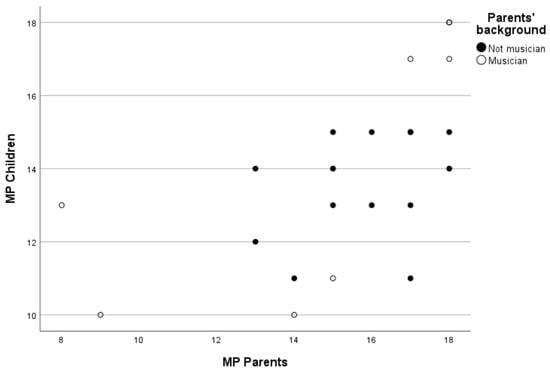
In turn, non-musicians’ parents reached greater means than musicians’ parents, obtaining also a lower dispersion and a more precise estimation of the mean. The scores from parents who are not musicians were consistent with those obtained by their children, even when these parents have a slight tendency to overestimate their children’s Mental–Perceptual Domain. That being said, Figure 1 illustrates the dispersion of both parents’ groups regarding MP Children.
Figure 1.
Simple dispersion referred to the background of parents as musicians (if any).
Subsequently, the Levene test indicated that variances were significantly different in the children and parents’ groups, respectively (see Table 7). Children’s scores significantly differ between those with parents who have a professional background in music and those who do not. Significant differences were also observed when comparing the two parent groups. Despite this, the differences were not statistically significant because their p-values were above 0.05, indicating a weak effect. Consequently, the identified differences can be observed in educational contexts, to the extent that both children and parents may be affected by external representations linked to social stereotypes. However, no statistically significant difference was observed.
Table 7.
Independent Samples Test in MP, according to ‘Parents as Musicians (if any)’ Variable.
Finally, a Between-Subject Effects Test displayed statistical consistency between MP Parents and MP Children (ρ < 0.05), accounting for 42% of the variance (see Table 8). No statistically significant differences were observed in this test regarding familiarity from the perspective of musical training and professional artistic culture. This means that the patterns of family variation between parents with musical backgrounds and those without, correspond to variables that were not measured in this study. Considering the above, we suggest that MP Children rely more on MP Parents than on parents’ musical background, as the former shows a significantly greater mean square. This result reveals the relevance of the Between-Subject Effects Test, as it allowed the prospective identification of Parents’ Background as a noise variable, which was leading to errors in data interpretation due to overestimating parents’ musical background. That being said, we only advocate for establishing health channels of mental and perceptual communication between parents and children in line with ethical care visions in musical environments (e.g., Juntunen & López-Íñiguez, 2025; López-Íñiguez & McPherson, 2025).
Table 8.
Test of Between-Subject Effects, considering MP Parents as a Covariance.
3.2. Qualitative Findings
The qualitative findings complement the statistical results by illuminating how children and parents make sense of mental–perceptual abilities and musical giftedness in everyday life, how giftedness is identified, and how being perceived as gifted is emotionally negotiated. Across families, narratives revealed both shared understandings and important differences in how perceptions were justified. While individual interviews varied in length and focus, participants consistently returned to embodied perception, early recognition of difference, and the relational nature of being seen as musically gifted. Rather than showing clear contrasts in which abilities were recognized, the interviews helped explain not only the strong statistical alignment between children and parents but also the systematic differences in the frames of reference used to evaluate those abilities, particularly between families with and without professional musical backgrounds.
3.2.1. Mental–Perceptual Abilities as Lived, Embodied Experiences
Rather than describing mental–perceptual skills in abstract or test-like terms, children frequently framed them through lived, bodily experiences linked to music-making. Abilities such as auditory sensitivity, memory, and motor awareness were described as things they feel while playing rather than traits they consciously analyze.
One child, for example, linked rapid learning and memory directly to her experience of playing:
“I learn quite quickly, very well… I learn the pieces quickly by memory… That is also my strong point.”
Auditory sensitivity was often described in concrete perceptual terms. A musician parent recalled how early listening skills revealed themselves spontaneously:
“There’s a million ways to test a child whether he has ability of hearing, musical abilities… when they sang back… they never sang [previously] together with me. My line, they harmonized it naturally.”
Here, hearing is not described as a general strength but as the ability to perceive and reproduce harmonic relationships—an embodied auditory awareness that both children and parents later rated highly in the survey.
Perception was also expressed through movement and bodily awareness. One musician parent interpreted her child’s physical expressiveness as perceptual-musical understanding:
“She moves. Forte, she moves. Piano, she moves. That’s a big symbol for me, ‘Oh, okay. You feel it.’”
This illustrates how proprioception—the sense of movement in space—was read as evidence of musical perception.
Beyond music, parents sometimes noticed heightened sensory awareness in everyday life. One described tactile sensitivity through clothing:
“I think it still bothers him if he has a t-shirt that he doesn’t like the texture of, or it’s the clothing tag.”
Such descriptions ground mental–perceptual abilities in ordinary embodied experiences rather than abstract ability labels.
These lived descriptions help explain the strong parent–child correlation in the quantitative results: both parties drew on recurring, observable sensory experiences when judging the child’s abilities.
3.2.2. Early Recognition and Social Identification of Giftedness
Giftedness was rarely described as a sudden realization; instead, it emerged through gradual recognition in social contexts. Parents often recalled noticing differences through comparisons with peers or through teacher feedback, while children tended to remember the experience of being told they were different.
One parent reflected on early perceptual–musical sensitivity by describing the speed and ease with which musical behaviors emerged:
“He’s always been really fast at learning… With music as well, his rhythm, the way he moves… You could tell from a really, really early age.”
Children, meanwhile, sometimes interpreted giftedness less as a label and more as a pattern of immersion and affinity:
“Maybe gifted is more like technical stuff… I think the most important thing is the musicality… when you grow up hearing this kind of music, playing with others… and you really are passionate about it.”
These narratives describe giftedness as emerging through interaction rather than as a purely internal attribute. This pattern was consistent with the quantitative finding that parents’ perceptions strongly predicted children’s scores.
3.2.3. Explaining Giftedness: Nature, Practice, and Environment
Across interviews, explanations of musical giftedness rarely relied on a single cause. Instead, families constructed multi-layered accounts combining innate predispositions with environmental support and effort.
A young musician described intonation as natural but broader musicianship as cultivated:
“For the intonation, I just had it. I didn’t really work hard for it. For being a good musician, I’ll say probably mixed as well.”
Similarly, a parent articulated a developmental interplay:
“I think it’s the combination of you have what you’re born with in your genes, with the environment you’re born into… and your motivation.”
Sensory references extended beyond hearing. One parent described broader aesthetic sensitivity:
“He’s very refined in everything that has to do with aesthetic… touching and smelling… he’s much more sensitive than I am for smells and tastes… food yes, very much so.”
This suggests that perceptual giftedness was sometimes understood as cross-sensory refinement, not solely musical hearing.
These layered explanations help interpret the greater variability found in families with professional musical backgrounds. Such parents often have more reference points—technical, pedagogical, and professional—which may lead to more differentiated (though not necessarily more aligned) evaluations.
3.2.4. Modesty, Discomfort, and the Emotional Weight of Labels
Although abilities were acknowledged, children frequently showed ambivalence toward being described or identified as gifted. Praise and public recognition sometimes triggered discomfort rather than pride.
One parent described her daughter’s reaction to compliments:
“She doesn’t accept compliments well… She doesn’t feel that comfortable.”
Another recalled a moment of public recognition:
“It was [an] extraordinary [performance]… The audience started applauding him… and he left. He didn’t know where to put himself…”
These accounts illuminate the systematic difference observed in the survey results, where parents rated children’s abilities higher than children rated themselves. Children frequently described discomfort with praise or public recognition.
3.2.5. High Standards as Self-Criticism
Giftedness was also associated with heightened self-expectations. Parents described children who minimized achievements and focused on imperfections:
“He always thinks he’s not good enough… ‘It wasn’t very good. It could be better.’”
Such narratives suggest that high mental–perceptual sensitivity may coexist with increased evaluative pressure, adding emotional nuance to the quantitative portrayal of advanced abilities.
3.2.6. Giftedness Beyond Music
Finally, several children linked musical strengths with rapid learning in other domains:
“Many people have said that if you are good at music, you also are really good in languages… I also learn other things really fast.”
Parents also linked perception to visual and aesthetic awareness:
“He’s always been extremely interested in what looks good… He knows style.”
This shows how visual perception was sometimes interpreted as aesthetic sensitivity rather than literal eyesight, which may explain weaker alignment on MP1. These broader cognitive associations support the idea that mental–perceptual abilities may be experienced as part of a wider developmental profile.
3.2.7. Differences in Evaluative Frameworks: Musical vs. Non-Musical Families
Although themes of sensitivity and perceptual awareness appeared across all families, differences emerged in how parents justified their evaluations, rather than in what they perceived.
Parents with professional musical backgrounds more often referred to technical, comparative, or training-based standards, as illustrated in earlier auditory and movement-based descriptions:
“Compared to other students at this level, her listening skills are truly advanced.”
“He hears details that usually come with many more years of training.”
These accounts situate children’s abilities within structured musical reference systems, such as peer groups, pedagogical stages, or professional norms. Such differentiated benchmarks may contribute to the greater variability observed in ratings within musical families.
In contrast, parents without professional musical backgrounds tended to rely on everyday observations and affective impressions:
“She just notices things more than other kids.”
“He’s always been exceptionally sensitive to his surroundings.”
These descriptions were generally more global and less anchored in formal comparison, which may explain the relatively lower dispersion in ratings among non-musical families.
Importantly, these differences in evaluative framing did not translate into stronger statistical alignment in musical families. Instead, they suggest that musician parents may draw on multiple standards of comparison, leading to more differentiated—but not necessarily more convergent—assessments.
3.2.8. Variability as a Feature of Musical Family Contexts
The interviews support the quantitative finding that professional musical background did not significantly moderate parent–child alignment but was associated with greater variability in responses. Musical families often described diverse musical environments, varying pedagogical experiences, and multiple points of comparison:
“In music school, expectations are different.”
“You see many levels of ability, so you evaluate differently.”
Such diversity of reference may lead to more nuanced and internally differentiated judgments, rather than uniformly higher or more accurate evaluations.
3.3. Integration of Quantitative Results and Qualitative Findings
Together, these themes explain the statistical patterns observed in the Mental–Perceptual Domain. Shared family experiences of music-making contribute to the strong parent–child correlations. Parental ratings that exceed those of children may partly reflect aspirational framing and adult interpretive confidence, while children’s lower self-ratings align with modesty and discomfort with labels. Greater variability among musician parents is mirrored in more differentiated and technically framed narratives. Thus, the qualitative findings do not simply accompany the quantitative results; they reveal the relational and emotional processes through which perceptions of ability are formed and negotiated.
Taken together, the qualitative findings clarify the statistical patterns observed. The strong parent–child correlation is reflected in shared everyday narratives of sensory and perceptual sensitivity. The systematic parental overestimation partly corresponds with aspirational and supportive parental framing. Finally, the greater variability in musical families is illuminated not by different perceptions of ability, but by differences in the evaluative frameworks and comparison standards used to interpret those abilities.
Rather than indicating greater accuracy or agreement, professional musical background appears to introduce more differentiated ways of seeing—highlighting how perceptions of giftedness are shaped not only by children’s characteristics, but also by the cultural and experiential lenses through which families interpret them.
While qualitative accounts often aligned with the quantitative trends, they also revealed nuances—such as children’s ambivalence toward praise or the differing evaluative frameworks used by parents—that complicate a purely confirmatory interpretation.
4. Discussion
This study examined how children gifted for music and their parents perceive children’s mental–perceptual abilities and giftedness, and how these perceptions are explained and emotionally experienced. By integrating quantitative measures of perceived mental–perceptual skills with qualitative accounts of identification and meaning-making, the findings provide a relational and interpretive view of giftedness that aligns with, and extends, existing developmental models (see further, Kuznetsova et al., 2024; Tirri & Margrain, 2023).
The results support Gagné’s (2021) Differentiated Model of Giftedness and Talent (DMGT), particularly the idea that giftedness consists of natural abilities that serve as developmental foundations for later talent. The Mental–Perceptual Domain investigated here corresponds to Gagné’s description of biologically rooted aptitudes, such as perceptual acuity, memory, and sensorimotor coordination. Contemporary research further emphasizes that these abilities are influenced by psychosocial and environmental factors, reflecting the malleable and socially situated nature of gifted development (Subotnik et al., 2023; VanTassel-Baska, 2022). Importantly, the inclusion of non-auditory senses in the Mental–Perceptual Domain should not be interpreted as equating these modalities with musical skill, but rather as reflecting generalized perceptual sensitivity that may shape how children attend to, experience, and engage with musical material.
Quantitatively, children and parents showed a strong positive association in their ratings of these abilities, indicating that mental–perceptual strengths as perceived by the participating children and parents are not only internally experienced but also externally observable in everyday musical activity. Qualitatively, participants described these abilities through embodied and experiential language—such as hearing fine sound details, memorizing music quickly, or sensing bodily movement while playing—rather than abstract cognitive terminology. These lived descriptions reinforce the DMGT view that natural abilities are both experientially salient and socially recognizable within close developmental environments (Gagné, 2021).
Importantly, families did not portray these abilities as fixed traits. Instead, they emphasized how perceptual predispositions interact with environmental catalysts, such as early exposure to music, supportive teaching, and sustained practice. This interplay closely reflects DMGT’s emphasis on the transformation of gifts into talents through the influence of intrapersonal and environmental catalysts. Thus, the Mental–Perceptual Domain appears not as an isolated set of sensory capacities, but as a developmentally activated resource, continually shaped through relational, educational, and care-oriented contexts (López-Íñiguez, 2024; López-Íñiguez & McPherson, 2023, 2025, in press). At the same time, the qualitative accounts suggest that auditory perception may be evaluated through increasingly technical standards in musically specialized contexts. Several participants referred not only to general hearing sensitivity, but to fine-grained listening abilities such as intonation control, sound differentiation, and stylistic awareness. These descriptions point to a domain-specific elaboration of perceptual abilities, whereby general sensory foundations, as conceptualized in DMGT, are interpreted through progressively higher technical self-demands as musical expertise develops. Rather than challenging the adequacy of the model, this finding underscores how general perceptual abilities may acquire specialized meaning within advanced musical environments.
A key quantitative finding was the strong correlation between children’s and parents’ perceptions of mental–perceptual abilities, alongside a consistent tendency for parents to rate their children higher than children rated themselves. The qualitative findings suggest that this pattern reflects shared but differently positioned interpretations rather than simple perceptual inaccuracy. Parents typically drew on long-term observation, accumulated comparisons, and future-oriented aspirations, whereas children’s accounts were more grounded in immediate experience and emotional comfort. Children’s modesty, discomfort with praise, and reluctance to adopt labels such as “gifted” help explain why self-ratings were often lower despite recognition of ability. Thus, the discrepancy between parent and child ratings appears to arise from differences in evaluative stance and emotional positioning rather than disagreement about underlying competence.
These findings resonate with research on parental perceptions in talent development, which suggests that parents often function as interpreters, advocates, and ethical guides of children’s potential (McPherson, 2009; Sosniak, 2006; López-Íñiguez & McPherson, 2023). Within DMGT, this highlights the relational dimension of how natural abilities are perceived, valued, and supported over time. Parents’ slightly elevated ratings may therefore partly reflect an aspirational orientation embedded in their caregiving, advocacy, and care-ethical responsibilities rather than simple overestimation (López-Íñiguez, 2024).
Although professional musical background did not significantly parent–child alignment in statistical terms, families with musician parents showed greater variability in both children’s and parents’ ratings. Rather than indicating stronger or weaker perception, this pattern suggests that musical expertise introduces more diverse evaluative frameworks. Qualitative accounts indicate that musician parents often grounded their evaluations in domain-specific standards, such as technical precision, interpretive nuance, or comparisons with similarly trained peers (see further, Juntunen & López-Íñiguez, 2025; López-Íñiguez & McPherson, 2025). Their descriptions frequently reflected reference points drawn from professional or pre-professional musical environments. In contrast, non-musician parents tended to rely more on holistic and everyday observations, describing children’s perceptual abilities in relation to general sensitivity, personality, or behavior across contexts.
Crucially, both groups often identified similar underlying characteristics (e.g., sensitivity to sound, bodily awareness, attentiveness to detail), but they differed in how those characteristics were interpreted and scaled. Musical families evaluated through differentiated, sometimes higher or more specialized benchmarks, whereas non-musical families framed abilities through broader, affective, or relational lenses. This difference in evaluative logic helps explain why musical families showed greater dispersion in ratings without demonstrating stronger parent–child consistency. Within DMGT, this pattern reflects variation in environmental catalysts: the musical ecology of the home shapes interpretive frameworks but does not guarantee perceptual agreement. Expertise adds evaluative nuance rather than uniformity, diversifying how ability is interpreted rather than stabilizing judgments (Subotnik et al., 2023).
Beyond cognitive and perceptual descriptions, interviews revealed the emotional complexity surrounding giftedness. Children often expressed ambivalence about being labeled as gifted, showing modesty, discomfort with praise, and sensitivity to expectations. Parents, in turn, described efforts to balance encouragement with protection from pressure. These dynamics suggest that perceptions of ability are embedded within ongoing relational processes involving recognition, expectation, and emotional support. While this study is grounded primarily in a developmental-psychological framework, these findings point toward the importance of considering giftedness within networks of care and responsibility (Gilligan, 1982; Noddings, 2013; López-Íñiguez, 2024; López-Íñiguez & McPherson, in press; López-Íñiguez & Westerlund, 2023). The ways in which abilities are interpreted and communicated appear to shape not only self-perception but also the emotional livability of giftedness.
Thus, perceptual alignment is not merely a cognitive phenomenon; it is also an affective and relational achievement, negotiated within everyday interactions between children and caregivers. The mixed-methods design allows the qualitative findings to illuminate the statistical patterns. Shared family narratives about sensory and perceptual sensitivity help explain the strong parent–child correlation. Parental overestimation partly aligns with aspirational framing, ethical advocacy, and protective pride, while children’s lower self-ratings correspond with modesty, uncertainty, and identity negotiation. Greater variability among musician families reflects the use of multiple technical and professional reference points rather than greater perceptual accuracy.
Thus, the qualitative data do not simply supplement the quantitative results; they clarify the interpretive, relational, and ethical processes through which perceptions of mental–perceptual abilities are formed and maintained. The findings suggest that consistency in ratings can coexist with differences in meaning-making, and that variability may stem from differences in evaluative frameworks rather than from disagreement about gifted children’s exceptional abilities in and outside of music.
4.1. Practical Implications for Music Education Contexts
The findings of this study suggest practical implications for music educators, specialist music institutions, clinicians working with gifted children, and families supporting musically gifted learners. Interviews revealed that while parents often act as advocates and interpreters of children’s abilities, children themselves may experience discomfort, modesty, or pressure in response to being labeled as gifted. Institutions may therefore play a mediating role by fostering open, developmentally sensitive communication between parents and children regarding ability, expectations, and identity. Explicit discussion of giftedness as a dynamic developmental process—rather than a fixed label—may help reduce performance pressure and support children’s emotional well-being. Providing guidance for parents on how to frame feedback, normalize uncertainty, and attend to children’s emotional responses may further contribute to healthier family dynamics. In this sense, educational practices that integrate musical development with relational and communicative care may help ensure that gifted identification supports, rather than constrains, children’s long-term engagement with music. For families, the results highlight the value of open conversations about ability and expectations, helping children interpret giftedness as a developmental process rather than a fixed identity.
4.2. Limitations
Several limitations should be considered. First, (1) the sample size was rather small due to the restricted accessibility of specialist music programs, which often operate as highly selective and internally regulated environments; this may raise concerns about statistical power, model stability, factorial analysis, and even overinterpretation of results. For those reasons, findings should be restrainedly appraised because this study does not present conclusive outcomes, but its purpose is to open a debate about mental–perceptual abilities in children gifted for music. Second, (2) although the sample included children across a relatively wide age range, the present study did not conduct systematic age-based comparisons. As a result, no claims are made regarding developmental differences in the negotiation of gifted identity, modesty, or emotional responses to being labeled as gifted. Future research would benefit from longitudinal or age-comparative designs to examine how these processes may evolve across developmental stages, particularly during adolescence. Third, (3) the reliance on self-report measures introduces the possibility of social desirability and interpretive bias. Fourth, (4) although the study included families from multiple national contexts, cultural differences were not analyzed in depth due to ethical constraints on identifiability. Fifth, (5) the Mental–Perceptual Domain was assessed using a brief scale with a limited response range, which may have reduced sensitivity to subtle differences. Finally, (6) the qualitative analysis focused on thematic and interpretive patterns rather than detailed case comparisons, which may have obscured some individual nuances and developmental trajectories.
4.3. Conclusions
This study demonstrates that mental–perceptual abilities in children gifted for music are both individually experienced and relationally constructed. Strong parent–child alignment reflects shared lived musical experiences, while systematic differences in ratings reveal distinct emotional and evaluative positions within the family. Variability across musical and non-musical families further highlights that differences lie less in what is perceived than in how perceptions are framed and justified. By integrating psychological models of giftedness with qualitative accounts of identification, and relational meaning-making, the study underscores that giftedness is not only a matter of ability, but also of how ability is perceived, interpreted, and supported within relationships (López-Íñiguez, 2024; López-Íñiguez & McPherson, 2023; Slote, 2013; VanTassel-Baska, 2022).
Although the present study is grounded in a developmental model of giftedness, its findings suggest that perceptions of mental–perceptual ability cannot be fully understood apart from the relational and ethical environments in which children grow and learn. Parents are not merely observers of ability; they are active participants in interpreting, valuing, and regulating how giftedness is experienced in daily life. Gifted children’s modesty, sensitivity to expectations, and emotional responses to praise further indicate that giftedness is lived within networks of recognition, support, and responsibility. In this sense, the processes through which musical giftedness is identified and sustained are intertwined with practices of care—including attentiveness to children’s emotional well-being, responsiveness to their needs, and efforts to balance encouragement with protection from pressure (López-Íñiguez, 2024; López-Íñiguez & McPherson, 2023, in press; López-Íñiguez & Westerlund, 2023).
While these relational and ethical aspects are not examined here through a specific care-ethical framework, they connect to a broader line of research led by the first author on care ethics in the upbringing and education of musically gifted children2. That broader program shifts the focus from the abilities children possess to the relational conditions under which those abilities can be nurtured in ways that support healthy and sustainable development.
Author Contributions
Conceptualization, G.L.-Í.; methodology, G.L.-Í. and R.A.-A.; formal analysis, G.L.-Í. and R.A.-A.; investigation, G.L.-Í.; resources, G.L.-Í.; data curation, G.L.-Í.; writing—original draft preparation, G.L.-Í.; writing—review and editing, G.L.-Í.; project administration, G.L.-Í.; funding acquisition, G.L.-Í. All authors have read and agreed to the published version of the manuscript.
Funding
The authors disclosed receipt of the following financial support for the research, authorship, and/or publication of this article: The funding for this study was provided by a research grant obtained by the first author, known as The Politics of Care in the Professional Education of Children Gifted for Music, which was sponsored by the Scientific Council for Culture and Society of the Research Council of Finland (348591).
Institutional Review Board Statement
The University of Arts Helsinki Ethical Review Committee has reviewed Dr. Guadalupe López Íñiguez’s study “The Politics of Care in the Professional Education of Children Gifted for Music” at the committee meeting on 28 April 2023. The Ethical Review Committee finds that based on the received material the planned study follows the ethical principles of research in the humanities and social and behavioral sciences issued by the Finnish Advisory Board on Research Integrity TENK. Thus, the Ethical Review Committee states that the mentioned study is ethically acceptable. If the person who has requested an ethical review statement does not accept the decision of the Ethical Review Committee, they may request a statement on the matter from TENK. The request for a statement, including the grounds for requesting a statement, must be submitted within two months of the ethics committee’s decision.
Informed Consent Statement
Informed consent was obtained from all participants.
Data Availability Statement
Due to ethical and privacy considerations, the data supporting this study are not publicly available. Data sharing would risk compromising participant confidentiality and was not covered by the consent provided.
Acknowledgments
We would like to sincerely thank the administrative staff who facilitated access to the participating families, as well as the leaders of the institutions who provided classrooms and safe spaces to conduct the interviews, making this study possible. We are also deeply grateful to the 22 gifted children who generously shared their time, insights, and experiences with the first author. Their openness and willingness to reflect on their musical journeys provided invaluable contributions to this research, and we are profoundly appreciative of their support and trust.
Conflicts of Interest
The authors declare no conflicts of interest. The funders had no role in the design of the study; in the collection, analyses, or interpretation of data; in the writing of the manuscript; or in the decision to publish the results.
Notes
| 1 | Note: For the purposes of the statistical analyses, the 25 parents were organized into 22 parent “groups,” corresponding to their 22 gifted children. This grouping approach was adopted because only three children were represented by both parents attending the interview together, whereas for the remaining 19 children, only one parent (either the mother or the father) participated. |
| 2 | See: website of the research project: https://www.uniarts.fi/en/projects/caring-for-musically-gifted-children/ (accessed on 3 March 2026). |
References
- Abu-Bader, S. H. (2016). Using statistical methods in social science research. Oxford University Press. [Google Scholar]
- Braun, V., & Clarke, V. (2006). Using thematic analysis in psychology. Qualitative Research in Psychology, 3(2), 77–101. [Google Scholar] [CrossRef] [Scilit]
- Clark-Carter, D. (2024). Quantitative psychological research: The complete student’s companion. Routledge. [Google Scholar]
- Creswell, J. W., & Plano Clark, V. L. (2017). Designing and conducting mixed methods research (3rd ed.). SAGE Publications. [Google Scholar]
- Davenport, E. C., Davison, M., Liou, P., & Love, Q. (2015). Reliability, dimensionality, and internal consistency as defined by Cronbach: Distinct albeit related concepts. Educational Measurement: Issues and Practice, 34(4), 4–9. [Google Scholar] [CrossRef] [Scilit]
- Denis, D. J. (2018). SPSS data analysis for univariate, bivariate, and multivariate statistics. Wiley. [Google Scholar]
- Eccles, J. S., & Wigfield, A. (2002). Motivational beliefs, values, and goals. Annual Review of Psychology, 53(1), 109–132. [Google Scholar] [CrossRef] [Scilit] [PubMed]
- Field, A. (2000). Discovering statistics using SPSS for Windows. SAGE. [Google Scholar]
- Freeman, J. (2010). Gifted lives: What happens when gifted children grow up. Routledge. [Google Scholar]
- Gagné, F. (2004). Transforming gifts into talents: The DMGT as a developmental model. High Ability Studies, 15(2), 119–147. [Google Scholar] [CrossRef] [Scilit]
- Gagné, F. (2021). Differentiating giftedness from talent: The DMGT perspective. Springer. [Google Scholar]
- Gilligan, C. (1982). In a different voice: Psychological theory and women’s development. Harvard University Press. [Google Scholar]
- Habibi, A., Damasio, A., Ilari, B., Elliott Sachs, M., & Damasio, H. (2018). Music training and child development: A review of recent findings from a longitudinal study. Annals of the New York Academy of Sciences, 1423, 73–81. [Google Scholar] [CrossRef] [Scilit] [PubMed]
- Hair, J., Black, W., Babin, B., & Anderson, R. (2014). Multivariate data analysis. Pearson Education. [Google Scholar]
- Hallam, S. (2010). The power of music: Its impact on the intellectual, social and personal development of children and young people. International Journal of Music Education, 28(3), 269–289. [Google Scholar] [CrossRef] [Scilit]
- Hallam, S., Rinta, T., Varvarigou, M., Creech, A., Papageorgi, I., Gomes, T., & Lanipekun, J. (2012). The development of practising strategies in young people. Psychology of Music, 40(5), 652–680. [Google Scholar] [CrossRef] [Scilit]
- Harter, S. (2012). The construction of the self: Developmental and sociocultural foundations (2nd ed.). The Guilford Press. [Google Scholar]
- Juntunen, M.-L., & López-Íñiguez, G. (2025). Enrichment and acceleration of highly motivated children’s instrumental music learning. A case study of a pilot development project. Research Studies in Music Education, 47(2), 239–258. [Google Scholar] [CrossRef] [Scilit]
- Keller, P. E. (2012). Cognition and the representation of musical structure. In D. Deutsch (Ed.), The psychology of music (3rd ed., pp. 349–404). Academic Press. [Google Scholar]
- Kuznetsova, E., Liashenko, A., Zhozhikashvili, N., & Arsalidou, M. (2024). Giftedness identification and cognitive, physiological and psychological characteristics of gifted children: A systematic review. Frontiers in Psychology, 15, 1411981. [Google Scholar] [CrossRef] [Scilit] [PubMed]
- Levitin, D. J., & Tirovolas, A. K. (2009). Current advances in the cognitive neuroscience of music. Annals of the New York Academy of Sciences, 1156(1), 211–231. [Google Scholar] [CrossRef] [Scilit] [PubMed]
- López-Íñiguez, G. (2024). The politics of care in the professional education of children gifted for music: A sustainable ecosystem worth advocating. Finnish Journal of Music Education, 27(1), 129–136. [Google Scholar]
- López-Íñiguez, G., & McPherson, G. E. (2023). Caring approaches to young, gifted music learners’ education: A PRISMA scoping review. Frontiers in Psychology, 14, 1167292. [Google Scholar] [CrossRef] [Scilit] [PubMed]
- López-Íñiguez, G., & McPherson, G. E. (2025). Issues and approaches to gifted education in specialist music programs globally. Gifted Education International. Online first manuscript. [Google Scholar] [CrossRef] [Scilit]
- López-Íñiguez, G., & McPherson, G. E. (Eds.). (in press). Caring for gifted and talented music learners: Perspectives and future possibilities. Oxford University Press.
- López-Íñiguez, G., & Westerlund, H. (2023). The politics of care in the education of children gifted for music: A systems view. In K. S. Hendricks (Ed.), Oxford handbook of care in music education (pp. 115–129). Oxford University Press. [Google Scholar]
- McPherson, G. E. (2009). The role of parents in children’s musical development. Psychology of Music, 37(1), 91–110. [Google Scholar] [CrossRef] [Scilit]
- McPherson, G. E., & Williamon, A. (2006). Giftedness and talent. In G. E. McPherson (Ed.), The child as a musician (pp. 239–256). Oxford University Press. [Google Scholar]
- McPherson, G. E., & Zimmerman, B. J. (2011). Self-regulation of musical learning: A social cognitive perspective on developing performance skills. In R. Colwell, & P. Webster (Eds.), MENC handbook of research on music learning: Volume 2: Applications (pp. 130–175). Oxford Academic. [Google Scholar]
- Noddings, N. (2013). Caring: A relational approach to ethics and moral education (2nd ed.). University of California Press. [Google Scholar]
- Pomerantz, E. M., Kim, E. M., & Cheung, C. S.-S. (2012). Parents’ involvement in children’s learning. In K. R. Harris, S. Graham, T. Urdan, S. Graham, J. M. Royer, & M. Zeidner (Eds.), APA educational psychology handbook, Vol. 2. Individual differences and cultural and contextual factors (pp. 417–440). American Psychological Association. [Google Scholar]
- Sheskin, D. J. (2011). Handbook of parametric and nonparametric statistical procedures. CRC Press. [Google Scholar]
- Slote, M. (2013). Education and human values. Reconciling talent with an ethics of care. Routledge. [Google Scholar]
- Sosniak, L. A. (2006). Retrospective Interviews in the Study of Expertise and Expert Performance. In K. A. Ericsson, N. Charness, P. J. Feltovich, & R. R. Hoffman (Eds.), The Cambridge handbook of expertise and expert performance (pp. 287–301). Cambridge University Press. [Google Scholar]
- Subotnik, R. F., Olszewski-Kubilius, P., Corwith, S., Calvert, E., & Worrell, F. C. (2023). Transforming gifted education in schools: Practical applications of a comprehensive framework for developing academic talent. Education Sciences, 13(7), 707. [Google Scholar] [CrossRef] [Scilit]
- Subotnik, R. F., Olszewski-Kubilius, P., & Worrell, F. C. (2011). Rethinking giftedness and gifted education: A proposed direction forward based on psychological science. Psychological Science in the Public Interest, 12(1), 3–54. [Google Scholar] [CrossRef] [Scilit] [PubMed]
- Sun, J., Sun, J., Liu, T., Gao, Y., Li, H., Chen, Y., Diao, H., Zhang, G., Shen, H., Chang, R., Yu, Z., Lu, J., Liang, L., & Zhang, L. (2022). Questionnaire development on measuring parents’ anxiety about their children’s education: Empirical evidence of parental perceived anxiety data for primary and secondary school students in China. Frontiers in Psychology, 13, 1018313. [Google Scholar] [CrossRef] [Scilit] [PubMed]
- Takada, M. E., Lemons, C. J., Balasubramanian, L., Hallman, B. T., Al Otaiba, S., & Puranik, C. S. (2023). Measuring kindergarteners’ motivational beliefs about writing: A mixed-methods exploration of alternate assessment formats. Frontiers in Psychology, 14, 1217085. [Google Scholar] [CrossRef] [Scilit] [PubMed]
- Tirri, K., & Margrain, V. (2023). Identifying and supporting giftedness and talent in schools—Introduction to a special collection of research. Education Sciences, 13(12), 1205. [Google Scholar] [CrossRef] [Scilit]
- Tronto, J. C. (1993). Moral boundaries: A political argument for an ethic of care. Routledge. [Google Scholar]
- VanTassel-Baska, J. (Ed.). (2022). Talent development in gifted education. Theory, research, and practice. Routledge. [Google Scholar]
- Verma, J. P., & Abdel-Salam, A. S. G. (2019). Testing statistical assumptions in research. Wiley. [Google Scholar]
- Vilá, R., & Bisquerra, R. (2014). El análisis cuantitativo de datos [Quantitative data analysis]. In R. Bisquerra (Ed.), Metodología de la investigación educativa (pp. 259–271). La Muralla. [Google Scholar]
- Williams, R., & Bornmann, L. (2014). The substantive and practical significance of citation impact differences between institutions: Guidelines for the analysis of percentiles using effect sizes and confidence intervals. In Y. Ding, R. Rousseau, & D. Wolfram (Eds.), Measuring scholarly impact: Methods and practice (pp. 259–281). Springer. [Google Scholar]
- Zatorre, R. J., Chen, J. L., & Penhune, V. B. (2007). When the brain plays music: Auditory–motor interactions in music perception and production. Nature Reviews Neuroscience, 8(7), 547–558. [Google Scholar] [CrossRef] [Scilit] [PubMed]

Disclaimer/Publisher’s Note: The statements, opinions and data contained in all publications are solely those of the individual author(s) and contributor(s) and not of MDPI and/or the editor(s). MDPI and/or the editor(s) disclaim responsibility for any injury to people or property resulting from any ideas, methods, instructions or products referred to in the content. |
© 2026 by the authors. Licensee MDPI, Basel, Switzerland. This article is an open access article distributed under the terms and conditions of the Creative Commons Attribution (CC BY) license.