


Abstract
Declining fertility rates are decreasing college-aged populations and placing sustained pressure on higher education systems worldwide. This study examines how long-term demographic contraction brings recurring system-level challenges, using Germany, the United States, South Korea, and Japan as illustrative examples. Drawing on secondary data from official demographic and higher education statistics, the study applies a data-informed analytical approach and a structured analytical framework to identify key pressures related to financial and operational viability, educational quality assurance, structural and regional imbalances, and governance constraints. The analysis indicates that higher education systems have responded with strategic and operational measures, including international student recruitment, lifelong and recurrent education, institutional consolidation, and enrollment and retention management. While these responses can partially mitigate demographic pressures in the short to medium term, they face structural limits under sustained population decline. Long-term sustainability, therefore, requires coordinated system-level adaptation through diversified learner populations, institutional differentiation, and policy frameworks aligned with evolving labor market and societal demands, in order to maintain educational quality and equitable access.
1. Introduction
Over the past several decades, global demographic patterns have undergone a profound transformation characterized by sustained declines in fertility rates. Many advanced and emerging economies now face aging populations, shrinking labor forces, and widening generational imbalances. According to the United Nations Department of Economic and Social Affairs (UN-DESA), more than two-thirds of the world’s population now lives in countries with fertility rates below the replacement level of 2.1 births per woman (United Nations, 2025). This demographic shift has far-reaching consequences for multiple dimensions of society, including economic productivity, labor supply, social security systems, and regional development (Ashraf et al., 2013; Gauthier, 2007; OECD, 2024). It also reshapes consumption behavior, healthcare demand, and intergenerational equity, compelling governments to redesign welfare, employment, and innovation policies to sustain social and economic vitality in the face of long-term population decline (Buh, 2023; Fauser et al., 2024; Rabl & Kühlmann, 2009; Raymo & Shibata, 2017).
In recent decades, declining fertility has become a widespread demographic phenomenon that profoundly affects the higher education sector. With the decline in the school-aged population, universities face unprecedented challenges in maintaining enrollment, financial stability, and educational quality (Unglesbee, 2025). Countries such as Germany, the United States, South Korea, and Japan are at the forefront of this demographic shift, experiencing varying degrees of its impact on higher education. The issue is especially critical in countries where higher education systems expanded rapidly during periods of population growth. The enrollment boom of the past has been replaced by concerns over underenrollment, institutional mergers, and potential university closures. In Europe and the United States, the so-called “enrollment cliff” has forced institutions to rethink their recruitment strategies and financial models (Harvey, 2021). In Asia, particularly in South Korea and Japan, universities are struggling with shrinking youth populations and increasing difficulty in filling admissions quotas (J. Jung, 2024; Yonezawa, 2020).
This study examines how sustained declines in birth rates reshape higher education systems at the system level. Focusing on selected countries and regions, it addresses three research questions: (1) How has sustained fertility decline reshaped demographic trends and enrollment patterns, as well as the structural characteristics of national higher education systems? (2) What system-level challenges arise from prolonged demographic contraction across different institutional and governance contexts? and (3) How have universities and governments responded to these challenges, and what structural limitations remain evident in existing institutional and policy approaches? Based on secondary data and policy evidence, this work provides an analytical synthesis that clarifies key mechanisms linking demographic change to system-level pressures and discusses implications for sustaining higher education missions amid long-term population decline.
2. Analytical Scope and Approach
2.1. Analytical Scope
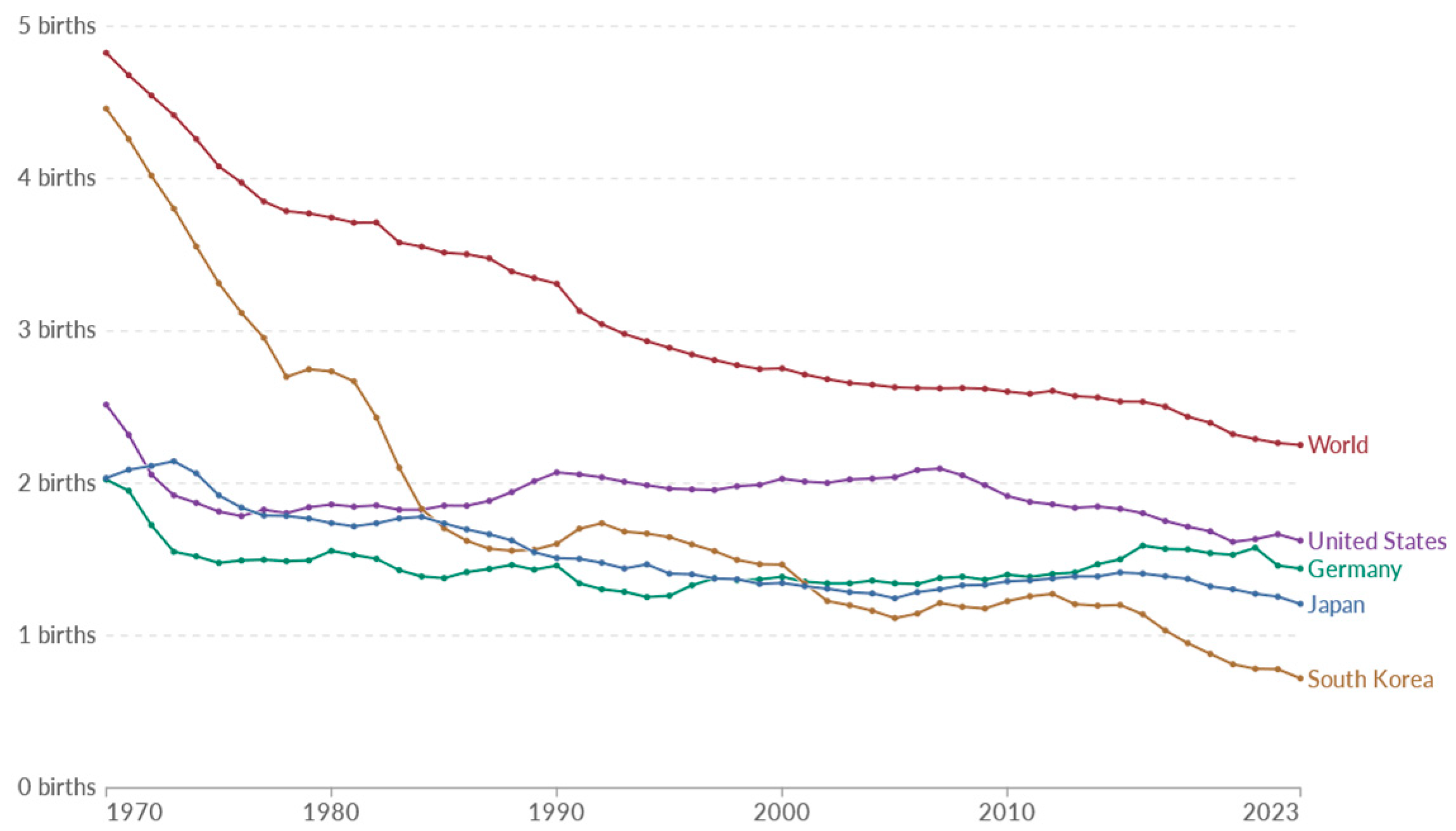
Many countries are facing a decline in fertility rates. Figure 1 shows the declining trends 1970–2023 worldwide and for four countries: Germany, the United States, South Korea and Japan. These countries were selected based on a combination of analytical relevance and diversity in educational systems.
Figure 1.
Fertility rate trends (1970–2023) in selected countries.
All four countries are experiencing sustained fertility decline at or below replacement level, leading to measurable contractions of college-aged cohorts and systemic pressure on higher education systems. These countries share the availability of extensive and comparable secondary data, including official statistics, policy documents, and peer-reviewed research. These common conditions provide a shared analytical foundation for examining system-level responses to demographic decline.
At the same time, the selected countries differ substantially in their higher education system structures and policy environments, including governance arrangements, funding models, institutional stratification, and the public–private balance. Germany features a predominantly public and tuition-free system with strong federal–state coordination; the United States operates a highly differentiated and market-oriented system; South Korea combines mass private provision with strong state steering; and Japan operates a mixed system characterized by a large private sector, centralized policy coordination, and pronounced regional differentiation. This institutional diversity enables meaningful synthesis of policy and institutional responses under similar demographic pressures, without implying universal generalization.
2.2. Data Collection
This study relies on secondary data and document analysis, including international statistical sources, national policy documents, and academic literature. Data collection was designed to support evaluative analysis at the system level.
Demographic and enrollment-related data were obtained mainly from international organizations such as the United Nations (UN-DESA) and the OECD, as well as from official national sources, including ministries of education and government statistical agencies. These sources provide longitudinal indicators on fertility trends, population cohorts, enrollment patterns, and higher education structures, enabling cross-national contextual understanding of demographic pressures. Policy-related information was collected from government reports and official strategy documents describing institutional reforms, funding arrangements, enrollment regulations, and national responses to demographic decline.
In addition, research in demography, higher education, and education policy provides supplementary evidence. Relevant literature and policy documents were identified through targeted thematic searches using keywords related to fertility decline, demographic change, and system-level higher education change. The search focused on peer-reviewed journals, reports by international organizations, and official policy documents. Priority was given to data and studies published within approximately the past decade to ensure analytical relevance, particularly given the rapidly changing demographic and policy contexts. Inclusion was guided by relevance to system-level impacts of demographic change on higher education, while clearly outdated data or materials lacking empirical or policy relevance were not used as primary evidence for the analysis.
Triangulation was achieved through the combined use of official statistical data, national policy documents, and existing academic studies. Official national and international statistics were used as baseline references to establish system-level trends, while policy documents and academic literature were used to interpret institutional responses and analytical mechanisms. When numerical estimates or interpretations differed across sources, these differences were examined in relation to variations in data definitions, reference periods, national contexts, or analytical scope, and were incorporated into the analytical synthesis.
Overall, the data and literature provide a transparent and robust foundation for system-level analytical research across national contexts.
2.3. Analytical Approach
This study adopts a data-informed analytical approach, based on secondary data from multiple countries, to examine the current situation, key challenges, response strategies and their limitations, and future implications of higher education systems under sustained fertility decline.
The primary unit of analysis is the national higher education system. Evidence is drawn from Germany, the United States, South Korea, and Japan as empirical contexts illustrating how demographic pressures affect higher education systems under different institutional and governance arrangements. The analysis is organized around a set of common analytical dimensions applied consistently across national contexts. These dimensions structure both the organization of the analysis and the interpretation of empirical evidence. Documents and policy materials were organized and synthesized in accordance with these predefined analytical dimensions. The dimensions include:
- (1)
- Enrollment and financial pressures on higher education institutions;
- (2)
- Challenges related to educational quality and student composition;
- (3)
- Structural and regional imbalances within higher education systems;
- (4)
- Institutional and policy responses at the system level.
Within each dimension, evidence from different national contexts is examined using secondary statistical data and existing studies to identify prevailing conditions, key tensions, and observed limitations of current responses. Consistency across cases is maintained through the application of a common analytical framework to all selected national contexts. Analytical robustness is strengthened through the triangulation of statistical data, policy documents, and peer-reviewed research, as well as through explicit consideration of structural constraints and contextual variation.
Through this approach, the study synthesizes evidence on the current state of higher education under demographic decline, clarifies major problem structures, assesses the strengths and limitations of existing response strategies, and outlines likely future developments.
3. Global Demographic with Higher Education
UN-DESA reports the global total fertility rate (TFR) in 2024. There were 2.2 births per woman on average, which decreased from approximately 5 in the 1960s to 3.3 in 1990. Below 2.1 births indicates “low fertility”, and a birth rate below 1.5 births indicates “very low fertility”. Fertility levels of fewer than 2 births per woman are becoming the global norm and will worsen in the future. Low or very low fertility may lead to a range of serious and interconnected challenges at the economic, social, and educational levels, such as labor force shortages, pensions and healthcare stress, and institutional decline (McDonald, 2008; OECD, 2024).
Under the circumstances, as the population declines, especially as the school-aged population decreases, education systems are facing challenges. In Europe, Germany was already among the Organization for Economic Cooperation and Development (OECD) countries with one of the lowest percentages of the school-aged group, but a further decline is forecast. According to previous studies of the SVR Research Unit 2019, 41 German universities experienced an average reduction of 11% in domestic students since 2012, particularly in eastern Germany (Expert Council of German Foundations, 2019). The United States is experiencing an “enrollment cliff” projected to begin in 2025, largely due to declining birth rates following the 2008 financial crisis. Post-secondary enrollment in the U.S. has already fallen by 12.5% since 2010, with community colleges and less research-intensive institutions most severely affected (Vigdor, 2024). Research by Harvey indicates that the pool of college-aged students is expected to decrease by approximately 15% by 2029, with regional institutions in the Midwest and Northeast being particularly vulnerable (Harvey, 2021). In Asia, South Korea has the lowest fertility rate among OECD countries, reaching 0.73 in 2024. According to Jung, South Korea’s college-aged population is shrinking rapidly, leading to nationwide underenrollment. By 2024, the shortfall is projected to exceed 100,000 seats and 10 percent of universities in the country will have less than 50 percent of their target enrollment. Small private universities in rural areas are especially at risk, with some closing or merging due to financial insolvency (J. Jung, 2024). Japan’s higher education system has been under demographic pressure since the mid-1990s. The population of 18-year-olds, who make up the primary cohort entering higher education institutions, peaked at approximately 2.49 million in 1966, then declined to approximately 2.05 million in 1992, and has continued to decrease significantly. By 2023, the number had dropped to approximately 1.1 million, less than half of the peak. If the projected decline in the 18-year-old population continues as estimated, the number is expected to fall to approximately 0.82 million by 2040, representing approximately 75% of the current level (MEXT, 2024b). Many small and medium-sized private universities in Japan are struggling to maintain enrollment. Some universities have voluntarily closed or merged, and the government has implemented enrollment caps on metropolitan universities to protect regional institutions (Yonezawa, 2020).
This demographic has resulted in a shrinking pool of college-aged individuals. Regional universities, particularly those in smaller cities and less urbanized areas, have been more severely affected by the decline in student numbers. The global trend of population decline is bringing multifaceted challenges, which compel governments and higher education institutions to take responsive actions. Table 1 summarizes the major challenges for higher education institutions (HEIs) and the corresponding strategic and operational measures adopted by governments and institutions. Each of these components is discussed in detail in the subsequent sections.
Table 1.
Major challenges for HEIs and the corresponding response strategies.
4. Challenges from Declining Fertility Rate
The sustained decline in fertility has substantially reduced the size of college-aged cohorts and generated significant structural pressure on higher education systems. Many institutions, particularly in eastern Germany, the Midwest of the United States, South Korea, and rural Japan, are experiencing sharp declines in applicants and enrollments. This contraction intensifies competition for a shrinking student population and places a growing strain on institutional stability, prompting universities to reconsider their missions and long-term strategies. Although demographic contraction does not mechanically determine institutional collapse, it creates structural, financial, pedagogical, and policy-related challenges that may threaten the long-term sustainability of higher education systems.
4.1. Financial and Operational Stress
The shrinking of students directly translates into reduced tuition revenues, especially for private and regional universities that depend heavily on tuition fees. Subsidies stagnation and rising maintenance costs further exacerbate fiscal pressure. Many institutions adopt short-term survival measures, including staff reductions, deferred maintenance, or aggressive international student recruitment, to offset domestic shortfalls. Although these steps provide temporary relief, they often compromise long-term sustainability, academic quality, and institutional identity. In some cases, financial insolvency has led to forced university mergers or closures. In Japan, private universities depend heavily on tuition fees. As of 2025, over 53% of private universities nationwide did not fill their student quotas, particularly smaller regional institutions (Yamamoto & Masutani, 2023). This underenrollment has led directly to financial deterioration, manifesting in budget shortfalls, staff reductions, and increased pressure to merge or close. With further demographic decline expected, there is growing concern that the stable and sustainable quality of higher education will be undermined. To address this, the government has to tighten university establishment approval, facilitate downsizing, mergers, and closures, and reform the system of financial support for private universities to promote a more appropriate and sustainable institutional structure.
4.2. Struggles for Quality Assurance
To sustain enrollment, universities are expanding access and lowering admission thresholds, leading to greater diversity in students’ academic preparedness. In the United States, for instance, to sustain enrollment and promote equity, federal and state governments have implemented a range of access-oriented policies, such as Pell Grants, tuition-free community college initiatives, and early-college programs. While these measures have improved participation rates among underrepresented groups, they have also resulted in higher demand for remedial education and student-support services (Bettinger & Long, 2009; Duchini, 2017; Page & Scott-Clayton, 2016). In Japan, despite a halving of the college-aged population, the entrance rate to four-year universities has exceeded 59%. The rapid expansion of university access has diversified students’ academic preparedness, prompting many institutions to introduce remedial and first-year education programs (Hasegawa, 2023; Sugitani, 2013). These measures reflect universities’ efforts to maintain academic quality amid the growing heterogeneity of their student population.
As universities admit increasingly diverse cohorts, including adult and nontraditional learners, the challenge of ensuring quality education has intensified. The growing variation in student needs, combined with limited instructional resources, demands more flexible curricula and additional academic support. Faculty workloads continue to rise as institutions strive to uphold educational standards with shrinking budgets, making it increasingly difficult to ensure teaching quality, student engagement, and equitable learning outcomes.
4.3. Structural Imbalances
The demographic decline has amplified disparities across regions, institutional types, and academic disciplines. Metropolitan and prestigious universities continue to attract sufficient applicants, while regional and less prestigious institutions suffer from chronic underenrollment. In Germany, demographic contraction in the eastern states has led to significant declines in local university enrollment and staff reductions, even as western and metropolitan institutions remain stable (Expert Council of German Foundations, 2019). In South Korea, approximately half of the total number of university students (49.8%) enroll in universities in the Seoul metropolitan area (Jisoo, 2025). In Japan, 316 out of 594 private universities (53.2%) did not reach their admission capacity for the 2025 academic year (PMAC, 2025). This uneven distribution accelerates the concentration of education and research resources in urban centers and prestigious universities, eroding the viability of smaller colleges that play a crucial role in local economies and community development.
In addition to regional and institutional inequalities, demographic pressures have also reshaped the distribution of students across academic disciplines. According to recent statistics, enrollment in business, engineering, and technology-related fields has expanded most rapidly across OECD countries, whereas the number of students in the humanities and basic sciences has declined over the past decade (OECD, 2023a). In South Korea, enrollment in engineering and business departments increased because of high-paying jobs. The number of engineering departments in four-year universities rose 8.5%, while a total of 155 humanities departments were abolished across the nation in four-year universities, representing a 16% drop from 2012 to 2021 (H.-Y. Lee, 2022). A similar trend can be seen in Japan and Germany, where governments promote STEM-oriented education as part of national industrial strategies. Consequently, the imbalance between applied and foundational disciplines has deepened, posing long-term challenges for academic diversity and balanced knowledge production in higher education systems.
4.4. Policy and Strategic Challenges
Governments and institutional leaders face complex strategic dilemmas. Government policymakers must balance efficiency-oriented reforms such as university mergers, closures, and capacity controls with the need to preserve regional educational ecosystems and equitable access. At the institutional level, universities must adapt governance strategies, financial models, and academic missions to remain viable in a shrinking demographic environment. The overarching challenge is to ensure sustainability and diversity in higher education while avoiding excessive concentration of resources and opportunities in metropolitan centers. In Europe, such as Denmark, Finland, Norway, the Netherlands, and France, demographic pressures and fiscal constraints have driven the European governments to promote institutional mergers and alliances in higher education, aiming to improve efficiency and competitiveness but often at the cost of regional accessibility and institutional diversity (Williams, 2017). In the United States, at least 84 public or nonprofit colleges have closed, merged, or announced closures or mergers since March 2020. More closures or merges ahead may occur by 2030 due to declining enrollment, rising tuition discount rates, and growing financial distress, particularly in nonurban regions (Evan & Lyss, 2025; Kelchen et al., 2025). In Japan, as of the 2024 academic year, approximately 41% of all undergraduate students were enrolled in universities in the Tokyo metropolitan area (Tokyo, Kanagawa, Saitama, and Chiba), reflecting the continued concentration of higher education in the capital region (MEXT, 2025a). In South Korea, nearly half of all university students are now enrolled in the Seoul Metropolitan Area, exacerbating regional disparities and accelerating the outflow of young people from rural provinces (Jisoo, 2025).
With respect to the trends, governments must reconcile efficiency-oriented restructuring with regional equity, balance central control with institutional autonomy, and sustain financial viability without eroding academic diversity. The ultimate challenge lies in designing policies that preserve the accessibility, diversity, and social vitality of higher education systems under demographic contraction.
5. Potential Solutions
Strategic and operational responses to demographic decline operate at both institutional and governmental levels, with their applicability and effectiveness varying according to institutional capacity, regional conditions, and national policy contexts. At the same time, despite differences in governance structures and funding models, the selected national systems display broadly similar response patterns under sustained demographic contraction, suggesting that demographic pressures generate structural constraints that extend across institutional variation.
5.1. Strategic Responses
Strategic responses to demographic decline typically focus on system-level orientation, long-term positioning, and structural adjustment.
5.1.1. Attracting International Students
Attracting international students has been widely adopted as a response to declining domestic cohorts. The primary policy goal is to stabilize enrollment and tuition revenue in the short to medium term by compensating for the contraction of traditional college-aged populations.
Across Germany, the United States, South Korea, and Japan, international student numbers have increased substantially. Germany recorded a 55.7% increase in international students between 2013/14 and 2023/2024 (My German University, n.d.; Study In Germany, 2025), supported by the expansion of English-taught programs. In the United States, international students contributed USD 43.8 billion to the economy and supported 378,175 jobs during the 2023–2024 academic year, underscoring their financial significance for higher education institutions. The South Korean government has implemented a suite of strategic policies to bolster international student recruitment. South Korea’s Study Korea 300K Project aims to attract 300,000 international students, approximately 30% rise by 2027, to mitigate the impact of demographic decline (U. Jung, 2023). Japan intends to recruit 400,000 international students by 2033, through initiatives of the Global 30 Project and its successor, the Top Global Universities Project.
These measures have been effective in compensating for domestic enrollment shortages and enhancing institutional global competitiveness and diversity, particularly at the institutional level. Improved international students also contribute to local and national economies through tuition and living expenses.
However, enrolling international students involves substantial operational and structural challenges. At the implementation level, institutions face complex admission procedures, bureaucratic visa processes, and often low yield rates. Expanding international enrollment also requires significant additional investment in language instruction, cultural integration, and student support services. Beyond these operational constraints, the benefits of international student recruitment are unevenly distributed across the higher education system, particularly large, research-intensive, and metropolitan institutions with strong international visibility. Smaller and regional universities frequently face high recruitment costs and limited support capacity. Moreover, reliance on international students exposes institutions to external shocks, including changes in immigration policy, geopolitical tensions, and global mobility disruptions.
As a result, while international student recruitment may delay the financial impact of demographic decline, it does not address the structural demographic drivers of enrollment contraction and may, in some cases, introduce new forms of institutional vulnerability.
5.1.2. Targeting Nontraditional Students
In response to shrinking school-aged populations, many universities, particularly those in demographically declining regions, are expanding their enrollment strategies beyond traditional students. Two widely adopted and often overlapping approaches are as follows: targeting nontraditional students such as adult learners and working professionals, and offering market-oriented programs such as short-term certificates, microcredentials, and online modules. The primary goal of these approaches is to broaden the potential learner base and partially offset declining youth enrollment by attracting new categories of students.
Universities and governments in the mentioned countries have expanded flexible and lifelong learning pathways to attract nontraditional students. In the United States, the rapid expansion of online and adult-oriented higher education reflects a broader national shift toward lifelong and flexible learning provision, particularly for working adults, military veterans, and mid-career learners. Institutions such as Southern New Hampshire University (SNHU) and Arizona State University (ASU) exemplify this system-wide trend through large-scale investments in online, modular, and competency-based programs. In Germany, federal initiatives such as the open universities program (2011–2020) promoted part-time and modular access for adult learners, while the FernUniversität in Hagen enrolled approximately 72,458 students in the winter semester of 2024/2025, with an average age of 38.2 and approximately 75% employed adults or nontraditional learners (Office for Communication and PR, 2025). In South Korea, national strategies have expanded university-based lifelong learning through evening, online, and community-linked programs to support mid-career adults (NILE, 2018). Regional universities have expanded flexible programs for mid-career professionals and adult learners, such as evening classes and short-term job-training courses, to offset declining youth enrollment and support lifelong learning opportunities. Japan has similarly promoted recurrent education, supporting the development of 207 programs between 2020 and 2022, with approximately 7000 participants enrolled or completed (MEXT, 2024c).
The findings indicate that targeting nontraditional students has been effective in expanding participation opportunities and diversifying enrollment at the institutional level and providing several key benefits. First, these approaches help universities tap into previously underrepresented student populations, thereby broadening the enrollment base. Second, the flexibility of modular and short-term programs allows working adults to balance education with personal and professional responsibilities. Third, market-responsive producers enhance employability by aligning course offerings with industry needs, attracting career changers and skill-focused learners. Finally, such diversification supports institutional financial sustainability by generating new revenue streams and reducing dependency on traditional full-time undergraduate cohorts. For regional or mid-tier universities, these approaches can be especially valuable in stabilizing operations and extending their relevance to broader communities. These developments are also closely related to ongoing changes in labor market structures and skill demand, which have increased the need for reskilling and upskilling among adult and mid-career learners.
However, the effectiveness of this strategy is constrained by several structural and institutional limitations. Adult learners often expect customized programs, flexible schedules, and clear career outcomes, placing demands that many institutions, especially smaller ones, may lack the resources to meet. The enrollment conversion rate among nontraditional learners remains uncertain and often lower than expected. Moreover, the proliferation of short-term, nondegree programs risks undermining traditional academic structures, potentially devaluing degrees or diluting institutional reputation. Universities also face growing competition from private and corporate training providers, particularly in online models.
As a result, while targeting nontraditional students can provide incremental enrollment gains and enhance institutional adaptability, it is unlikely to compensate fully for system-level enrollment contraction driven by long-term demographic decline without sustained quality assurance, strategic coordination, and public support.
5.1.3. Institutional Mergers, Restructuring, and Specialization
Governments in many countries have launched policies to address demographic contraction through institutional mergers, restructuring, and specialization. The primary goal of these measures is to rationalize higher education systems under declining enrollment by improving resource efficiency, financial sustainability, and regional balance.
In the United States, demographic decline and financial pressure have accelerated institutional consolidation and closure. Since 2020, at least 84 public or nonprofit colleges have closed, merged, or announced plans to do so (Evan & Lyss, 2025). A prominent example is the consolidation of Castleton University, Northern Vermont University, and Vermont Technical College into Vermont State University, to assist the institutions in improving financial stability through shared administrative structures (Vermont State University, 2023). South Korea forced some institutions to merger and close alongside regional revitalization initiatives. Sangjoo University’s integration into Kyungpook National University illustrates the creation of regional flagship institutions (OECD, 2023b). More recently, a series of planned mergers under the “Glocal University 30” project and new legislation targeting financially distressed “zombie universities” signal a shift toward more systematic consolidation of underenrolled regional institutions (Jeung, 2025; D. Jung, 2025; T.-H. Lee, 2024). Japan’s higher education policy has increasingly aimed to improve regional balance and system rationalization. Since the 1970s, the Japanese government has placed restrictions on establishing new universities in major metropolitan areas such as Tokyo, Osaka, and Aichi to prevent overconcentration and promote regional equity (Yanagiura & Tateishi, 2024). Recent policies further promote specialization, industry–government collaboration, and human resource development as mechanisms for strengthening regional universities under demographic decline (MEXT, 2025b; Ishibashi, 2025).
These strategies improve resource efficiency and financial sustainability at the system and institutional levels, reduce operational redundancy, and facilitate the rationalization of regional higher education systems. Research also demonstrated that institutional distress and potential closures can be predicted with reasonable accuracy using publicly available financial and enrollment data, enabling governments to develop early-warning and risk-monitoring systems to manage restructuring more proactively (Kelchen et al., 2025).
However, the effectiveness of these strategies is constrained by significant institutional and social risks. These processes are complex and involve governance challenges, cultural integration difficulties, and stakeholder conflicts. The government often faces strong resistance from students, faculty, and local governments, particularly when institutions play a central role in regional identity and local economies. As a result, these initiatives may lead to the loss of institutional identity, reduce academic diversity, and weaken regional educational ecosystems if not carefully designed and supported.
Consequently, while institutional mergers and restructuring can improve system-level efficiency by reducing organizational redundancy and consolidating administrative and financial resources, outcomes depend on effective governance integration, alignment of academic missions, and regional coordination.
5.2. Tactical and Operational Measures
These measures address operational bottlenecks in recruitment and enrollment, functioning as short-term complements to broader strategic responses to demographic decline.
5.2.1. Enhancing the Recruitment Process and Enrollment Rate
In addition to targeting new demographic segments, many institutions seek to increase conversion rates at each stage of the admissions pipeline from applicants to admitted students and actual enrollees by reducing informational, procedural, and financial barriers faced by prospective students.
In Germany, federal and Länder governments have promoted school–university cooperation through outreach programs, career counseling, and early study orientations initiatives such as Taster Courses and Study Orientation Weeks (BLK, 2005). Financial reforms, including expanded student aid and the abolition of tuition fees in most states, have been implemented to reduce barriers to enrollment (Bruckmeier & Wigger, 2014). In the United States, state-level initiatives such as dual enrollment/concurrent enrollment, free community college programs, and mandatory FAFSA submissions have demonstrated measurable effects on access and postsecondary continuation (Carlos et al., 2022; Gellman & Meyer, n.d.; Hutchins et al., 2024; Rodriguez et al., 2023; THEC & TSAC, 2023). Strengthened partnerships between high schools and colleges have also been shown to increase students’ interest in higher education (Glennie & Edmunds, 2025). In South Korea, universities have emphasized outreach and visibility through alumni-led school visits, professor-led lectures, student ambassador programs, structured campus visits, and precollege summer programs, aiming to reduce psychological distance between prospective students and universities. In Japan, various measures have been implemented. Kodairenkei (high school–university collaboration), delivery lectures, open campus events, and flagship programs such as the Super Science High School initiative have helped foster early engagement and sustain student motivation. Moreover, admissions reforms, including regional quotas, recommendation-based entry, and pre-enrollment education, have been introduced (Matsushita et al., 2023; MEXT, 2021; Tanaka, 2022).
The measures suggest that enhancing recruitment processes and enrollment pipelines can be effective in increasing participation rates and partially offsetting demographic decline at the margin. By increasing the proportion of high school graduates who transition into higher education, institutions can mitigate the impact of shrinking youth cohorts. Moreover, well-designed matriculation policies may also advance equity objectives by expanding access for students from underrepresented or disadvantaged backgrounds. In addition, coordinated pipeline management enables governments to steer students toward regional or underenrolled institutions, helping to moderate excessive concentration in metropolitan or elite universities.
However, this strategy faces notable limitations. First, it typically requires substantial government investment in scholarships, outreach programs, and institutional support systems. Second, many of its effects unfold slowly and may not address short-term enrollment gaps, which are particularly urgent for financial struggles. Additionally, if not well-coordinated, pipeline initiatives can unintentionally exacerbate regional disparities or overwhelm better-resourced universities. Some countries, like South Korea, attempting to push students toward vocational or regional pathways have faced cultural resistance and limited success, highlighting the challenge of aligning policy incentives with student preferences and perceptions of institutional prestige (Jisoo, 2025; J. Jung, 2024).
Consequently, while strengthening recruitment processes and enrollment pipelines can improve participation and distributional balance within higher education systems, it should be understood as a gradual, system-supporting measure rather than a rapid solution to demographic-driven enrollment contraction.
5.2.2. Enhancing Retention
Facing sustained demographic decline and increasing dropout risk, universities worldwide are implementing various strategies to increase student retention and ensure academic persistence after enrollment. The primary policy goal of retention-focused strategies is to stabilize effective enrollment by reducing dropout rates, improving progression, and maximizing completion among admitted students, thereby mitigating enrollment losses without expanding intake.
A range of interventions has been implemented to address academic, financial, and psychosocial factors associated with student attrition. In the United States, Georgia State University has emerged as a prominent example of data-driven student success management, using predictive analytics to identify at-risk students and trigger timely advising and support interventions, leading to significant improvements in retention and reduced achievement gaps among underrepresented groups (Bird et al., 2021; GSU, n.d.). Similarly, the University of Central Florida (UCF) has implemented an integrated retention strategy that integrates earning analytics, mandatory first-year seminars, and proactive advice. The university’s “Student Success Initiatives” promoted a 94% first-year retention rate from 2023 to 2024 (UCF, 2024). In South Korea, studies have shown that students with low income, poor psychological instability, or those with unclear career goals are more likely to drop out. Attending nonmetropolitan or less-resourced institutions, combined with low academic satisfaction or poor performance, also increases the risk of dropping out (Yoo, 2024). In addition, regional location significantly influences recruitment rates. Thus, nonmetropolitan institutions need to emphasize transportation access, marketing, and program uniqueness to maintain yields (Jong Na et al., 2025). In Japan, universities have strengthened retention through first-year education reforms, learning support centers, and early warning systems based on academic performance data. MEXT also introduced the higher education support system for students in 2020, combining tuition reductions with need-based grants to promote equity and sustain regional institutions (MEXT, 2025b). Germany’s Studienkolleg system similarly functions as a preparatory bridge for international entrants, improving academic readiness and reducing dropout risk (Haxhiavdyli, 2024).
The approaches suggest that retention-focused strategies have been effective in reducing dropout rates and stabilizing enrollment yields. Interventions such as academic advice, early warning systems, first-year support programs, and targeted financial assistance contribute to improved persistence by addressing academic and non-academic barriers to continuation. Data-informed approaches further enhance institutional efficiency by enabling resources to be directed toward students with the greatest need, while also supporting equity objectives for underrepresented groups.
However, the effectiveness of retention strategies is subject to important institutional and structural constraints. Many initiatives require substantial financial investment, advanced data infrastructure, and skilled personnel, posing challenges for smaller or less-resourced universities. Concerns related to data privacy, ethical use of student information, and the risk of overly standardized or superficial interventions may also limit their impact. Moreover, without effective coordination among academics, student services, and financial support, retention efforts may remain fragmented.
Consequently, while enhancing student retention can meaningfully improve enrollment stability and educational outcomes, it functions primarily as an internal optimization strategy rather than a comprehensive solution to system-level enrollment contraction driven by demographic decline. Its sustained effectiveness depends on long-term funding, institutional commitment, and the integration of academic, financial, and psychosocial support mechanisms.
5.2.3. Ensuring Educational Quality
Despite mounting pressures caused by demographic contraction, maintaining educational quality has become a central concern for higher education systems seeking to preserve institutional reputation and student demand in increasingly competitive environments.
In Germany, quality assurance is embedded in a highly institutionalized governance framework by German Accreditation Council and centered on program accreditation and external evaluation. In the United States, educational quality is primarily addressed through accreditation-based accountability frameworks, in which recognized accrediting bodies play an important role under the oversight of the U.S. Department of Education. Within this decentralized system, quality is articulated through outcome-oriented indicators such as learning achievement, retention, and graduation rates, which serve as key instruments for maintaining institutional reputation under enrollment pressure. In South Korea, quality assurance operates as an explicit policy instrument within a centralized reform framework led by the Ministry of Education. Nationwide evaluation schemes link educational quality directly to funding allocation, institutional consolidation, and system restructuring, positioning quality assessment as a mechanism for rationalizing the higher education sector under rapid demographic contraction. In Japan, ensuring educational quality has been institutionalized through policy initiatives promoted by the MEXT, with a strong emphasis on internal quality assurance, learning outcome assessment, and teaching management. These instruments are intended to maintain academic standards and public trust in higher education as student numbers decline and student composition becomes increasingly diverse.
Although these approaches have contributed to sustaining educational quality to some extent, quality-oriented responses across countries face common structural constraints. Persistent enrollment decline, financial pressure, and uneven institutional capacity limit the extent to which quality assurance initiatives can move beyond compensatory or adaptive measures. As a result, while educational quality has been elevated to a strategic concern in policy discourse and institutional planning, its assurance remains closely intertwined with broader survival-oriented responses, constraining the ability of higher education systems to fundamentally address quality-related challenges under long-term demographic decline.
6. Future Impact on Higher Education Under Demographic Pressure
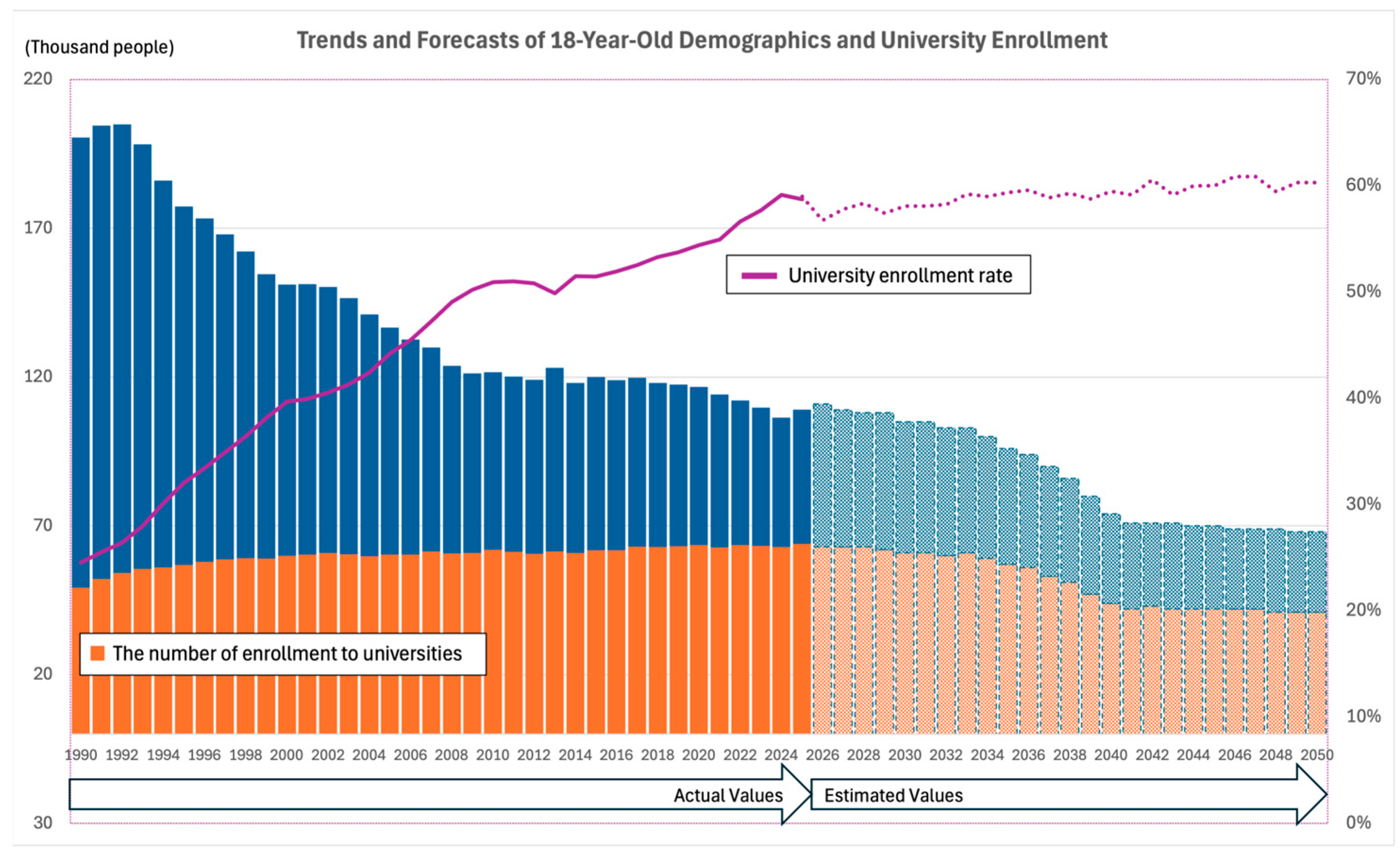
Figure 2 presents the historical trends and estimated values of the 18-year-old population and university enrollment in Japan (MEXT, 2024a). The results suggest that, even with an increase in the enrollment rate, the total number of university enrollees will continue to fall. The impact of declining enrollment on higher education is expected to intensify over the next two decades. Many countries, including Germany, the United States, South Korea, and Japan, will continue to face significant reductions in the number of college-aged students through the 2050s and beyond. In response to these shifts, several key trends are emerging across national higher education systems.
Figure 2.
Japan’s 18-year-old population and university enrollees.
Demographic decline will continue to reshape higher education systems worldwide. The contraction of student cohorts is expected to accelerate, especially in nonmetropolitan regions, which place smaller, private, and regional universities at a heightening of the risk of underenrollment and financial strain. As institutional viability becomes increasingly uncertain, more universities may face consolidation or closure, prompting large-scale restructuring within national systems. At the same time, shifting demographics will encourage universities to broaden their learner base by expanding lifelong-learning pathways, nondegree programs, and flexible study formats designed for adult and middle-career learners. Intensified competition for a shrinking pool of traditional applicants will further push institutions toward more differentiated academic offerings, targeted recruitment strategies, and international outreach.
These demographic pressures will also drive systemic transformations in governance, delivery modes, and educational quality. Governments are expected to intervene more frequently through regional revitalization policies, enrollment quota adjustments, and funding reforms aimed at preserving the stability of higher education ecosystems. Universities will increasingly adopt online learning, microcredentialing, and modular programs to attract diverse learners and respond to rapidly changing skill demands. However, these shifts also raise concerns about academic quality, resource allocation, and financial sustainability, as institutions struggle to balance enrollment pressures with the maintenance of rigorous standards and equitable access. Collectively, these long-term trends suggest that demographic decline will require universities to reconfigure their missions, diversify their educational portfolios, and develop more resilient operational models.
In assessing the future impact on higher education, higher education systems are being affected by broader labor market transformation and rapid technological change, particularly the accelerated diffusion of artificial intelligence. These forces are reshaping skill demand and increasing expectations for recurrent education, reskilling, and flexible learning pathways. Such changes are transmitted to higher education through employer demand for job-relevant competencies, public reskilling policies, and growing participation of adult and mid-career learners seeking targeted qualifications. Moreover, technological change further enables and accelerates these shifts by supporting modular program design, online and hybrid delivery modes, and scalable lifelong learning platforms, while simultaneously increasing expectations for institutional responsiveness and efficiency. Therefore, the future impact on higher education is not limited to smaller entering cohorts, but also includes growing pressure on institutions to adapt program structures and delivery modes to evolving workforce needs.
7. Conclusions
The global decline in fertility rates poses substantial challenges to the long-term viability of higher education systems. Countries such as Germany, the United States, South Korea, and Japan are undergoing demographic shifts that have significantly reduced the number of college-aged students and intensified institutional pressures.
This study has examined selected regions to demonstrate how demographic change affects university enrollment, institutional structures, and educational quality. It has also analyzed the main strategies deployed in response, including international student recruitment, lifelong learning initiatives, institutional mergers, and enrollment management. Each approach carries distinct benefits and limitations, and their effectiveness varies across policy environments, institutional capacities, and regional conditions. Looking forward, government and HEIs should proactively adapt to demographic contraction by pursuing structural reforms, diversifying their learner populations, and developing more flexible and innovative academic offerings.
In addition, governments and HEIs also play a critical role in supporting sustainable institutional practices. Reforms in response to demographic contraction may affect equity and access in higher education, particularly for students from disadvantaged backgrounds. Policymakers and institutional leaders need to ensure strategies with long-term sustainability that preserve broad participation, equal opportunity, and maintain the third mission beyond traditional teaching and research missions.
It is important to recognize that demographic decline does not automatically lead to institutional contraction. Its impact depends on participation expansion, internationalization, and policy intervention. Nonetheless, sustained fertility decline constitutes a long-term structural constraint that reshapes system-level dynamics across diverse contexts. Ultimately, the demographic crisis represents not only a formidable challenge but also provides an opportunity for universities to redefine their missions, strengthen their operational resilience, and align more closely with the evolving needs of society.
Funding
This research received no external funding.
Informed Consent Statement
Not applicable.
Data Availability Statement
https://ourworldindata.org/fertility-rate, accessed on 1 October 2025.
Acknowledgments
ChatGPT 5.2 was used for language editing.
Conflicts of Interest
The author declares no conflict of interest.
References
- Ashraf, Q. H., Weil, D. N., & Wilde, J. (2013). The effect of fertility reduction on economic growth. Population and Development Review, 39(1), 97–130. [Google Scholar] [CrossRef] [Scilit]
- Bettinger, E. P., & Long, B. T. (2009). Addressing the needs of underprepared students in higher education: Does college remediation work? Journal of Human Resources, 44(3), 736–771. [Google Scholar] [CrossRef] [Scilit]
- Bird, K. A., Castleman, B. L., Mabel, Z., & Song, Y. (2021). Bringing transparency to predictive analytics: A systematic comparison of predictive modeling methods in higher education. AERA Open, 7, 23328584211037630. [Google Scholar] [CrossRef] [Scilit]
- BLK. (2005). BLK: Cooperative structures at the interface of school/university for study and career choice preparation (issue 126) (Collection Issue 126). Federal-State Commission for Educational Planning and Research Promotion. Available online: https://www.bildungsserver.de/onlineressource.html?onlineressourcen_id=29772 (accessed on 1 October 2025).
- Bruckmeier, K., & Wigger, B. U. (2014). The effects of tuition fees on transition from high school to university in Germany. Economics of Education Review, 41, 14–23. [Google Scholar] [CrossRef] [Scilit]
- Buh, B. (2023). Measuring the effect of employment uncertainty on fertility in low-fertility contexts: An overview of existing measures. Genus, 79(1), 4. [Google Scholar] [CrossRef] [Scilit]
- Carlos, J., Chris, D., Lauren, B., Sharmila, M., & Tom, K. (2022). 50-state comparison: Dual/concurrent enrollment policies (pp. 1–6). Education Commission of The States. Available online: https://www.ecs.org/50-state-comparison-dual-concurrent-enrollment-policies/ (accessed on 1 October 2025).
- Duchini, E. (2017). Is college remedial education a worthy investment? New evidence from a sharp regression discontinuity design. Economics of Education Review, 60, 36–53. [Google Scholar] [CrossRef] [Scilit]
- Evan, C., & Lyss, W. (2025, September 18). Closed colleges: List of closures, mergers, and trendline|BestColleges. BestColleges. Available online: https://www.bestcolleges.com/research/closed-colleges-list-statistics-major-closures/ (accessed on 1 October 2025).
- Expert Council of German Foundations. (2019). Countering demographic decline—How Germany’s shrinking universities attract and retain international students (Research Unit Study 2019-1). Expert Council on Integration and Migration (SVR). [Google Scholar]
- Fauser, B. C. J. M., Adamson, G. D., Boivin, J., Chambers, G. M., De Geyter, C., Dyer, S., Inhorn, M. C., Schmidt, L., Serour, G. I., Tarlatzis, B., Zegers-Hochschild, F., Contributors and members of the IFFS Demographics and Access to Care Review Board, Ashiru, O., Brown, S., Bye, K., Calhaz-Jorge, C., Collura, B., De Sutter, P., Gianaroli, L., … Taylor, H. (2024). Declining global fertility rates and the implications for family planning and family building: An IFFS consensus document based on a narrative review of the literature. Human Reproduction Update, 30(2), 153–173. [Google Scholar] [CrossRef] [Scilit]
- Gauthier, A. H. (2007). The impact of family policies on fertility in industrialized countries: A review of the literature. Population Research and Policy Review, 26(3), 323–346. [Google Scholar] [CrossRef] [Scilit]
- Gellman, E., & Meyer, K. (n.d.). Improving college access through financial aid transparency and FAFSA simplification. Brookings Institution. [Google Scholar]
- Glennie, E., & Edmunds, J. (2025). Strengthening dual enrollment partnerships. RTI Press. [Google Scholar] [CrossRef] [Scilit]
- GSU. (n.d.). Approaching student success with predictive analytics. Student Success Programs, Georgia State University. Available online: https://success.gsu.edu/approach/ (accessed on 25 November 2025).
- Harvey, B. C. (2021). Teetering on the demographic cliff, part 1. Society for College and University Planning (SCUP), 49(4), 1–12. [Google Scholar]
- Hasegawa, H. (2023). A conceptual overview of first-year education within higher education reform: The practice and future challenges of common first-year education at Taisho University. Taisho University Repository, 108, 189–208. [Google Scholar]
- Haxhiavdyli, V. (2024). Studienkolleg in Germany (prep course). Study in Germany for Free. Available online: https://www.studying-in-germany.org/studienkolleg/ (accessed on 1 October 2025).
- Hutchins, B. C., Arshavsky, N., Edmunds, J. A., & Rosof, L. C. (2024). Why students participate (or not) in dual enrollment: Results from an evaluation of North Carolina’s career and college promise. Community College Journal of Research and Practice, 1–18. [Google Scholar] [CrossRef] [Scilit]
- Ishibashi, A. (2025). Promotion of regional university revitalization initiatives (pp. 1–20). Japan’s Ministry of Education, Culture, Sports, Science and Technology (MEXT). Available online: https://www.mext.go.jp/content/20251007-mxt_chisui02-000045241_3.pdf (accessed on 1 October 2025).
- Jeung, Y. (2025, August). Landmark law allows payouts to ‘zombie universities’. University World News. Available online: https://www.universityworldnews.com/post.php?story=20250815125600612 (accessed on 1 October 2025).
- Jisoo, P. (2025, October 9). Half of all university students now attend schools in the Seoul metropolitan area… accelerating regional exodus. The Asia Business Daily. Available online: https://www.asiae.co.kr/article/2025100920581174828 (accessed on 1 October 2025).
- Jong Na, H., Shin, H.-Y., & Cho, Y. (2025). Predicting freshman recruitment rates: A comparative analysis of metropolitan and non-metropolitan universities in South Korea. IEEE Access, 13, 138699–138717. [Google Scholar] [CrossRef] [Scilit]
- Jung, D. (2025). Declining enrollments force Korean universities to fight for survival—The Korea Times. Available online: https://www.koreatimes.co.kr/southkorea/society/20250129/declining-enrollments-force-korean-universities-to-fight-for-survival (accessed on 1 October 2025).
- Jung, J. (2024). When massified higher education meets shrinking birth rates: The case of South Korea. Higher Education, 88(6), 2357–2373. [Google Scholar] [CrossRef] [Scilit]
- Jung, U. (2023, August 18). New plan aims at 31% rise in international students by 2027. University World News. Available online: https://www.universityworldnews.com/post.php?story=20230818155906138 (accessed on 1 October 2025).
- Kelchen, R., Ritter, D., & Webber, D. (2025). Predicting college closures and financial distress. Finance and Economics Discussion Series, (2025–003), 1–69. [Google Scholar] [CrossRef] [Scilit]
- Lee, H.-Y. (2022, March 4). Humanities students and departments struggle in Korean universities. Korea JoongAng Daily. Available online: https://koreajoongangdaily.joins.com/2022/03/04/national/kcampus/humanities-university-engineering/20220304053007087.html (accessed on 1 October 2025).
- Lee, T.-H. (2024, October 7). Wonkwang universities set to merge by 2026 after Glocal University 30 project selection. Korea JoongAng Daily. Available online: https://koreajoongangdaily.joins.com/news/2024-10-07/national/kcampus/Wonkwang-universities-set-to-merge-by-2026-after-Glocal-University-30-project-selection/2149714 (accessed on 1 October 2025).
- Matsushita, K., Tanaka, K., Ono, M., Mutoh, H., Uda, H., & Okada, K. (2023). Diversity of student transitions in high school-university articulation. Journal of Japan Association for College and University Education, 45(2), 115–120. [Google Scholar] [CrossRef]
- McDonald, P. (2008). Very low fertility: Consequences, causes and policy approaches. Japanese Journal of Population, 6(1), 19–23. [Google Scholar]
- MEXT. (2021). Second report of the expert panel on the future direction of the super science high school (SSH) support program. MEXT (Ministry of Education, Culture, Sports, Science and Technology).
- MEXT. (2024a). 18-year-old population and Higher education enrollment rate [Statistics]. Available online: https://www.mext.go.jp/content/20240719-koutou02-000037140_14.pdf (accessed on 1 November 2025).
- MEXT. (2024b). Reconsidering the role of higher education for the future society under rapid demographic decline (p. 70). Japan’s Ministry of Education, Culture, Sports, Science and Technology (MEXT). Available online: https://www.mext.go.jp/b_menu/shingi/chukyo/chukyo4/053/toushin/1411360_00001.html (accessed on 1 October 2025).
- MEXT. (2024c). The significance of universities’ engagement in recurrent education and directions for its promotion. Japan’s Ministry of Education, Culture, Sports, Science and Technology (MEXT). Available online: https://www.mext.go.jp/content/240510-mxt_syogai03-100000261_1.pdf (accessed on 1 October 2025).
- MEXT. (2025a). 2025 basic school survey. Japan’s Ministry of Education, Culture, Sports, Science and Technology (MEXT). [Google Scholar]
- MEXT. (2025b). Future vision for improving Japan’s “collective knowledge and wisdom”—Reconstructing the higher education system. Japan’s Ministry of Education, Culture, Sports, Science and Technology (MEXT).
- My German University. (n.d.). Are there English-speaking universities in Germany? My German University. Available online: https://www.mygermanuniversity.com/articles/english-universities-in-germany (accessed on 25 November 2025).
- NILE. (2018). 2018 lifelong learning in Korea (pp. 1–12). National Institute for Lifelong Education. Vol. 1, Issue 1.
- OECD. (2023a). Education at a glance 2023: OECD indicators. OECD Publishing. [Google Scholar] [CrossRef] [Scilit]
- OECD. (2023b). OECD reviews of innovation policy: Korea 2023. OECD Publishing. [Google Scholar] [CrossRef] [Scilit]
- OECD. (2024). Society at a glance 2024: OECD social indicators. OECD Publishing. [Google Scholar] [CrossRef] [Scilit]
- Office for Communication and PR. (2025). Facts and figures—FernUniversität in Hagen. FernUniversitat in Hangen. Available online: https://www.fernuni-hagen.de/english/university/facts-and-figures.shtml (accessed on 1 November 2025).
- Page, L. C., & Scott-Clayton, J. (2016). Improving college access in the United States: Barriers and policy responses. Access to Higher Education, 51, 4–22. [Google Scholar] [CrossRef] [Scilit]
- PMAC. (2025). Admission trends for private universities and junior colleges in 2025 (p. 8). Information Office of Promotion and Mutual Aid Corporation for Private Schools of Japan (PMAC). Available online: https://www.shigaku.go.jp/files/shigan_doukouR7.pdf (accessed on 1 November 2025).
- Rabl, T., & Kühlmann, T. M. (2009). Work-life balance and demographic change: Relationships with age and age discrimination. Zeitschrift für Personalpsychologie, 8(2), 88–99. [Google Scholar] [CrossRef] [Scilit]
- Raymo, J. M., & Shibata, A. (2017). Unemployment, nonstandard employment, and fertility: Insights from Japan’s “lost 20 years”. Demography, 54(6), 2301–2329. [Google Scholar] [CrossRef] [Scilit]
- Rodriguez, O., Payares-Montoya, D., Ugo, I., & Gao, N. (2023). Improving college access and success through dual enrollment. Public Policy Institution of California. [Google Scholar]
- Study In Germany. (2025). Germany International Student Statistics 2025. Study in Germany. Available online: https://www.studying-in-germany.org/germany-international-student-statistics/ (accessed on 1 October 2025).
- Sugitani, Y. (2013). Consideration of remedial education from an analysis of programs of first-year experience. Remedial Education Research, 8(1), 49–54. [Google Scholar] [CrossRef]
- Tanaka, K. (2022). Characteristic of types of educational articulation between high school and university. Journal of Japan Association for College and University Education, 44(1), 150–159. [Google Scholar] [CrossRef]
- THEC & TSAC. (2023). Tennessee promise annual report 2023. Tennessee Higher Education Commission (THEC) and Tennessee Student Assistance Corporation (TSAC). Available online: https://digitaltennessee.tnsos.gov/hec_promise_reports/7 (accessed on 1 October 2025).
- UCF. (2024). 2023–2024 annual report. Division of Student Success and Well-Being. [Google Scholar]
- Unglesbee, B. (2025, March 27). ‘You can’t create 18-year-olds’: What can colleges do amid demographic upheaval?|Higher Ed Dive. Higher Ed Dive. Available online: https://www.highereddive.com/news/demographic-cliff-colleges-closures-retention-attendance-diversity-wiche/743636/ (accessed on 1 October 2025).
- United Nations. (2025). World fertility 2024. United Nations. Available online: https://www.un-ilibrary.org/content/books/9789211071887 (accessed on 1 October 2025).
- Vermont State University. (2023). History. Vermont State University. Available online: https://vermontstate.edu/about/mission-history-values/history/ (accessed on 1 October 2025).
- Vigdor, J. L. (2024). The ebbing tide: How will higher education adapt to demographic change? In Financing institutions of higher education. University of Chicago Press. Available online: https://www.nber.org/books-and-chapters/financing-institutions-higher-education/ebbing-tide-how-will-higher-education-adapt-demographic-change (accessed on 1 October 2025).
- Williams, J. (2017). Collaboration, alliance, and merger among higher education institutions (Vol. 160). OECD Education Working Papers No. 160; OECD Education Working Papers. OECD. [Google Scholar] [CrossRef]
- Yamamoto, C., & Masutani, F. (2023). Enrollment quotas not met at 53.3% of private universities|The Asahi Shimbun: Breaking news, Japan news and analysis. The Asahi Shimbun. Available online: https://www.asahi.com/ajw/articles/14994234 (accessed on 1 October 2025).
- Yanagiura, T., & Tateishi, S. (2024). Local economic impact of small, non-research private universities: Evidence from Japan. Economics of Education Review, 102, 102576. [Google Scholar] [CrossRef] [Scilit]
- Yonezawa, A. (2020). Challenges of the Japanese higher education Amidst population decline and globalization. Globalisation, Societies and Education, 18(1), 43–52. [Google Scholar] [CrossRef] [Scilit]
- Yoo, J. (2024). Why do college students in South Korea drop out and stop out? Impact of personal characteristics, college environment, and college life. Sage Open, 14(3), 21582440241282920. [Google Scholar] [CrossRef] [Scilit]

Disclaimer/Publisher’s Note: The statements, opinions and data contained in all publications are solely those of the individual author(s) and contributor(s) and not of MDPI and/or the editor(s). MDPI and/or the editor(s) disclaim responsibility for any injury to people or property resulting from any ideas, methods, instructions or products referred to in the content. |
© 2026 by the author. Licensee MDPI, Basel, Switzerland. This article is an open access article distributed under the terms and conditions of the Creative Commons Attribution (CC BY) license.