Skip to Content
Education SciencesEducation Sciences
  • Article
  • Open Access

27 February 2026

Demographic Change and Higher Education Governance: Evidence from Departmental Restructuring and Enrollment Dynamics in Taiwan’s TVET Institutions

and
1
Institutional Research Center, Ming Chi University of Technology, New Taipei City 243303, Taiwan
2
Department of Visual Communication Design, Ming Chi University of Technology, New Taipei City 243303, Taiwan
*
Author to whom correspondence should be addressed.

Abstract

Taiwan’s higher education system is undergoing profound demographic change as declining birthrates continue to reduce the size of incoming student cohorts. These demographic pressures pose significant challenges for institutional governance, enrollment management, and program sustainability, particularly within the technological and vocational education and training (TVET) sector, which relies heavily on stable freshman enrollment. Using five nationwide administrative datasets, this study conducts a longitudinal analysis of 1087 departmental restructuring cases implemented across 74 TVET institutions between 2020 and 2024. The restructuring strategies examined include renaming, mergers, additions, closures, and quota expansions. Fixed-effects regression models and multi-year enrollment trend analyses are employed to evaluate how different forms of departmental adjustment influence freshman enrollment outcomes. The results show that departmental renaming is the only strategy consistently associated with improved enrollment performance, particularly in private institutions. In contrast, mergers generally fail to generate positive enrollment effects, while closures are concentrated among programs with sustained low enrollment over multiple years. Newly established programs and quota expansions perform relatively well in fields aligned with strong labor market demand, such as healthcare and applied technologies. By providing large-scale, system-level empirical evidence, this study contributes to research on higher education policy, institutional governance, and enrollment management under demographic decline. The findings offer practical implications for administrators and policymakers seeking to design effective program adjustment strategies and support institutional resilience in higher education systems facing long-term population contraction.

1. Introduction

Taiwan is undergoing a profound demographic transition characterized by a persistent decline in birth rates, a trend that poses significant challenges to the governance and long-term viability of its higher education system. As shrinking birth cohorts reduce the pool of prospective students, higher education institutions face intensified enrollment pressures and growing uncertainty in institutional planning and resource allocation. These pressures are particularly pronounced in technological and vocational education and training (TVET) institutions, which rely heavily on stable freshman enrollment to sustain instructional capacity, faculty deployment, and program operations.
In response to these demographic constraints, universities have increasingly adopted departmental organizational adjustment strategies—including mergers, closures, renaming, and quota modifications—as mechanisms of structural adaptation. While such adjustments have become widespread across the sector, systematic empirical evidence regarding how these strategies are deployed across institutions and how they are associated with enrollment outcomes remains limited.
This study addresses this gap by examining departmental adjustment practices across all TVET institutions in Taiwan between 2021 and 2024. Drawing on longitudinal administrative data, the study analyzes how different types of adjustment strategies are associated with changes in freshman enrollment rates. By providing system-level evidence, this research contributes to a clearer understanding of how higher education institutions respond organizationally to sustained demographic contraction.

2. Background

2.1. Demographic Pressures and the TVET Sector

The viability of Taiwan’s higher education institutions depends heavily on stable freshman enrollment to sustain instructional capacity and faculty allocation. However, recent demographic projections indicate that Taiwan’s annual number of births declined to approximately 204,000 by 2024. This demographic contraction has directly affected the TVET sector: the number of private TVET institutions decreased from 53 in 2021 to 49 in 2024, while affiliated departments and academic programs declined from 685 to 590 during the same period (W.-B. Lin & Yang, 2025).
Under the combined pressures of demographic decline and rapid industrial transformation, universities are compelled to undertake structural adaptations within an increasingly market-oriented and performance-driven governance environment. These sectoral shifts underscore the urgency of examining how institutions reorganize internally in response to external demographic shocks.

2.2. Institutional Responses in the Literature

Existing research conceptualizes departmental adjustment strategies—including renaming, mergers, program additions, closures, and enrollment quota adjustments—as organizational tools through which institutions respond to resource constraints and shifts in academic positioning. Studies have documented how Taiwan’s higher education system has faced declining registration rates and managerial challenges under demographic pressure (Kuo, 2016). In response, institutions have adopted marketing initiatives and value co-creation approaches to enhance student attraction (Smørvik & Vespestad, 2020; Inaba, 2020; Yonezawa, 2020).
Other scholars have utilized survey data and administrative databases to examine how enrollment strategies shape college choice and registration behavior (Luo, 2007; Y.-Y. Lin, 2010), while case-based research has analyzed the governance processes and organizational dynamics of departmental mergers (A. Lin & Ho, 2021). In addition, institutional admissions design and recruitment practices have been identified as important determinants of post-admission enrollment behavior (Hossler & Gallagher, 1987; Antecol & Smith, 2012).
Despite these contributions, prior studies remain fragmented. Most focus either on marketing and recruitment strategies or on individual case studies of mergers, rather than providing a comprehensive, system-level analysis of multiple adjustment strategies across institutions.

2.3. Research Gap

There remains a lack of research that systematically integrates and compares the full range of departmental organizational adjustment strategies across the entire TVET sector. Existing studies have not examined how different types of adjustments are distributed across institutions at the system level, nor how enrollment outcomes change before and after such adjustments using longitudinal administrative data.
Moreover, because many institutional enrollment strategies involve internal decision-making processes that are not publicly disclosed, external observers face limitations in assessing their effectiveness. This study addresses these gaps by providing a sector-wide quantitative analysis of departmental adjustment practices and their association with freshman enrollment rates across both public and private TVET institutions.

3. Literature Review

3.1. Enrollment Challenges and Institutional Responses

Taiwan’s higher education system has been significantly affected by a sustained decline in birth rates. The number of higher education institutions increased from 134 in 1995 to 164 in 2007, while annual births fell sharply from 329,000 to 204,000 during the same period (H.-Y. Liu, 2005), and further declined to approximately 139,000 by 2022. This demographic contraction has generated wide-ranging impacts on individuals, institutions, and society (Y.-G. Lu, 2022; Ho, 2024). As the size of incoming student cohorts continues to shrink, higher education institutions—particularly those within the technological and vocational education and training (TVET) sector—face growing enrollment pressures, heightened uncertainty in institutional planning, and increased challenges in maintaining stable operations.
The declining student population has direct implications for institutional finances, program viability, resource allocation, and long-term planning (S.-J. Chan & Yang, 2014; Hong, 2020; H.-P. Tsai & Tang, 2023). In response, prior research has identified a range of strategies aimed at enhancing institutional attractiveness and stabilizing enrollment. These strategies include strengthening partnerships with senior high and vocational schools, expanding international student recruitment, offering scholarships, developing internship pathways that improve employability, and implementing targeted marketing to enhance institutional visibility (Luo, 2007; Y.-Y. Lin, 2010; C.-H. Wu, 2014; C.-W. Lu, 2016; M.-J. Chan, 2019; Y.-T. Chen, 2024). Such approaches are intended to reduce uncertainty for prospective students and reinforce institutional competitiveness in increasingly constrained enrollment environments. International studies similarly suggest that higher education institutions facing demographic pressure rely more heavily on market responsiveness and stakeholder engagement to manage enrollment challenges and institutional change (Guri-Rosenblit et al., 2007; Jongbloed et al., 2008).
Beyond external recruitment measures, institutions have also adopted internal strategies focused on differentiation and financial resilience. These include strengthening institutional reputation, improving global rankings, and establishing affiliated enterprises to diversify revenue sources and reduce dependence on tuition income (Asia University, 2022; M.-J. Tsai, 2008). At the policy level, the Taiwanese government has introduced a series of initiatives to support institutional adaptation, including the Higher Education Sprout Project, the Institutional Exit and Transformation Mechanism, and reforms to admission pathways designed to enhance flexibility and responsiveness to regional labor market needs. Collectively, these developments reflect a shift toward more data-informed governance and adaptive enrollment management practices within the higher education system.
Nevertheless, as demographic decline intensifies, higher education institutions increasingly turn to structural adjustments at the departmental level as a means of maintaining competitiveness and managing enrollment risk. This shift underscores the need for empirical research that systematically evaluates the effectiveness of such strategies across the TVET sector and examines how departmental restructuring influences enrollment outcomes. Despite the growing relevance of these issues, relatively few studies have examined restructuring using nationwide, multi-year data, leaving an important gap in understanding how demographic change intersects with institutional decision-making and program-level governance in higher education.

3.2. Organizational Change in Higher Education: International and Theoretical Perspectives

Organizational change has long been recognized as a critical mechanism through which higher education institutions adapt to environmental pressures such as demographic decline, fiscal constraints, and evolving societal expectations. International experience demonstrates that structural reforms can strengthen institutional viability and improve system-level coordination within higher education systems. In the United States, university mergers have been implemented since the 1960s as a means of improving financial stability, expanding academic offerings, and enhancing regional competitiveness. Similar reforms occurred in the United Kingdom, where three major waves of institutional mergers were introduced to increase efficiency and organizational performance (S.-J. Chan, 2004; Research, Development and Evaluation Commission, Executive Yuan, 2012). Higher education systems in East Asia, including Japan and South Korea, have likewise adopted policies that support institutional consolidation or transformation in response to shrinking student cohorts (Research, Development and Evaluation Commission, Executive Yuan, 2012). Comparative studies from Australia, Japan, and the United Kingdom further indicate that mergers can improve resource allocation and academic capacity when guided by coherent governance structures, clearly defined objectives, and effective stakeholder coordination (Ma & Tseng, 2012; Yen & Yang, 2022; Skodvin, 1999).
Higher education institutions operate as complex organizations composed of administrative units, academic departments, and professional communities. Prior research emphasizes that academic departments maintain distinct organizational identities, suggesting that structural reform requires careful coordination across multiple layers of governance (M.-J. Chen & Wu, 2009). Classic theories of organizational change highlight the importance of communication, consensus-building, and stakeholder engagement during periods of institutional transformation. Empirical studies have shown that poorly managed reform processes may generate resistance, weaken organizational morale, and result in temporary performance decline when communication is insufficient or institutional vision is unclear (Hanson, 1991; B.-E. Wu, 1991; Lo, 2006; Chin, 1997; Yang, 2015). Broader organizational scholarship similarly underscores that leadership alignment, cultural adaptation, and shared goals are essential to successful change processes in universities and other knowledge-based organizations (Kotter, 1995; Kezar, 2001).
From an organizational and governance perspective, international experience and theoretical research suggest that change in higher education is most effective when it is strategically planned, contextually grounded, and supported by broad participation across institutional actors. These insights provide an important foundation for understanding how higher education systems respond to demographic pressure through institutional restructuring. They also underscore the central role of adaptive governance and organizational capacity in navigating long-term population change while maintaining stable institutional operations.

3.3. Departmental Adjustments in Taiwan’s Higher Education System

In Taiwan, demographic decline and evolving labor market demands have intensified the need for structural adjustments at both institutional and departmental levels within the higher education system. Within the technological and vocational education and training (TVET) sector, departmental restructuring has become a central strategy for managing enrollment contraction, enhancing program relevance, and maintaining institutional competitiveness. Common forms of adjustment include program mergers, departmental renaming, the establishment of new academic units, the closure of underperforming programs, and modifications of enrollment quotas. These adjustments are regulated by national policy frameworks. Institutions are required to complete internal review procedures, build consensus among faculty and administrators, and obtain formal approval from the Ministry of Education. Approved cases are recorded in the TVET Program Adjustment Online System, which enhances transparency and public accountability in institutional decision-making (Ministry of Education, R.O.C. (Taiwan), 2025).
Empirical research indicates that departmental restructuring in Taiwan reflects multiple policy and organizational objectives. Li (2006) found that program adjustments are frequently aligned with government policy initiatives, emerging industry trends, and national development priorities. Case-based studies suggest that departmental renaming can reshape program identity and influence student perceptions, while mergers may improve operational efficiency depending on the quality of implementation and internal coordination (A. Lin & Ho, 2021). Other research has highlighted challenges related to academic alignment, curriculum continuity, and organizational integration following institutional consolidation (Z.-Y. Wu & Chen, 2021). International studies similarly indicate that institutional mergers and restructuring can facilitate resource integration and organizational adaptation when supported by coherent governance structures and active stakeholder engagement (Huisman et al., 2007). Despite these contributions, much of the existing research on higher education restructuring in Taiwan focuses on individual institutions or relies primarily on qualitative approaches, limiting insight into system-wide restructuring patterns.
From a higher education governance perspective, the existing literature makes clear that departmental adjustments play a critical role in institutional responses to demographic decline. However, systematic empirical evidence evaluating the effectiveness of different adjustment strategies across institutions remains limited. Examining how restructuring strategies operate at the sector level and how they influence enrollment outcomes is therefore essential for advancing research on higher education governance, institutional adaptation, and enrollment management in contexts characterized by sustained population decline.

3.4. Departmental Adjustment Strategies in Higher Education: A Conceptual and Literature Review

Under conditions of intensified global competition in higher education, sustained demographic decline, and rapid industrial transformation, adjustments at the departmental level have become an increasingly important governance instrument for universities seeking to maintain competitiveness and ensure institutional continuity. The existing literature generally suggests that departmental adjustment strategies adopted by higher education institutions can be broadly classified into five categories: departmental renaming, departmental mergers, program addition, enrollment quota expansion, and departmental suspension or closure. Together, these strategies reflect differentiated organizational responses to market demand, policy incentives, and internal resource constraints, highlighting the diverse pathways through which higher education institutions engage in structural adaptation.
Among these strategies, departmental renaming is often regarded as a relatively low-risk and flexible governance tool and is frequently interpreted as part of a broader institutional rebranding process. Prior studies indicate that by adopting more contemporary, industry-oriented, or easily identifiable program titles, institutions can reshape external perceptions of existing departments and enhance their attractiveness to prospective students (Stuart & Muzellec, 2004). Empirical research further suggests that linking departmental names to geographic identity or emerging industry trends may strengthen institutional reputation and market visibility, particularly in highly competitive enrollment environments (Guido et al., 2009).
In contrast, departmental mergers represent a higher level of structural adjustment and are typically implemented under conditions of prolonged enrollment decline, resource constraints, or efforts to achieve economies of scale. Through organizational consolidation, institutions may reduce administrative and personnel costs while potentially fostering interdisciplinary integration and academic innovation. As such, mergers are often viewed as defensive or transformative strategies adopted by higher education institutions facing survival pressures (Harman & Harman, 2003; Azziz et al., 2019). However, the literature also cautions that the outcomes of mergers depend heavily on governance design, internal coordination, and stakeholder participation; insufficient attention to these factors may lead to organizational friction and conflicts over academic identity.
With regard to program addition and enrollment quota expansion, prior research indicates that these strategies are largely driven by external labor market demand and government policy incentives. As emerging technology sectors such as artificial intelligence and semiconductors continue to expand, universities have increasingly established new programs or expanded enrollment capacity in related fields to address workforce shortages and secure policy-based funding support (Ministry of Education, R.O.C. (Taiwan), 2024). At the same time, scholars emphasize that through flexible enrollment strategies and new program development, institutions can cultivate niche markets within increasingly market-oriented environments, thereby strengthening institutional positioning and competitive advantage (H.-P. Tsai & Tang, 2023).
By comparison, departmental suspension or closure is widely regarded as the most controversial adjustment strategy and carries the highest political and organizational costs. Such decisions typically occur in contexts of persistent enrollment shortages, declining academic performance, or growing misalignment with institutional mission. Eckel (2002) notes that decisions to close academic units are not based solely on considerations of financial efficiency, but instead involve complex trade-offs among academic quality, mission centrality, and internal power dynamics. Institutional leaders must therefore balance resource reallocation with the protection of stakeholder interests when implementing departmental closures.
Overall, departmental adjustment should not be understood as a series of isolated or one-time managerial decisions, but rather as an evolving governance process shaped by demographic trends, policy environments, and changing industrial demands. While existing studies have examined the motivations and governance logics underlying individual adjustment strategies, systematic and quantitative analyses at the system level remain limited. In particular, there is a lack of empirical research that examines how different departmental adjustment strategies are configured across institutions and how these strategies are associated with enrollment outcomes. This gap underscores the need for further investigation using nationwide data to assess departmental adjustment practices and their enrollment effects within higher education systems.

4. Methodology

To examine how technological and vocational education and training (TVET) institutions respond to sustained demographic decline through organizational adjustment, this study is guided by two research questions:
  • RQ1: What types of departmental adjustment strategies have been adopted by public and private TVET institutions in Taiwan under sustained demographic decline?
  • RQ2: How are different departmental adjustment strategies associated with changes in freshman enrollment rates, and do these associations differ between public and private institutions?
RQ1 is addressed through descriptive and comparative analyses of restructuring cases across public and private institutions. RQ2 is examined using a fixed-effects regression framework to assess the association between restructuring strategies and changes in freshman enrollment rates.
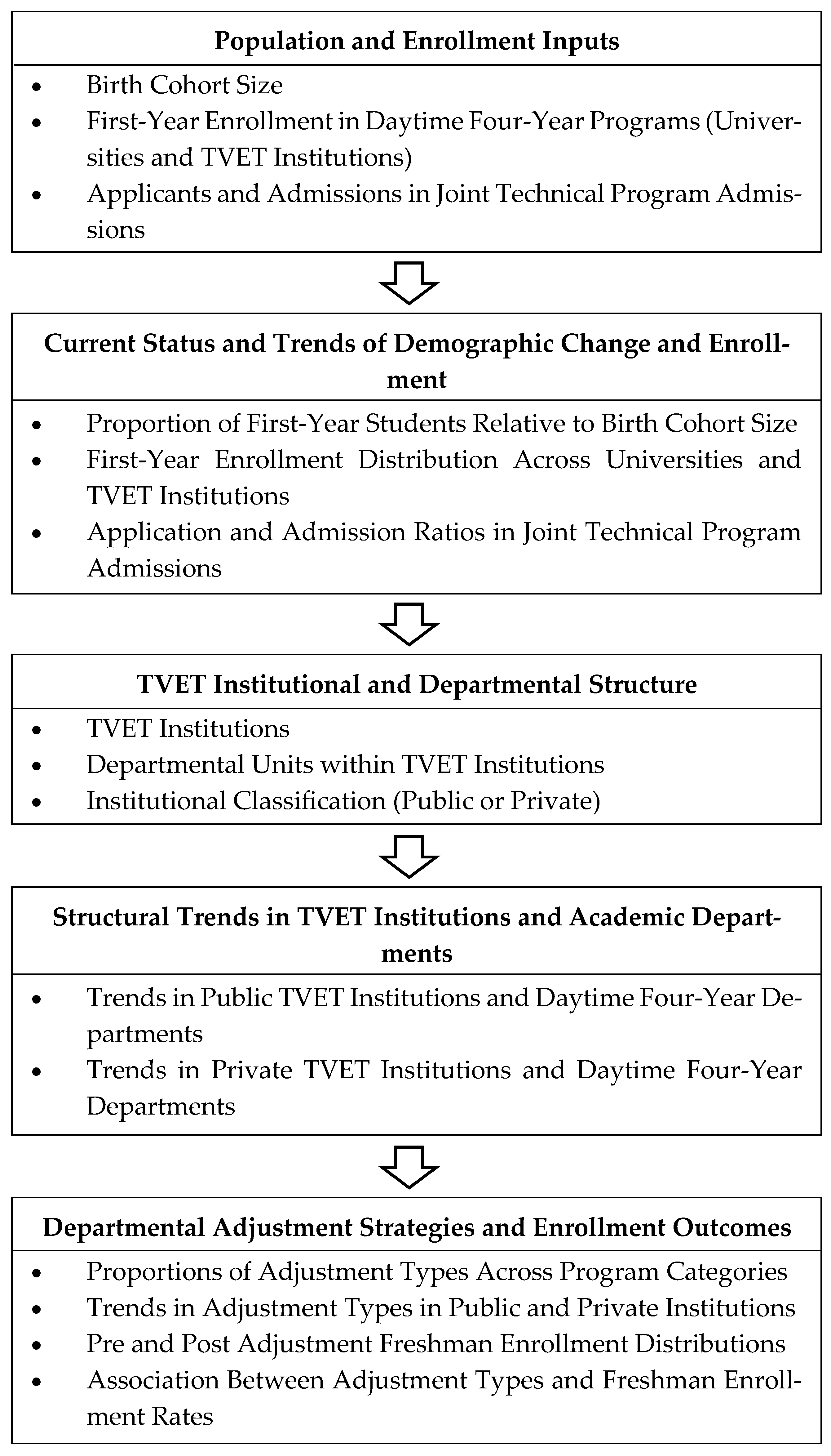
Figure 1 presents the conceptual research framework guiding this study. The framework begins with trends of demographic change and enrollment, including birth cohort size, first-year enrollment in daytime four-year programs, and application and admission ratios in joint technical program admissions. It then examines the institutional and departmental structure of TVET institutions, followed by an analysis of structural trends in public and private TVET institutions and their academic departments. Finally, the framework focuses on departmental adjustment strategies and their enrollment outcomes. This sequential analytical progression aligns with RQ1 and RQ2 by first identifying patterns of adjustment across institutions and subsequently examining their association with changes in freshman enrollment rates using a fixed-effects modeling approach.
Figure 1. Research Framework.

4.1. Data Sources and Analytical Instruments

This study employs a secondary data analysis design integrating four nationwide government datasets. The use of longitudinal and cross-sectional administrative data enables a system-level examination of demographic trends, institutional restructuring, and enrollment outcomes. The data sources include:
  • National birth statistics from the Department of Household Registration.
  • Enrollment statistics for daytime four-year programs from the Ministry of Education.
  • Official departmental adjustment records from the TVET Program Adjustment Online System.
  • Program-level freshman enrollment rates from the University Affairs Information Platform.
All datasets are publicly available and contain no personally identifiable information. Data processing and statistical analysis were conducted using Python 3.11.5 for data cleaning, integration, and modeling. Microsoft Excel was used to generate descriptive visualizations.

4.2. Research Subjects and Classification Criteria

The research subjects consisted of all technological and vocational education and training (TVET) institutions in Taiwan that implemented departmental adjustments between 2020 and 2024. A total of 74 institutions were included, representing 1087 documented restructuring cases across the sector during this period. Only six institutions reported no departmental adjustments, namely National Penghu University of Science and Technology, National Taiwan College of Performing Arts, Chung Jen Junior College of Nursing, Health Science and Management, Hsin Sheng Junior College of Medical Care and Management, Shu Zen Junior College of Medicine and Management, and Yuh Ing Junior College of Health Care and Management. Because the dataset covers the complete population of restructuring cases recorded during the study period, it provides a comprehensive empirical basis for analyzing system-wide institutional responses to demographic decline. All data were aggregated at the institutional and departmental levels and contained no personally identifiable information.
For analytical purposes, the 1087 restructuring cases were classified into five categories based on the nature of the adjustment. The first category, merger, includes both straightforward mergers and cases in which mergers were accompanied by departmental renaming. The second category, closure, refers to the termination of departments across different educational programs or the discontinuation of department groups. The third category, addition, encompasses the establishment of new departments, department groups, degree programs, or academic tracks. The fourth category, renaming, includes changes to department names, revisions of program titles, or reclassification of department groups. The fifth category, quota expansion, involves increases in enrollment quotas, primarily concentrated in medical and health-related fields in response to national policy initiatives. Together, these categories provide a consistent analytical framework for examining how different restructuring strategies operate across Taiwan’s TVET sector and for assessing their implications for institutional governance and enrollment management.

4.3. Data Preparation and Analytical Design

To examine the effects of Taiwan’s declining birthrate on departmental restructuring and subsequent enrollment outcomes, this study focused on three major types of adjustment: renaming, mergers, and quota expansion. Historical freshman enrollment rates from 2019 to the year preceding each adjustment, together with enrollment rates from the adjustment year through 2024, were used to capture changes in enrollment performance over time. Enrollment rates of discontinued departments were used to represent baseline conditions prior to closure, and the enrollment performance of newly established programs was also examined. Because the dataset includes both restructuring records (2020–2024) and enrollment data (2019–2024), longitudinal changes in enrollment outcomes could be traced before and after departmental adjustment at both the institutional and departmental levels. Freshman enrollment rate was therefore adopted as the primary outcome variable.
Enrollment decisions may be influenced by a range of institutional and program-related factors, including campus environment, program characteristics, financial incentives, employment prospects, institutional reputation, and public image. Previous studies have demonstrated that these factors affect students’ university and program choices (Drewes & Michael, 2006; Luo, 2007; Y.-Y. Lin, 2010; M.-C. Liu, 2020). Because many of these characteristics are relatively stable over time and difficult to observe directly, this study employed a fixed-effects ordinary least squares regression model to isolate the net effect of departmental restructuring strategies.
The regression model is specified as follows:
y i t = β X i t + α i + ε i t
where y i t denotes the freshman enrollment rate of department i in year t ; X i t denotes the restructuring type (renaming, merger, or quota expansion); α i captures unobserved, time-invariant department-specific characteristics; and ε i t is the error term. A fixed-effects estimator was adopted because restructuring decisions are likely correlated with stable departmental characteristics, making fixed effects more appropriate than pooled ordinary least squares for estimating restructuring effects.
Data processing and analysis were conducted using Python for classification, filtering, and dataset integration. Microsoft Excel was used to generate descriptive visualizations that supported interpretation of enrollment trends. Additional analyses examined differences in freshman enrollment rates before and after each restructuring type, providing a basis for evaluating how different adjustment strategies relate to enrollment outcomes in the TVET sector.

5. Data Analysis and Results

5.1. Overview of Departmental Adjustment Cases by Category

As shown in Table 1, the number of public TVET institutions in Taiwan remained stable between 2021 and 2024, while the number of affiliated departments and academic programs continued to increase during the same period. In contrast, private TVET institutions experienced sustained declines in both the number of institutions and the number of departments. These divergent patterns indicate different institutional responses to demographic change: public institutions appear to have expanded or reorganized academic programs in response to emerging skill demands, whereas private institutions increasingly adopted contractionary measures, such as program closures, to manage enrollment pressure. Consistent with international research, these patterns reflect how higher education systems respond to demographic and structural pressures through program diversification, consolidation, and the reallocation of organizational resources (Guri-Rosenblit et al., 2007; Jongbloed et al., 2008). The trends summarized in Table 1 illustrate how demographic decline is associated not only with changes in student numbers, but also with shifts in program portfolios, resource allocation, and institutional strategy.
Table 1. Number of Public and Private TVET Institutions and Daytime Four-Year Programs in Taiwan (2021–2024).
Between 2020 and 2024, a total of 1087 departmental adjustment cases were recorded across technological and vocational education and training (TVET) institutions in Taiwan. The annual number of adjustment cases declined steadily from 303 in 2020 to 163 in 2024. As shown in Table 2, this downward trend corresponds with the gradual decrease in birth numbers over the same period, indicating a temporal association between demographic change and the frequency of departmental restructuring within the TVET sector.
Table 2. Departmental Adjustment Cases by Type in Public and Private TVET Institutions (2020–2024).
Further analysis of adjustment types reveals clear differences between public and private institutions. Public institutions most frequently implemented program additions, accounting for 3.0% to 10.1% of annual cases, followed by closures (1.0% to 6.7%), renaming (1.0% to 2.3%), mergers (0.4% to 0.6%), and quota expansions (0.3% to 0.6%). In contrast, private institutions relied predominantly on closures, which comprised 42.0% to 61.3% of annual cases. This was followed by additions (14.7% to 27.4%), renaming (6.0% to 9.0%), mergers (0.6% to 9.8%), and quota expansions (0.3% to 1.1%). These distributions indicate that private institutions faced more pronounced enrollment pressures and were therefore more likely to discontinue or reorganize academic programs. At the same time, a subset of private institutions established new departments in response to emerging industry needs, particularly in areas related to digital technology and artificial intelligence, partially offsetting reductions associated with program closures.
Table 3 summarizes the distribution of departmental adjustment cases across different educational program types. Daytime four-year programs exhibited the highest concentration of adjustments (32.4%), followed by four-year continuing education programs (17.9%), two-year continuing education programs (12.1%), and master’s daytime programs (11.4%). Viewed together, Table 2 and Table 3 show that daytime four-year programs constituted the primary focus of departmental restructuring during the study period.
Table 3. Distribution of Departmental Adjustment Cases Across Program Types in TVET Institutions (2020–2024).
Based on these distinctions, the analysis in this study focuses on daytime four-year programs in both public and private TVET institutions to examine the relationship between departmental adjustment strategies and freshman enrollment outcomes. The descriptive patterns presented in Table 2 and Table 3 demonstrate that public and private institutions adopted markedly different restructuring approaches in response to demographic change. These patterns provide an empirical foundation for the subsequent analyses, which examine how specific types of departmental adjustment are associated with changes in enrollment performance.

5.2. Effects of Departmental Renaming on Enrollment Rates

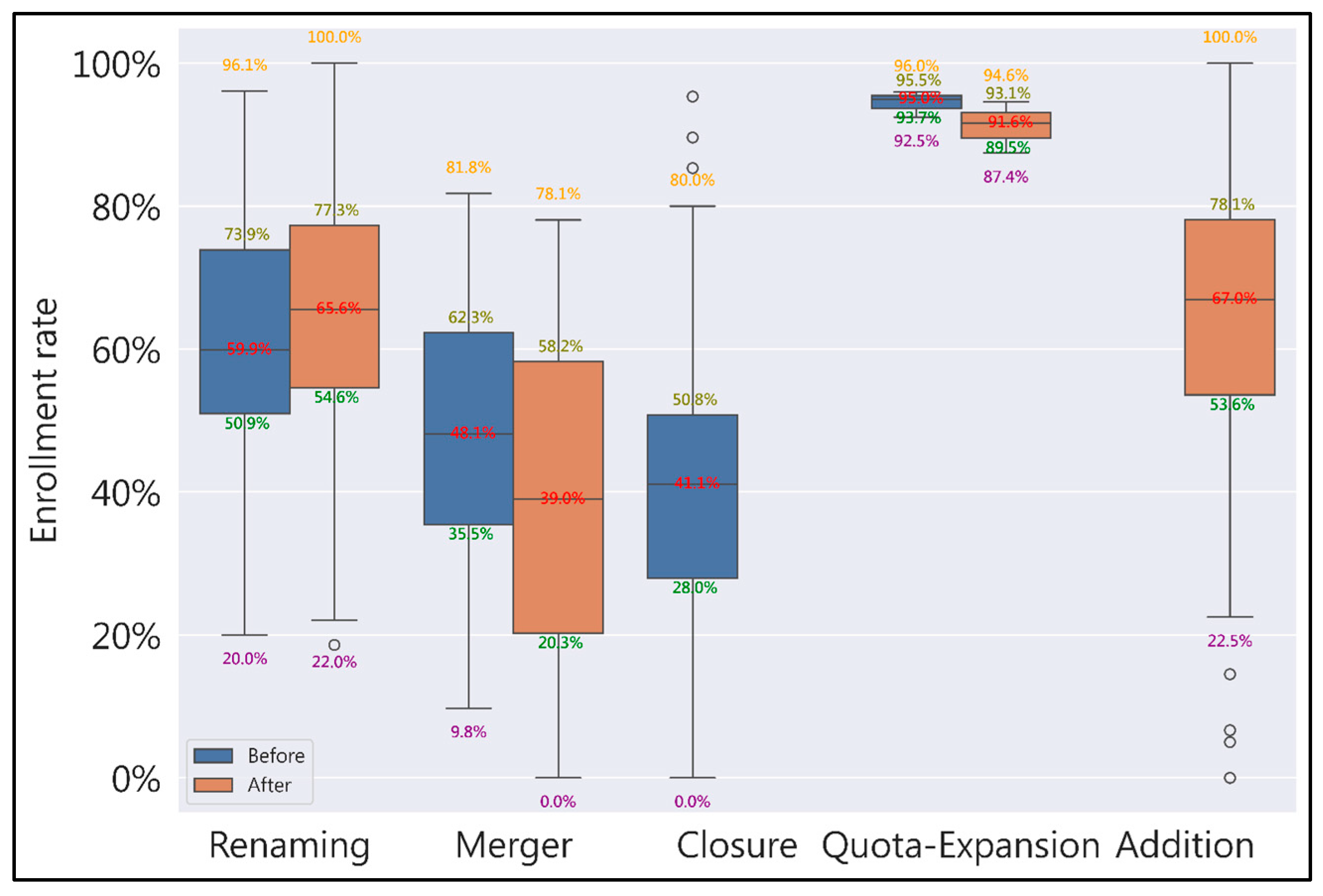
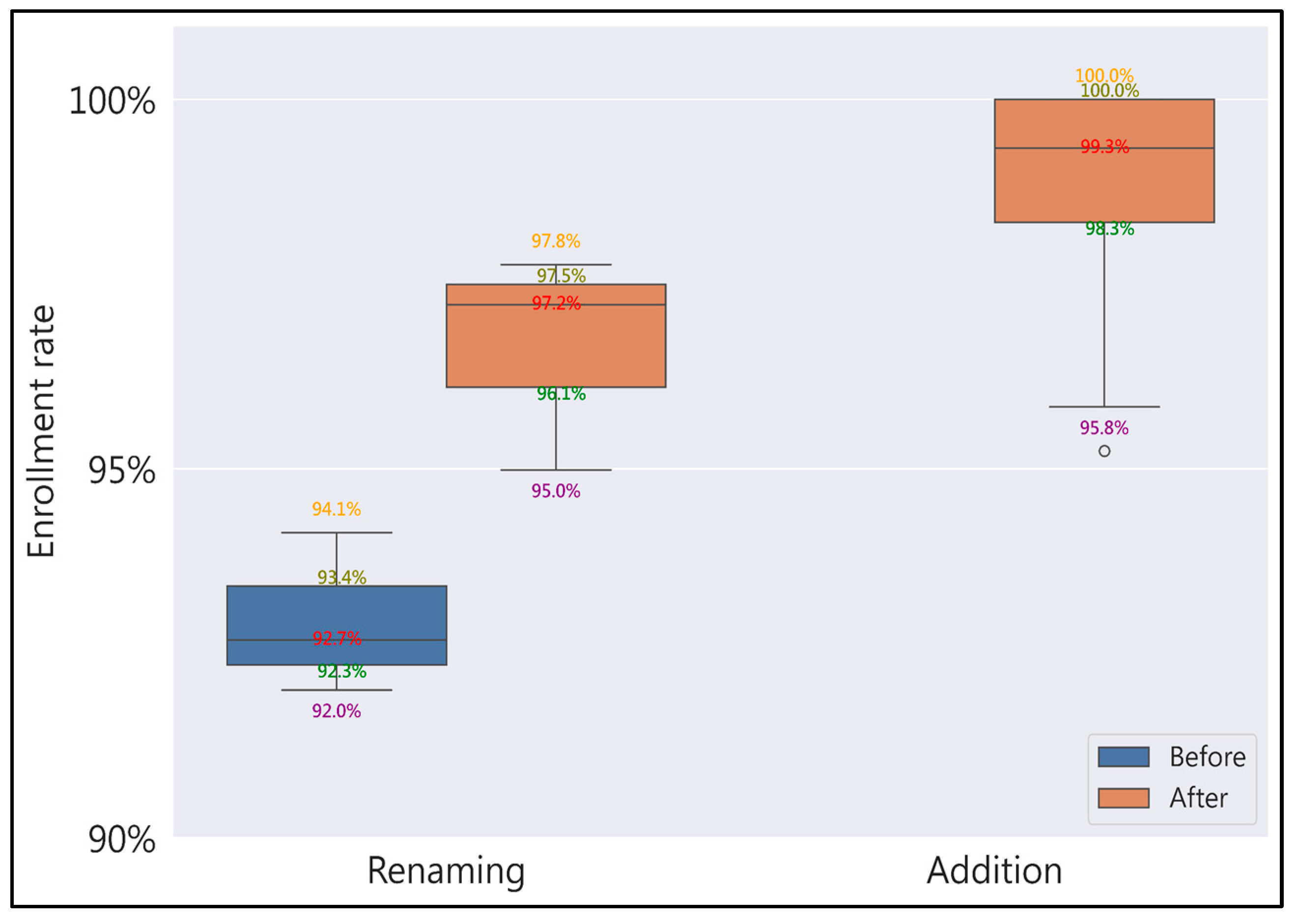
In cases of departmental renaming, median freshman enrollment rates increased in both public and private TVET institutions following the adjustment. Among private institutions, the median enrollment rate rose from 59.9% prior to renaming to 65.6% after renaming. Public institutions exhibited a smaller increase, with median enrollment rates rising from 92.7% to 97.2% over the same period. As illustrated in Figure 2, the distribution of freshman enrollment rates before and after renaming indicates more pronounced changes among private institutions than among public institutions.
Figure 2. Freshman enrollment rates before and after departmental renaming in daytime four-year programs at public TVET institutions (Note: Purple = Minimum; Green = Q1; Red = Q2 (Median); Olive = Q3; Orange = Maximum).
Results from the fixed-effects ordinary least squares regression analysis further show a statistically significant positive association between departmental renaming and freshman enrollment rates in private institutions (p = 0.025), whereas no statistically significant effect was observed for public institutions (Table 4). These findings indicate that the enrollment response to renaming differs systematically between public and private TVET institutions. In the private sector, renaming adjustments were more frequently associated with improvements in enrollment outcomes, whereas enrollment changes in public institutions were more limited.
Table 4. Fixed-Effects Regression Results for the Association between Departmental Restructuring and Freshman Enrollment Rates.
A further examination of departments that did not show improved enrollment outcomes following renaming indicates that these programs generally exhibited low freshman enrollment rates prior to the adjustment. In many cases, enrollment levels remained low both before and after renaming. Among the 58 renaming cases examined, 38 cases (66%) demonstrated increases in freshman enrollment rates after renaming, whereas 20 cases (34%) experienced declines. This variation suggests that the effects of renaming were not uniform across departments.
Table 5 presents departments that recorded increases of 10% or more in freshman enrollment rates following renaming. These cases illustrate that, under certain conditions, departmental renaming was associated with substantial improvements in enrollment performance. At the same time, the presence of departments with declining enrollment following renaming indicates that renaming alone was not sufficient to reverse enrollment challenges in all cases.
Table 5. Departments with a 10% or Greater Increase in Freshman Enrollment Rates Following Renaming (2020–2024).

5.3. Effects of Departmental Mergers on Enrollment Rates

From 2020 to 2024, a total of 23 departmental merger cases were identified, all of which occurred within private TVET institutions and primarily involved daytime four-year programs. Results from the fixed-effects regression analysis indicate that departmental mergers were not associated with statistically significant changes in freshman enrollment rates over time (p = 0.168), as reported in Table 4. This finding suggests that, on average, mergers did not lead to measurable improvements in enrollment outcomes during the study period.
Descriptive results presented in Figure 3 further show that median freshman enrollment rates declined following mergers, decreasing from 48.1% prior to the merger to 39.0% after merger. In many cases, post-merger enrollment rates converged toward the lower end of the historical enrollment levels of the original departments. In some instances, enrollment rates fell below those observed in both pre-merger units, indicating substantial variation in enrollment outcomes following consolidation. Only three merged departments demonstrated higher average freshman enrollment rates after merger compared with their pre-merger levels.
Figure 3. Freshman enrollment rates before and after major types of departmental adjustment in daytime four-year programs at private TVET institutions (Note: Purple = Minimum; Green = Q1; Red = Q2 (Median); Olive = Q3; Orange = Maximum).
Across the observed cases, the results indicate considerable heterogeneity in enrollment outcomes following departmental mergers, with limited evidence of systematic enrollment improvement. These patterns provide an empirical basis for further discussion of the conditions under which mergers may or may not support enrollment performance in private TVET institutions.

5.4. Enrollment Trends Prior to Departmental Closure

This study identified 146 departmental closures in daytime four-year programs, all of which occurred within private TVET institutions. Of these cases, 20 departments were discontinued but replaced in the same year by newly established programs with similar orientations; these transitional cases were therefore excluded from the primary analysis. Among the remaining closure cases, most discontinued departments recorded persistently low freshman enrollment rates over several consecutive years prior to closure, typically ranging from 28.0% to 50.8%. This pattern reflects prolonged underperformance rather than short-term variation in enrollment levels.
A smaller subset of discontinued departments experienced a temporary increase in freshman enrollment in the year immediately preceding closure, with enrollment rates in some instances exceeding 70%. However, these increases were not sustained. In these cases, enrollment levels declined again prior to or at the time of discontinuation, indicating that short-term improvements did not alter longer-term enrollment trajectories.
Across the closure cases examined, departments that were eventually closed tended to exhibit extended periods of low enrollment with little evidence of durable recovery. The observed patterns suggest that enrollment outcomes associated with departmental closure are better understood through multi-year trends rather than isolated annual changes.

5.5. Enrollment Outcomes of Expanded and Newly Established Departments

Between 2020 and 2024, three quota expansion cases were identified, all of which involved medical and healthcare-related programs. As shown in Table 6, freshman enrollment rates in these programs remained high both before and after quota expansion, generally ranging between 88% and 96% during the observation period. This indicates that programs in health-related fields consistently attracted strong enrollment during the study years.
Table 6. Freshman Enrollment Rates Before and After Quota Expansion in Daytime Four-Year Programs (2019–2024).
At the same time, variation was observed in enrollment trajectories following expansion. In certain cases, freshman enrollment declined gradually in the years after expansion. For example, the nursing program at Asia Eastern University of Science and Technology recorded a decline to 85.4% in the second year after expansion, while the nursing program at Hungkuang University declined to 60.6% by the fourth year after expansion. These cases demonstrate that post-expansion enrollment patterns differed across institutions.
Across the observed cases, quota expansion in medical and healthcare programs was associated with generally high enrollment levels, although post-expansion trends were not uniform. The variation observed in enrollment trajectories provides empirical context for examining how quota expansion relates to enrollment performance at the institutional level.
Regression results reported in Table 4 indicate that quota expansion was not associated with statistically significant changes in freshman enrollment rates over time. This finding suggests that, on average, quota expansion did not produce a measurable enrollment effect across the observed cases.
With respect to newly established departments, freshman enrollment rates generally ranged between 54% and 78%, representing the second-highest level of enrollment performance among the different types of departmental adjustments examined. Programs associated with emerging academic and occupational fields, including digital technologies, semiconductors, multimedia design, cross-border commerce, and applied healthcare, were more frequently observed among cases with relatively higher enrollment levels. These results indicate variation in enrollment outcomes across newly established programs and provide descriptive evidence on enrollment performance following program establishment.

6. Discussion

6.1. Governance-Mediated Structural Adjustment in Public and Private TVET Institutions Under Demographic Decline

The findings presented in Table 1 suggest that under sustained demographic decline, structural adjustment in Taiwan’s TVET sector has been mediated by institutional governance contexts, resulting in divergent adjustment patterns between public and private institutions. Between 2021 and 2024, the number of public TVET institutions remained stable while the number of daytime four-year programs increased modestly. In contrast, private TVET institutions experienced declines in both the number of institutions and the number of affiliated academic programs. These contrasting trends indicate that demographic contraction has not produced uniform system-wide responses, but has instead been filtered through different governance arrangements, leading to differentiated organizational adjustment pathways.
From a governance perspective, the expansion of programs within public TVET institutions may reflect relatively greater organizational flexibility supported by public funding mechanisms and policy incentives. Such conditions may enable public institutions to respond to emerging skill demands in a more exploratory manner, even under demographic pressure. By comparison, private TVET institutions rely more heavily on tuition revenue and are therefore more likely to experience enrollment fluctuations as immediate financial stress. This structural dependency may encourage more defensive forms of adjustment, including program suspension, consolidation, or downsizing. Importantly, these observations are not intended to establish a causal relationship between demographic decline and organizational restructuring. Rather, they suggest that similar demographic pressures may be mediated through distinct governance structures, producing different institutional responses across sectors.
These patterns are broadly consistent with international research indicating that higher education institutions adapt to demographic and structural pressures through a combination of program diversification, organizational consolidation, and resource reallocation (Guri-Rosenblit et al., 2007; Jongbloed et al., 2008). The Taiwanese case further highlights the role of institutional attributes—particularly public versus private status—in shaping the range of feasible adjustment strategies available to institutions. Given that the present analysis is based on a relatively short observation period, the results should be interpreted as indicative of early-stage structural adjustment rather than long-term institutional trajectories. Future research employing longer time horizons and mixed methodological approaches would be valuable for deepening the understanding of how governance contexts condition institutional adaptation to demographic decline over time.

6.2. Institutional and Governance Perspectives on Departmental Adjustment Strategies and Enrollment Patterns

From an institutional and governance perspective, the findings reported in Section 5 indicate that both the adoption of departmental adjustment strategies and their associated enrollment patterns vary substantially across public and private TVET institutions in Taiwan. Rather than reflecting a uniform institutional response to demographic decline, the results suggest that relationships between restructuring strategies and enrollment outcomes are shaped by institutional context and governance conditions, leading to differentiated patterns of organizational adaptation.
The overall decline in the number of departmental adjustment cases between 2020 and 2024 corresponds temporally with the continued contraction of birth cohorts. While this alignment does not imply a direct causal relationship, it highlights demographic change as an important contextual factor influencing institutional decision-making. Prior research similarly suggests that demographic pressure may constrain the scope and frequency of structural reorganization, thereby affecting the flexibility of institutional responses.
Clear contrasts also emerge between public and private TVET institutions in the distribution of adjustment strategies. Public institutions most frequently adopted program addition strategies, whereas private institutions relied primarily on program suspension or closure. This divergence is consistent with differences in governance capacity and financial structure. Public institutions, supported by relatively stable funding and policy frameworks, may have greater latitude to pursue exploratory or expansionary adjustments. In contrast, private institutions, which depend more heavily on tuition revenue, are more directly exposed to enrollment volatility and may therefore favor contractionary strategies in response to sustained enrollment risk.
In terms of enrollment outcomes, departmental renaming was the only strategy that showed a relatively consistent association with improved freshman enrollment rates during the study period, particularly among private TVET institutions. However, the substantial variation across renaming cases indicates that symbolic name changes alone are unlikely to resolve enrollment challenges. Their effectiveness appears to depend on pre-existing enrollment conditions, the extent of substantive program modification, and alignment with emerging academic fields or labor market trends. By contrast, departmental mergers did not exhibit a systematic association with improved enrollment performance. The wide dispersion of post-merger enrollment trajectories underscores the complexity of merger processes and suggests that potential enrollment effects may unfold over longer time horizons rather than in the short term.
Finally, analysis of program suspension, quota expansion, and new program establishment highlights the importance of long-term enrollment trends and underlying demand conditions. Departments that were ultimately closed typically exhibited persistently low enrollment over multiple years prior to discontinuation, reinforcing the need to interpret closure decisions through multi-year perspectives. While programs in healthcare and certain emerging technology fields generally maintained higher enrollment levels, quota expansion alone did not guarantee stable enrollment growth, indicating that institutional capacity and program quality remain critical moderating factors.

6.3. Methodological and Contextual Constraints on Causal Interpretation

The empirical analyses in this study reveal meaningful associations between departmental adjustment strategies and enrollment patterns; however, several methodological and contextual limitations must be acknowledged when interpreting these findings. These considerations are essential for clarifying the scope and implications of the results.
First, although fixed-effects models are employed to control for time-invariant heterogeneity across departments, this approach has inherent limitations. Fixed-effects estimation effectively accounts for persistent differences in baseline enrollment levels, but it does not address differences in enrollment trends that may have existed prior to the implementation of adjustment strategies. In some cases, departments may have already been experiencing upward or downward enrollment trajectories before any restructuring decisions were made. Under such conditions, the choice of adjustment strategy may reflect existing trends or expectations about future enrollment, rather than being solely a response to past performance.
Second, the relatively short observation period of four to five years constrains the ability to identify dynamic selection processes or to distinguish strategy-related effects from underlying enrollment trends. As a result, the findings should be interpreted as indicating associations between adjustment strategies and enrollment patterns within a specific time frame, rather than as estimates of causal effects. This limitation is particularly relevant for enrollment outcomes, as departmental decisions are often forward-looking and shaped by anticipated demographic developments.
Third, several adjustment strategies examined in this study are characterized by delayed effects. Departmental mergers and the establishment of new programs, in particular, may require extended periods before their potential impacts on enrollment become observable. Employment outcomes of graduates from newly merged or newly established programs typically emerge only after several years, and prospective students may lack sufficient information to evaluate such programs in the short term. Consequently, the absence of immediate enrollment changes during the observation period should not be interpreted as evidence of limited effectiveness, but rather as reflecting the temporal dynamics of organizational change.
Finally, the study period coincides with the post–COVID-19 context, which represents an atypical historical environment for higher education systems. Variation in the pace of enrollment recovery across institutions and programs may further complicate the interpretation of observed adjustment patterns. In this context, institutional decision makers may have adopted restructuring strategies based on short- to medium-term expectations about post-pandemic enrollment recovery, rather than on long-term demographic considerations alone. When enrollment declines were perceived as temporary or externally driven, institutions may have favored symbolic or lower-cost adjustments, such as departmental renaming, over more extensive forms of organizational restructuring.
Overall, the results presented in this study document patterns of association between departmental adjustment strategies and enrollment outcomes within a specific demographic, institutional, and historical setting. They should not be interpreted as evidence of causal effects. Future research that draws on longer longitudinal data and incorporates mixed-method approaches would be well-suited to further examine the medium- and long-term consequences of departmental adjustment strategies within TVET systems.

7. Conclusions and Recommendations

7.1. Conclusions

Under conditions of sustained demographic decline, technological and vocational education and training (TVET) institutions in Taiwan face shrinking student cohorts, intensified competition, and increasing pressure to adjust their academic structures. The findings of this study suggest that departmental adjustments have become a prominent element of institutional governance in contexts characterized by demographic pressure and enrollment challenges. Among the 1087 departmental adjustment cases identified between 2020 and 2024, daytime four-year programs were most frequently affected, reflecting their central role in enrollment management and institutional resource allocation. Private TVET institutions relied heavily on program closures and additions, indicating concurrent pressures to contract and realign program offerings, whereas public institutions more often expanded programs in emerging or socially demanded fields.
Analysis of adjustment outcomes revealed distinct patterns across the five types of restructuring examined. Departmental renaming was the only strategy consistently associated with improved enrollment performance, suggesting that program identity and academic positioning may play a role in competitive enrollment environments. In contrast, departmental mergers rarely coincided with enrollment gains and often produced outcomes that remained comparable to, or lower than, those of the original departments. Program closures were concentrated among departments with persistently low enrollment over multiple years, underscoring the importance of evaluating program viability using longitudinal indicators rather than single-year fluctuations. Additions and quota expansions exhibited relatively strong enrollment performance in healthcare and other high-demand fields, indicating that alignment with labor market demand remains an important contextual factor shaping enrollment patterns.
These observations are broadly consistent with international research suggesting that demographic change encourages higher education systems to adjust program portfolios and strengthen institutional responsiveness to external conditions (Ayalon & Yogev, 2005). Evidence from Taiwan’s TVET sector further indicates that enrollment outcomes are systematically associated with patterns of departmental adjustment decisions rather than attributable to any single strategy in isolation. Institutional capacity to navigate demographic change therefore depends on proactive planning, data-informed decision making, and continuous alignment between academic offerings and evolving societal and labor market demands—key considerations for higher education governance in an era of population decline.
The findings presented in this study should be interpreted as descriptive and associative rather than causal. They reflect observed patterns of departmental adjustment and enrollment outcomes within a specific demographic, institutional, and historical context, and do not constitute evidence of direct causal effects between adjustment strategies and enrollment performance.

7.2. Policy Recommendations

At the system level, coherent policy frameworks are important for supporting informed adjustment decisions among TVET institutions facing demographic contraction. First, departmental adjustment decisions could be informed by multi-year enrollment trend analyses rather than single-year indicators alone. The Ministry of Education may collaborate with higher education institutions to develop evaluation mechanisms that integrate demographic data, regional labor market demand, and program-level enrollment trajectories. Such longitudinal monitoring approaches provide a more comprehensive informational basis for institutional planning and are consistent with international practices that emphasize evidence-based governance and system-level coordination (Teichler, 2017).
Second, policy guidelines governing departmental renaming, mergers, program addition, and quota expansion could be further clarified. Approval processes may incorporate criteria that assess the consistency between program titles and curricular content, as well as their alignment with labor market demand in areas such as digital innovation and healthcare. This orientation aligns with research in strategic enrollment management, which highlights the importance of academic branding and program relevance when institutions seek to respond to enrollment challenges (Hossler & Bontrager, 2015).
Third, transitional support mechanisms may be strengthened for institutions undertaking substantial restructuring. Such mechanisms could include targeted resources for curriculum redesign, faculty development, and student recruitment during periods of organizational change. In addition, the development of a national database that documents departmental adjustments and related enrollment outcomes could support cross-institutional learning and provide a reference point for policy reflection. Comparable initiatives have been discussed in international research as components of transparent and adaptive higher education governance under demographic pressure (Guri-Rosenblit et al., 2007).

7.3. Institutional Recommendations

At the institutional level, TVET institutions may strengthen governance practices to ensure that departmental adjustments are aligned with enrollment management objectives and program development goals. In the case of departmental renaming, institutions could emphasize clarity, recognizability, and consistency between program titles, curricular content, and industry expectations. Programs incorporating terminology related to emerging fields—such as semiconductors, smart technologies, digital media, and healthcare—have shown relatively stronger enrollment performance and closer alignment with students’ perceptions of labor market relevance.
With respect to departmental mergers, institutions may benefit from moving beyond administrative consolidation to focus on academic integration, faculty coordination, and clear communication of the merged program’s identity and academic objectives. Without strategic repositioning and coherent messaging, merged departments may experience reduced visibility and persistent uncertainty among prospective students. Similarly, institutions considering program additions or quota expansion could conduct feasibility assessments grounded in demographic projections, regional labor market demand, and internal capacity. Prior research highlights that program relevance, community engagement, and alignment with institutional mission are important factors influencing institutional performance in higher education systems (Jongbloed et al., 2008; Altbach, 1991).
Departments exhibiting sustained enrollment decline may be identified at an early stage through institutional monitoring and risk assessment mechanisms. Timely responses, including program redesign, collaboration with industry partners, or phased consolidation, may help mitigate abrupt closures and reduce inefficiencies in resource allocation. By strengthening data-informed decision-making and aligning program portfolios with societal and regional needs, TVET institutions may enhance their capacity to adapt to demographic change and manage enrollment challenges within an increasingly constrained higher education environment.

7.4. Directions for Future Research

Future research may benefit from adopting multivariable longitudinal designs that incorporate a broader range of institutional- and student-level factors, such as academic preparation, financial conditions, employment outcomes, and faculty characteristics. In addition, mixed-method approaches that combine quantitative analysis with qualitative interviews from departments that have undergone multiple rounds of restructuring could provide deeper insight into how internal governance arrangements, leadership practices, and organizational culture influence the effectiveness of departmental adjustments. Comparative studies across regions experiencing demographic decline, including Japan, South Korea, and selected European countries, would further help situate Taiwan’s experience within broader international patterns of higher education adaptation.
Further research could also focus on the development of analytical frameworks for evaluating program-level outcomes in higher education, including indicators related to enrollment stability, stakeholder engagement, and regional relevance. As demographic change increasingly shapes higher education systems worldwide, greater attention to program-level decision-making and institutional adaptation processes will be essential for advancing research on higher education governance. Enhancing data availability, refining evaluation indicators, and incorporating system-level perspectives may enable future studies to generate more nuanced insights into how higher education institutions respond to long-term population change.

Author Contributions

Conceptualization, W.-B.L. and C.-M.Y.; Methodology, W.-B.L. and C.-M.Y.; Software, W.-B.L.; Validation, W.-B.L. and C.-M.Y.; Formal analysis, W.-B.L.; Investigation, W.-B.L.; Resources, C.-M.Y.; Data curation, W.-B.L.; Writing—original draft preparation, W.-B.L.; Writing—review and editing, W.-B.L. and C.-M.Y.; Visualization, W.-B.L.; Supervision, C.-M.Y.; Project administration, C.-M.Y.; Funding acquisition, C.-M.Y. All authors have read and agreed to the published version of the manuscript.

Funding

This research was supported by the personal research fund of Professor Chao-Ming Yang at Ming Chi University of Technology.

Institutional Review Board Statement

This study did not involve human participants or identifiable personal data. The research was based solely on publicly available secondary administrative data; therefore, ethical review and approval were not required.

Data Availability Statement

The data analyzed in this study are publicly available from official government sources in Taiwan, including the Ministry of the Interior and the Ministry of Education open data platforms.

Conflicts of Interest

The authors declare no conflicts of interest.

References

  1. Altbach, P. G. (1991). Patterns in higher education development: Towards the year 2000. Review of Higher Education, 14(3), 293–315. [Google Scholar] [CrossRef]
  2. Antecol, H., & Smith, J. K. (2012). The early decision option in college admission and its impact on student diversity. Journal of Law and Economics, 55, 217–249. [Google Scholar] [CrossRef]
  3. Asia University. (2022, October 20). Inviting former Deputy Minister Chen Der-Hwa to discuss “challenges and opportunities for the development of private universities”. Available online: https://orbitadm.asia.edu.tw/zh_tw/more_announcement/-96836351 (accessed on 12 December 2025).
  4. Ayalon, H., & Yogev, A. (2005). Field of study and students’ stratification in an expanded system of higher education. European Sociological Review, 21(3), 227–241. [Google Scholar] [CrossRef]
  5. Azziz, R., Hentschke, G. C., Jacobs, B. C., & Jacobs, L. A. (2019). Strategic mergers in higher education. Johns Hopkins University Press. [Google Scholar]
  6. Chan, M.-J. (2019). Development and enrollment strategies for international students in Taiwan’s higher education export. Evaluation Bimonthly, 80, 49–52. [Google Scholar]
  7. Chan, S.-J. (2004). Mergers in British higher education institutions. Comparative Education, 57, 31–61. [Google Scholar]
  8. Chan, S.-J., & Yang, C.-Y. (2014). Facing the challenges of declining birth rates and globalization: Development strategies for higher education organizations. Evaluation Bimonthly, 52, 19–22. [Google Scholar]
  9. Chen, M.-J., & Wu, C.-Z. (2009). Quality school culture: Observations from an exemplary principal. Journal of Education Research, 202, 36–52. [Google Scholar]
  10. Chen, Y.-T. (2024). Challenges and transformations: Diverse strategies to address the enrollment dilemma in Taiwan’s higher education. Taiwan Education Review Monthly, 13(1), 104–119. [Google Scholar]
  11. Chin, M.-C. (1997). Educational administration: Theoretical aspects. Wu-Nan. [Google Scholar]
  12. Drewes, T., & Michael, C. (2006). How do students choose a university? An analysis of applications to universities in Ontario, Canada. Research in Higher Education, 47(7), 781–800. [Google Scholar] [CrossRef]
  13. Eckel, P. D. (2002). Decision rules used in academic program closure: Where the rubber meets the road. The Journal of Higher Education, 73, 237–262. [Google Scholar] [CrossRef]
  14. Guido, G., Peluso, A. M., & Greco, V. (2009). Effects of university naming on preferences, credibility, image and enrolment intention of Italian students. International Journal of Management Cases, 11(2). Available online: https://iris.unisalento.it/handle/11587/337757 (accessed on 12 December 2025). [CrossRef]
  15. Guri-Rosenblit, S., Šebková, H., & Teichler, U. (2007). Massification and diversity of higher education systems: Interplay of complex dimensions. Higher Education Policy, 20(4), 373–389. [Google Scholar] [CrossRef]
  16. Hanson, E. M. (1991). Educational administration and organizational behavior (3rd ed.). Allyn & Bacon. [Google Scholar]
  17. Harman, G., & Harman, K. (2003). Institutional mergers in higher education: Lessons from international experience. Tertiary Education and Management, 9, 29–44. [Google Scholar] [CrossRef]
  18. Ho, J.-F. (2024). Precision enrollment strategies in higher education in Taiwan amid the impact of declining birth rates. Taiwan Educational Review Monthly, 13, 18–30. [Google Scholar]
  19. Hong, S.-J. (2020). A study on recruitment strategies of Tajen University under declining birth rates: From the perspective of institutional research. Tajen Journal, 54, 19–22. [Google Scholar]
  20. Hossler, D., & Bontrager, B. (Eds.). (2015). Handbook of strategic enrollment management. Jossey-Bass. [Google Scholar]
  21. Hossler, D., & Gallagher, K. S. (1987). Studying student college choice: A three-phase model and the implications for policymakers. College and University, 62, 207–221. [Google Scholar]
  22. Huisman, J., Meek, L., & Wood, F. (2007). Institutional diversity in higher education: A cross-national and longitudinal analysis. Higher Education Quarterly, 61(4), 563–577. [Google Scholar] [CrossRef]
  23. Inaba, Y. (2020). Higher education in a depopulating society: Survival strategies of Japanese universities. Research in Comparative and International Education, 15(2), 136–157. [Google Scholar] [CrossRef]
  24. Jongbloed, B., Enders, J., & Salerno, C. (2008). Higher education and its communities: Interconnections, interdependencies and a research agenda. Higher Education, 56(3), 303–324. [Google Scholar] [CrossRef]
  25. Kezar, A. J. (2001). Understanding and facilitating organizational change in the 21st century. In ASHE-ERIC higher education report (Vol. 28, No. 4). Jossey-Bass. [Google Scholar]
  26. Kotter, J. P. (1995). Leading change: Why transformation efforts fail. Harvard Business Review, 73(2), 59–67. [Google Scholar]
  27. Kuo, Y.-Y. (2016). Taiwan universities: Where to go? Humanities, 5(1), 12. [Google Scholar] [CrossRef]
  28. Li, H.-C. (2006). The analyses of manpower planning policies and adjustments of departments of universities in the post-WTO era: Three case studies [Master’s thesis, National University of Tainan]. [Google Scholar]
  29. Lin, A., & Ho, J.-F. (2021). Radical organizational change in a tranquil and harmonious environment: The experience of department consolidation at Fo Guang University. Taiwan Education Review Monthly, 10(5), 153–166. [Google Scholar]
  30. Lin, W.-B., & Yang, C.-M. (2025). Sustainable recruitment strategies in technological and vocational education: Admission scores and enrollment challenges under Taiwan’s joint registration and distribution system. Journal of Posthumanism, 5(1), 1128–1148. [Google Scholar] [CrossRef]
  31. Lin, Y.-Y. (2010). Some influential factors and its causal relationships regarding undergraduates’ college choices and major selections. Journal of Educational Research and Development, 6(3), 223–256. [Google Scholar]
  32. Liu, H.-Y. (2005). Resource distribution of higher education in the age of globalization. Journal of Curriculum Studies, 1(1), 85–101. [Google Scholar]
  33. Liu, M.-C. (2020). An application of data analysis on admission strategy for a university of technology in central Taiwan [Master’s thesis, National Taichung University of Science and Technology]. [Google Scholar]
  34. Lo, Y.-L. (2006). A study of organizational reforms of Taipei [Master’s thesis, National Taiwan Normal University]. [Google Scholar]
  35. Lu, C.-W. (2016). The challenges and response strategies for higher education enrollment in Taiwan. Taiwan Education Review, 691, 27–30. [Google Scholar]
  36. Lu, Y.-G. (2022). Analysis of the declining birthrate issue and response strategies in our country (Topic analysis). Legislative Research Bureau, Legislative Yuan (R01617). Available online: https://www.ly.gov.tw/Pages/Detail.aspx?nodeid=6590&pid=217372 (accessed on 29 April 2025).
  37. Luo, W.-C. (2007). A study of factors about undergraduate’s college choice and major choice in Taiwan [Master’s thesis, National Chi Nan University]. [Google Scholar]
  38. Ma, H.-P., & Tseng, S.-Y. (2012). Developments in the promotion of university mergers in the United Kingdom and France (Overseas study report). Available online: https://report.ndc.gov.tw/ReportFront/ReportDetail/detail?sysId=C10103559 (accessed on 29 April 2025).
  39. Ministry of Education, R.O.C. (Taiwan). (2024). Higher education sprout project: Sustained progress and rise of universities in Taiwan. Available online: https://sprout.moe.edu.tw/en-us/main.aspx?rn=-10728 (accessed on 20 January 2026).
  40. Ministry of Education, R.O.C. (Taiwan). (2025). Adjustment and allocation system for departments and programs in technical and vocational colleges (Administrative database). Available online: https://www.tlc.ntut.edu.tw (accessed on 29 April 2025).
  41. Research, Development and Evaluation Commission, Executive Yuan. (2012). A study on the mechanisms of merger, transformation, and closure of higher education institutions in response to declining birthrates in Taiwan. National Development Council. (In Chinese)
  42. Skodvin, O. J. (1999). Mergers in higher education: Success or failure? Tertiary Education and Management, 5(1), 65–80. [Google Scholar] [CrossRef]
  43. Smørvik, K.-K., & Vespestad, M.-K. (2020). Bridging marketing and higher education: Resource integration, co-creation and student learning. Journal of Marketing for Higher Education, 30(2), 256–270. [Google Scholar] [CrossRef]
  44. Stuart, H., & Muzellec, L. (2004). Corporate makeovers: Can a hyena be rebranded? Journal of Brand Management, 11, 472–482. [Google Scholar] [CrossRef]
  45. Teichler, U. (2017). Internationalisation trends in higher education and the changing role of international student mobility. Journal of International Mobility, 5(1), 177–216. [Google Scholar] [CrossRef]
  46. Tsai, H.-P., & Tang, Y. (2023). The crossroads of Taiwan’s higher education enrollment strategies. Taiwan Education Review Monthly, 12(3), 106–114. [Google Scholar]
  47. Tsai, M.-J. (2008). The impact and response of the education industry to the trend of declining birth rates. Inservice Education Bulletin, 25(5), 101–108. [Google Scholar]
  48. Wu, B.-E. (1991). Organizational behavior. Hwa-Tai. [Google Scholar]
  49. Wu, C.-H. (2014). A study on university recruiting strategies: A case study of S University. Mingdao Journal, 9(1), 3–18. [Google Scholar]
  50. Wu, Z.-Y., & Chen, Y.-C. (2021). Has university consolidation been “successful”? A student-centered perspective. Taiwan Education Review Monthly, 10(1), 96–105. [Google Scholar]
  51. Yang, C.-S. (2015). Research on educational organizational change and school development. Wu-Nan. [Google Scholar]
  52. Yen, K.-L., & Yang, H.-C. (2022). A study on the strategies and dilemmas of the successful merger of National Tsing Hua University and Hsinchu University of Education. Educational Policy Forum, 25(3), 35–72. [Google Scholar] [CrossRef]
  53. Yonezawa, A. (2020). Challenges of the Japanese higher education amidst population decline and globalization. Globalisation, Societies and Education, 18(1), 43–52. [Google Scholar] [CrossRef]
Disclaimer/Publisher’s Note: The statements, opinions and data contained in all publications are solely those of the individual author(s) and contributor(s) and not of MDPI and/or the editor(s). MDPI and/or the editor(s) disclaim responsibility for any injury to people or property resulting from any ideas, methods, instructions or products referred to in the content.

Article Metrics

Citations

Article Access Statistics

Multiple requests from the same IP address are counted as one view.