Improving Mental Health and Well-Being in Schools: Exploring School Leaders’ Roles and Influence

Abstract
1. Introduction
2. Conceptual Framework
2.1. Student and Teacher Well-Being at School
2.2. The Role of School Leadership in Fostering Well-Being in Schools
2.3. School Leadership in Enacting School Changes and Reforms
3. Context
3.1. Well-Being in Hong Kong Schools
3.2. One-Off Grant for Mental Health at School
4. Methodology
4.1. Document Analysis
4.1.1. Selection of Documents
4.1.2. Data Analysis
4.2. Interviews with School Leaders
4.2.1. Sampling and Data Collection
4.2.2. Data Analysis
5. Findings
5.1. Findings from Document Analysis
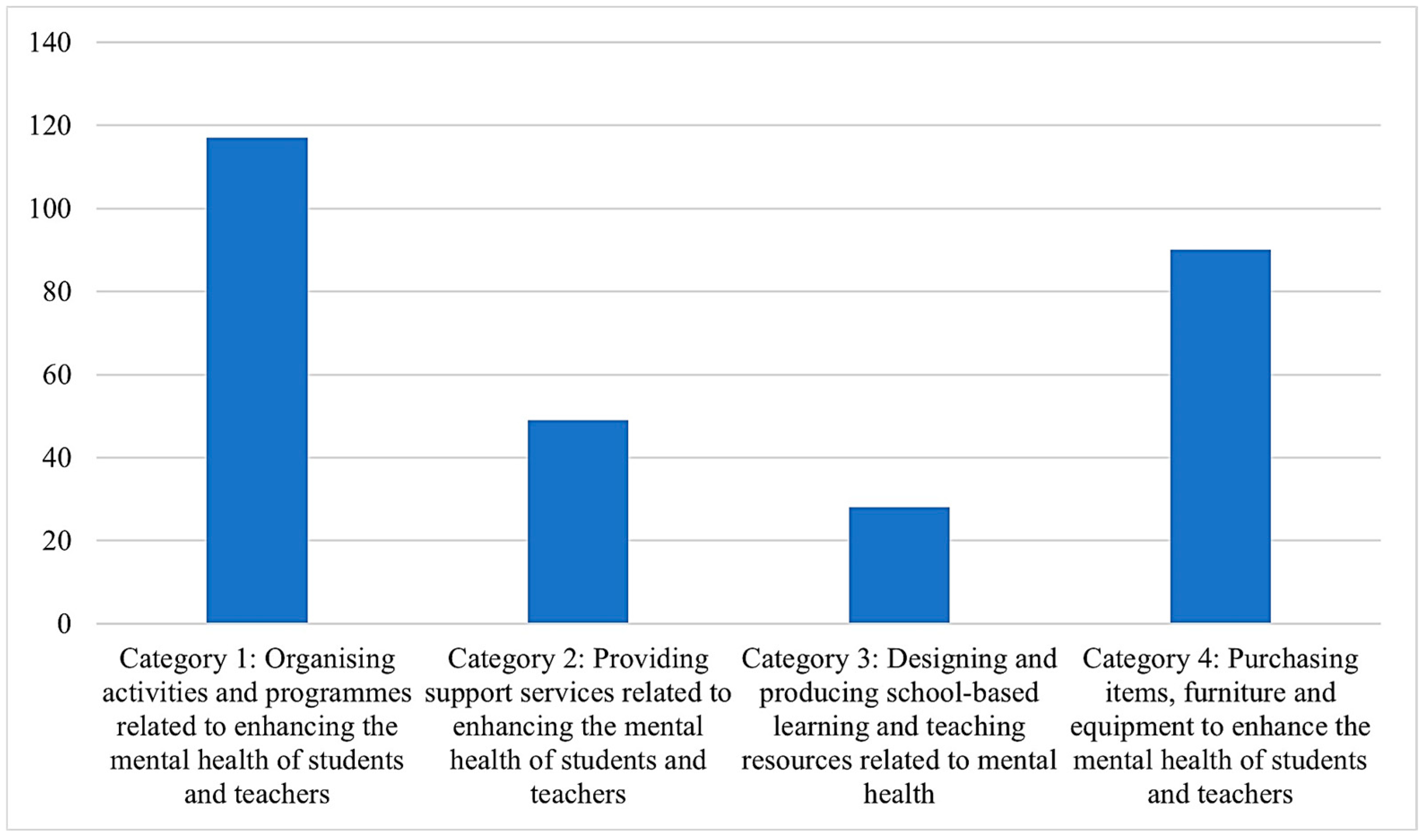
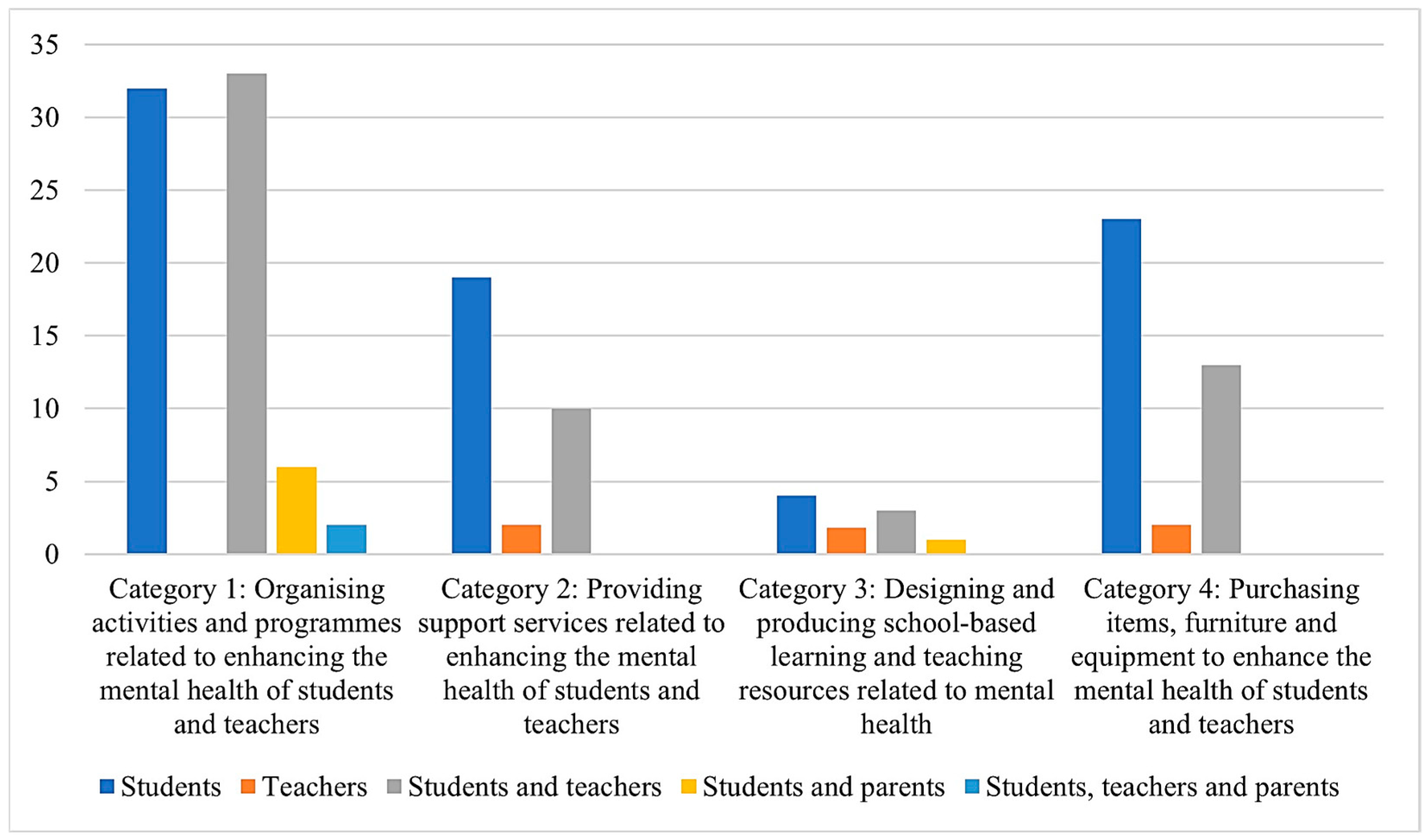
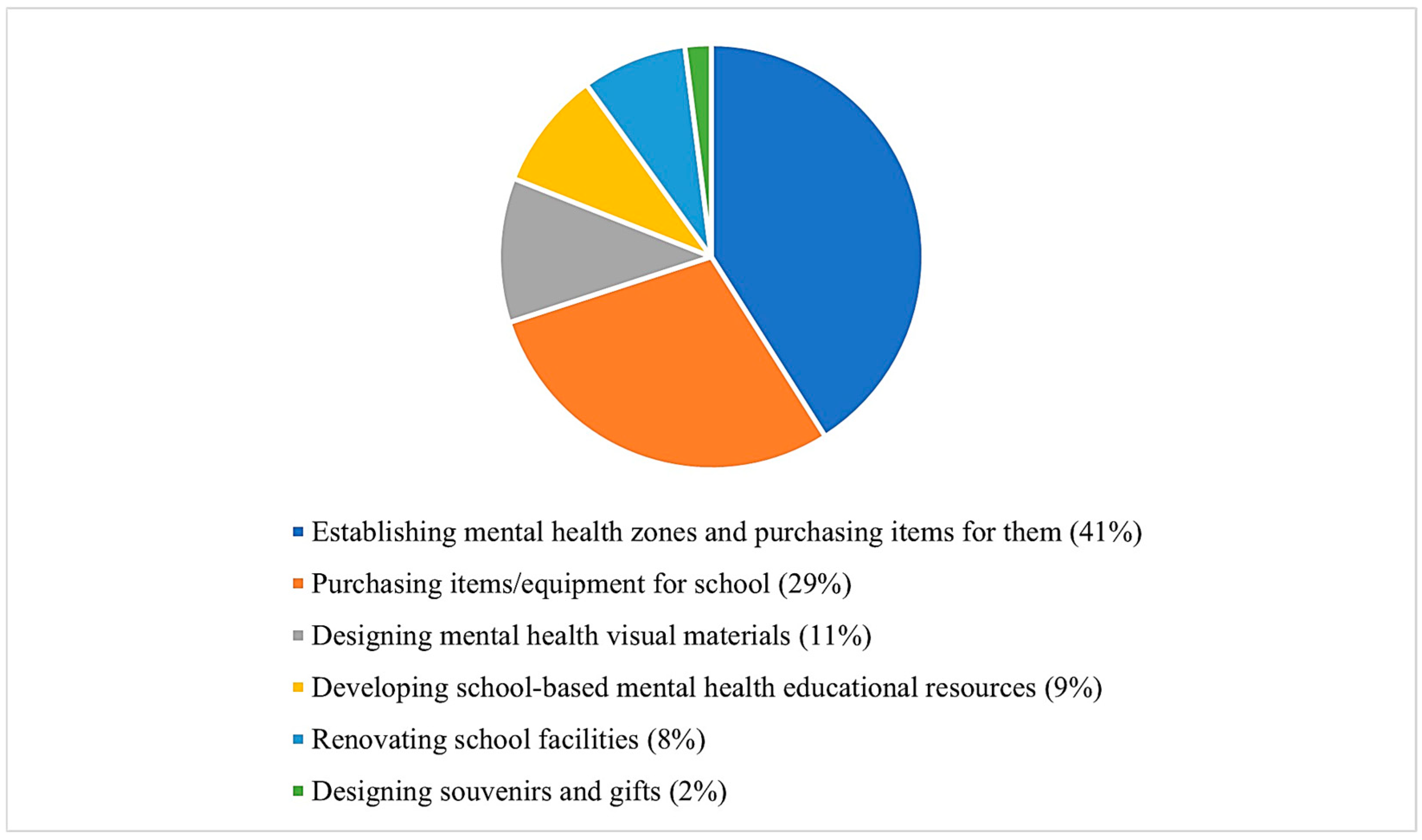
5.1.1. Use of the Grant
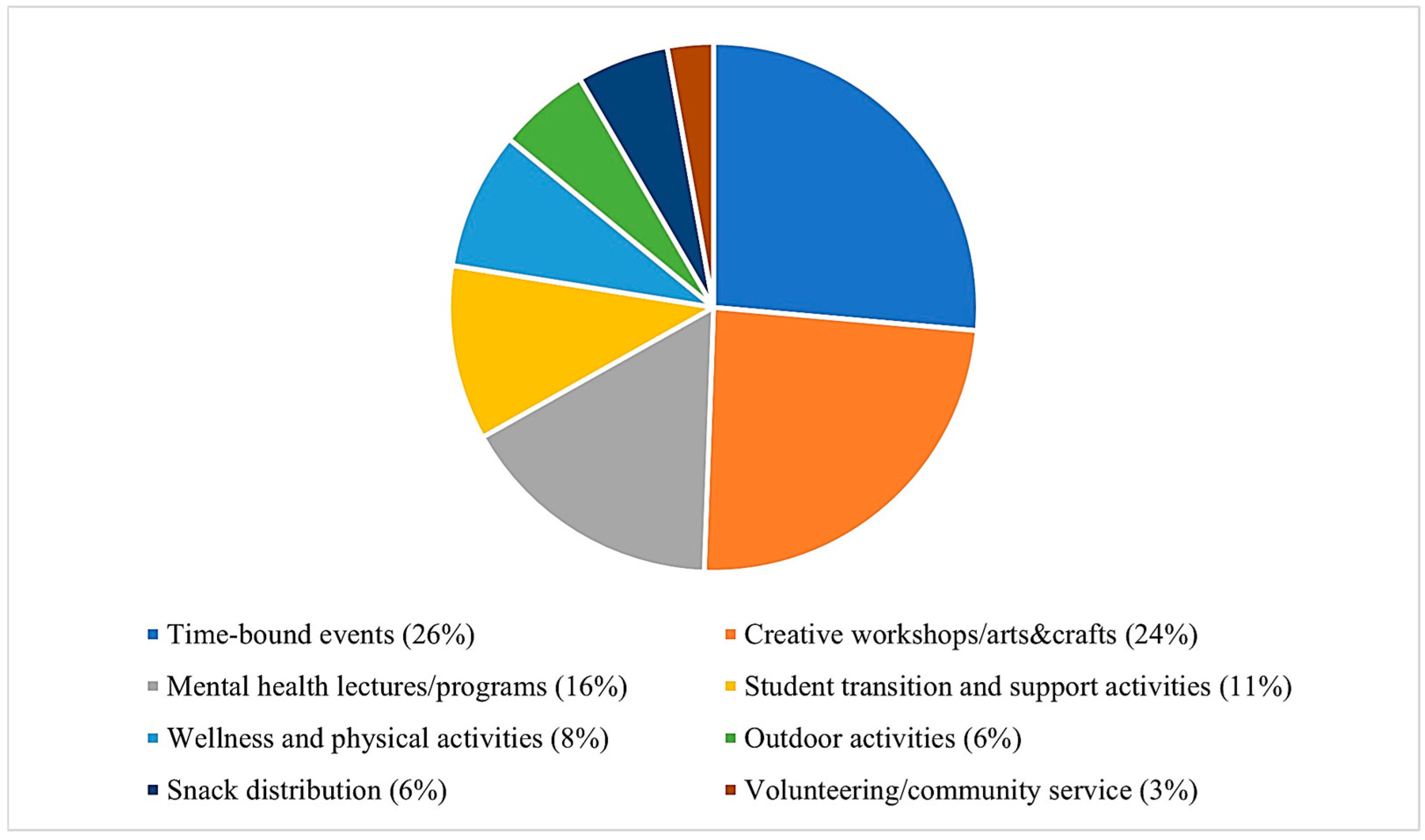
5.1.2. Types of Activities
5.1.3. Purchasing/Designing Items and Resources
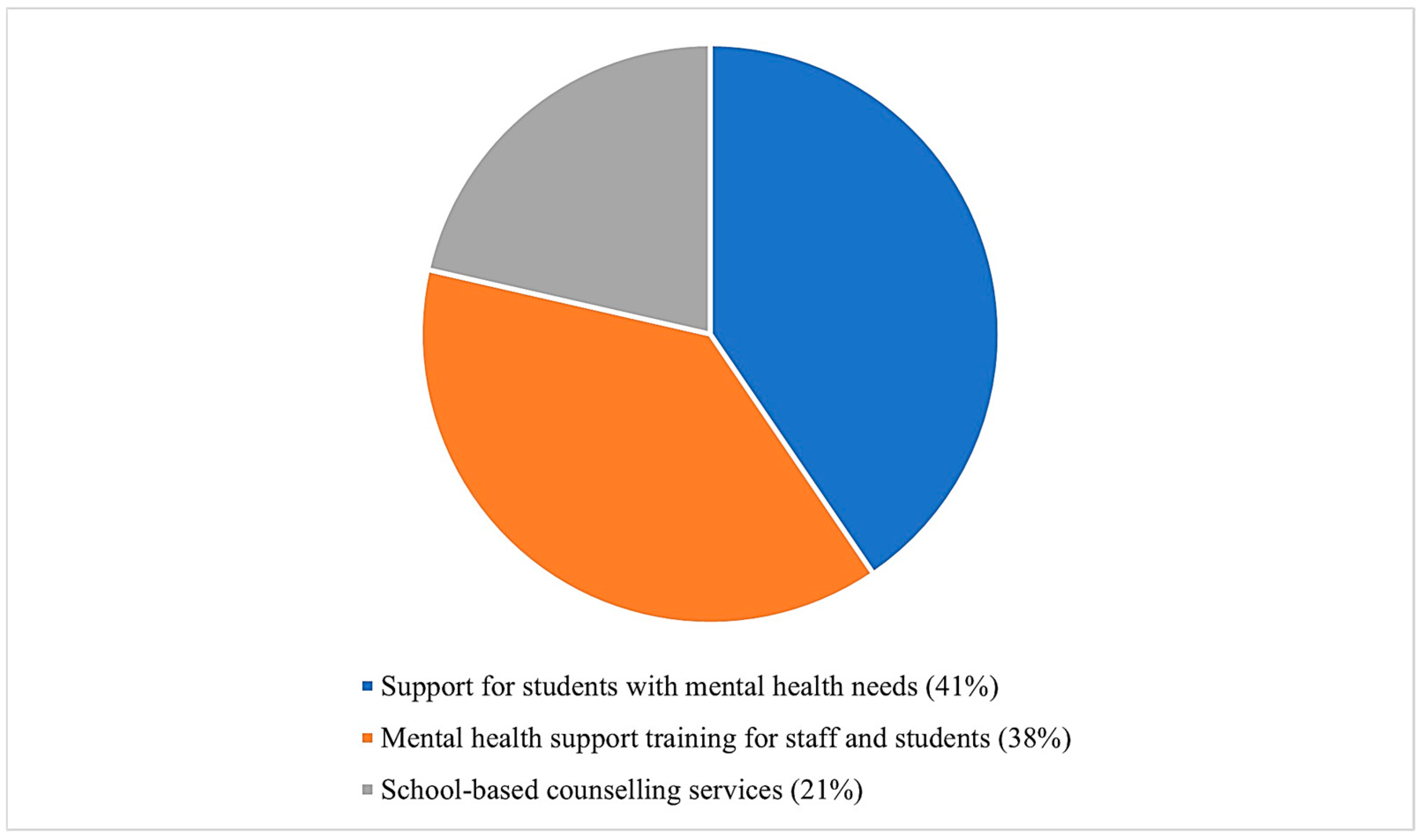
5.1.4. School-Based Support Services
5.2. Themes Emerged from the Interview Data
5.2.1. Upscaling Schools’ Well-Being Support Systems
After COVID, we do observe many students’ mental symptoms after they go back to school. Their socialization, their way of sharing, and also their emotional health are quite alarming. So, I’m grateful that during this period of time, the government is willing to offer some additional financial support.(School 3 Principal)
Schools have many similar ways to cheer people up, but because there are so many [people] involved, it’s difficult to implement these activities without a flexible budget. There’s a problem with the fund [general school fund]: it can’t be used to buy food or gifts. So this is also its [one-off grant’s] most flexible aspect. What’s so good about this fund? Why would I use it? It’s more flexible. I can buy some things, like food, because it’s for encouragement, as long as I use it for students or teachers.(School 4 Principal)
The change may not be long-term, but at least for the short term, we find that they’re very happy for those few days, and they will talk about the event quite often, and they may upload their photo to their social media.(School 2 Principal)
5.2.2. The Role of School Leaders: Policy-Setting, Bridging, and Decision-Making
My role is to collect opinions from the students and also my colleagues. For example, when you talk to the students, they will express what concerns they are having now and then. Then we will find suitable resources or activities to support those criteria. And also, like my principal and vice principal mentioned, we work closely with the social workers. Sometimes we also seek their opinion, see what kind of activities are the best for them. This is my role to gather information, to listen to the students, get their opinion, also to report to the school.(School 1 Teacher Leader)
Before I had to implement, to run all these policies or strategies, I had to get information from different parties. So then we discuss together. In order to let this program successfully implement, after all these opinion gathering, or all these suggestions, I make a draft and then go through all these meetings. And then we come to implement, to run the program.(School 2 Principal)
6. Discussion and Implications
7. Conclusions
Author Contributions
Funding
Institutional Review Board Statement
Informed Consent Statement
Data Availability Statement
Acknowledgments
Conflicts of Interest
Abbreviations
| EdB | Education Bureau |
| NGO | Non-governmental Organization |
Appendix A

| Participant’s Response | Code | Category | Theme |
|---|---|---|---|
| “Actually, I should have the leading role for the whole scheme. For me, mainly, I will try to set up the mechanism how to tackle with the problem for the student mental health, and also any of the preventive measures to prepare all the staff or student to have a well-being development. So that’s my role.” (School 1 Principal) | Developing policies | Leaders’ individual role | The role of school leaders: Policy-setting, bridging and decision-making |
| “My role is to collect opinions from the students and also my colleagues. For example, when you talk to the students, they will express what concerns they are having now and then. Then we will find suitable resources or activities to support those criteria. And also, like my principal and vice principal mentioned, we work closely with the social workers. Sometimes we also seek their opinion, see what kind of activities are the best for them. This is my role to gather information, to listen to the students, get their opinion, also to report to the school.” (School 1 Teacher Leader) | Bridging | ||
| “I think that the decision of holding these large scale activities is from our principal, vice-principal, or from the Administrative Council. But for those details, how many activities, or how many games, we have to rely on our teachers from Student Affairs.” (School 2 Principal) | Collaborative decision-making | Leaders’ collaborative practices | |
| “So, PCW [Pastoral Care and Well-being] team have a team head and he is also the head of counseling and discipline. But in this school, because we promote well-being, we stress on strength-based support. We focus more on preventive and developmental arena of the work. And SST team, student support team, the head is the SEN coordinator. And then both of them actually working very close together. And then these two teams are part of our system in strengthening or leading and even developing the whole well-being school.” (School 3 Principal) | Support of school-based committees |
References
- Arar, K., Kondakci, Y., & Taysum, A. (2019). The imposition of government education policy initiatives and school enactment: Uncovering the responses of school principals. Journal of Educational Administration and History, 51(4), 295–300. [Google Scholar] [CrossRef]
- Au, W. C. C., & Kennedy, K. J. (2018). A positive education program to promote wellbeing in schools: A case study from a Hong Kong school. Higher Education Studies, 8(4), 9–22. [Google Scholar] [CrossRef]
- Beatty, L., & Campbell-Evans, G. (2020). School leaders and a culture of support: Fostering student social emotional development. Issues in Educational Research, 30(2), 435–451. [Google Scholar]
- Bellibaş, M. Ş., Gümüş, S., & Chen, J. (2024). The impact of distributed leadership on teacher commitment: The mediation role o teacher workload stress and teacher well-being. British Educational Research Journal, 50(2), 814–836. [Google Scholar] [CrossRef]
- Berger, E., Reupert, A., Campbell, T. C., Morris, Z., Hammer, M., Diamond, Z., Hine, R., Patrick, P., & Fathers, C. (2022). A systematic review of evidence-based wellbeing initiatives for schoolteachers and early childhood educators. Educational Psychology Review, 34(4), 2919–2969. [Google Scholar] [CrossRef]
- Berkovich, I., & Eyal, O. (2017). The mediating role of principals’ transformational leadership behaviors in promoting teachers’ emotional wellness at work: A study in Israeli primary schools. Educational Management Administration & Leadership, 45(2), 316–335. [Google Scholar]
- Berkovich, I., Waked, J., Gümüş, S., & DeMatthews, D. (2025). Meeting students’ motivational needs based on Maslow’s framework in challenging contexts: The role of integrated leadership in advancing social justice. International Journal of Leadership in Education, 1–30. [Google Scholar] [CrossRef]
- Blaine, J. (2022). Teachers’ mental wellbeing during ongoing school closures in Hong Kong. Journal of Education, 11, 137–150. [Google Scholar]
- Bosworth, K., Garcia, R., Judkins, M., & Saliba, M. (2018). The impact of leadership involvement in enhancing high school climate and reducing bullying: An exploratory study. Journal of School Violence, 17(3), 354–366. [Google Scholar] [CrossRef]
- Bowen, G. A. (2009). Document analysis as a qualitative research method. Qualitative Research Journal, 9(2), 27–40. [Google Scholar] [CrossRef]
- Bradbury, A., Braun, A., Duncan, S., Harmey, S., Levy, R., & Moss, G. (2023). Crisis policy enactment: Primary school leaders’ responses to the COVID-19 pandemic in England. Journal of Education Policy, 38(5), 761–781. [Google Scholar] [CrossRef]
- Braun, S. S., Roeser, R. W., Mashburn, A. J., & Skinner, E. (2019). Middle school teachers’ mindfulness, occupational health and wellbeing, and the quality of teacher-student interactions. Mindfulness, 10(2), 245–255. [Google Scholar] [CrossRef]
- Braun, S. S., Schonert-Reichl, K. A., & Roeser, R. W. (2020). Effects of teachers’ emotion regulation, burnout, and life satisfaction on student well-being. Journal of Applied Developmental Psychology, 69, 101151. [Google Scholar] [CrossRef]
- Braun, V., & Clarke, V. (2006). Using thematic analysis in psychology. Qualitative Research in Psychology, 3, 77–101. [Google Scholar] [CrossRef]
- Bremner, N., Sakata, N., & Cameron, L. (2022). The outcomes of learner-centred pedagogy: A systematic review. International Journal of Educational Development, 94, 102649. [Google Scholar] [CrossRef]
- Bryan, J., Williams, J. M., & Griffin, D. (2020). Fostering educational resilience and opportunities in urban schools through equity-focused school–family–community partnerships. Professional School Counseling, 23(1), 1–14. [Google Scholar] [CrossRef]
- Bryant, D. A., Ko, J., & Walker, A. (2018). How do school principals in Hong Kong shape policy? Leadership and Policy in Schools, 17(3), 345–359. [Google Scholar] [CrossRef]
- Bryant, P., Butcher, J. T., & O’Connor, J. (2016). Improving school leadership: The connection of transformational leadership and psychological well-being of the followers. School Leadership Review, 11(2), 6. [Google Scholar]
- Burner, T., Madsen, J., Zako, N., & Ismail, A. (2017). Three secondary school teachers implementing student-centred learning in Iraqi Kurdistan. Educational Action Research, 25(3), 402–419. [Google Scholar] [CrossRef]
- Cann, R. F., Riedel-Prabhakar, R., & Powell, D. (2021). A model of positive school leadership to improve teacher wellbeing. International Journal of Applied Positive Psychology, 6(2), 195–218. [Google Scholar] [CrossRef]
- Chan, S. M., Chung, G. K. K., Chan, Y. H., Lee, T. S. K., Chen, J. K., Wong, H., Chung, R. Y.-N., Chen, Y., & Ho, E. S. C. (2024). Online learning problems, academic worries, social interaction, and psychological well-being among secondary school students in Hong Kong during the COVID-19 pandemic: The socioeconomic and gender differences. European Journal of Psychology of Education, 39(3), 2805–2826. [Google Scholar] [CrossRef]
- Chen, J., & Lee, J. C. (2024). Re-conceptualising teacher well-being: Drivers, measurements, and outcomes. Teachers and Teaching, 30(6), 717–723. [Google Scholar] [CrossRef]
- Chen-Levi, T., Buskila, Y., & Schechter, C. (2022). Leadership as agency. International Journal of Educational Reform, 33(2), 127–141. [Google Scholar] [CrossRef]
- Cherkowski, S., Kutsyuruba, B., Walker, K., Ragoonaden, K., Claypool, T., & Godden, L. (2022). Leaderful mindsets: Positive pat ways to embodiment and engagement for well-being and flourishing in organizations. In Handbook of global leadership and followership: Integrating the best leadership theory and practice (pp. 1–18). Springer International Publishing. [Google Scholar]
- Cherkowski, S., & Walker, K. (2018). Teacher wellbeing: Noticing, nurturing, sustaining and flourishing in schools. Word & Deed Publishing. [Google Scholar]
- Cheung, J. C. S., Chan, K. H. W., Lui, Y. W., Tsui, M. S., & Chan, C. (2018). Psychological well-being and adolescents’ internet addiction: A school-based cross-sectional study in Hong Kong. Child and Adolescent Social Work Journal, 35, 477–487. [Google Scholar] [CrossRef]
- Cho, E. Y.-N., & Chan, T. M. S. (2020). Children’s wellbeing in a high-stakes testing environment: The case of Hong Kong. Children and Youth Services Review, 109, 1–11. [Google Scholar] [CrossRef]
- Chow, I. H. S. (2007). Culture and leadership in Hong Kong. In Culture and leadership across the world (pp. 943–980). Psychology Press. [Google Scholar]
- Chung, J. H., & Park, Y. S. (2024). A study on the relationship between academic stress and mental health among high school students in South Korea. Research and Advances in Education, 3(1), 54–65. [Google Scholar] [CrossRef]
- Chyu, E. P. Y., & Chen, J. K. (2022). The correlates of academic stress in Hong Kong. International Journal of Environmental Research and Public Health, 19(7), 4009. [Google Scholar] [CrossRef]
- Cohen, L., Manion, L., & Morrison, K. (2011). Research methods in education (7th ed.). Routledge. [Google Scholar]
- Colizzi, M., Lasalvia, A., & Ruggeri, M. (2020). Prevention and early intervention in youth mental health: Is it time for a multidisciplinary and trans-diagnostic model for care? International Journal of Mental Health Systems, 14(1), 23. [Google Scholar] [CrossRef]
- Daly, B. P., Resnikoff, A., & Litke, S. (2025). Effective school leadership for supporting students’ mental health: Findings from a narrative literature review. Behavioral Sciences, 15(1), 36. [Google Scholar] [CrossRef] [PubMed]
- Day, C., Sammons, P., & Gorgen, K. (2020). Successful school leadership. Education Development Trust. [Google Scholar]
- Dowdy, E., Furlong, M., Raines, T. C., Bovery, B., Kauffman, B., Kamphaus, R. W., Dever, B. V., Price, M., & Murdock, J. (2015). Enhancing school-based mental health services with a preventive and promotive approach to universal screening for complete mental health. Journal of Educational and Psychological Consultation, 25(2–3), 178–197. [Google Scholar] [CrossRef]
- Dowdy, E., Furlong, M. J., Nylund-Gibson, K., Arch, D., Hinton, T., & Carter, D. (2023). Validating a brief student distress measure for schoolwide wellness surveillance. Assessment for Effective Intervention, 48(3), 159–169. [Google Scholar] [CrossRef]
- Education Bureau. (2021, August 12). Mental Health@School: Three-tier support model. Available online: https://mentalhealth.edb.gov.hk/en/whole-school-approach/three-tier-support-model.html (accessed on 12 November 2025).
- Education Bureau. (2024, April). Education bureau circular memorandum No. 60/2024: Mental Health@School—4Rs mental health charter. Available online: https://applications.edb.gov.hk/circular/upload/EDBCM/EDBCM24060E.pdf (accessed on 27 June 2025).
- Feng, X., Lee, J. C. K., Sin, K. F., Cai, Y., Saha, M., Hu, X., & Li, H. (2025). Mapping the literature on student well-being: A comparative scoping review of Finland and Hong Kong SAR. ECNU Review of Education, 1–23. [Google Scholar] [CrossRef]
- Fufa, F. S., Tulu, A. H., & Ensene, K. A. (2023). Examining the challenges of using student centred teaching strategies in secondary schools: A qualitative approach. Journal of Pedagogical Sociology and Psychology, 5(3), 61–72. [Google Scholar] [CrossRef]
- Gali, Y., & Schechter, C. (2020). NGO involvement in education policy: Principals’ voices. International Journal of Educational Management, 34(10), 1509–1525. [Google Scholar] [CrossRef]
- Ganon-Shilon, S., & Schechter, C. (2018). School principals’ sense-making of their leadership role during reform implementation. International Journal of Leadership in Education, 22(3), 279–300. [Google Scholar] [CrossRef]
- Geesa, R. L., Odell, K. M., Kruczek, T., Elam, N. P., Boyland, L. G., & Ceresa, M. L. (2021). A principal-school counselor relational leadership model to improve student mental well-being. In The Palgrave handbook of educational leadership and management discourse (pp. 1–26). Springer International Publishing. [Google Scholar]
- Gibbs, G. (2007). Qualitative research kit: Analyzing qualitative data. SAGE Publications. [Google Scholar]
- Glazzard, J., & Rose, A. (2020). The impact of teacher well-being and mental health on pupil progress in primary schools. Journal of Public Mental Health, 19(4), 349–357. [Google Scholar] [CrossRef]
- Goh, D. P., & Koh, A. (2024). The youth mental health crisis and the subjectification of wellbeing in Singapore schools. International Journal of Qualitative Studies in Education, 37(2), 451–465. [Google Scholar] [CrossRef]
- Govorova, E., Benítez, I., & Muñiz, J. (2020). Predicting student well-being: Network analysis based on PISA 2018. International Journal of Environmental Research and Public Health, 17(11), 4014. [Google Scholar] [CrossRef]
- Grootenboer, P. (2018). The practices of school middle leadership: Leading professional learning. Springer. [Google Scholar]
- Gu, Q., Sammons, P., & Chen, J. (2018). How principals of successful schools enact education policy: Perceptions and accounts from senior and middle leaders. Leadership and Policy in Schools, 17(3), 373–390. [Google Scholar] [CrossRef]
- Gurr, D. (2019). School middle leaders in Australia, Chile and Singapore. School Leadership & Management, 39(3–4), 278–296. [Google Scholar]
- Harrison, M. G., Wang, Y., Cheng, A. S., Tam, C. K. Y., Pan, Y. L., & King, R. B. (2025). School climate and teacher wellbeing: The role of basic psychological need satisfaction in student-and school-related domains. Teaching and Teacher Education, 153, 104819. [Google Scholar] [CrossRef]
- Heinrich, C. J., Colomer, A., & Hieronimus, M. (2023). Minding the gap: Evidence, implementation and funding gaps in mental health services delivery for school-aged children. Children and Youth Services Review, 150, 107023. [Google Scholar] [CrossRef]
- Huang, S., & Yin, H. (2018). Teacher efficacy and affective well-being in Hong Kong: An examination of their relationships and individual differences. ECNU Review of Education, 1(2), 102–126. [Google Scholar] [CrossRef]
- Hui, C. L. M., Suen, Y. N., Lam, B. Y. H., Wong, S. M. Y., Wong, C. S. M., Lui, S. S. Y., Chan, K.-T., Wong, M. T.-H., Chan, S. K.-W., Lee, E. H.-M., Chang, W.-C., Wong, G. H.-Y., & Chen, E. Y. H. (2022). LevelMind@ JC: Development and evaluation of a community early intervention program for young people in Hong Kong. Early Intervention in Psychiatry, 16(8), 920–925. [Google Scholar] [CrossRef]
- Konu, A., & Rimpelä, M. (2002). Well-being in schools: A conceptual model. Health Promotion International, 17(1), 79–87. [Google Scholar] [CrossRef]
- Krueger, R. A. (2014). Focus groups: A practical guide for applied research. Sage Publications. [Google Scholar]
- Kutsyuruba, B., Klinger, D. A., & Hussain, A. (2015). Relationships among school climate, school safety, and student achievement and well-being: A review of the literature. Review of Education, 3(2), 103–135. [Google Scholar] [CrossRef]
- Kwon, K. A., Ford, T. G., Jeon, L., Malek-Lasater, A., Ellis, N., Randall, K., Kile, M., & Salvatore, A. L. (2021). Testing a holistic conceptual framework for early childhood teacher well-being. Journal of School Psychology, 86, 178–197. [Google Scholar] [CrossRef]
- Lau, J., Vähäsantanen, K., & Collin, K. (2024). Teachers’ professional agency in a centralisation-decentralisation system and a hierachical cultural context: The case of Hong Kong. Pedagogy, Culture & Society, 32(3), 699–719. [Google Scholar]
- Lau, N. S., & Hue, M. T. (2011). Preliminary outcomes of a mindfulness-based programme for Hong Kong adolescents in schools: Well-being, stress and depressive symptoms. International Journal of Children’s Spirituality, 16(4), 315–330. [Google Scholar] [CrossRef]
- Lau, S. S., Shum, E. N., Man, J. O., Cheung, E. T., Amoah, P. A., Leung, A. Y., Okan, O., & Dadaczynski, K. (2022). Teachers’ well-being and associated factors during the COVID-19 pandemic: A cross-sectional study in Hong Kong, China. International Journal of Environmental Research and Public Health, 19(22), 14661. [Google Scholar] [CrossRef] [PubMed]
- Laursen, R. (2025). School leaders navigating student wellbeing: The interplay between academic achievement and economic logics in Danish schools. Educational Review, 77(5), 1403–1421. [Google Scholar] [CrossRef]
- Laursen, R., Gümüş, S., & Walker, A. D. (2025). Navigating egalitarian culture and accountability pressures: Shared instructional leadership practices of Danish school leaders. Journal of Professional Capital and Community, 10(3), 371–392. [Google Scholar] [CrossRef]
- Leach, T. (2024). System reform: The ever-elusive quest—An Australian study of how system middle leaders’ role enactment influences the attainment of policy coherence. Education Sciences, 14(6), 596. [Google Scholar] [CrossRef]
- Lee, A., Cheng, F. F., Fung, Y., & St Leger, L. (2006). Can health promoting schools contribute to the better health and wellbeing of young people? The Hong Kong experience. Journal of Epidemiology & Community Health, 60(6), 530–536. [Google Scholar]
- Lee, D. H. L. (2023). When social hierarchy meets hierarchical school culture: Implications for Chinese Hong Kong school leaders. Educational Management Administration & Leadership, 53(1), 158–181. [Google Scholar] [CrossRef]
- Leung, D. Y., Leung, S. F., Zhang, X. L., Ruan, J. Y., Yeung, W. F., & Mak, Y. W. (2023). Factors associated with severe depressive symptoms among Chinese secondary school students in Hong Kong: A large cross-sectional survey. Frontiers in Public Health, 11, 1148528. [Google Scholar] [CrossRef]
- Liang, H., Wang, Z., & Wu, W. (2022). The effect of shadow education on Hong Kong student wellbeing: Evidence from PISA 2018. Frontiers in Psychology, 13, 860179. [Google Scholar] [CrossRef] [PubMed]
- Lincoln, Y. S., & Guba, E. G. (1985). Naturalistic inquiry. Sage Publications. [Google Scholar]
- Ling, X., Chen, J., Chow, D. H. K., Xu, W., & Li, Y. (2022). The “trade-off” of student well-being and academic achievement: A perspective of multidimensional student well-being. Frontiers in Psychology, 13, 772653. [Google Scholar] [CrossRef] [PubMed]
- Liu, Y., Bellibaş, M. Ş., & Gümüş, S. (2021). The effect of instructional leadership and distributed leadership on teacher self-efficacy and job satisfaction: Mediating roles of supportive school culture and teacher collaboration. Educational Management Administration & Leadership, 49(3), 430–453. [Google Scholar]
- Lo, J. C. C., Yu, Z. H. S., Chan, P. F., Tso, W. W. Y., Chan, K. T., Suen, Y., Hui, C. L. M., Yan, W. C., Ip, P., & Chan, S. K. W. (2025). Youth mental health services in Hong Kong: Evidence, interconnectedness, and challenges. East Asian Archives of Psychiatry, 35(2), 109–122. [Google Scholar] [CrossRef] [PubMed]
- Lui, I., Bai, Y., & Yip, P. S. F. (2023, September 19–23). Developing student leadership in school mental health promotion and suicide prevention in Hong Kong [Paper presentation]. International Association for Suicide Prevention 32nd World Congress, Piran, Slovenia. [Google Scholar]
- March, A., Stapley, E., Hayes, D., Town, R., & Deighton, J. (2022). Barriers and facilitators to sustaining school-based mental health and wellbeing interventions: A systematic review. International Journal of Environmental Research and Public Health, 19(6), 3587. [Google Scholar] [CrossRef]
- Maricuțoiu, L. P., Pap, Z., Ștefancu, E., Mladenovici, V., Valache, D. G., Popescu, B. D., Ilie, M., & Vîrgă, D. (2023). Is teachers’ well-being associated with students’ school experience? A meta-analysis of cross-sectional evidence. Educational Psychology Review, 35(1), 1. [Google Scholar] [CrossRef]
- Marsh, R. J., & Mathur, S. R. (2020). Mental health in schools: An overview of multitiered systems of support. Intervention in School and Clinic, 56(2), 67–73. [Google Scholar] [CrossRef]
- McNeven, S., Main, K., & McKay, L. (2024). Wellbeing and school improvement: A scoping review. Leadership and Policy in Schools, 23(3), 588–606. [Google Scholar] [CrossRef]
- Nalipay, M. J. N., King, R. B., & Cai, Y. (2024). Happy teachers make happy students: The social contagion of well-being from teachers to their students. School Mental Health, 16(4), 1223–1235. [Google Scholar] [CrossRef]
- Noble, T., Wyatt, T., McGrath, H., Roffey, S., & Rowling, L. (2008). Scoping study into approaches to student wellbeing: Final report. Australian Catholic University and Erebus International. [Google Scholar]
- Norwich, B., Moore, D., Stentiford, L., & Hall, D. (2022). A critical consideration of ‘mental health and wellbeing’ in education: Thinking about school aims in terms of wellbeing. British Educational Research Journal, 48(4), 803–820. [Google Scholar] [CrossRef]
- OECD. (2019). PISA 2018 results (volume III): What school life means for students’ lives. OECD Publishing. [Google Scholar]
- Qu, D., Wen, X., Cheng, X., Zhu, A., Wu, Z., Che, L., & Chen, R. (2024). School mental health prevention and intervention strategies in China: A scoping review. The Lancet Regional Health–Western Pacific, 53, 101243. [Google Scholar] [CrossRef]
- Ramberg, J., Brolin Låftman, S., Åkerstedt, T., & Modin, B. (2020). Teacher stress and students’ school well-being: The case of upper secondary schools in Stockholm. Scandinavian Journal of Educational Research, 64(6), 816–830. [Google Scholar] [CrossRef]
- Rechsteiner, B., Kyndt, E., Compagnoni, M., Wullschleger, A., & Maag Merki, K. (2024). Bridging gaps: A systematic literature review of brokerage in educational change. Journal of Educational Change, 25(2), 305–339. [Google Scholar] [CrossRef]
- Reyes-Rojas, J., Cerveira Kampff, A., Denardin, L., Salinas, A., & Sánchez, J. (2025). “What is the best we can give?” School leaders’ agency during emergency situations in Chile. International Journal of Leadership in Education, 1–23. [Google Scholar] [CrossRef]
- Saldaña, J. (2015). The coding manual for qualitative researchers. SAGE. [Google Scholar]
- Shek, D. T. L., & Liang, L.-Y. (2018). Psychosocial factors influencing individual well-being in Chinese adolescents in Hong Kong: A six-year longitudinal study. Applied Research in Quality of Life, 13(3), 561–584. [Google Scholar] [CrossRef]
- Shek, D. T. L., & Lin, L. (2017). Trajectories of personal well-being attributes among high school students in Hong Kong. Applied Research in Quality of Life, 12(4), 841–866. [Google Scholar] [CrossRef]
- Shek, D. T. L., & Liu, T. T. (2014). Life satisfaction in junior secondary school students in Hong Kong: A 3-year longitudinal study. Social Indicators Research, 117, 777–794. [Google Scholar] [CrossRef]
- Skerritt, C., McNamara, G., Quinn, I., O’hara, J., & Brown, M. (2023). Middle leaders as policy translators: Prime actors in the enactment of policy. Journal of Education Policy, 38(4), 567–585. [Google Scholar] [CrossRef]
- Smith, T. E., Sheridan, S. M., Kim, E. M., Park, S., & Beretvas, S. N. (2020). The effects of family-school partnership interventions on academic and social-emotional functioning: A meta-analysis exploring what works for whom. Educational Psychology Review, 32(2), 511–544. [Google Scholar] [CrossRef]
- Soini, T., Pyhältö, K., & Pietarinen, J. (2010). Pedagogical well-being: Reflecting learning and well-being in teachers’ work. Teachers and Teaching: Theory and Practice, 16(6), 735–751. [Google Scholar] [CrossRef]
- Soutter, A. K., O’Steen, B., & Gilmore, A. (2014). The student well-being model: A conceptual framework for the development of student well-being indicators. International Journal of Adolescence and Youth, 19(4), 496–520. [Google Scholar] [CrossRef]
- Spillane, J. P. (2009). Standards deviation: How schools misunderstand education policy. Harvard University Press. [Google Scholar]
- Spillane, J. P., & Anderson, L. (2019). Negotiating policy meanings in school administrative practice: Practice, professionalism, and high-stakes accountability in a shifting policy environment. In Innovations in educational change: Cultivating ecologies for schools (pp. 121–145). Springer Nature. [Google Scholar]
- Spillane, J. P., Reiser, B. J., & Reimer, T. (2002). Policy implementation and cognition: Reframing and refocusing implementation research. Review of Educational Research, 72(3), 387–431. [Google Scholar] [CrossRef]
- Tang, L., Tsui, P. F., Shum, A. K., Leung, W. G., Lung, D. W., Ng, P. S., Leung, K. P. Y., & Yip, P. S. (2023). Changing school cultures for mental wellbeing in Hong Kong: The potential of pedagogic practices that take power into account. Critical Public Health, 33(4), 472–484. [Google Scholar] [CrossRef]
- Thomas, L., MacMillan, J., McColl, E., Hale, C., & Bond, S. (1995). Comparison of focus group and individual interview methodology in examining patient satisfaction with nursing care. Social Sciences in Health, 1(4), 206–220. [Google Scholar]
- Truong, T. D., Hallinger, P., & Sanga, K. (2017). Confucian values and school leadership in Vietnam: Exploring the influence of culture on principal decision making. Educational Management Administration & Leadership, 45(1), 77–100. [Google Scholar]
- Tsang, K. K. (2018). The structural causes of teacher burnout in Hong Kong. Chinese Education & Society, 51(6), 449–461. [Google Scholar] [CrossRef]
- Valli, L., Stefanski, A., & Jacobson, R. (2018). School-community partnership models: Implications for leadership. International Journal of Leadership in Education, 21(1), 31–49. [Google Scholar] [CrossRef]
- Van der Vyver, C. P., Kok, T., & Conley, L. N. (2020). The relationship between teachers’ professional wellbeing and principals’ leadership behaviour to improve teacher retention. Perspectives in Education, 38(2), 86–102. [Google Scholar]
- Van Horn, J. E., Taris, T. W., Schaufeli, W. B., & Schreurs, P. J. (2004). The structure of occupational well-being: A study among Dutch teachers. Journal of Occupational and Organizational Psychology, 77(3), 365–375. [Google Scholar] [CrossRef]
- Vaughn, S., Schumm, J. S., & Sinagub, J. M. (1996). Focus group interviews in education and psychology. SAGE Publications. [Google Scholar]
- Viac, C., & Fraser, P. (2020). Teachers’ well-being: A framework for data collection and analysis. OECD Publishing. [Google Scholar]
- Walker, A., & Dimmock, C. (2000). Leadership dilemmas of Hong Kong principals: Sources, perceptions and outcomes. Australian Journal of Education, 44(1), 5–25. [Google Scholar] [CrossRef]
- Waters, L., & White, M. (2015). Case study of a school wellbeing initiative: Using appreciative inquiry to support positive change. International Journal of Wellbeing, 5(1), 19–32. [Google Scholar] [CrossRef]
- Wenner, J. A., & Settlage, J. (2015). School leader enactments of the structure/agency dialectic via buffering. Journal of Research in Science Teaching, 52(4), 503–515. [Google Scholar] [CrossRef]
- Wong, K. M., & Moorhouse, B. L. (2020). The impact of social uncertainty, protests, and COVID-19 on Hong Kong teachers. Journal of Loss and Trauma, 25(8), 649–655. [Google Scholar] [CrossRef]
- World Health Organization (WHO). (2021). Making every school a health-promoting school—Global standards and indicators. Available online: https://www.who.int (accessed on 10 December 2025).
- Wu, Q., Ou, Y., & Jordan, L. (2021). Contribution of family and school factors to the health and wellbeing of cross-border, new immigrant and local students in Hong Kong. Children and Youth Services Review, 120, 105775. [Google Scholar] [CrossRef]
- Young, T., & Lewis, W. D. (2015). Educational policy implementation revisited. Educational Policy, 29(1), 3–17. [Google Scholar] [CrossRef]
- Yuen, W. W., Liu, L. L., & Tse, S. (2019). Adolescent mental health problems in Hong Kong: A critical review on prevalence, psych social correlates, and prevention. Journal of Adolescent Health, 64(6), 73–85. [Google Scholar] [CrossRef] [PubMed]
- Zhang, Y., Liu, S., Aramburo, C. A., & Jiang, J. (2025). Leading by serving: How can servant leadership influence teacher emotional well-being? Educational Management Administration & Leadership, 53(3), 602–624. [Google Scholar]



Disclaimer/Publisher’s Note: The statements, opinions and data contained in all publications are solely those of the individual author(s) and contributor(s) and not of MDPI and/or the editor(s). MDPI and/or the editor(s) disclaim responsibility for any injury to people or property resulting from any ideas, methods, instructions or products referred to in the content. |
© 2026 by the authors. Licensee MDPI, Basel, Switzerland. This article is an open access article distributed under the terms and conditions of the Creative Commons Attribution (CC BY) license.
Share and Cite
Gümüş, S.; Belova, X.; Lu, J. Improving Mental Health and Well-Being in Schools: Exploring School Leaders’ Roles and Influence. Educ. Sci. 2026, 16, 373. https://doi.org/10.3390/educsci16030373
Gümüş S, Belova X, Lu J. Improving Mental Health and Well-Being in Schools: Exploring School Leaders’ Roles and Influence. Education Sciences. 2026; 16(3):373. https://doi.org/10.3390/educsci16030373
Chicago/Turabian StyleGümüş, Sedat, Xeniya Belova, and Jiafang Lu. 2026. "Improving Mental Health and Well-Being in Schools: Exploring School Leaders’ Roles and Influence" Education Sciences 16, no. 3: 373. https://doi.org/10.3390/educsci16030373
APA StyleGümüş, S., Belova, X., & Lu, J. (2026). Improving Mental Health and Well-Being in Schools: Exploring School Leaders’ Roles and Influence. Education Sciences, 16(3), 373. https://doi.org/10.3390/educsci16030373