Article

Small Private Online Courses (SPOCs) in Higher Education in a Flipped Classroom Framework: A Case Study Introducing Quantum Physics

by
Athanasia Psyllaki
1,
Anthi Karatrantou
2,* and
Christos Panagiotakopoulos
2
1
Physics Department, University of Crete, 70013 Heraklion, Greece
2
Department of Educational Sciences and Social Work, University of Patras, 26504 Patras, Greece
*
Author to whom correspondence should be addressed.
Educ. Sci. 2026, 16(2), 327; https://doi.org/10.3390/educsci16020327
Submission received: 7 January 2026 / Revised: 5 February 2026 / Accepted: 14 February 2026 / Published: 18 February 2026
(This article belongs to the Special Issue Unleashing the Potential of E-learning in Higher Education)

Abstract

Small Private Online Courses (SPOCs) have gained attention as a promising approach to blended learning in higher education, particularly within the Flipped Classroom framework. Unlike Massive Open Online Courses (MOOCs), SPOCs cater to a limited number of students, allowing for more personalized learning experiences and enhanced interaction with instructors. This case study examines the integration of a SPOC titled “Introduction to Quantum Physics” into the undergraduate course “Introduction to Modern Physics” at the University of Crete. The research employs a mixed-methods approach, combining quantitative and qualitative data collection methods. Quantitative data were obtained from a questionnaire distributed to students and an analysis of student grades, while qualitative insights were derived from interviews with the course instructors. The findings indicate that the SPOC was associated with positive student engagement and comprehension of complex physics concepts, aligning with previous research on blended learning effectiveness. However, challenges were identified, including the need for increased student–instructor interaction in the online component. Recommendations for improving the SPOC model include the development of interactive activities and enhanced instructor support. This study aims to contribute to the growing body of research on the Flipped Classroom framework in higher education, highlighting the potential utility of SPOCs to enrich learning experiences.

1. Introduction

In recent years, higher education (HE) has increasingly adopted blended learning models that integrate online instructional components with traditional in-person teaching. One such approach is the Flipped Classroom, which redefines the learning process by shifting the delivery of instructional content outside the classroom, allowing in-class time to focus on active learning and student-centered engagement (Bishop & Verleger, 2013). This model has been shown to facilitate deeper understanding, support self-regulated learning (Abeysekera & Dawson, 2015), and relate to increased student participation (Akçayır & Akçayır, 2018), positioning it as a valuable pedagogical strategy in university settings.
Within the Flipped Classroom framework, Small Private Online Courses (SPOCs) have gained attention as a promising means of delivering structured online content while maintaining interactive, small-scale learning environments (Fox, 2013). Unlike Massive Open Online Courses (MOOCs), which are designed for large audiences, SPOCs limit enrollment, allowing for greater instructor–student interaction and personalized support (Bruff et al., 2013; Yousef & Sumner, 2021). Research suggests that SPOCs can support student engagement and facilitate self-paced learning and have been associated with improved academic performance, particularly in disciplines that require conceptual understanding and problem-solving skills (Martínez-Muñoz & Pulido, 2015; Psathas et al., 2020; Ruiz-Palmero et al., 2020; Xue & Dunham, 2023).
Despite their advantages, the successful integration of SPOCs into HE remains an ongoing challenge. Studies highlight issues related to student engagement, interactivity, and the design of learning activities, which can be linked to student satisfaction, performance expectancy, and the intention to continue using the platform (Kang & He, 2018; Zhang et al., 2025). Furthermore, while SPOCs have been widely studied in general educational contexts, there is limited empirical research on their application in specific academic disciplines, such as physics, where abstract and mathematical concepts play a central role in student comprehension. Understanding how SPOCs function in this domain can provide valuable insights for educators seeking to improve blended learning models.
To address this gap, the present study explores the implementation of a SPOC in a Flipped Classroom framework within the course “Introduction to Modern Physics” at the University of Crete. The SPOC “Introduction to Quantum Physics” is serving as the online learning component of the university course, enabling students to engage with instructional content before attending in-person sessions facilitated by two instructors.
A mixed-methods approach was employed to explore the utility of the SPOC in supporting students’ conceptual understanding, engagement, and academic performance. The research integrates quantitative data from student questionnaires and performance analysis, alongside qualitative data from instructor interviews, offering a comprehensive perspective on the implementation of the SPOC. Specifically, the study aims to address the following research questions:
(1)
How does the integration of the SPOC function within a Flipped Classroom framework to support student learning?
(2)
What are students’ perceptions of the SPOC, and how does it relate to their learning experience?
(3)
How do instructors perceive the utility of SPOC in facilitating their teaching practices?
(4)
What challenges and areas for future improvement emerge from the implementation of the SPOC?
By examining these aspects, the study provides empirical insights into both quantitative outcomes (student questionnaire and performance data) and qualitative perspectives (instructors’ feedback). The findings contribute to the broader discussion on the role of SPOCs in higher education, emphasizing their potential to support the complementarity of online and in-person instruction (Dong et al., 2021). Furthermore, this study aims to offer practical recommendations for the optimized design and implementation of SPOCs, contributing to the ongoing efforts to enrich digital learning experiences in HE.

Theoretical Framework

The integration of Small Private Online Courses (SPOCs) within Flipped Classroom models has gained significant attention in HE. This section provides the theoretical foundation of the study by discussing key constructs related to SPOCs, blended learning, and student engagement, as well as psychological and behavioral factors influencing learning experiences and technology adoption.
The Flipped Classroom model is an instructional approach that inverts traditional teaching by delivering instructional content outside the classroom (e.g., through pre-recorded lectures, readings, or online modules) and reserving classroom time for active learning (Bishop & Verleger, 2013). This model offers flexibility (Akçayır & Akçayır, 2018; Herreid & Schiller, 2013), reinforces student engagement (Demirel, 2016), supports student-centered learning (FLN, 2014), encourages collaborative problem-solving (Kim et al., 2014), and enhances knowledge retention by shifting the focus from passive content delivery to interactive, hands-on activities (Garrison & Kanuka, 2004; Papadimitriou et al., 2017). Within this framework, SPOCs serve as a structured online component that provides students with flexible access to high-quality educational materials before class (Muñoz-Merino et al., 2017) while maintaining smaller, more personalized learning environments than MOOCs (Fox, 2013). A SPOC can be described as a delivery/learning design package for pre-class online part of a lesson/course with structured modules, restricted enrollment, built-in activities/assessments, and usually platform analytics.
The difference between a Flipped classroom environment without a SPOC and a SPOC-supported/included Flipped classroom environment focuses on how the online component is organized and supported. Flipped classroom with an SPOC is a structured online pathway (sequenced weekly modules, clear learning objectives, required checkpoints), private and cohort-based (access only for class/school students, often stronger alignment with syllabus), with integrated assessment (quizzes, deadlines, gradebook), containing richer online learning design (forums, guided practice, feedback), supporting learning analytics, offering more consistent experience. Existing research suggests that the combination of SPOCs and the Flipped Classroom provide significant educational benefits. Studies have shown that this approach reduces dropout rates while increasing student performance and satisfaction (Martínez-Muñoz & Pulido, 2015; Psathas et al., 2020; Ruiz-Palmero et al., 2020; Xue & Dunham, 2023). Additionally, it enhances instructional quality (Nejkovic & Tosic, 2018; Wang et al., 2016), fosters greater student–instructor interaction (Nejkovic & Tosic, 2018), and supports independent learning and creativity (Kang & He, 2018). SPOCs have also been recognized for their adaptive, flexible, and efficient learning experiences, contributing to the development of professional skills (Ruiz-Palmero et al., 2020).
Despite these advantages, research has also identified several challenges in the implementation of SPOCs, such as low participation in online activities, limited interaction, and variability in instructional design that continue to impact their effectiveness (Nejkovic & Tosic, 2018). The need for well-designed, engaging, and accessible digital content has been emphasized (Martínez-Muñoz & Pulido, 2015), along with the importance of structured learning activities (Kang & He, 2018; Zhang et al., 2025). Moreover, continuous improvements in SPOC design (Zhang et al., 2025), platform development (Wang et al., 2016), and teacher training programs (Wang et al., 2016) are crucial for maximizing their effectiveness in HE.
To assess the impact of the SPOC-based Flipped Classroom in this study, five key constructs were examined:
  • Perceived Quality of SPOCs
    Perceived quality refers to a learner’s judgment regarding the excellence or superiority of an online learning experience (Zeithaml, 1988). In the context of SPOCs, quality is a multidimensional construct that includes both the technical aspects of the platform and the effectiveness of its integration into the in-person course (Griffiths et al., 2015).
    The key factors determining SPOC quality include student interaction and engagement within the platform, instructional design and content structure (de Moura et al., 2021; Yousef et al., 2015), availability of support and guidance from instructors, assessment methods and feedback mechanisms and technological usability and flexibility (Yousef et al., 2015).
    The effectiveness of a SPOC-based blended learning experience depends on how well these components are designed and implemented, ensuring seamless integration between online and in-person learning activities (de Moura et al., 2021).
  • Performance Expectancy
    Performance expectancy refers to the degree to which individuals believe that using a system will enhance their performance (Venkatesh et al., 2003). In the context of online education, performance expectancy reflects students’ perceptions of how SPOCs contribute to their academic success (Altalhi, 2021). Studies suggest that students are more likely to engage with a learning platform if they perceive it as beneficial to their understanding and performance in coursework (Zhang et al., 2025).
  • Student Satisfaction
    Satisfaction in online learning environments refers to students’ positive perceptions of their learning experience and the extent to which it meets their expectations (Kuo et al., 2014). Research highlights that satisfaction plays a crucial role in motivation and engagement, influencing both short-term performance and long-term adoption of digital learning tools (Hew et al., 2020; Ruiz-Palmero et al., 2020). In the case of SPOCs, student satisfaction is linked to the clarity and structure of the educational material, the ease of navigation and accessibility of the platform and the level of interaction and feedback provided by instructors (Zhang et al., 2025).
  • Intention to Continue Using the SPOC in the future
    The intention to continue using an online learning platform is a key indicator of its success (Alraimi et al., 2015). In HE, students’ willingness to reuse a SPOC depends on their perceived benefits, ease of use, and overall learning experience (de Moura et al., 2021; Zhang et al., 2025). Research suggests that positive learning experiences and perceived usefulness strongly predict students’ likelihood of engaging with SPOCs beyond a single course (Wu & Chen, 2017; Ruiz-Palmero et al., 2020).
  • Attitude Toward SPOC Use
    Attitude refers to an individual’s overall evaluation of a system, which can be either positive or negative (Ajzen & Fishbein, 1977). In educational technology, attitude toward use reflects how favorably students perceive a platform and whether they are willing to engage with it (Teo & Zhou, 2014).
    In the context of SPOCs, attitude is influenced by factors such as perceived usefulness which refers to whether students believe the SPOC contributes to their learning (Wu & Chen, 2017), ease of use, which refers to the accessibility and navigability of the platform and previous experiences with online learning, which refers to their prior exposure to digital learning environments shapes students’ attitudes.
    Studies suggest that a positive attitude toward SPOC use can lead to higher engagement, increased satisfaction, and a stronger intention to continue using the platform (Zhang et al., 2025). Conversely, negative attitudes—stemming from difficulties in navigating content, lack of interactivity, or insufficient instructor support—can reduce student motivation and participation (Wu & Chen, 2017).
While SPOCs offer significant advantages, studies have identified challenges that impact their effectiveness. Key concerns include the limited student interaction in online discussions (Nejkovic & Tosic, 2018; Ruiz-Palmero et al., 2020) and the variability in instructional design and assessment methods (Kang & He, 2018; Zhang et al., 2025).
To address these issues, research suggests strategies such as integrating gamification elements (Zakaria et al., 2019), enhancing structured interactive activities (Kang & He, 2018), and improving SPOC instructional design to increase student engagement. Additionally, teacher training programs can support instructors in effectively utilizing SPOCs to foster an interactive and engaging learning experience (Wang et al., 2016).

2. Materials and Methods

2.1. Research Design

This study follows a case study approach, focusing on the integration of the SPOC “Introduction to Quantum Physics” into a Flipped Classroom framework within the undergraduate course “Introduction to Modern Physics” of the Physics Department at University of Crete during the winter semester of the 2023–2024 academic year. A mixed-methods approach was employed to gather both quantitative and qualitative data, allowing for a comprehensive evaluation of the SPOC’s effectiveness.

2.2. Description and Structure of the SPOC-Supported Flipped Classroom Model

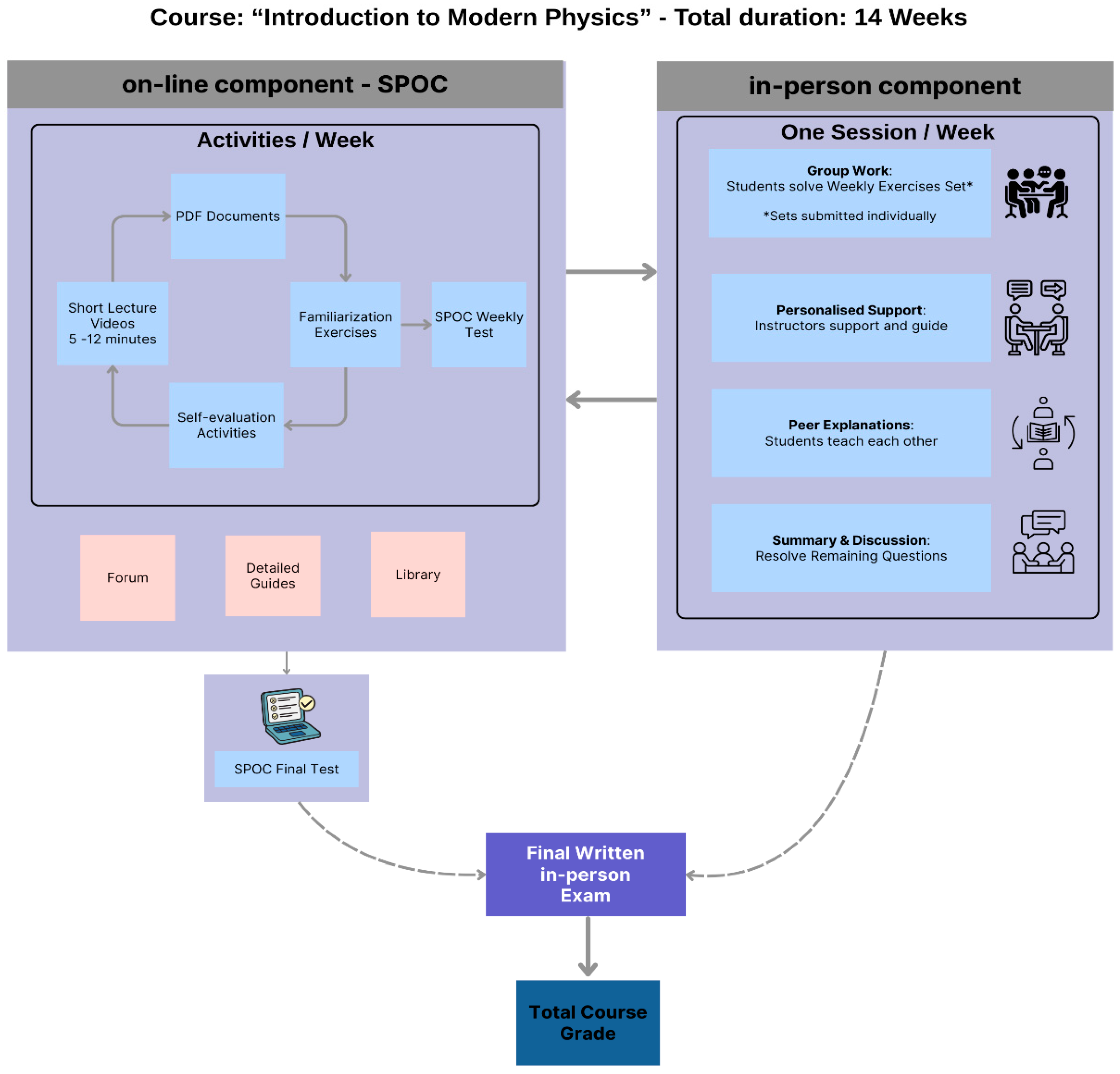
The SPOC “Introduction to Quantum Physics” is hosted on the Mathesis platform https://mathesis.cup.gr/ (accessed on 14 January 2025)—an Open Online Course Center that operates as part of the University of Crete Press and the Foundation for Research and Technology (FORTH) in Greece. It employs the Greek version of the open-source platform OpenEdX (OpenEdx/gr) and access is restricted to enrolled students, verified through their institutional credentials. The total duration of the course is 14 weeks (see Figure 1). On average, students are expected to dedicate five hours per week to studying online material. Regarding prior knowledge, the expected baseline is limited to elementary calculus and physics at the secondary education level. No advanced university-level prerequisites are mandatory, ensuring that the course is accessible to students with a standard high school science background.
The educational content (see Figure 1) is structured into granular weekly modules consisting of thematic units arranged in a linear learning path. Each unit begins with a theoretical summary, followed by a series of short lecture videos ranging from 5 to 12 min in length. In these videos, the instructor employs a direct and friendly tone, using handwritten notes, equations, and real-life examples to explain complex concepts. Students are supported by documents in pdf, familiarization exercises for practicing on topics that they find difficult, a Library describing practical applications of the concepts of physics included in the educational content of the studying week, and embedded self-evaluation activities including multiple-choice, numerical, and algebraic questions that provide immediate feedback and enforce active engagement. Given the mathematical nature of the subject, detailed guides and symbolic syntax instructions to help students use algebraic formulas correctly. User-friendly features such as bookmarks and a “Resume” button allow students to easily navigate and continue their studying from where they last stopped. In addition, a discussion forum is available to facilitate peer-to-peer and student–instructor interaction.
The grading system for the SPOC is based on 14 weekly tests, which account for 40% of the overall SPOC grade, and a final online test which accounts for 60% of the overall SPOC grade. Students can monitor their completion percentage and detailed grades in real-time through a dedicated progress tab. Students who achieve an overall SPOC grade greater than 5 receive one bonus credit to their total course grade.
The in-person component of the course follows a ‘flipped classroom’ model (see Figure 1). Students are expected to attend weekly in-person class sessions having already studied the relevant weekly material on the SPOC platform. During class, students work in groups to solve a weekly set of exercises. Instructors provide personalized support to each student throughout the process. On occasion, students may be asked to explain specific concepts to their peers. Each session concludes with a discussion to resolve any remaining questions concerning the exercises and the studying material. Students who attend in-person sessions and submit their weekly set of exercises for at least 12 weeks receive one bonus credit to their total course grade.
At the end of the semester, students take a final written in-person exam at the University, and their final course grade ( G f i n a l ) is calculated by the sum of the Final Written Exam grade ( G e x a m ) and two additional components, as described in Equation (1):
G f i n a l = G e x a m + B S P O C + B c l a s s
where
  • G e x a m represents the grade from the final in-person written examination (0–10 scale).
  • B S P O C is the bonus for online engagement (max 1 point), calculated as:
    B S P O C = { 1 , i f   G S P O C > 5 0 , o t h e r w i s e
    with the overall SPOC grade ( G S P O C ) derived from the weighted average of weekly tests ( S ¯ w e e k l y ) and the final online test ( S f i n a l ):
    G S P O C = 0.4 × S ¯ w e e k l y + 0.6 × S f i n a l
  • B c l a s s is the bonus for in-person participation (max 1 point), defined as:
    B c l a s s = { 1 , i f   N s e t s > 12 0 , o t h e r w i s e
    where N s e t s is the number of weekly exercise sets submitted during face-to-face sessions.
The grading scheme was intentionally designed to align with the Flipped Classroom objectives. Specifically, SPOC Bonus ( B S P O C ) aimed to foster distributed practice and combat procrastination. By incentivizing weekly engagement with the online SPOC material, the goal was to ensure students arrived at the lectures adequately prepared. In addition, In-person Bonus ( B c l a s s ) was introduced to validate the importance of active participation. Since the face-to-face sessions focused on collaborative problem-solving rather than passive listening, physical presence was deemed essential for the learning process.

2.3. Participants

The study population consisted of undergraduate students who participated in the SPOC “Introduction to Quantum Physics” while simultaneously attending the weekly in-person sessions of the course “Introduction to Modern Physics” during the winter semester of the 2023–2024 academic year. The total number of students who met these criteria was 54.
The sample consisted of students who voluntarily responded to the questionnaire. The questionnaire was completed by 46 students, of whom 19 (41.3%) were female, 25 (54.3%) were male, and 2 (4.3%) preferred not to disclose their gender. Furthermore, 35 students (76.1%) were taking the course for the first time, while 11 students (23.9%) had attended it in the past.
The study cohort included 11 participants who were retaking the course having enrolled in a previous academic year. Although these students had been exposed to the same instructional format (SPOC) in the past, their prior enrollment had resulted in failure or non-completion due to minimal engagement. Consequently, any potential ‘carryover effects’ or content familiarity were considered negligible, as these students had not previously mastered the material nor completed the learning path. For the current iteration, they were treated as new entrants and were required to complete the full set of learning activities and assessments de novo, with no grade carryover. Preliminary statistical checks indicated that their performance did not differ significantly from first-time students ( t ( 44 ) = 1.24 , p = 0.0221 ) ; thus, they were retained in the final dataset.
In addition, it’s crucial to note that engagement with the SPOC was strictly optional. It was designed as a supplementary tool rather than a mandatory requirement, meaning that students self-selected their preferred study method. To ensure that the comparison between participants and non-participants was scientifically valid, the core instructional conditions were kept identical for the entire cohort. Specifically, regardless of their choice to utilize the platform, all students attended the same weekly in-person lectures delivered by the same instructor and followed a unified syllabus based on a mandatory textbook available to all. Thus, the distinguishing variable in this study was solely the mode of independent study: comparing those who voluntarily utilized the interactive SPOC material against those who relied exclusively on traditional resources.
Additionally, the two instructors responsible for the course, both experienced in teaching physics at the university level, also participated in the study. Their role in the SPOC was crucial in facilitating discussions, guiding problem-solving activities, and assessing student progress. Their perspectives provided valuable qualitative insights into the implementation of the SPOC and its integration within the Flipped Classroom model.

2.4. Data Collection Tools

Three primary sources of data were used in order for the study to provide a multi-dimensional perspective on the role of SPOCs in HE and their integration into a Flipped Classroom framework.
1.
Students’ Questionnaire
A structured questionnaire was distributed to students to assess their perceptions of the SPOC’s effectiveness, usability, and impact on their learning. The questionnaire was administered electronically using the LimeSurvey tool and was made available on the Physics Department’s official survey page https://survey.physics.uoc.gr (accessed on 15 January 2025). Students were notified via email and given time to complete it at their convenience.
The questionnaire included two questions designed to collect demographic information about students and 41 Likert-scale questions with answers ranging from 1 to 5 ((1) strongly disagree; (2) disagree; (3) neither agree nor disagree; (4) agree; (5) strongly agree), designed to measure student perceptions, engagement, and satisfaction.
The questionnaire was divided into four sections (see Table A1):
  • Section 1: Educational Material Quality and Organization (21 questions)—Detect students’ perceptions of the quality, clarity, and effectiveness of the SPOC content available on the Mathesis platform.
  • Section 2: Learning Motivation and Satisfaction (11 questions)—Detect student expectations, perceived satisfaction, and intrinsic motivation for engaging with the SPOC.
  • Section 3: Integration of SPOC with In-person Sessions (5 questions)—Explored student opinions on how the SPOC complemented the in-person teaching component.
  • Section 4: Attitudes Toward Online Learning and Future Intentions (4 questions)—Measured student willingness to engage in future online learning experiences.
Ιtems of the questionnaire, which measured the same underlying concept, according to prior research (see Table A1), were grouped to form a construct (see Table 1). These constructs are:
  • Perceived Quality: A construct including 21 items (A1–A21), based on the studies of de Moura et al. (2021), Ruiz-Palmero et al. (2020) and Xue and Dunham (2023), Yousef et al. (2015) and Zaharias and Poylymenakou (2009). These items captured students’ perceptions on student interaction and engagement within the platform, instructional design and content structure. This structure represents students’ overall perception of the quality and organization of the educational material.
  • Performance Expectancy: A construct including 4 items (B1–B3), based on the study of Zhang et al. (2025). These items captured students’ perceptions regarding the usefulness of the course in their learning process, its effectiveness in knowledge acquisition, and its contribution to enhancing their academic performance.
  • Intrinsic Motivation: A construct including 4 items (B4–B7), based on the study of Zaharias and Poylymenakou (2009). This reflects students’ motivation for active learning.
  • Satisfaction: A construct including 4 items (B8–B11), representing the overall satisfaction students experienced with the SPOC. This construct based on the studies of Zaharias and Poylymenakou (2009), Zhang et al. (2025) and Yousef et al. (2015).
  • Blended Learning: Defined in the third section of the questionnaire (items C1 and C3-C5), capturing the integration of SPOC study materials with in-person learning activities. This construct based on the studies of de Moura et al. (2021) and Yousef et al. (2015).
  • Intention for Future Use: Investigated in the fourth section of the questionnaire (items D1–D3), measuring students’ willingness to continue using SPOC-based blended learning approaches. This construct based on the studies of de Moura et al. (2021) and Ruiz-Palmero et al. (2020).
Table 1. Constructs & Variables of the study.
Constructs & VariablesCronbach’s AlphaItemsN of Items
performance expectancy 0.919B1–B33
intrinsic motivation0.846B4–B74
satisfaction0.942B8–B114
blended learning0.822C1, C3–C54
intention for future use0.936D1–D33
instructor’s support C21
attitude towards SPOC use D41
perceived quality0.749A1–A2121
Additionally, individual variables defined are:
  • Instructor’s Support: Represented by item C2, measuring students’ perceptions of the instructor’s role in supporting learning through the SPOC as suggested by de Moura et al. (2021).
  • Attitude Toward SPOC Use: Represented by item D4, capturing students’ stance on the educational effectiveness of SPOCs, based on Wu and Chen (2017), who defined a similar variable as “Attitude Towards Using MOOCs.”
All defined constructs were assessed for internal consistency using Cronbach’s Alpha (see Table 1).
The questionnaire incorporated validated items, originally in English, adapted from prior studies (de Moura et al., 2021; Ruiz-Palmero et al., 2020; Wu & Chen, 2017; Xue & Dunham, 2023; Yousef et al., 2015; Zaharias & Poylymenakou, 2009; Zhang et al., 2025), which underwent a back-translation process to ensure linguistic accuracy (Brislin, 1970). The original English questions were translated into Greek and then independently translated back into English by a bilingual expert to verify consistency and clarity. Then, they underwent content validity assessment by a panel of three university instructors experienced in integrating online educational materials into university courses. Afterwards, the questionnaire was pilot tested by 10 students, with a similar profile to the participants, who were not included in the study sample.
The research followed a convenient sampling method, as the questionnaire was answered by students who were available at the time. It was anonymous and included an introductory note requesting participants’ consent. In this introduction, the researcher clearly stated the purpose and significance of the study, along with a commitment to maintain anonymity and confidentiality. The researchers also ensured that the results would be used exclusively for research purposes, without any alterations to serve particular interests. Furthermore, the introductory note provided clear instructions on how to fulfil the questionnaire to minimize misunderstandings and ambiguities that could threaten its validity (Mills et al., 2016).
2.
Instructors’ Interviews
Semi-structured interviews were conducted with the course instructors to explore their experiences with the SPOC, the challenges they encountered, and their perspectives on its effectiveness within the Flipped Classroom model. One of the instructors was also the creator of the SPOC, providing a unique perspective on the design and implementation of the SPOC.
Semi-structured interviews were chosen to allow for both consistency in questioning and flexibility in exploring the instructors’ experiences (Mills et al., 2016). This format ensured that the same core topics were addressed with both instructors while allowing for open-ended discussions that provided richer qualitative data. The interview questions were designed based on the literature review to extract comparable data while enabling participants to elaborate freely on their teaching experiences.
The interviews covered key themes such as:
  • The role of the SPOC in the course structure.
  • Perceived benefits and challenges of using the SPOC.
  • Student engagement and learning outcomes.
  • Instructor’s workload and support needs.
  • Suggestions for improving the SPOC structure and content.
To ensure the validity of the interviews, the interview questions were piloted with a university instructor experienced in integrating online educational materials into university courses. This instructor did not participate in the study but had a similar profile to the participating instructors. Based on the feedback, adjustments were made to the questions, and the estimated duration of the interviews was determined.
The interviews were conducted in person from 9 December 2024 to 13 December 2024, in the offices of the two instructors, recorded with participant consent, and transcribed for analysis by the researchers.
3.
Students’ Performance Analysis
Following the completion of the SPOC students’ grades from the online activities and tests available on the SPOC platform, as well as the students’ final examination grades, they were retrieved with the consent of the instructors. These data were anonymized and did not contain any identifiable information, such as student ID numbers, that could reveal the identity of the participants.
It should be noted that the sample size of the students’ performance analysis is different from the sample of the questionnaire because the analysis of academic performance included the entire population of students who sat for the final written exam (n = 86), 54 participants to the SPOC and 32 non-participants. Conversely, the questionnaire data were derived from a smaller subset of students (n = 46). This sample consists exclusively of SPOC participants who voluntarily opted to complete the survey and therefore represents the perceptions of the engaged student cohort.

2.5. Ethical Considerations and Data Privacy

It should be stated that prior to the commencement of the course, all enrolled students received a formal notification via their institutional email regarding the research study. This communication detailed the purpose of the inquiry, the nature of the data to be collected, and the guarantee of strict confidentiality. Students were invited to participate and were explicitly informed of their right to opt-out without any impact on their academic standing, with informed consent obtained through this process. Furthermore, to ensure data privacy, all datasets—including exam grades and SPOC activity logs—were fully anonymized by the research team prior to analysis. Personal identifiers were removed and replaced with random codes, ensuring that no individual student could be identified in the reported results.
In addition, for the purposes of transparency and to address potential conflicts of interest, the specific roles of the instructional and research teams should be strictly defined. The in-person sessions were co-taught by two faculty instructors, who were jointly responsible for the face-to-face sessions and the final grading. While the SPOC content was designed by one of these instructors to ensure pedagogical alignment with the syllabus, the study design, data collection, and statistical analysis were conducted by an independent research team, distinct from the instructional staff. This separation of roles mitigated potential biases. Finally, while the instructor’s involvement ensured content relevance, the independent analysis of anonymized data guaranteed that the evaluation of the intervention’s effectiveness was not influenced by the instructors’ expectations.

2.6. Data Analysis

Quantitative data from students’ questionnaires and Students’ Performance were examined utilizing descriptive and inferential statistical methods using SPSS 19.
Kolmogorov–Smirnov and Shapiro–Wilk criteria used to examine if the data for the variables of the study follow or not normal data distributions. Therefore, for the variables following a non-normal data distribution, non-parametric statistical tests utilized (Mann–Whitney’s U test for two independent samples and Spearman’s correlation coefficient (ρ) were used to detect statistically significant differences in the values of factors and variables between groups and subgroups of the sample and correlations between the factors and variables respectively) and for the variables following a normal data distribution, parametric statistical tests utilized (Student’s t test for two independent samples were used to detect statistically significant differences in the values of factors and variables between groups and subgroups of the sample). Cronbach’ s alpha coefficient was utilized to examine the internal consistency of the questionnaire and the subscales/constructs/factors used.
Qualitative data obtained from the instructor interviews were analyzed using an inductive thematic analysis approach, adhering to the six-phase framework established by Braun and Clarke (2006). This methodological choice allowed themes to be derived directly from the data content, rather than being forced into pre-existing categories. The process began with the primary researcher immersing himself in the data through repeated reading of the transcripts (familiarization), followed by the systematic generation of initial codes across the entire dataset. To ensure the trustworthiness and credibility of the findings, a peer-review validation strategy was employed. Following the initial coding, the codebook and emerging themes were reviewed by the second researcher. Through a collaborative dialogue, the researchers discussed the interpretation of the data and refined the themes until consensus was reached, thereby minimizing potential individual researcher bias. The final analysis yielded specific codes which were aggregated into broader thematic areas, as detailed in Table A3.

3. Results

3.1. Students’ Questionnaire

The first step of the analysis was to conduct a factor analysis for the 21 items of the first section of the questionnaire which relates to the quality and organization of the SPOC content to identify the underlying factor structure. Principal Component Analysis (PCA) was employed with Varimax rotation. The factor analysis identified four main factors that explained 68.23% of the variance. The items involved in each factor along with their loadings and the Cronbach Alpha internal consistency index (Mills et al., 2016) are given in Table 2. While the Cronbach alpha values for Factors 3 and 4 were slightly below the conventional threshold of 0.70, they were deemed acceptable given the small number of items (two) comprising each of these subscales (Pallant, 2020).
Τhe items related to the first factor focus on characteristics related to the quality, structure, and relevance of the instructional materials in the SPOC to the university course. Each item addresses the completeness, organization, and clarity of the materials, as well as their connection to the learning objectives of the course. Therefore, factor1 can be expressed as “quality of content and organization of educational material”.
Items related to the second factor focus on the structure and learning experience provided by the SPOC. They refer to elements that maintain student interest and focus, as well as the achievement of learning objectives through activities. Based on these items, factor2 can be expressed as “structure of educational material and maintenance of interest”.
Items belonging to the third factor focus on the accessibility of the educational material. They concern the ability of students to access the material at any time and from any location, features that are critical to the flexibility of SPOC learning. Based on these items, factor3 can be expressed as “accessibility and flexibility of educational material”.
Items belonging to the fourth factor concern the understanding of the assessment criteria and the ease of identifying specific points in the material, characteristics that facilitate students in managing their learning. Based on these items, factor4 can be expressed as “clarity and easy navigation of the educational material”.

3.1.1. Descriptive Statistics of Constructs & Variables

First, given the relatively small sample size (n = 46), a Shapiro–Wilk test was conducted to determine whether the defined constructs followed a normal distribution. The results indicate non-normal distributions for all constructs p < 0.05.
As part of the descriptive statistical analysis, means (M), standard deviations (SD), and medians were calculated for all questionnaire items (see Table A2). Furthermore, descriptive statistics, including means, standard deviations, and medians, were calculated for all examined constructs, factors and variables (see Table 3).

3.1.2. Correlation Analysis

Correlations were calculated using Spearman’s rho, since the variables do not follow a normal distribution. The results show several statistically significant correlations (see Table 4).
Perceived quality shows a positive correlation with performance expectancy (ρ = 0.717, p < 0.01), intrinsic motivation (ρ = 0.680, p < 0.01) and satisfaction (ρ = 0.761, p < 0.01).
Intrinsic motivation was positively associated with satisfaction (ρ = 0.802, p < 0.01) and attitude towards SPOC use (ρ = 0.693, p < 0.01).
Intention for future use has a strong positive correlation with attitude towards SPOCs (ρ = 0.849, p < 0.01) and performance expectancy (ρ = 0.824, p < 0.01).
These correlations suggest that students’ perception of course quality, intrinsic motivation, and satisfaction positively impact their intention to use SPOC in the future and their attitude towards it.
The positive correlations observed between the constructs of the study provide important information for understanding the factors that influence students’ intention to use the SPOC platform in the future and their overall satisfaction.
First of all, the positive correlation of perceived quality of the course material with performance expectancy (ρ = 0.717), intrinsic motivation (ρ = 0.680) and satisfaction (ρ = 0.761) suggests that when students perceive the course material as high quality, they are more likely to believe that the course will improve their performance, feel intrinsically motivated and satisfied with the learning experience.
In addition, the positive correlation of intrinsic motivation with satisfaction (ρ = 0.802) and attitude towards using the SPOC platform (ρ = 0.693) indicates that students who are intrinsically motivated tend to be more satisfied with their educational experience and have a more positive attitude towards using the platform.
Apart from that, the strong positive correlation of intention for future use with attitude towards using the SPOC platform (ρ = 0.849) and performance expectancy (ρ = 0.824) suggests that students who have a positive attitude towards using the platform and believe it will improve their performance are more likely to want to use it in the future.

3.1.3. Impact of Gender and Semester on Students’ Perceptions of the SPOC

To examine whether gender influenced students’ perceptions of the SPOC, the Mann–Mann-Whitney U test was performed. No statistically significant differences were found between male and female students across the constructs (p > 0.05 for all comparisons).
The Mann–Whitney U test also investigated whether students taking the course for the first time differed in motivation compared to those in later semesters. The analysis revealed a statistically significant difference in Intrinsic Motivation (U = 109.50, Z = −2.16, p = 0.031 < 0.05, r = 0.32), with students in higher semesters reporting greater motivation than first-time participants. This indicates a low to medium effect size.

3.2. Instructors’ Interviews

The thematic analysis of the instructor interviews provided valuable insights into the integration and utility of the SPOC within the Flipped Classroom framework. The findings presented below correspond to the thematic structure detailed in the Coding Tree (Table A3, Appendix A). Several key themes emerged, covering the structure of implementation, student interaction, assessment challenges, and critical areas for improvement.

3.2.1. Integration of the SPOC into In-Person Instruction

Both instructors emphasized that the SPOC was designed to complement, rather than replace, in-person instruction. Students were expected to engage with the online materials before attending class, ensuring that in-person sessions focused primarily on problem-solving activities.
The model is that every week, students watch online videos, complete the quizzes to check their understanding, and then come to class. In class, we assign them exercises, and they work in groups while we walk around to assist them. At the end, we discuss the difficulties they encountered”.
(Instructor 2)
However, one instructor noted that students often showed a passive learning approach, reflecting a broader shift in student expectations at the university level:
Nowadays, students have a ‘high school’ mindset. University has become ‘the new secondary education’, so our teaching methods should adapt accordingly”.
(Instructor 2)
In this context, the instructor did not imply that university education should be simplified, but rather that incoming students often lack skills related to self-regulated learning required for higher education. Consequently, the SPOC was viewed as an appropriate intervention precisely because it offers a highly structured learning environment. The SPOC provides necessary scaffolding—through linear progression and mandatory checkpoints—guiding students who might otherwise struggle to engage critically with the material on their own.

3.2.2. Student Interaction and Support

A major advantage of integrating the SPOC into a Flipped Classroom framework is reported to be the increased interaction between instructors and students. Unlike traditional lecture-based courses, the in-person sessions allowed for more direct engagement, facilitating personalized feedback.
In in-person sessions, students can ask whatever they need. This allows us to provide personalized guidance, identifying gaps in their understanding and clarifying difficult concepts”.
(Instructor 1)
The instructors also highlighted the importance of student participation:
Sometimes, you see it in their eyes—they don’t understand, but they don’t dare to ask. One question from a student can reveal gaps that many others have, benefiting the whole class”.
(Instructor 1)

3.2.3. Assessment of Student Performance

The course assessment strategy, apart from the final written exam, comprises two additional distinct components: the online individual assessment ( G S P O C ) and the in-person collaborative assessment ( B c l a s s ).
Τhe SPOC platform facilitated the process through quizzes that provided immediate feedback and seamlessly contributed to the final grade. In contrast, evaluating students’ performance during the in-person group activities presented significant challenges according to the instructors. Unlike the automated tracking of the SPOC, monitoring individual contributions within a group setting proved difficult, as it required manual observation of soft skills and participation.
As Instructor 1 noted, this created a disparity in how prepared students were for the collaborative work:
One challenge is that we cannot ensure that all students come to class adequately prepared. Some do very little, and others might rely too much on their group members to complete the work”.
(Instructor 1)
To address this issue, one instructor suggested incorporating peer assessment to encourage deeper engagement:
Since we don’t have the capacity to manually review every student’s work, peer assessment could be a useful solution. It would push students to critically evaluate each other’s responses, reinforcing their own learning”.
(Instructor 1)

3.2.4. Challenges and Limitations

The analysis revealed specific limitations in the implementation. A primary issue was the underutilization of the online discussion forum, which was originally intended to facilitate peer interaction and collaborative learning.
The forum exists, but unfortunately, students rarely use it. It’s an essential feature of MOOCs, yet in our case, it doesn’t function as expected. That is a significant shortcoming”.
(Instructor 2)
Another challenge was the need to update and improve the learning materials to better align with students’ difficulties:
We should revise and enrich the learning material to better address students’ difficulties. For instance, we observed that many students struggle to explain why they apply specific formulas. We need to incorporate more exercises that challenge them to justify their reasoning”.
(Instructor 2)
Finally, the instructors reflected on the changing role of educators in a technology-enhanced learning environment:
At first, you feel like your role is secondary, as if you’re not really ‘teaching.’ But over time, you see that this model actually works—it fosters engagement and interaction. That is what makes it rewarding”.
(Instructor 1)

3.2.5. Suggestions for Improvement

Based on their experience, the instructors proposed several improvements for future implementations of the SPOC model:
  • Enhancing student engagement in the online forum to encourage peer-to-peer discussion.
  • Updating course materials to include more interactive exercises and problem-solving activities.
  • Exploring new assessment methods, such as peer review, to better evaluate student participation.
One instructor emphasized the value of fostering a more dynamic learning experience:
I would love to see the forum being used effectively, allowing students to ask questions and engage with each other. Those who answer their peers’ questions would benefit the most, as explaining reinforces their own understanding”.
(Instructor 1)
These findings highlight both the strengths and challenges of integrating SPOCs into HE, offering valuable recommendations for future course designs.

3.3. Students’ Performance Analysis

To assess the impact of the SPOC and in-person instruction on student performance, descriptive and referential statistical analysis dataset included variables such as students’ final exam grades which is the final written in-person exam grade, participation in SPOC weekly tests and overall course grades, was conducted. It is important to note that to evaluate academic performance accurately and avoid any confounding effects from the course’s incentivization policy, the comparison between SPOC participants and non-participants was based strictly on the raw Final Written Exam scores. The bonus points awarded for SPOC completion were excluded from this specific analysis. This methodological decision allows for isolating the SPOC’s impact on learning outcomes from the mechanical grade inflation caused by the bonus system.

3.3.1. Descriptive Statistics

As part of the descriptive statistical analysis the final written exam grades of 86 students were analyzed, with a mean grade of M = 3.51 (SD = 1.92) on a scale of 0 to 10 (see Table 5). Of these students, 54 (63%) actively participated in the SPOC, while 32 (37%) did not engage with the online material.

3.3.2. Correlation Between SPOC Participation and Final Written Exam Grades

Spearman’s rho correlation analysis (see Table 6) revealed a statistically significant but not strong positive relationship between participation in SPOC weekly test and final exam performance (ρ = 0.368, p < 0.01). Similarly, the correlation between the SPOC quiz grades and the final exam was also statistically significant but not strong (ρ = 0.357, p < 0.01), suggesting that engagement with the online material could be associated with better exam outcomes.

3.3.3. Impact of SPOC Participation on Final Written Exam Performance

To determine whether SPOC participation had a statistically significant effect on students’ final written exam grades, an independent samples t-test was performed. The results (Table 7) indicated that students who completed the SPOC achieved significantly higher final exam grades (M = 3.99, SD = 1.99) compared to those who did not participate (M = 2.69, SD = 1.48, t (84) = −3.202, p = 0.002). The effect size was medium (Cohen’s d = 0.71). This suggests that engagement with the SPOC positively influenced students’ academic performance.

4. Discussion

4.1. The Role of SPOC in Supporting Learning Within a Flipped Classroom Framework

This study examined the role and key functions of the SPOC within the Flipped Classroom framework and how they relate to course outcomes. Data from SPOC observations, instructor interviews, and student performance analysis were used to address this research question.
The findings suggest that the primary role of the SPOC is to integrate the benefits of e-learning with those of in-person instruction, supporting a blended learning approach. Specifically, the SPOC provides students with flexibility by allowing them to access educational material at their own pace and convenience, a key advantage highlighted in prior research (Fesol & Salam, 2016; Kang & He, 2018; Psathas et al., 2020; Ruiz-Palmero et al., 2020; Yousef et al., 2015). Additionally, students can regulate their learning process, selecting when and how they engage with content while ensuring they are prepared for in-class problem-solving activities. This aspect of self-regulated learning aligns with previous studies emphasizing the role of SPOCs in supporting learner autonomy (Martínez-Muñoz & Pulido, 2015; Psathas et al., 2020; Demirel, 2016).
The study also found that students who studied material at home became better prepared for in-person sessions, allowing them to focus on clarifying difficult concepts. This supports the conception that personalized and self-paced learning is associated with better content retention (Kim et al., 2014). Moreover, utilizing the Flipped Classroom model allows available class time for collaborative activities and problem-solving exercises, promoting active participation, teamwork, and critical thinking—elements that are widely recognized as crucial to student engagement and deeper learning (Giannakos et al., 2014; Martínez-Muñoz & Pulido, 2015; Strelan et al., 2020; Zaharias & Poylymenakou, 2009; Estes et al., 2014).
Furthermore, instructors reported that the SPOC helped students develop independent learning habits, as they were responsible for accomplishing studying theoretical content before class. However, some students did not consistently engage with the online materials, which seemed to limit their ability to participate effectively in in-person activities. This highlights a potential gap in student accountability, suggesting that additional strategies, such as structured motivation or pre-class quizzes, may be necessary to ensure engagement with the SPOC.
Regarding student performance, the analysis revealed a positive correlation between final written exam grades and SPOC weekly tests grades (r = 0.368, p < 0.01), as well as between final exam grades and final SPOC test grades (r = 0.357, p < 0.01). This suggests that students who are actively engaged with SPOC weekly test tend to perform better in their final assessments. Additionally, a strong correlation was found between SPOC weekly test and SPOC test grades (r = 0.793, p < 0.01), indicating that consistent participation in SPOC weekly tests is associated with higher preparedness for assessments. These findings align with prior research showing that structured SPOC engagement is related to higher academic performance (Kang & He, 2018; Xue & Dunham, 2023).
Further analysis using t-tests confirmed that students who actively participated in the SPOC (by fulfilling activities and tests) achieved significantly higher final written exam grades compared to those who did not engage with the SPOC, suggesting that pre-class engagement with the material was associated with deeper understanding and better preparation (Psathas et al., 2020). Moreover, the difference in performance may be partially attributed to the incentive system, where successful completion of the SPOC weekly tests granted students an additional bonus point on their final written grade, as also implied by one of the instructors.
Additionally, students who attended in-person sessions also performed significantly better, likely due to increased instructor interaction, real-time clarification, and peer collaboration. These findings reinforce the argument that instructor support and peer interaction play a crucial role in learning success (Dong et al., 2021; Nejkovic & Tosic, 2018; Wang et al., 2016).
Overall, the study demonstrates that both SPOC engagement and in-person participation are positively associated with student performance, with SPOC participation showing a slightly stronger association with final grades. These results are consistent with the literature, which suggests that SPOCs support flexibility, active learning, and student-centered instruction (Nejkovic & Tosic, 2018; Ruiz-Palmero et al., 2020; Xue & Dunham, 2023; Zhang et al., 2025).

4.2. Students’ Perceptions of SPOC and Their Learning Experience

To explore students’ perspectives on the SPOC and its effect on their learning experience, this study analyzed questionnaire responses, focusing on perceived content quality, accessibility, motivation, and satisfaction.
The findings indicate that students generally held positive perceptions of the SPOC, particularly regarding content quality (M = 3.99, SD = 0.67, Median = 4.06) and accessibility (M = 4.68, SD = 0.51, Median = 5.00). High ratings for these aspects were strongly correlated with intrinsic motivation and satisfaction (ρ > 0.70, p < 0.01), suggesting that when students perceive a SPOC as well-structured and relevant, they tend to report higher engagement and motivation. These results align with previous studies highlighting the importance of well-designed digital learning materials in supporting student engagement (Zhang et al., 2025; Ruiz-Palmero et al., 2020; Nejkovic & Tosic, 2018).
Additionally, students strongly emphasized accessibility as a major benefit of the SPOC. The ability to access course materials at any time and from any location allowed them to manage their studies more effectively, reinforcing prior research on the importance of accessibility in digital learning environments (Yousef et al., 2015; Fesol & Salam, 2016; Kang & He, 2018; Ruiz-Palmero et al., 2020). This flexibility was particularly beneficial for students with diverse schedules, as it facilitated engagement with course content at their convenience and helped them balance their academic responsibilities.
However, while students valued the flexibility and content quality of the SPOC, some findings suggest that it could benefit from more interactive elements. Specifically, students’ responses showed that the SPOC had limited association with motivating further knowledge exploration (M = 3.11, SD = 1.23, Median = 3), indicating that its structure did not appear to strongly promote deeper engagement beyond the provided materials. Furthermore, while students found the SPOC useful (M = 3.67, SD = 1.32, Median = 4) and enjoyable (M = 3.54, SD = 1.31, Median = 4), their overall satisfaction with the learning experience was comparatively lower (M = 3.30, SD = 1.22, Median = 3.38). The relatively high standard deviations (SD>1.20) across these items further indicate that student reception was not uniform. This variability suggests a divergence in student experiences, where a subset of learners engaged deeply while others remained neutral, highlighting the challenge of designing a SPOC that best fits all. These results suggest that while students appreciated the SPOC’s accessibility and content, the platform may need further improvement to support active learning experiences. The need for engaging and targeted instructional activities is also emphasized in the studies of Kang and He (2018), Ruiz-Palmero et al. (2020), and Zhang et al. (2025).
Moreover, survey results showed that instructor support was perceived as a critical factor in student learning experiences (M = 4.20, SD = 0.94, Median = 3.75). Students indicated that the guidance and feedback provided by instructors were believed to be important to their understanding of course materials and their ability to navigate the SPOC effectively. This finding highlights the importance of blended learning environments where digital resources are complemented by instructor presence, as also noted in prior studies (Ruiz-Palmero et al., 2020; Zhang et al., 2025).
Finally, students indicated a moderate intention to continue using the SPOC in the future (M = 3.42, SD = 1.48, Median = 3.67), along with a positive attitude toward online learning (M = 3.57, SD = 1.49, Median = 4.00). These findings suggest that while the SPOC was generally well received, improvements in interactivity and course depth could be connected to increased students’ willingness to continue using the platform. Previous research has similarly found that students’ intentions to continue using the SPOC are closely linked to their satisfaction and perceived usefulness of the online learning environment (Ruiz-Palmero et al., 2020; Zhang et al., 2025).
Overall, students highly valued the accessibility, flexibility, and quality of the SPOC but emphasized the need for more engaging content and interactive learning experiences to optimize its potential utility.

4.3. Instructors’ Perspectives on the Utility and Implementation of the SPOC

Instructors’ interviews provided valuable insights into their experiences using the SPOC. Instructors reported that the SPOC allowed for better use of classroom time, providing opportunities to focus on higher-order learning activities such as problem-solving and discussion. Additionally, the SPOC was perceived to assist them in addressing individual student needs during in-person sessions, as they could adapt their instruction based on students’ needs. These findings align with previous research highlighting the role of SPOCs in supporting active learning environments (Ruiz-Palmero et al., 2020; Zhang et al., 2025).
Both instructors highlighted perceived improvements in interaction with students as one of the key benefits of combining the SPOC with the Flipped Classroom model. The structured nature of the SPOC appeared to encourage student engagement and supported more meaningful discussions, a finding also supported by Dong et al. (2021).
Their previous experience with MOOCs also played a significant role in shaping their instructional strategies. MOOCs assisted them in better organizing their teaching materials and adopting a more dynamic and adaptive teaching mindset. As one instructor and creator of the SPOC stated, ‘It would be a shame if we didn’t change! If we don’t recognize our weaknesses and push ourselves further!’ This aligns with the conclusions of Andone et al. (2015).
Equally important, both instructors emphasized the evolution of their pedagogical approach. Through their experience with SPOCs, they identified limitations in in-person teaching, such as passive student participation, and improved their methodology to support interactive and engaging learning experiences. The Flipped Classroom model was intended to promote student activation, supporting active participation (Bishop & Verleger, 2013; Kim et al., 2014), problem-solving interactions (Kim et al., 2014), and deeper understanding of course material (FLN, 2014).
Furthermore, instructors also recognized a fundamental shift in their role within the Flipped Classroom model. Initially, concerns were raised about the potential ‘downgrading’ of their role compared to traditional teaching, a challenge also noted in Demirel (2016). However, they ultimately embraced their new role as more guiding and supportive, aligning with the findings of Kang and He (2018). The successful implementation of the Flipped Classroom technique requires a transformation of the instructor’s role into that of a facilitator and motivator, as emphasized by King (1993).
Nevertheless, instructors identified several challenges that need to be addressed to optimize the utility of the SPOC. Student engagement issues remained a concern, as some students did not fully engage with the SPOC content before attending class, potentially limiting the benefits of the Flipped Classroom model. Furthermore, low participation in discussion forums was noted as a significant drawback, despite their potential to support peer interaction and deeper discussions (Nejkovic & Tosic, 2018; Kang & He, 2018). Instructors acknowledged that while the SPOC structure was designed to encourage independent learning, additional strategies might be needed to promote more active participation in online discussions.
Another key issue was the lack of open-ended questions, which presented challenges in evaluating students’ higher-order thinking skills and deeper understanding of the subject matter. Incorporating more critical thinking exercises, case studies, and problem-based learning activities within the SPOC framework could strengthen assessment and student engagement.
Finally, instructors suggested that peer assessment and additional formative assessments could help address these issues, making student engagement more transparent and encouraging deeper learning.

4.4. Challenges and Areas for Improvement in SPOC Implementation

Despite its benefits, the implementation of the SPOC revealed several challenges that need to be addressed to improve its utility.
A key issue highlighted by instructors was the need to strengthen online interaction. Digital communication can take both synchronous and asynchronous forms. To support synchronous interaction, virtual office hours, live Q&A sessions, and instant messaging tools could be introduced. For asynchronous engagement, motivation for forum participation, such as small grading rewards for meaningful contributions, could encourage student involvement. Weekly discussion prompts focusing on challenging concepts could further stimulate engagement, aligning with the findings of Kloos et al. (2015) on the role of social networks in digital education.
Another challenge noted was that students often do not adequately prepare before in-person sessions. A potential solution is the implementation of pre-class online quizzes to assess comprehension and encourage accountability. Incorporating gamification elements into these quizzes could further support engagement and motivation.
Moreover, students expressed the need for more in-depth educational materials, particularly regarding abstract or complex concepts. To address this, the SPOC could incorporate more open-ended questions to encourage critical thinking, as well as additional explanatory videos, diagrams, and real-world examples. One instructor suggested that popular science-style notes and videos could be used to simplify difficult topics and aid in comprehension.
Instructors also highlighted difficulties in objectively assessing student participation during in-person sessions. To tackle this issue, peer assessment strategies, where students evaluate each other’s problem-solving approaches using instructor-defined rubrics, could be introduced. This method aligns with the work of Yousef et al. (2015) on peer-based evaluation. Additionally, learning analytics tools could be leveraged to track student engagement with SPOC materials, assist instructors in providing personalized support, a factor closely linked to student satisfaction and learning quality (Wang et al., 2016).
Furthermore, there is a clear need for supporting instructors in adapting to their new role as facilitators and mentors. While students acknowledge the importance of instructor support, instructors themselves require training on best practices for implementing SPOCs within a Flipped Classroom model. Wang et al. (2016) suggest that professional development programs focused on student mentoring and online facilitation techniques could be highly beneficial.
Although students generally view the SPOC positively, overall satisfaction levels remain moderate, which may influence their attitude toward continued use in the future. Instructors also expressed concerns that the SPOC may not be equally engaging for all students. To address this, gamification techniques and additional incentives could support interactivity and student engagement. Research by Andone and Mihaescu (2018) and Zakaria et al. (2019) indicates that hybrid MOOCs, including SPOCs, are associated with more positive outcomes when designed with elements tailored to digitally native learners.
In conclusion, future improvements should focus on strengthening interaction, promoting engagement, improving assessment strategies, supporting instructors, and enriching educational content. These adjustments could further optimize the potential utility of SPOCs and support their role in Flipped Classroom instruction.

4.5. Contributions and Implications of the Study

This study aims to offer a significant contribution to the literature on SPOCs within the Flipped Classroom framework, as it provides empirical evidence regarding the positive association of SPOC engagement with student learning outcomes and experiences. It also highlights the necessity of promoting online interaction, enriching educational content with interactive and engaging activities, and deepening the level of instructional material. By integrating insights from both students and instructors, this research aims to provide a comprehensive framework for improving digital learning strategies, informing educators, instructional designers, and policymakers on best practices for implementing SPOCs in HE.

4.6. Limitations and Directions for Future Research

Despite its significant contributions, this study has certain limitations. First, it is a case study, with data collected from students in a single academic semester from one department at a single university. This limits the generalizability of the findings. Crucially, the results should be interpreted within the specific disciplinary context: an introductory Quantum Physics course, characterized by high conceptual abstraction and demanding mathematical formalism. The utility of the SPOC in this setting may be attributed to the subject’s specific need for mastering symbolic syntax and algorithmic problem-solving—needs that are effectively served by automated quizzes and linear learning paths.
A significant methodological limitation concerns the comparison between participants and non-participants in SPOC. Since engagement with the SPOC was voluntary, the study lacks a randomized control group. This implies that the participants might have been more motivated than the average student. Consequently, definitive causal inferences regarding the exclusive impact of the SPOC on academic performance cannot be drawn, as it is difficult to isolate the SPOC participation effect from students’ inherent motivation or prior academic aptitude (e.g., mathematical background), which were not controlled for as covariates. In addition, strict data privacy regulations prevented access to students’ prior academic records. Consequently, we were unable to compare SPOC participants and non-participants on baseline academic aptitude, preventing a quantitative assessment of selection bias based on prior performance.
Furthermore, this study does not examine the long-term effects of SPOCs on student learning outcomes, as it provides only a snapshot of one academic term. Therefore, broader implications should be framed tentatively, suggesting that such interventions are most likely to be beneficial in similar large-enrolment STEM courses with comparable instructional goals, rather than assuming general applicability.
Additionally, a discrepancy exists in the sample sizes of the quantitative datasets. While the grade analysis encompassed the full student cohort, the questionnaire responses represent a self-selected subset of SPOC participants. Consequently, the reported student perceptions may skew towards those who were more positively disposed of or highly engaged with the platform, potentially underrepresenting the views of students who dropped out of the SPOC or chose not to complete the survey.
Finally, a limitation of the current study concerns the unavailability of granular student trace data (e.g., clickstreams, time-on-task logs, video pause/rewind rates). While the SPOC platform provided the instructors with aggregate dashboards to monitor general progress, it did not support the export of detailed log data in a format suitable for statistical analysis. As confirmed during the instructor’s interview, extracting meaningful individual trace data was technically infeasible due to platform restrictions at the time of the intervention. Consequently, the study relied on performance outcomes (grades) and self-reported perceptions, without being able to triangulate these with behavioral log data.
Future research could explore several areas to further advance understanding of SPOC utility and implementation. First, comparative studies across multiple institutions and disciplines would help assess the broader applicability of the findings beyond the specific context of Introduction to Quantum Physics. Second, to mitigate selection bias and better account for confounding variables, future studies should incorporate pre-tests assessing students’ prior knowledge and motivation levels. Using these metrics as covariates in statistical analyses would allow researchers to isolate the specific contribution of the SPOC to learning outcomes more accurately. Longitudinal studies tracking student performance over time could provide more robust evidence of the relationship between SPOC engagement and academic achievement. Furthermore, experimental research designs that compare different instructional approaches (e.g., in-person lectures vs. Flipped Classroom with SPOCs) using randomized control groups could offer stronger causal inferences. Additionally, to overcome the technical restrictions encountered in this study, future research should leverage Learning Analytics to analyze granular student trace data (e.g., time-on-task, video interaction patterns). Correlating these objective behavioral metrics with performance would provide insights into study habits that complement self-reported perceptions. Finally, future research could examine the potential value of specific instructional practices, such as gamification, adaptive learning tools, and personalized feedback mechanisms, in supporting SPOC engagement and learning outcomes. By addressing these areas, future studies can provide deeper insights into how digital learning environments can be further optimized to support student success, engagement, and knowledge retention.

5. Conclusions

This study examined the role, functionality, and potential utility of the SPOC “Introduction to Quantum Physics” within a Flipped Classroom framework for the university course “Introduction to Modern Physics.” Overall, the findings suggest that the SPOC provides a supportive learning environment which is flexible and student-centered that fosters autonomy and better preparation, while allowing for a more interactive in-class experience.
The quantitative analysis confirmed that consistent engagement with online material—specifically the short lecture videos and self-assessment activities—correlate positively with academic performance. Notably, the bonus point system for students achieving a grade greater than five in the overall SPOC grade appeared to act as a strong incentive for participation in SPOC.
Students generally perceived the SPOC positively, particularly in terms of quality and accessibility, but highlighted the need for more interactive and engaging activities to encourage deeper engagement.
Instructors also recognized the value of the SPOC in facilitating personalized student support and fostering student–teacher interaction. Despite these benefits, challenges remain, including inconsistent student pre-class engagement, assessment methods and low participation in discussion forums.
To optimize the implementation of SPOCs in a Flipped Classroom framework, future implementations should focus on promoting student interaction through forums and synchronous live discussions, enriching instructional content with diverse learning activities, such as open-ended questions and case studies, which could help stimulate critical thinking. Finally, leveraging assessment tools to track student progress, while maintaining the flexibility and accessibility that students value, can help establish the SPOC as a vital tool for modernizing Higher Education curricula.

Author Contributions

Conceptualization, A.P. and A.K.; methodology, A.P. and A.K.; investigation, A.P.; writing—original draft preparation, A.P.; writing—review and editing, A.K. and C.P.; visualization, A.P.; supervision, A.K. All authors have read and agreed to the published version of the manuscript.

Funding

This research received no external funding.

Institutional Review Board Statement

Ethical review and approval were waived for this study due to in Greece, in the field of education, a compulsory license is required from the primary or secondary education authority, the school on behalf of the Ministry of Education in accordance with the law, based on Article 46, paragraph 3 of Law 4589/2019 (Government Gazette 13/A/29-1-2019) and Article 212, paragraph 3 of Law 4610/2019 (Government Gazette 70/A/7-5-2019), when the research concerns and is addressed to underage students (under 18 years of age). In the case of education, when the research concerns adult students or teachers (as in this case), they participate in their own free will and consent, signing a statement. Additionally, part of the data of this study derived from the use of anonymized student assignments and classroom presentations, which were originally created for educational purposes during the academic semester. The data used was non-identifiable and was collected in the context of regular university coursework, in line with ethical guidelines for educational research.

Informed Consent Statement

Informed consent for participation was obtained from all subjects involved in the study. Additionally, part of the data are anonymized data derived from student assignments, which were originally created solely for educational purposes within the context of a university course. All data were analyzed in a non-identifiable form and in accordance with the ethical guidelines for educational research.

Data Availability Statement

The data that support the findings of this study are available from the author upon reasonable request because: There is data supporting the findings of this study that are not publicly available due to ethical restrictions as this data consists of grades on student assignments and exams (online and written in person) during the course as well as of instructors’ responses to the interview question.

Conflicts of Interest

The authors declare no conflicts of interest.

Abbreviations

The following abbreviations are used in this manuscript:
SPOCSmall private online courses
HEHigher Education
FLNFlipped Learning Network
SDStandard Deviation

Appendix A

Table A1. Dimensions, instrument items, associated codes and referenced studies.
DimensionItemCodeReference Study
Educational Material Quality and OrganizationThe course material in Mathesis is accurate and up to dateA1(Zaharias & Poylymenakou, 2009)
The course material of the course in Mathesis is well structuredA2(de Moura et al., 2021)
The course material in Mathesis is very relevant to the course F201A3(de Moura et al., 2021)
The course material in Mathesis is appropriate for my level of knowledgeA4(de Moura et al., 2021)
The course material in Mathesis covers the subject matter in sufficient breadth to serve the objectives of the courseA5(Zaharias & Poylymenakou, 2009)
The course material in Mathesis covers the subject matter in sufficient depth to serve the objectives of the course F201A6(Zaharias & Poylymenakou, 2009)
The course material in Mathesis is sufficient for the completion of the course F201A7(Ruiz-Palmero et al., 2020)
In the course material in Mathesis, abstract or complex concepts are adequately explained with clear examples, pictures, graphs, etc.A8(Zaharias & Poylymenakou, 2009)
The number of activities contained in the course in Mathesis is sufficientA9(Xue & Dunham, 2023)
The activities included in the lesson in Mathesis helped me understand and focus on the key points of each weekly unit.A10(Xue & Dunham, 2023)
The course materials in the Mathesis course are organized in an appropriate sequence and in small and easily manageable weekly modulesA11(Zaharias & Poylymenakou, 2009)
In the course material in Mathesis, all weekly modules contain an introduction, summary and abstractA12(Zaharias & Poylymenakou, 2009)
In the Mathesis course material the purpose and expected learning outcomes of each weekly module are evident and understandable to the learnerA13(Zaharias & Poylymenakou, 2009)
The teaching material of each weekly module of the Mathesis course covers the main points of the material of the corresponding week of the in-person courseA14(Xue & Dunham, 2023)
In the Mathesis course the grading criteria are clear from the beginning of the courseA15(Yousef et al., 2015)
The structure of the course in Mathesis keeps my interestA16(Yousef et al., 2015)
The structure of the course in Mathesis maintains my focus on the learning objectivesA17(Yousef et al., 2015)
I can access the course material at any time that is convenient for meA18(Yousef et al., 2015)
I can access the learning material from anywhereA19(Yousef et al., 2015)
The Mathesis learning environment offers me a variety of learning material options to choose fromA20(Yousef et al., 2015)
I can locate specific parts of the learning material without much difficultyA21(Yousef et al., 2015)
Learning Motivation and SatisfactionI find the course in Mathesis useful in my learning processB1(Zhang et al., 2025)
Studying the course in Mathesis helps me to master knowledge more quicklyB2(Zhang et al., 2025)
Studying the course in Mathesis increases my learning productivityB3(Zhang et al., 2025)
The course in Mathesis contains innovative featuresB4(Zaharias & Poylymenakou, 2009)
The course in Mathesis motivates me to further search for information and engagementB5(Zaharias & Poylymenakou, 2009)
The course in Mathesis is enjoyable and interestingB6(Zaharias & Poylymenakou, 2009)
The course in Mathesis provides training relevant to my existing knowledgeB7(Zaharias & Poylymenakou, 2009)
The course in Mathesis as combined with in-person teaching gives me a ‘feeling’ of satisfactionB8(Yousef et al., 2015)
The course in Mathesis satisfies my educational needsB9(Zaharias & Poylymenakou, 2009)
I find the course in Mathesis to be a satisfactory learning tool for the whole courseB10(Zhang et al., 2025)
I am satisfied with the learning experience I get from the course in MathesisB11(Zhang et al., 2025)
Integration of SPOC with In-person SessionsThe teaching material of each weekly section of the course in Mathesis is aligned with the activities carried out in-person by the teacher each week.C1(de Moura et al., 2021)
The support offered by the teacher in the classroom for the course material in Mathesis is necessaryC2(de Moura et al., 2021)
I believe that combining each week’s study of the course in Mathesis with the live lectures and activities improves my academic performanceC3(Yousef et al., 2015)
I believe that combining each week’s study of the course in Mathesis with the live lectures and activities motivates me to discover new knowledge and share my ideasC4(Yousef et al., 2015)
I believe that the combination of studying each week of the course in Mathesis with the in-person lectures and activities helps me to complete the course obligations more quicklyC5(Yousef et al., 2015)
Attitudes Toward Online Learning and Future IntentionsIf I were to choose this course again, I would like the teacher to use the Mathesis course again as part of the teaching materialD1(de Moura et al., 2021)
I would suggest that other courses utilize lessons in Mathesis as part of their instructional materialsD2(de Moura et al., 2021)
I would choose to take a course that uses the same methodology (online educational material in Mathesis combined with a in-person lesson for questions and activities) instead of a course with traditional in-person lecturesD3(Ruiz-Palmero et al., 2020)
I believe that the use of online courses in university courses is educationally effectiveD4(Wu & Chen, 2017)
Table A2. Descriptive statistics for questionnaire items.
Item CodeMeanMedianStd. Deviation
A14.2240.941
A24.0441.115
A34.2450.97
A44.0241.105
A53.7241.167
A63.5741.259
A73.6541.269
A83.4641.206
A93.2831.205
A103.5241.329
A113.6341.019
A123.9841.105
A133.7841.052
A143.7441.144
A154.1551.074
A163.3341.351
A173.2441.303
A184.6350.679
A194.7450.491
A203.7840.964
A213.6741.212
B13.6741.317
B23.6141.341
B33.4141.423
B43.7241.241
B53.1131.233
B63.5441.312
B73.6340.928
B83.1731.322
B93.1131.32
B103.4141.408
B113.5241.206
C13.7841.031
C24.240.957
C33.841.167
C43.4631.11
C53.5941.326
D13.4841.602
D23.4641.559
D33.3331.564
D43.5741.486
Table A3. Thematic Areas and Codes—Coding Tree.
Thematic AreasCodes
Course OrganizationSPOC structure
Integration of SPOC in face-to-face (F2F) class
Course workload
SPOC Educational ContentSummary
Videos
Self-assessment activities with immediate feedback
Formula sheet
In-person SessionStudent participation
Motivation for participation
Student collaboration
Problem-based learning
Personalized learning via individual feedback
SPOC elements utilized in face-to-face (F2F) class
Student Interaction and SupportStudent-instructor contact
Forum functionality
Assessment of Student PerformanceAutomated assessment
Peer assessment
Role of SPOCContinuous access to educational material
Interaction with educational material
Role of InstructorStudent support
Leveraging MOOC experience
Flipped Classroom ChallengesStudent preparation
Assessment difficulties
Learning AnalyticsMonitoring statistics
Change in Instructor AttitudeAwareness
Integration of new practices
Limitations of Traditional TeachingPassive participation
Lack of personalization
SPOC AdvantagesActive engagement
Flexibility and personalized learning
Student familiarity with videos
SPOC Challenges and LimitationsLack of interaction
Lack of forum participation
Lack of open-ended questions
Suggestions for ImprovementsInteraction via forum
Renewal of educational material

References

  1. Abeysekera, L., & Dawson, P. (2015). Motivation and cognitive load in the flipped classroom: Definition, rationale and a call for research. Higher Education Research & Development, 34(1), 1–14. [Google Scholar] [CrossRef]
  2. Ajzen, I., & Fishbein, M. (1977). Attitude-behavior relations: A theoretical analysis and review of empirical research. Psychological Bulletin, 84(5), 888–918. [Google Scholar] [CrossRef]
  3. Akçayır, G., & Akçayır, M. (2018). The flipped classroom: A review of its advantages and challenges. Computers & Education, 126, 334–345. [Google Scholar] [CrossRef]
  4. Alraimi, K. M., Zo, H., & Ciganek, A. P. (2015). Understanding the MOOCs continuance: The role of openness and reputation. Computers & Education, 80, 28–38. [Google Scholar] [CrossRef]
  5. Altalhi, M. (2021). Toward a model for acceptance of MOOCs in higher education: The modified UTAUT model for Saudi Arabia. Education and Information Technologies, 26(2), 1589–1605. [Google Scholar] [CrossRef]
  6. Andone, D., & Mihaescu, V. (2018, July 9–13). Integrating open education concepts in blended learning with MOOCs. 2018 IEEE 18th International Conference on Advanced Learning Technologies (ICALT) (pp. 24–26), Mumbai, India. [Google Scholar] [CrossRef]
  7. Andone, D., Mihaescu, V., Ternauciuc, A., & Vasiu, R. (2015, May 18–20). Integrating MOOCs in traditional higher education. The Third European MOOCs Stakeholder Summit (pp. 71–75), Mons, Belgium. [Google Scholar]
  8. Bishop, J., & Verleger, M. A. (2013, June 23–26). The flipped classroom: A survey of the research. 2013 ASEE Annual Conference & Exposition (pp. 23.1200.1–23.1200.18), Atlanta, Georgia. [Google Scholar] [CrossRef]
  9. Braun, V., & Clarke, V. (2006). Using thematic analysis in psychology. Qualitative Research in Psychology, 3(2), 77–101. [Google Scholar] [CrossRef]
  10. Brislin, R. W. (1970). Back-translation for cross-cultural research. Journal of Cross-Cultural Psychology, 1(3), 185–216. [Google Scholar] [CrossRef]
  11. Bruff, D. O., Fisher, D. H., McEwen, K. E., & Smith, B. E. (2013). Wrapping a MOOC: Student perceptions of an experiment in blended learning. Journal of Online Learning and Teaching, 9(2), 187–199. [Google Scholar]
  12. Demirel, E. E. (2016). Basics and key principles of flipped learning: Classes upside down. International Journal of Languages, Literature and Linguistics, 2(3), 109–112. [Google Scholar] [CrossRef]
  13. de Moura, V. F. D., Souza, C. A. D., & Viana, A. B. N. (2021). The use of Massive Open Online Courses (MOOCs) in blended learning courses and the functional value perceived by students. Computers & Education, 161, 104077. [Google Scholar] [CrossRef]
  14. Dong, Y., Ang, J., & Sun, Z. (2021, January 18–20). Designing path of SPOC blended teaching and learning mode in post-MOOC era. 2021 10th International Conference on Educational and Information Technology (ICEIT) (pp. 24–28), Chengdu, China. [Google Scholar] [CrossRef]
  15. Estes, M. D., Ingram, R., & Liu, J. C. (2014). A review of flipped classroom research, practice, and technologies. International HETL Review, 4, 7. Available online: https://www.hetl.org/feature-articles/a-review-of-flipped-classroom-research-practice-and-technologies (accessed on 14 January 2025).
  16. Fesol, S. F. A., & Salam, S. (2016, August 23–25). Towards MOOC for technical courses: A blended learning empirical analysis. 2016 4th International Conference on User Science and Engineering (i-USEr) (pp. 116–121), Melaka, Malaysia. [Google Scholar] [CrossRef]
  17. Flipped Learning Network. (2014). The four pillars of F-L-I-P™. Available online: https://flippedlearning.org/definition-of-flipped-learning/ (accessed on 14 January 2025).
  18. Fox, A. (2013). From MOOCs to SPOCs. Communications of the ACM, 56(12), 38–40. [Google Scholar] [CrossRef]
  19. Garrison, D. R., & Kanuka, H. (2004). Blended learning: Uncovering its transformative potential in higher education. The Internet and Higher Education, 7(2), 95–105. [Google Scholar] [CrossRef]
  20. Giannakos, M. N., Krogstie, J., & Chrisochoides, N. (2014). Reviewing the flipped classroom research: Reflections for computer science education. In Proceedings of the computer science education research conference (pp. 23–29). Association for Computing Machinery. [Google Scholar] [CrossRef]
  21. Griffiths, R., Mulhern, C., Spies, R., & Chingos, M. (2015). Adopting MOOCs on campus: A collaborative effort to test MOOCs on campuses of the university system of Maryland. Online Learning, 19(2). Available online: https://www.learntechlib.org/p/157856/ (accessed on 14 January 2025).
  22. Herreid, C. F., & Schiller, N. A. (2013). Case studies and the flipped classroom. Journal of College Science Teaching, 42(5), 62–66. [Google Scholar]
  23. Hew, K. F., Hu, X., Qiao, C., & Tang, Y. (2020). What predicts student satisfaction with MOOCs: A gradient boosting trees supervised machine learning and sentiment analysis approach. Computers & Education, 145, 103724. [Google Scholar] [CrossRef]
  24. Kang, Z., & He, L. (2018). Construction and practice of SPOC teaching mode based on MOOC. International Journal of Emerging Technologies in Learning, 13(12), 35–49. [Google Scholar] [CrossRef]
  25. Kim, M. K., Kim, S. M., Khera, O., & Getman, J. (2014). The experience of three flipped classrooms in an urban university: An exploration of design principles. The Internet and Higher Education, 22, 37–50. [Google Scholar] [CrossRef]
  26. King, A. (1993). From sage on the stage to guide on the side. College Teaching, 41(1), 30–35. [Google Scholar] [CrossRef]
  27. Kloos, C. D., Muñoz-Merino, P. J., Alario-Hoyos, C., Ayres, I. E., & Fernández-Panadero, C. (2015, March 18–20). Mixing and blending MOOC technologies with face-to-face pedagogies. 2015 IEEE Global Engineering Education Conference (EDUCON) (pp. 967–971), Tallinn, Estonia. [Google Scholar] [CrossRef]
  28. Kuo, Y. C., Walker, A. E., Schroder, K. E., & Belland, B. R. (2014). Interaction, Internet self-efficacy, and self-regulated learning as predictors of student satisfaction in online education courses. The Internet and Higher Education, 20, 35–50. [Google Scholar] [CrossRef]
  29. Martínez-Muñoz, G., & Pulido, E. (2015, March 18–20). Using a SPOC to flip the classroom. 2015 IEEE Global Engineering Education Conference (EDUCON) (pp. 431–436), Tallinn, Estonia. [Google Scholar] [CrossRef]
  30. Mills, G. F., Gay, L. R., & Airasian, P. (2016). Educational research: Competencies for analysis and applications (11th ed.). Pearson. [Google Scholar]
  31. Muñoz-Merino, P. J., Ruipérez-Valiente, J. A., Delgado Kloos, C., Auger, M. A., Briz, S., De Castro, V., & Santalla, S. N. (2017). Flipping the classroom to improve learning with MOOCs technology. Computer Applications in Engineering Education, 25(1), 15–25. [Google Scholar] [CrossRef]
  32. Nejkovic, V., & Tosic, M. (2018). Exploring factors for effective use of online information in SPOC within engineering education. Computer Applications in Engineering Education, 26(5), 1457–1469. [Google Scholar] [CrossRef]
  33. Pallant, J. (2020). SPSS survival manual: A step by step guide to data analysis using IBM SPSS. Routledge. [Google Scholar] [CrossRef]
  34. Papadimitriou, S. T., Ioakeimidou, S., & Manousou, G. (2017). The flipped classroom model supports drama in education. International Conference in Open and Distance Learning, 9(3A), 199–213. [Google Scholar] [CrossRef]
  35. Psathas, G., Katsanos, C., Tsiatsos, T., Tegos, S., & Demetriadis, S. (2020, November 20–22). MOOCs in higher education: A study on the learning effectiveness, quality and usability of a SPOC on introduction to programming. The 24th Pan-Hellenic Conference on Informatics (pp. 46–49), Athens Greece. [Google Scholar] [CrossRef]
  36. Ruiz-Palmero, J., Fernández-Lacorte, J. M., Sánchez-Rivas, E., & Colomo-Magaña, E. (2020). The implementation of Small Private Online Courses (SPOC) as a new approach to education. International Journal of Educational Technology in Higher Education, 17, 27. [Google Scholar] [CrossRef]
  37. Strelan, P., Osborn, A., & Palmer, E. (2020). The flipped classroom: A meta-analysis of effects on student performance across disciplines and education levels. Educational Research Review, 30, 100314. [Google Scholar] [CrossRef]
  38. Teo, T., & Zhou, M. (2014). Explaining the intention to use technology among university students: A structural equation modeling approach. Journal of Computing in Higher Education, 26, 124–142. [Google Scholar] [CrossRef]
  39. Venkatesh, V., Morris, M. G., Davis, G. B., & Davis, F. D. (2003). User acceptance of information technology: Toward a unified view. MIS Quarterly, 27(3), 425–478. [Google Scholar] [CrossRef]
  40. Wang, X. H., Wang, J. P., Wen, F. J., Wang, J., & Tao, J. Q. (2016). Exploration and practice of blended teaching model based flipped classroom and SPOC in higher university. Journal of Education and Practice, 7(10), 99–104. [Google Scholar]
  41. Wu, B., & Chen, X. (2017). Continuance intention to use MOOCs: Integrating the technology acceptance model (TAM) and task technology fit (TTF) model. Computers in Human Behavior, 67, 221–232. [Google Scholar] [CrossRef]
  42. Xue, X., & Dunham, R. E. (2023). Using a SPOC-based flipped classroom instructional mode to teach English pronunciation. Computer Assisted Language Learning, 36(7), 1309–1337. [Google Scholar] [CrossRef]
  43. Yousef, A. M. F., Chatti, M. A., Schroeder, U., & Wosnitza, M. (2015). A usability evaluation of a blended MOOC environment: An experimental case study. International Review of Research in Open and Distributed Learning, 16(2), 69–93. [Google Scholar] [CrossRef]
  44. Yousef, A. M. F., & Sumner, T. (2021). Reflections on the last decade of MOOC research. Computer Applications in Engineering Education, 29(4), 648–665. [Google Scholar] [CrossRef]
  45. Zaharias, P., & Poylymenakou, A. (2009). Developing a usability evaluation method for e-learning applications: Beyond functional usability. International Journal of Human–Computer Interaction, 25(1), 75–98. [Google Scholar] [CrossRef]
  46. Zakaria, M., Awang, S., & Rahman, R. A. (2019). Are MOOCs in blended learning more effective than traditional classrooms for undergraduate learners? Universal Journal of Educational Research, 7(11), 2417–2424. [Google Scholar] [CrossRef]
  47. Zeithaml, V. A. (1988). Consumer perceptions of price, quality, and value: A means-end model and synthesis of evidence. Journal of Marketing, 52(3), 2–22. [Google Scholar] [CrossRef]
  48. Zhang, L., Shao, Z., Zhao, T., & Chen, K. (2025). The influences of four dimensions of perceived fit on individuals’ utilisation of SPOCs: An extension of the task-technology fit model. Behaviour & Information Technology, 44(3), 611–629. [Google Scholar] [CrossRef]
Figure 1. Flowchart of the SPOC-supported Flipped Classroom model.
Education 16 00327 g001
Table 2. Quality and organization factors, item codes, factor loadings and factors’ Cronbach’s Alpha.
FactorItem CodeFactor LoadingCronbach’s Alpha
factor1—quality of content and organization of educational materialA50.7470.930
A90.740
A10.736
A80.712
A30.696
A60.674
A20.660
A140.617
factor2—structure of educational material and maintenance of interestA160.8270.904
A170.790
A100.730
A40.701
A130.643
factor3—accessibility and flexibility of educational materialA180.8050.648
A190.748
factor4—clarity and easy navigation of the educational materialA150.7870.632
A210.703
Table 3. Descriptive Statistics of Constructs & Variables.
Descriptive StatisticsnMeanSDMedian
intention for future use463.421.483.67
performance expectancy463.571.263.83
intrinsic motivation463.461.083.67
Satisfaction463.301.223.38
blended learning463.660.943.75
instructor’s support464.200.964.00
attitude towards SPOC use463.571.494.00
perceived quality463.990.674.06
factor1—quality of content and organization of educational material463.780.913.89
factor2—structure of educational material and maintenance of interest463.581.054.00
factor3—accessibility and flexibility of educational material464.681.515.00
factor4—clarity and easy navigation of the educational material463.910.984.00
Table 4. Correlation Matrix (Spearman’s rho).
Spearman’s Rho Correlations1234567
1. blended learning
2. intrinsic motivation0.565 **
3. performance expectancy0.769 **0.803 **
4. satisfaction0.694 **0.802 **0.848 **
5. instructor’s support0.2770.318 *0.1850.188
6. intention for future use0.721 **0.747 **0.824 **0.827 **0.242
7. attitude towards SPOC use0.700 **0.693 **0.711 **0.767 **0.2550.849 **
8. perceived quality0.608 **0.680 **0.717 **0.761 **0.329 *0.527 **0.535 **
Note: p < 0.05 (*), p < 0.01 (**).
Table 5. Descriptive Statistics of Students’ Grades.
VariableNMean (M)MaxSD
Final Written Exam Grade863.518.901.92
SPOC non-participants Final Written Exams Grade322.695.51.48
SPOC participants Final Written Exams Grade543.998.901.99
SPOC Weekly Tests Grade545.679.402.45
SPOC Final Test Grade544.529.303.37
Overall SPOC Grade544.989.282.70
Table 6. Correlation Matrix (Spearman’s rho) Between Student Performance Variables.
Variable12
1. SPOC participants Final Written Exam Grade
2. SPOC Weekly Tests Grade0.368 **
3. SPOC Final Test Grade0.357 **0.793 **
Note: p < 0.01 (**).
Table 7. Independent Samples t-test for the Effect of SPOC Participation on Final Written Exam Grades.
SPOC ParticipationNMean Final Written Exam GradeSDt (df = 84)p-ValueCohen’s d
No322.691.48−3.2020.0020.71
Yes543.991.99
Disclaimer/Publisher’s Note: The statements, opinions and data contained in all publications are solely those of the individual author(s) and contributor(s) and not of MDPI and/or the editor(s). MDPI and/or the editor(s) disclaim responsibility for any injury to people or property resulting from any ideas, methods, instructions or products referred to in the content.