


Abstract
Autistic people experience lower rates of employment, education, and participation, and the identification of autistic people is growing rapidly with improved early identification, increased community awareness, and improved identification in previously under-diagnosed populations. Although inclusive education policies and practices present an opportunity to bolster the transition into adulthood for autistic young people, there is little mandate around these processes and supports. This qualitative study gathered the perspectives of people with direct experience of mainstream school transition supports through 46 interviews with autistic young people, educators, and parents/carers. The participants’ narratives were interpreted through the lens of self-determination theory to understand how inclusive schools can best fulfil autistic young peoples’ needs for competence, autonomy, and relatedness. The findings enable recommendations for inclusive school practice and supports, informed by the stories of those who have experience with the phenomenon.
1. Introduction
1.1. Schooling and Transition to Adult Life for Autistic Young People
Autism Spectrum Disorder (hereafter, autism) refers to a group of neurodevelopmental conditions leading to differences in an individual’s communication and social engagement with others (World Health Organization, 2023). Other common characteristics of autism may include (but are not limited to) atypical reactions to sensory stimuli, specific and intense interests, and repetitive behaviours (American Psychiatric Association, 2013). While the aetiology of autism remains poorly understood, it is thought to be linked to a combination of genetic and environmental factors (Emberti Gialloreti et al., 2019). The prevalence of autism has increased by 150% in the last 20 years (Maenner et al., 2023), and those without concurrent intellectual disability are the fastest growing group (Tomaszewski et al., 2022). Its increased identification relates to increased community awareness and public health response, as well as the increased recognition of autism in previously under-diagnosed groups defined by sex, geography, ethnicity, or socio-economic status (Zeidan et al., 2022). It is estimated that around 1% of the world’s children are autistic (Zeidan et al., 2022). Hundreds of thousands of Australians are diagnosed with autism each year (Australian Bureau of Statistics, 2018); however, the strengths, challenges, and support needs of autistic people vary immensely. Approximately 70% of autistic individuals experience co-occurring medical, developmental or psychiatric conditions (Lai et al., 2014), and one-third have a co-occurring intellectual disability (Zeidan et al., 2022).
Many autistic individuals possess strengths that could be of benefit to employers, such as high intellectual capacity (Crespi, 2016), attention to detail (Happe & Frith, 2006), exceptional visual processing skills (Kunda & Goel, 2011), and technological fluency (Bailey et al., 2022). Nevertheless, the education and employment opportunities of autistic people are frequently impacted by barriers created by societal responses to their neurodivergence (World Health Organization, 2023). In an educational context, a narrow view of neurodivergence—as a deficit or impairment—can limit an educators’ ability or motivation to adjust their teaching approaches to support a wide range of learners (Cook, 2024). Neurodivergent students may encounter a range of structural and attitudinal obstacles within educational settings, including assistive technology access barriers, cognitive and physical access barriers, and social access barriers (Borsotti et al., 2024). In Australia—the site of the current study—9 of every 10 autistic young people will have their educational opportunities restricted, with fewer than 1 in 10 expected to complete a bachelor’s degree, and less than half will go on to meaningfully participate in the workforce (Australian Bureau of Statistics, 2018).
In successfully transitioning to adult life, the inclusive school environment has a critical role to play in achieving inclusion and equity. It is crucial that the transition to post-school life for autistic young people is carefully planned, personalised, and well-executed by educators and supporting services within inclusive education (Hendricks & Wehman, 2009). In Australia, transition planning policy for autistic school-leavers remains unmandated and preferred procedures vary between institutions (Chandroo et al., 2020). The Australian Government Department of Education most recently reviewed the 2005 Disability Standards for Education in 2020 (Australian Government Department of Education, Skills and Employment, 2020). Whilst this review acknowledges the challenges faced by students during their transition from school and suggests that building closer relationships between providers could ease these transitions (including commencing post-school planning earlier, arranging visits to tertiary settings, and offering early exposure to vocational courses and learning environments), it falls short of mandating transition planning. In contrast, countries such as the United States and United Kingdom have implemented mandated transition planning for students with disabilities (Individuals with Disabilities Education Act—IDEA, 2004 and Department for Education & Department of Health, 2015 SEND code of practice: 0 to 25 years, respectively). These statutory mandates aim to ensure a coherent and well-supported transition from secondary schooling to post-school pathways for all young people with disabilities.
Schall et al. (2012) have identified five key facilitators of a smooth transition from school to adult life for autistic young people. These include ensuring employment readiness; enhancing independence; strengthening social competence, self-determination, and self-advocacy; and maximising parental involvement and connection to community (Schall et al., 2012). Wong et al. (2020) interviewed 20 school personnel and identified that successfully preparing autistic young people for employment requires addressing priorities and barriers across the school system, community, family, and the young person themselves. G. K. Lee and Carter’s (2012) literature review identified seven key elements of high-quality supports for autistic young people to transition to employment, including (a) individualised, strengths-based transition services and supports; (b) positive career development and early work experiences; (c) meaningful collaboration and interagency involvement; (d) family supports and expectations; (e) fostering self-determination and independence; (f) social and employment-related skill instruction; (g) establishing job-related supports. Unfortunately, many autistic students do not receive sufficient transition planning to address the complex and unique challenges they face, reducing the likelihood of a fluent transition and maximal post-school success (Hendricks & Wehman, 2009).
In a recent Australian study, Mills et al. (2022) identified many gaps in the transition support offered to autistic school-leavers within the context of inclusive schooling. Participants reported they lacked appropriate support and had not been adequately prepared for the realities of adult life (Mills et al., 2022). Several studies have explored interventions with the aim of improving education and/or employment outcomes and wellbeing for autistic young people during the final years of schooling. Such interventions include peer mentoring (Ashburner et al., 2018; Cooper et al., 2024; Nguyen et al., 2020), online transition planning (Hatfield et al., 2017), vocational rehabilitation and workplace experiences (Roux et al., 2021; E. A. L. Lee et al., 2019), and transition programme trials (S. W. White et al., 2017, 2021), which were implemented with mixed results. In addition, a systematic review of transition supports for autistic youth was unable to definitively determine which practices predictably led to their post-school employment (Westbrook et al., 2015).
There are increasing calls for inclusive education policies and practices to maximise student autonomy and utilise a strengths-based approach (Taylor et al., 2023) and be devised through greater autistic involvement (Haar et al., 2024). Current school-based transition supports may help autistic students manage certain aspects of transitions; however, they are unlikely to build the skills needed to navigate transitions independently and effectively over the long term, as they are often passive recipients of support (Webster et al., 2022). This is especially true for those living in non-metropolitan communities, where the interplay of local cultural norms and additional logistical constraints underscores the need for more targeted, context-responsive supports (L. M. White et al., 2024). Transition programmes ought to adopt a participatory approach to ensure they are founded on the priorities and values of the young people they seek to support (Edwards et al., 2025). Furthermore, research should examine strategies for empowering diverse autistic students to assume greater leadership in their own transition process, as well as investigate the respective contributions of parents and schools to foster home-school collaboration (L. M. White et al., 2025).
1.2. Transitioning to a Good Life After School: Self-Determination Theory
Whilst autistic individuals—like all individuals—present with relative strengths and difficulties, most educational supports and interventions focus on targeting impairments (Soorya et al., 2015). This traditional approach is largely underpinned by the medical model of disability where the individual with disability is viewed as the ‘problem,’ with intervention focused on ‘fixing’ the individual so they can function within society. Whilst support to build capabilities in areas of difficulty is warranted, a sole focus on remediation leads to negative consequences such as lowered self-esteem (van der Cruijsen & Boyer, 2021), poor quality of life (van Heijst & Geurts, 2015), and depression and anxiety, with masking and camouflaging developing from social skill and behavioural interventions (Cassidy et al., 2020).
Educational provision is changing, albeit slowly. The rise of the social model of disability (Finkelstein, 2001), the neurodiversity movement (Leadbitter et al., 2021) and the positive psychology movement (Seligman & Csikszentmihalyi, 2000) have advanced the idea that emancipation can only occur when the very structure of society and its institutions (e.g., schools) are transformed, strengths that allow individuals and societies to flourish are promoted, and deficits are reframed as differences.
Whilst recent studies attest to this new approach (E. A. L. Lee et al., 2024; Mirenda et al., 2024), self-determination theory (SDT) provides a valuable framework to understand inclusive school supports for autistic young people transitioning to life after school. SDT is a motivational theory postulating that all people have three basic psychological needs—the needs for competence, autonomy, and relatedness (Deci & Ryan, 2015). More specifically, competence involves the need to experience self-efficacy and mastery, autonomy represents the need to acquire self-regulation over one’s own experiences and actions, and relatedness involves the need to feel socially connected. Satisfaction of these needs results in high intrinsic motivation, self-regulation and, ultimately, psychological wellbeing and effective participation in society (Ryan & Deci, 2000). The SDT casts the social environments in which one exists as paramount to meeting these needs and the subsequent attainment of these positive life outcomes, therefore highlighting the inclusive school as an influential environment for young people transitioning into adulthood to achieve inclusion and equity.
A critique of the empirical literature reveals a recent emergence of studies regarding autistic individuals that apply SDT to various phenomena such as school-to-work interventions (Fisher et al., 2020), work motivation (Goldfarb et al., 2023), physical activity promotion (Block et al., 2022), and visual communication analysis (Shkedy et al., 2020). Regarding preparing autistic young people for transitioning to life after school, emphasis in research and practice has been given to self-determination to enable positive outcomes (e.g., Tomaszewski et al., 2022). This resonates with the autonomy construct propositioned in SDT but does not align with the full SDT framework.
In summary, key factors underpinning a successful transition to life after school for autistic students remains unclear (Westbrook et al., 2015), imploring more research to inform policy and practice. Shortcomings of the current body of research include a primary focus remedying deficits in the individual (Soorya et al., 2015), within specialised supports rather than mainstream supports (e.g., Cooper et al., 2024), and limited involvement of a range of stakeholders including the young people themselves (e.g., Valentin & Zanuttini, 2025; Wong et al., 2020). The SDT framework and its three constructs have been found to promote transition readiness amongst adolescents and young adults with other needs (e.g., chronic healthcare needs; see Stephens et al., 2021). Therefore, it is timely to apply SDT to investigate the lived experiences of young autistic people and their supporters during this pivotal period of life. This will ensure that inclusive policies and practices are formulated and implemented in such a way that facilitates positive outcomes.
1.3. The Current Study
The purpose of the current study is to explore the experiences of mainstream school supports for autistic young people transitioning to life after school through the lens of SDT. The research questions were as follows:
- How are the needs for competence, autonomy, and social-relatedness fulfilled within mainstream school for autistic young people to transition to life after school?
- How do these perceptions vary amongst autistic young people, their parents/carers and educators?
2. Materials and Method
2.1. Research Design
This study adopted a cross-sectional and longitudinal qualitative design to understand the construction of reality from the participants’ perspectives (Braun & Clarke, 2013). A qualitative design was selected due to its suitability to capture the voices of individuals about a phenomenon, collecting data that is open-ended without predetermined responses constructed by researchers (Creswell & Creswell, 2023). Three key participant groups took part in semi-structured interviews, representing a ‘vertical slice’ of stakeholders from various layers of engagement with the phenomenon of interest. Parents, carers, and educators of autistic young people participated in a single semi-structured interview. Young autistic participants, however, were interviewed longitudinally at either two or three time points, capturing their changing perspective as they journeyed out of school and into young adulthood. This longitudinal design provided rich data from the stakeholders at the core of the phenomenon and offered a unique understanding of their experience of mainstream school supports, given that these perspectives may be shaped by time and post-schooling experiences (Carter, 2006).
Co-Production
Co-production was prioritised in the study, promoting collaboration with important stakeholders and ensuring that the research is meaningful for the community (Nind & Strnadová, 2020). A paid advisory committee comprising autistic young people and industry professionals met regularly to advise on the design, implementation, and dissemination for the study throughout its duration. Researchers met with the advisory committee on four occasions over the course of the study, aligning these meetings with key stages of the research process. The committee consisted of four autistic young adults, each bringing different experiences of schooling and school-leaver supports. Two of these members were also employed within the disability sector. Alongside them were two professionals working in disability services in roles supporting young people during and after their schooling years. The committee provided guidance during online consultation meetings—reviewing materials such as recruitment information, specific questions guidance in interview guides, and both early and final qualitative findings. They contributed through verbal and written feedback. For example, the advisory committee gave advice specifically about refraining from asking onerous demographic questions of participants if the purpose of the interview was to hear their story. One of the lead researchers and authors of this paper is also autistic.
2.2. Participants
A total of 33 participants were interviewed for the study, comprising three distinct participant groups, including 10 autistic young people who had recently left school or who would leave school in the next two years (aged 16–25 years; males = 6; females = 4); 9 parents or carers of young autistic school leavers (8 parent carers and 1 sibling carer); and 14 educators within the mainstream secondary school system occupying positions including transition support teachers (n = 6), head teachers (n = 3), classroom teachers (n = 2), learning support officers (n = 2), and careers advisors (n = 1). Carers and young people, or educators and young people, were not recruited as ‘dyads’; however, this did occur in five cases (2 parent/young person dyads; 3 educator/young person dyads).
Of the young autistic participants, all ten completed a Time 1 and Time 2 interview, with three also completing a Time 3 interview. At Time 1, five were currently in their senior high school years (4 in their final year and 1 in their second last year) while five had recently left school. All were educated within a mainstream setting. Only one of the ten young autistic participants had access to an individualised funding package through Australia’s National Disability Insurance Scheme (National Disability Insurance Scheme, 2024); therefore, the reported experiences are generally that of available mainstream school supports funded by the education system, with no additional supports funded by the National Disability Insurance Scheme.
2.3. Procedure and Analysis
This study received ethical approval from Western Sydney University and NSW Education (State Education Research Approvals Procedure, SERAP) prior to participant recruitment. Participants were identified through purposive sampling using various avenues such as social media, disability provider networks, and educational institutions, as well as through snowball sampling. Interested individuals reached out to the researchers and provided written consent to participate. In cases where autistic participants were below 18 years, they provided written and verbal assent, while their parents/carers provided written consent.
Semi-structured interviews took place with participants, either individually or—when requested—with another participant; for instance, interviews with young individuals and their parents/carers were conducted jointly on occasions. Interviews took place either in person or via Zoom and varied in duration from 13 to 138 min, averaging 50 min per interview, across a total of 46 interviews. Specific interview guides were developed for each stakeholder group in collaboration with the project’s advisory committee. This collaborative effort aimed to ensure that questions were posed in an affirming manner and would effectively address the research inquiries (Adeoye-Olatunde & Olenik, 2021). Interview questions garnered the experiences and perceptions of participants in relation to the school supports that existed, or are needed, to achieve successful transition to life after school. Interview questions inquired into the supports available in the classroom and school and those delivered by parents or others in the community and their perceived strengths and gaps. Participants were invited to share their views on how the school system is structured to support autistic students more broadly.
Interviews were recorded and transcribed verbatim for analysis, with transcripts de-identified and exported to the NVivo Version 20 software for analysis. Data were analysed using a directed content analysis approach, allowing for in-depth analysis of the nature and volume of responses to the predetermined research questions and SDT framework (Assarroudi et al., 2018; Neuendorf, 2016). During the directed content analysis process, existing theory in the field can be applied to the analysis (Assarroudi et al., 2018; Colorafi & Evans, 2016), in this case, SDT. An initial coding scheme was created to ensure consistency and accurate representation of the views of participants. Codes were combined, manipulated, and ordered hierarchically as thematic categories based on the interview and research questions. All parts of the interviews were considered equally significant, and the entirety of each interview was mined for codes regardless of subject matter or question being responded to. Coding units included paragraphs and sentences with similarities within context to develop themes. One researcher (SN) undertook the initial data analysis. Codes and generated themes were thoroughly discussed and agreed upon by researchers (DT, SN, CM) during regular meetings. Rigour was enhanced through the process of triangulation amongst the researchers with experience in content analysis (Lincoln et al., 1985). To answer research question 1, the SDT framework was applied—more specifically, its three primary constructs—as a lens to interpret the findings.
To answer research question 2, counts are presented in relation to the number of times that an SDT construct was referred to within participants’ transcripts, expressed as a percentage of the total number of references to that construct. Whilst counting codes in qualitative research is controversial (Morgan, 1993), such counts can be used in qualitative analysis as an additional means to help researchers organise and conceptualise the information presented (Fife, 2020). The use of counts also facilitates pattern recognition within the data and aids in the interpretation of qualitative results (Maxwell, 2010) and has been implemented within directed content analysis in this field (e.g., Valentin & Zanuttini, 2025). In this study, counts were applied as they are well matched to comparative analysis (Morgan, 1993), which is central to conceptualising how each of the SDT constructs were represented across the three stakeholder groups.
3. Results
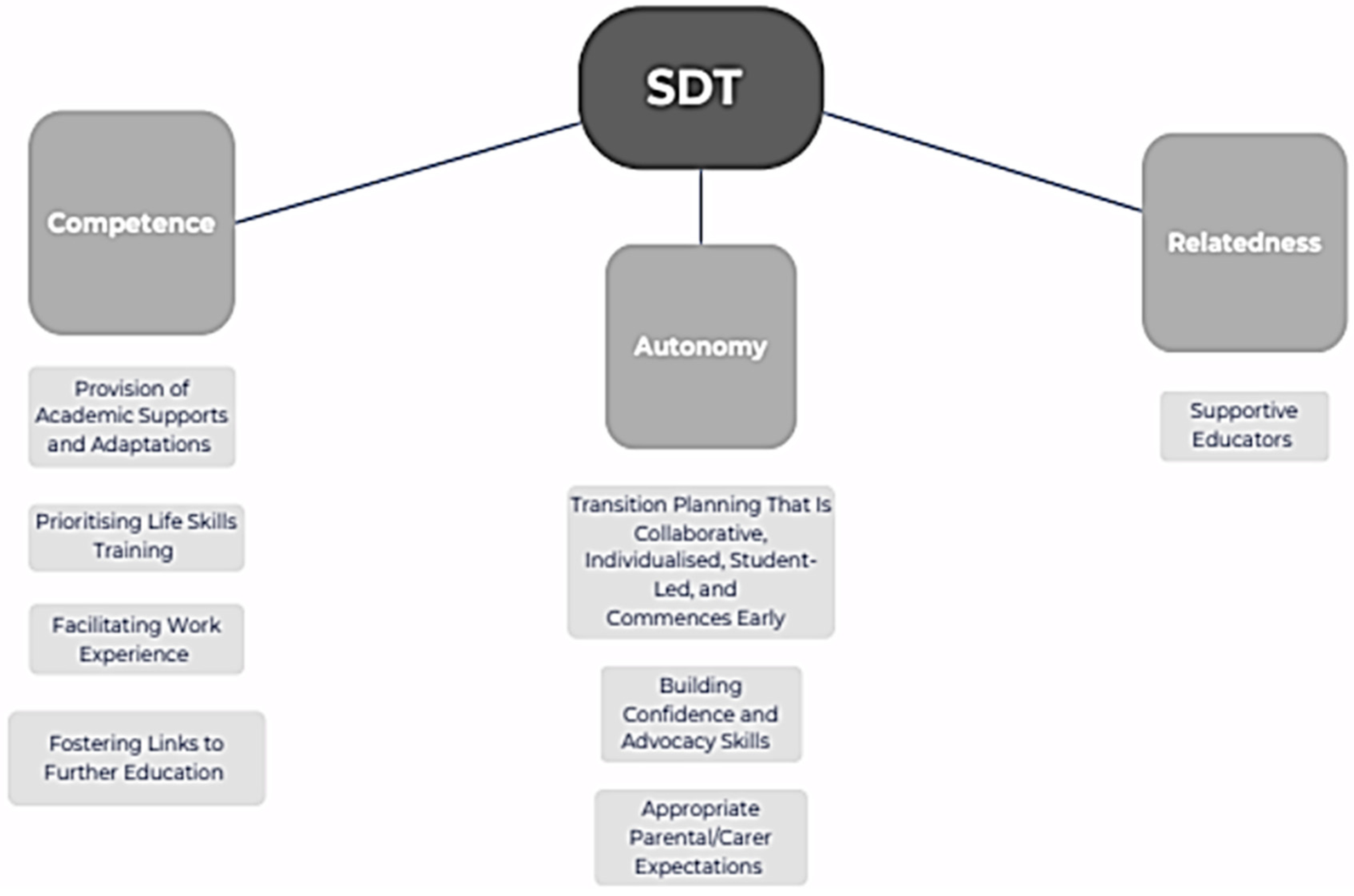
The findings are presented as they relate to the research questions posited by the study, with specific participant quotes exemplifying the presented themes. Themes generated for research question 1 are presented in Figure 1.
Figure 1.
Themes generated in response to research question 1.
3.1. How Is the Need to Accomplish Competence Fulfilled Through Inclusive Schooling?
The most common theme derived from interviews were participant descriptions of how schools could best address the need to develop the competence of autistic young people for transition. Whilst participants recounted both positive and negative examples of how this occurred in schools, four subthemes highlighted key strategies: providing academic supports and adaptations, prioritising life skill training, facilitating work experience, and fostering links to further education.
3.1.1. Provision of Academic Supports and Adaptations
The most frequently mentioned strategy to fulfil the need for competence was through the provision of tailored and responsive academic supports and adaptations in the classroom, predominantly during exams. All stakeholder groups provided examples of provisions they considered to be effective, with Young Person 8 expressing ‘I get provisions in all my tests, so I get small groups, extra time, rest breaks… if it’s an essay or something I will get a scaffold to write out stuff on it so that my brain can process, I can understand what I actually have to write.’
3.1.2. Prioritising Life Skill Training
Participants in each stakeholder group identified the importance of teaching practical life skills, such as catching a train, managing money transactions, communication, and social skills; however, the schools’ focus on this was considered inadequate.
One educator explained that schools should support autistic young people with skills that are required for daily living after school: ‘What are the skills you need for leaving school? How are you going to communicate? How are you going to ask for help? How you’re going to count up so you get the right change?’—Educator 7
A few young people spoke poignantly about their needs for life skill training and the shortcomings of their school experience, with one likening their school-life to a ‘giant game’ where ‘everybody knows the rules except me’ (Young Person 9). Another expressed feeling they had been ‘thrown out into the world’ at the end of their schooling (Young Person 1). Furthermore, Young Person 10 noted that adequate support had been available at school for students who were struggling academically, but that their ‘academics were never the issue, it was always—social, so they didn’t help me at all.’
3.1.3. Facilitating Work Experience
Providing access to work experience while in school was highly valued to meet the need for competence. The barriers young autistic people face in securing part-time work while still at school were also highlighted. One educator stated ‘There’s such a need around looking at creating sort of those part-time jobs while you’re still at school…because they miss out on a lot of those sort of soft skills and those opportunities.’—Educator 13
Educators were able to provide numerous examples of work experience and their commitment to, and the importance of, facilitating these experiences: ‘We try to give the kids the opportunities here to have some in-school work experience in small work crews, and just learning, working with other people and putting trust in each other. And then basically, when they get skills and a little bit of the trust and also some confidence, then getting them to do some work experience out of school.’—Educator 3
Interestingly, while parents/carers and young people valued work experience, they were keen for the work experience to be more tailored to the goals, interests, and capacities of the young person as there were only limited opportunities provided, mostly in the areas of retail and hospitality. Young Person 5 expressed frustration at the lack of diversity in work experience opportunities: ‘I feel like if I keep on doing cafes for work experience, that’s not really giving me a variety.’ One parent/carer indicated that the autistic young person in their life had not enjoyed taking part in vocational training at all, noting that ‘as part of the school journey it’s important to discover what they like… to allow them to like something that’s important to them’ (Parent/Carer 1).
3.1.4. Fostering Links to Further Education
The school’s capacity to provide links to further education was also valued to meet autistic young peoples’ need for competence through transition. This included links to vocational training through Technical and Further Education (TAFE) or private colleges, as well as links to universities. Silos between the sectors were apparent, with the reliance on a diagnosis as the mechanism to gain support in the next educational setting. This was summarised by an educator who had told their students ‘it’s a label and it’s not great to have a label, but sometimes a label gets you the supports you need’ (Educator 8)
Completing tertiary education courses whilst still at school was generally viewed as a positive experience: ‘I did TAFE and I did my hair, the hair course, loved it, I loved it so much, it was so much fun.’—Young Person 8
Educators advocated for a more robust transition to further vocational education following school, with one stating
…if there was some kind of transition to TAFE programme. That would be amazing, because even navigating TAFE in general is pretty much a nightmare. Like what programs are available each semester, it just changes and so it’s very hard to recommend programs to students because they just change all the time.—Educator 12
3.2. How Is the Need to Accomplish Autonomy Fulfilled in Inclusive Schooling?
Whilst discussions about autonomy did not attract as much attention as competence, participants elucidated that schools could best address autistic young peoples’ need for autonomy via three key strategies: transition planning, building students’ confidence and advocacy skills, and (according to educators) parents/carers having appropriate expectations for their child.
3.2.1. Transition Planning That Is Collaborative, Individualised, and Student-Led and Commences Early
Educators highlighted the value of transition planning to support autonomy, in particular transition planning that is collaborative, tailored to the individual, and led by the student and commences in early high school. Educator 13 emphasised the importance of involving the family in the transition plan to strengthen collaborative decision-making about ‘This is where we want to go, this is Plan A, Plan B, Plan C, How are we going to get there? and everyone’s sort of working towards what sort of pathway.’ Educator 3 championed that ‘the most important part is listening to the student… Because if they don’t have ownership of it, they’re not going to basically follow that goal,’ while Educator 5 shared a similar sentiment: ‘the student is centre and foremost at those conversations, it is about them and try and have the student articulate what they want. Not what the parent wants, what the student wants.’ Young Person 9 stressed that transition planning must be individualised: ‘It’s understanding that there are different types of disabilities and different types of disabilities need different types of support…It’s like you know, funnelling through a tunnel and you have to—it’s a tall, box tunnel, you’re not that shape.’
3.2.2. Building Confidence and Advocacy Skills
Educators in particular spoke of the importance of building confidence, independence, and self-advocacy skills in the autistic young person during the transition to post-school life. Statements such as ‘teaching young people how to advocate for themselves as well is very important.’ (Educator 13) and ‘…make them feel good about themselves … That their voice is as equal as everyone else’s in this school. And no opportunity is missed, they’ve got equal opportunities as everyone else.’ (Educator 3) express recognition that bolstering confidence and self-advocacy skills in autistic young people is an important part of an educator’s role during the transition process.
One parent/carer also conveyed the value in achieving confidence and independence and believed this was possible through establishment of secure relationships with compassionate supports:
A highly skilled compassionate support worker who he’d built up a really strong rapport with, and was able to start talking about his struggles and hopes and goals. And that would assist him to get back out there into society, to [disability programs], back to TAFE, and he could build that confidence up, and independence.—Parent/Carer 8
3.2.3. Appropriate Parental/Carer Expectations
Educators placed emphasis on the role of parent/carer expectations as a core determinant in achieving autonomy, as indicated by Educator 11: ‘The most successful transitions are the ones where the parents are on top of things early as possible. And have realistic, high expectations.’
Interestingly, some educators believed that parent/carer expectations were too low, or they were too reluctant to allow opportunities for young people to build their independence, noting that this may lead to diminished independence and opportunity for the autistic young people in their care:
The penny doesn’t drop until often after school, or Year 12, and they realise, oh, this student is too dependent on me. And it doesn’t necessarily have to happen. Some of our guys have certainly the capacity—especially with autism when there’s no intellectual disability to cross roads, catch buses, catch trains with the right learning set up. But parents are often very, very reluctant to allow that step to happen. And they become not as independent as they possibly could be. What that does is limit their opportunities.—Educator 11
I think a big barrier for parents as well is just wanting to protect their kids as well. So, often, …they’re trying, yeah, to kind of protect them from bad experiences. So sometimes it’s just most comfortable for their children to be home, or to be doing something that’s non-threatening.—Educator 12
In contrast, some educators reported parent/carer expectations to be too high:
You know, you need to know where you’re going. Even if you know, for some of our kids, they want to join the Police Force and it’s not realistic … They say, that’s fine. It’s good to have your goals. We don’t want to question any of your goals, but let’s have a plan B and C.—Educator 8
The [student’s] expectations sometimes are lower than the parents, but I think they’re more realistic in some ways.—Educator 5
A few parents/carers spoke about the value of holding high expectations for their child’s autonomy, both in principle and through the practice applied in the classroom:
So hold on to your loved one’s dream… rather than chipping it down, because you are forced to chip away at your young person’s dreams. So hold onto the hope. We need a society that dreams big for our young people as well, and believes that they can, and they should, and they will.—Parent/Carer 8
3.3. How Is the Need to Accomplish Relatedness with Others Fulfilled in Inclusive Schooling?
Whilst SDT prioritises the need to feel socially connected, interviewees did not place relative emphasis on the school’s role in supporting autistic young peoples’ capacity to forge relationships with peers. Cultivating social skills was cast as an area for meeting competence needs; however, only the theme of ‘supportive educators’ pertained to meeting the need for relatedness.
Supportive Educators
Educators’ care and concern towards autistic young people was viewed as an important foundation, with one educator explaining ‘I think that teachers are very protective of students with disabilities’ (Educator 1). A number of specialist educators—including careers advisors, school counsellors, learning support officers, and transition support teachers—were seen as central to supporting the transition of autistic young people: ‘there’s a whole lot of people that need to play in this space’ (Educator 13). Two young people highlighted the strength of these relationships and, in one particular case, how these relationships transcended their difficult experience at school:
I also talked to the school counsellor a fair bit. She was really… lovely. She was able to help me a fair bit … There were good moments in the shit show.—Young Person 10
Whilst the importance of positive relationships and support from a range of educators was signalled, the inconsistency in educator’s roles was apparent, as demonstrated by two opposing descriptions of the involvement of careers advisors:
The careers advisor doesn’t do a lot with our support unit. A lot of their stuff is with mainstream.—Educator 11
Engaging with a career’s adviser kind of Year 10 and onwards is excellent, because you can gain access to programs and plan as much as you can in advance.—Educator 12
3.4. Are the Views of Autistic Young People, Parents/Carers and Educators Aligned or Divergent?
The SDT construct of competence attracted the highest number of references (n = 73) compared to relatedness (n = 17) and autonomy (n = 18). The largest number of references for each of the SDT constructs was made by educators. Educators made more than three-quarters of the references to the construct of autonomy, and over 50% of the references to competence and relatedness, even though they represented only 30% of the transcripts. Autistic young people made around one-third of the references to competence and relatedness, but only one single reference to autonomy. Parents/carers represented the smallest stakeholder group, making most of their references to competence, with only two references to each of the constructs of relatedness and autonomy. Autonomy attracted the highest number of comments from educators, who cited concerns about inappropriate parent/carer expectations and poor links to further education. Relatedness attracted attention from autistic young people, where they advocated for supportive educators. A summary of counts is shown in Table 1.
Table 1.
Counts of SDT construct references within transcripts across the stakeholder groups.
Participants expressed both satisfaction and dissatisfaction regarding the ways in which mainstream schools had fulfilled autistic young peoples’ needs for competence, autonomy, and relatedness. Autistic young people focused most on the accomplishment of competence and expressed concern over poor life skill training and work experience. Interestingly, there was very little focus on accomplishing autonomy, with only one reference made to this construct. The comments of parents/carers focused more on competence, with the inadequacy of work experience being a concern.
4. Discussion
Given the alarmingly low rates of participation in employment and further education experienced by autistic people (Australian Bureau of Statistics, 2018), it is paramount to investigate what inclusive school supports may bolster their successful transition to adult life. The current qualitative study advances knowledge in this context by applying a novel, strengths-based approach to this inquiry. Firstly, it captures the perspective of a range of stakeholders who have direct experience with the mainstream school environment preparing autistic young people to transition out of school: autistic young people themselves, educators, and parent/carers. Moreover, this phenomenon is framed within self-determination theory (Deci & Ryan, 2015), in order to understand how school supports might assist autistic young people in meeting three basic psychological needs—competence, autonomy and relatedness (Deci & Ryan, 2015)—to enhance their transition readiness and subsequent attainment of positive life outcomes.
The findings reveal that inclusive schools have an important role to play in supporting autistic young people to meet their needs for competence, autonomy, and relatedness. Strategies to fulfil the need for competence garnered the most attention, which some may argue is not surprising given the widely held views about the primary purpose of schooling. Four main strategies were promoted by participants: the provision of academic supports and adaptations; prioritising life skill training; facilitating work experience; and fostering links to further education. The school personnel interviewed by Wong et al. (2020) similarly identified that the willingness and capacity of schools to provide necessary supports and adaptations is critical for successful transition. The findings of the literature review of G. K. Lee and Carter (2012) corroborate the current findings, highlighting the importance of work experience and social and employment-related skills.
Despite recent studies highlighting the importance of self-determination for autistic young people (G. K. Lee & Carter, 2012; Tomaszewski et al., 2022), the related SDT construct of autonomy received minimal attention compared to competence needs. Three primary strategies were recommended by participants. These included early transition planning that is collaborative, individualised and student-led; building confidence and advocacy skills; and appropriate parental/carer expectations from the perspective of educators.
The views of educators about inappropriate parental expectations may signal a barrier to effective transitions, as research attests that the alignment of family expectations with that of school personnel is critical (G. K. Lee & Carter, 2012; Wong et al., 2020). Strong collaboration between parents and schools plays a pivotal role in effectively navigating the transition out of school (L. M. White et al., 2025), yet Rabba et al. (2025) found that mothers of autistic children feel in a constant battle with their child’s school, being treated as the problem. With positive parent expectations found to be a predictor of positive post school outcomes (Mazzotti et al., 2016), school personnel may benefit from understanding and collaborating with parents/carers in this area. While family-centred practice is common in the early years (Fordham & Johnston, 2023), perhaps the transition out of school could be strengthened by the adoption of these principles.
Participants discussed how inclusive schools could help autistic young people to fulfil their need for relatedness; however, it did not attract the same attention as fulfilling the need for competence. Interestingly, peer relationships did not emerge as a theme despite research attesting to the challenges and importance of peer social connections in this critical period (Feldman et al., 2022; Lamash et al., 2020). Perhaps, when asked to discuss the transition to adulthood, friendships and peer belonging were not central but, rather, how supportive educators could collaborate to help the autistic young person fulfil their need for competence was. This aligns with the observation that peer relationships were not identified as a theme in previous research focusing on the transition to employment (G. K. Lee & Carter, 2012; Wong et al., 2020). Nonetheless, supportive educators within the school environment were highly valued.
Interestingly, whilst SDT advocates that individuals strive to achieve competence, autonomy and relatedness, all participant groups placed less emphasis on how inclusive schooling fulfils the need for relatedness and autonomy. This finding may represent the needs of autistic students, or the low expectations participants have of inclusive schooling to fulfil the needs of autistic students beyond enhancing competence. More research is needed to understand the relevance of SDT for autistic people who experience differences in social engagement with others (World Health Organization, 2023) and lower levels of self-determination than non-autistic peers (Andrews et al., 2024). It is critical that theory is constructed in consideration of neurodivergent populations who have traditionally been locked out of research.
Whilst this novel study advances our knowledge and gives voice to people with direct experience of the phenomenon, it is not without its shortcomings. Firstly, the recruitment process relied on purposive sampling, where interviewees volunteered to participate; it is likely that their perspectives may differ from those of others who did not choose to participate. Furthermore, student characteristics such as socio-economic status and ethnicity affect the school supports provided (Eilenberg et al., 2019) above and beyond a diagnosis of autism, meaning that it is too simplistic to categorise the experience of autistic young people as a shared experience. Secondly, given the inequitable life outcomes faced by autistic young people, this study endeavoured to understand what school-based strategies can meet their needs as they prepare for transition. It is possible that these needs and the usefulness of the suggested strategies are not unique and may apply to all young people; however, a comparative analysis was not the focus of this study and, thus, this aspect remains unexplored. If this is the case, these recommendations align with universal design, whereby all students may benefit from these supports within inclusive education. Finally, this study was focused primarily on autistic young people who are supported within an inclusive school setting and within the context of school-based supports and resources. It therefore was not intended to capture the experiences of autistic students with higher support needs who receive substantial supports outside of school, such as those provided under the NDIS.
In conclusion, this study applied the strengths-based self-determination theory to elucidate how inclusive schools can fulfil the competence, autonomy, and relatedness needs of autistic young people as they transition out of school. The experiences of autistic young people, educators, and parents/carers with direct experience of the phenomenon enable us to provide recommendations for practice and school supports, which centre on not only what schools should prioritise (e.g., transition planning, life skill training, academic supports and adaptations, confidence and advocacy skills), but also how to approach such priorities (e.g., collaborative, individualised, student-led, and early transition planning; relational-led support with supportive educators). Finally, schools are not islands beholden to the challenges and solutions for transition. Collaboration with young people, their parents/carers, workplaces, and further education institutions is imperative, as is the continued investigation into how to strengthen these environments and processes to support successful transitions.
Author Contributions
Conceptualization, D.T., N.S. and C.M.; Methodology, D.T., N.S. and C.M.; Formal analysis, D.T., S.N. and C.M.; Investigation, D.T., N.S., S.N. and C.M.; Writing—original draft, D.T. and S.N.; Writing—review and editing, N.S. and C.M.; Project administration, D.T., N.S. and C.M.; Funding acquisition, D.T., N.S. and C.M. All authors have read and agreed to the published version of the manuscript.
Funding
This research was funded by Northcott Disability Services.
Institutional Review Board Statement
The study was conducted in accordance with the Declaration of Helsinki and approved by the Western Sydney University Human Research Ethics Committee (protocol code H13884, 23 July 2020).
Informed Consent Statement
Informed consent was obtained from all subjects involved in the study.
Data Availability Statement
The datasets generated and analysed during the current study are not publicly available due the qualitative nature of this work and the risk that a participant may be identifiable through their interview transcript.
Acknowledgments
The authors thank the participants of the study and Northcott Disability Services for funding and supporting the research.
Conflicts of Interest
The authors declare no conflicts of interest.
References
- Adeoye-Olatunde, O. A., & Olenik, N. L. (2021). Research and scholarly methods: Semi-structured interviews. Journal of the American College of Clinical Pharmacy, 4(10), 1358–1367. [Google Scholar] [CrossRef] [Scilit]
- American Psychiatric Association. (2013). Autism spectrum disorder. Available online: https://www.psychiatry.org/File%20Library/Psychiatrists/Practice/DSM/APA_DSM-5-Autism-Spectrum-Disorder.pdf (accessed on 8 December 2025).
- Andrews, H. E., Hedley, D., & Bury, S. M. (2024). The relationship between autistic traits and quality of life: Investigation of indirect effects through self-determination. Autism in Adulthood, 6(2), 177–191. [Google Scholar] [CrossRef] [Scilit]
- Ashburner, J. K., Bobir, N. I., & van Dooren, K. (2018). Evaluation of an innovative interest-based post-school transition programme for young people with autism spectrum disorder. International Journal of Disability, Development, and Education, 65(3), 262–285. [Google Scholar] [CrossRef] [Scilit]
- Assarroudi, A., Heshmati Nabavi, F., Armat, M. R., Ebadi, A., & Vaismoradi, M. (2018). Directed qualitative content analysis: The description and elaboration of its underpinning methods and data analysis process. Journal of Research in Nursing: JRN, 23(1), 42–55. [Google Scholar] [CrossRef] [Scilit]
- Australian Bureau of Statistics. (2018). Disability, ageing and carers, Australia: Summary of findings. ABS. Available online: https://www.abs.gov.au/statistics/health/disability/disability-ageing-and-carers-australia-summary-findings/latest-release (accessed on 4 September 2025).
- Australian Government Department of Education, Skills and Employment. (2020). Final report of the 2020 review of the disability standards for education 2005. Australian Government Department of Education, Skills and Employment. [Google Scholar]
- Bailey, J., Parsons, O. E., Baron-Cohen, S., & Baker, S. T. (2022). A pilot study of autistic and non-autistic adults’ systemizing in a learning task using observational measures of attention, misunderstanding, and reasoning. Cambridge Educational Research e-Journal, 9, 1–16. [Google Scholar] [CrossRef]
- Block, M., Whaley, D., Johnson, M., & Judge, J. (2022). Utilizing self-determination theory to promote physical activity in individuals with autism spectrum disorder. Palaestra, 36, 52. [Google Scholar]
- Borsotti, V., Begel, A., & Bjørn, P. (2024). Neurodiversity and the accessible university: Exploring organizational barriers, access labor and opportunities for change. Proceedings of the ACM on Human-Computer Interaction, 8(CSCW1), 172. [Google Scholar] [CrossRef] [Scilit]
- Braun, V., & Clarke, V. (2013). Successful qualitative research: A practical guide for beginners. Sage Publications Ltd. [Google Scholar]
- Carter, S. M. (2006, December 10–13). Longitudinal qualitative research design: Experience over time. ACSPRI Social Science Methodology Conference, Sydney, Australia. [Google Scholar]
- Cassidy, S. A., Gould, K., Townsend, E., Pelton, M., Robertson, A. E., & Rodgers, J. (2020). Is camouflaging autistic traits associated with suicidal thoughts and behaviours? Expanding the interpersonal psychological theory of suicide in an undergraduate student sample. Journal of Autism and Developmental Disorders, 50(10), 3638–3648. [Google Scholar] [CrossRef] [Scilit]
- Chandroo, R., Strnadová, I., & Cumming, T. M. (2020). Is it really student-focused planning? Perspectives of students with autism. Research in Developmental Disabilities, 107, 103783. [Google Scholar] [CrossRef] [Scilit]
- Colorafi, K. J., & Evans, B. (2016). Qualitative descriptive methods in health science research. HERD: Health Environments Research & Design Journal, 9(4), 16–25. [Google Scholar] [CrossRef] [Scilit]
- Cook, A. (2024). Conceptualisations of neurodiversity and barriers to inclusive pedagogy in schools: A perspective article. Journal of Research in Special Educational Needs, 24(3), 627–636. [Google Scholar] [CrossRef] [Scilit]
- Cooper, K., Burnley, A., Allain, L., Beresford, B., Crane, L., Vazquez Morales, M., Portway, L., Redmayne, B., Russell, A., & Mandy, W. (2024). Autism Transition to Adulthood Groups (ATAG): Protocol for a feasibility RCT of a new peer-group intervention to promote successful transition to adulthood for autistic young people. BMJ Open, 14(11), e089802. [Google Scholar] [CrossRef] [Scilit]
- Crespi, B. J. (2016). Autism as a disorder of high intelligence. Frontiers in Neuroscience, 10, 300. [Google Scholar] [CrossRef] [Scilit]
- Creswell, J. W., & Creswell, J. D. (2023). Research design: Qualitative, quantitative, and mixed methods approaches (6th ed.). SAGE Publications, Inc. [Google Scholar]
- Deci, E. L., & Ryan, R. M. (2015). Self-determination theory. In International encyclopedia of the social & behavioral sciences (2nd ed., pp. 486–491). Elsevier Ltd. [Google Scholar]
- Department for Education & Department of Health. (2015). Special educational needs and disability code of practice: 0 to 25 years. UK Government. Available online: https://www.gov.uk/government/publications/send-code-of-practice-0-to-25 (accessed on 8 December 2025).
- Edwards, C., Cai, R. Y., Love, A., White, L. M., Harris, K., Brooker, K., Kendall, E., & Gibbs, V. (2025). Beyond the “service cliff”: Experiences of an inclusive postschool transition program for autistic youth with intellectual disability. Advances in Autism, 11(4), 385–399. [Google Scholar] [CrossRef] [Scilit]
- Eilenberg, J. S., Paff, M., Harrison, A. J., & Long, K. A. (2019). Disparities based on race, ethnicity, and socioeconomic status over the transition to adulthood among adolescents and young adults on the autism spectrum: A systematic review. Current Psychiatry Reports, 21(5), 32. [Google Scholar] [CrossRef] [Scilit]
- Emberti Gialloreti, L., Mazzone, L., Benvenuto, A., Fasano, A., Alcon, A. G., Kraneveld, A., Moavero, R., Raz, R., Riccio, M. P., Siracusano, M., Zachor, D. A., Marini, M., & Curatolo, P. (2019). Risk and protective environmental factors associated with autism spectrum disorder: Evidence-based principles and recommendations. Journal of Clinical Medicine, 8(2), 217. [Google Scholar] [CrossRef] [Scilit]
- Feldman, M., Hamsho, N., Blacher, J., Carter, A. S., & Eisenhower, A. (2022). Predicting peer acceptance and peer rejection for autistic children. Psychology in the Schools, 59(11), 2159–2182. [Google Scholar] [CrossRef] [Scilit]
- Fife, W. (2020). The importance of counting for qualitative research. In Counting as a qualitative method (pp. 121–128). Springer International Publishing. [Google Scholar]
- Finkelstein, V. (2001). The social model of disability repossessed (pp. 1–5). Manchester Coalition of Disabled People. [Google Scholar]
- Fisher, M. H., Athamanah, L. S., Sung, C., & Josol, C. K. (2020). Applying the self-determination theory to develop a school-to-work peer mentoring programme to promote social inclusion. Journal of Applied Research in Intellectual Disabilities, 33(2), 296–309. [Google Scholar] [CrossRef] [Scilit]
- Fordham, L., & Johnston, C. (2023). Family-centred practice for inclusive early years education. In K. Cologon, & Z. Mevawalla (Eds.), Inclusive education in the early years: Right from the start (2nd ed., pp. 387–401). Oxford University. [Google Scholar]
- Goldfarb, Y., Golan, O., & Gal, E. (2023). A self-determination theory approach to work motivation of autistic adults: A qualitative exploratory study. Journal of Autism and Developmental Disorders, 53(4), 1529–1542. [Google Scholar] [CrossRef] [Scilit]
- Haar, T., Brownlow, C., Hall, G., Heyworth, M., Lawson, W., Poulsen, R., Reinisch, T., & Pellicano, E. (2024). “We have so much to offer”: Community members’ perspectives on autism research. Autism, 29(9), 2254–2267. [Google Scholar] [CrossRef] [Scilit]
- Happe, F., & Frith, U. (2006). The weak coherence account: Detail-focused cognitive style in autism spectrum disorders. Journal of Autism and Developmental Disorders, 36(1), 5–25. [Google Scholar] [CrossRef] [Scilit]
- Hatfield, M., Murray, N., Ciccarelli, M., Falkmer, T., & Falkmer, M. (2017). Pilot of the BOOST-A™: An online transition planning program for adolescents with autism. Australian Occupational Therapy Journal, 64(6), 448–456. [Google Scholar] [CrossRef] [Scilit]
- Hendricks, D. R., & Wehman, P. (2009). Transition from school to adulthood for youth with autism spectrum disorders: Review and recommendations. Focus on Autism and Other Developmental Disabilities, 24(2), 77–88. [Google Scholar] [CrossRef] [Scilit]
- IDEA. (2004). Individuals with disabilities education improvement act of 2004, pub. L. No. 108–446, 118 stat. 2647. Available online: https://www.congress.gov/108/plaws/publ446/PLAW-108publ446.pdf (accessed on 8 December 2025).
- Kunda, M., & Goel, A. K. (2011). Thinking in pictures as a cognitive account of autism. Journal of Autism and Developmental Disorders, 41(9), 1157–1177. [Google Scholar] [CrossRef] [Scilit]
- Lai, M., Lombardo, M. V., & Baron-Cohen, S. (2014). Autism. The Lancet (British Edition), 383(9920), 896–910. [Google Scholar] [CrossRef] [Scilit]
- Lamash, L., Bedell, G., & Josman, N. (2020). Participation patterns of adolescents with autism spectrum disorder compared to their peers: Parents’ perspectives. The British Journal of Occupational Therapy, 82(2), 78–87. [Google Scholar] [CrossRef] [Scilit]
- Leadbitter, K., Buckle, K. L., Ellis, C., & Dekker, M. (2021). Autistic self-advocacy and the neurodiversity movement: Implications for autism early intervention research and practice. Frontiers in Psychology, 12, 635690. [Google Scholar] [CrossRef] [Scilit]
- Lee, E. A. L., Black, M. H., Tan, T., Falkmer, T., & Girdler, S. (2019). “I’m destined to ace this”: Work experience placement during high school for individuals with autism spectrum disorder. Journal of Autism and Developmental Disorders, 49(8), 3089–3101. [Google Scholar] [CrossRef] [Scilit]
- Lee, E. A. L., Scott, M., Black, M. H., D’Arcy, E., Tan, T., Sheehy, L., Bölte, S., & Girdler, S. (2024). “He sees his autism as a strength, not a deficit now”: A Repeated cross-sectional study investigating the impact of strengths-based programs on autistic adolescents. Journal of Autism and Developmental Disorders, 54, 1656–1671. [Google Scholar] [CrossRef] [Scilit]
- Lee, G. K., & Carter, E. W. (2012). Preparing transition-age students with high-functioning autism spectrum disorders for meaningful work: School-to-work transition for students with HFASD. Psychology in the Schools, 49, 988–1000. [Google Scholar] [CrossRef] [Scilit]
- Lincoln, Y. S., Guba, E. G., & Pilotta, J. J. (1985). Naturalistic inquiry. Sage Publications. [Google Scholar]
- Maenner, M. J., Warren, Z., Williams, A. R., Amoakohene, E., Bakian, A. V., Bilder, D. A., Durkin, M. S., Fitzgerald, R. T., Furnier, S. M., Hughes, M. M., Ladd-Acosta, C. M., McArthur, D., Pas, E. T., Salinas, A., Vehorn, A., Williams, S., Esler, A., Grzybowski, A., Hall-Lande, J., … Shaw, K. A. (2023). Prevalence and characteristics of autism spectrum disorder among children aged 8 years—Autism and developmental disabilities monitoring network, 11 sites, United States, 2020. MMWR Surveillance Summaries, 72(2), 1–14. [Google Scholar] [CrossRef] [Scilit]
- Maxwell, J. A. (2010). Using numbers in qualitative research. Qualitative Inquiry, 16(6), 475–482. [Google Scholar] [CrossRef] [Scilit]
- Mazzotti, V. L., Rowe, D. A., Sinclair, J., Poppen, M., Woods, W. E., & Shearer, M. L. (2016). Predictors of post-school success: A systematic review of NLTS2 secondary analyses. Career Development and Transition for Exceptional Individuals, 39(4), 196–215. [Google Scholar] [CrossRef] [Scilit]
- Mills, C., Sharp, N. L., Triandafilidis, Z., & Tracey, D. K. (2022). Thrown out into the world’: Transition to post schooling for autistic young people. Western Sydney University. [Google Scholar]
- Mirenda, P., Zaidman-Zait, A., Cost, K. T., Smith, I. M., Zwaigenbaum, L., Duku, E., Kerns, C., Georgiades, S., Vaillancourt, T., Elsabbagh, M., Bennett, T., & Szatmari, P. (2024). Educators describe the “best things” about students with autism at school. Journal of Autism and Developmental Disorders, 54(1), 1–17. [Google Scholar] [CrossRef] [Scilit]
- Morgan, D. L. (1993). Qualitative content analysis: A guide to paths not taken. Qualitative Health Research, 3(1), 112–121. [Google Scholar] [CrossRef] [Scilit]
- National Disability Insurance Scheme (NDIS). (2024). NDIS website. Available online: https://www.ndis.gov.au/ (accessed on 21 May 2025).
- Neuendorf, K. A. (2016). Defining content analysis. In The content analysis guidebook. SAGE Publications, Incorporated. [Google Scholar]
- Nguyen, L., Jack, S., Ketelaar, M., Di Rezze, B., Soper, A. K., & Gorter, J. W. (2020). Understanding the essential components and experiences of youth with autism spectrum disorders in peer mentorship programmes during the transition to adulthood: A qualitative meta-ethnography. Child: Care, Health & Development, 46(6), 667–681. [Google Scholar] [CrossRef] [Scilit]
- Nind, M., & Strnadová, I. (2020). Changes in the lives of people with profound intellectual and multiple disabilities. In Belonging for people with profound intellectual and multiple disabilities (pp. 1–22). Routledge. [Google Scholar]
- Rabba, A. S., Smith, J., Hall, G., Alexander, V., Batty, K., Datta, P., Goodall, E., Heyworth, M., Lamb, S., Lawson, W., Lilley, R., Reid, K., Syeda, N., & Pellicano, E. (2025). ‘I’m sick of being the problem’: Autistic mothers’ experiences of interacting with schools for their autistic children. Autism: The International Journal of Research and Practice, 29(4), 1034–1046. [Google Scholar] [CrossRef] [Scilit]
- Roux, A. M., Rast, J. E., Anderson, K. A., Garfield, T., & Shattuck, P. T. (2021). Vocational rehabilitation service utilization and employment outcomes among secondary students on the autism spectrum. Journal of Autism and Developmental Disorders, 51(1), 212–226. [Google Scholar] [CrossRef] [Scilit]
- Ryan, R. M., & Deci, E. L. (2000). Self-determination theory and the facilitation of intrinsic motivation, social development, and well-being. The American Psychologist, 55(1), 68–78. [Google Scholar] [CrossRef]
- Schall, C., Wehman, P., & McDonough, J. L. (2012). Transition from school to work for students with autism spectrum disorders: Understanding the process and achieving better outcomes. The Pediatric Clinics of North America, 59(1), 189–202. [Google Scholar] [CrossRef] [Scilit]
- Seligman, M. E. P., & Csikszentmihalyi, M. (2000). Positive psychology: An introduction. The American Psychologist, 55(1), 5–14. [Google Scholar] [CrossRef]
- Shkedy, G., Shkedy, D., Sandoval-Norton, A., & Fantaroni, G. (2020). Visual communication analysis (VCA): Applying self-determination theory and research-based practices to autism. Cogent Psychology, 7(1), 1803581. [Google Scholar] [CrossRef] [Scilit]
- Soorya, L. V., Siper, P. M., Beck, T., Soffes, S., Halpern, D., Gorenstein, M., Kolevzon, A., Buxbaum, J., & Wang, A. T. (2015). Randomized comparative trial of a social cognitive skills group for children with autism spectrum disorder. Journal of the American Academy of Child and Adolescent Psychiatry, 54(3), 208–216.e1. [Google Scholar] [CrossRef] [Scilit]
- Stephens, S. B., Raphael, J. L., Zimmerman, C. T., Garland, B. H., de Guzman, M. M., Walsh, S. M., Hergenroeder, A. C., & Wiemann, C. M. (2021). The utility of self-determination theory in predicting transition readiness in adolescents with special healthcare needs. Journal of Adolescent Health, 69(4), 653–659. [Google Scholar] [CrossRef] [Scilit]
- Taylor, E. C., Livingston, L. A., Clutterbuck, R. A., Callan, M. J., & Shah, P. (2023). Psychological strengths and well-being: Strengths use predicts quality of life, well-being and mental health in autism. Autism: The International Journal of Research and Practice, 27(6), 1826–1839. [Google Scholar] [CrossRef] [Scilit]
- Tomaszewski, B., Klinger, L. G., & Pugliese, C. E. (2022). Self-determination in autistic transition-aged youth without intellectual disability. Journal of Autism and Developmental Disorders, 52(9), 4067–4078. [Google Scholar] [CrossRef] [Scilit]
- Valentin, C. R., & Zanuttini, J. Z. (2025). Parents’ insights on post-transition support for students on the autism spectrum in secondary schools. Australasian Journal of Special and Inclusive Education, 49(2), 111–125. [Google Scholar] [CrossRef] [Scilit]
- van der Cruijsen, R., & Boyer, B. E. (2021). Explicit and implicit self-esteem in youth with autism spectrum disorders. The International Journal of Research and Practice, 25(2), 349–360. [Google Scholar] [CrossRef] [Scilit]
- van Heijst, B. F., & Geurts, H. M. (2015). Quality of life in autism across the lifespan: A meta-analysis. Autism, 19(2), 158–167. [Google Scholar] [CrossRef] [Scilit]
- Webster, A., Bruck, S., & Saggers, B. (2022). Supporting self-determination of autistic students in transitions. Research in Developmental Disabilities, 128, 104301. [Google Scholar] [CrossRef] [Scilit]
- Westbrook, J. D., Fong, C. J., Nye, C., Williams, A., Wendt, O., & Cortopassi, T. (2015). Transition services for youth with autism: A systematic review. Research on Social Work Practice, 25(1), 10–20. [Google Scholar] [CrossRef] [Scilit]
- White, L. M., Adams, D., Simpson, K., & Malone, S. A. (2025). Transitioning on from secondary school for autistic students: A systematic review. Autism in Adulthood, 7(4), 386–402. [Google Scholar] [CrossRef] [Scilit]
- White, L. M., Simpson, K., Malone, S., & Adams, D. (2024). Autistic adults’ reflections on what supported their transitioning from secondary school. Education Sciences, 14(6), 576. [Google Scholar] [CrossRef] [Scilit]
- White, S. W., Elias, R., Capriola-Hall, N. N., Smith, I. C., Conner, C. M., Asselin, S. B., Howlin, P., Getzel, E. E., & Mazefsky, C. A. (2017). Development of a college transition and support program for students with autism spectrum disorder. Journal of Autism and Developmental Disorders, 47(10), 3072–3078. [Google Scholar] [CrossRef] [Scilit]
- White, S. W., Smith, I. C., Miyazaki, Y., Conner, C. M., Elias, R., & Capriola-Hall, N. N. (2021). Improving transition to adulthood for students with autism: A randomized controlled trial of STEPS. Journal of Clinical Child and Adolescent Psychology, 50(2), 187–201. [Google Scholar] [CrossRef] [Scilit]
- Wong, J., Cohn, E. S., Coster, W. J., & Orsmond, G. I. (2020). “Success doesn’t happen in a traditional way”: Experiences of school personnel who provide employment preparation for youth with autism spectrum disorder. Research in Autism Spectrum Disorders, 77, 101631. [Google Scholar] [CrossRef] [Scilit]
- World Health Organization (WHO). (2023). Autism. Available online: https://www.who.int/news-room/questions-and-answers/item/autism-spectrum-disorders-(asd) (accessed on 11 March 2025).
- Zeidan, J., Fombonne, E., Scorah, J., Ibrahim, A., Durkin, M. S., Saxena, S., Yusuf, A., Shih, A., & Elsabbagh, M. (2022). Global prevalence of autism: A systematic review update. Autism Research, 15(5), 778–790. [Google Scholar] [CrossRef] [Scilit]

Disclaimer/Publisher’s Note: The statements, opinions and data contained in all publications are solely those of the individual author(s) and contributor(s) and not of MDPI and/or the editor(s). MDPI and/or the editor(s) disclaim responsibility for any injury to people or property resulting from any ideas, methods, instructions or products referred to in the content. |
© 2026 by the authors. Licensee MDPI, Basel, Switzerland. This article is an open access article distributed under the terms and conditions of the Creative Commons Attribution (CC BY) license.