


Abstract
This explanatory mixed-methods study explored the relationship of teachers’ early informal teaching and facilitation experiences on the development of a teacher identity and decisions to pursue careers in teaching. Science teachers were surveyed (n = 160) about informal experiences they had prior to teaching that influenced their decision to enter a teaching career. Ten teachers were randomly selected to participate in a follow-up interview designed to gain insight into the context and nature of the experiences. Results showed that activities involving facilitation, such as tutoring, camp counselling, and volunteering at museums, were perceived as significant influences on career choice more than participatory experiences. Facilitating roles allowed individuals to practice and develop leadership and teaching skills. Experiences such as museum volunteering were reported as particularly impactful. The results suggest that some types and contexts of experiences play differential roles in the development of science teachers’ career aspirations. The findings underscore the potential of informal, facilitation-based experiences as tools to cultivate future science educators. This study examined reported experiences that contribute to science teachers’ identity and career aspirations, and the results can inform our understanding of the teacher pipeline by supporting opportunities for youth to be engaged in experiences where they can facilitate learning for others.
1. Introduction
The United States’s STEM Education Strategic Plan envisions a future where “all Americans will have lifelong access to high-quality STEM education, and the United States will be the global leader in STEM literacy, innovation, and employment” (Committee on STEM Education, 2018, p. v). Achieving this vision relies heavily on having effective teachers in the classroom. Sustained exposure to qualified educators significantly impacts student achievement, college enrolment, and career aspirations (Lee & Mamerow, 2019). However, fewer individuals are choosing teaching as a career (e.g., King, 2018). The National Center for Education Statistics (National Center for Education Statistics, 2023) found that 86% of public schools faced significant obstacles in hiring teachers. As of the 2023–2024 academic year, 77% of schools reported difficulty filling positions in critical subjects such as physical science (National Center for Education Statistics, 2023). Addressing teacher shortages requires a closer examination of the factors that motivate individuals to pursue careers in teaching (MacLeod, 2025).
This study seeks to add to the literature insights on positive informal (e.g., out-of-school) experiences that affirm science educators’ aspirations to becoming a teacher by examining these research questions: (1) What informal teaching-related experiences do science teachers report experiencing prior to their decision to become a teacher?, (2) What is the degree of reported influence of science teachers’ informal experiences on their decision to choose a career in teaching?, and (3) Is there a perceived difference in the influence of participating versus facilitating informal experiences on science teachers’ career aspirations? By documenting these factors, we can better design precollege experiences that can support and sustain interests in science teaching.
Through surveys and interviews with pre- and in-service secondary science teachers, this study documented the experiences and influences that teachers reported as motivational factors that affirmed their science teacher identity and their decisions to enter a teaching career. By examining antecedent experiences to careers in science teaching, we were able to identify key factors that could be used to develop targeted programs that build science teaching career aspirations to help address the ongoing science teacher shortage.
1.1. Influence of Early Teaching and Facilitation Experiences on Career Choice
Research into career development has consistently demonstrated that informal programs, such as camps, clubs, or after-school programs, positively influence participants’ career trajectories (Behrendt, 2017; Bhattacharyya et al., 2011; Dabney et al., 2012; Davis et al., 2021; DeWitt et al., 2013; Gottfried & Williams, 2013; Maltese & Tai, 2011). These programs not only foster interest in careers but also develop participants’ skills, self-efficacy, and identity (Refvem et al., 2022; Jones et al., 2019; Dabney et al., 2012; DeWitt & Archer, 2015; Habig et al., 2020).
Emerging research shows that participation in informal activities like volunteering at museums, participating in clubs, and engaging in after-school programs also fosters science teaching career aspirations (Refvem et al., 2022). According to a study of youth career pathways (Rende et al., 2023), volunteering in public-facing educational programs at a science museum significantly contributed to youths’ interest in pursuing careers in STEM, science education, and science communication. A study by Garst et al. (2015) found that being a camp counsellor encouraged individuals to pursue human service-oriented careers, including teaching. In an exploration of motivations for choosing teaching, Fray and Gore (2018) reviewed 70 empirical articles and found that one of the motivations to pursue a career in teaching was to give back to the communities.
Tutoring has also been closely studied for its role in developing teaching aspirations. Research shows that tutoring helps individuals build critical teaching skills, including communication and mentoring abilities, while also fostering motivation for teaching careers (Sprinthall, 1994; Sprinthall et al., 1993). Moreover, tutoring has been found to enhance adolescents’ career decision-making processes (Obiunu, 2008). Within teacher education programs, service-learning (i.e., preservice teacher education program requirements) has been shown to reinforce teaching career decisions (Hart & King, 2007; Malone et al., 2002; Wallace & Brooks, 2015). For older students, graduate teaching assistant experiences have been shown to positively influence career choice (e.g., Park, 2004; Smith, 1998; Speer et al., 2005).
1.2. Theoretical Framework
This study was informed by Carlone and Johnson’s (2007) science identity framework, which emphasizes how individuals see themselves as “science people” and how this identity influences their career choices. Science identity can be constructed through the interaction of three key components: competence (understanding science content and the development of self-efficacy), performance (demonstrating scientific knowledge and skills), and recognition (being acknowledged by others as a science person). Research has consistently shown that science identity is a significant factor in shaping individuals’ decisions to pursue STEM careers (Li et al., 2023; Starr et al., 2020; Tan et al., 2013).
In addition to classroom-based science activities, informal education settings—such as museums, after-school programs, and volunteer experiences—play an essential role in developing identity (Dou et al., 2019; Goff et al., 2020; Zhao et al., 2024). These environments offer participants opportunities to enhance their competence, early self-efficacy, and skills, and to receive peer, mentor, and educator validation (Kang et al., 2019). Informal experiences are particularly valuable in cultivating and affirming academic identity for individuals from underrepresented groups (Calabrese Barton et al., 2013; Archer et al., 2022).
Furthermore, the types of roles individuals take on in these informal settings, such as leading educational programs, guiding tours, or engaging in science communication, can influence their motivations to pursue careers adjacent to STEM, including teaching (Refvem et al., 2022). As participants gain confidence in their abilities and are recognized for their contributions in informal settings, they may begin to see themselves as capable of teaching science, thus bridging the gap between academic identity and a teaching career choice (Rende et al., 2023). For this study, we hypothesized that when participants assume leadership and facilitation roles in informal education settings, these experiences could be more influential in affirming their teaching identity and supporting their teaching career motivation compared to participatory experiences.
2. Materials and Methods
2.1. Methods
This exploratory study utilized an explanatory sequential mixed-methods design (e.g., survey and follow-up interviews) (Tashakkori & Teddlie, 2010) to investigate the reported influence of early teaching and learning experiences on the career motivations of pre- and in-service science teachers within a southeastern U.S. state. The survey was designed to explore teachers’ experiences that were reported as influential in the decision to enter a teaching career (described further below). Interviews were conducted with a subsample of survey respondents to further explore participants’ experiences and specific factors that influenced their decision to become a teacher.
2.2. Participants
Both inservice and preservice teachers were included in the study to provide a range of teachers’ retrospective experiences. Participants were recruited using a snowball sampling technique (Goodman, 1961) in which participants who agreed to participate were asked to suggest others they know who might be willing to participate in the study. The recruitment began with contacts to teachers through email lists from three university science teacher preparation programs, a science teacher professional organization, and direct recruitment at professional conferences for science educators.
The survey was ultimately completed by 134 in-service and 26 pre-service secondary science teachers (total N = 160). At the end of the survey, participants were asked if they would be willing to participate in a follow-up, semi-structured survey to gain additional context and information from the survey (Ruslin et al., 2022). Of those who completed the survey, 69 educators expressed interest in participating in the follow-up interviews. From this group, five in-service and five pre-service teachers were randomly selected for interviews. All of the participants held or sought licensure in secondary science education (grades 6–12). In alignment with U.S. teaching population demographics (U.S. Department of Education, 2020), most participants were White women (n = 116, 73%). The in-service teachers’ teaching experience ranged from 1 to 46 years, with a mean of 14 years.
2.3. Data Collection and Analysis
2.3.1. Survey Data
The survey was designed by the research team to explore patterns in teachers’ reported experiences that were perceived as influential on their decision to enter a teaching career. The survey was reviewed by an expert panel composed of 5 education researchers (3 were former teachers) for clarity and validity. Following the review, minor revisions were made in wording. The survey was piloted with three secondary teachers for clarity and timing. The final survey included 6 items that asked teachers to report participation in different experiences, (e.g., participating in a club) 6 items that asked about the influence of those experiences on career choices, 6 items that asked teachers about facilitation experiences (e.g., camp counsellor), and 7 items that asked them to rate the influence of the facilitation experiences on their career choices.
The survey began with questions to determine the descriptive characteristics of the teachers, for example: “Are you currently teaching in a K-12 setting?” “Do you currently hold a professional teaching licensure?” and “Which grades do you teach?”. Teacher participants then responded to items that asked about their teaching and learning experiences before becoming teachers. Participants were asked to identify, from a list, whether they participated in selected activities prior to their postsecondary education. These activities were chosen based on established literature connecting participation to teaching career influence (e.g., babysitting, tutoring, camp counsellor, informal education experience). Next, participants were asked to indicate how much each experience influenced their teaching career decisions, with one being “not at all important to my career decision” and five being “extremely important to my career decision.” Finally, the survey asked participants about demographic information (e.g., age, gender, and race/ethnicity).
The survey data were cleaned and imported into Stata software, version 18 (StataCorp, 2025) for quantitative analysis. Frequencies and percentages were calculated to determine the participation rates in education- and teaching-related experiences before the decision to teach. To assess the influence of these experiences on career decisions, Likert scale scores were averaged to produce a mean score for each experience. Experiences were categorized as participatory experiences, where they took part in educational programs or activities, or facilitation experiences, where they took on a leadership-related role focused on educating others.
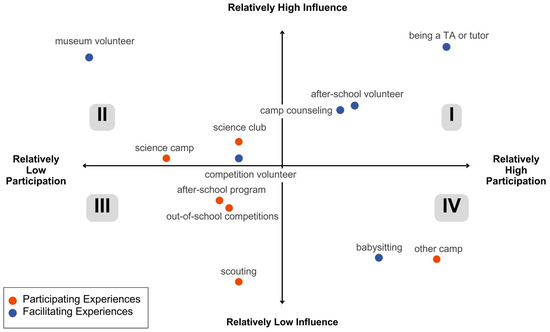
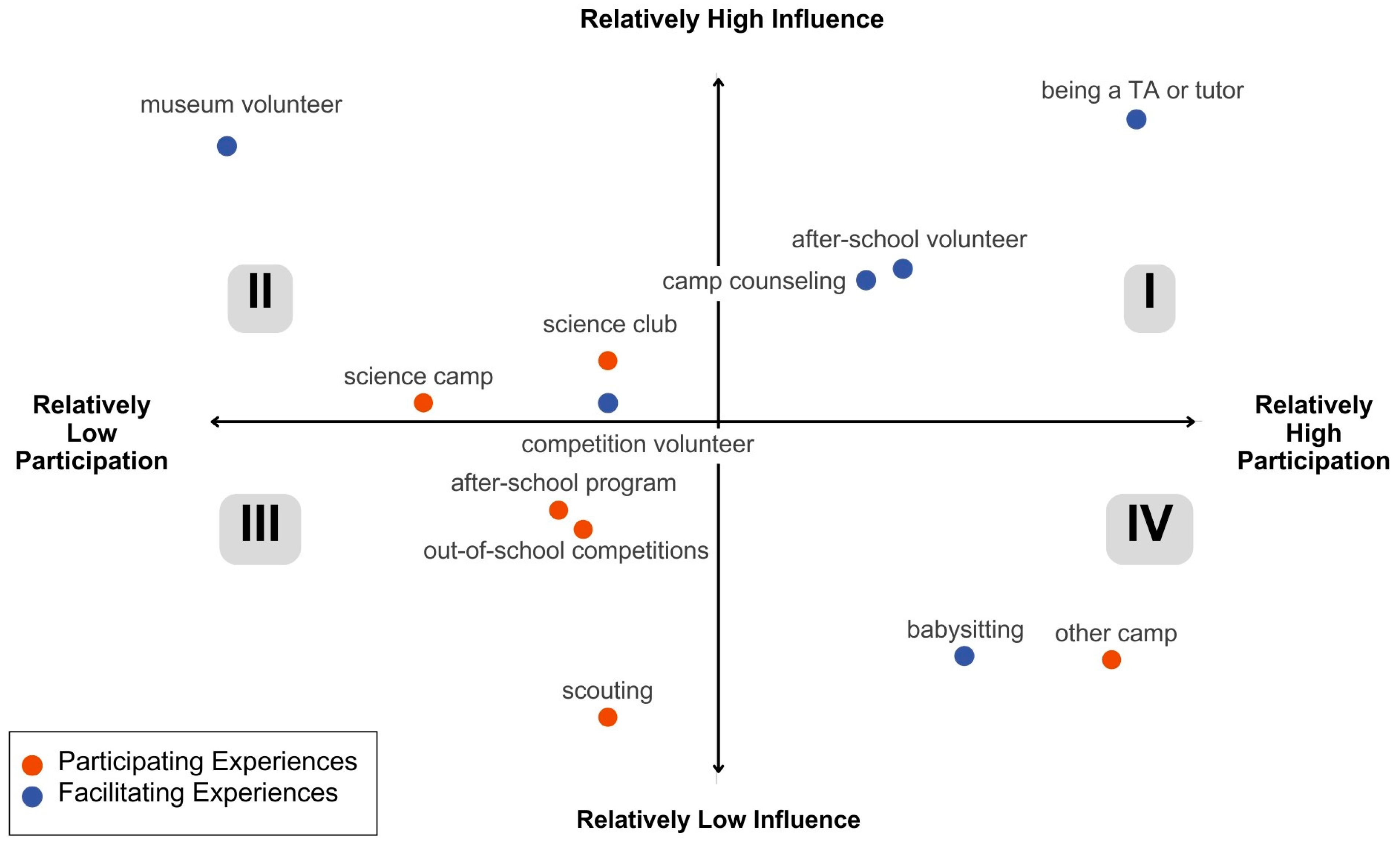
A quadrant analysis was used to visualize the relationship between the frequency of participation and the perceived influence of various education and teaching-related experiences (see Figure 1). The x-axis represents the overall average participation rate (47%), with activities to the right indicating higher participation. The y-axis represents the mean influence score (2.82), with activities higher on the y-axis indicating greater perceived influence. This quadrant analysis approach allowed us to examine those experiences that were reported as highly influential and those that teachers found were not influential on their teaching aspirations.
Figure 1.
Informal Experiences by Influence on Career Choice.
Preliminary analyses were conducted to examine differences in the reported influence of participatory and facilitation experiences for preservice and inservice teachers. Independent-samples Welch’s t-tests indicated statistically significant differences between groups for participatory experiences, t(317.01) = 1.98, p = 0.049, and facilitation experiences, t(271.07) = 2.99, p = 0.003. However, the magnitude of these differences was small, with effect sizes of d = 0.20 for participatory experiences and d = 0.32 for facilitation experiences. These effect sizes suggest minimal practical significance despite statistical significance, likely influenced by the unequal group sizes. Given the study’s focus on experiences common across the teacher development continuum, preservice and inservice teachers were combined for subsequent analyses.
2.3.2. Interview Data
After completing the survey, participants were invited to volunteer for a follow-up interview. Of the 69 volunteers, five in-service and five pre-service teachers were randomly chosen to participate in the interviews (see Table 1).
Table 1.
Interview Participants.
The interview protocol was designed to further explore details surrounding participants’ experiences and the factors that influenced their decisions to pursue science teaching careers. This explanatory mixed methods approach allowed us to use the quantitative data to document broad trends and the qualitative data to gain context, examples, and rich description of participants’ experiences (Ivankova & Creswell, 2009). Sample interview questions included, “Before entering your teacher education program, did you have any personal experiences teaching, for example, tutoring or camp counselling?” Follow-up questions further explored the specific tasks and responsibilities undertaken during these experiences, such as lesson planning or leading activities. Additionally, probing questions explored the impact of these experiences on their decision to pursue teaching. The interview protocol was reviewed by the expert panel (described above) and the interview protocol was piloted with three secondary teachers for timing, wording, and clarity.
Interviews were conducted via Zoom, recorded and transcribed. Each interview lasted approximately 45 min to an hour. The results of the survey guided the coding of the interviews to include codes by question for frequency of reported experience, influence of experience, and the nature and type of experience (participatory or facilitative). Facilitative experiences were coded if the experience involved some element of leadership, instruction, or responsibility for others.
3. Results
The science teachers’ reported experiences, organized by means from most to least influential, are summarized in Table 2.
Table 2.
Education- and teaching-related experiences by frequency and influence.
The most frequently reported informal experiences were being a reaching assistant or tutor, participating in a camp (68%), babysitting (60%), and working with an after-school or weekend youth program (57%). However, the participants reported that the most influential experiences were being a teaching assistant or tutor (M = 3.62), volunteering in an informal education program at a museum or science centre (M = 3.55) and working with an after-school or weekend youth program (M = 3.23). The average influence of facilitation experiences (M = 3.02, SD = 1.18) was significantly higher than the average influence of participatory experiences (M = 2.38, SD = 1.01) (t(159) = −6.27, p = 0.000).
The visualization in Figure 1 represents the relative involvement in and influence of various participating (orange) and facilitating (blue) experiences as compared to the mean of the mean scores. On this graph, values in quadrant I represent experiences with a higher-than-average percentage of participation and a higher-than-average reported influence on career choice. For example, being a TA or tutor was a highly reported activity that was also reported as highly influential. Quadrant II indicates experiences with a lower-than-average percentage of participation but a higher-than-average influence on career choice. For example, though few participants reported volunteering in an education program at a museum, the overall mean influence of the experience was high. Quadrant III contains those experiences with relatively low involvement and low relative influence compared to the mean influence of all activities. For example, scouting was less frequently reported, and when it was, it was reported as having a low reported influence on teaching career choice. Quadrant IV contains those with relatively high participation but low relative influence, such as babysitting or participating in non-discipline-specific camps. In the following paragraphs, experiences are noted with percentage participation (e.g., how many individuals participated in each experience) and mean influence (e.g., how influential each experience was to their career choice) in parentheses.
3.1. Highly Influential Experiences
Quadrant I (high participation/high influence) included being a TA or tutor (69%, M = 3.62), working with an after-school or weekend youth program (ex: scouting, coaching) (57%, M = 3.23), and being a camp counsellor (55%, M = 3.20). All activities located in this quadrant were facilitation experiences. The most common and influential experience on career choice indicated by the teachers was being a teaching assistant or tutor. Interview participants indicated that both formal tutoring (i.e., getting paid to tutor younger students) and informal tutoring (helping siblings or classmates to learn difficult material) influenced their ability to see themselves as science teachers. These informal tutoring sessions often involved working with younger individuals within their family unit. For example, Julie (all names are pseudonyms) tutored her little sister’s friend group in earth science, and Candace was often responsible for helping teach her younger siblings. Adrienne noted that her decision to teach did not come “until after I had children and saw that working with kids is actually pretty fun.” Other interview participants who had been camp counsellors indicated that it gave them leadership positions and experience with different age groups of students and was “a lot of fun” (Leah).
Quadrant II (low participation/high influence) contains both facilitating activities, such as volunteering at museums (23%, M = 3.55) and volunteering in out-of-school competitions, such as Science Olympiad (42%, M = 2.88), and participatory experiences, participating in a science club (including 4H or FFA) (42%, M = 2.99) or in a science camp (33%, M = 2.88). These STEM-specific experiences, though accessed by fewer participants, were reported as transformative in shaping their career trajectories. For example, after an informal science education internship, April noted that she intended to secure a job at a science museum. However, she found her way into classroom teaching instead, stating, “I knew I wanted to be a science teacher, but I took a different route”—referring to the museum internship as an uncommon yet formative part of her pathway to teaching.
Other facilitation-based experiences, such as leading nature walks, organizing community environmental education classes, or conducting environmental education workshops, demonstrated the diverse ways participants perceived how informal education shaped their career trajectories, especially in contexts that combine environmental stewardship with teaching. When asked about her leadership experiences before choosing a teaching career, Elizabeth noted that she “took a lot of kids and adults on nature walks, explaining all the different flora and fauna. We fished with them, and we’d canoe with them and stuff like that.” Another participant, Madison, talked about working in an internship with the US Fish & Wildlife Service, leading kayak trips and helping with touch tables, which led her toward a career in environmental education.
3.2. Experiences with Low Influence
Quadrant III (reported low participation/low influence) contains all participatory experiences and includes attending an after-school or weekend program (39%, M = 2.60), participating in an out-of-school competition such as Science Olympiad (41%, M = 2.55), and participating in a scouting program like Boy Scouts, Girl Scouts, or others (42%, M = 2.06). Quadrant IV included reported experiences with relatively high participation but low relative influence on career choice. These included the facilitation activity of babysitting (60%, M = 2.22) and the participation activity of participating in a camp that was not necessarily science-focused (68%, M = 2.21). While activities in both quadrants were frequently referenced in the interviews, participants rarely elaborated on these types of experiences or considered them defining influences on their teaching career trajectory.
4. Discussion
The findings of this study offer valuable insights into the types and nature of experiences that teachers associate with their decisions to pursue a career in science teaching. The results support previous research that shows community-based and informal experiences can play a significant role in shaping science teaching career trajectories (Heinz, 2015). However, the type and context of the experience appear to play key roles in the development of an identity as a teacher and supporting career aspirations in education.
4.1. Reported High Participation and Influence: Facilitating Roles
Experiences in Quadrant I, including being a teaching assistant or tutor, working within an after-school program, and serving as a camp counsellor, were among the most reported and were considered by teachers as highly influential activities. These roles allowed participants to practice teaching skills, develop leadership abilities, and build confidence in working with others, which participants retrospectively described as influential in their developing sense of themselves as teachers (Heinz, 2015). For example, interview participants described how tutoring younger siblings or classmates helped them see themselves as educators. Similarly, camp counselling allowed individuals to interact with diverse age groups, fostering enjoyment and skill development in teaching contexts. A recurring response was that these experiences were “fun,” perhaps reflecting a desire among participants to pursue careers they perceive as enjoyable. These findings suggest that precollege experiences involving facilitation and direct engagement with students could potentially serve as critical entry points into teaching careers by supporting identity-relevant factors such as perceived competence, recognition, and belonging. There is evidence from engineering that precollege experiences can impact their decision to major in engineering (Verdin et al., 2021). One potential strategy for developing future teachers is to provide youth with early experiences with scaffolded teaching (like these participants described for camp counselors or museum volunteers).
4.2. Reported Low Participation but High Influence: Underrepresented Opportunities
Quadrant II highlights experiences with lower levels of participation but significant reported influence on career choices, such as museum volunteering and participating in science clubs, camps, or competitions. Among these, museum volunteering was particularly noteworthy, as it ranked second only to being a teaching assistant or tutor in terms of its influence on career choice, surpassing other facilitation-based experiences such as being an after-school volunteer or a camp counsellor. Participants shared examples of facilitation-based activities that could be classified more broadly as informal education experiences, such as facilitating environmental education programs or experiences. These findings expanded our categories of informal science opportunities beyond museums to include settings where participants engage in education and communication. These findings point to the need for future research to explore the diverse range of facilitation-based informal experiences and studies that might compare the influence of generic experiences like camp counseling to STEM-related experiences such as volunteering in a science museum on career aspirations.
4.3. Reported Low Participation and Low Influence: Limited Impact of Participatory Experiences
Quadrant III, which includes participatory experiences such as attending after-school programs or scouting, highlights activities with minimal reported influence on career choice. These results suggest that simply participating in activities, without a facilitation or leadership component, may not be sufficient to inspire a teaching career. This finding points to the importance of designing programs that actively engage participants in teaching or leadership roles and allow youth to see themselves as science educators and maximize the program’s impact.
4.4. Reported High Participation but Low Influence: Common but Less Transformative Roles
Quadrant IV includes highly reported activities, such as babysitting and attending general camps, which participants viewed as having a limited influence on career choice. While these experiences may help develop general interpersonal or organizational skills, they highlight that facilitation alone is not sufficient to strongly influence science teaching career aspirations. Rather, experiences that provided participants opportunities to engage in facilitation activities situated within STEM or science-related contexts appear to be particularly important for affirming science teachers’ early self-efficacy. One can speculate that mere participation in activities requires less motivation and engagement than when facilitating an experience, and this could impact the influence of this experience on the individual. The findings in this study reinforce the value of targeted, STEM-focused facilitation experiences, rather than facilitation roles more broadly, in supporting the development of science teaching identity and career motivation.
4.5. Implications for Addressing the Science Teacher Shortage
The results of this study provide new insights into the potential role that precollege experiences can have on science teachers’ career aspirations and career decisions. Whereas other researchers have reported that informal experiences can influence career trajectories (e.g., Dabney et al., 2012), this study found evidence of a differential influence of participatory and facilitation experiences on science teachers’ reported career decisions.
Experiences in facilitation-based activities, such as tutoring, being a teaching assistant, volunteering, and camp counselling, consistently emerged as having the highest reported participation and influence on teachers’ motivation to pursue a career in teaching, underscoring their importance in providing opportunities for those inclined to teach to develop teaching identity, skills, leadership abilities, and confidence in working with students. This aligns with prior findings that taking on new roles can be identity-affirming and influential in shaping how one sees oneself and possible career pathways (Sprinthall, 1994). There are significant costs (time, funding, and program design) to developing precollege programs that are focused on developing teaching self-efficacy, skills development, and career aspirations, but given the shortage of qualified science teachers, this investment in our future teachers may prove to be a valuable investment. Furthermore, taking a different approach to developing the next generation of teachers may require rethinking what it means to be successful with informal experiences, as well as determining how to evaluate success over a long period of time.
Importantly, this study also points to the significant potential of less-frequently reported facilitation experiences in informal education, such as museum volunteering, leading clubs and competitions, and other outreach activities. While few participants indicated that they participated in these activities, they demonstrated a high influence on teachers’ career choices. These experiences may provide opportunities for participants to engage with youth and others in meaningful ways and foster teaching self-efficacy (Rende et al., 2023). This suggests that facilitatory informal education experiences may be a powerful yet underutilized pathway for inspiring teaching careers.
Future research should explore motivations for pursuing teaching careers in greater depth, particularly focusing on how to expand access to all learners and include experiences in teacher preparation. Additional studies should examine the role of students’ teachers who can support early career aspirations as reported by Zhang et al. (2018) as well as international differences that might be present for informal experiences that contribute to teachers’ career aspirations.
By designing programs that intentionally include opportunities for mentorship, skill development, and leadership in education contexts, we can further leverage these experiences to build pathways for aspiring educators. For example, giving high school students early experiences volunteering in museums, after-school programs, and youth groups could motivate more individuals to pursue careers as science teachers while enriching the professional preparation of future educators. For those who are already interested in teaching-related careers, providing facilitating experiences can support interests and career aspirations for teacher education (e.g., Ernst-Slavit et al., 2022). Furthermore, it may be worthwhile to recruit future teachers from those individuals who are engaged in facilitating and educating youth in out-of-school programs.
5. Limitations
The inductive nature of the study contributed to its limitations. First, while we identified facilitation experiences as key drivers of teaching aspirations reported by teachers, this study did not systematically capture the nuances of what occurred within these experiences. Factors such as the specific tasks performed, the setting and context of the activities, and the roles of mentors or peers were not explicitly explored. These elements likely play a significant role in shaping the influence of these experiences and warrant closer examination. The study is also limited by the use of snowball sampling, which can restrict the diversity of participants in the study. Furthermore, larger sample sizes could allow us to determine if there are meaningful differences in the responses of experienced and perservice teachers.
While science identity emerged as an insightful framework, this study did not directly measure identity formation or its components (see Avraamidou, 2014, 2019). Instead, the analysis relied on teachers’ retrospective reports of the perceived influence of informal experiences on their career decisions. As such, references to identity in this study reflect identity-relevant processes and meaning-making, rather than direct evidence of identity formation itself. Future research should incorporate longitudinal designs and established measures of science teacher identity to more precisely examine how informal experiences contribute to identity development over time.
Another limitation of this study is the difficulty in distinguishing between experiences that reflect a general interest in teaching and those that are more directly tied to a discipline. Finally, the study only examined those who engaged in facilitation experiences and went on to become teachers, but we did not examine those individuals who may have had these experiences but decided not to go on to become teachers.
6. Conclusions
This study found evidence that there is a differential influence of informal experiences on teacher identity development and on teaching career aspirations. The survey data and interviews showed that identity-affirming activities involving facilitation, such as tutoring, camp counselling, and volunteering at museums, were perceived as significant influences on a teaching career choice more than participatory experiences. Participants reported that facilitating roles allowed them to practice and develop leadership and teaching skills. Experiences such as museum volunteering were reported as particularly impactful.
Future studies are planned to investigate the relationship between discipline-specific experiences and identity development as well as teaching interests. More research is needed to better understand the impact of programs designed to nurture future teachers and whether we can design more effective experiences to develop teaching career aspirations. Through these studies, we hope to gain a clearer picture of how specific informal experiences can either enhance or hinder the development of a career in teaching.
Author Contributions
Conceptualization, M.G.J. and E.R.; Methodology, M.G.J. and E.R.; Formal analysis, E.R. and K.R.M.; Investigation, M.G.J., E.R., S.J.C., J.N., T.L. and A.T.; Writing—original draft, M.G.J., E.R. and K.R.M.; Writing—review & editing, M.G.J., E.R. and K.R.M.; Supervision, M.G.J.; Project administration, M.G.J. All authors have read and agreed to the published version of the manuscript.
Funding
This research received no external funding.
Institutional Review Board Statement
The study was conducted in accordance with the Declaration of Helsinki and approved by the Institutional Review Board of NCSU on 26 November 2019 (IRB#20394).
Informed Consent Statement
Informed consent was obtained from all subjects involved in the study.
Data Availability Statement
The original contributions presented in this study are included in the article. Further inquiries can be directed to the corresponding author.
Conflicts of Interest
The authors declare no conflicts of interest.
References
- Archer, L., Calabrese Barton, A. M., Dawson, E., Godec, S., Mau, A., & Patel, U. (2022). Fun moments or consequential experiences? A model for conceptualising and researching equitable youth outcomes from informal STEM learning. Cultural Studies of Science Education, 17(2), 405–438. [Google Scholar] [CrossRef] [Scilit] [PubMed]
- Avraamidou, L. (2014). Studying science teacher identity: Current insights and future research directions. Studies in Science Education, 50(2), 145–179. [Google Scholar] [CrossRef] [Scilit]
- Avraamidou, L. (2019). Stories we live, identities we build: How are elementary teachers’ science identities shaped by their lived experiences? Cultural Studies of Science Education, 14(1), 33–59. [Google Scholar] [CrossRef] [Scilit]
- Behrendt, M. (2017). Examination of a successful and active science club: A case study. Science Educator, 25(2), 82–87. [Google Scholar]
- Bhattacharyya, S., Mead, T. P., & Nathaniel, R. (2011). The influence of science summer camp on African-American high school students’ career choices. School Science and Mathematics, 111(7), 345–353. [Google Scholar] [CrossRef] [Scilit]
- Calabrese Barton, A., Kang, H., Tan, E., O’Neill, T. B., Bautista-Guerra, J., & Brecklin, C. (2013). Crafting a future in science: Tracing middle school girls’ identity work over time and space. American Educational Research Journal, 50(1), 37–75. [Google Scholar] [CrossRef] [Scilit]
- Carlone, H. B., & Johnson, A. (2007). Understanding the science experiences of successful women of color: Science identity as an analytic lens. Journal of Research in Science Teaching, 44(8), 1187–1218. [Google Scholar] [CrossRef] [Scilit]
- Committee on STEM Education. (2018). Charting a course for success: America’s strategy for STEM education. In National science and technology council (Issue December). Committee on STEM Education. Available online: http://www.whitehouse.gov/ostp (accessed on 10 December 2025).
- Dabney, K. P., Tai, R. H., Almarode, J. T., Miller-Friedmann, J. L., Sonnert, G., Sadler, P. M., & Hazari, Z. (2012). Out-of-school time science activities and their association with career interest in STEM. International Journal of Science Education, Part B: Communication and Public Engagement, 2(1), 63–79. [Google Scholar] [CrossRef] [Scilit]
- Davis, K., Fitzgerald, A., Power, M., Leach, T., Martin, N., Piper, S., Singh, R., & Dunlop, S. (2021). Understanding the conditions informing successful STEM clubs: What does the evidence base tell us? Studies in Science Education, 59(1), 1–23. [Google Scholar] [CrossRef] [Scilit]
- DeWitt, J., & Archer, L. (2015). Who aspires to a science career? A comparison of survey responses from primary and secondary school students. International Journal of Science Education, 37(13), 2170–2192. [Google Scholar] [CrossRef] [Scilit]
- DeWitt, J., Osborne, J., Archer, L., Dillon, J., Willis, B., & Wong, B. (2013). Young children’s aspirations in science: The unequivocal, the uncertain and the unthinkable. International Journal of Science Education, 35(6), 1037–1063. [Google Scholar] [CrossRef] [Scilit]
- Dou, R., Hazari, Z., Dabney, K., Sonnert, G., & Sadler, P. (2019). Early informal STEM experiences and STEM identity: The importance of talking science. Science Education, 103(3), 623–637. [Google Scholar] [CrossRef] [Scilit]
- Ernst-Slavit, G., Newcomer, S. N., Morrison, S. J., Lightner, L. K., Morrison, J. A., Ardasheva, Y., & Carbonneau, K. J. (2022). Latina paraeducators’ stories of resistance, resilience, and adaptation in an alternative route to teaching program. Journal of Career Development, 49(5), 1021–1038. [Google Scholar] [CrossRef] [Scilit]
- Fray, L., & Gore, J. (2018). Why people choose teaching: A scoping review of empirical studies, 2007–2016. Teaching and Teacher Education, 75, 153–163. [Google Scholar] [CrossRef] [Scilit]
- Garst, B. A., Baughman, S., & Gagnon, R. J. (2015). Influences of resident camp experiences on career choice: A case study of female alumnae. Research in Outdoor Education, 13(1), 59–82. [Google Scholar] [CrossRef] [Scilit]
- Goff, E. E., Mulvey, K. L., Irvin, M. J., & Hartstone-Rose, A. (2020). The effects of prior informal science and math experiences on undergraduate STEM identity. Research in Science & Technological Education, 38(3), 272–288. [Google Scholar]
- Goodman, L. A. (1961). Snowball sampling. The Annals of Mathematical Statistics, 32(1), 148–170. [Google Scholar] [CrossRef] [Scilit]
- Gottfried, M. A., & Williams, D. N. (2013). STEM club participation and STEM schooling outcomes. Education Policy Analysis Archives, 21, 79. [Google Scholar] [CrossRef] [Scilit]
- Habig, B., Gupta, P., Levine, B., & Adams, J. (2020). An informal science education program’s impact on STEM major and STEM career outcomes. Research in Science Education, 50, 1051–1074. [Google Scholar] [CrossRef] [Scilit]
- Hart, S. M., & King, J. R. (2007). Service learning and literacy tutoring: Academic impact on pre-service teachers. Teaching and Teacher Education, 23(4), 323–338. [Google Scholar] [CrossRef] [Scilit]
- Heinz, M. (2015). Why choose teaching? An international review of empirical studies exploring student teachers’ career motivations and levels of commitment to teaching. Educational Research and Evaluation, 21(3), 258–297. [Google Scholar] [CrossRef] [Scilit]
- Ivankova, N. V., & Creswell, J. W. (2009). Mixed methods. In Qualitative research in applied linguistics: A practical introduction (Vol. 23, pp. 135–161). Springer. [Google Scholar]
- Jones, M. G., Childers, G., Corin, E., Chesnutt, K., & Andre, T. (2019). Free choice learning and STEM career choice. International Journal of Science Education, Part B, 9(1), 29–39. [Google Scholar] [CrossRef] [Scilit]
- Kang, H., Calabrese Barton, A., Tan, E., D Simpkins, S., Rhee, H. Y., & Turner, C. (2019). How do middle school girls of color develop STEM identities? Middle school girls’ participation in science activities and identification with STEM careers. Science Education, 103(2), 418–439. [Google Scholar] [CrossRef] [Scilit]
- King, J. E. (2018). Colleges of education: A national portrait executive summary. Available online: www.aacte.org (accessed on 10 December 2025).
- Lee, S. W., & Mamerow, G. (2019). Understanding the role cumulative exposure to highly qualified science teachers plays in students’ educational pathways. Journal of Research in Science Teaching, 56(10), 1362–1383. [Google Scholar] [CrossRef] [Scilit]
- Li, X., Xiao, W., Sun, C., Li, W., & Sun, B. (2023). Does burnout decrease with teacher professional identity among teachers in China? Journal of Career Development, 50(5), 983–996. [Google Scholar] [CrossRef] [Scilit]
- MacLeod, E. (2025). ‘I’ve always known that I would become a teacher’: How White women narrate their choice to teach, and what this means for teacher recruitment. British Educational Research Journal, 51, 2013–2035. [Google Scholar] [CrossRef] [Scilit]
- Malone, D., Jones, B. D., & Stallings, D. T. (2002). Perspective transformation: Effects of a service-learning tutoring experience on prospective teachers. Teacher Education Quarterly, 49(1), 61–81. [Google Scholar]
- Maltese, A. V., & Tai, R. H. (2011). Pipeline persistence: Examining the association of educational experiences with earned degrees in STEM among U.S. students. Science Education, 95(5), 877–907. [Google Scholar] [CrossRef] [Scilit]
- National Center for Education Statistics. (2023, October). School pulse panel: Surveying high-priority, education-related topics. School Pulse Panel—Interactive Results. Available online: https://nces.ed.gov/surveys/spp/results.asp (accessed on 10 December 2025).
- Obiunu, J. J. (2008). The effects of reciprocal peer tutoring on the enhancement of career decision making process among secondary school adolescents. Educational Research and Reviews, 3(7), 236–241. [Google Scholar]
- Park, C. (2004). The graduate teaching assistant (GTA): Lessons from North American experience. Teaching in Higher Education, 9(3), 349–361. [Google Scholar] [CrossRef] [Scilit]
- Refvem, E., Jones, M. G., Rende, K., Carrier, S., & Ennes, M. (2022). The next generation of science educators: Museum volunteers. Journal of Science Teacher Education, 33(3), 326–343. [Google Scholar] [CrossRef] [Scilit]
- Rende, K., Jones, M. G., Refvem, E., Carrier, S. J., & Ennes, M. (2023). Accelerating high school students’ science career trajectories through non-formal science volunteer programs. International Journal of Science Education, Part B, 13(1), 28–39. [Google Scholar] [CrossRef] [Scilit]
- Ruslin, R., Mashuri, S., Rasak, M. S. A., Alhabsyi, F., & Syam, H. (2022). Semi-structured Interview: A methodological reflection on the development of a qualitative research instrument in educational studies. IOSR Journal of Research & Method in Education (IOSR-JRME), 12(1), 22–29. [Google Scholar]
- Smith, K. (1998). Academic morphing: Teaching assistant to faculty member. To Improve the Academy, 17(20210331), 85–102. [Google Scholar] [CrossRef] [Scilit]
- Speer, N., Gutmann, T., & Murphy, T. J. (2005). Mathematics teaching assistant preparation and development. College Teaching, 53(2), 75–80. [Google Scholar] [CrossRef] [Scilit]
- Sprinthall, N. A. (1994). Counseling and social role taking: Promoting moral and ego development. Moral Development in the Professions: Psychology and Applied Ethics, 1969, 85–99. [Google Scholar]
- Sprinthall, N. A., Reiman, A. J., & Thies-Sprinthall, L. (1993). Roletaking and reflection: Promoting the conceptual and moral development of teachers. Learning and Individual Differences, 5(4), 283–299. [Google Scholar] [CrossRef] [Scilit]
- Starr, C. R., Hunter, L., Dunkin, R., Honig, S., Palomino, R., & Leaper, C. (2020). Engaging in science practices in classrooms predicts increases in undergraduates’ STEM motivation, identity, and achievement: A short-term longitudinal study. Journal of Research in Science Teaching, 57(7), 1093–1118. [Google Scholar] [CrossRef] [Scilit]
- StataCorp. (2025). Stata statistical software: Release 19. StataCorp LLC.
- Tan, E., Calabrese Barton, A., Kang, H., & O’Neill, T. (2013). Desiring a career in STEM-related fields: How middle school girls articulate and negotiate identities-in-practice in science. Journal of Research in Science Teaching, 50(10), 1143–1179. [Google Scholar] [CrossRef] [Scilit]
- Tashakkori, A., & Teddlie, C. (2010). Putting the human back in “human research methodology”: The researcher in mixed methods research. Journal of Mixed Methods Research, 4(4), 271–277. [Google Scholar] [CrossRef] [Scilit]
- U.S. Department of Education. (2020). Characteristics of public school teachers. In Digest of education statistics. U.S. Department of Education. Available online: https://nces.ed.gov/programs/digest/d19/tables/dt19_209.22.asp (accessed on 10 December 2025).
- Verdin, D., Smith, J. M., & Lucena, J. (2021). Funds of knowledge as pre-college experiences that promote minoritized students’ interest, self-efficacy beliefs, and choice of majoring in engineering. Journal of Pre-College Engineering Education Research, 11(1), 192–213. [Google Scholar] [CrossRef] [Scilit]
- Wallace, C. S., & Brooks, L. (2015). Learning to teach elementary science in an experiential, informal context: Culture, learning, and identity. Science Education, 99(1), 174–198. [Google Scholar] [CrossRef] [Scilit]
- Zhang, J., Yuen, M., & Chen, G. (2018). Teacher support for career development: An integrative review and research agenda. Career Development International, 23(2), 122–144. [Google Scholar] [CrossRef] [Scilit]
- Zhao, M., Ozturk, E., Law, F., Joy, A., Deutsch, A. R., Marlow, C. S., Mathews, C. J., McGuire, L., Hoffman, A. J., Balkwill, F., & Burns, K. P. (2024). Reciprocal associations between science efficacy, STEM identity and scientist career interest among adolescent girls within the context of informal science learning. Journal of Youth and Adolescence, 53(2), 472–484. [Google Scholar] [CrossRef] [Scilit] [PubMed]

Disclaimer/Publisher’s Note: The statements, opinions and data contained in all publications are solely those of the individual author(s) and contributor(s) and not of MDPI and/or the editor(s). MDPI and/or the editor(s) disclaim responsibility for any injury to people or property resulting from any ideas, methods, instructions or products referred to in the content. |
© 2026 by the authors. Licensee MDPI, Basel, Switzerland. This article is an open access article distributed under the terms and conditions of the Creative Commons Attribution (CC BY) license.