Article

Changing the Concept of Teaching English in Novice English Teachers Through Attentive Teaching
The English Language Education Department, The Attentive Teaching Institute, David Yellin Academic College of Education, Jerusalem 9103501, Israel
*
Author to whom correspondence should be addressed.
Educ. Sci. 2026, 16(2), 219; https://doi.org/10.3390/educsci16020219
Submission received: 20 November 2025 / Revised: 29 January 2026 / Accepted: 30 January 2026 / Published: 2 February 2026
(This article belongs to the Special Issue Supporting Teaching Staff Development for Professional Education)

Abstract

This study investigated conceptual change in novice English teachers’ understanding of English teaching fostered through an Attentive Teaching-based professional development course. In particular, the practice of an approach called Attentive Teaching applied to English teaching enabled the participants to expand their initial concept of English teaching; this change can be seen in multimodal artifacts the teachers produced, involving a visual representation, a written explanation, and an oral presentation. In the course, the concept of teaching English was explored by applying the Attentive Teaching approach, which aligns with other action-oriented approaches under the CEFR framework. The main findings reveal a change in the novice teachers’ understanding: they initially perceived teaching from the outside; as learners, however, following the course, they positioned themselves as leaders of the teaching process in the classroom. This change was observed through creative multimodal products in which each participant expressed their unique point of view, produced at the beginning and the end of the course. The findings illustrate a conceptual change at both the individual and group levels regarding the participants’ understanding of the concept of English teaching. Thus, the practice of Attentive English Teaching is a promising pedagogical tool for inducing and observing conceptual change in novice teachers.

1. Introduction

The discipline of teaching English as a foreign language has undergone a transition in recent years, highlighting the need for dialogic approaches within English language education. As English has become the lingua franca for intercultural communication, learners worldwide aim to develop language competencies that extend beyond the classroom, thus enabling interpersonal communication in real-world contexts. Reflecting this shift, the Common European Framework of Reference (CEFR) has become a dominant global standard, advocating for an action-oriented approach that views the learner as a social agent (North, 2021). Within this framework, emphasis has moved beyond linguistic proficiency in receptive skills, such as reading and listening, toward communicative skills, including language production in writing and speaking, mediation, and interaction (Council of Europe, 2020). Moreover, the learning outcomes of language activities are defined in terms of what the learner can do as a language user.
This communicative and action-oriented perspective on language education motivates a change in teaching practices. The focus of traditional language teaching on achievements in specific language tasks—such as accuracy in grammatical constructions or reading comprehension exams—dictates specific priorities in teaching, favoring accuracy over fluency and following instructions over creativity. Both priorities stand in contrast to the use of language in interpersonal communication, which increasingly calls for fluency and creativity in globalized contexts.
Novice English teachers find themselves in a unique professional position. While they are expected to spearhead action-oriented pedagogy and facilitate active language production, their own formative experiences as language learners often reflect a traditional, teacher-centered paradigm. When they start teaching, they hold deeply rooted beliefs about language teaching that are shaped by their own experiences as learners (Borg, 2003). Research on the sociocultural aspects of teacher education (Johnson, 2009) suggests that shifting these internal concepts requires more than the delivery of theoretical knowledge. Similarly, Farrell (2012) suggested that the challenge of professional development lies in the ‘theory–practice gap’, where novice teachers may acquire theoretical knowledge without fully integrating it into their professional identities.
To address this gap, the present study first examines how prior experiences shape novice teachers’ initial perceptions of English teaching. Following this baseline assessment, the study investigated whether these inherited concepts require a significant reorientation to align with contemporary, dialogic language teaching goals. Finally, the study explores the process by which novice teachers can change their initial concept of English teaching.
Exploring these questions is made possible by the Attentive Teaching approach (Schur, 2015, 2025). Attentive Teaching is a dialogic approach to teaching that stems from social constructivism (Allen, 2022). When teachers implement the principles of Attentive Teaching in the classroom, they can attend to each learner’s learning process and track changes in understanding over time. In addition to attentiveness, this approach offers teachers specific practices to use, allowing them to effectively engage all learners in the learning process. The teacher listens attentively to each learner and can observe how their understanding changes throughout the learning process.
We implemented Attentive Teaching in a professional development course for novice English teachers as part of a municipal project. This implementation served a dual purpose: first, as the instructors of the course, Attentive Teaching practices enabled us to observe the point of view of these novice English teachers on English teaching. Second, as the course participants, the novice teachers became familiar with the Attentive Teaching approach, with the course instruction modeling how a dialogic, action-oriented approach to teaching can be practiced in the classroom. At the end of the course, we observed conceptual change in their understanding of English teaching.

2. Theoretical Framework

2.1. The Attentive Teaching Approach

Any learning process is about understanding. Understanding is more than giving the teacher the correct answer; it is a personal process of conceptual change (Posner et al., 1982). Nevertheless, the learner can be guided by a significant other, such as a teacher, in constructing the steps of understanding (Vygotsky, 1934/1986). Thus, the Attentive Teaching approach is couched within the theoretical framework of conceptual change (diSessa, 2022), seeking to observe the learner and enable them to experience a change in understanding. Conceptual change refers to the learning process of all subjects, in every field, and at every age; it is a key component in the constructivist approach, with the assumption that learners are not simply empty vessels to be filled (Piaget, 1975; Allen, 2022). In contrast, they come with initial perceptions that are relevant to their knowledge and their world, and as they learn, they may change their understanding of the concepts learned.
Most theories of conceptual change focus on the process of learning and how it can be supported or achieved (diSessa, 2022). In this context, the added value of Attentive Teaching is its focus on the teacher’s role as a mediator in a classroom setting, while still allowing learners to play an active role in the learning process. When practicing Attentive Teaching, the teacher listens to the learners’ ideas as presented in their individual products and conveys the study material to them by providing feedback. Here, the teacher’s feedback refers to an individual presentation in a whole-class discussion, allowing other learners to benefit from listening to the perspectives of their peers, as well as from the comments made by the teacher. Through this cyclic dialogic process, the learners gradually construct understanding (Schur, 2025). While the understanding of a particular learner is unique, some aspects of understanding are shared by learners in the same class as a result of the attentive discussion (Gal et al., 2022). This dialogic cycle of feedback and shared meaning-making is referred to as Mediated Interaction (Schur, 2015).

2.2. Core Practice of Attentive Teaching

A Mediated Interaction is the main practice of Attentive Teaching (Schur, 2025). It starts with a practical activity, where learners are instructed to present their unique point of view on a specific concept through a visual representation, explain their drawing in writing, and present this multimodal text orally to the class. The individual outcome, a multimodal product, allows the teacher to observe the learner’s thinking process and level of understanding (Schur & Guberman, 2024). Multimodal artifacts, combining written and oral language, as well as other modes of expression like images or video, are widely used in the context of English language education for different purposes (see a comprehensive review in You & Han, 2023); the unique contribution of the Mediated Interaction is that learners create their own products to express their point of view on a topic studied in class via a multimodal meaning-making process.
The teacher listens to each learner’s point of view and mediates by commenting and providing supportive feedback, conceptualizing the learners’ contributions and, in this way, promoting and expanding the understanding of the concept at both the individual and group levels (Schur, 2015). Mediation in this context involves facilitating the understanding of the concept introduced in class, modeled on the construct of Mediated Learning Experience (MLE; Feuerstein et al., 1980). The MLE assumes an interaction between a mediator, a learner, and a stimulus. By adapting the MLE to the classroom setting, the teacher assumes the role of a mediator, leading the teaching process. The Attentive Teaching approach utilizes Mediated Interactions through two key teaching practices: Dynamic Learning and a Thinking Journey (Schur, 2025).

2.2.1. Dynamic Learning

In Dynamic Learning, the teacher observes changes in the learners’ understanding over time by conducting repeated Mediated Interactions focused on the same concept (Schur & Axelrod-Tayer, 2014; Schur & Guberman, 2024). For instance, Gal et al. (2022) applied Attentive Teaching in a course for students in an environmental education master’s program in order to teach the concept of social–ecological systems: a complex concept built on how human attitudes and ecological systems interact. The participants went on three field trips to observe three instances of social–ecological systems at three different sites. The purpose of including Mediated Interactions in the field trips was first to observe the initial understanding by asking them to represent the system they observed upon arriving, and then to compare these individual products with the representations they each created at the end of the day following numerous learning activities and experiences. This comparison is also part of the participants’ learning process: they can compare their own products and reflect on the changes they see.
Taking all of the representations of all learners from all three sites, the researchers could construct a rubric specifying discrete levels of understanding of the social–ecological system concept. More specifically, the practice of Dynamic Learning, composed of two Mediated Interactions during each field trip, allowed the researchers to observe conceptual change in each learner. Furthermore, based on the rubric for levels of understanding, the researchers found that the average level of understanding of the whole class had increased at the end of the course compared to the beginning.

2.2.2. Thinking Journey

In a Thinking Journey, the teacher introduces novel and surprising points of view on the learnt concept (Schur & Galili, 2009; Schur, 2015). Observing and referring to different aspects or perspectives on the same concept enables learners to create spaces of learning (Marton et al., 2005). Schur et al. (2025) showed how a series of Mediated Interactions changed how 10th-grade students understood the concept of the refraction of light. At the beginning of the study unit, the students were asked to imagine how they would see their surroundings if they were looking out from inside a drop of water. The unit was taught in a class of 14 students, and the research provides a detailed analysis of four case studies from this group. The participants reported that the surprising perspective was challenging for them and their responses, as observed through multimodal products, revealed varied initial stages of understanding as well as a lack of explicit knowledge of how a change in density affects the speed of light. At the end of the study unit, the students created another multimodal product relating to the same task after studying the properties of light, demonstrating that they had gained explicit knowledge and a deeper understanding of the topic. This study highlights the key role that a change in perspective can play in promoting learning by inducing uncertainty. The researchers also emphasized the significance of this practice in enhancing the learners’ feeling of competence as they reflected on changes in their understanding.

2.3. The Use of Attentive Teaching in English Teaching

The general principles of Attentive Teaching, as a dialogic, action-oriented teaching approach, aligns well with the communicative, real-world needs targeted by current English as a foreign language curricula. Furthermore, the practice of Mediated Interactions, including Dynamic Learning and Thinking Journeys, offers a structured and well-defined method that English teachers can apply in their teaching.
First, a Mediated Interaction promotes language production. The core idea of Attentive Teaching is to connect the study material to the personal world of the learner, by asking them to express their unique point of view. In doing so, learners engage in communication and interaction activities in English. This initial phase of classroom communication, in which learners express their perspectives through multimodal products, aims at promoting language fluency. Thus, the Mediated Interaction serves as a platform for pedagogical mediation, a core communicative activity emphasized in the CEFR Companion Volume (Council of Europe, 2020). Moreover, the products of this interaction can form the basis for further teacher mediation. After observing the learners’ products, the teacher can refer to specific language features within them, thereby supporting language accuracy. This step reinforces the significant role of the teacher as a mediator in the language learning process.
Second, Attentive Teaching addresses the challenge of observing understanding. When learners interact individually with the study material (e.g., a text), they primarily practice receptive skills; in this context, it may be difficult for the teacher to assess their level of understanding. In contrast, during a Mediated Interaction, learners develop their own ideas and express them in their own words. The move toward language production is scaffolded by first creating a visual representation of their thinking. Beyond its value in priming language activity, the personal and creative process of responding to a text allows learners to express themselves and connect the study material to their inner world. The final multimodal product enables the teacher to observe the learner’s unique perspective, better understand their viewpoints, and assess their language proficiency. This approach can also be characterized as Deeper Learning (Mehta & Fine, 2019), emerging at the intersection of mastery, identity, and creativity.
The growing prevalence of multimodal texts in English Language Teaching (ELT) reflects real-world contexts where visuals play a significant role in meaning-making. Accordingly, the focus on linguistic input has expanded to include “multiliteracies” accommodating meaning constructed from both text and image (Unsworth, 2001; Kress & van Leeuwen, 2021). While multimodality is widely acceptable in language teaching materials and their receptive interpretation, it is also equally important to incorporate multimodality into productive activities (You & Han, 2023).
In Attentive Teaching, multimodal representations are created by learners as part of a meaning-making process through which they express their own ideas. Additionally, as a research tool, multimodal products allow for a more comprehensive understanding of the participants’ perspectives (Wanselin et al., 2023).
In this study, we aimed to introduce the Attentive Teaching approach to novice English teachers through a professional development course. This was achieved by assigning background reading on Attentive Teaching, conducting a Mediated Interaction in each lesson, and asking each teacher to lead a Mediated Interaction with one of their students. The ongoing Mediated Interactions modeled the application of Attentive Teaching principles to English teaching materials and language-focused instruction. At the beginning and end of the course, we addressed the concept of “English teaching” explicitly. To systematically analyze conceptual change, the study addressed the following research questions:
  • How do novice English teachers initially conceptualize “English teaching”?
  • In what ways do the Attentive Teaching approach facilitate a shift from teacher-centered paradigms toward dialogic, action-oriented pedagogy?
  • What is the nature of the conceptual change observed in the participants’ multimodal representations (visual and written) at the conclusion of the training?

3. Materials and Methods

3.1. Design

The research design was an embedded qualitative multi-case study (Yin, 2018). A case study approach was selected because it allows for an in-depth analysis of an individual participant’s conceptual change within the context of the course. Although the course included more participants, the present analysis focused on embedded cases, enabling fine grained examination while maintaining contextual integrity. The change in the participants’ perceptions of “English Teaching” was assessed via a pre–post paradigm, comparing products from the initial phase of the course to those in the final phase. This comparison was conducted to infer the nature of the conceptual change that occurred during the mediation process.

3.2. Context

The data presented here were taken from a larger municipal project targeting English language teaching, sponsored by the Jerusalem Foundation. The project involved professional development courses for both novice and veteran English teachers with the aim of introducing teachers to the Attentive Teaching approach as it applies to teaching English. The course for novice teachers was delivered at the advanced studies department of the David Yellin Academic College of Education, Jerusalem, Israel.

3.3. Participants

A total of 16 teachers (15F, 1M; ages 19–25), with one to three years of teaching experience in public secondary schools (grades 7–8), took part in the course for novice teachers. The participants were proficient English users at the B2 level, and their L1 was Arabic. All participants signed up for the professional development course voluntarily and provided informed consent. The study was approved by the academic ethics committee prior to data collection; that is, before the course began. Data analysis was conducted after the end of the course and after all participants were reported to have successfully completed the course. Although anonymity could not be maintained during data collection, the identities of the participants were not reported to safeguard confidentiality in accordance with the ethical guidelines. Pseudonyms were assigned to all participants, and identifying details were altered or removed.

Sampling Strategy

A random purposeful sampling strategy (Patton, 2015) was used to enhance the credibility of the findings by reducing the potential for researcher bias in case selection. All 16 participants shared similar professional backgrounds, completed the course, and were considered “information-rich” cases; thus, the sample size was narrowed to ensure a manageable yet representative analysis. First, six participants were randomly selected to represent group-level conceptual change. From this group, a subset of four participants was randomly chosen to illustrate shared conceptual changes, while the other two individuals served as case studies illustrating conceptual change at an individual level. This sampling strategy was used to show that Attentive Teaching enabled every participant in the course to experience conceptual change.

3.4. Data Collection

The course consisted of ten 90-min synchronous sessions and two asynchronous fieldwork modules, totaling 12 units of instruction. The procedure was structured into three phases:
Phase I. Baseline Interaction (Lessons 1–2): The course opened with a Mediated Interaction focused on the concept of “English teaching”. To capture the participants’ initial baseline perceptions, they were asked to reflect on a specific teaching event, create a visual representation (drawing) of that event, and write an explanation of the drawing. They uploaded the products, that is, the drawing and explanation, to a shared Slides interface, and each participant presented their product to the class. The oral explanations were documented after the lesson in comments on the slides. Some participants presented their products during the first lesson, and others during the second lesson.
Phase II. The Thinking Journey (Lessons 3–8 + Fieldwork): This phase served as the intervention context. Participants explored the nature of English teaching from various perspectives, including the reading comprehension of texts, reader-response to literary texts, teaching a grammar point, teacher–learner communication, and the concept of mediation. They also completed two asynchronous fieldwork modules: background theoretical reading and a practical requirement to implement the Attentive Teaching approach with a student. Both modules included submitting a written reflection. Two lessons (7–8) were dedicated to presenting the fieldwork experience to the peer group.
Phase III. Dynamic Learning (Lessons 9–10): The final two lessons mirrored the first two, allowing for a comparative analysis of conceptual change. Participants revisited their perception of English teaching, producing a final set of multimodal products. They also reflected on how their understanding had evolved in comparison to their initial baseline from Phase I. This enabled a direct comparison between Phase I and Phase III to infer the nature of the conceptual change.
We present two case studies, representing an individual-level change in understanding and a group-level change in understanding shared by four participants in the course. The changes were observed by comparing products between the first and final phases of the course.

3.5. Data Analysis

The products of the participants in the course were analyzed for content as multimodal texts. A text is multimodal if it combines two or more modes of communication—such as written language, visual elements, audio, and gestures—which are combined to convey meaning (Kress & van Leeuwen, 2021). Multimodal texts are becoming increasingly common in academic and non-academic contexts as part of 21st-century modes of meaning-making (You & Han, 2023). The main incentive for using multimodal products was that they enabled participants to better express their ideas. While traditional strategies for assessing understanding focus on written text only, the analysis of a multimodal product, in this case, comprising both text and image, allowed us to better understand the perceptions of the participants, with each mode contributing a part of the meaning that cannot be conveyed through the other mode (Wanselin et al., 2023). Specifically, the visual representations provide access to meanings that are not easily worded, such as thoughts, feelings, and experiences, which often facilitate verbal communication by sharpening the thinking process of the person who created them (Brailas, 2020). Moreover, the act of drawing is generative in the sense that the person drawing has to create their own world and cannot choose a pre-given wording or simply repeat something that was taught in class (Literat, 2013). In this sense, the creative process of making a visual representation activates a different type of cognitive process (Gauntlett, 2007). As we were interested in observing the participants’ understanding of the concept under discussion, which forms the content of the product, the artistic quality of the representation was of secondary importance to its semiotic content.
Once the products of the participants were created, a key challenge was to conduct an insightful analysis of their meaning. The analysis framework used for extraction of the content of the products was Systemic Functional Linguistics (SFL; Halliday & Matthiessen, 2014), in which language is viewed as a social semiotic system that takes into account how people use language to create meaning (e.g., to represent reality, interact, and organize text) within a specific context. SFL identifies three metafunctions of language use: Ideational, Interpersonal, and Textual. This functional approach enabled us to analyze the content of each product as an outcome of a meaning-making process with an Ideational Metafunction in the context of the Mediated Interaction. A required extension is that the outcomes under consideration are multimodal; hence, we draw on Visual Grammar (Kress & van Leeuwen, 2021), which extends SFL to multimodal meaning-making using the same metafunctions. See Appendix A for the full dataset of multimodal products.
The analysis focused on the representational correspondence between the visual elements and their accompanying written explanations (Kress & van Leeuwen, 2021). We looked for Intermodal Cohesion by noting how the written explanation extends the meaning of the visual representation (Martinec & Salway, 2005). We also noted the presence or absence of key actors (e.g., the teacher, a group of students, classroom settings), the specific actions attributed to them, and how they interact. An inter-rater reliability procedure was implemented to enhance the trustworthiness of the products’ analysis. Each researcher conducted the analysis independently, after which interpretations were compared and discussed in analytic meetings. Differences were resolved through negotiation and reference to the data until consensus was reached.

4. Findings

4.1. Case Study 1: Anna

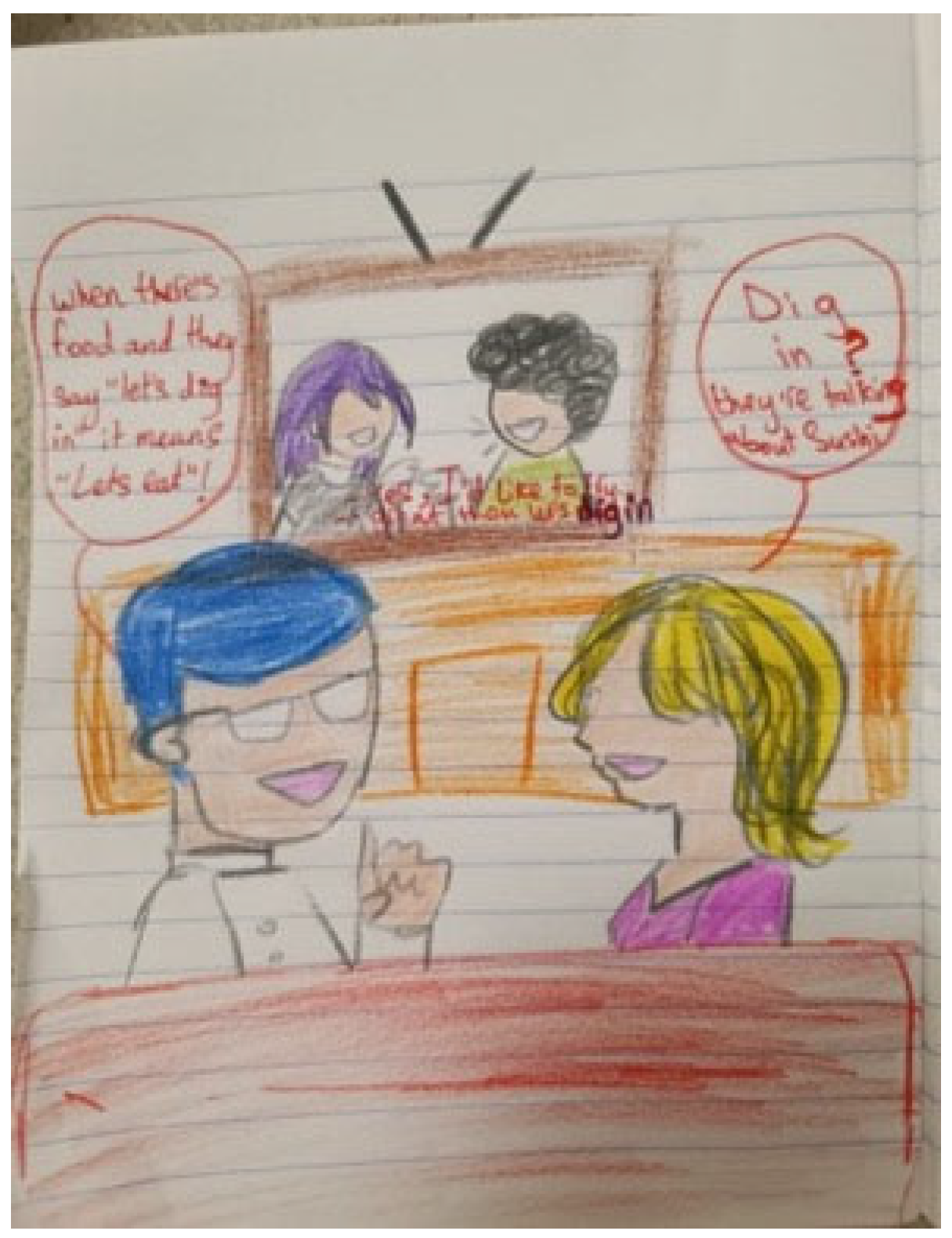
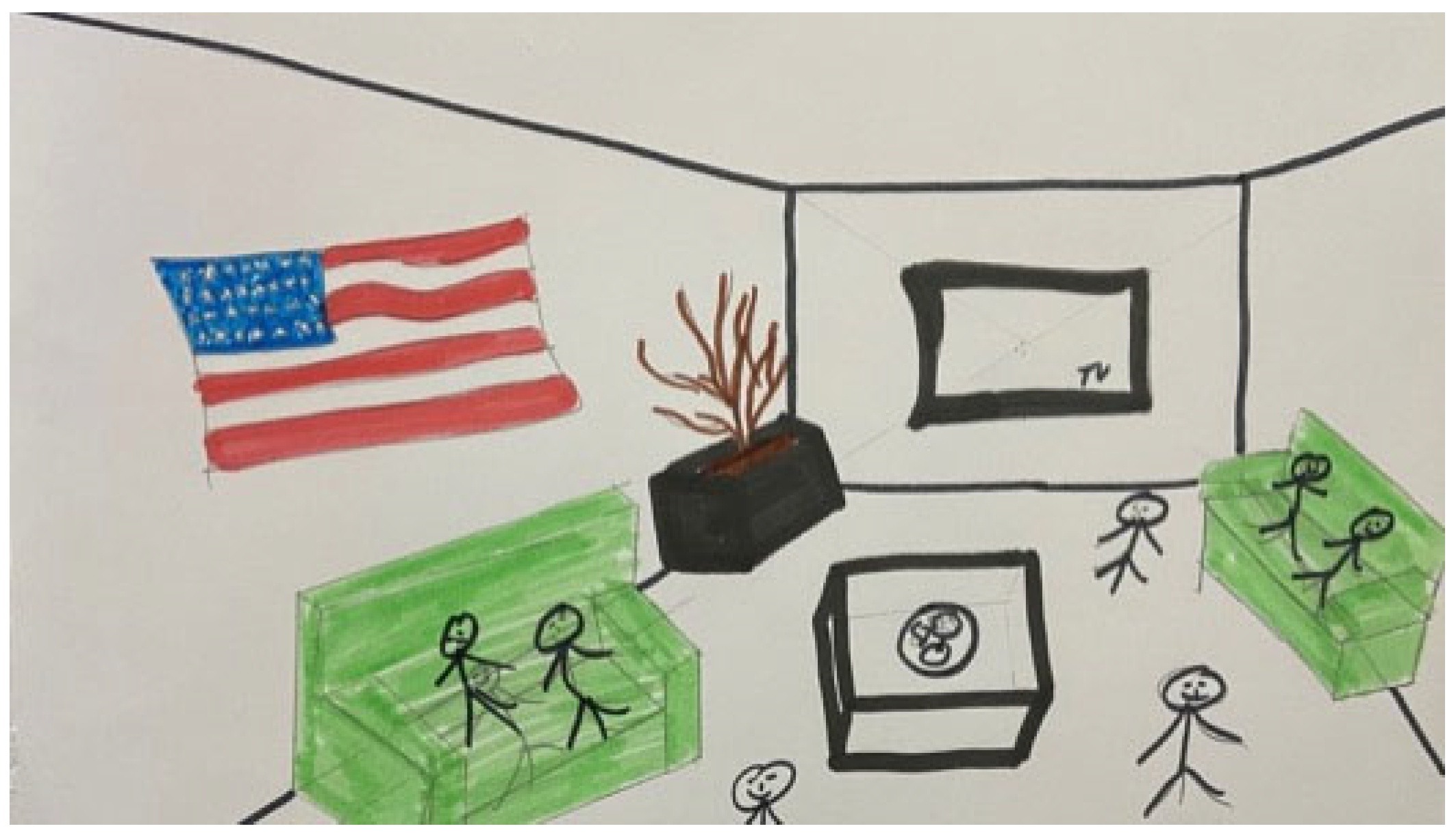
In the first lesson of the course, the participants were asked in a Mediated Interaction to describe English teaching by choosing a “teaching moment”. Let us consider Anna’s multimodal product, shown below in Figure 1. She depicted herself and her brother watching television. Speech bubbles show their dialogue: she is asking her brother about the expression “dig in”, which was used in the television show, and in response, he explains that it means “Let’s eat”. In addition to the visual representation, she explained her intended meaning: that watching programs in English with English subtitles can expand the learners’ vocabulary.
What do we see in this drawing? What does it tell us about Anna? At the most straightforward level, she perceives teaching as related to real life, involving communication, and explicitly interpreting lexical items. Then, the written explanation expands the watching event into a language teaching strategy: by watching programs in English, the viewer can expand their vocabulary. Another key component in this event is the role of the brother in mediating the language to his learner (Anna). However, there are important elements of teaching that are missing. This perception of the teaching event is particularly surprising in light of the fact that Anna is a novice English teacher. First, the whole teaching event takes place outside the classroom; second, Anna herself is the learner and not the teacher.
Anna’s multimodal product shows her implicit awareness of three significant aspects of English teaching: The learner’s engagement in the learning process, exposure to authentic language as used in the real-world, and the contribution of scaffolding (e.g., subtitles) to assist the learner with the language (e.g., learning vocabulary). However, in her perception, English teaching is removed from the classroom setting; there is no real teacher involved and no intentional teaching strategy employed. The television provides the material, and the viewer is learning new information, but in fact, there is no ‘teaching’ in the conventional sense. Her written response is short (23 words) and, while she is using professional terminology, such as “expand the vocabulary”, she does not use the words “teacher” or “teaching” at all.
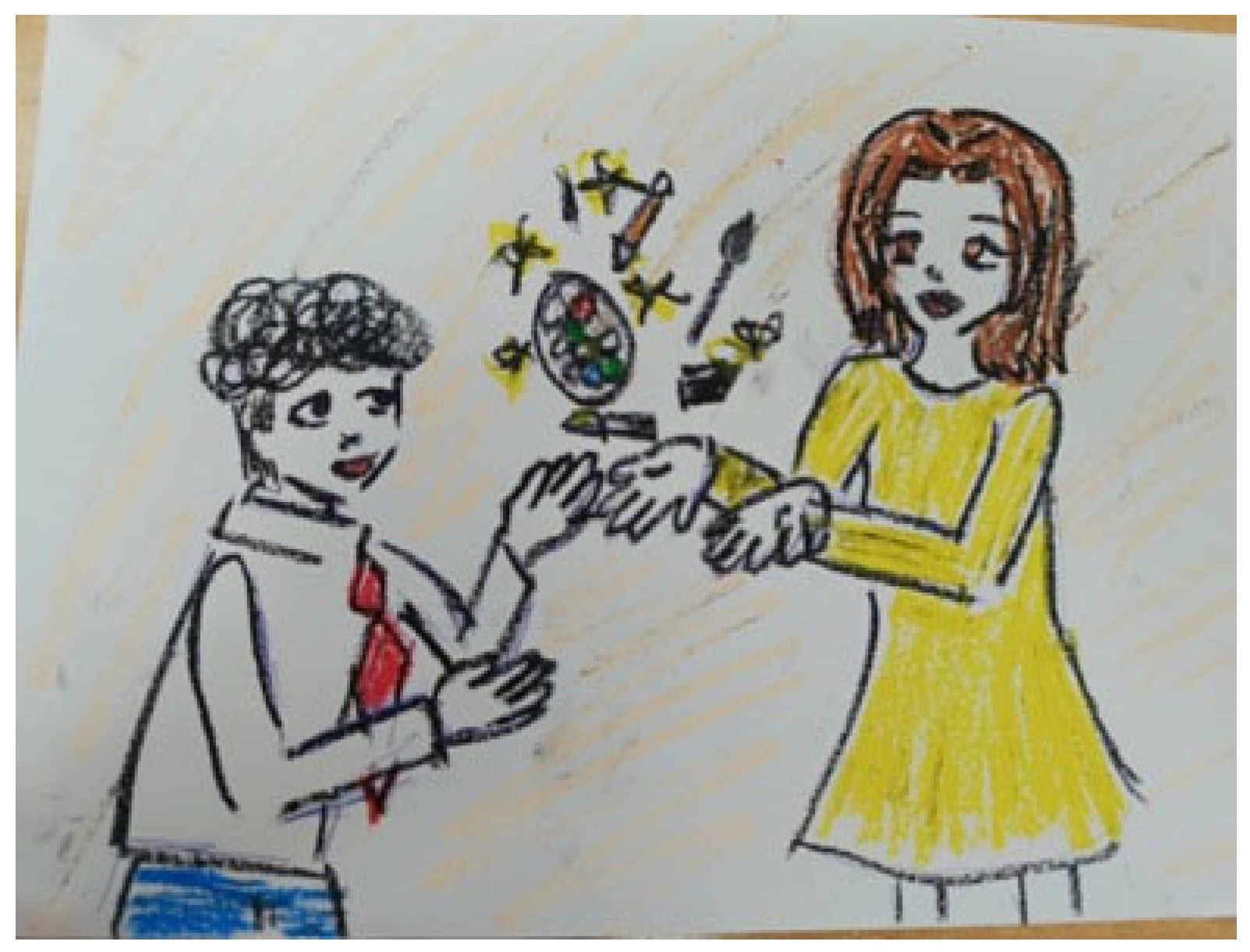
In contrast, let us consider Anna’s multimodal product at the end of the course. In Figure 2, she depicts herself with a student, and her text explains that she is using superpowers and magic. What does this product tell us about her perception? How is it different from her initial representation?
First, we observed that in this product, Anna focuses on one learner (and one instructor), similarly to her initial concept. However, her focus shifts from the material (English) to the interaction between a teacher and a student. She also changes her concept of teaching to “using superpowers through art”. The key changes we observed were both in explicitly referring to good communication as the basis of teaching and in recognizing the value of creativity in teaching. The most significant change was in her positioning of herself as the teacher in this interaction.
In her drawing, she used vivid colors to emphasize the creativity and imagination involved in the interaction between the student and herself as the teacher. Her drawing style is different. She is fascinated by the technique of using drawing as a strategy in teaching, which allows learners to express their own ideas and forms the basis for mediation. In her writing, she shares her personal experience of teaching and drawing, expanding on the potential power of this strategy at length (185 words), and she explicitly mentions “teaching” or “teacher” three times.
This remarkable process of change is observable in several dimensions. The most significant change is her general attitude and approach to herself: from the perspective of being a learner watching and listening to being a teacher with superpowers who can use magic in the classroom in her interaction with learners. This change is significant both in terms of the shift from being passive to being active, but more importantly in her self-perception as she assumes the role of teacher and leader of the teaching process. In addition, we observed a formal change in the manner of her writing and the sheer amount of it. It is clear that she was very eager to explain and share her personal world; she had more to say about teaching and, as a result, she wrote more (185 words instead of 23). In her writing, she refers to her learning process in the course as a perspective-changing process.

4.2. Case Study 2: Sarah

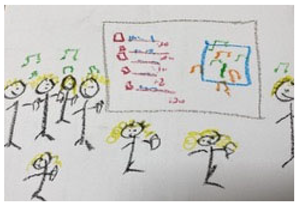
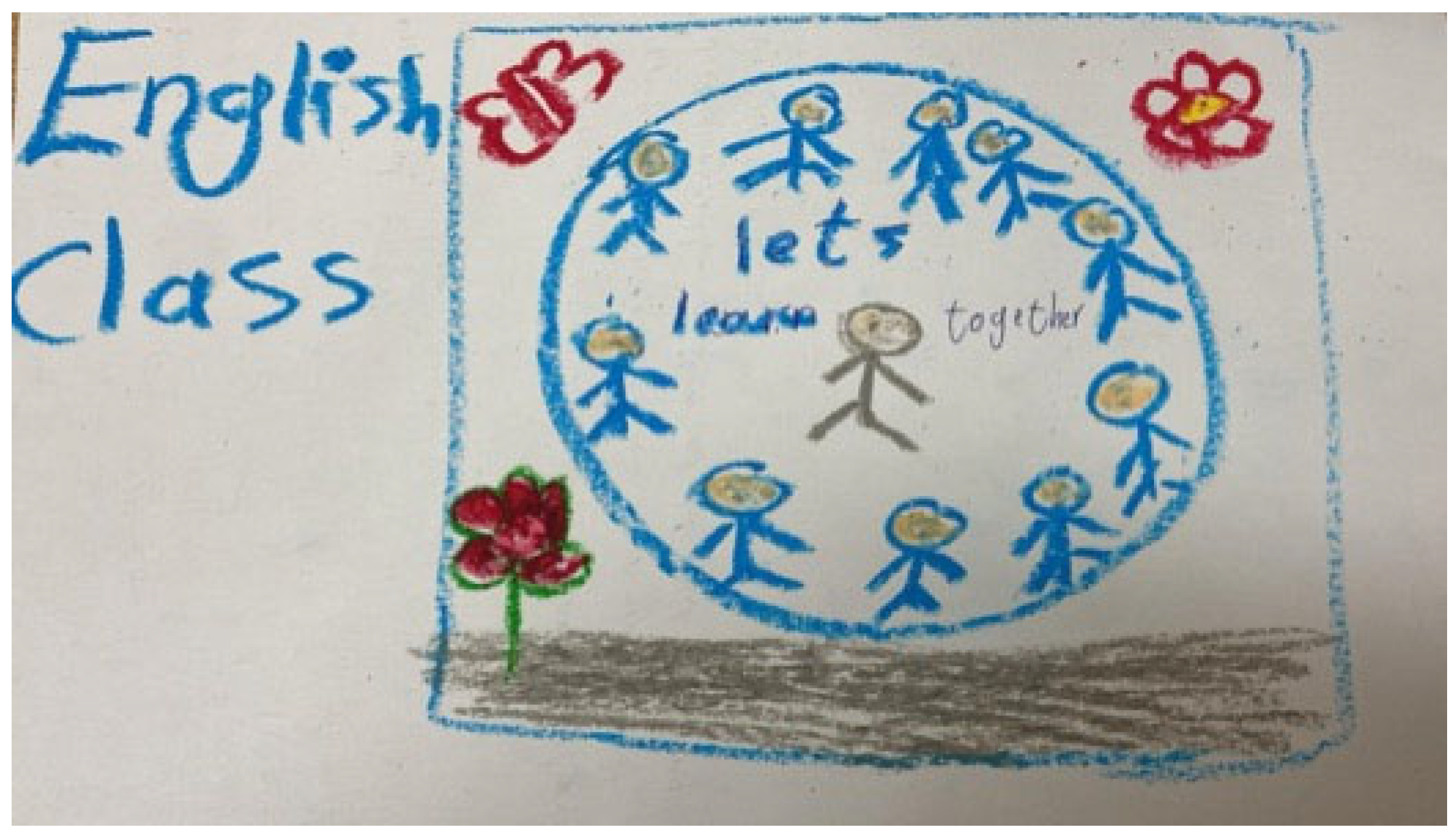
Another example in which we observed an individual conceptual change is Sarah. In the first lesson, she described teaching English in the context of her visit to the United States, when her American relatives were ‘teaching’ her English. This was presented visually (see Figure 3) and explained orally in class. Her product did not include any writing:
Consider Sarah’s drawing: her explanation is essential to understanding the context, but she does not provide a written account. One interpretation of her not writing is that she lacks confidence to express herself in English; another could be that she is unsure about what “teaching” is. Similarly to Anna, teaching here does not occur in the classroom, but rather as a real-life experience. In contrast to Anna, she is aware of the communicative role of using English and, for her, teaching is a group activity. Sarah herself is in the position of the learner in this event, but we cannot tell her apart in the visual representation of the group.
At the end of the course, she refers to her initial product in writing: “At the first [lesson, I showed how] the children tried to teach me.” In this initial concept of teaching English, the learner also has a passive role: “I thought that teaching English is just to receive from others.” She refers to teaching as a one-sided activity: “So all the time I thought that teaching is to teach someone without having a back-and-forth conversation,” and she expresses this experience with her relatives explicitly: “they didn’t know if I understand them or not.”
Her visual representation of English teaching at the end of the course (Figure 4) is very different, and her written explanation describes her new understanding that teaching involves discussion and mutual learning. The complete written part of the product was 112 words long.
In some ways, this representation of English teaching is consistent with her initial concept; however, we observed a significant change in how Sarah represents teaching.
It is important to observe that the similarity between the products stems from the fact that they were created by the same participant; in both products, she has a communicative view of language teaching as a group activity. However, her written explanation for the second drawing shows that she has expanded the interaction to include teacher–student two-way interactions as essential to teaching. Furthermore, she includes the teacher’s learning and peer-learning in this process.
This process of change is significant in several aspects. First, it shows the professional identity shift from her perception of herself as a learner to a perception of herself as a teacher. Second, the teaching process, which was initially set at home, is brought into the classroom. Third, her traditional view of the teacher as talking and imparting information has been replaced with a collaborative model in which the teacher and students learn together.
In both case studies, the Mediated Interactions of the course enabled the participants to express their personal understanding of English teaching. At the beginning of the course, they both showed a narrow view of learning the language on their own, outside of the classroom. It seems that they still viewed the concept of teaching from the outside and that it did not resonate with their inner world, despite having recently graduated from a teacher training program and having started teaching in class. By going through a learning process in the course, their concept expanded to involve communication and interaction between a teacher and a learner or a group of learners. Most importantly, at the end of the course, they positioned themselves as teachers, assuming a leading and active role in teaching, which involves activity and creativity. This dramatic change was also observed at the group level.

4.3. Group-Level Findings

As a group, all the participants (N = 16) in the course reflected on their process of change in their concept of English teaching. This change was also reflected in the length of their writing in the multimodal product. The average length at the beginning of the course was 30.88 words (std. 25.9 words), with three participants not writing at all (min = 0), and the maximal length being 77 words. At the end of the course, the average length of writing was 105.27 words (std. 45.45 words), with the shortest text being 33 words and the longest being 204 words. This shows a significant improvement in their fluency of expression, indicating an increase in confidence in expressing themselves (t(15) = −7.27, p < 0.001).
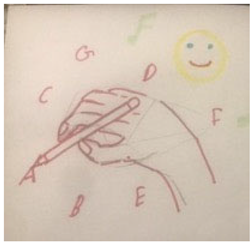
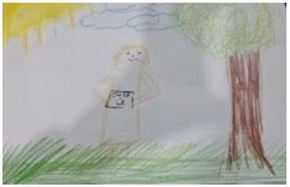
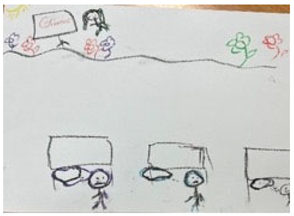
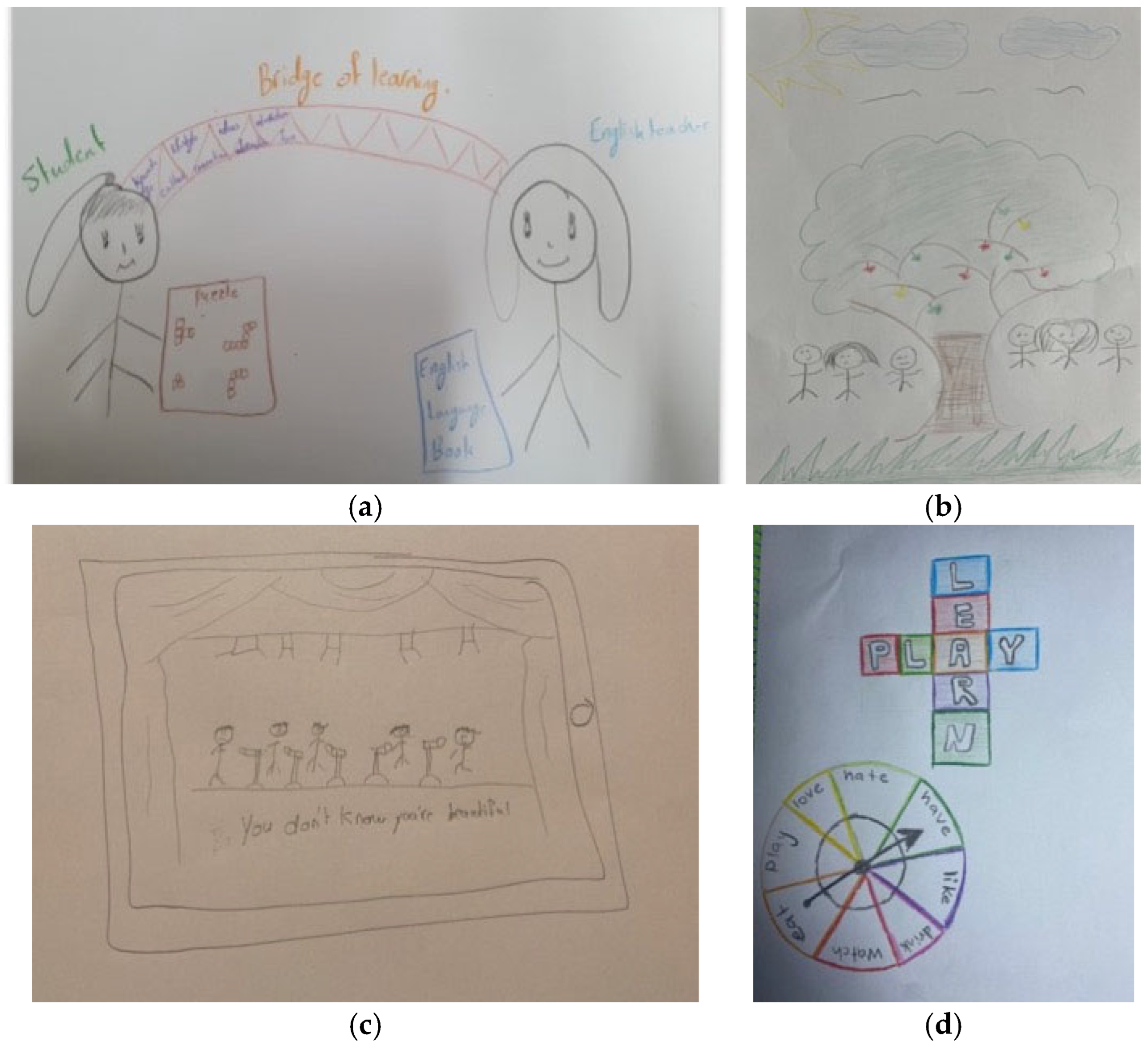
A random purposeful sampling strategy (Patton, 2015) was used to ensure a manageable, yet representative analysis. Six participants were randomly selected, and a subset of four individuals from this group was chosen to illustrate shared conceptual changes. Each pair of products below allowed us to observe conceptual change at the individual level per participant; however, when taken together, they demonstrated shared properties of the conceptual change at the group level. The initial representations of teaching English showed varied perspectives, such as forming a bridge between an individual learner and the teacher (Rose, Figure 5a); learners gaining knowledge independently, like picking apples from a tree (Ollivia, Figure 5b); listening to music (Sharon, Figure 5c); and language-learning games (Alice, Figure 5d).
Although one product depicted a teacher (Rose, Figure 5a), three of them did not involve a teacher, one of them did not even show people (Alice, Figure 5d), and no participant referred to teaching in a classroom. What these products have in common is an experiential, communicative approach to English teaching, whether in terms of personal communication, discovery learning, games, or music; however, they are all framed as an independent activity, and not part of a formal teaching process.
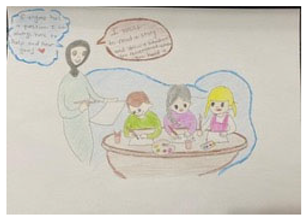
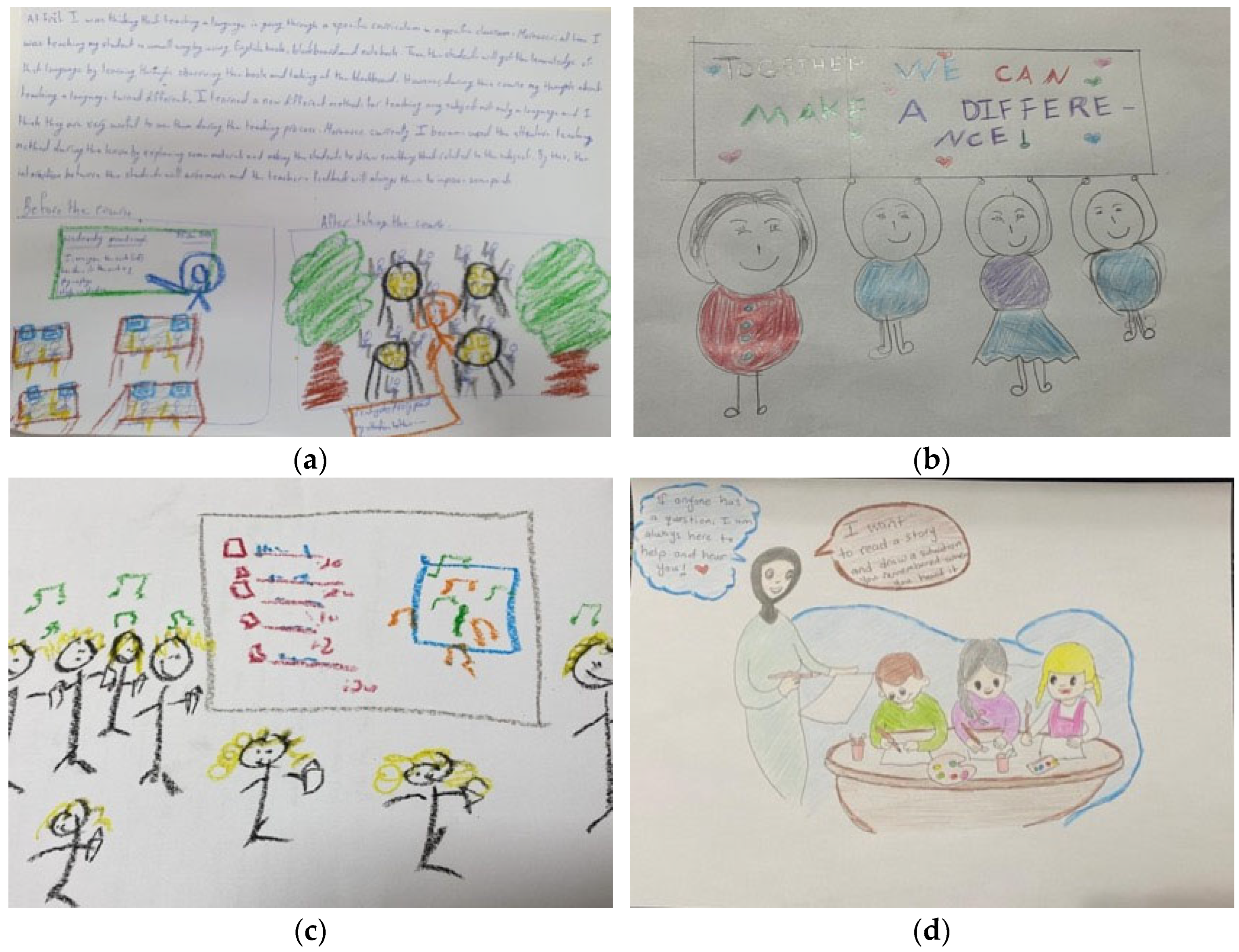
In the final phase, the same participants created the following products representing English teaching. The visual representations were more colorful and richer than those produced at the beginning of the course. These representations highlighted aspects that were unique to each learner. Participants were also asked to compare their own products, observe the changes, and explain them in their writing. Two participants referred to the change in their perception of the teacher’s role: one emphasized providing positive, constructive feedback (Rose, Figure 6a), and another highlighted making a conscious effort to engage students in learning (Ollivia, Figure 6b). The other two referred to the active involvement of students in learning: how the teacher found ways to make them feel important (Sharon, Figure 6c), and how she supported learners in expressing feelings and thoughts (Alice, Figure 6d). Their visual representations all depicted teachers as leaders of the teaching process, and three of them showed the process occurring in a classroom (Ollivia, Figure 6b does not). Moreover, all four explicitly referred to a change in their concept: “my thoughts about teaching a language turned different” (Rose, Figure 6a); “But now, after learning[…], a new idea was formed” (Sharon, Figure 6c); “I was thinking […]. But at the end of the course, I realized I was wrong.” (Ollivia, Figure 6b); “But after taking the course, I gained and learned something new” (Alice, Figure 6d).
Thus, by carrying out multiple Mediated Interactions throughout the course, we were able to observe a change in the participants’ understanding of English teaching. This conceptual change was evident in both the individual products and the shared elements across the group’s representations. The shared features of the group’s final products indicate the effectiveness of the attentive whole-class discussion, in which participants listened to the ideas of their peers as part of the mediation process, as well as to the explanations provided by the course instructors.

5. Discussion

The presented findings illustrate the transformative processes experienced during the professional development course for novice English teachers. We set out to examine how these teachers conceptualized English teaching. By representing their concepts at both the beginning and the conclusion of the course, participants engaged in Dynamic Learning, a practice of Attentive Teaching that served here as both a pedagogical approach and an evaluative tool for observing conceptual change.
The findings demonstrate how Attentive Teaching enabled the observation of conceptual change at both the individual and group levels. By presenting their multimodal products in class, participants made their thinking explicit to themselves as well as to their peers. Our analysis highlighted the unique learning processes of two participants, alongside the collective shift observed among a group of four participants.
This conceptual change was marked by the inclusion of the teacher in the visual representations and by the increased use of teaching-related language in the written explanations. Overall, the products revealed a conceptual change from a fragmented view of individual learning activities to a more holistic, mediated understanding of teacher–learner interaction. This suggests that the novice teachers moved from being “observers” of learning to “active agents” in the teaching process, a shift that is significant for the development of their professional identities.

5.1. Initial Understanding

In the first Mediated Interaction at the beginning of the course, we gained insight into the inner worlds of the participants and how these were connected to their concept of English teaching. Their career choice to become English teachers suggests that learning English has long been important to them, and their life experiences indicate that they found ways to develop their English outside the classroom. The findings also show that the figure of the teacher was largely absent from their products, both visually and verbally; in particular, no reference was made to an intentional teaching process. This led us to deduce that their personal proficiency was often acquired despite the formal education system, rather than because of it.
This aligns with Borg’s (2003) assertion that novice teachers’ perceptions are heavily influenced by their prior schooling experiences. Their formative experiences did not provide them with a positive model of professional agency; consequently, their initial conceptualization of English teaching lacked a clear vision of the teacher’s role in a communicative, action-oriented classroom. This is consistent with Farrell’s (2012) notion of the “theory–practice gap”, in which novice teachers may struggle to internalize pedagogical theories into their professional identities.
Nevertheless, although a general theme emerged across the groups, each of the case studies also showed that each participant’s initial concept of English teaching was distinct, reflecting their varied personal experiences.

5.2. Conceptual Change

In contrast to the absence of a teacher-agent figure, the products created in the final session of the course revealed a clear transformation. Through repeated Mediated Interactions, participants deepened their understanding of English teaching and underwent a meaningful learning process that also transformed their perspectives on their role as teachers, in line with Johnson’s (2009) sociocultural view of teacher development. This change was realized both visually and linguistically in the multimodal products, all of which featured representations of a teacher and students, often a group of students, and three of which also depicted teaching in a classroom setting. The written explanations included specific references to how teachers engaged students in learning and provided feedback to promote understanding, and the grouped samples contained 24 references to “teach” or “teaching”. In other words, the participants moved beyond being passive ‘observers’ of learning activities to becoming ‘active agents’ in their emerging roles as teachers.
Moreover, by expressing their unique points of view in class repeatedly, participants came to realize that they could articulate their ideas and that they were listened to by both their peers and the course instructors. The experience of being heard and taken seriously supported their sense of competence. Not only did they grow in their understanding of English teaching, but they also became more aware of their own professional agency as practicing teachers. In this sense, the process of conceptual change was empowering.

5.3. Attentive Discourse

This identity shift was made possible through the dialogic conditions of Attentive Discourse. In Attentive Discourse, the classroom functions as a social semiotic space. The ongoing practice of listening to one another and receiving feedback is fundamental to Attentive Teaching. The underlying premise is that each learner in the class is important: each has something to contribute and what they say enriches the shared understanding of the group. Because each learner brings a unique perspective, all participants are encouraged to respond to one another in constructive and supportive ways. The teacher mediates individual contributions to the whole class, such that the process benefits both the learner and the group. Through this attentive discussion, understanding of the concept under study is deepened by integrating multiple points of view, including those introduced by the instructor.
When considering the professional development course in the broader context of teaching, the conceptual change observed can be understood as the outcome of a deeper learning process (Mehta & Fine, 2019). The change in understanding involves more than mastery of the scientific concept, in this case, the concept of English teaching. Following Mehta and Fine (2019), we suggest that the Attentive Teaching approach fostered Deeper Learning through the intersection of mastery, identity, and creativity. Mastery was supported as the teacher mediated the study material to the learners, thus guiding the learner’s knowledge construction; identity was engaged by connecting the course content to the learners’ inner worlds; and creativity was sparked through the generative act of multimodal production, as the participants constructed their own understanding through visual representation and verbal explanation.
In the context of English Language Teaching, this discourse also serves an important linguistic function. The multimodal product acts as a scaffold: the visual representation primes the written text which, in turn, supports the oral presentation. In this way, the cognitive load of producing a foreign language is reduced, allowing for authentic communication in a supportive, “mistake-friendly” environment.

5.4. The Teacher as a Mediator

In contemporary educational contexts, teachers are not always fully clear about their role and position in the classroom. In Attentive Teaching, however, the teacher assumes two clearly defined roles. First, the teacher initiates and leads a Mediated Interaction focused on the concept under study. Second, the teacher mediates the concept to learners through attentive whole-class discussion, building on the participants’ responses and conceptualizing their ideas and contributions.
The novice teachers in this study initially had stronger experiences of learning independently outside the classroom than of participating in a meaningful teaching process guided by a teacher. When the participants did refer to classroom teaching, their impressions were often of teacher-centered instruction that did not promote language production. By introducing them to Attentive Teaching, one aim was to support a deeper understanding of the teacher’s role as a mediator.
The two case studies presented here provide meaningful examples of conceptual change in understandings of English teaching. In the final phase of the course, Anna described the learner as excited and motivated by the teacher, mirroring the sense of “magic” she experienced during Mediated Interaction as a learner in the course. Sarah’s insight was that group learning can foster deeper understanding than what is possible when only the teacher presents a prepared explanation. Both products revealed a more advanced understanding of the concept of English teaching compared to the initial understanding presented in their products.
Similarly, the group products and reflections demonstrated conceptual change in the participants’ emerging roles as teachers: seeking to involve learners actively in the learning process, linking study materials to the learners’ lived worlds, encouraging the expression of feelings and thoughts, and providing meaningful feedback that promotes understanding. A comparable change in understanding was also observed among veteran teachers who participated in an Attentive Teaching course (Schur & Guberman, 2024).
Taken together, these findings suggest that Attentive Teaching supports conceptual change not only by eliciting the participants’ initial beliefs, but also by providing a structured dialogic space in which novice teachers can reconstruct their professional identities through Mediated Interaction.

5.5. Study Limitations

Several limitations of this study should be noted. First, the small sample size (N = 16) along with the embedded focus on two individual and four group cases restrict the statistical generalizability of the findings. However, as is common in qualitative case study research (Yin, 2018), the objective was analytical depth, which is best achieved in a close examination of a small sample. Second, the interpretation of multimodal products is inherently subjective. Although this was mitigated by applying a Systemic Functional Linguistics framework (Halliday & Matthiessen, 2014; Kress & van Leeuwen, 2021), other researchers might interpret the visual data through different theoretical lenses. Finally, the study was conducted within a specific, short-term professional development context. Therefore, the long-term stability of these conceptual shifts in the teachers’ actual classroom practice is an area for further research.

6. Conclusions

The goal of this course was to expand novice English teachers’ understanding of the concept of English teaching. We observed the outcomes of six participants who, at the end of the course, characterized English teaching as a shared, dynamic process between teachers and students; this characterization was dramatically different from their initial conceptualizations. Within a student-centered approach, they positioned themselves as teachers who lead the teaching process in the classroom.
By asking the participants to represent the same concept (English teaching) at both the beginning and the end of the course, we were able to observe conceptual change. Moreover, the participants themselves became aware of this change and reflected on the development of their understanding. Thus, these findings also illustrate the value of practicing Dynamic Learning and Mediated Interactions as pedagogical and reflective tools.
Another important outcome of practicing Mediated Interactions in the course was the development of the participants’ self-expression. By the end of the course, they felt more confident expressing themselves in English and were able to write more extensively, as reflected in the increased word count of their products.
In the context of early career professional development, introducing novice teachers to Attentive Teaching and its relevance to English teaching provides clear added value. Not only did the participants enhance their understanding of English teaching, but they also learned a practice that can help them listen attentively to their learners when they teach. Attentive English Teaching is a promising approach aligned with the CEFR action-oriented framework. It supports meaningful communication in the English classroom, encourages learners to express themselves in English, and provides the teachers with opportunities to mediate and support language production activities.

Author Contributions

Conceptualization, Y.S. and S.F.; Methodology, Y.S. and S.F.; Validation, Y.S. and S.F.; Formal analysis, Y.S. and S.F.; Investigation, Y.S. and S.F.; Resources, Y.S. and S.F.; Data curation, Y.S. and S.F.; Writing—original draft, S.F.; Writing—review & editing, Y.S.; Visualization, S.F.; Supervision, Y.S.; Project administration, Y.S.; Funding acquisition, Y.S. and S.F. All authors have read and agreed to the published version of the manuscript.

Funding

This research was funded by The Jerusalem Foundation [project number 12658] (to The Attentive Teaching Institute of the David Yellin Academic College of Education), as part of the project to promote professional development for English teachers in East Jerusalem, and by The MOFET Institute [Grant number 59/2025, MRF] (to Y.S. and S.F). MOFET is the national institute for research and program development in teacher education and education. The funders had no role in the design of the study; in the collection, analyses, or interpretation of data; in the writing of the manuscript; or in the decision to publish the results.

Institutional Review Board Statement

The study was conducted in accordance with the Declaration of Helsinki and approved by the Institutional Review Board of the David Yellin Academic College of Education (protocol code 12.01.2024.012, Date of approval: 1 December 2024).

Informed Consent Statement

Informed consent was obtained from all subjects involved in the study.

Data Availability Statement

The original contributions presented in this study are included in the article. Further inquiries can be directed to the corresponding author.

Conflicts of Interest

The authors declare no conflict of interest.

Abbreviations

The following abbreviations are used in this manuscript:
CEFRCommon European Framework of Reference
ELTEnglish Language Teaching
MLEMediated Learning Experience
SFLSystemic Functional Linguistics

Appendix A

The participants’ multimodal products are included here as supplementary data, of which representative data are provided in the main text of the manuscript. All names are given as pseudonyms to maintain confidentiality.
Table A1. Representations of English teaching in the initial phase.
ParticipantVerbal ExplanationVisual Representation
HannaI believe that the essence of language teaching is to imitate the language. I remember in school that the English teachers would speak to us in Arabic throughout the class and we would just learn some vocabulary and grammar from them! Now I am having difficulty speaking English fluently, unfortunately.Education 16 00219 i001
NarimanI believe that when the teacher loves her students in the class, she will teach them from her heart and teach them as she as can, they will love her too, and this thing let them to interact and learn too much information and vocabulary.Education 16 00219 i002
JosephThe left one is when I used to watch the program in English. The right one is me being taught by my sisters.Education 16 00219 i003
AnnaWatching tv shows and movies in English with English subtitles would be a great way to expand the vocabulary through listening and watching.Education 16 00219 i004
RoseEnglish teaching is like building a bridge of learning the language. It helps to share more ideas, information, knowledge, and culture by making it easier to cross through the student’s mind. Because of this, the student will be able to interact and produce more when the process of learning is different than usual and having more fun.Education 16 00219 i005
AnghamSharing the privilege of knowing English is like sharing a ray of sunshine on a cloudy day.Education 16 00219 i006
OlliviaThe education process is like an apple tree.Education 16 00219 i007
RawanAccording to me, being an English teacher means you can help others to improve their language skills. I feel wonderful when I see students’ growth and success.Education 16 00219 i008
RamonaI’ve always thought of teaching English Language as a garden that came out from Jane Austen’s Pride and Prejudice, with the scene of Elizabeth walking towards her house and the sun is shining to let everything so bright and the green color giving the positive vibes and the feeling of wanting to learn and know everything… Elizabeth’s passion to learn is my feeling that teaching and learning English gives me the opportunity to know everything about anything.Education 16 00219 i009
TanyaEnglish is a fun learning process, and students should be encouraged to be a part of it. Education 16 00219 i010
Alice No text.Education 16 00219 i011
SarahNo text.Education 16 00219 i012
HarrietEnglish teaching for me is that I’m in a class as a teacher, all of the students are sharing with me the answer, or their opinion or their feelings about the English lesson in a comfortable way. Build with them a strong relationship, which leads them to share with me their feelings about the language without fear or hesitation.Education 16 00219 i013
RachelI imagine a class full of students happily trying to be creative and enjoy learning the English language.Education 16 00219 i014
SharonI believe that when the students feel in touch with the topic/lesson their probability to learn will become higher than ever. And that’s what my drawing is about. I learned English by doing something I like which is listening to music. I had that group that I loved and used to listen to every song they released, read its meanings, and memorize it by heart. That is what made me be here now.Education 16 00219 i015
ImanNo text.Education 16 00219 i016
Table A2. Representations of English teaching in the final phase.
ParticipantVerbal ExplanationVisual Representation
HannaIn the beginning of the course, we were asked to draw the general picture we think of the teacher. Nothing came to my mind except the image of my teachers in primary school, who used to give her student a word and its meaning and that’s it. Today, after I had this course, I am thinking about a joyful teacher who has a big bag with a lot of ideas and activities to her students, and she also has a very long arm that reaches every one of her students and is ready to understand them, help them, and they will all reach the goal together.Education 16 00219 i017
NarimanIn the first class I drew the teacher explaining to the students—and the method was traditional. But now I changed my opinion. Changing the style of explaining lessons is important to make the class enjoyable for students. For example, the teacher can read a story to the students, and they draw what they understand from the story. In this way the students can express their feelings. The students like drawing and colors so they will be excited in the class.Education 16 00219 i018
JosephA teacher with his student and sharing their experience together. Above them are some of the elements that should be activated by both—the teacher and the student. Each of them uses these elements in balance of their position. The elements are: Zoom lens, the sun (positivity), brain, heart.
I think that the new thing I learned is that there should be times where I should refresh my relationship with my students. The teacher should pay attention to the ideas and feelings produced by the students. From the reflections and discussions in this course I learned that the special good teacher is the one who is present and who manages to include every student and make each student special.
Education 16 00219 i019
AnnaMe on the right feeling like I’m using superpowers through art (mediated interaction, dynamic learning) and on the left is a student I’ve met last year in my teaching-practice and only now I realized I used this magic with him. He used to draw me things and so I drew him back which made him always excited and waiting for my class. Now that I realize this, I’ll use it forever. This course has opened my eyes to something that was always there with me, but I’ve never realized how to use it. It showed me that I can do more than what I could, like a person with magical powers but only now learned how and for what to use them. I like venting through drawing and building and presenting my own world, but it’s the first time I realize I can use that power to enter others’ worlds. For me, this ability as a teacher is something I’ll hold on to forever because good teaching starts with a good connection, and this mediation is the hero of the day to let that happen.Education 16 00219 i020
RoseAt first I was thinking that teaching a language is going through a specific curriculum. Moreover, all the time I was teaching my students in a usual way by using an English book, blackboard, notebook. Thus, the students will get knowledge of that language by learning through observing the book and looking at the blackboard. However, during this course my thoughts about teaching a language turned different. I learned a new, different method for teaching my subject—which is not only “language”. I think these ideas are very useful to use during teaching in general. Moreover, I became used to the attentive teaching method during the lesson by explaining some material and asking the students to draw something that related to the subject. By doing this, the interaction between the students will arise and the teachers’ feedback will always think to improve some point. Education 16 00219 i021
AnghamI always thought that teachers should be decent humans. But in this course, I am now certain about this. If anything, I do believe that every teacher should go through a psychological report.Education 16 00219 i022
OlliviaAt the beginning of this course, we were asked to draw our vision of the educational process in the classroom. At that time, I drew students learning on their own, and the teacher was only there to help “student-center method”. I was thinking that students were responsible for their education from A to Z. But at the end of the course, I realized I was wrong. It is the teacher’s duty to integrate students into the learning process. This is done by linking the material to the students’ reality. Furthermore, to let them express their thoughts through the most fun way: drawing.Education 16 00219 i023
RawanAt a normal English lesson, we used to see that the teacher is the one who speaks and explains, and there is no time or importance for the thoughts of students. We used to not listen or understand the students’ points of view. After this course, I understand how it’s important to engage the student to express their points of view and encourage the communication at the classroom. This way the students feel happy, enjoy, and feel excited.Education 16 00219 i024
RamonaIn this picture we see the teacher in her own world (usually a pink world) and she is explaining the grammar lesson while the students in the class are busy with their own world and feelings, which certainly affects the quality of their learning. After taking this course, I believe that in addition to finishing the curriculum and covering the essentials, teachers should spend more time getting to know their students’ backgrounds and worlds so that they can better connect their experiences to what they are learning. It would be simpler for teachers to select authentic materials from real-world scenarios to support the learning process if they are aware of their students’ environments.Education 16 00219 i025
TanyaI’ve always had the idea that teaching is a powerful message because it’s not only about teaching but it’s also about empowering our students and helping them become better people. It’s also about accepting the individuals as they are. In my drawing the teacher is the earth that carries us all and provides us with home.Education 16 00219 i026
Alice Before taking this course, I thought just how to teach students the English language in an effective and fun way, like using different games and funny activities through the lesson. But after taking the course I gained and learned something new, which is how to make students express their feelings and their thoughts through drawing. How the teacher can read to them a story and ask them to draw a situation that happened to them and they remembered when they heard the story. I liked this method very much, and I think there’s no person who doesn’t like drawing and doesn’t feel happy when using colors. So, sure, I’ll use this method with my students in class.Education 16 00219 i027
SarahAt the beginning of the course, I thought that teaching English is just to receive from others. At the first [lesson, I showed how] the children tried to teach me, but they didn’t know if I understand them or not. So all the time I thought that teaching is to teach someone without having a back-and-forth conversation. But now I learned that teaching is mutual between the teacher and the student. As a teacher, I learn from the students and also they are learning from me. This drawing expresses mutual learning between the teacher and students, as there are mutual discussions between them and not just teaching by the teacher. Education 16 00219 i028
HarrietI thought that the English classroom is about studying grammar, and the teacher must explain the lessons of the grammar to the student with no interaction between the teacher and the student. I changed in my perception during the course. English teaching is more interesting for me now. There are different ways to engage students and to get them to be active. The important thing is the interaction between the students and between the students and the teacher (build a good relationship). Students should feel free to express their feelings, and then the teacher can discover the world of the students. The basic role of the teacher is to be a good listener.Education 16 00219 i029
RachelI changed my opinion about the method of teaching English language to students. At first, I felt that English is just teaching students while they are sitting in front of me. But now I feel my point of view has changed. Teaching must be effective and active. Students are an essential part of the learning process through experiences, discussions, analysis, and linking ideas. Education 16 00219 i030
SharonAt the beginning of the course, I drew my journey with learning and loving English. I learned it via music. I loved it and got all knowledge of English from it; I was taught the information. It was like a one side work (the music). But now, after learning about attentive teaching, and after also reading the articles, a new idea was formed. Now, I see teaching as a road that goes both ways. I learn and teach even if during teaching there are abstract things such as math and reading. Learning is supposed to be a fun, comfortable experience for both the teacher and the learner. I was also exposed to something that wasn’t considered at our company, which is the teacher’s feelings. The teacher should be in a good place mentally to teach kids. She should be aware of her feelings and should be comfortable and not pressured so she could give the best to the kids because even small looks that mean nothing to her can change a student’s life. As for the students, they should be more involved in the learning process to be aware of the steps they will go through and feel they are important in the class.Education 16 00219 i031
ImanTeaching depends on various qualities for teachers, so they would achieve the best teaching/learning process. I learned to respect my students’ thinking and imagination more. To listen to their viewpoints and help them to achieve a point of respect and acceptance of each other. Almost never stick to my visualization of anything because their heads are full of treasure.Education 16 00219 i032

References

  1. Allen, A. (2022). An introduction to constructivism: Its theoretical roots and impact on contemporary education. Journal of Learning Design and Leadership, 1(1), 1–11. [Google Scholar]
  2. Borg, S. (2003). Teacher cognition in language teaching: A review of research on what language teachers think, know, believe, and do. Language Teaching, 36(2), 81–109. [Google Scholar] [CrossRef] [Scilit]
  3. Brailas, A. (2020). Using drawings in qualitative interviews: An introduction to the practice. The Qualitative Report, 25(12), 4447–4460. [Google Scholar] [CrossRef] [Scilit]
  4. Council of Europe. (2020). Common European framework of reference for languages: Learning, teaching, assessment—Companion volume. Council of Europe Publishing. [Google Scholar]
  5. diSessa, A. A. (2022). A history of conceptual change research. In R. K. Sawyer (Ed.), The Cambridge handbook of the learning sciences (pp. 114–133). Cambridge University Press. [Google Scholar] [CrossRef] [Scilit]
  6. Farrell, T. S. C. (2012). Reflecting on professional development. ELT Journal, 66(1), 26–34. [Google Scholar] [CrossRef] [Scilit]
  7. Feuerstein, R., Hoffman, M. B., Miller, R., & Rand, Y. (1980). Instrumental enrichment: An intervention program for cognitive modifiability. Scott, Foresman, Lifelong Learning Division. [Google Scholar]
  8. Gal, A., Schur, Y., Nevo, E., & Gan, D. (2022). Using drawings and explanations based on attentive teaching as a means for understanding the social-ecological systems concept. Environmental Education Research, 29(2), 287–307. [Google Scholar] [CrossRef] [Scilit]
  9. Gauntlett, D. (2007). Creative explorations: New approaches to identities and audiences. Routledge. [Google Scholar] [CrossRef] [Scilit]
  10. Halliday, M. A. K., & Matthiessen, C. M. I. M. (2014). Halliday’s introduction to functional grammar (4th ed.). Routledge. [Google Scholar] [CrossRef] [Scilit]
  11. Johnson, K. E. (2009). Second language teacher education: A sociocultural perspective. Routledge. [Google Scholar]
  12. Kress, G., & van Leeuwen, T. (2021). Reading images: The grammar of visual design (3rd ed.). Routledge. [Google Scholar] [CrossRef] [Scilit]
  13. Literat, I. (2013). A pencil for your thoughts: Participatory drawing as a visual research method with children and youth. International Journal of Qualitative Methods, 12(1), 126–142. [Google Scholar] [CrossRef] [Scilit]
  14. Martinec, R., & Salway, A. (2005). A system for image–text relations. Visual Communication, 4(3), 337–371. [Google Scholar] [CrossRef] [Scilit]
  15. Marton, F., Hounsell, D., & Entwistle, N. (Eds.). (2005). The experience of learning: Implications for teaching and studying in higher education (3rd ed.). University of Edinburgh. [Google Scholar]
  16. Mehta, J., & Fine, S. (2019). In search of deeper learning: The quest to remake the American high school. Harvard University Press. [Google Scholar]
  17. North, B. (2021). The CEFR Companion Volume: What’s new and what might it imply for teaching/learning and for assessment? CEFR Journal: Research and Practice, 4(1), 5–24. [Google Scholar] [CrossRef] [Scilit]
  18. Patton, M. Q. (2015). Qualitative research & evaluation methods: Integrating theory and practice (4th ed.). Sage. [Google Scholar]
  19. Piaget, J. (1975). The development of thought: Equilibration of cognitive structure. The Viking Press. [Google Scholar]
  20. Posner, G. J., Strike, K. A., Hewson, P. W., & Gertzog, W. A. (1982). Accommodation of a scientific conception: Toward a theory of conceptual change. Science Education, 66(2), 211–227. [Google Scholar] [CrossRef] [Scilit]
  21. Schur, Y. (2015). Thinking journeys in the classroom: The power of uncertainty and mediation. Professional Development Today, 18(1), 44–53. [Google Scholar]
  22. Schur, Y. (2025). The art of attentive teaching. Brill. [Google Scholar]
  23. Schur, Y., & Axelrod-Tayer, N. (2014). Dynamic learning: Seeing, observation, cognitive processes and conceptual understanding. Bemaaglei Hahinuch, 4, 127–196, [In Hebrew]. [Google Scholar]
  24. Schur, Y., & Galili, I. (2009). Thinking journey: A new mode of teaching science. International Journal of Science and Mathematics Education, 7, 627–646. [Google Scholar] [CrossRef] [Scilit]
  25. Schur, Y., & Guberman, A. (2024). Conceptual change of ‘teaching’ among experienced teachers after studying attentive teaching. Education Sciences, 14(3), 231. [Google Scholar] [CrossRef] [Scilit]
  26. Schur, Y., Guberman, A., & Ovsyannikov, S. (2025). Promoting understanding of the concept of the refraction of light through the use of attentive teaching. Education Sciences, 15(2), 118. [Google Scholar] [CrossRef] [Scilit]
  27. Unsworth, L. (2001). Teaching multiliteracies across the curriculum: Changing contexts of text and image in classroom practice. Open University Press. [Google Scholar]
  28. Vygotsky, L. S. (1986). Thought and language (A. Kozulin, Trans.). MIT Press. (Original work published 1934). [Google Scholar]
  29. Wanselin, H., Danielsson, K., & Wikman, S. (2023). Meaning-making in ecology education: Analysis of students’ multimodal texts. Education Sciences, 13(5), 443. [Google Scholar] [CrossRef] [Scilit]
  30. Yin, R. K. (2018). Case study research and applications: Design and methods (6th ed.). Sage Publications. [Google Scholar]
  31. You, Y.-L., & Han, S.-J. (2023). Examining EFL learners’ multimodal texts: Exploring the rhetorical purposes of semiotic embeds in multimodal texts. The International Journal of Literacies, 30(2), 149–166. [Google Scholar] [CrossRef] [Scilit]
Figure 1. Anna’s visual representation of her initial concept for English teaching: “Watching TV shows and movies in English with English subtitles would be a great way to expand the vocabulary through listening and watching”.
Education 16 00219 g001
Figure 2. Anna’s visual representation of her concept for English teaching at the end of the course: “Me on the right feeling like I’m using superpowers through art […] and on the left is a student I’ve met last year in my teaching-practice and only now I realized I used this magic with him. He used to draw me things and so I drew him back which made him always excited and waiting for my class. Now that I realize this, I’ll use it forever. This course has opened my eyes to something that was always there with me, but I’ve never realized how to use it. […] For me, this ability as a teacher is something I’ll hold on to forever because good teaching starts with a good connection, and this mediation is the hero of the day to let that happen.”
Education 16 00219 g002
Figure 3. Sarah’s visual representation of her initial concept for English teaching.
Education 16 00219 g003
Figure 4. Sarah’s visual representation of her concept for English teaching at the end of the course: “…now I learned that teaching is mutual between the teacher and the student. As a teacher, I learn from the students and also they are learning from me. This drawing expresses mutual learning between the teacher and students, as there are mutual discussions between them and not just teaching by the teacher.”
Education 16 00219 g004
Figure 5. Group visual representation of participants’ initial concept of English teaching: (a) Rose: “English teaching is like building a bridge of learning the language. It helps to share more ideas, […], the student will be able to interact and produce more”; (b) Ollivia: “The education process is like an apple tree”; (c) Sharon: “I believe that when the students feel in touch with the topic, their probability to learn will become higher than ever. […] I learned English by listening to music. […] I had that group that I loved and used to listen to every song they released, read its meanings, and memorize it by heart”; (d) Alice did not write, but explained orally that students learn best when they are engaged by playing language games.
Education 16 00219 g005
Figure 6. Group visual representation of participants’ initial concept of English teaching: (a) Rose: “By doing [Attentive Teaching], the interaction between the students will arise and the teacher’s feedback will always think to improve some point”; (b) Ollivia: “ It is the teacher’s duty to integrate students into the learning process. This is done by linking the materials to the students’ reality”; (c) Sharon: “ after learning about attentive teaching, […] I see teaching as a road that goes both ways. […] students should be more involved in the learning process […] and feel they are important in the class”; (d) Alice: “after taking the course, I gained and learned something new, which is how to make students express their feelings and their thoughts through drawing.”
Education 16 00219 g006
Disclaimer/Publisher’s Note: The statements, opinions and data contained in all publications are solely those of the individual author(s) and contributor(s) and not of MDPI and/or the editor(s). MDPI and/or the editor(s) disclaim responsibility for any injury to people or property resulting from any ideas, methods, instructions or products referred to in the content.