


Abstract
Generative artificial intelligence (AI) is rapidly transforming online higher education by increasing efficiency in instructional design, feedback, and communication. However, its integration raises important questions about preserving social presence and meaningful human connection in digitally mediated learning environments. This conceptual, practice-informed interdisciplinary synthesis examines the relationship between technological efficiency and relational engagement in asynchronous online education. Drawing upon Social Presence Theory, the Community of Inquiry framework, the Social Presence Model, social development theory, and research on human-centered pedagogy, the manuscript extends the Social Presence Literacy Framework) to AI-mediated instructional decision-making. The synthesis identifies three potential relational challenges associated with unintentional AI integration: the displacement of meaningful engagement through task automation, diminished opportunities for empathy and emotional attunement, and the erosion of human-centered teaching practices. In response, a five-step decision-making framework is proposed, connecting the SPLF dimensions of Knowledge, Application, Evaluation, and Creation to evaluating, identifying gaps, adjusting, testing, and refining AI-supported instructional practices. Although the proposed framework has not been empirically validated, it offers educators a practical approach to balancing technological efficiency with relational intentionality. The manuscript concludes by emphasizing the importance of reflective instructional judgment, student experiences, and institutional support in sustaining human-centered AI integration.
1. Introduction
The rapid adoption of generative AI in higher education represents one of the most significant shifts in contemporary teaching and learning. Tools capable of generating text, feedback, and instructional materials have moved quickly from novelty to necessity, particularly in online learning environments where faculty often manage high volumes of communication and assessment (Mah & Groß, 2024). While these technologies offer meaningful efficiencies, their integration into core teaching practices has introduced a complex and pressing challenge: how to preserve the human elements of teaching in an increasingly automated landscape.
Online education has long grappled with issues of disconnection, isolation, and reduced engagement (Shaikh & Asif, 2022). Research consistently demonstrates that students in online environments can experience diminished interaction and a lack of belonging when relational elements are not intentionally cultivated (Shaikh & Asif, 2022; Akpen et al., 2024). The teacher becomes more important in an online classroom strengthening learner engagement, limiting isolation, and creating a cohesive environment conducive to learning success (Martin & Bolliger, 2018; J. Miao et al., 2022). Social presence, the degree to which individuals perceive others as real, accessible, and emotionally connected (Short et al., 1976), has been identified as a critical factor in mitigating these challenges. As generative AI becomes embedded in instructional workflows, a relational risk arises when automated tools substitute human interactions that serve key relational functions.
This manuscript addresses the central problem of balancing AI-driven efficiency with the preservation of social presence in asynchronous online instruction by drawing upon the established Social Presence Literacy Framework (SPLF; Dyer, 2025) as a conceptual bridge between technological efficiency and relational pedagogy. The widespread adoption of AI tools in the academic environment establishes a tension between cognitive engagement and learning support (Wang & Zhang, 2026). This issue is particularly urgent as faculty increasingly use AI to generate discussion responses, provide feedback, and assist with grading. Without intentional design and critical reflection, these practices risk creating transactional learning environments that prioritize speed over connection.
In response to this challenge, we draw on interdisciplinary perspectives, existing research that emphasizes the importance of humanizing online instruction, and practitioner experience to propose a five-step decision-making framework for human-centered AI integration. While it has not yet undergone empirical validation, it offers an actionable model for instructors while inviting future empirical testing. This framework is designed to help educators increase social presence literacy and evaluate and refine AI use in ways that sustain empathy, immediacy, and meaningful interaction. Building upon the Social Presence Literacy Framework (SPLF) developed through qualitative research with online faculty (Dyer, 2025), this manuscript examines how educators can apply relational pedagogical capacities to decisions about generative AI integration. Specifically, the study extends the SPLF’s four dimensions—Knowledge, Application, Evaluation, and Creation—into a proposed decision-making process intended to preserve meaningful human connection while leveraging the instructional benefits of AI. By centering social presence as a guiding principle rather than an afterthought, this work offers a practical pathway for navigating the evolving relationship between technology and teaching, enhancing AI efficiency while increasing relational function.
2. Literature Review
Understanding the impact of generative artificial intelligence (AI) on online learning requires an interdisciplinary lens that integrates perspectives from educational psychology, communication theory, instructional design, and learning sciences. Across these domains, a consistent theme emerges meaningful learning is not solely cognitive, but relational. As such, the concept of social presence provides a critical foundation for examining how AI reshapes teaching and learning in digital environments.
Social Presence Theory offers an initial lens for understanding how learners perceive others as “real” and emotionally available within mediated communication contexts. In online education, social presence extends beyond interaction frequency to include affective expression, immediacy, and relational connection. Social presence is not defined by instructor or instructional design alone, but by the student’s experienced perception of relational availability. Contemporary research continues to affirm that higher levels of perceived social presence are associated with increased student satisfaction, engagement, and persistence in online courses (Richardson et al., 2017; Fiock, 2020; Nazaretsky et al., 2026). Recent research on humanized online learning similarly emphasizes the relational dimensions of digitally mediated instruction. Humanizing approaches prioritize interpersonal connection, empathy, instructor presence, and learner-centered interaction rather than treating technology as the primary driver of the learning experience (Chai et al., 2024; Razak et al., 2025). A recent systematic review further identified the Community of Inquiry framework as a prominent theoretical foundation for integrating digital technologies with student-centered and human-centered online pedagogy (Razak et al., 2025).
The Community of Inquiry (CoI) framework extends this understanding by situating social presence alongside teaching and cognitive presence as interdependent elements of meaningful learning experiences. Within this model, social presence supports open communication and group cohesion, teaching presence structures and facilitates learning, and cognitive presence enables knowledge of construction and deep learning. Recent meta-analyses have demonstrated that these presences function as a dynamic system, where disruption in one dimension, particularly social presence, can negatively impact overall learning outcomes (Stenbom, 2018; Martin et al., 2022). Interaction with instructors appears to be particularly consequential in online learning environments. Students have rated learner–instructor engagement strategies as more important than learner–learner or learner–content engagement strategies (Martin & Bolliger, 2018), while teacher–student interaction has also been linked with social presence and learning engagement in online environments (J. Miao et al., 2022). These findings reinforce the importance of considering not simply the frequency of instructional communication, but its relational function. In AI-supported environments, this interdependence becomes especially important, as technological efficiency may weaken the student perception of relational components that sustain engagement (Nazaretsky et al., 2026). While teaching presence emphasizes design, facilitation, and the direction of learning, social presence literacy can expand relational components as it provides the instructor with the capacity to assess the impact technology has on relational availability.
From a developmental perspective, Social Development Theory further reinforces the centrality of social interaction in learning. Vygotsky’s concept of the Zone of Proximal Development (ZPD) positions learning as a socially mediated process, where guidance and interaction enable learners to progress beyond independent capability. Recent studies suggest that AI tools can support scaffolding within the ZPD by providing adaptive feedback and personalized learning pathways (Cai et al., 2024; Holmes et al., 2019). However, this support is enhanced when paired with human facilitation that provides contextual understanding, encouragement, and emotional attunement. Without this relational layer, AI-driven scaffolding risks becoming mechanistic rather than developmental.
Within instructional design and online pedagogy, the Social Presence Model offers a more granular understanding of how social presence is enacted. Whiteside’s (2015) model identifies key dimensions such as affective association, interaction intensity, and instructor involvement, all of which contribute to learners’ sense of connection and belonging. Recent research emphasizes that affective association, expressed through empathy, warmth, and responsiveness, is particularly critical in online environments where nonverbal cues are limited (Ensmann et al., 2021; Borup et al., 2015). When these elements are diminished, students are more likely to perceive the learning environment as transactional rather than relational.
Humanizing online pedagogy provides an additional lens for understanding the relational dimensions of digitally mediated teaching. Li et al. (2022) identified student agency, instructor presence, and peer presence as central elements of humanized online learning and demonstrated how instructors intentionally enact these dimensions through course design and interaction. Similarly, Murtafi’ah and Pradita (2024) positioned social presence as a means of humanizing online learning, illustrating how affective, cohesive, and interactive forms of presence can support more relational learning environments. Together, this literature reinforces the importance of intentionally designing human connection rather than assuming interaction alone produces presence.
Educational technology research adds another layer to this analysis by examining the role of AI in shaping instructional interaction. Generative AI tools have demonstrated significant potential to enhance efficiency, support personalization, and reduce faculty workload (Zawacki-Richter et al., 2019; Holmes et al., 2019; Razak et al., 2025). More recent studies highlight how AI can assist with feedback generation, content creation, and adaptive learning design (Kasneci et al., 2023). However, humanization has emerged as a pivotal factor in online learning experiences and additional evidence indicates that AI-mediated communication can lack variability, emotional nuance, and responsiveness, leading to decreased student motivation and perceived instructor presence (Bewersdorff et al., 2023; Chai et al., 2024; Lin & Chen, 2024). This tension underscores a critical challenge: while AI can simulate interaction, it cannot reliably replicate the relational depth required for meaningful learning experiences.
Social Presence Literacy extends beyond the presence of relational practices themselves. Whereas social presence describes the degree to which individuals are perceived as real and relationally available within mediated environments, and humanizing pedagogies identify practices that foster agency, instructor presence, peer presence, empathy, and connection (Li et al., 2022; Murtafi’ah & Pradita, 2024), Social Presence Literacy concerns an educator’s capacity to intentionally understand, enact, evaluate, and create those relational conditions. In AI-mediated learning environments, this literacy becomes particularly consequential because educators must determine not only how to foster presence, but also when technological mediation supports, diminishes, or fundamentally alters the relational function of an instructional interaction.
Social Presence Literacy extends traditional conceptualizations of social presence by positioning it as a pedagogical capacity that educators can intentionally develop and refine. Drawing upon qualitative research examining how online faculty understand and operationalize social presence, Dyer (2025) developed the Social Presence Literacy Framework (SPLF), consisting of four interconnected dimensions: Knowledge, Application, Evaluation, and Creation. Knowledge concerns understanding social presence and its significance in mediated learning environments; Application involves intentionally enacting relational teaching practices; Evaluation emphasizes critically assessing the effectiveness of those practices; and Creation focuses on designing meaningful opportunities for human connection and engagement. Together, these dimensions position social presence not simply as a condition to be achieved, but as a form of literacy that informs instructional decision-making. Unlike AI literacy, which emphasizes understanding and critically engaging with artificial intelligence technologies, SPLF focuses specifically on the relational knowledge and pedagogical capacities educators bring to instructional decisions. These complementary forms of literacy become particularly important when technological capabilities intersect with the interpersonal purposes of teaching.
The SPLF provides a particularly relevant conceptual foundation for examining generative AI in online education. As AI increasingly supports instructional communication, feedback, and course facilitation, educators must exercise more than technical proficiency. They must understand the relational purposes of instructional interactions, determine when AI assistance is appropriate, evaluate whether mediated communication sustains meaningful human connection, and intentionally design learning experiences that balance technological efficiency with relational engagement. In this context, Social Presence Literacy offers a framework for considering which instructional tasks may be delegated to AI and which interactions require intentional human involvement (Dyer, 2025).
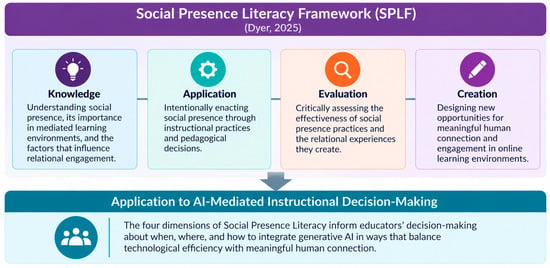
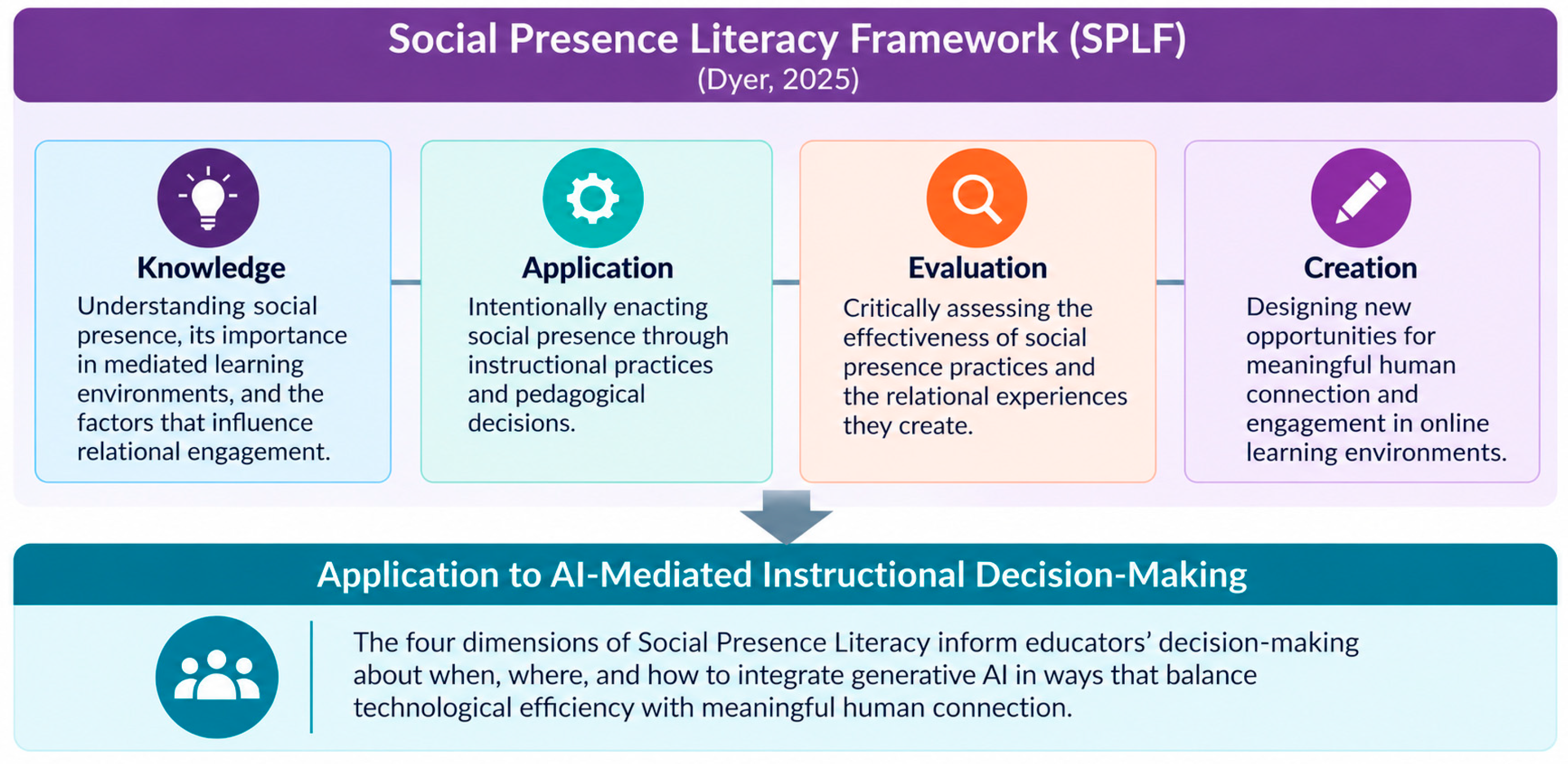
Despite these advances, the literature reveals a critical gap. Research on AI in education often focuses on efficiency, scalability, and innovation, while studies on social presence emphasize relational dynamics and human connection. These domains are frequently examined in isolation, resulting in a lack of integrated, practice-oriented frameworks that guide educators in balancing technological innovation with relational pedagogy. Existing approaches tend to either advocate for AI adoption without sufficient attention to its relational implications or emphasize human connection without offering concrete strategies for navigating emerging technologies. Although existing frameworks provide important foundations for understanding social presence, humanizing pedagogy, and responsible technology integration, less attention has been given to how educators can systematically apply relational literacy when making decisions about generative AI. The present manuscript addresses this gap by extending the Social Presence Literacy Framework (Dyer, 2025) into an AI-mediated instructional context. Specifically, it proposes a five-step decision-making process that translates the framework’s four dimensions into practical considerations for balancing technological efficiency with meaningful human connection. While Figure 1 illustrates the Social Presence Literacy Framework and its proposed application to AI-mediated instructional decision-making, Table 1 situates SPLF within the broader theoretical and conceptual perspectives informing the present study.
Figure 1.
The Social Presence Literacy Framework (Dyer, 2025) and its proposed application to AI-mediated instructional decision-making. Note. The four dimensions of Knowledge, Application, Evaluation, and Creation are drawn from Dyer (2025). Their application to AI-mediated instructional decision-making represents the conceptual extension proposed in the present manuscript and has not yet been empirically validated. The figure was created by the authors using design tools with the assistance of generative artificial intelligence (DALL·E).
Table 1.
Theoretical and conceptual foundations of human-centered AI integration.
Importantly, learner perspectives reinforce the relational significance of instructor presence. Students have identified learner–instructor engagement as particularly important within online courses (Martin & Bolliger, 2018). Similarly, graduate students reported positive experiences with humanizing practices such as instructor videos, detailed personalized feedback, and multimodal opportunities for interaction (Stewart, 2023). These findings suggest that the relational quality of online instruction is not solely an instructional design concern, but an aspect of the learning environment experienced and interpreted by learners.
This manuscript addresses this gap by synthesizing interdisciplinary perspectives into a cohesive, actionable framework for human-centered AI integration. By positioning social presence as a guiding principle rather than an outcome, this work contributes to a practical model that helps educators intentionally design AI-supported learning environments that preserve connection, empathy, and engagement.
3. Materials and Methods: Conceptual and Practice-Informed Synthesis
This study is grounded in a practice-informed, interdisciplinary synthesis of scholarship and instructional experience related to generative artificial intelligence (AI) in online learning environments. It is important to note that this framework is conceptual and practice-informed; it has not been empirically validated through quantitative or qualitative field trials. Rather than employing a single formal methodological tradition, this approach draws on reflective analysis and engagement with current literature to examine how AI integration is shaping relational dynamics in asynchronous instruction.
Reflective practice served as a primary lens for examining patterns in instructional decision-making. As experienced online educators, we observed emerging tensions in how AI tools were being used, particularly in discussion facilitation, feedback, and instructor communication, where efficiency gains were often accompanied by subtle shifts in interaction quality. These observations were not treated as isolated anecdotes, but as recurring patterns that warranted closer examination.
To contextualize these patterns, we engaged with recent scholarship across educational technology, social presence, and online learning research. Studies on social presence, feedback design, and AI in higher education provided a foundation for understanding how interaction quality, emotional engagement, and instructional intent influence student experience (Richardson et al., 2017; Fiock, 2020; Kasneci et al., 2023; Bewersdorff et al., 2023). We identified the literature through searches across primary educational and interdisciplinary databases, which included ERIC, EBSCOhost (Education Source), Google Scholar, and direct publisher repositories (e.g., ScienceDirect etc.). Key concepts and search terms were combined across thematic clusters and disciplines “generative AI and higher education”, “social presence and relational pedagogy” and “feedback, interaction, and student outcomes”. The scope of research focused on the literature (2015–2026) to include contemporary developments in online learning and generative AI integration; however, we also relied on foundational theoretical texts (e.g., Short et al., 1976). This engagement allowed us to situate observed instructional shifts within broader theoretical and empirical conversations.
Sources were considered for inclusion based on their relevance to at least one of three areas: (a) theoretical understandings of social presence and relational engagement in online learning, (b) empirical or conceptual scholarship examining generative AI and instructional practice, and (c) research addressing instructor communication, feedback, and student engagement. Foundational theoretical publications were retained when necessary to establish the conceptual grounding of the synthesis, while more recent scholarship was emphasized to reflect developments in AI-mediated education. The selected literature was examined comparatively to identify recurring concepts, areas of agreement, and potential tensions across these domains. These insights were then interpreted through the four dimensions of the established Social Presence Literacy Framework, Knowledge, Application, Evaluation, and Creation, to inform the relational considerations embedded in the proposed five-step decision-making process. This interpretive approach was intended to support conceptual development rather than provide an exhaustive or systematic review of the literature.
Through this process, we organized the literature and reflective instructional insights around recurring questions concerning the relational functions of instructor interaction, the potential implications of AI-mediated communication, and the role of human-centered teaching practices. We compared insights across the theoretical perspectives and instructional contexts to identify areas of convergence and tension. Three interconnected conceptual challenges emerged from this interpretive synthesis: the potential displacement of meaningful engagement through task automation, diminished opportunities for empathy and emotional attunement, and the erosion of human-centered teaching practices. These challenges were treated as conceptual patterns informed by existing scholarship and practitioner reflection rather than empirically established findings. Together, they provided the organizing foundation for developing the proposed decision-making framework.
The five-step decision-making framework developed in this manuscript emerged from this synthesis of practice and scholarship. We grounded our inquiry in established theoretical foundations, specifically Social Presence Theory, the Community of Inquiry (CoI) framework, and the Social Presence Model alongside of synthesis of recent literature on generative AI in higher education, social presence and relational pedagogy, and feedback, interaction, and student outcomes. We then integrated these theoretical insights with reflective practice from our online instruction to examine pedagogical tensions. The Social Presence Literacy Framework (SPLF; Dyer, 2025) provided an additional conceptual foundation for interpreting these tensions through its four dimensions: Knowledge, Application, Evaluation, and Creation. Rather than defining a new literacy, we extended the application of SPLF to AI-mediated instructional decision-making. Each step reflects an attempt to translate recurring instructional challenges into actionable strategies that align AI use with principles of social presence. Rather than presenting the framework as a prescriptive model, it is offered as a practical guide that instructors can adapt within their own teaching contexts.
This approach aligns with broader calls in higher education research to bridge theory and practice by developing frameworks that are both conceptually grounded and instructionally usable (Bond et al., 2020). While the framework is informed by existing research, including the previously developed SPLF (Dyer, 2025), the proposed five-step AI decision-making process has not been empirically evaluated or validated, it should therefore be understood as a conceptual, practice-informed application that invites further testing and refinement.
It is important to acknowledge that this work reflects the perspective of online educators who prioritize relational aspects of teaching. While this perspective is supported by research on social presence and student engagement, future work would benefit from incorporating additional stakeholder perspectives, including student experiences and institutional contexts.
4. Conceptual Synthesis: Preserving Social Presence in AI-Mediated Education
This interdisciplinary synthesis highlights three interconnected challenges that may arise when generative artificial intelligence (AI) is integrated into online instruction without intentional consideration of social presence. These challenges are not isolated technical issues but relational disruptions that reshape the quality of interaction, engagement, and learning in digitally mediated environments.
4.1. Task Automation Replacing Engagement
The first challenge identified is the substitution of meaningful instructional engagement with task automation. While generative AI tools offer efficiency in generating discussion responses, feedback, and instructional content, their overuse can displace the instructor’s active presence in the learning environment. In online learning environments, instructor presence and responsiveness play important roles in supporting student engagement and satisfaction (Martin et al., 2022). This shift reduces opportunities for dialogic interaction, formative feedback, and relational connection. Recent research indicates that while AI can streamline instructional processes, excessive reliance may lead to reduced instructor immediacy and diminished opportunities for meaningful interaction, both of which are critical predictors of student engagement and satisfaction (Bewersdorff et al., 2023; Martin et al., 2022). J. Miao et al. (2022) found that teacher–student interaction was positively associated with both social presence and learning engagement among undergraduate students in online courses. Their findings further demonstrated that social presence mediated the relationship between interpersonal interaction and engagement, emphasizing the importance of considering the relational dimensions of instructional communication.
From a social presence perspective, engagement involves more than participation frequency, it also reflects the quality of interaction that signals attentiveness, responsiveness, and relational investment. When AI-supported instructional practices are implemented without intentional consideration of their relational purpose, interactions may appear complete while providing limited opportunities for meaningful connection. For example, an instructor may use AI to generate discussion responses that acknowledge students’ contributions but do not address their specific ideas or encourage further dialogue. Although these approaches may improve instructional efficiency, they may also shift communication toward transactional exchanges when the relational dimensions of teaching are overlooked. This distinction highlights the importance of evaluating not only the efficiency of AI-supported instruction but also its capacity to foster meaningful engagement and human connection.
4.2. Diminished Empathy and Emotional Attunement
The second challenge involves the potential loss of opportunities for empathy and emotional attunement when AI-mediated instructional practices substitute for meaningful human interaction. Teaching is inherently relational, requiring instructors to interpret student needs, respond to affective cues, and provide encouragement that supports both cognitive and emotional development. However, AI-mediated interactions may not adequately account for the individual circumstances, emotional cues, and contextual factors that inform an instructor’s response, particularly when implemented without intentional human oversight.
Research on social presence highlights the importance of interpersonal connection and perceived instructor support in online learning. Li et al. (2022) found that instructors in highly humanized online courses integrated social and academic presence through practices that combined instructional guidance with encouragement, responsiveness, and expressions of care. Their findings emphasize the role of sustained, contextually responsive interactions in establishing and maintaining instructor–student relationships. Complementing these findings, J. Miao et al. (2022) identified a significant positive relationship between perceived social presence and learning engagement, including its emotional, behavioral, and cognitive dimensions. However, as AI becomes increasingly integrated into instructional communication, its implications for students’ emotional engagement warrant careful consideration, particularly regarding how these tools are implemented and how students perceive the resulting interactions (Lin & Chen, 2024; Kasneci et al., 2023). When instructional communication becomes overly standardized or lacks contextual responsiveness, students may perceive fewer opportunities for individualized support and meaningful connection.
In practice, this challenge becomes most visible in moments that require empathy. For example, when a student discloses a personal challenge, an AI-generated response may default to generalized advice rather than acknowledging the emotional context of the situation. Likewise, feedback that focuses solely on correctness without recognizing effort or growth can inadvertently signal detachment. These interactions, while technically accurate, fail to communicate presence, care, or relational investment, ultimately weakening the instructor–student connection. This challenge underscores the importance of educators recognizing when AI can support instructional communication and when direct human involvement is needed to respond appropriately to students’ emotional and contextual needs.
4.3. Erosion of Human-Centered Teaching Practices
The third challenge reflects a broader shift in instructional orientation, where efficiency-driven practices may begin to take precedence over human-centered teaching approaches. As AI tools reduce the time required for routine instructional tasks, there is a risk that instructional decision-making becomes increasingly guided by speed and convenience rather than pedagogical intentionality.
Research on humanized online learning emphasizes that effective instruction requires sustained efforts to support student agency, instructor presence, and peer presence. At the same time, scholarship on AI integration in higher education suggests that automation may influence not only how instructional tasks are completed but also how teaching practices are conceptualized (Bond et al., 2020; Holmes et al., 2019). Li et al. (2022) identified specific practices through which instructors maintained meaningful connections with students, including responsive communication, individualized academic support, and the integration of social and academic presence. These findings suggest that the value of instructional practices extends beyond their efficiency to include how they support students’ relational and academic needs. Without deliberate reflection, instructors may adopt AI-generated outputs as finished products rather than starting points, potentially limiting opportunities for personalization, adaptation, and relational engagement. In AI-mediated environments, this distinction becomes particularly important when educators determine which instructional responsibilities can be automated, and which require intentional human involvement to maintain meaningful engagement and social presence.
This shift is particularly consequential in online learning environments, where human presence must be actively constructed. Human-centered teaching practices, such as personalized feedback, responsive communication, and facilitation of meaningful dialogue, are not incidental but essential for fostering belonging and engagement. When these practices are diminished, students may experience the learning environment as efficient but impersonal, potentially limiting opportunities for meaningful participation and connection. However, when AI is intentionally integrated to support rather than replace these practices, it may allow instructors to devote greater attention to the relational dimensions of teaching.
4.4. A Reinforcing Cycle of Disconnection
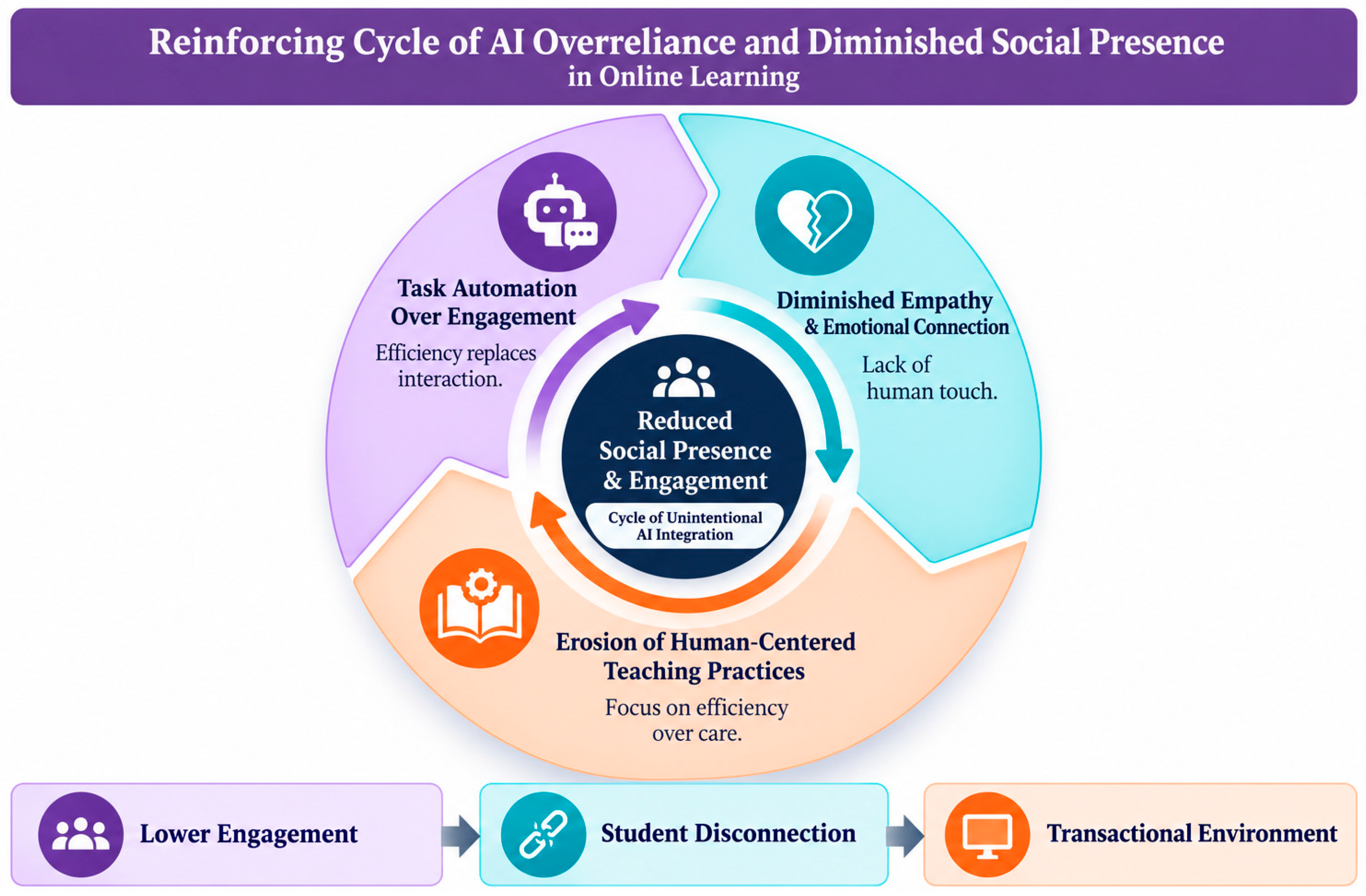
Importantly, these three challenges may not operate independently. Instead, they can be understood as interconnected processes that may reinforce one another when AI-mediated instruction is implemented without intentional consideration of social presence. When task automation substitutes meaningful instructional engagement, opportunities for relational interaction may become limited, potentially affecting instructors’ ability to recognize and respond to students’ emotional and contextual needs. As these opportunities diminish, instructional practices may become increasingly transactional, further encouraging reliance on automated processes. Over time, this proposed cycle may contribute to learning environments characterized by fewer opportunities for meaningful interaction, weakened relational connection, and diminished student engagement.
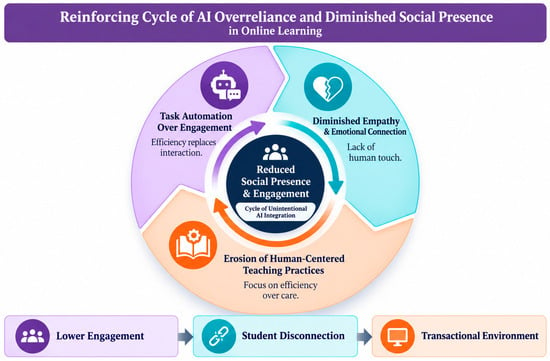
This proposed relationship is informed by broader research on online learning, which demonstrates that reduced social presence is associated with lower levels of participation, satisfaction, and persistence (Richardson et al., 2017; Fiock, 2020). In AI-supported environments, this cycle may be less visible because communication remains frequent, yet relational quality is diminished. As a result, courses may appear active while lacking the depth of interaction necessary for meaningful learning. Although this reinforcing cycle has not been empirically validated, it provides a conceptual explanation of how instructional decisions surrounding AI integration may influence social presence and highlights the need for intentional strategies that preserve meaningful human connection. Figure 2 illustrates this proposed reinforcing cycle of AI overreliance and diminished social presence, emphasizing its conceptual rather than empirically validated nature.
Figure 2.
Reinforcing cycle of AI overreliance and diminished social presence in online learning. Note. This conceptual model illustrates how overreliance on AI-driven task automation may contribute to diminished empathy and emotional connection and the gradual erosion of human-centered teaching practices. These interconnected processes may reinforce reduced social presence and engagement, potentially contributing to student disconnection and increasingly transactional learning environments. The model represents a proposed conceptual relationship rather than an empirically validated causal cycle. The figure was created by the authors using design tools with the assistance of generative artificial intelligence (DALL·E).
5. Discussion
A central insight emerging from the conceptual synthesis is that the challenge is not the presence of AI itself, but the absence of intentional strategies for integrating it in ways that preserve social presence. AI tools are not inherently detrimental to learning; rather, their impact depends on how they are used within instructional practice. Depending on its implementation, AI-mediated communication may create conditions in which students experience interactions as less personal, although such outcomes require empirical examination. This distinction reframes the problem from one of technological adoption to one of pedagogical design. The question is no longer whether AI should be used, but how it can be integrated in ways that sustain empathy, connection, and meaningful interaction.
5.1. From Diagnosis to Design: Informing the Framework
A guiding principle for applying Social Presence Literacy to AI-mediated instruction is to delegate the transactional while protecting the relational. Routine administrative, organizational, and informational tasks may be appropriate for AI assistance, particularly when automation creates additional opportunities for meaningful instructor engagement. However, interactions involving empathy, encouragement, individualized guidance, belonging, and relationship development require more deliberate consideration. Transactional and relational functions are not necessarily mutually exclusive; for example, assignment feedback may communicate both instructional information and personal encouragement. Social Presence Literacy enables educators to recognize these overlapping functions and make intentional decisions about when AI should automate, augment, or preserve direct human involvement.
Guided by this principle, we developed a five-step decision-making framework designed to address the potential cycle of disconnection identified in Section 4 and re-center social presence in AI-supported instruction. The framework translates interdisciplinary insights into actionable steps that guide educators in evaluating, adapting, and refining AI use. Rather than rejecting AI or adopting it uncritically, the framework positions instructors as intentional designers of relational learning experiences, with the intention that technological efficiency supports rather than displaces opportunities for human connection. Central to this approach is Social Presence Literacy (SPL), which we conceptualize as educators’ capacity to recognize, intentionally foster, and evaluate the relational dimensions of teaching within AI-mediated learning environments.
5.2. Five-Step Decision-Making Framework
The proposed five-step decision-making framework operationalizes Social Presence Literacy (SPL) by providing online educators, instructional designers, and higher education faculty integrating generative AI into their teaching practices with a structured approach to evaluating and refining AI-supported instructional practices. Rather than treating social presence solely as an outcome, the framework emphasizes educators’ capacity to intentionally consider relational dimensions throughout instructional decision-making. At its core, the framework emphasizes the importance of preserving meaningful human connection, ensuring that empathy, responsiveness, and relational engagement remain central to teaching and learning in AI-supported environments.
The originality of the proposed framework does not reside in the five-step sequence itself. Evaluating instructional practices, identifying gaps, making adjustments, testing outcomes, and refining approaches are familiar processes within instructional design and continuous improvement. Rather, the distinctive contribution is the application of the established Social Presence Literacy Framework (Dyer, 2025) as a set of relational criteria for AI-mediated instructional decision-making. Its four dimensions: Knowledge, Application, Evaluation, and Creation guide educators in recognizing the relational purposes of instructional interactions, assessing how AI integration might affect those purposes, and designing or refining practices that intentionally support human connection. This perspective extends conventional considerations of instructional efficiency, accuracy, and effectiveness by asking whether AI should automate, augment, or preserve direct human involvement in a particular teaching interaction. The proposed framework thus offers a conceptual approach for incorporating relational pedagogical judgment into existing instructional improvement processes rather than presenting an entirely new improvement cycle.
The framework is grounded in research on social presence, feedback design, and online engagement, which emphasizes that the quality of instructor interaction, particularly personalization, immediacy, and responsiveness, is associated with student engagement and learning (Richardson et al., 2017; Fiock, 2020; Martin et al., 2022). J. Miao et al. (2022) further demonstrated that social presence mediated the relationships between teacher–student and student–student interaction and learning engagement in online higher education. These findings provide an empirical foundation for emphasizing the relational quality of instructional interactions within the proposed SPL framework. Additionally, emerging research on AI in higher education highlights the need for human oversight and pedagogical intentionality when integrating automated tools into instructional workflows (Kasneci et al., 2023; Bewersdorff et al., 2023).
Rather than treating AI as a replacement for instructor interaction, this framework positions it as a support tool that must be shaped through relational and pedagogical judgment. Each step builds upon the previous, forming a continuous cycle of evaluation, adaptation, and refinement. As a conceptual, practice-informed framework, these steps are intended to help provide guidance for intentional instructional decision-making, ongoing reflection, and effective integration of social presence in AI-mediated learning environments.
The proposed five-step decision-making framework represents a practical application of the Social Presence Literacy Framework (Dyer, 2025) to generative AI integration in online teaching. Whereas SPLF identifies four dimensions of relational pedagogical capacity—Knowledge, Application, Evaluation, and Creation—the proposed process translates those capacities into a sequence of instructional decisions. Educators draw upon their knowledge of social presence to evaluate the relational purpose of an instructional interaction, identify potential gaps introduced by AI mediation, apply and create appropriate instructional adjustments, test the effectiveness of those decisions, and iteratively evaluate and refine their practices. The contribution of this framework therefore lies not in proposing an entirely new cycle of instructional improvement, but in explicitly situating AI-related instructional decisions within a social presence literacy perspective.
Each step is aligned with one or more dimensions of the Social Presence Literacy Framework (Dyer, 2025), illustrating how Knowledge, Application, Evaluation, and Creation inform the proposed AI-mediated instructional decision-making process.
- Step 1: Evaluate AI-Generated Content for Social Presence Indicators (SPLF: Knowledge and Evaluation)
The first step requires instructors to critically evaluate AI-generated content for key indicators of social presence, including personalization, acknowledgment of student ideas, emotional tone, and opportunities for interaction. These indicators provide a starting point for evaluating whether AI-supported communication reflects the relational needs of students and the instructional context.
From a theoretical perspective, this step aligns with research demonstrating that instructor immediacy and affective communication significantly influence student perceptions of presence and engagement (Borup et al., 2015; Fiock, 2020). J. Miao et al. (2022) further identified positive relationships among instructor–student interaction, perceived social presence, and learning engagement in online higher education. AI-generated content often meets informational needs but may lack relational signals that communicate attentiveness and care.
In practice, this involves reviewing AI-generated outputs with questions such as:
- Does this response acknowledge the student’s specific ideas?
- Does it invite further thinking or dialogue?
- Does the tone feel human, supportive, and responsive?
- Does the response accurately reflect the student’s contribution and the instructor’s understanding of their learning needs?
For example, an AI-generated response such as:
is technically correct but relationally limited. A revised version might read:“Good job expanding your argument.”
“Maria, I appreciated how you expanded your argument, especially your example about workplace communication. How do you think this idea might apply in a leadership context?”
This shift introduces name recognition, specificity, and dialogic invitation, which may help communicate instructor attentiveness and encourage meaningful interaction. Importantly, relational language alone does not establish social presence. Instructors must also consider whether the response reflects genuine engagement with the student’s ideas rather than simply reproducing personalized or supportive language.
- Step 2: Identify Gaps in Social Presence (SPLF: Knowledge and Evaluation)
The second step focuses on identifying where AI-generated content falls short in conveying empathy, encouragement, and relational responsiveness. While AI can produce grammatically sound and contextually relevant responses, it may not consistently reflect the emotional nuance and contextual understanding needed for meaningful human-centered instructional interaction.
Research on AI-mediated communication suggests that repetitive or generic responses can reduce students’ perception of instructor care and emotional engagement (Lin & Chen, 2024; Bewersdorff et al., 2023). These gaps are often subtle but cumulative, shaping how students interpret the learning environment. It is important to note that the concern is not the use of AI itself, but the potential for automated communication to replace meaningful human interaction and diminish the personal connections that are central to teaching and learning.
In practice, instructors look for:
- Absence of encouragement or acknowledgment of effort;
- Lack of emotional attunement (e.g., ignoring student struggle);
- Generic or templated phrasing;
- Missed opportunities for connection;
- Responses that appear supportive but are vague and do not reflect the student’s specific circumstances or learning needs.
For example, feedback such as
may be accurate but impersonal. A gap-aware revision begins by recognizing the student’s effort:“Improve clarity and expand your analysis.”
“You’re developing a strong foundation here, especially in how you introduced the concept. Let’s work on strengthening clarity, how might you expand your analysis in the second paragraph to make your argument even clearer?”
This approach transforms feedback from directive correction to relational guidance by combining specific instructional direction with encouragement and an invitation for continued dialogue. However, such revisions should be grounded in the instructor’s actual understanding of the student’s work rather than the addition of supportive language alone.
- Step 3: Adjust AI-Generated Content to Strengthen Social Presence (SPLF: Application and Evaluation)
Once gaps are identified, instructors actively revise AI-generated content using evidence-based social presence strategies. This step positions instructors as relational designers, ensuring that AI outputs are shaped through pedagogical intent rather than adopted verbatim. The goal is not simply to make automated communication appear more human, but to preserve meaningful instructor–student connections through intentional and responsive communication.
Research on effective online teaching highlights the importance of personalized feedback, dialogic prompts, and emotionally supportive communication in fostering engagement and learning (Richardson et al., 2017; Martin et al., 2022). Additionally, studies on feedback design emphasize that feedback is most effective when it is specific, actionable, and relationally framed (Winstone & Carless, 2020).
Three primary strategies guide this adjustment:
- Personalization—Should reflect the instructor’s familiarity with the student and their work, rather than solely relying on individualized wording.
- Use student names;
- Reference specific ideas or examples;
- Connect feedback to prior contributions.
- Dialogic Engagement—Create opportunities for continued dialogue rather than treating feedback as a one-way exchange.
- Add reflective or open-ended questions;
- Invite response or continuation of the conversation;
- Encourage peer interaction.
- Emotional Attunement—Responses should acknowledge students’ individual circumstances and reflect the instructor’s understanding of their learning experiences.
- Acknowledge effort, progress, or struggle;
- Use encouraging and supportive tone;
- Demonstrate presence and care.
Example transformation:
AI-generated:
“Your post addresses the topic well. Consider adding more detail.”
Revised with social presence:
“James, you’ve done a nice job connecting your post to this week’s topic, especially in how you explained motivation. I’d love to see you take this one step further, what additional detail could you add to strengthen your example?”
This revision shifts the interaction from evaluation to engagement, reinforcing both cognitive and relational presence.
- Step 4: Test and Assess Relational Effectiveness (SPLF: Application and Evaluation)
The fourth step moves from design to implementation by introducing revised AI-supported content into instructional practice and evaluating its impact. Social presence is not guaranteed by design alone; it is experienced subjectively by learners. To better understand how students experience these interactions, instructors should consider both observable engagement and students’ perceptions of connection, responsiveness, and instructor presence.
Research in online learning emphasizes the importance of monitoring student engagement patterns, participation quality, and perceptions of instructor presence to assess instructional effectiveness (Bond et al., 2020; Martin et al., 2022). J. Miao et al. (2022) further identified a positive relationship between perceived social presence and learning engagement, reinforcing the importance of considering students’ experiences when evaluating instructional interactions.
In practice, instructors gather feedback through:
- Discussion board participation (depth and the quality of responsiveness);
- Student tone and engagement in replies;
- Informal check-ins or surveys;
- Course evaluations or mid-course feedback;
Indicators of effectiveness include:
- Increased student response rates;
- More substantive and reflective discussion posts;
- Greater evidence of peer interaction;
- Student expressions of feeling supported or connected.
For example, instructors may observe that revised responses lead to longer student replies or follow-up questions, which may suggest greater engagement. Informal student feedback can provide additional insight into whether these interactions are experienced as personal, supportive, and meaningful.
Assessing relational effectiveness also requires attention to metacognitive self-regulation. Instructors must reflect not only on the quality of AI-supported interactions, but also on how their reliance on AI may influence instructional judgment, responsiveness, and engagement with students. Similarly, students should be encouraged to consider whether AI-supported learning experiences strengthen their understanding and participation or merely facilitate task completion. Yurt (2025) identified cognitive and metacognitive strategies as important dimensions of self-regulation in AI-assisted learning, reinforcing the need for learners to monitor and evaluate their engagement with these technologies. Incorporating this reflective process into the framework helps ensure that instructional efficiency does not become a substitute for meaningful cognitive and relational engagement.
- Step 5: Iterate and Refine Instructional Practices (SPLF: Evaluation and Creation)
The final step emphasizes iteration as an ongoing instructional practice. Social presence is not a static outcome but a dynamic, evolving component of course design that must be continuously refined in response to students’ experiences, instructional needs, and changing learning environments.
This step aligns with research on iterative instructional design and reflective teaching, which highlights the importance of ongoing adaptation based on feedback and context (Bond et al., 2020; Winstone & Carless, 2020). Within AI-supported instruction, this reflective process allows educators to reconsider how automated tools are being used and whether their integration continues to support meaningful human connection.
In practice, instructors:
- Reflect on which social presence strategies help foster meaningful connection and interaction;
- Consider student feedback and patterns of engagement;
- Adjust tone, structure, or interaction strategies;
- Reuse and refine strategies that support relational engagement while adapting approaches to students’ changing needs.
For example, an instructor may find that adding a single reflective question consistently increases student replies. Over time, this insight becomes an intentional design choice embedded in future discussion responses, with continued attention to the quality of interaction and students’ perceptions of connection.
This iterative process ensures that AI integration remains responsive, intentional, and aligned with human-centered pedagogy, rather than becoming routine or automated.
5.3. Framework Synthesis: From Automation to Intentional Design
Together, these five steps form a continuous cycle that repositions instructors as intentional designers of relational learning experiences. The framework is designed to address the proposed cycle of disconnection by embedding social presence considerations into each stage of AI integration.
The key insight is that AI does not determine the relational quality of a course, instructional decisions do. When AI is used without reflection, it can contribute to depersonalization. When used intentionally, however, it can enhance efficiency while preserving empathy, immediacy, and connection that define meaningful learning.
This framework provides a practical pathway for educators to move from unintentional automation to intentional, human-centered design, ensuring that technological innovation supports rather than replaces the relational foundations of teaching.
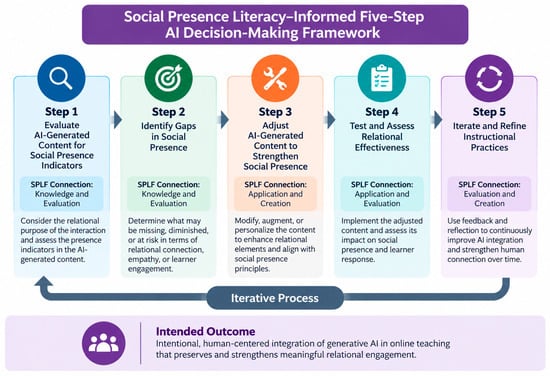
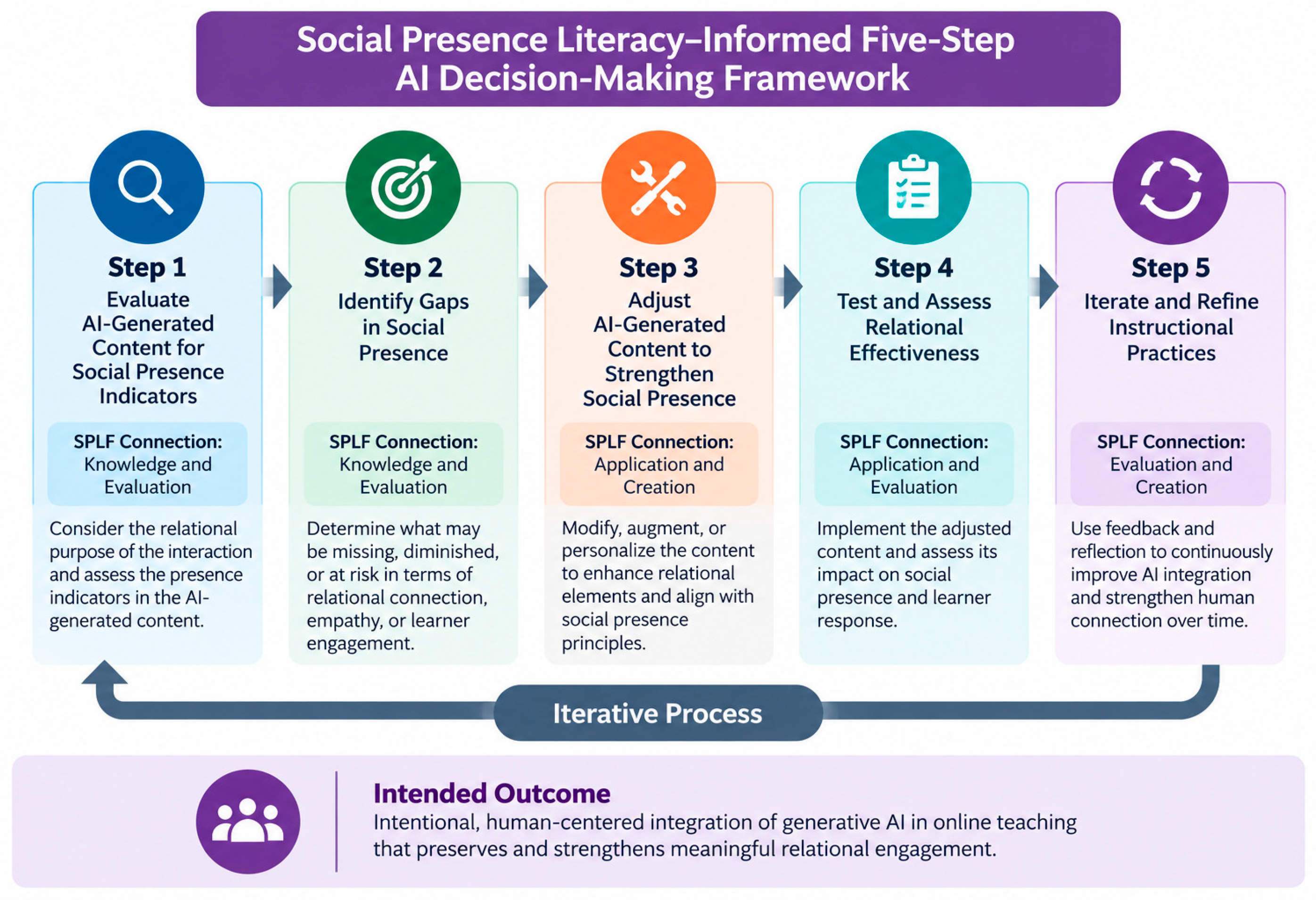
Importantly, iteration should not be reduced to repeatedly refining AI prompts or automating instructional workflows. Through the Evaluation and Creation dimensions of SPLF, instructors must periodically reconsider whether AI-supported practices continue to serve their intended relational purposes. This may involve returning to direct instructor communication, redesigning opportunities for student interaction, or discontinuing automated practices that no longer support meaningful engagement. In this way, the framework’s iterative process remains responsive to students’ changing needs rather than becoming a fixed technological routine. Figure 3 illustrates the proposed five-step AI decision-making process and its conceptual alignment with the four dimensions of the Social Presence Literacy Framework.
Figure 3.
Social presence literac-informed five-step AI decision-making framework. Note. The five-step process represents a proposed application of the Social Presence Literacy Framework (Dyer, 2025) to AI-mediated instructional decisions. The indicated relationships between the steps and SPLF dimensions are conceptual and have not been empirically validated. The figure was created by the authors using design tools with the assistance of generative artificial intelligence (DALL·E).
6. Reflective Critique
The interdisciplinary problem-solving process employed in this study provided both significant insight and notable challenges. Integrating perspectives from educational psychology, social presence theory, instructional design, and learning sciences enabled a more comprehensive understanding of how the potential implications of generative artificial intelligence (AI) shapes relational dynamics in online learning environments. However, this integration also required navigating differences in disciplinary language, assumptions, and priorities. Interdisciplinary work demands not only synthesis, but translation, reconciling varying definitions of concepts such as engagement, presence, and interaction across fields (Repko & Szostak, 2021).
Across disciplines, AI is frequently positioned as a tool for optimizing performance, scalability, and productivity. In contrast, scholarship on social presence and relational pedagogy emphasizes immediacy, empathy, and human connection as central to meaningful learning (Whiteside, 2015; Richardson et al., 2017; Fiock, 2020). This divergence reveals a fundamental challenge: technologies designed to increase efficiency may, depending on how they are implemented, alter opportunities for relational engagement. The nature and extent of these effects require further empirical investigation.
Recent research highlights the importance of pedagogical oversight when integrating generative AI into instructional practices (Kasneci et al., 2023; Bewersdorff et al., 2023). Although AI may support instructional efficiency, its use in place of meaningful instructor interaction raises concerns about maintaining human connection. This insight was central to the development of the framework, which seeks to reconcile these competing priorities by positioning AI as a support tool shaped through pedagogical intent rather than as a replacement for interaction.
A second critical insight relates to the role of assumptions in shaping both analysis and design. Our positionality as experienced online educators influenced our interpretation of the problem, particularly our emphasis on relational aspects of teaching. While this perspective is supported by research on social presence and student engagement, it may also privilege instructor-centered interpretations of connection. Recent scholarship highlights the importance of incorporating diverse stakeholder perspectives, including students, instructional designers, and administrators, to develop more holistic and equitable approaches to technology integration (Bond et al., 2020; Holmes et al., 2019).
Future iterations of this work would benefit from more explicit inclusion of these perspectives, particularly student voice. Social presence is experienced subjectively, and students’ perceptions of connection, support, and engagement may differ from instructor intentions. J. Miao et al. (2022) found that students perceived social presence was positively associated with learning engagement, reinforcing the importance of understanding how students experience relational interactions in online learning environments. Incorporating student feedback more systematically would strengthen both the validity and applicability of the framework.
The process also revealed the limitations of relying on reflective and practice-based insights without complementary empirical validation. While reflective practice is widely recognized as a valuable approach for generating professional knowledge and informing instructional design (Holdo, 2023; Greenberger, 2020), it is inherently context-bound and shaped by individual experience. As such, the proposed framework should be understood as a theoretically grounded, practice-informed model that requires further empirical testing across diverse educational contexts. Future research should begin by examining how instructors implement the five-step framework in asynchronous online courses and how students experience the resulting interactions. A pilot study could combine faculty reflective journals, analysis of instructional communications, student interviews, and established measures of perceived social presence and engagement. Subsequent research could compare courses implementing the framework with courses using existing AI-supported instructional practices to examine differences in perceived instructor presence, relational engagement, and student experiences. Findings from these studies could inform refinement of the framework and provide an empirical foundation for evaluating its applicability across disciplines and institutional contexts.
Another important consideration is the potential for unintended consequences in the application of the framework. While designed to support intentional social presence practices, structured approaches to relational interaction may become formulaic if applied without genuine instructor engagement and responsiveness to individual students. Research on online teaching cautions that overly scripted communication can reduce perceived genuineness, even when well-intentioned (Lowenthal & Snelson, 2017). This highlights the importance of maintaining instructor voice and adaptability, ensuring that the framework serves as a guide rather than a prescription.
Equity considerations further extend the implications of this work. AI tools are not neutral; they are shaped by the data and systems from which they emerge. Without careful and intentional use, AI-supported instruction may inadvertently reinforce disparities in access, representation, and student support (Holmes et al., 2019). Additionally, students’ experiences of social presence are not uniform, and AI-mediated communication may differentially impact learners’ sense of belonging and connection. These considerations underscore the importance of ongoing critical reflection and ethical awareness in AI integration.
Finally, this process reinforced the essential role of reflective practice during periods of rapid technological change. The pace of AI development in education has outstripped the pace of pedagogical adaptation, creating a risk that tools will be adopted more quickly than their implications are understood. Reflective practice provides a necessary counterbalance, enabling educators to critically examine not only how tools are used, but why they are used and with what impact.
The most significant takeaway is not simply the development of a framework, but the recognition that intentionality must guide innovation. Without deliberate attention to relational dynamics, technological advancement risks reshaping education in ways that prioritize efficiency over connection. Through interdisciplinary inquiry and reflective critique, this work contributes to a growing conversation about how to ensure that the future of education remains fundamentally human-centered.
7. Conclusions
This manuscript addresses the complex and timely challenge of integrating generative artificial intelligence (AI) into online education while preserving the relational foundations of meaningful learning. Through an interdisciplinary conceptual synthesis drawing on educational psychology, social presence theory, instructional design, and learning sciences, we identified three potential challenges associated with AI integration when meaningful human interaction and connection is not intentionally preserved: the displacement of engagement through automation, diminished empathy in instructional interactions, and the erosion of human-centered teaching practices.
These conceptual insights underscore a central argument: meaningful learning is not solely a function of content delivery or efficiency, but of connection. Grounded in Social Presence Literacy (SPL), the framework emphasizes educators’ capacity to recognize, foster, and evaluate the relational dimensions of AI-supported teaching. While AI offers powerful opportunities to enhance instructional workflows, it should not replace the human connection that defines effective teaching, including empathy, immediacy, and relational responsiveness. As such, the challenge facing educators is not whether to adopt AI, but how to do so in ways that sustain the human elements of learning.
In response, this manuscript proposes a five-step decision-making framework that translates the established Social Presence Literacy Framework into a structured approach for human-centered AI integration. By guiding educators through evaluation, adaptation, and iterative refinement, the framework is intended to support intentional consideration of relational dimensions throughout instructional decision-making. However, this proposed extension remains conceptual and has not yet been empirically validated. Its practical applicability and potential effects on perceived instructor presence, relational engagement, and student experiences must be examined through future research across varied instructional contexts.
By extending the Knowledge, Application, Evaluation, and Creation dimensions of Social Presence Literacy (Dyer, 2025) into AI-mediated instructional decision-making, the proposed framework offers educators a structured approach for considering not only what technology can accomplish, but what meaningful human connection requires. Future empirical research should examine how educators apply these dimensions when making AI-related instructional decisions and how learners perceive the relational quality of the resulting interactions.
The implications of this work extend beyond individual courses or technologies. As AI continues to evolve, interdisciplinary collaboration will remain important for examining how technological innovation intersects with instructional practice, student experiences, and the relational foundations of higher education.
Preserving human connection in AI-supported learning environments is not solely the responsibility of individual faculty. Higher education institutions also play an essential role in establishing the conditions for ethical and human-centered AI integration. In a systematic review of 55 studies, Kaşarcı et al. (2025) identified significant gaps in institutional AI governance, including fragmented coordination, limited ethical literacy, and inadequate evaluation mechanisms. These findings reinforce the need for institutional approaches that extend beyond technical guidance to include transparent expectations for AI use, faculty development, student privacy protections, and policies that prioritize meaningful instructor–student engagement. Aligning instructional practice with broader institutional governance can help ensure that technological innovation supports educational authenticity, relational integrity, and the human dimensions of teaching and learning.
Ultimately, this work affirms that the future of online education is not defined by technology alone, but by the intentional choices educators and institutions make in how that technology is used. When guided by relational principles and informed by interdisciplinary insight, AI has the potential to enhance, not diminish, the human experience of learning. In the end, the most important question is not what AI can do for teaching and learning, but what we are willing to preserve as essential to both.
Author Contributions
Conceptualization, T.D.D.; methodology, T.D.D.; investigation, T.D.D., E.L., and J.A.; writing—original draft preparation, T.D.D.; writing—review and editing, T.D.D., E.L., and J.A.; visualization, T.D.D.; project administration, T.D.D. All authors have read and agreed to the published version of the manuscript.
Funding
This research received no external funding.
Institutional Review Board Statement
Not applicable.
Informed Consent Statement
Not applicable.
Data Availability Statement
The original contributions presented in this study are included in the article. Further inquiries can be directed to the corresponding author.
Acknowledgments
The authors acknowledge the broader scholarly community whose work in social presence, online learning, and generative artificial intelligence informed the interdisciplinary synthesis and development of the framework presented in this article. Generative artificial intelligence tools (ChatGPT-6 OpenAI) were used solely to assist with grammar, spelling, and language refinement during manuscript preparation. The three figures included in the manuscript were created by the authors using design tools with the assistance of generative artificial intelligence (DALL·E, ChatGPT-6 OpenAI). Generative AI was not used to conduct the analysis, develop the conceptual framework, or generate the study’s findings or conclusions. The authors reviewed and take full responsibility for all content presented in the manuscript.
Conflicts of Interest
The authors declare no conflicts of interest.
References
- Akpen, C. N., Asaolu, S., Atobatele, S., Okagbue, H., & Sampson, S. (2024). Impact of online learning on student’s performance and engagement: A systematic review. Discover Education, 3, 205. [Google Scholar] [CrossRef] [Scilit]
- Bewersdorff, A., Zhai, X., Roberts, J., & Nerdel, C. (2023). Myths, mis- and preconceptions of artificial intelligence: A review of the literature. Computers and Education: Artificial Intelligence, 4, 100143. [Google Scholar] [CrossRef] [Scilit]
- Bond, M., Buntins, K., Bedenlier, S., Zawacki-Richter, O., & Kerres, M. (2020). Mapping research in student engagement and educational technology in higher education: A systematic evidence map. International Journal of Educational Technology in Higher Education, 17(1), 2. [Google Scholar] [CrossRef] [Scilit]
- Borup, J., West, R. E., & Thomas, R. (2015). The impact of text versus video communication on instructor feedback in blended courses. Educational Technology Research and Development, 63(2), 161–184. [Google Scholar] [CrossRef] [Scilit]
- Cai, L., Msafiri, M. M., & Kangwa, D. (2024). Exploring the impact of integrating AI tools in higher education using the Zone of Proximal Development. Education And Information Technologies, 30(6), 7191–7264. [Google Scholar] [CrossRef] [Scilit]
- Chai, S. S., Ting, S.-H., Goh, K. L., Chang, Y. H. R., Wee, B. L., Novita, D., & Karthikeyan, J. (2024). Beyond digital interfaces: The human element in online teaching and its influence on student experiences. PLoS ONE, 19(7), e0307262. [Google Scholar] [CrossRef] [Scilit]
- Dyer, T. D. (2025). Purposeful presence: Faculty perspectives on social presence in online learning. International Journal for the Scholarship of Teaching and Learning, 19(2), 5. [Google Scholar] [CrossRef] [Scilit]
- Ensmann, S., Whiteside, A. L., Gomez-Vasquez, L., & Sturgill, R. (2021). Connections before curriculum: The role of social presence during COVID-19 emergency remote learning for students. Online Learning, 25(3), 36–56. [Google Scholar] [CrossRef] [Scilit]
- Fiock, H. S. (2020). Designing a community of inquiry in online courses. International Review of Research in Open and Distributed Learning, 21(1), 134–152. [Google Scholar] [CrossRef] [Scilit]
- Garrison, D. R., Anderson, T., & Archer, W. (2000). Critical inquiry in a text-based environment: Computer conferencing in higher education. The Internet and Higher Education, 2(2–3), 87–105. [Google Scholar] [CrossRef] [Scilit]
- Greenberger, S. W. (2020). Creating a guide for reflective practice: Applying Dewey’s reflective thinking to document faculty scholarly engagement. Reflective Practice, 21(4), 458–472. [Google Scholar] [CrossRef] [Scilit]
- Holdo, M. (2023). Critical reflection: John Dewey’s relational view of transformative learning. Journal of Transformative Education, 21(1), 9–25. [Google Scholar] [CrossRef] [Scilit]
- Holmes, W., Bialik, M., & Fadel, C. (2019). Artificial intelligence in education: Promises and implications for teaching and learning. Center for Curriculum Redesign. [Google Scholar]
- Kasneci, E., Sessler, K., Küchemann, S., Bannert, M., Dementieva, D., Fischer, F., Gasser, U., Groh, G., Günnemann, S., Hüllermeier, E., Krusche, S., Kutyniok, G., Michaeli, T., Müller, K.-R., Schütze, H., Weller, J., & Kasneci, G. (2023). ChatGPT for good? On opportunities and challenges of large language models for education. Learning and Individual Differences, 103, 102274. [Google Scholar] [CrossRef] [Scilit]
- Kaşarcı, İ., Akın Demircan, Z., Çeliker Ercan, G., & İnci, T. (2025). Managing artificial intelligence ethics in higher education: A systematic framework for issues and policy recommendations. International Journal of Current Education Studies, 4(2), 112–137. [Google Scholar] [CrossRef] [Scilit]
- Li, Q., Bañuelos, M., Liu, Y., & Xu, D. (2022). Online instruction for a humanized learning experience: Techniques used by college instructors. Computers & Education, 189, 104595. [Google Scholar] [CrossRef] [Scilit]
- Lin, H., & Chen, Q. (2024). Artificial intelligence (AI)-integrated educational applications and college students’ creativity and academic emotions: Students and teachers’ perceptions and attitudes. BMC Psychology, 12(1), 487. [Google Scholar] [CrossRef] [Scilit]
- Long, D., & Magerko, B. (2020). What is AI literacy? Competencies and design considerations. In Proceedings of the 2020 CHI conference on human factors in computing systems (pp. 1–16). Association for Computing Machinery. [Google Scholar] [CrossRef] [Scilit]
- Lowenthal, P. R., & Snelson, C. (2017). In search of a better understanding of social presence: An investigation into how researchers define social presence. Distance Education, 38(2), 141–159. [Google Scholar] [CrossRef] [Scilit]
- Mah, D. K., & Groß, N. (2024). Artificial intelligence in higher education: Exploring faculty use, self-efficacy, distinct profiles, and professional development needs. International Journal of Educational Technology in Higher Education, 21(1), 58. [Google Scholar] [CrossRef] [Scilit]
- Martin, F., & Bolliger, D. U. (2018). Engagement matters: Student perceptions on the importance of engagement strategies in the online learning environment. Online Learning, 22(1), 205–222. [Google Scholar] [CrossRef] [Scilit]
- Martin, F., Wu, T., Wan, L., & Xie, K. (2022). A meta-analysis on the community of inquiry presences and learning outcomes in online and blended learning environments. Online Learning, 26(1), 325–359. [Google Scholar] [CrossRef] [Scilit]
- Miao, F., & Cukurova, M. (2024). AI competency framework for teachers. UNESCO. [Google Scholar] [CrossRef] [Scilit]
- Miao, J., Chang, J., & Ma, L. (2022). Teacher–Student interaction, student–student interaction and social presence: Their impacts on learning engagement in online learning environments. Journal of Genetic Psychology, 183(6), 514–526. [Google Scholar] [CrossRef] [Scilit]
- Mishra, P., & Koehler, M. J. (2006). Technological pedagogical content knowledge: A framework for teacher knowledge. Teachers College Record, 108(6), 1017–1054. [Google Scholar] [CrossRef] [Scilit]
- Murtafi’ah, B., & Pradita, I. (2024). Social presence as means to humanizing online classroom. Journal of Applied Research in Higher Education, 16(2), 391–404. [Google Scholar] [CrossRef] [Scilit]
- Nazaretsky, T., Mejia-Domenzain, P., Swamy, V., Frej, J., & Käser, T. (2026). Who gives feedback matters: Student biases towards human and AI-Generated formative feedback. Journal of Computer Assisted Learning, 42(1), e70153. [Google Scholar] [CrossRef] [Scilit]
- Razak, N. A., Zulkifli, C. Z., Abdullah, Y., Khairuddin, A. Z., Misron, A., Somasundram, P., & Shakirdjanovna, A. G. (2025). Bridging technology and humanity: Humanizing online pedagogy in digital environments. International Journal of Evaluation and Research in Education, 14(3), 2207–2223. [Google Scholar] [CrossRef] [Scilit]
- Repko, A. F., & Szostak, R. (2021). Interdisciplinary research: Process and theory (4th ed.). SAGE Publications. [Google Scholar]
- Richardson, J. C., Maeda, Y., Lv, J., & Caskurlu, S. (2017). Social presence in relation to students’ satisfaction and learning in the online environment: A meta-analysis. Computers in Human Behavior, 71, 402–417. [Google Scholar] [CrossRef] [Scilit]
- Shaikh, U. U., & Asif, Z. (2022). Persistence and dropout in higher online education: Review and categorization of factors. Frontiers in Psychology, 13, 902070. [Google Scholar] [CrossRef] [Scilit]
- Short, J., Williams, E., & Christie, B. (1976). The social psychology of telecommunications. John Wiley & Sons. [Google Scholar]
- Stenbom, S. (2018). A systematic review of the Community of Inquiry survey. The Internet and Higher Education, 39, 100842. [Google Scholar] [CrossRef] [Scilit]
- Stewart, O. G. (2023). Understanding what works in humanizing higher education online courses: Connecting through videos, feedback, multimodal assignments, and social media. Issues and Trends in Learning Technologies, 11(2), 2–26. [Google Scholar] [CrossRef] [Scilit]
- Wang, S., & Zhang, H. (2026). Pedagogical partnerships with generative AI in higher education: How dual cognitive pathways paradoxically enable transformative learning. International Journal of Educational Technology in Higher Education, 23, 11. [Google Scholar] [CrossRef] [Scilit]
- Whiteside, A. L. (2015). Introducing the social presence model to explore online and blended learning experiences. Online Learning, 19(2), n2. [Google Scholar] [CrossRef] [Scilit]
- Winstone, N. E., & Carless, D. (2020). Designing effective feedback processes in higher education: A learning-focused approach. Routledge. [Google Scholar]
- Yurt, E. (2025). The self-regulation for AI-based learning scale: Psychometric properties and validation. International Journal of Current Education Studies, 4(1), 95–118. [Google Scholar] [CrossRef] [Scilit]
- Zawacki-Richter, O., Bond, M., Marin, V. I., & Gouverneur, F. (2019). Systematic review of research on artificial intelligence applications in higher education—Where are the educators? International Journal of Educational Technology in Higher Education, 16(1), 39. [Google Scholar] [CrossRef] [Scilit]

Disclaimer/Publisher’s Note: The statements, opinions and data contained in all publications are solely those of the individual author(s) and contributor(s) and not of MDPI and/or the editor(s). MDPI and/or the editor(s) disclaim responsibility for any injury to people or property resulting from any ideas, methods, instructions or products referred to in the content. |
© 2026 by the authors. Licensee MDPI, Basel, Switzerland. This article is an open access article distributed under the terms and conditions of the Creative Commons Attribution (CC BY) license.