


Abstract
Higher-order thinking skills (HOTS) are increasingly emphasised in English as a second language (ESL) reading, yet less is known about how Chinese postgraduate TESOL students recognise HOTS and regulate related reading strategies. This mixed-methods study examined learners’ metacognitive reading-strategy awareness in relation to HOTS at a UK university. Quantitative data were collected using a questionnaire adapted from the Metacognitive Awareness Listening Questionnaire (MALQ), administered to 80 participants; 76 valid responses were analysed using descriptive and inferential statistics. Qualitative data were collected through semi-structured interviews with six survey participants and analysed thematically. Questionnaire results varied across four dimensions, with Problem-Solving receiving the highest mean score and Planning-Evaluation the lowest. Interview findings indicated that participants recognised and valued HOTS, but their reported regulation of HOTS-related reading processes was uneven. Analysing was perceived as more accessible, whereas creating was seen as more challenging. Participants more often described immediate, problem-driven adjustments and outcome-oriented reflection than systematic planning, monitoring, and evaluation. The findings suggest the potential value of explicitly guiding learners in planning, monitoring, and evaluating HOTS-related reading processes.
1. Introduction
Fostering higher-order thinking skills (HOTS) has gained increasing attention across educational contexts (Pogrow, 2005; Conklin, 2012), including second language education (Ghanizadeh et al., 2020; Samadi et al., 2024), given its relevance to critical thinking, creativity, and complex problem-solving in educational contexts (Hague, 2024). In reading comprehension, fostering HOTS is particularly important because literal comprehension provides a foundation for understanding written texts (Zhang, 2007; Silalahi et al., 2021), while successful reading often involves moving beyond surface-level comprehension to engage with texts through deeper cognitive processes, including analysis, evaluation, and creation (Nourdad et al., 2018; Kusrini et al., 2019; Ghanizadeh et al., 2020; Horváthová & Naďová, 2021; Nurmaharaeni et al., 2022; Aziz & Rawian, 2022). This highlights the importance of examining learners’ engagement with HOTS during English as a second language (ESL) reading comprehension.
Despite growing attention to HOTS in second-language reading, existing research has predominantly examined HOTS through learners’ performance on higher-order reading tasks, with relatively limited attention to how learners recognise and regulate higher-order cognitive processes during reading comprehension. This distinction is important because recognising the value or presence of HOTS does not necessarily mean that learners can deliberately regulate their use of such processes during reading. Building on this research gap and the need for a process-oriented examination of HOTS in ESL reading, the following subsections review HOTS in ESL reading comprehension, metacognitive awareness of HOTS in reading, and the theoretical framework guiding the present study.
1.1. HOTS and ESL Reading Comprehension
While there is no single agreed-upon definition of HOTS, they are generally understood as a set of cognitive skills that enable learners to analyse and evaluate information, generate new ideas, and solve complex, non-routine problems independently (Resnick, 1987). To apply this broad concept to ESL reading comprehension, a clear framework is needed to distinguish the specific higher-order processes involved. Among alternative frameworks, Marzano and Kendall’s (2008) taxonomy offers valuable perspectives on HOTS and metacognition but does not distinguish analysing, evaluating, and creating as separate higher-order cognitive categories. Its analysis processes overlap with cognitive processes across several levels of Bloom’s original taxonomy (Bloom et al., 1956), while its metacognitive system primarily addresses goal setting and monitoring. By contrast, Bloom’s revised taxonomy (Anderson & Krathwohl, 2001) explicitly distinguishes analysing, evaluating, and creating as higher-order cognitive processes, providing a clear basis for categorising HOTS. The present study therefore adopts this taxonomy to categorise HOTS in examining ESL learners’ metacognitive reading-strategy awareness in relation to HOTS during reading comprehension.
Previous studies have explored the integration of HOTS into reading comprehension activities (e.g., Thamrin & Agustin, 2019; Cheng et al., 2024). Reading comprehension involves constructing meaning by integrating textual information with prior knowledge and drawing inferences (Kintsch, 1998; Snow, 2002). These processes may provide opportunities for higher-order thinking, depending on the demands of the reading task. Consistent with this theoretical connection, studies in second-language reading contexts have suggested that the use of HOTS may support learners’ reading comprehension performance (Nourdad et al., 2018; Thamrin et al., 2019; Silalahi et al., 2021; Fitria & Nafiah, 2025). For example, Nurmaharaeni et al. (2022) found that Indonesian eighth-grade EFL learners who received HOTS-based reading instruction showed greater improvements in reading comprehension than those receiving conventional instruction. However, existing research has largely examined HOTS through outcome-oriented measures, particularly performance on HOTS-related reading tasks (Nourdad et al., 2018; Thamrin et al., 2019; Silalahi et al., 2021; Nurmaharaeni et al., 2022; Akbar et al., 2025). Relatively little attention has been paid to ESL learners’ awareness of and self-reported use of HOTS during reading comprehension. At the same time, pedagogical factors, including exam-oriented assessment practices and the design of reading tasks, may shape opportunities for HOTS-related engagement (Kusrini et al., 2019; Mitani, 2021; Ke & Liang, 2023). Learner-related factors, such as perceptions of and attitudes towards HOTS, may also be relevant (Din, 2020). Taken together, these limitations suggest the need to examine HOTS in reading comprehension not merely through performance outcomes, but through learners’ awareness of and self-reported regulation of HOTS.
1.2. Metacognitive Awareness of HOTS in Reading
This issue is closely related to metacognitive awareness. Building on Flavell’s (1979) concept of metacognition as “cognition about cognition”, metacognitive awareness refers to an individual’s ability to recognise and regulate their own cognitive processes and strategy use (Brown, 1987; Schraw & Dennison, 1994; Schraw, 2001; Kuhn, 2000). It is particularly relevant to reading comprehension because learners must not only construct meaning from texts but also monitor their understanding, evaluate their reading processes, and regulate their strategies to support comprehension (Baker & Brown, 1980; Garner, 1987; Baker & Beall, 2009; Jaleel & Premachandran, 2016; Dewitz & Graves, 2021; Aziz & Rawian, 2022). These metacognitive processes become especially important when comprehension breaks down and learners need to employ appropriate repair strategies (Pearson & Cervetti, 2017).
In second-language reading research, considerable attention has been paid to learners’ metacognitive reading strategy awareness (Zhang, 2001; Ahmadi et al., 2013; Girli & Öztürk, 2017; Dardjito, 2019), particularly their awareness of how they monitor and regulate their use of reading strategies (Sheorey & Mokhtari, 2001; Macaro, 2001; Prichard & Atkins, 2019). Despite this growing attention, findings on the relationship between metacognitive reading-strategy awareness and reading comprehension remain mixed (Dardjito, 2019; Soto et al., 2019). Although effective monitoring and regulation may support reading performance (Garner, 1987; Baker & Beall, 2009; Aziz & Rawian, 2022), other studies suggest that learners’ reported awareness does not necessarily translate into effective comprehension or strategy use (Dardjito, 2019). Indeed, self-report instruments may capture learners’ perceptions or knowledge of strategies rather than their actual use (Schellings & Van Hout-Wolters, 2011). Such variation in findings may partly reflect differences in how metacognitive awareness is conceptualised and measured, the variables examined in relation to it, and the language-learning contexts of the participants. Learner-related beliefs, including self-efficacy, have also been associated with language-learning strategy use (Yang, 1999). More importantly, existing research has tended to examine metacognitive awareness in relation to general reading strategies. Although previous studies suggest that metacognitive awareness may support learners’ engagement with analytical, evaluative, and meaning-construction processes (Lindholm & Tengberg, 2019; Soto et al., 2019; Teng & Reynolds, 2019; Teng, 2020; Aziz & Rawian, 2022), awareness or self-reported use of reading strategies does not necessarily indicate engagement in analysing, evaluating, or creating. Less is known about how learners recognise and describe regulating their reading strategies in relation to analysing, evaluating, and creating during second-language reading comprehension. This gap is significant because learners may engage in higher-order cognitive processes without explicitly recognising them, while recognition alone does not necessarily lead to the deliberate regulation of HOTS-related reading processes.
1.3. The Present Study
The present study addresses this gap by examining Chinese TESOL postgraduates at a UK university. Their approaches to reading may reflect prior English learning in China’s ESL context, including possible exposure to examination-oriented practices (Niu & Sternberg, 2002), despite national English curriculum standards having increasingly emphasised the development of HOTS (The Ministry of Education of the People’s Republic of China, 2017, 2022). As TESOL postgraduates with extensive experience in English learning and academic reading, they are well positioned to reflect on how they recognise and regulate HOTS during ESL reading comprehension.
Against this background, the present study adopts a process-oriented perspective to examine learners’ self-reported awareness of metacognitive reading strategies in relation to HOTS, with particular attention to their recognition and regulation of these higher-order cognitive processes during reading. The study is guided by the following research questions: 1. What are the patterns of metacognitive reading-strategy awareness in relation to HOTS across the dimensions of Problem-Solving, Planning-Evaluation, Person Knowledge, and Directed Attention? 2. How do participants describe their understanding of HOTS and the ways they report regulating HOTS-related processes during reading comprehension?
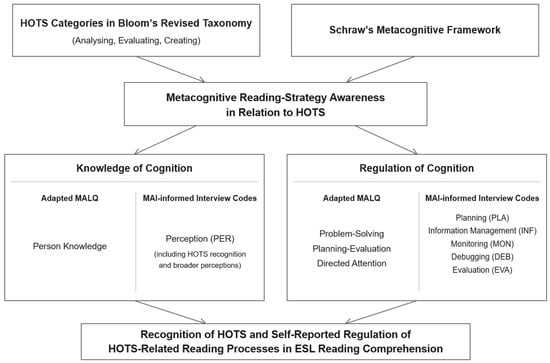
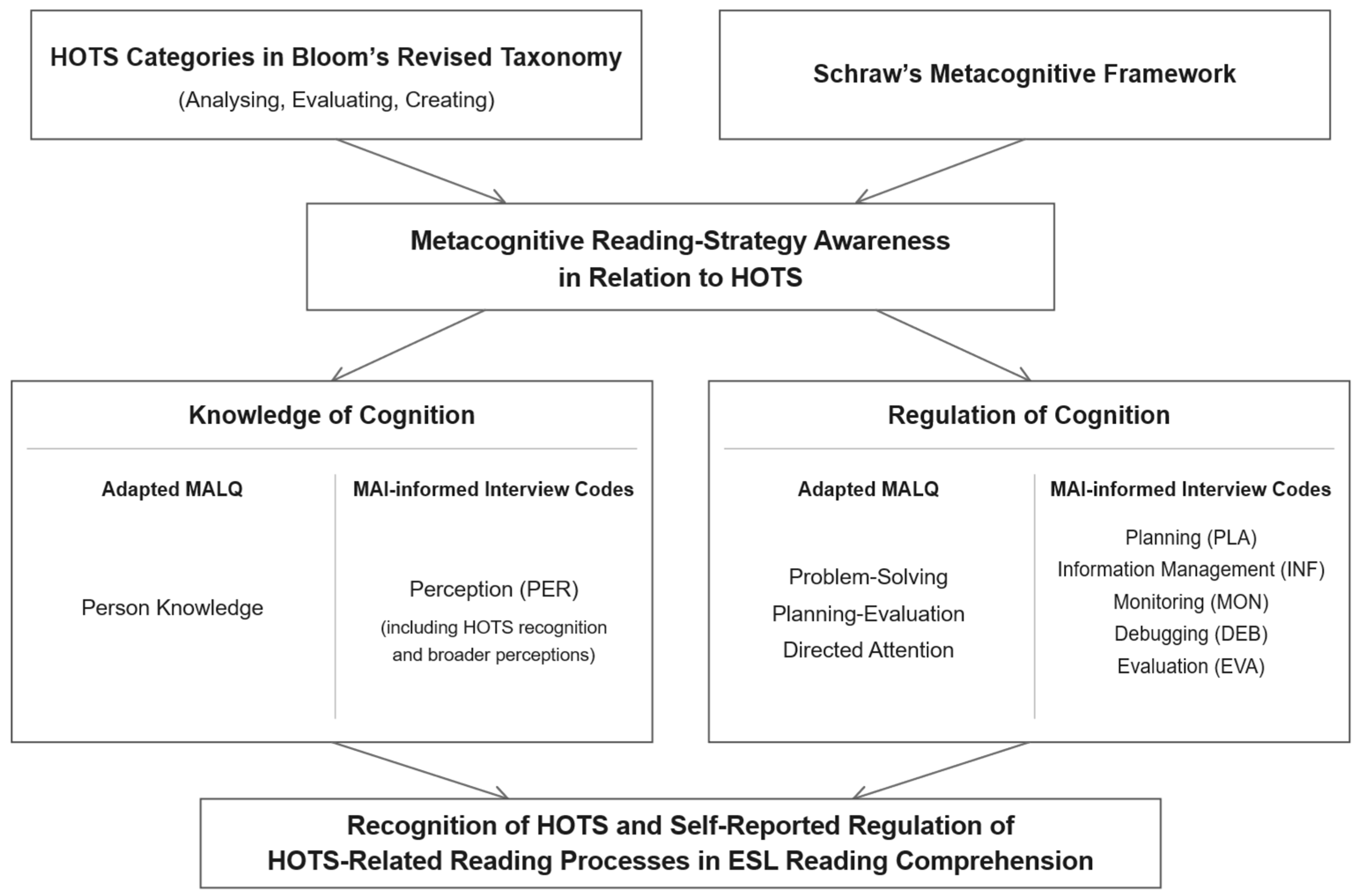
Building on Schraw’s (2001) metacognitive framework and Bloom’s revised taxonomy (Anderson & Krathwohl, 2001), the present study adopts a process-oriented framework to examine ESL learners’ awareness of metacognitive reading strategies in relation to HOTS during reading comprehension. Bloom’s revised taxonomy specifies the higher-order cognitive processes under examination, whereas Schraw’s framework provides the metacognitive lens by distinguishing between knowledge of cognition and regulation of cognition. In this study, general metacognitive reading-strategy awareness concerns learners’ awareness of how they manage reading comprehension through strategies such as planning, monitoring, and adjusting their reading, whereas HOTS-specific metacognitive awareness concerns their awareness of how they engage in and regulate analysing, evaluating, or creating during reading. Although these forms of awareness may overlap, metacognitive awareness of general reading strategies does not necessarily establish HOTS-specific metacognitive awareness. Within this framework, the adapted Metacognitive Awareness Listening Questionnaire (MALQ) ’s Person Knowledge dimension is primarily associated with knowledge of cognition, whereas Planning-Evaluation, Problem-Solving, and Directed Attention address aspects of regulation of cognition. In the MAI-informed interview coding framework, recognition of HOTS is captured within the broader Perception (PER) code, which also encompasses learners’ understanding, perceived value, confidence, and challenges. Regulation is examined through five codes: Planning (PLA), Information Management (INF), Monitoring (MON), Debugging (DEB), and Evaluation (EVA). These relationships represent conceptual alignments rather than direct equivalence between the questionnaire dimensions and interview codes, as illustrated in Figure 1.
Figure 1.
Theoretical framework of the study, informed by Bloom’s revised taxonomy (Anderson & Krathwohl, 2001) and Schraw’s (2001) metacognitive framework.
2. Materials and Methods
2.1. Research Design
A mixed-methods design was adopted to combine complementary quantitative and qualitative evidence, allowing the findings from one method to elaborate on those from the other (Greene et al., 1989; Dörnyei, 2007) and to provide a more nuanced understanding of learners’ metacognitive reading-strategy awareness in relation to HOTS during ESL reading comprehension. The study was conducted in two phases. In the first phase, learners’ awareness of metacognitive reading strategies in relation to HOTS was examined using an adapted MALQ. In the second phase, semi-structured interviews were conducted to explore learners’ perceptions of HOTS and their reported regulation of HOTS-related reading processes during reading comprehension.
2.2. Participants
The participants were Chinese postgraduate students enrolled in a Master of Arts in TESOL programme at a university in the United Kingdom. The study focused on ESL academic reading in the UK university context, distinct from the broader EFL context of English education in China. Participants were recruited through convenience sampling, which provided access to students who met the study’s inclusion criteria and were willing to participate (Dörnyei, 2007). Of the 80 questionnaire respondents, 76 were included in the final quantitative analysis, comprising 69 females (90.8%), six males (7.9%), and one participant who preferred not to disclose their gender (1.3%). All participants were enrolled in the same compulsory TESOL course and were in their final semester of the programme, making the sample relatively homogeneous in terms of academic context and programme stage.
For the interview phase, a convenience subsample was recruited from the main questionnaire sample (n = 6, all female). Interview participants were selected based on their availability, willingness to participate, and experience with English reading as ESL learners. These criteria provided a relevant basis for reflecting on how they recognised and reported regulating HOTS during ESL reading. Although the interviews included accounts of participants’ previous English-learning experiences in China, the questionnaire did not collect detailed educational histories, and these accounts were not generalised to all survey respondents. Gender was not an inclusion criterion. Female students constituted the majority of both the available volunteer pool and the wider TESOL programme. This is broadly consistent with wider subject-level gender distributions reported by HESA (2026).
2.3. Instruments
The first instrument was a questionnaire adapted from the Metacognitive Awareness Listening Questionnaire (MALQ; Vandergrift et al., 2006), which was originally developed to assess learners’ metacognitive awareness in listening (Goh, 2017; Goh & Hu, 2014). The MALQ was selected as the basis for instrument development not simply because listening and reading are both receptive language skills that require learners to process and comprehend linguistic input (Samuels, 1987; Bae & Bachman, 1998), but primarily because its multidimensional structure provided a useful framework for examining metacognitive reading-strategy awareness in relation to HOTS. Reading-specific inventories, such as the Metacognitive Awareness of Reading Strategies Inventory (MARSI; Mokhtari & Reichard, 2002) and the Survey of Reading Strategies (SORS; Mokhtari & Sheorey, 2002), assess learners’ metacognitive awareness of reading strategies across three categories: Global Reading, Problem-Solving, and Support Reading strategies. The Metacognitive Awareness Inventory (MAI; Schraw & Dennison, 1994) assesses metacognition at a broader, domain-general level through knowledge of cognition and regulation of cognition, rather than within a second-language receptive-comprehension context. By contrast, the MALQ distinguishes Problem-Solving, Planning-Evaluation, Directed Attention, Person Knowledge, and Mental Translation within an L2 receptive-comprehension context. Of these five dimensions, Problem-Solving, Planning-Evaluation, and Directed Attention primarily concern metacognitive awareness of strategy use, whereas Person Knowledge addresses learners’ perceptions of task difficulty, confidence, and anxiety (Vandergrift et al., 2006). These four dimensions were therefore retained to examine both strategy-related awareness and learner-related perceptions in the present study.
The use of these MALQ-derived dimensions in a reading context is consistent with Schraw’s (1998) view of metacognition as multidimensional and domain-general in nature, providing a theoretical basis for considering similar metacognitive functions across listening and reading. A more direct example is provided by Jeon (2012), who adapted the original 21-item MALQ into the Metacognitive Awareness Reading Questionnaire (MARQ) and reported an overall Cronbach’s α of 0.77. In L2 reading research, Phakiti (2003) also found a positive relationship between self-reported metacognitive strategy use and reading-test performance. Together, these studies provide a theoretical rationale and methodological precedent for adapting MALQ-derived items to the reading context. To explore metacognitive reading-strategy awareness in relation to HOTS, the MALQ-derived dimensions were used to organise the metacognitive aspects of the questionnaire, while Bloom’s revised taxonomy (Anderson & Krathwohl, 2001) defined the higher-order cognitive categories (Analysing, Evaluating, and Creating) and guided the proposed alignment of individual adapted items with these categories. These proposed alignments reflect the intended focus of the adaptation but do not establish the validity of the questionnaire as a measure of HOTS-specific metacognitive awareness.
The adapted questionnaire comprised two sections: a demographic section collecting only gender information and a 17-item scale using a five-point Likert scale ranging from 1 (strongly disagree) to 5 (strongly agree). The response format was changed from the original MALQ’s six-point scale to a five-point scale. The items were organised into four dimensions: Problem-Solving (6 items), Planning-Evaluation (5 items), Person Knowledge (3 items), and Directed Attention (3 items). During the adaptation process, three key revisions to the item content and structure were made. First, the wording of several items was refined for the ESL reading context and to reflect the study’s focus on metacognitive reading-strategy awareness in relation to HOTS. Second, the “Mental Translation” dimension of the original MALQ was removed because its focus on reliance on translation for comprehension was conceptually misaligned with the study’s emphasis on metacognitive awareness of reading strategies in relation to HOTS. Third, two original Directed Attention items, Item 6 (“When my mind wanders, I recover my concentration right away”) and Item 12 (“I try to get back on track when I lose concentration”), were merged into a single HOTS-oriented item (Q5), as both address the process of restoring attentional focus after concentration is lost.
Following questionnaire administration, a post hoc expert content review was conducted by two experts to assess the content relevance and HOTS alignment of the 17 adapted items. Each item was rated for its relevance to metacognitive awareness of HOTS during ESL reading using a four-point scale, with ratings of 3 or 4 considered indicative of content relevance. The experts also evaluated the proposed alignment of each item with analysing, evaluating, and/or creating. Nine items achieved an I-CVI of 1.00, four achieved 0.50 (Q8–Q11), and four achieved 0.00 (Q3, Q7, Q12, and Q13), yielding an S-CVI/Ave of 0.65. Regarding HOTS alignment, both experts agreed with the proposed classifications for nine items (Q1, Q2, Q4–Q6, and Q14–Q17), identified three items (Q7, Q12, and Q13) as having no clear HOTS alignment, and differed in their judgements for Q3 and Q8–Q11. The four items with an I-CVI of 0.00 were all rated as somewhat relevant (2) by both experts. These findings indicate limitations in the alignment between several questionnaire items and HOTS. Some adapted items may reflect broader aspects of reading-related metacognitive awareness rather than awareness specifically directed towards analysing, evaluating, or creating. As the review was conducted after questionnaire administration, its findings informed interpretation and recommendations for future instrument refinement rather than changes to the administered questionnaire. Detailed item-level evidence is presented in Appendix A.
The second instrument was a semi-structured interview protocol comprising three parts. Semi-structured interviews were selected because they are commonly used in metacognitive research and allow participants to reflect on and articulate their self-reported thinking and regulation processes during reading (Hughes, 2017; Heidbrink & Weinrich, 2021). The first part involved brief HOTS judgements based on Bloom’s revised taxonomy and its definitions of analysing, evaluating, and creating (Anderson & Krathwohl, 2001), providing a common reference point for the subsequent interview questions. The second part explored participants’ perceptions of HOTS in reading comprehension, including the perceived value and challenges of using HOTS. The third part examined participants’ self-reported regulation of HOTS-related reading processes during reading comprehension. Questions in this part were informed by the components and subcomponents of the Metacognitive Awareness Inventory (MAI; Schraw & Dennison, 1994).
2.4. Data Collection Procedure
In the quantitative phase, the adapted questionnaire was pilot tested with 10 TESOL students to assess the clarity, feasibility, and wording of the adapted items. Based on the pilot feedback, the HOTS explanations in the questionnaire statements were revised for clarity and consistency. The final questionnaire was administered online via Qualtrics, and the questionnaire link was distributed through WeChat. Participation was voluntary, and participants were informed of the study’s purpose and provided informed consent before completing the questionnaire. Participants who were willing to take part in the interview phase could provide their contact details at the end of the questionnaire. The contact details were used only for interview recruitment and were not included in the quantitative analysis. The questionnaire took approximately 10 min to complete.
Similarly, two pilot interviews were conducted before the formal interviews to refine the interview guide. Minor revisions were made to improve clarity, including replacing technical terms with narrative descriptions. Preparatory materials, including definitions, examples, and a pre-interview judgement activity, were provided in advance to familiarise participants with the HOTS categories. The formal interviews were conducted online via Microsoft Teams in Chinese, the participants’ first language, to allow them to express their views more accurately and in greater depth. All interviews were audio-recorded with participants’ consent, transcribed verbatim, translated into English, and reviewed by a bilingual co-author for accuracy and consistency before analysis.
2.5. Data Analysis
2.5.1. Quantitative Analysis
A total of 80 questionnaire responses were collected. After data screening, four questionnaires with missing responses to certain items were excluded, leaving 76 valid responses for quantitative analysis. Quantitative data from the adapted questionnaire were analysed in R (version 4.5.2; R Foundation for Statistical Computing, Vienna, Austria) using descriptive statistics to examine participants’ responses across the four adapted MALQ dimensions. Dimension-level scores were computed by averaging item responses within each dimension. Descriptive statistics, including means, standard deviations, and 95% confidence intervals (CIs), were calculated for each dimension. For descriptive purposes, mean scores were classified into three equal-width categories, low (1.00–2.33), moderate (2.34–3.66), and high (3.67–5.00), following the approach adopted by Alnemari (2023). These categories were used as descriptive references for mean response levels and were not treated as validated thresholds for HOTS-specific metacognitive awareness. Internal consistency was assessed using Cronbach’s α and McDonald’s ω. A preliminary confirmatory factor analysis (CFA) was conducted to examine the proposed four-dimensional structure of the adapted questionnaire. Model fit was assessed using the comparative fit index (CFI), Tucker–Lewis index (TLI), root mean square error of approximation (RMSEA), and standardised root mean square residual (SRMR). Given the sample size, the CFA was treated as a preliminary assessment rather than definitive validation of the proposed factor structure. The Shapiro–Wilk test, together with skewness and kurtosis, was used to examine the distribution of dimension scores. Given the observed departures from normality, a Friedman test was conducted to compare scores across the four related dimensions. Kendall’s W was calculated to estimate the overall effect size. Post hoc comparisons were performed using paired Wilcoxon signed-rank tests with Holm adjustment for multiple comparisons, and rank-biserial correlations were reported as effect sizes. Statistical significance was set at p < 0.05.
2.5.2. Qualitative Analysis
Interview data were analysed using deductive thematic analysis to explore participants’ understanding and perceptions of HOTS and their self-reported regulation of HOTS-related reading processes during reading comprehension. The Metacognitive Awareness Coding Framework, informed by previous research on metacognition (Zohar & Dori, 2012; Hughes, 2017; Heidbrink & Weinrich, 2021), was used to guide the analysis (see Appendix B). The framework comprised six codes: Perception (PER), Planning (PLA), Information Management (INF), Monitoring (MON), Debugging (DEB), and Evaluation (EVA). Within the knowledge-of-cognition component, a single Perception (PER) code was used to capture participants’ knowledge of HOTS, alongside their perceived value, confidence, and challenges in applying them during reading. As the interviews explored these perceptions broadly rather than separately assessing declarative, procedural, and conditional knowledge, these aspects were coded together.
The first author conducted the initial deductive coding of all six interview transcripts using the predefined coding framework. To enhance analytical consistency and credibility, a bilingual co-author with expertise in linguistics reviewed selected extracts alongside their assigned codes from all six transcripts and confirmed the appropriateness of the coding decisions. No coding discrepancies were identified in the reviewed extracts. As this review did not involve independent double-coding, no formal inter-coder agreement coefficient was calculated. Interview material falling outside the six reported codes was retained in the original transcripts but excluded from the corresponding code-frequency counts. Coding frequencies were summarised using the explicit code annotations in the transcripts (Appendix C). These frequencies were used descriptively and were not treated as direct indicators of participants’ actual HOTS use.
2.6. Ethical Considerations
Ethical approval for this study was obtained from the University of Southampton (ERGO 53198). All participants provided informed consent before taking part in the study. Participants were informed that participation was voluntary and that they could withdraw at any time. Before analysis, identifying information, including contact details provided for follow-up interview recruitment, was removed from the questionnaire dataset. Questionnaire responses were anonymised for quantitative analysis, and interview data were pseudonymised for qualitative analysis. All data were used only for research purposes.
3. Results
3.1. Patterns of Metacognitive Awareness in Relation to HOTS Across the Dimensions
After data screening, four incomplete responses were excluded, leaving 76 valid questionnaire responses for quantitative analysis. Table 1 presents the descriptive statistics and internal consistency reliability for the four proposed MALQ-derived dimensions. Among these dimensions, Problem-Solving recorded the highest mean score (M = 3.94, SD = 0.56), followed by Directed Attention (M = 3.48, SD = 0.62), Person Knowledge (M = 3.33, SD = 0.68), and Planning-Evaluation (M = 3.26, SD = 0.66). Based on the predefined descriptive categories, Problem-Solving fell within the high category, whereas the remaining three dimensions were classified as moderate. The full 17-item questionnaire had overall internal consistency (Cronbach’s α = 0.86, 95% CI [0.81, 0.90]; McDonald’s ω = 0.87). However, internal consistency varied across dimensions. Problem-Solving showed good internal consistency (Cronbach’s α = 0.80, McDonald’s ω = 0.81), while Planning-Evaluation demonstrated acceptable internal consistency (α = 0.70, ω = 0.71). In contrast, Person Knowledge (α = 0.58, ω = 0.59) and Directed Attention (α = 0.45, ω = 0.50) showed relatively low internal consistency. Given these measurement limitations, together with differences in item content and number, the four dimension scores were used for descriptive comparisons of questionnaire responses rather than interpreted as validated measures of HOTS-specific metacognitive awareness.
Table 1.
Descriptive Statistics and Internal Consistency Across Dimensions (N = 76).
A preliminary confirmatory factor analysis (CFA) was conducted to examine the proposed four-dimensional structure. The analysis produced an inadmissible solution, indicated by a non-positive-definite latent covariance matrix. The reported fit indices (scaled CFI = 0.846, TLI = 0.814, RMSEA = 0.129, SRMR = 0.119) also suggested inadequate fit but should be interpreted cautiously. Together with the relatively small sample size (N = 76), these findings did not provide sufficient evidence to support the proposed four-dimensional structure.
A Friedman test revealed a statistically significant difference in scores across the four dimensions, χ2(3) = 68.29, p < 0.001, with Kendall’s W = 0.30. Post hoc Wilcoxon signed-rank tests with Holm adjustment showed that Problem-Solving scores were significantly higher than those of Planning-Evaluation, Person Knowledge, and Directed Attention (all adjusted p < 0.001). Directed Attention scores were also significantly higher than Planning-Evaluation (adjusted p = 0.007) and Person Knowledge (adjusted p = 0.043). However, no statistically significant difference was found between Planning-Evaluation and Person Knowledge (adjusted p = 0.464). Detailed pairwise comparisons and effect sizes are presented in Appendix D. These comparisons should be interpreted cautiously, particularly those involving Person Knowledge and Directed Attention, given their relatively low internal consistency and differences in item content and number across the subscales. The observed differences in scores do not establish the content or structural validity of the adapted subscales.
Building on the dimension-level results, the item-level analysis provides a more detailed account of participants’ responses to individual items. Table 2 presents the mean scores, standard deviations, and descriptive categories for all 17 items, allowing comparisons within each dimension.
Table 2.
Item-level Descriptive Statistics for the Adapted MALQ (N = 76).
The item-level results provide further detail on the relatively high scores within the Problem-Solving dimension. All six items fell within the high range, with mean scores ranging from 3.67 to 4.28. Q4, which focused on using context to infer the meaning of unfamiliar words, recorded the highest mean score among all questionnaire items (M = 4.28, SD = 0.74). In addition, 70 of the 76 participants (92.1%) selected “agree” or “strongly agree,” indicating strong endorsement of context-based inference as a reading comprehension strategy. However, this result does not establish that the reported strategy necessarily involved HOTS-specific processing. Q15 (M = 4.11, SD = 0.78) and Q14 (M = 4.01, SD = 0.76) also received high mean scores, reflecting participants’ endorsement of statements about checking inferred meanings against context and using analytical cues to support comprehension.
Within the Directed Attention dimension, Q2 was the only item in the high descriptive category (M = 3.86, SD = 0.63), with 63 participants (82.9%) selecting “agree” or “strongly agree.” This reflected strong endorsement of the item concerning the use of HOTS-related methods to maintain concentration when comprehension breaks down. By contrast, Q13 (R), a reverse-scored item concerning the tendency to give up when applying HOTS methods became difficult, recorded the lowest mean score in this dimension (M = 3.14, SD = 1.05). Before reverse scoring, 36 participants (47.4%) selected “disagree” or “strongly disagree”, 28 participants (36.8%) selected “agree” or “strongly agree”, and 12 (15.8%) selected the neutral option. Given the negative wording of this item, disagreement indicates greater persistence, whereas agreement indicates a greater tendency to give up. The response distribution, together with the relatively high standard deviation, indicated notable variability in participants’ persistence when encountering difficulties in applying HOTS.
A similar pattern of variability was observed for Q3 (R) within the Person Knowledge dimension. This item stated, “I find that using HOTS in reading is more difficult than directly understanding the text in reading”, and, after reverse scoring, recorded the lowest mean score among all questionnaire items (M = 2.97, SD = 1.07). In the original responses, 31 participants (40.8%) selected “disagree” or “strongly disagree” and 28 participants (36.8%) selected “agree” or “strongly agree”. Disagreement indicates that participants did not perceive using HOTS as more difficult than directly understanding the text, whereas agreement indicates greater perceived difficulty. The response distribution, together with the relatively large standard deviation, indicates variability in participants’ perceptions of difficulty when using HOTS in reading. Within the same dimension, Q7 was the only item reaching a high level (M = 3.72, SD = 0.69), with 58 of the 76 participants (76.3%) selecting “agree” or “strongly agree”. This indicates that many participants reported confidence in using HOTS to support reading comprehension, despite differences in their perceived difficulty of using these skills.
Lastly, the Planning-Evaluation dimension recorded the lowest mean score among the four dimensions, with all five items falling within the moderate range. Compared with the Problem-Solving items, these items received lower mean ratings. In particular, Q8 and Q11, which addressed pre-reading planning and post-reading reflection and evaluation in relation to HOTS use, received “agree” or “strongly agree” from 36 participants (47.4%) and 37 participants (48.7%), respectively. Thus, fewer than half of the participants endorsed the statements concerning planning before reading or reflective evaluation after reading when in relation to HOTS. The relatively large standard deviations further suggested considerable variation in participants’ responses to these HOTS-related planning and evaluation items.
3.2. Participants’ Perceptions of HOTS and Self-Reported Regulation of HOTS-Related Reading Processes
To address the second research question, the qualitative findings are organised around two interrelated themes: participants’ perceptions of HOTS and their self-reported regulation of HOTS-related reading processes. The first theme examines participants’ perceptions of HOTS, including their recognition of HOTS, perceived value, and challenges, while the second concerns participants’ accounts of planning, information-managing, monitoring, adjusting, and evaluating their reading in relation to HOTS.
3.2.1. Participants’ Perceptions of HOTS: Recognition, Value, and Challenges
Following the preparatory activity, some participants reported recognising HOTS-related practices that they had previously used without explicitly identifying them as such. As Participant 3 noted, “This topic is very novel and interesting. I had never thought that these skills could be classified in this way, even though I had used them unconsciously in the past.” However, participants did not always distinguish HOTS categories consistently. Three participants classified an item involving both comparison and justification as analysing rather than evaluating. As Participant 5 explained, “I felt it involved both, but I had focused more on the first part of the question.” This suggests that salient task cues may have outweighed attention to the type of reasoning required, influencing the participant’s initial classification.
Participants also recognised the value of HOTS in moving beyond literal understanding and supporting more complex engagement with texts. However, they emphasised that these skills should be applied in ways that support rather than divert attention from textual comprehension. As Participant 4 cautioned, “Sometimes, focusing only on strategies rather than the text itself can lead me to overlook important information. For me, strategies are a means of supporting comprehension.”
Some participants also perceived differences in the cognitive demands of HOTS categories, viewing analysing as more accessible and creating as more demanding. As Participant 6 explained, “I think I would be more confident using analysing skills because I can obtain information from the available text. Creating is more difficult because it requires analysing and evaluating first.” Participant 4 further noted, “Creating requires me to draw on my own experiences and knowledge to develop new ideas, which I find challenging.”
Beyond these perceived cognitive demands, participants attributed difficulties in applying creating skills to both individual and contextual factors. At the individual level, Participant 3 expressed hesitancy about using creating skills due to perceived limitations in second language proficiency, while Participant 1 associated lower confidence with insufficient practice, explaining, “When a question involving creating appears occasionally, you may find it more challenging because you are unfamiliar with it, or you may be unsure whether the answer you come up with is correct or reasonable.” These accounts suggest that participants perceived creating as challenging not only because it involved generating new ideas, but also because expressing those ideas in a second language required linguistic resources, confidence, and repeated opportunities for practice.
At the contextual level, participants highlighted the influence of exam-oriented reading practices. Several participants reported limited engagement in reflection, focusing primarily on reading outcomes rather than evaluating their use of HOTS and regarding such reflection as unnecessary or time-consuming in examination contexts. Participant 5 further explained, “The reading comprehension tasks we encounter are mostly exam-oriented, and even when I read extensively on my own, creating is not required as much as analysing. I tend to think in an exam-oriented way and have few opportunities to practise this skill.” Thus, although participants recognised the value of HOTS, they perceived fewer opportunities to practise creating in reading contexts that emphasised answer selection, textual analysis, and examination performance over generating, extending, or reorganising meaning. Overall, participants perceived linguistic demands, limited opportunities to practise creating, and exam-oriented reading experiences as barriers to applying creating during reading.
3.2.2. Self-Reported Regulation of HOTS-Related Reading Processes
The second theme concerned participants’ self-reported regulation of HOTS-related reading processes. Drawing on the Metacognitive Awareness Coding Framework (Appendix B), the interview data were coded according to five predefined components of cognitive regulation: planning, information management, monitoring, debugging, and evaluation.
Planning was the least consistently reported component, with only two participants describing explicit planning, primarily involving goal setting and strategy selection. Participant 1 explained, “When I read an academic paper, I have a purpose. I might think in advance about why I chose it and what information I want to obtain. Based on that goal, I might plan to use analysing skills to identify keywords and locate relevant information.” In contrast, participants who did not report prior planning tended to rely on habitual reading approaches. Limited understanding of HOTS terminology also appeared to hinder explicit planning. As Participant 3 claimed: “I was not very familiar with the academic definitions of these skills, so I might have used one or two of them without realising it. But I don’t think I had ever planned how to use them. I wouldn’t think about which method to use for one part of a reading passage and which for another.” Deliberate planning of HOTS-related reading strategies was not prominent in participants’ reports, providing qualitative context for the comparatively low Planning-Evaluation mean score in the questionnaire.
By contrast, information management strategies were more commonly reported. Participants described using visual markings, such as circles, wavy lines, underlining, or colour coding, to highlight important textual information. One participant also reported taking notes to organise and summarise information for later understanding and retrieval. However, participants differed in how systematically they described using these strategies. Participant 1 was the only interviewee to describe a hierarchical marking: “Colour coding is the most noticeable, so I use it to highlight the most important paragraphs, sentences, or words. […] I use circles and wavy lines to mark information that may be useful or new but is not necessarily needed.” Other participants described using markings without clear differentiation.
Debugging strategies were also commonly reported. Participants described adjusting their reading approaches when initial understanding did not support comprehension, revisiting earlier parts of the text, and integrating information from different sections to resolve comprehension problems. As Participant 3 explained, “To save time, I would first check the opening and closing paragraphs for information related to the illustration. If the illustration still seemed unhelpful after considering it alongside the text, I would stop relying on it to avoid wasting time.” Reactive and problem-driven adjustments were more frequently described than systematic planning of HOTS-related reading strategies in advance.
Monitoring and evaluation were coded as separate components of metacognitive regulation. Participants’ accounts involved answer checking, error reflection, and judgements of overall comprehension. Some participants described a more process-oriented form of monitoring and evaluation. As Participant 1 reported, “After reading, I check my answers. If I get one wrong, I think back to which skill I used and what caused the problem. Even if I get a difficult question right, I reflect on how I used the skill and what I could apply to future reading.” In this account, answer checking could prompt reflection on the application of HOTS rather than simply the correctness of the final answer.
However, this process-oriented approach was not consistently reported. Several participants focused on reading outcomes rather than explicitly reviewing their use of HOTS-related strategies. Participant 6 described that “I probably wouldn’t, because I think that if I can obtain information and form my own view of the text after reading, the reading has been effective.” Participant 3 also noted that non-exam reading often prioritised comprehension over strategy evaluation and that excessive monitoring could increase cognitive load. Similarly, post-reading evaluation was often dependent on answer accuracy. As Participant 4 reported, “It depends. If I get a reading question right, I don’t reflect on it; if I get it wrong, I do.” She added that she might reread the text using analysing skills after making errors but did not habitually evaluate her use of HOTS. Participants’ accounts of monitoring and evaluation of HOTS-related reading strategies were often outcome-oriented rather than process-oriented.
3.3. Integration of Quantitative and Qualitative Findings
To integrate the quantitative and qualitative findings, Appendix E presents a joint display linking the four proposed questionnaire dimensions with relevant interview evidence, following the approach described by Fetters et al. (2013). The relatively higher Problem-Solving and lower Planning-Evaluation mean scores were broadly consistent with interview accounts emphasising immediate, text-based adjustments in response to comprehension difficulties, while systematic planning and post-reading evaluation were less prominent. The interviews also provided complementary insights into a possible discrepancy between participants’ recognition and perceived value of HOTS and their self-reported deliberate regulation of HOTS-related reading processes. As the questionnaire dimensions and interview codes were not equivalent measures, and some of their proposed links were indirect, these findings are interpreted as selective convergence and contextual complementarity rather than direct cross-method confirmation. The individual questionnaire profiles of the six interviewees are provided in Appendix F.
4. Discussion
This study examined metacognitive reading-strategy awareness in relation to HOTS during ESL reading comprehension among Chinese TESOL postgraduates at a UK university. The discussion focuses on two interrelated findings: variation in questionnaire responses across the four proposed dimensions and the discrepancy between participants’ recognition of HOTS and their self-reported regulation of HOTS-related reading processes.
4.1. Variation in Questionnaire Scores Across Dimensions
The questionnaire findings revealed variation across the four dimensions. Problem-Solving recorded the highest mean score and fell within the high descriptive category, while the remaining three dimensions were classified as moderate, with Planning-Evaluation receiving the lowest mean score.
The prominence of the Problem-Solving dimension suggests that participants more strongly endorsed statements about addressing immediate comprehension difficulties than those concerning planning and evaluation. This finding can be considered alongside previous research linking HOTS to problem-solving and deeper engagement with reading comprehension (King et al., n.d.; Akbar et al., 2025). Higher-order reading processes may involve analysing information, making judgements, and constructing meaning beyond literal understanding (Nourdad et al., 2018; Nurmaharaeni et al., 2022). However, the strategies represented by the Problem-Solving items are not necessarily HOTS-specific. In particular, Q4 focused on using context to infer the meanings of unfamiliar words, which may also reflect routine comprehension repair rather than higher-order analysis. Its high mean score therefore indicates strong endorsement of an analysis-oriented reading strategy rather than direct evidence of HOTS engagement. This distinction also applies to other items. Q14 and Q15 involve lexical inference and checking inferred meanings against context, which may reflect general comprehension strategies, while Q10 primarily concerns the adjustment of strategies when they are ineffective. By contrast, Q6 more explicitly refers to comparing textual interpretations with prior knowledge, suggesting a closer conceptual link to analysing. The interview accounts provide complementary context, as participants frequently described using contextual cues and adjusting their reading approaches when comprehension difficulties arose.
The comparatively lower Planning-Evaluation score reflects weaker endorsement of statements about planning and evaluating HOTS-related reading strategies. Planning, monitoring, and evaluation are central components of metacognitive regulation, enabling learners to select, manage, and assess strategies across different stages of a task (Schraw & Dennison, 1994). In second-language reading, these processes help learners approach reading tasks strategically and evaluate not only comprehension outcomes but also the effectiveness of the strategies employed (Baker & Beall, 2009). The difference between the Problem-Solving and Planning-Evaluation scores therefore needs to be understood in light of their different item content, rather than as a direct comparison of actual regulatory abilities.
Directed Attention and Person Knowledge both fell within the moderate descriptive category. Directed Attention received a slightly higher mean score, reflecting comparatively stronger endorsement of statements about maintaining focus on task-relevant information and regaining concentration when using HOTS during reading. However, comparisons involving these two dimensions require caution because of their relatively low internal consistency. Previous research has highlighted the importance of selecting task-relevant information in second-language reading (Prichard & Atkins, 2019). Such attention may support comprehension regulation by helping learners identify relevant textual cues and sustain their engagement when comprehension difficulties arise. Nevertheless, the interview accounts of selective text marking, presented alongside Directed Attention in the joint display (Appendix E), may primarily reflect information management rather than the attentional processes addressed by the questionnaire dimension. These accounts therefore provide contextual evidence rather than direct confirmation of Directed Attention.
Person Knowledge provides a further perspective on participants’ perceived difficulty and confidence in using HOTS. These perceptions may vary according to the demands of particular tasks and are relevant to understanding learners’ reported strategy awareness. This interpretation is consistent with Yang (1999), who highlighted the relationship between learners’ beliefs about their abilities and their use of language-learning strategies.
4.2. From Perceived Value to Uneven Regulation of HOTS
The interview findings indicated that participants generally perceived HOTS as valuable and practical resources for reading comprehension. This finding resonates with research on metacognitive reading strategy awareness, which shows that language learners can recognise the usefulness of strategies in English learning (Ahmadi et al., 2013; Dardjito, 2019; Teng, 2020). Building on this literature, the present interviews offer an exploratory perspective on how participants understood analysing, evaluating, and creating not merely as abstract categories, but as practical resources for supporting reading comprehension. Participants further emphasised that HOTS-related strategies should support close engagement with the text rather than distract attention from it. However, participants had received preparatory materials explaining the HOTS categories before the interviews, which may have influenced their subsequent recognition and descriptions of HOTS. Their accounts therefore cannot be interpreted as evidence of independently established or unprompted HOTS awareness.
However, the three HOTS categories were not perceived as equally accessible. Some participants described analysing as more familiar and readily applied, associating it with common reading practices such as identifying key information, comparing textual details, and drawing inferences from context. Evaluating occupied an intermediate position, while creating was perceived as particularly challenging. Participants attributed difficulties with creating to perceived limitations in their second-language proficiency, insufficient practice, and limited opportunities to generate, extend, or reorganise meaning beyond the text. Some participants also associated these difficulties with exam-oriented reading experiences, which they perceived as placing greater emphasis on finding correct answers and analysing textual information than on generating or reorganising meaning beyond the text. This concern echoes discussions of the potential constraints of exam-oriented education on creativity (Ke & Liang, 2023).
Despite recognising the value of HOTS for reading comprehension, participants did not consistently describe deliberate regulation of HOTS-related reading processes. Previous research has examined the role of metacognitive awareness in HOTS-oriented reading comprehension (Thamrin et al., 2019; Nurmaharaeni et al., 2022), while the present study extends this research by offering an exploratory perspective on how learners describe and reflect on their use of HOTS-related reading processes. Participants more often described immediate, problem-triggered adjustments when comprehension difficulties arose than deliberate planning, ongoing monitoring, and systematic post-reading evaluation. When discussing evaluation, several participants focused on answer accuracy or overall comprehension rather than assessing the effectiveness of particular strategies. This tendency towards problem-triggered adjustments and limited systematic reflection may help explain the relatively low ratings of the Planning-Evaluation dimension in the questionnaire.
Several factors may help explain why systematic regulation featured less prominently in participants’ accounts. One possible explanation is that participants’ limited conceptual understanding of HOTS categories may have constrained their ability to categorise, plan, monitor, and evaluate their use of related reading strategies. This interpretation is consistent with Kuhn’s (2000) argument that learners’ perceptions and understanding shape their thinking and learning processes. Participants also reported limited opportunities to practise HOTS, exam-oriented reading habits, and perceived limitations in instructional support. These experiences may help explain why their accounts emphasised immediate, task-specific adjustments rather than deliberate planning and systematic reflection, although the study did not systematically assess their instructional experiences. Previous research has also highlighted the importance of instructional scaffolding and practices in supporting HOTS-related performance development (Mitani, 2021). Some participants also regard explicit monitoring and reflection as unnecessary or time-consuming in certain reading contexts, suggesting that the perceived demands of these processes may have contributed to their limited prominence in participants’ accounts. These perceptions may help explain why constrained sustained and systematic regulation featured less prominently in their accounts. These findings qualify the theoretical expectation that metacognitive awareness supports sustained learning and self-regulation (Marzano & Kendall, 2008), suggesting that recognising or valuing HOTS did not always coincide with participants’ descriptions of systematic regulation during reading.
5. Conclusions
This mixed-methods study examined metacognitive reading-strategy awareness in relation to HOTS during reading comprehension among Chinese TESOL postgraduates at a UK university. Questionnaire responses varied across the four proposed MALQ-derived dimensions, with Problem-Solving receiving the highest mean score and Planning-Evaluation the lowest. The interview accounts further suggested a distinction between participants’ recognition of HOTS and their regulation of HOTS-related reading processes, with immediate, problem-triggered adjustments described more often than systematic planning and evaluation. These findings provide an exploratory, process-oriented perspective on how participants understood HOTS and described regulating related reading processes, complementing research focused on reading performance or task outcomes. However, given limitations in item-level content relevance and HOTS alignment, the low internal consistency of two dimensions, and insufficient evidence supporting the proposed factor structure, the questionnaire scores should be interpreted as exploratory descriptions of self-reported metacognitive reading awareness rather than validated measures of HOTS-specific metacognitive awareness.
Despite the contextual specificity of the study, the findings may offer insights relevant to learners from similar examination-oriented educational backgrounds in comparable ESL reading contexts. Pedagogically, the findings highlight the potential value of moving beyond introducing HOTS to explicitly guiding learners in planning, monitoring, evaluating, and refining reading strategies in HOTS-related reading tasks. Providing sustained opportunities to practise more complex higher-order cognitive processes, particularly creating, may help address the limited practice opportunities described by participants.
Several limitations should be acknowledged. First, the study focused on a single cohort of Chinese postgraduates at a UK university, limiting the transferability of the findings to learners from different educational and linguistic backgrounds. The cross-sectional design also precluded examining changes in self-reported metacognitive reading-strategy awareness and perceptions of HOTS over time. Second, the study relied primarily on questionnaire and interview data, which cannot directly establish participants’ actual use and regulation of HOTS-related reading processes. Third, the adapted questionnaire had several measurement limitations. The expert content review, conducted after questionnaire administration, revealed uneven support for item relevance and alignment with HOTS. In addition, the Person Knowledge and Directed Attention subscales showed relatively low internal consistency, while the proposed four-dimensional structure was not adequately established. The low internal consistency of some subscales may partly reflect their small number of items and differences in item content. The relatively small sample size also constrained the assessment of the proposed factor structure. Fourth, the HOTS preparatory materials provided before the interviews and the initial judgement activity may have influenced participants’ subsequent recognition and descriptions of HOTS. It is therefore difficult to determine the extent to which their interview accounts reflected pre-existing awareness. Future research could include learners from more diverse educational and linguistic backgrounds and adopt longitudinal or intervention-based designs to examine changes in metacognitive reading-strategy awareness, recognition of HOTS, and reported regulation over time. Incorporating think-aloud protocols, classroom observations, or reading-task performance measures could provide a more comprehensive account of how learners apply and regulate HOTS-related reading processes. Further refinement of the adapted questionnaire and testing with larger, independent samples are needed to evaluate assess item-level HOTS alignment, reliability, and the proposed four-dimensional structure. Finally, assessing participants’ understanding of HOTS before introducing definitions or examples could help distinguish pre-existing recognition from responses influenced by the preparatory activity.
Overall, the study suggests a possible distinction between participants’ recognition of HOTS and their self-reported regulation of HOTS-related reading processes. Examining both how learners recognise HOTS and how they describe planning, monitoring, and evaluating HOTS-related reading processes offers a more process-oriented perspective on HOTS in ESL reading comprehension.
Author Contributions
Conceptualization, C.C. and Q.G.; methodology, C.C. and Q.G.; software, C.C.; validation, C.C. and Q.G.; formal analysis, C.C.; investigation, C.C.; resources, C.C.; data curation, C.C.; writing—original draft preparation, C.C.; writing—review and editing, C.C. and Q.G.; visualization, C.C.; supervision, Q.G.; project administration, C.C. and Q.G. All authors have read and agreed to the published version of the manuscript.
Funding
This research is funded by the 2026 Research and Professional Development Funding from the School of Arts at Western Sydney University.
Institutional Review Board Statement
The study was approved by the Faculty Research Ethics Committee (FREC) at the University of Southampton (ERGO 53198), approved in 15 June 2023.
Informed Consent Statement
Informed consent was obtained from all subjects involved in the study.
Data Availability Statement
The raw questionnaire data and interview transcripts generated and analysed during this study are not publicly available due to ethical and confidentiality restrictions concerning participant privacy. The adapted questionnaire is provided in Appendix A, and the coding framework is provided in Appendix B. The interview protocol are available from the corresponding author upon reasonable request.
Acknowledgments
The authors would like to thank all participants who took part in the questionnaire and interviews for sharing their time and reflections.
Conflicts of Interest
The authors declare no conflicts of interest.
Appendix A
Table A1.
Item-Level Mapping and Expert Content Review Results of the Adapted MALQ.
Appendix B
Table A2.
The Metacognitive Awareness Coding Framework.
Appendix C
Table A3.
Distribution of Explicit Code Annotations Across Interview Participants.
Appendix D
Table A4.
Post hoc Pairwise Comparisons of the Four Dimensions.
Appendix E
Table A5.
Joint Display of Quantitative and Qualitative Findings.
Appendix F
Table A6.
Questionnaire Dimension Scores of the Six Interview Participants.
References
- Ahmadi, M., Ismail, H., & Abdullah, M. (2013). The importance of metacognitive reading strategy awareness in reading comprehension. English Language Teaching, 6(10), 235–244. [Google Scholar] [CrossRef] [Scilit]
- Akbar, F., Wilany, E., & Siahaan, S. (2025). Higher-order thinking skills (HOTS) in reading comprehension of EFL class. Celtic: A Journal of Culture, English Language Teaching, Literature and Linguistics, 12(2), 730–753. [Google Scholar] [CrossRef] [Scilit]
- Alnemari, A. (2023). Analysing affective factors in relation to students’ achievement and behaviour in EFL in Saudi Arabia [Ph.D. thesis, Cardiff University]. [Google Scholar]
- Anderson, L., & Krathwohl, D. (2001). A taxonomy for learning, teaching and assessing: A revision of Bloom’s taxonomy of educational objectives: Complete edition (1st ed.). Longman. [Google Scholar]
- Aziz, M., & Rawian, R. (2022). Modeling higher order thinking skills and metacognitive awareness in English reading comprehension among university learners. Frontiers in Education, 7, 991015. [Google Scholar] [CrossRef] [Scilit]
- Bae, J., & Bachman, L. (1998). A latent variable approach to listening and reading: Testing factorial invariance across two groups of children in the Korean/English two-way immersion program. Language Testing, 15(3), 380–414. [Google Scholar] [CrossRef] [Scilit]
- Baker, L., & Beall, L. (2009). Metacognitive processes and reading comprehension. In S. Israel, & G. Duffy (Eds.), Handbook of research on reading comprehension (pp. 373–388). Routledge. [Google Scholar]
- Baker, L., & Brown, A. (1980). Metacognitive skills and reading (Technical Report No. 188). Available online: https://files.eric.ed.gov/fulltext/ED195932.pdf (accessed on 28 October 2026).
- Bloom, B., Engelhart, M., Furst, E., Hill, W., & Krathwohl, D. (1956). Taxonomy of educational objectives: The classification of educational goals: Handbook I cognitive domain. Longmans. [Google Scholar]
- Brown, A. (1987). Metacognition, executive control, self-regulation and other more mysterious mechanisms. In F. Weinert, & R. Kluwe (Eds.), Metacognition, motivation, and understanding (pp. 65–116). Erlbaum. [Google Scholar]
- Cheng, S., Hiong, S., & Daniel, E. (2024). Integrating HOTs in reading comprehension in inclusive classrooms: Implications from a dyslexia study. Journal of International and Comparative Education, 13(2), 127–152. [Google Scholar] [CrossRef] [Scilit]
- Conklin, W. (2012). Higher-order thinking skills to develop 21st century learners (1st ed.). Shell Education. [Google Scholar]
- Dardjito, H. (2019). Students’ metacognitive reading awareness and academic English reading comprehension in EFL context. International Journal of Instruction, 12(4), 611–624. [Google Scholar] [CrossRef] [Scilit]
- Dewitz, P., & Graves, M. (2021). The science of reading: Four forces that modified, distorted, or ignored the research finding on reading comprehension. Reading Research Quarterly, 56, S131–S144. [Google Scholar] [CrossRef] [Scilit]
- Din, M. (2020). Evaluating university students’ critical thinking ability as reflected in their critical reading skill: A study at bachelor level in Pakistan. Thinking Skills and Creativity, 35, 100627. [Google Scholar] [CrossRef] [Scilit]
- Dörnyei, Z. (2007). Research methods in applied linguistics: Quantitative, qualitative, and mixed methodologies. Oxford University Press. [Google Scholar]
- Fetters, M., Curry, L., & Creswell, J. (2013). Achieving integration in mixed methods designs—Principles and practices. Health Services Research, 48, 2134–2156. [Google Scholar] [CrossRef] [Scilit] [PubMed]
- Fitria, W., & Nafiah, U. (2025). Enhancing students’ inferential reading skills through a higher order thinking skills based module: An experimental study. International Journal of Education and Teaching Zone, 4(2), 163–181. [Google Scholar] [CrossRef] [Scilit]
- Flavell, J. (1979). Metacognition and cognitive monitoring: A new area of cognitive-developmental inquiry. American Psychologist, 34, 906–911. [Google Scholar] [CrossRef]
- Garner, R. (1987). Metacognition and reading comprehension (1st ed.). Ablex. [Google Scholar]
- Ghanizadeh, A., Al-Hoorie, A., & Jahedizadeh, S. (2020). Higher order thinking skills in the language classroom: A concise guide (1st ed.). Springer. [Google Scholar]
- Girli, A., & Öztürk, H. (2017). Metacognitive reading strategies in learning disability: Relations between usage level, academic self-efficacy and self-concept. International Electronic Journal of Elementary Education, 10(1), 93–102. [Google Scholar] [CrossRef] [Scilit]
- Goh, C. (2017). Metacognitive awareness listening questionnaire (MALQ). In D. Worthington, & G. Bodie (Eds.), The sourcebook of listening research: Methodology and measures (pp. 430–437). John Wiley & Sons, Inc. [Google Scholar]
- Goh, C., & Hu, G. (2014). Exploring the relationship between metacognitive awareness and listening performance with questionnaire data. Language Awareness, 23(3), 255–274. [Google Scholar] [CrossRef] [Scilit]
- Greene, J., Caracelli, V., & Graham, W. (1989). Toward a conceptual framework for mixed-method evaluation designs. Educational Evaluation and Policy Analysis, 11(3), 255–274. [Google Scholar] [CrossRef]
- Hague, C. (2024). Fostering higher-order thinking skills online in higher education: A scoping review (Report No. 306). OECD Publishing. [Google Scholar] [CrossRef] [Scilit]
- Heidbrink, A., & Weinrich, M. (2021). Undergraduate chemistry instructors’ perspectives on their students’ metacognitive development. Chemistry Education Research and Practice, 22(1), 182–198. [Google Scholar] [CrossRef] [Scilit]
- Higher Education Statistics Agency (HESA). (2026, January). The student enrolments by CAH level 1 subject and sex, academic years 2020/21 to 2024/25 (Figure 13). Available online: https://www.hesa.ac.uk/data-and-analysis/sb273/figure-13 (accessed on 28 October 2026).
- Horváthová, B., & Naďová, L. (2021). Developing critical thinking in reading comprehension of texts for specific purposes at all levels of Bloom’s taxonomy. Journal of Teaching English for Specific and Academic Purposes, 9(1), 1–16. [Google Scholar] [CrossRef] [Scilit]
- Hughes, A. (2017). Educational complexity and professional development: Teachers’ need for metacognitive awareness. Journal of Technology Education, 29(1), 25–44. [Google Scholar] [CrossRef] [Scilit]
- Jaleel, S., & Premachandran, P. (2016). A study on the metacognitive awareness of secondary school students. Universal Journal of Educational Research, 4(1), 165–172. [Google Scholar] [CrossRef] [Scilit]
- Jeon, E. (2012). Oral reading fluency in second language reading. Reading in a Foreign Language, 24(2), 186–208. [Google Scholar] [CrossRef] [Scilit]
- Ke, Z., & Liang, C. (2023). Research on the relationship between exam-oriented education and students’ creativity. Journal of East China Normal University (Education Science), 41(4), 72–82. [Google Scholar] [CrossRef]
- King, F., Goodson, L., & Rohani, F. (n.d.). Higher order thinking skills: Definition, teaching strategies, and assessment. Center for Advancement of Learning and Assessment. [Google Scholar]
- Kintsch, W. (1998). Comprehension: A paradigm for cognition. Cambridge University Press. [Google Scholar]
- Kuhn, D. (2000). Metacognitive development. Current Directions in Psychological Science, 9(5), 178–181. [Google Scholar] [CrossRef] [Scilit]
- Kusrini, E., Sugirin, S., & Priyana, J. (2019). Incorporating higher order thinking skills in developing reading materials and tasks for EFL learners. In Proceedings of the third international conference of arts, language and culture (ICALC 2018) (pp. 328–337). Atlantis Press. [Google Scholar] [CrossRef] [Scilit]
- Lindholm, A., & Tengberg, M. (2019). The reading development of Swedish L2 middle school students and its relation to reading strategy use. Reading Psychology, 40(8), 782–813. [Google Scholar] [CrossRef] [Scilit]
- Macaro, E. (2001). Learning strategies in foreign and second language classroom. Continuum International. [Google Scholar]
- Marzano, R., & Kendall, J. (2008). Designing and assessing educational objectives: Applying the new taxonomy. Corwin Press. [Google Scholar]
- Mitani, H. (2021). Test score gaps in higher order thinking skills: Exploring instructional practices to improve the skills and narrow the gaps. AERA Open, 7(1), 1–23. [Google Scholar] [CrossRef] [Scilit]
- Mokhtari, K., & Reichard, C. (2002). Assessing students’ metacognitive awareness of reading strategies. Journal of Educational Psychology, 94, 249–259. [Google Scholar] [CrossRef]
- Mokhtari, K., & Sheorey, R. (2002). Measuring ESL students’ awareness of reading strategies. Journal of Developmental Education, 25(3), 2–10. [Google Scholar]
- Niu, W., & Sternberg, R. (2002). Contemporary studies on the concept of creativity: The East and the West. The Journal of Creative Behavior, 36(4), 269–288. [Google Scholar] [CrossRef] [Scilit]
- Nourdad, N., Masoudi, S., & Rahimali, P. (2018). The effect of higher order thinking skill instruction on EFL reading ability. International Journal of Applied Linguistics & English Literature, 7(3), 231–237. [Google Scholar] [CrossRef] [Scilit]
- Nurmaharaeni, Nappu, S., & Hambali, U. (2022). The implementation of higher-order thinking skill (HOTS) in learning reading for EFL learners. English Language Teaching Methodology, 2(1), 54–64. [Google Scholar] [CrossRef] [Scilit]
- Pearson, P., & Cervetti, G. (2017). The roots of reading comprehension. In S. E. Israel (Ed.), Handbook of research on reading comprehension (2nd ed., pp. 12–56). The Guilford Press. [Google Scholar]
- Phakiti, A. (2003). A closer look at the relationship of cognitive and metacognitive strategy use to EFL reading achievement test performance. Language Testing, 20(1), 26–56. [Google Scholar] [CrossRef] [Scilit]
- Pogrow, S. (2005). HOTS revisited: A thinking development approach to reducing the learning gap after grade 3. Phi Delta Kappan, 87(1), 64–75. [Google Scholar] [CrossRef] [Scilit]
- Prichard, C., & Atkins, A. (2019). Selective attention of L2 learners in task-based reading online. Reading in a Foreign Language, 31(2), 269–290. [Google Scholar] [CrossRef] [Scilit]
- Resnick, L. (1987). Education and learning to think. National Academy Press. [Google Scholar]
- Samadi, F., Jafarigohar, M., Saeedi, M., Ganji, M., & Khodabandeh, F. (2024). Impact of flipped classroom on EFL learners’ self- regulated learning and higher-order thinking skills during the Covid19 pandemic. Asian-Pacific Journal of Second and Foreign Language Education, 9, 24. [Google Scholar] [CrossRef] [Scilit]
- Samuels, S. (1987). Factors that influence listening and reading comprehension. In R. Horowitz, & S. Samuels (Eds.), Comprehending oral and written language (pp. 295–325). Academic Press. [Google Scholar]
- Schellings, G., & Van Hout-Wolters, B. (2011). Measuring strategy use with self-report instruments: Theoretical and empirical considerations. Metacognition and Learning, 6, 83–90. [Google Scholar] [CrossRef] [Scilit]
- Schraw, G. (1998). Promoting general metacognitive awareness. Instructional Science, 26, 113–125. [Google Scholar] [CrossRef] [Scilit]
- Schraw, G. (2001). Promoting general metacognitive awareness. In H. Hartman (Ed.), Metacognition in learning and instruction: Theory, research and practice (pp. 3–16). Kluwer Academic. [Google Scholar]
- Schraw, G., & Dennison, R. (1994). Assessing metacognitive awareness. Contemporary Educational Psychology, 19(4), 460–475. [Google Scholar] [CrossRef] [Scilit]
- Sheorey, R., & Mokhtari, K. (2001). Differences in the metacognitive awareness of reading strategies among native and non-native readers. System, 29, 431–449. [Google Scholar] [CrossRef] [Scilit]
- Silalahi, L., Sitorus, M., Rajagukguk, H., Panggabean, N., & Nasution, J. (2021). The effect of higher-order thinking skill on reading comprehension. IDEAS: Journal on English Language Teaching and Learning, Linguistics and Literature, 9(1), 455–463. Available online: https://ejournal.iainpalopo.ac.id/index.php/ideas/article/view/1895 (accessed on 28 October 2026).
- Snow, C. (2002). Reading for understanding: Toward a research and development program in reading comprehension. RAND Corporation. [Google Scholar]
- Soto, C., Gutiérrez de Blume, A., Jacovina, M., McNamara, D., Benson, N., & Riffo, B. (2019). Reading comprehension and metacognition: The importance of inferential skills. Cogent Education, 6(1), 1565067. [Google Scholar] [CrossRef] [Scilit]
- Teng, F. (2020). The benefits of metacognitive reading strategy awareness instruction for young learners of English as a second language. Literacy, 54, 29–39. [Google Scholar] [CrossRef] [Scilit]
- Teng, F., & Reynolds, B. (2019). Effects of individual and group metacognitive prompts on EFL reading comprehension and incidental vocabulary learning. PLoS ONE, 14(5), e0215902. [Google Scholar] [CrossRef] [Scilit] [PubMed]
- Thamrin, N., & Agustin, S. (2019). Conceptual variations on reading comprehension through higher order thinking skills (HOTS) strategy. English Review: Journal of English Education, 7(2), 93–100. [Google Scholar] [CrossRef] [Scilit]
- Thamrin, N., Widodo, P., & Margana, M. (2019). Developing higher order thinking skills (hots) for reading comprehension enhancement. Journal of Physics: Conference Series, 179, 012073. [Google Scholar] [CrossRef] [Scilit]
- The Ministry of Education of the People’s Republic of China. (2017). 普通高中英语课程标准 (2017版) [English curriculum standards for senior high schools (2017 Version)] (1st ed.). Beijing Normal University Publishing Group.
- The Ministry of Education of the People’s Republic of China. (2022). 义务教育英语课程标准(2022版) [National English curriculum standards for compulsory education (2022 Version)] (3rd ed.). Beijing Normal University Publishing Group.
- Vandergrift, L., Goh, C., Mareschal, C., & Tafaghodtari, M. (2006). The metacognitive awareness listening questionnaire: Development and validation. Language Learning, 56(3), 431–462. [Google Scholar] [CrossRef] [Scilit]
- Yang, N. (1999). The relationship between EFL learners’ beliefs and learning strategy use. System, 27, 515–535. [Google Scholar] [CrossRef] [Scilit]
- Zhang, L. (2001). Awareness in reading: EFL students’ metacognitive knowledge of reading strategies in an acquisition-poor environment. Language Awareness, 10(4), 268–288. [Google Scholar] [CrossRef] [Scilit]
- Zhang, L. (2007, March 21–24). Teaching critical reading to in-service EFL teachers in Singapore [Paper presentation]. 41st TESOL International Convention, Washington, DC, USA. [Google Scholar]
- Zohar, A., & Dori, Y. (2012). Metacognition in science education: Trends in current research. Springer. [Google Scholar]

Disclaimer/Publisher’s Note: The statements, opinions and data contained in all publications are solely those of the individual author(s) and contributor(s) and not of MDPI and/or the editor(s). MDPI and/or the editor(s) disclaim responsibility for any injury to people or property resulting from any ideas, methods, instructions or products referred to in the content. |
© 2026 by the authors. Licensee MDPI, Basel, Switzerland. This article is an open access article distributed under the terms and conditions of the Creative Commons Attribution (CC BY) license.