


Abstract
This study examined the perceptions of pre-service teachers regarding the Spanish government’s response to the misuse of generative artificial intelligence (generative AI) for creating disinformation, as well as the mitigation of risks associated with deepfakes produced using these digital tools. A quantitative methodology was employed, involving 133 pre-service teachers pursuing a Primary Education degree in the Region of Murcia (Spain) who participated voluntarily. The results revealed low levels of confidence in the government’s response to these online threats. However, a minority of participants expressed greater confidence in the government and focused more on the risk of generative AI being misused to amplify manipulative disinformation campaigns. Raising awareness about the link between pre-service teachers’ knowledge of this issue and the government’s response could prompt educational authorities to take action and establish boundaries regarding the weaponisation potential of deepfakes. Specifically, further research within higher education programs is needed to help students master digital citizenship competencies that enable them to identify tactics of digital political manipulation, evaluate the motivations underlying the sources, and adopt preventive tracking mechanisms to rebuild the trust in authentic political information digitally accessible.
1. Introduction
In the age of artificial intelligence (AI) and algorithms, the proliferation of data is blurring the lines between real evidence and technology-generated content. Specifically, deepfakes that can be produced using generative adversarial networks (GANs) replicate real data and generate manipulated fake content from it, altering the paradigm of social behavior due to their ability to distort facts and misrepresent the truth (Campillo-Ferrer & Miralles-Sánchez, 2026). This is particularly notable in the realm of politics, government, and election campaigns, where social media increasingly disseminates a vast number of synthetic media. To address these new AI-generated fakes, academics, government institutions, and other stakeholders are developing strategies aimed at identifying and filtering web content to prevent citizens from being deceived and manipulated (Islam et al., 2024).
Recent literature has examined the impact of deepfakes on politics, focusing on how these synthetic media are maliciously used to influence voter decisions and the popularity of politicians. In this regard, Łabuz and Nehring (2024) conducted research on the growing use of these online fakes in digital campaigns targeting specific politicians and concluded that they caused uncertainty among the electorate, which could ultimately taint the campaign environment. Building on this finding, Kruschinski and Votta (2026) recently analysed the effects of AI-based content on political campaigns and found that the main challenge regarding the spread of deepfakes is knowing who generates them, how they are used, and within what regulatory framework they proliferate. In this regard, Lestari and Ibrahim (2025) analysed regulations concerning deepfakes and found that many countries had not yet developed specific regulatory frameworks, which facilitated the spread of misinformation among citizens that could jeopardize democratic processes.
These unresolved problems have led to regulatory proposals, at the international level, several organisations have developed policy frameworks and recommendations to guide the responsible development and use of artificial intelligence. UNESCO, for example, has promoted a human-centred approach to generative artificial intelligence, particularly in education, emphasising ethical considerations, human agency, data privacy, and the development of appropriate regulatory and institutional frameworks (Miao & Holmes, 2023). These international recommendations reflect the growing recognition that governments and educational institutions have a role in addressing the risks associated with generative AI, including misinformation and the increasing difficulty of distinguishing AI-generated content from authentic information.
At the European level, the European Union has established a comprehensive regulatory framework through Regulation (EU) 2024/1689, commonly known as the Artificial Intelligence Act. The regulation adopts a risk-based approach to AI and establishes specific transparency obligations for AI-generated and manipulated content. In particular, Article 50 includes transparency requirements concerning deepfakes and certain AI-generated content, with the aim of enabling individuals to recognise when they are exposed to artificially generated or manipulated information. These transparency obligations became applicable on 2 August 2026 (European Parliament & Council of the European Union, 2024). At the national level, Spain has developed its own policy framework within the broader European regulatory context. In May 2024, the Spanish Government approved the Artificial Intelligence Strategy 2024, which seeks to strengthen Spain’s capacity to develop and implement AI while promoting an ethical, human-centred, and transparent approach to the technology (Gobierno de España, 2024). The Spanish institutional framework has also been reinforced through the establishment of the Spanish Agency for the Supervision of Artificial Intelligence (AESIA), which is responsible for contributing to the supervision and responsible development of AI in Spain.
All the same, deepfakes are being weaponised for political gain worldwide, the erosion of trust in democratic processes is on the rise, demanding multi-faceted approaches to combat these digital fabrications. According to experts, the analysis of social context and the social and civic skills developed in that context are essential in countering digital manipulation. Exploring and understanding the expected behavior of the sender and the broader political, economic, and cultural factors that influence whether the situation is real or fabricated can be quite revealing and helpful. Within this framework, Oliullah and Murtuza (2026) investigated how contextual factors such as ideological alignment can influence the detection of deepfakes. They found that voter alignment plays a decisive role in considering deepfakes as authentic, especially when they reflect the political narratives of respondents. In line with these results, Halvarsson (2024) advocated for greater transparency in political campaigns so that citizens can understand that, at times, the information provided may be generated by AI algorithms, since this will contribute to a more informed perspective on social reality. In this context, Łabuz (2025) examined the role of deepfakes as tools of political advertising and concluded that, in order to raise public awareness against this manipulated content, it is essential to adjust standard liability disclaimers by strengthening transparency obligations and refining the conditions relating to the public’s freedom to be well informed. In connection with this, media literacy also stands for a powerful solution to tackle these civic challenges. In fact, recent literature advocates for the promotion of digital skills as a way to address the identification of synthetic data such as the study conducted by Geissler et al. (2026) who examined the impact of digital literacy interventions and concluded that easy-to-follow guides, whether textual, visual, or gamified, can improve the identification of deepfakes while keeping trust in real data. Another study by El Mokadem (2023) highlighted the value of media literacy lectures for verifying information, whether in textual or audiovisual format, along with a lower tendency to share these synthetic data.
Therefore, promoting digital citizenship—a broad term encompassing the skills and competencies to critically reflect on and actively engage with current social issues through technological development, while acting and behaving safely—is essential for citizens to fully leverage the potential of AI-generated resources. Specifically, fostering their skills in detecting deepfakes, alongside the development of civic and social competencies, is an effective way to prepare citizens to more effectively combat this manipulated data in the present situation (Miralles et al., 2023). However, evidence remains limited regarding how pre-service teachers perceive, evaluate and respond to AI-generated deepfakes, despite their future responsibility for supporting pupils’ critical engagement with digital information. Delving into this research niche, Dame Adjin-Tettey (2022) tested the efficacy of media and information literacy intervention and showed that the more trained participants were the less likely to determine the authenticity of data, due to lack of assimilation of all information training. Examining similar performance outcomes, Delchev et al. (2024) also assessed the deepfake detection skills of university students with poor results as participants’ response sequences were less accurate than if they had been randomly presented. Focusing on educators, da Cruz Júnior et al. (2025) explored the level of knowledge of primary school teachers regarding deepfakes and found that the vast majority of respondents, -nearly 80%-, were unfamiliar with these AI-generated synthetic media but wanted to acquire greater competence soon. Along these lines, Murillo-Ligorred et al. (2023) explored whether postgraduate students in primary education were able to effectively detect deepfakes by developing critical thinking skills and found that the age of the respondents was a key factor, as older students considered themselves more capable of identifying them than younger ones. They also concluded that these skills should be part of the training in their university courses, as confirmed by recent research (Tiwari et al., 2025). Extending this emphasis on reflective frameworks, Naffi et al. (2025) evaluated the effectiveness of an educational approach to help internet users reflect on disinformation processes and assess their vulnerabilities, with the aim of fostering their resilience. Furthermore, they demonstrated how participants gained greater knowledge about the deepfake phenomenon as they developed their reflective learning.
Despite recent literature having analysed the spread of deepfakes and their potential to compromise democratic processes, significant research gaps remain regarding how future educators identify and tackle these threats. While prior studies have largely examined public trust and the societal challenges of AI, little attention has been paid toward initial teacher training scenarios, where students often show very limited knowledge of AI-generated tools along with an explicit desire to acquire more proficient digital competencies. Furthermore, there is a scarcity of research exploring how pre-service teachers’ baseline trust characteristics relate to how student teachers interpret and identify synthetic content according to their digital literacy and detection capabilities before and after targeted educational interventions. Addressing this gap is essential for fostering media competencies against modern disinformation campaigns.
2. Objectives of the Study
This study aims to examine the effects of an educational intervention on pre-service teachers’ conceptions regarding AI-based deepfakes from a political view and their pre- and post-identification abilities to distinguish them in digital media. To achieve this objective, these research questions are posed:
- RQ1. What level of trust does pre-service teachers have in the government’s ability to effectively address AI-generated deepfakes before and after participating in the AI-based educational program?
- RQ2. Are there significant differences in pre-service teachers’ perceptions and levels of trust following the implementation of the educational program?
- RQ3. How does pre-service teachers’ level of trust in the government relate to their success rate in detecting deepfakes between the pre- and post-tests?
3. Materials and Methods
3.1. Research Design
This research involved a quantitative study; specifically, a single-group pre-experimental design was applied, with pre- and post-tests (Hernández-Pina & Maquilón, 2010; McMillan & Schumacher, 2005). This approach enabled an analysis of students’ perceptions before and after the implementation of a training program that served as the intervention, as well as facilitating an exploration of the relationship between the level of trust in the government and the variables examined, in accordance with the stated objectives. However, the study has certain limitations, such as the restricted ability to establish strict causal inferences when analyzing post-intervention findings, which may be influenced by practice effects or confounded by external factors like online media consumption.
3.2. Context and Participants
The study was conducted in the Region of Murcia, specifically within the field of initial teacher training. It was carried out with the participation of 133 university students enrolled on the bachelor’s degree in Primary Education at the University of Murcia, of whom 104 were women (78.2%) and 29 were men (21.8%). Regarding the selection of participants, a non-probabilistic, purposive or convenience sampling method was chosen, which, according to McMillan and Schumacher (2005), involves selecting accessible or suitable participants. In this case, the participants were enrolled in the core subject ‘Social Sciences and their Didactics’, which forms part of the second year of the degree program. Furthermore, participants were categorised into low trust (n = 79), moderate trust (n = 31), and high trust (n = 23) subgroups after directly choosing an option out of three that indicated their overall level of trust in the government. A formal statistical power analysis was not conducted prior to data collection because of the exploratory and pre-experimental nature of this single-group educational intervention. The sample size was regarded as adequate to detect potential pre- and post-test changes in perceptions through the development of digital identification competencies within this target cohort. However, the single-group pre-experimental design applied in this study does not incorporate a parallel control group, which restricts our ability to more substantially identify and contrast the direct effects of the educational intervention. Pre-service teachers were selected as the target population for this study for both educational and societal reasons. Unlike the general population, future teachers will have a dual role in relation to AI-generated content: they will encounter synthetic and potentially misleading information as citizens and will also be responsible for helping primary school pupils critically evaluate digital information. Their future professional role therefore makes their digital literacy and ability to recognise and critically assess AI-generated content particularly relevant.
In terms of timing, the intervention took place during the first term of the 2025/2026 academic year, coinciding with the launch of a funded national project on the design of educational tools to combat disinformation, which provides support for this study while potentially having independently shaped participants’ political trust. The educational intervention, which focused on the detection of deepfakes and the use of generative AI, was explained in detail to the participants, who were required to give their consent after being informed of the nature of the study and its anonymity, in accordance with the guidelines of the Research Ethics Committee of the University of Murcia (Spain), in force at present. For the purposes of this study, the governmental response to AI-related risks was understood in relation to the main Spanish and European policy initiatives applicable during the study period, particularly the Spanish Artificial Intelligence Strategy 2024 and the implementation of Regulation (EU) 2024/1689 (Artificial Intelligence Act). These frameworks were considered the main institutional context for participants’ perceptions of governmental action regarding AI governance and the risks associated with synthetic media.
3.3. Information Collection Tool
To launch the study, data were collected using a survey method; specifically, a questionnaire previously designed and validated by Neyazi et al. (2024) was employed. This questionnaire aims to assess perceptions and competencies relating to the responsible use of digital resources, the identification of content generated by artificial intelligence, and the prevention of misinformation associated with deepfake technologies. It also includes questions regarding the characteristics or variables to be studied; consequently, its design must be clear and unambiguous, ensuring that the research objectives are adequately represented (Bisquerra, 2000).
Although it has already been validated, it was deemed appropriate to analyse its reliability, which refers to the degree of consistency of its results; that is, it assesses the extent to which the scores obtained are stable and similar when the instrument is administered at different times or in equivalent forms, thereby minimizing the influence of factors external to what is intended to be measured (McMillan & Schumacher, 2005). To this end, Cronbach’s alpha was applied, the result of which (α = 0.929) indicates that the instrument has excellent reliability (George & Mallery, 2003). It was then administered on two occasions (pre-test and post-test), allowing changes in perceptions following the intervention and the delivery of the training program to be analysed.
The instrument is structured into four sections, as defined in a previous study (Campillo-Ferrer & Miralles-Sánchez, 2026). Firstly, it includes an introduction that outlines its purpose, explains its structure, refers to the relevance of the European Digital Competence Framework (DigComp), provides some instructions on how to complete the questionnaire, and explains the anonymous nature of the study. Similarly, this first section includes several questions that serve as nominal or identifying variables: gender, year group, course, age, level of digital competence in using AI, frequency of AI use, and awareness of AI’s potential to generate deepfakes. The main body of the survey comprises three further sections. The second and third sections contain 10 Likert-type items, each with five response options, where 1 means ‘strongly disagree’ and 5 means ‘strongly agree’. Section 2 includes six items on the respondents’ level of exposure to and concern about deepfakes, whilst Section 3 presents a further four items relating to the perceived influence of, or level of trust in, the central government as a body responsible for addressing the challenge of disinformation. Finally, the fourth section includes four open-ended questions, which aim to assess students’ ability to identify deepfakes. To this end, two images and two video links featuring potential fakes are provided, and participants are asked to distinguish and explain which of the items are authentic and which have been manipulated, thereby adopting a theoretical perspective that provides objective data on their media literacy. In this way, a comparative framework can be established regarding the filtering practices young people employ about content circulating on the internet, as well as their critical engagement with this information. A response was considered successful when the participant correctly classified the digital content according to its verified status, conversely, an unsuccessful response corresponded to an incorrect classification. The success rate was calculated as the percentage of correctly classified items out of the total number of items presented, thus, higher success-rate values indicate greater accuracy in identifying the potential deepfakes.
In short, the instrument combines structured self-report measures (analysis of perceptions and attitudes) with a task designed to assess performance and proficiency in the critical handling of information, as participants are required to identify deepfakes. In this way, digital media literacy is operationalised from both perceptual and behavioral perspectives. Nonetheless, administering identical pre- and post-test instruments may have created practice effects, priming participants to look for specific cues and artificially inflating post-intervention scores.
3.4. Generative AI-Mediated Intervention Programme
The intervention program developed was based on a previous program on social and digital skills, which included the design of educational projects aimed at teaching social sciences through generative AI (Campillo-Ferrer et al., 2025). However, the present program differed from the previous study, as its objective went beyond the use of AI to focus on raising participants’ awareness of the educational implications of AI, particularly regarding information management, the detection of deepfakes, and their associated risks. However, without a control group receiving standard or alternative instruction, internal validity remains more vulnerable due to the lack of a meaningful comparison group.
From a more disciplinary perspective, the initiative aimed to enhance students’ understanding of society through an intercultural lens focused on education for citizenship and civic responsibilities. Thus, students were taught to address everyday problems linked to sustainability, human rights, or other social issues, such as immigration, poverty, the impact of economic growth, or war, which required mastery of strategies for reasoning and critical reflection from contrasting perspectives. This is what López-Facal and Santidrián-Arias (2011) refer to as ‘hot-button social issues’, justifying their treatment in the classroom not only from a didactic point of view—in terms of how to address them—but also in terms of dealing with divisive politics, controversial political leadership, and the impact of questionable decisions.
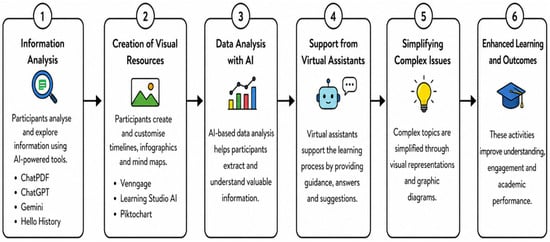
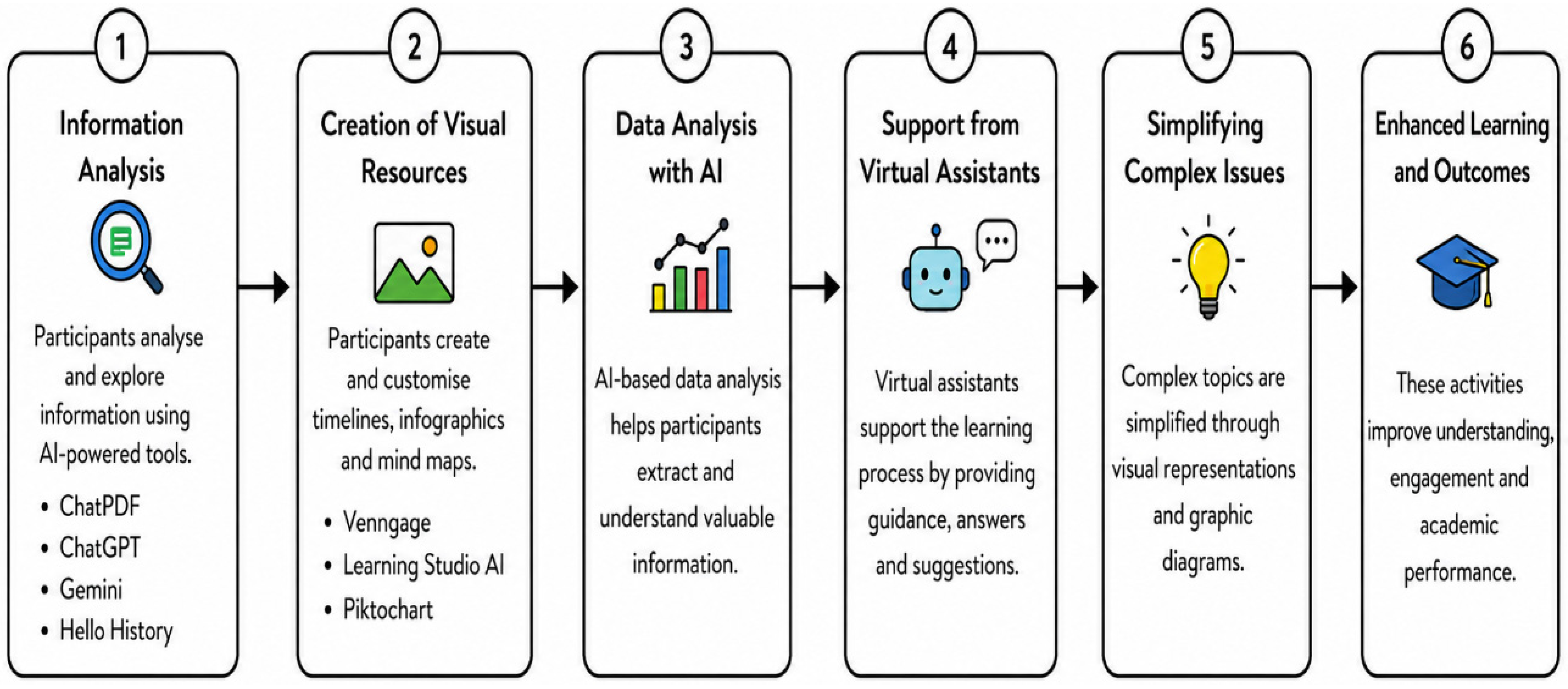
As part of the program, trainee teachers learned how to use various generative AI tools to support learning and research. This training was delivered through a step-by-step process, as illustrated in Figure 1, which was created using generative AI.
Figure 1.
AI-based workflow in the intervention program.
The program was developed in the core subject “Social Sciences and their Didactics” during the first term of the academic year 2025–2026. It lasted ten weeks, and pre-service teachers devoted four of the seven weekly hours to completing the assignments designed by the academic faculty of the Department of Social Sciences Education. To ensure fidelity, the academic integrity guidelines of the University of Murcia were strictly followed to minimise the harmful use of synthetic media. In addition, student attendance, session duration records, and student work products were tracked weekly to verify that the intended goals were accomplished. As shown in the graph, the students analysed complex texts—some of which were genuine or factual, whilst others were manipulated or falsified—using tools such as ChatPDF to create summaries; ChatGPT and Gemini to generate prompts that enabled them to detect falsehoods and verify information against the articles and documents they had worked on; and Hello History to construct historical narratives based on primary sources and the historical skills they had practiced. In addition, they created visual resources relating to the social issues described. Using Venngage and Piktochart, they personalised timelines of historical facts and events, and designed infographics and mind maps; with Learning Studio, meanwhile, they learnt instructional design, creating educational materials and generating content and activities on the work of combating disinformation and the need to develop critical literacy. Similarly, the virtual assistants helped to summarise more complex issues and adapt them to the students’ level of understanding, which improved their comprehension and engagement with the program.
Furthermore, these platforms made it easier for students to search for and organise information, enabling them to analyse research articles and review multidisciplinary studies from a critical digital perspective; to develop skills in documentary analysis, researching and handling primary historical sources; to acquire skills in the creation and development of teaching resources; and to learn to visually represent complex information related to the social concepts covered (network ecosystems, conceptual models, flowcharts, infographics, mind maps, activity and skills matrices, etc.).
At the same time, the course addressed the threat that false information poses to public trust and the dissemination of accurate information. Participating students undertook continuous exercises in which they had to analyse numerous pieces of online content, forcing them to decide whether they were false or true, and to justify their reasoning through a process of identifying and reflecting on potential temporal discrepancies (mismatches between voice and lip movement, irregularities in video timing), color discrepancies between images and videos (dulled colors, increased saturation or brightness, watermarks, etc.), or audio irregularities (unusual sound patterns, synchronization issues, etc.), always in comparison with other models. This verification approach was adapted from previous studies on deepfake detection techniques applied to social science videos (Farid, 2022; Wang et al., 2024). Thus, it was possible to identify troll accounts, detect fake profiles, and even analyse social media platforms that distribute manipulated content, whilst verifying the source of the content, analyzing metadata, and identifying fraudulent or manipulative patterns and intentions.
As a final activity, the trainee teachers were asked to design a social studies unit plan for primary school. This training proposal was to include activities for detecting deepfakes, strategies for combating disinformation, as well as the use of digital classroom materials, particularly AI tools, applying all the knowledge developed during the pedagogical intervention to this final product.
In short, the program fostered the creation of a collaborative culture in which, in working groups of four or five students, participants engaged in activities that activated complex metacognitive processes, enabling them to develop resources and training proposals that were incorporated into their project or unit plan using generative AI. During this process, they addressed the pressing issues described and the intercultural challenges facing society, whilst also learning to critically evaluate information and detect deepfakes.
4. Results
This section presents the main findings of the study based on the data collected and analysed. Concerning the classification of participants according to their self-reported level of trust in the government, a larger proportion of low-trust respondents can be clearly identified, as can be seen in Table 1.
Table 1.
This Description of the classification of participants according to their level of trust in the government.
As regards the level of trust in the government, most participants stated that they had little trust in it, and only a subgroup of less than 18% said they had a strong degree of trust. About the variance in the responses analysed, a greater difference can be seen in the responses given by the group with low trust in the government. Conversely, there is greater unanimity in the responses expressed by the group with high trust.
With respect to the views expressed on the level of concern surrounding deepfakes and the information and measures provided by the Spanish Government to tackle this problem, participants’ views are consistently below the neutral position, as can be seen in Table 2.
Table 2.
Descriptive statistics of the level of concern about deepfakes and government information.
Participants expressed serious concern that AI-generated content could manipulate public opinion during elections, with scores exceeding 4 in both the pre- and post-surveys. Furthermore, they also expressed little confidence in the measures taken by the Government to safeguard their interests and security. However, by the end of the four-month period, there was a slightly more positive perception of the information provided by the government and the measures taken.
Regarding the level of concern about deepfakes, the opinions of the participants show greater concern about deepfakes and the potential risks associated with them, as can be seen in Table 3.
Table 3.
Concern about deepfakes by level of government trust.
Specifically, participants with the highest level of trust in the government are more concerned about the possibility of AI being used in large-scale disinformation campaigns for manipulative purposes, with scores close to 5 in the post-tests. Furthermore, this subgroup also demonstrates high confidence in the measures taken by the government to address this issue. Conversely, the other two subgroups express lower levels of trust in Spanish government institutions, with scores close to 3 for participants with moderate trust and below 2 for those with low trust, in both the pre- and post-tests.
Significant differences were found among the three-subgroups with respect to the information and actions taken by the Spanish government (see Table 4).
Table 4.
Differences in perceptions of government measures by trust group.
As can be seen, respondents differ significantly in their opinions regarding the effectiveness of government institutions in disseminating reliable information and taking appropriate measures to combat digital forgeries and protect citizens’ interests. Those who place greater trust in the government showed significantly higher scores in these areas than the other two subgroups.
Once Dunn’s tests with Bonferroni corrections were implemented, significant differences were also identified among the subgroups regarding the information and actions implemented by the institutions (see Table 5).
Table 5.
Results of Dunn tests with Bonferroni corrections in relation to the information and measures taken by the government regarding deepfakes.
As shown in Table 5, participants with different levels of trust significantly diverge in their perspectives regarding the reliability of government information and their due diligence in tackling deepfakes and protecting citizens’ rights. However, no significant results were found between high-trust and mid-trust respondents, reflecting more comparable underlying attitudes between these two subgroups.
Wilcoxon signed-rank tests were applied to determine if there were statistically significant differences between the opinions expressed by the participants before and after the analysed period, as can be seen in Table 6.
Table 6.
Wilcoxon signed-rank test among participants with moderate trust in government regarding the level of concern about deepfakes.
Participants who expressed moderate trust in the government gave different ratings to items regarding the potential for general AI to be used in large-scale disinformation campaigns, reflecting a greater level of concern about this risk in post-tests. Furthermore, they felt that the government was not looking after their interests as much as they had indicated at the start of the term.
Regarding RQ3, the results indicate differences in deepfake identification accuracy according to participants’ level of trust in government, particularly in the pre-test. Participants in the high-trust group obtained the highest overall identification accuracy before the intervention (49.1%), compared with 30.2% in the low-trust group and 28.2% in the moderate-trust group. Following the intervention, identification accuracy increased substantially in all three groups, reaching 95.4% in the low-trust group, 95.3% in the moderate-trust group, and 99.4% in the high-trust group (Table 7). Therefore, the differences observed between trust groups in the pre-test were considerably smaller in the post-test. These results indicate an association between the initial level of trust in government and deepfake identification accuracy, although the single-group pre-experimental design does not allow this association or the increase in accuracy to be interpreted as a causal effect of the intervention.
Table 7.
Deepfake identification accuracy by level of government trust.
Participants who expressed greater trust in the Spanish government demonstrated a greater ability to identify deepfakes than the other two subgroups in the pre-tests, with an average accuracy rate of around 50%. The results of the subsequent tests show greater consistency across the three subgroups under study, with accuracy rates exceeding 90% in most cases. However, these findings must be interpreted cautiously as associational trends due to applied research design.
5. Discussion and Conclusions
Once the main findings of this study are presented, this section is devoted to examining more thoroughly the implications of the results. Regarding the second objective, which is related to analyzing participants’ perspectives on their concerns about deepfakes and the government’s measures and actions to address this issue-, participants’ ratings are quite low, demonstrating weak expectations about the measures taken so far. Examining these findings from a wider perspective indicates that political trust may shape how institutional countermeasures against deepfakes are perceived. One reason that may explain this conclusion is that deeply polarised sociopolitical scenarios can foster rigid interpretive perspectives that are less permeable to short-term educational interventions. This is reinforced by previous literature highlighting that cognitive resilience to misinformation is related to pre-existing institutional conceptions rather than technical literacy alone (Boxell et al., 2024). Theoretically, this conclusion may help educational administration prioritise civic and critical citizenship more effectively, thereby helping to move the educational paradigm of media literacy away from restrictive, purely technical approaches. Educationally, it implies that educators should not develop media literacy independently. Rather, curriculum guidelines should explicitly address deepfakes and how institutional campaigns should be implemented to minimise political distrust, which would benefit teaching and learning practices. This implies the articulation of targeted pedagogical approaches that meet these needs effectively rather than applying one-size-fits-all models.
These findings are also related to prior research that highlights the potential impact of deepfakes on shaping public opinion, security risks, and election manipulation (Kopecky, 2024), and they extend this literature by examining trust in the governmental response to deepfakes rather than trust in the content or political actors represented in the manipulated material. Vaccari and Chadwick (2020), for example, found that synthetic political videos increased uncertainty and reduced confidence in news content. Similarly, Momeni (2025) reported that this inauthentic digital content can reduce public trust among American citizens, especially in certain political figures who appear in it, because it can distort the truth, interfere with the interests of politicians, and derail national election debates. Likewise, Ahmed et al. (2025) found that exposure to deepfakes caused a higher distrust among American participants but not Singaporeans.
This finding aligns with those of Neyazi et al. (2024) that concluded that Singaporeans’ high public trust was due mainly to great investment in AI and efforts to minimise web-based risks, in this sense, it can be concluded that contextual factors influence highly public trust. Our findings also highlighted the need for a deeper analysis of how regional dynamics can influence the perception and impact of deepfakes. This includes examining varying levels of public concern, trust in government, regulatory frameworks, and societal responses to AI technologies, which can differ significantly from country to country. However, our findings also differ from those reported by Neyazi et al. (2024), who identified relatively high levels of public trust in government in some Asian contexts. This difference may reflect contextual variation in institutional trust and perceptions of governmental responses to AI-related risks. However, given the single-country and non-probabilistic nature of our sample, this interpretation should be considered exploratory rather than conclusive.
Additionally, the respondents who initially showed greater trust in the government differed significantly in their assessments of the strength of government institutions to control these synthetic media, compared to the other two subgroups with lower levels of trust. Specifically, those with greater trust in the government expressed greater concern about the potential threats posed by deepfakes. In the Spanish context, this could be due to the manipulation campaigns launched in recent years to discredit political institutions, generate instability, and provoke political division (Garzón, 2015; Berdón Prieto & Reguero Sanz, 2025). This progressive discrediting is causing political polarization, which is reflected in the study’s results, where pro-government participants expressed greater concern about these manipulated files. Furthermore, the existence of significant differences only within the moderate trust subgroup before and after the program also reflects the strength of the beliefs of respondents with the highest and lowest levels of trust in the government. In other words, only the moderate subgroup was able to significantly modify their perspectives after the program ended, unlike the other, less moderate subgroups, who maintained their opinions throughout the period under study.
With respect to RQ3, exploratory findings indicated that these awareness-raising initiatives could be beneficial in helping pre-service teachers navigate deepfakes. Nevertheless, any causal links regarding vulnerability reduction should be interpreted with caution. Furthermore, although the deepfakes presented were generally not perceived as credible, particularly in the post-tests, this finding alone does not mean that such media cannot still alter public perceptions of politicians and their decisions, as indicated in previous research (Hameleers et al., 2024). It can be concluded that, despite there is a growing interest in examining the impact of these synthetic media on citizens from a political perspective, further research is needed to analyse the particular potential effects of disseminating them for manipulative, deceptive purposes throughout the web (Vaccari & Chadwick, 2020; Dobber et al., 2021; Hameleers et al., 2024). Specifically, in the teaching and learning of social sciences, one of the greatest challenges is to choose the right approach to accurately address these civic and cultural controversial issues without resorting to biased synthetic media that may influence students’ viewpoints on politics and other related disciplines (Campillo-Ferrer et al., 2025). Therefore, educational communities must remain vigilant regarding these digital risks carefully analyse the sources of the digital media they make use of in their teaching and learning practices. Likewise, it is essential to take into consideration the potential factors that influence the development of political and social tendencies not only at a national level, but also worldwide, allowing for a deeper understanding and a more critical analysis (Miralles et al., 2023). As Bhatnagar (2018) states, it is essential to cultivate active and engaged citizens who are socially aware of the threats that could endanger their democratic rights and compromise their integrity as critical citizens.
When analyzing the results of this research, it is important to consider some limitations. First, the sample was collected using convenience sampling, which could limit the generalizability of the findings due to selection bias. Furthermore, the AI-generated deepfakes were presented to participants randomly, which could influence their ratings. Furthermore, the absence of a control group may have influenced the perceived impact of this program on the participants. Consequently, while the descriptive findings highlight learning gains in deepfake literacy, future studies should integrate control groups to robustly validate program efficacy. Additionally, this research focused on higher education students in a specific degree program, which limits the study’s scope and applicability to broader communities. Likewise, the findings may have been oversimplified due to the quantitative methods employed and the rating-scale questionnaire used. Finally, one more limitation of the study is related to the amount of time devoted to training on deepfake discrimination, which may limit the external validity of the results. Consequently, it is paramount to address these limitations in future studies to progressively analyse participants’ detection skills in online environments. However, this research makes a valuable contribution to the development of the capabilities and skills of higher education students regarding the detection of deepfakes, which may pave the way for more sophisticated training proposals.
Author Contributions
Conceptualization, P.M.S. and J.M.C.-F.; methodology, J.M.C.-F. and A.L.-G.; software, P.M.S.; validation, P.M.S., J.M.C.-F. and A.L.-G.; formal analysis, P.M.S., J.M.C.-F. and A.L.-G.; investigation, P.M.S., J.M.C.-F. and A.L.-G.; resources, A.L.-G.; data curation, P.M.S.; writing—original draft preparation, P.M.S., J.M.C.-F. and A.L.-G.; writing—review and editing, P.M.S., J.M.C.-F. and A.L.-G.; visualization, J.M.C.-F.; supervision, P.M.S.; project administration, P.M.S., J.M.C.-F. and A.L.-G.; funding acquisition, J.M.C.-F. and A.L.-G. All authors have read and agreed to the published version of the manuscript.
Funding
This research was funded by MICIU/AEI/10.13039/501100011033/FEDER, EU, grant number PID2024-155318NB-C31.
Institutional Review Board Statement
The study was conducted in accordance with the Declaration of Helsinki and approved by the Ethics Committee of Ethics Research Committee of the University of Murcia (protocol code M10/2025/020 and ACTA34/2026/CEI and approved on 6 July 2026).
Informed Consent Statement
Informed consent was obtained from all subjects involved in the study.
Data Availability Statement
The original contributions presented in this study are included in the article. Further inquiries can be directed to the corresponding author.
Conflicts of Interest
The authors declare no conflicts of interest.
References
- Ahmed, S., Masood, M., Bee, A. W. T., & Ichikawa, K. (2025). False failures, real distrust: The impact of an infrastructure failure deepfake on government trust. Frontiers in Psychology, 16, 1574840. [Google Scholar] [CrossRef] [Scilit] [PubMed]
- Berdón Prieto, P., & Reguero Sanz, I. (2025). Desinformación en tiempos de polarización política: El debate en X sobre los cinco días de reflexión de Pedro Sánchez (2024). Anuario Electrónico de Estudios en Comunicación Social” Disertaciones”, 18(2), 1–21. [Google Scholar] [CrossRef] [Scilit]
- Bhatnagar, R. (2018). Challenges in teaching and learning of social science—The dual perspective. PEOPLE: International Journal of Social Sciences, 4(3), 519–532. [Google Scholar] [CrossRef] [Scilit]
- Bisquerra, R. (2000). Métodos de investigación educativa: Guía práctica. Ediciones Ceac. [Google Scholar]
- Boxell, L., Gentzkow, M., & Shapiro, J. M. (2024). Cross-country trends in affective polarization. Review of Economics and Statistics, 106(2), 557–565. [Google Scholar] [CrossRef] [Scilit]
- Campillo-Ferrer, J. M., López-García, A., & Miralles-Sánchez, P. (2025). Student perceptions of the use of Gen-AI in a higher education program in Spain. Digital, 5(3), 29. [Google Scholar] [CrossRef] [Scilit]
- Campillo-Ferrer, J. M., & Miralles-Sánchez, P. (2026). Perceptions of pre-service teachers in early childhood and primary education on GenAI-Generated deepfakes. Education Sciences, 16(4), 575. [Google Scholar] [CrossRef] [Scilit]
- da Cruz Júnior, G. G., do Nascimento, R. L. S., & do Nascimento Fidalgo, R. (2025). Deepfake em escolas brasileiras: Uma perspectiva de profissionais da educação básica. RENOTE, 23(1), 125–135. [Google Scholar]
- Dame Adjin-Tettey, T. (2022). Combating fake news, disinformation, and misinformation: Experimental evidence for media literacy education. Cogent Arts & Humanities, 9(1), 2037229. [Google Scholar] [CrossRef] [Scilit]
- Delchev, K., Safieddine, F., & Hammad, R. (2024). Identification of AI generated deep fake video by higher education students. In K. Arai (Ed.), Intelligence computing. Science and information conference (pp. 473–489). Springer Nature. [Google Scholar] [CrossRef] [Scilit]
- Dobber, T., Metoui, N., Trilling, D., Helberger, N., & De Vreese, C. (2021). Do (microtargeted) deepfakes have real effects on political attitudes? The International Journal of Press/Politics, 26(1), 69–91. [Google Scholar] [CrossRef] [Scilit]
- El Mokadem, S. S. (2023). The effect of media literacy on misinformation and deep fake video detection. Arab Media & Society, 35, 115–138. [Google Scholar] [CrossRef] [Scilit]
- European Parliament & Council of the European Union. (2024). Regulation (EU) 2024/1689 of 13 June 2024 laying down harmonized rules on artificial intelligence (Artificial intelligence act). Official Journal of the European Union. Available online: https://eur-lex.europa.eu/eli/reg/2024/1689/oj/eng (accessed on 7 January 2026).
- Farid, H. (2022). Creating, using, misusing, and detecting deep fakes. Journal of Online Trust and Safety, 1(4). [Google Scholar] [CrossRef] [Scilit]
- Garzón, B. (2015). El fango: Cuarenta años de corrupción en España. Debate. [Google Scholar]
- Geissler, D., Robertson, C., & Feuerriegel, S. (2026). Designing Effective digital literacy interventions for boosting deepfake discernment. In Proceedings of the 2026 CHI conference on human factors in computing systems (pp. 1–45). Association for Computing Machinery. [Google Scholar] [CrossRef] [Scilit]
- George, D., & Mallery, P. (2003). SPSS for Windows step by step: A simple guide and reference. 11.0 update (4th ed.). Allyn & Bacon. Available online: https://archive.org/details/spssforwindowsst00geor (accessed on 7 January 2026).
- Gobierno de España. (2024). Estrategia de inteligencia artificial 2024. Gobierno de España. [Google Scholar]
- Halvarsson, M. (2024). Deepfakes, real votes political parties’ use of deepfakes through the lens of AI ethics and democracy theory. Umea University. Available online: http://www.diva-portal.org/smash/record.jsf?pid=diva2%3A1879392 (accessed on 7 January 2026).
- Hameleers, M., Van Der Meer, T. G., & Dobber, T. (2024). Distorting the truth versus blatant lies: The effects of different degrees of deception in domestic and foreign political deepfakes. Computers in Human Behavior, 152, 108096. [Google Scholar] [CrossRef] [Scilit]
- Hernández-Pina, F., & Maquilón, J. J. (2010). Introducción a los diseños de investigación educativa. In M. Santiago Nieto (Ed.), Principios, métodos y técnicas esenciales para la investigación educativa (pp. 79–91). Dykinson. [Google Scholar]
- Islam, M. B. E., Haseeb, M., Batool, H., Ahtasham, N., & Muhammad, Z. (2024). AI threats to politics, elections, and democracy: A blockchain-based deepfake authenticity verification framework. Blockchains, 2(4), 458–481. [Google Scholar] [CrossRef] [Scilit]
- Kopecky, S. (2024). Challenges of deepfakes. In Science and information conference (pp. 158–166). Springer Nature. [Google Scholar] [CrossRef] [Scilit] [PubMed]
- Kruschinski, S., & Votta, F. (2026). Efficiency tool or manipulation machine? Assessing dominant claims about the quantity, quality, and persuasive power of visual generative AI in political campaigns. Zeitschrift für Politikwissenschaft, 36, 79–89. [Google Scholar] [CrossRef] [Scilit]
- Lestari, M., & Ibrahim, R. (2025). Legal aspects of using Deepfake in political campaigns: A threat to democracy. International Journal of Humanities Law and Politics, 3(1), 30–35. [Google Scholar] [CrossRef] [Scilit]
- López-Facal, R., & Santidrián-Arias, V. M. (2011). Los “conflictos sociales candentes” en el aula. Iber: Didáctica de las Ciencias Sociales, Geografía e Historia, 69, 8–20. [Google Scholar]
- Łabuz, M. (2025). A teleological interpretation of the definition of DeepFakes in the EU artificial intelligence act—A purpose-based approach to potential problems with the word “existing”. Policy & Internet, 17(1), e435. [Google Scholar] [CrossRef] [Scilit]
- Łabuz, M., & Nehring, C. (2024). On the way to deep fake democracy? Deep fakes in election campaigns in 2023. European Political Science, 23(4), 454–473. [Google Scholar] [CrossRef] [Scilit]
- McMillan, J. H., & Schumacher, S. (2005). Investigación educativa (J. Sánchez, Trans.; 5th ed.). Pearson Educación. Available online: https://des-for.infd.edu.ar/sitio/upload/McMillan_J._H.__Schumacher_S._2005._Investigacion_educativa_5_ed..pdf (accessed on 7 January 2026).
- Miao, F., & Holmes, W. (2023). Guidance for generative AI in education and research. UNESCO. Available online: https://unes.co/vvle9m (accessed on 7 January 2026).
- Miralles, P., Campillo, J. M., & Prats, J. (2023). La enseñanza y el aprendizaje de las ciencias sociales en tiempos de incertidumbre. Areas, (45), 5–9. [Google Scholar] [CrossRef] [Scilit]
- Momeni, M. (2025). Artificial intelligence and political deepfakes: Shaping citizen perceptions through misinformation. Journal of Creative Communications, 20(1), 41–56. [Google Scholar] [CrossRef] [Scilit]
- Murillo-Ligorred, V., Ramos-Vallecillo, N., Covaleda, I., & Fayos, L. (2023). Knowledge, integration and scope of deepfakes in arts education: The development of critical thinking in postgraduate students in primary education and master’s degree in secondary education. Education Sciences, 13(11), 1073. [Google Scholar] [CrossRef] [Scilit]
- Naffi, N., Charest, M., Danis, S., Pique, L., Davidson, A. L., Brault, N., Bernard, M. C., & Barma, S. (2025). Empowering youth to combat malicious deepfakes and disinformation: An experiential and reflective learning experience informed by personal construct theory. Journal of Constructivist Psychology, 38(1), 119–140. [Google Scholar] [CrossRef] [Scilit]
- Neyazi, T. A., Nadaf, A. H., Tan, K. E., & Schroeder, R. (2024). Does trust in government moderate the perception towards deepfakes? Comparative perspectives from Asia on the risks of AI and misinformation for democracy. Government Information Quarterly, 41(4), 101980. [Google Scholar] [CrossRef] [Scilit]
- Oliullah, M., & Murtuza, H. M. (2026). Exploring how political deepfakes trigger cognitive processes and downstream psychological and behavioral outcomes: A systematic review. Computers in Human Behavior Reports, 101066. [Google Scholar] [CrossRef] [Scilit]
- Tiwari, R., Anjum, B., Chand, K., & Bajaj, S. (2025). Dynamics of deep fake in higher education. In Navigating the deepfake conundrum: A manager’s roadmap (pp. 183–193). Springer Nature. [Google Scholar] [CrossRef] [Scilit]
- Vaccari, C., & Chadwick, A. (2020). Deepfakes and disinformation: Exploring the impact of synthetic political video on deception, uncertainty, and trust in news. Social Media+ Society, 6(1), 2056305120903408. [Google Scholar] [CrossRef] [Scilit]
- Wang, T., Liao, X., Chow, K. P., Lin, X., & Wang, Y. (2024). Deepfake detection: A comprehensive survey from the reliability perspective. ACM Computing Surveys, 57(3), 1–35. [Google Scholar] [CrossRef] [Scilit]

Disclaimer/Publisher’s Note: The statements, opinions and data contained in all publications are solely those of the individual author(s) and contributor(s) and not of MDPI and/or the editor(s). MDPI and/or the editor(s) disclaim responsibility for any injury to people or property resulting from any ideas, methods, instructions or products referred to in the content. |
© 2026 by the authors. Licensee MDPI, Basel, Switzerland. This article is an open access article distributed under the terms and conditions of the Creative Commons Attribution (CC BY) license.