


Abstract
Preparing engineers for rapidly changing sociotechnical environments requires a clear account of the competencies that undergraduate engineering programs should foster. This study used the term future outstanding engineers to refer to engineering undergraduates being prepared for engineering excellence and examined the structure and correlates of their self-reported core competence. Cross-sectional survey data were obtained from 578 engineering undergraduates at a Chinese research university. A reflective–formative higher-order model was estimated using partial least squares structural equation modeling (PLS-SEM); partial least squares multigroup analysis (PLS-MGA) compared grade cohorts; and multiple linear regression examined associations with student background and educational experience. Adaptive, professional, and basic competence formed the higher-order construct, with adaptive competence receiving the largest outer weight. The outer weight of adaptive competence was larger, and that of professional competence smaller, among third-year than first-year students; the outer weight of basic competence did not differ significantly. Selected co-curricular and language-learning experiences were associated with adaptive competence, whereas family background and leadership experience were associated with professional competence. Basic competence was associated with a broader set of student background and engagement variables. These findings support a differentiated, stage-sensitive approach to competence development. Because the data are cross-sectional, self-reported, and drawn from one institution, the results should be interpreted as structural and associational rather than developmental or causal.
1. Introduction
Rapid advances in artificial intelligence, data-intensive technologies, and digitally connected production are reshaping engineering work. Employers increasingly seek graduates who can integrate technical knowledge with problem solving, collaboration, ethical judgement, lifelong learning, and the capacity to work across disciplinary and sociotechnical boundaries (Beagon & Bowe, 2023; Fleming et al., 2024). Yet competence frameworks and educational practice do not always evolve at the same pace as industrial and societal needs. Clarifying the competencies that undergraduate engineering programs should cultivate is therefore a central concern for engineering education internationally.
The term “outstanding engineers” is used in English-language materials from the Chinese Society of Engineers and China’s Ministry of Education concerning engineering workforce development. In this study, “future outstanding engineers” refers to engineering undergraduates in the Chinese engineering-education context. The term expresses a future-oriented educational goal and emphasizes undergraduate preparation for advanced engineering practice. Alongside technical problem solving and engineering fundamentals, these students need adaptive capacities that enable them to learn continuously, work across disciplines, and respond to technological and organizational change (Supriya et al., 2024).
Competence development does not occur solely through classroom instruction. Astin’s (1993) input–environment–outcome perspective suggests that students’ entry characteristics, educational environments, and involvement experiences jointly shape development during college. Prior achievement, learning capacities, social relationships, and participation in educational programs are associated with multidimensional student outcomes (van den Beemt et al., 2020; van der Zanden et al., 2018). In engineering education, curricular, interdisciplinary, and co-curricular experiences can likewise contribute to professional skill development (W. C. Lee et al., 2023; Liu et al., 2025; Qi et al., 2025). These relationships may differ across competence dimensions and grade cohorts, but evidence linking a higher-order competence structure to students’ backgrounds and educational experiences remains limited.
China has one of the world’s largest engineering education systems and has pursued reforms through Emerging Engineering Education and programs for cultivating outstanding engineers. This context provides a useful setting in which to examine how internationally recognized graduate attributes are organized and how they relate to students’ educational experiences. The present study makes two contributions. First, it tests a reflective–formative higher-order model in which adaptive, professional, and basic competence form a broader core-competence construct. Second, it examines whether the relative weights of these dimensions differ across grade cohorts and how each dimension is associated with individual characteristics, family background, and human-capital indicators. The study addresses the following research questions:
RQ1: What is the multidimensional structure of core competence among engineering undergraduates being prepared for engineering excellence, and do the relative weights of its dimensions differ across grade cohorts?
RQ2: How are individual characteristics, family background, and human-capital indicators associated with adaptive, professional, and basic competence?
2. Literature Review
2.1. Standards Related to the Development of Core Competence Among Future Outstanding Engineers
The 2021 Graduate Attributes and Professional Competencies framework of the International Engineering Alliance (IEA) provides an influential international benchmark for the outcomes of accredited engineering programs. Under the Washington Accord profile, 11 graduate attributes address engineering knowledge, problem analysis, design/development of solutions, investigation, tool usage, the engineer and the world, ethics, individual and collaborative teamwork, communication, project management and finance, and lifelong learning. Other frameworks organize related outcomes differently. The CDIO Syllabus 3.0 combines disciplinary knowledge with personal and professional skills, interpersonal skills, and capabilities for conceiving, designing, implementing, and operating engineering systems, while its extension areas include leadership, entrepreneurship, and research. The 2021 EUR-ACE Framework Standards specify eight areas of program outcomes, including knowledge and understanding, engineering analysis, design, investigation, practice, judgment, communication and teamwork, and lifelong learning. The U.S. Engineering Competency Model distinguishes personal effectiveness, academic, workplace, and industry-wide technical competencies, with optional tiers for discipline-, management-, and occupation-specific competencies. ABET’s current accreditation criteria likewise combine technical outcomes with communication, teamwork, ethical responsibility, and the acquisition of new knowledge. Together, these frameworks show that engineering competence extends beyond disciplinary knowledge to include professional, interpersonal, contextual, and adaptive capacities.
China’s engineering education standards have increasingly converged with international outcome-based frameworks. The Engineering Education Accreditation Criteria, issued by the China Engineering Education Accreditation Association, specify 12 graduate outcomes: engineering knowledge; problem analysis; design/development of solutions; research; use of modern tools; engineering and society; environment and sustainable development; professional ethics and norms; individuals and teams; communication; project management; and lifelong learning. Although international and national frameworks differ in terminology and level of specificity, they share an emphasis on technical capability, transferable professional skills, and the capacity to adapt responsibly to changing contexts. Following the competence classification proposed by Liu and Zhang (2023), this study adopts a three-dimensional framework comprising adaptive, professional, and basic competence.
2.2. Multidimensional Structure of Core Competence Among Future Outstanding Engineers
As engineering tasks become increasingly interdisciplinary and integrated, engineering practice requires the combined application of knowledge, problem solving, design, communication, teamwork, professional responsibility, and continuous learning; technical capability alone cannot fully account for engineering competence (Passow & Passow, 2017; Winberg et al., 2020). Different skills are also embedded within one another in authentic work tasks (Beagon & Bowe, 2023; Fleming et al., 2024; Markes, 2006), and engineering competence depends not only on disciplinary knowledge but also on generic competencies such as communication and collaboration, self-management, and professional conduct (Male et al., 2011a). On this basis, the present study conceptualizes core competence as comprising adaptive, professional, and basic competence.
Engineering problems are embedded in specific sociotechnical contexts. Adaptability refers to an individual’s capacity to apply existing knowledge flexibly, continue learning, and adjust problem-solving strategies when facing novel tasks (Bohle Carbonell et al., 2014). Learning environments organized around complex, authentic problems further emphasize the integration of theory and practice and collaboration among students, other disciplines, and external stakeholders (Hadgraft & Kolmos, 2020; Tembrevilla et al., 2023). Engineering students must also understand how social, cultural, environmental, political, and economic factors constrain and shape engineering solutions (Ro et al., 2015). Interdisciplinary experiences inside and outside the curriculum allow students to encounter diverse knowledge and perspectives (Lattuca et al., 2017) and to integrate disciplinary viewpoints when addressing shared problems (van den Beemt et al., 2020). Accordingly, adaptive competence refers to the capacity for continued growth and adjustment in complex engineering environments. It encompasses lifelong learning, project management, and an understanding of the relationship between engineering and the wider world.
Professional competencies such as problem solving, design, and the use of engineering tools are closely connected to workplace practice (Passow, 2012). Engineering design is open-ended and iterative, requiring designers to move repeatedly among problem definition, information gathering, solution generation, analysis and evaluation, and optimization (Atman et al., 1999, 2007; Dym et al., 2005). Accordingly, professional competence refers to the ability to identify, analyze, and solve complex engineering problems. It encompasses engineering knowledge, problem analysis, the design and development of solutions, investigation, and the use of engineering tools.
Teamwork, effective communication, and professional responsibility are essential to the collaborative implementation of engineering tasks (Forcael et al., 2022; Male et al., 2011b; Passow & Passow, 2017). Research on problem-based and collaborative learning indicates that team tasks provide contexts in which students can practice communication, negotiation, joint decision-making, and shared responsibility, although competence development depends on task design and the quality of interaction (Boelt et al., 2022; Marra et al., 2016; Stump et al., 2011). Accordingly, basic competence encompasses individual and teamwork capabilities, communication, and professional ethics and norms. These capabilities provide a foundation for students’ professional development and collaboration.
2.3. Factors Associated with the Dimensions of Core Competence Among Future Outstanding Engineers
The core competence of future outstanding engineers is associated with students’ pre-college backgrounds, family resources, and learning and engagement experiences during university (W. C. Lee & Matusovich, 2016; W. C. Lee et al., 2023; Wang et al., 2022).
Individual characteristics may be related to how engineering students understand and assess their competencies and to the experiences in which they participate. Women engineering students have been found to place greater emphasis on the environmental impacts and social responsibilities of engineering, whereas men have placed greater emphasis on mathematical, scientific, and technical skills (Chen et al., 2023). Among STEM students, women have also reported higher self-regulated learning and academic self-efficacy, while men have expressed greater confidence in digital literacy (Bennett et al., 2022). Such differences vary by learning outcome, team context, and measurement approach (Hirshfield, 2018; Ro & Knight, 2016; Stump et al., 2011). LaPatin et al. (2023) identified family size as a demographic correlate of engineering students’ perceptions of macroethical responsibility. Birth order has likewise been associated with choice of university major: in one national study, firstborn students were more likely than later-born siblings to enter and graduate from engineering programs (Barclay et al., 2017).
Family background may be associated with competence development through educational expectations, cultural resources, access to information, and pre-college learning opportunities. Parents’ educational experience is related to the resources available to students as they enter and adapt to university, and first-generation and continuing-generation students differ in their entry characteristics, college experiences, and cognitive development (Terenzini et al., 1996). Family knowledge, practical experience, advice, material resources, and emotional support can also contribute to students’ engineering interests, competence beliefs, and engineering role identities (Verdín et al., 2021, 2024). Engineering master’s students whose parents have higher levels of education are also more likely to pursue doctoral study, suggesting that parental education may shape academic confidence and intentions for further study (Wei et al., 2025).
Human capital encompasses both the learning foundation established before university and the knowledge and skills accumulated through learning, projects, and organizational participation during university. Practical STEM experiences in high school may provide an early foundation for engineering competence. Domain-specific self-efficacy developed early in students’ education is associated with achievement, persistence, and career development in engineering (Hwang, 2025). After students enter university, the tasks they encounter vary across stages of training. Senior students typically gather more information, consider more alternatives, and demonstrate more complex design processes (Atman et al., 1999, 2007). Curricular and co-curricular experiences provide contexts in which students can develop leadership, communication, engineering identity, and a sense of belonging (Ju & Zhu, 2023; Knight & Novoselich, 2017; M. Lee et al., 2025). Sustained participation in engineering competition teams can expose students to technical and organizational responsibilities and support leadership-identity development through team interaction and task coordination (Wolfinbarger et al., 2021). Well-designed educational environments may also support competence attainment and employment-related outcomes (López-Pérez et al., 2023; Winberg et al., 2020). Communication is another key employability skill for engineering students (Wu et al., 2023), and intercultural learning can foster communication across cultures and a better understanding of context (Jaiswal et al., 2024).
In summary, individual characteristics capture relatively stable differences among students; family background represents intergenerational educational resources and pre-college opportunities; and human-capital and engagement indicators represent prior learning foundations, stages of training, and participation in projects, organizations, and learning activities during university. The present study examines how variables in these three domains are associated with adaptive, professional, and basic competence.
3. Materials and Methods
3.1. Participants
The participants were engineering undergraduates at T University, referred to in this study as “future outstanding engineers” in accordance with the educational framing outlined in the Introduction. A two-week voluntary online questionnaire survey was administered in November 2023 at T University, a Chinese research university recognized as a demonstration institution for Emerging Engineering Education. The data were drawn from the baseline wave of a longitudinal survey of student education and development. A total of 631 questionnaires were returned. After invalid and duplicate submissions had been removed, 578 responses were retained for analysis. All participants provided informed consent before completing the survey.
The final sample comprised 163 first-year (28.20%), 207 second-year (35.81%), 164 third-year (28.37%), and 44 fourth-year students (7.61%). Of the participants, 448 (77.51%) were men and 526 (91.00%) identified as Han Chinese. A total of 243 students (42.04%) were only children. For maternal education, 225 participants (38.93%) reported junior-secondary education or below, 243 (42.04%) upper-secondary or junior-college education, and 110 (19.03%) a bachelor’s degree or above. The corresponding counts for paternal education were 214 (37.02%), 240 (41.52%), and 124 (21.45%). Regarding current family location, 130 students (22.49%) reported a township or rural area, 127 (21.97%) a county seat or county-level city, 111 (19.20%) a prefecture-level city, and 210 (36.33%) a centrally administered municipality or provincial capital.
3.2. Measures
The core-competence items were included in the baseline questionnaire of the T University longitudinal survey of student education and development. The measurement content was developed with reference to the Graduate Attributes and Professional Competencies framework (International Engineering Alliance, 2021) and the Engineering Education Accreditation Criteria T/CEEAA 001–2022 (China Engineering Education Accreditation Association, 2022). The three-dimensional classification followed Liu and Zhang (2023), who organized the relevant graduate attributes into adaptive, professional, and basic competence. Before formal administration, the candidate items were reviewed by eight experts in engineering education and student development and further refined through pilot testing. Based on the expert review and pilot feedback, redundant items were removed and some wording was revised, while the predefined three-dimensional structure was retained. The final measure comprised 15 items: six for adaptive competence (AC), five for professional competence (PC), and four for basic competence (BC). Responses were recorded on a seven-point Likert scale from 1 (strongly disagree) to 7 (strongly agree).
Adaptive competence was measured with six items covering lifelong learning, awareness of the societal and environmental consequences of engineering, multidisciplinary team roles, engineering management and economic decision-making, and autonomy in student leadership activities. Example items included ‘I am aware of the need for self-directed and lifelong learning and possess the ability to continue learning and adapt to development’ and ‘I can understand and evaluate the impacts of engineering practice addressing complex engineering problems on the environment and sustainable social development.’ The mean score was 5.045.
Professional competence was measured with five items concerning problem analysis, investigation before decision-making, academic teamwork, generation of alternative solutions, and learning new skills. Example items included ‘I always conduct relevant investigations before making decisions’ and ‘I perform better in analyzing and solving problems.’ The mean score was 5.397.
Basic competence was measured with four items concerning career-goal attainment through student leadership, collaboration with classmates, the rapid acquisition and application of knowledge, and performance in examinations or competitions. Example items included ‘My career goals are progressively realized through student leadership activities’ and ‘I collaborate effectively with my classmates.’ The mean score was 5.053.
Convergent validity of the higher-order formative construct was assessed through redundancy analysis. The global criterion for development of core competence (DC) consisted of the single item ‘My knowledge base continues to expand, and my professional horizons continue to broaden.’ Its mean score was 5.292.
Individual characteristics included gender, ethnicity, and only-child status. Family-background variables included maternal education, paternal education, and current family location. Human-capital and engagement indicators included type of high school attended, grade cohort, political status, student leadership experience, English-test experience, and participation in the Shi Changxu Honors Degree Program, a selective honors program for engineering students. Because first-year students had not yet completed the College English Test Band 4 or Band 6 and had not formally participated in student-leader selection and service, the first-year questionnaire did not include student leadership experience or English-test experience.
3.3. Data Analysis
Analyses proceeded in four stages. First, a reflective–formative higher-order model was estimated in SmartPLS 4 using the repeated-indicators approach. Second, the first-order measurement models were assessed using outer loadings, Cronbach’s alpha, rho_A, composite reliability, average variance extracted, the Fornell–Larcker criterion, and the heterotrait–monotrait ratio. The higher-order formative model was assessed through redundancy analysis and the significance and relevance of outer weights. Collinearity was examined at the observed-item level using variance inflation factors, and statistical uncertainty was estimated using 5000 bootstrap subsamples. Third, PLS-MGA was used to compare the outer weights across first-, second-, and third-year cohorts. Fourth, multiple linear regression examined associations between the covariates and each competence dimension among second-, third-, and fourth-year students, because two covariates were not administered to first-year students. Regression coefficients are unstandardized, with standard errors reported in parentheses. Statistical significance was reported at the 1%, 5%, and 10% levels.
4. Results
4.1. Multidimensional Structure of Core Competence Among Future Outstanding Engineers
4.1.1. Assessment of the Measurement Model
A reflective–formative higher-order model was specified in PLS-SEM. Adaptive, professional, and basic competence were treated as distinct but complementary components of core competence. Table 1 presents the assessment of internal consistency and convergent validity. Outer loadings ranged from 0.750 to 0.861 for adaptive competence, from 0.768 to 0.853 for professional competence, and from 0.849 to 0.894 for basic competence. Cronbach’s alpha, rho_A, and composite reliability exceeded 0.70 for all three constructs, and each average variance extracted (AVE) exceeded 0.50. These results indicate satisfactory internal consistency and convergent validity at the first-order level (Hair et al., 2019).
Table 1.
Assessment of outer loadings, Cronbach’s Alpha, rho_A, CR, and AVE.
Discriminant validity was assessed using both the Fornell–Larcker criterion and the heterotrait–monotrait ratio (HTMT). According to Fornell and Larcker (1981), discriminant validity is established when the square root of each latent variable’s AVE exceeds its correlations with the other latent variables. HTMT was also used as a supplementary test. Henseler et al. (2015) recommended that HTMT values remain below 0.90 and that their confidence intervals not include 1; values above 0.90 indicate insufficient discriminant validity between constructs.
As shown in Table 2, the square roots of the AVE values were 0.824 for professional competence (PC), 0.872 for basic competence (BC), and 0.812 for adaptive competence (AC). These values exceeded the corresponding interconstruct correlations (0.758 between PC and BC, 0.732 between PC and AC, and 0.769 between BC and AC), supporting satisfactory discriminant validity under the Fornell–Larcker criterion.
Table 2.
Fornell–Larcker Criterion.
As shown in Table 3, the HTMT values were 0.842 between basic competence (BC) and professional competence (PC), 0.808 between adaptive competence (AC) and professional competence (PC), and 0.841 between adaptive competence (AC) and basic competence (BC). The corresponding 90% confidence intervals were [0.803, 0.877], [0.762, 0.852], and [0.804, 0.875], respectively. All HTMT values were below 0.90, and none of the confidence intervals included 1, further supporting satisfactory discriminant validity.
Table 3.
HTMT ratios and confidence intervals.
4.1.2. Validation of the Higher-Order Structure
Formative measurement models are typically evaluated sequentially in terms of convergent validity, indicator collinearity, and the significance and relevance of the formative indicators (Cheah et al., 2018; Hair et al., 2017). The formative measurement model of core competence was therefore assessed using this procedure.
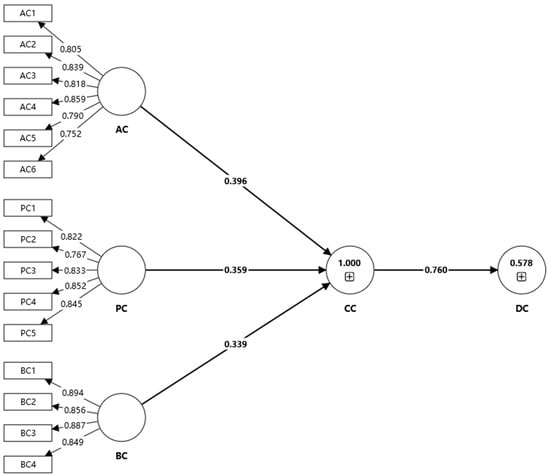
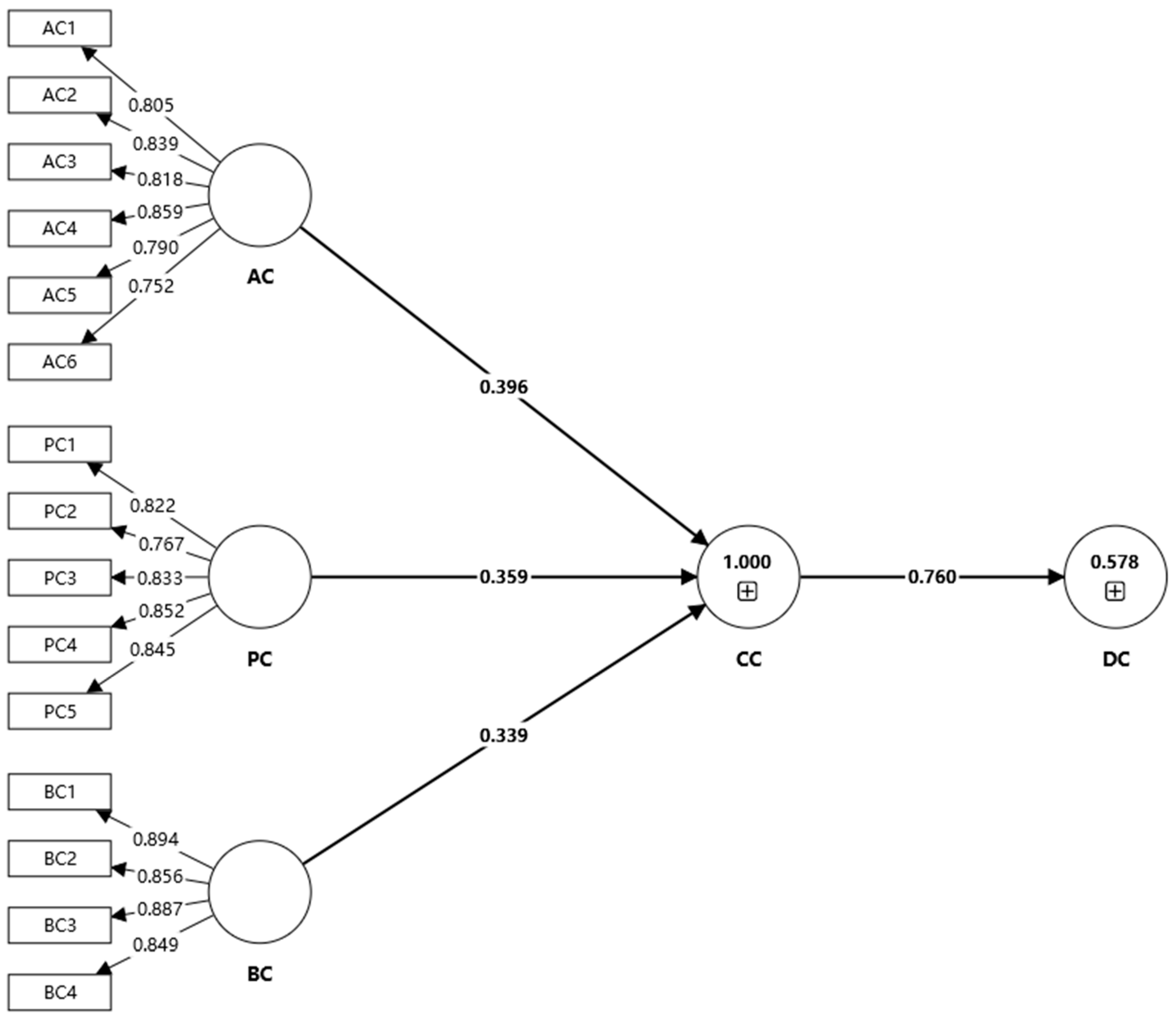
Development of core competence (DC) was used as a global item to assess the convergent validity of core competence as a formative latent variable. Convergent validity is considered satisfactory when the path coefficient between the formative latent variable and the global item is significant and exceeds 0.70 and when the global item has an explained variance greater than 0.50. As shown in Figure 1, generated in SmartPLS 4, the path coefficient between core competence and the global item was 0.760, indicating a strong relationship. The R2 of development of core competence was 0.578, showing that the formative latent variable explained more than half of the variance in the global item and thus demonstrated satisfactory convergent validity.
Figure 1.
Assessment of the convergent validity of the second-order construct.
The formative indicators were also examined for multicollinearity using variance inflation factors (VIFs). A VIF above 5 may indicate substantial collinearity, whereas values below 5 are generally considered acceptable. The VIF values for the 15 observed items ranged from 2.029 to 4.346, all below the threshold of 5, indicating no serious collinearity at this level.
The significance and relevance of each indicator were then assessed. Bootstrapping with 5000 subsamples was conducted at a significance level of 0.05, and t and p values were reported. Indicator relevance was evaluated by the magnitude and direction of the outer weights. Under the repeated-indicators approach, the path coefficients from the first-order constructs to the second-order construct can be interpreted as outer weights and used to assess the relative contribution of each first-order construct to the higher-order construct (Becker et al., 2012; Sarstedt et al., 2019). Table 4 presents the outer-weight results for the second-order formative measurement model of core competence estimated without DC. The outer weights of professional competence (PC), basic competence (BC), and adaptive competence (AC) on core competence (CC) were 0.355, 0.321, and 0.419, respectively, and all were statistically significant (p < 0.01). Adaptive competence made the largest relative contribution, followed by professional competence and basic competence.
Table 4.
Significance and relevance of outer weights in the formative measurement model.
Blindfolding was used to calculate Q2 for the higher-order core-competence construct. As shown in Table 5, Q2 was 0.570, exceeding zero and indicating predictive relevance under the conventional blindfolding criterion (Hair et al., 2019).
Table 5.
Predictive relevance assessment.
4.1.3. Multigroup Comparisons Across Grade Levels
Table 6 presents the outer weights of professional, basic, and adaptive competence for the first-, second-, and third-year cohorts. All three weights were statistically significant in each cohort, and adaptive competence had the largest weight. Descriptively, the weight of adaptive competence was larger in higher-grade cohorts, the weight of professional competence was smaller, and the weight of basic competence was similar across cohorts. Because the data are cross-sectional, these patterns represent between-cohort differences rather than within-student development. PLS-MGA was then used to test pairwise differences.
Table 6.
Outer weights of the core-competence dimensions by grade cohort.
As shown in Table 7, the outer weights of adaptive and professional competence differed significantly between the first- and third-year cohorts, whereas the outer weight of basic competence did not. The outer weight of professional competence was higher in the second-year cohort than in the third-year cohort, with the difference significant at the 10% level but not at the 5% level (p = 0.069). The remaining pairwise differences were not statistically significant.
Table 7.
PLS-MGA pairwise comparisons.
4.2. Factors Associated with the Three Competence Dimensions
Multiple linear regression was used to examine associations between individual characteristics, family background, human-capital and engagement indicators, and the three competence dimensions. Because student leadership and English-test experience were not measured in the first-year questionnaire, these models used data from second-, third-, and fourth-year students. Table 8 presents the results.
Table 8.
Factors associated with the core-competence dimensions.
For adaptive competence, three coefficients met the p < 0.05 criterion after adjustment for the other variables. Students classified as other in political status scored 0.253 points lower than CPC members (including probationary members) or active applicants for Party membership (p < 0.05). Students with leadership experience in a student association scored 0.223 points higher than those without such experience (p < 0.05), and students who had taken CET-6 scored 0.250 points higher than those who had not (p < 0.05). Class-level leadership experience was also positively associated with adaptive competence at the 10% significance level.
For professional competence, students whose mothers had upper-secondary or junior-college education scored 0.302 points higher than those whose mothers had junior-secondary education or below (p < 0.05). Students whose families were located in a centrally administered municipality or provincial capital scored 0.299 points higher than those from townships or rural areas (p < 0.05). Class-level and student-association leadership experience were associated with scores that were 0.237 and 0.222 points higher, respectively (both p < 0.05). Maternal education at the bachelor’s level or above was also positively associated with professional competence at the 10% significance level.
For basic competence, students whose mothers had upper-secondary or junior-college education scored 0.325 points higher than those whose mothers had junior-secondary education or below (p < 0.05), and students with class-level leadership experience scored 0.271 points higher than those without such experience (p < 0.05). Gender, maternal education at bachelor’s level or above, and political status were also significantly associated with basic competence at the 10% level.
5. Discussion
Using cross-sectional survey data from 578 engineering undergraduates at one Chinese research university, this study examined the higher-order structure and correlates of self-reported core competence through PLS-SEM, PLS-MGA, and multiple linear regression.
First, the results support a higher-order representation in which adaptive, professional, and basic competence jointly form core competence, with adaptive competence receiving the largest outer weight. This pattern is consistent with the view that contemporary engineering practice requires more than disciplinary knowledge: engineers must continually update what they know, coordinate resources and people, and evaluate technical decisions within organizational, social, and environmental contexts (Bohle Carbonell et al., 2014; Lattuca et al., 2017; Passow & Passow, 2017; Ro et al., 2015). For engineering education, the result suggests that professional knowledge, collaborative capability, and adaptive learning should be developed as complementary rather than competing outcomes. Open-ended tasks, interdisciplinary projects, and structured reflection may provide settings in which students learn to integrate these capabilities.
Second, the multigroup analysis identified cohort differences rather than longitudinal development. Compared with first-year students, third-year students showed a larger outer weight for adaptive competence and a smaller outer weight for professional competence, while the weight of basic competence did not differ significantly. One plausible interpretation is that later-year curricula provide more opportunities for projects, team coordination, and practical responsibility, making adaptive differences more salient. Sustained participation in multi-semester engineering projects has been linked to progressively more complex coordination and technical-leadership roles (Sonnenberg-Klein & Coyle, 2024), and capstone design and competition experience have been associated with engineering identity among senior students (Ju & Zhu, 2023). Nevertheless, cohort composition and selection may also explain the observed differences. Longitudinal evidence is needed before they can be interpreted as developmental change.
Third, the regression results suggest that the three competence dimensions have different correlational profiles, although the models explained only 10.9–11.6% of their variance. At p < 0.05, adaptive competence was associated with political-status classification, student-association leadership, and CET-6 experience; professional competence was associated with maternal education, family location, and class- and student-association leadership; and basic competence was associated with maternal education and class-level leadership. These patterns are compatible with evidence that curricular and co-curricular participation can provide opportunities to practice leadership, communication, and teamwork (Knight & Novoselich, 2017; Wolfinbarger et al., 2021), and that family educational resources can shape access to information, support, and engineering-related identities (Terenzini et al., 1996; Verdín et al., 2024). Viewed through the input–environment–outcome perspective and a human-capital lens, these differentiated associations are theoretically plausible: family background reflects variation in pre-college resources and educational support, whereas leadership and language-learning experiences represent forms of participation and skill accumulation during university. Because the three competence dimensions emphasize different domains of development, these background conditions and educational experiences may relate to them in different ways. The associations involving student leadership and CET-6 experience may also reflect differences in students’ motivation, prior achievement, or self-efficacy. Accordingly, these findings are interpreted as correlational patterns within the present sample, with further longitudinal evidence needed to clarify how such experiences relate to competence development over time. These findings suggest that engineering programs could provide more differentiated opportunities for competence development across stages of study. Project-based and collaborative activities could be used to support problem analysis, continuous learning, teamwork, and adaptation, while stage-specific feedback could help identify the competence dimensions in which students need additional support. Programs could also broaden access to substantive participation through project teams, student organizations, language learning, and intercultural activities.
6. Limitations
This study has four limitations. First, the cross-sectional design does not support causal inference or conclusions about within-student development; grade differences may reflect cohort composition or selection. Self-selection may also contribute to the associations involving student leadership and CET-6 experience, as students may already differ in motivation, prior achievement, or self-efficacy before participation. Second, the sample came from a single research university with distinctive engineering resources and training arrangements, limiting generalizability across institutions, disciplines, and national contexts. Third, the competence measures and most experience variables were self-reported and may be affected by common-method variance and differences in self-evaluation standards. Fourth, the regression models explained a modest proportion of variance and did not include potentially relevant factors, including curriculum and instruction, learning engagement, the quality of engineering practice, peer interaction, engineering identity, and self-efficacy.
Longitudinal studies across institutions and disciplines are needed to test the stability of the higher-order structure and examine how educational experiences relate to competence over time. Assessing competence before participation and collecting more detailed information on student leadership, volunteering, and other extracurricular activities would help clarify these relationships. Future research may further enrich the documentation of the item-development process and examine the measurement structure across broader samples and educational contexts. It should also examine how the dimension labels and item wording may need to be adapted across different national and educational contexts, taking country-specific characteristics into account. It could further incorporate more direct engineering-education experiences, such as capstone projects, design projects, internships, industry exposure, and practical engineering work, to examine how these experiences are associated with competence development.
7. Conclusions
First, adaptive, professional, and basic competence jointly formed the higher-order core-competence construct in this sample, with adaptive competence receiving the largest outer weight. This finding supports a multidimensional understanding of core competence in undergraduate engineering education, in which different competence dimensions contribute jointly to students’ overall development.
Second, adaptive competence had a larger outer weight and professional competence a smaller outer weight among third-year than first-year students, while basic competence did not differ significantly. These cross-sectional cohort differences indicate that the relative contribution of different competence dimensions may vary across stages of undergraduate study, although they should not be interpreted as within-student developmental change.
Third, the competence dimensions showed different patterns of association with student background and educational engagement. This suggests that the development of engineering students’ core competence is differentiated across dimensions and may require attention to variation in students’ backgrounds and educational experiences.
Overall, this study contributes to engineering education by integrating the multidimensional structure of core competence, grade-cohort differences, and associated student factors within a unified empirical framework. The findings provide empirical support for understanding engineering students’ core competence as a differentiated and multidimensional construct and highlight the importance of considering both competence dimensions and stages of undergraduate study in engineering talent development. Future research should further test the framework using longitudinal data, more diverse institutional samples, and more direct measures of engineering-education experiences.
Author Contributions
Conceptualization, X.L.; methodology, J.W.; formal analysis, J.W.; investigation, J.W.; writing—original draft preparation, X.L. and J.W.; writing—review and editing, X.L. and J.W. All authors have read and agreed to the published version of the manuscript.
Funding
This study was funded by a key research project of social science sponsored by Tianjin Municipal Education Commission, grant number 2025JWZD06.
Institutional Review Board Statement
The study was conducted in accordance with the Declaration of Helsinki and approved by the Ethics Committee of Tianjin University (protocol code TJUE-2023-231, 1 September 2023).
Informed Consent Statement
Informed consent was obtained from all subjects involved in the study.
Data Availability Statement
Data will be made available upon reasonable request.
Conflicts of Interest
The authors declare no conflicts of interest.
Abbreviations
The following abbreviations are used in this manuscript:
| PLS-SEM | Partial Least Squares Structural Equation Modeling |
| PLS-MGA | Partial Least Squares Multigroup Analysis |
| AC | Adaptive Competence |
| PC | Professional Competence |
| BC | Basic Competence |
| CC | Core Competence |
| DC | Development of Core Competence |
References
- Astin, A. W. (1993). What matters in college? Four critical years revisited. Jossey-Bass. [Google Scholar]
- Atman, C. J., Adams, R. S., Cardella, M. E., Turns, J., Mosborg, S., & Saleem, J. (2007). Engineering design processes: A comparison of students and expert practitioners. Journal of Engineering Education, 96(4), 359–379. [Google Scholar] [CrossRef] [Scilit]
- Atman, C. J., Chimka, J. R., Bursic, K. M., & Nachtmann, H. L. (1999). A comparison of freshman and senior engineering design processes. Design Studies, 20(2), 131–152. [Google Scholar] [CrossRef] [Scilit]
- Barclay, K., Hällsten, M., & Myrskylä, M. (2017). Birth order and college major in Sweden. Social Forces, 96(2), 629–660. [Google Scholar] [CrossRef] [Scilit]
- Beagon, U., & Bowe, B. (2023). Understanding professional skills in engineering education: A phenomenographic study of faculty conceptions. Journal of Engineering Education, 112(4), 1109–1144. [Google Scholar] [CrossRef] [Scilit]
- Becker, J.-M., Klein, K., & Wetzels, M. (2012). Hierarchical latent variable models in PLS-SEM: Guidelines for using reflective-formative type models. Long Range Planning, 45(5–6), 359–394. [Google Scholar] [CrossRef] [Scilit]
- Bennett, D., Bawa, S., Ananthram, S., & Pitman, T. (2022). Is there a gender difference in STEM students’ perceived employability? Education + Training, 64(6), 754–773. [Google Scholar] [CrossRef] [Scilit]
- Boelt, A. M., Kolmos, A., & Holgaard, J. E. (2022). Literature review of students’ perceptions of generic competence development in problem-based learning in engineering education. European Journal of Engineering Education, 47(6), 1399–1420. [Google Scholar] [CrossRef] [Scilit]
- Bohle Carbonell, K., Stalmeijer, R. E., Könings, K. D., Segers, M., & van Merriënboer, J. J. G. (2014). How experts deal with novel situations: A review of adaptive expertise. Educational Research Review, 12, 14–29. [Google Scholar] [CrossRef] [Scilit]
- Cheah, J.-H., Sarstedt, M., Ringle, C. M., Ramayah, T., & Ting, H. (2018). Convergent validity assessment of formatively measured constructs in PLS-SEM: On using single-item versus multi-item measures in redundancy analyses. International Journal of Contemporary Hospitality Management, 30(11), 3192–3210. [Google Scholar]
- Chen, J., Kolmos, A., & Clausen, N. R. (2023). Gender differences in engineering students’ understanding of professional competences and career development in the transition from education to work. International Journal of Technology and Design Education, 33(3), 1121–1142. [Google Scholar] [CrossRef] [Scilit]
- China Engineering Education Accreditation Association. (2022). Engineering education accreditation criteria (T/CEEAA 001–2022). Available online: https://www.hfuu.edu.cn/_upload/article/files/f2/4b/0b6c00f640f59b53cac981eea61a/5208e356-8228-475c-99d5-67f186bfae5b.pdf (accessed on 28 July 2026).
- Dym, C. L., Agogino, A. M., Eris, O., Frey, D. D., & Leifer, L. J. (2005). Engineering design thinking, teaching, and learning. Journal of Engineering Education, 94(1), 103–120. [Google Scholar] [CrossRef] [Scilit]
- Fleming, G. C., Klopfer, M., Katz, A., & Knight, D. (2024). What engineering employers want: An analysis of technical and professional skills in engineering job advertisements. Journal of Engineering Education, 113(2), 251–279. [Google Scholar] [CrossRef] [Scilit]
- Forcael, E., Garcés, G., & Orozco, F. (2022). Relationship between professional competencies required by engineering students according to ABET and CDIO and teaching–learning techniques. IEEE Transactions on Education, 65(1), 46–55. [Google Scholar] [CrossRef] [Scilit]
- Fornell, C., & Larcker, D. F. (1981). Evaluating structural equation models with unobservable variables and measurement error. Journal of Marketing Research, 18(1), 39–50. [Google Scholar] [CrossRef] [Scilit]
- Hadgraft, R. G., & Kolmos, A. (2020). Emerging learning environments in engineering education. Australasian Journal of Engineering Education, 25(1), 3–16. [Google Scholar] [CrossRef] [Scilit]
- Hair, J. F., Hult, G. T. M., Ringle, C. M., & Sarstedt, M. (2017). A primer on partial least squares structural equation modeling (PLS-SEM) (2nd ed.). Sage. [Google Scholar]
- Hair, J. F., Risher, J. J., Sarstedt, M., & Ringle, C. M. (2019). When to use and how to report the results of PLS-SEM. European Business Review, 31(1), 2–24. [Google Scholar] [CrossRef] [Scilit]
- Henseler, J., Ringle, C. M., & Sarstedt, M. (2015). A new criterion for assessing discriminant validity in variance-based structural equation modeling. Journal of the Academy of Marketing Science, 43(1), 115–135. [Google Scholar] [CrossRef] [Scilit]
- Hirshfield, L. J. (2018). Equal but not equitable: Self-reported data obscures gendered differences in project teams. IEEE Transactions on Education, 61(4), 305–311. [Google Scholar] [CrossRef] [Scilit]
- Hwang, S. (2025). Scoping review of studies on affective–psychological and social characteristics of South Korean engineering students. Behavioral Sciences, 15(9), 1189. [Google Scholar] [CrossRef] [Scilit] [PubMed]
- International Engineering Alliance. (2021). Graduate attributes & professional competencies (Version 2021.1). Available online: https://www.internationalengineeringalliance.org/assets/Uploads/IEA-Graduate-Attributes-and-Professional-Competencies-2021.1-Sept-2021.pdf (accessed on 28 July 2026).
- Jaiswal, A., Sapkota, M., & Acheson, K. (2024). Bridging borders: Assessing the impact of semester-long study abroad programs on intercultural competence development in undergraduate engineering students. International Journal of STEM Education, 11, 24. [Google Scholar] [CrossRef] [Scilit]
- Ju, T., & Zhu, J. (2023). Exploring senior engineering students’ engineering identity: The impact of practice-oriented learning experiences. International Journal of STEM Education, 10, 48. [Google Scholar] [CrossRef] [Scilit]
- Knight, D. B., & Novoselich, B. J. (2017). Curricular and co-curricular influences on undergraduate engineering student leadership. Journal of Engineering Education, 106(1), 44–70. [Google Scholar] [CrossRef] [Scilit]
- LaPatin, M., Barrens, S., Poleacovschi, C., Vaziri, B., Spearing, L., Padgett-Walsh, K., Feinstein, S., Rutherford, C., Nguyen, L., & Faust, K. M. (2023). Engineering in a crisis: Observing students’ perceptions of macroethical responsibilities during pandemics and natural disasters. Journal of Civil Engineering Education, 149(4), 04023003. [Google Scholar] [CrossRef] [Scilit]
- Lattuca, L. R., Knight, D. B., Ro, H. K., & Novoselich, B. J. (2017). Supporting the development of engineers’ interdisciplinary competence. Journal of Engineering Education, 106(1), 71–97. [Google Scholar] [CrossRef] [Scilit]
- Lee, M., Lee, A. A., Lee, G. A., Lira, A. K., Lawson, H. D., Freer, E., Briedis, D., Walton, S. P., & Linnenbrink-Garcia, L. (2025). Exploring supports for belonging as predictors of student outcomes: Different roles of co-curricular and extracurricular activities in engineering by students’ year in college. Journal of Engineering Education, 114(2), e70001. [Google Scholar] [CrossRef] [Scilit]
- Lee, W. C., Hall, J. L., Josiam, M., & Pee, C. M. (2023). (Un)equal demands and opportunities: Conceptualizing student navigation in undergraduate engineering programs. Journal of Engineering Education, 112(4), 890–917. [Google Scholar] [CrossRef] [Scilit]
- Lee, W. C., & Matusovich, H. M. (2016). A model of co-curricular support for undergraduate engineering students. Journal of Engineering Education, 105(3), 406–430. [Google Scholar] [CrossRef] [Scilit]
- Liu, X., Wang, J., & Luo, Y. (2025). Acceptance and use of technology on digital learning resource utilization and digital literacy among Chinese engineering students: A longitudinal study based on the UTAUT2 model. Behavioral Sciences, 15(6), 728. [Google Scholar] [CrossRef] [Scilit] [PubMed]
- Liu, X., & Zhang, Y. (2023). Governance mechanisms for cultivating outstanding engineers under the new nationwide system. Journal of Northwestern Polytechnical University (Social Sciences), (3), 43–51. (In Chinese) [Google Scholar]
- López-Pérez, M. F., Larrubia, M. Á., Fernández, A., & Sempere, J. (2023). Overview of the current situation relating to chemical engineering degree courses. Education for Chemical Engineers, 43, 73–82. [Google Scholar] [CrossRef] [Scilit]
- Male, S. A., Bush, M. B., & Chapman, E. S. (2011a). An Australian study of generic competencies required by engineers. European Journal of Engineering Education, 36(2), 151–163. [Google Scholar] [CrossRef] [Scilit]
- Male, S. A., Bush, M. B., & Chapman, E. S. (2011b). Understanding generic engineering competencies. Australasian Journal of Engineering Education, 17(3), 147–156. [Google Scholar] [CrossRef] [Scilit]
- Markes, I. (2006). A review of literature on employability skill needs in engineering. European Journal of Engineering Education, 31(6), 637–650. [Google Scholar] [CrossRef] [Scilit]
- Marra, R. M., Steege, L., Tsai, C.-L., & Tang, N.-E. (2016). Beyond “group work”: An integrated approach to support collaboration in engineering education. International Journal of STEM Education, 3, 17. [Google Scholar] [CrossRef] [Scilit]
- Passow, H. J. (2012). Which ABET competencies do engineering graduates find most important in their work? Journal of Engineering Education, 101(1), 95–118. [Google Scholar] [CrossRef] [Scilit]
- Passow, H. J., & Passow, C. H. (2017). What competencies should undergraduate engineering programs emphasize? A systematic review. Journal of Engineering Education, 106(3), 475–526. [Google Scholar] [CrossRef] [Scilit]
- Qi, S., Mi, X., Niu, M., & Huang, D. (2025). Enhancing engineering education: The impact of college experience, interpersonal interaction, and student engagement on developing practice-oriented competencies. European Journal of Engineering Education, 1–28. [Google Scholar] [CrossRef] [Scilit]
- Ro, H. K., & Knight, D. B. (2016). Gender differences in learning outcomes from the college experiences of engineering students. Journal of Engineering Education, 105(3), 478–507. [Google Scholar] [CrossRef] [Scilit]
- Ro, H. K., Merson, D., Lattuca, L. R., & Terenzini, P. T. (2015). Validity of the contextual competence scale for engineering students. Journal of Engineering Education, 104(1), 35–54. [Google Scholar] [CrossRef] [Scilit]
- Sarstedt, M., Hair, J. F., Cheah, J.-H., Becker, J.-M., & Ringle, C. M. (2019). How to specify, estimate, and validate higher-order constructs in PLS-SEM. Australasian Marketing Journal, 27(3), 197–211. [Google Scholar] [CrossRef] [Scilit]
- Sonnenberg-Klein, J., & Coyle, E. J. (2024). Leadership growth over multiple semesters in project-based student teams embedded in faculty research (Vertically Integrated Projects). IEEE Transactions on Education, 67(3), 443–452. [Google Scholar] [CrossRef] [Scilit]
- Stump, G. S., Hilpert, J. C., Husman, J., Chung, W.-T., & Kim, W. (2011). Collaborative learning in engineering students: Gender and achievement. Journal of Engineering Education, 100(3), 475–497. [Google Scholar] [CrossRef] [Scilit]
- Supriya, Y., Bhulakshmi, D., Bhattacharya, S., Gadekallu, T. R., Vyas, P., Kaluri, R., Sumathy, S., Koppu, S., Brown, D. J., & Mahmud, M. (2024). Industry 5.0 in smart education: Concepts, applications, challenges, opportunities, and future directions. IEEE Access, 12, 81938–81967. [Google Scholar] [CrossRef] [Scilit]
- Tembrevilla, G., Nesbit, S., Ellis, N., & Ostafichuk, P. (2023). Developing transdisciplinarity in first-year engineering. Journal of Engineering Education, 112(1), 43–63. [Google Scholar] [CrossRef] [Scilit]
- Terenzini, P. T., Springer, L., Yaeger, P. M., Pascarella, E. T., & Nora, A. (1996). First-generation college students: Characteristics, experiences, and cognitive development. Research in Higher Education, 37(1), 1–22. [Google Scholar] [CrossRef] [Scilit]
- van den Beemt, A., MacLeod, M., van der Veen, J., Van de Ven, A., van Baalen, S., Klaassen, R., & Boon, M. (2020). Interdisciplinary engineering education: A review of vision, teaching, and support. Journal of Engineering Education, 109(3), 508–555. [Google Scholar] [CrossRef] [Scilit]
- van der Zanden, P. J. A. C., Denessen, E., Cillessen, A. H. N., & Meijer, P. C. (2018). Domains and predictors of first-year student success: A systematic review. Educational Research Review, 23, 57–77. [Google Scholar] [CrossRef] [Scilit]
- Verdín, D., Smith, J. M., & Lucena, J. C. (2021). Recognizing the funds of knowledge of first-generation college students in engineering: An instrument development. Journal of Engineering Education, 110(3), 671–699. [Google Scholar] [CrossRef] [Scilit]
- Verdín, D., Smith, J. M., & Lucena, J. C. (2024). First-generation college students’ funds of knowledge support the development of an engineering role identity. Journal of Engineering Education, 113(2), 383–406. [Google Scholar] [CrossRef] [Scilit]
- Wang, X., Dai, M., & Mathis, R. (2022). The influences of student- and school-level factors on engineering undergraduate student success outcomes: A multi-level multi-school study. International Journal of STEM Education, 9, 23. [Google Scholar] [CrossRef] [Scilit]
- Wei, L., Wu, X., & Li, M. (2025). Who continues to a doctoral degree? Employment choices and influencing factors among engineering master’s students. Behavioral Sciences, 15(9), 1232. [Google Scholar] [CrossRef] [Scilit] [PubMed]
- Winberg, C., Bramhall, M., Greenfield, D., Johnson, P., Rowlett, P., Lewis, O., Waldock, J., & Wolff, K. (2020). Developing employability in engineering education: A systematic review of the literature. European Journal of Engineering Education, 45(2), 165–180. [Google Scholar] [CrossRef] [Scilit]
- Wolfinbarger, K. G., Shehab, R. L., Trytten, D. A., & Walden, S. E. (2021). The influence of engineering competition team participation on students’ leadership identity development. Journal of Engineering Education, 110(4), 925–948. [Google Scholar] [CrossRef] [Scilit]
- Wu, Y., Xu, L., & Philbin, S. P. (2023). Evaluating the role of the communication skills of engineering students on employability according to the outcome-based education (OBE) theory. Sustainability, 15(12), 9711. [Google Scholar] [CrossRef] [Scilit]

Disclaimer/Publisher’s Note: The statements, opinions and data contained in all publications are solely those of the individual author(s) and contributor(s) and not of MDPI and/or the editor(s). MDPI and/or the editor(s) disclaim responsibility for any injury to people or property resulting from any ideas, methods, instructions or products referred to in the content. |
© 2026 by the authors. Licensee MDPI, Basel, Switzerland. This article is an open access article distributed under the terms and conditions of the Creative Commons Attribution (CC BY) license.