


Abstract
Public speaking anxiety (PSA) represents a significant challenge, with a notable impact on the development of technical-scientific and communication skills. Based on a quantitative, cross-sectional design, the present study aims to carry out the cross-cultural adaptation of the Portuguese version of the Public Speaking Anxiety Scale (PSAS), evaluating its psychometric properties and structural validity through confirmatory factor analysis (CFA). A convenience sample of 348 nursing students from a higher education institution in the Lisbon region was used. The PSAS is a multidimensional instrument composed of 17 items, which evaluates the cognitive, physiological, and behavioral components of the PSA. The adaptation process followed the robust translation method developed by a panel of experts, ensuring semantic equivalence and internal consistency (n = 10; Content Validity Index Global 0.95). The results indicate that the mean PSAS score is 48.02 ± 13.03 (range 20–33). The cognitive dimension obtained the highest mean scores, followed by the physiological and behavioral dimensions (22.86 ± 6.13; 14.99 ± 4.26; 10.17 ± 3.68, respectively). In conclusion, the Portuguese PSAS is a valid and reliable instrument to systematically assess public speaking anxiety in Portuguese nursing students and contributes to the growing literature on culturally adapted measures of communication anxiety.
1. Introduction
Population aging, the increased prevalence of chronic diseases, and the complexity of healthcare systems affect contemporary care delivery contexts (Fonseca et al., 2024). Concurrently, global phenomena such as wars, humanitarian crises, and natural disasters present challenges for healthcare professionals regarding continuity of care, resource management, and response within environments characterized by uncertainty and high care demands (Alanazi & Shaban, 2025; Smith et al., 2009). In this context, healthcare professionals, specifically nurses, require technical-scientific skills, communication skills, adaptability, emotional intelligence, and resilience (Kawashima et al., 2025; Maznieda et al., 2022; Yoshida et al., 2023). The literature indicates that assertive communication under pressure is a determinant of clinical leadership, interprofessional coordination, and patient safety in complex environments (Maznieda et al., 2022).
Oral presentation competence enables knowledge transfer, patient advocacy, clinical leadership, and professional development among healthcare providers (Kwon et al., 2025; Lee et al., 2026). Nevertheless, psychological, cultural, and organizational constraints hinder skill acquisition in student and professional populations (Espinoza Suarez et al., 2021; Martinez et al., 2021; Pagana & Gingrow, 1990). Documented individual factors include fear, anxiety, reduced self-efficacy, limited language proficiency, and an absence of structured oral communication training (Hmidani, 2017; Santos, 2012; Vahidi et al., 2025). Furthermore, broad sociocultural and institutional dynamics, namely concerns regarding negative evaluation, cultural differences, and insufficient administrative resources, directly impact communication performance and skill mastery (Jirwe et al., 2010; Kang et al., 2023; Khawaja et al., 2018).
Public speaking anxiety (PSA) denotes the fear or apprehension associated with delivering presentations or public interventions, typically coupled with distress over negative evaluation, embarrassment, and fear of failure (Blöte et al., 2009; Pull, 2012). From a theoretical standpoint, PSA represents a multidimensional construct integrating cognitive, behavioral, and physiological components (Bartholomay & Houlihan, 2016; Mörtberg et al., 2018; Wong et al., 2019). The cognitive dimension involves concerns regarding content recall and external judgment; the behavioral dimension comprises task avoidance and compensatory strategies; and the physiological dimension reflects autonomic arousal, such as tremors, sweating, and tachycardia (Girondini et al., 2024). Empirical evidence confirms that factors such as trait anxiety, anxiety sensitivity, linguistic context, and cultural norms influence the intensity and expression of PSA (Behnke & Sawyer, 2001; Broeckelman-Post et al., 2020; Dewaele, 2002; Dewaele & Furnham, 2026; King & Finn, 2017).
Sociocultural dynamics directly affect the assessment of public speaking anxiety, as variables such as language proficiency, gender, age, and cultural differences shape how individuals experience and manifest anxiety symptoms (Roohani et al., 2024; Wong et al., 2019). Accordingly, valid assessment of PSA across distinct cohorts requires cross-cultural adaptation to verify psychometric reliability, measurement invariance, and conceptual equivalence across populations and cultural contexts (Cardon, 2025; Karagöl et al., 2025; Lin et al., 2022).
Anxiety in nursing undergraduates represents a well-documented phenomenon globally. Evidence indicates prevalence rates ranging from 25% to 75%, with heightened occurrence among senior students exposed to intense clinical rotations and demanding academic workloads (Amin et al., 2026; Manana et al., 2023; Perez-Siguas et al., 2023; Vo et al., 2023). This strain impedes academic performance, clinical skill acquisition, and professional identity formation. Documented manifestations include social anxiety, communication apprehension, sleep disturbances, fatigue, burnout, and psychological distress (Efstathiou et al., 2025; Muggeo & Ginsburg, 2019). Furthermore, factors including fear of clinical errors, exposure to direct observation and formal evaluation, and unsupportive practice environments correlate significantly with elevated anxiety levels (Mohamed et al., 2024; Wang et al., 2019).
Academic environments directly shape communication competence and the attenuation of performance-related anxiety. Educational interventions, incorporating high-fidelity simulation, virtual reality, structured communication workshops, peer feedback, and assertiveness training, demonstrate measurable efficacy in reducing anxiety levels and fostering communication self-efficacy among nursing students (Hmidani, 2017; Omura et al., 2019). However, deploying these pedagogical interventions requires psychometrically sound instruments capable of capturing both the intensity and multidimensional structure of PSA across varied cultural and linguistic settings. The study aimed to conduct the cross-cultural adaptation and validation of the Portuguese version of the PSAS, evaluating its psychometric properties and structural validity through confirmatory factor analysis in a sample of Portuguese nursing students.
2. Materials and Methods
2.1. Study Design
A cross-sectional, methodological study design was used to conduct the cross-cultural adaptation and psychometric validation of the Public Speaking Anxiety Scale (PSAS) for Portuguese nursing students. The study was structured into two operational stages: (1) translation and cross-cultural adaptation and (2) psychometric evaluation. Reporting of the research design, psychometric property evaluations, and structural validation parameters strictly adhered to the recommendations for reporting the results of studies of instrument and scale development and testing established by Streiner and Kottner (2014).
2.2. Participants, Samples and Setting
A convenience sampling method was utilized to recruit nursing students from a Higher School of Nursing in Lisbon, Portugal, between 20 April and 20 May 2025. The inclusion criteria were defined as (1) full-time enrollment in either the undergraduate (licensure) or postgraduate (master’s) nursing degree programs, and (2) provision of informed consent and voluntary participation. Exclusion criteria comprised students on official leave of absence during the data collection period.
The sample size requirement was estimated based on recommendations for structural equation modeling and confirmatory factor analysis (CFA), which suggest a minimum of 200 participants or a ratio of 5 to 10 participants per questionnaire item to ensure stable parameter estimates (Streiner & Kottner, 2014). Given that the Public Speaking Anxiety Scale (PSAS) contains 17 items, the minimum required sample size ranged from 85 to 170 participants to satisfy the item ratio, and a minimum of 200 participants to meet the specific threshold for CFA. A final sample of 348 nursing students was recruited, exceeding the minimum calculated threshold for structural validation.
2.3. Instrument
The Public Speaking Anxiety Scale (PSAS), which was originally developed by Bartholomay and Houlihan (2016), is a 17-item self-report questionnaire designed to measure public speaking anxiety across cognitive, behavioral, and physiological domains. Each item is scored using a 5-point Likert scale, ranging from 1 (strongly disagree) to 5 (strongly agree). Total scores range from 17 to 85, with higher scores reflecting greater levels of public speaking anxiety. In its original psychometric evaluation, the PSAS demonstrated high internal consistency, yielding a Cronbach’s alpha coefficient of 0.938 (Bartholomay & Houlihan, 2016).
Cross-cultural adaptation of the instrument adhered to the ten-stage protocol proposed by Wild et al. (2005). Initially, formal permission for translation and psychometric evaluation was secured from the scale’s original developers. Two native Portuguese translators independently produced initial forward translations, which were subsequently synthesized into a single preliminary version by the research group. Next, two additional translators—blind to the source text—conducted back-translations into English. The investigation team then critically compared these back-translated documents against the original instrument to confirm conceptual equivalence, resolving semantic and idiomatic discrepancies during the harmonization phase.
To evaluate face validity and item clarity, a panel of ten doctoral experts (aged 39–65 years) across various fields, including General Nursing, Medical–Surgical Nursing, Pediatric Health, Rehabilitation, Mental Health, Public Health, and Systems Engineering, participated in a cognitive debriefing process. Feedback from this panel was systematically reviewed to refine ambiguous phrasing. Finally, meticulous proofreading was carried out to guarantee grammatical precision and stylistic consistency in the finalized Portuguese version.
2.4. Cultural and Content Validation
The Portuguese version of the instrument was quantitatively evaluated for content validity by a panel of ten experts using the Item-Level Content Validity Index (I-CVI) and the Content Validity Ratio (CVR) across its 17 items. In line with standard psychometric literature, the conservative thresholds for acceptable validity with a 10-expert panel were established at ≥0.78 for I-CVI (Lynn, 1986) and ≥0.62 for CVR (Lawshe, 1975). The quantitative analysis revealed excellent consensus for the vast majority of the instrument:
- ○
- Maximum Agreement: 13 items (Items 1, 3, 5, 6, 7, 8, 9, 11, 12, 13, 15, 16, and 17) achieved perfect scores (I-CVI = 1.00; CVR = 1.00).
- ○
- Strong Agreement: Items 2 and 4 demonstrated strong parameters (I-CVI = 0.90; CVR = 0.80), satisfying all retention criteria.
- ○
- Items Requiring Revision: Item 10 failed to meet both minimum benchmarks (I-CVI} = 0.60; CVR = 0.20). Additionally, Item 14 satisfied the item-level index (I-CVI = 0.80) but fell slightly below the critical minimum threshold for the content validity ratio (CVR = 0.60).
At the scale level, the overall Scale-Level Content Validity Index based on the Average Method (S-CVI/Ave) was 0.95. This exceeds the standard methodological requirement of ≥0.90 (Polit & Beck, 2006), confirming the acceptable content validity of the total instrument.
Regarding qualitative modifications, the feedback provided by the experts in the open-ended response fields was meticulously analyzed. Consequently, both Item 10 and Item 14 underwent targeted semantic and stylistic revisions to eliminate ambiguities, address the statistical vulnerabilities identified in the quantitative phase, and optimize comprehension for Portuguese nursing students before field testing.
2.5. Data Collection Procedure
To minimize academic stress and mitigate potential response bias, data collection was scheduled during periods of lower academic workload, excluding examination sessions, assignment deadlines and formal evaluations. Administration took approximately 10 min and was conducted at either the beginning or end of scheduled lectures. Written informed consent was secured prior to participation, providing respondents with documented details regarding voluntary enrollment. Upon completing the consent process, participants accessed the sociodemographic questionnaire and scale instruments. Digital survey access was facilitated via a projected QR code and web link displayed on classroom screens, as well as through institutional email invitations, enabling completion on personal electronic devices (computers, tablets, or smartphones) at the participants’ convenience.
2.6. Statistical Analysis
Descriptive analysis was initially performed using IBM® SPSS® Statistics software, version 31.0.2.0. Scale reliability was assessed using Cronbach’s alpha (α) and McDonald’s omega (ω) coefficients. Internal consistency values were interpreted according to standard thresholds: >0.9 (excellent); between 0.8 and 0.9 (good); between 0.7 and 0.8 (acceptable); between 0.6 and 0.7 (questionable); between 0.5 and 0.6 (poor); and <0.5 (unacceptable).
Factorial validity of the Portuguese Public Speaking Anxiety Scale (PSAS) was subsequently evaluated via confirmatory factor analysis (CFA) employing maximum likelihood estimation to derive structural goodness-of-fit indices. This analysis was conducted in IBM® SPSS® AmosTM 29.0.0. To assess the adequacy of the global model, multiple fit metrics were examined, specifically the Chi-square to Degrees of Freedom ratio (X2/gl), Root Mean Square Error of Approximation (RMSEA), Root Mean Square Residual (RMR), Comparative-of-Fit Index (CFI), Tucker–Lewis Index (TLI), Bollen’s Incremental Fit Index (IFI), and Parsimony Normed Fit Index (PNFI). In alignment with Bentler (1990) and Kline (2011); X2/gl less than 5.0 (or ideally below 3.0); RMSEA and RMR less than 0.08; CFI, TLI, and IFI greater than 0.90 (ideally ≥ 0.95); and PNFI greater than 0.50 reflect acceptable/adequate structural models. Four residual covariances were incorporated into the measurement model based on the inspection of modification indices. Statistical significance was established at p < 0.05.
2.7. Ethical Considerations
The study protocol was reviewed and formally approved by the Ethics Committee of the Centro Académico de Medicina de Lisboa before implementation (Reference No. 75/26, dated 27 March 2026). All institutional guidelines and ethical principles for research involving human subjects were strictly followed to ensure data confidentiality, participant anonymity, and voluntary participation throughout the research process.
3. Results
3.1. Sample Characterization
The sample consisted of 348 participants, the majority of whom were female (88.2%), with a mean age of 22.57 ± 6.06 years (range 18–53 years).
Most participants are full-time students (71.3%) and are currently concluding their bachelor’s degree (59.8%). Concerning previous experience in public speaking and using digital tools, the majority consider themselves to have moderate experience (33.6% and 51.1%, respectively) (Table 1).
Table 1.
Sociodemographic and background variables.
3.2. Descriptive Statistics for the Public Speaking Anxiety Scale
The descriptive statistics for the PSAS showed that the highest percentages in the ‘Extremely’ category were found for items 2 and 17. For the ‘Very’ category, it was item 4. For the ‘Moderately’ category, it was items 1, 3, 8, and 15. For the ‘Slightly’ category, it was items 6, 7, 9 to 13. Finally, the highest percentages in the ‘Not at all’ category were obtained for items 5, 9, and 14. The mean score on the Public Speaking Anxiety Scale was 48.02 ± 13.03 (range 20–33). The cognitive dimension had the highest mean score, followed by the physiological and behavioral dimensions (22.86 ± 6.13; 14.99 ± 4.26; 10.17 ± 3.68, respectively) (Table 2).
Table 2.
Descriptive statistics for the Public Speaking Anxiety Scale (n; percentages).
3.3. Reliability for Public Speaking Anxiety Scale
Item-total correlations exceeded 0.49 across all indicators (Table 3), ranging from 0.49 (items 3 and 9) to 0.77 (item 16). Both Cronbach’s alpha and McDonald’s omega coefficients ranged between 0.92 and 0.93 across subscales, with overall internal consistency reaching 0.92 to 0.93—confirming excellent scale reliability. Mean scores and standard deviations demonstrated proper item centering, except for item 5.
Table 3.
Internal consistency for the Public Speaking Anxiety Scale.
3.4. Factorial Structure for Public Speaking Anxiety Scale
Confirmatory Factor Analysis
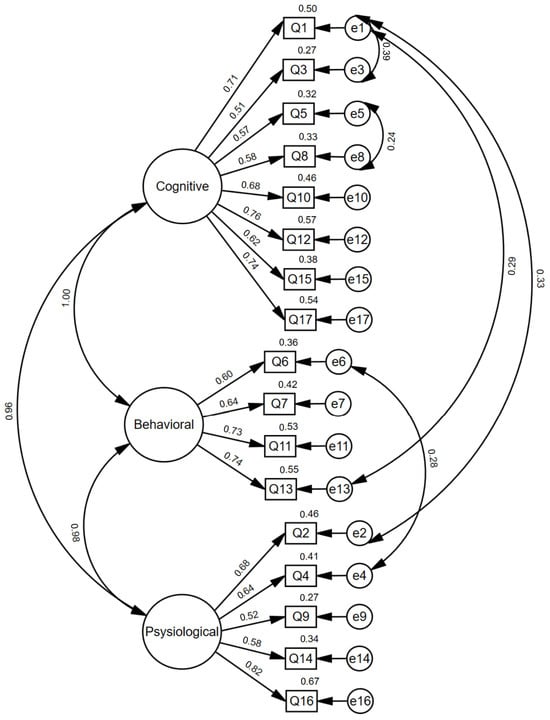
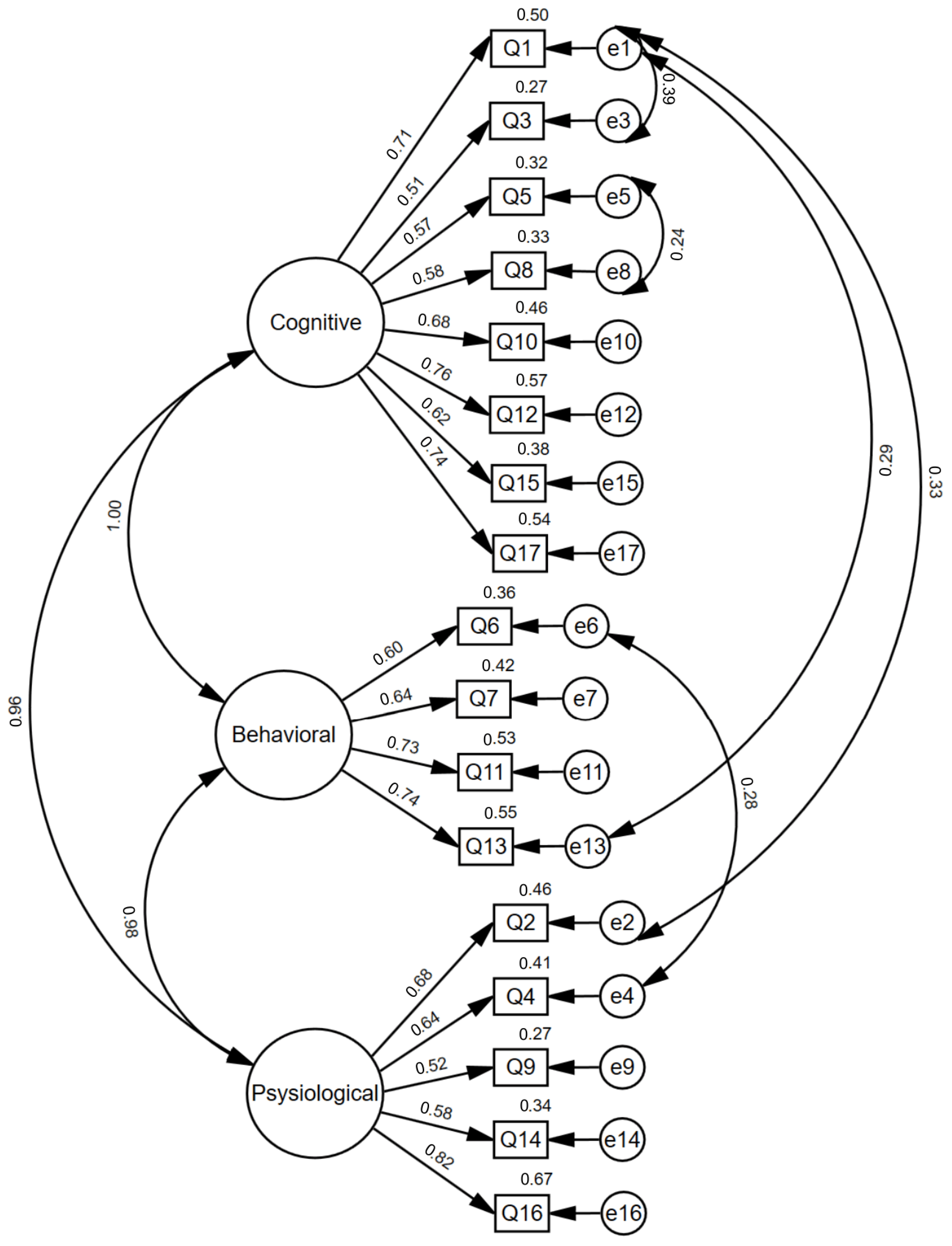
Confirmatory factor analysis (CFA) supported the underlying factorial structure of the Public Speaking Anxiety Scale (Figure 1). Model adequacy metrics demonstrated acceptable data fit: X2/df (Chi-square to Degrees of Freedom ratio) = 3.30, RMSEA (root mean square error of approximation) = 0.08 (Lower Interval 90 = 0.07, Upper Interval 90 = 0.09), RMR (Root Mean Square Residual) = 0.06, CFI (Comparative Fit Index) = 0.91; TLI (Tucker–Lewis Index) = 0.90, IFI (Bollen’s Incremental Fit Index) = 0.91; PNFI (Parsimony Normed Fit of Index) = 0.72.
Figure 1.
The circles represent latent factors. Squares represent measured variables, such as a question score. Arrows represent covariances. Circles containing the letter ‘e’ represent associated errors. The model presents standardised direct effects, which are the preferred measure for indicating the strength of associations (with a magnitude between 0 to 1). Higher values indicate stronger associations.
4. Discussion
4.1. Principal Findings
This study aimed to translate and cross-culturally adapt the Portuguese version of the PSAS among nursing students, and to evaluate its psychometric properties. Overall, the findings suggest that the Portuguese version demonstrated satisfactory psychometric performance, with excellent internal consistency, high content validity, and an acceptable factorial structure that was consistent with the multidimensional theoretical framework proposed by the original authors (Bartholomay & Houlihan, 2016). These findings provide preliminary evidence supporting the use of the Portuguese PSAS as a valid and reliable instrument for assessing public speaking anxiety in Portuguese nursing students and contribute to the growing international literature on culturally adapted measures of communication anxiety (Lin et al., 2022; Roohani et al., 2024).
Public speaking anxiety (PSA) has increasingly been recognized as an important educational construct because effective oral communication underpins numerous competencies required in nursing education, including clinical reasoning, teamwork, patient education, leadership, simulation-based learning, and evidence dissemination (Kawashima et al., 2025; Lee et al., 2026; Maznieda et al., 2022). Although communication skills are widely incorporated into undergraduate nursing curricula, anxiety associated with oral presentations may negatively influence academic performance, confidence, participation in simulation activities, and clinical communication, ultimately affecting professional development (Efstathiou et al., 2025; Pull, 2012; Wong et al., 2019). Consequently, the availability of a psychometrically sound Portuguese instrument represents an important step towards identifying students experiencing elevated communication anxiety and evaluating educational interventions designed to improve oral communication competence.
The present findings are also consistent with the conceptualization of public speaking anxiety as a multidimensional construct integrating cognitive, behavioural, and physiological responses (Bartholomay & Houlihan, 2016; Blöte et al., 2009). Rather than representing independent manifestations, these dimensions describe complementary psychological processes that occur before and during public speaking situations. Cognitive symptoms typically involve concerns regarding negative evaluation and fear of failure; behavioural responses include avoidance and safety behaviours; whereas physiological manifestations comprise autonomic activation, such as palpitations, tremor, sweating, and increased muscle tension (Girondini et al., 2024; Pull, 2012). Preserving this multidimensional structure during cross-cultural adaptation strengthens confidence that the Portuguese version maintains the theoretical integrity of the original instrument.
These findings are consistent with previous studies showing that public speaking anxiety is a consistent, multidimensional construct across linguistic and cultural settings (Cardon, 2025; Karagöl et al., 2025; Lin et al., 2022). Cross-cultural adaptation mitigates measurement artifacts arising from linguistic discrepancies, ensuring that the observed variance reflects true population differences (Streiner & Kottner, 2014; Wild et al., 2005). The Portuguese PSAS successfully replicates the original conceptual model, thus confirming its structural stability in this context.
4.2. Reliability and Construct Validity of the Portuguese PSAS
The present findings provide robust evidence supporting the reliability and construct validity of the Portuguese version of the Public Speaking Anxiety Scale (PSAS). Internal consistency was excellent, with both Cronbach’s alpha and McDonald’s omega exceeding the recommended threshold of 0.90, indicating that the instrument consistently measures a common latent construct while maintaining adequate homogeneity among its constituent items (Nunnally & Bernstein, 1994; Streiner & Kottner, 2014). The similarity between alpha and omega coefficients further strengthens these findings, as McDonald’s omega is considered a more robust and less restrictive estimate of reliability than Cronbach’s alpha, particularly when the assumption of tau-equivalence cannot be guaranteed (Hayes & Coutts, 2020). Therefore, the convergence of both coefficients therefore provides stronger psychometric evidence than reliance on Cronbach’s alpha alone.
Notably, the reliability coefficients observed in the Portuguese version closely resemble those reported during the original development of the PSAS (Cronbach’s α = 0.938). This suggests that the translation and cultural adaptation procedures have preserved the internal coherence of the instrument without altering its measurement properties (Bartholomay & Houlihan, 2016). Similar levels of internal consistency have also been reported in subsequent psychometric investigations of public speaking anxiety conducted in different linguistic and cultural contexts, supporting the notion that the construct demonstrates satisfactory measurement stability across populations (Lin et al., 2022; Roohani et al., 2024).
Corrected item–total correlations confirmed that all items contributed to the target construct. All values exceeded the standard psychometric thresholds, while Cronbach’s alpha values after hypothetical item deletion showed negligible variance, confirming that no individual item compromised internal consistency (Streiner & Kottner, 2014). Consequently, all original items were retained without psychometric detriment. Because high reliability does not imply construct validity (American Educational Research Association et al., 2014), confirmatory factor analysis was conducted to evaluate structural fit against the established three-factor model.
Overall, the confirmatory factor analysis supported the adequacy of the three-factor measurement model. The values obtained for the Comparative Fit Index (CFI), Tucker–Lewis Index (TLI), Incremental Fit Index (IFI), Root Mean Square Error of Approximation (RMSEA), Root Mean Square Residual (RMR), and Parsimony Normed Fit Index (PNFI) all reached levels that are generally considered to represent an acceptable model fit for a multidimensional psychological instrument (Goretzko et al., 2024; Kline, 2011; Rogers, 2024). While some indices occasionally fall marginally below the more conservative criteria occasionally proposed in structural equation modelling, the current methodological literature increasingly discourages rigid adherence to universal cut-off values. Instead, it argues that model evaluation should consider theoretical coherence, sample characteristics, model complexity, and the collective interpretation of multiple fit indices rather than isolated statistical thresholds (Goretzko et al., 2024; Kline, 2011; Marsh et al., 2004).
This interpretation is particularly relevant for instruments assessing psychological constructs such as public speaking anxiety. Unlike biomedical measurements, latent psychological variables are inherently multidimensional and influenced by contextual, cognitive, behavioural, and emotional factors. Consequently, perfect model fit is rarely expected, particularly following cross-cultural adaptation where subtle linguistic and cultural differences may introduce minor sources of shared variance between conceptually related items (Brown, 2015; Streiner & Kottner, 2014).
Integrating four error covariances improved model fit without compromising structural validity. In confirmatory factor analysis, correlated residuals may indicate minor item redundancy, parallel phrasing, or overlapping behavioral manifestations of the same latent construct (Brown, 2015; Kline, 2011). These parameters were specified only when backed by high modification indices and clear conceptual alignment. Restricting modifications to theoretically justifiable parameters prevents post hoc over-fitting (Brown, 2015; MacCallum et al., 1992), and ensures that the Portuguese version refines, rather than alters, the original factor architecture.
From a theoretical perspective, the preservation of the original three-dimensional structure is particularly noteworthy. Public speaking anxiety (PSA) is currently understood as a multidimensional manifestation of social evaluative anxiety, integrating cognitive, behavioural, and physiological processes that interact dynamically during public performance situations (Blöte et al., 2009; Pull, 2012). Cognitive symptoms typically involve fear of negative evaluation, catastrophic expectations, and concerns regarding performance failure; behavioural manifestations include avoidance, escape behaviours, and reduced communicative engagement. Physiological activation involves autonomic responses such as tachycardia, tremor, sweating, muscle tension, and facial flushing (Girondini et al., 2024; Pull, 2012). The successful replication of this theoretical structure in the Portuguese version provides additional evidence supporting the cross-cultural stability of the construct and reinforces previous psychometric observations suggesting that, although the intensity of anxiety may vary according to cultural norms and educational environments, its underlying psychological architecture remains relatively stable across populations (Lin et al., 2022; Wong et al., 2019).
Interestingly, descriptive analyses revealed that cognitive symptoms were the most prominent component of public speaking anxiety among Portuguese nursing students. This finding aligns closely with cognitive models of social anxiety, which identify fear of negative evaluation as the principal mechanism underlying anxiety during oral performance situations (Clark & Wells, 1995; Rapee & Heimberg, 1997). Similar observations have been reported among university students in different educational settings, where anticipatory cognitions, self-focused attention, and concerns regarding external judgement consistently emerge as stronger predictors of communication anxiety than physiological symptoms alone (King & Finn, 2017; Wong et al., 2019). From an educational perspective, these findings suggest that interventions designed to improve communication competence should extend beyond repeated exposure to public speaking situations and incorporate strategies targeting maladaptive cognitive beliefs, self-efficacy, emotional regulation, and constructive feedback.
These findings confirm that the Portuguese PSAS retains the structural properties of the original scale while demonstrating acceptable reliability and construct validity. The results support the hypothesis that public speaking anxiety is a measurable, multidimensional construct across cultures. The instrument can be used as a standardized outcome measure in educational research, for baseline screening, and for evaluating interventions in clinical communication and simulation training.
4.3. Implications for Nursing Education and Research
The availability of a validated, culturally adapted instrument to assess public speaking anxiety has significant applications in nursing curricula. Effective communication is a core clinical competence that underpins patient interactions, interprofessional teamwork, health education, simulation exercises, and research dissemination (International Council of Nurses, 2021; World Health Organization, 2021). Within this framework, early identification of students experiencing severe public speaking anxiety enables targeted instructional support, promoting both academic persistence and career readiness.
Public speaking is becoming an integral part of undergraduate nursing programmes through oral presentations, case discussions, simulation debriefings, objective structured clinical examinations (OSCEs), reflective seminars, and research dissemination activities. Oral presentations, case discussions, simulation debriefings, objective structured clinical examinations (OSCEs), and research dissemination are central components of modern nursing education. While designed to build clinical communication skills, these formats subject students to heightened evaluative stress, elevating cognitive and emotional loads (Cant & Cooper, 2017). Maladaptive anxiety levels can trigger task avoidance, diminished self-efficacy, and compromised delivery regardless of underlying knowledge (Blöte et al., 2009; Pull, 2012; Nascimento et al., 2026). Validated assessment tools are therefore essential for early identification of affected students and tracking progress post-intervention. The Portuguese PSAS provides an empirical outcome measure to evaluate educational interventions aimed at improving oral communication. Structured communication modules, repeated clinical simulation, peer debriefing, video-assisted self-reflection, and virtual reality training systematically attenuate speech anxiety while improving student confidence and performance (Cant & Cooper, 2017; Efstathiou et al., 2025; Shorey et al., 2020). Employing a validated metric such as the PSAS enables educators to identify students requiring targeted support while objectively tracking intervention-driven shifts in communication anxiety over time.
The emergence of cognitive symptoms as the primary dimension of speech anxiety has clear educational implications. Social anxiety frameworks attribute communication fears to negative evaluation concerns, distorted self-appraisals, and catastrophic predictions (Clark & Wells, 1995; Rapee & Heimberg, 1997). Therefore, interventions must move beyond repeated presentation practice to integrate cognitive restructuring, guided reflection, emotional regulation, and self-efficacy development. This approach is consistent with learner-centered models, in which communication competence stems from the integration of technical skills, behavioral practice, reflective learning, and psychological confidence (Benner et al., 2010).
Beyond basic training, the Portuguese PSAS offers utility for postgraduate education and continuous professional development. Advanced practice requires effective communication across multidisciplinary panels, quality initiatives, patient education, scientific presentations, and organizational leadership, tasks that mirror undergraduate public speaking demands and may perpetuate anxiety into clinical practice (International Council of Nurses, 2021). This validated metric enables longitudinal tracking across career stages and supports evaluating interventions designed to build sustained communication leadership.
Culturally equivalent Portuguese adaptation opens avenues for cross-national comparative research. By preserving the original instrument’s core conceptual architecture, multi-center investigations can evaluate speech anxiety across diverse educational frameworks and clinical settings while controlling adaptation-related measurement bias (Wild et al., 2005). These cross-cultural comparisons offer insight into how pedagogical approaches, institutional climates, and societal expectations shape nursing students’ communication skills. Ultimately, the Portuguese PSAS functions as both a robust psychometric scale and a practical curriculum design resource. Systematic screening can facilitate targeted student support, inform longitudinal programmatic evaluations, and build an empirical foundation for strategies aimed at fostering clinical confidence, effective communication, and professional readiness.
4.4. Strengths, Limitations and Future Research
Methodological strengths of this study center on rigorous adaptation and psychometric testing. Culturally adapting the instrument strictly according to Wild et al. (2005) guidelines ensured semantic and conceptual equivalence. Construct validity was confirmed via confirmatory factor analysis (CFA), the gold standard for testing predefined factor structures (Brown, 2015; Kline, 2011).
Nevertheless, several limitations must be noted. The cross-sectional design precluded test–retest reliability evaluation, necessitating longitudinal verification of temporal stability. Additionally, sampling exclusively Portuguese nursing students limits generalizability across other academic disciplines and clinical populations. Future research should evaluate scale performance among practicing nurses and multidisciplinary healthcare professionals.
Several sampling and analytical considerations warrant discussion. First, while the sample’s female predominance (88.2%) and age distribution (22.57 ± 6.06 years) match national nursing demographics, this homogeneity restricts extrapolation to older or non-nursing populations. Second, structural model fit (X2/df = 3.30, RMSEA = 0.08) met standard benchmarks, accounting for sample size (n = 348) sensitivity on chi-square values; however, model adequacy required specifying four error covariances based on modification indices, reflecting residual item overlap. Finally, self-report reliance may introduce recall and social desirability biases. Multi-center studies across diverse institutions are recommended to verify structural invariance.
A further limitation involves the absence of convergent and discriminant validity testing. Although CFA supported structural validity, evaluating correlations with validated measures of social anxiety, communication apprehension, general anxiety, and self-efficacy is essential to solidify construct validity. Incorporating Average Variance Extracted (AVE), Composite Reliability (CR), and heterotrait–monotrait ratio (HTMT) indices would provide robust convergent and discriminant evidence (Hair et al., 2022).
Future studies should also test measurement invariance across sex, academic year, and institutional settings to confirm cross-group equivalency. Establishing configural, metric, scalar, and residual invariance is required for valid subgroup comparisons and multi-center applications (Putnick & Bornstein, 2016). Furthermore, longitudinal intervention designs should assess the scale responsiveness to post-training performance shifts following communication modules, simulations, or public speaking workshops. Lastly, evaluating predictive validity against objective metrics, such as clinical communication grades, simulation debriefing scores, overall GPA, and self-efficacy measures, will clarify the operational impact of public speaking anxiety in nursing education and enhance the scale’s programmatic utility.
5. Conclusions
This study completed the cross-cultural adaptation and psychometric validation of the Public Speaking Anxiety Scale (PSAS) for Portuguese nursing students. Structural equation modeling and reliability analyses confirmed that the Portuguese version preserves the original three-factor conceptual structure, and presented acceptable content validity, construct validity, and internal consistency across subscales. The Portuguese PSAS provides an empirical tool to evaluate public speaking anxiety within nursing curricula. Beyond individual assessment, the scale enables objective evaluation of pedagogical interventions by measuring baseline anxiety and tracking changes over time.
By maintaining conceptual equivalence with the original instrument, the Portuguese PSAS facilitates cross-national research on communication anxiety in nursing education. The scale serves as a standardized outcome measure to examine associations between speech anxiety and clinical performance, simulation outcomes, academic achievement, and self-efficacy, supporting evidence-informed curriculum planning and evaluation.
Author Contributions
Conceptualization, A.R., E.S. and C.N.; methodology, A.R., E.S. and C.N.; software, E.S.; validation, A.R., E.S., J.M., V.B. and C.N.; formal analysis, E.S.; investigation, A.R. and C.N.; resources, C.N. and A.R.; data curation, A.R., E.S., J.M., V.B. and C.N.; writing—original draft preparation, A.R., E.S., J.M., V.B. and C.N.; writing—review and editing, A.R., E.S., J.M., V.B. and C.N.; visualization, A.R., E.S., J.M., V.B. and C.N.; supervision, C.N.; project administration, C.N.; funding acquisition, A.R. and C.N. All authors have read and agreed to the published version of the manuscript.
Funding
The APC was funded by the Center for Research, Innovation, and Development in Nursing (CIDNUR), in Portugal, by means of grants provided to some of the authors (Inov@U—Centro de Excelência de Inovação Pedagógica de Lisboa, funded by the European Union—NextGenerationEU).
Institutional Review Board Statement
The study was conducted in accordance with the Declaration of Helsinki and approved by the Ethics Committee of the Centro Académico de Medicina de Lisboa (Reference No. 75/26, dated 27 March 2026).
Informed Consent Statement
Informed consent was obtained from all subjects involved in the study.
Data Availability Statement
The data presented in this study are available on request from the corresponding author. The data are not publicly available due to ethical/privacy issues.
Acknowledgments
During the preparation of this manuscript, the authors utilized Grammarly (version: v.1.2.290.1948) and ChatGPT (OpenAI, version GPT-5.6 Sol, accessed August 2026) as language-support tools exclusively for spelling, grammar correction, and structural readability. The tools were not used for data collection, statistical analysis, or drawing scientific conclusions. All software-assisted revisions were thoroughly reviewed and manually edited by the authors, who take full responsibility for the technical accuracy and final content of this manuscript.
Conflicts of Interest
The authors declare no conflicts of interest.
References
- Alanazi, M. A., & Shaban, M. (2025). Challenges and strategies in maintaining continuity of care for chronic disease patients by emergency nurses during disasters. International Nursing Review, 72(2), e70029. [Google Scholar] [CrossRef] [Scilit] [PubMed]
- American Educational Research Association, American Psychological Association & National Council on Measurement in Education. (2014). Standards for educational and psychological testing. American Educational Research Association. [Google Scholar]
- Amin, S. M., El-Monshed, A. H., Khedr, M. A., Morsy, O. M. I., & El-Ashry, A. M. (2026). Future nurses in a changing climate: Exploring the relationship between environmental literacy and climate anxiety. Journal of Advanced Nursing. early view. [Google Scholar] [CrossRef] [Scilit] [PubMed]
- Bartholomay, E. M., & Houlihan, D. D. (2016). Public speaking anxiety scale: Preliminary psychometric data and scale validation. Personality and Individual Differences, 94, 211–215. [Google Scholar] [CrossRef] [Scilit]
- Behnke, R. R., & Sawyer, C. R. (2001). Patterns of psychological state anxiety in public speaking as a function of anxiety sensitivity. Communication Quarterly, 49(1), 84–94. [Google Scholar] [CrossRef] [Scilit]
- Benner, P., Sutphen, M., Leonard, V., & Day, L. (2010). Educating nurses: A call for radical transformation. Jossey-Bass. [Google Scholar]
- Bentler, P. M. (1990). Comparative fit indexes in structural models. Psychological Bulletin, 107(2), 238–246. [Google Scholar] [CrossRef] [Scilit] [PubMed]
- Blöte, A. W., Kint, M. J. W., Miers, A. C., & Westenberg, P. M. (2009). The relation between public speaking anxiety and social anxiety: A review. Journal of Anxiety Disorders, 23(3), 305–313. [Google Scholar] [CrossRef] [Scilit] [PubMed]
- Broeckelman-Post, M. A., Hawkins, K. E. H., Murphy, J., Otusanya, A., & Kueppers, G. (2020). The impact of gender and introductory communication course type on public speaking performance. Communication Teacher, 34(1), 53–67. [Google Scholar] [CrossRef] [Scilit]
- Brown, T. A. (2015). Confirmatory factor analysis for applied research. The Guilford Press. [Google Scholar]
- Cant, R. P., & Cooper, S. J. (2017). Use of simulation-based learning in undergraduate nurse education: An umbrella systematic review. Nurse Education Today, 49, 63–71. [Google Scholar] [CrossRef] [Scilit] [PubMed]
- Cardon, P. (2025). Communication apprehension among autistic professionals. Business and Professional Communication Quarterly, 88(2), 249–276. [Google Scholar] [CrossRef] [Scilit]
- Clark, D. M., & Wells, A. (1995). A cognitive model of social phobia. In R. G. Heimberg, M. R. Liebowitz, D. A. Hope, & F. R. Schneier (Eds.), Social phobia: Diagnosis, assessment, and treatment (pp. 69–93). The Guilford Press. [Google Scholar]
- Dewaele, J.-M. (2002). Psychological and sociodemographic correlates of communicative anxiety in L2 and L3 production. International Journal of Bilingualism, 6(1), 23–38. [Google Scholar] [CrossRef] [Scilit]
- Dewaele, J.-M., & Furnham, A. (2026). Identifying demographic and personality correlates of public speaking anxiety among adult workers. Acta Psychologica, 263, 106247. [Google Scholar] [CrossRef] [Scilit] [PubMed]
- Efstathiou, M., Kakaidi, V., Tsitsas, G., Mantzoukas, S., Gouva, M., & Dragioti, E. (2025). The prevalence of mental health issues among nursing students: An umbrella review synthesis of meta-analytic evidence. International Journal of Nursing Studies, 163, 104993. [Google Scholar] [CrossRef] [Scilit] [PubMed]
- Espinoza Suarez, N. R., Urtecho, M., Nyquist, C. A., Jaramillo, C., Yeow, M.-E., Thorsteinsdottir, B., Wilson, M. E., & Barwise, A. K. (2021). Consequences of suboptimal communication for patients with limited English proficiency in the intensive care unit and suggestions for a way forward: A qualitative study of healthcare team perceptions. Journal of Critical Care, 61, 247–251. [Google Scholar] [CrossRef] [Scilit] [PubMed]
- Fonseca, C., Morgado, B., Alves, E., Ramos, A., Silva, M. R., Pinho, L., João, A., & Lopes, M. (2024). The functional profile, depressive symptomatology, and quality of life of older people in the Central Alentejo Region: A cross-sectional study. Healthcare, 12(22), 2303. [Google Scholar] [CrossRef] [Scilit] [PubMed]
- Girondini, M., Frigione, I., Marra, M., Stefanova, M., Pillan, M., Maravita, A., & Gallace, A. (2024). Decoupling the role of verbal and non-verbal audience behavior on public speaking anxiety in virtual reality using behavioral and psychological measures. Frontiers in Virtual Reality, 5, 1347102. [Google Scholar] [CrossRef] [Scilit]
- Goretzko, D., Siemund, K., & Sterner, P. (2024). Evaluating model fit of measurement models in confirmatory factor analysis. Educational and Psychological Measurement, 84(1), 123–144. [Google Scholar] [CrossRef] [Scilit] [PubMed]
- Hair, J. F., Black, W. C., Babin, B. J., & Anderson, R. E. (2022). Multivariate data analysis (8th ed.). Cengage Learning. [Google Scholar]
- Hayes, A. F., & Coutts, J. J. (2020). Use omega rather than Cronbach’s alpha for estimating reliability. But…. Communication Methods and Measures, 14(1), 1–24. [Google Scholar] [CrossRef] [Scilit]
- Hmidani, A. T. (2017). A structured approach to developing the public speaking skill of Saudi nursing students. New Trends and Issues Proceedings on Humanities and Social Sciences, 4(4), 205–214. [Google Scholar] [CrossRef] [Scilit]
- International Council of Nurses. (2021). The ICN code of ethics for nurses (Revised 2021). International Council of Nurses. [Google Scholar]
- Jirwe, M., Gerrish, K., & Emami, A. (2010). Student nurses’ experiences of communication in cross-cultural care encounters. Scandinavian Journal of Caring Sciences, 24(3), 436–444. [Google Scholar] [CrossRef] [Scilit] [PubMed]
- Kang, J. Y., Lee, M. K., Fairchild, E. M., Caubet, S. L., Peters, D. E., Matti, L., & Howell, T. G., Jr. (2023). Do organizational values and leadership impact staff engagement, wellbeing, and patient satisfaction? Journal of Healthcare Leadership, 15, 209–219. [Google Scholar] [CrossRef] [Scilit] [PubMed]
- Karagöl, E., Yıldırım Bilgen, D., & Korkmaz, C. B. (2025). The impact of AI applications on pre-service teachers’ public speaking anxiety and academic speaking skill in the context of oral presentations: A mixed-methods study. Teaching and Teacher Education, 166, 105180. [Google Scholar] [CrossRef] [Scilit]
- Kawashima, T., Ota, Y., Aikawa, G., Watanabe, M., Ashida, K., & Sakuramoto, H. (2025). Effectiveness of emotional intelligence training on nurses’ and nursing students’ emotional intelligence, resilience, stress, and communication skills: A systematic review and meta-analysis. Nurse Education Today, 151, 106743. [Google Scholar] [CrossRef] [Scilit] [PubMed]
- Khawaja, N. G., Chan, S., & Stein, G. (2018). The relationship between second language anxiety and international nursing students stress. Journal of International Students, 7(3), 601–620. [Google Scholar] [CrossRef] [Scilit]
- King, P. E., & Finn, A. N. (2017). A test of attention control theory in public speaking: Cognitive load influences the relationship between state anxiety and verbal production. Communication Education, 66(2), 168–182. [Google Scholar] [CrossRef] [Scilit]
- Kline, R. B. (2011). Principles and practice of structural equation modeling (3rd ed.). Guilford Press. [Google Scholar]
- Kwon, E., Asri, R., Grachan, J., & Traba, C. (2025). The voice of physicians: The essential role of public speaking in medical training. Medical Science Educator, 35(4), 1887–1892. [Google Scholar] [CrossRef] [Scilit] [PubMed]
- Lawshe, C. H. (1975). A quantitative approach to content validity. Personnel Psychology, 28(4), 563–575. [Google Scholar] [CrossRef] [Scilit]
- Lee, H.-C., Chiang, Y.-C., Chu, T.-L., Lin, C.-T., Moser, D. K., & Hsiao, Y.-C. (2026). Beyond presentation skills: Effects of a health care presentation course on nursing students. Journal of Nursing Education, 65(1), 12–19. [Google Scholar] [CrossRef] [Scilit] [PubMed]
- Lin, X. B., Lee, T.-S., Man, R. E. K., Poon, S. H., & Fenwick, E. (2022). Rasch analysis reveals multidimensionality in the public speaking anxiety scale. Health Services and Outcomes Research Methodology, 22(3), 332–348. [Google Scholar] [CrossRef] [Scilit]
- Lynn, M. R. (1986). Determination and quantification of content validity. Nursing Research, 35(6), 382–385. [Google Scholar] [CrossRef] [Scilit]
- MacCallum, R. C., Roznowski, M., & Necowitz, L. B. (1992). Model modifications in covariance structure analysis: The problem of capitalization on chance. Psychological Bulletin, 111(3), 490–504. [Google Scholar] [CrossRef] [PubMed]
- Manana, M., Ntuli, S. T., Mokwena, K., & Maaga, K. (2023). Prevalence and risk factors for anxiety symptoms among student nurses in Gauteng Province of South Africa. Behavioral Sciences, 13(8), 630. [Google Scholar] [CrossRef] [Scilit] [PubMed]
- Marsh, H. W., Hau, K.-T., & Wen, Z. (2004). In Search of Golden Rules: Comment on Hypothesis-Testing Approaches to Setting Cutoff Values for Fit Indexes and Dangers in Overgeneralizing Hu and Bentler’s (1999) Findings. Structural Equation Modeling: A Multidisciplinary Journal, 11(3), 320–341. [Google Scholar] [CrossRef] [Scilit] [PubMed]
- Martinez, G. A., Parés-Avila, J. A., Graham, M., Stauber, L., Szalacha, L., & Menon, U. (2021). Communicating and coaching in Spanish for chronic care. Journal of Nursing Education, 60(1), 34–37. [Google Scholar] [CrossRef] [Scilit] [PubMed]
- Maznieda, M., Dalila, R., Rosnah, S., Rohaida, I., Rosmanajihah, M. L., Mizanurfakhri, G., & Nurhanie, M. (2022). The soft skills emergency management that matters at the hardest time: A phenomenology study of healthcare worker’s experiences during Kelantan flood 2014. International Journal of Disaster Risk Reduction, 75, 102916. [Google Scholar] [CrossRef] [Scilit]
- Mohamed, N. A., Ali, S. O., Ehrahim, E. E. E., Ahmed, A. L., & Wahba, A. M. (2024). Predictors of academic and clinical stress among nursing students. SAGE Open Nursing, 10, 23779608241290392. [Google Scholar] [CrossRef] [Scilit] [PubMed]
- Mörtberg, E., Jansson-Fröjmark, M., Pettersson, A., & Hennlid-Oredsson, T. (2018). Psychometric properties of the Personal Report of Public Speaking Anxiety (PRPSA) in a sample of university students in Sweden. International Journal of Cognitive Behavioral Therapy, 11, 421–433. [Google Scholar] [CrossRef] [Scilit] [PubMed]
- Muggeo, M. A., & Ginsburg, G. S. (2019). School nurse perceptions of student anxiety. The Journal of School Nursing, 35(3), 163–168. [Google Scholar] [CrossRef] [Scilit] [PubMed]
- Nascimento, C., Sousa, E., Martins, H., Santos, E., & Ramos, A. (2026). Mental well-being and emotional regulation in preparing for the master’s nursing thesis defense: An interpretative thematic analysis. Psychiatry International, 7(1), 39. [Google Scholar] [CrossRef] [Scilit]
- Nunnally, J. C., & Bernstein, I. H. (1994). Psychometric theory. McGraw-Hill. [Google Scholar]
- Omura, M., Levett-Jones, T., & Stone, T. E. (2019). Design and evaluation of an assertiveness communication training programme for nursing students. Journal of Clinical Nursing, 28(9–10), 1990–1998. [Google Scholar] [CrossRef] [Scilit] [PubMed]
- Pagana, K. D., & Gingrow, K. S. (1990). A practical plan for teaching oral communication skills. Nurse Educator, 15(1), 17–19. [Google Scholar] [CrossRef] [Scilit] [PubMed]
- Perez-Siguas, R., Matta-Solis, H., & Matta-Solis, E. (2023). The state-trait anxiety level in nursing students. International Journal of Advanced and Applied Sciences, 10(7), 11–16. [Google Scholar] [CrossRef] [Scilit]
- Polit, D. F., & Beck, C. T. (2006). The content validity index: Are you sure you know what’s being reported? Critique and recommendations. Research in Nursing & Health, 29(5), 489–497. [Google Scholar] [CrossRef] [Scilit] [PubMed]
- Pull, C. B. (2012). Current status of knowledge on public-speaking anxiety. Current Opinion in Psychiatry, 25(1), 32–38. [Google Scholar] [CrossRef] [Scilit] [PubMed]
- Putnick, D. L., & Bornstein, M. H. (2016). Measurement invariance conventions and reporting: The state of the art and future directions for psychological research. Developmental Review, 41, 71–90. [Google Scholar] [CrossRef] [Scilit] [PubMed]
- Rapee, R. M., & Heimberg, R. G. (1997). A cognitive-behavioral model of anxiety in social phobia. Behaviour Research and Therapy, 35(8), 741–756. [Google Scholar] [CrossRef] [Scilit] [PubMed]
- Rogers, P. (2024). Best practices for your confirmatory factor analysis: A JASP and lavaan tutorial. Behavior Research Methods, 56(7), 6634–6654. [Google Scholar] [CrossRef] [Scilit] [PubMed]
- Roohani, A., Parhizkar, R., & Ostovar, S. (2024). Developing and validating perceived intercultural communication anxiety/apprehension scale. Psychology in the Schools, 61(12), 4589–4607. [Google Scholar] [CrossRef] [Scilit]
- Santos, M. C. (2012). Nurses’ barriers to learning. Journal for Nurses in Staff Development, 28(4), 182–185. [Google Scholar] [CrossRef] [Scilit] [PubMed]
- Shorey, S., Ang, E., Ng, E. D., Yap, J., Lau, L. S. T., & Chui, C. K. (2020). Communication skills training using virtual reality: A descriptive qualitative study. Nurse Education Today, 94, 104592. [Google Scholar] [CrossRef] [Scilit] [PubMed]
- Smith, S. M., Tremethick, M. J., Johnson, P., & Gorski, J. (2009). Disaster planning and response: Considering the needs of the frail elderly. International Journal of Emergency Management, 6(1), 1. [Google Scholar] [CrossRef] [Scilit]
- Streiner, D. L., & Kottner, J. (2014). Recommendations for reporting the results of studies of instrument and scale development and testing. Journal of Advanced Nursing, 70(9), 1970–1979. [Google Scholar] [CrossRef] [Scilit] [PubMed]
- Vahidi, M., Rahmani, F., Areshtanab, H. N., & Allahyari, Z. (2025). Exploring the barriers to nursing students’ speaking up for patient safety in Iran: A qualitative study. BMC Nursing, 24(1), 513. [Google Scholar] [CrossRef] [Scilit] [PubMed]
- Vo, T. N., Chiu, H.-Y., Chuang, Y.-H., & Huang, H.-C. (2023). Prevalence of stress and anxiety among nursing students. Nurse Educator, 48(3), E90–E95. [Google Scholar] [CrossRef] [Scilit] [PubMed]
- Wang, A. H., Lee, C. T., & Espin, S. (2019). Undergraduate nursing students’ experiences of anxiety-producing situations in clinical practicums: A descriptive survey study. Nurse Education Today, 76, 103–108. [Google Scholar] [CrossRef] [Scilit] [PubMed]
- Wild, D., Grove, A., Martin, M., Eremenco, S., McElroy, S., Verjee-Lorenz, A., Erikson, P., & ISPOR Task Force for Translation and Cultural Adaptation. (2005). Principles of good practice for the translation and cultural adaptation process for patient-reported outcomes (PRO) measures: Report of the ISPOR Task Force for Translation and Cultural Adaptation. Value in Health, 8(2), 94–104. [Google Scholar] [CrossRef] [Scilit] [PubMed]
- Wong, Q. J. J., Chen, J., Gregory, B., Baillie, A. J., Nagata, T., Furukawa, T. A., Kaiya, H., Peters, L., & Rapee, R. M. (2019). Measurement equivalence of the Social Interaction Anxiety Scale (SIAS) and Social Phobia Scale (SPS) across individuals with social anxiety disorder from Japanese and Australian sociocultural contexts. Journal of Affective Disorders, 243, 165–174. [Google Scholar] [CrossRef] [Scilit] [PubMed]
- World Health Organization. (2021). Global strategic directions for nursing and midwifery 2021–2025. World Health Organization. [Google Scholar]
- Yoshida, M., Sawano, T., Kobashi, Y., Hori, A., Nishikawa, Y., Ozaki, A., Nonaka, S., Tsuboi, M., & Tsubokura, M. (2023). Importance of continuing health care before emergency hospital evacuation: A fatal case of a hospitalized patient in a hospital within 5 km radius of Fukushima Daiichi Nuclear Power Plant: A case report. Journal of Medical Case Reports, 17, 37. [Google Scholar] [CrossRef] [Scilit] [PubMed]

Disclaimer/Publisher’s Note: The statements, opinions and data contained in all publications are solely those of the individual author(s) and contributor(s) and not of MDPI and/or the editor(s). MDPI and/or the editor(s) disclaim responsibility for any injury to people or property resulting from any ideas, methods, instructions or products referred to in the content. |
© 2026 by the authors. Licensee MDPI, Basel, Switzerland. This article is an open access article distributed under the terms and conditions of the Creative Commons Attribution (CC BY) license.