


Abstract
Background. Attrition from STEM programs remains a persistent challenge for universities globally. To better support student success and socio-academic integration, universities have developed a range of curricular and co-curricular resources. Much emphasis has been placed on the benefits of these resources; however, less is known about how students recognize, access, and realize these benefits. Guided by a capital-mediated agency model, this asset-based focus group study examined how university-provided resources support undergraduate STEM students’ use of capital. We conducted four parallel focus groups with 21 students at a Norwegian university and analyzed narratives using thematic analysis. Results. Students described using both curricular and co-curricular resources to build personal/emotional, social, and human resource capital that helped them navigate academic and personal challenges. Curricular resources, including mandatory assignments, fieldwork, and laboratory activities, supported disciplinary training and opportunities to develop relationships with peers. Co-curricular resources, including tutoring rooms and student organizations, similarly provided academic and emotional support. Although students often initially accessed resources to address academic challenges, they frequently described emergent social benefits. Recognition of these social benefits appeared to link resource use with decisions to invest in them. Across participants’ accounts, social capital and sense of belonging appeared to operate reciprocally: relationships formed through resource engagement fostered belonging, while belonging strengthened students’ willingness and capacity to continue engaging with peers, resources, and their academic communities. Conclusions. These findings extend the capital-mediated agency model by identifying students’ recognition of resource benefits as a meaningful process linking their use to investment. They also position students’ sense of belonging as an emergent and reciprocal outcome of engagement with both primarily academic and social resources. For institutions and instructors, the findings suggest that simply providing resources may be insufficient and that students must be able to recognize their relevance, access them, and use them in ways that generate meaningful academic and, critically, social outcomes. Designing and evaluating university resources to support these processes and build social capital may create learning environments that better support student agency, resilience, belonging, and persistence in STEM.
1. Introduction
Globally, we are not producing enough science, technology, engineering, and math (STEM) graduates to meet pressing societal needs (Tønnessen & Vold, 2023). This deficit is compounded by the fact that many students who begin university intending to major in STEM leave early in their academic program (Li et al., 2022). Attrition in STEM is multi-factorial, reflecting the interactions among academic, psychosocial, and instructional conditions. For example, misalignment between students’ preparation and university course expectations may lead to underperformance. Psycho-social barriers, such as low sense of belonging (i.e., the extent to which students feel they are accepted by, connected to, and matter within their institution; Strayhorn, 2018) and imposterism prompt students to opt out of STEM (Balgopal et al., 2022; Núñez-Peña et al., 2016; Rainey et al., 2018; Tao & Gloria, 2019). Finally, traditional teaching methods may fail to engage students (Dibner & Pandya, 2018).
In response to this “retention challenge”, several international (e.g., OECD, 2018, 2025) and national reports (e.g., in Norway: Haugen et al., 2025; in the USA: National Academies of Sciences, Engineering, and Medicine, 2021) call for reforms to undergraduate STEM education. These calls are further supported by research on student retention, integration, and participation in STEM higher education (Braxton et al., 2000; Dyrberg & Holmegaard, 2019; Tinto, 1975; Ulriksen et al., 2010). Taken together, this work emphasizes how we teach and assess students meaningfully shapes their performance, motivation, and decision to persist. Critically, it also frames the retention challenge not as a phenomenon driven primarily by student deficits, but as a relational one, driven by students’ interactions with their institution’s structures, practices, and environment. Thus, institutions have increasingly recognized the important role the campus environment plays in shaping students’ experiences and learning (Borch & Svabo, 2025) and their role in promoting socio-academic integration (Deil-Amen, 2011; Gansemer-Topf & Schuh, 2006).
Following these calls for action, institutions have increasingly developed and implemented resources intended to improve their students’ experiences and reduce barriers to socio-academic integration. These resources may take multiple forms, including curricular practices, academic support programs, large-scale initiatives, and physical spaces. Some offerings are curricular, embedded directly within formal coursework, and can include active learning (e.g., collaborative group work), which promotes student engagement, performance, and retention (Balgopal et al., 2018; Freeman et al., 2014; Miller et al., 2021; Theobald et al., 2020; Walker et al., 2008). Other academically oriented supports, such as “bridge” programs (Walpole et al., 2008), tutoring services (Arco-Tirado et al., 2011), or Supplemental Instruction (Dawson et al., 2014), may complement coursework by helping students address gaps in preparation and navigate academic expectations. Recognizing the benefits of the campus environment for socio-academic integration (Gansemer-Topf & Schuh, 2006), institutions have also developed co-curricular resources that sit outside formal coursework but are financially, administratively, or otherwise supported by the institution. They include campus-wide orientation programs (e.g., “welcome week”), mentoring networks (e.g., “buddy” programs; Pavlovic & Jeno, 2024), student organizations (Abdul-Rahaman et al., 2022; Deil-Amen, 2011), study spaces, and other on-campus learning resources.
Although much emphasis has been placed on the benefits of these university-provided resources, less is known about the processes by which students recognize, access, and realize these benefits. Student perceptions of the availability, relevance, and utility of such resources are likely to shape how they prioritize and use them, thus motivating the current study. This gap is particularly important because foundational work in STEM retention skews toward attrition-centered analytical framings that prioritize the question “Why do they leave?” over “Why do they stay?” Pivotal texts, such as Seymour and Hunter’s (2019) Talking about Leaving Revisited, examine the structural and cultural conditions that lead talented undergraduate students to “abandon STEM majors” (p. 367) rather than the mechanisms that sustain students who persist. The review literature similarly characterizes STEM attrition as a problem, emphasizing the loss of students and the structural contributors to departure rather than the positive conditions that support staying (e.g., Sithole et al., 2017). Thus, we contribute a more balanced perspective to the STEM attrition discussion by employing an asset-based approach to examine how students who persist in STEM access and engage with university-provided resources and how these interactions support the development of personal/emotional, social, and human resource capital. Rather than evaluating the efficacy of specific programs or resources, we focused on the processes through which students derive value from the resources available to them within their university environment.
2. Theoretical Framing
The current research was guided by various contributions to capital theory (e.g., Bandura, 2000; Liou & Canrinus, 2020), whereby people seek and use a variety of capitals to help them achieve agency, i.e., to feel like they are in control of their actions and projected outcomes. For the purposes of this study, we draw a key distinction between resources and capital: the resource is something that is provided, while capital is the value or capacity gained from accessing and using it. Thus, all capitals are resources—but not all resources become capital unless they are used to create meaningful outcomes.
Capitals may be intrinsic (e.g., psychological) or extrinsic (e.g., social; Ehren et al., 2021) and are often leveraged to build professional development skills, social ties, and emotional well-being (Hargreaves & Fullan, 2013; Liou & Canrinus, 2020). For the purposes of this study, we categorized capitals as personal/emotional, social, and human resource. Personal/emotional capital refers to affective and psychological capacities developed through students’ experiences and interactions. Social capital refers to the relational value and capacity developed through social connections, access to others, and opportunities for social interaction. Human resource capital refers to the knowledge, competencies, and academic capacities developed through participation in disciplinary and academic environments. Because people tend to invest more heavily in capitals that confer perceived benefits (Diaz-Clark et al., 2024; Wiswall & Zafar, 2021), capital use is driven both by knowledge of the capitals that exist and perceptions of their likely benefits, costs, and relevance within a given context.
In an academic setting, university STEM students acquire and leverage capitals to achieve agency. Here, we define agency as students’ capacity to draw upon and convert accumulated forms of capital to navigate opportunities, overcome constraints, and act purposefully to influence educational outcomes. For example, as first-year students navigate the challenging transition period from home to university, they may feel agentic if they choose what is needed for their success, such as an appropriate study program or supportive community of peers. In this regard, Emirbayer and Mische (1998) argued that agency is constrained by social and institutional contexts and is achieved, rather than given. According to this conceptualization of agency, institutions can create environments, design programs/initiatives, provide resources, and implement curricula that help students feel agentic, but it is the student who actively makes decisions about if, when, and how to engage with these offerings. A better understanding of how agentic students engage with university-provided resources can illuminate which forms of institutional support help students access and mobilize capital and, ultimately, how these supports contribute to student success and retention.
In the current study, we draw heavily from the capital-mediated agency model proposed by Diaz-Clark et al. (2024) to better understand how undergraduate STEM students access and build capital. This model explains that to become agentic, individuals must know what resources exist, how to access and use them, and subsequently, invest in them, ensuring that they continue to be available (Diaz-Clark et al., 2024). Using this model as our initial framework, we were driven by the following research question: How do undergraduate STEM students access and use university-provided resources to develop and mobilize capital?
3. Methods
Our objective was to determine how agentic undergraduate STEM students perceive and utilize university-provided resources. Because students’ motivations to engage with resources are multi-faceted and subjective, this objective warranted a qualitative research design, informed by phenomenological traditions. Our intention was to understand the experiences of participants through their words, without making inferences through the triangulation of other data sources, and describe their perceptions of why they remained in their STEM majors (Marco-Bujosa et al., 2024; Tisdell et al., 2025). To realize this intent, we drew on student narratives collected via focus groups. While some researchers question the use of focus groups to answer questions informed by phenomenology, others argue that groups can hold shared perceptions of their lived experiences, justifying the use of focus groups (Bradbury-Jones et al., 2009; Kjellsdotter et al., 2026).
3.1. Context
This study enrolled undergraduate students from the Faculty of Science and Technology at the University of Bergen (Bergen, Norway). This faculty serves approximately 4000 students who are enrolled in three-to-five-year programs consisting almost entirely of STEM coursework. This faculty, like others in Norway, faces persistent retention and degree-completion challenges (i.e., ~30% of incoming students do not progress to the second year; fewer than 50% earn a 3-year degree on time). Prior study of students in this faculty point to socio-academic integration (Pavlovic & Jeno, 2024), sense of belonging (Hammarlund et al., 2025; Møgelvang et al., 2023), and test anxiety (Costello et al., 2025; Cotner et al., 2020) as factors that impact student outcomes. As a result, the university and faculty provide resources (Table 1), some of which (e.g., the mentor program) demonstrably benefit students (Pavlovic & Jeno, 2024).
Table 1.
University-provided curricular and co-curricular resources.
3.2. Data Collection and Analysis
3.2.1. Data Collection
A recruitment email was sent to all students who had previously consented to participate in a larger retention study (“Gjennomføring”). Students were invited to join focus group sessions and were told that the discussion would focus on their experiences at the university. All who expressed interest could attend.
Our sample included 21 students who volunteered for one of four parallel focus groups. We considered these students to be agentic because they had successfully navigated at least one semester of university opportunities and constraints. With their consent, we were able to obtain limited demographic data for 19 of the 21 students from an institutional database. Eight students (42%) were in their first year of study, 6 (32%) were in their second year, and 5 (26%) were in their third year. Students represented most academic programs within the faculty, including energy engineering, computer technology/security/engineering, data science, medical and marine technologies, geosciences, informatics, physics, biology, chemistry, and mathematics. Thus, our sample represented a range of student experiences both at the university and within specific STEM disciplines.
Of the 19 students, 13 (68%) were male, while 6 (32%) were female. Institutional data records report biological sex, which may not have aligned with the gender identity of our participants. While we acknowledge that resource use and sense of belonging may vary by gender, examining these differences was beyond the scope of our study and the binary sex data available to us precluded us from making definitive claims about such variation. We report these data solely to more fully characterize our sample.
Prior to any discussion, students read and signed informed consent forms. These forms gave information about the project (e.g., “This work is being used to conduct research into factors affecting student decisions about their education”), project leaders and points of contact, and the voluntary and confidential nature of participation. This study and associated protocols for human subjects research were approved by Sikt, the Norwegian Agency for Shared Services in Education and Research (Reference number 926686).
Four parallel focus groups, each lasting one hour, consisting of four to six students, and facilitated by two authors, were conducted in Norwegian, though some participants spoke in English. This group size was consistent with methodological guidance for focus group research in educational settings, which recommends relatively small groups that permit sufficient opportunities for all participants to contribute (Creswell & Guetterman, 2019). The use of four groups was also consistent with empirical research on sample adequacy indicating that most themes are identified within two to six groups (Guest et al., 2017; Hennink et al., 2019).
Focus group questions were designed by all authors to ensure consistency and alignment with the research objective. Following a round of informal introductions, interviews were loosely structured around multiple iterations of the following questions:
- What supports you in your study program?
- How do you use ___?
- How did you acquire ___?
- How do you ensure/maintain/support ___?
- How has this resource helped you to overcome any challenges?
- How important has this resource been for your completion/wanting to keep going? (Please explain the role/if any that this resource plays in your education)
Focus groups were audio-recorded and auto-transcribed using Microsoft Teams. A native Norwegian speaker reviewed the audio recordings and validated transcripts by making corrections to the text, where necessary. The Norwegian utterances were translated to English using Microsoft Co-Pilot. English transcripts were validated by a bilingual team member by checking against the original Norwegian transcript and making manual corrections to the text, where necessary. Finally, the transcribed interviews were manually anonymized.
3.2.2. Analysis
Following methods used by Fereday and Muir-Cochrane (2006), our thematic analysis started with a deductive approach using a published codebook (see Diaz-Clark et al., 2024), followed by inductive coding that reflected the context of our study (Braun & Clarke, 2023). Inductive analysis was informed by capital theory to help us better understand what capitals (personal/emotional, social, and human resource) participants said they knew they needed or were available (awareness), accessed, used, and invested in. These capitals were related to participants’ perceptions of how they achieved agency as a university STEM student.
Using the codebook in Diaz-Clark et al. (2024) and working in small groups, our deductive thematic analysis began by using a generalized codebook (challenges; capitals: personal/emotional, social, human resource). The codebook (Table 2) was modified by removing tertiary-level codes, adding resources (curricular and co-curricular), and revising challenges (subcodes: implicit, explicit), personal/emotional capital (subcodes: confidence, sense of belonging, emotional adaptive capacity), social capital (subcodes: social connections, social access, spaces for social interaction), and human resource capital (subcodes: disciplinary competencies, academically adaptive competencies, academic community of practice).
Table 2.
Final codebook developed through deductive and inductive thematic analysis.
3.3. Validity and Positionality
Validity was established in multiple ways. First, the original codebook was collaboratively revised via multiple rounds of coding and peer-debriefing sessions. Team members were divided into two coding groups of four individuals each. Team members first coded independently and then met in pairs within and across coding groups to discuss and compare results with the aim of arriving at consensus. Consequently, after multiple rounds of iterative coding using the modified codebook, our team achieved agreement, and the first author reviewed all the final codes. Secondly, in a final debriefing, our team identified emergent themes and narratives to support them, ensuring all findings were informed by our theoretical framework.
Our team comprises members across professional levels, including two professors, an administrative adviser, two researchers, and six Ph.D. candidates. Six are native Norwegians, and five are non-Norwegian (from Denmark and the USA). Critically, because no interviews were conducted by current instructors, we minimized potential concerns about students aligning their responses with interviewer expectations. As the team consists of members with a range of experience and familiarity with the university and cultural aspects of the study, we were able to ensure our findings were both locally and broadly relevant.
4. Results
Throughout the student narratives, a clear emergent theme was that students explained remaining in STEM programs because of opportunities to build capacity. This occurred through accessing, using, and investing in university curricular and co-curricular resources (Table 1), which subsequently increased students’ sense of belonging and resilience. In the sections below, we describe three interrelated findings that illustrate how students used university resources to achieve agency, recognized the social benefits of these resources, and invested in the sustainability of these resources.
4.1. Students Used University Resources to Overcome Challenges and Achieve Agency
Students described using both curricular and co-curricular resources to build capital and address challenges. The students spoke about curricular resources (i.e., activities and assignments) as building both social and human capitals. One student explained:
I really like mandatory attendance, like for example group assignments. It pushes me to get out and actually have to work with the subject and topic I have […] And I’m maybe a bit bad at getting started with doing assignments […] So, if it’s mandatory, then I have to do it.
And another student replied, “Yes. It’s a double positive. You feel responsible because you’re working with others. And you feel responsible because it’s a mandatory assignment.” In this way, instructional practices can be a basis for students to gain capital.
Students also discovered that, through accessing co-curricular resources, they could build both academic and social capitals that helped them achieve agency. For example, one participant said of a study room, “[It is] an environment arranged for working on the subject, with people who know things, and others who want to work on it. So, you create a good environment for working on what you need to work on.” Another student elaborated on this point, saying, “… of course there will be socializing with others by talking about other things, but at the same time, when you work, you always have someone who can help you or talk to.”
In addition to accessing and building these capitals, students leveraged them to overcome challenges. For example, one student explained that they:
hit a big wall, where I really doubted where I was and whether I wanted to continue studying [subject]. And then it was the group I had that helped me push through it and helped me find joy in what I studied.
Here, this student found that peers were supportive, “very available,” and provided personal/emotional and social capital, motivating them to persist. Another student shared that:
[w]hen the courses don’t go as we expect, or [we have] problems with assignments and such, it’s about having a group where everyone can be a bit frustrated together. And knowing that you’re not alone in thinking things are a bit silly.
In addition to peers, several students also mentioned university personnel who modeled resilience and agency. For example, teaching assistants were willing to share how to work through problems. One student explained that teaching assistants were “nice” because “you combine an academic person who has control and you can rely on [with] someone who was in the same situation not long ago.” When students felt overwhelmed with their courseload, they “start[ed] spiraling.” However, if they then went to their “student advisor who help[ed them] break it into smaller pieces” and who said “Yes, but you’ll get through this”, it increased students’ confidence in their competencies.
Hence, taken together, these resources supported students in developing coping strategies and overcoming academic hurdles, and ultimately, allowed students to achieve agency.
4.2. Students Recognized the Emergent Social Benefits of Resources as Keys to Success
Although students may have initially been motivated to use university-provided resources to address academic challenges, they continued to access and use these resources for unintended but beneficial social outcomes. One participant explained that this is because “we motivate each other in terms of show[ing] up in the discipline.” This motivation was partially achieved through the sharing of resources. For example, one student noted, “sometimes there is material somewhere you didn’t know about. When somebody gets this, they inform the others. They are like, have you seen this, have you seen that, maybe this is… [a] cheat sheet for this program [others agree and laugh].”
Participants explained that getting to know one another and making new friends was important for their studies:
When you’ve already gotten to know your classmates better through buddy week, it’s much easier to go to lectures because you know your classmates. It’s much easier to just sit and talk with them and try to understand what’s happening in the lecture.
In other cases, social benefits emerged through academic, human resource capitals. This is illustrated by a student who explained the benefits of curricular resources, such as field courses and excursions:
[I]t’s nice to get practical experience there. It helps with social relations among the students. We were recently in [the field] for a week last semester. That helped a lot, first of all, to learn things first-hand and get experiences that will be relevant later. It also gives a nice joy for [the discipline] later. […] and it helps that you build pretty strong relationships within the program that motivate you to stay, and when I’ve had tough times, it has helped to have a good group that I’ve gotten to know through these things, which then motivates me a bit more to stay.
Not only did participants recognize the emergent social benefits of human resource capitals, but they also identified the resulting social capital as the key to their success. One student succinctly stated: “The social environment is the most important. You thrive better at school and in your studies.” In a longer narrative, another student articulated the value of community and the social support it provides:
I think that no matter how much the university helps with anything at all—resources, [the] math room, […] If you’re just the one person coming to the math room or […] the group session, but you don’t have someone to fall back on or get support from, or support others, then it doesn’t work. […] You need a group. You need someone to fall back on; someone you can talk to. And they don’t need to have the same subjects […] If I struggle with a math assignment, you probably struggle with a geology assignment, and then we can still complain about it. [all laugh; others agree]
4.3. Students Invested in Resources That Conferred Social Benefits to Ensure Availability
Students invested in capitals that conferred social benefits by becoming part of the resource (e.g., engaging in curricular or co-curricular activities), thereby ensuring that these valuable resources continued to be available. Some students found value in integration resources, such as the mentor and “buddy” programs that rely on near peers to advise incoming students, and chose to become mentors themselves. One student explained that:
I wasn’t in a mentor group when I started the program I’m in now. But during the corona time, being in a mentor group was very nice. […] I think mentor groups are very good for new students, that they have that offer too. I’ve been a mentor for three years. I love it.
Another student shared, “I’ve been a buddy. I try to get people integrated there. I’m vice leader [on] our subject committee. That means taking care of the next cohort.”
Other students valued the long-term investment in student organizations. When student organizations broadened their definition of community to include graduates, some students felt inspired to see people still connected to the university and their degree program. For example, one student explained:
I know many big student organizations have […] older people who stay around […] and still come to events because it was such an important part of their student life, and they look back on it fondly. […] So, I think it helps a lot when you have that thing alongside your studies—somewhere to go with lots of people.
Investment in university resources was not limited to those that conferred social capital; rather, students’ use of one form of capital could lead to the development of another. In this sense, investment was synergistic—students who built social capital through university-provided resources encouraged one another to use other resources to build human resource capital in the form of academic and professional competencies. As one student explained:
In our group we have many who are on the boards of several student organizations, so we’re very into pushing and joining those things. So, we go to [activities organized by student associations]. And we don’t only do the academic things together—we also do the rest. We’ve become a proper friend group. We get academic help from each other, but also just… for those of us not from Bergen, it’s nice to have that extra support and joy.
5. Discussion
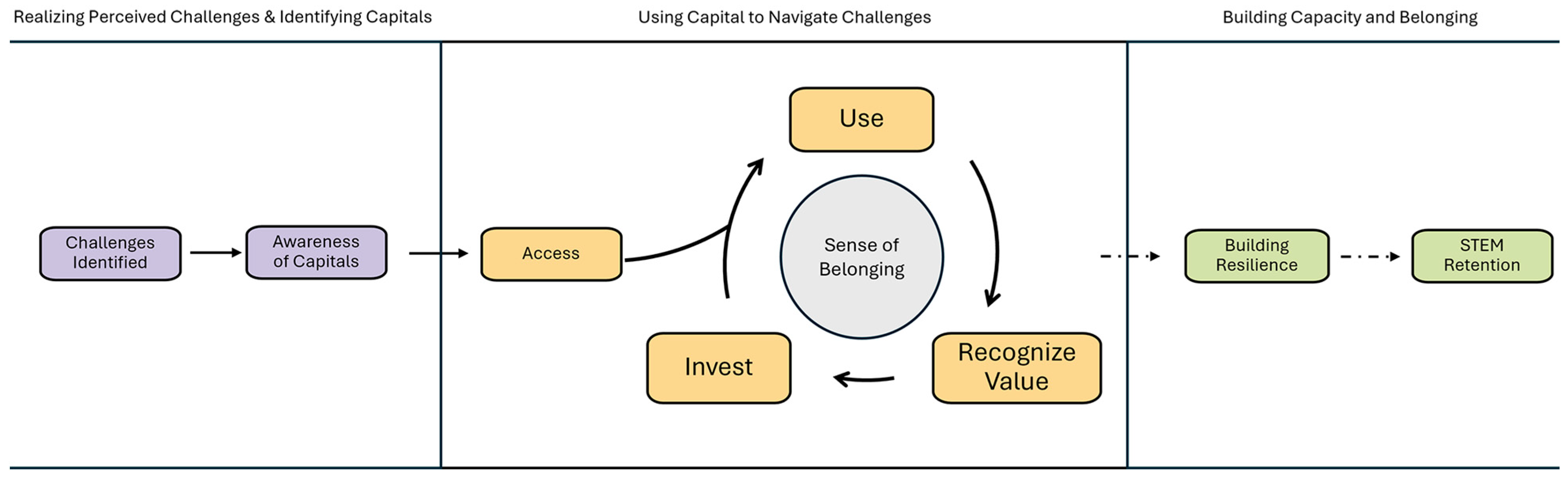
Guided by an asset-based research objective, through this study we sought to identify the university-provided resources students accessed, used, and invested in, and how they leveraged these resources to support persistence in STEM. While much of the retention research focuses on identifying and removing barriers to persistence, our findings demonstrate that agentic students recognize resources as assets that can help them persist despite the challenges they face. Students consistently framed persistence not simply as the outcome of barrier removal, but as the outcome of drawing on resources they perceived as locally relevant and effective for mobilizing social, human resource, and personal/emotional capitals. This process, outlined in Figure 1, enabled students to achieve agency (Emirbayer & Mische, 1998), develop a stronger sense of belonging, and build resilience. We hypothesize that this emergent sense of belonging and the resilience promoted through this process may translate directly to retention in STEM.
Figure 1.
Navigating challenges using capitals builds capacity and belonging in undergraduate STEM students. Students overcome challenges by first developing awareness of available capitals and their potential benefits, then by accessing and using those capitals, recognizing the benefits gained through their use (e.g., increased academic performance), and investing in their continued use for themselves and/or others. Collectively, this process builds and strengthens students’ sense of belonging, which we hypothesize is an important driver of resilience and retention in STEM programs. Dotted lines represent these hypothetical relationships.
5.1. Extending the Capital-Mediated Agency Model
While there are studies that use capital theory to explain university student retention and success, they often overlook the role of students investing in capitals for later use and for use by their peers. Such investment increases the potential of various capitals, including university-provided resources, and maximizes institutional investment. In this way, our findings support the model proposed by Diaz-Clark et al. (2024), which posits that agency persists when individuals are not only aware of their capitals but also actively use and invest in them to address challenges. We also extend this model by highlighting an additional, critical dimension: students’ recognition of the importance and role their capitals have in shaping their sense of agency. This recognition appears to bridge use and investment, enabling students to more deliberately engage with their resources in ways that build a sense of belonging and resilience.
This extension is supported by and reinforces previous empirical work. Macaulay et al. (2023), for example, found that successful university students from low socio-economic backgrounds were aware of both the capitals they possessed, such as identity capital, and those they lacked, including cultural and economic capital. Importantly, rather than dwelling on missing capitals, students adopted agentic strategies to acquire missing capitals (e.g., securing financial resources), or leverage existing ones (e.g., drawing on identity capital to maintain motivation and direction). Similarly, Crul et al. (2017) demonstrated that ethnic minority students who lacked certain forms of cultural capital could compensate by drawing on social capital, effectively “trading” one form of capital for another to succeed.
While these studies describe processes involving awareness and strategic use of capitals, our contribution lies in making explicit the underlying mechanism of recognition. Specifically, we identify students’ recognition of capitals’ benefits, not simply their presence or use, as a distinct and influential component in the enactment of agency. What is novel in our work is therefore not the existence of these dynamics, which have been observed in prior research, but the explicit conceptualization and naming of recognition as a key process that links capitals to students’ experience of being agentic (Figure 1).
5.2. Sense of Belonging Is an Emergent Property of Capital Use and Investment
Taken together, our findings suggest that a sense of belonging emerges through students’ interactions with university curricular and co-curricular resources (Brouwer et al., 2016). While some resources, such as student groups and the buddy program, were explicitly social in nature, students also described gaining social capital and belonging through resources that were intended to primarily support human resource and personal/emotional capitals. In this way, belonging not only emerged from direct social support, but also from students’ involvement in the broader process of accessing, using, and investing in resources that helped students build capacity.
This finding can be interpreted through social support theory within an academic setting, whereby students’ ability to navigate challenges, access resources, and remain committed to their studies is shaped by the support they receive through social relationships (Cohen & Wills, 1985; House, 1987; House et al., 1988). Such support can reduce barriers, buffer stress, and promote persistence, positioning sense of belonging as a critical factor in student integration and retention in STEM (Preuß et al., 2025). In alignment with this theory, the relationships that students in our study formed appeared to provide more than emotional reassurance; they helped students become more aware of resources, seek help, and become more integrated in their academic community. Thus, social capital and belonging appeared to operate reciprocally: relationships formed through engagement with university resources fostered belonging, while belonging increased students’ willingness and capacity to continue engaging with peers, resources and the institution. In this way, an increased sense of belonging enhanced students’ sense of agency, enabling them to engage more actively and confidently in their academic environment (De Coninck et al., 2025), and, potentially, persist in STEM.
6. Limitations
The data were collected from only one institution using an interpretivist approach with a subsample of participants from the institution. We also realize that our participants were likely those who already feel agentic and, therefore, were more likely to volunteer in the study. Further, resources identified by the participants were usually linked to their specific STEM discipline, and, as a result, the identified resources and capitals were limited to our participants’ experiences. Therefore, our ability to generalize our findings to non-STEM students remains limited, and we are unable to comment on the problems, experiences, and perceptions of students who did not access resources. Nonetheless, we reiterate the importance of our study in understanding persisting STEM students’ perceptions of the capitals necessary to succeed. Creating academic environments that allow students to create social capital in organic and unstructured ways across curricular and co-curricular contexts is critical. Hence, despite its limitations, our study informs how institutions and instructors can support students by fostering resources and environments that build connection, belonging, and ultimately, retention.
7. Implications
Sense of belonging has been identified as one of the most significant factors shaping students’ experiences in higher education (Preuß et al., 2025). A strong sense of belonging is associated with a wide range of academic and psychological benefits, including increased motivation, self-efficacy, and academic achievement, as well as reduced loneliness and enhanced well-being and resilience. It is also linked to improved degree completion and retention rates (Ahn & Davis, 2020; Dost & Mazzoli Smith, 2023; Hazari & Rodriguez, 2024; Pedler et al., 2022; Romeo et al., 2024; Sax et al., 2018; ul Hasan & Channa, 2021; Van Kessel et al., 2025). By identifying sense of belonging as an emergent property of resource use and investment by agentic students, our work reinforces these claims and leads us to suggest several implications.
At the institutional level, universities may need to broaden how they evaluate their curricular and co-curricular resources, particularly those designed to support students’ academic development. Given that these resources are intended to improve student academic performance, universities often assess their efficacy through grades, degree progression, or retention. While we acknowledge the importance of these outcomes, our results suggest they may not fully capture the benefits students gain from engaging with university-provided resources. For example, a resource (e.g., tutor room) may support persistence not only by improving academic outcomes, but by also allowing students to gain social capital and an increased sense of belonging. Evaluating resources through this broader lens can help institutions recognize forms of value that are otherwise overlooked, but central to socio-academic integration and retention.
Expanding on this broader evaluative lens, universities may benefit from conducting systematic self-audits of their curricular and co-curricular resources to determine which resources students use, which remain underutilized, and the extent to which these resources make key forms of capital accessible. Since the availability of resources does not itself directly transfer to gains in capital, underutilized resources may be diagnostic of misalignment between the intended use of the resource, and the forms of capitals students need most to persist. These self-audits may be particularly effective when conducted in partnership with students. A vast literature on Students as Partners (e.g., Chan & Chen, 2023; Mercer-Mapstone et al., 2017) points to the positive benefits of involving students along a continuum of possible roles, from giving limited input on constrained choices to full control of curricular elements such as project design and assessment forms (Bovill & Bulley, 2011). In the context of resource evaluation, student partners are well positioned to provide insight regarding which resources students are aware of, which they use, and what forms of capitals they gain through resource use and investment. This involvement may be particularly salient in future work examining whether resource access, use, and mobilization differ across, e.g., demographic groups, degree programs, or disciplines in ways not captured by our study. It may also be salient in identifying which specific elements of resources promote or inhibit the generation of social capital. Student partnerships may also generate social capital in their own right: students in defined roles (e.g., as tutors or teaching assistants) become socially integrated in the academic culture and their peers may see these student partners as “possible selves,” a benefit that shone through in our interviews. Thus, self-audits can help universities design novel resources or re-design existing resources to better attend to their student population and institutional culture while simultaneously providing opportunities for students to help better align resource offerings with their needs.
The above institutional implications are complemented by direct implications for instructors and course design. Given that students described gaining social capital through curricular resources (e.g., mandatory assignments and field work), instructors can play an important role in making these resources, and the capital development they support, accessible to their students. Thus, instructors have a responsibility to consider how their teaching practices and course design enable or constrain students’ opportunities to develop and use social capital and develop a sense of belonging within the classroom. These teaching practices can be relatively simple to implement, such as using name tents to allow instructors and peers to readily identify one another and foster greater interpersonal connection (Cooper et al., 2017). More structured approaches may similarly build opportunities for student collaboration and formation of socio-academic relationships within the classroom. These include active learning, which has been consistently shown to promote engagement with peers and encompasses a range of teaching and learning practices, as well as Cooperative Learning, Team-Based Learning, and formative assessments involving peer review. Outside the lecture hall, course components including field work, laboratory work, course-based research experiences, and/or internships that require students to work collaboratively in authentic scientific situations can confer similar benefits.
Finally, across these institutional and instructional implications, student metacognition—the ability to reflect on one’s learning, strategies, and use of available supports—may be a critical mechanism through which students in our context became agentic and successfully navigated university resources (Dunlosky & Metcalfe, 2008; Frazier et al., 2021). Our results emphasize that persistence in STEM is not simply about the availability of resources, but about students’ recognition of their value and their deliberate decisions to access, use, and invest in them. Metacognitive awareness likely underpins this recognition. Students who can identify which behaviors, strategies, and forms of capital support their success are better positioned to leverage both intrinsic (e.g., confidence) and extrinsic (e.g., social networks, tutoring) resources, thereby strengthening their sense of belonging and resilience. Therefore, supporting metacognition should be an explicit goal: instructors and programs can embed structured reflection (e.g., exit tickets, minute papers; Tanner, 2013), train peer leaders and tutors to prompt students to “connect the dots” between actions and outcomes, and design activities that help students articulate how specific resources contribute to their learning and progress. In doing so, institutions can help students not only use resources but also transform them into meaningful capital that sustains agency and persistence in STEM.
8. Conclusions
This asset-based, qualitative focus group study, guided by a capital-mediated agency model, illustrates how undergraduate STEM students transformed university-provided curricular and co-curricular resources into personal/emotional, social, and human resource capitals. Students described resilience and persistence in STEM not as a result of barrier removal, but as a process of using and investing in resources that conferred benefits they recognized as meaningful. Through this process, students built social relationships and a sense of belonging, which appeared to strengthen their capacity and willingness to continue engaging with peers, resources, and their academic community.
These findings contribute to STEM education research by extending the capital-mediated agency model to emphasize students’ recognition of resource benefits as a meaningful link between their access, use, and investment. They also position sense of belonging as an emergent and reciprocal outcome of engagement with both explicitly social and academic resources. For institutions and instructors, our findings underscore that providing resources alone is not enough; students must be able to recognize their relevance, access them, and use them in ways that generate meaningful academic and, critically, social value. Designing and evaluating university resources with an emphasis on opportunities to build social capital may help create learning environments that better support student agency, resilience, belonging, and persistence in STEM.
Author Contributions
Conceptualization, C.M.M., O.T.K.F., R.G., K.H., Z.P., T.R.S., J.K.S., R.S.T., K.v.B., M.M.B. and S.C.; methodology, M.M.B.; formal analysis, C.M.M., O.T.K.F., K.H., Z.P., T.R.S., J.K.S., R.S.T., K.v.B.; investigation, C.M.M., O.T.K.F., R.G., K.H., Z.P., T.R.S., J.K.S., R.S.T., K.v.B.; writing- original draft preparation, C.M.M., O.T.K.F., K.H., Z.P., T.R.S., J.K.S., R.S.T., K.v.B., M.M.B., S.C.; writing- review and editing, C.M.M., O.T.K.F., K.H., T.R.S., M.M.B., S.C.; visualization, C.M.M.; supervision, C.M.M., K.v.B., M.M.B., S.C., project administration, K.H.; funding acquisition, S.C., M.M.B. All authors have read and agreed to the published version of the manuscript.
Funding
Gjennomføring 202X is supported by the University of Bergen, through funds for educational quality development awarded to S.C. The Nordic Discipline-Based Education Research network (NOR-DBER), to which the authors belong, was supported by Nordplus (NPHE-2025/10438). The Novo Nordisk Foundation funds the Novo Nordic Foundation Center for University Science Education (Grant NNF24SA0092452), which enabled collaborations with DBER researchers at USE partner universities (University of Copenhagen, Aarhus University, University of Southern Denmark). M. M. B’s participation in this project was supported by a USA-Norway Fulbright Foundation Award.
Institutional Review Board Statement
The study was conducted in accordance with the Declaration of Helsinki, and approved by Sikt, the Norwegian Agency for Shared Services in Education (protocol code 926686 and 14 August 2023).
Informed Consent Statement
Informed consent was obtained from all subjects involved in the study.
Data Availability Statement
The data set(s) generated and/or analyzed during the current study are not publicly available due to Norwegian data privacy laws but are available, in deidentified form, from the corresponding author upon reasonable request.
Acknowledgments
The authors are grateful to the funding sources listed above. Critically, we are thankful to the students who took the time to engage in our focus group interviews.
Conflicts of Interest
The authors declare no conflicts of interest.
Correction Statement
This article has been republished with a minor correction to the Institutional Review Board Statement and Informed Consent Statement. This change does not affect the scientific content of the article.
Abbreviations
| OECD | Organization for Economic Co-operation and Development |
| STEM | Science, Technology, Engineering, and Mathematics |
References
- Abdul-Rahaman, N., Arkorful, V. E., & Okereke, T. (2022). Academic integration in higher education: A review of effective institutional strategies and personal factors. Frontiers in Education, 7, 856967. [Google Scholar] [CrossRef] [Scilit]
- Ahn, M. Y., & Davis, H. H. (2020). Four domains of students’ sense of belonging to university. Studies in Higher Education, 45(3), 622–634. [Google Scholar] [CrossRef] [Scilit]
- Arco-Tirado, J. L., Fernández-Martín, F. D., & Fernández-Balboa, J.-M. (2011). The impact of a peer-tutoring program on quality standards in higher education. Higher Education, 62(6), 773–788. [Google Scholar] [CrossRef] [Scilit]
- Balgopal, M. M., Casper, A. M. A., Wallace, A. M., Laybourn, P. J., & Brisch, E. (2018). Writing matters: Writing-to-learn activities increase undergraduate performance in cell biology. BioScience, 68(6), 445–454. [Google Scholar] [CrossRef] [Scilit]
- Balgopal, M. M., Weinberg, A. E., McMeeking, L. B. S., Hunter, D. E. L., & Wright, D. S. (2022). A sense of belonging: The role of higher education in retaining quality STEM teachers. PLoS ONE, 17(8), e0272552. [Google Scholar] [CrossRef] [Scilit] [PubMed]
- Bandura, A. (2000). Self-efficacy: The foundation of agency. In Control of human behavior, mental processes, and consciousness. Psychology Press. [Google Scholar]
- Borch, K. B., & Svabo, C. (2025). Science learning environments in higher education: Researching classroom, laboratory, and field settings. Education Sciences, 15(2), 213. [Google Scholar] [CrossRef] [Scilit]
- Bovill, C., & Bulley, C. J. (2011). A model of active student participation in curriculum design: Exploring desirability and possibility. In Improving student learning (18) global theories and local practices: Institutional, disciplinary and cultural variations. The Oxford Centre for Staff and Educational Development. [Google Scholar]
- Bradbury-Jones, C., Sambrook, S., & Irvine, F. (2009). The phenomenological focus group: An oxymoron? Journal of Advanced Nursing, 65(3), 663–671. [Google Scholar] [CrossRef] [Scilit] [PubMed]
- Braun, V., & Clarke, V. (2023). Toward good practice in thematic analysis: Avoiding common problems and be(com)ing a knowing researcher. International Journal of Transgender Health, 24(1), 1–6. [Google Scholar] [CrossRef] [Scilit]
- Braxton, J. M., Milem, J. F., & Sullivan, A. S. (2000). The influence of active learning on the college student departure process: Toward a revision of Tinto’s theory. The Journal of Higher Education, 71(5), 569–590. [Google Scholar] [CrossRef] [Scilit]
- Brouwer, J., Jansen, E., Flache, A., & Hofman, A. (2016). The impact of social capital on self-efficacy and study success among first-year university students. Learning and Individual Differences, 52, 109–118. [Google Scholar] [CrossRef] [Scilit]
- Chan, C. K. Y., & Chen, S. W. (2023). Student partnership in assessment in higher education: A systematic review. Assessment & Evaluation in Higher Education, 48(8), 1402–1414. [Google Scholar] [CrossRef] [Scilit]
- Cohen, S., & Wills, T. A. (1985). Stress, social support, and the buffering hypothesis. Psychological Bulletin, 98(2), 310. [Google Scholar] [CrossRef] [Scilit]
- Cooper, K. M., Haney, B., Krieg, A., & Brownell, S. E. (2017). What’s in a name? The importance of students perceiving that an instructor knows their names in a high-enrollment biology classroom. CBE—Life Sciences Education, 16(1), ar8. [Google Scholar] [CrossRef] [Scilit] [PubMed]
- Costello, R. A., Hammarlund, S. P., Christiansen, E. M., Kiani, M. K., Glessmer, M. S., Cotner, S., & Ballen, C. J. (2025). STEM students prefer assessment practices known to reduce the impact of test anxiety. Nordic Journal of STEM Education, 9(1), 43–65. [Google Scholar] [CrossRef] [Scilit]
- Cotner, S., Jeno, L. M., Walker, J. D., Jørgensen, C., & Vandvik, V. (2020). Gender gaps in the performance of Norwegian biology students: The roles of test anxiety and science confidence. International Journal of STEM Education, 7(1), 55. [Google Scholar] [CrossRef] [Scilit]
- Creswell, J. W., & Guetterman, T. C. (2019). Educational research: Planning, conducting, and evaluating quantitative and qualitative research (6th ed.). Pearson. [Google Scholar]
- Crul, M., Schneider, J., Keskiner, E., & Lelie, F. (2017). The multiplier effect: How the accumulation of cultural and social capital explains steep upward social mobility of children of low-educated immigrants. Ethnic and Racial Studies, 40(2), 321–338. [Google Scholar] [CrossRef] [Scilit]
- Dawson, P., Van Der Meer, J., Skalicky, J., & Cowley, K. (2014). On the effectiveness of supplemental instruction: A systematic review of supplemental instruction and peer-assisted study sessions literature between 2001 and 2010. Review of Educational Research, 84(4), 609–639. [Google Scholar] [CrossRef] [Scilit]
- De Coninck, J., Stevens, P., & Vantieghem, W. (2025). Sense of belonging defined: A conceptual exploration through a qualitative content analysis of ethnic-minority students’ experiences at university. Studies in Higher Education, 51(6), 1304–1322. [Google Scholar] [CrossRef] [Scilit]
- Deil-Amen, R. (2011). Socio-academic integrative moments: Rethinking Academic and social integration among two-year college students in career-related programs. The Journal of Higher Education, 82(1), 54–91. [Google Scholar] [CrossRef] [Scilit]
- Diaz-Clark, E. D., Otto, J. L., Wright, D. S., Lin Hunter, D. E., Sample McMeeking, L. B., Weinberg, A. E., & Balgopal, M. M. (2024). Under pressure: How do science teachers use capital to achieve agency during turbulent times? Science Education, 108(3), 680–700. [Google Scholar] [CrossRef] [Scilit]
- Dibner, K. A., & Pandya, R. (2018). Learning through citizen science: Enhancing opportunities by design. National Academies Press. [Google Scholar]
- Dost, G., & Mazzoli Smith, L. (2023). Understanding higher education students’ sense of belonging: A qualitative meta-ethnographic analysis. Journal of Further and Higher Education, 47(6), 822–849. [Google Scholar] [CrossRef] [Scilit]
- Dunlosky, J., & Metcalfe, J. (2008). Metacognition. Sage Publications. [Google Scholar]
- Dyrberg, N. R., & Holmegaard, H. T. (2019). Motivational patterns in STEM education: A self-determination perspective on first year courses. Research in Science & Technological Education, 37(1), 90–109. [Google Scholar] [CrossRef] [Scilit]
- Ehren, M. C. M., Madrid, R., Romiti, S., Armstrong, P. W., Fisher, P., & Mcwhorter, D. L. (2021). Teaching in the COVID-19 era: Understanding the opportunities and barriers for teacher agency. Perspectives in Education, 39(1), 61–76. [Google Scholar] [CrossRef] [Scilit]
- Emirbayer, M., & Mische, A. (1998). What is agency? American Journal of Sociology, 103(4), 962–1023. [Google Scholar] [CrossRef] [Scilit]
- Fereday, J., & Muir-Cochrane, E. (2006). Demonstrating rigor using thematic analysis: A hybrid approach of inductive and deductive coding and theme development. International Journal of Qualitative Methods, 5(1), 80–92. [Google Scholar] [CrossRef] [Scilit]
- Frazier, L. D., Schwartz, B. L., & Metcalfe, J. (2021). The MAPS model of self-regulation: Integrating metacognition, agency, and possible selves. Metacognition and Learning, 16(2), 297. [Google Scholar] [CrossRef] [Scilit] [PubMed]
- Freeman, S., Eddy, S. L., McDonough, M., Smith, M. K., Okoroafor, N., Jordt, H., & Wenderoth, M. P. (2014). Active learning increases student performance in science, engineering, and mathematics. Proceedings of the National Academy of Sciences, 111(23), 8410–8415. [Google Scholar] [CrossRef] [Scilit] [PubMed]
- Gansemer-Topf, A. M., & Schuh, J. H. (2006). Institutional selectivity and institutinoal expeditures: Examining organizational factors that contribute to retention and graduation. Research in Higher Education, 47(6), 613–642. [Google Scholar] [CrossRef] [Scilit]
- Guest, G., Namey, E., & McKenna, K. (2017). How many focus groups are enough? Building an evidence base for nonprobability sample sizes. Field Methods, 29(1), 3–22. [Google Scholar] [CrossRef] [Scilit]
- Hammarlund, S. P., Christiansen, E. M., Kiani, M. K., Glessmer, M. S., Cotner, S., & Costello, R. A. (2025). Understanding student sense of belonging in introductory STEM courses. Nordic Journal of STEM Education, 9(3), 61–81. [Google Scholar] [CrossRef] [Scilit]
- Hargreaves, A., & Fullan, M. (2013). The power of professional capital. The Learning Professional, 34(3), 36. [Google Scholar]
- Haugen, A., Holme, T., & Rabben, Å. K. (2025). Tilstandsrapport for høyere utdanning 2025 (No. 06/2025). Direktoratet for Høyere Utdanning og Kompetanse.
- Hazari, Z., & Rodriguez, I. (2024). Examining the relationship between disciplinary counterspaces for undergraduate women and sense of belonging: A physics exemplar. Journal of Research in Science Teaching, 61(10), 2336–2361. [Google Scholar] [CrossRef] [Scilit]
- Hennink, M. M., Kaiser, B. N., & Weber, M. B. (2019). What influences saturation? Estimating sample sizes in focus group research. Qualitative Health Research, 29(10), 1483–1496. [Google Scholar] [CrossRef] [Scilit] [PubMed]
- House, J. S. (1987). Social support and social structure. Sociological Forum, 2(1), 135–146. [Google Scholar] [CrossRef] [Scilit]
- House, J. S., Umberson, D., & Landis, K. R. (1988). Structures and processes of social support. Annual Review of Sociology, 14(1), 293–318. [Google Scholar] [CrossRef]
- Kjellsdotter, A., Sundberg, F., Wills, J., & Berglund, M. (2026). Belonging to a community—Newly graduated nurses’ lived experiences of participating in an introduction program: A phenomenological hermeneutical study. Scandinavian Journal of Caring Sciences, 40(2), e70238. [Google Scholar] [CrossRef] [Scilit] [PubMed]
- Li, C., Herbert, N., Yeom, S., & Montgomery, J. (2022). Retention factors in STEM education identified using learning analytics: A systematic review. Education Sciences, 12(11), 781. [Google Scholar] [CrossRef] [Scilit]
- Liou, Y.-H., & Canrinus, E. T. (2020). A capital framework for professional learning and practice. International Journal of Educational Research, 100, 101527. [Google Scholar] [CrossRef] [Scilit]
- Macaulay, L., Webber, W., & Fraunholz, B. (2023). Successful university students from low socio-economic backgrounds’ perspectives on their academic success: A capital-based approach. Higher Education Research & Development, 42(8), 1986–1999. [Google Scholar] [CrossRef] [Scilit]
- Marco-Bujosa, L. M., Baker, L., & Malott, K. M. (2024). “Why am I here?”: A phenomenological exploration of first-generation college student experiences in STEM majors within a predominantly white institution. Journal of Research in Science Teaching, 61(4), 905–936. [Google Scholar] [CrossRef] [Scilit]
- Mercer-Mapstone, L., Dvorakova, S. L., Matthews, K. E., Abbot, S., Cheng, B., Felten, P., Knorr, K., Marquis, E., Shammas, R., & Swaim, K. (2017). A systematic literature review of students as partners in higher education. International Journal for Students as Partners, 1(1), 15–37. [Google Scholar] [CrossRef] [Scilit]
- Miller, D., Deshler, J., McEldowney, T., Stewart, J., Fuller, E., Pascal, M., & Michaluk, L. (2021). Supporting student success and persistence in STEM with active learning approaches in emerging scholars classrooms. Frontiers in Education, 6, 667918. [Google Scholar] [CrossRef] [Scilit]
- Møgelvang, A., Vandvik, V., Ellingsen, S., Strømme, C. B., & Cotner, S. (2023). Cooperative learning goes online: Teaching and learning intervention in a digital environment impacts psychosocial outcomes in biology students. International Journal of Educational Research, 117, 102114. [Google Scholar] [CrossRef] [Scilit]
- National Academies of Sciences, Engineering, and Medicine. (2021). Call to action for science education: Building opportunity for the future. National Academies Press. [Google Scholar]
- Núñez-Peña, M. I., Suárez-Pellicioni, M., & Bono, R. (2016). Gender differences in test anxiety and their impact on higher education students’ academic achievement. Procedia-Social and Behavioral Sciences, 228, 154–160. [Google Scholar] [CrossRef] [Scilit]
- OECD. (2018). Education at a glance 2018: OECD indicators. OECD Publishing. [Google Scholar] [CrossRef] [Scilit]
- OECD. (2025). Education at a glance 2025: OECD indicators. OECD Publishing. [Google Scholar] [CrossRef] [Scilit]
- Pavlovic, Z., & Jeno, L. M. (2024). Facilitating academic and social integration among first-year university students: Is peer mentoring necessary or an additive measure? Mentoring & Tutoring: Partnership in Learning, 32(1), 29–48. [Google Scholar] [CrossRef] [Scilit]
- Pedler, M. L., Willis, R., & Nieuwoudt, J. E. (2022). A sense of belonging at university: Student retention, motivation and enjoyment. Journal of Further and Higher Education, 46(3), 397–408. [Google Scholar] [CrossRef] [Scilit]
- Preuß, J. S., Zimmermann, J., & Jonkmann, K. (2025). Intersectional perspectives on the university belonging of international STEM students. Social Psychology of Education, 28(1), 59. [Google Scholar] [CrossRef] [Scilit]
- Rainey, K., Dancy, M., Mickelson, R., Stearns, E., & Moller, S. (2018). Race and gender differences in how sense of belonging influences decisions to major in STEM. International Journal of STEM Education, 5(1), 10. [Google Scholar] [CrossRef] [Scilit] [PubMed]
- Romeo, I., Stanislaw, H., McCreary, J., & Hawley, M. (2024). The importance of belonging for well-being in college students. PLoS Mental Health, 1(1), e0000057. [Google Scholar] [CrossRef] [Scilit] [PubMed]
- Sax, L. J., Blaney, J. M., Lehman, K. J., Rodriguez, S. L., George, K. L., & Zavala, C. (2018). Sense of belonging in computing: The role of introductory courses for women and underrepresented minority students. Social Sciences, 7(8), 122. [Google Scholar] [CrossRef] [Scilit]
- Seymour, E., & Hunter, A.-B. (Eds.). (2019). Talking about leaving revisited: Persistence, relocation, and loss in undergraduate STEM education. Springer International Publishing. [Google Scholar] [CrossRef] [Scilit]
- Sithole, A., Chiyaka, E. T., McCarthy, P., Mupinga, D. M., Bucklein, B. K., & Kibirige, J. (2017). Student attraction, persistence and retention in STEM programs: Successes and continuing challenges. Higher Education Studies, 7(1), 46–59. [Google Scholar] [CrossRef] [Scilit]
- Strayhorn, T. L. (2018). College students’ sense of belonging: A key to educational success for all students. Routledge. [Google Scholar]
- Tanner, K. D. (2013). Structure matters: Twenty-one teaching strategies to promote student engagement and cultivate classroom equity. CBE—Life Sciences Education, 12(3), 322–331. [Google Scholar] [CrossRef] [Scilit] [PubMed]
- Tao, K. W., & Gloria, A. M. (2019). Should I stay or should I go? The role of impostorism in STEM persistence. Psychology of Women Quarterly, 43(2), 151–164. [Google Scholar] [CrossRef] [Scilit]
- Theobald, E. J., Hill, M. J., Tran, E., Agrawal, S., Arroyo, E. N., Behling, S., Chambwe, N., Cintrón, D. L., Cooper, J. D., Dunster, G., Grummer, J. A., Hennessey, K., Hsiao, J., Iranon, N., Jones, L., Jordt, H., Keller, M., Lacey, M. E., Littlefield, C. E., … Freeman, S. (2020). Active learning narrows achievement gaps for underrepresented students in undergraduate science, technology, engineering, and math. Proceedings of the National Academy of Sciences, 117(12), 6476–6483. [Google Scholar] [CrossRef] [Scilit] [PubMed]
- Tinto, V. (1975). Dropout from higher education: A theoretical synthesis of recent research. Review of Educational Research, 45(1), 89–125. [Google Scholar] [CrossRef]
- Tisdell, E. J., Merriam, S. B., & Stuckey-Peyrot, H. L. (2025). Qualitative research: A guide to design and implementation. John Wiley & Sons. [Google Scholar]
- Tønnessen, E., & Vold, S. B. (2023, October 7). Fra 2025 blir det vesentlige endringer i finansiering av universiteter og høgskoler. Khrono.
- ul Hasan, N., & Channa, M. A. (2021). Relationship between college students’ sense of belonging and academic resilience. Journal of Development and Social Sciences, 2(3), 426–439. [Google Scholar] [CrossRef] [Scilit]
- Ulriksen, L., Madsen, L. M., & Holmegaard, H. T. (2010). What do we know about explanations for drop out/opt out among young people from STM higher education programmes? Studies in Science Education, 46(2), 209–244. [Google Scholar] [CrossRef] [Scilit]
- Van Kessel, G., Ryan, C., Paras, L., Johnson, N., Zariff, R. Z., & Stallman, H. M. (2025). Relationship between university belonging and student outcomes: A systematic review and meta-analysis. The Australian Educational Researcher, 52(3), 2511–2534. [Google Scholar] [CrossRef] [Scilit]
- Walker, J. D., Cotner, S. H., Baepler, P. M., & Decker, M. D. (2008). A delicate balance: Integrating active learning into a large lecture course. CBE—Life Sciences Education, 7(4), 361–367. [Google Scholar] [CrossRef] [Scilit] [PubMed]
- Walpole, M., Simmerman, H., Mack, C., Mills, J., Scales, M., & Albano, D. (2008). Bridge to success: Insight into summer bridge program students’ college transition. Journal of the First-Year Experience & Students in Transition, 20(1), 11–30. [Google Scholar] [CrossRef] [Scilit]
- Wiswall, M., & Zafar, B. (2021). Human capital investments and expectations about career and family. Journal of Political Economy, 129(5), 1361–1424. [Google Scholar] [CrossRef] [Scilit] [PubMed]

Disclaimer/Publisher’s Note: The statements, opinions and data contained in all publications are solely those of the individual author(s) and contributor(s) and not of MDPI and/or the editor(s). MDPI and/or the editor(s) disclaim responsibility for any injury to people or property resulting from any ideas, methods, instructions or products referred to in the content. |
© 2026 by the authors. Licensee MDPI, Basel, Switzerland. This article is an open access article distributed under the terms and conditions of the Creative Commons Attribution (CC BY) license.